A History of the County of Somerset: Volume 3. Originally published by Victoria County History, London, 1974.
This free content was digitised by double rekeying. All rights reserved.
A P Baggs, R J E Bush, Margaret Tomlinson, 'Somerton hundred', in A History of the County of Somerset: Volume 3, ed. R W Dunning (London, 1974), British History Online https://www.british-history.ac.uk/vch/som/vol3/pp57-60 [accessed 30 April 2025].
A P Baggs, R J E Bush, Margaret Tomlinson, 'Somerton hundred', in A History of the County of Somerset: Volume 3. Edited by R W Dunning (London, 1974), British History Online, accessed April 30, 2025, https://www.british-history.ac.uk/vch/som/vol3/pp57-60.
A P Baggs, R J E Bush, Margaret Tomlinson. "Somerton hundred". A History of the County of Somerset: Volume 3. Ed. R W Dunning (London, 1974), British History Online. Web. 30 April 2025. https://www.british-history.ac.uk/vch/som/vol3/pp57-60.
THE HUNDRED OF SOMERTON
The hundred lies in the southern central area of the county, principally on the Lower Lias which provides the main building stone for the district. It is bisected by the river Cary and, with the exception of East Lydford, is bounded on the south-east by the Foss Way and on the south by the river Yeo. Its economy has always been agrarian, although the market town of Somerton provided an early focus for the cloth trade and was the county's administrative centre for a brief period in the 13th and 14th centuries. (fn. 1) The landscape of the lias areas is composed largely of nucleated villages with scattered hamlets, mainly of manorial origin, subsisting originally on open-field arable agriculture. At Aller and in parishes bordering the rivers Yeo and Cary the drainage of low-lying 'moors' provided rich tracts of pasture. Conversion from arable to grassland following 18th- and 19th-century inclosure has also contributed to the current predominance of dairy farming.
The hundred evidently originated in the pre-Conquest royal estate at Somerton and its members. As a hundred it first occurs in contemporary indices of the geld rolls, although the inquest itself is missing. (fn. 2) If the early area coincided with that of Somerton warren it included the parishes of Somerton (south and west of the Cary), Kingsdon, Northover, Long Sutton, Pitney, and parts of Huish Episcopi and High Ham. (fn. 3) Suit to the forest court in the 13th century was required of Somerton, Kingsdon, Pitney, and Knole (in Long Sutton). (fn. 4) It has also been suggested that the hundred may formerly have included the manors which comprised the later hundred of Pitney. (fn. 5)
The hundred was mentioned as an administrative unit in 1168 (fn. 6) and in 1212 its jurisdiction evidently included Langport and Curry Rivel, Newton Placy (in North Petherton), Hurcot (in Somerton), Steart (in Pitney ?), and West Camel. (fn. 7) To these may be added Wearne (in Pitney and Huish) and Kingsdon, mentioned in 1225. (fn. 8) By c. 1243 Aller, Northover, Charlton Mackrell, and Bineham (in Long Sutton) also lay within the hundred, (fn. 9) as did Nether Somerton and Long Sutton in 1251–2, (fn. 10) and Bridgehampton (in Yeovilton), Queen Camel, and Littleton (in Compton Dundon) in 1265. (fn. 11) The jury of the out-hundred (hundredum forinsecum) presented in 1274 that the manor and hundred had been much 'alienated and dismembered', but had formerly included Ilchester, East (or Queen) Camel, Pitney and Wearne, Curry Rivel and Langport, North Curry, Aller, a moiety of Northover, and Sedgemoor, besides smaller areas of land. (fn. 12) In 1286 the hundred comprised Queen Camel, West Camel, Yeovilton (with Bridgehampton and Speckington), Kingsdon, Long Sutton, Aller, Littleton, Charlton Adam, Charlton Mackrell (with Cary Fitzpaine and Lytes Cary), and East Lydford. (fn. 13) In the course of the 14th century Queen Camel was removed, Charlton Adam and Charlton Mackrell were united to form a single tithing, and Cary Fitzpaine in Charlton Mackrell was transfered to Whitley hundred. (fn. 14) In 1327 the tithings of Hurcot and Pitney Wearne were taxed with Somerton borough. (fn. 15) From 1376 at least until 1762 eleven tithings owed suit to the hundred court: East Lydford, Bridgehampton, Yeovilton, Charlton, Kingsdon, Long Sutton, Demi Sutton (in Long Sutton), Littleton, and Somerton Erleigh. (fn. 16) Throughout this period Kingsdon paid suit with the tithing of Cary (Lytes Cary and Tuckers Cary) in Charlton Mackrell. (fn. 17) In 1569 the administrative hundred was made up of the borough of Somerton and the tithings of Long Sutton, West Camel, East Lydford, Littleton, Yeovilton, Aller, Hurcot, Somerton Erleigh, Charlton, and Kingsdon. (fn. 18) To these Pitney Plucknett (or Pitney Wearne) had been added by 1582. (fn. 19) During the 18th century Bridgehampton was often considered an individual fiscal tithing, as were Charlton Adam and Charlton Mackrell. (fn. 20) These divisions continued at least until 1832. (fn. 21)
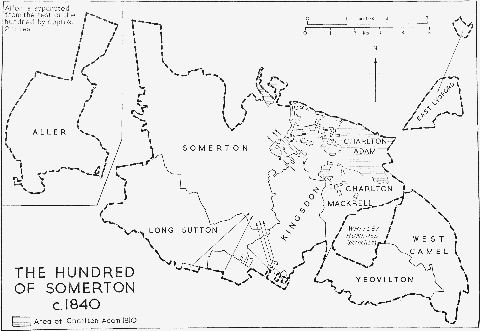
The hundred of Somerton, c.1840
In the medieval period Somerton borough was evidently considered to form the in-hundred and all other tithings the out-hundred. In 1262 the hundred was granted to Eleanor of Provence, queen of Henry III, and thereafter it descended with Somerton manor. (fn. 22) In 1318 it was committed with the bailiwick to John de Countevill during pleasure. (fn. 23) Sir John Carew was appointed steward by the Crown in 1509, (fn. 24) and a further grant of the stewardship was made to Carew and William Compton in survivorship in 1512. (fn. 25)
Court records for the out-hundred survive for the years 1376–7, 1392–3, (fn. 26) 1436–7, (fn. 27) 1539–40, 1542–4, (fn. 28) 1562–3, 1565–6, 1573–4, (fn. 29) 1617–20, 1730–62. (fn. 30) There were originally three courts in and for the out-hundred, all held within Somerton borough: a tremure court, the equivalent of an early view of frankpledge, the lawday court, and a three-weekly court, which balanced the three-weekly court of Somerton borough.
The tremure court was held three times a year, at Michaelmas, Hilary, and Hockday (later Easter), until the 18th century when generally only the two latter courts met. In January 1377 it was combined with the lawday court, and in Michaelmas 1392 and Hockday 1393 with the view of frankpledge. The court was known simply as tremura or Somerton forinsecum, curia tremura. Its business comprised the appearance of the eleven tithingmen, their presentments, and the payment of customary fines. The presentments included default of suit, breach of the assize of ale, unjust tolls taken by millers, and the disrepair of roads, bridges, and ditches. The customary fines included tithing silver and payments for failure to keep watch at night. Tremure courts are also recorded for three Devon hundreds. The term borh-treming for view of frankpledge is found in Suffolk, and there was a 'triming day' at Leighton Buzzard (Beds.). (fn. 31) It has thus been argued that the trimming of the tithings represents the Anglo-Saxon counterpart of the Norman view of frankpledge.
The hundred lawday court was held twice a year at Michaelmas and Hockday (later Easter), including in 1392–3 the sheriff's tourn and view of frankpledge, and in 1437 and from 1573 the view of frankpledge alone. Until 1731 it was held within a few days of the tremure court but thereafter it met on the same day. By the mid 17th century the Michaelmas court was customarily adjourned to St. Simon and St. Jude's day (28 October) for the swearing-in of officers. (fn. 32) The court was known usually as the curia legalis of either Somerton hundred or Somerton forinsecum, but after 1731 as the court leet. The tithingmen appeared, presented, and paid further customary fines, including those for not bringing their measures. A jury was empanelled and presented instances of disrepair, assaults, and other minor offences. Pleas, mainly of debt and trespass, were heard, and the freeholders of the hundred paid fines for release of suit to the Michaelmas lawday. In 1376 there were 18 freeholders, generally representing manors within the hundred. This number increased to 24 in 1392 and to 27 between 1543 and 1562. Thereafter persistent default reduced the suitors to 25 between 1573 and 1617 and to 20 or 21 between 1730 and 1762. By the 18th century the lawday court was concerned almost wholly with the maintenance of roads and bridges and the collection of customary payments.
The three weeks court was devoted to pleas, again mainly of debt and trespass. In 1376 East Lydford was paying for release of suit to it and by the 16th century only five tithings, Kingsdon, Charlton, Long Sutton, Somerton Erleigh, and Littleton, were appearing. Courts were known simply as hundreda or curiae hundredi for Somerton forinsecum. No rolls survive for this court after 1574 but it was still being held in the mid 17th century when it dealt with actions for debt or damage under 40s. and was usually held on Mondays. (fn. 33)
The only officers appointed by these courts, apart from the tithingmen presented by their tithings, were two constables elected at the Michaelmas lawday from 1565. During the 18th century the hundred was split into two divisions and a constable was selected from each of them. The eastern division comprised Bridgehampton, Yeovilton, Kingsdon, Charlton, East Lydford, and West Camel, and the western Somerton Erleigh, Aller, Long Sutton, Demi Sutton, and Littleton. References to the hundred bailiff occur as late as the 18th century, but he was not elected in any of the three hundred courts.
A reference to the unlawful imprisonment of a clerk by the hundred court in 1436 (fn. 34) suggests the existence of a gaol for the hundred at Somerton.