A History of the County of Leicester: Volume 4, the City of Leicester. Originally published by Victoria County History, London, 1958.
This free content was digitised by double rekeying. All rights reserved.
'The City of Leicester: Social and administrative history since 1835', in A History of the County of Leicester: Volume 4, the City of Leicester, ed. R A McKinley (London, 1958), British History Online https://www.british-history.ac.uk/vch/leics/vol4/pp251-302 [accessed 30 April 2025].
'The City of Leicester: Social and administrative history since 1835', in A History of the County of Leicester: Volume 4, the City of Leicester. Edited by R A McKinley (London, 1958), British History Online, accessed April 30, 2025, https://www.british-history.ac.uk/vch/leics/vol4/pp251-302.
"The City of Leicester: Social and administrative history since 1835". A History of the County of Leicester: Volume 4, the City of Leicester. Ed. R A McKinley (London, 1958), British History Online. Web. 30 April 2025. https://www.british-history.ac.uk/vch/leics/vol4/pp251-302.
In this section
SOCIAL AND ADMINISTRATIVE HISTORY SINCE 1835
1835–1860, p. 251. 1860–1914, p. 275. 1914–1945, p. 295. 1945–1955, p. 301.
1835–1860
On 28 December 1835 the councillors for the borough of Leicester were for the first time elected in accordance with the Municipal Corporation Act, (fn. 1) and with the choice of aldermen on 29 December and finally with the election and swearing-in of the mayor on 1 January 1836 the reformed corporation was fully constituted and entered upon its municipal duties. (fn. 2) The new borough council consisted of 42 councillors, six elected by each of the seven wards into which the borough was divided, and of fourteen aldermen chosen by the councillors. The mayor was elected by the council from among its members. (fn. 3)
The reforms of 1835 marked in Leicester both the rise to power in borough government of a different party and the beginning of a new period in the scope and methods of municipal activity. The triumph of the Liberals was singularly complete so far as control of the borough council was concerned. Of the councillors elected in 1835 only four were Tories, (fn. 4) and for the rest of the 19th century the corporation was dominated by the Liberal party. The new borough council was much more broadly based than the unreformed corporation. After 1835 the council was elected by all rate-paying householders who had resided in the borough for three years or more, whereas in the old corporation vacancies had been filled by co-optation. The old corporation had been strongly Anglican (fn. 5) but of the 56 aldermen and councillors chosen at the end of 1835, 40 were dissenters and only 16 Anglicans. (fn. 6) It would be inaccurate to suppose that the changes of 1835 placed the control of municipal affairs at Leicester in the hands of a class altogether new to the exercise of such power, for in general there was little difference in occupation or social status between the members of the old and the new corporations. The hosiers, the leaders of Leicester's most important industry, were well represented in both bodies; the old corporation, in 1835, contained at least 12 hosiers out of a total of 66 members, (fn. 7) while the new corporation that came into power at the beginning of 1836 had 19 hosiers among its 56 members. (fn. 8) Of the 12 persons who held the office of mayor from 1820 to 1835, 6 were hosiers, (fn. 9) as were 5 of the 12 who filled the office from 1836 to 1850. (fn. 10) Both the old and the new councils included a number of retailers. (fn. 11) The difference between them lay not in any transfer of power from one class to another, but in the fact that while the old corporation had been close and exclusive, with its membership in practice tending to be confined to a small number of families and their dependants, (fn. 12) the new corporation was recruited from a much wider circle, and in particular included numerous representatives of the large class of dissenting industrialists who were so important in Leicester's trade and manufactures, especially in the hosiery industry. (fn. 13) Even this difference should not be exaggerated, for a certain tendency towards oligarchy was manifested by the prominence within the new corporation of members of the Unitarian Great Meeting, perhaps the most important dissenting place of worship in Leicester. The first seven mayors under the new dispensation were all drawn from the Great Meeting congregation and for more than twenty years after 1835 many of the leading members of the corporation, such men as Thomas Paget, Thomas Stokes, the brothers John and William Biggs and Joseph Whetstone, were also Unitarians. (fn. 14)
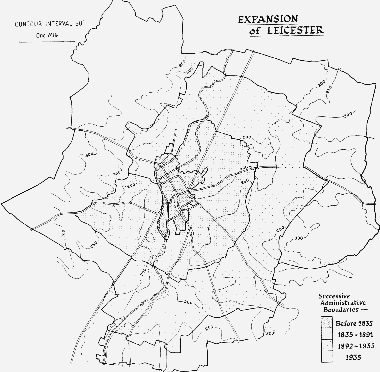
The expansion of Leicester
The reforms of 1835 marked the beginning of great changes in the scope and the methods of municipal activity, but here too the consequences of introducing a new system of municipal government should not be exaggerated. If a notable feature of the old borough administration had been the lack of permanent officials and the entrusting of important functions to unpaid and sometimes incapable amateurs, (fn. 15) the officials of the new corporation were neither numerous nor highly paid. The town clerk continued to be the borough's chief permanent officer. The new corporation, not surprisingly, at its first meeting displaced the old town clerk, Thomas Burbidge, who had been a bitter Tory partisan, (fn. 16) and appointed in his stead Samuel Stone. (fn. 17) Stone was a solicitor of notable ability. His Justices' Manual became a standard work of which many editions were published and he was the author of several other books on legal subjects. (fn. 18) He was, however, just as much politically committed as his predecessor Burbidge had been. Stone was one of the Great Meeting congregation and came from a family long connected with it. (fn. 19) After he began to practise as a solicitor in 1826, Stone soon came to be regarded as the special legal adviser of the Liberals in Leicester. (fn. 20) He played an important part in the struggle against the corporation in the years before 1836 (fn. 21) and it was generally realized that despite his very real talents he owed his appointment primarily to his party connexions. (fn. 22) Like Burbidge, Stone continued to practise as a solicitor throughout his term of office, and like Burbidge he accumulated lesser posts, becoming clerk to the borough magistrates, clerk and solicitor to the local board of health when that body was set up in 1849, and solicitor to the trustees of the Leicester General Charities. (fn. 23) Like Burbidge too, Stone was accused of exercising undue influence upon the corporation's policy. (fn. 24) Though it is difficult to decide how far such charges were justified, it would be surprising if a man of Stone's ability had not exercised some influence, and it is evident that even some of the Liberals felt that Stone's position, as both town clerk and a solicitor in private practice, at times placed him in an unduly advantageous position. (fn. 25) After Stone retired in 1872, he was succeeded by George Toller, who was similarly a solicitor in private practice and closely linked with the Liberals, for he sat as a Liberal member of the council, first as councillor and then as alderman, from 1850 to 1872 and was twice mayor. (fn. 26) In consequence for many years after 1835 the chief municipal officer was not politically an impartial servant of the borough. The town clerk's salary was fixed at £400 in 1836, but he was in addition entitled to fees from the corporation for legal business. (fn. 27) The staff of his department was very small by later standards and as late as 1874 numbered only three. (fn. 28)
The control of municipal finance, very defective under the old corporation, was from 1836 in the hands of the council's finance committee, which was presided over by Joseph Whetstone. (fn. 29) Apart from the committee, the care of the borough's finances was in the hands of the borough treasurer and the borough accountant. In 1836 Samuel Kirby (d. 1854) was appointed borough treasurer; (fn. 30) he was a partner in one of the local banks, the head of which was Thomas Paget, first mayor of the reformed corporation. (fn. 31) Paget himself succeeded Kirby and was followed by his son T. T. Paget. (fn. 32) It appears that during the 19th century the borough treasurer was not one of the corporation's permanent officials, but rather its banker, holding the corporation's funds and handling some of its financial business upon terms much the same as those which normally prevailed between bankers and their clients. He received no salary but was allowed to keep a balance of £5,000 free of interest. (fn. 33) It is no doubt significant that after 1835 the borough's finances ceased to be dealt with by the local banking firm of Mansfield and Babbington, which had acted for the old corporation (fn. 34) and had strong Tory connexions. (fn. 35) The actual keeping of the council's accounts was done by the borough accountant who as late as 1860 was assisted only by one part-time office-boy; (fn. 36) from 1837 to 1849 the accountant was George Bown, a Radical. (fn. 37)
For the sake of economy the new corporation abolished a number of lesser posts. Of these the most important was that of the land steward, who up to 1835 had managed the corporation's estates; his functions were taken over by the estates committee of the council. (fn. 38) The offices of the mace-bearer, four sergeants-at-mace, two bellmen, town crier, six town waits, beadle, and mole-catcher were abolished. (fn. 39) In those minor posts that survived the existing officials were mostly replaced by supporters of the triumphant Liberal party. (fn. 40) Although the corporation's officials were relatively few in 1836, the old Town Hall was inadequate to accommodate them and they had to be provided with offices in various parts of the town. (fn. 41)
The scope of the new corporation's activities also was at first very restricted and it was not until some ten years after 1836 that large measures of town improvement were taken in hand. This was partly because the council's powers to effect improvements were very limited, but chiefly because the financial position of the borough in 1836 was so difficult that no expensive schemes for dealing with its problems could be contemplated. The finance committee, appointed by the corporation early in 1836 to investigate the extent of the borough's liabilities and resources, discovered that the corporation's total known debts were £22,700, including a mortgage on part of the South Fields of £10,000 which the old corporation had raised to cover its heavy outlay in bribery and other political expenses in the election of 1826, and another loan of £10,000 secured on the borough rates, which had been raised to defray the cost of building a new gaol. (fn. 42) How serious a burden these debts were may be seen from the fact that the corporation's income in 1836 was about £3,500 from its estates and about £1,200 from rates. (fn. 43) In addition to this heavy debt, the new corporation was faced with a large claim for compensation for loss of office from Thomas Burbidge, the former town clerk, and with claims by charities for sums which had been held in trust by the old corporation. After long and expensive litigation, the borough was obliged to pay substantial compensation to Burbidge and more than £7,000 to the charities. (fn. 44) The old corporation had also put its successor at a disadvantage by granting 15-year leases of much of the borough property. (fn. 45) The town's financial circumstances were consequently difficult in 1836 and the only policy conceivable was one of strict economy and careful management. The new corporation decided to liquidate its debts by sales of land. (fn. 46) It was estimated in 1836 that the abolition of various minor offices and the cutting-off of the salary hitherto paid to the mayor and of sundry pensions would save the borough £1,100 a year. (fn. 47) Small economies were effected by discontinuing the subscriptions previously paid to the infirmary and to Leicester races and the allowances made to the Anglican clergy in the town. (fn. 48) As it had been decided to put an end to the civic feasts which had been a feature of the old regime, the town's large stock of plate, crockery, cutlery, glass, and table linen was sold, and in the momentary enthusiasm for clearing away everything connected with the pomp, carousals, and corruption of the unreformed corporation the town's 17th-century great mace, with some lesser pieces of civic regalia, was also auctioned. (fn. 49) The new corporation's financial policy was successful in relieving the town from its pecuniary embarrassments. In the twenty years after 1836, more than £50,000 was raised by the sale of 62 acres of corporation land and a further £11,600 was obtained for royalties paid for the working of clay on the borough estates. (fn. 50) By 1839 only £7,000 of debt remained unpaid (fn. 51) and in 1841 the last debts inherited from the old corporation were liquidated. (fn. 52) Despite considerable sales of land the income from the borough estate was by good management increased; in the year ending 1 September 1845 the estate produced a gross revenue of £3,200, compared with one of £2,906 ten years earlier. (fn. 53)
This financial stringency greatly limited the activities of the new corporation for the first ten years of its existence and no far-reaching plans of town improvement could be carried out. One urgent problem which had much impeded the old corporation had been solved by the Municipal Corporations Act, under which the liberties, for long the cause of so much dispute, (fn. 54) were finally included in the borough, so that, whereas the authority of the old corporation had been excluded from certain important sections of the town, the new corporation controlled and could levy rates on the whole urban area. (fn. 55) Another problem which was urgently requiring solution by 1836, that of policing the town, was promptly dealt with. Early in 1836 the borough council appointed Frederick Goodyer, an officer of the Metropolitan Police who had been recommended by the Home Office, as superintendent to organize a force, originally consisting of 50 men, on the lines of the London police. (fn. 56) The new police were a considerable burden on the corporation's finances, costing in the period immediately after 1836 about £3,000 a year, (fn. 57) the heaviest single charge on the town's income. The police headquarters were at the Town Hall, where a house was built for the head constable in 1836. (fn. 58) A borough fire brigade, consisting of a superintendent and ten men, also came into existence, although it was less important than the Midland Counties Fire Office Force, which consisted of a Superintendent, two subordinate officers, and 28 firemen. (fn. 59) As regards street lighting, another function very inefficiently performed by the old corporation, the Leicester parishes placed themselves under the provisions of the Lighting and Watching Act of 1833 (fn. 60) so far as it concerned street lighting. (fn. 61) As a result, the street lighting seems to have improved, for in 1846 it was noted that the town was well lighted by gas. (fn. 62)
More extensive measures of town improvement had to be deferred. In particular the new council could do little to cope with the town's growing difficulties over health and sanitation. The council's powers under the Municipal Corporations Act did not enable it to deal with such matters, and when in 1839 it was proposed to set up a committee of the council to consider obtaining a town improvement Act the proposal was defeated. The opposition to it was led by Thomas Paget and Joseph Whetstone and was probably moved by a desire to avoid any strain on the borough's still precarious finances. (fn. 63) The project was again brought up in 1840 but without success (fn. 64) and it was not until 1845 that the idea was seriously considered. (fn. 65)
Inside the borough the parishes still continued to exist after 1835 as local government units and they retained several important functions. They were responsible for the repair and lighting of highways (fn. 66) and they were also the only public bodies in Leicester which made any provision of sewers, inefficient though these were. (fn. 67) The parishes also retained the right to levy compulsory church rates and this was the cause of a bitter dispute. In 1836 Protestant dissenters in Leicester decided to offer resistance to the payment of church rates. (fn. 68) In three parishes, St. Nicholas's, All Saints', and St. Mary's, the vestries were controlled by dissenters and decided against the levy of church rates. (fn. 69) In St. Margaret's, the largest and most populous parish, the select vestry (fn. 70) levied a church rate in 1836 and proceedings were taken against 21 dissenters who failed to pay. (fn. 71) In 1837 the dissenters obtained control of the select vestry which for the future declined to authorize the levy of a church rate. (fn. 72) An attempt made by the vicar to coerce the vestry by proceedings in the Queen's Bench was unsuccessful. (fn. 73) In St. Martin's parish the controversy was more prolonged. Until 1849 the vestry there was controlled by Anglicans who favoured compulsory church rates. Many dissenters in the parish refused to pay the rates and between 1845 and 1848 inclusive there were 87 prosecutions for non-payment. (fn. 74) Especially strong indignation was aroused among dissenters by the case of William Baines who was imprisoned for some months in 1840–1 for his refusal to pay the church rate. (fn. 75) The levying of rates in St. Martin's parish and proceedings against dissenters for refusing to pay continued until the opponents of compulsory church rates obtained a majority in the parish vestry in 1849. From then on no church rates were levied in Leicester. (fn. 76)
One other important duty, the administration of poor relief, rested not upon the council but upon the board of guardians. At Leicester this was the first of the bodies set up in the 19th century to perform a specialized function of local government. Under the Poor Law Amendment Act of 1834 (fn. 77) a board of guardians was set up in 1836 to administer poor relief throughout the Leicester Union, which originally comprised the parishes of St. Margaret, St. Martin, St. Mary, St. Leonard, and All Saints with the two small liberties of the Newarke and Castle View. (fn. 78) Two small extra-parochial areas, Black Friars and Augustine Friars, remained outside the union until the end of 1861, and until that date there seems to have been no provision for poor relief in either. (fn. 79) The election of guardians was, from the first, conducted on party lines. The system of plural voting for such elections, established by the act of 1834, was very advantageous to the Conservative party, as it allowed owners and occupiers to have additional votes, up to a maximum of twelve, in proportion to the rateable values of their property. The Conservatives were thus enabled to maintain a majority on the board of guardians almost continuously from 1836 to 1845. (fn. 80) Just as the Liberals used their control of the town council to fill municipal offices with their supporters, so the Conservatives used their dominance of the board of guardians to provide posts for their own political sympathizers. When first established the board appointed as its clerk an employee of Thomas Burbidge. In 1840 this clerk died and Burbidge himself was appointed to the vacant post, and when the Poor Law Commissioners refused to agree to his appointment, the guardians chose his son Joseph as clerk. (fn. 81)
Under the new system of poor relief introduced by the Act of 1834 the civil parish remained the unit for the levying of the poor rate, which in Leicester continued to be collected by the overseers of the poor in each parish or liberty, but the administration of the poor law was controlled by the board of guardians for the whole union under the supervision of the central Poor Law Commissioners. In 1838 the Leicester guardians built a new workhouse to accommodate 400 persons, (fn. 82) on a rather elevated site which at that date lay just outside the town's built-up area. (fn. 83) Perhaps because of their predominantly Conservative character, they were not at first in favour of the curtailment of out-relief or of a strict imposition of the workhouse test, and in consequence the workhouse was built at the least possible expense, though its size and cost nevertheless aroused unfavourable comment. (fn. 84) Little attempt was made to put into practice the principles of the new poor law and, although in 1837 the Leicester hosiery industry was in a more than usually depressed state and large numbers of unemployed had to be relieved, (fn. 85) the workhouse test was not enforced. At the end of 1837, however, the guardians resolved to introduce the new system by witholding out-relief. At the same time they decided to enforce the separation of the sexes in the three existing parochial workhouses which, pending the completion of the new union workhouse, were still in use. (fn. 86) These measures met with so much opposition from the working classes of the town that the guardians felt obliged to go on paying out-relief. (fn. 87) Despite this concession, agitation against the new poor law continued (fn. 88) and the full application of the workhouse test was for some years avoided. The winter of 1841–2 was one of severe depression in the hosiery industry (fn. 89) and in January 1842 5,000 people in Leicester were being relieved by the guardians. (fn. 90) Out-relief continued to be given but the guardians attempted to impose a labour test for those of the persons being relieved who were able-bodied, and this, together with the feeling that the relief given was not enough, led in the spring of 1842 to serious riots, which were only suppressed with the aid of troops. (fn. 91) Meanwhile, in the hands of Joseph Burbidge, the guardians' affairs fell into a state of confusion reminiscent of the administrative methods of the unreformed corporation. In 1843 an investigation into the union's expenditure disclosed some corruption by officials and a general laxness in keeping and auditing accounts. As a result Joseph Burbidge, the board's auditor, the workhouse master, and two relieving officers were all dismissed. (fn. 92) The discredit which this scandal brought upon the Conservatives, together with a close scrutiny of the voters' list by the Liberals, which resulted in the disqualification of many Conservative votes, led to a Liberal success in the election of guardians in 1845, and for the future the Liberals were in a majority on the board. (fn. 93)
In the winter of 1847–8 distress and unemployment in the town again became more acute than usual. During the six months ending at Lady Day 1848 19,000 persons were relieved out of a population approaching 60,000, and a sum of over £17,000 was expended in relief. (fn. 94) The total expenditure on relief for the whole of 1848 was over £32,000. (fn. 95) The guardians attempted to enforce a labour test and opened stoneyards where able-bodied men seeking relief were put to work. The physique of frameworkknitters was proverbially poor and many of the men proved to be unequal to strenuous work. (fn. 96) The labour test caused so much discontent that in May 1848 the unemployed broke out into riots which lasted for several days. (fn. 97) The large expenditure on poor relief, the difficulty of supervising men performing test labour, and the belief that many who obtained relief were actually doing some paid work had earlier led the guardians to appoint a committee to consider policy for the future. (fn. 98) The committee decided in favour of the workhouse test and in order to enable this policy to be carried out it advised the building of a larger workhouse. (fn. 99) These proposals met with widespread opposition, and when the elections were held for the new board of guardians in April 1848 all those who were in favour of a strict application of the workhouse test lost their seats, and a new board, pledged to resist the principles of the new poor law, was elected. (fn. 100) Distress continued to be serious and the expenditure upon relief correspondingly high. In the year ending 25 March 1849 a sum of over £26,000 was spent and nearly one in ten of the town's population was relieved. (fn. 101) These facts forced the guardians to reconsider their views and they gradually became more favourable to the idea of enforcing the workhouse test. Towards the end of 1848 it was decided to build a larger workhouse as a preliminary to putting into force the principles of the new poor law. The new building, capable of accommodating 1,000, was opened in September 1851 and the workhouse test for all applicants for relief was introduced gradually. (fn. 102) The years from 1851 to 1856 saw no particular depression in Leicester but expenditure upon poor relief was never less than £15,000 in any year. (fn. 103) When in the winter of 1857–8 distress again became more severe, the guardians applied the workhouse test to nearly all applicants for relief. In case the workhouse should become full, extra accommodation was hired, though it was never needed. (fn. 104) Out-relief continued to be given to a small number of married men whose families could not be conveniently removed to the workhouse; in such cases a labour test, generally of picking oakum, was imposed, and the maximum number of men employed at any one time was 73. (fn. 105) The guardians were pressed to provide outrelief on a large scale but refused, (fn. 106) and this policy of refusing out-relief in all except a few cases was certainly successful in reducing expenditure. How effectively the new policy deterred persons seeking relief can be seen from the fact that in the period from 11 January to 20 February 1858, when distress was very severe, 1,378 persons applied for relief and were offered accommodation in the workhouse, but only 202 accepted. (fn. 107) Just over 3,000 were relieved during the last quarter of 1857 and the first quarter of 1858, compared with just over 19,000 in corresponding periods of 1847 and 1848, (fn. 108) and expenditure on relief for the year ending 25 March 1858 was £21,600, compared with over £32,000 for the year ending in March 1848. (fn. 109) The Leicester guardians considered that these results proved the superiority of their policy over that which had been pursued earlier, and complacently compared their own activities with the conduct of the Nottingham guardians, who had continued to give out-relief on a large scale. (fn. 110) It is probable, however, that the depression of 1857–8 was less severe at Leicester than that of ten years earlier. Had distress on the same scale as developed in 1847–8 occurred again, the guardians could hardly have avoided giving relief outside the workhouse, but the absence during the second half of the 19th century of any depression as serious as that of 1847–8 saved their policy from being put to a really severe test.
The recurrent periods of depression which affected Leicester during the first half of the 19th century were due immediately to fluctuations in the activity of the hosiery manufacture, from which a large proportion, probably a majority, of Leicester's inhabitants obtained their livelihood. The persistence throughout the first half of the century of under-employment, which sharpened in periodic crises to acute and widespread distress, made poor-law policy an issue which affected the lives and at times aroused the passions of so many of the town's population. Other industries were not altogether lacking. In 1835 Leicester already had two important iron-foundries and the beginnings of an engineering industry which was one day to be a main source of the town's prosperity. (fn. 111) The industry expanded rapidly in the middle of the century, though for long it was chiefly confined to supplying machinery for the making of local products, hosiery, footwear, and elastic web. (fn. 112) In 1835 the manufacture of boots and shoes was just beginning to grow into an important industry in the town. During the middle years of the century it grew in size until by 1861 it was employing 2,700 workers. (fn. 113) The spinning of worsted yarn was also of some importance. It had long been extensively used in the Leicester hosiery industry, (fn. 114) but the spinning of woollen yarn had only been carried on in the town since about 1820. (fn. 115) Both types of yarn were already being produced in factories by 1835. (fn. 116) The production of elastic web was begun at Leicester in 1839 and rapidly expanded. By 1861 there were twenty firms engaged in its manufacture, but the industry never became a major one. (fn. 117)
The hosiery industry was by far the most important single source of employment in the town. In 1833 there were said to be 28,000 persons, including many children, employed in this industry in Leicester, which had a population of nearly 40,000 in 1831. (fn. 118) In 1835 the hosiery manufacture was depressed and stagnant. Earnings were low, though they varied between the different branches of the industry, and there was much unemployment. The prosperity of the industry fluctuated and there were periods of exceptional depression in 1837, 1839–42, 1847–8, and 1857–8, (fn. 119) although even when times were better employment was irregular and wages were low. (fn. 120) In considering the general condition of Leicester it must be borne in mind that from the closing years of the Napoleonic Wars until about 1860 a large proportion of the town's inhabitants were employed in an industry which even in its more prosperous periods was hardly able to provide them with a reasonable living.
The chronic depression which lay upon Leicester's chief industry did not prevent a rapid growth of the town's population from not quite 40,000 in 1831 to over 60,000 twenty years later and to 68,000 in 1861. (fn. 121) This expansion must have been largely due to the growth of the boot and shoe manufacture and, on a rather smaller scale, of the engineering and elastic-web industries, and it was assisted by the construction of new railway connexions. In 1840 the completion of the Midland Counties Railway linked Leicester with Nottingham and Derby to the north, and through Rugby to London in the south. (fn. 122) Later lines joined Leicester and Peterborough in 1848, and Leicester and Burton on Trent in 1849, and in 1857 gave direct access to London through Market Harborough, Kettering, and Hitchin. (fn. 123)
Building was also going on rapidly in this period. (fn. 124) The new corporation at first continued the sale of the South Fields land in building lots in order to pay off the heavy debts left by its predecessor. (fn. 125) This policy was continued in the estate near the Aylestone and Welford roads until after 1850, but in general from then on the corporation ceased to make large and regular sales from the South Fields estate. From the first the new estates committee drew attention to the need to make conditions in the sales which would ensure high standards of building, (fn. 126) and from 1850 the corporation had to approve the plans for each new factory, house, workshop or street. (fn. 127) The earlier building parallel to New Walk had been of good quality but a group of streets of much poorer character had been built on privately owned land between the New Walk and London Road. The hosiery merchants, who occupied the streets laid out c. 1814 at the lower end of New Walk, were beginning to build factories and warehouses on land which not long before had been regarded as the best residential area in the town. New Street, which had served that purpose in the late 18th century, was by 1835 already the preserve of the legal profession, which it still remains. (fn. 128) Consequently the best new houses of the years 1830–50 were scattered along Granby Street and London Road. Those who lived there, some of the members of the corporation among them, naturally wished to see the upper part of the New Walk saved from the invasion of squalid streets and ramshackle houses. It was at least partly the fear that land values might suffer further degeneration that led the Corporation to oppose so strongly in 1836 the building of the Midland Railway through the South Fields. (fn. 129) The land allotted to the freemen in the South Fields still retains much of its identity, though cut through by the railway. The Freemen's Meadow remained a common pasture until it was acquired by the city corporation in 1920 as the site for an electricity generating station. (fn. 130) In spite of power stations, the main line of the Midland Railway, and some domestic building, the existence of parks, allotments, and other open spaces still proclaim the identity of the South Fields and their long association with the borough. The conditions of sale imposed by the borough strengthened the effect of the nature and position of the area in making the residential district built up in the more distant part of the South Fields a rich and middle-class one. Stoneygate, which stretched from here over the borough boundary into Knighton, was the wealthiest residential area of the town, while a middle-class district began to grow up on the rising ground known as Highfields. (fn. 131)

New building 1850-1860
The most extensive area built over between 1835 and 1860 lay in the east of the borough in St. Margaret's parish, where many new streets were built along both sides of the roads leading to the villages of Belgrave and Humberstone, and along the main London road. The development of housing in this district was a continuation of the expansion which had taken place there in the years before 1835. (fn. 132) Between 1850 and 1860 more than 600 houses were thrown up on both sides of Humberstone Road and it was this area that succeeded the canal region as the main area of new building for artisans and labourers. (fn. 133) It is tempting to see in this the attraction of the railway, which ran through this district, but since South Wigston, and not Leicester, was the important junction the railway line did not in fact strongly attract labour. Nor did it attract much industry in the 1840's and 1850's, since the staple trades were not yet drawn into the factory system. To build along Humberstone Gate in the gap left between the railway and the built-up area was the obvious course open to the speculative builder, and the most important of the new streets had, in fact, been contemplated for twenty years before they were built. (fn. 134) The large suburb which thus grew up in St. Margaret's parish was from the point of view of housing conditions and sanitation the worst part of the town, but almost as bad were two other areas largely built up between 1836 and 1861, one along the east bank of the Soar in the Newarke and St. Mary's parish, the other on the opposite bank of the river, around West Bridge. (fn. 135) Some of the land in the first of these two areas had been allotted to private owners on the inclosure of South Fields and was sold for building as the demand for land arose. Land held by the borough council was sold piecemeal for building from 1839, without, in this case, stipulation as to building standards. (fn. 136) It was an area in which the warehouses and workshops of the hosiers and the boot and shoemakers tended to expand from their earlier centres in Southgate Street and the lower end of New Walk. (fn. 137) Thus Welford Road became the axis along which another working-class area began to emerge. The process of growth was by no means a simple outward movement on an ever-expanding periphery. Earlier building had left raw gaps in the close ranks of streets and houses, and these were only slowly filled in. One district within the old borough, the extra-parochial place called Blackfriars, had been largely built up in the very early 19th century and there too housing and sanitation were deplorable. (fn. 138) Part of the activity of the years 1850–60 was still concerned with filling in the area between Belgrave Gate and the canal, and much of this late building here and in the Pingle between Northgate Street and the River Soar stood on the alluvium which was so often flooded in winter. There was still a good deal of building to go up in the ancient quarter of walled Leicester between the High Street and Sanvey Gate. In the years after 1850 it was filling up, and the orchards and gardens which had stood there for centuries were slowly disappearing. William Gardiner described it vividly about 1838, and wrote that it had earlier been vacant ground composed of tracts 'enclosed in every direction by walls made of mud and straw, forming dark and gloomy lanes'. He went on, 'Within the last twenty years the mud walls have begun to disappear and houses for working people give a more cheerful aspect to this solitary part of the town'. (fn. 139)
Though the new working-class portions of the town were badly sited, the houses themselves on the average seem to have been rather better than those built in other industrial towns at the same period. In the middle of the 19th century some 'back-toback' houses, consisting of one room on the ground floor and one room above, were to be found, mostly in the northern part of St. Margaret's parish, (fn. 140) and there were some houses of a worse character, like those containing a single small room and made out of converted pig-sties, mentioned in 1849, which were still inhabited in 1855, when they were condemned. (fn. 141) Cellar dwellings were unknown, however, no doubt because the waterlogged soil on which so much of the enlarged town stood made anything of the sort impossible. (fn. 142) By about 1840 the majority of working-class houses were two-storied, with two rooms on each floor; the newer ones were, at least by the standards of the time, satisfactory. (fn. 143) It was said in 1845:
In two-thirds of the town the streets, though not wide, are yet sufficiently so to be not unhealthy. They are scarcely ever placed back-to-back and the houses usually have a small court at the back and are generally tolerably airy, and well supplied with water for domestic purposes though not for cleanliness. We occupy a larger space of ground than any town in the kingdom in proportion to our population, there being gardens and some of them of very considerable extent even in the very centre of the town. (fn. 144)
In the areas into which the town had expanded the older and inferior houses were largely grouped round narrow courts, close and ill ventilated, with privies and sometimes workshops in the centre. (fn. 145) In 1849 there were said to be 347 courts in Leicester, containing 1,931 houses. (fn. 146) The older streets, too, were narrow, often only 16 or 18 feet wide; (fn. 147) streets of a later date were better, being 20 to 50 feet wide. (fn. 148) In the 1840's there seems to have been little over-crowding in Leicester's working-class districts and generally there was only one family to a house. (fn. 149) Irish immigrants, in Leicester as elsewhere, were a source of trouble. They tended to concentrate in one part of St. Margaret's parish, around Belgrave Gate and Abbey Gate, and the houses that they occupied there were often overcrowded. (fn. 150)
Perhaps the worst characteristic of Leicester as it existed shortly before the middle of the 19th century was the state of the sanitation. The area of the old walled borough, though bordering on the river fairly closely, had been little troubled with flooding because it was situated on a gravel rise which was slightly but definitely elevated above the surrounding countryside. Of the new districts built during the 19th century, virtually all but the better-class areas of South Fields were built on low-lying land which provided little natural fall for sewers and was frequently exposed to flooding. (fn. 151) One area, the part of St. Margaret's parish lying between the Soar, Sanvey Gate, Churchgate, Archdeacon Lane, Belgrave Gate, and the Willow Brook, was liable to be flooded from three sources: the Soar, the Grand Union Canal, and the Willow Brook. (fn. 152) These floods not only caused great inconvenience by inundating streets and houses sometimes to a depth of 2 or 3 feet, (fn. 153) but, forcing their way through the drains, they brought up sewage and, on receding, left behind them a deposit of insanitary mud. (fn. 154) The more southerly parts of St. Margaret's parish were outside the region of flooding but suffered from another disadvantage. Over much of the district, the ground had been excavated to produce clay and the resulting pits had been filled in with rubbish on which buildings had been erected before the filling had decayed and settled. (fn. 155) In consequence the central part of St. Margaret's parish, between the Belgrave and Humberstone roads, was perhaps the most unhealthy part of the town. (fn. 156)
Several of the districts into which the town had expanded during the first half of the 19th century were thus by nature unsuitable for building. Only a far-reaching plan for drainage and flood prevention could have made such areas habitable, and it was not until after 1860 that the corporation was prepared to contemplate the execution of such a plan and possessed the financial means required. Indeed there is no indication that the evils which would arise from building on the low-lying areas adjacent to the old walled borough were appreciated in any quarter until those evils had in fact materialized. In practice, there was no systematic provision for drainage and sanitation. Occasionally sewers were laid down by the owners of house property or by the parish authorities, but as sewerage was the responsibility of the parishes and not of the borough council there was no scheme for draining the town as a whole. Such sewers as existed varied widely in size; they gave off 'noxious gases' and because of their lack of fall and defective construction they became choked. A report of 1845 described the town's drains as 'more a menace than a relief'. (fn. 157) Most streets were quite without sewers. In 1849 it was reported that out of 242 streets and 347 alleys, courts, and yards, only 112 were fully culverted and more than half were without any sewers at all. (fn. 158) The streets were in some cases drained by open ditches; the whole of the Blackfriars area, for example, was drained by a long ditch which, when inspected in 1849, was found to be choked with decaying animal and vegetable matter to a depth of between 3 and 4 feet. (fn. 159) Both sewers and ditches drained into the Soar and the canal, which were both badly polluted for several miles downstream from Leicester. (fn. 160) Many houses in the working-class districts of the town were without even such drainage as the defective sewers and ditches provided, and had, as their only form of sanitation, privies draining into open cesspits, which were emptied at long intervals. (fn. 161) In 1849 a surveyor employed by the corporation estimated the number of open cesspits at 2,900. (fn. 162)
The general unhealthiness of the town caused by these insufficient sanitary arrangements was aggravated by Leicester's lack of an adequate water-supply. Until 1853 the town was without a proper supply of piped water. (fn. 163) The only water available came from the conduit which conveyed water from a spring in St. Margaret's parish to the Market Place, (fn. 164) from the Soar and from the Willow Brook, from a few public wells, and from the numerous private wells and rain-water cisterns. In 1849 there were estimated to be 2,800 wells in Leicester and about the same number of cisterns, in which rainwater from the roofs was stored. (fn. 165) The well-water was contaminated because of seepage from cesspits and because the holes from privies had been dug right down to the water seam. (fn. 166)
The surfaces of streets continued after 1835 to be maintained by the parochial surveyors of highways, who levied a rate in each parish. In St. Margaret's parish, for example, the highways surveyor had fourteen miles of road to care for; in 1849 a rate of 4½d. in the pound, producing about £1,000, was levied in the parish for road maintenance, but of this sum £200 was paid to the trustees of the Market Harborough to Loughborough turnpike, which ran through the parish and formed one of its main thoroughfares, in return for the trustees' work in maintaining the turnpike. (fn. 167) In the extraparochial area of Blackfriars, a poor quarter of the town, it was thought that there was no power to appoint a surveyor or to levy a highway rate so that apparently no streets repairs were done. (fn. 168) The efforts of the parish surveyors were enough to keep the streets paved but only in a rather unsatisfactory manner. (fn. 169) The borough council had no responsibility for street surfaces, though it paid for the paving of the new streets laid out on its own property in the south of the town. (fn. 170) Street scavenging was similarly in the hands of the parish surveyors, except in the case of the Market Harborough to Loughborough turnpike, which was cleaned by the trustees. The other main streets were fairly well cleaned, but side streets and courts were dependent on the casual services of private scavengers, who removed dung and rubbish at irregular intervals for their own profit. (fn. 171) No attempt was made to clean or drain the various open spaces in the town, which in consequence were filthy and waterlogged. (fn. 172) Street lighting seems to have been adequate. The powers of the private company which supplied gas for street lighting were enlarged by Act in 1838. (fn. 173)
The difficulties which confronted Leicester were little different from those which other growing industrial towns faced at the same period. In some ways Leicester was perhaps more fortunate than other comparable towns: it occupied an unusually large area in proportion to its population; cellar dwellings were unknown and overcrowding uncommon; in general its housing seems to have compared favourably with that of other large towns. (fn. 174) On the other hand a very high rate of mortality suggests that Leicester was even more unhealthy than other industrial towns. For the years from 1840 to 1842 the average yearly mortality was 30 in every 1,000 of the population, a figure only exceeded by Bristol, Liverpool, and Manchester. (fn. 175) It is probable that one cause of this very high death-rate was the prolonged depression in the staple hosiery industry, with the resulting low standard of living and constant undernourishment of much of the town's population, but bad drainage and sanitation were the most important reasons.
For some ten years after 1835 the new corporation found itself unable to deal vigorously with the town's problems. The rebuilding of the West Bridge in 1841 was the only important town improvement carried out during this period. (fn. 176) In 1845 the corporation, feeling that it was at last able to undertake larger schemes, set up a town improvement committee, which compiled a report proposing the building of a new Town Hall, the enlargement of the Saturday market place, the establishment of a livestock market outside the town, and some other measures of less importance. These improvements were to be financed by selling part of the town estate as building land. The report did not contain any proposals for rectifying the town's defects in drainage and sanitation. (fn. 177) The proposals largely reflected the views of the committee's chairman, William Biggs, who with his brother John led a group which favoured expenditure on improvements of the type advocated in the report rather than on sanitation. (fn. 178) Another party in the council, led by Joseph Whetstone, opposed the scheme on the grounds that it would involve more expense than the town could afford, and that sanitation was the matter most urgently needing attention. (fn. 179) Whetstone's attention had first been directed to the problems of public health by Edwin Chadwick's Report on the Sanitary Condition of the Working Classes, published in 1842, and he had become convinced of the need to improve the town's sanitation. (fn. 180) While the two parties on the council were debating which problem should be dealt with first, an attempt was made to improve Leicester's defective sanitation by private action. In 1845 the Leicester Water and Sewerage Company was formed, with the object of providing an adequate water-supply and of completely draining and cleansing the town. It was proposed that the company should receive about £1,600 a year from the borough rates for providing and maintaining drains and sewers. The company had a nominal capital of £150,000, two-thirds of which was held by the Metropolitan Towns Improvement Company, formed not long before by Edwin Chadwick to carry out schemes for improving public health. (fn. 181) The Leicester company came to an end, however, without effecting anything. (fn. 182) The dispute within the council over town improvements ended in compromise. John and William Biggs and their supporters agreed to abandon for the time being the proposals to build a new Town Hall and cattle market, and the remainder of the plan put forward by the town improvement committee was then accepted by the whole council. (fn. 183) By thus abandoning two important parts of the improvement plan the estimated cost of the scheme was reduced from £50,000 to £25,000, of which it was intended to raise £10,000 by the sale of land and the remainder from the rates. (fn. 184) The scheme as adopted made no provision for the improvement of sanitation or water-supply. In this failure to take action on matters of public health Leicester was not exceptional, for a majority of English boroughs were similarly inactive. (fn. 185) The town council's existing powers were not great enough to allow it to carry out even the modest plan that had been agreed upon and in 1846 the council obtained an Act (fn. 186) which authorized it to provide a new post office, to extend the Saturday market place and the cattle market, to establish recreation grounds and public bathing places, and to take steps to suppress drunkenness and disorder. The council was further empowered to finance these improvements by borrowing and by the levy of an improvement rate.
The new Act was put into execution with some vigour. A new post office was built; (fn. 187) in 1848 property was purchased for the extension of the Saturday market place (fn. 188) and the Exchange there was replaced by a new market hall in 1851; (fn. 189) the cattle market was enlarged in 1849. (fn. 190) These improvements were financed by a series of loans, the first of which was raised in January 1847, (fn. 191) and by a special town improvement rate, first levied during the financial year 1847–8. (fn. 192)
Two other improvements carried out by the corporation should be mentioned. The very crowded state of burial grounds in the town had led to the formation in 1845, by a body of dissenters amongst whom was William Biggs, of a private company to establish a cemetery, which was originally intended to be for nonconformists only. The company arranged to buy from the corporation about seventeen acres of land on the Welford road as a cemetery site. A strong party in the council, led by Joseph Whetstone, considered that it was essential to provide a new publicly owned graveyard for all denominations. (fn. 193) Presumably the opposition to the cemetery company was part of the more general conflict over town improvement between the parties led by Biggs and Whetstone respectively. Whetstone's views prevailed, the company abandoned its plans, and an Act (fn. 194) was obtained in 1848 empowering the corporation to establish a cemetery. The Welford Road site was brought into use as a cemetery in 1849, part being consecrated for use by Anglicans and the remainder being set aside for dissenters. (fn. 195) In 1848 the corporation, under the authority of a general Museum Act of 1845, (fn. 196) purchased the former Proprietary School building in the New Walk for a museum. It was opened in 1849, and the Leicester Literary and Philosophical Society presented the contents of its own private museum to the corporation to form the beginning of the municipal collection. (fn. 197)
These developments, useful though they were, left the urgent matter of the town's sewerage and water-supply still untouched. The responsibility of the corporation for such questions was greatly changed by the passing in 1848 of the Act for Promoting the Public Health, (fn. 198) which established a General Board of Health and authorized the creation of local boards to deal with matters of sanitation, street cleaning, and watersupply. In July 1849 a provisional order, subsequently confirmed, was made by the General Board applying the terms of the Act to Leicester, and the borough council was constituted a local board of health. Joseph Whetstone was the chief local promoter of this measure. (fn. 199) In its new capacity the council took over from the parish surveyors of highways the duties of cleaning the streets and maintaining their surfaces, and it also became responsible for providing adequate sewerage and a satisfactory water-supply. In order to carry out its new duties the council established three new committees, the sewerage and highway committee, whose duties are sufficiently indicated by its title, the sanitary committee to deal with public nuisances, and a temporary committee to draw up a code of by-laws on sanitary matters. (fn. 200) The finances of the local board of health were distinct from those of the borough council, and a separate rate, known as the general district rate, was levied to provide its funds. There continued to be a separate highway rate and there was also a special district rate for financing certain capital expenditure in matters of public health. (fn. 201)
The local board of health immediately set to work. Before the end of 1849 it was already dealing effectively with such nuisances as pig-sties within the town and defective drains and cesspools. (fn. 202) During the next few years the medical officer of health and the inspector of nuisances appointed by the local board were able to remove many public nuisances and effected a noticeable improvement. (fn. 203) In September 1849 the local board commissioned Thomas Wicksteed, a well-known civil engineer, to draw up a report on the best method of draining the town and supplying it with water. (fn. 204) Wicksteed's proposals were criticized by the General Board of Health whose most influential member, Edwin Chadwick, was an opponent of Wicksteed. (fn. 205) It was agreed between the local and general boards that the proposals should be referred to Robert Stephenson, who advised that Wicksteed's scheme, with some minor modifications, should be adopted. (fn. 206) Wicksteed proposed to construct an extensive series of sewers for the town, which were to lead to an outfall on the Soar downstream from the town. The solid matter in the sewage was to be precipitated in tanks and converted into manure, while the liquid por- tion was to be deodorized and discharged into the Soar. (fn. 207) Like others of his time, Wicksteed believed that sanitation could be carried on at a profit, and he calculated that the sale of manure would produce a net revenue of £10,000 a year during the first fifteen years that the plan was in operation, and £20,000 a year during the next fifteen years. (fn. 208) Accordingly he proposed that the treatment of the sewage should be carried out by a private company with which he was connected. (fn. 209) The corporation agreed to this, and in 1851 obtained an Act which authorized the construction of works as proposed by Wicksteed, and empowered the local board of health to sell or lease the sewage. (fn. 210) The local board and Wicksteed's company then made an agreement by which the company undertook to treat the sewage for 30 years and to erect and maintain the buildings and machinery needed, in return for being allowed to dispose of the manure. It was further provided that the company might surrender their lease by giving up, without compensation, all the buildings and machinery then in use to the local board. (fn. 211) Wicksteed's plans were carried out; the corporation constructed sewers at a total cost of some £40,000 and the company set up works to deal with the sewage. (fn. 212) The sewage works began operation in 1855, but the sale of manure proved much less remunerative than had been expected, and eventually the company surrendered its lease, and the buildings and machinery were handed over to the borough. (fn. 213) After this the corporation operated the works but at a cost of £2,000 a year, which was considered excessive. (fn. 214) Though Leicester had acquired sanitation of a sort, the sewers do not seem to have been of a satisfactory construction. (fn. 215)
At the same period the town obtained a piped water-supply, which Wicksteed considered essential for proper sanitation. (fn. 216) In 1846 the Leicester Waterworks Company was formed for providing the town with water, and in 1847 the company obtained an Act empowering it to construct a reservoir at Thornton, about seven miles away, and to supply water to Leicester by pipes. (fn. 217) The company failed at first to attract enough capital to start operating and nothing was done until in 1850 the borough council, urged on by Whetstone, made an agreement with the company. It was provided that the company should have a total capital of £80,000; £17,000 of this was to be subscribed by the corporation as the local board of health and the remaining £63,000 by the general public; the local board was to guarantee a dividend of 4 per cent. a year until 1883 and would be entitled to all net profits over 4½ per cent. for ever. After some opposition, both from ratepayers and in Parliament, a local Act (fn. 218) was obtained in 1851 authorizing this agreement. The reservoir at Thornton was completed and in December 1853 water was first brought to Leicester from it. (fn. 219) Many houses, however, remained without piped water; as late as 1877 there were still 7,000 houses whose only water-supply came from wells and cisterns. (fn. 220)
The measures of improvement undertaken from 1845 onwards produced appreciable changes in the town's character. By 1860 the problems created by Leicester's great and continuing growth were being tackled, although they were very far from being completely solved. An examination of Leicester as it was about 1860 shows that it was much larger and in some respects much healthier than it had been 25 years before. In 1861 the town had a population of 68,000 as against about 44,000 in 1836. (fn. 221) The death-rate fell from 30 in every 1,000 in 1840 to an average of 24 in every 1,000 in 1859. (fn. 222) The working-class houses erected in about 1850 were decidedly superior to those erected earlier, although in some instances the need for haste in building to meet an ever-increasing demand led to weaknesses in construction. (fn. 223) Much unsatisfactory accommodation remained, and it was estimated in 1864 that there were still 1,500 back-to-back houses in Leicester. (fn. 224) The improvement in the town's health manifested in the lower death-rate had been assisted by the removal of many public nuisances by the officials of the local board (fn. 225) and by the fact that the streets were now regularly cleaned. (fn. 226) Something had been done to improve road surfaces, and from 1853 onwards the local board began to replace the rounded cobble-stones on the footpaths of the principal streets by flags and granite setts. (fn. 227) The town was still without any public baths, though the corporation had power to provide bathing places under the improvement Act of 1846, but in 1849 the corporation had agreed to subsidize two privately owned bath houses, one in the New Walk and one in Burley's Lane, in return for the owners' undertaking to provide cheap baths. (fn. 228) The need for such facilities can be seen from the fact that in a period of eighteen months, from March 1849 to September 1850, more than 94,000 visits were made to the New Walk baths. (fn. 229)
By 1860, too, Leicester was beginning to experience a new prosperity and the prolonged depression which had affected the hosiery industry almost without a break since the end of the Napoleonic Wars was coming to an end. The hard times of 1857–8 (fn. 230) were followed by a period of increasing though not altogether stable good fortune. (fn. 231) Employment was generally good, though in the early 1860's there was usually a slack period in the first month or two of each year. (fn. 232) By 1864 it was possible to speak of the 'almost universal prosperity' of Leicester, and in 1868 it was remarked that 'Leicester's lean stockinger has disappeared'. (fn. 233) This improvement in the town's economic position was partly due to the changed circumstances of the hosiery industry, which had been lifted out of its long depression by a renewed demand for its products and was about to undergo the transition to a factory organization. (fn. 234) Leicester had also perhaps benefited from the growth of the two new industries, the manufacture of elastic web and footwear, which had relieved the town from its dependence upon one major industry. (fn. 235) Unemployment was by no means at an end. In 1862, for example, a good year for industry, one person in every 36 of Leicester's population received poor relief. (fn. 236) The widespread distress of earlier periods had, however, passed.
The improvement in Leicester's material circumstances by 1860 hardly extended to the habits of its population. One notable characteristic of the town's inhabitants was a marked readiness to resort to violence. This exhibited itself most spectacularly in occasional riots, such as those of 1848, (fn. 237) or in outbreaks of public hooliganism, such as that which caused the destruction of a balloon on the racecourse in 1864. (fn. 238) The most convincing evidence of this tendency, however, is the constant flow of assault cases in the borough courts. During the decade 1847–57 there were on an average more than 420 actions, civil and criminal, for common assault yearly, and more than 40 a year for assaults upon the police, at a time when the population of the town was about 60,000. (fn. 239) This may be compared with the 283 actions for common assault in 1890, when the population was about 170,000. (fn. 240) The violence illustrated by such incidents and such statistics was only one manifestation of the general roughness of life in the poorer districts of Leicester, and the annual reports of the Revd. Joseph Dare, who laboured for some 30 years, from 1845 to 1876, in the poorer areas of the north and north-east of the town on behalf of the Domestic Mission attached to the Great Meeting, provide much detailed information about life in those quarters of the town. From these and from the local press it is clear that in the years around 1860 and earlier the poorer parts of the borough were characterized by widespread drunkenness and disorder. (fn. 241) There is no evidence to suggest that conditions in Leicester were in any way worse than those prevailing in other towns, but any survey of the borough's character would be incomplete without reference to this aspect of its life.
Nor can this state of affairs be surprising when the education of the population is considered. The available evidence indicates that about 1860 slightly more than half the children attended school at some period of their lives, but in many cases the time spent there was so brief as to have been of little value. (fn. 242) It was not altogether because of lack of room in the schools that so many children went untaught, for the existing schools were not filled. Many children were employed in the hosiery industry, mainly as winders on the stocking frames, in the boot and shoe industry and in the brick-yards. (fn. 243) The employment of children in the hosiery industry as a whole was not regulated by law until 1864. (fn. 244) In 1862 it was estimated that out of 120,000 persons employed in the whole country, only 4,063 came under the Factory Act of 1833, (fn. 245) and the boot and shoe industry and such occupations as brick-making remained outside statutory control until 1867. (fn. 246) In 1867 it was stated that at Leicester children as young as seven or eight were still being employed in the brick-yards and in the manufacture of footwear. (fn. 247) Such prospect of early employment naturally drew children away from school, while in times of depression their parents generally found it impossible to pay the small fees required by the day schools. (fn. 248)
While a considerable proportion of manual workers in the town were without any formal education, many also had no contact of any importance with organized religion. There was no lack of religious bodies in Victorian Leicester. In 1846 there were 8 Anglican churches, with an estimated seating capacity of 12,000, and 26 Protestant nonconformist and Roman Catholic chapels, with a total of about 16,000 sittings. (fn. 249) By 1877 eight new Anglican churches had been completed giving nearly 7,000 additional places and the number of nonconformist sittings had been increased to about 27,000. (fn. 250) The building of new churches and chapels had hardly kept pace with the growth in the town's population, which had risen to 95,000 in 1871. (fn. 251) The figures showing church and chapel accommodation do indicate, however, the predominance of nonconformists in the town. Sectarian feeling was strong, especially between the Anglicans and the Protestant dissenters; when, for instance, from 1871 a school board existed at Leicester, the elections to it were conducted almost exclusively on denominational lines. (fn. 252) Despite this religious activity and despite the existence in Leicester of a numerous and devout body of nonconformists who exercised great influence in municipal affairs, a substantial part of the town's population did not belong to any religious denomination. Joseph Dare, whose work for the Domestic Mission attached to the Great Meeting gave him a thorough acquaintance with the poorer quarters of the town, estimated on several occasions that about half the population never attended any place of worship. (fn. 253) His statements are based only on personal observation and not on any form of census, but his reports from 1846 to 1876 leave little doubt that there was then a considerable body of persons who neglected religious observance. During the hard times before 1860 this neglect seems to have been partly due to the poverty of the hosiery workers, who were often unable to dress in a fashion sufficiently respectable for attendance at church or chapel, (fn. 254) but widespread indifference and scepticism were also an important factor. (fn. 255)
The public houses and beer shops were perhaps the most important places of recreation in the middle of the 19th century. In 1849 there were 246 public houses and 94 beer shops in the borough; (fn. 256) by 1867 there was estimated to be one public house for every 300 of the population, and the justices then decided not to license any new ones. (fn. 257) Shops for retailing beer could be opened without licence, however, merely on payment of an excise fee, (fn. 258) and in 1867 there were between 160 and 170 of these shops in the town. (fn. 259) It is of course difficult to ascertain just how much drunkenness occurred under these conditions. In the decade 1847–57 there were on the average just under 260 persons a year convicted for being drunk and disorderly, (fn. 260) but there are no statistics of the less militant forms of drunkenness, and it might be unwise to take too literally the strongly worded attacks by such reformers as Joseph Dare on widespread intoxication and drunken brawling in the poorer areas of the town. (fn. 261) From about 1855 it became increasingly common for public houses to have a large saloon attached to them where customers were entertained by singers and comedians. One such saloon, described in 1865, was capable of holding 600 people and it was said to be visited by about 1,000 every Saturday night. A charge of 2d.–6d. was made for admission and customers were expected to order drinks in addition. (fn. 262) The first working men's club in Leicester was opened in 1866 with the idea of providing a more respectable place of entertainment than the existing public houses. By November 1866 it had more than 400 members. (fn. 263)
Opportunities for outdoor recreation were limited. In 1839 the corporation had set aside a small close in the South Fields beside the Welford road as a recreation ground (fn. 264) to serve the growing working-class population in the Newarke and on the western side of the South Field. For many years the only other open space available to the population as a whole was St. Margaret's Pasture, an area of about 19 acres on the east bank of the Soar. It was owned by the parish and controlled by the select vestry, and until 1878 the parishioners had rights of common there. (fn. 265) The pasture was used as a playground for the crowded district in the north of St. Margaret's parish, though before Wicksteed's sewerage schemes took effect the pollution of the river and the canal, between which the pasture lay, made it less attractive. (fn. 266) The practice of nude bathing in the river beside the pasture was common and drew down strong censures. (fn. 267) Until the town racecourse, now Victoria Park, was thrown open to the public in 1866, (fn. 268) the Welford Road recreation ground and the pasture were the only freely available open spaces in the town. For those who were able to pay a fairly heavy subscription there was the Wharf Street cricket ground, opened in 1825 on a site near Humberstone Road, not far from the centre of the borough and in an area rapidly being built up. (fn. 269) The ground possessed a bowling green as well as a cricket pitch and was used for entertainments of various kinds such as dances and exhibitions of fireworks. (fn. 270)
In 1835 Leicester possessed only one theatre, in Hotel Street. In 1836 this was pulled down and replaced by another occupying the same site but facing Horsefair Street; the new building was soon given the name of the Theatre Royal. (fn. 271) In 1840 a second theatre was built in Humberstone Gate. The new building, the Amphitheatre, was often used for circus performances, for which special provision was made when it was constructed. (fn. 272) Lightly built and heavily mortgaged, the Amphitheatre was not a success, and in 1849 it was closed. (fn. 273) The Theatre Royal remained and was still in use in 1956. It was the only theatre in Leicester from 1849 to 1877, when the Opera House was opened. (fn. 274) Concerts and other entertainments were held in the New Hall in Wellington Street, originally built as a meeting-place for the Liberals in 1831, (fn. 275) and in the large Temperance Hall in Granby Street, built in 1853. (fn. 276)
It is impossible to state even approximately what proportion of the population of Leicester was literate in the middle of the 19th century, but there were sufficient readers to maintain several local newspapers and to ensure a considerable circulation for cheap periodicals. In 1850 the penny weekly publications of the 'Newgate Calendar' class, dealing chiefly with lurid stories of crime and violence, were being sold at a rate of over 1,300 a week. At the same date some 1,100 penny weeklies of a less objectionable kind were sold each week. Of these the London Journal seems to have enjoyed the largest circulation. In addition, about 120 cheap atheistical periodicals, of which The Reasoner was the most important, were sold weekly. (fn. 277) No precise figures are available for any later date but it is evident that such publications continued to circulate in Leicester on a considerable scale. (fn. 278) It is interesting to note that in 1868 complaint was made that The Police News, apparently then the chief weekly periodical purchased in the town, was illustrated with crude woodcuts depicting scenes of violent crime and that these were considered likely to encourage brutality. (fn. 279)
The local newspapers provided more reputable weekly reading. In 1835 Leicester had three weekly newspapers, the old-established Leicester Journal, which was Tory in outlook, the Liberal Leicester Chronicle, and the Leicester Herald and General Advertiser, a rather less influential Tory paper. (fn. 280) The Chronicle had been owned and edited since 1813 by Thomas Thompson, who remained in control until his retirement in 1864, when his son James, the author of a scholarly history of Leicester who had already been writing most of the editorials for many years, became owner and editor. Under the Thompsons the Chronicle supported the more moderate section of the Liberals, both in national and local politics. It favoured, for example, Joseph Whetstone's proposals to treat sanitation as the most urgent need when schemes of town improvement were being actively considered after 1845. James Thompson was educated by Charles Berry, minister of the Great Meeting, and was thus linked with the Unitarian group which dominated local politics after 1835. At one time he sat as a Liberal councillor for East St. Margaret's ward. (fn. 281) In July 1836 publication of a fourth paper was begun, the Leicestershire Mercury, which expressed the views of the more advanced section of the local Liberals. (fn. 282) The Mercury was published and apparently edited by Albert Cockspur, a printer who had earlier been prosecuted for his publication of a pamphlet criticizing the old corporation. (fn. 283) In October 1864 the Chronicle and the Mercury were united under James Thompson's control and ownership. (fn. 284) The amalgamation of the two newspapers which had each expressed the views of one of the main sections of the Liberal party in Leicester was made easier by the reunion, a little earlier, of the two wings of the party, which had hitherto been much divided. (fn. 285) The combined paper was published as the Leicester Chronicle and Leicestershire Mercury. (fn. 286)
The Leicester Advertiser, which began publication in 1841, adopted a neutral attitude politically. (fn. 287) A new paper of a Conservative character, the Leicester Guardian, was established in 1857 by T. B. Cleveland (fn. 288) but it never seems to have become influential and apparently ceased publication about 1876. (fn. 289) More important was the South Midland Free Press, a paper originally published at Kettering but moved to Leicester in 1859. (fn. 290) The Free Press was a Radical paper. Thomas Emery, who edited it until his death in 1868, had earlier been a bookseller in Belgrave Gate, and played a prominent part in the affairs of the St. Margaret's select vestry. He was at one time a supporter of Owenite socialism, and was inclined to atheism, as James Thompson himself had at one time been. (fn. 291) These papers were all published weekly and the town had no daily newspaper until 1872. (fn. 292)
Until 1870 Leicester had no municipal library. (fn. 293) The Domestic Mission attached to the Great Meeting possessed a library, but in 1865 it was said that it was 'abused rather than used'. (fn. 294) There was also usually at least one privately owned circulating library in the town. (fn. 295) A more ambitious institution was the General News Room, established by a body of shareholders in 1838 in handsome new premises in Granby Street. (fn. 296) In 1839 the proprietors came to an agreement with a bookseller, Thomas Combe, by which the circulating library which he had carried on since 1800 should be removed to the News Room, and for the future should be a part of that institution. (fn. 297) Membership of the General News Room was expensive, and the subscription to the news room alone was £1 11s. 6d. for the public and £1 6s. for shareholders; those who wished to use the library had to purchase a share in it at 6 guineas and pay 1 guinea subscription. (fn. 298) These charges were later reduced and in 1860 the combined subscription for news room and library seems to have been £1 5s. (fn. 299) The General News Room survived until the end of the 19th century when its building was demolished to allow Granby Street to be widened. (fn. 300) It seems to have enjoyed moderate prosperity and usually had about 250 members. (fn. 301) A less successful institution of a similar kind was the Athenaeum, founded in 1845 to provide a coffee room and news room for the lower middle class, who might find the General News Room too expensive. (fn. 302) In 1849 the withdrawal of 120 subscribers, caused by the financial difficulties of the time, placed the Athenaeum in a serious position and it closed in 1850. (fn. 303)
The Leicester Mechanics' Institute, founded in 1834, was intended to provide somewhat similar facilities for the working classes, together with easy opportunities for education. (fn. 304) The institute's history has been dealt with elsewhere (fn. 305) and here it is only necessary to mention that it provided courses of study of various subjects, which were well attended at first though they gradually lost support. A considerable library was built up, amounting by 1870 to some 5,000 volumes, and from about 1855 onwards this was perhaps the most active part of the institute. There were about 500 members in the early days of its existence, but by 1857–8 the number had fallen to 200 and the institute expired from lack of support in 1870. (fn. 306)
By 1860 two societies which were to play a permanent and important part in Leicester's cultural life had been firmly established. The Leicester Literary and Philosophical Society was founded in 1835. It was intended to form a meeting-place for men of all opinions at a time when there were bitter party and sectarian divisions in the town, and politics and theology were therefore debarred at the meetings, and it was provided that the annual president was to be chosen alternately from the Conservative and Liberal parties. (fn. 307) A very wide variety of subjects were discussed at the meetings of the society which were held monthly at first and after 1838 fortnightly. (fn. 308) The Society seems to have begun its collection of antiquities in 1840, and this was presented to the borough as a nucleus for the town museum in 1849. (fn. 309) The Literary and Philosophical Society survived the economic difficulties of 1848–9 and continued to be one of the town's most active and influential cultural institutions. In the period 1850–70 it usually had about 150 members. (fn. 310)
The Leicester Architectural and Archaeological Society was founded in 1855. Its most important early interest was architecture, especially ecclesiastical architecture. As an extension of this interest it gave advice on the repair and restoration of churches, often unheeded, and was active with more success in the preservation of historic buildings. The society was as much concerned with the county as with the town and in general seems to have attracted less attention in Leicester than did the Literary and Philosophical Society. (fn. 311)
1860–1914
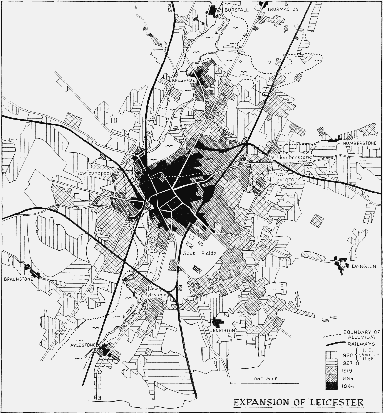
Expansion of Leicester
The years from 1860 to 1914 were in general a period of prosperity, expansion, and improvement in Leicester. The borough's population swelled with immense rapidity from 68,000 in 1861 to just over 142,000 in 1891. (fn. 312) In the decade 1861–71, the time of most rapid growth, the population increased by 39.9 per cent. (fn. 313) Under the Leicester Extension Act of 1891, which came into force in January 1892, the borough was much enlarged and areas with a population of 32,500 in 1891 were added to it, so that the total population of the borough as enlarged was 174,600 in 1891. (fn. 314) By 1911 the population had risen to 227,000. (fn. 315)
Most of the increase during the 19th century came from the excess of births over deaths within the town itself, but migrants from the county and from outside contributed a substantial proportion. In 1851 45 per cent. of the people living in Leicester had migrated there from elsewhere, and this was a proportion which seems to have held good for the rest of the century, though it can be calculated only for 1851 and for 1911, when 62 per cent. came from outside the town. (fn. 316) The statistics for those who had migrated to Leicester from beyond the county boundary are more continuous, however, and indicate that from 1861 to 1901 they were increasing in numbers and in the proportion they bore to the total population. In 1851 and 1861 20 per cent. came from beyond Leicestershire, but in 1891 and 1901 the proportion was 28 per cent., most of them from surrounding counties, but more particularly from the rural counties to the south and east of Leicester. (fn. 317) The volume of migration to Leicester tended to increase, except in the last decade for which birthplace statistics are available (1901–11), but the average range showed no parallel increase, and there was in fact a tendency for the relative importance of newcomers from the most distant counties to fall off towards the end of the period. (fn. 318)
A rate of increase which amounted to a third of the total population every ten years and which was sustained for 40 years was impressive enough, but what mattered in terms of the physical expansion of the town were the total numbers to be housed. It is impossible to say exactly how many new houses were built over the whole period, but the number of occupied dwellings increased by some 30,000 between 1861 and 1901, a figure three times as large as the increase between 1801 and 1861, and twice as large as the total number of houses in the town in 1861. (fn. 319) Though this growth seems so rapid, the town hardly did more than maintain its position in relation to other towns. In 1851 Leicester was the biggest town in the east Midlands, rather larger than its chief rival, Nottingham, and half as large again as Derby. (fn. 320) By 1891 Nottingham was considerably larger than Leicester, (fn. 321) and in the 20th century it has retained its lead, although no other town in the east Midlands approached Leicester's population in numbers. During the late 19th and early 20th centuries Derby remained little more than half the size of Leicester, and Coventry and Northampton substantially less than half. (fn. 322) In its own county Leicester was without a rival. Loughborough, the next largest town in Leicestershire, never had during the period from 1835 to 1914 a population more than a quarter the size of Leicester's. (fn. 323)
For the town's chief industries the period was on the whole one of growth and success, characterized in hosiery and footwear manufacture by a general transition from domestic to factory production. (fn. 324) The growth of population would in itself have provided much extra work for the borough council even if the scope of its activities had not been extended at all. The second half of the 19th century was, however, a period when new tasks were being laid upon municipalities and when higher standards were beginning to prevail in various spheres which were already the responsibility of local authorities.
In the field of public health, in particular, Leicester corporation was faced with serious problems. After the completion of Wicksteed's sewerage scheme, (fn. 325) little was done in the way of town improvement for some years and by 1860 action was badly needed in several directions. Most serious perhaps was the need to cope with the recurrent floods caused by the overflowing of the Soar and its tributaries. Flooding had long been a cause of much annoyance and of some danger to public health, (fn. 326) and during the middle years of the 19th century the damage and inconvenience had been aggravated by the growth of residential areas in the low-lying parts of the town, and by the obstruction of the river valley at and below Leicester by mill dams and railway embankments and by numerous minor encroachments on the river itself, all of which hindered the free passage of flood water down the river. (fn. 327) There were disastrous floods in the spring of 1867, and these perhaps hastened the corporation's action, for in the same year it decided that major alterations were necessary, both in the course of the river itself and in its weirs and sluices. (fn. 328) To obtain the powers to execute this plan and to effect other town improvements contemplated at the same time the corporation in 1868 procured the Leicester Improvement, Drainage, and Markets Act (fn. 329) by which it was empowered to widen and deepen several stretches of the river bed, to cut a completely new channel for the Soar at two points and to make alterations in the system of weirs which controlled the passage of the river through the town. (fn. 330) In 1874 and again in 1876 the corporation obtained further powers to widen and deepen both the Soar and the Union Canal and to alter the river's course at various points. By the 1876 Act it was also empowered to widen and deepen the Willow Brook, a small tributary of the Soar which ran through the northern part of the borough. (fn. 331) It proved impossible to carry out the works authorized by these three Acts within the times specified; as a result and also because it became clear that further alterations to the river were needed, the corporation obtained a further Act in 1881, which sanctioned additional floodprevention works, including the cutting of new channels for the Soar at three points and important alterations to the Willow Brook. (fn. 332) The whole undertaking was completed in 1891. (fn. 333)
The flood-prevention scheme was the largest single undertaking in the field of public works carried out by Leicester corporation in the 19th century. The total cost was some £300,000 (fn. 334) and the magnitude of this sum in terms of the corporation's finances can be gauged from the fact that in 1890 the rateable value of the borough was £523,000. (fn. 335) The project involved long and complicated negotiations for the purchase of riparian property and of water rights, and in one case the corporation's acquisition of land by compulsory purchase led to bitterly contested litigation. (fn. 336) The works not only ended the flooding that had affected large areas of the town but greatly altered the channels along which the Soar flowed. (fn. 337) In connexion with the alterations to the river it was found desirable to rebuild the West Bridge and the Braunstone Gate Bridge, (fn. 338) and two new bridges were built across the Soar at Mill Lane and Walnut Street, in the southern part of the town. (fn. 339) In 1898, after the flood-prevention scheme was complete, a third bridge was built between the Newarke and Braunstone Gate. (fn. 340) These three bridges much improved communications between the east and west banks of the Soar in the area south of the town centre. Before their construction there had been no road bridge between the West Bridge and Aylestone, a distance of about 2½ miles. (fn. 341)
For much of the second half of the 19th century the municipal authorities were engaged in a long struggle to provide the borough with an efficient system of sewerage and sanitation. Wicksteed's sewerage scheme, (fn. 342) though it had improved the town's health considerably, proved as time went on to be increasingly inadequate. The sewers themselves seem to have been badly constructed and particularly to have had too little fall, (fn. 343) but the worst defect was the failure of the works set up by Wicksteed to deodorize the liquid sewage before discharging it into the Soar in an efficient manner. In consequence of this failure the river became badly polluted downstream from the works, and as early as 1867 it was remarked that for several years previously the stench from the river in the summer had been most obnoxious. (fn. 344) It was long, however, before the situation was effectively remedied. A proposal to experiment with the irrigation system of sewage disposal, brought forward in 1870, was not adopted because it was thought to be too expensive, (fn. 345) and in 1873–4 another scheme to improve the sewers and sewage works was considered but abandoned because the Local Government Board did not approve it. (fn. 346) In 1875 another plan for treating the sewage by irrigation was dropped because of its cost and it was not until 1885 that a thorough reform of the sewerage was set in hand. In the meantime the existing sewage works were extended in 1877. (fn. 347)
That this postponement of radical changes was at all possible was due to the adoption of the pail-closet system. The increasing use of water-closets in Leicester had been hindered by the refusal of the water company to supply water for a closet alone and its insistence that no water would be supplied unless it was taken for all purposes. (fn. 348) It was also found that in the poorer areas of the town water-closets were not properly used and were soon out of order. (fn. 349) In 1871 the corporation decided to introduce the pailcloset system, which had been successful in various northern towns, (fn. 350) and some 7,000 pail-closets were eventually installed. (fn. 351) This development certainly did much to relieve the defective sewers, but difficulties arose in the removal and disposal of the night soil. At first, up to 1873, this had been removed by contractors, but the system proved unsatisfactory, and the task was then undertaken directly by the local authority although it proved to be very expensive. (fn. 352) The night soil was loaded upon railway wagons in a siding in Freak's Ground, but the nuisance caused by this led in 1878 to legal proceedings against the corporation. (fn. 353) Subsequently the sewage was loaded on to canal barges but this caused complaints that the canal was being polluted. (fn. 354) The pail-closets were in fact never a satisfactory substitute for an adequate sewage system. (fn. 355)
It was eventually the pollution of the Soar by the existing Leicester sewage works that made a complete reorganization essential. An inspection of the condition of the river in September 1884 revealed serious pollution. This led to a report by the Local Government Board insisting on the need for the corporation to take immediate steps to deal effectively with the sewage. (fn. 356) In November 1884 the borough surveyor, Joseph Gordon, presented a full report on the situation, suggesting eight possible schemes. (fn. 357) Only two were seriously considered, one for the establishment of a sewage farm at Beaumont Leys, not far from the north-west boundary of the town, and the other for a sewage farm at Thurmaston, about three miles to the north. Gordon favoured the Thurmaston plan but after much investigation and consideration the corporation decided on Beaumont Leys, (fn. 358) and arranged to purchase 100 acres there as a site for the works and to lease about 1,260 acres to be used for irrigation. (fn. 359) Pumping the sewage to the new works began in September 1890. (fn. 360) From 1886 onwards a new system of main sewers was constructed. (fn. 361) The construction of this and of the sewage works made it possible for the town council to decide in 1891 to replace gradually all pail-closets by water-closets, (fn. 362) but it was not until 1895 that it compelled all owners of property to make the change. (fn. 363) The work of conversion was carried on during the next few years, part of the cost being borne by the municipality. (fn. 364) These extensive works for the first time gave Leicester a really adequate system of sanitation. It is an indication of the way in which the work was done that no radical change was necessary until after the Second World War. In 1956 Beaumont Leys sewage farm was still serving the city, though the corporation were planning new works at Wanlip. (fn. 365)
Some other activities of Leicester corporation in matters connected with public health must be briefly mentioned. In 1865 the council decided to build an asylum for the town's pauper lunatics, who had hitherto been accommodated in the Leicestershire and Rutland Asylum in the town, and in other institutions. A site was purchased at Humberstone and the building was opened in 1869. It was enlarged in 1883 and 1890. The architect of the original building was Edward Loney Stephens, the borough surveyor. (fn. 366) In 1871 the town council ordered the erection on its property at Freak's Ground of an isolation hospital. It was led to take this step by an outbreak of scarlet fever and by the fear of a smallpox epidemic. The buildings were intended to be temporary only and were built of corrugated iron. (fn. 367) They nevertheless remained in use until the building of the new isolation hospital at Gilroes in 1900. (fn. 368) In 1879 the corporation acquired by Act (fn. 369) the power to compel doctors to inform the medical officer of health of cases of any of a number of important infectious diseases. At the time only four other municipalities possessed such powers, the acquisition of which at first aroused much opposition from local doctors, although the results proved to be really beneficial. (fn. 370)
The improvement of the town's health, brought about partly by the activities of the local authority and partly by such factors as the rising standards in housing and the increasing prosperity of the town as a whole, was reflected by the decline in the deathrate. For the ten years 1860–9 the average death-rate was 25.2 in every 1,000 of the population, while for the years 1900–9 it was 14.6 in every 1,000. (fn. 371) The mortality at Leicester during the last quarter of the 19th century and the early years of the 20th compared favourably with that of most other large industrial towns in Britain, (fn. 372) and the death-rate would have been lower still had it not been for the ravages of the disease known as summer diarrhoea. Long investigation was carried out at Leicester and elsewhere to discover the causes of this illness, but without success. (fn. 373) No remedy was forthcoming, and Leicester for long suffered more from this disease than almost any other town in England. (fn. 374) The influence of this disease upon the death-rate can be seen from the fact that in the decade 1866–75 just over 11 per cent. of all deaths in the town were due to diarrhoea. (fn. 375) The districts most affected were the low-lying areas in the north and central parts of St. Margaret's parish (fn. 376) and the mortality among infants was especially heavy. (fn. 377) Between 1890 and 1899 an average of 290 children under a year old died of summer diarrhoea yearly. (fn. 378) In the early years of the 20th century the number of deaths per 1,000 of the population from this disease began to decline, apparently because of the cumulative effects of continued improvements in sanitation and in the general cleanliness of the town, and in particular there was a marked fall in the infant mortality from the disease. (fn. 379) By 1912, when for the first time for many years there was no summer epidemic of diarrhoea, the disease was no longer a serious menace to the town's health. (fn. 380)
In the case of summer diarrhoea Leicester was prominent because of its sufferings from a disease which defeated the efforts of medical science. In the case of smallpox the town became famous for its refusal to adopt the preventive methods which were considered efficacious by most medical authorities. Although the vaccination of infants was made obligatory in 1853, it was not until after the passage in 1867 of an Act providing for the more stringent enforcement of compulsory vaccination that opposition developed at Leicester. (fn. 381) Previously vaccination had been generally accepted, and in 1863–4, when a smallpox epidemic occurred in the town, nearly 4,000 additional vaccinations and revaccinations were performed. (fn. 382) A substantial proportion of children born remained unvaccinated, but this does not seem to have been due to any organized resistance. (fn. 383) In the years after 1867 considerable opposition grew up, mostly due to a belief that vaccination might infect children with skin diseases. (fn. 384) In 1869 the Leicester Anti-Vaccination League was formed (fn. 385) and by 1871, when an Act was passed under which vaccination could be still more rigorously enforced, the agitation had become sufficiently effective to provoke a strong protest against it from the town's medical officer of health. (fn. 386) This was followed by legal proceedings against parents for failing to have their children vaccinated; between 1868 and 1889 there were more than 6,000 such prosecutions in Leicester; 3,651 persons were fined and 64 imprisoned for non- payments of fines. (fn. 387) Prosecution only made the opposition stronger. (fn. 388) The duty of enforcing the law in this matter rested upon the Board of Guardians, and in January 1883 the Leicester guardians declined to authorize proceedings against a number of people who had failed to have their children vaccinated. (fn. 389) The triennial election to the board held in April was fought very largely on this issue, a majority opposed to vaccination was returned, and until the end of 1883 there were no more prosecutions. Some of the guardians later changed their attitude, and in 1884 prosecutions were resumed. At the next election in 1886 a board almost entirely pledged to oppose compulsory vaccination was elected, and declined to authorize prosecutions again. (fn. 390) From 1886 to 1898 the law about vaccination was virtually in abeyance at Leicester. (fn. 391) The number of primary vaccinations fell sharply. In 1870 the number of registered vaccinations was 81.7 per cent. of the number of births. In 1886 this fell to 23.1 per cent. and in 1889 to 3.6 per cent. (fn. 392) The corresponding figures for England and Wales as a whole in 1873, 1886, and 1887 were 60.2 per cent., 54.9 per cent., and 53.9 per cent. (fn. 393) From 1889 to 1899 the number of primary vaccinations never reached 300 in any one year, although there were more than 4,500 births in every year during that period. (fn. 394) In 1898 a new Act (fn. 395) provided that children might be exempted from vaccination if their parents had conscientious objections to it, and also gave larger powers to the Local Government Board to control the process of public vaccination. This arrangement was not generally considered acceptable by the opponents of compulsory vaccination, but more than 11,000 certificates of exemption under the Act were applied for in Leicester during 1898, the great majority of them presumably for children born during the time when compulsory vaccination was in abeyance in the town. At the end of 1898 the vaccination officer for Leicester retired and the guardians refused to appoint a successor. They feared that a new officer might without their consent begin prosecutions of parents who had neither had their children vaccinated nor secured exemption, for from 1898, under the Act of that year and an order subsequently made by the Local Government Board, it was possible for the vaccination officers to take such action without the consent of the board of guardians. The Leicester guardians persisted in their refusal to appoint a vaccination officer and in 1899 the Local Government Board obtained a writ mandamus ordering the guardians to make the appointment. (fn. 396) The guardians remained contumacious and only gave way when a writ of attachment was issued against them. (fn. 397) A new and active vaccination officer was appointed and in 1901 he obtained a conviction, upheld on appeal to the High Court for failure to comply with the Act of 1898. Further prosecutions followed but the law was not put into operation very vigorously. (fn. 398) From 1901 to 1907 resistance to vaccination continued. After 1901 the number of vaccinations increased, perhaps partly because of a smallpox epidemic in the town in 1902–4, (fn. 399) but despite this most children born in Leicester in 1901–7 were neither vaccinated nor exempted, as is shown in Table I. After the enactment in 1908 of legislation which made it much easier for parents to secure exemption from vaccination for their children, the controversy gradually became less acute. In consequence of the changed legal position the number of exemptions granted in Leicester in 1908 was nearly double that in 1907, and in subsequent years the numbers remained much higher than they had previously been (see Table II). (fn. 400) The number of vaccinations declined and there continued to be many infants who were neither vaccinated nor exempted.
Table I: Vaccinations, 1901–7 (fn. 401)
Table II: Vaccinations, 1908–14 (fn. 402)
Agitation against compulsory vaccination was not confined to Leicester, though in few other places was there such stormy feeling in the matter. The agitation is interesting because it shows the persistence into the 20th century of that spirit of 'nonconformist' independence and of resistance to constituted authority that had at an earlier period earned for the town the name of 'Radical Leicester'. The agitation was important too in the history of public health, for it was largely the resistance to compulsory vaccination that led to the elaboration at Leicester of a new method for dealing with smallpox. The Leicester opponents of vaccination believed that while it failed to give security against infection and was itself dangerous, immunity from smallpox epidemics could be secured by paying thorough attention to all aspects of hygiene, especially sanitation, and by the prompt isolation of any cases of smallpox that might occur and of any persons suspected of being in contact with such a case. (fn. 403) The practical application of these views and the treatment of smallpox cases gave rise to a new system of dealing with the disease. This became known as the 'Leicester method' and consisted briefly in removing every case of smallpox as soon as detected to the isolation hospital, and in inducing all members of the patient's family and persons with whom he or she had been in contact to submit to a period of quarantine. (fn. 404) This system was first used in 1877 (fn. 405) and its operation was made much more effective in 1879 when the corporation obtained power to compel doctors and householders to give notice of cases of infectious disease. (fn. 406) The system was largely successful in preventing smallpox epidemics at Leicester, despite the presence in the town of many unvaccinated children. Serious outbreaks of smallpox did take place in 1892–3 and in 1902–4, (fn. 407) but otherwise, although cases were reported almost yearly from 1886, the disease was prevented from spreading. (fn. 408)
Leicester's experience in dealing with smallpox did not fully justify the views of those who supported compulsory vaccination or of those who opposed it. The opponents of vaccination failed to make good their contention that vaccination was altogether ineffective as a safeguard against smallpox. On the other hand it was proved that it was possible for a town to have a considerable proportion of its population unvaccinated and yet to escape disastrous visitations of the disease. One of the arguments advanced in favour of compulsory vaccination was that the existence of any number of unvaccinated persons would cause epidemics and that such persons were an actual danger to public health. The demonstration that by the methods used at Leicester the spread of smallpox could be checked, even in a community with many unvaccinated people, was important in bringing about a change in public opinion about the need for compulsory and universal vaccination.
The corporation's activities in the years from 1860 to 1914 included the execution of many schemes for widening streets especially in the centre of the town. It is impossible to describe these developments in detail (fn. 409) but two of the most important may be mentioned. In a very central position at the East Gates was the town's most important road junction, which had been obstructed since about 1750 by a large detached building. (fn. 410) In 1862 this was demolished, partly at the expense of private individuals, leaving a considerable open space, (fn. 411) in the centre of which a Gothic clock tower was built in 1868. (fn. 412) The High Street, though for centuries one of the town's main thoroughfares, had always been narrow, (fn. 413) and had by 1900 become quite inadequate for the amount of traffic that passed along it. Between 1898 and 1902 the corporation purchased much property on both sides of the road (fn. 414) and in 1902 many of the buildings were demolished and the street greatly widened. (fn. 415)
The removal of several of the markets, too, contributed to making the flow of traffic through the town easier. The Saturday market was left in its ancient market-place though steps were taken to improve the means of access to it. (fn. 416) The Wednesday market for fruit and vegetables, held in High Cross Street, became a great obstruction to traffic there and despite some opposition the corporation in 1884. secured the insertion in a local Act of a clause providing that the market should in future be held in the Saturday market place, where a certain area was to be set aside on Wednesdays for the sale of fruit and vegetables. (fn. 417) The hay market was removed from the East Gates, as part of the scheme for improving the traffic conditions there, and was in future held in Humberstone Gate. (fn. 418) A more important step was the construction of a livestock market. The old site of the cattle and sheep market, on ground adjoining Horsefair Street, was con- venient enough when it was on the southern outskirts of the town, but by about 1860 the area had been enclosed by streets and there were complaints of the hindrances to traffic and the danger to public health caused by the driving of large numbers of animals to the market. (fn. 419) The corporation decided that the market would have to be removed and in 1866 obtained from Parliament power to construct a new market on some land belonging to the borough on the Welford road. (fn. 420) In 1866 there was little opposition to this move (fn. 421) but the transfer of the market was delayed for some years and when, in 1871, it was imminent, strong opposition was aroused amongst local farmers, who feared that a market away from the centre of the town would fail to attract buyers for their stock, and from traders with premises near the existing market. 12,000 people signed a memorial to the corporation opposing the removal of the market. (fn. 422) It was found, however, that the corporation was legally obliged to remove the market and the new livestock market was opened in 1872. (fn. 423) It remained on the same site in 1956.
Of the fairs existing at Leicester before 1835, the additional livestock fairs established in 1794 (fn. 424) seem all to have been abandoned by 1870. (fn. 425) The two ancient fairs, held in May and October, (fn. 426) still existed in 1956 for the sale of livestock, (fn. 427) but the pleasure fairs connected with them were suppressed in 1904. (fn. 428) The fairs in July and December, granted to the town by Henry VIII in 1540, (fn. 429) also still existed in 1956 as livestock fairs. (fn. 430)
In the late 19th century the corporation's work in the sphere of public utilities expanded very greatly. Its first action in this field, the acquisition of the water company, has already been mentioned. (fn. 431) For many years the corporation remained merely a shareholder. The growth of the town's population made the reservoir at Thornton inadequate, and after the shortage of water had been severely felt in 1863 and 1864 it was decided to build a new reservoir at Cropston, about four miles to the north-west of Leicester. To carry this out an Act (fn. 432) was obtained in 1866 authorizing an increase in the company's capital and the new reservoir was duly built. (fn. 433) In 1874, partly because of the company's proposals to raise additional capital, the corporation decided to buy the whole undertaking. (fn. 434) In spite of some legal difficulties agreement was reached in 1877 between the corporation and the company, and an Act authorizing the transfer was obtained. (fn. 435) The borough thus became the sole owner of the water undertaking. By 1885 it was necessary to obtain additional water-supplies and the corporation tried and failed to gain permission through Parliament to take water from a stream in Charnwood Forest. (fn. 436) In 1890 the corporation was empowered by Act (fn. 437) to construct a new reservoir at Swithland in Charnwood, (fn. 438) but this was not completed until 1894, and in 1893 Leicester was faced with a serious water shortage, only overcome by obtaining water from a colliery at Ellistown. (fn. 439) The Swithland reservoir only met the needs of the growing town for a few years, and in 1898 a plan was brought forward to supply Leicester with water from the River Derwent in Derbyshire. (fn. 440) Other towns, of which Derby, Nottingham, and Sheffield were the chief, also had claims on the Derwent's water (fn. 441) and in consequence an Act (fn. 442) was obtained in 1899 providing for the division of the water from the Derwent and from the Ashop, an adjacent stream, between Leicester, Derby, Nottingham, and Sheffield. The works made necessary under this Act, including two large reservoirs in the Derwent Valley, were completed in 1912. The Derwent continued to be an adequate source of water for Leicester until after 1945, though additions had to be made to the works in the Derwent valley between the two world wars. (fn. 443)
Leicester corporation acquired the town's gas company at much the same time and in much the same circumstances as it acquired the water undertaking. Gas had been supplied to the town by a private company since 1821. (fn. 444) For more than 50 years the only gas works were in Belgrave Gate, but in 1877 the increased demand for gas led the company to plan the construction of a large new plant in Aylestone Road, on the southern outskirts of the town. (fn. 445) The corporation at first opposed this proposal, which involved the purchase of municipal land, but in 1877 an agreement was reached by which the corporation was to buy the gas undertaking. In the next year the undertaking came under municipal ownership and the council set up a gas committee to manage it. In view of the urgent need to increase gas production the corporation decided to carry out the plan to build new works in Aylestone Road, and the construction had in fact begun before the corporation became the owner. Large additions were made to this plant in 1884, 1885, and 1887. (fn. 446) These repeated increases in the size of the works reflect the rapidly growing demand for gas; the amount supplied to consumers in 1890 was almost four times that supplied in 1870. (fn. 447)
Although the corporation had obtained in 1879 the power to use municipal funds for electric street lighting, (fn. 448) no steps were taken to supply electricity to the town until 1889. In that year the corporation, knowing that several private companies were likely to apply to the Board of Trade for permission to supply the borough with electricity, obtained such permission for itself. (fn. 449) At first electricity was only supplied to the commercial and business quarter in the centre of the town and in that area the supply began in 1894. (fn. 450) The electricity works were situated by the gas works on the Aylestone Road site and were controlled by the gas committee of the council. (fn. 451)
The third public utility to pass into municipal control was the system of street tramways. The growth of Leicester itself and the increasing tendency for persons who worked in Leicester to live in the villages just outside the borough boundary made it necessary to provide some form of public transport between the centre of the town, its outskirts, and the adjacent villages: the town's first omnibus services seem to have been those started in 1863 which ran south-east from the town centre along the London road and to the north along Belgrave Gate. (fn. 452) In 1872 two private companies announced their intention of seeking powers to construct tramways in Leicester, and after some negotiations the council came to an agreement with one of them, the Leicester Tramway Company, by which it was agreed that the company should pay the corporation £500, and that the corporation should also take half of the profits over 12½ per cent. (fn. 453) The formation of the Leicester Tramway Company was the work of a group which had already had success in operating trams in the north of England. (fn. 454) The company's first tram service, between Leicester and Belgrave, was opened in 1874, and two others, along London Road and Humberstone Road, began operating in the following year. (fn. 455) In 1877 the company obtained an Act (fn. 456) authorizing it to extend the London Road line and to build two new ones from the town centre, one along Aylestone Road to the southwestern suburbs and the other to the northern suburbs beyond the Soar. (fn. 457) These extensions were all completed before the end of 1878. In 1884 the company was authorized to make further additions to its lines, but very little was actually done. (fn. 458)
The tramway company had taken over as its headquarters part of the defunct Amphitheatre, which provided a spacious building in a central position. By 1888 about 50 tramcars were in use and the company also operated two routes with horse buses and provided vehicles for hire. (fn. 459) In 1876 an experiment in the hauling of cars by a light steam engine made by a Loughborough firm was carried out, but although the tests seem to have been technically successful nothing further was done. (fn. 460)
Under an Act of 1870 (fn. 461) the corporation had certain powers to acquire the tramway by compulsory purchase and by a clause specially inserted in the Leicester Corporation Act of 1890 (fn. 462) it had obtained full powers to operate tramcars. By 1900 it was evident that radical alterations to the Leicester tramways were required; the routes needed to be extended and it was time that electric trams, long used on the Continent and already in operation in many other English towns, should be introduced. (fn. 463) The corporation therefore set up a special sub-committee to study the issues involved. This committee, after making an exhaustive study of tramways on the Continent and elsewhere in Britain, advised that the Leicester undertaking should be purchased by the corporation, that electric trams, operating on the overhead trolley system, should be introduced, and that existing lines should be reconstructed and extended. (fn. 464) These proposals were carried out. The corporation purchased the trams in 1901, the conversion to electric trams was completed by 1904, and several new routes were brought into operation. (fn. 465)
Although the corporation maintained a small fire brigade, the chief responsibility for extinguishing fires seems to have rested with the fire insurance offices (fn. 466) until 1872 when the brigade maintained by the Sun Fire Office was united with the municipal force to form an enlarged borough fire brigade. (fn. 467) From that time onwards the fire brigade remained a public responsibility.
The control of public education was to become perhaps the most important function exercised by local authorities. The history of education in Leicester has been treated in a separate article. (fn. 468) Here it may be briefly mentioned that the establishment of a school board for Leicester in 1871 created in the borough a public body which like the Board of Guardians was separately elected, independent of the borough council, and charged with one particular sphere of public activity. Under the Education Act of 1902 the school board ceased to exist and was replaced by a committee of the council.
Although as early as 1895 the town clerk of Leicester commented unfavourably on the disposition of the central government to limit the activities of the local authority, the ancient duty of providing a borough prison was the only task of which the municipality was relieved during the 19th century. The prison inherited from the old corporation was largely reconstructed in 1858–9 and a new wing was added in 1867–8. In 1878, how- ever, the ownership of and the responsibility for the borough gaol was transferred from the corporation to the Home Secretary. The council, though no longer the owner of the prison, remained responsible for the outstanding debt, then more than £7,000, which had been contracted through expenditure on it. (fn. 469) In 1878 the Home Office decided that the borough gaol should no longer be used for civil prisoners, the county gaol being sufficient for both the town and county. It was proposed to use the borough gaol as a military prison, but the council exercised their statutory right to buy back the gaol at a fixed price, on its disuse as a civil prison. The council's hope that the prison site, a large one near the centre of the town, could be advantageously sold, was not, however, realized. (fn. 470)
The late 19th century saw major alterations in Leicester's local government arrangements. In 1891 the borough was greatly enlarged by the Leicester Extension Act. (fn. 471) The increase in population and the spread of the urban area which led to this development have been discussed below. (fn. 472) The town council had appointed a committee to consider the enlargement of the borough in 1880. (fn. 473) Such an extension could have been effected by an order of the Local Government Board, but the council decided to proceed by Act of Parliament as it feared that the board might not agree that the extension should be also for sanitary and school board, as well as for municipal, purposes. (fn. 474) A bill was accordingly brought in, but it met with much opposition from neighbouring local authorities, from the railway companies, and from many private individuals, and it was rejected in 1886 by a committee of the House of Commons. (fn. 475) Application was made again to Parliament in 1890; (fn. 476) opposition was shown by the Leicestershire County Council and by several lesser local authorities, (fn. 477) and the bill was strongly criticized in a long report by the Local Government Board. (fn. 478) On the other hand, property owners in the areas concerned seem mostly to have been in favour of the bill. (fn. 479) Resistance to the bill was reduced by special concessions made by the corporation to the inhabitants of Belgrave and Knighton, two of the parishes which it was proposed to include in the borough. (fn. 480) The bill also met with considerable opposition in both houses of parliament and the corporation was obliged to give up its proposals to include certain agricultural areas in the borough, but eventually the bill was passed and received the royal assent in July 1891. (fn. 481)
By the Extension Act the area of the borough was increased from just over 3,000 acres to just over 8,500, and its population from 142,000 to 174,000. (fn. 482) The districts brought into the borough were the two small civil parishes of Freak's Ground and Newfoundpool, the greater part of the parishes of Belgrave, Knighton, Leicester Abbey, and Aylestone, and small portions of the parishes of Humberstone, Evington, and Braunstone. The last three villages remained outside the borough. (fn. 483) The extended borough was divided by the Act into 16 wards, each to elect three councillors, and the number of aldermen was increased from 14 to 16. In November 1891 the existing aldermen and councillors retired; fresh elections in the 16 new wards took place and new aldermen were chosen. (fn. 484) Under the Act important changes were made in the rating system. Before 1891 the corporation had levied watch and borough rates, for which land not occupied by buildings was rated at its full rateable value as was all other property. It had also in its capacity as the urban sanitary authority levied a general district rate, for which land not occupied by buildings was only rated at a quarter of its rateable value. (fn. 485) The Act provided that for the future the corporation should levy all required rates as general district rates over the whole of the new borough, so that watch and borough rates were abolished. (fn. 486) This arrangement was of course very favourable to the owners of land not occupied by buildings, and was adopted to avoid laying an undue burden of local taxation on the considerable area of agricultural land newly included in the borough. Rates were, of course, still levied separately by the board of guardians and the school board.
The 1891 Act, thought not so comprehensive as the corporation had at one time desired, (fn. 487) brought within the municipal boundary the districts into which the town's population had been spreading, together with agricultural land sufficient for Leicester's expansion for 40 years to come.
The administrative system of the borough was simplified by the amalgamation in 1896 of all the civil parishes within the borough into a single parish, and the vesting in the corporation of all the powers and duties of a parish council. (fn. 488) This change was made by the Local Government Board at the instance of the corporation. (fn. 489) The aims of the alteration were to reduce the costs of administration and to ensure that a uniform poor rate should be levied throughout the borough. Previously each parish had had to raise the funds to pay for its own poor, even though poor relief was administered by the guardians. Under this system the level at which poor rates were collected naturally varied from one parish to another. (fn. 490) Under the Local Government Act of 1888 Leicester became a county borough. (fn. 491)
The growth of the town and the expanding scope of the municipality's functions led inevitably to a great increase in the corporation's administrative and financial staff. It was during the last quarter of the 19th century, rather than in the years immediately after 1835, that the local government service in Leicester began to assume its modern shape. First, the Town Clerkship underwent a change. When the veteran Samuel Stone (fn. 492) retired in 1872, after holding the office since 1836, he was succeeded by George Toller, who himself retired a few weeks later, on grounds of ill health. (fn. 493) It seems that there had been differences between Toller and members of the council. The council next appointed Thomas Standbridge, son of a town clerk of Birmingham. Standbridge was a man with no private practice, and indeed no previous connexion with the town, (fn. 494) who may be considered the first of the modern, professional town clerks of Leicester. His appointment was not a success, and when he had been in office for about a year several members of the council advised him privately to resign. He failed to take this advice and in 1874 after a debate in the council a resolution was passed calling for his resignation. Apparently it was felt that he had been neither conscientious nor efficient. It is possible that both Toller and Standbridge lacked the ability required of a successful town clerk, but it may be conjectured that one cause of the difficulties that arose in 1872–4 was that at a time when the town clerk's duties were so rapidly growing, his department was not expanding at all. In 1874 his only staff was a chief clerk, with a salary of £160, and a junior clerk earning 14s. a week. (fn. 495) Such municipal activities as the flood prevention scheme, the removal of the markets, and the new system of sanitation involved the town clerk in much labour, both in the legal business entailed by the purchase of large quantities of real property and in the management of the parliamentary business connected with the passage of local Acts. Samuel Stone had been able for a while to perform the duties of town clerk and clerk to the borough magistrates without any additional assistance. These offices were never combined after 1872, but even if Stone's successors had been as able and experienced as he was, the growing volume of business falling upon the town clerk would have necessitated a much larger staff. (fn. 496)
After Standbridge's resignation in 1874, the council appointed John Storey as town clerk. (fn. 497) He had served in the town clerk's department under Stone and Toller and had been Standbridge's chief clerk. (fn. 498) He was not a qualified solicitor when appointed and there was a separate town solicitor from 1875 to 1885. His appointment was at first intended to be temporary, but he remained in office for twenty years. (fn. 499) Under Storey the town clerk's department expanded considerably although it still remained modest in size. By 1888 it consisted of the town clerk himself, two administrative assistants, and four clerks. The town clerk's salary was then £1,000, and in addition the gas and water departments each paid him £50 and he received a further £50 as clerk to the visitors of the borough asylum. Storey's successor James (later Sir James) Bell was another professional local government official and had been in the service of the Birmingham corporation. (fn. 500)
Other departments grew in a similar way. In 1860 the borough accountant carried on his work almost unassisted, (fn. 501) but by 1888 he had nine clerks and assistants. There were also fifteen rate-collectors, apparently working part-time. (fn. 502) The accountant's salary was then £400. His duties seem to have comprised no more than the actual keeping of accounts. Financial policy remained the province of the council's finance committee, and in 1885–7 and again in 1894–5 the important task of funding parts of the borough debt was performed by the town clerk. (fn. 503) The borough treasurer continued to be a banker, not a municipal official. In 1901 the offices of treasurer and accountant were combined and for the future were held by an official who was known as the borough treasurer. (fn. 504) It was not, however, until 1924 that it was decided that the borough treasurer should be recognized as the corporation's chief adviser on financial policy. (fn. 505)
By 1888 the borough surveyor had a staff of 14 clerks and draughtsmen, 10 foremen and clerks of works, and 3 building inspectors. (fn. 506) The number of officials charged with safeguarding the public health had also increased. The medical officer of health, who also acted as public analyst, had become a full-time salaried official of the corporation in 1885. (fn. 507) There were only two sanitary inspectors as late as 1883, when, in an attempt to relieve them of some of their burdens, the chief building officer was created chief sanitary inspector as well, so that he might give some attention to public health. (fn. 508) Further increases were inevitable; by 1888 there were four inspectors under the chief sanitary inspector; (fn. 509) by 1895 there were seven, and in that year the first woman health visitor was appointed. (fn. 510) Before the end of the 19th century the size of the staff in the older branches of the local government service had therefore increased considerably, although the number of officials was still relatively small. In addition, a number of new departments were created as the corporation took over the public utilities and the work of the school board.
One consequence of the increase of the borough's administrative and other staff was the building of a new town hall. Such a step had been advocated in the early days of town improvement, (fn. 511) and in 1845 proposals were made to build a new town hall, preferably in the Market Place, though sites in Friar Lane and at the junction of Horsefair Street and Gallowtree Gate had been considered as alternatives. (fn. 512) For many years nothing was done, though the question was discussed at intervals. (fn. 513) In 1871 the council finally decided to build a new town hall in Friar Lane, but differences arose among members of the council over the methods employed to select a plan for the new building, and in 1872 it was decided not to proceed with the Friar Lane plan, but to build a new town hall on a site, previously part of the old cattle market, in Horsefair Street. (fn. 514) This plan was carried through and the new Town Hall was opened in 1876. (fn. 515) The building originally contained, besides a council chamber and offices for the borough officials and the school board, two courts of law and a house for the head constable, and premises for the Fire Brigade. (fn. 516) Before the end of the 19th century the growth of the administrative departments was already straining the accommodation at the new Town Hall. The attics had to be used as offices, and in 1892 a new station was built in Rutland Street for the Fire Brigade and its rooms in the town hall used to house the public health officials. (fn. 517) In 1894 the chief constable's house was taken over as offices too.
The actual built-up area of the town took its present shape during these years, expanding to a wide area outside the boundaries of the old town. Large new residential suburbs were created on the outskirts (fn. 518) and at the same time much rebuilding was done in the centre. This was partly due to a desire to use these central sites, hitherto occupied by older houses of poor quality, for industrial and commercial purposes, and partly to the road-widening schemes of the corporation. In the process of rebuilding much poor cottage property built in the early 19th century was demolished. (fn. 519) The picturesque if sometimes inconvenient timbered houses which had survived in the older parts of the town were nearly all swept away and some buildings of historic interest and architectural merit were also destroyed. The surviving portion of Lord's Place, once the town house of the earls of Huntingdon, for example, was demolished when the High Street was widened in 1902, (fn. 520) and the General News Room in Granby Street was another victim of road-widening, in 1901. (fn. 521) The new houses built between 1860 and 1914 were in general superior to those built earlier in the 19th century in point of sanitation and soundness of construction, (fn. 522) and working-class houses in Leicester were rather better than those in many other industrial towns. (fn. 523) A good deal of inferior house property, erected before the enactment in 1859 of the first Leicester by-laws regulating building construction, still remained; in particular about 300 back-to-back houses survived until the demolitions of 1931–9. (fn. 524) Both in the new suburbs and in the rebuilt streets around the centre of the town, the architecture was undistinguished. Leicester became a town of brick buildings, preponderantly of 19th century date, substantial but lacking in any local character.
A development which affected the central streets of Leicester was the strong tendency of the more wealthy residents to give up their houses in the centre and migrate to the outskirts, especially to the prosperous suburb of Stoneygate on the southeastern edge of the town. This was a development which had begun well before the middle of the 19th century. Samuel Stone, for example, had built himself a large house in Stoneygate in 1848, (fn. 525) and some ten years earlier John Biggs built his new house opposite Victoria Park. (fn. 526) Even in 1860 the main streets in the centre of the town still contained many substantial houses, (fn. 527) but soon after that date the movement away from the centre became more pronounced. (fn. 528) The breaking-up of estates accelerated the process by putting land for building into the market. By 1885 Stoneygate had become a considerable suburb, largely consisting of fair-sized mansions, and scattered houses of a kind similar to those first built on the Stoneygate estate reached as far as the boundary of Oadby parish. (fn. 529) Farther west, private builders had by-passed the obstacle presented by the public ownership of the South Fields and were already laying out their streets in Clarendon Park by 1885. (fn. 530) Across the river both Danet's Hall and Westcotes had succumbed to the demand for building land and the patches of housing which had clustered around the bridges in 1844 were being rapidly extended by the end of the 19th century. The west was, in fact, the most active area of new building between 1885 and 1914. (fn. 531)
The movement outwards was not confined to the richer classes. Even by 1844 building had spread along Humberstone Gate and Belgrave Gate for the best part of a mile, and this was still the zone in which dense ranks of poor housing continued to grow in the next 40 years. The tendency for houses to be strung out along the main roads, leaving the intermediate spaces to be filled in later, was well marked between the Humberstone and London Roads in 1885, and it was a tendency which was accentuated by the availability of cheap tramway services along the main roads from 1874. (fn. 532) No doubt this development was caused not only by the attractions of the suburbs but also by the increasing value for commercial purposes of sites on the chief streets in the centre of the town. By the end of the century the streets in the centre of the town were occupied almost exclusively by shops, inns, and offices, and few buildings of any antiquity survived. (fn. 533)
Even beyond the tentacles of building along the main approaches to the town, there were, by 1885, isolated patches where farmers had profited from the demands of the speculative builder. Near the railway and straddling the road, the new settlement of West Humberstone depended for its existence on the railway stations and the tramways which served it. A little to the south another settlement was being created at North Evington, also outside the boundaries of the borough. In Belgrave parish the process had gone much further, and the village was almost submerged in the flood of new housing. (fn. 534) It was this steady encroachment of building into adjacent parishes that led to the extension of the borough in 1892. (fn. 535) Between 1871 and 1881 the population of the adjacent parishes grew from 4,699 to 18,871 and in the next ten years to 33,272. (fn. 536)
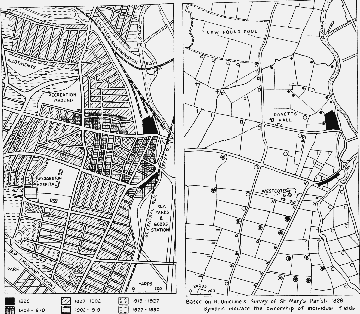
Expansion of building west of the River Soar
From 1885 to 1914 piecemeal growth continued to change an agricultural landscape into one of pavement and brick. Fields and farms, and even former administrative areas sometimes retained a vestige of identity in the process by which streets were laid down in rectangular blocks to maximize the profit to be drawn from them. (fn. 537) As an example of this process of growth, one may quote the fate of the small extra-parochial place of Newfoundpool which came into the hands of the builder between 1885 and 1891. By the latter year the boundary of built-over land coincided exactly with administrative boundaries that had stood for centuries. (fn. 538) Even in 1955 the area retained its identity, not merely in the architectural individuality of late Victorian housing set in a matrix of the semi-detached villas of the inter-war years, but also in its street names—Hawthorne, Alma, Rowan, Ruby, Ivanhoe, Sylvan, Oban and Newport—the initial letters of which spell out proudly the name of their author. (fn. 539)
The rate at which the town extended its grip on the surrounding countryside was undoubtedly increasing in the years before the First World War, even though the rate of building and of population increase had both been falling off since 1901. The average density of building was, in fact, declining. The tramways, especially when they were extended and electrified, permitted new building at a far greater range from the centre than had formerly been possible. It was a tendency encouraged by the demand for more garden space attached to individual houses, though there was not yet the extreme dispersion made possible by the flexibility of motor transport. In addition, a greater sense of civic consciousness demanded that the inhabitants of a town which now covered four or five square miles should have access to some open space. Apart from the tiny recreation ground set apart in the South Fields and the public right of access to the racecourse, no provision had been made, but in the last quarter of the 19th century and the early years of the 20th land was bought and set aside by the corporation for parks and recreation grounds. (fn. 540) Partly because of its foresight in the provision of open space and partly because of the accident which preserved the South Fields from continuous building, Leicester acquired a reputation for the extent of the open spaces within the town, but this meant that new building was pushed even farther out from the centre.
In the period between 1860 and 1914 the hosiery industry lost its predominant position in Leicester's economic life, and in terms of numbers employed the boot and shoe industry became the most important in the town. (fn. 541) In 1911, 15,727 persons were employed in hosiery, and 23,495 in footwear. Engineering, the town's third industry, employed 6,162. (fn. 542) An important factor in the town's prosperity was the complementary nature of the labour requirements in the main industries. The hosiery industry had come to employ many more women than men (fn. 543) while the reverse was true in the footwear industry, (fn. 544) and the engineering industry employed men almost exclusively. (fn. 545) The location of the various industries in the town changed during the 19th century. In 1794 persons engaged in the hosiery trade were scattered fairly evenly through the built-up area. (fn. 546) Forty years later the Swannington Railway and the canal had had a discernible effect on the grouping of the heavy trades, but it was still difficult to see any systematic pattern in the location of the hosiery trade. (fn. 547) By 1846 a rough distinction could be made between the framework-knitters and the hosiers. The master framework-knitters were to be found very largely in the poorest parts of the town, mainly in the mean, ugly streets by the canal and in the North Gate. The hosiers had their warehouses and offices in the better parts of the town, for the most part in the streets which had been built in the first twenty years of the century to the south of the old town. (fn. 548) When steam power was introduced into the hosiery industry the location of the industry took on a new aspect. Factories and larger workshops were erected by the hosiers in and around the region where they had formerly lived and where the warehouses were, and particularly among the new houses being built in 1850–60 in the nearby area to the south of the Newarke. (fn. 549) The industry became localized in this new district and remained there to the end of the century, though there was, in addition, a number of factories in the areas where the framework-knitters had been so numerous in the north and north-east of the town, or again where new building was going up while the transition from a domestic to a factory industry was being accomplished. (fn. 550) This basic pattern is still dominant in spite of the general tendency, shared to some extent by the hosiery industry, to move towards the outskirts of the town or to the planned industrial area in the east.
It is less easy to analyse the location of the boot and shoe manufacture, though it appears again that what mattered was the relation between industrial evolution and the growth of the town. In 1835 the distribution of the trade reflected little more than the distribution of population. The industry did not become concentrated in one area and in the middle of the 20th century is still to a very large extent unlocalized though it has in the inter-war years tended to gravitate towards the planned industrial quarter in the Evington Valley Estate, in company with the immense variety of new industries which have supplemented the traditional staples since 1918.
The improvements in public health which took place between 1860 and 1914 have already been described. They were paralleled by equally important but less tangible reforms in other spheres. By 1914 Leicester was not only a healthier but a more orderly town than it had been in the middle of the 19th century. The drunken brawling which had characterized some quarters of the borough disappeared, (fn. 551) the amount of violence declined (fn. 552) and a better feeling grew up between the police and the general public. (fn. 553) The last serious outbreak of rioting in the town took place on the occasion of the hosiery workers' strike in 1886. (fn. 554) It is not easy to determine the precise causes of this improvement. The prosperity which the town generally enjoyed no doubt had some effect in softening the harshness of life, and higher standards of living probably helped to bring about higher standards of behaviour. (fn. 555) The introduction of compulsory education, which had a noticeably improving effect upon the town's children, probably exercised in the long run a far-reaching and beneficial influence. (fn. 556) The provision of parks and other amenities no doubt helped to make Leicester a more peaceful town. The town acquired its first public park of any size in 1880 when the races were moved to a new course at Oadby and the old racecourse, which occupied land long owned by the corporation, was transformed into Victoria Park. (fn. 557) A second large park, the Abbey Park in St. Margaret's parish, very near to the most crowded district of the town, was opened in 1882. (fn. 558) Two further parks were opened before 1914: Spinney Hill Park for the rapidly growing suburb in the south-east of the town in 1886, (fn. 559) and Western Park on the western edge in 1901. (fn. 560) The first municipal swimming bath was completed in 1879 in Bath Lane and others were opened in 1891 and 1898 in Vestry Street and Cossington Street. (fn. 561)
The first daily local newspaper in the borough was the Leicester Daily Post, a moderate Liberal publication, founded in 1872. (fn. 562) It was edited at first by Joseph Wood, a Congregational minister, whose management was not a success financially. (fn. 563) (fn. 564) The Post also published a weekly edition. James Thompson, the owner of the weekly Leicester Chronicle and Leicestershire Mercury, began publication of the Daily Mercury, an afternoon paper, in 1874. (fn. 565) The ownership of both Thompson's papers passed in the same year to Francis Hewitt, who was also the owner of local papers at Loughborough and Melton Mowbray. (fn. 566) Besides these new daily papers, the older weekly publications, the Leicester Journal, the Guardian, the Advertiser, and the Midland Free Press, all still existed until after 1890, and from time to time other short-lived journals appeared. A daily evening paper, the Leicester Evening News, owned and edited by a prominent Liberal, G. R. Searson, was being published in 1875 but seems to have ceased publication by 1877. (fn. 567) Other local newspapers which had only a brief existence were the Leicester Times, published for a short period about 1900, (fn. 568) the Leicester Sporting News, published between about 1888 and 1902, and the Saturday Herald, which had a short existence about 1896. (fn. 569) The local newspapers, however, tended to become fewer and their ownership more concentrated. The Guardian and the Advertiser were by 1870 both owned by William Cox, who also owned a local paper at Loughborough, and an interest in the Journal. (fn. 570) About 1875 the Guardian ceased publication. (fn. 571) The Leicester Daily Post was acquired by Hewitt, (fn. 572) and it with the Chronicle and Mercury and the Daily Mercury was owned first by Hewitt and then by a joint stock company, F. Hewitt & Son Ltd., until after 1945. (fn. 573) The company acquired the Advertiser in 1920. (fn. 574) All the Leicester newspapers remained under local control until the Daily Mercury was acquired by the Kemsley press after the Second World War. The Midland Free Press which was owned and edited by Thomas Windley, a leading member of the borough council since 1861, (fn. 575) came to an end in 1912, (fn. 576) and the old-established Journal ceased to be published in 1920. (fn. 577) Of the surviving papers, the Daily Mercury became an evening paper in 1921, changing its name to the Leicester Evening Mercury, (fn. 578) and the weekly Chronicle and Mercury had changed in 1915 into the Illustrated Leicester Chronicle. (fn. 579) The Leicester Daily Post ceased to be published in 1921 and was replaced by another evening paper, the Leicester Evening Mail. (fn. 580) In 1955 no morning daily paper was published in the town.
In 1862 the corporation passed a resolution in favour of establishing a free library in the town, but no practical steps were taken until 1869, when it was decided to levy a ½d. rate for the purpose. Shortly afterwards the corporation was able to buy a suitable building, the New Hall in Wellington Street, and it was opened as a public library in 1871. (fn. 581) The new institution seems to have been widely used by the manual workers of the town. (fn. 582) The New Hall eventually became too small for the growing stock of volumes, and in 1905 the library was transferred to a new building in Bishop Street, the cost of which was borne by a gift from Andrew Carnegie. (fn. 583) The first branch library was opened in 1883, (fn. 584) and there were five branches before the end of the 19th century. (fn. 585)
1914–1945
The outbreak of war in 1914 brought about some momentary unemployment, which it was at first feared might become serious. (fn. 586) The situation soon changed, however, and by October 1914 some shortage of labour was already evident. (fn. 587) Much of the town's engineering industry became engaged in the manufacture of munitions. (fn. 588) In general the experience of Leicester during the war was similar to that of most other industrial towns. Recruiting was carried on, at first with small results but eventually with much success. (fn. 589) For those not in the forces the period was one of full employment and rising wages, since not only the engineering industry, but the hosiery and footwear industries were exceptionally busy. (fn. 590) Under the leadership of Alderman Jonathan North, (fn. 591) mayor 1914–18, the town was much engaged in raising money for various purposes connected with the war and in caring for sick and wounded servicemen. (fn. 592)
In 1919 Leicester became a city. (fn. 593) In 1889 the corporation had petitioned the queen for this privilege, but the request was refused. The issue was revived after the extension of the borough boundaries in 1891 but again without result. (fn. 594) In 1928 the mayor was authorized by letters patent to assume the style of lord mayor. (fn. 595)
Leicester suffered perhaps less severely than most industrial towns from the economic vicissitudes of the inter-war years. In 1920 unemployment in Leicester began to be serious and became worse as the year went on, affecting both the hosiery and boot and shoe industries, in both of which there was also considerable short-time working. (fn. 596) From this depression the city recovered and by the end of 1922 the number of unemployed had fallen to about 2,700. (fn. 597) Some degree of unemployment persisted. In 1930, with the general deterioration of the country's economic position, it increased sharply, and from that date until 1939 there were seldom fewer than 10,000 unemployed in Leicester (see Table III). This degree of unemployment was very moderate in comparison with that which prevailed in the depressed areas between the world wars. Leicester was relatively prosperous and its population continued to expand, though less rapidly than in the 19th century; it rose from 234,000 in 1921 to 229,000 in 1931. (fn. 598) By 1939 the population of the city as enlarged in 1935 was 261,000. (fn. 599)
Table III: Unemployed Persons, 1922–39 (fn. 600)
The General Strike of 1926 caused no serious disturbances in the town. As elsewhere, transport and printing workers struck. (fn. 601) Workers in the hosiery and boot and shoe industries did not take part in the strike, though many factories in both industries were forced by shortage of coal to work short-time and some to close. (fn. 602) In the engineering industry there were at first few strikers, (fn. 603) but on 11 May all members of the Amalgamated Engineering Union in Leicester were summoned to strike by their union, and the industry was in consequence largely brought to a standstill. (fn. 604) Apart from the General Strike, which was of course not due to local factors, Leicester remained free from serious disputes during the period between the wars.
Because of the high level of activity in the town's chief industries, hosiery and footwear manufacture and engineering, the problems which confronted the city between 1918 and 1939 were those of growth rather than of depression. There was urgent need to provide many more houses. In 1914 the corporation had decided that it would be necessary to begin building houses under the Housing of the Working Classes Act, (fn. 605) as the houses at moderate rents erected by private builders had for some time not been adequate to meet the demand. (fn. 606) Because of the outbreak of war, no municipal houses were then built and when in 1919 it again became possible to contemplate building on a large scale, the need for houses had, of course, increased. In October 1919 the council had a list of 1,455 persons in the city who wanted houses, and it was estimated that 1,500 working-class houses would have to be built during the next four years. It was thought that most or all of the required houses would have to be provided by the municipality. (fn. 607) In 1919 the Coleman Road Estate in North Evington and Tailby Estate in West Humberstone, both to the east of the town, were bought for housing. (fn. 608) Under the Housing Act of 1919 (fn. 609) the corporation built 746 houses to let, mostly on the two newly purchased properties. These houses were nearly all completed by October 1924. (fn. 610) Under the Housing Act of 1923 (fn. 611) a further 638 houses were built to let. (fn. 612) It was evident, however, that building on an altogether larger scale would be needed. By May 1924 the council had received 5,700 applications for houses. (fn. 613) It had become increasingly difficult to find sites within the city boundaries and it was thought advisable for the corporation to acquire large, compact blocks of property on which houses in sufficient numbers could be built with speed and economy. (fn. 614) Accordingly the council by a succession of purchases in 1920–5 acquired a large area to the south of the city, partly within and partly without its boundary, and comprising the Saffron Lane Estate and Park Estate. (fn. 615) In 1925 it bought the Braunstone estate of over 1,000 acres, mostly lying outside the boundary. (fn. 616) On these two estates and on several smaller ones the building of new houses was pressed forward vigorously. (fn. 617) To accelerate construction 1,500 concrete houses were built. (fn. 618) Between 1919 and the end of March 1929 4,500 houses were completed by the corporation, more than 3,000 of them under the 'Wheatley Act' of 1924. (fn. 619) In addition, nearly 2,000 houses had been built by private enterprise but with the assistance of a state subsidy. (fn. 620) Despite this large amount of building the demand for more working-class houses continued, and between March 1929 and March 1939 a further 4,600 houses were built by the corporation and another 900 by private builders assisted by the subsidy. (fn. 621) Before the outbreak of war in 1939 plans were made to build many more municipally owned houses, notably on a large estate at New Parks, acquired by the corporation through a succession of purchases in 1933–7. (fn. 622) The war postponed the execution of these plans. The construction of extensive housing estates with a distinctive character to the south and south-east of the city was a new development in Leicester's urban growth and one that was to become increasingly important after 1945.
The constant need for more houses was due not only to the increase of population, which was only moderate in the years between the wars, (fn. 623) but also partly to the destruction of houses in slum clearance and in the construction of new roads. At Leicester, as elsewhere, a defect in municipal plans for housing between 1919 and 1929 was the failure to provide houses at rents low enough to be within the reach of the poorest. (fn. 624) Between 1929 and 1939 the corporation's efforts in the sphere of housing were largely concentrated on replacing slums, and nearly 2,700 houses were built for that purpose. (fn. 625) By contrast rather more than 1,600 were built for general working-class use under the Housing Act of 1924 between 1929 and 1932, when the Act ceased to operate. (fn. 626) In 1929 the corporation proposed under the Housing Act of 1925 (fn. 627) to clear and reconstruct a slum area adjoining Belgrave Gate, but owing to the legal complications which impeded action under that statute nothing was accomplished. (fn. 628) In 1930 the corporation decided to carry out slum clearance under the Housing Act of that year and between 1930 and 1939 a large area in St. Margaret's parish and smaller areas in other central parts of the city were cleared by demolition. (fn. 629) The area in St. Margaret's was used to provide sites for a new bus station, a large municipal car park, and some new dwellinghouses. (fn. 630) Plans for the further demolition of unsatisfactory property were cut short by the outbreak of war in 1939. Besides rehousing those displaced by this clearance, the corporation built between 1928 and 1939 some 270 houses to accommodate tenants displaced by new road construction in the central districts of the city. Despite the large number of houses built between the wars, it was estimated that in 1939 6,000 more working-class houses were needed in the city. (fn. 631)
The provision of housing was perhaps the most important task undertaken by the municipality in the years between the wars. Traffic congestion in the city, if less serious in its social consequences, was a problem whose solution required bold measures on the part of the municipal authority. By 1920 the quantity of road traffic on some of the roads in the centre of the city was already causing serious difficulties. (fn. 632) The streets most affected were Granby Street, Gallowtree Gate, and Belgrave Gate, all of which carried through the centre of Leicester traffic between the London area and places to the north and north-west of the town, and in 1920 a joint report by two committees of the corporation advised that these streets should be widened. (fn. 633) This proposal would have involved the destruction of many valuable buildings on the city's main streets and it was not carried out. Instead a more far-reaching plan to construct several new routes in the city centre by widening some existing streets and by constructing new ones was put forward. (fn. 634) This project was supported by a large majority of the corporation, and in 1924 it was decided to promote a bill to obtain the powers needed to carry it out. (fn. 635) There was, however, much opposition in the city, as it was considered in some quarters that the scheme was too grandiose; it was also feared that labour would be diverted from house-building, and that the great expenditure involved would increase the rates at a time when the economic situation was uncertain. (fn. 636) A minor scandal that occurred in connexion with the management of the city farm at Beaumont Leys gave to the opponents of the scheme the opportunity to argue that municipal activities were often inefficient. (fn. 637) At a town meeting held to discuss the proposed bill the opponents of the street improvement plan were in a majority, (fn. 638) and a poll of the city in January 1924 resulted in a substantial majority against it. (fn. 639) It was therefore decided not to proceed with the full proposals but to introduce a modified plan, (fn. 640) which provided only for the widening of a stretch of Belgrave Gate, and for the construction of a new main road, partly along the line of existing side streets, to carry north-south traffic through the centre of the city. (fn. 641) A bill empowering the corporation to carry out this lesser scheme was approved by a town meeting and by a majority of electors in a town poll, (fn. 642) and the bill became law during 1925. (fn. 643) The construction of the new road, Charles Street, was completed in 1931, (fn. 644) and traffic congestion in the centre of the city was much relieved, but the obvious need for further measures led to a new corporation plan, generally resembling that rejected in 1924, for the building of several new roads which would form a ring round the very centre of Leicester. (fn. 645) A beginning was made on the building of one of the new streets, but little was accomplished before the outbreak of war in 1939. (fn. 646)
In 1922, after some previous discussion, a plan was brought forward for the building of an outer highway running round the outskirts of the city along a roughly circular route, most of which lay outside the municipal boundaries as they then were. (fn. 647) Differences about the proposal arose between the city corporation and the adjacent local authorities, through whose districts the projected road was to run. (fn. 648) It did not prove possible to do very much before 1939 towards the building of the road, though short stretches of it were constructed before 1939 where its route passed through the new corporation housing estates. (fn. 649)
In the years between the two wars some subjects that had given rise to serious problems at earlier periods again required action. The existing means of sewage disposal became inadequate owing to the growth of the city's population, and in 1924 legal action was taken against the corporation because of the pollution of the Soar by sewage. (fn. 650) In consequence large additions had to be made to the sewage works. (fn. 651) The Town Hall became increasingly inadequate to accommodate the staff of all the corporation's departments, so that the municipal officials had to work in premises scattered all over the city. In 1926 the education department offices, for example, were divided between the Town Hall and four other buildings. (fn. 652) A special committee of the corporation, which was set up in 1927 to consider the problem of administrative buildings, rejected on grounds of expense two schemes for the erection of large blocks of offices, and decided in favour of making minor alterations to the existing Town Hall. (fn. 653) It was, however, decided to build a new police headquarters, so that the police left the Town Hall, (fn. 654) and the education department was transferred to a building in Newarke Street. (fn. 655) These arrangements were not sufficient and in 1933 it was decided to build large new municipal offices in Charles Street, which was then under construction. (fn. 656)
An important administrative change took place in 1930 when the board of guardians was abolished and its functions transferred to a new public assistance committee under the Local Government Act of 1929. (fn. 657) By 1930 the guardians had long since ceased to be the only official agency for dealing with poor relief and unemployment. They were, however, perhaps the most important of the elected local authorities set up during the 19th century to perform specific tasks and their disappearance marks the completion of the process of concentrating the responsibility for performing all the tasks of local government in the city corporation.
Between the two wars the population of the borough as constituted under the 1891 Act decreased, as new residential districts outside the municipal boundary replaced older ones within it. There were estimated to be 245,000 persons in the borough in 1919 and 241,000 in 1934. (fn. 658) The lesser density of the new areas meant that the expansion of the built-up area of Leicester was disproportionately great in relation to the rise in population. The large housing estate built by the corporation at Braunstone, which in a few years engulfed almost all of that hitherto rural parish and which lay very largely outside the city, was a notable example of this growth. (fn. 659) The corporation also acquired for various municipal purposes other large properties just outside the city. (fn. 660) In consequence it became necessary to consider extending the city boundary again and in 1935, after an agreement between the city and county authorities about the areas to be included within a new city boundary had been made, this was done. (fn. 661) The complete civil parishes of Gilroes and Braunstone Frith, large parts of the parishes of Evington, Humberstone, Braunstone, Leicester Frith, New Parks, and Beaumont Leys, and smaller portions of the parishes of Anstey, Birstall, Thurmaston, and Kirby Muxloe were brought within the city. (fn. 662) By these changes the area of the city was increased from 8,582 acres to 16,977 acres, (fn. 663) and its population increased from 241,000 to 261,000. (fn. 664)
During the period from 1918 to 1939 the hosiery industry was the most important in Leicester from the standpoint of the numbers employed. The boot and shoe industry had lost its predominant position by 1923, and thenceforth until 1939 its importance in relation to hosiery and engineering continued to decline. In 1939 the hosiery industry was employing more persons at Leicester than any other, more in fact than the footwear and engineering industries combined, though the engineering industry was growing rapidly. (fn. 665)
During the Second World War Leicester escaped a major attack from the air, though some damage and loss of life was caused by a raid on 19 November 1940, and the city suffered minor attacks on other occasions. (fn. 666) The need for munitions led to a considerable expansion of the local engineering industry and to the transfer to that industry of many workers previously engaged in hosiery and footwear. Engineering consequently became of greater relative importance than ever before in Leicester's history. (fn. 667)
1945–1955
In 1945 the problems which confronted the city after 1918 had again to be faced. The need for more housing was particularly acute, as was the necessity for far-reaching measures to deal with traffic congestion. The construction of Charles Street before the Second World War (fn. 668) had somewhat relieved the pressure of traffic, but in Leicester, as in Britain as a whole, the continued increase in the number of vehicles made the existing roads inadequate and raised almost insuperable problems. In the case of Leicester historical factors caused some peculiar difficulties. In the area of the old walled borough the medieval street plan still survived in 1955 largely unchanged, and though some streets had been widened the district still remained one of relatively narrow thoroughfares ill adapted to modern traffic. At the very centre of the modern city an extremely awkward road junction existed on the site of the old East Gate. There in the Middle Ages four roads, Churchgate, Belgrave Gate, Humberstone Gate, and Gallowtree Gate converged from outside the town walls, while inside the walls the High Street ran up to the gate and was joined just inside it by three lesser streets, Cheapside, Silver Street, and Bond Street. (fn. 669) Though the gate and walls had disappeared the streets remained, and along them traffic converged towards the centre. The main highways leading into the city were more adequate than its central streets, largely because of road improvements carried out in the years before the war. (fn. 670) But even on these outer roads the quantity of traffic was so great as to cause frequent congestion and delays at certain times of the day.
These difficulties would have been less acute had it been possible to carry out earlier proposals to complete an outer ring road round the city and to construct new roads in the city centre. The fulfilment of these plans was impossible both during the war and in the years immediately after 1945, when most of the resources available for construction work had to be devoted to housing. Some relief was afforded by the final withdrawal of tramcar services in 1949 and their replacement by motor buses. (fn. 671)
In 1945 it was necessary to put aside for some years any hope of resuming the clearance of unhealthy areas and to concentrate on the provision of new houses. Between the end of the war in 1945 and the end of 1954 just over 8,000 houses were built in Leicester by the corporation. Private builders completed 2,500. (fn. 672) In 1955 municipal building on a large scale was still continuing and there seemed little prospect that the demand for council houses would abate. It was, however, possible to resume the work of slum clearance, and in 1955 a large area was cleared in St. Margaret's parish, adjacent to the district cleared in 1930–9. By 1951 the city's population had risen to 285,000, (fn. 673) and between 1950 and 1955 more large new residential districts sprang up just outside the city boundary, especially in the south, where the corporation acquired a large estate on the boundary for housing in 1951, (fn. 674) and in the east, where the rapid spread of housing, both municipal and private, threatened to engulf the hitherto separate villages of Scraptoft and Thurnby. These extensions led the corporation to propose another extension of the city boundary, but by 1955 no such measure had been put into force.
After 1945 nationalization deprived Leicester corporation of its gas and electricity undertaking, which had in the past made substantial contributions of money in aid of rates. (fn. 675) The municipal hospitals were transferred to the Ministry of Health in 1948. (fn. 676) Between 1945 and 1955 education absorbed half of the corporation's income every year. (fn. 677) After education, the provision of housing should be considered the most important municipal activity from 1945, and involved much capital expenditure. (fn. 678) The maintenance of law and order and the protection of public health, which were once the two most important municipal tasks, were still duties which the corporation had to pérform, and which, though in general attracting little public attention, remained vital to the wellbeing of the city's inhabitants.
The expansion of the city, that has been traced above, was due of course to the continuous enlargement of its important industries. Of those industries hosiery and engineering were the most important industries between 1945 and 1955. In the middle of 1955, out of 173,000 persons at work in the city, 28,000 were employed in the manufacture of hosiery and 27,000 in engineering and metal-working. At the same time, 18,000 were employed in the boot and shoe industry, which had never regained the predominant position held by it in the late 19th and early 20th centuries. (fn. 679) After the war Leicester maintained its position as the largest town in the east Midlands after its close rival Nottingham, (fn. 680) and it was in 1955 the 12th largest town in England and Wales. (fn. 681) In Leicestershire it was by far the largest town, and its continuing expansion into the surrounding countryside was in 1955 causing serious problems.
By 1955 little remained of the Leicester that had grown up in the first half of the 19th century. The central districts of the city consisted largely of late-Victorian brick buildings, diversified by a few more modern buildings in brick or concrete. Outside the Victorian core stretched the 20th-century suburbs, largely residential, with the great municipal housing estates conspicuous among them. Between 1835 and 1955 the city's economic circumstances had changed no less than its physical composition. A state of long-continued distress and depression had given place to one of equally prolonged boom and prosperity. Perhaps, too, the character of the inhabitants had been modified by the altered conditions. The old spirit of individualism and nonconformity, if not altogether lost, had been much softened. By the middle of the 20th century Leicester had acquired a general character which it shared with other industrial towns of the east Midlands, a character marked by a high level of industrial and commercial activity, by a high general standard of living, and by the absence of any extreme or distinctive movements in politics, religion, or culture. The Leicester of 1955, wealthy, healthy, and bustling, was very different from the Leicester of a century earlier.