A History of the County of Cambridge and the Isle of Ely: Volume 3, the City and University of Cambridge. Originally published by Victoria County History, London, 1959.
This free content was digitised by double rekeying. All rights reserved.
'The colleges and halls: Newnham', in A History of the County of Cambridge and the Isle of Ely: Volume 3, the City and University of Cambridge, ed. J P C Roach (London, 1959), British History Online https://www.british-history.ac.uk/vch/cambs/vol3/pp493-495 [accessed 1 May 2025].
'The colleges and halls: Newnham', in A History of the County of Cambridge and the Isle of Ely: Volume 3, the City and University of Cambridge. Edited by J P C Roach (London, 1959), British History Online, accessed May 1, 2025, https://www.british-history.ac.uk/vch/cambs/vol3/pp493-495.
"The colleges and halls: Newnham". A History of the County of Cambridge and the Isle of Ely: Volume 3, the City and University of Cambridge. Ed. J P C Roach (London, 1959), British History Online. Web. 1 May 2025. https://www.british-history.ac.uk/vch/cambs/vol3/pp493-495.
In this section
NEWNHAM COLLEGE
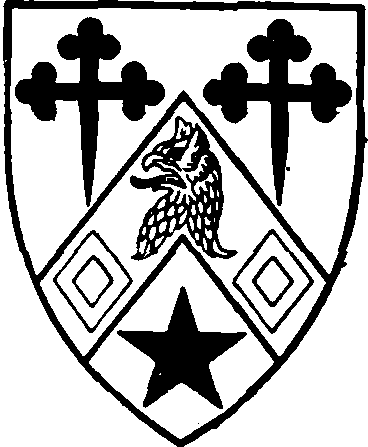
Newnham College. Argent on a chevron azure (for Clough) between in chief two crosses bottony fitchy sable (for Kennedy) and in base a mullet sable (for Balfour) a griffin's head razed or (for Sidgwick) between two voided lozenges argent (for Clough). [Granted 1924]
The organization indirectly responsible for the founding of Newnham College (fn. 1) was the North of England Council for Promoting the Higher Education of Women, which existed between 1867 and 1874. This council attacked the low intellectual standards prevailing in girls' schools, and it succeeded in interesting certain university teachers in its scheme for providing women with courses of lectures on advanced subjects at different centres. These reformers did not want to establish a purely classical curriculum, and the council soon approached the Universities of Oxford and Cambridge with a memorial asking for a special examination for women over eighteen which, conducted in several subject groups, would be of sufficiently high standard to serve as a test for those entering the teaching profession.
A Women's Local Examination, later known as the Higher Local Examination, was instituted in 1868 by the Senate of Cambridge University, and the next year Henry Sidgwick, fellow of Trinity College, called a committee together to arrange courses of study in preparation for the examination. This committee, which in 1873 grew into the Association for the Promotion of the Higher Education of Women in Cambridge, was supported by Professors F. D. Maurice, Fawcett, Adams, Cayley, and many other distinguished lecturers, (fn. 2) and their scheme met with immediate success. From the first they had hoped to attract women students living outside Cambridge, a plan encouraged by the scholarships offered by J. S. Mill, Helen Taylor, and others, and it was soon clear that some house of residence would have to be opened for these women. In September 1871 Sidgwick persuaded Anne Jemima Clough, the first secretary and one of the principal organizers of the North of England Council, to take charge of 74 Regent Street.
To this small house five students were admitted in October, and even before the end of the first year the number had increased. In 1872 a lease was taken of Merton Hall and for two years this remained the centre for resident and out-students. Then in 1874 the 'Lectures Association' decided to promote a limited liability company to build a permanent home for them. By means of this company Newnham Hall, known later as South Hall, and now as Old Hall, was opened in 1875 when Miss Clough came into residence with Miss Paley (fn. 3) as the first resident lecturer. This building in its turn was quickly outgrown and by 1879 it was felt that the time had come to amalgamate the association and the company in a new society which would co-ordinate the work of teaching and housing the students. The Newnham College Association thus formed was registered on 23 April 1880. It immediately took in hand the building of a North Hall, now called Sidgwick Hall, which was opened in 1880 under Mrs. Henry Sidgwick as viceprincipal. Mrs. Sidgwick, as Miss Eleanor Balfour, had been a benefactor of Newnham Hall since 1874 and had stayed with Miss Clough in 1875. She was succeeded by Miss Gladstone in 1882. Even after the building of Clough Hall in 1888 a public right of way ran through the grounds, but in 1891 this was closed by an agreement with the town, and the Pfeiffer Building, built largely from a grant from the trust left by Mr. and Mrs. Pfeiffer for encouraging women's work, was erected over the site two years later. In 1897 the library given by Mr. and Mrs. Yates Thompson was added, and by the opening of Kennedy Buildings, named in honour of Dr. and the Misses Kennedy, in 1906 and of Peile Hall in 1910 the main block of the College buildings was completed. Peile Hall commemorated the work which Dr. Peile, Master of Christ's College, and his wife had done for Newnham. He was President of the College from 1890 to 1909 and Mrs. Peile organized the correspondence classes which helped many women unable to come up to Cambridge. Mr. Basil Champneys was the architect of all these buildings. In 1938 Fawcett Building, the beginning of a smaller court, was the work of the firm of Scott, Shepherd, and Breakwell. Further extensions, including a new porter's lodge in a more central position, were carried out in 1948–50. The architects were Buckland and Haywood. A Principal's Lodge, built with a bequest from Mrs. Jessie Lloyd in memory of her daughter, M. E. H. Lloyd (Newnham College, 1913–17), and designed by Louis Osman, was under construction in 1956.
On 24 February 1881 the University first formally recognized Newnham and Girton Colleges and opened the tripos examinations to their women students on the same conditions of entrance and residence as those imposed on men. (fn. 4) In 1897 a proposal to grant women students titles of degrees was rejected by the University, (fn. 5) but the need for some recognition of their academic status other than the tripos certificate was shown by the numbers of women who, between 1904 and 1907, proceeded to the 'ad eundem' degrees offered by Trinity College, Dublin. (fn. 6) In 1923, following on a grace of the Senate passed in 1921, ordinances were approved by the University admitting women to the titles of degrees and at the same time limiting the number of women students at Girton and Newnham to 500, exclusive of research students. (fn. 7) By the statutes of 1926 women became eligible for membership of faculties and faculty boards and for all teaching offices in the University, (fn. 8) while most of the University scholarships, studentships, exhibitions, and prizes were opened to women in 1928. (fn. 9) In December 1947 a grace was passed admitting women to full membership of the University and constituting Newnham a College of the University. The relevant changes of statutes received royal approval in 1948. (fn. 10)
Meanwhile Newnham College had worked out its own constitution. By the articles of association in 1880 the government of the College and the administration of its property were vested in a council. When the articles were revised in 1892 a further group was added to the members of the College who elected the council. These were the associates of the College, who, numbering finally 48, represented the past students. Instituted to promote the interests of education, learning, and research, the associates had also their own organization and soon proved very influential. Among other schemes which the College owes to their initiative are the raising of a research fellowship fund between 1898 and 1899, the founding of the Henry Sidgwick Memorial in 1900, and the draft of the new constitution which was embodied in the royal charter granted in April 1917. By this charter the ultimate authority in 'all questions affecting the good government of the College, the promotion of the interests thereof and the maintenance of the discipline and studies of the students' passed to the governing body, whose members, the principal and fellows of the College, are the teaching and administrative staff and representatives of the research fellows and associates. The council, which included three members of the Senate of the University, was elected by the governing body and retained the power of making appointments and of conducting the general business and finance of the College. The charter and statutes were revised in 1951 to take account of the new status of the College in the University, and to bring its nomenclature into line with that of other colleges. Some modifications were made in the representation of associates and research fellows.
Side by side with the work of extending the College buildings and developing its institutions went that of securing opportunities for women to undertake independent research. At first the poverty of the College prevented this and even teaching appointments were few. However, in 1882 the Bathurst Studentships were founded for the encouragement of advanced work in any of the natural sciences, (fn. 11) and in 1888 another studentship was given by the friends of Marion Kennedy, who was honorary secretary of the College from 1876 to 1903, and presented to her for this purpose on the day that Clough Hall was opened. (fn. 12) Ten years later the first research fellowship, the Geoffrey Fellowship, was offered, (fn. 13) and in 1900 the first College fellowship was also awarded. (fn. 14) On the death of Mary Bateson in 1906 another fellowship was founded (fn. 15) and in recent years the Sarah Smithson Fellowship, (fn. 16) the Jenner Fellowship, (fn. 17) and the Wheldale Onslow Memorial Fellowship (fn. 18) have been added to the College fellowships of which at least one is offered annually.
Many members of Newnham College have distinguished themselves in different branches of learning and in administrative, educational, and social work. Accounts of them and of their published work will be found in the Principals' reports, (fn. 19) and the reports of the Research Fellowship Committee. (fn. 20)
Principals of Newnham College
Anne Jemima Clough: 1871–92.
Mrs. Eleanor Mildred Sidgwick: 1892 to Dec. 1910.
Katharine Stephen: Jan. 1911–20.
Blanche Athena Clough: 1920–3.
Joan Pernel Strachey: 1923–41.
Myra Curtis, D.B.E.: 1942–54.
Ruth Louisa Cohen: 1954–.