A History of the County of York East Riding: Volume 1, the City of Kingston Upon Hull. Originally published by Victoria County History, London, 1969.
This free content was digitised by double rekeying. All rights reserved.
'Civic institutions', in A History of the County of York East Riding: Volume 1, the City of Kingston Upon Hull, ed. K J Allison (London, 1969), British History Online https://www.british-history.ac.uk/vch/yorks/east/vol1/pp433-443 [accessed 1 May 2025].
'Civic institutions', in A History of the County of York East Riding: Volume 1, the City of Kingston Upon Hull. Edited by K J Allison (London, 1969), British History Online, accessed May 1, 2025, https://www.british-history.ac.uk/vch/yorks/east/vol1/pp433-443.
"Civic institutions". A History of the County of York East Riding: Volume 1, the City of Kingston Upon Hull. Ed. K J Allison (London, 1969), British History Online. Web. 1 May 2025. https://www.british-history.ac.uk/vch/yorks/east/vol1/pp433-443.
In this section
CIVIC INSTITUTIONS
Guildhall
The first building to which there is reference is the motehall, described in 1333 as the hall of pleas, which was situated at the southern end of Marketgate (now Market Place). (fn. 1) Throughout the 14th century mention is made of the common hall, which was used as a meeting-place for the mayor and aldermen, (fn. 2) and in the mid-15th century the corporation met in the Guildhall. It is likely that these variouslydescribed halls were the same building which, although much altered and repaired, remained in Market Place until the 19th century. (fn. 3) A prison tower stood next to the Guildhall, with an arched passage-way between them leading to Butchery (now Queen St.). There were shops at ground level beneath the Guildhall from at least 1465. (fn. 4)
In 1632 the corporation decided to build a new Guildhall with money bequeathed to the town by Thomas Ferries. (fn. 5) In the following year the site of the fish shambles was chosen, lying on the north side of the old Guildhall. The new building was to measure 44 by 21 feet, its greatest length lying eastwest. It was to be a two-storied brick building, standing on arches, with battlements around the roof. The window-frames and other embellishments were to be of stone. John Catlyn, bricklayer, was commissioned to supervise the work, and the hall was to be completed by 24 August 1634. (fn. 6) The building was not completed until at least 1636, possibly because of the financial difficulties of the corporation, (fn. 7) and Hollar's plan of c. 1640 shows only the old Guildhall. (fn. 8)
The old and new buildings are clearly shown in two 18th-century paintings. (fn. 9) The old Guildhall was of two stories, with a steeply-pitched roof, and appears to have been altered when the new building was erected. The passage-way to Butchery ran under three bays of the old Guildhall. The new Guildhall was built over an arcaded ground floor, with five arches on each side; there was a large mullioned window above each arch. The middle bay on each floor had pilasters and pediments, and a third stage of this centrepiece, rising above the parapet, was similarly embellished. The parapet was battlemented and the roof apparently flat. In front of the prison tower was a two-storied portico, perhaps forming the main entrance to both Guildhall and prison. It too had pilasters and a pediment; above the doorway was a wreath and scrolls, then a large niche, and over that the Royal Arms. Also standing out in front of the prison tower was a guard-house, built in 1679. (fn. 10)
Alterations and additions to the old and new Guildhalls were numerous in the later 17th century, and in 1657, at the instigation of Trinity House, the roof, doubtless of the old Guildhall, was whitened to serve as a landmark for seamen. (fn. 11) Eighteenthcentury alterations and repairs (fn. 12) included sash windows, put in the council chamber in 1754; and plans were made for converting some shops beneath the Guildhall into kitchens in 1766. (fn. 13)
The replacement of the Guildhall was authorized by the Act of 1801, (fn. 14) and by 1805 it had so fallen into disrepair that it was ordered to be demolished; arrangements were made with the then mayor, William Jarratt, to rent his house in Lowgate for a temporary meeting-place. (fn. 15) Nothing came of plans to build a new Guildhall in Humber Street, and the lease of Jarratt's house was subsequently renewed; various alterations were made to the building to accommodate the council and the courts. (fn. 16) Finally, in 1822, the house was purchased, (fn. 17) and in 1823–4 further alterations and extensions were made to provide new accommodation for the Quarter Sessions and Requests courts. (fn. 18) It was later decided that a new building should be erected, partly on the same site, and that the property between Hanover Square and Leadenhall Square (now Alfred Gelder Street) should be bought and demolished. Cuthbert Brodrick was chosen as architect and the foundation stone was laid in 1862; the building was completed in 1866. (fn. 19) It included council chamber, magistrates' and sessions courts, cells, committee rooms, mayor's rooms, and offices for the town clerk and other officials. It was of two stories, designed in Renaissance style, and had its frontage in Lowgate. There was a central clocktower (fn. 20) and angle-turrets, and the whole building was richly decorated. The corporation met in the county court for a few months in 1863 until the new council chamber was completed in November of that year. (fn. 21)
The Guildhall was rebuilt on the same site in 1903–16, to designs by Russell, Cooper, & Davies, chosen by competition. (fn. 22) It was at first intended to retain the existing building at the eastern end of the site. The present building, therefore, consists of two distinct parts: the long western range, containing law courts and civic offices, and the eastern block which was erected later on the site of the former Guildhall, demolished in 1912. The western range has its principal elevation facing Alfred Gelder Street. This is three-storied and is mainly of rusticated Ancaster Stone. It consists of a central feature flanked above ground-floor level by two long colonnades, which terminate against end pavilions; the whole is crowned by a continuous entablature with a heavy cornice. The central block, of three bays, has a ground-floor entrance surmounted by a figure of Justice. On the upper stories the wide central bay is recessed behind an arch supported on two columns; above is a carved shield bearing the city arms. The flanking colonnades, each of fifteen bays, have composite columns of Darley Dale Stone with two tiers of windows between them. The end pavilions each consist of a single bay. Above the main cornice they are carried up to support elaborate pedestals on which stand vigorously-carved groups of sculpture, by A. H. Hodge; these dominate the skyline and are the most striking feature of the range. The group at the west end consists of a female figure standing at the prow of a boat drawn by seahorses. The eastern group has a standing figure in a chariot, flanked by lions.
The block at the east end of the site, built to replace the old Guildhall, is also in a monumental Renaissance style but is less massive in treatment. The asymmetrical south front adjoins that of the west range, but is set back from it. Near the east end, however, the frontage breaks forward to support a pedimented portico occupying the two upper floors. The principal entrance front of the block faces east and has a central portico flanked on either side by three bays of windows. The portico, which consists of an entablature and pediment supported on paired columns, stands on a rusticated base containing three entrances. Behind the pediment rises a square clock tower of three stages. The middle, or belfry, stage is colonnaded and the third stage, which is recessed, has a rectangular opening in each face. The whole is surmounted by a finial consisting of four carved putti supporting a small dome.
Internally the principal rooms are on the first floor. The banqueting room, which, with the reception room, occupies the full width of the east front, has three round-headed windows opening onto a balcony within the central portico; an end window is set in the south portico. The mayor's, mayoress's, and sheriff's parlours form a suite on the south side. The rich internal decoration is influenced by the style of Sir Christopher Wren and the cruciform plan and section of the council chamber show close affinities with those of his city church of St. Anne and St. Agnes. (fn. 23)
From at least the 15th century, the Guildhall was used for meetings of both the council and the burgesses. Elections to Parliament took place there, and meetings of burgesses were summoned for special purposes and held in the common hall within the Guildhall. (fn. 24) The Guildhall was not, however, the only meeting-place of the corporation. In 1453 a meeting was held in St. Mary's Church, and in 1486 another in the vestibule of Holy Trinity Church. After the Reformation the corporation frequently met in a chapel in Holy Trinity Church which remained one of its meeting-places until the mid-17th century. (fn. 25) It had been agreed in 1522 that the corporation should meet every Thursday in its council house, but the whereabouts of this was not stated. (fn. 26) The Guildhall was also used to store the town's records. In 1564 a chest for them was ordered for the council room, and in 1576 a place to store the court records was to be made at the east end of the common hall. (fn. 27)
In 1637 the corporation met at the exchange, the 'hall', and the castle. (fn. 28) The new Guildhall was certainly in use by the following year when some of the town's records were housed there. (fn. 29) In 1642 the mayor brought the town's plate to the Guildhall for safe keeping, but was persuaded to take it home again upon assurance that he would not be held guilty for its loss. (fn. 30) More records were deposited in the Guildhall in 1649. (fn. 31) In 1673 a new chamber to house the records was ordered to be built over the old Guildhall; it seems that this chamber was not completed until 1681, for in that year a new room adjoining the new hall was to be ceiled and made fit for the records. (fn. 32) Accommodation at the Guildhall was also provided during the 17th century for the sheriff's clerk, the serjeants, and the town's courts. (fn. 33) By the late 18th century most corporation business was done in the Grand Jury Room over the fish shambles, presumably because of the disrepair of the Guildhall. (fn. 34) From the early 19th century both Jarratt's house and later Guildhalls have been used as the administrative and judicial centre of the city.
Weigh-house, Exchange, and Custom House
The need for an adequate building for the weighing and storing of wool is first mentioned in 1343. (fn. 35) By 1365 the town council had built a weighhouse a little to the south of Chapel Lane Staith. Ground belonging to at least two plots fronting on High Street, and running down to the river, was used, and as a result the town paid rents to the Birkyn family, which later passed to Robert Cross and his heirs, and to the Pole family. (fn. 36) The building was either rebuilt or extended in 1389. (fn. 37) By the early 15th century it was already referred to as the woolhouse, (fn. 38) and this remained its alternative name although it was by no means used solely for wool. (fn. 39)
Money was frequently spent on the maintenance of the weigh-house. (fn. 40) Some extensive work was done, for example, in 1439–41, including the rebuilding of the east part of the weigh-house. (fn. 41) A plan of the building, probably of the late 16th century, shows that storage rooms were arranged around an open 'quadrant' which measured 112 ft. by 73 ft., and the whole building was of two stories. On either side of the main entrance from High Street was an area, open to the central courtyard, 'for merchants to walk dry'. At the river end openings led to two wharves; these were separated by a projecting section of the building, which accommodated the custom house on the first floor and had a four-storied tower. On one wharf was a 'jibbet', on the other a crane, a 'jebbet', and a balance. (fn. 42)
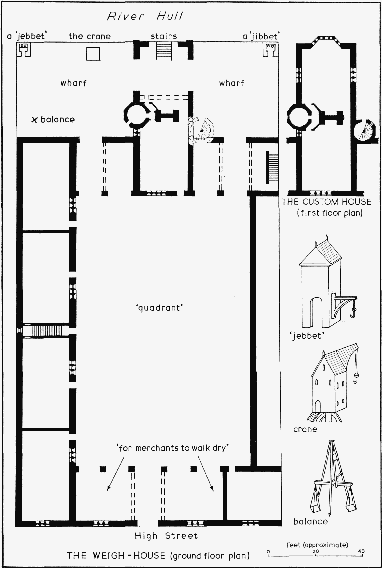
The weigh-house and custom house. Based on a plan, probably of the late 16th century.
The building contained a number of rooms not used for its primary business. Such rooms were let out in the 1560s and 1570s, for example; one was used by the mayor in 1571, perhaps in his capacity of Admiral of the Humber for a room there was said in 1592 to be the customary place for the Admiralty court to be held. (fn. 43) The whole building appears to have been rebuilt in the 1620s, (fn. 44) and cellars and chambers continued to be let out in the 17th and 18th centuries. (fn. 45) When the first Hull dock was opened in 1778, with its new wharves and warehouses, the weigh-house was no longer needed. In 1775 the tenants of rooms there were ordered to leave, and weigh-master and porters were told that their services would not be required after the following midsummer. (fn. 46) The whole building was then apparently used for the exchange and the custom house.
Part of the weigh-house was first used as a merchants' exchange in the early 17th century. In 1617 John Lister, alderman and merchant, bequeathed £100 towards the building of a merchants' meetingplace, (fn. 47) but in 1620, with the consent of Lister's son, the corporation decided to make the meetingplace in the weigh-house. (fn. 48) In the following year the town received £60 from the Crown towards the work, on condition that the customs officials should have the use of part of it. (fn. 49) Later in 1621 the corporation was having difficulty in collecting money promised for the work and it was decided to meet the cost for the time being from the town funds. (fn. 50) Thereafter the exchange was constantly repaired and altered, work including the installation of a clock in 1675, the provision of new iron gates in 1744, and the laying of new paving in 1756. (fn. 51)
The exchange had various subsidiary uses. A place to keep the town's armour was ordered to be prepared there in 1623, and this use of the exchange is often mentioned until the old armour in the armoury chamber was ordered to be disposed of in 1705. (fn. 52) On at least one occasion, in 1637, the corporation met in the exchange. (fn. 53) In the late 17th century it was used for storage purposes by private individuals as well as by the weigh-house master. Such goods were ordered to be removed in 1668 and a keeper was appointed in 1674, (fn. 54) suggesting that merchants were perhaps actively using the premises at that time. The Dock Company commissioners leased rooms in the exchange in 1774. (fn. 55) After the corporation ceased to use any part of it as a weigh-house, the whole building was extensively altered, the work being completed in 1784. (fn. 56) It did not, however, long continue to house the exchange.
In 1794 a new exchange was built in Exchange Alley, off Lowgate; it was a three-storied building and it had a news-room above the exchange room. (fn. 57) In 1866 this was replaced by a new building on the corner of Lowgate and Bowlalley Lane. Abortive plans for an improved exchange had been put forward in 1845 by the newly-founded Exchange and Commercial Building Company. About 20 years later the Hull Exchange Company was formed, and it was this which put up the 1866 building. It was designed by W. Botterill, of Hull, in a Renaissance style with a grandiose interior; it, too, included a news-room. (fn. 58) It was still in use in 1965.
The custom house was certainly kept in the weigh-house in the early 15th century, and probably had been from the beginning. (fn. 59) The accommodation consisted of two chambers, rented from the corporation. (fn. 60) There was a cellar under the custom house in 1453, and when the customer and controller wanted more space in 1555 they leased a room in the adjoining house from the corporation. (fn. 61) The late-16th-century plan (see above) shows the custom house as consisting of two firstfloor rooms at the river end of the weigh-house; this part of the building may have been rebuilt or repaired in 1573, for this date is shown on the principal elevation. (fn. 62) When the building was altered in 1621 to incorporate the exchange, the Crown contributed £60 towards the cost on condition that the customs officers should be given a 50-year lease of part of the new premises. (fn. 63) The lease was renewed in 1679. (fn. 64) The custom house was repaired in 1731 and the Crown rent increased, (fn. 65) and in 1756 the rent was again raised. (fn. 66)
The corporation proposed in 1771 to sell the custom house, with the cellars, chambers, and warehouses, and to build a new house on the site, but by 1776 it was prepared to take a lower price or to let the building on a repairing lease. (fn. 67) In 1781 the customs collector required alterations to be made to the now disused weigh-house before he would accept a lease. (fn. 68) A new rent was agreed upon in 1782, (fn. 69) but the alterations were not completed and the lease sealed until the beginning of 1784. (fn. 70) Three years later the Dock Company paid rent to the Crown for the use of the custom house, (fn. 71) only part of the building presumably being involved.
Late in 1814 the corporation agreed to accept a surrender of the lease should the Crown wish to give it up, (fn. 72) and a new building came into use in 1815. (fn. 73) The High Street building, however, was not demolished until 1855. The new custom house was the former Neptune Inn in Whitefriargate, built in 1794–7 by Trinity House. (fn. 74) These premises, which still bear the name 'Custom House Buildings', were replaced in 1912 by the former head post office in Market Place. (fn. 75) This remained in use until a new building for H.M. Customs and Excise was opened on the north side of Queen's Gardens in 1964. (fn. 76)
Prison (fn. 77)
By the charter of 1299 the burgesses were given leave to have a prison in the borough, (fn. 78) and their right to do so was four times confirmed. (fn. 79) Presumably the prison was promptly built, for the first commission of gaol delivery dates from 1313–17. (fn. 80) Originally entrusted to the serjeant of the borough, (fn. 81) the building was surrendered to the Sheriff of Hull (fn. 82) on the creation of the county. From 1440, therefore, it became the gaol for the county of Hull. (fn. 83) It is known to have been delivered by the king's justices three times in the earlier 14th century, (fn. 84) and in the early 16th century appears to have been one of five Yorkshire gaols included in the northern circuit. (fn. 85) Later deliveries seem to have been irregular. Commissions authorizing the Corporation of Hull to deliver the gaol were occasionally issued in Elizabeth I's reign. (fn. 86) In 1583 the President of the Council in the North came to deliver the gaol at the special request of the corporation, because it was overcrowded, (fn. 87) and the deliveries of 1633, 1650, and 1652, (fn. 88) if not that of 1630, (fn. 89) were likewise carried out on the petition of the corporation. According to Howard, writing in 1777, the assizes were held triennially, but had formerly occurred only once in seven years, because of the expense of entertaining the judges. (fn. 90) In the fifteen-year period 1658–73, however, assizes were held in Hull on at least four occasions, (fn. 91) and between 1729 and 1745, too, four sittings are known to have been held. (fn. 92) The last delivery took place in 1794, after which time Hull prisoners were tried at York. (fn. 93)
While it was primarily a felons' gaol, the building was also put to other uses. The room at the top was in 1456 set aside as an Admiralty prison, to be used for the custody and punishment of 'rebels and delinquents' on the orders of the mayor and the commissioner for the Admiralty of the Humber. (fn. 94) This and other parts of the tower continued to serve, under the name of the 'burgess prison' or the 'kytcoate', for the custody of persons who were not felons. The former term is encountered from time to time in the later 16th and the 17th centuries. It was found in 1690, for example, that men were being put in the 'burgess prison' who should have been committed to the 'king's prison', i.e. the gaol for felons. (fn. 95) The 'kytcoate' is first mentioned in 1605, and, when it was ordered to be demolished in 1679, it was described as 'the little house . . . standing into the street under the lowest prison window'. (fn. 96)
The gaol building stood in Market Place, next to the Guildhall, at the corner of Butchery (now part of Queen Street) and Mytongate. It was a tower of four stories (fn. 97) and was hence sometimes called the 'Guildhall tower'. It was furnished with chimneys in 1679, (fn. 98) had a 'dungeon' in 1690, (fn. 99) and was covered with lead by 1705. (fn. 100) At the time of Howard's visit the lowest story was a 'damp dungeon', long since disused. Above was a room for debtors and above that two floors assigned to felons. The debtors were free to walk upon the leads, but there was no court and no sewer, and the felons were denied access to water. The gaoler lived in an adjacent house, (fn. 101) which was in existence by 1731. (fn. 102) The average number of debtors in 1774–9 was six and of felons two. (fn. 103)
The prison was presented by the grand jury as insufficient shortly before 1783, in which year an Act was procured empowering the Justices of the Peace to raise money for a new one. (fn. 104) Work was promptly put in hand and the new gaol, planned to be half as large again as its predecessor, (fn. 105) appears to have been ready by 1785. (fn. 106) The old building seems to have been demolished by 1792. (fn. 107)
The new building, which stood in Castle Street, was an oblong block of three, in part four, stories, divided, by 1810, into six large rooms and an attic and thirteen smaller rooms or cells. (fn. 108) The turnkey's lodgings at first formed an integral part of the building. Neild criticized this arrangement, and by 1817 the lodgings had been reconstructed so as to form a forebuilding. In several respects the gaol was a model of its kind. Standing upon a small eminence, it commanded good views from some of its windows and was perpetually 'refreshed by sea breezes'. The heating-system, ventilation, bedding, clothing, and general state of cleanliness all met with Neild's commendation. Classification was effective and there were separate courts for debtors and felons, the latter furnished with arcades. The rooms were provided with copies of the Scriptures, and there was a small chapel. In 1808 a 'fever ward' was contemplated. (fn. 109) The total number of prisoners in 1802–9 averaged 30. (fn. 110)
This building did not last long. Hull was one of the towns brought within the provisions of the Gaol Act of 1823 (fn. 111) and no doubt in consequence the corporation decided to rebuild on a new site and unite the house of correction (fn. 112) with the new gaol. The new United Gaol and House of Correction, adapted to the classification of prisoners as the Act directed, was opened in Kingston Street in 1829. (fn. 113) It consisted of five blocks, radiating from a hub, each block separated from the next by a yard and wall. The whole was enclosed within a walled octagon of which the east and west sides were the longest. In the middle of the north wall was a gatehouse. (fn. 114) The average daily population in 1835 was 85. (fn. 115) The prison was, in its turn, replaced by a new building on a 12-acre site in Hedon Road, of which the foundation stone was laid in 1865. It was of red brick with stone facings and was designed by David Thorp (d. 1865), the borough surveyor. The central block was in the form of a cross with a wing projecting at an acute angle between its west and south arms and an L-shaped building attached to its east arm. It was, like its predecessor, on the panopticon plan, for the chief officer, standing at the point where the arms of the cross intersected, could view the whole. The chapel was circular. In front of the main block stood residences in the 'Italian villa style' for the governor, his deputy, the chaplain, and the chief turnkey. The ventilating tower also exhibited 'Italian' details, but otherwise the building appeared to a contemporary to be an example of 'carpenter's gothic' and an 'eyesore'. (fn. 116) The old gaol of 1827–30 was pulled down and covered by the goods yard of the N.E. Railway.
The building of Thorp's prison was not completed until 1870, and meanwhile accommodation in the old prison was severely strained. The new building provided 304 certified cells, 84 noncertified cells, 11 punishment cells, and 24 reception cells. The average daily population in 1870 was 204, (fn. 117) but by 1873 this had risen to 280. (fn. 118) In 1877 187 military prisoners were taken in by contract, and by 1879 they had swollen the daily prison population to 394; the prison had been transferred to the Prison Commissioners under the Prisons Act of 1877. (fn. 119) Accommodation was increased and by 1880 120 new cells had been constructed. This allowed districts in N. Lincolnshire to commit felons to Hull instead of to the prison at Lincoln. (fn. 120) By 1892, however, the population had dropped to under 250. (fn. 121)
The health of the prisoners remained satisfactory throughout the later 19th century, and when a smallpox epidemic visited Hull in 1900 there were only two cases in the prison. (fn. 122) In 1881 special provision was made for the lying-in of women in the female wing, and a new infirmary was built the following year. (fn. 123) In 1890 a mortuary was provided. (fn. 124)
Much attention was given during the same period to the employment and education of the prisoners. In 1878 work took the unusual form of sugar-breaking, and between 1878 and 1887 the prison foundry was used to provide castings for several prisons then under construction elsewhere. (fn. 125) In 1880 the prison met an important need by manufacturing fish-boxes, and in 1888 gas-making was undertaken. (fn. 126) The results of the system of education were described in 1887 as 'very decidedly satisfactory', and in 1898 the chaplain declared that all prisoners were able to read any 'reasonable' work, write an intelligible letter, and keep their accounts before they were excused school-instruction. (fn. 127)
From 1904, contrary to the nationally-observed decline in convictions, the population of the prison increased sharply, and by 1907 the daily average had reached 372. The building of new docks at Hull and Grimsby had attracted large numbers of casual labourers to the area, and more women had been committed owing to the closing of Wakefield prison to female prisoners. (fn. 128) The average daily population in 1910 was 401, of which 80 per cent. comprised prisoners serving terms of a month and under. (fn. 129) In conformity with the national pattern, however, the number fell after 1914. (fn. 130) It varied between 150 and 250 from 1918 until 1939 when the prison was partly evacuated. (fn. 131)
From 1906 the 'Borstal' system was applied at the prison with encouraging results. A Hull shipowner assisted the process of rehabilitation by providing employment for recommended juveniles, but the supervision of young persons discharged to Grimsby and the outlying areas proved most difficult. (fn. 132) Education in the prison was organized from 1923 by C. H. Gore, headmaster of Hymers College. (fn. 133)
The prison was severely damaged in air-raids in 1940 and 1941. (fn. 134) Rebuilding began in 1946, and in 1949 the prison was reopened as a 'closed Borstal' for hardened offenders. (fn. 135) In 1960 a new cell block replaced the last of the buildings damaged in the war. (fn. 136) In 1966 part of the prison was used as a special prison for serious offenders or recidivists sentenced to medium or long terms. (fn. 137)
House of Correction
The house of correction is first mentioned in 1620 when a master was appointed to set rogues to work in a room already provided; he was also to teach poor children to read and write in another room still to be appointed. (fn. 138) The accommodation of children in the house is not referred to again, and it seems likely that poor children were placed solely in Charity Hall. (fn. 139) A woman was imprisoned in the house in 1629. (fn. 140) The master was living on the premises by 1621. (fn. 141) The house was closed in 1642 'until times be more quiet', but it was open again by 1647 when equipment was provided for the beating of hemp and tile sherds. (fn. 142) Repairs to both the house and the master's dwelling were ordered in 1671 and 1680. (fn. 143)
In 1699 it was decided to hand over the house of correction, as well as Charity Hall, to the newlyestablished Corporation of the Poor. (fn. 144) The town and county reserved the right to use it, (fn. 145) and orders for the house of correction continued to be made by the town corporation. By 1702 a new building may have been built on the same site, as had been done with the workhouse. In 1749 and again in 1766 a corporation committee was appointed to treat with Charity Hall about enlarging or rebuilding the house of correction; on the latter occasion an exchange of ground with Charity Hall was to be made for the purpose and rebuilding was ordered in 1767. (fn. 146) Lunatics confined in the house were ordered to be transferred to cells in the hall in 1790. (fn. 147) An old passage between the house and Charity Hall was ordered to be opened in 1792 for the convenience of visiting aldermen, (fn. 148) and it is clear that the two buildings stood close together in Whitefriargate.
About 1780 the house consisted of four rooms, two below and two above, about 12 feet square. It had a small court, but no sewer or fire-place; the pump was unserviceable and the house was dirty and offensive. Its prisoners, who included those committed by the Court of Conscience, averaged four or five between 1774 and 1779. (fn. 149) Its rebuilding was decided upon in 1795 and a building in 'the Tiger Yard' was to be fitted up as a temporary house of correction; in 1796 the ground where the Tiger Inn had formerly stood was chosen as the site of the new house. (fn. 150) This was the site on the south side of Fetter Lane which the house occupied in the early 19th century. (fn. 151)
The new building consisted, in 1812, of seven cells and three rooms, arranged on three floors including a basement; it was still dark, dirty, and ill-drained. (fn. 152) In 1818 it was said to be capable of holding 22 prisoners, but the number had actually risen to 30 in that year. (fn. 153) In 1819 the Justices of the Peace bought from the corporation a site near Lime Kiln Close for a new house. (fn. 154) It was here, after the corporation had decided to join the two institutions, that the United Gaol and House of Correction was opened in 1829. (fn. 155) The old building was in that year converted into a lock-up by the Hull and Myton Commissioners, (fn. 156) but after the formation of the police force in 1836 it was let by the corporation, and in 1884 it was demolished. (fn. 157)
Workhouses
The corporation workhouse known as Charity Hall is first mentioned in 1594, when a master kept poor children at work spinning and knitting worsted stockings; in that year or in 1595 various improvements were made to the hall. (fn. 158) Four overseers were appointed in 1618, but by 1622 there was again a single overseer or master (fn. 159) and this continued to be the case. (fn. 160) A matron was also appointed in 1631. (fn. 161) In 1633 the master's salary was replaced by various pro rata payments for his services. (fn. 162) The hall was in 1655, and probably from its inception, situated in Whitefriargate, (fn. 163) and it may always have occupied the site on the north side of the street where it remained until the 19th century.
Charity Hall was used to house prisoners-of-war for some time before 1651 when the corporation petitioned for this to cease, but it was not released by the army until 1655. (fn. 164) A room in the hall where flax had formerly been kept was let out in 1666; it was perhaps that called 'the west chamber' where linen yarn lay in 1664. (fn. 165) Tuition in reading and writing is first expressly mentioned in 1667–8. (fn. 166) In the 1680s the hall was held on lease from the corporation, (fn. 167) and in 1690 it was said 'of late years' to have been discontinued as a poorhouse: it was then revived. (fn. 168)
In 1699 the newly-established Corporation of the Poor took over Charity Hall (fn. 169) and by 1702 it had built a new workhouse (fn. 170) on the same site. It was sometimes still called Charity Hall. After 1728 the children shared the house with adult paupers; (fn. 171) in 1743 it contained 20 men, 48 women, 23 boys, 42 girls, and 11 children at nurse. (fn. 172) In 1773 agreement was reached with Trinity House about the admission of poor seamen; and in 1790 lunatics were transferred to the workhouse from the house of correction. (fn. 173) The building was considerably extended in the early 19th century, (fn. 174) but it was replaced by the guardians of the poor in 1852 and part of it became the police station.
Consideration had been given to the replacement of the old building as early as 1833, (fn. 175) but it was not until 1852 that a new workhouse, in Anlaby Road, was opened. It served the parishes of Holy Trinity and St. Mary's. Designed by H. F. Lockwood and W. Mawson, the building was in a Renaissance style; the tympanum over the pediment carried a representation of the seal of the former Corporation of the Poor, placed there in 1858. There was accommodation for 600 paupers. (fn. 176) The workhouse was taken over by Hull Corporation in 1930 and later became the Western General Hospital.
Drypool, Sculcoates, and Sutton all had parish workhouses before they became part of the Sculcoates Poor Law Union in 1837. Drypool workhouse stood in Great Union Street, (fn. 177) the Sculcoates house in Carr Street, (fn. 178) and the Sutton house in Church Street. (fn. 179) The name 'Poor House Lane', in Marfleet, suggests that this parish also had a workhouse. (fn. 180) The union workhouse, in Beverley Road, was built in 1844; it was designed by H. F. Lockwood in the Tudor style. It accommodated 500 paupers. (fn. 181) By 1889 extensions had increased the accommodation to over 800. (fn. 182) The workhouse was taken over by the corporation in 1930 and later became the Kingston General Hospital.
City Hall
In 1900 the corporation inaugurated the Junction Street improvement scheme. This involved the formation of Queen Victoria Square and the erection of a public hall on a site owned by the corporation, extending from the square to Chariot Street. The proposed building was to include a principal hall with its main entrance in the square and three reception halls on the first floor, while shops were incorporated in the ground floor. The main hall had side and rear galleries and an orchestra, and held 3,000 people. The smaller halls could be used separately or in conjunction with it. Frank Matcham, the theatre architect, was consulted about the design of the main hall. (fn. 183) The foundation-stone was laid by the Princess of Wales in 1903. (fn. 184)
In 1905 it was proposed to incorporate an art gallery in the rear of the building on the first floor. (fn. 185) The hall does not appear to have been opened formally, but was in use in December 1909. The art gallery was opened in 1910; (fn. 186) and an organ was installed in the main hall in 1911. (fn. 187) The art gallery was removed in 1927 to a new building in Queen Victoria Square, and in 1929 the premises thus left vacant housed the museum of prehistoric antiquities; from 1931 they were known as the Mortimer Museum. (fn. 188) In 1941 the hall was damaged by bombing and the organ was destroyed. In 1950 the hall was reopened and a new organ was installed in 1951. (fn. 189) In 1957 the museum was removed and the premises now known as the Victoria Galleries were used for temporary exhibitions. (fn. 190)
The City Hall was designed by the city architect, J. H. Hirst, mainly in the Renaissance style of the Wren period. (fn. 191) The building is of stone ashlar and of three stories. On the long north and south sides the shops are interrupted by entrances to hall and gallery. The east front has a central Tuscan porch projecting over the pavement; above this, extending through both stories, is a recessed portico with Composite columns and a segmental pediment; a swagged cartouche in the tympanum bears the arms of Hull. Above the pediment rises a crowning dome. The arcaded design of the drum is partly based on that of St. Paul's, London. It consists of glazed raches between Ionic pilasters and has four projecting pedimented tabernacles set diagonally to the axis of the building; in front of the tabernacles are carved female figures, each representing one of the Arts. The copper-covered dome is surmounted by a Tuscan cupola. (fn. 192)
The Seals, Insignia, Plate, and Officers of the City
The first common seal of the town is said to be
coeval with the charter of 1299, and is round, of gilt
latten, 23/8 in. It depicts Edward I standing with
a crown and long mantle, in his hands a sceptre
fleury topped by a dove, and under his feet a lion
couchant guardant. On each side of him is a lion
passant guardant of the king. Legend, lombardic:
SIGILLUM COMUNE DE KYNGISTON SUPER HULL. (fn. 193)
This seal was repaired in 1872, and the matrix,
which was cracked, is now enclosed in a brass ring
with an ivory handle. (fn. 194) A counter-seal of the common seal, round, 15/8 in., is attached to a deed of
1347. It depicts a single-masted ship on waves, with
shrouds, poop, and forecastle. Legend, lombardic:
SIGILLUM PRIVATUM DE KINGESTON SUPER HULL. (fn. 195)
The mayor's seal depicted a shield bearing the
town's arms within a cusped and pointed quatrefoil,
decorated with ball-flower ornamentation and
sprigs of foliage, 1¼ in. Legend, black letter:
SIGILLUM OFFICII MAIORATUS VILLE D[E] KYNGESTON
SUPER HULL.
The matrix has disappeared; the earliest known
impression is attached to a deed of 1415. (fn. 196) A larger
seal, 1¾ in., with the same device, was used from the
mid-15th century. (fn. 197)
Two other seals may possibly be ascribed to the
mayoralty. The first is an oval silver seal, 13/8 in. long.
It dates from the late 17th century, and depicts the
arms of the town on a shield. Legend, humanistic:
SIGILLUM VILLÆ KINGSTON SUPER HULL.
The second is an oval seal or signet, 7/8 in. long, the
date of which is unknown. It depicts a shield with
the arms of the town between a palm branch and
a laurel branch tied at the bottom. (fn. 198)
The seal of the Admiralty is of latten and round,
17/8 in. It is said to be coeval with the letters patent of
1447, and depicts a one-masted ship on waves. The
ship has a crow's nest, a pennon at the masthead,
and a high poop and prow. The mainsail is charged
with a shield bearing the arms of the town. Legend,
black letter:
SIGILLUM OFFICII ADMIRALLITATIS VILLE . . . HUL[L].
Two seals belong to the sheriff's office and were
in the custody of the under-sheriff in 1965. (fn. 199) The
first is oval, of latten, 11/8 in. long. It depicts a castle
with an embattled wall and side towers, and a
closed, rounded, doorway. Above are three crowns
in pale. Legend, humanistic:
KINGSTON SUPER HULL.
The second is an oval seal of latten, 1¼ in. long. It
depicts on a shield an anchor, point downwards,
between three dolphins. Legend, humanistic:
SHERIFF OF HULL.
In the 19th century a round seal, 11/8 in., was used.
It depicted a two-towered castle with a rounded
doorway and portcullis beneath a circular dome.
Legend, humanistic:
SIGILLUM OFFICII VICECOMITIS KINGSTON SUPER
HULL.
The matrix has disappeared, but an embossing
stamp copied from it was in the custody of the
sheriff in 1965. (fn. 200) The last of these was perhaps in
use in 1698. (fn. 201)
A seal for the recognizance of statute merchant
debts was granted in 1334. Like the seals of other
towns enjoying a similar privilege, it was in two
pieces, the larger kept by the mayor, the smaller by
the clerk. The mayor's piece was round, 2¼ in., and
depicted Edward III full-faced and crowned, and on
either side a single-masted ship with shrouds and a
forecastle. The whole was encircled in a border of
four-leaved flowers. Legend, lombardic:
SIGILLUM EDWARDI REGIS PRO RECOGNICIONIBUS
DEBITORUM APUD KYNGESTON SUPER HULL.
The matrix has disappeared; the earliest known
impression is attached to a bond of 1507. The
earliest known impression of the clerk's seal, the
matrix of which is also lost, is attached to a bond of
1548. It is round, 1 in., with a shield bearing the
arms of the town. Legend, humanistic:
VILLA DE KYNGESTONE SUPER HULL. (fn. 202)
The insignia consists of two swords, a cap of maintenance, and two garters; the great gilt mace, the sheriff's mace, and two lesser maces all of silver; gold chains for the lord mayor, the lady mayoress, the deputy lord mayor, the sheriff, and the sheriff's lady; two beadle's staves, and the water-bailiff's staff and oar. (fn. 203)
The letters patent of 1440 permitted that a sword be carried erect before the mayor, and a sword, mounted in silver, with four sheaths was acquired soon after. A fragment of it seems to have survived in the guard of the present principal sword. This sword measures 3 ft. 9¼ in. The blade and pommel date from the late 18th century, and the grip from the mid-16th century. The present sheath was acquired in 1955. The decoration upon it, transferred from a previous 19th-century sheath, includes 15th-century ornaments, possibly from the original sword, a chape of the same date as the sword-grip, and a shield bearing the date 1613, and the initials of John Lister, mayor. The two garters existing in 1965 may have been formed from the original girdle of the sword of 1440.
The second sword measures 3 ft. 2 in. It has an ancient blade and a silver gilt hilt which has been ascribed to the 18th century. There are no hallmarks. The sheath is dated 1636, but there is no other evidence to support the local tradition that this sword was presented to the town by Charles I.
A hat was bought by the town in 1440, presumably as a cap of maintenance for the sword-bearer. By 1464 there were two hats, 'one standing furred with grey, the other of beaver'. (fn. 204) A velvet, laced, hat was bought in 1776, but was replaced in 1895 by the brimless hat of sable lined with red which existed in 1965.
The earliest reference to the maces is in 1424–5 when three were acquired. (fn. 205) By 1429–30 there were three serjeants-at-mace, designated respectively as 'ad clavam deauratam', 'ad clavam maioris', and 'ad clavam'. (fn. 206) In 1440 two of the maces were repaired, and a new mace was made. In 1619 a new gilt mace was furnished 'of greater substance, because the old one is smaller than is used in many other towns of meaner account than this'. In 1650 the corporation was ordered to change the arms upon this mace, and seems eventually to have done so, after first attempting to evade the charge. (fn. 207) The present gilt mace was acquired in 1778, and measures 3 ft. 3½ in. The gilt mace which had been supplanted in 1619 was replaced by a larger in 1678. This existed as late as 1798, but had disappeared by 1835.
The sheriff's mace measures 1 ft. 4¼ in., has a Hull hallmark of 1665–80, and is possibly a copy of a 16th-century mace. The Stuart arms which it bears are possibly an 18th-century copy of the arms on the larger of the lesser maces. The latter measures 1 ft. 51/8 in., and is without a hallmark. It is probably a 16th-century piece to which the Stuart arms were added in 1660. The smaller of the lesser maces measures 1 ft. 4 in., and is without a hallmark. It contains a reversible plate bearing on one side the Commonwealth arms of 1651, and on the other the Royal Arms of 1660. Some of the other decoration may date from the 18th century.
The mayor's gold chain was presented by Sir William Knowles in 1553–4. It was augmented by gifts from other mayors and mayoral families, and was refashioned in 1570 when it contained 317 links and weighed 11¾ ounces. The weight and the number of links recorded in inventories of the 17th and 18th centuries vary slightly. By 1835 it contained 294 links and weighed 13 ounces. In 1855 a badge was added, in 1857 ornamental shoulder bosses, and in 1861 a jewelled pendant. In 1596–7 a gold chain 'flagonfashion', weighing 20 ounces, was presented by William Gee for the use of the mayoress, but was sold in 1785. In 1916 a gold chain was presented to the first lady mayoress of Hull, and is in current use. The chain of the deputy lord mayor was presented in 1933, the sheriff's chain in 1864, and the chain of the sheriff's lady in 1928.
The staff of the water-bailiff is a seven-sided baton of oak measuring 1 ft. 63/8 in. It has a silver band in the centre, and is tipped with silver ferrules at either end, on one of which are engraved the arms of the town and the date 1817. The waterbailiff's oar measures 1 ft. 117/8 in., and is of hardwood with a round handle and pointed blade. It may date from the 16th century.
The beadle's staves measure 7 ft., and are of oak, tipped with silver and surmounted by a triple crown. They have a London hallmark, and are dated 1826.
The nucleus of the corporation's collection of plate was formed by the gifts of John Aldwick in 1444, Geoffrey Thurscross in 1520, and John Dubbings and George Painter in the 1530s. In 1536 the corporation ordered all the plate to be sold to meet its expenses, but these early gifts continue to be mentioned in later inventories. In 1597 William Gee presented several pieces of plate. These and the earlier gifts were exchanged or sold in the 17th and 18th centuries, and the domestic articles acquired in their place were in turn auctioned by the reformed corporation in 1836. Several items, however, have since been returned to the council.
The oldest pieces existing in 1965 were the silver flagons presented by Sir John Lister in 1640. Other 17th-century pieces include a salver presented by Thomas Johnson in 1667–8, two tankards bequeathed by William Dobson in 1671–2, and the plate of the Merchants' Society, which was received into the safe keeping of the corporation in 1707, and 'taken for the town's use' in 1738. None of these items was dispersed in 1836. In 1856 the Revd. W. H. Dixon presented two other 17thcentury pieces, one of them a tankard of Anthony Lambert, mayor in 1667. The remaining plate dates from the 18th and 19th centuries. The 18th-century pieces include the Wilberforce cups, which were acquired in 1783 in exchange for two ewers originally given to the corporation in 1723 by William Wilberforce, and subsequently engraved with his name. The 19th-century plate includes the collections presented by Sir Henry Cooper, Sir Seymour King, and Sir A. K. Rollitt.
The origin of the arms of Hull is unknown. The crown may have been adopted simply as a token of royal foundation, with the familiar medieval triplicity of the symbol. It has been suggested, further, that the similarity of the device to the popular representation of the arms of King Arthur may reflect the enthusiasm for the Arthurian legend for which the reign of Edward I is notable. On the other hand, the arms may have their origin in the civic arms of Cologne which were frequently displayed by merchants trading with that city; or in a device of local merchants likening themselves to the three kings of the east. (fn. 208)
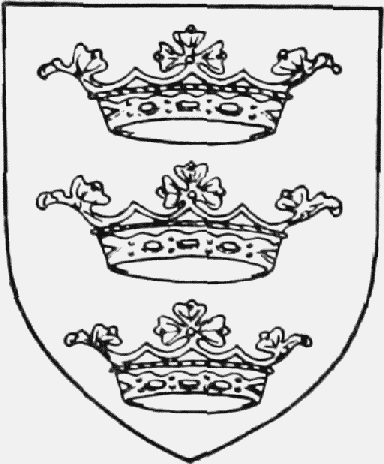
The City and County Borough of Kingston upon Hull. Azure, three open crowns of gold palewise.
Lists of the officers of the corporation are given in all the principal histories of Hull. (fn. 209) None of them is completely reliable. Pryme lists mayors, bailiffs, sheriffs, and chamberlains for the period 1318–1570. Gent lists the mayors, sheriffs, and chamberlains from 1332 until 1734. In the early portion of his list he includes disputed readings and alternative names. Hadley's list, ending in 1790, seems to have been copied from Gent's, although he does not include the alternative suggestions. Tickell lists mayors and sheriffs from 1332 to 1791, and recorders from 1546 to 1721. His lists differ noticeably from the foregoing. Frost lists mayors and bailiffs from 1301 until 1400. Sheahan lists mayors and sheriffs from 1331 to 1864. His list agrees in general with Frost's for the early years, but elsewhere is often at variance with it and with previous lists. (fn. 210)