Survey of London: Volume 13, St Margaret, Westminster, Part II: Whitehall I. Originally published by London County Council, London, 1930.
This free content was digitised by double rekeying. All rights reserved.
'Whitehall Palace: History', in Survey of London: Volume 13, St Margaret, Westminster, Part II: Whitehall I, ed. Montagu H Cox, Philip Norman (London, 1930), British History Online https://www.british-history.ac.uk/survey-london/vol13/pt2/pp10-40 [accessed 1 May 2025].
'Whitehall Palace: History', in Survey of London: Volume 13, St Margaret, Westminster, Part II: Whitehall I. Edited by Montagu H Cox, Philip Norman (London, 1930), British History Online, accessed May 1, 2025, https://www.british-history.ac.uk/survey-london/vol13/pt2/pp10-40.
"Whitehall Palace: History". Survey of London: Volume 13, St Margaret, Westminster, Part II: Whitehall I. Ed. Montagu H Cox, Philip Norman (London, 1930), British History Online. Web. 1 May 2025. https://www.british-history.ac.uk/survey-london/vol13/pt2/pp10-40.
In this section
CHAPTER 2: WHITEHALL PALACE—HISTORY
The King did not wait for the completion of the legal formalities before taking possession of York Place. On 2nd November, 1529, only a few days after Wolsey's departure, he came from Greenwich by water, "and landed at the house which once belonged to the Cardinal, where he has found handsome and well-furnished apartments, provided with everything that could be wished." (fn. n1) In the Privy Purse Expenses of Henry VIII (fn. n2) are several items relating to York Place from November, 1529, to January, 1529–30, such as: (fn. n3)
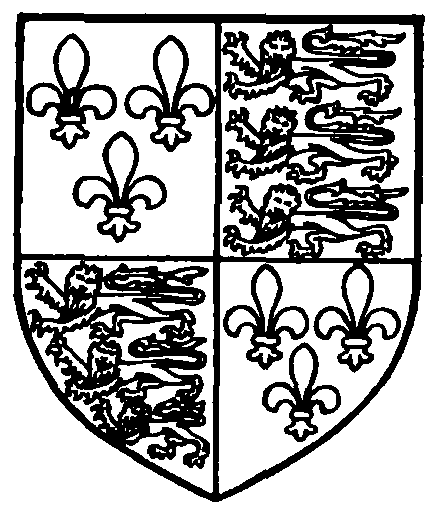
Henry VIII.
Among the same expenses are two items of payment to Doctor Stubbs (i) in November, 1529, of £200 "for his bylding at yorke place," and (ii) on 1st April, 1530, of £400 "to be employed aboute the Kinges buyeldinges at yorke place."
Lawrence Stubbs was Wolsey's almoner (fn. n4) and acted as his surveyor. (fn. n5) On 17th May, 1530, he wrote to Wolsey (fn. n6) concerning the £1000 which the King had granted for the payment of the cardinal's debts, stating that the Council had ordered him, after paying the creditors of the household, to use the rest for paying persons "who made exclamation for lack of payment for buildings," and that he had accordingly paid the painter, the smith, the glazier and others at daily wages, who were unpaid for work at Esher and York Place. He was unable to pay James Nedam, in full, but the King had paid the remainder. (fn. n7) Again, on 1st July, 1530, he tells Wolsey that he is "abiding here at Westminster for the King's buildings." (fn. n8)
It appears therefore that the works referred to in the privy purse expenses were in continuation of those set on foot by Wolsey. The King's plans were, however, by no means limited to such rebuilding and extensions as Wolsey had contemplated. The old Palace of Westminster had fallen into decay, and Henry had in view the erection of a new Royal Palace on the site of York Place, of much greater extent than the latter, and provided with a large park. For this purpose he effected exchanges of land with the Abbey of Westminster and the College of Eton, acquiring from the latter the Hospital of St. James (which he rebuilt as St. James's Palace) and 185½ acres of land, most of which lay between Charing Cross and Eye Hill. (fn. n9) The indenture was dated 5th September, 1531. The property acquired from the Abbey is set out in the Act of 1531 (23 Henry VIII, c. 33—Private) transcribed in Appendix A. That on the west side of the road included the Abbey's properties between the brewhouse called the Axe (on the site of Downing Street) and Charing Cross, as well as Petty Calais (fn. n10) and lands lying next to and intermingled with the lands of Eton. Most of this was added (as well as certain property in other ownership) to the Eton lands to form St. James's Park, but a portion was utilised for what may be called the "recreation" side of the new Palace. The cockpit, tennis courts, tilt yard, bowling alley, pheasant yard, etc., were provided on this side of the road, and access to them from the main portion of the Palace was afforded by two gates spanning the road from Westminster to Charing Cross. These buildings, so far as they were in the parish of St. Margaret's, will be dealt with in the next volume.
On the east side of the road the acquisitions from the Abbey comprised all the property extending from Lamb Alley to the Bars next to York Place, and from "Scotland" to the chapel of St. Mary Rouncivall. The latter property (Craig's Court) lay in the parish of St. Martin-in-theFields, and was never used as part of the Palace, and it is with the former property that we have here to deal.
The grant by the Abbey was, like the indenture with Eton, dated 5th September, 1531, (fn. n11) but the leasehold interests in the property on the east side of the road had been acquired nearly four months earlier. (fn. n12) Unfortunately, the descriptions contained in the indentures are not very detailed, but in most cases copies of the original leases are available, and from the particulars therein given it is possible to obtain an approximate estimate of the amount of the property acquired.
This extended from Lamb Alley to the Bars. The position of the latter is not known. If it were not for this fact, no investigation would be necessary, for the site of Lamb Alley can be identified (see p. 229), its northern side being almost in a line with the southern face of the King Street Gate.
(i) The property immediately south of the Bars was that of which Wolsey had purchased the leasehold interest from Lytton (see p. 8). The width along the street was 108 feet 11 inches, and it was bounded on the south by the ground in the tenure of Thomas a Legh.
(ii) The property of Legh is described (fn. n13) as a great gate with chamber and 6 tenements with garden adjoining and 4 cottages towards the lane called "le Endif" (fn. n14) on the south, the whole being in King Street between the tenements late of Edmund Chaderton and the lane called "le Endyf" on the south, the property of Richard Lytton on the north, and the Thames on the east. The dimensions were: east to west 23 "virgae" of 15 feet each, north to south towards the street 4 "virgae," 13 feet and 11 inches, and towards the Thames 5 "virgae" and 9 feet, at the east end from the lane called "le Endyf" to Lytton's tenement 6 "virgae" and 9 feet, and in the middle next the "piretum" 3 "virgae" and 2 feet. The four cottages contained in length from the house of John Holland to the Thames 8 "virgae" and 3 feet.
(iii) In the northern angle of King Street and Endif Lane, bounded north and east by (ii), was the property leased (fn. n15) to Edmund Chaderton and John "Holand." It is described as three tenements, with gardens adjoining, in King Street, next to the lane leading to the water of Thames and called "Endive," abutting on King Street west, the garden late of Walter Lokyngton and formerly of David Selly (fn. n16) east and north, and the lane on the south. The dimensions were: from King Street to Lokyngton's garden 168 feet, from the lane to Lokyngton's garden on the east side 65 feet, and along King Street on the west side 50 feet.
(iv) South of the lane was a tenement with chamber above leased to Richard Walker. (fn. n17) It is described as abutting on the lane called "le Endiff Lane" on the north and a messuage called "le Rose" on the south. The tenement was 16 feet 4 inches from east to west, and 10 feet 2 inches north to south along King Street, while the chamber was 24 feet each way.
(v) Next came the messuage called "The Rose" with a shop and two tenements annexed, leased to Edward Yngham. (fn. n18) The messuage abutted on Walker's tenement on the north and on a tenement demised to John Henbury on the south, and along King Street had a width of 40 feet. Its length from King Street to "le Entre" was 52 feet, and from "le Entre" along the tenement demised to Thomas "Bryhtman" as far as the latter's stone wall 88 feet. The garden contained at the end where it abutted on "le Endyff Lane" on the north to the stream [i.e. the Clowson] on the south 76 feet, and where it abutted on the garden of Henbury from Brightman's wall to the stable 44 feet.
(vi) The next property was that of Thomas Brightman mentioned above, consisting of the "Berehouse [or Brewhouse] buylded at Endiff." It obviously lay behind The Rose and did not abut on King Street. No details are given in any of the numerous leases of this property or in the sale by Brightman to Henry VIII. (fn. n19)
(vii) South of (v) was the property of John Henbury. In the sale of Henbury's interest to Henry VIII it is described as "certen tentilde;ts, curtilages, closes and gardeynes wth the appurtenants, set and being in the kings strete … as they be conteyned with their mets and bounds lymyted in the … indenture" of lease of 25th July, 1508. The lease unfortunately cannot be referred to, as the Westminster Abbey Register for the years 1504–9 is missing. From particulars contained in a document concerning the properties between Endif Lane and Lamb Alley belonging to Westminster Abbey, it appears, however, that Henbury's property was The Red Lion, and that it extended southwards as far as Lamb Alley. (fn. n20) On 1st May, 1529, Henbury sub-leased to Robert Penythorn (fn. n21) a part of the property described as "all thoise his howsynges callyd the hall, parlor, kechyn & the lyttell Chambre Whiche one Thomas Tomlyn nowe holdyth … & a Stable, togyder wt all the Chambers beyng over the sayd hall, parlor, kechyn & lyttell chambre, And also the Wharf sett & lyeng at the watesyde & beyng on the baksyde of the tenement Bruhows callyd the Redd lyon … Betwene the pale & wharf lately lett to Ferme unto one William Hawkyns agaynst the Sowth & the comon dyche callyd Clowson towards the North, and the water off Temys towards the Est, & Agaynst the grounde of the sayd John Henbury towards the Sowth … And also a Gardeyn lyeng next to the Gardeyn of the sayd John Henbury, Al whiche the sayd Wharf, hall, parlor, wt all the Chambres & Gardeyn one Rauf Williams late hild & occupied." This shows that Henbury's property reached to the Thames on the east. Although it extended southwards as far as Lamb Alley, this must have been on the east side, for other premises intervened on the side of the street.
(viii) South of The Red Lion was the property of John Kellett. It is described (fn. n22) as a tenement, with garden adjoining, in King Street, extending from the street on the west along a tenement on the north side called "le red lyon" to a ditch called "le Clowson" on the east 153 feet, and on the south from King Street along a tenement in the tenure of the widow of Robert Currall 102½ feet, and in breadth from north to south along King Street 37½ feet. At the east end the width of the tenement was 90 feet.
(ix) We now come to Currall's property. On 10th February, 1521–2, the Abbey leased to Robert Currer (or Currall) three tenements in King Street, 95 feet long from west to east on the north side and 116 feet on the south, 38 feet wide on the west side along King Street and 50 feet on the east along the common ditch, abutting on the house of John Pomfrett (obviously Kellett's predecessor) on the north and on the tenement of Thomas Wyld on the south. (fn. n23) On 12th April, 1527, Currer ("yoman coke of my lord cardinalls hall") granted a sub-lease of part of the property, described as a tenement "sett, lying & beyng in the King Strete … on the north side of the Lambe alley", to Henry Hayes, (fn. n24) so that Currer's property obviously reached as far as Lamb Alley, on the street side.
The tenement of Wyld has not been identified, but the presence of another house between Currer's property and Lamb Alley is quite inconsistent with the description of Hayes' tenement. The document of Westminster Abbey referred to above contains no mention of any property that can possibly be identified with Wyld's house. In fact, all the properties mentioned therein have now been dealt with. Wyld's house must therefore have been on the other side of Lamb Alley. (fn. n25)
In framing an estimate of the extent of the property purchased between the Bars and Lamb Alley we are faced with two unknown quantities (i) the width of Endif Lane, and (ii) the width of The Red Lion. The former was probably in the nature of 12 feet, the latter we may conjecture to have been about 32 feet. With these assumptions the extent was as follows:
This figure places the Bars near the line of the south end of the Banqueting House and the northern line of the Holbein Gate. Owing principally to the lack of details of Henbury's property, it is not possible to plot out the properties south of Endif Lane, but an attempt has been made to do this north of the lane, and the result is given on p. 17. Needless to say, this must not be taken to be anything more than a rough approximation. Two important factors are unknown—(i) the line of the river wall, if, as is probably the case, it differed from that adopted by Henry VIII when laying out the Palace extension, and (ii) the point at which Endif Lane met the river. In the case of the former, the extension southward of the line to the north of Whitehall Stairs has been adopted as probable.
It will be seen that the adoption of the lengths of 357 feet and 168 + 123 feet given in the leases as the length of Lytton's land and of the properties on the north side of Endif Lane indicates that the eastern line of the road south of the Bars was much nearer the river than the later line shown on the plan of 1670. The length of 345 feet ascribed to Thomas a Legh's property cannot be fitted into the line given by the above figures, but even if it is correct, the western part of this property is still about 55 feet from the later line of King Street. At the south end the distance from the river was 341 feet (see p. 229) as against about 360 feet in the case of the later line. It would therefore appear that the old eastern line of the highway south of the Bars was practically a continuation of the modern line north of that point, but that from Endif Lane it sloped so as to reduce the width of the road to a more normal amount. There is no reason to believe that the eastern line north of the Bars has ever varied, and the plan of 1670 shows that the expansion of the highway in that direction was formed by a curve in the western line starting from near the site of the Admiralty. The reason for the expansion is suggested by a description (fn. n26) of six tenements on the west side of the road, north of the Bars, purchased by Henry VIII, as "set and lyeng ayenst the white crosse and ayenst the grene before the Kinges Manor latelie called Yorke Place." We may therefore imagine the road at this point broadening out round an open grass space and a cross. (fn. n27) (fn. c1)
The King's plans were all ready, (fn. n28) and it is probable that building operations were started immediately upon the acquisition of the leasehold interests in May, 1531. To what extent the existing buildings of York Place were demolished it is impossible to say, but certainly some were pulled down. The accounts (fn. n29) contain references to "two pykes to two Shores made for the overthrowing of the wallis of the greate Towre in the palesse," "labourers … occupied in … overthrowing the wallis aswelle of the kinges place in the paleis as also at the mewis and Kennyngton place," "iij pyckaxis with hamber heedis provided for breking downe of the greate Toure in the palesse," "the wagies of hym which deviseth the engynnes for the overthrowing of the wallis at the paleis and Kennyngton place," "to Rauffe Williams for a bargeyne in greate with hym made for the taking downe of a Toure of Stone and bricke at the Kings place within his paleis." While speaking of demolitions it may be remarked that some of the stone used for Whitehall was obtained from the destruction of Wolsey's college at Ipswich. (fn. n30)
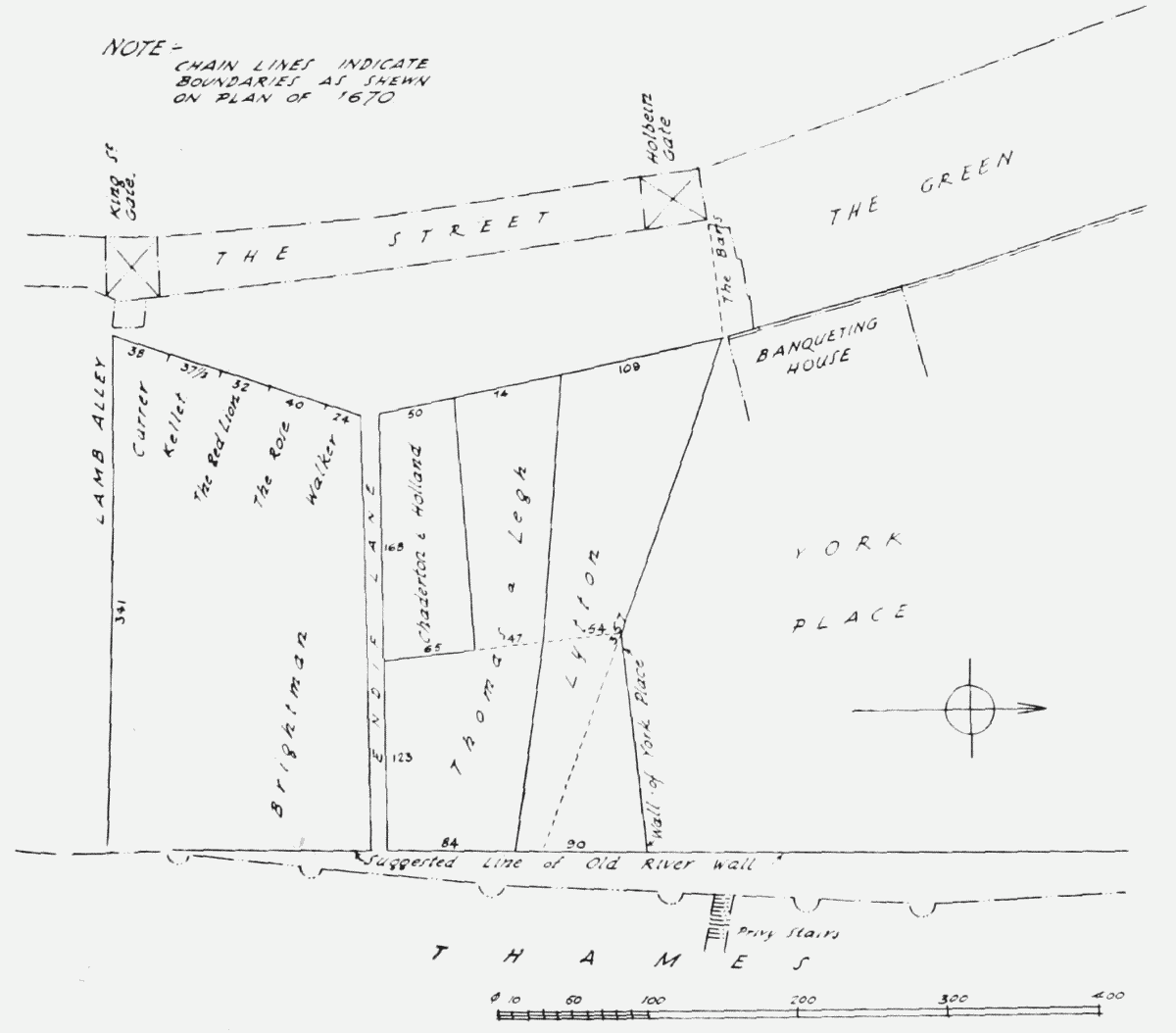
PROPERTY BETWEEN LAMB ALLEY AND YORK PLACE ACQUIRED IN 1531
There seems no reason to suppose that the central part of Wolsey's mansion was pulled down. The Hall had only just been rebuilt (see p. 8), if indeed it was finished, and the wine cellar close by still persists. The exact extent of York Place, as Wolsey left it, is a matter of speculation. Even if he had not built on the ground acquired from Lytton, the measurements of that property show that in the middle and towards the east York Place reached further south than the Bars which were its boundary on the street side. Again, in view of the uncertainty attaching to the position of the boundary between York Place and "Scotland,"it is impossible to say whether Wolsey had utilised any portion of the latter for building, though the references quoted below suggest that it was still open ground. It had been resumed by Henry VIII on the cardinal's fall (though no record of the resumption has been found) and is alluded to occasionally in the accounts. (fn. n31)
How far the lay out of the Palace, as orĩginally constructed by Henry VIII, corresponded with that of the Whitehall of, say, Charles II's time, is not known, but it certainly differed in some respects. One great difference was in its extent to the south. As appears from the above, the property acquired by the King reached only as far as Lamb Alley, and it is shown on p. 228 that the site of The Lamb, with its gardens and meadows, on the south side of Lamb Alley, was not used as part of the Palace until about 1545, when it was converted into the Palace orchard.
In the early part of 1531–2 the orchard was apparently on the north side of Endif Lane, (fn. n32) but in the course of that year was extended to Lamb Alley. The accounts contain entries relating to the employment of "xxv Gardeneres for the levelling of a certeyne Grounde late Edified, appoyntid by the Kinges highnes for the enlarging of his Orcheyarde annexid unto his forenamed manor," to "breking, taking up and conveying awey the olde walle of a Foundacion by the Theamyse side, Cont' in length from Endyve lane to the fornamed lamb Aleye," to making a new wall "by the Theamyse side enclosing the ende of the Orcheyarde there," and to "pyles drevyn in the Foundacion of the walle made betwyxte of the Theamyse and the forenamed Grounde appoyntid for the enlargeing of the Orcheyarde." (fn. n33) It would therefore appear that from 1531 to about 1545 the site of the later Privy Garden was occupied by the Orchard.
The Privy Gallery, one of the most striking features of Henry VIII's Whitehall, and referred to on numerous occasions in the building accounts as "the new gallery," was brought from Esher. (fn. n34) The frame of the gallery was set up in a field on the west side of the road, (fn. n35) and subsequent entries refer to the putting together of the frame, (fn. n36) the formation of the walls (fn. n37) and the masons' work. (fn. n38)
Other galleries referred to are (i) the gallery next the Thames, (ii) the low gallery by the orchard, (iii) the low gallery in the garden, and (iv) the nether gallery. (i) is probably to be identified with the later Shield Gallery. (ii) The "lowe galarye by the Orcheyarde" (fn. n39) [i.e. the later Privy Garden] is almost certainly the Stone Gallery, which ran at right angles to the Privy Gallery. An early entry mentions brick "spente in and upon a Chymney made in a lodgeing late altrid and transposid in the lowe galarye annexid unto the new Galarye nowe in making, and towardes a Chymney and a jakes made in the crosse houses in like maner nowe in making." (fn. n40) Its walls were decorated with an illustration of the King's coronation, (fn. n41) but as no subsequent reference to this adornment has been found, it has not been possible definitely to identify the gallery. As the orchard adjoined the Thames (see above), the southernmost part of the Stone Gallery and of the lodgings which afterwards occupied the whole space between the gallery and the river could not yet have been built. The southern block of the Privy Lodgings was, at least as early as the reign of Elizabeth, known as the Prince's Lodgings. (fn. n42) As the allusion in the name can hardly have been to any other than the prince who afterwards became Edward VI, these buildings must have been erected at some time between 1532 and 1547.
(iii) & (iv). The "lowe galarye within the gardeyne" (fn. n43) and the "nether galarye in the Gardeyne" (fn. n44) may be identical.
The garden in question is probably the old garden of York Place, and was almost certainly situated (see p. 88) on the other side of the Privy Gallery, on the site of the later Preaching Place Court of Pebble Court.
The extension of the Palace on the west side of the road resulted in travellers from Charing Cross to Westminster or vice versa having literally to pass through it. It happened too that when parishioners of St. Margaret's, who were resident in St. Martin's, died, their bodies were brought through the Holbein and King Street Gates, and the narrow road through the Palace lying between, in order to be buried in St. Margaret's churchyard. This caused considerable apprehension to the King, who was afraid of infection arising from those who had died of plague or "other contagious sickness," and he therefore on 12th November, 1534, directed that in future all parishioners of St. Margaret's resident in St. Martin's should be deemed to be parishioners of the latter parish, and be buried accordingly in St. Martin's. The text of the letter embodying this decision is given in Appendix B. It was followed up in 1542 by letters patent decreeing that the portion of St. Margaret's which lay north of Whitehall should be annexed to St. Martin's. (fn. n45)
Henry had now, to use the language of the statute of 1536 (28 Henry VIII, c. 12), "apon the soyle of the said mansion place & howse [York Place], & apon the ground therunto adioynyng, most sumptuosly & curyously … buylded & edyffyed many & dystryncte, beautyffull, costly & pleasant lodgyngs, buyldyngs & mansions, for his gracys synguler pleasure, comforte & Commodite, to the greate honor of his highnes & of his realme, & therunto adioynyng … made a Parke, Walled & envyroned wt brycke & stone, & theryn … devysed & ordeyned many & syngler commodious thyngs, pleasurs & other necessaryes, most apt & convenyent to apperteyne only to so noble a prynce, for his syngler comforte, passetyme & solace." The title "York Place" was no longer suitable, and it was therefore ordained that the whole of the Palace and park should be "called and namyd the Kyng's Pales att Westm,'"and that the old palace of Westminster should be reputed only as a member and parcel of the said new palace. We have here no mention of "Whitehall"—a name which seems, however, already to have been sparingly in use. The earliest instance occurs in a document (Westmr. Abbey Deed, 18049A) of about Michaelmas, 1530, concerning property on the west side of the road "prope mansion' dni Regis vic' Whytehale alias Yorke place." Two other early instances are dated 1533 and occur in (i) Wriothesley's account of Anne Boleyn retiring after her coronation feast "by water to Yorke Place, which is called White Hall, "and (ii) the account in the Chronicle of the Grey Friars of her being brought before her coronation to "Whytt halle at Westmyster that some tyme was the bysshoppe of Yorkes place." The name "York Place," however, continued for several years to be generally used, and "Whitehall" does not seem to have completely superseded it until about 1542. The name may be supposed to have reference to the appearance of the new stone buildings of the Palace. (fn. n46)
The Palace had hardly been completed before it received a new Queen. Anne Boleyn had resided there before the alterations were put in hand, and is alluded to in the building accounts (fn. n47) as "Lady Anne Rochford." Her arrival at Whitehall on the day of her coronation has already been mentioned (see p. 21), and on the following day the new tilt yard (on the site of the Horse Guards) was the scene of "great justes … donne by eightene lordes and knightes." (fn. n48)
Three years passed, and on 19th May, 1536, Anne was beheaded on Tower Hill. Next day, Jane Seymour was formally betrothed to Henry, and on 30th May she was married "in the Queen's closet at York Place." (fn. n49) Wriothesley gives an account (fn. n50) of a kind of naval engagement on the Thames before "Yorke Place" a month later (29th June). "Their was a great boote made like a caricke, goodlie trymmed with targattes and ordinance and full of men of armes, and also their was three other bootes made like foistes, which warred against the carick, and so shott great peeces of ordinance one against another by the space of tow howers long." Some casualties occurred, and the King stopped the fight. "Then was justing at the tilte before the said Yorke Place on the land … which was a goodlie sight to beholde; the King and the Queene standing in the gatehowse beholding them."
Henry died at Whitehall on 28th January, 1546–7, (fn. n51) and three weeks later Edward VI was brought thither from the Tower in readiness for his coronation. During the six years of his reign Edward spend most of his time either at Whitehall or Greenwich. For an account of his erection of a pulpit in the Privy Garden see p. 88. Edward died at Greenwich on 6th July, 1553, and a month later his body, which had been embalmed, was removed to Whitehall for burial in Westminster Abbey.
Mary, during her short reign, spent some portion of her time at Whitehall, but her favourite residence was St. James's. On 14th January, 1553–4, she received at Whitehall the special ambassadors from the Emperor, who had come to treat concerning her marriage with Philip of Spain. During the advance of Whatt from Charing Cross to Ludgate in the early morning of 8th February, "a certein Captayne of the said rebelles with divers of his souldiers retourned from Charingecrosse, downe to the court gate at white halle, and gave a larme before the gate, and shotte divers arrowes into the saied courte the gate being open, in so muche that one maister Nicolas Rockewood being a gentilman of Lyncolnes inne, and in armour at the said court gate, was shotte throughe his nose with an arrowe by the rebelles. For the comminge of the said rebelles was not loked for that way." (fn. n52) The rebellion collapsed, and a fortnight later the men of Kent came to Whitehall, bound two and two together, and with halters round their necks, and "be-twyn the ij tyltes the powr presonars knelyd downe in the myre, and ther the Quens grace lokyd owt over the gatt and gayff them all pardon, and they cryd owt "God save quen Mare!" (fn. n53) On 27th November, 1554, Parliament was summoned to the presence chamber at Whitehall before Philip and Mary to receive Cardinal Pole as special ambassador from the Pope. A year later (4th November, 1555) Pole held a synod of both the convocations at Whitehall, that place being selected because Pole at the time was lodging in the Palace, and to allow Gardiner, Bishop of Winchester and Lord Chancellor, who resided there and was very ill, to attend the meeting. (fn. n54) Gardiner died at Whitehall about a week later. On Philip's short second visit in 1557 the King and Queen spent most of the time at Whitehall, where on 2nd July the former stood sponsor to the son of the Duke of Norfolk. Philip left London for good on the following day, and Mary soon after removed to Richmond. She returned in November to Whitehall, whence she rode on 20th January, 1557–8, to open Parliament. (fn. n55) On 7th March Parliament was held at Whitehall, and three days later Mary left the Palace for the last time. (fn. n56)
Elizabeth was at Hatfield when her sister died, and did not arrive at Whitehall until just before Christmas. On 14th January, 1558–9, she left the Tower, where she had been staying for a couple of days, and made a ceremonial entry through the city, where she was greeted with one pageant after another, to Whitehall, to prepare for her coronation on the following day.
It must be remembered that, like other Tudor sovereigns, Elizabeth had the choice of several royal residences, and was in the habit of spending some time at each. She was thus frequently, and at times for rather long periods, at Somerset House, St. James's, Greenwich, Hampton Court, Richmond, Windsor, Oatlands and Nonsuch. Moreover, she frequently went on progresses, sometimes extending over many weeks, through the country. She was, however, in residence at Whitehall for something like a quarter of the whole time during the reign. (fn. n57)
In February, 1558–9, the Speaker and other members of the House of Commons attended at Whitehall to address the Queen on the subject of her marriage. On the day appointed Elizabeth "came foorth into the greate gallery at White-Hall, richly furnished in attire, and honorably attended," and listened to the Speaker's "sett oratione." (fn. n58) To this she gave the wellknown answer, which closed with the memorable words: "As for me, it shall be sufficient that a marble stone shall declare that a queen, having lived and reigned so many years, died a virgin."
We have an account of a river pageant at Whitehall on May-day in the Queen's first year. Two pinnaces, decked with streamers and flags, over against "the Quens plasse at Westmynster," fought against one another with eggs, oranges and squibs. A squib fell on a bag of gunpowder "and sett dyvers men a fyre." One of the pinnaces was "over-swelmed," and many persons fell in the water, "butt, thanke be God, there was but on man drowynd, and a C. bottes abowtt here, and the Quens grace and her lordes and lades lokyng out of wyndows." (fn. n59)
Later in the month Elizabeth received the French ambassadors with much pomp and ceremony. On 24th May the Duc de Montmorency and his colleagues arrived, and "entered the great hall on the ground floor, hung with very choice tapestries, with the canopy, throne and royal cushions." Then "mounting the stairs, they went to kiss [hands] and do reverence to the Queen, who received them very joyfully and graciously, going to meet them as far as the guard chamber at the head of the stairs, and being conducted to the presence chamber they presented their credentials, and explained their embassy." (fn. n60)
Montmorency came again in 1572 to treat concerning the proposed marriage of the Queen to the Duc d' Alencon, (fn. n61) and a special Banqueting House was provided (see p. 116) for the festivities. A more splendid Banquenting House was erected in 1581, when other commissioners, followed by d' Alencon himself, came over for the same purpose. Plays, masques, jousts and other entertainments of a princely charcter were given, and the Queen is represented as only giving thought to "whether there are any new devices in the joust, or where a ball is to be held, what beautiful women are to be at court." (fn. n62)
Visits of other ambassadors and foreign notabilities there were of course in plenty. Thus in 1600–1 we have reference to "makeinge ready the gallerye at Whitehall for her Matie and the twoe Ambassadors againste the runninge at Tilte" (November, 1600); "makinge readye a standinge in ye Tiltyeard for the Barbaria Ambassador at the runninge" (November, 1600); "makeinge readye at Whitehall againste the comeinge thether of the Ambassador and the duke of Bracchiano" (January, 1601); "makeinge readie at Whitehall against the comeinge of the Muscovia Ambassador" (March, 1601). (fn. n63)
Sometimes the Palace was decked in its best for the benefit of foreign sightseers. For instance in September, 1578, the keeper of the standing wardrobe had to arrange for the Queen's apartments to be hung and furnished "wth riche stuffe … againste the comminge of a frenche Lorde to se the howse," (fn. n64) and in September, 1581, is an entry of expenditure in "makinge reddye by her Mats Comaundemt of Whitehaule for cominge thether of the Countie of Emden and his Trayne to see the magnificence of the same." (fn. n65) On both these occasions the Court was elsewhere, and the costly hangings and other decorations had been taken down.
Ordinarily, the festivities at Whitehall were concentrated about the anniversary of Elizabeth's accesion (in November), Christmas and Shrovetide. It was particularly at the first-mentioned "that the tilt-yard of Westminster blazed with the pageantry and range with the spears of the manhood of England." (fn. n66) At the two other seasons masques and plays were the chief amusements provided, and were usually given in the Great Hall or in the Great Chamber. (fn. n67) Plays seem to have increased in number towards the end of the reign, elevan being recorded in the winter of 1600–1.
Of building at Whitehall during Elizabeth's reign we hear but little. The erection of the Banquenting House in 1581 has already been referred to. Otherwise the only operations on any large scale were in connection with the "longe raunge of the newe buildinges nexte the streete where the officers of the housholde do lye." (fn. n68) … These, which were erected in 1601, were probably in the neighbourhood of Scotland Yard.
Elizabeth died at Richmond on 24th March, 1602–3. Her body was brought to Whitehall for the funeral, which took place on 28th April, at Westminster Abbey. (fn. n69)
James I was staying at Whitehall at the time of his coronation (25th July, 1603), but his earliest residence there for more than a few days was in February-March of the following year. During his reign the Court was generally at Whitehall, Hampton Court or Windsor. "After the winter of 1603, when plague held him at Hampton Court, his Christmasses and Shrovetides were invariably at Whitehall, and hither he always proceeded at the end of October, in time for the celebration of All Saints' Day on 1st November … The Twelve Nights, with Candlemas and Shrovetide, remained the chief seasons for plays and masks, (fn. n70) but the plays were greatly increased in number. One was often given on All Saints' Day to usher in the winter, and others were called for at intervals during the winter months. James was also regularly at Whitehall on his Accession Day, 24th March, which, like his predecessor, he honoured with a tilt." (fn. n71)
The first notable event of the reign, so far as Whitehall is concerned, was the arrival towards the end of 1604 of the Queen's brother, the Duke of Holstein. (fn. n72) The visit of the duke is chiefly remarkable for the questions of precedence which arose between him and the ambassadors, and which made the lives of the great court officials a burden. On the occasion of the marriage of Sir Philip Herbert at Whitehall on 27th December, 1604, the Venetian ambassador managed to get a more honourable seat at dinner than the duke, who, in consequence, was rather put out. At supper-time, however, the duke stole a march on the ambassador, got to table first, and took the latter's place. The ambassador was furious, and positively declined to attend the masque which was to follow unless his proper place was given him. An apology was made, and the King himself conducted him to the Hall for the masque, where a seat was prepared for him on the King's right hand. The duke was accommodated with a seat on the left of the Queen, but he declined to avail himself of it, preferring to stand for the three hours during which the masque and balls lasted. (fn. n73) The duke stayed in England until the beginning of June, (fn. n74) and about a year later his brother, Christian IV of Denmark, came. His only visit to Whitehall was a matter of two days, (fn. n75) at the beginning of August, 1606.
In the following year we are introduced to the first of James' unworthy favourites. Robert Carr, afterwards successively Viscount Rochester and Earl of Somerset, being in attendance on Lord Dingwall at the tilt yard at Whitehall, fell with his horse and broke his leg. According to Weldon (fn. n76) he was carried into a house at Charing Cross, where the king frequently visited him until his recovery, but it would rather appear from the official records that he was lodged in the Palace. (fn. n77)
The same year saw the erection of the new Banqueting House (see p. 118), as well as the rebuilding of "the oulde buildinges betwene the banquettinge house and Councell chamber." (fn. n78)
In 1612–13 the ceremonies at Whitehall reached their high-water mark in the festivities which greeted the Elector Palatine on his visit to woo and wed the Princess Elizabeth. He arrived at Whitehall on 18th October. He was provided with apartments at first in Essex House, and afterwards in the Lord Treasurer's lodgings in the Palace, and created a most favourable impression by his constant attendance on the Princess, who had a separate establishment at the Cockpit. (fn. n79) The death of Prince Henry on 6th November was not allowed to interfere with the elector's courtship. On 27th December the royal pair were betrothed in the Banqueting House. On 11th and 13th February, there were fireworks and a triumph on the Thames, and on 14th February the marriage was performed in Whitehall Chapel. The feast was provided in a new Banqueting House erected for the occasion (see p. 61), and was followed by a masque in the Banqueting House proper. On the next night another masque was given in the Great Hall. The elector and his bride left Whitehall on 10th April.
In 1616 Prince Charles was created Prince of Wales in the Great Hall of Whitehall.
In January, 1618–19, a great disaster occurred. The Banqueting House, which had only been built about eleven years, was completely destroyed by a fire which also caused damage to the neighbouring buildings (see p. 120.) A new Banqueting House was immediately put in hand.
In addition to the two banqueting houses the principal building operations carried out by James at Whitehall seem to have consisted in the erection in 1617–18 of new lodgings for the Marquess (afterwards Duke) of Buckingham, who had succeeded Somerset in the king's affections. This building was "towards the privie garden", (fn. n80) but its exact position is uncertain.
James died on 27th March, 1625, at Theobald's. Charles I had, after the death of Prince Henry, taken over the latter's establishment at St. James's, and he continued to reside there for some days before taking up his permanent quarters at Whitehall. (fn. n81) Henrietta Maria, whom he married by proxy on 1st May, arrived in England in June. The presence of a Roman Catholic Queen, with a train of attendants belonging to the same religion, necessitated some provision being made for their worship, but, with the exception of one room at Whitehall, (fn. n82) this was provided away from the Palace.
The Queen's French attendants (who, after all, were practically the only companions she had) were at first the cause of considerable illfeeling between the royal pair, and in July, 1626, as the result of a "scene" at Whitehall, the King drove them all from the Palace, (fn. n83) replacing them (in contravention of the marriage treaty) with English.
A rather curious entry in the records, dated 9th July, 1628, concerning a warrant "to ye great Wardrobe for ye delivery of 3 Bedticks unto Mr. Vanderdoort to bee used for the drawing of his Mats Picture" (fn. n84) introduces us to what was perhaps the most striking feature of Charles I's Whitehall—the art collection. Prince Henry had begun the collection, which together with the keeper, Abraham Vanderdoort, had afterwards been taken over by Charles. The latter is said to have built a cabinet at Whitehall (see p. 98), where many of the articles were kept, though most of the pictures and statues were distributed among the galleries and principal rooms of the Palace. A description of the collection (drawn up apparently by Vanderdoort himself) has been edited by Horace Walpole.
John De Critz, sergeant painter, was kept busily employed during the reign. There are many references to his work in the records, some of which will be found later on in this volume. Allusions to works of art also occur. Among others we have references to (i) "repayring & mending twoe great peeces of paynted woork that were done by Palma, thone being the Story of David and Goliah, thother of Saules Conversion, wch were much defaced," "repayring, mending and new varnishing vijen of the greate Emperours Heades that were done by Titian, being likewise much defaced," "painting a large Store in oyle cont' divers naked figures in it bigger then the life, being xven fo. square;" (fn. n85) (ii) "repairing an ould peece of painting of Adam and Eve" (see p. 100), "mending and repairing a picture of Holbyon," "repairing an old Dutch peece" and "mending and repairing a greate old peece of a Musitian painted by Titian, and for mending and repairing the great pece of venus asleep;" (fn. n86) (iii) "Certen Drawings taken oute of the Hangings of the Apostles," "mending and Repairing certen peeces of painting of Julio Romanoes doeing," "guilding with fine Angell gould a Copper plate of St. George for his Mats Cabinett." (fn. n87)
The paintings on the ceiling of the Banqueting House were also done by Rubens at the command of Charles (see p. 127), who had a special hall built for the performance of masques so that the paintings should not be injured (see p. 62). Mention should also be made of Vandyck's residence at Whitehall during this reign. (fn. n88)
On the departure of Charles to the north in March, 1639, to take up arms against the Scots, he left Whitehall in nominal charge of the prince (afterwards Charles II), only nine years old. (fn. n89)
On 10th January, 1641–2, following his unsuccessful attempt to arrest the five members of the House of Commons, he left Whitehall, never to return until he came back to die.
Whitehall was for a time deserted. A graphic, but perhaps overdrawn, picture of its emptiness and desolation is contained in a pamphlet, "A deep sigh breath'd through the lodgings at White-Hall," printed in the same year, from which the following extracts are taken:
"A Pallace without a Presence! A White-Hall clad in sable vestments! … These are misteries and miseries …
"To begin at the entrance into the Court, where there had wont to be a continuall throng, either of Gallants standing to ravish themselves with the sight of Ladies hansome legs and Insteps as they tooke Coach; Or of the tribe of guarded Liveries, by whom you could scarce passe without a jeare or a saucy answer to your question; now if you would aske a question there is no body to make answer …
"Being entred the Court-yard, which had wont to be a Schoole of Complement … now if you have a mind to exercise ther's room enough …
"You may without a rub, walke into the Hall, for surely there are no strong smells out of the Kitching to delight your Nostrells withall, no Provision to bee sould, nor the greasie Scullions to bee seene over Head and Eares in a Kettle full of Kidnies, nor anything else to stoppe your progresse into the House …
"If you steppe up Staires to the Guard Chamber, where His Majesties great Beefe-eaters had wont to sit in attendance on their places, which was nothing but to tell Tales, dovoure the beaverage, keepe a great fire, and carry up Dishes … now they are all vanisht, nothing left but the bare Walls, and a cold Harth, from whence the Fire-irones are removed too, and as its thought converted into shooes for light Horses. The great black-Jackes set under the Table, all full of Cobwebs …
"You may walke into the Presence Chamber with your Hat, Spurres and sword on, And if you will presume to be so unmannerly, you may sit downe in the Chaire of State …
"If you be minded to survey the Lodgings and withdrawing rooms, you shall finde those rich and costly hangings of Persian Arras and Turky worke (like the Bishops) for their pride taken downe …
"In the Cockpit and Revelling Roomes, where at a Play or Masque the darkest night was converted to the brightest Day that ever shin'd, by the luster of Torches, the sparkling of rich Jewells … now you may goe in without a Ticket or the danger of a broken pate, you may enter at the Kings side, walke rounde about the Theaters, view the Pullies, the Engines …
"There is no presse at the Wine-Sellor Dores and Windowes, no gaping noise amongst the angry Cookes in the Kitchings, no wayting for the opening of the Posterne-dore to take water at the Stayres, no racket nor balling in the Tenis Court, no throng nor rumbling of Coaches before the Court Gates, but all in a dumbe silence, as the Pallace stood not neere a well peopled City, but as if it were the decay'd buildings of ruin'd Troy."
In 1643, in anticipation of an attack on London by the Royalist forces, the Parliament threw up fortifications round the City, and it is probably on this occasion (fn. n90) that the gun battery between the Banqueting House and the Holbein Gate, so devised as to sweep the approach to the Palace from Charing Cross, was constructed (see p. 110). It lasted for 80 years.
In the following year steps were taken to "purge" Whitehall. A list was, on 18th June, ordered to be drawn up of "what ill-affected and other Persons do lodge in Whitehall,"and on its being received, it was on 22nd July resolved "That the Committee for Whitehall shall have Power to purge Whitehall from all Papists … all Women whose Husbands are now, or have been, in Service against the Parliament, the Servants and Children of all such, all other ill-affected Persons and Persons of scandalous Conversation, and to dispose of their Lodgings to well-affected Persons." (fn. n91)
In 1648 troops were quartered in the Palace. (fn. n92)
On 19th January, 1648–9, the King, who had been brought to St. James's, was removed thence to Whitehall "and lodged in his usual BedChamber; after which a Guard of Musqueteers were placed, and Centinels at the door of his Chamber." Next day he was taken to Sir Robert Cotton's house near the west end of Westminster Hall, where (except for one night when he was brought back to St. James's) he lodged during his trial. At the rising of the Court he was carried back for a few hours to Whitehall "through the Privy-Garden … to his Bed-Chamber," and thence removed again to St. James's. (fn. n93) The execution was fixed for 30th January. In the morning of that day Charles was brought through the Park, up the stairs that led to the Tilt-yard Gallery, and so over the Holbein Gate to "a room, which is that they now call the Green-chamber." (fn. n94) After resting there for a time, he was led through the Banqueting House to the scaffold, which had been erected in front of that building, (fn. n95) and there beheaded.
All the early accounts of the execution mention the provision of a special means of access from the Banqueting House to the scaffold. Thus Herbert's original MS. (fn. n96) states that "his Maty past to ye scaffold through ye wall yt was purposely broken downe at ye north end of ye roome," while other writers refer to a "window" which was enlarged to allow of the King's passage. Where exactly this special exit was is a question which has been much debated, but certainty on the point seems unattainable. (fn. n97)
Parliament now set about disposing of the furnishings of Whitehall, (fn. n98) and utilising the rooms as lodgings for its own adherents. (fn. n99)
A notable resident in Whitehall at this time was John Milton, though no information is available as to the precise site of his lodgings. On 11th June, 1651, a committee was appointed to confer with the committee of Parliament for Whitehall on "the case of Mr. Milton, in regard of [the latter committee's] positive order for his speedy remove out of his lodgings in Whitehall, and to endeavour with them that Mr. Milton may be continued where he is, in regard of the employment which he is in to the Council, (fn. n100) which necessitates him to reside near the Council." (fn. n101)
In 1650 Cromwell had taken up his quarters at the keeper's house in the Cockpit, but in 1654 he removed to the main building. The course of events can be traced in the following extracts from Severall Proceedings of State Affairs:
24th March, 1653–4—"His Highnesse and Family remain as yet at the Cockpit."
3rd April—"The Lord Ambassador of the King of Portugal had this day audience by His Highnesse the Lord Protector at the Cockpit."
12th April —"On Friday next [14th April] His Highnesse intends to come to Whitehal and is that day to Dine there."
13th April—"This day the Bedchambers and the rest of the lodgings and rooms appointed for the Lord Protector in Whitehall were prepared for his Highnesse to remove from the Cockpit on the morrow."
14th April—"His Highness the Lord Protector with his Lady and Family this day Dined at White-hal, whither His Highness and Family are removed, and did this night lie there, and do there continue."
Cromwell exercised some influence in preventing the entire dispersal of the furnishings of Whitehall. In June, 1653, we hear that "the late King's hangings and furniture are called in, for refitting the rooms at Whitehall," (fn. n102) and the petition of Clement Kinnersley, "wardrobe keeper to the Protector," in December, 1654, mentions that during the nine months of his employment he had got in many goods, which would not else have been recovered, and with which he had furnished Whitehall. (fn. n103) When, a little over a twelvemonth later, Evelyn visited the Palace, he was well satisfied with the way in which it was furnished. (fn. n104)
Among the notable events at Whitehall during Cromwell's residence may be mentioned the attempt by Miles Sindercombe in 1657 to fire the Chapel Royal and murder him in the ensuing confusion (see p. 55), and the marriages of his daughters, Frances and Mary, to Robert Rich, grandson and heir of the Earl of Warwick, and Thomas Belasyse, Viscount (afterwards Earl) Fauconberg, respectively. The marriages were celebrated on 11th and 19th November, 1657, "at Whitehall, with all imaginable pomp and lustre." (fn. n105) An account of the wedding feast of Frances and Robert Rich, which took place at Whitehall on 12th November, states that there were "48 violins and 50 trumpets, and much mirth with frolics, besides mixt dancing (a thing heretofore accounted profane) 'till 5 of the clock" on the following morning. (fn. n106) Rich died a few months later (16th February, 1657–8) "in his apartments in Whitehall." (fn. n107)
Cromwell died at Whitehall on 3rd September, 1658. In the following year we find his widow removed to the lodgings at the Cockpit, and Whitehall put up for sale. (fn. n108) Nothing seems to have come of this, however, and on Monck's arrival in London on 3rd February, 1659–60, the Prince's Lodgings at Whitehall were assigned to him. (fn. n109)
On 29th May, 1660, Charles II arrived at Whitehall by way of the City and Charing Cross, being received by the two houses of Parliament, and what was in some respects the most noteworthy era in Whitehall's history began. In the popular mind Whitehall (apart from its being the scene of the execution of Charles I) is inseparably associated with Charles II, though no doubt this fact is largely due to interest in the King's love affairs. To most people it is the Whitehall of Lady Castlemaine, the Duchess of Portsmouth, "la Belle Stuart," and Nell Gwynne. This is not, however, the whole story. The King's lavish expenditure on building works, the pomp and ceremonial, as well as the court etiquette and manners, which favourably impressed even foreigners who were used to the magnificent court of Louis XIV, gave a splendour and dignity to Whitehall which it had never before had in like measure, and it was this which combined with the popularity of Charles and the romantic careers of the Court beauties to make up the Whitehall of Pepys, Evelyn and De Grammont.
O(?)ne of the first matters that engaged attention was the recovery of the contents of Whitehall that had been dispersed, and Evelyn on 18th June records that plate, hangings, pictures and so forth were then daily being brought in. The statement is confirmed by another writer, (fn. n110) who adds that the Jewel Office was appointed as the place of receipt. "Their you might have seene Carpetts, hangings, pictures, medells, inscriptions and peeces of Art, rich bedds, curtins and vallance comm hilter skilter, many that had bought goods of his majestys on purpose that att his returne they might be restored brought in to the Jewell Office all such." A large amount is said to have been recovered from Cromwell's widow. (fn. n111) The collection later in the year received a valuable addition from the Dutch Government. (fn. n112)
The King's first year at Whitehall was saddened by the deaths of his favourite brother, the Duke of Gloucester, and his sister Mary, Princess of Orange. The former died at Whitehall of smallpox on 13th September. Shortly afterwards the princess arrived. (fn. n113) She had actively exerted herself to promote Charles's restoration, and was assured of a welcome at the English court. She was not, however, overpleased at finding one of her former maids of honour the acknowledged wife of the Duke of York and mother of a prince of the blood royal. She therefore came to the resolution to curtail her visit, but before the time for her departure arrived, she fell ill with smallpox, and died at Whitehall on Christmas Eve.
On 23rd August, 1662, Charles brought home his queen, Catherine of Braganza. Their arrival at the Palace, where the Queen was destined to spend years of misery due to her husband's infidelities, was marked by a magnificent river pageant. An omen of the unhappiness in store for her was provided in the presence of the Countess of Castlemaine among the spectators. (fn. n114) Since the time of Henry VIII the married life of the Kings of England had been without reproach, but now the King not only flaunted his amours openly, but provided apartments in the Palace for his mistresses. The official records mention the residence there, among others, of Lady Castlemaine, the Duchess of Portsmouth, the Duchesse Mazarin, Miss Stuart, and Winifred Wells. The name of Nell Gwynne does not occur. (fn. n115)
Among other residents in Whitehall may be mentioned the notorious Oates and Bedloe, though the rooms they occupied were not in that part of the Palace which lay in St. Margaret's. Lord Arlington received instructions to provide lodgings for Oates "upon His first information concerning ye plott." All rooms being occupied he prevailed on Sir Edward Carteret to give up his rooms from 7th November, 1678, at a rent of £60 a year. (fn. n116) Oates stayed there until 31st August, 1681, when an order was issued to "warne Mr. Oates to Withdraw himselfe from Lodging any longer in ye Court." (fn. n117) Bedloe was provided with Sir Paul Neale's lodgings at £1 a week. (fn. n118)
Charles evidently found Whitehall in a bad condition of repair. The works of reparation, alteration and improvemend detailed in the records are very extensive. A great amount of rebuilding also took place during his reign, the most important works being: (i) the reconstruction of the Court Gate and the building of the new gallery connecting it with the Guard Chamber, (ii) the building of new lodgings in the Volary Garden, (iii) the erection of new rooms for the Queen near the Privy Stairs, and (iv) the provision of a new Bathing Room and Laboratory. Details of these works are given in the next chapter.
On the night of 1st February, 1684–5, the King had been supping with the Duchess of Portsmouth in her apartments at the end of the Stone Gallary. He retired to rest in his usual bed-chamber, attended by the Earl of Ailesbury and Henry Killigrew. The former did not sleep well. "Several circumstances made the lodging very uneasy,—the great grate being filled with Scotch coal that burnt all night, a dozen dogs that came to our bed, and several pendulums that struck at the half quarter, and all not going alike, it was a continual chiming." (fn. n119) The next morning, as the barber was preparing the King for shaving, the latter was suddenly seized with an apoplectic fit. At first he seemed to recover, but on the night of 4th February he became worse, and died on the morning of the 6th.
The brief reign of James II saw the continuance of the building operations set on foot by Charles. The whole of the range of buildings extending from the Holbein Gate eastwards to the Vane Room, including the Privy Gallary, the Council Chamber, and Treasury Offices, was pulled down and rebuilt in sumptuous style (see p. 102). At the west end, on a portion of the Privy Garden, a Roman Catholic Chapel was erected (see p. 105). The rebuilding of the Queen's apartments fronting the river was also put in hand.
On the morning of 18th December, 1688, James left Whitehall, never to return. On 12th February, 1688–9, Mary arrived, in apparently high spirits, ran from room to room, peeped into the closets, examined the quilt of the state bed, and in every way showed a girlish delight at being mistress of so fine a house.
On the following day the Crown of England was offered to William and Mary in the Banqueting House (see p. 137), and they were proclaimed by the heralds at the Court Gate.
Whitehall was not favoured by William as a residence. Its low and damp situation ill suited his asthma, and he found more congenial quarters at Kensington. During his absences from England, however, Mary occasionally resided at Whitehall, (fn. n120) and the only constructional work of importance carried out at the Palace was the formation of what was afterwards known as Queen Mary's Terrace (see p. 59).
Mary died on 28th December, 1694, at Kensington, and her body was removed to Whitehall on the following night. The funeral took place on 5th March, 1694–5.
Fire was always a danger at Whitehall. Mention has already been made of the destruction of the Banqueting House in 1619. On that occasion the fire was only prevented from spreading by the demolition of adjoining buildings. This destruction, and possibly the actual damage by fire to other buildings in the Palace, is reflected in entries relating to "making ready the King and Quenes lodginges at Whitehall after the fyer in the banquetting house" and to "yronworke … made for the privie lodgings at Whitehall since the late accidente of fyre in the banquetting house," as well as a record of payment to "John de Creetes, his Mats sergeaunte Painter, for repairinge and newe framing diverse Peeces in his Mats privy Lodgings at Whitehall, being defaced with the late fier there." (fn. n121) The fire was accompanied, as usual in such circumstances, by plunder. (fn. n122)
In 1651 the Council of State gave instructions for the provision of "two engines to cast water in case of fire, 50 leather buckets, 4 short ladders, and 4 shorter hooks than those already in Whitehall." (fn. n123) A serious fire seems to have taken place in 1661. On 18th October of that year a warrant (fn. n124) was issued for payment of £540 to the paymaster of works "for new building, erecting and repairing of the offices wch were pulled downe to prevent the encrease of the fire lately happening in the Pallace at Whitehall."
A few months later another conflagration occurred. In a letter dated 21st February, 1661–2, (fn. n125) it is stated that "Whitehall was four times on fire in that great wind. (fn. n126) My lord Barclet lost to the value of £500. Secretary Nicklaus his lodgings were on fire and Prince Robart's & my Lord Mandevell's. Duke D'arsy's chamber was plundered, for to prevent the burning he took down his goods, and they cleared his chamber of all, nor can he recover any of them again."
These two disasters coming close together provoked the issue of special regulations (fn. n127) "for avoiding the great dangers happening by fire." All persons having lodgings in the Palace were required to provide as many leather "boquetts" as they had chimneys, and in case of any fire happening every person was at once to send his "boquetts," full of water, to the "ayd therein." Provision was made for an annual inspection of the buckets. In case of a chimney being on fire "so as to be discovered above the top," the owner of the lodgings was to be fined 10s., which sum was to be distributed among the labourers employed for quenching the fire. Finally, in the case of a chimney fire, it was ordered "that they do not fire any guns up the Chimneys, but rather clap a wet sheet very close against the Mantle and jambes."
The Great Fire of London in 1666 caused much apprehension at Whitehall, and Sir John Denham's new buildings in Scotland Yard were pulled down (fn. n128) to prevent the fire reaching the main portion of the Palace if it should come so far.
In the following year another scare occurred, and the orders as to sweeping chimneys and inspection of buckets were renewed. (fn. n129)
When, however, in 1691 a big conflagration broke out, buckets were of little avail. The account of the disaster as given by Luttrell is as follows. "The 9th [April, 1691] about 8 at night, hapned a dismal fire at Whitehal, it began in the duke of Glocesters lodgins, late those of the dutchesse of Portsmouth, occasioned (as said) by the carelesnesse of a maid in burning of a candle from a bunch of candles, and leaving the others lighted, quickly sett fire to the buildings; it burnt violently for several hours, and consumed the greatest part of the stone gallery on both sides, that towards the privy garden and that towards the Thames, wherein were the lodgings of the lord Devonshire, Heer Overkirks, Lord Monmouths, etc.; they blew up several times before it could be stopt."
The fact that "they blew up" is amply confirmed by the entry (fn. n130) in the records relating to the making of "ltie [50] new Shasse Windows in her Mats Lodgings, the Vane Room, Great Anti-Roome, Lord Chamberlains, Lord Portlands and Lord Monmouths Lodgings and in ye New Chappell." The last-mentioned is evidence that the force of the explosions was felt on the other side of the Privy Garden.
This disaster was a small thing compared with what was to come. At about 4 o'clock in the afternoon of 4th January, 1697–8, a Dutch woman in Col. Stanley's lodgings, close to the Earl of Portland's house by the river side, having occasion to dry some linen, lighted a fire of charcoal, and left the linen hanging in too close proximity. It caught fire, and soon the hangings and furniture of the room were involved. The conflagration spread, and, in spite of all endeavours, it persisted until the greater part of the Palace was destroyed. Gunpowder was brought, and orders given to blow up buildings to prevent the progress of the fire, but this seemed only to increase it. (fn. n131) At one time it was thought to have stopped, but it broke out again next the Council Chamber, and only ceased when it reached the Banqueting House and the Holbein Gate. The former building was damaged, and so much apprehension was felt for the Duke of Ormonde's house, on the west side of the Gate, that it was cleared of all its rich furniture and hangings in anticipation of its being consumed. The fire was eventually mastered about 7 o'clock in the following morning, though even then it was glowing in the ruins of the Roman Catholic Chapel. With some exceptions (principally the lodgings of the Earls of Portland and Essex) all the main Palace buildings from the river side to the Holbein Gate and Banqueting House were destroyed, and the havoc extended northwards to Sir Alexander Frasier's house in Scotland Yard. The Chapel Royal, the Great Hall, the Guard Chamber, the Presence Chamber, the Privy Gallery, and the Roman Catholic Chapel were swept out of existence. (fn. n132) About a dozen persons perished, in the flames, or by the falling of materials from the houses, or from the explosions. (fn. n133)

Ruins of Whitehall after the Fire
According to an account contained in Vertue's notebook (fn. n134) all the pictures, tapestry and rich furniture belonging to the Crown were saved by the exertions of Sir John Stanley, "not so much as a Curtain or stool missing."
In the afternoon the King visited the scene, "and seem'd much concern'd, and said, if God would give him leave, he would rebuild it much finer than before." (fn. n135) Wren prepared at least two designs for the rebuilding of the Palace, but nothing was done, and for years the ruins cumbered the ground (see e.g. pp. 152 and 167).
From time to time sites were let on building lease to private individuals, and gradually a new Whitehall of a very different character arose. The story of these buildings is dealt with at length in the pages of this volume. The time is probably now not far distant when they in turn will be swept away.
In The Council's Collection Is:—
(fn. n136) Ruins of Whitehall after the Fire (photograph of water-colour drawing in the Wren Collection in Library of All Souls' College, Oxford).