
Survey of London: Volume 13, St Margaret, Westminster, Part II: Whitehall I. Originally published by London County Council, London, 1930.
This free content was digitised by double rekeying. All rights reserved.
'The Banqueting House', in Survey of London: Volume 13, St Margaret, Westminster, Part II: Whitehall I, (London, 1930) pp. 116-139. British History Online https://www.british-history.ac.uk/survey-london/vol13/pt2/pp116-139 [accessed 12 May 2024].
"The Banqueting House", in Survey of London: Volume 13, St Margaret, Westminster, Part II: Whitehall I, (London, 1930) 116-139. British History Online, accessed May 12, 2024, https://www.british-history.ac.uk/survey-london/vol13/pt2/pp116-139.
"The Banqueting House", Survey of London: Volume 13, St Margaret, Westminster, Part II: Whitehall I, (London, 1930). 116-139. British History Online. Web. 12 May 2024, https://www.british-history.ac.uk/survey-london/vol13/pt2/pp116-139.
In this section
CHAPTER 4: LXIV—THE BANQUETING HOUSE
Ground Landlords, etc.
The premises are the freehold of the Crown, and are at present used by the Royal United Service Institution as a Museum.
Banqueting Houses before 1607.
Henry VIII's Whitehall undoubtedly contained a Banqueting House. This is evidenced by two items in the building accounts dealing with (i) the provision of mats for two chambers "in the lowe galarye directly undre the banquette Chaumbre," and (ii) "the setting of xxviij foote of olde glasse in newe leade with Seemente, and for setting up of the same in the Galarye next unto the Banckette house." (fn. n1) The mention of the "low gallery" suggests that the building was over the Stone Gallery, and the fact that the maps of "Agas" and Braun and Hogenberg (fn. n2) show the site of the present structure unoccupied also points to Henry VIII's Banqueting House being in another portion of the Palace.
Elizabeth built at least two Banqueting Houses of a more or less temporary character. (fn. n3) In 1572, on the occasion of the visit of the French embassy, a Banqueting House was erected "all breaded and decked with flowers on the forrests, and also covered with canvas on the head." (fn. n4)
A more sumptuous building was provided in 1581 in connection with the visit of the embassy from France to negotiate a marriage between Elizabeth and the Duc d' Alencon. A description of it is given in an account (fn. n5) endorsed: "The manore and Charge of the makynge of the greate banketyng house at Whythall at the Intertaymt of mounsere by Queen Elyzabethe, 1581, 23 Eliz." It runs as follows: "Against the Coming of serteyn Com missioners out of Fraunce into England ther was a banquet howse made in manner & fourme of a long square 332 foot in measure about; 30 principalls made of great masts, being xl foot in length apeece, standing upright; betwene every one of theis masts x foot a sunder & more. The walls of this howse was closed wth canvas, and painted all the out sides of the same howse most arteficially wth a worke called rustick, much like unto stone. This howse hath 292 lights of Glas. The sides wth in the same howse was made wth x heights of degrees, for men & weomen to stand upon; and in the top of this howse was wrought most cuninglie upon canvas works of Ivie & holy, wth pendants made of wicker rods, & garnished wth baies, Rue & all manner of strang flowers, and garnished wth spangs of gould, as also garnished wth hanging Toseans made of holly & Ivie, wth all manner of strang fruits, as pomegarnetts, orrengs, pompions, Cowcombers, grapes, carretts, Peaes wth such other like, spanged wth gould & most ritchlie hanged. Betwene thes works of baies & Ivie were great spaces of Canvas, wch was most cuninglie painted, the cloudes wth the starrs, the sunne and sunne beames, wt diverse other coats of sundry sorts belonging to Qs matie, most ritchlie garnished wth gould. This banquet howse was begunne on ye 26 day of marche beinge (fn. n6) Easter Day in the morning. ij men had mischaunces, the one brake his leg & so did the other. Ther were of all manner persons 375. This howse was made in 3 weeks & 3 daies and ended on the 18 day of Aprell. (fn. n6) It cost 1744 li 19s ijd ob., as I was credebly enformed by Tho: Grave, Srveior unto her maties works, who served and gave orders for the same, as appereth by records."
Holinshed (fn. n7) states that the building was "on the southwest side of hir maiesties palace of Whitehall," which, if taken quite liternally, means that it was on the Cockpit side. Looked at from the point of view of the main entrance to the Palace, however, the expression might be interpreted as pointing to a site more or less that of the present Banqueting House, and that such is the correct interpretation is suggested by a marginal note (which has, however, been crossed through) on the document cited above, to the effect that the site was "in the entry of hir maiesties palace."
The natural impression conveyed by the description of the building is of a structure erected merely to meet the requirements of a particular occassion, and destined, like its predecessor of 1572, to be demolished when that occasion was past. There is, however, reason to think that the building lasted for a quarter of a century.
That a more or less substantial Banqueting House existed at Whitehall during the closing years of Elizabeth's reign and the early years of James I is shown by allusions in 1597–8 (fn. n8) to (i) "Cutting out a way of a Chymney in the great Banquetting house," and (ii) "breaking downe a waye in a stone walle under the Banquett house to make a Chymney in Doctor James Office and bringinge upp the same to the battlements," and in 1603–4 (fn. n9) to "making … a bottlehouse under the Banquetting house … for the king." (fn. c1)
This building was almost certainly on the site of that erected in 1607 (and consequently of the present structure). (i). The account of the erection of the 1607 Banqueting House in Howe's continuation of Stow's Chronicle runs: "The last yeare [1606] the king puld downe the old rotten, sleight builded Banqueting house at White hall, and new builded the same this yeare very strong and statlie, being every way larger than the first." It should be noted that the new structure was a "new building" of the old one, which implies that it was on the same site. This impression is confirmed by (ii) the statement of James I himself when, on the occasion of the Queen's masque given in the new building in January, 1607–8, he remarked to the Venetian ambassador that "he intended this function to consecrate the birth of the Great Hall, which his predecessors had left him built merely in wood, but which he had converted into stone." (fn. n10) (iii) In the accounts of the Paymaster of Works for 1606–7 (fn. n11) is an item: "Takeinge downe the olde roofes, flores, partitions and side walles of the oulde buildinges betwene the banquettinge house and Councell chamber, frameinge and settinge upp the greate flore and roofe of the Banquettinge house, and doinge sondrye other woorkes in the newe buildinge of the same." Not only does this confirm the fact that it was a "new building" of the old Banqueting House, but, the position of the Council chamber being known (see p. 98), the reference to the buildings between it and the Banqueting House is almost conclusive in fixing the latter at or near the present site.
Von Wedel in the account of his visit to Whitehall in 1584 (fn. n12) describes how, after leaving the Preaching Court, he was conducted "into a high and spacious house with many windows, and inside full of seats and benches one above the other, so that many people may be seated there. The ceiling is hung with leaves and thick bushes. When foreign gentlemen are present the queen orders all sorts of amusements to be arranged here, while above in the bushes birds sing beautifully." The building described by Von Wedel might well be the 1581 Banqueting House, and its site (after leaving the Preaching Court) corresponds generally with that of the pre-1607 Banqueting House. It is, moreover, reasonable to assume that the latter, which could be, described as "old" in 1606, was in existence in 1584. On the whole therefore it seems probable that the Banqueting House built by Elizabeth in 1581 was (i) the building visited by Von Wedel in 1584, and (ii) the "old rotten, sleight builded" structure pulled down by James in 1606.
The 1607–19 Banqueting House.
As mentioned above, a new Banqueting House was built in 1606–7. Among the Smithson drawings is a plan (here reproduced) of "The Banketinge house at the White Hall in London," showing its relation to the Chapel (or Preaching) Court behind. The dimensions are 120 feet by 53 feet (differing from those of the present building), and the way in which the internal pillars are arranged bears out the royal criticism on the 1607 building mentioned in a letter from Dudley Carleton to John Chamberlain on 16th September, 1607 (fn. n13) : "The K. in his crossing from Windsore to Wales toucht at Whitehall for no greater busines then to see his new building, wch when he came into it he could scarce see by reason of certaine pillars wch are sett up before the windowes, and he is nothing pleased wth his Ld Architect for that device."
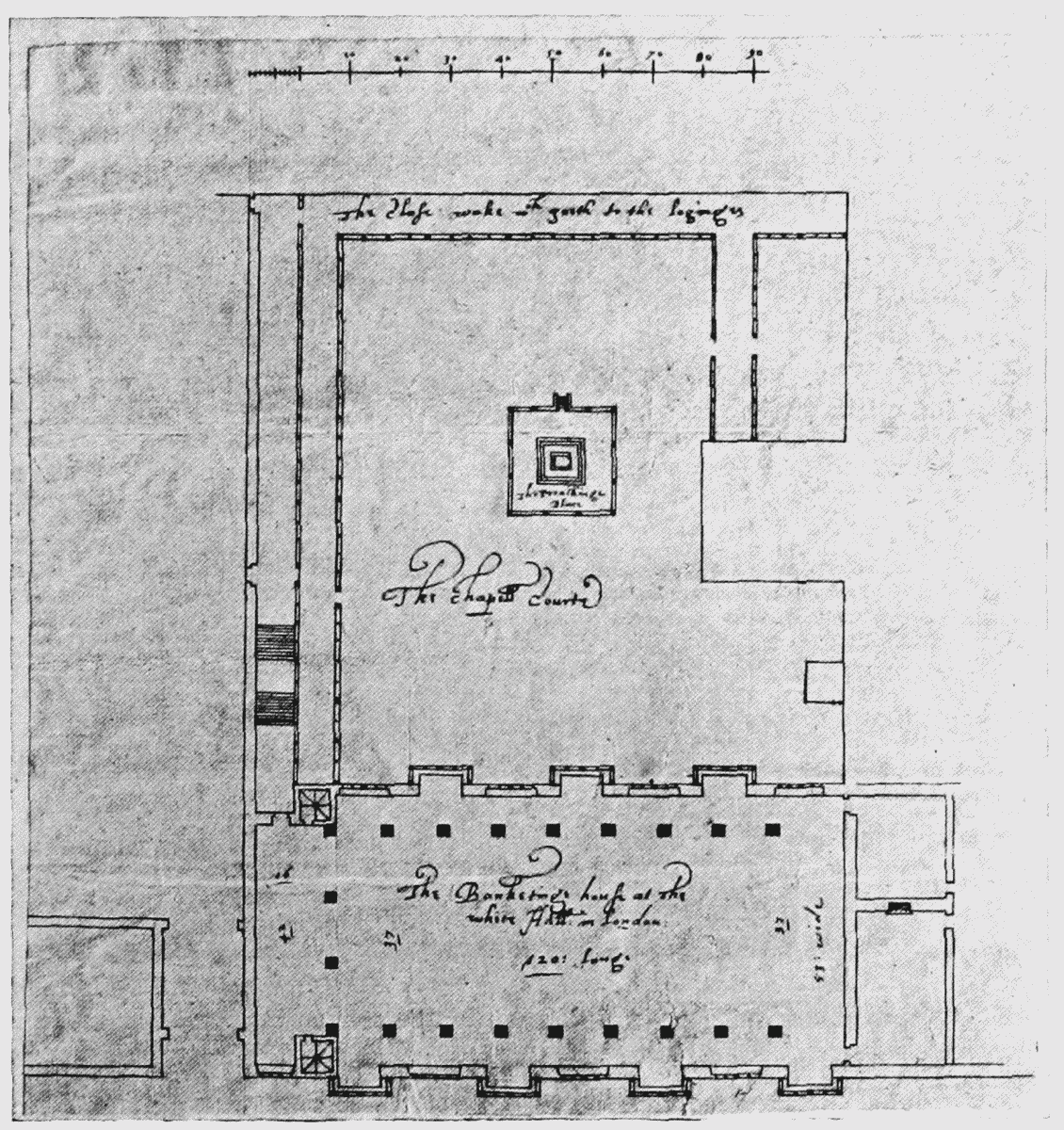
Plan of the 1607 Banqueting House.
From photograph kindly lent by Mr. J. A. Gotch, F.R.I.B.A., F.S.A., of plan in the possession of the Royal Institute of British Architects.
It is evident from the plan that the building stood on the site of the present Banqueting House.
The only description of the interior is that given by Orazio Busino, almoner to the Venetian ambassador, who was present at a masque on 6th January, 1617–18. He says (fn. n14) : "A large hall is fitted up like a theatre, with well secured boxes all round. The stage is at one end, and his Majesty's chair in front under an ample canopy. Near him are stools for the foreign ambassadors. … Whilst waiting for the king we amused ourselves by admiring the decorations and beauty of the house, with its two orders of columns, one above the other, their distance from the wall equalling the breadth of the passage, that of the second row being upheld by Doric pillars, while above these rise Ionic columns supporting the roof. The whole is of wood, including even the shafts, which are carved and gilt with much skill. From the roof of these hang festoons and angels in relief, with two rows of lights."
The building of 1607 had but a brief existence, being totally consumed by fire on 12th January, 1618–19. An account of the disaster is contained in a letter (fn. n15) written by Gerard Herbert to Dr. Ward on 21st January. "I doubt not but you heard of the great mischance by fire at Whitehall ten days past, which burnt all the Banqueting-house, and was feared the whole house of Whitehall would also have been consumed; but that my Lord Chamberlain and his brother being present, whose industry, pains, and great providence, all the time, through the abundance of water brought and pulling down of some places, God be thanked! prevented any more hurt. The fire arising by the neglect and heedlessness of two men that were appointed to sweep the room; and, having candles, firing some oily clothes of the devices of the mask (which the King had commanded should all remain to be again at Shrove-tide), that fire inflaming suddenly about and to the roof, which the two men not able to quench, and fearing to be known that they did it, shut the doors, parting away without speaking thereof, till at last perceived by others, when too late and irrecoverable. The two, since confessing the truth, are put to prison."
Underneath the building were the offices of the Signet and Privy Seal "in 3 romes with the Records of both offices in presses. … In wch fire perished all the said Records, vizt, the bills signed by K. H. 8, K. Edw. 6, Queene Mary, Queene Elizabeth & King James, together with the Signets & ancient docquet bookes of those times." (fn. n16)
The Present Building—History.
Without delay steps were taken for the erection of a new Banqueting House, and on 19th April, only three months after the fire, Inigo Jones, the King's surveyor-general, had the plans of a new building ready, together with an estimate of the cost. "The whole Charge of the Banquetting howse to be newe builte accordinge to a modell thereof made, beinge in Lengthe 110 foote, and in breadth 55 foote, the under story being arched 16 foote in haight, the upper story 55 foote highe, the masons worck, carpenters worcke, bricklayers worck, plumbers, plastorers, Joyners, Smithes worcke, glasinge and Labourers worcke with digginge, Ramminge and making ye foundacons, with scaffouldinge to all the saide worcks, will amount unto the some of 9,850 li." (fn. n17) Two designs (Plates 13, 14), probably by Inigo Jones, (fn. n18) are extant at Chatsworth, both showing a large pediment, which was not carried out. One of them contains "suggested alterations in red chalk, showing the carved swags under the top cornice, which were actually carried out, and may be seen to-day; and there are pencil lines indicating the balustrade which was adopted in lieu of the large pediment." The other design shows a low annexe at each end.
In the Burlington-Devonshire Collection in the possession of the Royal Institute of British Architects are two drawings, reproduced in Plate 15, which seem to have been made in connection with the preparation of the designs for the Banqueting House. One is inscribed, in writing probably of Inigo Jones, "The upper windows of ye modell." It agrees with the windows in the upper storey showed in the altered Chatsworth design mentioned above. The other drawing inscribed (also in writing, probably of Inigo Jones) "Elevation of the Great Doure, Ban. Ho. 1619", cannot be connected definitely with any features in the present building.
The cost exceeded the estimate, the expenditure in connection with the Banqueting House being returned in 1633 as £14,940 4s. 1d. to date. (fn. n19) The same document gives the following account of the building:
"Accompte to sondry Masons, Carpenters, Brickleyors … ymploied "in new building of a banquetting House at Whitehall wth a vaulte under the same, in length ex foote and in width lv foote wthin, The wall of the "Foundacion being in thicknes xiiij foote and in depth x foote wthin ground brought up wth bricks. The first story to the height of xvj foote wrought of Oxfordshire stone cutt into Rustique on the outside and bricks on the inside, the walles viij foote thicke wth a vault turned over on greate square pillers of bricks and paved in the bottome wth purbeckstone, the walles and vaulting layd wth finishing morter. The upper story being the banquetting House lv foote in height to the laying on of the roofe, the walles five foote di. thicke and wrought of North[amp]tonshire stone cutt in rustique wth twoe orders of Collomes and Pillasters Jonique and Composita, wth theire Architrave Freize and Cornish and other ornamts, alsoe railes and ballasters round aboute the top of the building all of Portland stone, wth xiiij windowes of eache side and one greate windowe at the upper end, and five Doores of stone wth Frontespeeces and Cartoozes, the inside brought up wth bricks finished over wth twoe orders of Collomes and pillasters, parte of stone and parte of Bricks, wth theire Architrave Freize and Cornish, wth a gallerie upon the twoe sides and the lower end borne upon greate Cartoozes of Tymber carved wth Railes and ballasters of Tymber, and the floore layd wth Spruce Deales, a strong Tymber roofe covered wth Lead, and under it a Ceeling divided into a Frett made of greate Cornishes inrichd wth carvings wth painting glazing [..]c. For performaunce whereof aswell a greate quantitie of stone hath beene digged at Portland Quarry in the County of Dorsett and Huddleston Quarry in the County of Yorke and from thence conveyed to Whitehall; as alsoe many other provicions and Empcions have been made and provided." The master mason was Nicholas Stone, who received 4s. 10d.a day.
It is evident that the works extended over a number of years; in fact, the painting and gilding was only carried out in 1635. (fn. n20) The building was, however, sufficiently advanced in 1623 to be used "for the maske and to give audience to the Spanish Ambassadors." (fn. n21)
The Fire of 1698, although it inflicted some damage on the Banqueting House, spared it for the most part. (fn. n22) The Chapel Royal having been destroyed, it was decided (fn. n23) to adapt the Banqueting House for that purpose. The work was completed by the end of the year, (fn. n24) and for nearly 200 years the building was used for ecclesiastical purposes.
In 1728 the roof was discovered to be in a dangerous condition. (fn. n25) When, after the removal of the ceiling in 1732, closer examination was possible, "the Ends of the Beams which bear a great length" were found to be "so very much decayd by the badness of the Covering" that thorough repair of the beams and new casting of the lead were decided upon. (fn. n26)
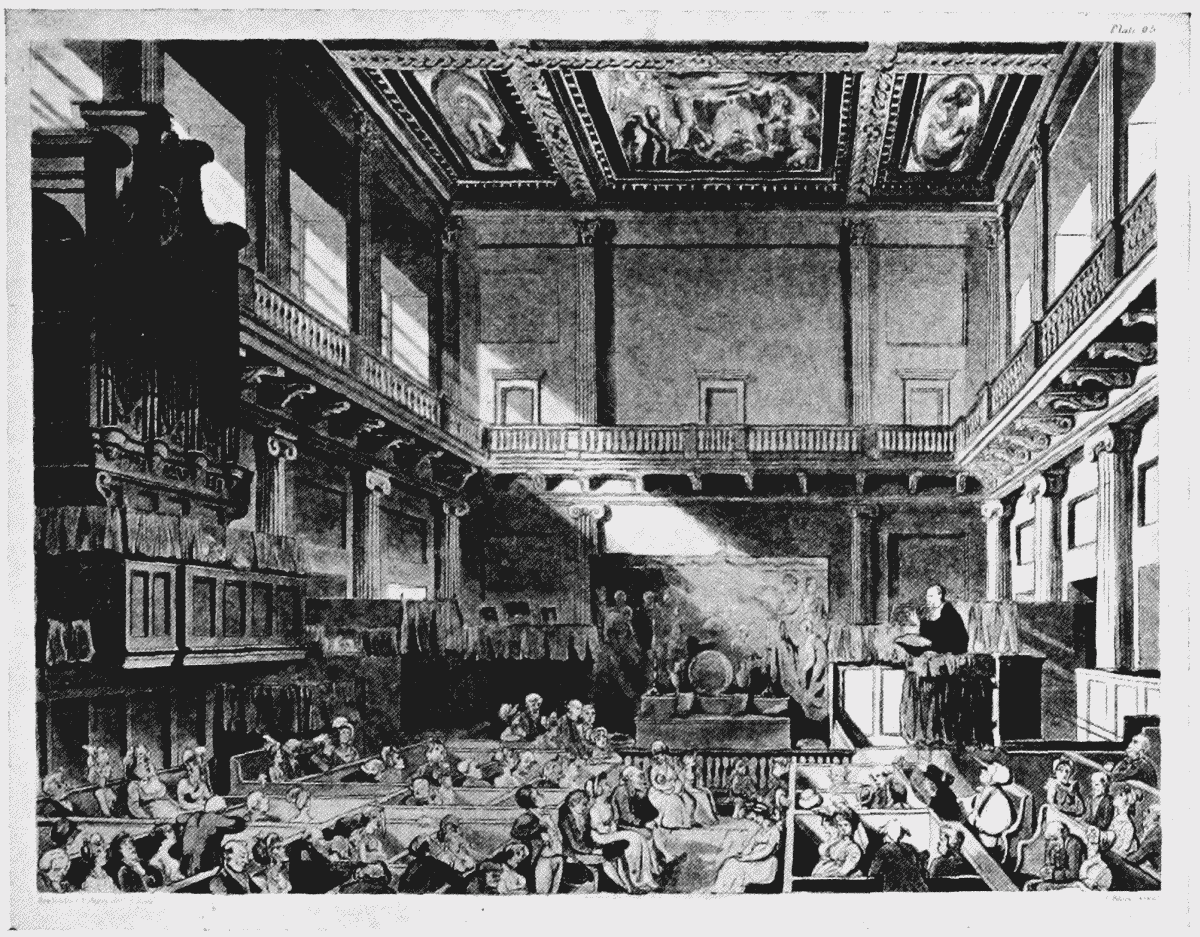
Interior of the Banqueting House before adaptation as a Military Chapel.
In 1773 it was reported that the stone facing of the basement storey of the building was much decayed, and instructions were given for new casing with Portland stone at an estimated cost of £510. (fn. n27)
In 1809 the accommodation of the building was enlarged by Wyatt to admit of the military attending Divine service. For this purpose a second gallery was constructed. The greater part of the upper gallery, also, owing to its condition, had to be rebuilt.
In 1814 alterations were carried out in connection with certain musical festivals given in the building for the relief of the inhabitants of Germany who had suffered during the Napoleonic wars. Later in the year further works were authorised (fn. n28) to restore the building to its former condition, viz.:
(i) Alterations of the part of the chapel altered by the Committee for relief of suffering Germans £825
(ii) Alterations to make the chapel again fit for Divine Service £1419
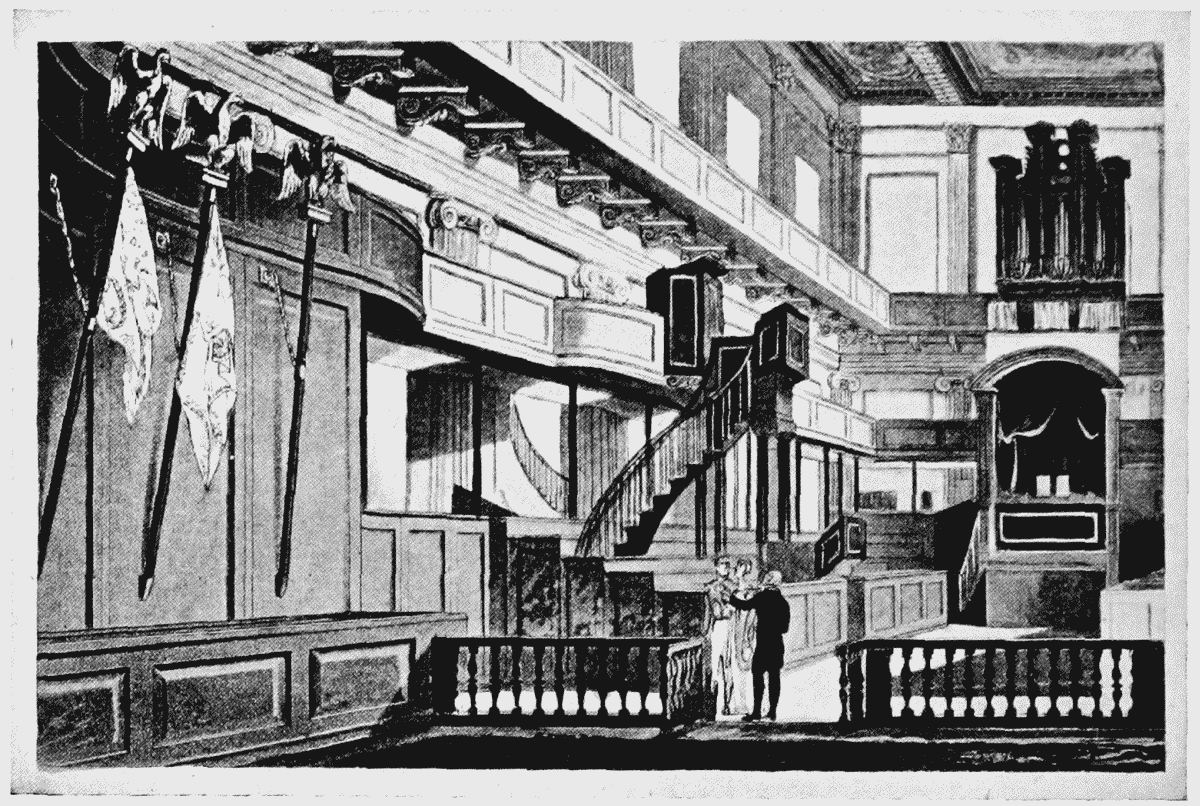
Interior of the Banqueting House as used for a Military Chapel.
The works were completed early in the following year. (fn. n29)
In 1829 the use by the military ceased, and for eight years the building was closed. Soane, having received instructions to repair the exterior stonework, (fn. n30) discovered that the roof was in a most dangerous condition, (fn. n31) and a new roof was accordingly constructed. On the completion of these works the restoration of the interior was taken in hand, and it was not until 1837 that the building was re-opened as a Royal Chapel.
In 1890 the Chapel Royal Commissioners asked for permission to discontinue Whitehall Chapel as a place of worship. This was granted, and at the same time Queen Victoria graciously agreed to lend the building to the United Service Institution for the purposes of a museum as from 1st January, 1891. (fn. n32) The building was publicly opened by H.R.H. the Prince of Wales (afterwards King Edward VII) on 20th February, 1895.
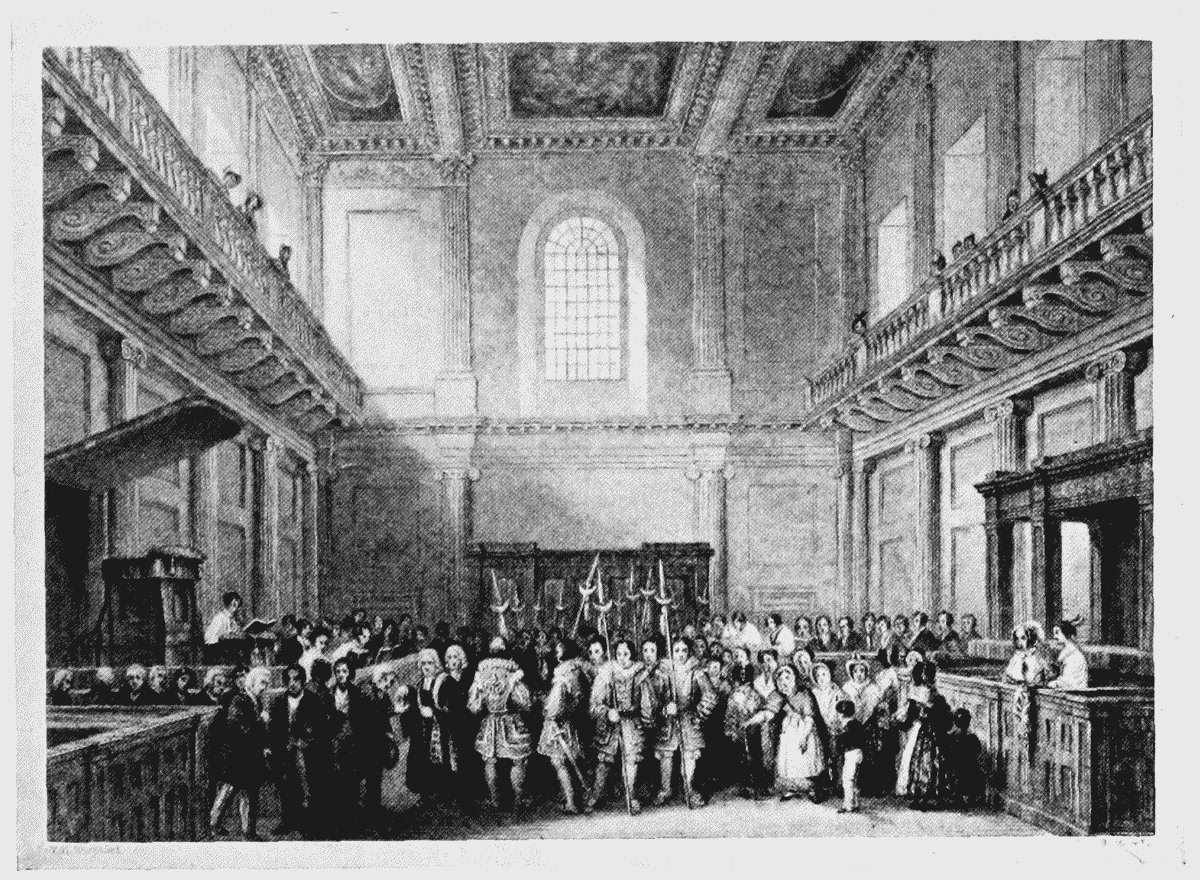
Interior of the Banqueting House in 1841.
The Ground Storey.
The plan of 1670 shows the ground storey of the building used for cellarage. It was divided by partitions into a number of separate compart ments, (fn. n33) and in 1808, when reporting on the proposed alterations to the Banqueting House, Wyatt stated that there were then 21 different divisions underneath the building "all about 18 or 20 feet square, occupied as Cellars by different persons, paying no Rent or acknowledgment as I can discover." (fn. n34) In 1830 the books and records of the Lottery Office were temporarily deposited there.
The Northern Annexe.
The Banqueting House, as erected by Inigo Jones, had within it no staircase either to the floor of the house or to the gallery above. Access of this kind was provided by means of an outside staircase at the north end, and the building which enclosed it is shown on the Hollar and Cosimo Views (Plate 4). The same views show a small square structure in the middle, continuing above the balustraded parapet of the main building. This presumably gave access to the leads of the great roof. On the building of the new gallery from the Banqueting House to the Guard Chamber in 1668–9 (see p. 63) a "new stairecase up to the Banquetting house" (fn. n35) was provided. The building enclosing the stairs also contained rooms, described in 1691 as: (fn. n36)
Sir Tho. Duppa—2 roomes up the Banquetting house staires
Ld Great Chamberlain—1 roome 1 Clossett up the same staires
Mr. Killigrew—1 roome 1 Clossett up the same staires
Ld Almoner—up the same staires, three roomes and Clossetts.
In 1755 the rooms were occupied by the Lord Great Chamberlain, the Lord Almoner and the Cofferer. (fn. n37) When in 1809 the Banqueting House was altered by Wyatt to admit of its being used as a military chapel, the building at the north end was carried up higher, and made to appear "as much as possible as part of the original Building, and not as a building added at any subsequent period." (fn. n38) Further extensions were subsequently carried out when extra accommodation was provided at the north-east end of the Banqueting House, the premises assuming their present shape and size. (Plate 19.)
The Rubens Ceiling.
The great feature of the Banqueting House is the famous ceiling painted by Rubens (fn. n39) (see description on pp. 132–3). The suggestion that Rubens should prepare something of the kind had evidently been mooted in 1621, when the Banqueting House was in building, for on 13th September of that year the painter wrote to William Trumbull as follows:— (fn. n40) "Quant à Sa Majesté et son A. Monsr le Prince de Galles, je seray tousjours bien ayse de reçevoir l'honneur de leurs commandemens, et touchant le sale au nouveau Palays je confesse d'estre, par un instinct naturel, plus propre à faire des ouvrages bien grandes que des petites curiositéz. Chacun a sa grace; mon talent est tel, que jamais entreprise encore quelle fust desmesurée en quantité et diversité de suggets a surmenté mon courage."
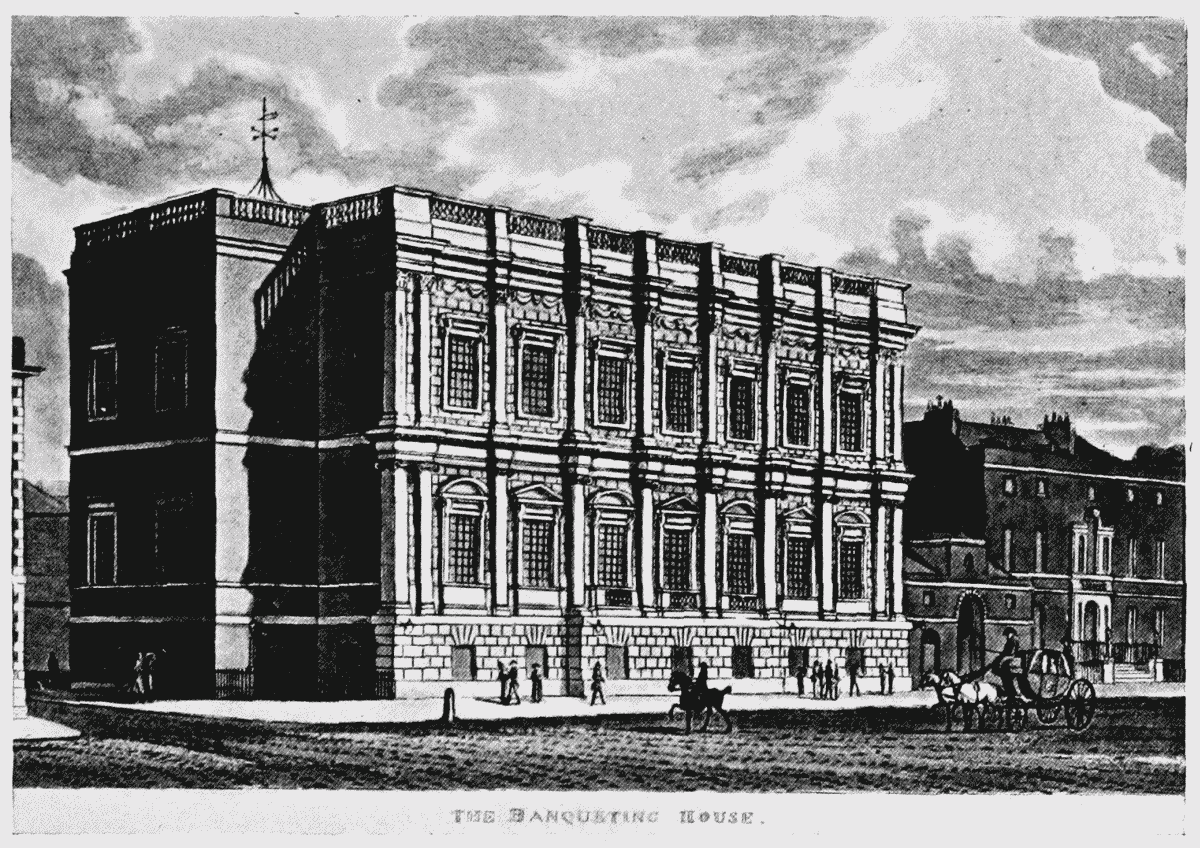
THE BANQUETING HOUSE.
The Banqueting House, showing Wyatt's alterations at the north end.
We next hear of the paintings in 1634 when Balthasar Gerbier wrote to Charles I that they were ready. Questions concerning the payment of customs duty delayed their transmission, and meanwhile certain work was found necessary "in retouching and mending the cracks, which had been caused through their having been rolled up almost a whole year." (fn. n41) Rubens desired to do this before transhipment to England, "fearing, when past the seas, to be taken by the goutt, of wch often visited." (fn. n42) An attack of this malady at home, however, further delayed matters, and it was not until October, 1635, that the pictures were forwarded. (fn. n43) Rubens' fee amounted to £3000. (fn. n44)
The paintings have on five occasions been restored.
(i) In 1686 an order was given to Wren "to Erect Scaffolds in the Banquetting House in Whitehall for ye Mending the Pictures in the Ceelings, which are to bee done with all Convenient Speede." (fn. n45) The work was intrusted to Parry Walton, whose account was in 1688 settled for £212. (fn. n46)
(ii) In 1729–32, in connection with the repairs to the roof, the ceiling was taken down by Kent. (fn. n47) It was found to be in such a bad condition that unless mending, new lining and cleaning were soon carried out the paintings were "in danger of totally perishing." Orders were therefore given for the work to be done at an estimated cost of £250. At the same time it was reported that "the masks, festoons and other ornaments painted all round the room and heightened with gold, are almost quite defaced." The repair and restoration of these was also decided on at an estimated cost of £200. (fn. n48)
(iii) In 1776–7 the ceiling was again restored by Cipriani. (fn. n49)
(iv) The next occasion was in connection with the extensive works of restoration carried out by Soane about 1830. On 2nd July, 1831, accounts amounting to £560 for expenses incurred in packing and protecting the paintings were ordered to be paid, (fn. n50) and later in the year instructions were given for their repair and reinstatement. According to Sheppard the work was done under the direction of Sir Robert Smirke.
(v) In 1906–7 the ceiling was again taken down, the canvases removed from their frames, cleaned, repaired, remounted on laminated boarding and replaced on the frames, which also had been carefully repaired and restored.
The Organ.
On 23rd July, 1662, a warrant was issued (fn. n51) to "pay to John Hingeston, Keeper and Repayrer of his Mats organs, the summe of seaventy six pounds five shillings for mending and repayring of his Mats organs in his Mats Chappell Royall at Whitehall … and for errecting an organ in the Banquetting house." It would seem that the latter organ was not a permanent fixture, but had been lent by Bernhardt Schmidt (Father Smith) for the Maundy Thursday celebration. According to Smith's biographer, an organ was lent for this purpose on thirteen occasions between 1662 and 1683. (fn. n52) On the adaptation of the Banqueting House as a chapel in 1698, a permanent organ was provided. On 5th May, 1699, an order was given for the fitting up of "a shed in Whitehall for Mr. Smith, his Majesties Musicall Instrument maker to work in during the time he is preparing an Organ for his Majesties chappell att Whitehall." (fn. n53) The instrument was ready by October, the London Post for the 3rd of that month containing an entry: "A new Organ is set up in the Banquetting-house-Chappel, with a Dial in the middle of it [see illustration on p. 123], this being the first of that make; the other is packt up in Boxes there, in order to be sent to Barbadoes." From this it would appear that a permanent organ had been supplied for the Banqueting House at some time after 1683. (fn. n54)
On the discontinuance of the Banqueting House as a chapel in 1890, the organ then in use was removed to the Royal Chapel of St. Peter-adVincula, in the Tower of London, where it now is (Plate 44). Affixed to it is a brass plate containing the following inscription:—
"This organ (originally built by Father Schmidt in 1676 by command of His Majesty King Charles the Second, being the first built by him in England) was rebuilt by Elliott in 1814 and enlarged by Hill in 1844, under the superintendence of Richard Massey Esq., Organist of Her Majesty's Chapel Royal Whitehall, from 1837 to 1877.
The organ was again rebuilt and enlarged by Hill and Son, under the superintendence of Charles Sherwood Jekyll Esq., Organist of Her Majesty's Chapels Royal, St. James's and Whitehall, 1877.
Some of the original pipes are in the choir organ."
From what has preceded it is clear that the organ was built in 1699, not 1676, and that it was not the first built by Smith in England, that statement properly referring to the organ built for the old Chapel Royal in 1662.
The Present Building—Description.
The building comprises two storeys: a vaulted ground storey and an upper storey containing the Banqueting Hall. The east and west elevations are faced with Portland stone, while the north and south ends, where exposed, are in cement with stone dressings. The south end is now hidden by the premises of the Royal United Service Institution.
With the exception of the stone balustraded parapet, and stonework to the depth of the entablature, no attempt has been made to treat the ends on the lines of the other two fronts. The south end has a large semi-circularheaded window (Plate 37), which is now converted into an internal light, with a doorway leading from the gallery floor to the main staircase of the adjoining premises.
The east and west elevations are symmetrical, each comprising seven bays.
The ground storey is treated as a podium with rusticated courses above a tooled plinth. The windows are square-headed, with rusticated arches, the centre of the head having a straight joint instead of the usual keystone or voussoir.
The upper storey is in two stages, an Ionic Order, carrying a Composite Order, with the entablatures continuous and their respective members enriched, the frieze to the lower Order being pulvinated. The central feature of the façade is formed by the middle bays being advanced, with ¾ diameter columns to the two stages, while the bays on either side have pilasters. Strength is given to the corners by the coupling of the pilasters, the outer one of each pair having a returned face. The general wall treatment to the bays is rusticated, and the windows are square-headed, those to the lower stage having alternate segmental and triangular pediments supported on shaped brackets, with panelled pilasters flanking the eared architrave to the openings. The windows to the upper stage are similar in character, but their cornices are supported on brackets without pediments. The lower windows to the central bays have a balustraded dado, the others a plain dado. The windows have double-hung oak sashes, divided into small squares by substantial bars: they were formerly fitted with solid frames. (fn. c2)
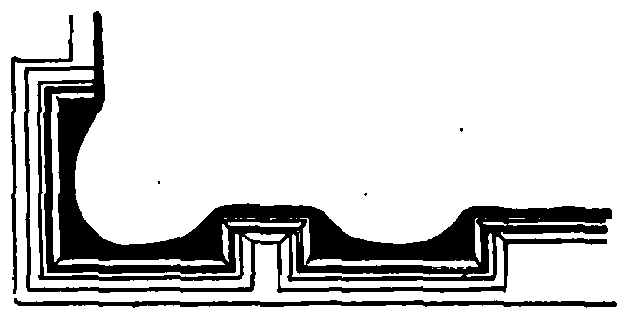
Banqueting House: base of pilasters of the lower Order
Between the capitals to the upper stage is a boldly carved frieze (Plate 29) representing draped female masks between swags of fruit. The modillion cornice is surmounted by an open balustraded parapet above a double plinth, which continues around the building.
The annexe at the north end contains an entrance hall and main staircase (Plate 32) leading to the Banqueting Hall, with a secondary staircase continuing from the Hall to the gallery and offices above. When carrying out his alterations (see p. 126) Wyatt presumably re-used Inigo Jones' stone parapet and cornice, and faced the wall below with cement relieved with stone bands and stone dressings to the windows. The remaining portion of the balustrade was taken down and refixed to the new parapet when the annexe was carried further eastward.
On the north end of the main roof is a wrought-iron weather-vane, erected by James II to indicate the direction of the wind while he was dreading the approach of the Dutch fleet. (fn. n55)
The south end of the Hall contains the large semi-circular-headed window mentioned above. The south face of the opening has a moulded archivolt and plain pilasters with moulded imposts and bases. (Plate 37).
The original roof seems to have been covered with lead, but in the restoration carried out by Soane in 1829–30 its form appears to have been altered, as it is now covered with slates, with a lead flat on top. (fn. n56)
The ground storey (Plate 32) is vaulted in brick, now plastered, and is divided into three longitudinal bays by a series of a double row of six square piers forming seven cross bays. Each bay has a groined vault, separated by flat ribs, which continue down to the floor, both on the wall surface and the piers. The wood dado was provided in 1891, and was formed out of the old pew panelling after the building had ceased to be used as a chapel. The Hall above (Plates 33, 34) comprises seven bays, and is divided into two stages by a gallery, which now (fn. n57) continues all round the room, and is supported by enriched brackets projecting from the frieze of the lower Order. The moulded front to the gallery floor forms the cornice to the Order, and is surmounted by symmetrically turned balusters, with a moulded handrail as capping. The balustraded front is divided by dies into bays corresponding with the divisions to the main wall surfaces. At the north end the central bay to the gallery is advanced, and is supported on coupled fluted Ionic columns (fn. n58) (Plate 36). Before the construction of the present shallow gallery at the south end, (fn. n59) the cornice to the lower Order, which has its bed-mould enriched and frieze pulvinated, was carried across the wall, the large roundheaded window above forming an end light to the hall free of obstruction. (See illustration on p. 125).
The windows are square-headed, inter-spaced below the gallery, with half-diameter fluted Ionic columns, and a square panel over. Above, the gallery wall is divided into bays by fluted Corinthian pilasters, supporting the heavily moulded entablature and main ribs of the painted ceiling (Plate 35).
At each end of the main floor is a central doorway, square-headed, with a moulded cornice supported on shaped brackets and a plain panel above. On each side is a doorway of smaller scale, and the panel over is consequently higher. The panel over the central door at the north end contains a decorative clockcase.
The walls are finished with an enriched entablature, comprising a modillion cornice, a frieze ornamented with the wave or crest, and a moulded architrave.
Between the pilaster capitals is a painted frieze, representing draped female masks and swags of fruit, similar to the carved frieze of the exterior (Plate 29).
The ceiling is divided into nine deep panels by decorative ribs formed by the modillion cornice and ornamental frieze being mitred around, with the guilloche to the soffits; the whole constituting a rich frame to each panel (Plate 37). The centre panel is of the oval shape favoured by Jones. The guilloche ornament on the soffit overlaps at the intersections with the main ribs, which position is marked by carved rosettes, similar features being introduced at the crossing of the ribs and intermediates. The main decorations are picked out in gilt, producing a rich effect.
The subject of the middle panel (fn. n60) (Plate 39) is the Apotheosis of James I. Justice is raising the King, who is shown holding a sceptre, with one foot on a globe and the other on the wing of a flying eagle, which is grasping a thunderbolt in its talons. In attendance are figures representing Zeal, Religion, Honour and Victory. Above the King are cherubs with the crown and orb, and others are blowing trumpets.
The large south panel (Plate 40) represents the King, seated on a throne within an architectural composition, and pointing to Peace and Plenty embracing on his right. Angels support a laurel wreath over his head and a cherub behind him carries the crown. On his left Minerva, holding a thunderbolt in her right hand and a shield in her left, is driving Rebellion; who holds a flaring torch, down to Hell, where Satan, attended by monsters, awaits him. Mercury is pointing with his caduceus to his downfall.
The large north panel (Plate 41) is an allegorical representation of the birth and crowning of Prince Charles. The King is seated on his throne, holding the orb, and pointing with his sceptre to Prince Charles (a nude infant figure), who is attended by two draped females, of whom one, who is crowned, may be intended for the Queen. Behind is Minerva, who is holding a crown over the prince. The background shows an architectural composition, with a domed coffered ceiling. In the upper part of the picture two cherubs support a crowned cartouche, bearing the Stuart arms, with garlands of roses.
The two oval panels (Plate 42) at the south end of the ceiling represent (i) Royal Bounty, pouring, from a cornucopia, crowns, emblems and medals, and trampling on Avarice; and (ii) Government, holding a bridle, and trampling on Rebellion.
Two similar panels (Plate 42) at the north end represent (i) Hercules (Heroic Virtues) clubbing Envy; and (ii) Minerva (Heroic Chastity) with a spear destroying Lust. Above her is a flying owl holding a wreath.
On each side of the large central panel are long oblong panels (Plate 43). That on the east side shows a procession of cherubs, with a chariot laden with fruit and drawn by a ram and a wolf, the former ridden by an infant Bacchus. In front is a cherub riding a tiger, preceded by other cherubs carrying a huge cornucopia of fruit, the whole representing the Peace and Plenty of King James's reign. The other panel is supposed to represent the Harmony and Happiness of the reign, and contains gambolling cherubs on a rope of fruit which issues from a chariot drawn by a lion and a bear. Cherubs are loading up the chariot with a huge cornucopia of fruit. The lion has a cherub on his back tickling his ear, while another in front is drawing his teeth.
The scale of the figures in the whole composition is extraordinary, the cherubs being more than 9 feet high.
The stone staircase (Plate 32) in the annexe at the north end has its balustrading similar in character to the gallery front of the Hall. The staircase gives access from the ground to the main floor of the Hall, and consists of two flights of steps around an open well, with a half-space landing. A wood staircase adjoining on the east side continues above to the gallery level, and another continues to the roof of the annexe.
Access to the main roof is obtained by dwarf dormer doors on the east and west sides, which lead from the lead gutter behind the stone balustraded parapet.
The organ case (Plate 44) which is now in the Chapel of St. Peter-adVincula (see p. 129), has a carved oak front in three bays with four towers of pipes polygonal on plan, the two middle towers on twin cherub-head corbels (Plate 45), the side towers on corbels of acanthus leaves and connected by panels of pierced carving with a continuous moulded cornice.
The towers are surmounted by a shaped entablature with pierced scrollwork below enclosing heads of pipes. The bays between contain the smaller pipes with similar scrollwork to heads and base. A length of moulding supports further scrollwork ramping up each side to the higher level of the middle towers. The centre is crowned by a carved cartouche bearing the Royal Arms of William and Mary.
The lower part of the case is composed of plain modern panelling.
General Observations.
At the present time it is impossible even to surmise, with any approach to accuracy, the extent to which renewals and other changes have been made in the original material of the building, or as affecting its more detailed decorative treatment. There is, however, no reason to suppose that the structure, as it exists to-day, does not express with reasonable truth the original design of Inigo Jones, in both general effect and detail.
It can certainly be said of the Banqueting House that, regarded as the work of an English architect in the first quarter of the 17th century, it is a remarkable building; defining a change that can well be described as revolutionary. The Renaissance, which at this period had reached an advanced stage in Italy, and had in less degree, exerted its influence on adjacent countries, was then but little felt in England, where, at the end of the 16th century, the long-established Gothic tradition survived. Tudor architecture, it is true, had shown, in a somewhat crude and uncertain way, certain qualities and features of classic architecture, intermixed with the late phase of medievalism, but, at the beginning of the 17th century, the mature revived Classic that had become common in Italy through such masters as Sansovino, San Gallo, Vignola, Palladio and Scamozzi, was in effect unknown. Inigo Jones spent a considerable time in Italy, in diligent study both of ancient architecture and of contemporary buildings where the classic manner was adapted to modern use. He was doubtless equally familiar with the well-illustrated writings of the architect-authors, Palladio, Serlio and Vignola. When, accordingly, the commission to rebuild the Banqueting House came to him, he was well equipped for producing a building expressive of mature Renaissance, comparable, as it turned out, with the best work that the Italian masters could produce; a combination of fine proportion and sense of design with massive scale and strength, and showing a wide grasp of both the practical and ornamental functions embraced in the Art of Architecture. Only a man of exceptional merit and powers of observation could have achieved such a result. By one stroke, as it were, he prepared the way for the modern phase of architecture, on classic lines, that we have since known. He thus provided the impulse whereby Webb, his pupil and successor, and, at a later stage, Sir Christopher Wren and his successors, completed and established that revolutionary change. For this reason it can be said that Inigo Jones is rightly regarded as the Father of modern English Architecture; and the Banqueting House, by its outstanding quality, as, perhaps, the most notable of English Renaissance buildings.
Condition Of Repair.
Good.
Historical Notes.
The original purpose for which the Banqueting House was built was not only to serve as a place for the giving of banquets, as implied by the name, but for the reception of ambassadors, the hearing of addresses and other ceremonial functions of various kinds, as well as the giving of masques and other entertainments.
The 1607 Banqueting House was opened on 10th January, 1607–8, with Ben Jonson's masque, The Mask of Beauty. A description of the scene has been preserved for us by the Venetian Ambassador, who a fortnight later wrote to the Doge and Senate as follows: (fn. n61) "I must just touch on the splendour of the spectacle, which was worthy of her Majesty's [Anne of Denmark, consort of James I] greatness. The apparatus and the cunning of the stage machinery was a miracle, the abundance and beauty of the lights immense, the music and the dance most sumptuous. But what beggared all else, and possibly exceeded the public expectation, was the wealth of pearls and jewels that adorned the Queen and her ladies, so abundant and splendid that in every one's opinion no other court could have displayed such pomp and riches."
On 27th December, 1612, the young Elector Palatine and the Princess Elizabeth were affianced "in the Banquetting-house at Whitehall." (fn. n62) On 14th February following the happy pair were wedded, and a masque was presented in the Banqueting House on the occasion. A detailed account-of this is given by a contemporary writer, (fn. n63) who is full of admiration at the wonderful scenic effects contrived by Inigo Jones. (fn. n64)
Another notable masque was that performed in the present building at Candlemas, 1633–4, by members of the Inns of Court, "in joyful acknowledgment of the happy birth of the Duke of York" (fn. n65) (afterwards James II). The masquers came in magnificent procession from Ely House. "In the mean time the Banqueting-house at Whitehall was so crouded with fair Ladies, glittering with their rich Cloths and richer Jewels, and with Lords and Gentlemen of Great Quality, that there was scarce room for the King and Queen to enter in." A special stage had been provided (fn. n66) and "the King and Queen, and all their noble Train being come in, the Masque [The Triumph of Peace, by James Shirley] began, and was incomparably performed in the Dancing, Speeches, Musick, and Scenes; the Dances, Figures, Properties, the Voices, Instruments, Songs, Airs, Composures, the Words and Actions, were all of them exact, and none failed in their Parts of them, and the Scenes were most curious and costly. (fn. n67)
The accounts of the Treasurer of the Chamber show that the Banqueting House was occasionally used for the performance of plays, though not as frequently as the Great Hall. Even the Elizabethan building was used for this purpose, for the accounts contain an item "for makinge readie the banquetinge house at Whitehalle for the Kinges Matie againste the plaie … mense Novembris 1604." This is no doubt the play referred to in the Revels Accounts as performed on 1st November, 1604, by "the King's Mates plaiers" in "the Banketinge House att Whithall, called The Moor of Venis."
In March, 1607–8, expenditure was incurred in "making readie the Banquetting house there likewise for the King, Queene and Prince to see the Dauncing Asse and Goate." It seems likely that the actual performance took place in the tilt-yard opposite, the Banqueting House being used simply as a place from which to view the spectacle. This was certainly the case on the many occasions when the building was prepared for bear-baiting, (fn. n68) the bearstake being actually set up in the tilt-yard.
Of audiences to members of Parliament given in the Banqueting House we hear on several occasions. A notable case was that in January, 1656–7, when the Speaker, with over 200 members of the House of Commons, waited on the Protector with an address of congratulation on his escape from Sindercombe's attempt at assassination (see p. 55). "As they were goeing up into the banquettinge house part of the stayrecase brake, and down fell many of the members, vizt. the Lord Richard Cromwell, whose shoulder was much bruised; Mr. Sollicitor Generall Ellis, one of whose legges is broken; Lieutenant-Colonel White, whose arme is sayd to be broken, with many other members prejudiced." (fn. n69)
There are many references to the reception of ambassadors in the Banqueting House. Evelyn's account of one of these is given in his Diary under date of 29th December, 1662. "Saw the audience of the Muscovy Ambassador, which was with extraordinary state, his retinue being numerous, all clad in vests of several colours, with buskins, after the Eastern manner; their caps of fur; tunics, richly embroidered with gold and pearls, made a glorious show. The King being seated under a canopy in the Banqueting-house, the Secretary of the Embassy went before the Ambassador in a grave march, holding up his master's letters of credence in a crimson taffeta scarf before his forehead. The Ambassador then delivered it with a profound reverence to the King, who gave it to our Secretary of State … Then came in the presents, borne by 165 of his retinue, consisting of mantles and other large pieces lined with sable, black fox, and ermine; Persian carpets, the ground cloth of gold and velvet; hawks … horses … etc. … Wind music played all the while in the galleries above."
The ceremony of touching for the King's evil seems usually to have been performed in the Banqueting House. Pepys witnessed it there on 13th April, 1661, and expresses the opinion that it was "an ugly office and a simple one." The first occasion of the kind after the Restoration was on 6th July, 1660, when Evelyn was present, and records the order of proceeding thus: "His Majesty sitting under his state in the Banqueting house, the chirurgeons caused the sick to be brought, or led, up to the throne, where they kneeling, the King strokes their faces or cheeks with both his hands at once, at which instant a chaplain in his formalities says, 'He put his hands upon them, and he healed them.'"
On 20th April, 1661, a few days before the coronation of Charles II, the King in the Banqueting House created "six Earls and as many Barons." (fn. n70) Pepys also saw the ceremony: "Then with my Lady and my Lady Wright to White Hall; and in the Banqueting-house saw the King create my Lord Chancellor and several others, Earls, and Mr. Crew and several others, Barons: the first being led up by Heralds and five old Earls to the King, and there the patent is read, and the King puts on his vest, and sword, and coronet, and gives him the patent. And then he kisseth the King's hand, and rises and stands covered before the king. And the same for the Barons, only he is led up but by three of the old Barons, and are girt with swords before they go to the King. That being done (which was very pleasant to see their habits) I carried my Lady back."
In 1685, when James II's new building works (see pp. 102 ff.) were proceeding, the Banqueting House was used for the storage of the contents of the old buildings. (fn. n71)
On occasions the Banqueting House was used for more or less private purposes. Thus on 19th July, 1664, Evelyn records: "To London, to see the event of the lottery which his Majesty had permitted Sir Arthur Slingsby to set up for one day in the Banqueting House at Whitehall, I gaining only a trifle, as well as did the King, Queen-Consort, and Queen-Mother, for nearly thirty lots; which was thought to be contrived very unhandsomely by the master of it, who was, in truth, a mere shark."
Auctions were also held there occasionally. The Gazette for 20th May, 1683, mentions: "His Majesty has permitted Grinling Gibbons and Parry Walton to expose to sale, at the Banqueting house, Sir P. Lely's collection of pictures, at nine in the morning, and two in the afternoon, and so to continue from day to day; "and Evelyn (fn. n72) gives an account of the auction there of Lord Melfort's pictures, which had been seized to satisfy his creditors.
The last great ceremonial function which took place in the Banqueting House was on the occasion of the offer of the Crown to the Prince and Princess of Orange. "The Grand Convention of the Lords and Commons of England … did on Wednesday morning [13th February, 1688–9] meet in both Houses of Parliament, and afterwards went in a Body with their Speakers and Maces to Whitehall to pray the Prince and Princess of Orangne [sic] to accept of the Crown: their Highnesses received them in the Banqueting House, where being at the upper end of the Room, and the Yeomen of the Guard ranged on both sides: The Lords and Commons entred at the lower end, and advanced between and Their Highnesses meeting them part of the way. After the ceremony on both sides were over, the Clerk of the House of Lords first read the Vote of both Lords and Commons, importing that the late King James the 2d having abdicated the Government, etc. that the Throne was thereby vacant. Then they read their Declaration to their Highnesses … To which their Highnesses were Graciously pleased to signifie their approbation and Consent to accept the Crown accordingly … Whereupon there were loud Shouts for Joy both in the Banqueting House and in all the Courts of Whitehall. Then the said Lords and Commons came down to Whitehall Gate, where … York Herald did in the presence of the said Lords and Commons, and Multitudes of People, proclaim the Prince and Princess of Orange King and Queen of England, France and Ireland, with all the Dominions … thereto belonging." (fn. n73)
There is little doubt that the building was used for the distribution of the Maundy from the time when it was converted into a Chapel until 1890, and it would seem that this was frequently the case even before 1698. (fn. n74) The distribution of the provisions took place normally in the antechapel, but the alteration of the building in 1814 made the place unsuitable. In 1815 a temporary barrack room was erected in the rear of the chapel for the purpose, but in the following year no preparation was made until a day or two before Maundy Thursday, when tents were put up. The result was disastrous. The poor people were not sufficiently protected, either from the cold or from the crowd outside, there was not nearly enough space for the distribution, and, to add to the trouble, heavy rain fell during the night before, penetrating the tent and spoiling the bread. (fn. n75) Recourse was therefore again had to the provision of a temporary building until 1837, when the gift in kind was abolished.
Musical festivals have sometimes been held in the building. In 1796 the Handel Commemoration Festival was held there, (fn. n76) and on 28th June, 1814, was given the first grand concert for the benefit of the German sufferers in the Napoleonic Wars. (fn. n77)
On 18th May, 1811, a grand spectacle was witnessed, when twelve standards and colours taken from the enemy including the French Eagle, taken at the Battle of Barrosa, were carried with military ceremonies from the Horse Guards Parade and deposited in the chapel. Other French Eagles, captured at Salamanca, were also placed there in the following year. (fn. n78) They remained in the chapel until it was closed in 1829. The view on p. 124, which represents the interior of the building while in use as a military chapel, shows three Eagles in position.
In the Council's collection are:—
(fn. n79) Elevation to Whitehall (photograph).
(fn. n79) Elevation to Horse Guards Avenue (photograph).
Elevation to Whitehall Gardens (photograph).
Detail of balustrading below to central windows to main floor (photograph).
(fn. n79) Details of bases to columns and pilasters to lower Order (photographs).
(fn. n79) Details of capitals to columns and pilasters to lower Order (photographs).
(fn. n79) Details of bases to columns and pilasters to upper Order (photographs).
(fn. n79) Details of capitals to columns and pilasters to upper Order (photographs).
(fn. n79) Details of window head to lower Order (photograph).
(fn. n79) Details of window head to upper Order (photograph).
Detail of main cornice and balustrading to parapet (photograph).
(fn. n79) Detail of carved frieze (photograph).
(fn. n79) General view of ground storey looking south (photograph).
General view of interior looking north (photograph).
(fn. n79) General view of interior looking south-west (photograph).
(fn. n79) General view of interior looking north-west (photograph).
(fn. n79) General view of central doorway at north end of Hall (photograph).
(fn. n79) General view of semi-circular window and doorway, from the staircase landing of the
Royal United Service Institution (photograph).
(fn. n79) General interior view of windows above gallery to side wall (photograph).
(fn. n79) Detail of modillion cornice and guilloche to ribs of panels of ceiling (photograph).
Descriptive key of subjects to panels of painted ceiling (photograph supplied by H.M.
Office of Works).
(fn. n79) Engraving of the ceiling by Gribelin, 1720 (photograph supplied by H,M. Office
of Works.)
(fn. n79) Painted ceiling. Subject of central panel (photograph supplied by H.M. Office
of Works).
(fn. n79) Painted ceiling. Subject of middle north panel (photograph supplied by H.M. Office
of Works).
(fn. n79) Painted ceiling. Subject of middle south panel (photograph supplied by H.M. Office
of Works).
(fn. n79) Painted ceiling. Views of two northern oval panels (photographs supplied by
H.M. Office of Works).
(fn. n79) Painted ceiling. Views of two southern oval panels (photographs supplied by H.M.
Office of Works).
(fn. n79) Painted ceiling. Views of two middle oblong panels (photographs supplied by H.M.
Office of Works).
(fn. n79) General view of staircase and entrance hall (photograph).
(fn. n79) "Elevation of the Great Doure, Ban. Ho., 1619" (photograph of drawing in the
Burlington-Devonshire Collection, R.I.B.A.).
(fn. n79) "The upper windows of ye modell" (photograph of drawing in the Burlington-Devonshire Collection, R.I.B.A.).
(fn. n79) Plan at ground level (measured drawing).
(fn. n79) Plan of Hall (measured drawing).
(fn. n79) Plan at gallery level (measured drawing).
(fn. n79) Cross section (measured drawing).
Longitudinal section (measured drawing).
(fn. n79) Elevation to Whitehall (measured drawing).
(fn. n79) Detail of central bay of façade (measured drawing).
(fn. n79) Detail of end bay to lower Order (measured drawing).
(fn. n79) Detail of end bay to upper Order (measured drawing).
(fn. n79) Full size sections of main mouldings to façade (measured drawings).
Plan and section of balustrading and roof showing additions at north-east corner (measured
drawing).
(fn. n79) Organ now in St. Peter-ad-Vincula, Tower of London (photograph).
(fn. n79) Detail of carved corbel to pipe, towers of organ (photograph).
The distribution of His Majesty's Maundy … in the Chapel Royal at Whitehall (photograph of engraving in possession of the Westminster Public Library).
(fn. n79) The distribution of His Majesty's Maundy … in the Ante-Chapel at Whitehall (photograph of engraving in possession of the Westminster Public Library).
(fn. n79) Smithson's plan of 1607 Banqueting House (from photograph of drawing in the possession
of the Royal Institute of British Architects.)
(fn. n79) Preliminary sketch for the existing Banqueting House (copy of photograph, in the possession
of the R.I.B.A., of drawing in the Chatsworth Collection).
(fn. n79) Elevation for the existing Banqueting House (copy of photograph, in the possession of
the R.I.B.A., of drawing in the Chatsworth Collection).
(fn. n79) Block plān of a scheme for erection of new palace at Whitehall (copy of photograph, in the
possession of the R.I.B.A., of original in the Chatsworth Collection).
Four drawings of timber construction of roof (copies of photographs, in the possession
of the R.I.B.A., of originals in the Chatsworth Collection).