Survey of London: Volume 16, St Martin-in-The-Fields I: Charing Cross. Originally published by London County Council, London, 1935.
This free content was digitised by double rekeying. All rights reserved.
'The Tiltyard and the Horse Guards', in Survey of London: Volume 16, St Martin-in-The-Fields I: Charing Cross, ed. G H Gater, E P Wheeler (London, 1935), British History Online https://www.british-history.ac.uk/survey-london/vol16/pt1/pp5-16 [accessed 2 May 2025].
'The Tiltyard and the Horse Guards', in Survey of London: Volume 16, St Martin-in-The-Fields I: Charing Cross. Edited by G H Gater, E P Wheeler (London, 1935), British History Online, accessed May 2, 2025, https://www.british-history.ac.uk/survey-london/vol16/pt1/pp5-16.
"The Tiltyard and the Horse Guards". Survey of London: Volume 16, St Martin-in-The-Fields I: Charing Cross. Ed. G H Gater, E P Wheeler (London, 1935), British History Online. Web. 2 May 2025. https://www.british-history.ac.uk/survey-london/vol16/pt1/pp5-16.
In this section
CHAPTER 2: I—THE TILTYARD AND THE HORSE GUARDS
History of the Site.
The tournament was still in Tudor times one of the favourite pastimes of royalty and the nobility. A great deal of the danger of this martial sport had, however, been eliminated by the invention of the "tilt," originally a cloth stretched along the middle of the lists, over which the knights fought. In time the cloth became a stout barrier of timber. No Tudor palace was complete without its tiltyard, and that at Whitehall, "for Noblemen and other to exercise themselves in Iusting, Turneying, and fighting at Barryers," (fn. n1) was on the west side of the road, just north of the Holbein Gate, and extended over the sites of the northern portion of Dover House, the Horse Guards, the Office of the Paymaster-General, and Admiralty House. (fn. n2) It is shown, with the longitudinal barrier clearly marked, in the maps of "Agas," Braun and Hogenberg, Norden and Faithorne and Newcourt.
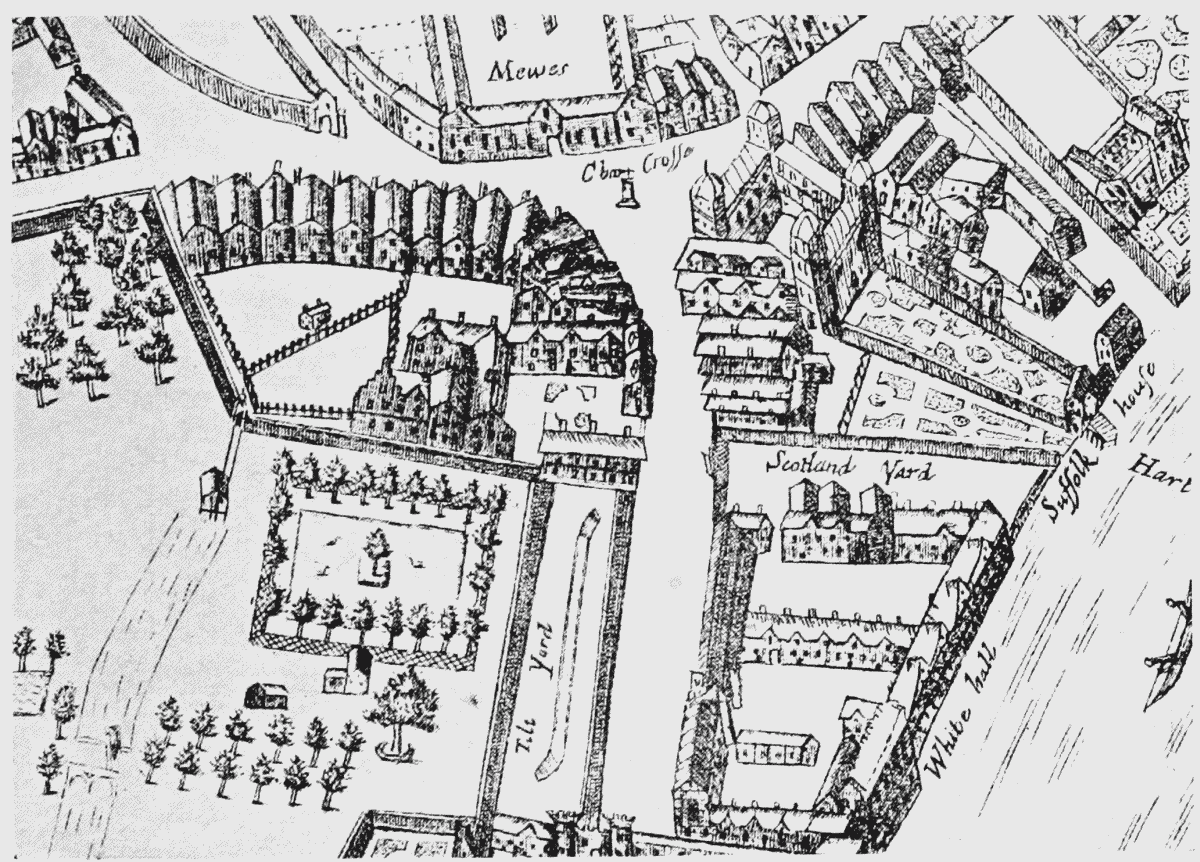
The neighbourhood of Charing Cross, from Faithorne and Newcourt's Map (1643–7)
Von Wedel, in his Journey through England, (fn. n3) has left a description of a tournament held at Whitehall in 1584. He says:
"Now approached the day when, on November 17, (fn. n4) the tournament was to be held. … About twelve o'clock the Queen with her ladies placed themselves at the windows in a long room (fn. n5) of weithol [Whitehall] palace, near Westminster, opposite the barrier, where the tournament was to be held. From this room a broad staircase led downwards, and round the barrier stands were arranged by boards above the ground, so that everybody by paying 12d. could get a stand and see the play. … Many thousand spectators, men, women and girls, got places, not to speak of those who were within the barrier and paid nothing. During the whole time of the tournament all who wished to fight entered the list by pairs, the trumpets being blown at the time and other musical instruments. The combatants had their servants clad in different colours; they, however, did not enter the barrier, but arranged themselves on both sides. Some of the servants were disguised like savages, or like Irishmen, with the hair hanging down to the girdle like women; others had horse manes on their heads; some came driving in a carriage, the horses being equipped like elephants; some carriages were drawn by men, others appeared to move by themselves; altogether the carriages were of very odd appearance. Some gentlemen had their horses with them, and mounted in full armour directly from the carriage. There were some who showed very good horsemanship and were also in fine attire. The manner of the combat each had settled before entering the lists. The costs amounted to several thousand pounds each. When a gentleman with his servant approached the barrier, on horseback or in a carriage, he stopped at the foot of the staircase leading to the Queen's room, while one of his servants in pompous attire of a special pattern mounted the steps and addressed the Queen in well-composed verses or with a ludicrous speech, making her and her ladies laugh. When the speech was ended he in the name of his lord offered to the Queen a costly present, which was accepted, and permission given to take part in the tournament. In fact, however, they make sure of the permission before preparing for the combat. Now always two by two rode against each other, breaking lances across the beam. On this day not only many fine horses were seen, but also beautiful ladies, not only in the royal suite, but likewise in the company of gentlemen of the nobility and the citizens. The fête lasted until five o'clock in the afternoon, when milurtt [milord] Lester, the royal Master of the Horse, gave the sign to stop. The Queen handed the first prize to the Counts of Ocsenfortt and of Arundel. … The others got prizes according to their performances."
The use of the Tiltyard was not confined to tilting. The Accounts of the Treasurer of the Chamber for 1608–9, for example, contain references to "running at the ring" and "fireworks." (fn. n6) But particularly, and in later days to an extent quite overshadowing its original purpose, the Tiltyard was used for bearbaiting. (fn. n7) This "sport" indeed was only discontinued at Whitehall when the erection of the Horse Guards building on the ancient tiltyard left no room for it. The latest reference to a performance of this kind which has been found is dated June, 1663. (fn. n8)
In 1641 some serious disturbances led to the setting up of a Court of Guard at Whitehall, apparently in the open space in front of Whitehall Gate. (fn. n9) This lasted less than four years. (fn. n10) The next step was taken in 1649, when the Council of State determined to build a Guard House in the Tiltyard. (fn. n11) This survived the Commonwealth, (fn. n12) and at the Restoration an additional building was erected. (fn. n13) These guard houses were comparatively small buildings, as is evident from the fact that their presence in the Tiltyard does not seem to have interfered with the bearbaiting exhibitions which still continued. In 1663–4, however, they had to make way for a much larger building designed to accommodate the Horse Guards and part of the Foot Guards. From the account of the expenditure contained in the records of the Board of Works (fn. n14) it would appear that the work was begun in September, 1663. (fn. n15) The last reference is in 1665. (fn. n16)
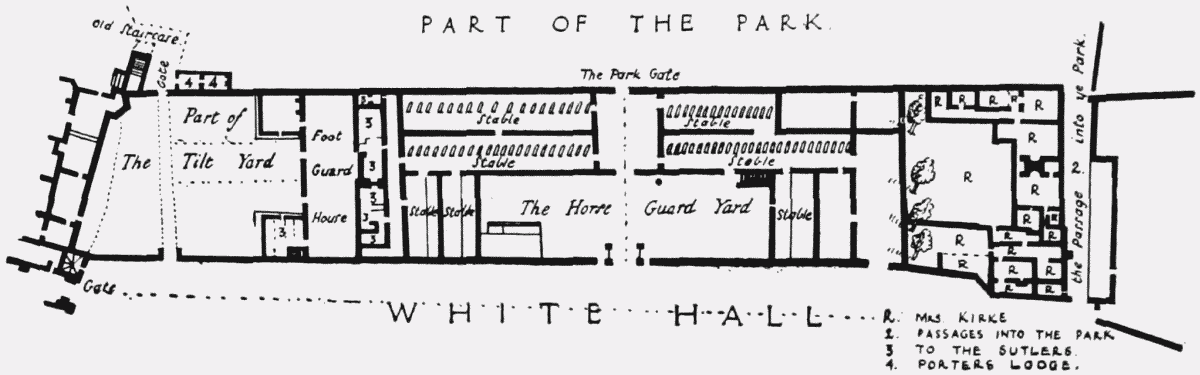
The old Horse Guards, etc., from the plan of 1670
The plan of Whitehall in 1670 (fn. n17) (a portion of which is here reproduced) and a plan in the possession of H.M. Office of Works and reproduced in Plate 2, show the building at the beginning, and towards the end, of its existence respectively. The western elevation of the building (much obscured by trees) may be seen in the three views of Whitehall from St. James's Park circa 1674–7, reproduced in Vol. XIV of the Survey of London, Plate 2, 3, 4, in Kip's Prospect, circa 1710, and in a water-colour drawing preserved at the Guildhall (Plate 1), while a good representation of the eastern elevation is contained in a view by Kip (Plate 1). From the plan of 1670 it will be seen that the building did not occupy the whole site of the Tiltyard, an open space being left at the south end, while the north end was occupied by lodgings belonging to "Mrs. Kirke." The latter formed the site of what are now (a) Admiralty House and (b) the northern portion of the Office of the Paymaster-General, while the former was afterwards utilised partly for an extension of the building occupied by the Foot Guard as shown on Plate 2 and, as regards the southern 31 feet of the frontage, as an addition to the site of Dover House. (fn. n18)
Early in its existence the building narrowly escaped disaster. Under date of 9th November, 1666, the London Gazette records: "Between 7 and 8 at Night there happened a Fire in the Horse guard House, in the Tilt-yard, over against Whitehal, which at first arising, as is supposed, from some snuff of a Candle falling amongst the straw, broke out with so sudden a flame, that at once it seized the North-West part of that Building: but being so close under His Majesty's own Eye, it was, by the timely help His Majesty and His Royal Highness caused to be applied, immediately stopped, and by Ten a Clock wholly mastered, with the loss only of that part of the Building it had at first seized." (fn. n19)
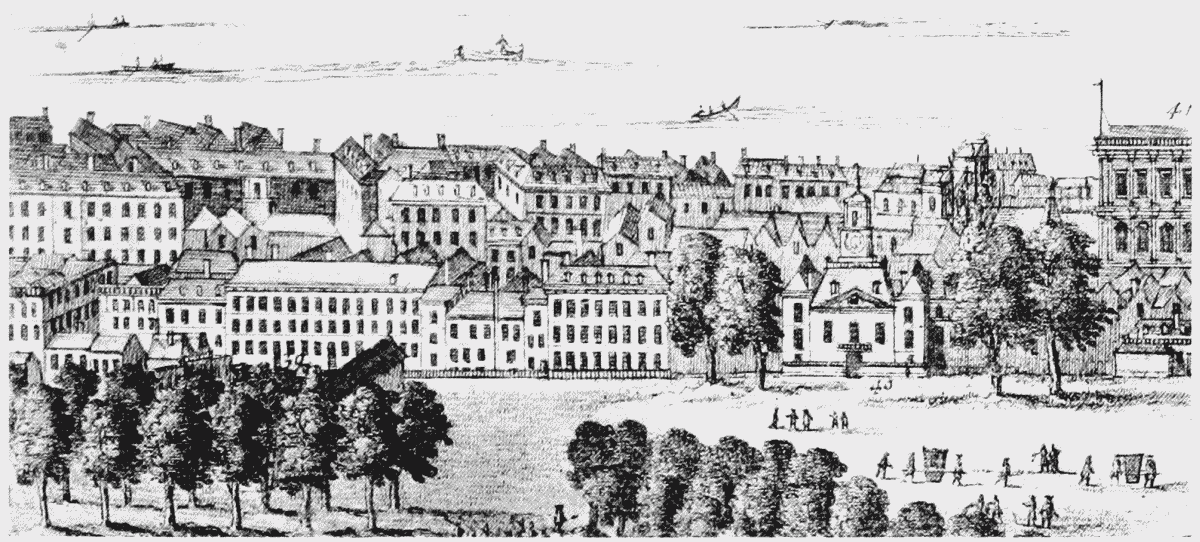
The old Horse Guards, etc., from Kip's "Prospect" (circa 1710)
In course of time a large proportion of the accommodation at the Horse Guards became used for purposes other than at first intended. A report (fn. n20) by Sir Christopher Wren, dated 4th March, 1712–3, states that stabling had originally been provided for 108 horses, but that at that time there was only room for 62 horses, accommodation for the remaining 46 being used by the sutler at the south end (room for 11 horses), the Paymaster's house and offices at the north-west corner (30 horses), and the Judge Advocate (fn. n21) on the west side (5 horses). A few years later that part of the Horse Guards used as the office and residence of the Paymaster-General, as well as certain adjacent rooms, forming altogether the northern portion of the building, was rebuilt as a separate structure (see Chapter 3.)
The main part of the building did not long survive the northern portion. In 1745 a memorial (fn. n22) was presented to the Secretary-at-War on the dangerous state of the Horse Guards. The whole building was, it was said, in a rotten and decayed condition; it had become so dangerous that it was not safe for the coaches of His Majesty and the Royal Family to pass under the gateway; the men and horses doing duty there were in perpetual danger of losing their lives by the falling down of the building, especially in stormy weather; and the stacks of chimneys had grown so bad that, though constantly swept, they were liable to take fire. Orders were given for the building to be shored up at a cost of £160, and for plans of a new building to be put in hand. On 5th September, 1749, the Board of Works submitted plans and elevations, with the following explanations: (fn. n23)
"In the Principal or Middle Building there may be a Room for the Holding Court Martials, a Chappel, and an Office for the Secretary at Warr as well as an apartment for the Judge Advocate General and likewise a Board Room and other Conveniencies for the Commissioners of the Chelsea Hospital with two Rooms for the Officers of the Horse Guards.
"On the south side of the Middle Building & Court is proposed a Guardroom, and Rooms for the Officers of the Foot Guards, larger and better than they now are, and a Sutling house (fn. n24) wth other proper conveniencies.
"On the North side the Building & Court is designed stabling for sixty two Horses, exclusive of the Stable now under the Paymaster General's Office, & likewise proper Conveniencies for the Horse Officers, and for Corn, Hay, & Straw necessary for ye Stables.
"As this will be a Publick Building and Fronts the one way to the King's Park, and the other way to the great Pasage leading to the two Houses of Parliament, We propose it to be Built in a very substantial Manner, and the whole faced with Portland stone.
"We beg leave to Observe to Your Lordships that this Building may be completely Finish'd in four Years time, That the middle Part and Buildings on the North side may be first Built, so that the Foot Guards may be placed over the new Stables, & the Officers may be in the Middle Building untill the Building on the south side for the Foot Guards and Officers is Compleated."
The cost of the new building was estimated at £31,748. On 24th April, 1750, instructions were given for the work to be proceeded with "with all expedition," (fn. n25) and the demolition of the old building (fn. n26) was at once put in hand. (fn. n27) Provision had already been made for the erection of stabling, etc., for the Horse Guards on the west side of James Street (now Buckingham Gate), (fn. n28) and the removal had actually been carried out. (fn. n29) The northern and middle parts of the new building were erected first, and in the early part of 1754 work was begun on the southern portion. (fn. n30) The whole of the building was completed by 1760. (fn. n31)
Description of the Structure.
The group of buildings known as the Horse Guards was erected roughly between 1750 and 1760 (see above) under the authorship of William Kent and John Vardy, these two architects being generally regarded as responsible for the western and eastern groups respectively. William Kent (born 1684, died 1748) was one of the better known followers of Wren who became a protégé of Lord Burlington, and was a scholarly designer, painter, and author, (fn. n32) while John Vardy (died 1765), Kent's able coadjutor, was, apart from the works that they jointly produced, responsible for some notable additions to London architecture. (fn. n33)
The present buildings took the place of a structure varying in height from one to three storeys, that provided primarily stabling upon the ground floor for the Horse Guards and for a part of the Foot Guards and a sutling house, and administrative offices above, with a chapel over the gateway. As with the present buildings, a courtyard on the Whitehall front was included and through communication with the Horse Guards Parade. These earlier buildings were of somewhat irregular character, as illustrated in Plate 1 and Plate 2.
In the replacement which was effected towards the middle of the eighteenth century, the new group of buildings took on the more formal and symmetrical arrangement characteristic of the period.
On the western side facing the Park—or Horse Guards Parade, as now known—the main central block is of three storeys with pavilion projections carried up to a fourth storey, the symmetrical, or axial, arrangement being emphasised by a centrally placed cupola. Flanking portions of generally similar height support the central block at the extreme ends of the façade, with recessed sections between, and a screen wall treatment, one storey in height, to connect architecturally the main block with the outer flanking pavilions. The general effect of this arrangement is illustrated in Plate 15 and the various reproduced photographs. The rusticated character given to the masonry on this front, with its strong plain string courses and a main entablature with modillioned cornice and pulvinated frieze, gives suitable emphasis to the purpose for which the buildings were designed. On the Whitehall side the note of architectural severity is obtained by different means, but is almost equally expressive of the purpose for which this remarkable example of mid-eighteenth-century architecture was designed. The central block, already referred to, has a frontage to the courtyard, with a pedimented gable in which are carved the Royal Arms and Supporters (Plate 19). The returns on the north and south sides of the courtyard are of less height, and terminate in the plain two-storey return wings that face directly on to Whitehall. In this case, as with the western front, its impressive effect, as an architectural composition, is largely due to the cubistic arrangement of the blocks and the advancing and recessed planes that arise from the arrangement of the plan. While in the main the group represents, as already mentioned, a period of construction between 1750 and 1760, a few later additions are apparent that include the low building formed behind the screen wall connecting the wings, with the back portion continued up an extra storey in height, the main cornice being continued across it. The effect of this later addition is made apparent when the illustration by Vardy in Plate 3 is compared with the drawing on Plate 4, though the general effect of the buildings as left by Kent and Vardy can hardly be said to have been materially altered.
Apart from the rustications on the western front, a great deal of the heavy solidity of effect expressed in the treatment is due to the use of the arch, mainly at the ground-floor stage, but also in certain portions of the first floor, where the formation of round-headed recesses in the masonry is combined with insertion therein of the orthodox rectangular-shaped and pedimented window. On the western front are examples of the Venetian type of window similarly introduced within arched recesses. The arcaded character of the ground-floor storey is continued and emphasised in the vaulted road and footways that connect the Whitehall courtyard with the Parade—in itself a feature of considerable interest relative to the whole composition. In this connection, whatever may be felt as to the adequacy of its size or scale, the solid simplicity of the central cupola affords a feature according well with the general design of these buildings.
The details of treatment, including the profiling of mouldings, have been determined with great judgment, and go to make this group of buildings one of the most distinguished of its period.
While the western front is, as already stated, more particularly attributed to Kent, and the buildings and fa¸ade treatment on the Whitehall side to Vardy, the intimate association between these two men in the general execution of the work suggests that it would be difficult to draw an exact line in respect of their individual shares in the work represented.
The courtyard is enclosed with high wrought-iron railings and gates. On each side is a pavilion guard-house, erected in stone with a slate roof, to accommodate a mounted sentry, and closed with double doors. A drawing, which has been accredited to Kent by Professor Richardson, shows alternative positions for these guard-houses (Plate 7).
As regards the accommodation that the buildings provide, the ground floor on the north side is mainly devoted to stabling and quarters for the King's Life Guard, with stores and offices in the rest of the floor. The remainder of the block is occupied by the headquarters of the Eastern Command and London District respectively. Living quarters are provided on the upper floor to the wings facing Whitehall. The rooms on the ground floor of the central block are panelled to the springing of the coved ceiling, as illustrated in Plate 28, showing Room No. 103 as typical.
Some of the rooms on the first floor are of considerable architectural interest, as, for example, the Commander-in-Chief's room (formerly the Levée Room) (Plate 23), the Vestibule forming the lower stages of the cupola (Plate 25), and the Library (Plate 26), while a number are panelled in the manner of the period, and have, among other features, excellent fireplaces, as illustrated in Plate 29 and 30. The staircases are in stone with plain iron balustrading, the basement flights having a stone newel (Plate 22).
The following details are given of additional features of historic and artistic interest.
The Commander-in-Chief's Room (Eastern Command) is situated over the central carriage-way and overlooks the Parade. The walls are panelled in three heights with a moulded dado rail and enriched frieze, finished with a moulded modillion cornice. The ceiling is divided into panels by moulded bands containing the guilloche ornament. One of the chief features of the room is the Venetian window, which has fluted Ionic pilasters supporting the entablature (Plate 23). The mantelpiece is in grey marble, with the shelf supported on scrolled trusses. The oval table in the room bears a brass plate with the following inscription: "This table was habitually used by Field Marshal the Duke of Wellington, K.G., during his tenure of office as Commander-in-Chief, 1842–52. It was restored to this room by Field Marshal the Duke of Connaught, K.G., Inspector General of the Forces, in 1904."
On the walls are hung full-length portraits of King George III and Queen Charlotte (Plate 24). There is also a marble bust of the Duke of Wellington on a pedestal.
On the other side of the vestibule is the waiting-room, now occupied by the Headquarters Library of the Corps of Royal Engineers (Officers). It overlooks the quadrangle to Whitehall and has features similar to those of the last-mentioned room (Plate 26).
The Vestibule is octangular on plan and rises to the full height of the clock chamber in the cupola. It is of somewhat special architectural interest. The walls are divided into three stages, the lower having semicircular niches and arched doorways with an entablature of the Doric order containing tablets in the frieze, which bear alternately the initials "G.R." and the date "1759" below a royal crown. The wall surfaces above contain recesses and niches, with semicircular windows in the top stage, affording the sole means of light to the vestibule below. The whole is completed by a coved ceiling springing from angle trusses (Plate 25).
Above is the octangular chamber containing the clock and chimes, access to which is obtained from the lead flat. Three bells are suspended in the upper portion below the small stone domed roof of the open turret (Plate 20). The hour bell is inscribed "Long live the King 1789." The "Ting-Tang" quarter bells each bear the inscription "Fear God and honour the King," and are dated 1789 and 1790 respectively. (fn. n34)
Room No. 112 on the north side, which was originally used as stabling, has been converted into offices, and the illustration on Plate 22 gives a general view of the interior of the stable portion. The roof is vaulted in brick.
There are numerous plans relating to the building in the possession of H.M. Office of Works, and a selection has been made for illustration in this volume.
A series of designs signed "Chas. Barry, Archt." and dated "18th January, 1847" is also preserved, which shows a scheme for rebuilding the structure on a larger scale, utilising the old walls of Kent's buildings where possible. The wings are shown extended and carried up an extra storey, with the centre also increased in height and crowned with a towering flèche.
Another design shows the wing to the Whitehall front carried to the height of the main block. These drawings are undated, but the watermark of the paper is dated 1850.
Condition of Repair.
Good.
In the Council's Collection (fn. n35) are:
(fn. n36) Elevation to parade facing south-west (photograph).
(fn. n36) Elevation to parade facing north-west (photograph).
(fn. n36) Elevation of central block facing parade (photograph).
(fn. n36) View from parade of covered way (photograph).
(fn. n36) View looking through covered way towards parade (photograph).
(fn. n36) View of cupola taken from roof looking south (photograph).
View of internal court on south side looking east (photograph).
View of internal court on south side looking west (photograph).
(fn. n36) Elevations and sections of No. 3 stables, from a drawing in the possession of H.M. Office
of Works (photograph).
View of lead rain-water head with royal monogram (photograph).
(fn. n36) View of Whitehall from Horse Guards Parade, from water-colour drawing by Taylor
in Guildhall Library (photograph).
(fn. n36) View of west front of Horse Guards, from drawing in Bodleian Library (photograph).
front to Whitehall prior to 1754, from drawing in the possession of H.M. Office of
Works (photograph).
(fn. n36) Elevation to Whitehall showing alternative position of guard-houses, from drawing in
the possession of H.M. Office of Works (photographs).
(fn. n36) View to Whitehall looking south-west (photograph).
(fn. n36) View facing Whitehall looking north-west (photograph).
(fn. n36) View of central block to Whitehall (photograph).
(fn. n36) View in courtyard looking north (photograph).
(fn. n36) Commander-in-Chief's room, general views, two (photographs).
(fn. n36) Commander-in-Chief's room, portrait of King George III (photograph).
(fn. n36) Commander-in-Chief's room, portrait of Queen Charlotte (photograph).
(fn. n36) Vestibule on first floor, general view (photograph).
(fn. n36) Vestibule, general view looking up (photograph).
(fn. n36) Library, general view (photograph).
(fn. n36) Room No. 46, recess (photograph).
Room No. 54, general view (photograph).
(fn. n36) Room No. 58, general view (photograph).
Room No. 59, general view (photograph).
(fn. n36) Room No. 63, general view (photograph).
Room No. 67, general view (photograph).
Room No. 73, general view (photograph).
(fn. n36) Room No. 103, general view (photograph).
(fn. n36) Room No. 112 (formerly stables), general view (photograph).
(fn. n36) Room No. 46, detail of mantelpiece (photograph).
Room No. 59, detail of mantelpiece (photograph).
(fn. n36) Room No. 65, detail of mantelpiece (photograph).
(fn. n36) Room No. 68, detail of mantelpiece (photograph).
(fn. n36) Room No. 110, detail of mantelpiece (photograph).
Main staircase, general view (photograph).
(fn. n36) Newel to basement stairs (photograph).
(fn. n36) General elevation to parade (copy of drawing in the possession of H.M. Office of Works).
(fn. n36) Sectional elevation looking south (dated 25th June, 1751), from drawing in the possession
of H.M. Office of Works (photograph).
(fn. n36) Section east to west through the centre, from drawing in the possession of H.M. Office of
Works (photograph).
(fn. n36) Plans of three floors to centre block, from drawing in the possession of H.M. Office of
Works (photograph).
(fn. n36) North front of Horse Guards wing, from drawing in the possession of H.M. Office of
Works (photograph).
(fn. n36) Section through the north stable looking south, and cross section, from drawing in the
possession of H.M. Office of Works (photograph).
Plans and sections of north stable looking south, from drawings in the possession of H.M.
Office of Works (photographs).
(fn. n36) Plan of building dated prior to 1754, from drawing in the possession of H.M. Office of
Works (photograph).
(fn. n36) Plan of first floor, dated 1847, from drawing in the possession of H.M. Office of Works
(photograph).
(fn. n36) Sectional elevation on line A.A. (dated 1847), from drawing in the possession of H.M.
Office of Works (photograph).
(fn. n36) Section on line B.B. (dated 1847), from drawing in the possession of H.M. Office of
Works (photograph).
North elevation of wing and section on line C.C. (dated 1847), from drawing in the
possession of H.M. Office of Works (photograph).
(fn. n36) General plan of the (old) Horse Guards, from drawing in the possession of H.M. Office
of Works (photograph).
(fn. n36) Plan of the one pair of stairs floor of the (old) Horse Guards, from drawing in the possession
of H.M. Office of Works (photograph).