Survey of London: Volume 20, St Martin-in-The-Fields, Pt III: Trafalgar Square and Neighbourhood. Originally published by London County Council, London, 1940.
This free content was digitised by double rekeying. All rights reserved.
'Trafalgar Square and the National Gallery', in Survey of London: Volume 20, St Martin-in-The-Fields, Pt III: Trafalgar Square and Neighbourhood, ed. G H Gater, F R Hiorns (London, 1940), British History Online https://www.british-history.ac.uk/survey-london/vol20/pt3/pp15-18 [accessed 29 April 2025].
'Trafalgar Square and the National Gallery', in Survey of London: Volume 20, St Martin-in-The-Fields, Pt III: Trafalgar Square and Neighbourhood. Edited by G H Gater, F R Hiorns (London, 1940), British History Online, accessed April 29, 2025, https://www.british-history.ac.uk/survey-london/vol20/pt3/pp15-18.
"Trafalgar Square and the National Gallery". Survey of London: Volume 20, St Martin-in-The-Fields, Pt III: Trafalgar Square and Neighbourhood. Ed. G H Gater, F R Hiorns (London, 1940), British History Online. Web. 29 April 2025. https://www.british-history.ac.uk/survey-london/vol20/pt3/pp15-18.
In this section
CHAPTER 2: TRAFALGAR SQUARE AND THE NATIONAL GALLERY
The genesis of Trafalgar Square is well set forth in the 5th Report of the Commissioners of H. M. Woods, Forests and Land Revenues dated 1826: "When the Line of Communication between Pall Mall and Portland Place had been completed, and as soon as we were put in possession of the Site of the Lower Mews at Charing Cross, we took measures for proceeding to execute that part of the Improvement, which had for its object the continuation of Pall Mall into Saint Martin's lane, terminating at the Portico of Saint Martin's Church, and forming an open area in front of the King's Mews, and it … appeared to us, after mature consideration, that the unequal lengths of the two sides of the open Area, proposed by the original Plan, would be a deformity, peculiarly striking, in the approach from Whitehall; that a much larger space, than was at first designed, ought to be left open, and the West end of the Strand considerably widened." The Commissioners therefore instructed Nash to draw up a new plan. This left open the whole area of what is now Trafalgar Square, except for an oblong block in the centre set aside as a site for the Royal Academy. The National Gallery was shown as extending along the entire north side of the square with the barracks behind, while the Golden Cross, the Athanaeum and the Vicarage of St. Martin's occupied the triangular block on the east of the square. The Charing Cross Act (fn. 66) was passed in 1826, but the original scheme underwent many modifications, and 30 years passed before the square as we know it was finally completed.
(i) The National Gallery.
In 1824 the purchase of John Julius Angerstein's collection of pictures was authorised by Parliament, thus forming the nucleus of the National Gallery Collection. (fn. 28) The pictures were for several years exhibited in the Angerstein Gallery in Pall Mall, but the site being required for the opening of a road from Carlton House Terrace to Pall Mall (fn. 43) it became necessary to erect a new gallery.
Designs for the gallery, which it was agreed should occupy the site proposed by Nash on the north side of the square, were sent in by Nash, C. R. Cockerell, and William Wilkins, (fn. 67) that of the last being accepted. (fn. n1) The work was commenced in 1832 and finished in 1838. In his treatment of the facade, Wilkins was handicapped by having to utilise the columns and capitals from Carlton House, which had been stored since its demolition.
The central feature of the symmetrical stone front is the effective octastyle pedimented portico of Corinthian columns standing on a high podium wall with well arranged flanking steps. The main wall surface is in two stages divided by a continuous band between the windows and niches. The length of the front is relieved by a series of breaks and by a grouping of pilasters to the wings, each of which is surmounted by an octagonal cupola forming a pavilion treatment. There are a series of detached columns to the flanks screening the secondary entrances. The entity of the composition is effected by the moulded entablature and by the high balustraded parapet which surmounts the whole front of the building, while the symmetrical or axial arrangement is emphasised by a centrally placed dome (Plate 5).
The public gain access by the entrances under the portico which lead into a central hall from which the main galleries are approached. A plan is here shown of the Gallery as it was first erected. Alterations to the interior were carried out by James Pennethorne and further additions, including the demolition of adjoining properties to isolate the galleries, have been subsequently carried out. The Royal Academy occupied the eastern half of the building until 1869.
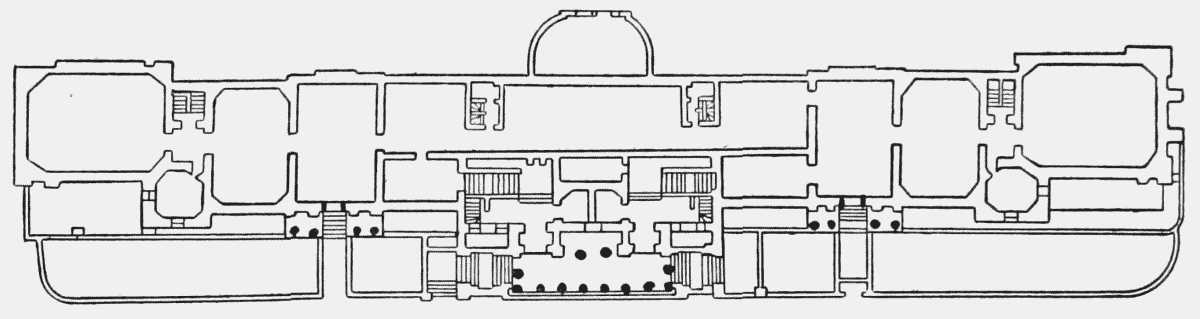
Plan of the National Gallery as first erected.
(ii) Trafalgar Square.
The area of the square was cleared soon after the passing of the Charing Cross Act, but though it formed an open space from 1830 onward it was unnamed until circa 1835; even so the name appears to have arisen prior to and independently of the siting of the Nelson Column (see below). William Wilkins died before any decision was reached on his plan for the formal lay-out, and the matter was referred to Charles Barry. In 1840 a Select Committee considered Barry's proposals which included the formation of a terrace in front of the National Gallery, and the levelling and paving of the area of the square. Barry opposed the erection of the Nelson Column in Trafalgar Square on the grounds that it would dwarf the gallery, and so spoil the effect which his terrace was designed to achieve, namely the improvement of the elevation of Wilkins' building. Work had, however, already begun on the foundations of the column, and Barry was forced to set aside his objections.
The lay-out of the square was not completed until circa 1850. The fountains and their basins, which did not form part of Barry's original design, occupy a large part of the area. A contemporary, writing in The Builder, notes that "they are exceedingly chaste in design, plain simple and unadorned as all works in granite ever should be … and in keeping with the prevailing design of the square. … They are the work of Messrs. Macdonald, the hydraulic part of the matter is entrusted to Messrs. Easton and Amos who are well known for their practical acquaintance with such matters. The water to supply the fountains is obtained from two wells, one in front of the National Gallery, and the other behind it, which are connected together by means of a tunnel, that of course passes directly under the National Gallery, behind which is also placed the engine-house for raising the required water into the tanks, etc., before it is forced through the fountains." The fountains were completed in 1845. They are now (1939) being remodelled as memorials to Lord Jellicoe and Lord Beatty.
The Square is bounded on the north by a terrace wall surmounted by a balustraded parapet, all being executed in grey granite. On each of the flanks are wide flights of steps with a right-angle turn leading to the higher level of the terrace, which is paved with squares of Mansfield stone laid diagonally. Flanking the steps are rectangular pylons, the one on the east being surmounted by a statue of George IV, the western one being vacant. Separating the terrace from the public footway are spaced a series of dwarf cylindrical granite posts. Along the eastern and western sides of the Square the parapet wall follows the slope of the adjoining roads and terminates at each of the southern ends with a cylindrical granite pylon surmounted by a handsome bronze octagonal lamp. Other lamps on high decorative bronze standards are situate along the top of the boundary walls. The southern side is defined by a further series of cylindrical posts which terminate at the base of the Nelson Column, (fn. n2) while on either side are statues of Napier and Havelock. Behind, equally spaced to the main portion of the Square, are the fountains with the Gordon memorial between. The square has recently been repaved with rectangular flagstones.
On a granite pedestal at the north-eastern side of the Square stands a bronze equestrian statue of George IV. The king is shown bareheaded in a semi-classical dress with his cloak thrown back. His right hand grasps a baton and his left the reins. He is shown without stirrups and his charger is standing with its four feet on the ground and its head slightly turned (Plate 7a). The statue, which was executed by Sir Francis Chantry, was originally intended for placing on the Marble Arch in front of Buckingham Palace.
Near the south-east corner on a high granite pedestal is a bronze statue of Major-General Sir Henry Havelock, K.C.B. He is shown in uniform standing bareheaded with his left hand grasping his grounded sword, his right tucked in his belt, and his cloak hanging loosely from his right shoulder. The sculptor was W. Behnes, R.A. The memorial was erected by public subscription in 1861.
Near the south-west corner, standing on a granite pedestal, is a bronze statue, 12 feet in height, of General Sir Charles James Napier. The general is shown bareheaded, in military uniform, with his cloak thrown back. His left hand is grasping his sword by the scabbard and raised above his waist, while his right, extended, holds a scroll symbolic of the govern ment awarded to Scinde during his tenure of office. The sculptor was G. G. Adams. The monument was erected in 1855–6 by means of public subscriptions, the most numerous contributors being private soldiers.
In the centre of the Square between the fountains, on a granite pedestal, is a bronze statue erected to the memory of General Charles Gordon, C.B.E., killed at Khartoum on 26th January, 1885. The statue depicts Gordon in military uniform but bareheaded, in a meditative mood holding his chin in his right hand. His left hand holds the Bible and under his left arm is his cane. His left foot is slightly raised and rests on a damaged mortar. On each side of the pedestal is a bronze panel representing "Faith and Fortitude" and "Charity and Justice," respectively. The total height of the memorial is 30 feet. It was unveiled on 16th October, 1888. The sculptor was Hamo Thornycroft assisted by Alfred Waterhouse.
The Nelson Column.
The suggestion that a national monument should be erected in honour of Nelson and in commemoration of the Battle of Trafalgar was discussed in Parliament in 1818, but it was not until 1838 that a Nelson Memorial Committee was formed for the collection of voluntary subscriptions, and a competition was held for the design of the monument. William Railton's design (reproduced on Plate 6) was finally selected, though the height of the column was subsequently reduced, and, having been approved by H.M. Commissioners of Woods and Forests and by the Lords of the Treasury, a site in Trafalgar Square was granted by the Government. Work was begun on the concrete foundations in 1839. (fn. 68) The fluted column (145 feet high) of the Corinthian order of architecture, is of granite brought from Foggin Tor, Devonshire, while the capital was cast from old guns in the Woolwich Arsenal foundry. The statue, which is of Craigleith stone, (fn. 69) was sculptured by Edward Hodges Baily and was raised in November, 1843. (fn. n3) The four bronze bas-relief panels to the square pedestal depict the Battle of St. Vincent, the Battle of the Nile, the Bombardment of Copenhagen and the death of Nelson. They were cast from guns captured at these battles, and at Trafalgar, and were the work respectively of the artists, M. L. Watson, W. F. Woodington, J. Ternouth, and J. E. Carew. (fn. c1)
The lions guarding the four corners of the monument, which were part of the original design, were lacking for many years, but were placed in position in January, 1867. The lions, superb in their scale, represent dignity and strength (Plate 7). They were all from the same model by Sir Edwin Landseer, R.A., and were cast in bronze by Baron Marochetti.
At the foot of the terrace wall along the northern side of the Square the standard measures are set out in metal.