Survey of London: Volume 20, St Martin-in-The-Fields, Pt III: Trafalgar Square and Neighbourhood. Originally published by London County Council, London, 1940.
This free content was digitised by double rekeying. All rights reserved.
'Orange Street', in Survey of London: Volume 20, St Martin-in-The-Fields, Pt III: Trafalgar Square and Neighbourhood, ed. G H Gater, F R Hiorns (London, 1940), British History Online https://www.british-history.ac.uk/survey-london/vol20/pt3/pp109-111 [accessed 10 May 2025].
'Orange Street', in Survey of London: Volume 20, St Martin-in-The-Fields, Pt III: Trafalgar Square and Neighbourhood. Edited by G H Gater, F R Hiorns (London, 1940), British History Online, accessed May 10, 2025, https://www.british-history.ac.uk/survey-london/vol20/pt3/pp109-111.
"Orange Street". Survey of London: Volume 20, St Martin-in-The-Fields, Pt III: Trafalgar Square and Neighbourhood. Ed. G H Gater, F R Hiorns (London, 1940), British History Online. Web. 10 May 2025. https://www.british-history.ac.uk/survey-london/vol20/pt3/pp109-111.
In this section
CHAPTER 16: ORANGE STREET
Early History
The original Orange Street comprised only that section of the present street which extends from St. Martin's Street to Charing Cross Road, the sections between Whitcomb Street and St. Martin's Street, formerly called Blue Cross Street, and between the Haymarket and Whitcomb Street, formerly James Street, having been included in Orange Street in 1905. A brief history of each section is given here:—
(i) James Street was built up at the same time as Panton Street and Oxendon Street. On the wall of the tennis court there was formerly a tablet with the inscription "Iames Street, 1673." (fn. n1) The street first appears in the ratebook for 1675. (fn. n2) Though no absolute proof is available it seems fairly certain that it was built by Colonel Panton on the southern part of the grounds of Shaver's Hall, and that the Tennis Court on the south side of the street which survived until 1866 was that built by Simon Osbaldeston, circa 1634. (See p. 102.) (fn. n3)
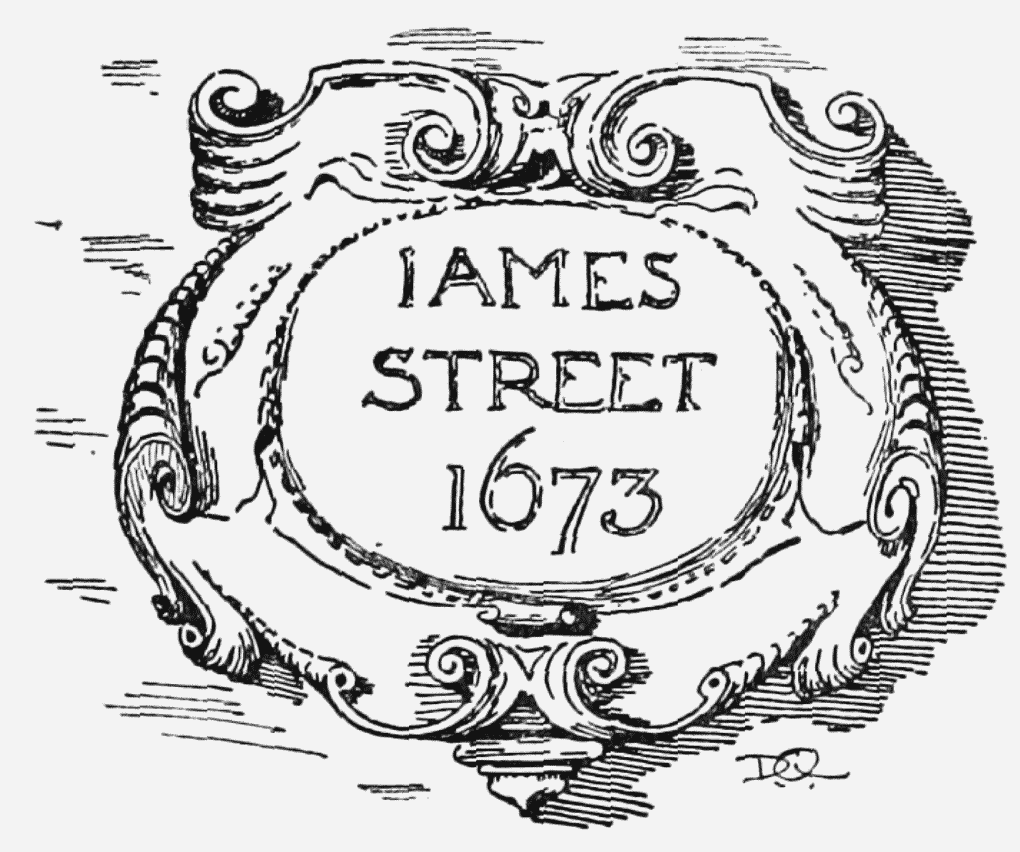
James Street date tablet
Throughout its existence the inhabitants of James Street have been mainly small traders.
(ii) Blue Cross Street. This street as stated on p. 106, where the earlier history of the site is given, was built circa 1692–93 on part of the "Blew Mews." In 1720 Strype described the houses as "fit for good Inhabitants." For the greater part of its existence the residents in the street have been small traders. For many years the Feathers public house occupied the south-east corner of Blue Cross Street and St. Martin's Street.
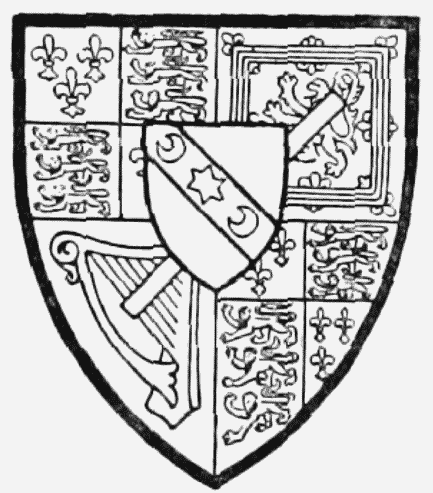
Scott, Duke of Monmouth
(iii) Orange Street. The site of Orange Street was formerly covered by the Duke of Monmouth's stables. The street was formed circa 1696, in which year building leases of the ground on either side were granted by Ann, Duchess of Buccleuch, and her son, James, Earl of Dalkeith, to various purchasers. (fn. 172) In 1720 Orange Street was described as "fair" with "good built houses."
The Tennis Court
A view of the exterior of the court from a drawing by T. H. Shepherd is given in Plate 97a. The court was dismantled in 1866 when the stone floor was bought by the Earl of Warwick, who intended to relay it at Warwick Castle, but the stone was found to be worn too thin for further use. The benches of the dedans were removed to the Merton Street Court at Oxford.
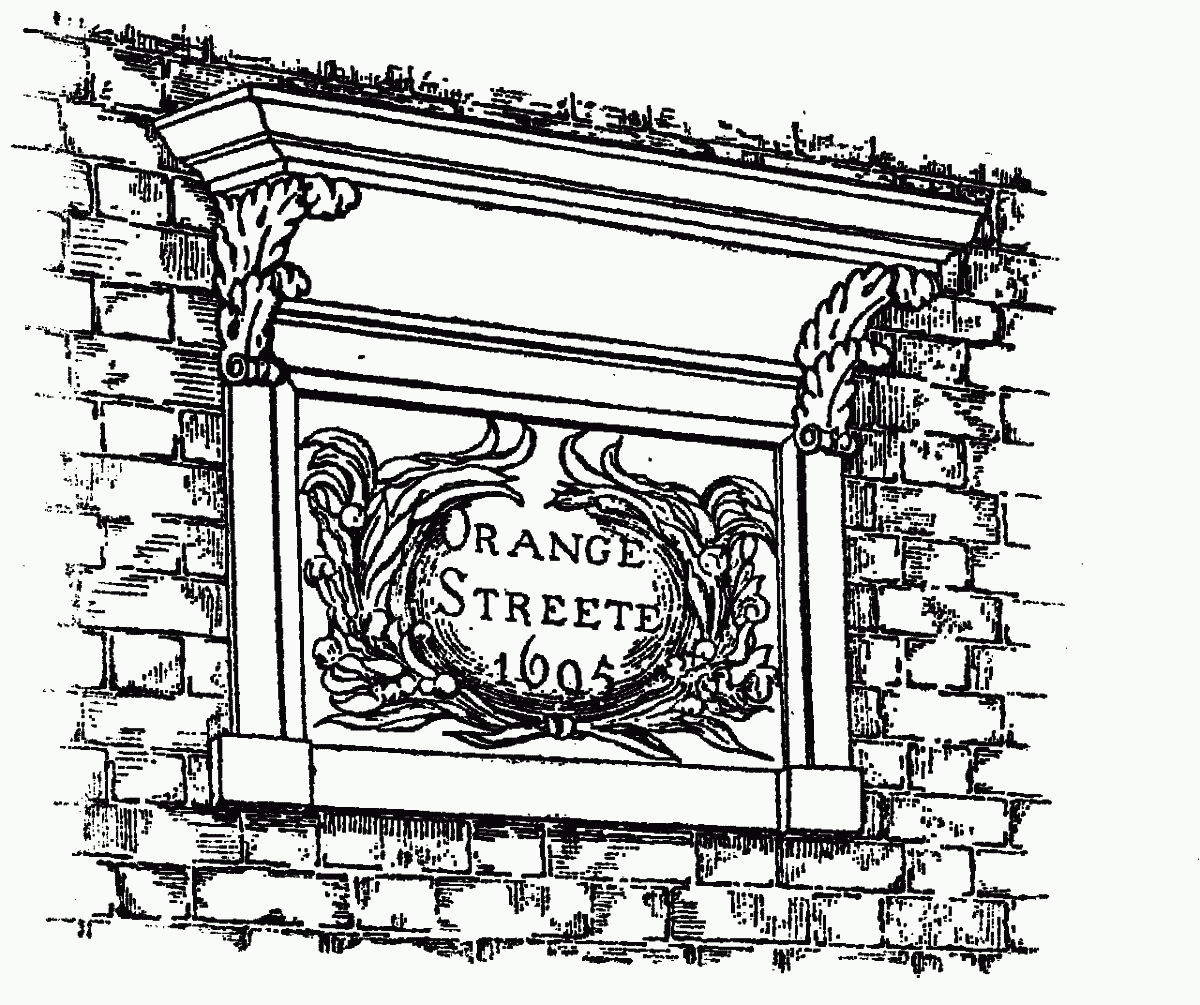
Orange Street date tablet.
Tenants of the tennis court from 1686 to 1735 were: Jane Davis, Isaac Lodgedon, Thomas Hawkins and Benjamin Itchell (or Ithell).
After 1735 the court fell into disuse and the building was used as a theatre. (fn. 173) Towards the end of the 18th century the playing of tennis was revived and from 1800 to 1866 the James Street court was the headquarters of the game in England. (fn. 166)
Orange Street Chapel
This chapel was built for a Huguenot congregation who removed there from a chapel in Glasshouse Street, Piccadilly, at Easter, 1693. Originally the chapel occupied only a small piece of ground at the corner of Long's Court and Orange Street, the entrance being in the court, but in 1790 the proprietors of the chapel obtained a lease of the house at the corner of St. Martin's Street (fn. 174) and the chapel was enlarged by the depth of it. The entrance in Long's Court was closed and a larger entrance was made into St. Martin's Street, the pulpits, desks, and organ being at the same time removed from the west to the east end of the building.
Architectural Description.— The exterior was faced in stucco. The main front to St. Martin's Street was divided into three bays by Corinthian pilasters which supported an entablature below a panelled attic surmounted by vase terminals. The bays contained two tiers of arched windows and a central porch with coupled fluted Doric columns. The return face had a double series of arched windows similar in character to the front and a modillion cornice with a plain parapet. This latter cornice appeared to be of an earlier date than that to the front (Plate 98a).
The interior had a flat ceiling with a central octagonal lantern light. A gallery, continued round the body of the chapel, was supported on cast iron columns. It contained the organ at the east end, behind which was a higher gallery across the end. The rostrum with a central pulpit was situated in front of the organ. Seating accommodation was provided for 700 persons. The last service in the old chapel was held on 25th March, 1917. The St. Martin's Street Library now covers the west end of the site while a small Orange Street Chapel built in 1929 occupies the ground at the corner of Orange Street and Long's Court. (fn. c1)
Orange Street Chapel was used by the Huguenots from 1693 until 1787. In 1776 the friends of the Rev. Augustus Montague Toplady secured a part-time possession of the building, and Toplady preached there on Sunday and Wednesday evenings until his death in 1778. When, in 1787, the Huguenots were forced by their decline in numbers and lack of funds to leave the chapel it was bought by Thomas Hawkes, Army Accoutrement Contractor, of Piccadilly, and converted into a Congregational Chapel, the first minister being the Rev. John Townsend, founder of the London Asylum for the Deaf and Dumb. (fn. 175)