
City of London Livery Companies Commission. Report; Volume 4. Originally published by Eyre and Spottiswoode, London, 1884.
This free content was digitised by double rekeying. All rights reserved.
'Report on the Charities of the Clothworkers' Company: Part I', in City of London Livery Companies Commission. Report; Volume 4, (London, 1884) pp. 572-599. British History Online https://www.british-history.ac.uk/livery-companies-commission/vol4/pp572-599 [accessed 25 April 2024]
In this section
CLOTHWORKERS' COMPANY.
PART I.
TO THE CHARITY COMMISSIONERS FOR ENGLAND AND WALES.
In pursuance of a Minute of the Board dated the 13th day of December 1859, I have inquired into the condition and circumstances of the Charities under the management of the Company of Clothworkers of the City of London, which comprise the following endowments:—
I have stated under the title of every distinct Charity the result of my inquiries relating to it.
Aaron's Gift.
Samuel Aaron, by his will of the 10th April 1730, gave to the Company 300l., requesting them to distribute 12l. at Christmas, viz., 10l. amongst 10 poor men in the almshouse formerly at Islington, and now in Monkwell Street, and 2l. amongst the eight poor women in the Whitefriars Almshouse, which is now in Islington.
This gift (of which it appears only 274l. 10s. was received from the executors) is considered as part of the endowment of the Countess of Kent's Almshouses, and is not paid to them separately, but included in the general allowance of 20l. each. The almsmen receive also more than the prescribed allowance. (See Heath's Endowment.)
Mrs. Acton's Charity.
By a Minute of the Court of Assistants of the 4th of October 1837, the master communicated to the court that he had received from Mrs. Acton, the widow of Mr. Samuel Acton, a liveryman of the Company, a free gift to the Clothworkers' Company of 1,000l.; and it was thereupon resolved that the thanks of the court be conveyed to Mrs. Acton for the very liberal gift, with an assurance on the part of the court that the proceeds of that sum, when invested, should be scrupulously devoted to charitable purposes, in conformity with the wishes expressed by the donor.
This money was invested in the purchase of 1,082l. 11s. Consols in the name of the Company, The dividends have been applied in pensions of 7l. 10s. each for four blind persons, the first of whom appeared to be nominated by the Company. The Company, I was informed, have always considered that the words "free gift" and the thanks of the Company for it, imply that the Company received the money free from any charitable trust. Under this impression the return of income tax has not been applied for, nor has any charge for management been made by the Company. It appears to me, certainly, that the language of the resolution implies that the Company received the money on a trust, which they cannot repudiate. It is a question of no actual importance at present, as the Company have always disposed of the money to the poor, as above stated. (fn. 1)
Armer's Charity.
William Armer, by his will of the 3rd September 1575, gave 50l. to the Clothworkers' Company, to be delivered out to five honest householders of the handicraft of clothworkers for three years, every of them giving security for the repayment thereof. The will was proved in the Prerogative Court of Canterbury on the 11th October 1575. This is one of the charities included in the loan fund administered according to the scheme in the report of the Master in Chancery of the 21st July 1840, referred to under Heydon's Charity.
Barkin's Charity.
James Barkin, by his will of the 20th September 1675, gave 100l. to the Clothworkers' Company, to be lent out to five young men free of the said Company, to each of them 20l. for three years without interest, upon giving security for the repayment thereof at the end of the time. The will was proved in the Prerogative Court of Canterbury the 5th July 1677, and the money was paid to the Company, and is included in the loan fund administered according to the scheme in the master's report of the 21st July 1840, referred to under Heydon's Charity.
Bayworth's Gift.
John Bayworth, by will of the 21st March 1622, gave
to the Clothworkers' Company a messuage in the parish
of St. Mary, Fenchurch, upon trust yearly at Easter—
and the residue amongst the poor handicraftsmen of the
said Company.
The property consists of the house, No. 134, Fenchurch Street, let to Thomas Heath, for a term of 21 years, expiring at Midsummer 1864, at a rent of 120l.
The payments are made to Christ's Hospital of 20s.; to the churchwardens of Farnham, 2l. 13s. 4d.; to the master and wardens, 10l.; to the renterwarden and clerk, 6s. 8d.; to the parish of St. Gabriel, Fenchurch Street, 1l. 2s. 6d. (including 2s. 6d. for the parish clerk, which does not appear to have been included in the gift).
The balance is carried to the funds, which are applied for the benefit of the poor of the Company in pensions. (See Rogers' Gift.)
The Company do not themselves administer the portion of the gift which is for the poor of the almshouses at Farnham, but the whole is paid to the churchwardens of that parish. (fn. 2)
Blundell's Charity.
Peter Blundell, by his will of the 9th June 1599 gave to the Company 150l. on trust, with parcel thereof to purchase lands, out of the rents of which 40s. yearly to be paid to the poor people of Bridewell, and the residue employed as that the wardens should have the benefit thereof for their pains.
The Company purchased a house in Friday Street, which is No. 36, and let to a Mr. Richardson for a term of 21 years, expiring in March 1865, at a rent of 28l. The sum of 2l. a year is paid out of the rents to the treasurer of the Bridewell Hospital. The residue is disposed of by the Company according to the internal arrangements. (fn. 3)
Blunt's Charity.
William Blunt, otherwise Blownte, by his will of the 24th April 1596, gave 50l. to the Clothworkers' Company (in addition to 50l. already given by him to the said Company) the money to be delivered to 10 poor men at 10l. a piece for three years freely, and giving security for the repayment thereof at the end of that time. The will was proved in the Prerogative Court of Canterbury in the year 1596, and the two sums of 50l. were included in the loan fund administered according to the scheme in the Report of the Master in Chancery of the 21st July 1840 referred to under Heydon's Charity.
Richard Boylston's Charity.
Richard Boylston, executor of Thomas Boylston, by deed poll of the 14th December 1648, after reciting that the said Thomas Boylston, deceased, had on the 3rd August 1642 lent to the Parliament in the name of the Clothworkers' Company 100l. for the pressing necessities of Ireland, to be repaid out of the next subsidies, granted and assigned to the said Company The said sum of 100l., with full authority to receive the same, upon condition that the said Company should yearly, on St. Stephen's Day, the Annunciation of the Virgin Mary, and the Nativity of St. John the Baptist, distribute to so many of the 24 poor men and women of the said Company partakers of the charitable benevolence of Mr. William Lambe, deceased, as should on the several feast days make their personal appearance at the usual place of meeting, and attend the said master and wardens to the chapel of St. James in the Wall, and there hear the several sermons there preached, twelve pence a piece, that is to say, if they all appeared there 24s. every feast day, but in default of their appearance then only 12d. to every one that should appear.
It would appear that this loan bore interest or was repaid in 1648, for the payment to the poor appears to have commenced in 1648 and continued to 1813. It was then paid to the almspeople until 1819, when it ceased.
From the year 1838 when payment was resumed, the sum of 3s. has been given to 24 poor persons, who received Lambe's clothing on the 1st October in every year. There is an attendance at the chapel on that day.
Boylston's Charity.
Thomas Boylston, by his will, declared that he had in 1648 delivered to the Company 800l. for the maintenance of a lecture in the parish church of Burton-uponTrent, and to pay to a preacher for the same 31l. 4s., and to the clerk and sexton 16s. a year.
This bequest is charged as a share of the purchase money of the King Street and Cheapside Estate. (See Heath's Almshouses.)
The Company attribute 32l. out of the rents to this gift, and pay the amount annually to the lecturer at Burton-upon-Trent, who is now the vicar of the parish, upon a certificate that the lecture has been delivered.
Bricklis' or Brykles' Charity.
John Brykles, by his will dated the 8th November 1440, bequeathed to the Church of Allhallows the Great and to the parson, his lands and tenements in the parish of St. Martin Vintry, and also an annual rent of 26s. 8d. out of a certain cellar and premises in Harbour Lane, and the yearly rent of five marks. The payment was settled by an award of the 20th May 1515, made for settling variances concerning the premises, the arbitrators awarded that the Clothworkers' Company should for ever thereafter pay the said five marks (3l. 6s. 8d.) to the parson, churchwardens, and parishioners of the said parish. The sum of 3l. 6s. 8d. accordingly is paid by the Company to the church wardens of Allhallows the Great, and is applied by them as fully described in my report of the charity in that parish. (fn. 4)
Barbara Burnell's Charity.
Barbara Burnell, by her will of the 27th June 1630, gave to the Company 300l. to purchase lands and pay yearly to the parson and churchwardens of Stanmore, 7l. for a distribution of 12d. every Sunday for bread for the poor, the parish clerk to have weekly one pennyworth thereof and 2s. yearly on Michaelmas Day for keeping his monument clean, and to bestow 4l. 6d., the residue, in clothing for six poor women And that the Company should also pay yearly to a poor scholar of Oxford, the sum of 5l. The 300l. is under the deed of June 1734 (see Heath's Almshouses) charged as a portion of the King Street and Cheapside Estate. It appears by the books of the Company that the Company, by an order of the 14th October 1685, had directed that the 300l. should be a charge on their Islington estate. The proportion of the rents of the estate attributed to this charity is 12l. a year.
The sum of 7l. a year is paid annually to the churchwardens of Great Stanmore and the Exhibition has been increased to 20l. per annum. (See Pilsworth's Charity.)
John Burnell's Gift.
John Burnell, by his will of the 15th December 1603, gave to the Company 100l., to be lent to two young men, free of the Company, at 5l. per cent. to be employed as follows: 2l. 12s. for bread to 12 of the poorest inhabitants of St. Michael Crooked Lane, 1l. 6s. for bread to the parish of Great Stanmore, and 1l. 2s. in coals among the poor of the said Company.
The loan fund is dealt with under the order of the Court of Chancery of 31st July 1840, confirming the master's report of the 21st July 1840, referred to in the report on Heydon's Charity.
The Company charge themselves with the interest whether the fund be lent or not, or be or be not productive, and apply the same as follows:—
Thomas Burnell's Charity.
By a deed poll of 10th July 1655, the Company, in consideration of 65l. paid by Thomas Burnell, covenanted with the parson and churchwardens of Allballows, Barking, to pay them 52s. a year for bread.
The rector and churchwardens of Allhallows are paid 52s. a year by the Company.
T. Burnell's Charity.
By a deed poll of the 10th June 1655, the Company, in consideration of 135l. paid by Thomas Burnell, covenanted with the parson and churchwardens of Stanmore, Middlesex, to pay yearly 5l. 8s., as follows: 2l. 9s. 6d. on the 29th September, and 19s. 6d. respectively on the 25th December, 25th March, and 27th June to be applied, 30s., part of the said 2l. 9s. 6d., to be added to 4l. 6s., the gift of Barbara Burnell, for clothing six poor women, and the remainder 19s. 6d., and also the other quarterly sum of 19s. 6d. to be paid to the said parson and churchwardens to furnish 1s. 6d. of good Suffolk cheese for the poor, to whom should be made a distribution of bread by John and Barbara Burnell, and Robert and Catherine Hilson.
The Company pay the 5l. 8s. to the churchwardens of the parish of Great Stanmore.
Burton's Gift.
Francis Burton by deed, 9th August 1684, released and assigned to the Company a deed or grant of 20s. per annum, made by the Company in the 27 Henry I. to Rowland Hill and his wife (who had given 30l. to the Charity) to pay annually for ever to two artizan clothworkers 10s. each.
This gift is distributed with Rogers' Charity.
Christian's Gift.
Philip Christian, by his will of the 6th December 1653, gave two houses in the parish of St. Faith to the Company to pay to two poor boys, natives of the Isle of Man, 10l. a piece; but if it should happen that there be a free school in the town of Peel, Isle of Man, the said 20l. a year should go to such school, the schoolmaster to have 18l. and the other 2l. for providing books, &c. and also to pay 7l. a year to seven poor men or women free of the Company, to the master and four wardens 10s. a piece, to the clerk 6s. 8d., and to the beadle 3s. 4d.
From an entry in the Company's Records it appears that a decree in Chancery was made in 1686, which assigned two thirds of the estate to the school, and the other third to the poor of the Company. An entry in the book of the Company of the 21st January 1747, states as follows:—
"This day Dr. Thomas Wilson, rector of St. Stephen Walbrook, attended this court and presented a memorial and request, setting forth that he had been the last year to visit his father, the Bishop of Man, and brought a petition from thence from Mr. Tear, master of the school of Peel in that island, that the contents of the said petition were true as the poor man had represented, that the schoolhouse founded by Mr. Philip Christian was now by length of time in such a ruinous condition that it must be taken down and rebuilt. That he procured from his friends in London some monies towards it, but far short of completing that good work, therefore humbly hoped this Worshipful Company would be pleased to become contributors to so good a design which would be an act of charity and a lasting advantage to that poor town and neighbourhood. The court thereupon ordered the said schoolmaster's petition to be read and the contents considered, but the request not to be granted for an augmentation to his salary, the estate out of which his salary is paid being three houses in Lovell's Court in Paternoster Row, two of them let at 12l. per annum clear of taxes, and the other now empty and has been so for about five years. That by a decree in 1686 two thirds are for the schoolmaster and the other third for the poor of the Company, That, notwithstanding, no more than 12l. per annum is made of this estate, 10l. per annum is continued to be paid to the schoolmaster although he is not entitled to more than 8l. till the rents are increased. That in regard to the schoolhouse, it appears by the said decree that upon stating of the then account the Company had received 230l., and thereby it was ordered that 80l. should be deducted by the Company to defray the charges of the suit, and the remainder, being 150l. to be divided according to the will, so that 100l. should be paid to complainants for the building of a schoolhouse as prayed for by their bill, and 50l. for the relief of the poor of the Company, which 100l. was paid on the 19th August 1686 to Horatio Darling by virtue of a letter of attorney from the then Bishop of Man; that the Company having no concern or anything to do with the schoolhouse and in consequence lying under no obligation whatsoever to be contributory to the upholding such schoolhouse, yet to manifest their readiness to promote and encourage all charitable good designs were pleased to vote that 10l. 10s. should be paid (as the Company's charity and benevolence) upon completing the said building by the quarter warden of the Company for the time being, and Dr. Wilson being required to come into Court was acquainted with the resolutions of the court afore-mentioned, for which he returned thankful acknowledgments for himself and on behalf of the inhabitants of the town of Peel for the court's favor to the poor schoolmaster by allowing him now more than the Company are obliged to pay him, and also of a further generous and charitable act of contributing towards the support of the said schoolhouse."
The property under this endowment now consists of the houses Nos. 8, 9, and 10 Lovell's Court, Paternoster Row, let to Messrs. Remnant and Evans on lease for 21 years from Christmas 1848, at the yearly rent of 105l. This money is divided according to the decree, two thirds to the Peel school and one third to the poor of the Company. The payment for the school is made to the Bishop of Sodor and Man annually after deducting 5l. 5s. for the annual expenses. The net amount is 66l. 10s. to the school (of which 63l. is yearly paid), and 33l. 5s. to the poor of the Company. The difference between the 63l. and the 66l. 10s. is reserved as a repairing fund. A letter from the Bishop of the 26th January 1860 states that "the school is in a very satis"factory condition in every other respect but that of room. The buildings are, I trust, likely to be extended this year, and the sum of 38l. 14s. 1d. which you name" (being the sum referred to by the clerk of the Company as being in hand) "will no doubt be most acceptable, but I will not apply for it without it is really wanted."
In the year 1842 the sum of 100l., in 1845 15l., and in 1848 15l., were paid by the Company in addition to the share of the rents for the assistance of the school and in aid of the repairs.
The payment for the poor of the Company is made to the general relief and pension account. (See Rogers' Charity.)
Oliver Claymond's Charity.
Oliver Claymond or Clement, by a codicil to his will of the last day of February, 31 Henry VIII. (1540), enrolled in the Mayor's Court in 1542, amongst other things directed the Company out of lands and tenements which he devised to them, to find a pascall light and sepulchre light at Easter within the parish of Allhallows Staining, London, and finding yearly four staff torches and the garnishing of 24 other torches in the said church on Corpus Christi day to accompany reverently the Sacrament at the procession of the same day. It appears also as stated in the report of the Commissioners of Inquiry (vol. 27, p. 332) by an old paper in the possession of the parish of Hitchin, Herts, the same person charged his houses with a sum of 6l. 13s. 4d. a year, payable by the Company in augmentation of the vicarage of Hitchin.
In the year 1551 the following note appears in the Rental Warden's Account:—
"Paid the vicar of Hitchin for his resignment of his title, and such evidence as he had to show concerning an annuity of 20 nobles a year going out of Mr. Claymond's lands, 19l. 6s. 8d.
In 1555, an agreement was made with the vicar to pay 4l. per annum. In 1558, the rental warden paid 4l. per annum. In 1560, the vicar was paid 10l., on condition that he would make no further claim for his annuity. On the 16th May 1569, it is stated that the Company purchased the annuity for 100l. In 1591, the opinion of counsel was taken on the objections of the Company to pay the annuity, and other proceedings were taken which are not at this time very intelligible. In July 1593, the vicar of Hitchin exhibited a bill in the exchequer for the recovery of the annuity. Since that time it is stated in the books of the Company that the payment has been regularly made.
The Company hold premises Nos. 62 and 63, Mark Lane, and 23, Abchurch Lane in fee, which they enter in their books as derived from this devise, and which produce a large rental. Out of the two former houses, they pay 20s. a year to the churchwardens of the parish of Allhallows Staining, and out of the latter 6l. 13s. 4d. a year to the vicar of Hitchin. (fn. 5)
Cornell's Charity.
George Cornell, by his will of the 5th of April, 1850, bequeathed to the Clothworkers' Company 2,000l., 3l. per cent. annuities, upon trust to pay six annuities of 10l. a year to six blind persons, members of the Company, and in the event of there not being a sufficient number of such persons, members of the Company, then to such other blind persons, citizens of London, as the court of the said Company should in their discretion think deserving of the said annuities.
The will was proved in the Prerogative Court of Canterbury, the 9th May 1850.
The sum of 1,800l. was received, after the legacy duty was deducted, but the Company added sufficient to make up the 2,000l. stock, which was purchased in the 3l. per cent. reduced annuities, and which now stands to their account.
The dividends, amounting to 60l. a year, are divided annually amongst six poor blind persons, some being members of the Company, and the others freemen of the city. It may be observed that the Company construe the word "citizen" to be confined to freemen of the city of London.
It certainly appears to me that the modern Acts which have opened the parliamentary franchise to the inhabitants and householders, must also have entitled them to the appellation of citizens. (fn. 6)
Dixon's Gift.
Thomas Dixon, by his will of the 2nd June, 1574, gave 250l. to Christ's Hospital, to purchase lands of 10l. a year, viz., 6l. for the Hospital, and 4l. for the Clothworkers' Company, and he directed that if the rent should increase, the amount should be divided rate and rate alike between the said Hospital and Company.
The estate is managed by Christ's Hospital, and the Company receives their proportion of the rents from that institution, according to an account rendered by the Hospital to the Company, and which the master and auditors and wardens sign; but I do not find that the account of Christ's Hospital is in fact audited. In 1858–9, the income of 384l. 11s. 1d. was subject to the payment of 51l. 6s. 6d. for outgoings, and after having applied 6l. to Christ's Hospital and to the Clothworkers Company 4l.; the surplus profits, amounting to 204l. 3s. 3d., were divided equally between the two institutions.
The moiety of this balance 102l. 1s. 8d., 4l. was distributed to the poor of the Company in pensions and in casual aid as stated under the head of Rogers' Charity and forms part of the distribution there mentioned.
George Neale Driver's Charity.
By an indenture of the 2nd July 1853, between George Neale Driver of the one part, and the master, wardens, and commonalty of the Clothworkers' Company of the other part, reciting that the said G. N. Driver was seised of the hereditaments therein-after described, subject as to those firstly described to an indenture of lease of the 17th November, 1696, whereby the same were demised for 500 years at the rent of 5l. And as to those secondly described to an indenture of lease of the 1st October 1694, whereby the same were demised for 500 years at 5l. 15s. per annum, and reciting that the said G. N. Driver was a member of the said Company, and in token of his esteem for the same had determined, to make such settlement of the said hereditaments in their favour as thereby effected. It was witnessed that the said G. N. Driver conveyed to the said Company, and their successors and assigns, all that piece of ground on the south side of Wellclose Square, near Ratcliffe Highway, Middlesex, containing in breadth from east to west 20 feet, and in depth from north to south 79 feet, together with the messuage or tenement, buildings and offices held therewith, and known as No. 35, Wellclose Square. And also all that other piece of ground situate on the east side of Wellclose Square aforesaid, containing in breadth 23 feet, and in depth 100 feet, together with the messuage, &c. held therewith, and known as 41, Wellclose Square aforesaid, to hold the same, subject to the said two leases unto the said Company, their successors and assigns for ever, upon trust to apply the rents thereof for the 1st, 3rd, and each successive corresponding alternate year for ever thereafter for the use of the said Company, and to apply the rents for the 2nd, 4th, and each successive corresponding alternate year for ever thereafter for such purposes of charity as the court of the said Company should direct, and whether by payment thereof to any indigent person or persons or otherwise as such court might think proper and without responsibility for the application thereof.
The rents of this estate are as follows:—
| £ | s. | d. | ||
| No. 35, Wellclose Square | 5 | 0 | 0 | |
| " 41, " | 5 | 15 | 0 | |
| 10 | 15 | 0 | ||
| £ | s. | d. | ||
| The deductions are Crown rents | 0 | 3 | 0 | |
| " " land tax | 0 | 12 | 7 | |
| " " property tax | 0 | 12 | 1 | |
| 1 | 7 | 8 | ||
The balance of the rents for each alternate year is given away in such year at the nomination of the master of the Company for the time being to one poor person.
Edward's Gift.
William Edwards, by will of the 7th April, 1700, gave 100l. in money to the Company to pay yearly at Christmas to 10 poor artisan clothworkers or their widows 10s. a piece amounting to 5l. a year.
This charity the Company administers with Rogers' Charity.
Thomasine Evan's Gift.
Thomasine Evans, by her will of the 11th October 1596, gave to the Clothworkers' Company five tenements in St. Catherine Coleman parish, London, on condition every second year to choose eight poor widows or wives of the age of 50 years dwelling within the city of London, whereof two to be of St. Mary, Abchurch parish, and every second year bestow on the said eight poor women one gown of cloth of 20s. value, and on further trust to provide two cart loads of coal to the poor of St. Catherine Coleman, and the like to St. Mary Abchurch.
The Company is the proprietor of the property in Crutched Friars devised by this will.
The Company pay annually—
The sum of 4l. a year is considered to have been included in the expenditure of clothing referred to under Hobby's Gift. The four persons receiving clothing in 1857 received articles to the amount of 18l. 11s. 8d.
These recipients and those under Webb's Charity attend at the church at St. Mary-at-Hill on the 5th September in every year, if a week day, or on the following Monday. (fn. 7)
Farrington's Charity.
It appears by a resolution of the court of the Company of the 15th November 1613, that Richard Farrington, by his will, gave to the Company 60l. to buy some rent, to be distributed yearly to the poor of the said Company, which 60l. was received of Mrs. Farrington, late wife and executrix of the said Richard Farrington, by Mr. Darkehurst, the last year quarterwarden, and was not employed and bestowed according to the said Richard Farrington's will: and forasmuch as it was not thought fit by this course that the said money should lie dead in the hands of the Company without any benefit coming to the poor thereby, according to the intent of the said Richard Farrington, it was therefore on that day agreed that from thenceforth until the said 60l. might be conveniently bestowed and laid out upon some purchase of land or rent, according to the said Richard Farrington's will. There should be distributed to the poor of the Company yearly, in regard to the use of the said money, 3l. half-yearly to be distributed by the master and wardens at the usual times of distribution of the rent of the lands given to the Company by Mrs. Holligrave.
The sum of 3l. a year is given away to the poor with the funds referred to in the report of Rogers' and other gifts.
Finch's Charity.
James Finch, by his will of the 15th February 1508, gave to the Clothworkers' Company certain premises in Hey Wharf Lane, in the parish of Allhallows the Great, upon trust that the master and wardens of the said Company should find and sustain yearly for evermore a Doctor or Bachelor of Divinity of good and honest fame and conversation to read divinity within Whittington College of London three days in every week, and that such reader from time to time should be elected by the master of the said college by the parson of Allhallows in Honey Lane, by the parson of St. Stephen, Walbrook, and by the parson of St. Peter, Cornhill, and by their successors, for the time being or by three of them, and the testator ordained that the said master and wardens should pay yearly to the said reader of divinity for his salary to be had of the issues and profits of the said premises 10l. at two terms of the year at the Feasts of Easter and St. Michael.
The Company, out of their property in Hey Wharf Lane in Thames Street, pay annually 10l. a year to the reader of Whittington College, who is now the Rev. Thos. Hill, the perpetual curate of the parish of the Holy Trinity, Minories. (fn. 8)
Frankland's Gift.
William Frankland, by his will of the 19th August 1574, gave to the Company his two tenements in Thames Street, upon condition to pay 20s. a year for coals to the poor in the parish of Allhallows the Great, and 3l. a year to the parish of Skipton, Yorkshire.
The property of the charity consists of a house in Thames Street, occupied by a Mr. Andrew McLaren, as a tenant to the Company. The rentcharge of 4l. a year is disposed of as follows:—
| £ | s. | d. | ||
| To the churchwardens in Allhallows the-Great | 1 | 0 | 0 | |
| To the churchwardens in Skipton in Yorkshire | 3 | 0 | 0 | |
| £4 | 0 | 0 | ||
The latter parish returns an account to the Company of the persons' names who receive the dole. (fn. 9)
Gregory's Charity.
Edward Gregory, formerly a member of the Company, by deed of the 4th June 1845, granted to the Company and their successors all that yearly rentcharge of 4l. payable out of the manor of Cowlesfield Esturmey, in the county of Wilts, and also out of all the lands and tenements formerly of Lawrence Low, situate in Cowlesfield, Cowlesfield Esturmey, and Whiteparish in the county of Wilts, upon trust to pay the same on the 26th December in every year unto one of the three most aged blind pensioners receiving pensions from the said Company, every nomination to be made between Michaelmas and Christmas days, and every such nomination to be deemed an appointment during the pleasure of the master, wardens, and commonalty And on the death of such augmented pensioner the next payment of the said 4l. should fall into the general funds of the Company for the purpose of indemnifying the said Company against the trouble and expense of receiving and paying the said augmentation pension, and that after the lapse of a year from the death of any augmented pensioner the said Company should elect another pensioner, and so on from time to time for ever: Provided that preference should be given to pensioners free of the said Company.
The Company receive 4l. a year from a solicitor at Devizes, Wilts, agent of Sir Frederick Bathurst. The Company pay the money annually to one of the three most aged of the blind pensioners. The sum is continually paid to the pensioner until he or she dies.
All the pensioners who have lately received it have attained upwards of 90 years of age.
Halse's Charity.
John Halse, by his will of the 10th August 1573, bequeathed 100l. to the Clothworkers' Company to the intent that the master and wardens should deliver the same to four young men of the Company by even portions to occupy the same without interest for three years, and so from three years to three years for ever. The will was proved in the Prerogative Court of Canterbury, and the said 100l. received by the said Company. It is now included in the loan fund, and administered under the scheme settled by the Master's Report of the 21st July 1840.
Hamer's Charity.
Ralph Hamer, by his will (date unknown), gave 100l. to the Clothworkers' Company, to be lent out to four young men free of the said Company, two to be retailing drapers, and the other two working clothworkers, to have the money by equal portions for seven years, finding securities for the repayment thereof at the end of that time.
This is included in the Loan Fund and administered under the scheme of the 21st July 1840, referred to under Heydon's Charity.
Heath's Almshouses.
John Heath, by his will of the 23rd January 1640, gave to the Clothworkers' Company 1,500l., and directed that 300l. should be laid out in erecting five tenements of brick, and that with the remaining 1,200l. the Company should purchase lands of the clear yearly value of 60l., and ten poor men of the Company aged 60 years who should be clothworkers or dressers of cloth, to inhabit the said tenements, and for want of clothworkers ten other mechanics and handicraftmen free of the Company, towards whose maintenance the rent and profits of the land should be equally divided.
The almshouses at the time of the former inquiry were situated in the parish of St. Mary, Islington. On the 3rd November 1824, ten almshouses and a clerk's house were built in Monkwell Street, Cripplegate, adjoining Lamb's Chapel or St. James in the Wall (see Lambe's Charity). The present building bears the following inscription:—
"John Heath, by his will in 1640 having bequeathed
property to the Clothworkers' Company for the building
almshouses for the purposes of solacing the declining
years of ten poor freemen of the Company aged 60
years or thereabouts, in pursuance of such bequest ten
almshouses were erected at Islington, but the same
becoming dilapidated, were taken down and the present
built at the Company's expense, at the same time the
adjoining chapel and clerk's residence were rebuilt,
the whole being situated upon ground given by will
to the said Company in 1568 by William Lambe, citizen
of London. The first stone of the above was laid on the
3rd day of November 1824, by
"John Ward,
"Master."
The expense of the building of the houses and the repair of the chapel was 6,600l.
The Commissioners of Inquiry (p. 231) remark that the Company were unable to inform them how the legacy was dealt with from the time of its receipt by the Company until 1734, but they proceed to state the investments made by the Company in 1734 of the sum of 1,200l. and of other charitable bequests.
There being no account furnished of the disposition of the money by the Company from the year 1640 to the year 1734, a question arises similar to that to which I referred in the case of the investment of the 360l., the property of the Free Grammar School at Sutton-Valence. If the Company invested moneys in the intervening period in the purchase of real estate, as it was their duty to do, it might not have been in their power in the year 1734 to appropriate such lands to their own use and attribute the investments then made to the charities. Upon this, however, no evidence whatever has been brought before me, and farther than the statement of the officers of the Company that they have no knowledge of any anterior investments, or of any documents illustrating them, it is of course not in my power to penetrate. In a record book of the Company it appears that a dispute had taken place between the Company and some adjoining proprietors of land in King Street respecting lights. On the 10th July 1734, it appears by the same book that a draft deed was produced to the Company for the purpose of conveying and appropriating the estate purchased in King Street to the discharge of several charitable donations formerly given to this Company "the several sums of money having been received and no lands purchased therewith"; so that the estates so purchased may be always subject to the payment of the charities of such benefactors. It appears in the document book of the Company or index to their muniments, that by deeds of the 26th and 27th June 1720, there was a conveyance by Long and others to the Company of three houses in King Street. The deed of the 13th June 1734 referred to by the Commissioners of Inquiry is a conveyance from Thomas Hennand (who, I am informed, was then the Clerk of the Company) to the Company of the premises mentioned in the Report, and it recites as its basis a previous conveyance of the 12th and 13th June in the same year of the same lands by the Company to their clerk, reciting the said donations and the fact that the Company had at several times laid out 6,074l. 10s. (a greater sum) in the purchase of lands, and that the same was intended to be thus conveyed for the better and more effectual continuation and establishment of the several and respective pious and charitable uses therein mentioned.
The funds of the following charities were according to this deed charged in the following proportions on the estate:—
The present property of the charities mentioned in the foregoing table is as follows:—
The two last are building leases and no fines are now taken. The property has been the site of very valuable improvements. To the foregoing account it appears that at the former Inquiry the land tax which had been redeemed by the Company had been carried; but no notice is now taken in the account of the land tax. If redeemed with the property of the charity it is immaterial, if with the property of the Company, the charity cannot of course complain of the omission.
The 300l. given by the founder for erecting the almshouses was no doubt (as the Commissioners observe, p. 231) expended, and probably a larger sum, in the erection of the old almshouses at Islington. The site of these houses is stated to have been and still is the property of the Company and not of the Charity.
Of the 570l. income produced by this estate, the proportion applicable to Heath's Trust is estimated at 112l. 13s. In 1853 the expenditure of the Company for the maintenance of the 10 Heath's almsmen was as follows:—
The excess of these payments beyond the 112l. 13s., and the 10l. under Aaron's endowment is therefore the bounty of the Company.
The 10 almsmen are poor freemen of the Company chosen by the court on petition. Their trades or businesses are miscellaneous. There are always more applicants for admission than there are persons to be admitted. (fn. 10)
Heath's Clothing Charity.
John Heath, by indenture of the 2nd December 1635, gave 1,000l. to the Clothworkers' Company, they agreeing to pay 50l. yearly for ever, viz., to a minister for a sermon on the day of his burial, 13s. 4d., also to purchase so much woollen cloth as would make 30 gowns for 30 poor men and women (26 whereof to be freemen or freemen's widows, and two men and two women should be inhabitants of the parish where he should be buried); also, to buy for the said men and women linen cloth for 30 shirts and smocks, 30 leather shoes, and 30 pair of stockings, to pay to the master and wardens 3s. 4d. each (16s. 8d.) and to every one of the livery present at the sermon 6d., to the clerk of the Company 3s. 4d., to the beadle of the livery 2s. 6d., to the beadle of the yeomanry 1s. 6d., to the clerk of the church 1s. 6d., and to the sexton 12d., and also to pay yearly to two poor scholars, one of Oxford and the other of Cambridge of the surname of Heath, 50s. a piece.
The King Street and Cheapside estate was applied by the Company to this and other charities (see Heath's almshouses). The sum appropriated to this charity as its proportion of the rent is 50l. a year.
The distribution of clothing annually made by the Company exceeds the amount of this and the other endowments for the purpose. (See Hobby's Charity).
The exhibitions are, like the others (see Pilsworth's Charity), increased to 20l. a year. They have not been usually held by persons of the name of Heath, but one is now claimed by a sizar of that name, of Trinity College, Cambridge. There are at the same time 12 applicants; all others, however, will be excluded in favour of Mr. Heath.
Heather's Charity.
Elizabeth Heather, by her will of the 4th January 1801, gave the annual inerest and dividends of the residue of her estate to be divided amongst six poor widows of decayed housekeepers to be annually nominated and chosen.
By a deed of the 2nd February 1842 between the Clothworkers' Company of the one part and Robert Joyce, Samuel Carter, and John Illidge, executors of Thomas Bailey, who was the surviving executor of the said Elizabeth Heather, of the other part. After reciting the said will and that by an order of Chancery of the 26th April 1839 in a suit in which the said Robert Joyce and Samuel Carter were plaintiffs, and the Attorney General and Henry John Fraser and the said John Illidge defendants, it was referred to the master to approve of a scheme for the application of so much of the residue of the said testatrix as should remain after the payments of the costs therein mentioned And that the said master had by his report of the 20th January 1841 found that the plaintiffs, considering that the trust funds (estimated at the annual sum of 60l.) would be too small for the foundation of an establishment for the relief of poor widows of deceased housekeepers, had proposed as a proper scheme for the application of the said testatrix's residuary estate that the sum should be transferred to the Clothworkers' Company, upon trusts there stated, and which scheme was approved by the master as being as near as might be to the charitable purposes expressed by the said will It was by the said deed declared that the Company should stand possessed of the funds to be so transferred upon the following trusts, viz.:—
1st. That the Company should in each year (after payment of the necessary charges of management) distribute the annual income among such six poor widows of deceased housekeepers as among the applicants conforming to the rules and regulations after contained, should appear to them to be most deserving and necessitous.
2nd. That a separate book should be kept relative to the management of the trust, in which an account should be entered of the name in which the said income was expended.
3rd. That the distribution should take place on the 1st December in each year, or within a week after that day.
4th. That to ensure a sufficient competition an advertisement should be inserted in three of the daily papers in the first and a like in the second week of each November.
5th. That such advertisement should state the amount to be distributed, the description of persons among whom the distribution is to take place, and to whom their applications were to be addressed, which must be received before the 23rd November. It may also state (if the Company think proper but not otherwise) what would be required under the next clause.
6th. Every candidate to produce certificate of marriage and of husband's death, and to state in writing at the time of such application, such particulars relative to herself, her condition, and circumstances as should be proper to be considered in deciding upon the respective claims with satisfactory references for information as to character and verification of statement.
7th. No application to be received or considered which should not be made previously to the 23rd November in the year in which distribution is to be made.
8th. All moneys paid to the Company under the before-mentioned order or under any other order in the suit to be invested in their names in the funds or on Government securities with liberty to alter and vary for other securities of like nature.
The fund is now 1,207l. 12s. 5d. Consols and 635l. 15s. 3d. 3 per Cent. Reduced Annuities, producing an income of 55l. 6s. 0d.
The applicants for participation in the gift are very numerous. There are always six pensioners of 8l. each. The expenses of advertising and of management amount to the balance of the fund after these payments. The administration of the trust is stated to be very troublesome and onerous. I annex the forms of application and a table of the names of applicants in the last year.
Petition for Mrs. Elizabeth Heather's Gift to Poor Widows of decayed housekeepers, distributed by the Clothworkers' Company, London.
To the Master, Wardens, and Court of Assistants of the Worshipful Company of Clothworkers.
The humble petition of
Widow of
residing at
late a housekeeper
Here insert any other particulars.
Sheweth that the petitioner is years of age, and bears the character of being a sober and honest person of good morals, is in destitute circumstances, and Your petitioner therefore humbly prays to be admitted a partaker of the above bequest. Dated this day of 185.
Signature of applicant Residence.
I of in the Parish of housekeeper, do certify that of my own knowledge (except as to age) the above statement is strictly correct.
Signed
This petition, together with a certificate of marriage, and a certificate or proper proof of the death of the husband, must be left at the Company's offices, Clothworkers' Hall, London, previous to the 23rd November.
Heather's Trust.
List of Applicants, 1859.
Note.—The Persons nominated to be marked thus +.
Any List having more than six names so marked will be considered void.
Heron's Charity.
William Heron by his will of the 12th July 1580, made the following bequests:—
And the testator directed his executors to convey his lands to the Clothworkers' Company to perform the several devises mentioned.
The property came into the possession of the Company under a deed of the 31st August 1580. (fn. 11)
By a decree of the Vice-Chancellor of England dated the 11th of June 1833, made at the hearing of a cause Attorney General at the relation of Thomas Spencer Hall against the Clothworkers' Company and the master and fellows of University College, Oxford, and the master, keeper, and fellows, scholars of Peterhouse, Cambridge, and the churchwardens of the parishes of Clerkenwell, St. Sepulchre, and Islington, and Stephen Simpson and Augustus Burney, the court declare that the lands and hereditaments devised to the defendants, the Clothworkers' Company, by the will of the testator and the rents and profits thereof from the time of the filing of the information and for the future, together with the 3,355l. 17s. Consols standing in the name of the said Company, and the dividends thereof from the time of filing the said information and for the future were devoted, and ought to be applied to the charitable purposes therein-after mentioned And it was ordered that the sum of 321l. 1s. cash in the hands of the Company which had arisen from the rents of the hereditaments and from the interest of the said 3,355l. 17s. Consols since the filing of the information be laid out in the purchase of bank three per cent. annuities in the names of the Company, and that interest thereafter to become due as well on the said 3,355l. 17s. as also on the bank annuities to be purchased as aforesaid, together with what should be received by the said Company in respect of future rents, be applied in the first place in payment of the specific sums in the said will mentioned, that was to say, 5l. per annum to the heir of the testator, 5l. per annum to Peterhouse, Cambridge, 5l. to University College, Oxford, 4l. to the poor of St. Sepulchre, 10l. towards the repairs of St. Sepulchre's Church, 4l. to the poor of Clerkenwell, 10l. to the repair of Clerkenwell Church, and 8l. towards the repair of the highways as in the bill mentioned And that the said Company should yearly retain and apply to their use one fourth part of the residue of the dividends and rents in full satisfaction of all their interests in the premises and of all trouble, costs, charges, and expenses to be incurred by them about the collection, receipts, and application of the said rents and interest And that the said defendants should annually distribute the other three fourth parts of such residue amongst the several charities and for the several purposes therein-before mentioned, and in aid of the several specific gifts or sums to them rateably, and in proportion to the amount thereof respectively, to wit, 5/46ths to Peter house College, 5/46ths to University College, Oxford, 4/46ths to the poor of St. Sepulchre's, 10/46ths to the repair of St. Sepulchre's Church, 4/46ths to the poor of Clerkenwell, 10/46ths to the repair of Clerkenwell Church, and 8/46ths towards the repairs of the highways aforesaid, such payments to be made on the 25th of March in every year.
The distribution of the estate has been subsequently according to the scheme above directed.
The premises Nos. 90 and 91, front in West Smithfield, and No. 92, partly in West Smithfield and partly in King Street (formerly Cow Lane), and form an area which may be represented for the purpose of description by the following sketch:—
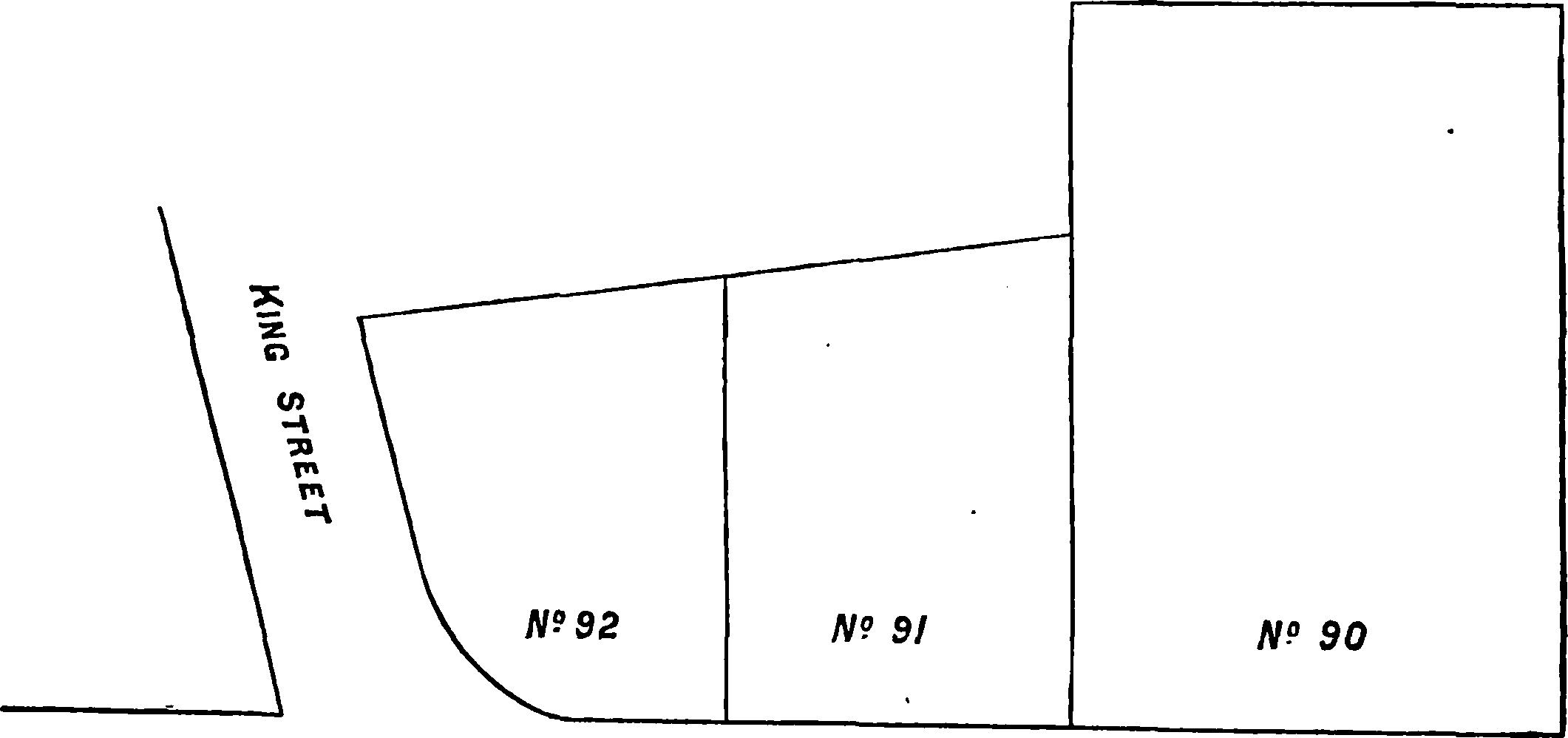
West Smithfield.
The leases on which this property was let were leases involving large improvements, and by the effect of these improvements the sites of the houses which were formerly Nos. 93 and 94, Smithfield, and Nos. 28, 29, and 30, Cow Lane (except so much as was taken by the Commissioners of Sewers), have become absorbed in the premises above described as Nos. 90, 91, and 92, West Smithfield.
The distribution according to the decree is as follows:—
The specific gifts directed by the decree amounting to 51l., reduces the fund to the sum of—
| £ | s. | d. | ||
| 260 | 10 | 10 | ||
| The Company's proportion is ¼th | 65 | 2 | 8 | |
| Leaving a surplus to be divided into 46 parts of | 195 | 8 | 2 | |
The division of the 46 parts is as follows:—
| £ | s. | d. | ||
| Parish of Clerkenwell, poor | 16 | 19 | 10 | |
| Clerkenwell Church | 42 | 9 | 7 | |
| St. Pancras highways | 33 | 19 | 8 | |
| Peterhouse College, Cambridge | 21 | 4 | 10 | |
| University College, Oxford | 21 | 4 | 10 | |
| Parish of St. Sepulchre, poor | 16 | 19 | 10 | |
| St. Sepulchre's Church | 42 | 9 | 7 | |
| 195 | 8 | 2 (fn. 12) | ||
Hewer's Gift.
William Hewer, by will of the 9th September 1715 gave to the Clothworkers 100l. for the use of the poor. With the interest of this sum the Company annually debits itself. The 5l. a year is carried to the account of the Company's poor and distributed with Watson's Gift.
Hewett's Charity.
William Hewett, by will of the 4th April 1599, gave 300l. to the Company to the intent that they should pay to Bartholomew's Hospital 5l. a year, to Christ's Hospital 5l. a year, and to St. Thomas's Hospital 5l. a year; and he also gave 110l. to the Company to the intent that they should allow yearly for ever 5l. to some poor honest scholar of Cambridge studying Divinity.
The 410l. formed part of the funds which the Company appropriated for the King Street and Cheapside property mentioned in the report on Heath's Almshouses; of the income of that estate the sum of 20l. is appropriated to this Charity.
The three hospitals receive the sums of 5l. a year a piece, and the Company have increased this exhibition to the sum of 20l. with the other exhibitions. (See Pilsworth's Gift.)
Heydon's Gift.
John Heydon, by his will of the 11th March 1573, gave 100l. to the Company to be lent out to two young men of the Company, and the interest thereon 3l. 6s. 8d. to be paid to the Mercer's Company.
By an Order of the Vice-Chancellor of England of the 21st March 1839 made upon the petition of the Company under Sir Samuel Romilly's Act, relating to the said charities, it was referred to the Master to inquire and state to the Court what sums of money had come to the hands of the Clothworkers' Company under the several donations mentioned in the said petition and to approve of a scheme for lending out the several sums given to the said Company and for the application of the interest, if any, to be paid by such loans; and the Master by his report of the 21st July 1840, settled and approved of the following scheme:—
1st. That the gift of 100l. under the will of John Heydon, of 100l. under the will of Alexandre Iverie, of 100l. under the will of John Burnell, of 100l. under the will of Samuel Lese, of 100l under the will of James Stoddart, of 120l. under the will of Roger Wilcocks, and of 26l. 13s. 14d. under the will of Katherine Hylson, amounting together to 646l. 13s. 4d., with such additions thereto as therein-after mentioned, should be united together in one separate sum; and that the residue of the several other charitable gifts in the report mentioned, which are to be lent out, without interest, amounting together to 1,496l. 13s. 4d., should be united into one other separate sum, and that so much of the said several sums of 646l. 13s. 4d. and 1,496l. 13s. 4d. as should remain after payment of the costs of the petition, should be set apart as two several funds, the said firstmentioned sum to be called "the Loan Fund bearing interest," and the other to be called "the Loan Fund not bearing interest," and that the management of the said respective funds and all matters incidental thereto should be vested in the Company and their successors.
2nd. That the said Fund to be constituted of the said 646l. 13s. 4d., be lent by way of loan to freemen or members of the Company in such sums as the said Company in their discretion should think fit, but not exceeding 300l. to any one freeman or member for a period of three years at such rate of interest as after mentioned.
3rd. That forasmuch as the sums payable, or which have been applied in respect of the interest of the said several sums constituting the said 646l. 13s. 4d. have amounted to the sum of 23l. 13s. 4d., and that as the said sum of 646l. 13s. 4d. will be reduced by the payment thereout of a proportion of the costs and expenses in this matter, it is proposed that in order to keep the rate of interest sufficiently low to afford an inducement to freemen to avail themselves of the intended accommodation and at the same time to provide for the said sum of 646l. 13s. 4d., together with so much of the said 1,496l. 13s. 4d. as would make up the principal sum of 800l., to be lent out in such manner and in such sums as in the preceding article mentioned at the rate of 3l. per cent. per annum.
4th. That the residue of such sum of 1,196l. 13s. 4d., after the making up the said 800l. as aforesaid, and paying the proportion of the costs, charges, and expenses in the matter in respect of the said first-mentioned sum, be also lent to the freemen of the said Company in such sums as the said Company in their discretion should think fit, but not exceeding 150l. to any one freeman for a period of three years and without any interest whatever in respect of such loans.
5th. That in regard to the persons to whom such loans respectively are to be made, and being such freemen or members as aforesaid, the same shall be at the discretion and nomination of the said Company.
6th. That from the advancement of each such sum by way of loan as aforesaid the freeman or member to whom the same should be made shall execute a bond with two or three sureties, as may be required, whereby he and they shall become jointly and severally bound unto the said Company in a penalty of double the amount of the sum so lent and advanced, conditioned for the repayment by the said obligors their heirs, executors, or administrators of the principal sum so lent, and either with or without interest, as the case may be within the aforesaid period of three years for which such loan is to be made.
7th. That the respective persons to whom such loans shall be made shall bear and pay all costs and charges attending the making and executing of the said bonds and sureties and all other matters and things relating thereto.
8th. That in a book, to be provided and kept for that purpose by the clerk of the said Company, shall be entered the names and residences of the respective borrowers and their respective sureties, the respective professions or business, the amount of the sums lent, the times of making such loans, and the times of the repayment of the same, and any other particulars which may be thought material or necessary.
9th. That when and as often as the said Company shall have in their hands any of the moneys aforesaid ready to be lent out by way of loan under the articles aforesaid, the said Company shall cause to be posted up in some conspicuous place in their common hall, and when such moneys shall amount to 500l. or upwards, shall also cause to be advertised in two of the London daily newspapers a Notice that such moneys are ready to be advanced in loans to freemen of the Company and in the manner therein-before mentioned.
10th. That until the said sum of 800l. shall have been lent out by way of loan under the aforesaid articles in that behalf, the said Company shall pay interest at the rate of 3l. per cent. per annum for the same, and of what shall from time to time remain thereof in their hands, and so from time to time whenever any part thereof, which shall have been lent out, shall be repaid, in order that the whole of the said fund may be productive and bear interest.
11th. That the interest to be paid or received by the said Company for or in respect of the said 800l., or every or any part thereof, shall from time to time be duly apportioned and divided between the said several donations respectively given by the said John Burwell, John Heydon, Katherine Hylson, Alexander Iverie, Samuel Lese, James Stoddart, and Roger Wilcocks respectively, in the proportion to the amount of such donations respectively, or of what has been received in respect thereof, and such interest and the respective appurtenances thereof shall be applied by the said Company, as far as the same will extend, towards the charitable purposes respectively declared concerning such interest, in and by the aforesaid respective wills or instruments in that behalf.
Under this scheme advertisements are published in the following form, and the freemen of the Company apply:—
"Loan trusts under the management of the Clothworkers' Company. The Company have in hand
money to be lent to their freemen in sums not above
150l. without interest, or 300l. with interest at 3l.
per cent. per annum, to any one person for a period
not exceeding three years, the borrower entering
into a bond to the Company with two or three
sureties for repayment (at the end of the first year
if required)". Applications to be addressed to,
"Robert B. Towse, Clerk,
" Clothworkers' Hall, Mincing Lane, London,
"January 1860."
Of the sum of 800l. to bear interest, there was at the 31st December 1858 250l. not lent, and 550l. lent to freemen in sums of 300l., 100l., and 150l.
Of the money not bearing interest there was on the 31st December 1858, 734l. 1s. 4d. not lent, and 225l. lent in sums of 25l., 50l., and 150l.
The Company requires a bond with two sureties conditioned on repayment at the end of the year, but the loans to those who are considered to continue respectable and solvent are allowed to remain for three years.
The Company notwithstanding their care have lost some of the loans by the failure of the sureties and have been obliged to sue for the recovery of some of the debts.
The sum of 3l. 6s. 8d. as the interest of the 100l. under this endowment, is paid every year to the Mercers' Company. (fn. 13)
Hilson's Gift.
Robert Hilson by his will appointed 1l. 6s. 8d. to be yearly paid for the relief of Great Stanmore, and by deed poll of the 25th January 1585, after reciting that Catherine Hilson his widow for better securing the payment of the said 1l. 6s. 8d., had paid to the Clothworkers' Company 40 marks (26l. 13s. 4d.) the Company bound themselves to pay yearly the said 1l. 6s. 8d. to the churchwardens of Great Stanmore, their executors, and administrators. It is stated that this sum of 40 marks the Company ordered to be lent out for three years to some honest man of the Company upon sufficient sureties for payment of the principal and interest, and at the three years end to be lent out again, and so on from three years to three years for ever. This sum is included in the order of the Court of Chancery of the 21st July 1840, made upon petition under Sir Samuel Romilly's Act for regulating the loan charities. (See Heydon's Charity.)
The sum of 1l. 6s. 8d. a year is paid annually to the churchwardens of the parish o Great Stanmore.
Hinde's Charity.
Lady or Mrs. Hinde by her will about the year 1569, bequeathed to the said Company, 20l., upon and for similar trusts to those declared in the will of Augustin Hynde.
This money is included in the Loan Fund, administered under the scheme settled in the master's report of the 21st July 1840, referred to in Heydon's Charity.
(fn. 14) Hitchins' Charity.
Robert Hitchins, by his will of the 24th June 1680, gave 1,500l. to the Company to purchase an estate and apply the rents as follows:—To 20 poor men and 20 poor women on St. Stephen's day yearly 3¼ yards of cloth at 6s. a yard, one pair of shoes, one pair of hose, and one shirt or smock, to a minister for a sermon 20s., to him who should read the Psalms 2s., to the clerk of the Company 5s., and to the beadle 2s. 6d. And he directed that six of the men and six of the women should be inhabitants of the freedom part of St. Giles, Cripplegate. (fn. 15)
The sum of 1,500l. is a part of the consideration of the King Street and Cheapside Estate, applied by the Company in 1734, to Heath's Almshouse (q.v.) and other charities. The portion of the rent of the estate attributed to this charity is 140l. 16s. 4d.
In 1858, the expenses of the estate preparatory to the building leases were—
| £ | s. | d. | ||
| To the surveyor | 18 | 18 | 0 | |
| Law expenses in 1857 and 1858, in reference to the application to the Commissioners for their sanction | 7 | 8 | 10 | |
| 26 | 6 | 10 | ||
Of these expenses—
| £ | s. | d. | ||
| Hitchins' provides | 6 | 10 | 2 | |
| and 5l. per cent. on the share (140l. 16s. 4d.) | 7 | 0 | 9 | |
| Making expenses | 13 | 10 | 11 | |
This leaves a net sum of 127l. 5s. 5d.
The clothing purchased by the endowment is given away on St. Stephen's Day, the 26th December every year. The parish of St. Giles, Cripplegate, by their churchwardens, nominate six poor men and six poor women, and the other recipients are free of the Company and selected by the court. They all receive the same description of dress according to sex, and the suits and articles are the same as are described in the report of Hobby's Charity.
The sum expended in clothing in 1858 in respect of this charity was 139l. 1s. 7d.
(fn. 16) Hobby's Charity.
John Hobby, by his will of the 12th March 1674, gave 3,000l. India stock to his executors for the purchase of lands of the yearly value of 170l. to be conveyed to 14 trustees, seven of whom to be Governors of Christ's Hospital, and seven to be of the Clothworkers' Company; and he directed that 40l. a year should be paid to Christ's Hospital to be employed in apprenticing four Blue-coat boys, and 20l. more in raising stocks for setting up such boys; and he appointed that the said Company should have 60l. a year to be laid out in clothing for 30 poor ancient persons, 12 of whom to be free of the Haberdashers' Company, and the other 18 as the said Clothworkers' Company should think fit, the clothing to be delivered with 5s. in money to each poor person on the 1st December yearly, the master to have 10s., each warden 5s., and the clerk 5s., and the residue, 50l. a year, to be yearly employed towards the discharge of 25 poor prisoners for debt in London, such as lie in for their fees, seven out of each Compter and 11 out of Ludgate.
By an indenture of the 14th March 1677, between Mary Hobby, relict and surviving executrix of the said John Hobby, of the first part, the Clothworkers' Company of the second part, and the governors of Christ's Hospital of the third part, reciting that the said Mary Hobby had found a purchase of lands of 150l. a year, and that it had been agreed that the said lands should be settled on the Clothworkers' Company, and that they should yearly pay 60l. to Christ's Hospital and should stand entrusted with the other charity, which agreement was confirmed by a decree of the Court of Chancery of the 22nd February, 29 Charles II., and further reciting that she had completed the said purchase and had made another purchase of lands of 24l. a year; it was witnessed that she conveyed to the Clothworkers' Company, certain messuages, lands, and tenements in Plumstead and Woolwich, Kent, and at Watford, Herts.
An information was filed on the 6th June 1832 against the master, wardens, and commonalty of the Company at the relation of Thomas Spenser Hall and Effingham Wilson, praying that the defendants might answer the premises and that it might be declared that the said defendants were trustees of all the messuages, &c. which they were possessed of under the said will and deed for the benefit of the charities they founded, and that all the rents and profits thereof ought to be applied to the charitable purposes therein expressed, and that it might be referred to one of the masters of the said Court to take an account of all sums of money received by the said Company for rents and profits, and also for fines and premiums on making leases of the said messuages and hereditaments. And also to take an account of the sums properly paid and expended by the defendants about the charitable purposes aforesaid. And that the said master might be directed to ascertain the amount of the sums received by said defendants yearly and every year above the sums so paid and expended, and to ascertain the amount of such surplus. And that the said defendants might be ordered to answer and pay the same, and that the same, when paid, might be applied in an augmentation of the said charities. And that it might be referred to the master to approve of a proper scheme for the application of the amount so to be paid, and also of the future surplus rents of the estates for the benefit of the said charity.
A decree was pronounced on the 10th March 1834, whereby it was declared that the several objects or persons to whom the specific sums in the pleadings mentioned, amounting to 170l. a year, were given by the will of J. Hobby, were entitled to the surplus rents and profits of the charity estates after making the said specific payments rateably and in the same proportion respectively as they are respectively entitled to the said 170l. And the defendants, by their answer, admitting a sum of 753l. to be in their hands in respect of the rents of the estates in question received by them since filing the information, it was ordered that after payment thereout of the said specified sums or gifts amounting to 170l. a year, or such of them as since the filing of the information had become due and remained unpaid and of the costs therein-after directed to be paid, the residue (if any) should be apportioned among the said several objects rateably and in proportion as they were entitled to the said 170l., and it was ordered that the future surplus of the said charity estates to be received by the said defendants after payment of all proper expenses and of the specific sums of 170l. and of such costs as after mentioned (if any) be apportioned among the said several objects entitled to the said specific sums amounting to 170l. rateably and in proportion as they were respectively entitled to the said 170l. And that the costs, &c. of the relators and of the defendants be taxed by the master in rotation and that the same be paid by the defendants out of the surplus rents received since the filing of the information, and in case they should be insufficient for that purpose then out of any future surplus rents.
The property taken and now held by the Company under the conveyance of 1677 consists of the following particulars:—
It does not appear under what circumstances or by what means the Company became entitled to 200l. a year of the rent of the paper mills. I have not been able to ascertain whether they purchased or became owners of the property adjoining the charity estate, and the question does not appear to have been dealt with by the decree of 1834. It appears by the conveyance of March 1677 that the charity property did not include what was called Hamper's Mill, and applied only to property adjoining Hamper's Mill.
The property, according to the scheme of 1834, is divisible into 17 parts, 6/17ths to Christ's Hospital, 6/17ths to the Company's clothing fund, 5/17ths to poor prisoners.
In the year 1853 the sum of 192l. 10s. 7d., and in 1858 154l. 15s. 5d. were paid to Christ's Hospital. The same sums were in those years applied to the clothing fund; the income of Evans', Heath's, Hobby's, Lambe's, Lute's, Middlemore's, and Webb's Charities amounted together to about 700l.
In the year 1858 the amount expended in clothing (including Lambe's Charity, but exclusive of Hitchins') was 708l. 19s. In May Heath's and Hobby's Charities are given away; on the 5th of September Evans' and Webb's; on the 1st of October Middlemore's; and on the 18th of October Lute's Charity is given away. The freemen of the Company and their widows know that such gifts are to be distributed at such times, and that it is necessary for them to attend at the Clothworkers' Hall and put down their names during the previous month, when the cases are inquired into and their eligibility as objects of the charities considered. Every male recipient obtains a hat, a shirt, a coat, waistcoat, and trowsers of blue cloth, and stockings and boots. The cost of these suits in April 1859 was 3l. 14s. each. The women each receive a bonnet, shawl, merino gown, flannel petticoat, a serge petticoat, shift, stockings, and shoes. The cost of these articles in April 1859 was 2l. 0s. 5d. each. The clothes are supplied by contract, and when the names of the selected recipients are written off by a member of the Court of Assistants they are entitled to go to the tradesmen indicated and obtain the clothes.
With regard to the 5/17ths for poor prisoners, there is an accumulated balance. Applications are constantly received from the governor of Whitecross Street Prison. The ordinary sum required for the release of prisoners is 3l. It is said that the present governor, Col. Martyn Hicks, has employed a person to get the poor prisoners through the insolvent court, and the expense of doing so defrayed from these funds in 1858 was 6l., and in 1859, 75l. There is now an accumulated balance of 1,221l. 12s. 8d.
The abolition of the three prisons mentioned in this endowment and the great alterations which have taken place in the modern laws and remedies between debtor and creditor would appear to render it necessary to adopt some new method of distributing charitable funds applicable to the benefit of prisoners for debt. This, however, raises a very large question, owing to the number and magnitude of the gifts for distributions in money and kind to prisoners in the metropolis and elsewhere, and it is a question which it appears to me ought to be considered in a more extensive point of view than could be taken in settling a scheme for any single charity. Instead, therefore, of recommending in this and other like cases any application to the court for a new scheme, I have rather preferred to leave the disposition of the income as it may happen to be made in the exercise of the judgment of the administrators, the capital being secure and hereafter capable of being applied in some manner more extensively beneficial to the unfortunate persons for whom it is intended than the direction for any detached and fragmentary application of a particular fund is likely to be.
With reference to the administration of this and other charities by the Company, I may here observe that in those cases where the Company do not take any beneficial interest in the charity, it is their habit to charge 5l. per cent. as the expense of general management, exclusively of the actual charges for purely professional purposes.
In the other cases where the Company take a beneficial interest, no general per-centage is charged. If the gift be, as in many cases it is, to the poor of the Company, it is right to mention that the charge is not in substance deducted, as the gifts by the Company commonly exceed the amount derived from the original benefaction.
It will be observed that a large portion of the estate of this charity is situated in the parish of Plumstead. The parish is very populous, and its inhabitants are for the most part artizans, labourers, and poor. The incumbent of Plumstead, the Rev. Wm. Acworth, attended at my inquiry and stated the educational wants of the poorer classes in his parish and the efforts which have been made by benevolent persons and by Government assistance to supply them, and urged his claims on the trustees as the owners of large real estate in his district dedicated, moreover, to charitable purposes.
I stated to the Company and its officers, in the presence of the incumbent, the disposition of the Board to afford its sanction and aid to the trustees of charities in the performance of the duties admitted to attach to real estate with due liberality, and I assured them that they might rely on the support of the Board in any application of a proper portion of the income of the charity estate to the local objects referred to.
Holligrave's Charity.
Mrs. Margaret Holligrave, by indenture of the 12th November 1595, granted to the Clothworkers' Company all her messuages, &c. in East Smithfield, upon trust, to pay to the poor of St. Botolph's, Aldgate, 20s. a year; to the poor of St. Mary, Aldermary, 20s. a year; to the prisons of Newgate, Ludgate, and the two compters, 5s. a year each, and the residue of the rents to the said Company to be distributed as follows: to the master and wardens for their pains, 20s. yearly; and the residue for the poorer sort of clothworkers, and no others, at Christmas and Midsummer.
The whole of the premises comprised in this devise were sold under an Act of 6 Geo. 4. to the St. Katherine's Dock Company for 11,150l., laid out in the purchase of 12,773l. 12s. 2d. Consols. In 1839 premises in Moorgate Street, paying ground rents of the annual value of 363l. 3s. 9d. were purchased, the stock sold for such purpose being 12,649l. 15s. 9d., leaving 123l. 16s. 5d. stock still in the Court of Chancery.
Under this purchase the Company are proprietors of the following property in fee, subject to the leases subsisting thereon:—
The charges as to the aforesaid gift are as follows:—
The pensions, which were formerly of sums of 4l., have been raised and classed in a different manner, as stated under Rogers' Gift. (fn. 17)
Hussey's Charity.
Thomas Hussey, by indentures of the 4th April 1622 and the 20th March 1623, gave to the Company 120l. to pay on the eve of St. Thomas, to 20 poor men of the Company 6s. a piece; to 20 poor women 12d.; and to the clerk, two beadles, butler, and porter 12d. a piece. This bequest is apportioned to the estate purchased as stated in my report of Heath's almshouses. The sum of 7l. 5s. 5d. attributed from the rents to this charity, and the distribution of this and other similar funds and charities is mentioned under Watson's Gift.
Hynde's Charity.
Augustin Hynde, by his will of the 23rd June 1556, gave to the said Company 100l., upon condition to deliver the same to four young men of the Company, to have the occupying thereof for three years, to each of them 25l., taking good securities for the same, and so from three years to three years for ever, the said 100l. to be delivered by the master and wardens and 12 of the assistants to four young men of the said Company to have the occupying thereof for three years.
The will was proved on the 16th August 1556, and the 100l. was paid to the Company.
This is one of the charities included in the loan funds, now administered according to the report of the Court of Chancery of the 21st July 1840 referred to under Heydon's Charity.
It forms part of the moneys comprised in the schedule to that report.
Iverie's Charity.
Alexander Iverie, by his will of the 25th December 1588 (31 Elizabeth), bequeathed to the Company of Clothworkers the sum of 100l. to be paid them by his executors, which money he willed might be employed towards the relief and better maintenance of the poor people of the said Company and that such small profits as they should make for the use of the said 100l., might for ever thereafter be employed towards the relief of the poor people free of the said Company.
This is one of the charities included in the loan fund now administered according to the report of the Court of Chancery referred to in Heydon's case. It forms a part of the money comprised in the schedule to that report. The Company charge themselves with an interest of 3l. a year, which they distribute to the poor of the Company, in the same manner as the other funds described under Rogers' Gift.
Countess of Kent's Almshouses.
The Right Honourable Margaret, Countess of Kent, by an indenture of 14th July 1538, reciting that she was seised in fee of four tenements at Queenhithe, and of one tenement in Fenchurch Street, and that she and the Clothworkers' Company were possessed of a lease of a garden ground in Whitefriars, with an almshouse built by the said countess for a term of 99 years, the said countess granted the residue of her part of the said lease to the said Company, and covenanted that she had by will devised the said five tenements to the Company, for which gift and for 350l. paid by the said countess to the Company, they covenanted to pay 18l. a year for ever for seven poor almswomen resident in the said almshouses.
And by her will of the 3rd December 1540, the said countess devised all her lands and tenements in London to the said Company, to the intent that seven poor women should be maintained continually by the said Company out of the rents of the property in Fenchurch Street and Queenhithe.
The Company take under the deed and by the will of the Countess of Kent property in Whitefriars and Fishmonger's Alley, Fenchurch Street. The houses in Queenhithe appear to have been sold by the Company in 1548 for the sum of 115l. 10s.
The Whitefriars estate of the Company consists of property derived from the countess, and also of the property purchased in 1654 of Daniel Potter at the north of the almshouse for 330l.; on these premises a building lease was afterwards granted.
The whole property of the Company in Whitefriars at present is,—
It does not appear what portion of this property belongs to the almshouse and what to the Company. There appears to be no doubt that the only property belonging to the Company originally in Whitefriars was the almshouse, and if the subsequent purchase of the Company cannot be defined, it will be difficult for them, I apprehend, to assert their exclusive claim to any part of the property as against the charity.
It is probably now impossible to ascertain whether this was taken by the Company under the deed or the will of the countess, or whether it is charged with the 18l. a year or is to any extent an absolute devise for the benefit of the charity.
The Company in the year 1770 transferred the almshouses which were originally in Whitefriars to Islington, consisting of eight tenements, built by the Company on land of their own at that place, situated in the Lower Road. These houses were rebuilt nearly on the same spot about five or six years ago, and were increased to 11 in number, with a garden for the whole. On this erection the Company expended 3,359l. The almshouses are occupied by 11 freemen's widows or freemen. They are allowed 20l. a year each (in the whole, 220l.) and coals, medical attendance, wages of gardener, and repairs amounting in the year 1858 to 158l. 18s. 11d., and 10l. per cent. on the rebuildings which amounted to 335l. 19s. 9d., making a total expenditure in the year 1858 of 714l. 18s. 8d. (fn. 18)
(fn. 19) Lambe's Clothing Charity.
By an indenture of the 12th July 1568 between the Clothworkers' Company of the one part and the Corporation of London of the other part, reciting that William Lambe intended to bequeath certain premises in the parishes of St. James in the Wall, St. Stephen Coleman, and St. Olave, Silver Street, to the said Company, it was covenanted that the said Company should on the 1st of October, and on the feast days of St. Stephen, the Annunciation of the Virgin, and the Nativity of St. John the Baptist, cause a sermon to be preached in the Church of St. James in the Wall, and that at every sermon four of the livery should be present and 6s. 8d. paid to the preacher of every sermon, and 13s. 4d. to the said four liverymen.
That the said Company should give 12 gowns to 12 men at the yearly expense of 6l. 9s., and 12 gowns to 12 women at the expense of 5l. 11s., and also 12 shirts to 12 men of the value of 1l. 10s., and 12 smocks to 12 women at the expense of 1l. 4s., and 24 pair of shoes for the said men and women, such distribution to be made on the 1st October in the chapel of St. James aforesaid, amongst 12 poor aged men and 12 women being impo tent and lame, such men and women to be present at every of the said four sermons. And it was further covenanted that if the chamberlain, town clerk, and under chamberlain of the said city, or any of them should on the 1st October be present at such sermon to see the premises duly executed, the Company should pay them 6s. 8d. a piece. And that the said Company should after the decease of the donor find a chaplain who should every Wednesday, Friday, and Sunday, say divine service in the said chapel, and should duly preserve the said chapel, with a proviso that if the said donor did not by will convey the said premises to the Company to their proper use and behoof for ever discharged of all incumbrances, the said covenants should be void.
And the said William Lambe, by his will of the 11th October 1574, gave all his messuages, &c. in the abovenamed parishes (subject to a yearly rent of 6l. 13s. 4d. to the Stationers' Company) to the said Clothworkers' Company for ever to the uses, intents, and purposes of the above-mentioned deed.
The dispositions thus directed are as follows:—
The Company consider that notwithstanding there is no gift of the residue, the above payments are all that they are liable to make, inasmuch as it was only upon the condition of making them that the Company entered into the covenant, and it is to be observed, that by an ultimate provision in the will, if the donor did not by will convey the said premises to the Company discharged of all incumbrances that the said covenants should be void.
A tabular statement of the property comprised in this devise is given in the report of the Commissioners of Inquiry (p. 220). Assuming that the conclusion come to by the Commissioners is the correct one, as upon the above circumstances it probably is, that "Lambe's pensioners owe what they receive beyond the specified sums to the voluntary benevolence of the Company," it does not appear necessary to go into the specific rents and description of the property charged, which are stated in the accounts of the Company to have produced a rental as follows.—
| £ | s. | d. | ||
| In 1853 | 873 | 15 | 0 | |
| " 1854 | 935 | 1 | 3 | |
| " 1855 | 1,028 | 9 | 0 | |
| " 1856 | 999 | 2 | 8 | |
| " 1857 | 993 | 1 | 0 | |
| " 1858 | 999 | 12 | 4 | |
The Company continued to make the distribution to Lambe's pensioners of sums of 4l. a year each for several years after the last report, but for many years past the Company have ceased to grant new pensions of 4l. a year, the applicants for such smaller pensions not having been considered proper objects, and instead of such smaller pensions, the number of larger pensions of 10l. a year was increased, which are limited to persons of either sex of the age of 60 years and upwards. There are only three 4l. a year pensioners remaining, and there are now 50 10l. a year pensioners, as stated under Rogers' Gift.
By a provision in the will it is declared that if the Company should be negligent in the performance of the trusts, so that the same be left undone for the space of a year, the testator willed that all bequests and devises so made to the Company should be void and then he gave and devised all the said lands and premises to St. John's College, Oxford, to the use of poor scholars of the said college for ever.
The Company only charge the trust with the actual sums specified in the deed, but they actually disburse in relation to this endowment the following sums, after paying the quitrent of 3s. 2d. and 6l. 13s. 4d. to the Stationers' Company.
The chapel, which was the ancient chapel of St. James in the Wall in Lambe's Chapel Court and Monkwell Street, was entirely taken down in 1825 and rebuilt with 10 almshouses adjoining and the chapel keeper's house (see Heath's almshouses), at an expense to the Company of 6,600l. The annual expense of repairs, rates, taxes, coals, insurance, &c. amount to about 60l. a year.
(fn. 20) Lambe's Almshouses, at Sutton Valence, Kent.
William Lambe, by an indenture of the 6th April, 22nd Elizabeth, between himself of the one part and the said Company of the other part, reciting that he had granted to the Company a messuage and land in Abbey Warley, Essex, a tilekiln, house, and land in Upminster, Essex; and reciting that he had erected six almshouses in Sutton-Valence for 12 poor almspeople; it was agreed that out of the profits of the said lands there should be yearly paid to the said Company 4l. for an annual visitation to the free school. And the Company covenanted to pay 4l. a year towards the maintenance of the people in the almshouses; and further reciting that William Lambe had by indenture of the 20th August, 18th Elizabeth, granted to the corporation of London, governors of Christ's Hospital, a term of 500 years in a tenement, &c. in Mile End, Stepney, to the intent that the said governors should yearly pay to the said Company 6l. towards the maintenance of the poor people in the almshouses. Nothing has been received from this last named gift, which appears to have been the subject of a suit in the 42nd year of Elizabeth. (Reports, p. 398, vol. 30.)
There are now six almshouses at Sutton-Valence adjoining the school premises. They are six continuous tenements with two rooms and a wash-house in each. They are occupied by inhabitants of Sutton-Valence, aged persons, men and women and married persons. They are selected by the court out of names recommended by the master of the school, the rector of the parish or his curate, and the churchwardens.
The Company pay 10l. a year to the inmate nominated in each house, as well as occasional gifts of 10s. each on their visitation and a ton of coals to each house.
Two widows and four men are now in the almshouses.
The sum has been increased at different times, and since they have received 10l. a year half relief is allowed by the parish, viz., 1s, 3d. to 1s. 6d. a week.
Laws and Regulations of the Free Grammar School at Sutton Valence, in the county of Kent, founded by William Lambe, Esquire, and extended by the voluntary bounty of the Worshipful Company of Clothworkers.
Introductory Address to the Court of Assistants of the Clothworkers' Company.
Gentlemen, 1st November 1841.
Having fulfilled the duty undertaken by us, of preparing a set of laws and regulations for the government of the Company's school at Sutton Valence, which laws and regulations have duly obtained your sanction, we have only to express our hope that they may prove useful and beneficial, and tend to raise and dignify the character of an institution, enlarged by you at a very considerable charge, derived from your own funds, and from which it is hoped that the Company, in their corporate character, will derive lasting credit hereafter.
The instances are but few, in the history of the great civic companies, of an act so truly beneficent and disinterested as this, but we hope that the example, which you have herein given, will not be without its effect upon them, for the motives are undoubtedly of great weight, which should induce them to devote a portion of the wealth, derived from their ancestors, to the advancement of the sacred cause of Education, among the rising generation of the present day.
This is one of the results which eminent statesmen have had in view when the measure of a general investigation into the trusts and charities of the Livery Companies of London received the sanction of the Legislature; by anticipating that object, they will, therefore, at once create the strongest of claims, on their own behalf, to a lasting place among the great institutions of the country, and render a service to the rising generation, the importance of which our daily experience tends to elevate and exalt to the highest degree.
It is with pride and satisfaction we shall ever reflect on the part you have permitted us to take in the various measures for the improvement of the school at Sutton Valence.
| William Horne, Chairman. | ||||
| Huntley Bacon | Members of the Committee of Record and Trusts. | |||
| T. M. Alsager | ||||
| J. R. Bousfield | ||||
Preface.
A brief account of the early history and progress of Sutton Valence School, would appear to be a proper appendage to this publication.
It was founded in 1576, by William Lambe, Esq., a member of this Company, at whose death it devolved permanently upon the court as a trust, but so limited were the notions of the founder, in making a provision for its future execution, that besides assigning the house and garden in which the school was then conducted in perpetuity to the Company, the only endowment for its support was a rentcharge of 30l. a year, and even that was so irregularly collected, owing to the unsettled state of the country in the following century, that it was finally disposed of by the Company for somewhat less than 12 years' purchase.
Our predecessors did not, on that account, neglect the trust which they had undertaken. Indeed, there is no period of our history in which it cannot clearly be shown, that the Company expended much more upon the school than the original endowment, and they have incurred a very large outlay at various periods, in rebuilding and repairing the school-house. The court did, moreover, bestow a large share of their attention on the management of the school at all times, and a reference to the rules and orders will show that frequent reports of Committees were made, and that more space, perhaps, in those proceedings, is occupied by that subject, than by any other. But it must at the same time be admitted, that long periods of total neglect often succeeded to the energy thus displayed, and that the school never acquired much distinction, or was of any decided benefit to the district in which it was placed.
A new era in the Company's affairs began in the year 1837. The court had consented to the formation of various committees for the management of the general business, and the extension of the trusts and charities, and it was soon determined that the school at Sutton Valence should partake of the benefits of the improved system. The duty of reconstructing that seminary was confided to the committee of record and trusts, who applied themselves to it with so much assiduity, that by the autumn of 1838, the old school had been broken up, and all arrangements duly planned for re-opening it upon the present plan, which took place in January 1839, when a great number of the members of the court repaired to Sutton Valence to give due importance to that ceremony. Divine service was performed on the occasion in the church of Sutton Valence, and a sermon was preached by the Company's Chaplain, in which a pledge was given on their part, that they would carry out this undertaking by all the means in their power.
An examination of the scholars took place in June of the same year, which was attended by the master of the Company, the chairman of the committee of record and trusts, and several other members of the court, but was conducted privately, as in the short time since the school had been opened, it was not to be expected that any great proficiency could have been made.
The first public examination took place in June 1840, and afforded very gratifying proofs of the ability of the master, and of the industry and talent of his pupils. At the examination, however, in June 1841, the whole had assumed a greatly improved character, Edward Russell James Howe, one of the pupils, presented an essay on the effects of the Norman Conquest, so well written and so carefully reasoned, as to create the surprise of the examiner, Professor Hall, of King's College. It of course received the prize, as well as the high encomiums of all the company present. An order of the court was passed, on the report of the visitors, that Howe's essay should be printed; and it was further ordered, that in consideration of his extraordinary merit, and in the event of his becoming resident at one of the universities, he should receive 50l. annually from the Clothworkers' Company, during three years, to enable him to complete his education.
With such encouragement the school cannot fail to produce great and learned men, and to reflect great honour on those by whom it is supported.
1st November, 1841.
Laws and Regulations of Sutton Valence School as revised and adopted by court 1st November, 1848.
The Scholars.
1. Shall be of two classes.
First.—The sons of freemen of the Clothworkers' Company; and the sons of freewomen, born after the admission of their mother to the freedom, and after the death of their father; preference being given to those whose parents have filled a respectable rank, but who have been rendered unable by declining circumstances to give their children a good education.
Second.—The sons of inhabitants of Sutton Valence and its vicinity, (preference being given to those residing in that and the adjoining villages of Langley, Leeds, Chart, East Sutton, and Lenham, but the benefit, may extend, by the permission of the Company, to every part of Kent.
2. The Clothworkers' boys, six in number, to be boarded and educated at the expense of the Company.
3. No boy to be admitted under the age of nine years, nor continue in the school after the age of 16 years, unless by the special permission of the Company.
4. No boy to be admitted who has not previously received the first rudiments of education. A certificate of good health must be given, and an examination take place by a medical man, if required, previous to admission.
5. Sons of clothworkers who may be candidates, shall have their names inserted in a book to be kept for that purpose, and will then be furnished with the subjects they will be required to know; the candidates shall be examined at the hall in Mincing Lane, by the master of the school, in the presence of the master of the Company, and those who can read without hesitation, give a satisfactory answer to the leading questions in the Bible, to simple questions in geography and English history, work the first four rules in simple arithmetic, write a legible hand, and have a tolerable knowledge of the Church catechism, shall be considered as eligible for election on any vacancy occurring, when the court shall make its own selection from such names.
6. The Kent boys to receive education free of all expense, but not to be boarded at the cost of the Company; and both classes of scholars in addition to English, French, German, arithmetic, and writing, shall pursue some branch of classical or mathematical learning, and other subjects, qualifying the scholar, if required, for admission to either of the universities.
7. Application for the admission of the Kent boys to be in writing, addressed to the master of the school, accompanied by the recommendation of two respectable housekeepers, which applications are to be submitted for the approval of the court.
8. All boys not present at the opening of the school after the vacations, without a legitimate excuse, to be punished as the master may think fit; and if absent more than six days, to be subject to expulsion, at the discretion of the master and the trustees of the school.
9. The Clothworkers' boys, or any of the Kent boys, that may board with the master shall attend Divine service on the Sabbath at Sutton Valence parish church, or at any other church in the neighbourhood, attended by a master.
10. The name of each scholar, and in the case of a Kent boy the names of the persons by whom he was recommended, together with the date of his admission and of final departure from the school, shall be registered in a book kept for that purpose by the master, or by his usher under his direction, with a column for remarks by those members of the Company who may occasionally visit the school.
11. Every scholar shall wear a cap similar to that worn by boys on the foundation of other free grammar schools, to be provided annually at the expense of the Company; but in the event of its being lost or wilfully injured or damaged, his parents shall be at the expense of substituting another.
12. The school hours shall be as follows: from Lady Day to Michaelmas, in the morning from 7 to 8, and from half-past 9 till half-past 12; and from half-past 2 to half-past 4 in the afternoon. From Michaelmas to Lady Day: from 9 to 12 in the morning, and from 2 to 4 in the afternoon.
13. The holidays shall commence on the 30th June, and continue for six weeks; and on the 23rd December, and continue for five weeks; and 10 days at Easter from Maunday-Thursday, but it shall not be compulsory for the boys to leave school at the latter period.
14. An examination of the scholars shall take place previously to the Midsummer holidays every year by an examiner, to be approved by the Committee of Record and Trusts, and prizes shall be distributed to the most deserving by the master of the Company for the time being, accompanied by two of the wardens and the chairman of that committee; and the names of the scholars obtaining such prizes shall be recorded on boards to be affixed in the schoolroom for that purpose.
15. A copy of these laws and regulations shall be given to the parents immediately after election.
The Master.
1. He shall be a member of the Church of England, a graduate of one of the Universities of Oxford or Cambridge, in priest's orders, and not more than 35 years of age at the time of election.
2. He shall be allowed a salary of 120l. annually, and five tons of coals for the use of the schoolroom and establishment, and also occupy the school-house and garden adjoining, free of all rent and taxes.
3. He shall be allowed 30l. annually for the board, and all charges connected therewith of each of the six Clothworkers' boys, the Company reserving to themselves a discretionary power of increasing the number to 12 on the same terms.
4. He shall have the entire superintendence and government of the school.
5. He shall appoint, subject to the approbation of the Company, an usher or assistant master, for whom he shall be allowed 80l. annually. (fn. 21) In the event of the introduction of other masters into the school, similar allowances to be made, at the discretion of the Company as to their amount.
6. He shall appoint the books to be read in the several classes; and personally instruct the scholars, more especially the higher classes, in Latin and Greek.
7. He shall furnish to the Company at Midsummer and Christmas a report of the number of scholars during the preceding half year, distinguishing the classes, and setting forth the subjects taught in each, with such other information as he may consider expedient to communicate.
8. He shall read, or cause to be read, prayers twice a day in the school.
9. The religious instruction of the pupils shall be strictly in conformity with the doctrines and articles of the Established Church.
10. He shall not take upon himself any cure or other employment, without the previous consent of the Company.
11. He shall make the system of education the same for the foundation scholars as for those of the Clothworkers' Company. No distinction being made in the treatment of any of the boys.
12. He shall keep a register for the inspection of the members of the court, to contain a statement of the punishments inflicted from time to time, and for what cause they were inflicted.
13. He shall not inflict, unless for trivial faults, any personal chastisement at the time when the faults are committed, but carry them into effect when necessary to be inflicted on the following morning, immediately after prayers.
14. He shall take especial care that during the hours of play the boys shall not be allowed to ramble about the country, but he shall know where they are, that they may always feel under his control and observation whether present or not.
15. He shall give a bond to the Company engaging to resign his office when called upon to do so by them.
The Matron.
A house is rented in the village by the Company for boarding and lodging the day scholars on the foundation to which a matron has been appointed.
Visitors.
Besides the master and wardens of the Company who are visitors by virtue of office, the school shall be under the general superintendence of the Committee of Record and Trusts.
Exhibitions.
An exhibition of 20l. a year, applicable either to Oxford or Cambridge, has been specially created by the court for scholars on the foundation, on their becoming resident at either of those universities, but only to be bestowed on the recommendation and approbation of the master, in concurrence with the court. (fn. 22)
Two exhibitions of 10l. a year each, payable by St. John's College, Cambridge, to scholars of Sutton Valence School upon their entering the university, were founded by Mr. Francis Robins in the year 1721.
The National School of Sutton Valence.
The Company in November 1838 gave 50l. towards building the national school in the village, and 20l. subsequently towards erecting a house for the master and mistress, they have also since 1839 subscribed 24l. annually, in consideration whereof 24 boys are educated free of expense, and called "the Clothworkers' boys."
At the annual visit to Sutton Valence for the examination of the boys of the Clothworkers' school, a gratuity is given towards providing a dinner for the children of the national school.
The Free Grammar School at Sutton Valence, Kent.
By letters patent of the 9th February, 18th Elizabeth (1576), Her Majesty, at the instance of William Lambe, ordained that there should be one grammar school at Sutton Valence to be called "The Free Grammar School of William Lambe" for the education of boys and youths in grammar for all time to come; and that after the death of the said William Lambe, the Clothworkers' Company should be the governors of the said school, and they were incorporated as such governors.
And by a deed of the 10th February following, 30l. a year was made payable out of certain messuages and lands in Kent to the said Company for the maintenance of the said school, 20l. thereof for the schoolmaster, and 10l. for the usher.
And John Maplisden by his will dated the 20th June 1713, gave a rentcharge of 5l. a year issuing out of property in the parish of Ullcombe for the usher of the said school; and Francis Robins by his will of the 7th July 1720 gave 600l. to St. John's College, Cambridge, to found two exhibitions of 10l. a year a piece, to be paid to two poor deserving lads of the name or kindred of Robins or Sabb, born in Kent; and for want of such to two poor and apt lads born in Chart, Sutton, Leeds, Langley, or Lenham, and educated at Sutton school. As to this latter part of the endowment there was a boy sent from the school to Cambridge in 1854 and who remained there till 1858; and there is at the present time a boy in the school who is ready for Cambridge.
The founder, William Lambe, also charged his estates in Essex (which now belong to the Company) with 4l. to the master and four wardens for a visitation of the Sutton Valence school, which money is carried to the credit of the school.
In an account of the school, printed by authority of the Company in 1848 and which I append, it is stated that "besides assigning the houses and gardens in which the school then was conducted in perpetuity to the Company, the only endowment for its support was a rentcharge of 30l. a year, and even that was so irregularly collected, owing to the unsettled state of the country in the following century, that it was finally disposed of by the Company for somewhat less than 12 years' purchase."
In Stowe's Chronicle (edition of 1598, p. 349) it is said that "William Lambe erected a free school and six almshouses at Sutton Valence, where he was born, and appointed for the master 20l. and the usher 10l. yearly for ever, and to the six almshouses 10l. a year with an orchard and garden."
The records of the Company show that in 1594 "a convenient lodging or chamber was ordered to be made for the master over the schoolhouse."
It is not certainly ascertained whether the buildings at present existing stand on the property of the charity or on land which has been purchased by the Company. The schoolhouse was built about 1840 at an expense of 800l. It communicates with the master's house by a covered way and has dormitories over it. It was originally built for a dining room, the old schoolroom then remaining but which has since been pulled down.
It appeared at the last inquiry, that from 1760 to 1818 the sum of 2,220l. 4s. 9d. was expended in repairs of the school, dwelling and almshouses; and very large sums have since been expended on the same objects. The premises consist of the schoolmaster's house and a schoolroom detached, and these with a garden and yard and the almshouses and small gardens stand upon somewhat more than an acre of ground.
The rentcharge of 30l. was, by a deed of the 10th February 1605, sold for 360l. This money is stated not to have been re-invested and to form part of the capital funds of the Company. There is no record at least of the re-investment of the 360l., nor is there any record of the manner in which it was disposed of. There is no evidence that it has been kept in money or in any manner ear-marked. Lands or real estate have been purchased by the Company subsequently to the sale of the rentcharge from time to time; and the Company claims to be entitled to say that such purchases were made exclusively with their own money and not with the money of this charity.
The gift of John Maplisden of 5l. a year was charged on property in Ulcombe. Of this 50s. a year was paid in respect of a small farm in Ulcombe occupied by a man of the name of Bates. The farm has been recently sold, having been purchased by a gentleman named Whittich of Tenterden. The other 50s. is paid to Mr. Milligan (the master not to the usher) from a house in the village of Sutton Valence, occupied by William Higgins, formerly belonging to William Cotton Shirley and now to Sir Edward Filmer. It is supposed to be transferred in exchange for an estate called Buckhurst.
The annual expenditure of the Company on the school for several years past is exhibited in the following tabular statement:—
The master's house and premises over the school afford accommodation for about 12 or 13 boarders, besides the two assistant masters. It appears that in 1818 the then master had 23 boarders and had accommodation for 30; and since that time the old schoolroom was taken down.
The Company considers that at the present time 24 boys are admissible on the Kent foundation, including the parishes of Sutton Valence, East Sutton, Chard, Leeds, and Langley. This was adopted under the ordinances of November 1786. Each boy is admitted on the certificate of the master that he has received the first rudiments of education, and a certificate of good health must be given, and an examination take place by a medical man if required previously to admission.
The present master is the Rev. Henry Mawson Milligan, who was appointed in 1848. About the year 1837 or 1838, the Company began to nominate six boys, the sons of freemen, as boarders, for each of whom the Company at first paid 30l. a year, and subsequently 40l. a year. There are at the present time six Clothworkers' sons and 15 day boys on the Kent foundation, and one day boy not on the foundation. The master also has four private pupils in the house: he was not at the time of his appointment allowed to take such boarders, but he has since been permitted to do so.
The present master's salary is 180l. a year, and the usher is appointed by the master at a salary of 80l. a year. The Company subscribe 24l. annually to the Sutton Valence national school for boys and girls, which is supported by voluntary subscriptions and the payments of the children. There is also a British and Foreign school in the parish.
The master of this school has furnished me with an account of his income and expenditure (Appendix A), which does not appear in any respect exaggerated, for the purpose of showing that the receipts barely meet the expenditure and allow but very little for the restoration of furniture, wear and tear, &c. It appears that if the school is to be continued in its present form that a large sum of money must be expended by the Company in repair or rebuilding, not less than 2,000l. and upwards. The Company are under no recognised obligation to make the expenditure nor to sustain the school at any expenditure beyond the income with which it may be chargeable in respect of the 360l.
It becomes an important question in what way the duties of the Company and the educational claims of the locality and the public can be reconciled.
The present measure of usefulness of the institution appears to be small; whether the changes in local circumstances and in the increase of the opportunities of education generally are such as to impede or advance the condition of the school are matters on which I cannot form any opinion. I append to the report a copy of an address, signed by many respectable inhabitants of the district, who conclude that a school of the highest class would flourish in Sutton Valence, but at the same time appear to think that it requires considerable support from the Company, and that it should afford a commercial education. I do not see that any public object is gained by the application of large funds to sustain a grammar or middle-class school where the upper or middle classes would do nothing to support it without that expenditure. I think if the Company were to appoint a master and permit him to have the use of the school-house and premises free of rent and taxes, the school, if really necessary to the inhabitants, should he a self-sustaining establishment. The present master is desirous of resigning his appointment, and it may be more useful that his successor should be a certificated master, able to give a good commercial education and depending on his own exertions for his success. (fn. 23)
The Sutton Valence Grammar School.
The undersigned, being the parish officers of the several parishes of Sutton Valence, East Sutton, Chart Sutton, Leeds, and Langley, beg leave to submit the following observations for the consideration of the Worshipful Company of Clothworkers, trustees of the above school.
That it is within the knowledge of some of those whose names are hereunto attached that previous to the year 1838, the school, on the whole, was very well attended, both by pupils resident in the neighbourhood as well as by boarders from other parts of the county.
That subsequent to the year 1838, when a system of education of a higher class was introduced into the school until a year or two previous to the death of the Rev. Mr. Goodchild, and also during the first few years of the present master's engagement, the school appeared to go on very satisfactorily; but that the last few years it has gradually declined, and from the small number of pupils now attending it is evident that, as now conducted, the school has become of very little use to the neighbourhood.
That the undersigned can conscientiously bear witness to the great liberality shown by the Clothworkers' Company in appropriating considerable sums annually from their own funds for the purposes of the school, and they highly appreciate the views expressed by the Company in 1838 and in 1848, with the object of improving the character and value of the establishment.
That it is the opinion of the undersigned that the success of all schools of that high order contemplated by the Company can only be secured by superior talents on the part of the head master, who should be a man who has distinguished himself at one of the universities in such a manner as to be able by his own abilities and judgment to command the respect and attention of the public, and also to merit the continued support and good opinion of those who may have placed pupils under his charge.
That the undersigned feel it to be their duty to state that in their opinion the present master of the school is not well adapted to fill the office which he now holds, and in respectfully submitting that opinion for the consideration of the Company, the undersigned believe that they are only giving expression to the general feeling of the majority of the respectable residents of the parishes which they represent.
That it is the opinion of the undersigned that the healthy character of the locality in which the school is situate, its accessibility from the metropolis, its nearness to the county town, and the support and countenance which it would receive from the Clothworkers' Company are advantages of the greatest importance, and afford such inducements as without doubt would command the services of a first-class man as master of the school. In support of the opinion they entertain, that a firstclass school would meet with ample support from the neighbourhood and from the county of Kent generally, they would point out the success which has gradually attended the grammar school at Cranbrook, especially the great increase in the number of pupils at the grammar school at Maidstone, which within these two years, under the management of a new master of known ability and discretion, has risen from a state of decay, and is now a most flourishing school; and in both these cases the only limit to the number of boarders appears to be the want of adequate accommodation.
Many rumours have been circulated as to the future intentions of the trustees of the school, and it is evident that the time has arrived when same alterations must be effected in order to make the establishment of any use, either to the neighbourhood, to the Clothworkers' Company, or to the public generally.
The undersigned venture respectfully to recall the attention of the Company to the address which they issued in 1838, and especially to the memorandum prepared by them and dated the 27th of July 1848, which contain statements and suggestions of a most valuable character, and the undersigned beg leave to express their decided conviction that with masters competent by ability, discretion, and right temperament to carry out the views therein set forth, the school would become one of the first establishments of the country.
The undersigned are of opinion that it is most desirable that the school should be continued on such a footing that all the higher branches of knowledge may be there obtained which would qualify the scholars to avail themselves of the great advantages which are open to cultivated talent in this free country. They would, however, most respectfully submit for the consideration of the Company that it would be very advisable and also advantageous to many of the inhabitants of the neighbourhood that the higher course of education carried on in the school should admit of such a modification in practice that those who might desire their sons to receive a course of education there more especially adapted to the ordinary commercial and other practical business pursuits of life might have the option of availing themselves of the advantages of a good school without their children being required to go through the whole of the extended course of education hitherto contemplated by the Company.
Charles Chambers. Richard Henry. John Newman. William Farmer. John Edmed. Thomas Alfred Woollett. Edwin James Godden. William Hadley. Richard Fitch Spicer. Wm. E. Long, junr. Thomas Joy. Thomas Chambers. Thomas Avery. P. S. Punnett. Thomas Foster. John Betts. D. A. Minor. Richard Bentley. Robert Jordan.
At a meeting held at the "Bell Inn," Maidstone, on the 19th of January 1860, it was resolved unanimously: "That the chairman of the meeting be deputed to attend at Clothworkers' Hall on Tuesday the 24th instant and hand in the before-written paper; to give any evidence in support of the same; and also to hand in a copy of the same to the Inspector under the Charity Commission."
P. S. Punnett,
Chairman.