
Survey of London: Volume 2, Chelsea, Pt I. Originally published by London County Council, London, 1909.
This free content was digitised by double rekeying. All rights reserved.
'Cheyne Walk: Queen's House (No. 16)', in Survey of London: Volume 2, Chelsea, Pt I, (London, 1909) pp. 54-60. British History Online https://www.british-history.ac.uk/survey-london/vol2/pt1/pp54-60 [accessed 25 April 2024]
In this section
XXIX.—QUEEN'S HOUSE, No. 16 CHEYNE WALK.
(FORMERLY KNOWN AS TUDOR HOUSE.)
Ground landlord, leaseholders, etc.
Ground landlord, Earl Cadogan. Leaseholder, the Hon. Sir William Pickford.
General description and date of structure.
Queen's House is the second house in point of size in Cheyne Walk, but although it has 10 feet less in frontage than No. 6, and has not enjoyed the same immunity from change, its design is more striking and original, and its features excite more interest in the eyes of the artist and connoisseur. Its architectural pre-eminence depends very largely upon the wealth and beauty of its ironwork, both within and without, which is equal to the very best of the kind. There is a peculiar fascination in the study of the design of wrought ironwork, a craft which has played such a conspicuous part in the development of English architecture during the later Renaissance, and nowhere among examples of similar size is there a better instance to be seen of its chief characteristics—namely, fine grouping, skilful contrast of plain bars with panels of scroll work, graceful outline, and beautiful workmanship—than in the gate and railings of Queen's House. We have before remarked that Chelsea is rich in wrought ironwork. Not only is this the best example, but it is also the best preserved. There were other gates in Cheyne Walk, just east of Manor Street, which, we may conclude from the evidence of old drawings, were from the same hand as those at Queen's House, but they have disappeared, and the other ironwork which we have considered lacks the strong personal character which the best work displays. (fn. 1) Attention should be directed to the clever way in which the gate is built up, with its arched bar and ornamented spandrils; to the fine pilasters on each side with four stout standards surmounted by good cast-iron vases; to the masterly lines of the cresting, enclosing the monogram of the first owner, Richard Chapman, in which the delicate leaf ornament is properly subordinated to the stronger lines of the main curves; and, lastly, to the excellence of the spearheads on the railings and the particularly fine panels that divide the latter into bays.
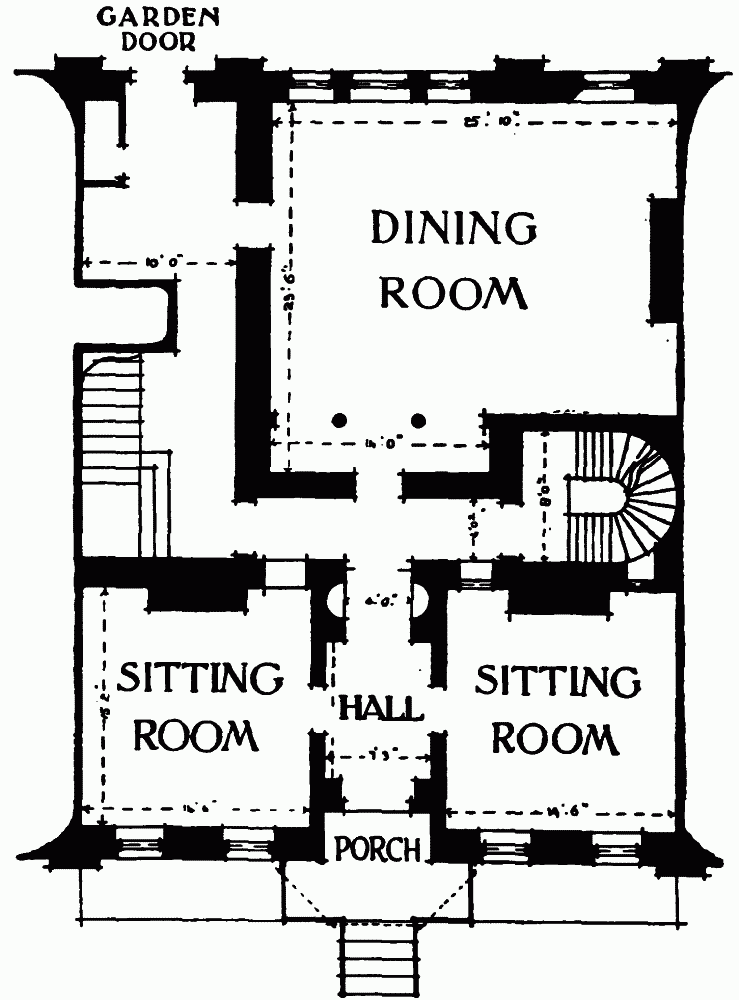
Queen's House, Plan.
Measured and drawn by Percy W. Lovell
Within the gates is a paved court, and a flight of five steps leads over the basement area to the front door, which stands within a recessed porch. To these steps there are some delicate little railings, consisting of panels of wroughtiron scroll-work with two bars between each.
The external appearance of the house is much as it was in 1717 when, having been erected by John Witt, the builder, who acquired so many of the plots of the old Manor garden, it was leased to Richard Chapman. The chief alteration, which, perhaps, has become to many Chelsea residents its most familiar feature, is the large bay window to the first and second floors that has been inserted in the centre of the front elevation, and which, although made of timber and plastered over, has been coloured red to match the brickwork as far as possible. Formerly the house had a plain characteristic Georgian front that depended for its effect on its well-proportioned windows, on its broad rusticated pilasters and string-courses of brick and the bold pediment brought forward upon carved brackets. The little figure of Mercury which used to crown the pediment (see Plate 67), and had endeared itself to many a passer-by, was added during the tenancy of Rev. H. R. Haweis, but during the recent restoration of the house by Mr. Edwin L. Lutyens it fell to pieces, being merely a figure cast in some ephemeral composition. Queen's House and No. 4 Cheyne Walk are the only houses which have the very large key-stones to the arches over the windows.
Passing for a moment to the back of the house we see that the quaint garden front is in striking contrast to the one towards the road. The 18th century element seems somehow lacking, and the grouping of the two bold wings and deeply-recessed centre is reminiscent rather of the Lincoln's Inn gateway in Chancery Lane than of a Georgian front. The effect is, perhaps, accidental and due to the unusual plan, for one recognises in the projections on the wings the idea of simple brick pilasters, and although there is no cornice the brick stringcourses are carried round as in the front. Its unusual character may, however, have given rise to the name of "Tudor House," which it bore until altered by Mr. Haweis. In the view on Plate 72 it may be seen that one or two of the old sashes remain, but the large mullioned window shown on the ground floor, a tasteless modern insertion, has been removed since the photograph was taken and replaced by three sash windows to match the old.
Before we leave this part of the house we may notice a more successful addition to the building in the shape of the "monogram" railing with its finely cast masks, which is shown in the view as bordering the area wall, but has since been removed to the position of the plain rail over the large centre window. The centre portion of this railing is entirely composed of the interlacing initials RC, written backwards and forwards—these being the letters that are found upon the gate—and it would seem by its design to be of about the same date as the house. We understand, however, that it was a fortunate "find" of Mr. Plimmer, a recent tenant, and that he bought it because of its appropriateness, "To him that hath shall be given, "and so Queen's House has added to its store of good ironwork. Two or three beautiful little iron balconies may be seen in their original position on the garden front.
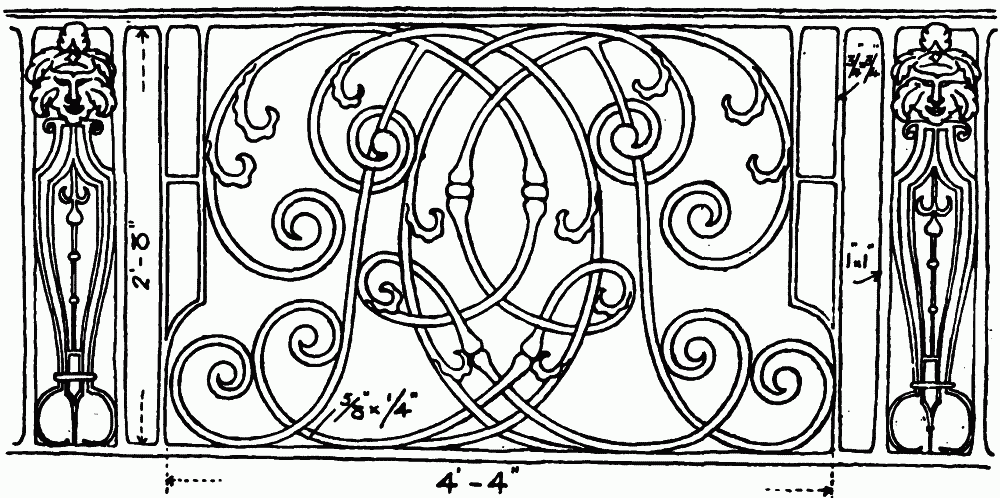
Queen's House, Monogram Railing.
Drawn by Edmund L. Wratten
We will now turn to the interior. The first door opens upon a little hall, paved diagonally with black and white squares. On either side is a front sitting-room, panelled from floor to ceiling, and with two circular-headed windows towards the street. On the authority of Sir Edward Burne-Jones we are told that the overmantel in the east room, formed of Japanese lacquer designs, was put there by Rossetti, and that he had lined the fireplace with beautiful Dutch tiles. Madame Blumenthal, who occupied the house until 1908, found that the latter had been taken away, and she has placed there some fine tiles of her own collecting. The west room was restored by Mr. Walter Cave, architect. He designed the fireplace with a bold architrave, in keeping with the old work. It has also been adorned with Dutch tiles.
Passing out of the hall through a deep archway, within which, on either side, is a recessed seat, one enters a passage leading right and left and having a door immediately in front which opens into the dining-room. The passage communicates with two staircases, one at each end, of which that on the west leads to the first floor only, while the other connects the basement with all the upper floors. The latter, or eastern stair, is the most remarkable, and the type is one that is extremely rare. It is a wood winding-stair, partly circular in plan, with a beautiful balustrade of forged and hammered iron, and besides this—a fact that emphasises its uniqueness—the ends of the treads are exquisitely carved in the form of brackets, which vary in size as they adapt themselves to the curving string, the enrichments being of the same excellence from the basement to the second floor. The design of the staircase is most ingenious, and to those who appreciate the application of iron to this purpose it is very beautiful. In seeking an example to which we can compare its character and detail we can only cite the garden balustrade to No. 44 Great Ormond Street, which, until its removal, was the subject of so much admiration, and which possessed very similar finials to the standards or "newels."
The original western and principal staircase disappeared many years ago; Mr. Cave found one of early Victorian date, which he removed. It occupied a space not very much larger than the spiral stair, for between it and the north wall was a vestibule leading to the garden, and above, at the height of the half landing, a small room, used at one time as a chapel or oratory, which exactly filled the west wing. Mr. Cave's staircase has since been replaced by a larger one from the design of Mr. Lutyens, and for this purpose the small room has been thrown open and its space added to the landing. The balusters used in the new staircase are old twisted examples from a house in Battersea on the Norfolk estate. The landing retains the little chimney-piece of the original room; French windows lead from it on to a small balcony overlooking the garden. The panelling here is new and designed by Mr. Lutyens.
To return to the ground floor, the dining-room, which was Rossetti's studio, is now some 26 feet long by 20 feet wide, including the space between the two wings of the house; but we are inclined to think that it was not originally so large. These two wings projecting towards the garden suggest at first sight the two projecting powder rooms of No. 4; they are, however, much larger in proportion to the building, and there is no evidence to show that they were ever ante-rooms to another apartment. It seems rather that Queen's House showed a step of progress in the matter of design and in the utilisation of the projecting wing, generally used as an anteroom, but here to be incorporated in a larger room as in this dining-room or to become a separate self-contained apartment. This view is supported by the position of the fireplace, which is in the centre of the east wall. The space occupied by the circular staircase causes a recess in the dining-room wall, which is skilfully covered by an arcade of two columns and two pilasters supporting three arches. This, as well as the whole panelling of the room, is beautifully designed and executed. One regrets that the old chimneypiece has gone, but the present one from the design of Mr. Walter Cave is in perfect keeping with the character of the room.
On the first floor the house is again divided by a passage, which connects the two staircases. This passage is ceiled with the plaster imitation of intersecting vaulting, which was not uncommon in the 18th century, and has at each end a circular archway with curious spandrel formed by the intersection of two circles in an oval. The drawing-room, which occupies the whole front of the house, is a fine room nearly 40 feet in length, and is delightfully panelled. The new bay adds to its size and interest. Here, as in the diningroom, the chimney-piece was inserted by Mr. Cave for Mr. Frank Lowrey. On the garden side are two other rooms, the centre being used as a boudoir and having a good chimney-piece, the other as a bedroom, with a mantel of Adam design. Both rooms have panelling throughout.
The rooms on the second floor have plain square framed panelling without mouldings. The present third floor was added recently by Mr. Lutyens. The basement, of which much has been said in various books on Chelsea, presents nothing more remarkable than the usual sturdy building of the period, and some of the 18th century "vaulting" above alluded to.
In conclusion, a note may be added regarding the authorship of the design. While dismissing its ascription to Wren as not only improbable, but not borne out by the character of the design, we may readily admit that it was the work of an artist of no inconsiderable merit. Vanbrugh has been put forward, but the detail is surely from a lighter hand than his. As far as the close of the second decade in the 18th century public taste in architecture had been maintained at a high level, many men were skilled in the contemporary style, and we are inclined to think that such an excellent work as Queen's House would be within the scope of some comparatively unknown architect.
Condition of repair.
The house is in excellent repair.
Historical notes.
It is our first duty, following the lead of Mr. Randall Davies, to whose researches we owe so much, to expose the falsity of the legend which connected Catherine of Braganza with this house. The initials R.C. on the gate are undoubtedly those of Richard Chapman, described in the original lease as "of St. Clement Danes, appothecary," for whom the house was built in 1717; but the fable which arose from the misinterpretation of the letters (fn. 2) once spread is hard to kill, and whether its inception was due to Mr. Haweis or not, he it was who effectively crystallised it for future generations by changing the old name of Tudor House into the misleading title "Queen's House." The name will probably persist, but the legend must certainly be discarded.
Richard Chapman lived here from 1719 until 1724. The house remained empty for three years, and was then taken by Alexander Spottiswood, or Spotswood, Colonial Governor. He had fought at Blenheim in the Earl of Bath's regiment and obtained a Lieutenant-Colonel's Commission. In 1710 he was made Governor of Virginia, being superseded in 1722. He died in 1740, shortly after his promotion to the rank of Major–General. His time of residence in this house was from 1728 to 1732. The lease seems then to have been taken over by Peter Elers, whose name appears in connection with the house from 1733 to 1742, when the break in the lists occurs. He, perhaps, did not reside here except for the first year. The house was empty from 1735–1742.
The names that follow in the rate-books are these:—
Miss Meteyard, the biographer of the Wedgwoods, has said that the brothers Elers (fl. 1690–1730), who established pottery works near Burslem, were responsible for laying the foundations of the Chelsea manufactory also. These Elers came to London with the Prince of Orange, and it is doubtful whether they were ever connected with Chelsea. Peter Elers, who lived at Queen's House, was the son of Peter Elers the elder, who settled in England at the accession of George I. He was of an ancient German baronial family. Peter Elers of Chelsea died in 1753 and was buried in Westminster Abbey. He married Dorothy, youngest daughter of Peter Carew, of Carew Hall, Pembrokeshire. His son George and grandson Carew are both buried at Chelsea.
Gryffid Price, the subject of a little eulogy by Faulkner, and by him styled one of His Majesty's Counsellors at Law, died at his house in Paradise Row in 1787. It seems, therefore, that on leaving Queen's House in 1783 he moved to Paradise Row.
Mr. Wm. Ascroft writes: "At the end of the 18th century and the beginning of the last Captain Denton lived here, who purchased at the sale of Don Saltero (1799) some of the curiosities. Afterwards, the Bayfords, who kept their yacht and took part in the sailing matches. One of them was distinguished as an amateur sculler, and was the first to win, in 1830, the Wingfield sculls. … Some of the sons were well-known proctors. Edward Irving used to visit here, and found in them staunch supporters of his Catholic Apostolic movement.
"Mr. N. Handford, architect and steward of the manor, lived here. He designed and constructed the Cadogan Pier, and also made designs for the river embankment. His sons, with the sons of the rector, Charles and Henry Kingsley, used to carry on their chemical electrotyping and other experiments in the basement. Mr. Geo. Handford, architect, succeeded his father as steward, and he formed a large collection of portraits, some of which were exhibited at the National Portrait Exhibition at South Kensington and Burlington House. The majority were sold in a two-days' sale at Christie's."
In 1862 Dante Gabriel Rossetti took Queen's House, and with him lived for a short time his brother William Rossetti and Algernon Charles Swinburne. Rossetti had taken a fancy to the house, and had asked, it seems, several of his friends to join him in occupying it. In addition to his brother and Swinburne, George Meredith accepted his invitation, but he never lived here, as he himself has taken the trouble to point out, in answer to several statements to the contrary. Rossetti lived here, and continued to occupy the house. for the most part by himself, almost to the close of his lifetime. Much has been written of his residence in Chelsea, of his collections of old furniture and pictures, of his bijou menagerie in the beautiful gardens of Queen's House. He died in 1882, and five years later the memorial fountain which stands in the Embankment Gardens opposite to the house was unveiled by Mr. Holman Hunt.
Later occupants of Queen's House have been the Rev. H. R. Haweis, Mr. Frank Lowrey, Mr. Henry George Plimmer and the late Mr. Jacques Blumenthal, under whose direction the last alterations were made by the well-known architect, Mr. Edwin L. Lutyens. Madame Blumenthal parted with the house to Sir William Pickford in 1908.
Biographical references.
Alfred Beaver, Memorials of Old Chelsea (1892).
Reginald Blunt, Handbook to Chelsea (1900).
Randall Davies, Pall Mall Gazette (September 4th, 1906).
Hall Caine, Record and Study (1882).
Dictionary of National Biography (D. G. Rossetti).
Eliza Meteyard, Life of Josiah Wedgwood, 2 vols. (London, 1865–6).
In the committee's ms. collection are—
| 3242. | (fn. 3) Plan. |
| 3243. | (fn. 3) General view from the east (photograph). |
| 3244. | General view from the west (photograph). |
| 3245. | (fn. 3) Lower part of house and gate (photograph). |
| 3246. | (fn. 3) Wrought-iron gate and railings (measured drawing). |
| 3247. | (fn. 3) Wrought-iron gate (photograph). |
| 3248. | View of gate from garden (photograph). |
| 3249. | Another view of same (photograph). |
| 3250. | Gate railings and piers (photograph). |
| 3251. | Panel of railings (photograph). |
| 3252. | (fn. 3) Back view of house (photograph). |
| 3253. | (fn. 3) Iron "monogram" railing (photograph). |
| 3254. | (fn. 3) Iron "monogram" (drawing). |
| 3255. | (fn. 3) Mask from same (photograph). |
| 3256. | (fn. 3) Iron railing to steps (photograph). |
| 3257. | (fn. 3) Hall from dining-room (photograph). |
| 3258. | Hall, another view (photograph). |
| 3259. | Dining-room, fireplace (photograph). |
| 3260. | Dining-room, arcade (photograph). |
| 3261. | Present wood staircase (photograph). |
| 3262. | Wood staircase, detail (drawing). |
| 3263. | (fn. 3) Iron staircase, from first floor (photograph). |
| 3264. | Iron staircase, another view (photograph). |
| 3265. | (fn. 3) Iron staircase, detail of carving (photograph). |
| 3266. | (fn. 3) Passage, first floor, showing iron stair (photograph). |
| 3267. | (fn. 3) Part of drawing-room (photograph). |
| 3268. | Drawing-room, bay window (photograph). |
| 3269–72. | Drawing-room panelling (four sheets) (measured drawings). |
| 3273–75. | Garden, three views (photograph). |