
Letters and Papers, Foreign and Domestic, Henry VIII, Volume 10, January-June 1536. Originally published by Her Majesty's Stationery Office, London, 1887.
This free content was digitised by double rekeying. All rights reserved.
'Henry VIII: February 1536, 21-25', in Letters and Papers, Foreign and Domestic, Henry VIII, Volume 10, January-June 1536, (London, 1887) pp. 126-135. British History Online https://www.british-history.ac.uk/letters-papers-hen8/vol10/pp126-135 [accessed 24 April 2024]
Image
Image
Image

Image

Image

Image
Image

Image
Image
Image

February 1536, 21-25
| 21 Feb. R. O. |
334. Cromwell to Thamworth and Markeby, Priests. |
|---|---|
|
Summons them to London to answer the charge brought against
them by Ric. Goodyng, of forging a will. London, 21 Feb. Signed: Your
friend, Thomas Crumwell. P. 1. Add.: To Thamworth and Markeby, priests, and to either of them, at Bostone. Sealed. |
|
| 21 Feb. R. O. |
335. Katharine Blount to Cromwell. |
|
Hears that the King intends to take into his hands certain abbeys
and priories, and put them to other uses. Desires his help that she may
have some of them for her two youngest sons, giving for them as another
will. Would be glad if her servant might consult him about certain
writings touching her son's marriage. Kynlett, 21 Feb. Hol., p. 1. Add.: To the right worshipful Master Cromewell. |
|
| 21 Feb. R. O. |
336. Sir Wm. Kyngston to Lord Lisle. |
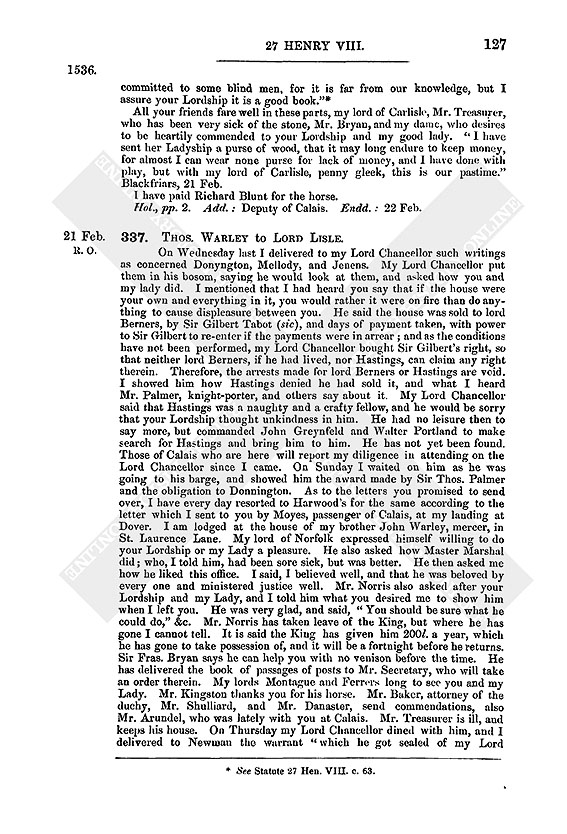
| I thank you for the pains you took in obtaining the horse you sent me by Ric. Blunt and your Lordship's servant. I hope he will be a good horse, and then you shall always be sure to have a horse in England. We of the Commons House have a good book for Calais. It has been read and will shortly pass, "but at the reading there was one that would have had it committed, as the manner is, and then, if it should be committed, it be committed to some blind men, for it is far from our knowledge, but I assure your Lordship it is a good book." (fn. 1) | |
| All your friends farewell in these parts, my lord of Carlisle, Mr. Treasurer, who has been very sick of the stone, Mr. Bryan, and my dame, who desires to be heartily commended to your Lordship and my good lady. "I have sent her Ladyship a purse of wood, that it may long endure to keep money, for almost I can wear none purse for lack of money, and I have done with play, but with my lord of Carlisle, penny gleek, this is our pastime." Blackfriars, 21 Feb. | |
|
I have paid Richard Blunt for the horse. Hol., pp. 2. Add.: Deputy of Calais. Endd.: 22 Feb. |
|
| 21 Feb. R. O. |
337. Thos. Warley to Lord Lisle. |
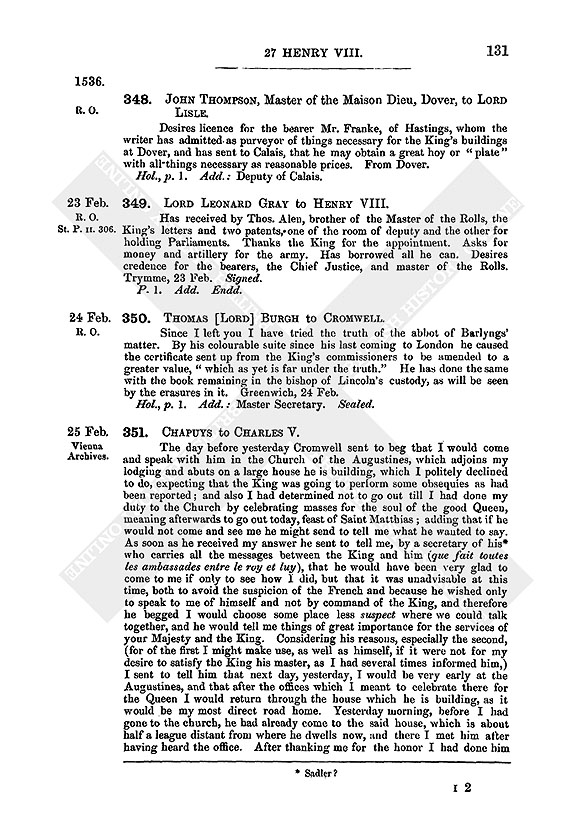
| On Wednesday last I delivered to my Lord Chancellor such writings as concerned Donyngton, Mellody, and Jenens. My Lord Chancellor put them in his bosom, saying he would look at them, and asked how you and my lady did. I mentioned that I had heard you say that if the house were your own and everything in it, you would rather it were on fire than do anything to cause displeasure between you. He said the house was sold to lord Berners, by Sir Gilbert Tabot (sic), and days of payment taken, with power to Sir Gilbert to re-enter if the payments were in arrear; and as the conditions have not been performed, my Lord Chancellor bought Sir Gilbert's right, so that neither lord Berners, if he had lived, nor Hastings, can claim any right therein. Therefore, the arrests made for lord Berners or Hastings are void. I showed him how Hastings denied he had sold it, and what I heard Mr. Palmer, knight-porter, and others say about it. My Lord Chancellor said that Hastings was a naughty and a crafty fellow, and he would be sorry that your Lordship thought unkindness in him. He had no leisure then to say more, but commanded John Greynfeld and Walter Portland to make search for Hastings and bring him to him. He has not yet been found. Those of Calais who are here will report my diligence in attending on the Lord Chancellor since I came. On Sunday I waited on him as he was going to his barge, and showed him the award made by Sir Thos. Palmer and the obligation to Donnington. As to the letters you promised to send over, I have every day resorted to Harwood's for the same according to the letter which I sent to you by Moyes, passenger of Calais, at my landing at Dover. I am lodged at the house of my brother John Warley, mercer, in St. Laurence Lane. My lord of Norfolk expressed himself willing to do your Lordship or my Lady a pleasure. He also asked how Master Marshal did; who, I told him, had been sore sick, but was better. He then asked me how he liked this office. I said, I believed well, and that he was beloved by every one and ministered justice well. Mr. Norris also asked after your Lordship and my Lady, and I told him what you desired me to show him when I left you. He was very glad, and said, "You should be sure what he could do," &c. Mr. Norris has taken leave of the King, but where he has gone I cannot tell. It is said the King has given him 200l. a year, which he has gone to take possession of, and it will be a fortnight before he returns. Sir Fras. Bryan says he can help you with no venison before the time. He has delivered the book of passages of posts to Mr. Secretary, who will take an order therein. My lords Montague and Ferrers long to see you and my Lady. Mr. Kingston thanks you for his horse. Mr. Baker, attorney of the duchy, Mr. Shulliard, and Mr. Danaster, send commendations, also Mr. Arundel, who was lately with you at Calais. Mr. Treasurer is ill, and keeps his house. On Thursday my Lord Chancellor dined with him, and I delivered to Newman the warrant "which he got sealed of my Lord Chancellor by his merry jests." He says if he can he will soon be with your Lordship, but not before mid Lent be passed, as he has business in the country. | |
| Yesterday the King had communication for more than half an hour with my Lord Chancellor and Mr. Secretary in the gallery at Greenwich as he came from mass. Before mass Master Hugh Pollard was made knight, and the King and Mr. Secretary communed a long season with him. This morning all the judges and serjeants of the law, barons of the Exchequer, the King's attorney and others, were all the forenoon at my Lord Chancellor's, for what cause I know not. On Friday the book which was drawn at Calais by the Commissioners passed the Commons House, and another Act concerning the liberties of bishops. I trust Calais shall be hereafter better stored with wood. London, 21 Feb. 27 Hen. VIII. | |
|
P.S.—My lord of Ely has asked after your Lordship and my Lady.
Antony Pickering has received 40s. of Harry Clark, grocer, which your
Lordship shall have at his coming to Calais. Hol., pp. 4. Add.: Deputy of Calais. Endd. |
|
| 22 Feb. |
338. William Barlow, Bishop of St. Asaph's. See Grants in February, No. 45. |
| 22 Feb. R. O. |
339. William Popley to Lord Lisle. |
| I have this day received your letters by Horsey, with one for my master, and a copy of it. The matter whereon it is grounded is changed by the death of the [grand] master of Malta. [Another master has been] ordained already in his room, and the King will not permit [the] . . . . . . . [of St.] John's to pass into those parts, though he has made great suit to do so; so he has been obliged to give up that journey. As to the other part of your request to my master, (fn. 2) I see no likelihood that the abbey of Bewley will be suppressed, or any other "of like lands," for Parliament this session is passing laws for the maintenance and good order of the clergy, both religious and secular; but if I see a chance for your commodity I will be vigilant. I thank you for the annuity you have sent me. The Rolls, 22 Feb. | |
|
I return your letter to my master. Hol., mutilated, p. 1. Add.: Deputy of Calais. |
|
| 22 Feb. R. O. |
340. Eleanor Studley to Cromwell. |
|
Sir Thos. Tleude, the priest of whom I spoke, is at Westminster
Sanctuary for felony. The searcher there will bring him forth at all times,
if required. For the slanders which, as I understand by Will. Bolton, he has
lately spoken to my great harm and discomfort, I beg he may be ordered
according to your pleasure. 22 Feb. Hol., p. 1. Add.: Secretary. |
|
| 22 Feb. R. O. |
341. Vaughan to Cromwell. |
| Writes to say how much he is pleased to see what he has long desired begun "in this most propice and expedient place of all the King's realm, which might be, towards the making of a haven." Wishes first that Cromwell were here to see what is done, secondly that God might stir the King to come hither also and see the forwardness of this work, the honor ablest and expedientest that has been for many years attempted. "Here is begun from the old pier that hath been many years past a brase running to seaward by estimation 500 foot in length, a work very substantial and good, wherein they yet intend to work till (that being viewed and seen by such as shall please the King's highness) it be known how his Grace liketh and favoreth the same." If completed according to the plan it will make Dover a glad and happy haven, and a great surety to the realm. Whalley takes great pains. The King could appoint no more faithful man. Dover, 22 Feb. | |
|
P.S.—A servant of the Emperor's ambassador passed yesterday hence
towards Calais, who openly bruited that there should be war between
Francis and the Emperor. Hol., pp. 2. Add.: Secretary. Endd. |
|
| 22 Feb. Vit. B. xxi. 137. B. M. |
342. Edmund Boner and Richard Caundyssh to [Cromwell]. |
|
Speak highly of the learning, sincerity, &c. of Dr. Adam Paceus,
whom the King has summoned to his presence. He has been maligned and
illtreated by the King's enemies, as they themselves have been, only on
account of his devotion to his Majesty. Advise that he should be treated
with no common favor, that he may see that his enemies have not injured
him with the King, but rather done him good, which will cause both him and
the writers to serve the King more cheerfully. Their only consolation after
God is in the King and Cromwell. Request him to obtain the despatch of
Dr. Adam before Easter, if possible, as his assistance and advice are necessary
to Dominus Bernardus for the King's affairs. Adam will give full information of what was done in the late diet, &c. We have sent to the bishop
of Hereford as you desired, but have had no answer. We hear that
messengers are badly treated, and letters of the Emperor, Ferdinand and
the lady Mary were lately intercepted by the people of Holstein. Desire
to return. If Suavenius goes to England, he will doubtless say much
against us all. Hamburg, 22 Feb. 1536. Signed. In Boner's hand. Lat., pp. 2. Mutilated. Begins: Clarissime domine. |
|
| 22 Feb. Paludan Müller, Aktstykker, III. 525. |
343. Boner and Caundish to Marcus Meyer. |
| Thank him for his kindness when they were at his castle of Werberg. Have not omitted to write from ingratitude, but from the doubtful aspect of affairs, and the want of a trustworthy messenger.—Expressions of friendship and readiness to serve him when with the King again. | |
|
Are writing to the King for help for him. The diet was held at Hamburg
on the octave of the Three Kings. There were present the duke of Luneburg,
the ambassadors of the dukes of Holstein and Brunswick, of the elector of
Saxony, the landgrave of Hesse, and of the people of Lubeck, Luneburg,
Bremen, Rostock, Wismar, Sonden, Copenhagen, Elbogen, Brunswick, Hildesheim, and Magdeburg. (fn. 3) Peace was concluded, in which the duke of
Holstein was acknowledged as king of Denmark. The friends of Lubeck are
not effectually comprehended. Meyer is excluded. Albert duke of Mecklenburg, the count of Oldenburg, Copenhagen, "Elbowe," and certain other
cities, are included if they ratify in 40 days; which it is thought they will not
do. The ambassadors of Copenhagen and Elbogen pressed for Christiern's
liberation, and, notwithstanding a double safe-conduct, were in great danger of
being taken by certain Holsteiners. The good people of Lubeck deserve that
some one should do them a kindness. They only told Boner and Candish
of the conclusion, when they had completed all their own business, and
refused to show them a copy of the conclusion. No faith should be kept
with them. Will inform the King of their incivility. Advise Meyer to put as
little trust in them as possible, and they believe that he will shortly receive
help from the King. Wolwever has been captured by the treachery of those
who should have been most friendly, and is cruelly tortured in prison at Rodenburg. He has been worse treated since the King wrote for his liberation.
Though certain princes and their ambassadors triumph at his capture, the
people of Bremen and others who are guilty will not laugh in the end. The
King wrote sharply to them. If they refused to set him free, it was determined to send speedily to the King, when Meyer's interests will be promoted.
Ask him, if he write to them, to send the letters to the Secretary in England.
Hope to receive them there soon after Easter. Assure him of the King's
favor. Desire to be recommended to his brother Garet, his friends, and
Frowe Wulfstan, with her children. Hamburg, 22 Feb. 1536. Lat. Add. |
|
| 23 Feb. | 344. Priory of Hornby, Yorkshire. |
| Surrender. See Vol. ix. No. 816 ii. (4.) | |
| 23 Feb. Faustina, C. iii. 456. B. M. |
345. Vice Chancellor and University of Cambridge to the Queen. |
| Thank her for her gentle and loving acceptance of their letters delivered to her in the West country, and for her promotion of their petition to the King for the remission of tenths and first-fruits due to him from the University. This yearly charge would greatly diminish the number of scholars in every college. | |
|
Beg her to consider what the Vice-Chancellor, the bearer, will show her
on this subject, and to speak for them to the King. From Cambridge in our
Regent House, 23 Feb. Add. Endd. |
|
| 23 Feb. R. O. |
346. Latimer's Preaching. |
|
"The communycatyon betewne Sur George Rowland, preste, and
John Stanton, in confessyon at the Crossed Fryers the xxiijti day of Feverrell
ano 1535." The priest had endeavoured to confirm the penitent, who had
been shaken in his faith by hearing a sermon of Latimer's, in the belief of
the Pope's supremacy, the efficacy of absolution, purgatory, and the duty of
offering to images of saints. The priest spoke of his having once appeared
before the archbishop of Canterbury, and told him that he would still pray
for the Pope, if not openly at least in secret, and the Archbishop had said to
him that he might pray for him secretly, but not openly, for the King had
forbidden it. Pp. 3. |
|
| 23 Feb. R. O. |
347. John Whalley to Cromwell. |
| After receipt of Cromwell's letter, the master of the Maisondewe, at the pay day, put away 300 of the men till he should have seen Cromwell. The master has now taken back over 200. Will Cromwell ask the said master, when he goes to London, how many men he has? If Cromwell shows him the number, the master will think Whalley has complained of him. Would not have more than 200 men till the King had seen the works. Asks for money to pay "all thinges," and sends a remembrance by the master of the Maisondewe. Dover, 23 Feb. | |
|
Has 500 and odd persons here in wages. Hol., p. 1. Add.: "Chief Secretary." Endd. |
|
| R. O. | 348. John Thompson, Master of the Maison Dieu, Dover, to Lord Lisle. |
|
Desires licence for the bearer Mr. Franke, of Hastings, whom the
writer has admitted as purveyor of things necessary for the King's buildings
at Dover, and has sent to Calais, that he may obtain a great hoy or "plate"
with all-things necessary as reasonable prices. From Dover. Hol., p. 1. Add.: Deputy of Calais. |
|
| 23 Feb. R. O. St. P. ii. 306. |
349. Lord Leonard Gray to Henry VIII. |
|
Has received by Thos. Alen, brother of the Master of the Rolls, the
King's letters and two patents, one of the room of deputy and the other for
holding Parliaments. Thanks the King for the appointment. Asks for
money and artillery for the army. Has borrowed all he can. Desires
credence for the bearers, the Chief Justice, and master of the Rolls.
Trymme, 23 Feb. Signed. P. 1. Add. Endd. |
|
| 24 Feb. R. O. |
350. Thomas [Lord] Burgh to Cromwell. |
|
Since I left you I have tried the truth of the abbot of Barlyngs'
matter. By his colourable suite since his last coming to London he caused
the certificate sent up from the King's commissioners to be amended to a
greater value, "which as yet is far under the truth." He has done the same
with the book remaining in the bishop of Lincoln's custody, as will be seen
by the erasures in it. Greenwich, 24 Feb. Hol., p. 1. Add.: Master Secretary. Sealed. |
|
| 25 Feb. Vienna Archives. |
351. Chapuys to Charles V. |
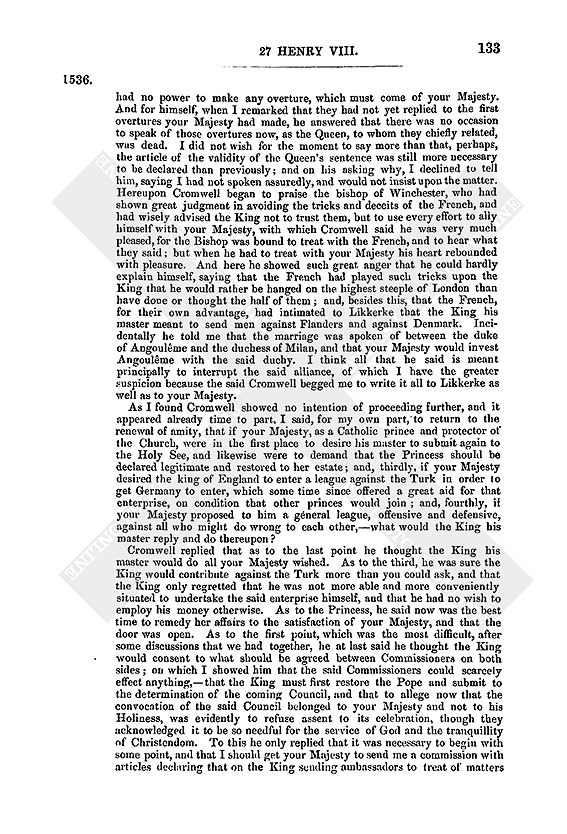
| The day before yesterday Cromwell sent to beg that I would come and speak with him in the Church of the Augustines, which adjoins my lodging and abuts on a large house he is building, which I politely declined to do, expecting that the King was going to perform some obsequies as had been reported; and also I had determined not to go out till I had done my duty to the Church by celebrating masses for the soul of the good Queen, meaning afterwards to go out today, feast of Saint Matthias; adding that if he would not come and see me he might send to tell me what he wanted to say. As soon as he received my answer he sent to tell me, by a secretary of his (fn. 4) who carries all the messages between the King and him (que fait toutes les ambassades entre le roy et luy), that he would have been very glad to come to me if only to see how I did, but that it was unadvisable at this time, both to avoid the suspicion of the French and because he wished only to speak to me of himself and not by command of the King, and therefore he begged I would choose some place less suspect where we could talk together, and he would tell me things of great importance for the services of your Majesty and the King. Considering his reasons, especially the second, (for of the first I might make use, as well as himself, if it were not for my desire to satisfy the King his master, as I had several times informed him,) I sent to tell him that next day, yesterday, I would be very early at the Augustines, and that after the offices which I meant to celebrate there for the Queen I would return through the house which he is building, as it would be my most direct road home. Yesterday morning, before I had gone to the church, he had already come to the said house, which is about half a league distant from where he dwells now, and there I met him after having heard the office. After thanking me for the honor I had done him in coming to see him, and for making such a good report to your Majesty of him as Granvelle had informed their ambassador, he repeated the grand prologue he has usually made touching the advantage of the amity between your Majesty and the King his master, by which you might easily succeed in your enterprises both against the Turk and others, for if you and the King were thoroughly united no other prince in Christendom durst murmur, and that he considered continually night and day how to cement the said amity. For this reason he had continually done his best to prevent anything being treated with the French to your prejudice, or to that of the said amity, and said I might remember that when the King's commissioners went to Calais to meet the Admiral and the other French commissioners he had assured me that nothing would be treated to your disadvantage, neither was there, and he could clearly show that this was one of the articles contained in the charge of the bishop of Winchester, concerning which he could also show me a letter from the king of France, who never forbore to beg the King his master to move war against you and invade Flanders; but he was quite mistaken, for the King would never undertake such a dance, and of this I might be quite assured; and, moreover, that the King his master desired nothing more earnestly than your friendship, to which he was not only naturally inclined himself but strongly urged by his Council, especially by those who were pensionaries of France, such as the dukes of Norfolk and Suffolk and the Treasurer, as well as by those of the opposite party like the earl of Wiltshire, the said councillors being indignant at the incredible ingratitude and wickedness of the French, and moved by the goodness and innumerable virtues of your Majesty, whose affairs are conducted by the grace and clemency of God, who seems to have taken your interests under His special care. Nor did they think you disinclined to reciprocate their friendship, considering the language used by Granvelle to their ambassador, and especially that it appeared by what they heard from Rome that your Majesty had not yet permitted the Pope to fulminate the censures, to do which his Holiness had been extremely urged by the cardinals since the death of the cardinal of Rochester. But although the King and his Council were well assured of your goodwill they thought if you [bore to them] onetenth part of the affection that all this people bore to you, your benevolence towards them would augment in such fashion that it would be impossible for the Pope, who was scarcely a friend of your Majesty, or any other power to persuade you to allow injury to be done to this kingdom; and since it had pleased God to remove from this world that which was the only hindrance to cordial amity, it was right that the servants of either Prince should do their utmost for the renewal and confirmation of the said amity; that he had great confidence that I would do my best to promote it, whereby I should acquire immortal fame; and he begged I would despatch some one in all diligence to inform you of the said matters, and to request that you would not lose the opportunity now that the door was open. I praised Cromwell's prudence and goodwill, and told him that hitherto I had not found in your Majesty any other desire than to continue and augment the said friendship, and that you only wished it restored to the condition of which he spoke; and as to despatching any one to your Majesty about such general conversation as we had had without any particular overture, it seemed like wasting time and trouble for nothing, for it was only the same song as ever; and, to cut the matter short, and show that something effectual was meant, it would be necessary to propose some overture. On this Cromwell said that I might feel quite assured there was no dissimulation in what he had said, and it would be very foolish in him to attempt it, for nothing could be gained thereby for his master; and as what he had said came of himself without commission from his master, I might see that he had no power to make any overture, which must come of your Majesty. And for himself, when I remarked that they had not yet replied to the first overtures your Majesty had made, he answered that there was no occasion to speak of those overtures now, as the Queen, to whom they chiefly related, was dead. I did not wish for the moment to say more than that, perhaps, the article of the validity of the Queen's sentence was still more necessary to be declared than previously; and on his asking why, I declined to tell him, saying I had not spoken assuredly, and would not insist upon the matter. Hereupon Cromwell began to praise the bishop of Winchester, who had shown great judgment in avoiding the tricks and deceits of the French, and had wisely advised the King not to trust them, but to use every effort to ally himself with your Majesty, with which Cromwell said he was very much pleased, for the Bishop was bound to treat with the French, and to hear what they said; but when he had to treat with your Majesty his heart rebounded with pleasure. And here he showed such great anger that he could hardly explain himself, saying that the French had played such tricks upon the King that he would rather be hanged on the highest steeple of London than have done or thought the half of them; and, besides this, that the French, for their own advantage, had intimated to Likkerke that the King his master meant to send men against Flanders and against Denmark. Incidentally he told me that the marriage was spoken of between the duke of Angoulême and the duchess of Milan, and that your Majesty would invest Angoulême with the said duchy. I think all that he said is meant principally to interrupt the said alliance, of which I have the greater suspicion because the said Cromwell begged me to write it all to Likkerke as well as to your Majesty. | |
| As I found Cromwell showed no intention of proceeding further, and it appeared already time to part, I said, for my own part, to return to the renewal of amity, that if your Majesty, as a Catholic prince and protector of the Church, were in the first place to desire his master to submit again to the Holy See, and likewise were to demand that the Princess should be declared legitimate and restored to her estate; and, thirdly, if your Majesty desired the king of England to enter a league against the Turk in order to get Germany to enter, which some time since offered a great aid for that enterprise, on condition that other princes would join; and, fourthly, if your Majesty proposed to him a general league, offensive and defensive, against all who might do wrong to each other,—what would the King his master reply and do thereupon? | |
| Cromwell replied that as to the last point he thought the King his master would do all your Majesty wished. As to the third, he was sure the King would contribute against the Turk more than you could ask, and that the King only regretted that he was not more able and more conveniently situated to undertake the said enterprise himself, and that he had no wish to employ his money otherwise. As to the Princess, he said now was the best time to remedy her affairs to the satisfaction of your Majesty, and that the door was open. As to the first point, which was the most difficult, after some discussions that we had together, he at last said he thought the King would consent to what should be agreed between Commissioners on both sides; on which I showed him that the said Commissioners could scarcely effect anything,—that the King must first restore the Pope and submit to the determination of the coming Council, and that to allege now that the convocation of the said Council belonged to your Majesty and not to his Holiness, was evidently to refuse assent to its celebration, though they acknowledged it to be so needful for the service of God and the tranquillity of Christendom. To this he only replied that it was necessary to begin with some point, and that I should get your Majesty to send me a commission with articles declaring that on the King sending ambassadors to treat of matters they would be favorably heard, on which the King would send a very great and honorable embassy, and once the matter was in train I might leave it to him, "et quil en jouyroit par dessus la corde." | |
| On this we remained some little time silent, except that he repeated to me what he had already said about the Princess, and told me I might have good hope about the rest, and that I should consider the wonders he had done here since he had had the government of the King's affairs. It seemed to me he meant to intimate that it was in his power "de faire partie de ce quil avoit fait," especially in the matter of the Princess, for whose service he offered to do all that was possible. | |
| Talking with Cromwell of his master's negotiations in Germany and Denmark, he told me that he was ready to forfeit his head if it were found that anything had been treated in those countries to the prejudice of your Majesty, but he thought that if the understanding between you and his master were such as he desired, your Majesty's affairs would be none the worse even on the side of Denmark; and that the reason why they had sent the bishop of Hereford into Germany was to learn the judgment of several persons touching their affairs, and to ascertain how things were going, and not for any other object. I did not wish to reply to him that for this purpose it was unnecessary to seek means of sending to the said Bishop 20,000 ducats, besides much money that he had already received, lest I should injure the merchant who had told me that two days before the said Cromwell had asked him to make a letter of exchange to that amount for Nuremberg, which the said merchant declined to do till he had an answer from Jehan Carlo de Affaictatis. | |
| As yet there is no change with regard to the Princess, who wrote to me yesterday she wished me to send or write again to your Majesty to remedy her case. | |
| I learn from several persons of this Court that for more than three months this King has not spoken ten times to the Concubine, and that when she miscarried he scarcely said anything to her, except that he saw clearly that God did not wish to give him male children; and in leaving her he told her, as if for spite, that he would speak to her after she was "releuize." The said Concubine attributed the misfortune to two causes: first, the King's fall; and, secondly, that the love she bore him was far greater than that of the late Queen, so that her heart broke when she saw that he loved others. At which remark the King was much grieved, and has shown his feeling by the fact that during these festive days he is here, and has left the other at Greenwich, when formerly he could not leave her for an hour. | |
| I forgot to write that among the news brought by Cromwell, he said it was reported in France that the good Queen had been poisoned, and that the French alleged the said report came from the Spaniards; which news he could not report to me without some change of colour and bearing. I replied that I did not think there was a Spaniard in the said Court who would presume to publish such news there, and that the French must have spoken it as what they presumed themselves, and that some of the wiser heads among them, in order to speak more freely, had attributed it to the Spaniards. To which he said "que ainsi l'escriproit il." On my saying to Cromwell that to promote the amity which he spoke of, the way was not to persecute the Church and churchmen, he answered that they would proceed no further therein. | |
|
The Princess has just sent to me to say that since Cromwell spoke with
me he had sent to her, on the part of the King, for a little cross which the
Queen had ordered to be taken to the said Princess after her death. I think
there are not 10 crowns worth of gold in the said cross nor any jewellery,
but within is a portion of the true Cross, towards which the Princess felt
great devotion. Thus your Majesty may judge what reliance is to be placed
upon the words of these men. I think that God will never give them grace
to recognise their error, lest they should avoid the punishment of their
abominable misdeeds. London, day of St. Matthias 1536. Fr., from a modern copy, pp. 9. |
|
| 25 Feb. Vienna Archives. |
352. Chapuys to Granvelle. |
|
I thank you for your good report to the ambassador of England
touching what I several times wrote of Mr. Secretary Cromwell, who, as you
will see by what I write to his Majesty, has formally thanked me for it.
You will learn all the news here from my letters to his Majesty, save that
Cromwell has told me that the French king insinuated to the King his
master that the Emperor was quite content with what he had done against
the duke of Savoy; and, moreover, that a Bible has been printed here in
English, in which the texts that favor the Queen, especially Deut. xix.,
have been translated in the opposite sense. I am credibly informed that the
Concubine, after her abortion, consoled her maids who wept, telling them it
was for the best, because she would be the sooner with child again, and that
the son she bore would not be doubtful like this one, which had been conceived during the life of the Queen; thereby acknowledging a doubt about
the bastardy of her daughter. London, 25 Feb. 1535. Fr., from a modern copy, p. 1. |
|
| 25 Feb. Vit. B. xxi. 138, B. M. |
353. Richard Caundysshe to [Cromwell]. |
| According to a letter which I sent . . . . . . . . . the merchant of Hamburg, bearing date the third . . . . . . . . wherein I made recital unto your mastership of cer[tain provision] to be made here for the King's highness of cables, ropes, and [cable] yarn, which Mr. Gunstone did write unto me for by our . . . . Cowche, of all which I have made as much provision as possible. At our coming there was neither cable yarn nor hemp; but I heard of a merchant of Rye who had pitch and tar to sell, of which I bought 20 lasts, and sent it home in the Menyon, and I bargained with him for 150 thousandweight of cable yarn, of which I have received 23 thousandweight at 5li. 1s. 8d. st. The remainder shall be delivered at Hamburg within a fortnight after St. George's Day, at 4li. the thousandweight. As the merchant could not do this without selling the pitch and tar he had, I bought 60 lasts of him at 3li., by which I trust to get some profit. | |
|
I request that 100l. may be paid to Lyutke Havirman, and the like sum to
Hans Berendes, both merchants of the Steliard, who hold bills of mine.
The whole sum I have taken up here is thr . . . . . . [pou]nds sterling,
and so my whole receipts amounteth to . . . . . . . pounde, the issueing
whereof I will declare at my coming home, which I trust will be shortly.
Hamburgh, 25 Feb. Signed. Pp. 3, mutilated. Begins: My singular good maister. |
|