
Letters and Papers, Foreign and Domestic, Henry VIII, Volume 10, January-June 1536. Originally published by Her Majesty's Stationery Office, London, 1887.
This free content was digitised by double rekeying. All rights reserved.
'Henry VIII: February 1536, 26-29', in Letters and Papers, Foreign and Domestic, Henry VIII, Volume 10, January-June 1536, (London, 1887) pp. 135-160. British History Online https://www.british-history.ac.uk/letters-papers-hen8/vol10/pp135-160 [accessed 24 April 2024]
Image

Image

Image

Image

Image

Image

Image
Image
Image

Image
Image

Image

Image

Image
Image

Image
Image

Image

Image

Image
Image

Image
Image

Image

Image

Image

February 1536, 26-29
| 26 Feb. R. O. |
354. Roland Lee, Bishop of Coventry and Lichfield, and Thos. Englefield, to Cromwell. |
|---|---|
|
John ap David Griffith, on the eve of Holyrood Day, whilst serving
the Council's letters upon John ap Morice Lloyd, now in sanctuary at
Westminster, was wilfully murdered by him, and he has therefore taken
sanctuary. His friends intend to move the King for pardon, which we think
should not be granted. Ludlow, 26 Feb. Signed. P. 1. Add.: Mr. Secretary. Endd. |
|
| [26 Feb.] R. O. |
355. Ri. Gwent to Cromwell. |
|
The bishop of St. David's died this day se'nnight. If you wish
letters or word conveyed thither I shall convey them with speed, and I can
inform you of one who will survey everything to the King's profit during
the vacation, and can exercise the jurisdiction at the same time and find good
sureties. London, Saturday. (fn. 1) Hol., p. 1. Add.: Secretary. Endd. |
|
| 26 Feb. R. O. |
356. Peter Bekwithius, of Calais, to Guillermus Groulius, M. A., of St. Omer (Adomarensis). |
|
In their conversation the night before Bekwith left Calais for
England, he promised to write of all that might befall him there. Has been
so busy that he has not found time to write before. Sends some verses of
his own, in praise of Thomas Cromwell, secretary of the king of England, a
man of great virtue and erudition. In these he has shown up the falsehood
of the Pope, and has put in some marginal notes to explain the text. Asks
Groulius to send some little piece of prose or verse. Quotes Ovid. Expects
that Cromwell, who is considered another Mæcenas of scholars, will, when he
sees the verses, bestow on the writer some small benefice, or admit him into
friendship. London, "Quinto kalendas Martias," 1535. Hol., Lat., p. 1. |
|
|
ii. Heroic and other verses in honor of Thomas Cromwell, and in dispraise
of the bishop of Rome, with marginal notes by the author. Hol., Lat. Large paper, pp. 13. Endd: "A book of certain verses in the praise of My Lord Master." |
|
| 26 Feb. Cleop. E. iv. 127.** B. M. |
357. Friar Cosyn. |
|
Indictment of Jas. Cosyn, prior of the Friars Preachers at Winchester,
for saying in a sermon at the parish church of St. Peter, Chusel, on
26 Feb. 27 Hen. VIII., "If thou put an whole stoup of holy water upon
thy head, and another stoup of other water upon thy head, the one shall do
thee as much good as the other in avoiding of any sin. As much other
bread of thine own blessing. shall do thee as much good as so much holy
bread. And as for confession, I will not counsel thee to go to any priest to
be confessed, for thou mayest as well confess thyself to a layman, thy
Christian brother, as to a priest, for no bishop ne priest have any power to
assoil any man of any sin. And I myself have shriven a woman this day
here in this church, but I did not assoile her, ne I will never assoile
none." P. 1. |
|
| R. O. |
2. Declaration by Sir James Cosyn of what he said in a sermon on
John xvi. 23, especially touching penance and satisfaction for sins, in
answer to the vicar of Stowe, who insisted on the necessity of confession,
for which sayings the vicar commanded that none of his parish should
believe him, and called him soul murderer in open audience. Pp. 3. Endd. |
| 26 Feb. Add. MS. 28,588, f. 205. B. M. |
358. Charles V. and Henry VIII. |
| Remarks of the Empress and Council of State upon articles sent by the Emperor. | |
|
* * * 11. Touching assistance to be given by the French
king to the Queen and Princess of England, and to reduce the kingdom to
obedience to the Church, now that the Queen is dead. This article might
be altered. In order to reduce the King to union with the Church the
Pope should make a request to the Emperor and the French king. In this
way there will be a better opportunity for speaking of the marriage and
other things. * * * Madrid, 26 Feb. 1536. Sp., pp. 19, modern copy. |
|
| 27 Feb. Add. MS. 8,715, f. 212 b. B. M. |
359. Bishop of Faenza to Mons. Ambrogio. |
|
* * * Has spoken to some of these lords of English affairs,
as if on his own account, according to the Pope's orders, but finds that they
have had no news for some days, and they do not trust much to each other.
Keeps his eyes open, and will send information. The English stand aloof
(stanno su l'alto), and say they cannot trust the French king much, being
such a friend of the Pope. Ital., pp. 8, modern copy. Headed: Al Signor Protonotario Ambrogio, Da Monte Plaisante, 27 Feb. 1536. |
|
| 28 Feb. | 360. Priory of Bilsington, Kent. |
| Surrender. See Vol. IX., No. 816 ii. (5.) | |
| 28 Feb. | 361. Abbey of Tiltey. |
| Surrender. See Vol. IX., No. 816 ii. (6.) | |
| 28 Feb. R. O. |
362. Henry Earl of Essex to Cromwell. (fn. 2) |
|
Has sent Thomas Edmondes to wait on him for the chantry of
Halstede. The vicar of Branketre (fn. 3) is so well known in the county there is
not owing him more than 90s. tithe, which he offered to resign. The
chantry of Halstede is in your gift by reason that there is no prior known
of the Charterhouse. Stanstede, 28 Feb. Signed. P. 1. Add.: "Secretary." Endd.: "For the chauntre of Hallsted, and concernyng the vicar of Branketre." |
|
| 28 Feb. R. O. |
363. William Blithmanne to Cromwell. |
|
After the conclusion of the visitation for the King in the province of
York has made a clean book of the compertes, which he sends by Cromwell's
commissaries, Dr. Layton and Dr. Lee. Will bring a duplicate shortly himself. Parted from the commissaries at Ludlow, and returned to York for
receipt of the first payment and sureties for the first-fruits of the monastery
of Funtance, and other money due to the King, with which he will repair to
London in the second week of Lent. Hopes to bring some acceptable
commodity for his mastership. Ludlow, 28 Feb. Hol., p. 1. Add.: Master Thomas [Cr]umwell, secretary [pri]ncipal to the King's highness. Endd.: John Blitheman. |
|
| R. O. | 364. Visitation of Monasteries. |
|
Compendium compertorum per Doctorem Layton et Doctorem Legh,
in visitatione regia in provincia Eboracensi ac episcopatu Coven. et
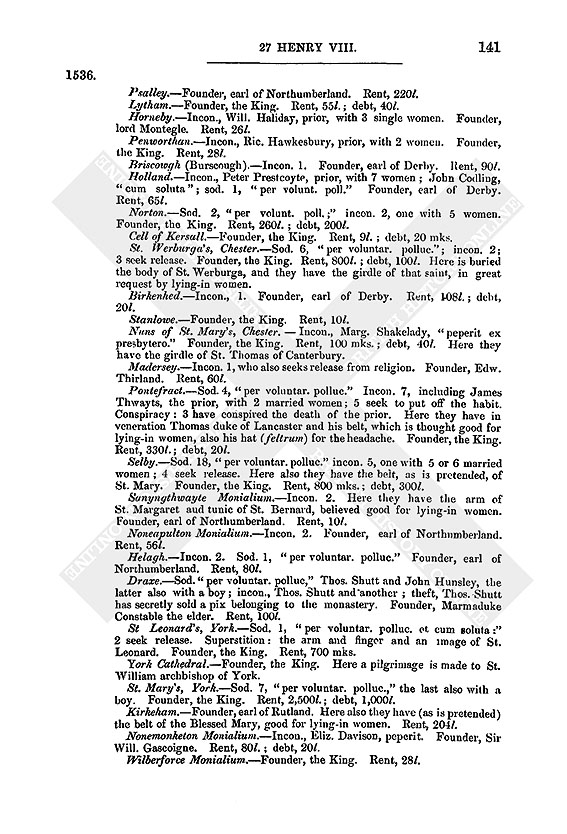
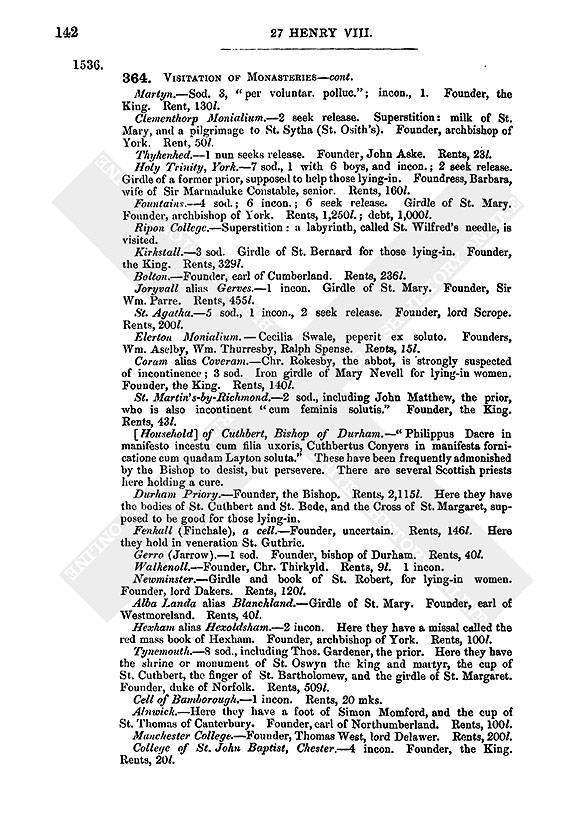
Lichfelden." Lichfield Cathedral.—Here a pilgrimage is held to St. Chad. Annual rent, 400l. Founder, the King. Monastery of Repyngdon alias Repton.—Thomas Rede, sub-prior, and three others, named as sodomites per voluntarias pollutiones. Superstition: a pilgrimage is made to St. Guthlac and his bell, which they put upon people's heads to alleviate headache. Nicholas Page seeks to be released from religion. The house owes 100 mks. Founder, the King. Grenesley.—Founder, Sir George Grenesley. Annual rent, 40l. Garadon.—5 names noted as sodomites, one with 10 boys. 3 of the monks seek release from religion. Foundress, the countess of Oxford, during her life, by grant of the King. Annual rent, 260 marks. House owes 100 mks. Langley Monialium.—Foundress, the wife of Sir Francis Bigot and her sisters. Rents, 36l.; debt, 20 mks. Bredon.—A cell of St. Oswald's. Founder, the King. Rents, 24l. Grace Dieu Monialium.—2 nuns charged with incontinence, with the note "pepererunt." Superstition: they hold in reverence the girdle and part of the tunic of St. Francis, which are supposed to help lying-in women. Founder, lord Ferys. Rents, 109 mks.; debt, 20l. Brisol Parke.—A prior without a convent. Founder, John Dirik. Rents, 20 mks. Cell of St. James Darby.—Thomas Gaynsborough, prior, guilty of incontinence with one single woman and one married woman. Founder, the King. Rents, 10l. Nuns of St. Mary Darby.—Superstition: they have part of the shirt of St. Thomas, which is reverenced among pregnant women. Founder, the King. Rents, 10l.; debt, 20 mks. Dale.—Incontinence, John Staunton, abbot, with one single and one married woman; Wm. Bramston, with 5 married women. They reverence part of the girdle and the milk of St. Mary, and the wheel of St. Katharine in silver. Founder, Gervays Kyngeston. Rents, 140l. Shelford.—3 sodomites, 3 guilty of incontinence, 3 desire release from religion. They venerate the girdle and milk of St. Mary, and part of a candle which it is believed she carried at the time of her purification; they have also the oil of the Holy Cross and the oil of St. Katharine. Founder, Henry Norres. Rents, 100l.; debts, 30l. Thurgarton.—10 sodomites, some with boys. Incontinence, Thos. Dethyk, prior, with several women, and 6 others with married and single women; 8 seek to be released from religion. A pilgrimage is held to St. Ethelburg (ad Sanctum Ethelburgum, masculine, MS.). Founder, the King. Rents, 240l. Rufford.—6 sod. Incontinence, Thos. Doncaster, abbot, with 2 married women, and 4 others; 6 seek release. Superstition: Virgin's milk. Founder, Mr. Henry Norres. Rents, 100l.; debt, 20l. Wellbek.—3 sod., 1 incon., 3 seek release. Founder, bishop of Ely. Rents, 280l.; debt, 40l. Wursopp.—4 sod., 1 seeks release. Founder, George earl of Shrewsbury. Rents, 240l.; debt, 200 marks. Rupa alias Roche.—5 sod. John Robinson, suspected of treason, and imprisoned at York. Pilgrimage to an image of Christ crucified, found, as supposed, in Rupa (qu. in rupe?). Founder, earl of Cumberland. Rents, 170l.; debt, 20l. Blida (Blyth).—4 sod., 1 incon. Founder, the King. Rents, 180l. Wallingwells Monialium.—Superstition: they keep the comb of St. Edmund, and an image of St. Mary, found, as supposed, at the foundation of this monastery. Founder, lord Dakers of the South. Rents, 60l. Felley.—Founder, Sir John Chowgh. Rents, 40l.; debt, 40l. St. Oswald's.—Sod. 4 "per voluntariam pollucionem" and 4 with boys; incon., 4; apostacy, 1. Pilgrimage to St. Oswald. Founder, the King. Rents, 1,100 mks. Burton alias Monk Bretton.—1 sod., 1 guilty of incest with his own sister and adultery with a married woman. Founder, lord Thomas Montegle. Rents, 200l. Arthington Monialium.—Founder, Henry Arthington. Rents, 20 mks. Superstition: girdle of St. Mary. Hampall Monialium.—Founder, Gervays Cliffton, jun. Rents, 40l. Pilgrimage to St. Richard, a saint not canonized. Esshot Monialium.—3 incon., 2 of whom have borne children. Founder uncertain, because there are many heirs of Chr. Warde, the founder. Kirkelees Monialium.—1 nun "peperit." Rents, 20l. Brenkborne.—Will. Hogeson, prior, incon. Founder, lord Burrowe. Rents, 100 mks. Superstition: girdle of St. Peter. Gisburne.—James Cokrell, prior, and 5 others, sod.; the prior also incon. with divers women; 2 seek release from religion. Founders, lord Conyers, James Strangwiche, earl of Rutland, and Wm. Gascoign. Rents, 700l. Basedale Monialium.—Joan Flecher, "peperit." Superstition: Virgin's milk. Founder, Sir Ralph Evers. Rents, 18l. Handall Monialium.—Alice Brampton, peperit. Founder, earl of Northumberland. Rents, 10l. Middelsburgh.—Founder, lord Conyers. Rents, 10l. Whitby.—3 sod., 2 incon. Here St. Hilda is worshipped. Founder, the King. Rents, 700 mks. Graunde Monte.—1 seeks release. Founders, Sir Francis Bigot and George Salvain. Rents, 13l. Yeddingham Monialium.—Agnes Butterfeld, peperit. Founder, lord Latimer. Rents, 40l. Rosdale Monialium.—Founder, the King. Rents, 44l. Wykeham Monialium.—Founder, the King. Rents, 13l. Here St. Sytha is worshipped. Nonnekeling Monialium.—Founder, the King. Rents, 36l. Here they have a part of the Holy Cross. Bridlington.—2 sod., 1 incon. Here St. John of Bridlington is worshipped, and 3 "lamina" (laminœ ?) of the wood of Holy Cross. Founder uncertain. Rents, 682l. Beverley College.—Founder, the King. Rents, 68l. Melsa alias Mewse.—Founder, the King. Rents, 298l. Here the girdle of St. Bernard is sometimes lent to pregnant women. Nonneburneham Monialium.—2 incon. Founder, lord Dakers. Rents, 7l. Here they have part of Holy Cross. North Feribye.—4 sod., 3 incon., including John Bawdewyn, the prior. Founder, the earl of Cumberland. Rents, 60l.; debt, 80l. Here St. Gatianus is worshipped. Haltemprise.—4 sod., 2 incon., one of them before entering religion. Founder, the duke of Richmond. Rents, 104l. Superstition: pilgrimage to Thomas Wake for fever, and they reverence the arm of St. George, a part of Holy Cross, and the girdle of St. Mary, which is thought to be helpful in childbirth. Warter.—4 sod.; the prior, Will. Holme, incon.; John Jakson, guilty of incest with a nun. Founder, earl of Rutland. Rents, 120l. Swynhey Monialium.—Eliz. Copley, "peperit ex sacerdote." Founder, Sir John Melton. Rents, 80l. Newburgh.—3 [sod.] "per voluntariam pollucionem." Superstition: girdle of St. Saviour (Sancti Salvatoris), which they say helps lying-in women; also an arm of St. Jerome. Founder, Thomas duke of Norfolk. Rents, 80l. Ryvall alias Ryvers.—1 sod., who desires to be released; 2 incon. Girdle of St. Alred, helpful to lying-in women. Founder, earl of Rutland. Rents, 300l.; debt, 200 mks. Kaldham Monialium.—Here they have part of Holy Cross and a finger of St. Stephen, which is lent to lying-in women. Founder, earl of Westmoreland. Rents, 30l.; debt, 20 mks. Arden Monialium.—Incest, Margery Lepton, "peperit ex canonico regulari." Women offered to the image of St. Bride for cows lost or sick. Founder, duke of Norfolk. Rents, 20 mks. Mowseby Monialium.—Founder, the King. Rents, 30l. Mons Gratiæ (Mountgrace).— 2 seek release. Founder, the King. Rents, 500 mks. Bylond.—Henry Thornton sod. "per voluntariam pollucionem;" 1 seeks release. Founder, duke of Norfolk. Rents, 400 mks. Neseham Monialium.—Margareta Trowlope, "peperit ex soluto." Founder, lord Dakers. Rents, 17l. Shapp.—3 seek to put off the habit. Founder, earl of Cumberland. Rents, 166l. Carlisle Monastery.—7 sod. "per voluntariam pollucionem"; 3 incon. including Chr. Slye, the prior. Here they have a portion of the Cross, the sword with which St. Thomas of Canterbury was martyred, and the girdle of St. Bride. Founder, the King. Rents, 482l. Armathwayte Monialium.—Founder, the King. Rent, 14l. Lampley Monialium.—Incon.: Mariana Wryte "ter peperit," Johanna Snaden "sexies peperit," Johanna Muscroff "peperit ex soluto." Founder, the King. Rent, 5l. 15s. 8d. College of Kirkesoswald.—Founder, lord Dakers. Rent, 71l. Wetherall.—Sod. 2, "per voluntariam pollucionem." Founder, the King. Rent, 130l. Here they think they have part of Holy Cross and of the milk of St. Mary. Lenarcoste.—Sod. 2, "per voluntar. polluc." Here they have the girdle of St. Mary Magdalene. Founder, lord Dakers. Rent, 100 mks. Holme Coltrom.—Sod. 5, "per voluntar. polluc." Incon.; Will. Watson with 2 single and one married woman; Thomas Carter, the abbot, with 3 women; and 6 others. Superstition: a necklace, called an Agnus Dei, which helps lying-in women. Founder, the King. Rent, 700 mks.; debts, 100l. St. Bege alias St. Bee.—Sod. 2, "per voluntar. polluc."—Founder, the King. Rent, 143l. Seton Monialium.—Incon., Johanna Copland, prioress, with a priest; Susanna Rybton, "peperit." Founder, Henry Kirkeby. Rent, 20 mks.; debt, 6l. and more. Calder.—Sod., Rob. Maneste, Wm. Car, John Gisburne, Matt. Ponsonby, Ric. Preston, "per voluntar. polluc." Incon., Will. Thorneton, cum soluta; Ric. Preston, cum una conjugata et pluribus solutis. Gisburne and Preston seek release. Superstition: a girdle of St. Mary, good for lying-in women. Founders, the lords of Copland. Rent, 64l.; debt, 20l. Furness.—Incon., Roger Pele, the abbot, and 3 others, with "solutæ" and "feminæ." Sod. 1, "per voluntar. polluc." Founder, the King. Rent, 900l.; debt, 140l. Cartemell.—Incon. 2; one has 6 children. Founder, Edw. Gray, heir of the earl of Kent. Rent, 100l.; debt, 40l. Here they have part of Holy Cross. Conyshed.—Incon. 5; one with 6 and another with 10 women; 2 seek release. Founder, Wm. Penyngton. Rent, 113l. Superstition: girdle of St. Mary, good for pregnant women. Cokersand.—Sod. 2, "per volunt. poll." Founder, uncertain. Rent, 200l.; debt, 100l. Whalley.—Sod., Ric. Wood, "per voluntar. polluc." Founder, the King. Rent, 541l. Psalley.—Founder, earl of Northumberland. Rent, 220l. Lytham.—Founder, the King. Rent, 55l.; debt, 40l. Horneby.—Incon., Will. Haliday, prior, with 3 single women. Founder, lord Montegle. Rent, 26l. Penworthan.—Incon., Ric. Hawkesbury, prior, with 2 women. Founder, the King. Rent, 28l. Briscowgh (Burscough).—Incon. 1. Founder, earl of Derby. Rent, 90l. Holland.—Incon., Peter Prestcoyte, prior, with 7 women; John Codling, "cum soluta"; sod. 1, "per volunt. poll." Founder, earl of Derby. Rent, 65l. Norton.—Sod. 2, "per volunt. poll.;" incon. 2, one with 5 women. Founder, the King. Rent, 260l.; debt, 200l. Cell of Kersall.—Founder, the King. Rent, 9l.; debt, 20 mks. St. Werburga's, Chester.—Sod. 6, "per voluntar. polluc."; incon. 2; 3 seek release. Founder, the King. Rent, 800l.; debt, 100l. Here is buried the body of St. Werburga, and they have the girdle of that saint, in great request by lying-in women. Birkenhed.—Incon., 1. Founder, earl of Derby. Rent, 108l.; debt, 20l. Stanlowe.—Founder, the King. Rent, 10l. Nuns of St. Mary's, Chester.—Incon., Marg. Shakelady, "peperit ex presbytero." Founder, the King. Rent, 100 mks.; debt, 40l. Here they have the girdle of St. Thomas of Canterbury. Madersey.—Incon. 1, who also seeks release from religion. Founder, Edw. Thirland. Rent, 60l. Pontefract.—Sod. 4, "per voluntar. polluc." Incon. 7, including James Thwayts, the prior, with 2 married women; 5 seek to put off the habit. Conspiracy: 3 have conspired the death of the prior. Here they have in veneration Thomas duke of Lancaster and his belt, which is thought good for lying-in women, also his hat (feltrum) for the headache. Founder, the King. Rent, 330l.; debt, 20l. Selby.—Sod. 18, "per voluntar. polluc." incon. 5, one with 5 or 6 married women; 4 seek release. Here also they have the belt, as is pretended, of St. Mary. Founder, the King. Rent, 800 mks.; debt, 300l. Sanyngthwayte Monialium.—Incon. 2. Here they have the arm of St. Margaret aud tunic of St. Bernard, believed good for lying-in women. Founder, earl of Northumberland. Rent, 10l. Noneapulton Monialium.—Incon. 2. Founder, earl of Northumberland. Rent, 56l. Helagh.—Incon. 2. Sod. 1, "per voluntar. polluc." Founder, earl of Northumberland. Rent, 80l. Draxe.—Sod. "per voluntar. polluc," Thos. Shutt and John Hunsley, the latter also with a boy; incon., Thos. Shutt and another; theft, Thos. Shutt has secretly sold a pix belonging to the monastery. Founder, Marmaduke Constable the elder. Rent, 100l. St Leonard's, York.—Sod. 1, "per voluntar. polluc. et cum soluta:" 2 seek release. Superstition: the arm and finger and an image of St. Leonard. Founder, the King. Rent, 700 mks. York Cathedral.—Founder, the King. Here a pilgrimage is made to St. William archbishop of York. St. Mary's, York.—Sod. 7, "per voluntar. polluc," the last also with a boy. Founder, the King. Rent, 2,500l.; debt, 1,000l. Kirkeham.—Founder, earl of Rutland. Here also they have (as is pretended) the belt of the Blessed Mary, good for lying-in women. Rent, 204l. Nonemonketon Monialium.—Incon. Eliz. Davison, peperit. Founder, Sir Will. Gascoigne. Rent, 80l.; debt, 20l. Wilberforce Monialium.—Founder, the King. Rent, 28l. Martyn.—Sod. 3, "per voluntar. polluc."; incon., 1. Founder, the King. Rent, 130l. Clementhorp Monialium.—2 seek release. Superstition: milk of St. Mary, and a pilgrimage to St. Sytha (St. Osith's). Founder, archbishop of York. Rent, 50l. Thykenhed.—1 nun seeks release. Founder, John Aske. Rents, 23l. Holy Trinity, York.—7 sod., 1 with 6 boys, and incon.; 2 seek release. Girdle of a former prior, supposed to help those lying-in. Foundress, Barbara, wife of Sir Marmaduke Constable, senior. Rents, 160l. Fountains.—4 sod.; 6 incon.; 6 seek release. Girdle of St. Mary. Founder, archbishop of York. Rents, 1,250l.; debt, 1,000l. Ripon College.—Superstition: a labyrinth, called St. Wilfred's needle, is visited. Kirkstall.—3 sod. Girdle of St. Bernard for those lying-in. Founder, the King. Rents, 329l. Bolton.—Founder, earl of Cumberland. Rents, 236l. Joryvall alias Gerves.—1 incon. Girdle of St. Mary. Founder, Sir Wm. Parre. Rents, 455l. St. Agatha.—5 sod., 1 incon., 2 seek release. Founder, lord Scrope. Rents, 200l. Elerton Monialium.—Cecilia Swale, peperit ex soluto. Founders, Wm. Aselby, Wm. Thurresby, Ralph Spense. Rents, 15l. Coram alias Coveram.—Chr. Rokesby, the abbot, is strongly suspected of incontinence; 3 sod. Iron girdle of Mary Nevell for lying-in women. Founder, the King. Rents, 140l. St. Martin's-by-Richmond.—2 sod., including John Matthew, the prior, who is also incontinent "cum feminis solutis." Founder, the King. Rents, 43l. [Household] of Cuthbert, Bishop of Durham.—"Philippus Dacre in manifesto incestu cum filia uxoris, Cuthbertus Conyers in manifesta fornicatione cum quadam Layton soluta." These have been frequently admonished by the Bishop to desist, but persevere. There are several Scottish priests here holding a cure. Durham Priory.—Founder, the Bishop. Rents, 2,115l. Here they have the bodies of St. Cuthbert and St. Bede, and the Cross of St. Margaret, supposed to be good for those lying-in. Fenkall (Finchale), a cell.—Founder, uncertain. Rents, 146l. Here they hold in veneration St. Guthric. Gerro (Jarrow).—I sod. Founder, bishop of Durham. Rents, 40l. Walkenoll.—Founder, Chr. Thirkyld. Rents, 9l. 1 incon. Newminster.—Girdle and book of St. Robert, for lying-in women. Founder, lord Dakers. Rents, 120l. Alba Landa alias Blanchland.—Girdle of St. Mary. Founder, earl of Westmoreland. Rents, 40l. Hexham alias Hexoldsham.—2 incon. Here they have a missal called the red mass book of Hexham. Founder, archbishop of York. Rents, 100l. Tynemouth.—8 sod., including Thos. Gardener, the prior. Here they have the shrine or monument of St. Oswyn the king and martyr, the cup of St. Cuthbert, the finger of St. Bartholomew, and the girdle of St. Margaret. Founder, duke of Norfolk. Rents, 509l. Cell of Bamborough.—1 incon. Rents, 20 mks. Alnwick.—Here they have a foot of Simon Momford, and the cup of St. Thomas of Canterbury. Founder, earl of Northumberland. Rents, 100l. Manchester College.—Founder, Thomas West, lord Delawer. Rents, 200l. College of St. John Baptist, Chester.—4 incon. Founder, the King. Rents, 20l. Bunbury College.—Founder, Sir (dominus) George Calveley. Rents, 100 mks. Cumbermere.—4 sod. Founder, the King. Rents, 255l.; debt, 160l. Pp. 33. In the hand of John ap Rice. |
|
| R. O. |
2. A similar record for Norwich diocese, headed "Compendium compertorum." Shuldham Monialium.—Joanna Plumstede, "peperit ante introitum in religionem"; Margery Benbrey, "peperit semel ex presbytero." Shuldham Canonicorum.—Incon., 3, "Fatentur voluntar. polluciones." Blackborough.—Eliz. Dawny, the prioress, and 2 others, suspected of incontinence. Pentney.—Incon., Robert Codde, prior, as appears from the confession of the abbess of Marham; and 5 others with women, and "per voluntar. polluciones." Marham.—Incon., Barbara Mason, "peperit semel et fatetur se cognita a priore de Pentney"; 3 others, each "peperit semel ex conjugato," and 1 "peperit duas proles ex solutis." Westacre.—Incon., Ric. Cobbes with various women, and 8 others "fatentur voluntar. polluc." Westacre.—Incon., Wm. Wyngfelde, the prior, confesses "voluntar. polluc.," another "cum conjugata," another "per voluntar. polluc.," and another "cum duabus feminis et fatetur se passum esse sodomiticum." Castellacre.—Incon., 2 with single women, and 6 "per voluntar. polluc.," one of them also with a married woman; sod., 1 "cum puero et per vol. polluc." Coxforde.—Wm. Nevell confesses incontinence and "voluntar. polluc." Walsingham.—Incon., 4, confess "voluntar. polluc.," and 2 with women. Here was seen much superstition in feigned relics and miracles. Bynham.—Incon., 2 with women; 1 "passus sodomiticum." Wendlyng.—1 incon.; "hic magnus dilapidator existit." Byston.—1 incon. Bromeholme.—Will. Lakenham, the prior, and 3 others, incon. A cross called the Holy Cross of Bromeholme. They say they have the girdle and milk of St. Mary, and a piece of the Cross of St. Peter and of St. Andrew. St. Benet's.—4 incon. Here the abbot has renewed and granted many unusual things under the common seal, in fear of the visitation. There is suspicion of a confederation "de non delegendo." Ikelyng.—Incon., 3 with women, and 3 "per voluntar. polluc." Ingham.—John Sae, prior, and another, incon. Norwich Cathedral.—5 incon. "per vol. polluc." one of them "cum muliere." Aldeby.—2 incon.; all except 2 desire to be released. St. Faith's.—2 incon., one of them "per vol. polluc." Langley.—Almost all seek release. Bukkenham.—John Milgate, prior, "cum soluta," and 2 others "per vol. polluc." Wymondeham.—Incon.; 4 profess "volunt. polluc." St. Olaves.—Will. Dale, prior, and 3 others, "per vol. polluc." Pp. 4. In the same hand as the preceding. |
| R. O. | 3. Fragment of a similar record, perhaps the continuation of the preceding, in the same hand. |
|
Superstition: among the relics they have "lintheamen quoddam," called
the wymple of St. Ethelrede, through which they draw knotted strings or
silken threads, which women think good for sore throats; they have also the
wymple of St. Audrede, for sore breasts, the comb of the same for headaches,
and the rod of Aaron for children troubled with worms, and a ring of St.
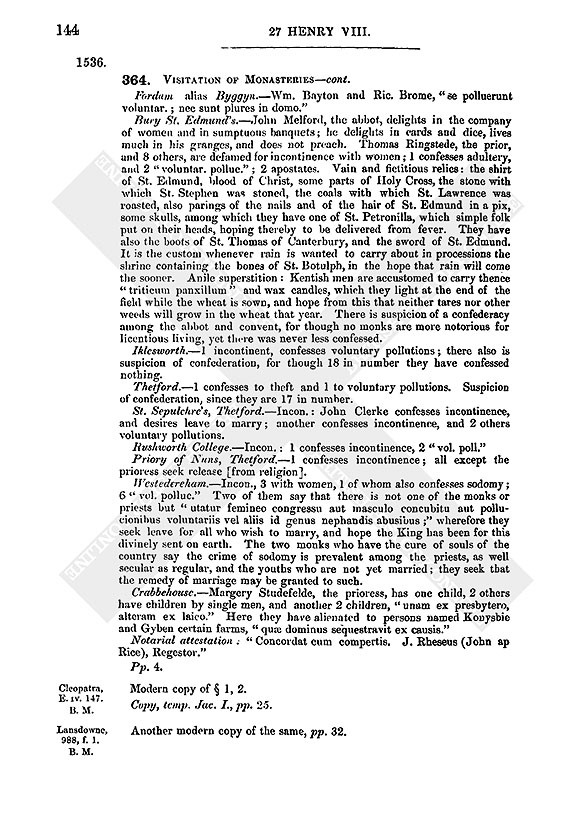
Ethelred, for lying-in women to put on their fingers. Fordam alias Byggyn.—Wm. Bayton and Ric. Brome, "se polluerunt voluntar.; nec sunt plures in domo." Bury St. Edmund's.—John Melford, the abbot, delights in the company of women and in sumptuous banquets; he delights in cards and dice, lives much in his granges, and does not preach. Thomas Ringstede, the prior, and 8 others, are defamed for incontinence with women; 1 confesses adultery, and 2 "voluntar. polluc."; 2 apostates. Vain and fictitious relics: the shirt of St. Edmund, blood of Christ, some parts of Holy Cross, the stone with which St. Stephen was stoned, the coals with which St. Lawrence was roasted, also parings of the nails and of the hair of St. Edmund in a pix, some skulls, among which they have one of St. Petronilla, which simple folk put on their heads, hoping thereby to be delivered from fever. They have also the boots of St. Thomas of Canterbury, and the sword of St. Edmund. It is the custom whenever rain is wanted to carry about in processions the shrine containing the bones of St. Botulph, in the hope that rain will come the sooner. Anile superstition: Kentish men are accustomed to carry thence "triticum panxillum" and wax candles, which they light at the end of the field while the wheat is sown, and hope from this that neither tares nor other weeds will grow in the wheat that year. There is suspicion of a confederacy among the abbot and convent, for though no monks are more notorious for licentious living, yet there was never less confessed. Iklesworth.—1 incontinent, confesses voluntary pollutions; there also is suspicion of confederation, for though 18 in number they have confessed nothing. Thetford.—1 confesses to theft and 1 to voluntary pollutions. Suspicion of confederation, since they are 17 in number. St. Sepulchre's, Thetford.—Incon.: John Clerke confesses incontinence, and desires leave to marry; another confesses incontinence, and 2 others voluntary pollutions. Rushworth College.—Incon.: 1 confesses incontinence, 2 "vol. poll." Priory of Nuns, Thetford.—1 confesses incontinence; all except the prioress seek release [from religion]. Westedereham.—Incon., 3 with women, 1 of whom also confesses sodomy; 6 "vol. polluc." Two of them say that there is not one of the monks or priests but "utatur femineo congressu aut masculo concubitu aut pollucionibus voluntariis vel aliis id genus nephandis abusibus;" wherefore they seek leave for all who wish to marry, and hope the King has been for this divinely sent on earth. The two monks who have the cure of souls of the country say the crime of sodomy is prevalent among the priests, as well secular as regular, and the youths who are not yet married; they seek that the remedy of marriage may be granted to such. Crabbehouse.—Margery Studefelde, the prioress, has one child, 2 others have children by single men, and another 2 children, "unam ex presbytero, alteram ex laico." Here they have alienated to persons named Konysbie and Gyben certain farms, "quæ dominus sequestravit ex causis." Notarial attestation. "Concordat cum compertis. J. Rheseus (John ap Rice), Regestor." Pp. 4. |
|
| Cleopatra, E. iv. 147. B. M. |
Modern copy of § 1, 2. Copy, temp. Jac. I., pp. 25. |
| Lansdowne, 988, f. 1. B. M. | Another modern copy of the same, pp. 32. |
| 28 Feb. R. O. |
365. John Prowez to Miles Coverdale. |
|
On the 23rd inst. received two letters from his master, for the mayors
of Winchelsea and Rye, and delivered them. The mayor of Winchelsea
immediately had the parson there to prison, where he will remain till my
master's pleasure be known. He is a very unthrift priest and a great
reveller, as all the county reports. There are others yet that cannot be had,
who are disposed to make business, but since the coming of my master's
letters there has not been half the business there was previously. The
people of Rye were daily likely to make insurrections, and they said it would
never be well till one party had put down the other. Now the parson is
in prison, they are almost at a stay, and dare not speak. As to his master's
fish, the weather has been so bad that the boats could not put to sea. Three
great ships going to Roume (Rouen ?) with 6,000 qrs. of wheat have been
lost, and two others. Rye, 28 Feb. Hol., p. 1. Add.: To my worshipful master Melles Coverde. Endd.: John Prouche. |
|
| 28 Feb. R. O. |
366. Oudart du Bies to Lord Lisle. |
|
I write in behalf of the wife of the commissary of mortepayes here,
to ask you to allow her to take out of your country 300 sheep. Boulogne,
28 Feb. Signed. Fr., p. 1. Add. |
|
| 28 Feb. Vit. B. xiv. 238. B. M. |
367. Pasquinade against Charles V. |
|
"Nos Pasquillus generalis, præfectus populi Romani, consideratis actis
et laudabilibus gestis Caroli Qui[nti regis] Neapolitani, maxime erga rem
publicam Romanam, e[i damus et con]cedimus liberum ac securum salvum
conductum eu[ndi et] transeundi per civitatem nostram, ejusque comitatu . .
. . . . . . rebus et personis, duraturum per totum mensem Martii [proxime
sequentem], non obstantibus quibuscunque latrociniis, rubariis . . . . . . . . .
mentis, adulteriis, incestis, Luteranismis commissis [in hac] Urbe per se
et ejus ministros; tam erga Christum [et ejus] sanctos, quam generaliter contra
universam civitatem . . . . . . . . . aliis. Datum Romæ, in solita nostra
residentia, d[ie 28] (fn. 4) Februarii 1536. Paulus Tertius Canci . . . . . ." Mutilated. |
|
| 28 Feb. R. O. |
368. Antonio Bonvisi to [Cromwell ?]. |
| Wrote on the 19th and 20th by way of Flanders by Francesco Ghabrielli. Wrote also on the 21st, hoping to send it by the same courier, but it was too late, and it will go with this. The answer from Naples and from Rome came two days ago. Nothing is known of its substance but preparations for war. Nothing is said of the journey of the Admiral, so it would seem they have little hope of agreement. The artillery of Paris has arrived, in all 112 pieces, 12 being siege guns (da battarie) and the rest fieldpieces. There is no news of other lanceknights coming to Burgundy for Francis, but 15,000 or 16,000 are expected from the Terre Franche (Franche Comté ?) and by way of Gueldres. The Swiss were at Geneva, having left 1,000 foot behind them to protect the Pays de Vaud, which they have taken as a pledge forfeited by the Duke. They decline to serve Francis, being only paid to defend the kingdom, and their doctors tell them it is unlawful to take money for invasion. These are of Berne, one of the principal cantons, but it is thought 8,000 or 10,000 will be got from the others; it is feared, however, that they will be later than was expected, and that it will be May before they pass the mountains. | |
| Francis has taken possession of Brescia, which has been long in the hands of the duke of Savoy, but which he claims by right of his mother. In a castle of Brescia, named Molvello, eight Genoese merchants were taken with 10,000 scudi, and made to give sureties for a much larger sum. | |
| Signor Gian Paulo da Cieri, son of the late Signor Renso, came hither two days ago, and brings news that the Imperialists are raising men everywhere. From other quarters it is known that they are raising 10,000 foot in Milan, and that Maximian Stampa, who was castellan there, has delivered the castle to Autonio di Leva as the Emperor's lieutenant, receiving 14,000 ducats in reward. He has been made colonel of 3,000 foot, Count Philip Torinello of as many, and two other captains of 4,000. At Trent 7,000 lances had arrived, and they were expecting in all 12,000. When Francis hears of the preparations, perhaps he will change his mind about crossing the mountains. The conclusion of the league between Francis and the Venetians is confirmed from many quarters. The bishop of Rome has given his word to the Emperor, but is very ill pleased, and there is little good understanding between them. The Emperor will leave Naples on the 5th March for Rome, accompanied by 7,000 foot, 800 lances, 1,500 light horse, and 40 pieces of artillery, some being siege guns. The bishop of Rome was in great fear, as cardinal Trivulci writes; nevertheless, they will receive him gloriously, more for fear than for love. The kingdom of Naples had granted him 1,500,000 ducats, but the money will be raised with difficulty. I send with this divers articles of news from Lucca, derived from good sources; also a supplication of the exiles of Florence to the Emperor, with the reply and a memorial given by the Emperor's council to the said exiles, with a letter of one of them to a friend. The Emperor has a very difficult task to settle matters there. He has demanded of the Siennese two of their seaports, Porto Ercole and Thalamone, and of the bishop of Rome, Civita Vecchia, to secure himself against Barbarossa, but he has been refused. I send some news from a friend at Rome that may concern the king of England. | |
| Neither in Seville nor in Portugal had it rained, till the 20th January, enough to allow them to sow. They are afraid the seed is lost for this year. In Sicily, on the other hand, it had rained two months continuously, and done great injury to the sowing. The Portuguese ambassador has obtained licence from Francis to buy corn at Bordeaux and in Brittany. A false report lately came that the marquis del Guasto had killed the viceroy of Naples, brother of the duke of Alva. | |
| Letters from Naples of the 19th say the Emperor has promised the exiles that when he reaches Rome he will restore them to liberty, and that the marriage with his daughter will take place two days after. The duke of Florence has purchased the dukedom of Sessa. | |
|
Sends a copy of letters from Seville about the arrival of ships from India
on the 30th January. Further news of the preparations for war. Lyons, 28 Feb. 1536. Ital., pp. 4. In Bonvisi's hand. Endd. |
|
| ii. Extracts from a letter from Lucca of the 14th Feb. 1536. | |
| The agreement about the duchy of Milan, as I hear from well-informed persons who lately left Naples, is not likely to take effect. The Emperor is willing to give it to the duke of Angoulême with the marriage of the Duchess, and security against Francis pushing his claims further. But the French king has asked it for the duke of Orleans under other conditions. My friend thinks it will be conferred on the son of the king of the Romans, who will soon be in Italy to visit the Emperor. Thinks Francis has lost his opportunity, even if he would accept it for the duke of Angoulême, having given offence in various ways. No doubt it will have to be taken by force, there is so much preparation made there, both defensive and offensive. The Emperor will conclude a league with the Venetians; the Pope cares little about it. If war break out, my friend thinks the fleet will not go into Spain. In proportion as they are cool in Italy they make great preparations in Spain. | |
|
From Naples, by letters of the 6th, the Emperor is trying to make an
agreement between the Duke and the exiles, but it is not thought very
hopeful. There is no certainty when the Emperor will leave Naples. He
has demanded of the kingdom 3,000,000, of which 1,500,000, payable in five
years, has been conceded; but the money will be levied with difficulty. He
will soon be in Rome with a large force, and preparations have been made
for his reception. The prince Doria left Naples unexpectedly, and arrived
here yesterday. Ital., pp. 2. In Bonvisi's hand. Endd. |
|
| R. O. | 2. Another copy of § ii. |
| [Feb.] R. O. |
369. Florence. (fn. 5) |
| Memorial of the Emperor's council given to the exiles (fora usciti) in answer to a reply made by them beginning "Noi non venimo qui." (fn. 6) | |
|
If the party of the exiles of Florence desire to come to an agreement, as
they say, let them consent that the duke Alexander de Medicis and his heirs
remain in the state of Florence with the title of duke and head of the
government, and the Emperor will reform the administration in accordance
with the articles agreed to by his Majesty's ministers. The submission of
the Duke, by which the Emperor holds the government, is not so exorbitant
as the exiles maintain, and he will do his duty in such a manner that it
will be seen clearly he has no other object in view than the interests of
Florence itself, &c. Spanish, p. 1. In Bonvisi's hand, with an endorsement in Italian in the same hand. |
|
| Calig. E. ii. 195. B. M. |
2. A mutilated paper in Italian, apparently in reply to the preceding,
endorsed "Risposta dei fora usciti al memoriale statoli dato dal consiglio di
sua Majesta." In Bonvisi's hand, pp. 2. The endorsement is in the same hand. |
| 29 Feb. R. O. |
370. John Lord Audeley to Cromwell. |
|
I have received a letter from my Lord Chancellor and you, to which
I have made the enclosed answer. I beg you to consider me as I am, a poor
man, unable to pay 1,720l. On the other hand, it would be an undoing to
my name to leave the old signory of my lordships. But I remit all to your
goodness. If the letter please you, let Parson Davys deliver it to my Lord
Chancellor; if not, alter it to your own mind, and I will re-write it. But
send me the copy sealed with your signet. Wade, 29 Feb. Hol., p. 1. Add.: Mr. Crumwell, secretary to the King's highness. |
|
| 29 Feb. R. O. |
371. Doubtful Divinity. |
| "The deposition of Tristram Reuel, late scholar of Christ's College, Cambridge, touching the translation of the book called the Sum of Christianity, ultimo Februarii, ao xxviimo." | |
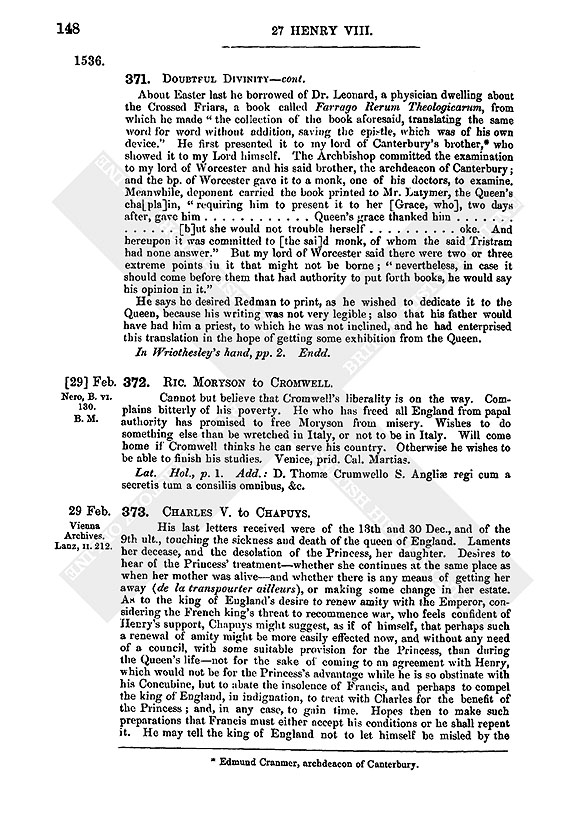
| About Easter last he borrowed of Dr. Leonard, a physician dwelling about the Crossed Friars, a book called Farrago Rerum Theologicarum, from which he made "the collection of the book aforesaid, translating the same word for word without addition, saving the epistle, which was of his own device." He first presented it to my lord of Canterbury's brother, (fn. 7) who showed it to my Lord himself. The Archbishop committed the examination to my lord of Worcester and his said brother, the archdeacon of Canterbury; and the bp. of Worcester gave it to a monk, one of his doctors, to examine. Meanwhile, deponent carried the book printed to Mr. Latymer, the Queen's cha[pla]in, "requiring him to present it to her [Grace, who], two days after, gave him . . . . . . . . . . . . Queen's grace thanked him . . . . . . . . . . . . . [b]ut she would not trouble herself . . . . . . . . . . oke. And hereupon it was committed to [the sai]d monk, of whom the said Tristram had none answer." But my lord of Worcester said there were two or three extreme points in it that might not be borne; "nevertheless, in case it should come before them that had authority to put forth books, he would say his opinion in it." | |
|
He says he desired Redman to print, as he wished to dedicate it to the
Queen, because his writing was not very legible; also that his father would
have had him a priest, to which he was not inclined, and he had enterprised
this translation in the hope of getting some exhibition from the Queen. In Wriothesley's hand, pp. 2. Endd. |
|
| [29] Feb. Nero, B. vi. 130. B. M. |
372. Ric. Moryson to Cromwell. |
|
Cannot but believe that Cromwell's liberality is on the way. Complains bitterly of his poverty. He who has freed all England from papal
authority has promised to free Moryson from misery. Wishes to do
something else than be wretched in Italy, or not to be in Italy. Will come
home if Cromwell thinks he can serve his country. Otherwise he wishes to
be able to finish his studies. Venice, prid. Cal. Martias. Lat. Hol., p. 1. Add.: D. Thomæ Crumwello S. Angliæ regi cum a secretis tum a consiliis omnibus, &c. |
|
| 29 Feb. Vienna Archives. Lanz, ii. 212. |
373. Charles V. to Chapuys. |
| His last letters received were of the 18th and 30 Dec., and of the 9th ult., touching the sickness and death of the queen of England. Laments her decease, and the desolation of the Princess, her daughter. Desires to hear of the Princess' treatment—whether she continues at the same place as when her mother was alive—and whether there is any means of getting her away (de la transpourter ailleurs), or making some change in her estate. As to the king of England's desire to renew amity with the Emperor, considering the French king's threat to recommence war, who feels confident of Henry's support, Chapuys might suggest, as if of himself, that perhaps such a renewal of amity might be more easily effected now, and without any need of a council, with some suitable provision for the Princess, than during the Queen's life—not for the sake of coming to an agreement with Henry, which would not be for the Princess's advantage while he is so obstinate with his Concubine, but to abate the insolence of Francis, and perhaps to compel the king of England, in indignation, to treat with Charles for the benefit of the Princess; and, in any case, to gain time. Hopes then to make such preparations that Francis must either accept his conditions or he shall repent it. He may tell the king of England not to let himself be misled by the boasts of the French, for it will be seen in six weeks if Charles be not the stronger. He may also tell the King or Cromwell that all the French king's boasting (braveté) is only for the duchy of Milan, about which Charles can arrange with him any day on such terms as he pleases. Will inform Chapuys what comes of the negociations now on foot about it; and he may write his advice what stipulations he thinks Charles might insist upon with Francis in behalf of the Princess. | |
|
Since the above was written, received on the 25th his letters of the 21st
and 29th Jan. Approves of his conduct in consoling and advising the
Princess. Thinks the language of the King and Cromwell shows they want
to set the above [alliance] on foot. Agrees with his advice that the Princess
should feign a wish to enter religion. Delays writing to her lest his letters be
intercepted; but Chapuys may assure her that he hopes to remedy her treatment (son affaire) to her satisfaction, whatever turn matters take, either for
peace or war. Is much grieved at the death of his aunt, and especially that
the manner of it should have been such as Chapuys reports. Naples, last
day of Feb. 1536. Fr. From a modern copy, pp. 3. |
|
| Harl. MS. 288, f. 27. B. M. | 374. [Gardiner] to Henry VIII. |
| I and Wallop have communed with the Emperor's ambassador, and learned from him such things as we think your Highness should know at once. | |
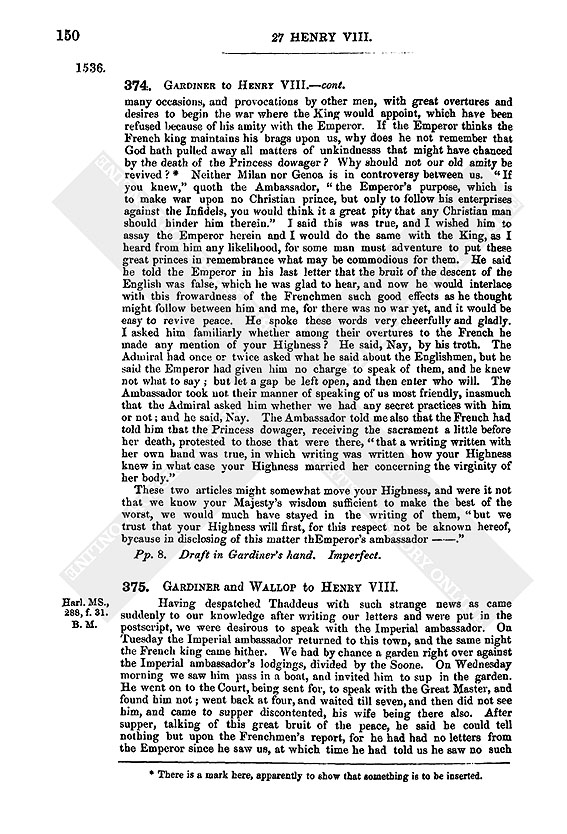
| The said Ambassador has been with the French king these three days six leagues from this town, and returned on Sunday. I at once sent him the letters directed to him from the Imperial ambassador in England, which came with your Highness's letter, with a message desiring to speak with him. He arranged a meeting at a church at evensong; and at the hour sent a message by his servant that he was letted by the Venetian ambassador, but would come by-and-by. On his arrival I thanked him for the tidings he sent me of the arrival of the Emperor's letters to him with the generality of his commission; "by reason whereof," quoth I, "I am very desirous to know how ye have done at the Court, for here be many bruits that ye have concluded [altered, 'are towards a peace'], as some say, and that ye have offered Milan to the French king. A peace! quoth he; nay, by my troth, these men be so froward and handle themself in such wise as I think they will rather cause the Emperor to recule from such conditions as else percase he might be brought unto;" and so, quoth he, I told the French king. "Trow you," quoth I, "to constrain my master to make peace with you, and is this the way, to levy your force and to arm yourself? The French king said he did it only for the matters of Savoy, and that he would make no war upon the Emperor." I asked the Ambassador again if the Emperor offered the French king Milan. He answered, he knew not; but he said he had in commission to say that the Emperor, for his desire of universal peace, would gladly part with somewhat, and signifieth to the French king that he thinks the offer of Mons. de Angolesme honorable, and will treat with him if he will send some one with power. While talking, a councillor of the French king, belonging to the Admiral, sat by. The Ambassador said it did not matter his seeing us speak together, but he did not wish him to overhear. I asked him why the French embraced this overture of peace no better, and whereupon they bore themselves so bold to make this visage of war? He said he supposed on the King our master. I reminded him that I had already assured him that we did nothing that was bruited, and that the King would do nothing against his treaties with the Emperor unless the occasion begins with the Emperor; and, to be frank with him, that if the King would have declined from the treaties with the Emperor he might have had many occasions, and provocations by other men, with great overtures and desires to begin the war where the King would appoint, which have been refused because of his amity with the Emperor. If the Emperor thinks the French king maintains his brags upon us, why does he not remember that God hath pulled away all matters of unkindnesss that might have chanced by the death of the Princess dowager? Why should not our old amity be revived? (fn. 8) Neither Milan nor Genoa is in controversy between us. "If you knew," quoth the Ambassador, "the Emperor's purpose, which is to make war upon no Christian prince, but only to follow his enterprises against the Infidels, you would think it a great pity that any Christian man should hinder him therein." I said this was true, and I wished him to assay the Emperor herein and I would do the same with the King, as I heard from him any likelihood, for some man must adventure to put these great princes in remembrance what may be commodious for them. He said he told the Emperor in his last letter that the bruit of the descent of the English was false, which he was glad to hear, and now he would interlace with this frowardness of the Frenchmen such good effects as he thought might follow between him and me, for there was no war yet, and it would be easy to revive peace. He spoke these words very cheerfully and gladly. I asked him familiarly whether among their overtures to the French he made any mention of your Highness? He said, Nay, by his troth. The Admiral had once or twice asked what he said about the Englishmen, but he said the Emperor had given him no charge to speak of them, and he knew not what to say; but let a gap be left open, and then enter who will. The Ambassador took not their manner of speaking of us most friendly, inasmuch that the Admiral asked him whether we had any secret practices with him or not; and he said, Nay. The Ambassador told me also that the French had told him that the Princess dowager, receiving the sacrament a little before her death, protested to those that were there, "that a writing written with her own hand was true, in which writing was written how your Highness knew in what case your Highness married her concerning the virginity of her body." | |
|
These two articles might somewhat move your Highness, and were it not
that we know your Majesty's wisdom sufficient to make the best of the
worst, we would much have stayed in the writing of them, "but we
trust that your Highness will first, for this respect not be aknown hereof,
bycause in disclosing of this matter thEmperor's ambassador—." Pp. 8. Draft in Gardiner's hand. Imperfect. |
|
| Harl. MS., 288, f. 31. B. M. | 375. Gardiner and Wallop to Henry VIII. |
| Having despatched Thaddeus with such strange news as came suddenly to our knowledge after writing our letters and were put in the postscript, we were desirous to speak with the Imperial ambassador. On Tuesday the Imperial ambassador returned to this town, and the same night the French king came hither. We had by chance a garden right over against the Imperial ambassador's lodgings, divided by the Soone. On Wednesday morning we saw him pass in a boat, and invited him to sup in the garden. He went on to the Court, being sent for, to speak with the Great Master, and found him not; went back at four, and waited till seven, and then did not see him, and came to supper discontented, his wife being there also. After supper, talking of this great bruit of the peace, he said he could tell nothing but upon the Frenchmen's report, for he had had no letters from the Emperor since he saw us, at which time he had told us he saw no such likelihood; the Great Master had sent for him the last day, and told him things were changed; but he saw no such foundation of peace as these men make out. They may have peace when they will, but not with such conditions as they list. The Emperor will not make war with any Christian prince if he can avoid it, but he will not part with his right. The French are so light and inconstant that one day they will have peace, and another day war. If he had not himself favored peace between his master and the French king, he might long ago have set them together. He could not tell on what they had conceived their hopes of peace, except the ambassador Velle's letters; and directly he (the Imperial ambassador) came to the Court, they had determined to send the cardinal of Lorraine, and had despatched a post to tell of his coming. "It may be," quoth he, "he comes to a peace, but I have yet no letters from the Emperor." I, Sir John Wallop, told him that if the French king inclined so to peace, the Emperor might acknowledge a great goodness of your Highness. "The Ambassador granted, and said he thought that your Highness might easily have set these men on hede," and that he would write that the French king's conformity, if there be any in him, proceeded chiefly because your Highness was not inclined according to his desire. Wallop repeated with a stomach what he had said before, and he agreed and told us of the negligent lightness of the French; what cheer they made him at his last being at the Court, and how he and the Portuguese ambassador had walked in the church two hours that afternoon to wait for the Grand Master, and could not see him, and yet there was a post arrived that day from Rome, though what he brought was not known. We said, percase the contrary of what was before written. He said, he could not tell, but one day a thing liked them, and another day not. They see themselves disappointed, and percase would gladly have what was once offered. He said the Emperor would not refuse Milan to one of the French king's children, but with such conditions that the King would have no foot in Milan, so that he could impeach the quiet of Italy. We supposed that the Emperor would keep the fortress in his own hands for a while, which he granted. We pressed him no further, but he said that undoubtedly the Emperor would be glad to agree with the French king for the wealth of Christendom, and as to England he would not begin any matter of variance contrary to his leagues. He had never had any commission to speak with the French king concerning the king of England. It has been generally moved on the French side, "what say you to our allies?" and answered generally that the Emperor trusted the French king's allies were also his; and when they spoke specially of the English, he replied he had nothing to say. The Ambassador told us further that he saw no cause that should move business between your Highness and the Emperor, for he thought you would not be against the General Council for the wealth of Christendom. The greatest cause is gone; and as to the third, my lady Mary, the time was not yet come; "and, using a certain gesture in casting his hand, said God should provide therein," and concluded that in his opinion your amity would increase, whatever conclusion was taken with the French king. We would not reason with him, being both together, but assured him that as the Emperor has been bound to the King in times past, so he is, if the French king come to conformity and seek peace, much more bound to your Highness now. | |
| The French king tarried in Lyons all that day, and the next (Thursday) determined to depart. Having heard nothing from the Court either of the peace or the sending of the cardinal of Lorraine to the Emperor, we determined to go into the country with the Emperor's ambassador's wife and servant, lest men should think we were over-careful of the peace. And at night the Ambassador supped at Wallop's lodging, so that, as they now bruit peace with the Emperor, we should make demonstration that we are not in enmity with him. | |
| The Emperor's ambassador had heard that day from the Great Master that at Rome the General Council was agreed to be celebrated at Mantua at Whitsuntide twelvemonth. I, the bishop of Winchester, said I marvelled the Emperor would appoint the Council; to which he answered that the Emperor had not appointed it, but the bishop of Rome, to whom the Emperor referred it. I said the Germans would complain that he promised to call it in Germany. "No," said he, "the Emperor promised, if the bishop of Rome would not call a Council Universal, he would call a Council National, to agree all Germany in one opinion; but now the bishop of Rome will have a Council General, all Germany shall resort thither, and you are deceived in thinking that a great part of Germany will resist." He described Germany to us, having been secretary to the emperor Maximilian, and vice-chancellor of the Empire. He reckons the Emperor will command Germany as he lists. They have reason to demand a Council and desire a reformation, and the Emperor is content to handle them gently, but if this peace take effect there would be no difficulty. | |
| We asked him if he knew any nearer likelihood of this peace, and he said Nay. We made familiar cheer with him, and so departed. | |
|
Today, Friday, the bailly of Troyes came, saying that the French king,
willing to communicate with your Highness such news as he hath, and glad
to concur with you in doing such pleasure as he can, had given commission
to the Great Master who sent the said bailly to show us how the General
Council is announced at Rome to be held at Mantua at Whitsuntide
twelvemonth, and if the King might stand your Highness in any stead
therein, he would gladly. I, the bishop of Winchester, told the bailly I
understood not what he meant by announcing. Is it not yet agreed unto by
the French king, or is this the first knowledge of a Council intended? He
said he was bidden to use those terms, and cannot answer to other circumstances; and that he was bidden also to say that the French king had sent
the cardinal of Lorraine to Rome to justify himself, that, if any war follow, it
shall not be in his default, and also to purge himself that he does not labour
the coming of the Turk, but desires quiet and agreement in Christendom.
We said we heard that he went for peace, and it was already agreed upon,
whereof we said we knew well your Highness would be glad. The bailly
shrank his shoulders, and said he knew not thereof; howbeit, if peace
follow, it shall be good for all Christendom, and your Highness would be,
he was sure, comprehended, though he had no commission to say so, and, to
speak more secretly, his master was so bound to do. "We passed over that
lest we should be seen to fear whether comprehension should be made or
not, and told him again what we had heard of the Cardinal's going, and how
we were advertised from the Emperor's court of the great practices there on
the French king's behalf for peace, and of the Emperor's longer tarriance.
* * * Pp. 16. Draft in Gardiner's hand. |
|
| Harl. MS., 283, f. 18. B. M. | 376. [Cromwell] to Stephen Vaughan. |
|
Your letters to me came to the King's hands; who opened them in
my absence, and on my return to Court desired me to answer as follows.
The King commends your zeal, but thinks you have no cause to ask for
reimbursement of the charges you have sustained in his service, or of the
money you are bound to pay him for the subsidy granted by Parliament,
considering the annual fee of 20l. and the office which he lately gave you of
the faculties. The charges you have sustained in your voyage to Germany
and otherwise shall be requited, but his Highness thinks you need not distrust
his liberality if you only continue as you have done hitherto. Am surprised
at the distrust you show of my old friendship, as I have given you no cause
to doubt it. Am as ready to do you service now as ever, and advise you
not to press me too much. As to your voyage, the King wishes you to
convey the 5,000l. you have received of Antony Denny, packed as Body
will show you, into Denmark by sea in the ship Sweepstake, which is
appointed for you and Christopher Morris; to keep the money as close as you
can, letting no one know of it; and when you arrive, to go to the castle of
Werberge, where you will find Dr. Bonner and Ric. Cavendish, and then do
as they advise you, either to pay the money or part of it on covenants to be
delivered by you, or to keep it with you and bring it home again, or put it
in sure custody to be repaid into the King's coffers. If they agree to pay
part, you shall bring home the remainder. As you desire to be furnished
with money, although you now go by sea, and need be at no great charge,
the King will allow you 13s. 4d. a day while you are abroad, and let you
have in prest— (fn. 9) months' diets, which you will receive of Sir Brian
Tuke on presenting my enclosed letter to him or to Allan Hawt. My servant
Williamson will pay you the money for your last voyage into Flanders,
amounting to 42l. 15s. 8d. Draft in Wriothesley's hand, pp. 7. |
|
| Nero, B. III. 109. B. M. |
2. Later copy of the preceding. |
| R. O. | 377. [Cromwell to Stephen Vaughan.] |
|
Finds by his letter that he has received the King's letters and
Cromwell's for his preparation towards Denmark. His letter was received
during Cromwell's absence from Court, by the King, who read every word
thereof, and gives him condign thanks for his readiness. He is to have
13s. 4d. a day for his diets, and will receive from Sir Brian Tuke three
months' diets in advance. The Sweepstake is prepared for his passage
across the sea, and he is to convey the money in the secretest manner
possible, and not deliver any but by consent of Dr. Bonner and Chr. Mount. Draft, p. 1. |
|
| R. O. | 378. Richard Androys to Cromwell. |
|
"Beseeching your mastership to remember the bishopric of St. Davyes,
and my promise shall be performed, viz., 500 marks. Your servant Androys." Add.: To the Hon. Mr. Secretary. Endd. |
|
| [Feb.] Corpus Reform. iii. 38. |
379. Melancthon to Augustine Schurffius. |
|
Congratulates him on his return from Austria. Has come to Wittenberg, summoned by Luther's letters, on account of the English, though he
would rather be with that part of the university which is in Thuringia.
Asks his advice about the return of the scholars. Supposes if there are no
signs of plague this month, there is no need to stay there longer, though he
fears the summer. Lat. |
|
| R. O. | 380. Garrison of Berwick's Lands. |
| Certain lands which were assigned by Act of Parliament towards the payment of the garrison of Berwick; now given by the King as follows:— | |
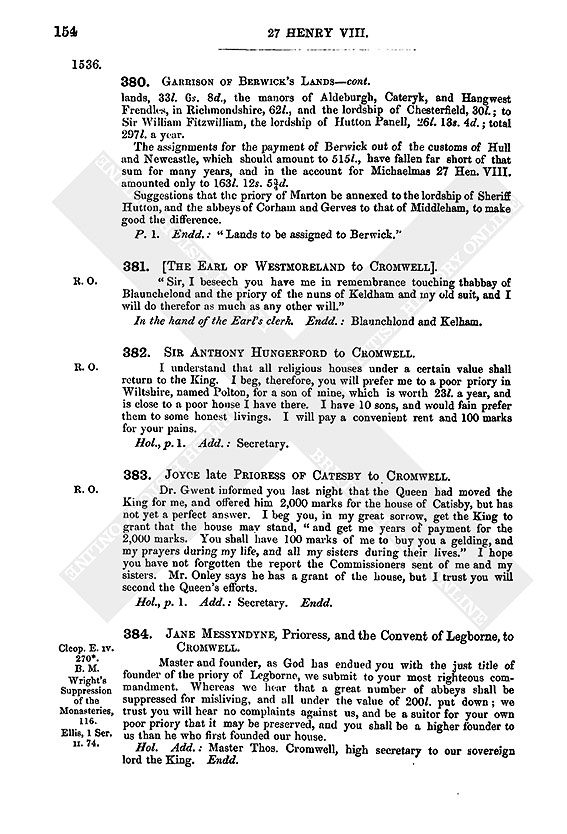
| To the duke of Richmond, the lordship of Raskall, Yorks., 44l. or 45l. to the countess of Sarum, a fourth part of Cottingham, called Salisbury's lands, 33l. 6s. 8d., the manors of Aldeburgh, Cateryk, and Hangwest Frendles, in Richmondshire, 62l., and the lordship of Chesterfield, 30l.; to Sir William Fitzwilliam, the lordship of Hutton Panell, 26l. 13s. 4d.; total 297l. a year. | |
| The assignments for the payment of Berwick out of the customs of Hull and Newcastle, which should amount to 515l., have fallen far short of that sum for many years, and in the account for Michaelmas 27 Hen. VIII. amounted only to 163l. 12s. 5¾d. | |
|
Suggestions that the priory of Marton be annexed to the lordship of Sheriff
Hutton, and the abbeys of Corham and Gerves to that of Middleham, to make
good the difference. P. 1. Endd.: "Lands to be assigned to Berwick." |
|
| R. O. | 381. [The Earl of Westmoreland to Cromwell]. |
|
"Sir, I beseech you have me in remembrance touching thabbay of
Blaunchelond and the priory of the nuns of Keldham and my old suit, and I
will do therefor as much as any other will." In the hand of the Earl's clerk. Endd.: Blaunchlond and Kelham. |
|
| R. O. | 382. Sir Anthony Hungerford to Cromwell. |
|
I understand that all religious houses under a certain value shall
return to the King. I beg, therefore, you will prefer me to a poor priory in
Wiltshire, named Polton, for a son of mine, which is worth 23l. a year, and
is close to a poor house I have there. I have 10 sons, and would fain prefer
them to some honest livings. I will pay a convenient rent and 100 marks
for your pains. Hol., p. 1. Add.: Secretary. |
|
| R. O. | 383. Joyce late Prioress of Catesby to Cromwell. |
|
Dr. Gwent informed you last night that the Queen had moved the
King for me, and offered him 2,000 marks for the house of Catisby, but has
not yet a perfect answer. I beg you, in my great sorrow, get the King to
grant that the house may stand, "and get me years of payment for the
2,000 marks. You shall have 100 marks of me to buy you a gelding, and
my prayers during my life, and all my sisters during their lives." I hope
you have not forgotten the report the Commissioners sent of me and my
sisters. Mr. Onley says he has a grant of the house, but I trust you will
second the Queen's efforts. Hol., p. 1. Add.: Secretary. Endd. |
|
| Cleop. E. iv. 270*. B. M. Wright's Suppression of the Monasteries, 116. Ellis, 1 Ser. II. 74. |
384. Jane Messyndyne, Prioress, and the Convent of Legborne, to Cromwell. |
|
Master and founder, as God has endued you with the just title of
founder of the priory of Legborne, we submit to your most righteous commandment. Whereas we hear that a great number of abbeys shall be
suppressed for misliving, and all under the value of 200l. put down; we
trust you will hear no complaints against us, and be a suitor for your own
poor priory that it may be preserved, and you shall be a higher founder to
us than he who first founded our house. Hol. Add.: Master Thos. Cromwell, high secretary to our sovereign lord the King. Endd. |
|
| R. O. | 385. A. Lady Oxford to Cromwell. |
|
Understanding that abbeys under 200l. a year are "at the King's
gracious pleasure to oppress," requests to have the farm of a place of
nuns in Norfolk, called Blakborow, not worth 100l. a year, as she supposes,
of which she is foundress, or else the house of Schuldam, which is not far
from her lands. Lambeth, this present day. Signed. P. 1. Add.: Secretary. |
|
| R. O. | 386. John Pakyngton to Cromwell. |
|
By my brother, Rob. Pakyngton, I sued to the King to have the
priory of Westwood, Worc., in farm. It is close to my house, where I have
no pasture for my horses, though I am now in the King's service in North
Wales, to my great charge. I will give your mastership a pleasure.
Hampton Lovet. Hol., p. 1. Add.: "Chief Secretary." Endd. |
|
| Cleop. E. iv. 269. B. M. Wright's Suppression of the Monasteries, 72. |
387. Nicolas Abbot of Rewley (fn. 10) to [Cromwell]. |
|
Thanks him that he has so soon come to his speech with so little
expense in lying at London, and for his kind offer. Hopes to acquit it
tenfold. Has had a letter sent him that their monastery is to be given to
Mr. Archard, Cromwell's servant, and that it was in the commission. Will
be bound in 100l., to be paid to Cromwell, if the house may be saved,
although it be converted into the use of a college to have both learning and
learned men go forward therein. Was loth to attempt Cromwell any
further, unless the great rumour of the town and university had compelled
him, because of the gift to Mr. Archard. Begs for his kind letter against
the surveyors coming to discharge them. Hol., p. 1. |
|
| R. O. | 388. John Tregonwell to [Cromwell]. |
| Asks his mastership for the farm of one of the underwritten monasteries. Promises that Cromwell shall be considered and rewarded for his kindness. | |
|
ii. Byndon, Wilts; Dorchester and Brewerne, Oxon; Bryggwater and
Clyve, Somers.; Canonbye and Polslowe, Devon; Mayden Bradley, Wilts;
Ivecherche, Wilts. Hol., p. 1. Endd. |
|
| R. O. | 389. [Robert Abbot of Walden to Cromwell.] |
|
I have made efforts to speak with your mastership, but could not, by
reason of your business. I have made you secret to my infirmities, and you
were very good to me, commanding me to use my remedy wisely, without
slander of the world; which I have done. But though it may be hid for a
time, it will be very hard to keep it long. Wherefore I beseech you to
continue me in my abbey, with this my remedy, if it be possible; or provide
me with some honest living, which may be done without reproach of my
name or hindrance of my preaching. Hol., p. 1. Endd.: Robert abbot of Walden. |
|
| Cleop. E. iv. 259* B. M. Wright's Suppression of the Monasteries, 51. |
390. Richard Zouche to Cromwell. |
|
Asks him to obtain for him a priory called Staverdell, founded by
his ancestors, and the inheritance of the lord his father and himself.
A lewd prior, who had been canon of Taunton, brought it to be a cell to
Taunton. It is now destroyed, and there are but two canons there, who
are of no good bearing. It is great pity the poor house is so ill
intreated. Hol., p. 1. Add.: Master Secretary. Endd. |
|
| R. O. | 391. Sir Thomas Dingley. |
| i. Henry VIII. to the Grand Master of the Order of St. John [Perin del Pont?]. | |
| Thanks him for his good acceptance of previous letters in favour of Thomas Dingley, brother of the Order of Jerusalem, for the next presentation to the preceptory of Grace in England. (fn. 11) Begs him to give Dingley the next preceptory which shall fall vacant. | |
| ii. Same to the Grand Master [Didier de Ste. Jaille?]. | |
|
Had recommended Thomas Dingley for the next vacancy of the preceptory
of Grace in England to the Grand Master's predecessor, who is now dead.
Begs that Dingley may still have that promotion. Lat., pp. 2. Each headed: Exemplum litterarum Regiarum ad Magnum Hierosolymitani Ordinis Magistrum. Endd. |
|
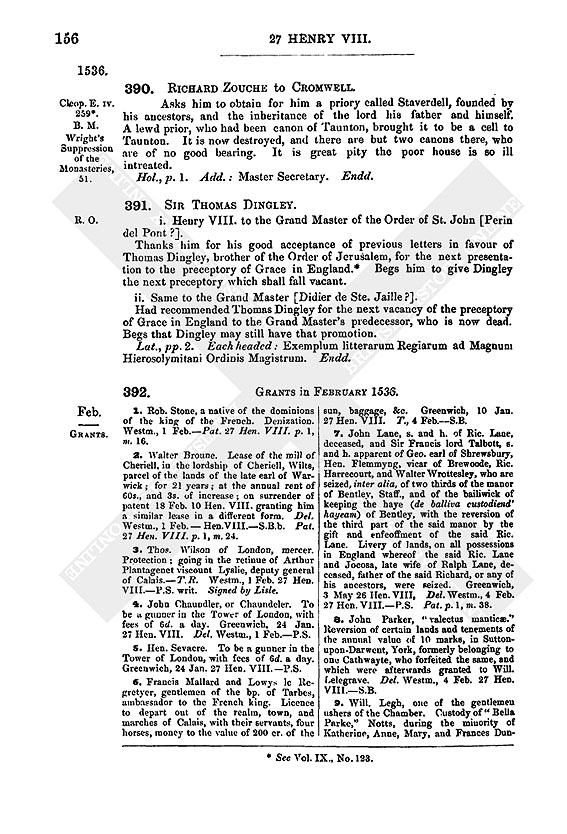
| Feb. Grants. |
392. Grants in February 1536. |
| 1. Rob. Stone, a native of the dominions of the king of the French. Denization. Westm., 1 Feb.—Pat. 27 Hen. VIII. p. 1, m. 16. | |
| 2. Walter Broune. Lease of the mill of Cheriell, in the lordship of Cheriell, Wilts, parcel of the lands of the late earl of Warwick; for 21 years; at the annual rent of 60s., and 3s. of increase; on surrender of patent 18 Feb. 10 Hen. VIII. granting him a similar lease in a different form. Del. Westm., 1 Feb. — Hen. VIII.—S.B.b. Pat. 27 Hen. VIII. p. 1, m. 24. | |
| 3. Thos. Wilson of London, mercer. Protection; going in the retinue of Arthur Plantagenet viscount Lyslie, deputy general of Calais.—T.R. Westm., 1 Feb. 27 Hen. VIII.—P.S. writ. Signed by Lisle. | |
| 4. John Chaundler, or Chaundeler. To be a gunner in the Tower of London, with fees of 6d. a day. Greenwich, 24 Jan. 27 Hen. VIII. Del. Westm., 1 Feb.—P.S. | |
| 5. Hen. Sevacre. To be a gunner in the Tower of London, with fees of 6d. a day. Greenwich, 24 Jan. 27 Hen. VIII.—P.S. | |
| 6. Francis Mallard and Lowys le Regretyer, gentlemen of the bp. of Tarbes, ambassador to the French king. Licence to depart out of the realm, town, and marches of Calais, with their servants, four horses, money to the value of 200 cr. of the sun, baggage, &c. Greenwich, 10 Jan. 27 Hen. VIII. T., 4 Feb.—S.B. | |
| 7. John Lane, s. and h. of Ric. Lane, deceased, and Sir Francis lord Talbott, s. and h. apparent of Geo. earl of Shrewsbury, Hen. Flemmyng, vicar of Brewoode, Ric. Harrecourt, and Walter Wrottesley, who are seized, inter alia, of two thirds of the manor of Bentley, Staff., and of the bailiwick of keeping the haye (de balliva custodiend' hayeam) of Bentley, with the reversion of the third part of the said manor by the gift and enfeoffment of the said Ric. Lane. Livery of lands, on all possessions in England whereof the said Ric. Lane and Jocosa, late wife of Ralph Lane, deceased, father of the said Richard, or any of his ancestors, were seized. Greenwich, 3 May 26 Hen. VIII, Del. Westm., 4 Feb. 27 Hen. VIII.—P.S. Pat. p. 1, m. 38. | |
| 8. John Parker, "valectus manticæ." Reversion of certain lands and tenements of the annual value of 10 marks, in Suttonupon-Darwent, York, formerly belonging to one Cathwayte, who forfeited the same, and which were afterwards granted to Will. Lelegrave. Del. Westm., 4 Feb. 27 Hen. VIII.—S.B. | |
| 9. Will. Legh, one of the gentlemen ushers of the Chamber. Custody of "Bella Parke," Notts, during the minority of Katherine, Anne, Mary, and Frances Dun ham, daughters and heirs of Sir John Dunham, deceased, with the herbage and pannage of the said park. Del. Westm., 4 Feb. 27 Hen. VIII.—S.B. Pat. p. 1, m. 28. | |
| 10. Brian Haselrigge of Halloughton, Leic. Pardon for the murder of Walter Haselrigge, elk., brother of the said Brian. Westm., 17 Feb. 27 Hen. VIII. Del. 5 Feb. "anno subscripto" (sic).—P.S. Pat. p. 2, m. 27. | |
| 11. John Norres, one of the gentlemen ushers of the Chamber. Grant, in reversion, of the office of comptroller of the works of Wyndesor castle, which was granted by Pat. 27 April 18 Hen. VIII. to Thos. Warde, the King's harbinger. Greenwich, 31 Jan. 27 Hen. VIII. Del. Westm., 5 Feb.—P.S. Pat. p. 1, m. 30. | |
| 12. Denizations:— | |
| Francis Van Skyn, tailor, a native of the Emperor's dominions. Westm., 6 Feb. | |
| Peter Cramys, tailor, a native as above. Westm., 6 Feb. | |
|
Arthur Andwarp, a native as above.
Westm., 6 Feb. Pat. 27 Hen. VIII. p. 1, m. 15. |
|
| 13. Sir Will. Poulet, the King's councillor. To be keeper and governor of Pamber forest, Hants, on surrender of Pat. 17 Oct. 25 Hen. VIII., granting the office to Rob. Lytle, groom of the Wardrobe of Beds, and in consideration that Sir Hugh Seynt John, lord Seynt John, whose heir the said Sir Will. Poulet is, was seized of the said office as of fee and inheritance. Greenwich, 26 Jan. 27 Hen. VIII. Del. Westm., 7 Feb.—P.S. Pat. p. 2, m. 14. | |
| 14. Thos. Welden, one of the clerks of the Kitchen. Licence to shoot with the crossbow at all marks and game in the manor of Creswell and the parish of Bray, Berks, "our forests, chases and parks, hernes and malardes, without our especial warrant only except." 20 Dec. 27 Hen. VIII. Del. Westm., 7 Feb.—P.S. Pat. p. 1, m. 31. | |
| 15. Thos. Danyell of Kylbreste in the parish of Tretire, Heref., labourer. Pardon for having, on the 13 April 4 Hen. VIII., assaulted and killed Rob. Moris at Kilbreste. Westm., 7 Feb.—Pat. 27 Hen. VIII. p. 2, m. 10. | |
| 16. Thos. Stradlyng. Annuity of 4l. 16s. 8d. out of the issues of the manor of Castelton, Glamorgan, lately belonging to Hugh Adams, deceased, during the minority of Anne Adams, daughter and heir of the said Hugh; with the wardship and marriage of the said Anne. Del. Westm., 7 Feb. 27 Hen. VIII.—S.B. Pat. p. 1, m. 28. | |
| 17. Sir Chr. Morys. To be master of the Ordnance; with fees of 2s. a day for himself, 6d. a day for a clerk, and 6d. a day for a yeoman under him. Del. Westm., 8 Feb. 27 Hen. VIII.—S.B. Pat. p. 1, m. 20. | |
| 18. Peter Mutton, yeoman usher of the Chamber. Lease of the herbage of the little park of Dynbygh alias "Castell parke," parcel of the earldom of March, N. Wales; for 21 years from Mich. 1539. on the expiration of a similar lease to Rob. Fraunces by pat 12 May 10 Hen. VIII.; at the annual rent of 6l. 3s. 4d., and 40d of increase. Del. Westm., 8 Feb. 27 Hen. VIII. —S.B.b. Pat. p. 1, m. 25. | |
| 19. Ric. Agmondesham, page of the Wardrobe of Robes. Reversion of the office of one of the walking foresters in Galtresse forest, Yorks., which was granted by pat. 24 Feb. 11 Hen. VIII. to John Wighell, one of the pages of the Chamber, on the death of Ric. Buckley, who late held the office, with fees of 4d. a day. Del. Westm., 8 Feb. 27 Hen. VIII.— S.B. Pat. p. 2, m. 8. | |
| 20. Baldwin Rooper or Roper, of London, mercer. Fiat for his protection; going in the retinue of Sir Arthur Plantagenet, K.G., viscount Lisle, deputy-general of Calais. Westm., 4 Feb. 27 Hen. VIII. Del. 9 Feb. —P.S. | |
| 21. Sir John Wallop. Next presentation to the parish church of Olderkyrke, Marches of Calais, Canterbury dioc., and the rectory thereof. Del. Westm., 10 Feb. 27 Hen. VIII.—S.B. Pat. p. 2, m. 14. | |
| 22. Thos. Thurresby. Licence to alienate a fourth part of the manor of Caxston alias Caxton, Camb., to Ambrose Jermyn and Anne his wife, one of the daughters and heirs of Geo. Hevenyngham and Margaret his wife, one of the daughters and heirs of John Burgoyn and one of the kinswomen and heirs of Ric. Burgoyn, deceased. Westm., 10 Feb.— Pat. 27 Hen. VIII. p. 1, m. 26. | |
| 23. John Christoferson of Brantham, Suff. Pardon for having on the 22nd Oct. last killed John le Sterlyng in self-defence, as appears by the record of Edm. Gosnolde, one of the coroners of Suffolk; the said John having surrendered to the Marshalsea prison as certified by Sir John Fitzjames, C. J. of King's Bench. Westm., 10 Feb.—Pat. 27 Hen. VIII. p. 1, m. 19. | |
| 24. Thos. Williams, yeoman of the Guard, and Owen ap Williams. Lease of several parcels of land; viz., 40 a. of land of the right of Gen. (?) Gough (de jure Gen. G.), in the vill of Moghdre, in the commote of Ughdulas, in the lordship of Denbigh, parcel of the earldom of March, N. Wales; 24 a. of land and 1 rood late of Denoved ap Jevan Goz there; 3 r. of land late of Ken' ap Jevan Goz, in the same vill; I water-mill in the vill of Talloyne, in the same commote, now in the tenure of the said Thos. Williams; and 24 a. of land late of Pridith Ybulche, in the vill of Bodricwynne in the commote of Istules, in the said lordship; 8 a. of the same land there; and 8 a. of the same land in the said vill, now in the tenure of the said Owen Williams; with reservations; for 21 years; at certain stated rents. Del. Westm., 10 Dec. 27 Hen. VIII.—S.B. b. Pat. p. 1, m. 26. | |
| 25. Tudor ap Robert Vaugham. Lease of 21 acres of land, ½ a. of land, 31 a. of land, and 31 a. of land, all late in the tenure of Thos. Billyng, in the vill of Beryng, in the commote of Issalett, in the lordship of Denbygh, parcels of the earldom of March, N. Wales; with reservations; for 21 years; at the annual rent of 13s. 8d., and 3s. of new increase. Del. Westm., 11 Feb. 27 Hen. VIII.—S.B. b. Pat. p. 1, m. 25. | |
| 26. Thos. Dokenton or Dockyngton, of London, salter. Protection; going in the retinue of Sir Arthur Plantagenet viscount Lisle, deputy general of Calais. T. 11 Feb. 27 Hen. VIII.— P.S. writ. (Signed by Lisle.) | |
| 27. John Grenehill. Lease of a watermill in Ridmerley Dabitott, late in the tenure of Rob. Wadley, parcel of the lands of the earl of Warwick, Worc.; for 21 years; at the annual rent of 30s., and 12d. of increase. Del. Westm., 12 Feb. 27 Hen. VIII. —S.B.b. Pat. p. 1, m. 21. | |
| 28. John Rogers. Livery of lands in England, Wales and Calais, as s. and h. of Sir John Rogers; and to Sir John FitzJames, C. J. of the King's Bench, Sir Francis Weston, Sir Will. Pawlett, Sir Will. Essex, Sir Will. Carewe, Sir Giles Strangwayes, Sir John Walshe, Sir Will. Uvedale, Mark Dyngley, Ric. Zowche, and Chr. More; and any other person seized to the use of the said John Rogers or Katherine his wife; or to the use of Margaret, now wife of Thos. Essex and late wife of Will. Rogers, elder brother of the said John; or to the use of the said Sir John Rogers, &c. Westm., 1 Feb. 27 Hen. VIII. Del. 12 Feb. — P.S. Pat. p. 1, ms. 36–7. | |
| 29. Lincolnshire.—Rob. Sutton, Vincent Grauntham, and Anth. Ireby. Commission to make inquisition on the lands and heir of Arthur Spanby. Westm., 12 Feb.— Pat. 27 Hen. VIII. p. 2, m. 18d. | |
| 30. Denizations:— | |
| James Hawkyns, a native of the Emperor's dominions. Westm., 13 Feb. | |
| Anthony Telleton, tailor. Westm., 13 Feb. —Pat. 27. Hen. VIII. p. 1, m. 15. | |
| 31. Thos. Layer, of Ovington, Essex, yeoman. Protection; going in the retinue of Sir Arthur Plantagenet viscount Lisle, deputy-general of Calais. T. 14 Feb. 27 Hen. VIII.—P.S. writ. (Signed by Lisle.) | |
| 32. Ric. Riche, the King's solicitor, and John Cooke. Grant, in survivorship, of the office of clerk of the recognizances taken before the chief justices of the Common Pleas and King's Bench, or, in their absence out of term, before the mayor of the Staple of Westminster, and the recorder of London, according to statute 23 Hen. VIII.; the said Richard and John to have 3s. 4d. for the writing and inrolment of every such recognizance, and 20d. for the certification of the same; on surrender of patent 26 March 23 Hen. VIII., granting the same to the said Richard alone. | |
| Vacated on personal surrender by the said Richard and John, 7 Dec. 2 Edw. VI. Del. Westm., 14 Feb. 27 Hen. VIII.—S.B. Pat. p. 1, m. 14. | |
| 33. Rob. Chawlner and John Lathom. Lease of the parcels of land following; 3½ a. 1 r. of land lying "in Acr' de Llewenny" in the commote of Issalett in the lordship of Denbigh, late in the tenure of Thos. Marsshe, 1½ a. 1 r. of land, and 3½ a. 6 p. 1 r. of land there in the tenure of the said Thomas, 12 a. 3 r. of land late in the tenure of Godfrey Fraunces there, 10 a. 1 r. of land in the tenure of Hen. Hetton and Thos. Mybott there, and 10 a. of land and 8½ a. 1 r. of land in the tenure of Rob. Mybott in Llewenney park in the said commote, and 2½ a. of land there in the tenure of Roger Matthew, 8 places of meadow late in the tenure of John Fletcher in the town of Denbigh, parcels of the earldom of March, N. Wales; with reservations; for 21 years; at certain stated rents. Del. Westm., 14 Feb. 27 Hen. VIII.— S.B.b. Pat. p. 1, m. 20. | |
| 34. Edm. Tame. Livery of lands as son and heir of Sir Edm. Tame, deceased. Greenwich, 3 Feb. 27 Hen. VIII. Del. Westm., 15 Feb.—P.S. Pat. p. 2, m. 21. | |
| 35. Inspeximus and confirmation to the sisters of the hospital of Kynwalgraves, near Bisshopesburton, of patent 20 June 1 Edw. III., inspecting and confirming a number of private grants not recited verbatim, and other patents of Edward III., &c. — Westm., 16 Feb. — Pat. 27 Hen. VIII. p. 1, m. 17. | |
| 36. Rob. Delman, gunner. To be a gunner in the Tower of London, vice Laurence Cleyton, deceased; with fees of 6d. a day. Del. Westm., 16 Feb. 27 Hen. VIII.—S.B. | |
| 37. John Pakyngton. Grant of one messuage in the city of Worcester, and two messuages, 100 a. of land, 10 a. of meadow, and 40 a. of pasture in Over Mytton, Kedermynster, and Oldyngton, Worc., which lately belonged to John Hale, of Istelworth, Middx., clk., attainted of high treason. Windsor Castle, 15 Nov. 27 Hen. VIII. Del. Westm., 16 Feb.—P.S.—Pat. p. 2, m. 2. | |
| 38. Ric. Cecyll, a groom of the Wardrobe. Reversion of the office of bailiff of Wittelesmere and keeper of the swans therein, and in all meres, creeks, &c. in cos. Huntingdon, Cambridge, Lincoln, and Northampton; which office was granted by pat. 23 June 3 Hen. VIII. to David Cecyll, serjeant-atarms, for 30 years. Greenwich, 15 Feb. 27 Hen. VIII. Del. Westm., 18 Feb.—P.S. | |
| 39. Thos. Williams, yeoman of the Guard. Lease of escheated lands, called Guys Rees, in Trovarth, in the commote of Istulas, late in the tenure of Marion daughter of Griffith ap David ap Hoell ap Griffith ap Rees ap David ap Grono, in the lordship of Denbigh, parcel of the earldom of March, N. Wales; with reservations; for 21 years; at the annual rent of 13½d., and 3s. 6½d. anew approved. Del. Westm., 18 Feb. 27 Hen. VIII.—S.B.b. Pat. p. 1, m. 20. | |
| 40. Sir John Horsey. Anth. Harvy, and Rob. Chudlegh. Licence to enfeoff Hen. marquis of Exeter of 1 messuage, 1 mill, 400 a. of land, 10 a. of meadow, 400 a. of pasture, 120 a. of wood, and 400 a. of furze and heath in Norton Dawney, Puddesworthy, and Townstall, and free fishery in the water of Puddesworthy, Devon, to hold to the said Marquis and his heirs; and to the said Marquis, on receiving possession thereof, to alienate the same to Jasper Horsey and the heirs male of his body. Westm., 19 Feb. —Pat. 27 Hen. VIII. p. 1, m. 26. | |
| 41. St. Paul's cathedral, London. Grant, in frank almoigne, to the dean and chapter (in recompense of an annual pension of 10 marks, formerly paid to them by the monastery of Lesnes, Rochester dioc., in consideration of the appropriation to them by Stephen, formerly bp. of London, of the parish church of Alvetheley, London dioc., which church on the dissolution of the said monastery was appropriated to Cardinal's College, Oxford, and came into the King's hands by the attainder of card. Wolsey) to have the said church of Alvetheley, with the rectory, tithes, &c. thereof. Greenwich, 8 Feb. 27 Hen. VIII. Del. Westm., 20 Feb. —P.S. Pat. p. 2, m. 29. | |
| 42. Sir Francis Brian, one of the gentlemen of the Privy Chamber. Licence to import 100 tuns of Gascon wine. Greenwich, 10 Feb. 27 Hen. VIII. Del. Westm., 20 Feb.—P.S. | |
| 43. Francis Hibberd, a born subject of the king of the French. Denization. Westm., 20 Feb.—Pat. 27 Hen. VIII. p. 1, m. 15. | |
| 44. Francis Metekalf. Lease of a tenement in Woodhall, late in the tenure of Geo. Metekalf, in the lordship of Middelham, York, parcel of the lands assigned by Parliament for the pay of the garrison of Berwick; with reservations; for 21 years; at the annual rent of 4l. 14s., and 3s. of increase. Del. Westm., 21 Feb. 27 Hen. VIII. —S.B. b. Pat. p. 1, m. 4. | |
| 45. Bishopric of St. Asaph. Assent to the election of Will. Barlowe, prior of the Augustinian priory of Bisham, Salisbury dioc., as bishop of St. Asaph's, vice Hen. Standisshe, deceased. Greenwich, 21 Feb. 27 Hen. VIII. Del. Westm., 22 Feb.—P.S. Pat. p. 2, m. 20. Rym. xiv. 559. | |
| 46. Ric. Reyner, of Long Stanton, Camb., smith. Pardon for having, along with Edm. Hawkyns, Ric. Heron, John Scoley alias Colynson, and Thos. Wilson, on the 15 Oct. 25 Hen. VIII. broken into the house of Alice Conyers, widow, at Stanton aforesaid, and beaten and bound the said Alice, and robbed her of some money and a piece of black velvet. Del. Westm., 23 Feb. 27 Hen. VIII.—S.B. Pat. p. 1, m. 11. | |
| 47. Will. Fyneux. Livery of lands as son and heir of Sir John Fyneux, deceased, C. J. of the King's Bench; with a reservation as to 30 acres of land, 8 acres of meadow, and 200 acres of pasture in Kyngeston and Wynterborne, Dorset, whereof the said Sir John died seized. Westm., 17 Jan. 27 Hen. VIII. Del. 23 Feb.—P.S. Pat. p. 1, m. 34. | |
| 48. Cos. of Glamorgan and Morgannok, earldom of Bedford.—Commission of Peace and of Oyer and Terminer to Hen. earl of Worcester, Llyson abbot of Nethe, Lewis abbot of Morgo, Sir Thos. Gamage, Sir Rees (Resius) Mauncell, Walter Herbert, Geo. Herbert, Geo. Mathewe, Thos. Stradlinge, Arnall Butler, Miles Mathewe, Edw. Lewes, Hoell Crane, Edm. Turnor, Rob. ap Will. Mathewe, John Broune, Thos. Atkins, Lewis Bethen, and John Bassett. T. Westm., 24 Feb. 27 Hen. VIII.—S.B.b. Pat. p. 2, m. 26 d. | |
| 49. John Aston, clk. Presentation to the church of Normanton, London dioc., vice Miles Hudelston, clk., resigned. Addressed to R. bp. of Coventry and Lichfield. Westm., 24 Feb.—Pat. 27 Hen. VIII. p. 2, m. 3. | |
| 50. John Brereton, clk. Presentation to the parish church of Astbury, co. Chester, Cov. and Lich. dioc., void by death, and at the King's disposal hac vice by reason of a grant thereof made by Will. Brereton. Del. Westm., 24 Feb. 27 Hen. VIII.—S.B. Pat. p. 2, m. 11. | |
| 51. Edm. Harman, the King's barber and one of the Privy Chamber. To be bailiff of Hovington, and to have the keeping of the manor-place and the farm thereto belonging, with fees of 5l. a year; during the minority of [blank] Berkley, lord Berkley, son and heir of the late lord Berkley, deceased; with all profits belonging to the said bailiwick, as enjoyed by Ric. Herwood, late bailiff. Westm., 24 Feb. 27 Hen. VIII. T. 26 Feb. —P.S. Pat. 27 Hen. VIII. p. 1, m. 14. | |
| 52. John Lyster of London, yeoman. Pardon for having robbed John Grove of 2s. 6d. in Westminster Hall. Del. Westm., 27 Feb. 27 Hen. VIII.—S.B. Pat. p. 1, m. 6. | |
| 53. Rob. Chawlner and John Lathom. Lease of 30 acres 1 rood and 10 perches of land in Acre of Llewenny, in the commote of Issalett, in the lordship of Denbith, late of Will. Llannergh, in the tenure of Henry ap. John Morice, parcel of the earldom of March, N. Wales; with reservations; for 21 years; at the annual rent of 11s. 2d., and 3s. 10d. of increase. Del. Westm., 27 Feb. 27 Hen. VIII—S.B.b. Pat. p. 1, m. 4. | |
| [1 March.] R. O. |
393. John Vaughan to Cromwell. |
|
There is a house of Black Friars, called the priory of Monmouth, in
Wales, and not in my commission. There is no pot, nor pan, nor bed, nor
monk in the said house, except one who boards in the town. The prior is in
sanctuary in Garwey. It is of the King's foundation, and the country marvels there is no reformation, as it can spend 60l. a year, all charges borne.
I intend to suppress the said house, for it is the voice of the country that
whilst you have monks there, you shall have neither good rule nor good order.
I hear by the common people that the houses of monks in Wales, also Tintern
and the priory of Breknoc, are greatly abused, and have transgressed the
King's injunctions. I beg your favour to the bearer, who is an ancient
gentleman, and gave me "grett schere." Breknoc, Ash Wednesday. Hol., p. 1. Add.: Secretary. Endd. |
|
| 1 March R. O. |
394. Cuthbert Marshall to Cromwell. |
|
I thank you for your letters delivered to me by Witham, assuring me
of your favour in my just cause. My archdeaconry of Nottingham was
assessed in York, and at Nottingham. The commissioners of the latter
ordered my official to bring in the valuation of the same. Thus I am twice
assessed, and will have to pay unless through your help. Whitbarn, 1 March. I send you a poor remembrance. Signed. P. 1. Add.: Master Secretary. Endd. |
|
| 1 March. R. O. |
395. Lord Edmund Howard and Thomas Fouler to Cromwell. |
|
On Friday, 24th Feb., (fn. 12) the Chamberwarde wall in Guysnes castle
fell into the moat: to-day a scaffolding is erected, and the "vawmewre,"
which is unsafe, is to be taken down. Some of the wall of Calais, between
the Watergate and Lanterne gate, has fallen, and the old walls both of
Calais and Guysnes are in great danger by reason of the last frost. The
King has new bricks, and earth seasoned for making bricks, both at Calais
and Guysnes. Calais, 1 March. Signed. Pp. 2. Add.: Secretary. Endd. |
|
| 1 March. R. O. |
396. Ordnance at Calais. |
| Account of ordnance received and delivered by Rob. and John Owyn. Receipts from Master Bentall, out of the charge of Sir Wm. Skevyngton, by command of Master Hary Johnson, three curtalls weighing in all 21,598 lb. From John Colverhowse, constable of Ryse Banke, a "a dobyll" colverin and a "basterd" colverin, 11,696 lb. From Randall, constable of the castle of the East Calais, a sacar 1,710 lbs. From lord Gray, captain of Hams castle, a colverin and a sacar, 7,944 lbs. Total weight, 42,924 lb. | |
| ii. Delivered to Hary Johnson, master gunner, 21 pieces of ordynance, 37,809 lb. Metal remaining, waste allowed for, 534 lb., as shown by a bill indented of Master Hary's hand, dated 1 March 27 Hen. VIII. | |
| Due to the said Rob. and John: for breaking 42,000 lb. of metal, at 14s. per 1000 lb., 30l. 8s. sterling; for breaking 3,400 lb. of metal, being part of a bombard received from the Tower of London, at 14s. per 1000 lb., 47s. 6d. | |
|
Sum for breaking of old guns, 32l. 8s. 2d. Pp. 3. Endd.: "The gonners, 2." |
|