
Letters and Papers, Foreign and Domestic, Henry VIII, Volume 11, July-December 1536. Originally published by Her Majesty's Stationery Office, London, 1888.
This free content was digitised by double rekeying. All rights reserved.
'Henry VIII: July 1536, 1-5', in Letters and Papers, Foreign and Domestic, Henry VIII, Volume 11, July-December 1536, (London, 1888) pp. 2-19. British History Online https://www.british-history.ac.uk/letters-papers-hen8/vol11/pp2-19 [accessed 19 April 2024]
Image
Image
Image
Image
Image

Image

Image
Image
Image

Image
Image
Image
Image
Image

Image

Image

Image

Image

July 1536, 1-5
| 1 July. Otho, C. x. 267. B. M. Hearne's Sylloge, 129. |
6. Princess Mary to [Cromwell]. |
|---|---|
|
Cannot express the great joy and comfort she has received, both by
his letters and by the report of her servant, the bearer, of the King her
father's goodness; which she doubts not she has obtained the better by his
continual suit. Is bound to pray for him during her life. Has made no bill
for her apparel. The King's favor is so good clothing to her, she desires no
more; and so she has written to his Grace. Thanks him for the horse he
sent by bearer, which is a great pleasure, for she had never a one to ride on
sometimes for her health. Hownsdon, 1 July. Hol., Mutilated, Begins: My Lord. |
|
| 1 July. Vienna Archives. |
7. Chapuys to Charles V. |
| Since the departure of my man I have several times solicited that it might please the King to decide upon treating with your Majesty for the mutual intelligence so often discussed, and to declare to me the conditions, as he lately promised, without waiting further answer from France, as he might be sure the French would never agree to reasonable terms. Cromwell has twice said to me in reply that the King was anxious to bring your Majesty and the French king into amity, and that until he received an answer to the message sent by the bailiff of Troyes, he would take no further step; but I might be sure that on the French refusing to do their part the King would do his duty towards your Majesty. Cromwell also told me, the last time I spoke to him, that the King had that day received letters from his ambassadors in France, stating that the French king had made to them great complaints of your Majesty, and intimating that the French had gained a victory over the Imperialists. Cromwell said the King laughed at these news as French brag, and that he was quite devoted to the Emperor's interests, waiting an opportunity to declare himself with honour; but your Majesty must take care to make a firm and sincere amity, not for one year or two, but for ever. This I affirmed was your real intention, and I made him confess that you were not to blame, as the King pretended, for breach of promise for not continuing the war against Francis after his capture. | |
| Cromwell then said, en passant, and half in mockery, that the French were seeking to have the Princess in marriage. He said no more, but I have since learned that a principal servant of the French ambassador told some one a marriage was treated of between the Princess and the duke of Angoulême, who would come and reside here; and that the French expected by this means to get the King to declare himself on their side, or at least to be a mediator to settle everything. Will endeavour to find out something about this in conversation with Cromwell. | |
| Yesterday, St. John's Day, I received your letters of the 8th June, with the documents therein mentioned; which arrived most opportunely, for to-day the French ambassador and I were in Court to discuss matters, and Cromwell had sent to tell me yesterday that we should be called for that purpose, and that I must not take the slightest suspicion from anything said or done, but use the most moderate language with the said ambassador, and afterwards leave matters to him, for he would conduct them to Your Majesty's satisfaction. This he repeated to me this morning. Soon after the said ambassador and I had arrived in Court, as it was not intended that the King should go out to mass, or that we should speak to him, we were asked to dine, and suddenly after dinner, Cromwell in presence of the Council, viz., the dukes of Norfolk and Suffolk, the marquis of Exeter, the earls of Auffourt (Oxford) and Succes (Sussex) and others, stated that his master had been urged by his ally the Most Christian king, by virtue of the leagues between them, to assist him against your Majesty, who, in violation of treaties, had made war upon him, and that his master, being a prince of virtue and honor, desirous to do right and keep promises, and having also treaties with your Majesty, had called the said ambassador and myself to learn what he should do; and addressing the said ambassador, said that as it was he who made this claim, it was for him to speak first and make his complaints. On this the ambassador said the King, his master, never imagined that this matter would come into discussion, and therefore had given him no instructions to dispute about it, and that he thought he had given full information of every thing to the King; but since Cromwell desired it, he would repeat everything there. He then entered into the matter at great length, first speaking of the great endeavours of Francis, and his willingness to accept unreasonable conditions to obtain the patrimony of his children, viz., Milan, which he could not have alienated by certain laws which he alleged very mal à propos; moreover, that Milan could not be declared lawfully alienated, seeing that the treaty of Madrid had been made by his master to be delivered from most severe imprisonment, and that of Cambray had been made for the redemption of the children, which by law implies as great intimidation as if the father himself had been detained in prison, and that the money ransom alone was excessive, apart from the surrender of so many titles and lordships; and that nevertheless his master had observed the treaties in everything, which only showed that he did not pursue his own quarrel against others as he might have done against the duke of Savoy without violating the treaties; for although the said Duke was comprehended in them, he was not named as a principal contrahent, but only as accessory, and the accessory could not weaken the principal; and that the King, his master, might ignore the fact of the Duke being a vassal of the Empire instead of demanding redress from him of your Majesty, as you pretend; and, moreover, even if the King his master had certainly known the said Duke to be your vassal, yet, having seen the little regard for justice you had shown in the case of Merveilles, he had no occasion to demand of your Majesty justice from the said Duke; and further, the house of France was not accustomed to demand justice, but to enforce it; and it was needless to quote the civil law against this, for his master was not subject thereto; also, that it was not his master who had begun the war, but the duke of Savoy, by denying restitution of what belonged to his master, citing as to this a rule of common law which says qui causam dat damni damnum fecisse videtur. | |
| He said you had, without regard to treaties or relationship and without defiance, invaded his master's subjects, besieged Fossan, and, which he made a case of great importance, summoned the marquis of Saluces to acknowledge the Empire, though he was notoriously subject to the French king; in proof of which the marquis' elder brother had been all his life in the service of the King his master, and your Majesty had never complained nor had you made any provision for him, and no mention had been made of Saluces in the treaties. The ambassador also complained of a ship lately taken by Spaniards at Aigues Mortes, and of some incursions by your subjects on the frontiers of Picardy; moreover that you boasted you would invade Provence and pass further; and that this King ought to consider that this pretension to invade France could only arise from the desire of monarchy, which you hoped to obtain partly by force and partly by dissimulation and cunning, like other monarchs, and it must be supposed that as the said monarchy had such a beginning it would be dissolved by the same means, and things would return in the end to their natural liberty. In this he scarcely spoke in favor of other princes; and although the said ambassador denounced the usurpation of the ancient Romans, "repeter le sien par force sans autres ceremonie que denvoyer un roy d'armes pour indire la guerre." He concluded by declaring his master was attacked (estoit a tourd agaresse?) by the Emperor, and that the King was bound to assist him in his lawful defence. | |
| On my being asked to speak, I said that it should be considered, even if I did not say so, that since the said ambassador, who was the claimant, and ought to have come instructed of his rights, had no charge to enter into the discussion of such matters, still less should I have any such charge, and that I thought the case was so notorious, even to the King and his Council, that they could not disguise or palliate it; and that I was very sorry that the French had not sooner addressed this King, so as to come to peace before things had gone so far; at least, before attacking the duke of Savoy they might have asked the King's advice, which I was sure would have been quite contrary to what they have done. But since the King and the company wished me to reply, I would obey willingly, protesting in the first place that I spoke without instructions, and like a private person, "et que m'en deporteroye le plus legierement que me seroit possible, reservant de les informer du tout au vray et si amplement quilz demoureroient satisfaictz du tout entierement apres quen avroye parle a ced. roy." I then spoke of the efforts made by your Majesty for peace, as shown by the offers made in the consistory and before that, at which all the world was astonished that you would give such an estate (Milan), worth as much as any kingdom, "de droit denier," which was the bulwark of the kingdom of Naples, and the state, of all the world, most profitable to your Majesty,— observing that the said offer arose from pure liberality, and that the king of France could not rightly put in any claim, even if the treaty of Madrid were invalid, as Cromwell had seen by the book I had shown him some time ago, to which no answer had been made on the side of France, the case was so clear; and as to the treaties of Madrid and Cambray, what the ambassador said could not render them invalid for several reasons that I alleged, especially as the French king had always ratified them, who said, even lately, to Nassau, when he passed through France, that he would observe them; nevertheless, he has only observed them in words, especially the articles mentioned in the reply of your Majesty, which I specified myself, without stating that I had been instructed by you. | |
| To these articles the ambassador made no reply, except touching the heirs of the late duke of Bourbon. He said that the goods of the said Duke had been justly confiscated, and thereupon he inveighed against the said Duke's infamy. As to the rest of the articles he tried to escape by what your Majesty had declared to the ambassadors of the King his master on the third day of Easter, that your Majesty did not intend, by the words you had used in Consistory the day before, to defy the King his master, nor that war should be begun (ouverte), meaning to insinuate by a letter of his master, which he showed, that your Majesty acknowledged that there had been no cause of rupture before the said third day of Easter. I said that, as the words he used were obscure, the interpretation, according to law, ought to be that of him who had used them, although there was no doubt that by the said words your Majesty had declared openly that you would not make war or duel in case the offer of the duchy of Milan for the third son of France was accepted, and reparation was made to the duke of Savoy; and this expression, "rompre la guerre en Italie," could only signify proclaim it, and it was impossible to infer from it that your Majesty was satisfied with the said articles. And if he meant to say that, according to the lawyers, injuries are remitted by dissimulation, "et que vre. Mate appelloit toutes les contraventions mencionnez au propoz que vre. Mate tint au Consistoire," I replied that the saying of the lawyers applied to verbal injuries or slanders, et non prosecutive rei familiaris, and it might be said that your Majesty did not intend to break war (rompre la guerre), for the French had already broken it. | |
| I must not omit to mention that in alleging the treaties of the French king with Gueldres, I called Cromwell to witness that he had seen them, which he did not deny. As to the allegation of the said ambassador that the duke of Savoy was the aggressor, I said it was like the wolf in Æsop accusing the lamb, and I wondered at his argument from civil law in one point, when in others he repudiated civil law, as it was well known, as one of our doctors recited, that the French accepted the civil law, not as founded on right and equity, and even if there were no question of that law, it would not be found by any other that a party could be judge on his own side, except in certain cases which I alleged. Reports further his arguments touching Savoy and Nice, showing that France had no right to them, and his reply to the ambassador about the marquis of Saluces, the siege of Fossan, the ship taken, and other accidents of war, which he showed to have been since the aggression on the duke of Savoy. Said he had heard nothing of the rumour about the invasion of Provence; but, if it were true, the Emperor would only be invading his own property, and even if it were not his he had a right to molest France on all sides. Speaking for himself as a lawyer, Chapuys said that Francis having broken the treaties, the Emperor was not bound to him any way. Thinks that the most part of the company applauded this sentiment, especially the Chancellor and Cromwell. As to the monarchy, he said the Emperor had clearly disarmed suspicion in everyone, except those who hankered after it themselves, and this not by words but by deeds. He had restored the kingdom of Tunis to the expelled King, refused the dukedom of Florence and Monego, frequently given away the duchy of Milan, and allowed Genoa to be erected into a republic, and after so much war and trouble had not increased his territory by a foot of earth. The ambassador said the Emperor had acted with great subtlety, giving away Milan and Florence to those who served him at need and gave pensions, so that it was just as if you had kept the duchies. I replied that I was surprised that they who aimed at this monarchy had not used equal subtlety, and retained the king of England as vassal in the duchies of Guienne and Normandy; at which everybody laughed, much to the ambassador's disgust. After these discussions, in which there was not an unpleasant word, but all was done as if for pastime, the Chancellor and two or three of the company said to the French ambassador that whatever might be said about the other articles in which I had said the French king had infringed the treaties, he had shown no justification of the invasion of Savoy, and the duke of Norfolk told him that he would do well to put his case in writing, "et que je y refusa ce faire," of which I was very glad. After this I said that since I had been called as it were to judgment, it was lawful to me to make use of reconvencion (revival of suit), and I begged the King according to the old treaties between him and your Majesty to assist you with men and money. Cromwell then said the King his master wished to do his duty to both parties as he was bound; and thereupon went alone to the King, and having remained some time returned and told us that the King having heard the report of our discussions would take good advice upon the whole and call us again within two days. As it was now supper time I had no opportunity of showing this King your Majesty's letters upon the answer made to the king of France. | |
| The two days being passed during which we were to be called, I continually pressed to have audience either of the King or Council, or of Cromwell alone, to show the said letters of your Majesty and to urge that the King should declare himself according to the treaties since the French ambassador had opened the door; but till this day, 1 July, Cromwell has put me off with gracious excuses, begging me two or three times not to be at the trouble to go thither, but to send him the copy of the said letters; which, when I declined to do for certain reasons, he sent to me today to say that tomorrow he would speak to the King his master for my audience, and that he begged, as the King might suspect something from the negociations having cooled for the establishment of amity, about which nothing has been done for some time, that I would tell him what it was, that he might answer about it. This he asked, as he said, of his own accord, but I think it was by the King's command. I sent to say that your Majesty's goodwill had nowise cooled, indeed, was warmer than ever, and that I had declared it several times to the King, and that till the King made some answer, you could add nothing to what you had written to me, as it appeared by your last letters and that I expected my man within a few days, by whom I would write to your Majesty the conditions required by the King for the renewal of the treaties, and that as soon as he came I would inform the King. I think those here were very glad that I irrefragably confuted the demand of the French, whom they want to bring into perplexity in order to bring them over to their opinion against the Pope, and they keep deferring my audience till they have news from France, and also to win time in order that according to the progress of affairs they may play at "boules de veue." Cromwell, who used continually to say that it was necessary to punish the French, now speaks only about peace. | |
| When the Princess, having written several good letters to the King her father, and to this Queen, expected to be out of trouble, trusting to the hope held out to her, she found herself in the most extreme perplexity and danger she had ever been in, and not only herself, but all her principal friends. The King, seven or eight days after the departure of the man whom I sent to your Majesty, took a fancy to insist that the Princess should consent to his statutes, or he would proceed by rigour of law against her, and, to induce her to yield, sent to her the duke of Norfolk, the earl of Sussex, the bishop of Chester, (fn. 1) and certain others, whom she confounded by her wise and prudent answers, till they, seeing that they could not conquer her in argument, told her that since she was so unnatural as to oppose the King's will so obstinately, that they could scarcely believe she was his bastard, and if she was their daughter, they would beat her and knock her head so violently against the wall that they would make it as soft as baked apples, and that she was a traitress and should be punished, and several other words. And her gouvernante was commanded not to allow any one to speak to her, and that she and another should never lose sight of her day or night. Nevertheless the said Princess found means to send me immediate information of everything, begging me not to leave her without counsel in her extreme necessity. On this I wrote to her very fully, telling her, among other things, that she must make up her mind if the King persisted in his obstinacy, or she found evidence that her life was in danger, either by maltreatment or otherwise, to consent to her father's wish, assuring her that such was your advice, and that, to save her life, on which depended the peace of the realm and the redress of the great disorders which prevail here, she must do everything and dissemble for some time, especially as the protestations made and the cruel violence shown her preserved her rights inviolate and likewise her conscience, seeing that nothing was required expressly against God or the articles of the Faith, and God regarded more the intention than the act; and that now she had more occasion to do thus than during the life of the Concubine, as it was proposed to deprive the Bastard and make her heiress, and I felt assured that if she came to court she would by her wisdom set her father again in the right road, to which the intercession of your Majesty through the reconciliation and establishment of amity would conduce. | |
| The King, on hearing the report of the above Commissioners, and the prudent answer of the Princess, grew desperate with anger, which was for two reasons: first, for the refusal of the said Princess; and second, because he suspected that several of her attendants had advised her so to do. He accordingly made the most strict inquiries, and the Chancellor and Cromwell visited certain ladies at their houses, who, with others, were called before the Council and compelled to swear to the statutes; one of them, the wife of her chamberlain, (fn. 2) a lady of a great house, and one of the most virtuous in England, was taken to the Tower, where she is at present. The chief servant of the Princess, who knows all her secrets, was kept two days in Cromwell's house; and during six or seven days they were in council at Court from morning to evening, which was the reason I could not have audience during that time either of the King or Cromwell as I greatly wished. | |
| As I suspected even then, it was not opportune because the King was too angry, and Cromwell, for having communicated with me upon the affairs of the Princess, and showing himself rather favourable, was not free from suspicion, or without danger of being put to death, and, as he has since told me, he remained four or five days considering himself a lost man and dead. At the same time the Marquis (fn. 3) and the Treasurer (fn. 4) as suspected persons were excluded from the Council, and the matter proceeded so far that, in spite of the prayers of this Queen, which he rudely repulsed, the King called the judges to proceed according to law to the inquest and first sentence which is given in the absence of the parties. I have been informed from more than one source that the King had sworn, in a great passion, that not only the Princess should suffer, but also the Marquis, Cromwell, and several others. Now I hear that the judges, in spite of threats, refused to decide, and advised that a writing should be sent to the Princess, and that if she refused to sign it, they should proceed against her. The Princess, being informed from various quarters how matters stood, signed the document without reading it. For her better excuse I had previously sent her the form of the protestation she must make apart. I had also warned her that she must in the first place endeavour to secure the King's pardon (grace), and, if possible, not give her approval to the said statutes except so far as she could do so agreeably to God and her conscience, or that she should promise only not to infringe the said statutes without expressing approval. I have not yet ascertained how the thing has passed, but in any case she never made a better day's work, for if she had let this opportunity slip there was no remedy in the world for her. As soon as news arrived of her subscription, incredible joy was shown in all the Court except by the Earl of Essex, who told the King that was a game that would cost him his head, for the injurious language he had used against the Princess. Innumerable persons sent to me to congratulate me on the reconciliation of the King and the Princess. After the Princess had signed the document she was much dejected, but I immediately relieved her of every doubt, even of conscience, assuring her that the Pope would not only not impute to her any blame, but would hold it rightly done. | |
| Since the Princess subscribed the said document, the King sent back the above Commissioners with others, among whom was Master Cromwell, who was charged by the King to carry to her a most gracious letter, and also, according to the custom of the country, another with the paternal blessing. And they all offered her the highest possible honour, addressing her almost continually kneeling upon the ground, especially asking her pardon for their previous conduct. The Princess remains very happy, especially on account of the goodwill that Cromwell bears her in the promotion of her affairs. She is only anxious as to how your Majesty will be satisfied with what she has done. And now that she has done it on my assurance that it was the will of your Majesty, yet it would be a marvellous consolation to her to know it by letters from you. She has also desired me to write to your Majesty's ambassador at Rome to procure a secret absolution from the Pope, otherwise her conscience could not be at perfect ease. I have congratulated Cromwell, expressing great satisfaction at what the Princess had done, for several reasons, especially that he and other of her friends had been extricated from the danger they were in. I even sent to him several times, when matters were so desperate, to advise the Princess to consent to the King's will, and I have since fully assured him that he should know before two months were over that there was no man in the world who had done better service in this matter than I. This I thought good to say for the advancement of the negociations for the amity. | |
|
The French ambassador received letters the day before yesterday, and
was yesterday with Cromwell, and this morning at Court, where I am told
he has been for some time. To-morrow he and I are to be there again on
the same matter as before. I have just heard this morning that several
French ships, seeking to injure the subjects of your Majesty "si tiennent
ung part du temps a la couste et aux autres de votre mate," and also that
the French who make incursions into your countries take refuge at Calais,
and sell their booty there. I will speak to the King to-morrow, awaiting
instructions from you what to request in case the King remain neutral. I
spoke of it already the other day to Cromwell, who said the King himself
had spoken of it to the ambassador of France, who said that the ships which
were near Dover had gone thither only to secure the passage of the Bailly
of Troyes in case he wished to depart; but the contrary is very evident.
London, 1 July 1536. Fr., a modern copy, pp. 19. |
|
| 1 July. Vienna Archives. |
8. Chapuys to Granvelle. |
| The dispute between the French ambassador and myself, of which I write to his Majesty, was so long and so confused that when I came back from Court I was half bewildered, and in that state began immediately to write, and went on till next day. This has been the cause of the confusion of my letters, especially in the article about the duke of Savoy in the discussion about rights, on which I would not have entered but that the company desired to hear everything; and though I forgot it in the letters of his Majesty I did not omit to say that if the king of France claimed a share in Savoy on account of his mother, he must give it in France on account of Madame Yolande, formerly married in Savoy, an elder daughter of the House of France ("que si le roy de France vouloit partaige en Savoye a cause de sa mere, quil failloit quil le donnast en France a cause de Madame Yolant jadis mariee en Savoye que fut aysme fille de la maison de France"). And moreover I showed some right that the duke of Savoy might claim to the succession of the last duke of Berri, and this to aggravate further the injustice of the French, seeing that the bystanders were pleased with it, especially Cromwell, who applauded all I said, and to give more effect to it repeated it all in English, adding always something of his own, which he did without suspicion, because the said ambassador did not understand the language, and all the more because the duke of Norfolk, who is partial to the French, slept most part of the time. Cromwell in the end told him that the substance of our conversation was that the French ambassador alleged two or three points by which they pretended that the breach of treaties had come from his Majesty, and that besides having sufficiently replied to them I had propounded more than 12 articles, in which the French King had broken the said treaties, to which the said ambassador had made no reply, saying he would only speak about what had happened since the 3rd day of Easter. Thus you may see that those here have no desire to assist the French. I know not what they will do with regard to his Majesty; hitherto I have only been able to obtain general words, and I think they will not hasten to declare them selves till they see the probable issue of events in order, as I write to his Majesty "pour jouer a bouleveue"; for which reason they delay giving me audience. | |
|
What I last wrote to his Majesty about the marriage of the King of
Scots was upon the authority of this King's ambassador who had just
returned from Scotland; and it seemed very probable, seeing that the
marriage with the Lady of Vendôme was considered to be broken off, and
at the same time the king of Scots had withdrawn his mistress from her
husband and was trying hard to get a divorce; but from what I have since
learned it is not the case, and they were talking of the former match.
The coronation of this Queen has been delayed till after Michaelmas.
Suspicious persons think it is to see if she shall be with child; and, if not,
and there is danger of her being barren, occasion may be found to take
another. I am told on good authority that this King will not have the
prize of those who do not repent in marriage; for within eight days after
publication of his marriage, having twice met two beautiful young ladies,
he said and showed himself somewhat sorry that he had not seen them
before he was married. My not writing since the departure of my man
has been owing to want of messengers and waiting for some answer on
current affairs. London, 1 July 1536. Fr., a modern copy, pp. 2. |
|
| 1 July. Vienna Archives. |
9. Chapuys to Antoine Perrenot. |
| The substance of the great bible which I write to his Majesty is that the French pretend that there is no ground for speaking of the violation of treaties except after the third day of Easter, which they justify by what his Majesty then said, that he did not understand war to be opened by the words reported in Consistory, and that since that time his Majesty had been the aggressor. This they wished to signify to the English to gain their assistance, but I have shown the contrary in such wise that I think they will not obtain their request. The other chief article is touching the Princess, who if she had not consented to the will of her father, when she was last required, would have been dead, and a great company with her. I write to His Majesty that they were talking of giving her the title of York, which is that of the second son of England, but some one has just informed me that she will have that of duchess of Bedford, which is commonly given to the third. But I think it is all one which title they give her, because she must succeed in default of lawful children, which, it is said, will not come. Of late the King was desperately enraged against the Princess, and was going to maltreat her. One of the principal persons of the chamber summoned, for three or four nights, five of my men who play upon instruments to give the King morning music (aubade) to soften and amuse his fancy. My men went in a barge below the windows of the King's chamber, who was much pleased. I think the King was emboldened thus to treat the Princess seeing how the Emperor was occupied, and on the other hand considering that if he did not make her his heir he would have no peace with his people; but that it would be a terrible mortification to him to make one his heir who held in favour of the Pope, whom he regards as his greatest enemy, seeing that after his death she would revoke all his statutes, which she alone in all the realm opposed. | |
|
I am sorry for the trouble you will have in the deciphering of my very
prolix letter, but I hope you will cut down the superfluity, especially in the
article of the duke of Savoy and the monarchy, and do as you did with my
letters mentioned in yours of the 9th ult. I have only given you this summary not to keep you in suspense till you have deciphered the whole. I
cannot express half of what I have done, or of the strange language used at
Court. This affair of the Princess has tormented her more than you think,
both for the fear of her person, and for the danger of interrupting our
negociations for amity, in which the English proceed so coldly that I know
not what to say. The French ambassador said the other day before the
King's Council, that although His Majesty would give nothing in writing
of what passed in Consistory to the ambassadors of the King his master, nor
even M. Lymerle (Lykerke ?) to his said master, yet they had found means
to get everything from His Holiness. God grant that he may do indifferent
justice. London, 1 July 1536. Fr., from a modern copy, pp. 2. |
|
| 10. Sir Thomas Audeley to Cromwell. (fn. 5) | |
| R. O. |
"Master Secretary, I send you your book with a little reformation,
done suddenly without great deliberation. I pray you take it in good
part. The matter is good, but the act is dangerous, if it should go in
general terms. Therefore I brought it to some specialties; praying you to
deliberate in it and add and substra[ct] what ye think good." A servant
from lady Husse in the Tower has been twice with me this day, desiring
that she might go abroad to the chapel and take the air, as she is very sick.
I wish your opinion on this matter. "Her offence was nought, but ye
perceyve how she aboryth yt, with that she never spake it but by event,
and not of wil deliberat nor malice." For the cell at Lincoln (fn. 6) the name is
not in the book, but there are no more at Lincoln belonging to York, and
the value is but 23l. Devise the King's letter. Hol., p. 1. Add.: Mr. Secretary. Endd. |
| 1 July. |
11. William Buttes, the King's Physician. See Grants in July, No. 1. |
| 1 July. R. O. |
12. John Perpowntte, Curate of Subberton, to Lady Lisle. |
| I have received your letter from Mr. Kyrton, saying "that you will bestow such money as the old prior laid out for Master George, upon his soul. The house of Hyde looketh for every penny, for the prior which now is bade me let it alone, because I had not there ready so much." The sum is about 23s. Robt. Amner had the rest of your money from me. As for his "ostes," I will send you knowledge by the ship. I thank you for speaking to Master Kyrton. Subberton, 1 July. | |
|
I will see Master George every month, as he is still at Winchester, which
is much better for his learning than to go to Banwell. If it please you "to
make meet with the prior and hostess now," he shall want nothing while I
tarry at Subberton. " It may please you to send Mrs. Brygette a thing
that goeth over the fore part of her head. It is of crimson satin, edged with
gold." Hol., p. 1. Add.: At Calais. |
|
| 1 July. R. O. |
13. Thos. Warley to Lady Lisle. |
| Would be glad to see lady Lisle in these parts for a season, because he thinks it would be profitable. As lord Lisle can obtain no licence to come over, if she were here she might move the King and Queen for one of the abbeys towards the maintenance of their charges. Knows she would be very welcome to the King and Queen, which is as gentle as can be, and now is the time to speak or never. The presence of a noble man or woman may do more than 20 fearful solicitors. Mr. Lovell, Palmer, Corbet, himself, Cranwell, Suowden, Clyfford, Pykeryng, London, and other spears would come to Dover and wait on her to court. Has written the news to lord Lisle, and how Mr. Secretary is Lord of the Privy Seal. Asks her to get lord Lisle to write for him to Sir Fras. Brian, who has already promised to be good to him for their sakes, and also to write a letter, saying that he is displeased at his long absence, that he may show it to the Lord Chancellor, who will perhaps then make more speed in his suit. Wishes to know from Mr. Fowler, vice-treasurer, what danger he stands in for his check, being a suitor to the King. London, 1 July. | |
|
The bearer's name is Jerome, a very honest man. Hol., p. 1. Add.: At Calais. |
|
| 1 July. R. O. |
14. William Body to Cromwell. |
| Has hired a good ship at Westchester, which shall be ready at Holyhead for the first wind. Goes thither with all speed, and hopes for a prosperous passage. Chester, 1 July. | |
| Hol., p. 1. Add: Secretary. Endd. | |
| 1 [July]. Vit. B. xiv 243. B. M. |
15. Extracts of Pate's Letters. |
| "* * * Mr. Pate's Letters . . . . . . . . . . . . to the King's Highness:— | |
| "Declare how the Emperor, on Corpus [Christi day, bore one] of the staves of the canopy borne over [the host]. | |
| "Item, that the Marques of Saluce hath [received the] collar of the order of St. Michael [of the] French king. | |
| "Item, that the French king's ambassador, imp[uting unto the] Emperor the cause of this war in a cer[tain controversy] between them, received again a sharp an[swer]. | |
| "The French ambassador resident took h[is leave] gently of him, saying that he doubted not [the] King's highness would remember his godson [the duke] of Orleance, and this peace is his only p . . . . remaining, which succeeding, should be to h[is] renome, &c. | |
| "The Emperor sent the French ambassador a c[hain] of the value of 4,000 ducats, but he d[id] not receive it for fear of displeasure." | |
| "The Morrow after Midsummer:— | |
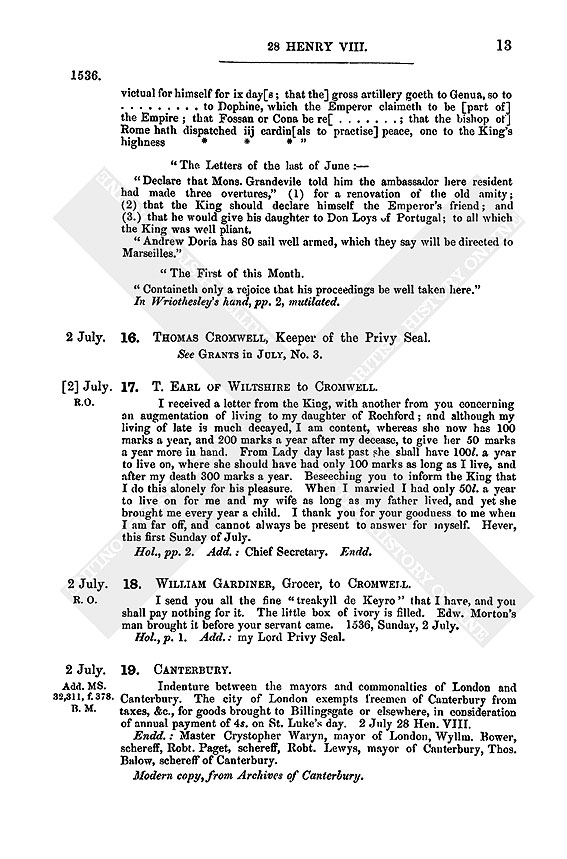
| "First he maketh a congratulation of the King . . . . . . . . . . declaring it to be there well accepted. For [other news] he writeth the King's book against Luther to [be in every] mannes hand there; that there be certain articles to . . . . . the opinions against purgatory, pilgrimages, [worshipping] of saints, etc.; that the lady Mary is by th[e King's] highness legitimated, and had for a gift of h[is grace] half the late Queen's jewels; that the mar[ques of] Saluce is come to the Emperor, and hath talked [with him] three hours disclosing all the French king's co[unsel; that] the army shall pass the straits that . . . . . . . at his coming into Italy, every man hav[ing] to provide victual for himself for ix day[s; that the] gross artillery goeth to Genua, so to . . . . . . . . . to Dophine, which the Emperor claimeth to be [part of] the Empire; that Fossan or Cona be re[ . . . . . . .; that the bishop of] Rome hath dispatched iij cardin[als to practise] peace, one to the King's highness * * *" | |
| "The Letters of the last of June:— | |
| "Declare that Mons. Grandevile told him the ambassador here resident had made three overtures," (1) for a renovation of the old amity; (2) that the King should declare himself the Emperor's friend; and (3.) that he would give his daughter to Don Loys of Portugal; to all which the King was well pliant. | |
| "Andrew Doria has 80 sail well armed, which they say will be directed to Marseilles." | |
| "The First of this Month. | |
|
"Containeth only a rejoice that his proceedings be well taken here." In Wriothesley's hand, pp. 2, mutilated. |
|
| 2 July. |
16. Thomas Cromwell, Keeper of the Privy Seal. See Grants in July, No. 3. |
| [2] July. R.O. |
17. T. Earl of Wiltshire to Cromwell. |
|
I received a letter from the King, with another from you concerning
an augmentation of living to my daughter of Rochford; and although my
living of late is much decayed, I am content, whereas she now has 100
marks a year, and 200 marks a year after my decease, to give her 50 marks
a year more in hand. From Lady day last past she shall have 100l. a year
to live on, where she should have had only 100 marks as long as I live, and
after my death 300 marks a year. Beseeching you to inform the King that
I do this alonely for his pleasure. When I married I had only 50l. a year
to live on for me and my wife as long as my father lived, and yet she
brought me every year a child. I thank you for your goodness to me when
I am far off, and cannot always be present to answer for myself. Hever,
this first Sunday of July. Hol., pp. 2. Add.: Chief Secretary. Endd. |
|
| 2 July. R. O. |
18. William Gardiner, Grocer, to Cromwell. |
|
I send you all the fine "treakyll de Keyro" that I have, and you
shall pay nothing for it. The little box of ivory is filled. Edw. Morton's
man brought it before your servant came. 1536, Sunday, 2 July. Hol., p. 1. Add.: my Lord Privy Seal. |
|
| 2 July. Add. MS. 32,311, f. 378. B. M. |
19. Canterbury. |
| Indenture between the mayors and commonalties of London and Canterbury. The city of London exempts freemen of Canterbury from taxes, &c., for goods brought to Billingsgate or elsewhere, in consideration of annual payment of 4s. on St. Luke's day. 2 July 28 Hen. VIII. | |
|
Endd.: Master Crystopher Waryn, mayor of London, Wyllm. Bower,
schereff, Robt. Paget, schereff, Robt. Lewys, mayor of Canterbury, Thos.
Balow, schereff of Canterbury. Modern copy, from Archives of Canterbury. |
|
| 3 July. |
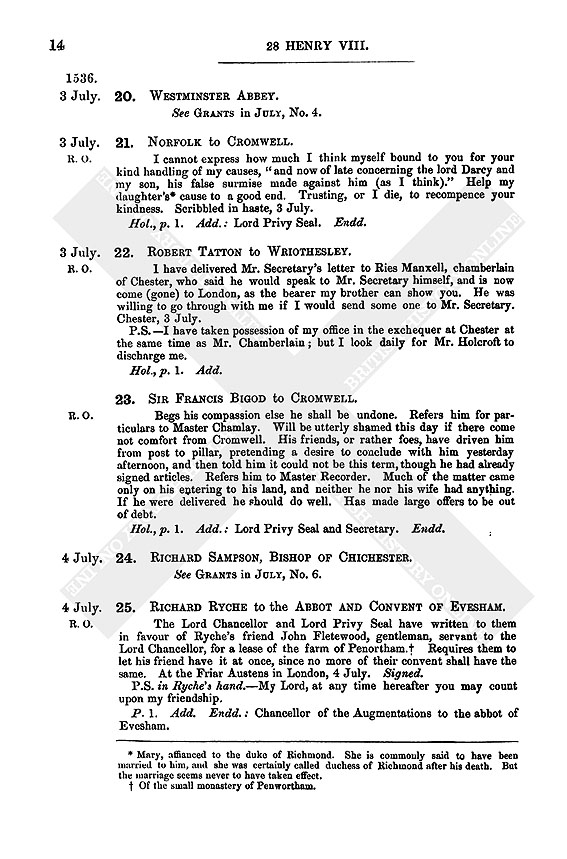
20. Westminster Abbey. See Grants in July, No. 4. |
| 3 July. R. O. |
21. Norfolk to Cromwell. |
|
I cannot express how much I think myself bound to you for your
kind handling of my causes, "and now of late concerning the lord Darcy and
my son, his false surmise made against him (as I think)." Help my
daughter's (fn. 7) cause to a good end. Trusting, or I die, to recompence your
kindness. Scribbled in haste, 3 July. Hol., p. 1. Add.: Lord Privy Seal. Endd. |
|
| 3 July. R. O. |
22. Robert Tatton to Wriothesley. |
| I have delivered Mr. Secretary's letter to Ries Manxell, chamberlain of Chester, who said he would speak to Mr. Secretary himself, and is now come (gone) to London, as the bearer my brother can show you. He was willing to go through with me if I would send some one to Mr. Secretary. Chester, 3 July. | |
|
P.S.—I have taken possession of my office in the exchequer at Chester at
the same time as Mr. Chamberlain; but I look daily for Mr. Holcroft to
discharge me. Hol., p. 1. Add. |
|
| 23. Sir Francis Bigod to Cromwell. | |
|
Begs his compassion else he shall be undone. Refers him for particulars to Master Chamlay. Will be utterly shamed this day if there come
not comfort from Cromwell. His friends, or rather foes, have driven him
from post to pillar, pretending a desire to conclude with him yesterday
afternoon, and then told him it could not be this term, though he had already
signed articles. Refers him to Master Recorder. Much of the matter came
only on his entering to his land, and neither he nor his wife had anything.
If he were delivered he should do well. Has made large offers to be out
of debt. Hol., p. 1. Add.: Lord Privy Seal and Secretary. Endd. |
|
| 4 July. |
24. Richard Sampson, Bishop of Chichester. See Grants in July, No. 6. |
| 4 July. R. O. |
25. Richard Ryche to the Abbot and Convent of Evesham. |
| The Lord Chancellor and Lord Privy Seal have written to them in favour of Ryche's friend John Fletewood, gentleman, servant to the Lord Chancellor, for a lease of the farm of Penortham. (fn. 8) Requires them to let his friend have it at once, since no more of their convent shall have the same. At the Friar Austens in London, 4 July. Signed. | |
| P.S. in Ryche's hand.—My Lord, at any time hereafter you may count upon my friendship. | |
| P. 1. Add. Endd.: Chancellor of the Augmentations to the abbot of Evesham. | |
| 4 July. R. O. |
26. The Monks of Leicester (fn. 9) to the Earl of Huntingdon. |
| We beg you to have pity on our good and religious father abbot, otherwise we are likely to lose a virtuous pastor. We should never be so loth to miss him, but are afraid that sinistral reports have been made of him to the King. We beg you therefore to intercede for us. Leicester, 4 July. | |
|
Signed: Richard Bromley, prior, (fn. 10) John Anysworth, Thos. Bather,
Thos. Broughton, Robert Sapcote, sub-prior, and 15 others. P. 1. Add. Endd. |
|
| 5 July. Faustina, C. III. 472. B. M. |
27. Vice-Chancellor and University of Cambridge to Convocation. |
|
Desires the exemption of the heads of colleges from the taxes paid
by ecclesiastics. Convocation had previously decided that the exaction was
not to be made, and the King also has remitted a large sum of money which
was to be annually paid by the colleges. Cambridge, 5 July. Lat., p. 1. Add.: Ampliss. Præsidi ac cæteris Patribus in hac sacra synodo considentibus, dominis et patronis nostris colendissimis. |
|
| 5 July. Add. MS. 25, 114, f. 170. B. M. |
28. Henry VIII. to Gardiner and Wallop. |
| Perceives by their conversations with the Great Master and their conference with the card. Bellay, that the French, whatever they pretend, will be glad of an honest peace. Francis himself also has acknowledged to them, in speaking of Henry's answer to the bailly of Troyes, that he would be willing to refer his dispute with the Emperor to Henry's arbitration, promising to send the King certain articles to that effect, which, however, he has not received. He complains also of Henry's calling upon him for speedy payment of the money due to him. Thanks them for their substantial proceedings. Informs them what he has done with the ambassadors of both princes, so that they may know how to act and keep the King indifferent, and without breaking treaties with the Emperor, "to help our friend the French king to stay the Emperor's affection, if it shall appear that indeed he aspireth to a monarchy." The ambassadors of both Princes have demanded succours of Henry. Considering the faith of treaties and the danger of entering into war, has resolved upon a method to satisfy both, at the same time keeping his hands clear, and commits to them the expression of his answer to the French king. He first called the ambassadors before him and told them, indifferently, that their requests on either side were for an aid, which, being in amity with both their masters, he could not grant to either without offence, unless he could ascertain with certainty who made the first rupture, and this he had not been able to judge from their disputation in the presence of the council, and that, to avoid effusion of blood, he offered to mediate as a friend of both. After this conference the King, judging from the complaints of Francis about the importunate calling for our money, and the fact that all his requests were for a contribution, that he only wanted money, not men, and, considering that he had already a good sum of Henry's money in his hand, viz., for the arrears of pensions, salt money, presents for the dukes of Wittemberg and Bavier, called the French ambassador apart and told him that though his master had not proceeded with him sincerely in all things, he was desirous, on his part, to fulfil every obligation; that though, for want of precise knowledge of the treaties, Henry had not yet been able to determine by whom they were first violated, yet, in order to assist his friend as far as he could do so with honor, perceiving that it is money the French are most in want of, he was content not to call for payment of the great sums of money due to him which they have retained without due payment on the days limited, contrary to the treaties, till it should appear whether he was bound to aid them with any contribution or not, covenanting with them at the same time that they should make no peace without England being a principal contrahent, nor consent to a general council without England's concurrence. The payments, however, thus forborne must be renewed when any peace shall be made, or in case of contribution, so much to be deducted as the same shall amount to. Are to intimate these conditions to the French king, qualifying the same as they think fit. | |
|
Had commissioned Cromwell to write to them about the granting to
them of the annuity that Norris had to Sir Fras. Brian, "which in case
of extremity, as the same is void, we think we might give by a prerogative."
Desires Gardiner, whom alone it concerns, to inform by next post whether
he will grant it at the King's request "or stand with us in argument
concerning the right thereof; assuring you, that as we shall be content to
permit the one, so in the other ye shall, proceeding simply and plainly,
deserve our hearty thanks." Westminster, 5 July. Signed and sealed. In Wriothesley's hand, pp. 7. Add.: To &c. the bp. of Winton and to &c. Sir John Wallop, knt., our ambassadors in France. Endd. |
|
| 5 July. Add. MS. 25, 114, f. 175. B.M. |
29. Cromwell to Gardiner. |
| Thanks him for his letters, especially those of the 23rd ult., in answer to a few words at the end of a letter of his own, touching his contention for the annuity granted by the King to Master Brian on Norris's attainder. Thinks his reasons for disputing the point are not so friendly towards himself "as I think my merits towards you have deserved, being only your fantasy that I should rather of myself than otherwise promote that matter unto you." Gardiner writes, "When his Majesty shall give me an express commandment and say, my pleasure is, thou shalt pay 100l. to such an use," &c. "Truly, my Lord, though my talent be not so precious as yours, yet I trust, with his help that gave me it, to use it so as it shall do his office without gathering such suspicions upon friendship. I repeat that word again because I meant friendly in the writing of it, or the adhering so fast to the imagination thereof, that I should do nothing without express commandments at his request, whose only inclination should of congruence bow the affections of such men as we be, who hath received all that we have at his hand, and cause us rather kindly to give place, than so earnestly to contend as might percase neither prevail ne suffer the thing to have that grace it might have had at the beginning. And yet would I, as one that took myself in your own estimation for your friend, desire you to think that I will not wade in any private matter in the King my sovereign lord's name, unless I have his commandment so to do, as in my last letters written for the said annuity I declared unto you I had, which of his great goodness it pleaseth his Highness to avouch at this time unto you. But now to your letters. Your gifts received of God be great, and so much the more cause ye have to thank him for them. Your other gifts received of the King be not small, and therefore your service to his Majesty for the same is loyal and diligent." The King knows his wisdom, "and therefore desired you not to do him pleasure if ye will exclude utterly right, for that ye could not use it pleasantly yourself," but imagined a request in such a case would have been as good as a commandment. What Gardiner's debts may be the King knows not, nor has Cromwell leisure to make an account of all he has received and paid since he was made bp. of Winchester. Advises him not to "enter gifts" with the King, and let his creditors think he was giving away what should content them. "but I signified, as a minister, though not worthy of credence, his Grace's mind only in the bestowing of one part of three parts of that which ye never had before." Gardiner had replied to this that if the King had the disposal of it he hoped he would consider his services, and if the law allotted it to himself he trusted his Grace would allow him the use of his own. Finding that the King did not take this answer in very good part, he had advised Gardiner to comply with a good grace, and now Gardiner is hurt at the advice, which was proferred in pure friendship. | |
|
As to his great desire for news, had written as fully as he could, unless he
could have sent the very confessions "which were so abominable that a great
part of them were never given in evidence, but clearly kept secret." Doubts
not he knows that the King is married again. He has chosen, as all his
nobles and council upon their knees moved him to do, the most virtuous lady
and veriest gentlewoman that liveth. Lady Mary is a most obedient child.
The late Princess, Lady Elizabeth, is by Parliament pronounced also
illegitimate. Has given his servant Peter Lark, as Gardiner desired,
233l. 6s. 8d. Desires him to send by next post the copy of the treaty made
last when Pomerey was here. The Rolls, 5 July. Signed. Pp. 4. In Wriothesley's hand. Add.: My lord of Winchester, the King's ambassador in France. Endd. "Johannes Kingston." |
|
| 5 July. R. O. |
30. Fitzwilliam to Lord Lisle. |
|
Has spoken with the King concerning Snodon, and had but small
comfort. Yesternight spoke with the King, who heard myself and Sir Ric.
Whetell for a quarter of an hour, and determined that my Lord Chancellor
and Master Secretary should examine the patents. Has spoken with
Master Secretary concerning Snodon, and thinks that Lisle should do the
same. Westminster, 5 July. Signed. P. 1. Add.: Deputy of Calais. |
|
| 5 July. R. O. |
31. [John Husee] to Lord Lisle. |
| Today in a long interview with Mr. Secretary, he made me answer that he had spoken to the King several times for you, and read several letters of yours sent to the King, and he thought the King would see to your lordship, but how he could not tell. He promised to keep the King in remembrance and be your very friend. To all your other letters he would make answer next morning, and Mr. W.'s (Wingfield's) patent should not fail to be resumed in this present parliament. On my departure he called me again, and said he wished in anywise you would meet the King at Dover. I said you desired nothing so much as to see his Grace, and besought him to procure your licence; when he commanded me to go to Mr. Sadleyr, who is of the King's privy chamber, in his name, and he would motion the King in it; "who so did and his Grace stayed at it, and said that he would common with Mr. Secretary, and devise further therein. And so I returned unto Mr. Secretary, and showed him the King's pleasure; who said that he would speak to his Grace therein at his next coming to Court." So that whether you shall come over or no I cannot yet write certainly. Tomorrow I shall know the truth. The King will be at Dover on Tuesday next [11 July], remain Wednesday and Thursday [12th and 13th], and be at Greenwich again on Saturday [15th]. If your licence be obtained you will require to be there a day before the King. It is now thought that Mr. Secretary will over to Calais at this journey. I delivered your lordship's letter, which the King read, and said it was for a suit requiring no hasty answer, but he would see to your lordship at leisure. | |
|
As to Hide, he has sent hither his man to Button, his friend, with these
offers: to give 500 marks ready-money to redeem the rent wholly, or else to
lend 400 marks "upon forfeiture of the same for a year's pay, taking the
profits of the same in the mean season, which 62l. by the year, 18s. 8d."
As far as I can see he will rise little higher. I asked for eight years'
purchase, but I fear he will scant come to six. Let me know your mind,
for Mich. day draws near, and 120l. is no small rent. And where your
lordship writes that you will not give the land in Wyzt (I. of Wight?)
under 300l., it is but 13l. a year, and standing in reversion I know no one
will give half the money for it; but your lordship knows best. If you do
not intend to make money out of the premises other shift must be made at
the King's hand, which will be very hard to come by. London, 5 July.
Not signed. Hol., pp. 2. Add. |
|
| 5 July. R. O. |
32. John Husee to Lord Lisle. |
|
I wrote this morning by Bracy what till then was requisite. I was
afterwards sent for by Mr. Treasurer of the King's House, who showed me
that, after much discussion between him and Mr. Whethill the elder before
the King, his Highness was content to refer the matter to the judgment of
my lord Chancellor, Mr. Secretary, and him; so that he hopes to give your
enemy the overthrow. The matter will be examined by the patents, and I
have procured a copy of your Lordship's. Mr. Treasurer advises you to
write to Mr. Secretary for his lawful favor. He has written to you by
Byrcham, and Mr. Secretary promised that I should have his letters this
day, but he maketh no haste therein. He has this day, however, moved
the King for your licence to come to Dover, but his Grace has deferred
considering it till the afternoon. In any case, be ready; for even if your
Lordship be not allowed to come over, I think Mr. Secretary will come
thither, even though he went in one tide and came in another. It is not
settled yet whether the Queen shall go. London, 5 July. Hol., p. 1. Add. |
|
| 5 July. R. O. |
33. Edw. Corbet to Lady Lisle. |
|
I send enclosed Mrs. Margery Horseman's letter. She desired me to
inform your ladyship that the King and Queen take their journey to Dover
on the 10th inst. She would have written before, but could not tell certainly
if it were so or no till the Queen informed her, and she thinks it would
please her Grace if your ladyship would come thither. I and Worley will
be there to wait upon your ladyship in your livery. London, 5 July. Hol., p. 1. Add: At Calais. |
|
| 5 July. R. O. |
34. Thos. Boys and Wm. Pryseley to Lord Lisle. |
| Received, 30 June, his letters dated the 27th, complaining that he had no answer from Mr. Secretary for the hoys he had stayed in Calais Have given attendance on Mr. Secretary accordingly, who says he has written to his lordship on the subject, and has caused the ambassador to write likewise. We daily put Master Secretary in remembrance about the resumption [of Sir Rob. Wy]nfylde's patent. It is said the King will leave Greenwich for Dover on Monday or Tuesday next. London, 5 Ju[ly]. Signed. | |
|
Since writing have found means to obtain a copy of Sir Rob. Wynfyld's
patent of the marsh called the Mayne Broke. Delivered it today, 6 July,
to Master Secretary, sitting openly in the parliament house, Mr. Treasurer (fn. 11)
being present, and the whole house furnished with the copy, when
Mr. Secretary opened the matter to them, and every man was agreed.
Mr. Secretary then called to him Master Portman of the Temple, and
commanded him to make out a bill for the resumption of the patent, to be
enacted tomorrow. Mutilated, p. 1. Add. Endd. |
|
| 5 July. Vesp. C. vii. 68. B. M. |
35. Charles V. to Mary of Hungary. |
| "Nouvelles venues de l'Empereur a la Reyne, le ve jour de Juillet 1536." | |
| That the marquis of Saluces has certainly arrived in the Emperor's camp, and is sworn to his service. The castle of Connin, taken by the French, has surrendered to the Emperor,—one of the strongest places you can see. The town of Fousan, which the French had strengthened with 4,000 foot and 300 men-at-arms has given hostages to the Emperor to surrender if not relieved within 10 days, giving up their arms, and bargaining only for their lives and some "petits chevaux courtaux" to withdraw. It was very well supplied with victuals and provisions, but, seeing the Emperor so strong, durst not oppose him. The Emperor is about to invade France well equipped, and with the best prospects of success. | |
| ii. Other news received the same day. The town, castle, and monastery of Hondicourt are taken and the men killed and burnt, except some monks who are prisoners; also the castles of Myremont, Mailly, and Sorret are taken, all by de Roeux's men. | |
|
"Et vous envoye ces nouvelles affin que les presentes a Monsieur, le
remerchiant." Fr., p. 1. |
|
| 5 July. Add., M.S. 8715. f. 268. B. M. |
36. Bishop of Faenza to Mons. Ambrogio. |
|
No fresh news from England. The bailly of Troens (Troyes) is
expected, with the final resolution. The English ambassadors say that if the
Emperor attacks this kingdom they will do much to defend it. Ital. Pp. 3. Modern copy. Headed: Al Medesimo. Da Lione. 5 Luglio, 1536. |
|