
Letters and Papers, Foreign and Domestic, Henry VIII, Volume 8, January-July 1535. Originally published by Her Majesty's Stationery Office, London, 1885.
This free content was digitised by double rekeying. All rights reserved.
'Henry VIII: January 1535, 1-10', in Letters and Papers, Foreign and Domestic, Henry VIII, Volume 8, January-July 1535, (London, 1885) pp. 1-12. British History Online https://www.british-history.ac.uk/letters-papers-hen8/vol8/pp1-12 [accessed 26 April 2024]
Image
Image
Image

Image

Image

Image
Image

Image

Image
Image
Image

Image
January 1535, 1-10
| 1 Jan. Vienna Archives. |
1. Chapuys to Charles V. |
|---|---|
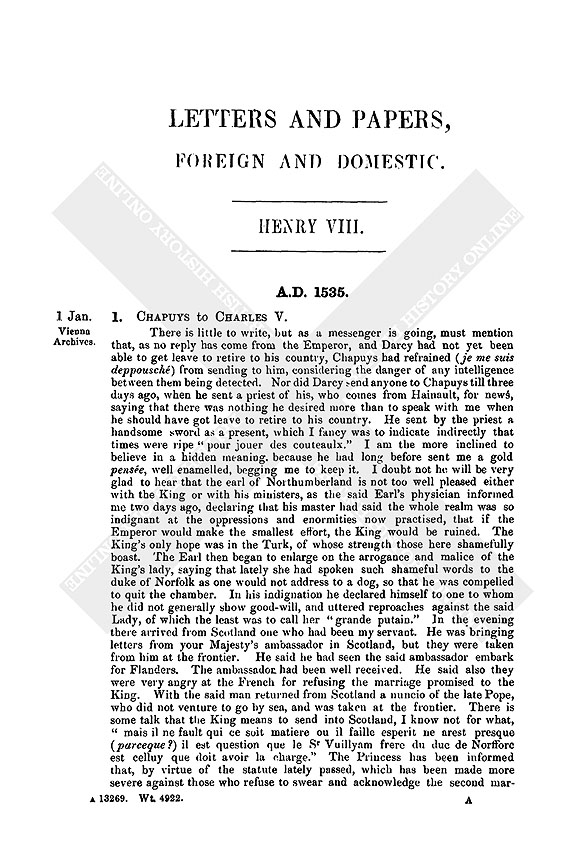
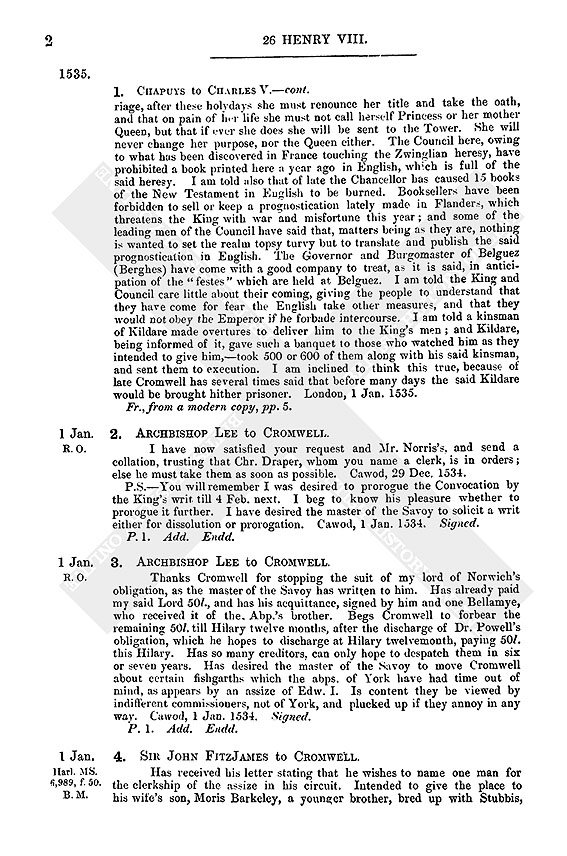
| There is little to write, but as a messenger is going, must mention that, as no reply has come from the Emperor, and Darcy had not yet been able to get leave to retire to his country, Chapuys had refrained (je me suis deppousché) from sending to him, considering the danger of any intelligence between them being detected. Nor did Darcy send anyone to Chapuys till three days ago, when he sent a priest of his, who comes from Hainault, for news, saying that there was nothing he desired more than to speak with me when he should have got leave to retire to his country. He sent by the priest a handsome sword as a present, which I fancy was to indicate indirectly that times were ripe "pour jouer des couteaulx." I am the more inclined to believe in a hidden meaning, because he had long before sent me a gold pensée, well enamelled, begging me to keep it. I doubt not he will be very glad to hear that the earl of Northumberland is not too well pleased either with the King or with his ministers, as the said Earl's physician informed me two days ago, declaring that his master had said the whole realm was so indignant at the oppressions and enormities now practised, that if the Emperor would make the smallest effort, the King would be ruined. The King's only hope was in the Turk, of whose strength those here shamefully boast. The Earl then began to enlarge on the arrogance and malice of the King's lady, saying that lately she had spoken such shameful words to the duke of Norfolk as one would not address to a dog, so that he was compelled to quit the chamber. In his indignation he declared himself to one to whom he did not generally show good-will, and uttered reproaches against the said Lady, of which the least was to call her "grande putain." In the evening there arrived from Scotland one who had been my servant. He was bringing letters from your Majesty's ambassador in Scotland, but they were taken from him at the frontier. He said he had seen the said ambassador embark for Flanders. The ambassador had been well received. He said also they were very angry at the French for refusing the marriage promised to the King. With the said man returned from Scotland a nuncio of the late Pope, who did not venture to go by sea, and was taken at the frontier. There is some talk that the King means to send into Scotland, I know not for what, "mais il ne fault qui ce soit matiere ou il faille esperit ne arest presque (parceque?) il est question que le Sr Vuillyam frere du duc de Norfforc est celluy que doit avoir la charge." The Princess has been informed that, by virtue of the statute lately passed, which has been made more severe against those who refuse to swear and acknowledge the second mar riage, after these holydays she must renounce her title and take the oath, and that on pain of her life she must not call herself Princess or her mother Queen, but that if ever she does she will be sent to the Tower. She will never change her purpose, nor the Queen either. The Council here, owing to what has been discovered in France touching the Zwinglian heresy, have prohibited a book printed here a year ago in English, which is full of the said heresy. I am told also that of late the Chancellor has caused 15 books of the New Testament in English to be burned. Booksellers have been forbidden to sell or keep a prognostication lately made in Flanders, which threatens the King with war and misfortune this year; and some of the leading men of the Council have said that, matters being as they are, nothing is wanted to set the realm topsy turvy but to translate and publish the said prognostication in English. The Governor and Burgomaster of Belguez (Berghes) have come with a good company to treat, as it is said, in anticipation of the "festes" which are held at Belguez. I am told the King and Council care little about their coming, giving the people to understand that they have come for fear the English take other measures, and that they would not obey the Emperor if he forbade intercourse. I am told a kinsman of Kildare made overtures to deliver him to the King's men; and Kildare, being informed of it, gave such a banquet to those who watched him as they intended to give him,—took 500 or 600 of them along with his said kinsman, and sent them to execution. I am inclined to think this true, because of late Cromwell has several times said that before many days the said Kildare would be brought hither prisoner. London, 1 Jan. 1535. | |
| Fr., from a modern copy, pp. 5. | |
| 1 Jan. R. O. |
2. Archbishop Lee to Cromwell. |
| I have now satisfied your request and Mr. Norris's, and send a collation, trusting that Chr. Draper, whom you name a clerk, is in orders; else he must take them as soon as possible. Cawod, 29 Dec. 1534. | |
| P.S.—You will remember I was desired to prorogue the Convocation by the King's writ till 4 Feb. next. I beg to know his pleasure whether to prorogue it further. I have desired the master of the Savoy to solicit a writ either for dissolution or prorogation. Cawod, 1 Jan. 1534. Signed. | |
| P. 1. Add. Endd. | |
| 1 Jan. R. O. |
3. Archbishop Lee to Cromwell. |
| Thanks Cromwell for stopping the suit of my lord of Norwich's obligation, as the master of the Savoy has written to him. Has already paid my said Lord 50l., and has his acquittance, signed by him and one Bellamye, who received it of the Abp.'s brother. Begs Cromwell to forbear the remaining 50l. till Hilary twelve months, after the discharge of Dr. Powell's obligation, which he hopes to discharge at Hilary twelvemonth, paying 50l. this Hilary. Has so many creditors, can only hope to despatch them in six or seven years. Has desired the master of the Savoy to move Cromwell about certain fishgarths which the abps. of York have had time out of mind, as appears by an assize of Edw. I. Is content they be viewed by indifferent commissioners, not of York, and plucked up if they annoy in any way. Cawod, 1 Jan. 1534. Signed. | |
| P. 1. Add. Endd. | |
| 1 Jan. Harl. MS. 6,989, f. 50. B. M. |
4. Sir John FitzJames to Cromwell. |
| Has received his letter stating that he wishes to name one man for the clerkship of the assize in his circuit. Intended to give the place to his wife's son, Moris Barkeley, a younger brother, bred up with Stubbis, late "prenytorie" of the Common Pleas, and asks Cromwell to respite the matter until he comes to London at the beginning of next term. Redlinche, 1 Jan. Signed. | |
| P. 1. Add.: Mr. Thos. Cromwell, Supreme Secretary to the King's majesty. Endd.: My lord Chief Justice. | |
| 1 Jan. R. O. |
5. Laurence Stauber to Cromwell. |
| Sends news collected among the German princes. Did not dare to commit his letters to the King to an ordinary messenger. Has sent them therefore under cover to Cromwell, whom he begs to deliver them in person. Neuuenmarckt, at the Court of Frederick Count Palatine, 1 Jan. 1535. | |
| Lat. Hol., p. 1. Add. Endd. | |
| 1 Jan. R. O. |
6. Jeanie Beaujeu (?) to Lord Lisle. |
| We are at St. Germain, and regret the good cheer you made us. Your servant, the bearer, spoke to me about some wines at Rouen when the Admiral was holding the estates there. I have heard the Admiral speak about making you such a present when he came into Burgundy, and I will solicit it for you. It is of his own growth, and there will be none for a year. I hope, however, to present you with some from the Admiral sooner than you think. I am at your service, with all the gentlemen of the Admiral. St. Germain en Laye, "ce primier jour dan 1534." Signed. | |
| Fr., p. 1. Add. | |
| 2 Jan. R. O. |
7. John Smyth, of Paules, to Cromwell. |
| This is to thank you for your kindness in my suit for the vicarage of Stepney. (fn. 1) I said the suit was at the suggestion of my brother-in-[law], Dr. Layton, patron of the said vicarage, who granted me the preferment of it in preference to his own natural brother. I am this day secretly informed that Dr. Layton intends the preferment of his brother or some other, forgetting his former promise, to my great discomfort and the consolation of my unkind brethren. London, 2 Jan. Signed. | |
| P. 1. Add.: Secretary and Master of the Rolls. Endd. | |
| 2 Jan. Add. MS. 28, 587, f. 164. B. M. |
8. Charles V. to his Ambassador in France (Hannaert). |
| To the proposal for the marriage of the Princess of England to the third son of the French king, the said King replies that it is not in the Emperor's power to treat of it, and he does not see how it could be brought about while the king of England is living and his friend. Feels sure that if [Hannaert] has told him what the Emperor wrote, he would have understood, what the Emperor's letters and Nassau's instructions show, that this proposal is not based on the supposition that the Princess is in the Emperor's power, and is not intended to prejudice the honor, conscience or estate of the king of England, nor to break the alliance between him and Francis, but rather that Francis may see the affection and good-will which the Emperor has to please him, and for the aggrandisement of his sons, and to do a friendly and honorable act to the king of England for the repose of his conscience and the comfort of his subjects. | |
| Touching what the King says about this marriage, that giving up his son's pretensions to Milan would be giving up a certainty for an uncertainty, the Emperor does not mean to argue (tornar en razonamiento) that his sons cannot lay any claim to Milan on account of what is past, and Francis understands fully the peremptory reasons concerning this; but it appears to the Emperor that this marriage would not be unsuitable or difficult, and, in the course of nature, would be much more profitable. Would not have proposed it but from good-will to him. * * * Madrid, 2 Jan. 1535. | |
| Sp., pp. 20. Modern copy. The original is docketed as a translation of a French despatch; but it would appear rather to be a first draft of the despatch of 5 Jan. | |
| Ibid. f. 174. | 2. Another modern copy, pp. 17. |
| 2 Jan. Add. MS. 28,587, f. 183. B. M. |
9. Charles V. |
| Instructions for the count of Reulix, master of the Emperor's household, who left Madrid 2 Jan. 1535 for Italy, Germany and Flanders. | |
| The only reference to England is in a paragraph about the prospect of the French king instigating the duke of Gueldres to make war on Flanders, and persuading the English to attack Gravelines. | |
| Sp., pp. 36. Modern copy. | |
| 3 Jan. R. O. St. P. v. 15. |
10. Sir Adam Otterburn to Cromwell. |
| Wrote lately by a servant of the King. Thinks the restraint against Englishmen selling horses to Scotchmen should now cease. Desires a licence for James's servants to buy horses in England. Edinburgh, 3 Jan. Signed. | |
| Add.; Secretary. Endd. | |
| 3 Jan. R. O. |
11.— to Thos. Broke. |
| Thanks him for his good cheer when last in London. The prior of Tutbury is at the point of death. Recommends the sub-prior, Dan Arthur Meverell. He is an honest man and a gentleman well born. Wishes Broke to speak to Mr. Secretary for him. Understands he is his kinsman, born in the house of Trowley in Staffordshire, out of which house, as he is informed, Mr. Secretary is come, "as of one of the daughters of one Meverell." | |
| Has not written to Mr. Secretary for lack of familiar acquaintance, though he once made suit to him for a kinswoman, who by his goodness was made abbess of Wilton. 3 Jan. | |
| Desires to be recommended to Broke's wife, good Mrs. Flaxton and Robt. Melsom. | |
| Hol., p. 1. Add.: In Flete Strete, at the Kyngis Hedde. | |
| Endd. in a modern hand: The commendation of Arthur Meverell to be made prior of Tutbury in Staffordshire, vij. Jan. 1613. | |
| And by another writer: He was my godfather, and I knew him a comely grave man. | |
| 3 Jan. R. O. |
12. John Cokeson, Water-bayly of Calais, to Cromwell. |
| Has, both in person and through John Broke, his son-in-law, asked Cromwell to let him have again the "droytes" of his office. He enjoyed these until Sir Rob. Wyngfelde, being deputy, withdrew them. As for the "castyng downe of Mr. Wyngfeldis marris," is certain lord Lisle, the King's deputy, will have showed that it would save 200l. or 300l. to grant them to the King's subjects in common. Asks Cromwell's favor to get a patent for the inhabitants of the parishes of Froyton, Nele and Shentercase, to have 70 years' lease of a small portion of ground "marris," abutting on these parishes. Understands that Cromwell has got for Mr. Palmer, knight porter of Calais, all the King's lands "late in the tenure of Sand Ingfelde." This is a specially good deed, for "they" used to feed "harlottes and enemies, exiling frome them all Englishmen," for they abhorred all Englishmen, and said that they held of the Pope. He got a grant from the King of 100 acres of the land in Pitham, and when they could not show proofs that they held it of the Pope, they were constrained to allow that they held all their land of the King. Asks that John Broke, sometime vintner in London, may have, in company with John Broke, constable, the writer's son-in-law, a place in the Exchequer of Calais, vacant by the promotion of Ric. Blount to a spear's place. Calais, 3 Jan. | |
| Hol., pp. 2. Add.: Secretary. Endd. | |
| 4 Jan. R. O. |
13. W. Frankelyn, Priest, to Cromwell. |
| In consequence of your letters for a search to be made in the King's interest as to the foundation of the hospital of Our Lady in Bothum, called the Horsfair, we have spoken with John Good, late receiver to master Withers within the province of York; but he refused to deliver anything to us. We said, as commission was granted by the Ordinary to inquire who was the true founder, "the King's interest was to have sight for his title as heir unto Bruse, and otherwise for lack of heirs of the first founders." But he still refused, and finally said he would show them to Cromwell and the Council. My lord Archbishop then sent his chancellor to York to command him to produce the evidence, and he said he had sent them to London. We then made search in my Lord's registers, where we find that divers men of the names of Bruse, Nevill, Pykering, Eure, Marshall and Eglesfelde have presented as founders, but by what title we cannot find. York, 4 Jan. Signed. | |
| P. 1. Add.: Master Cromwell, secretary to the King's highness and Master of the Rolls. Endd. | |
| 4 Jan. R. O. |
14. John Husee to Lord Lisle. |
| Delivered his gift to the King on New Year's day, in the presence of Mr. Nores. Has not yet been able to despatch his other business. Has delivered his letter to my lord of Canterbury at Knowll. He is willing to see everything redressed, and will send you two preachers of his own appointment. I send his letter. Some think his Grace will be there this Lent, but he has not yet got his licence. I send you the abridgment of the statutes, but the statutes are not yet out. London, 4 Jan. 1534. | |
| Hol., p. 1. Add. Endd. | |
| 4 Jan. R. O. |
15. John Husee to Lady Lisle. |
| I wrote by Hercules, and sent such things as you commanded. On New Year's day, by the hands of Mr. Taylor, the Queen's receiver, I delivered your gift to her Grace. While waiting in the place where her New Year's gifts "were appointing," her Grace came in and asked me how you liked Calais? I said, well, and that you wished her many new years. Mr. Receiver then told me he thought she would send you a gift by one of her Wardrobe. I have done little of my Lord's business yet on account of the holidays, but I hope his affairs will speed well. Mr. Roll has discharged Glyn's matter, and has therein "demerited" one piece of French wine. He wishes to know what sum you would give to have possession of lord "Dawby's" lands. Mr. John Basset should be here before next term. I delivered your gifts to Mr. Secretary and Norres; and Mr. Bryan says he will wear his for your Ladyship's sake. London, 4 Jan. 1534. | |
| Hol., pp. 2. Add. | |
| 5 Jan. R. O. |
16. Sir Thomas Clifford to Cromwell. |
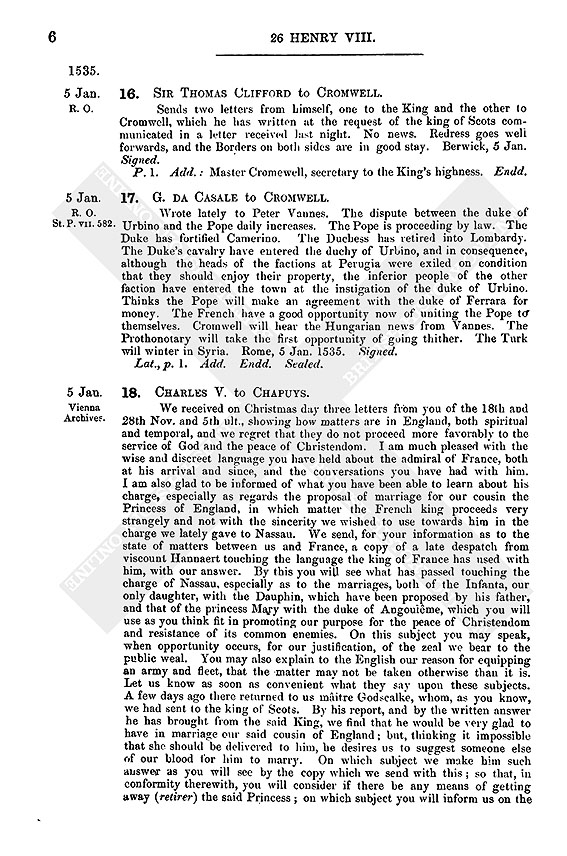
| Sends two letters from himself, one to the King and the other to Cromwell, which he has written at the request of the king of Scots communicated in a letter received last night. No news. Redress goes well forwards, and the Borders on both sides are in good stay. Berwick, 5 Jan. Signed. | |
| P. 1. Add.: Master Cromewell, secretary to the King's highness. Endd. | |
| 5 Jan. R. O. St. P. VII. 582. |
17. G. da Casale to Cromwell. |
| Wrote lately to Peter Vannes. The dispute between the duke of Urbino and the Pope daily increases. The Pope is proceeding by law. The Duke has fortified Camerino. The Duchess has retired into Lombardy. The Duke's cavalry have entered the duchy of Urbino, and in consequence, although the heads of the factions at Perugia were exiled on condition that they should enjoy their property, the inferior people of the other faction have entered the town at the instigation of the duke of Urbino. Thinks the Pope will make an agreement with the duke of Ferrara for money. The French have a good opportunity now of uniting the Pope to themselves. Cromwell will hear the Hungarian news from Vannes. The Prothonotary will take the first opportunity of going thither. The Turk will winter in Syria. Rome, 5 Jan. 1535. Signed. | |
| Lat.,p. 1. Add. Endd. Sealed. | |
| 5 Jan. Vienna Archives. |
18. Charles V. to Chapuys. |
| We received on Christmas day three letters from you of the 18th and 28th Nov. and 5th ult., showing how matters are in England, both spiritual and temporal, and we regret that they do not proceed more favorably to the service of God and the peace of Christendom. I am much pleased with the wise and discreet language you have held about the admiral of France, both at his arrival and since, and the conversations you have had with him. I am also glad to be informed of what you have been able to learn about his charge, especially as regards the proposal of marriage for our cousin the Princess of England, in which matter the French king proceeds very strangely and not with the sincerity we wished to use towards him in the charge we lately gave to Nassau. We send, for your information as to the state of matters between us and France, a copy of a late despatch from viscount Hannaert touching the language the king of France has used with him, with our answer. By this you will see what has passed touching the charge of Nassau, especially as to the marriages, both of the Infanta, our only daughter, with the Dauphin, which have been proposed by his father, and that of the princess Mary with the duke of Angouieme, which you will use as you think fit in promoting our purpose for the peace of Christendom and resistance of its common enemies. On this subject you may speak, when opportunity occurs, for our justification, of the zeal we bear to the public weal. You may also explain to the English our reason for equipping an army and fleet, that the matter may not be taken otherwise than it is. Let us know as soon as convenient what they say upon these subjects. A few days ago there returned to us maitre Godscalke, whom, as you know, we had sent to the king of Scots. By his report, and by the written answer he has brought from the said King, we find that he would be very glad to have in marriage our said cousin of England; but, thinking it impossible that she should be delivered to him, he desires us to suggest someone else of our blood for him to marry. On which subject we make him such answer as you will see by the copy which we send with this; so that, in conformity therewith, you will consider if there be any means of getting away (retirer) the said Princess; on which subject you will inform us on the first opportunity, as well as what has happened in Ireland since your letters, and if the news reported of the earl of Kildare are confirmed. Madrid, 5 Jan. 1534. | |
| Fr., from a modern copy, pp. 2. | |
| 5 Jan. Granvelle Papers, II. 264. |
19. Charles V. to his Ambassador in France. |
| Concerning the Emperor's desire for peace and union and the negotiations for the marriage of his daughter with the Dauphin, and the resistance against the Turk. | |
| As to the marriage between our cousin of England (Mary) and the third son of the French king, which he says is not at our disposition nor practicable during the life of the king of England, Charles's letters to his ambassador and the charge of the count of Nassau will have shown him that the proposition was only in case Mary came into his power, and nothing was intended prejudicial to the honor or conscience of the king of England nor to interfere with any alliances between him and France, but to show Francis the Emperor's good-will to him and to do a friendly act toward the king of England. | |
| Denies the truth of what Francis has said, that he is willing to treat for granting him the duchy of Milan if he will give up the king of England * * *. Madrid, 5 Jan. 1534. | |
| Fr. | |
| 6 Jan. Cleop. E. IV. 126. B. M. |
20. Rites of the Church. |
| Indictment of Robt. Vaws, parson of Over Wallop, Hants, not a priest, for saying in a sermon on Jan. 6, 26 Hen. VIII., "All they do tread Almighty God under their feet that will not believe in the new law"; for refusing to allow his parishioners to maintain lights before images in the parish church, saying it is but pomp and pride, and the saints shall do us no good; and for not suffering women who are purified to offer candles before Our Lady. | |
| ii. Answer of the accused:— | |
| 1. As to his not being a priest, if he could see a clear and perfect definition of one, it would appear what he lacked. Was instituted and admitted by the archbishop of Canterbury. Has offered himself to Stephen bishop of Winchester to receive whatever is requisite to the making of a priest, if it can be proved by God's word that he lacks anything. | |
| 2. The sentence of which he is accused is gathered from a place that he rehearsed in the Epistle to the Hebrews. | |
| 3. Has done what he could to put Christ, who is the very light of the world, before his people, but has not letted their popish holiness in image worship with any resistance. Withdrew his example and denied them money when they asked it for that purpose. When they were offended thereat, could do no less than show what he had read and what authority moved him. | |
| 4. The saints which they buy of the carvers were set up not for sacrifice, but to be laymen's books. The bishops and priests have kept Christ's gospel in silence, and committed the teaching of the people to such dumb masters, so that the scholars have received much of their masters' properties; viz., they have eyes without sight, &c. Prays God that the people may have eyes and ears to see and hear Christ, hid so long with popery. | |
| 5. Was accused at the Archdeacon's visitation on 21 June of keeping his benefice without a dispensation. A year ago exhibited the testament of our Lord to Stephen bishop of Winchester as a sufficient dispensation for the holding of his spiritual office and the charge of the church of Over Wallop and the parishioners' souls. Considers this charge to be no worldly preferment, but a heavy burden, exposing him to hatred, persecution and death. | |
| 6. Is accused of keeping a woman. Never made vow to the contrary, "but plain exception of all ungodly boadage," wherefore he is at liberty to have a wife. Whether the cure of souls and honest matrimony may stand together by the authority of God's holy letters, he refers to the judgment of Christ's Church. | |
| Hol., pp. 2. Endd. at f. 127*b. | |
| 6 Jan. R. O. |
21. Thomas Lord Lawarr to Cromwell. |
| I send you a poor remembrance for the new year, thanking you for your manifold goodness to me. At my poor house, 6 Jan. Signed. | |
| P. 1. Add.: Secretary. Endd. | |
| 7 Jan. Harl. MS. 283, f. 14. B. M. |
22. Sir Perus Dutton to Henry VIII. |
| When the King granted the stewardship of Halton to Sir Edw. Nevell, he commanded that Dutton should have the exercising thereof. Has brought it into better order than it was before and has put his men in readiness to serve the King. Has lately received letters from Nevell. bidding him pay 100 marks for the office. which he might hold during the nonage of his sonin-law John Savage. Sent him the money, but then he would not receive it, in consequence of the sinister labor and offers of money made by Sir Wm. Brereton. The fee is but 100s. a year. If he is so soon put from it, his adversaries would greatly rejoice, for it would be thought that he had committed some offence. Begs the King to write to Nevell, that he may continue in the office. His house and manor of Dutton is within the circuit thereof. Dutton, 7 Jan. Signed. | |
| P. 1. Add. Endd. | |
| Harl. MS. 283, f. 15. B. M. |
2. Petition of Sir John Done to the King. |
| Begs him to command John Baker, his Attorney-General, to prosecute Sir Piers Dutton, sheriff of Chester, and Rauf Mannyng, his undersheriff, for divers misdemeanors, or else to send a commission to Robt. earl of Sussex to examine the matter. | |
| Vellum. | |
| Ibid. f. 16. | ii. Misdemeanors committed by Sir Piers Dutton and Rauf Manning. |
| With the intention of procuring untrue inquests, they have returned Dutton's servants upon many panels, of which two instances are given in 27 Hen. VIII., forfeiting thereby for each offence 40l. by the statute of 23 Hen. VI. They have taken money for the return of writs. Dutton has caused his servants to kill the King's deer, under color of his rangership of the forest of Mara and Mondrom. His servants caused a riot to be made against the servants of Sir John Done, forester of the said forest, and prevented them from fetching in a strayed hart. | |
| Geo. Holford. Rauf Mannyng and William Glasier tried to induce Peter Feldaye, prisoner in Chester Castle, to "appeche" Piers Bryen, one of Done's servants by a promise of pardon. After refusing at first, he did so, and Bryen was committed to the Tower for 18 weeks. Dutton has now obtained a supersedeas to prevent anyone from sning him or his servants. | |
| Pp. 2. Endd. | |
| 7 Jan. R. O. |
23. Archdeaconry of Oxford. |
| Account of Will. Walker, receiver of Nic. Wylson, S.T.P., archdeacon of Oxford during the time of this account, from 6 Nov. 1533 to 4 Jan. following according to the computation of the English Church, 1534 (sic). | |
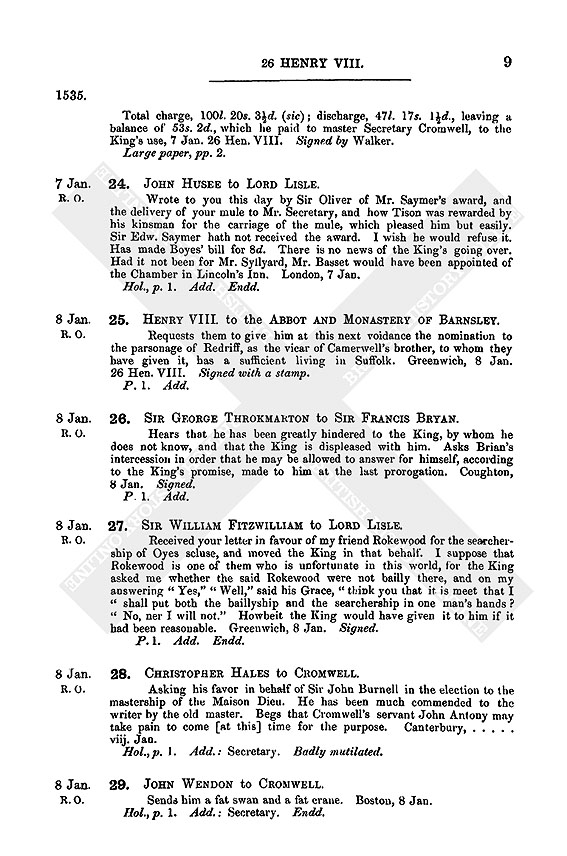
| Total charge, 100l. 20s. 3½d. (sic); discharge, 47l. 17s. 1½d., leaving a balance of 53s. 2d., which he paid to master Secretary Cromwell, to the King's use, 7 Jan. 26 Hen. VIII. Signed by Walker. | |
| Large paper, pp. 2. | |
| 7 Jan. R. O. |
24. John Husee to Lord Lisle. |
| Wrote to you this day by Sir Oliver of Mr. Saymer's award, and the delivery of your mule to Mr. Secretary, and how Tison was rewarded by his kinsman for the carriage of the mule, which pleased him but easily. Sir Edw. Saymer hath not received the award. I wish he would refuse it. Has made Boyes' bill for 8d. There is no news of the King's going over. Had it not been for Mr. Syllyard, Mr. Basset would have been appointed of the Chamber in Lincoln's Inn. London, 7 Jan. | |
| Hol., p. 1. Add. Endd. | |
| 8 Jan. R. O. |
25. Henry VIII. to the Abbot and Monastery of Barnsley. |
| Requests them to give him at this next voidance the nomination to the parsonage of Redriff, as the vicar of Camerwell's brother, to whom they have given it, has a sufficient living in Suffolk. Greenwich, 8 Jan. 26 Hen. VIII. Signed with a stamp. | |
| P. 1. Add. | |
| 8 Jan. R. O. |
26. Sir George Throkmarton to Sir Francis Bryan. |
| Hears that he has been greatly hindered to the King, by whom he does not know, and that the King is displeased with him. Asks Brian's intercession in order that he may be allowed to answer for himself, according to the King's promise, made to him at the last prorogation. Coughton, 8 Jan. Signed. | |
| P. 1. Add. | |
| 8 Jan. R. O. |
27. Sir William Fitzwilliam to Lord Lisle. |
| Received your letter in favour of my friend Rokewood for the searchership of Oyes scluse, and moved the King in that behalf. I suppose that Rokewood is one of them who is unfortunate in this world, for the King asked me whether the said Rokewood were not bailly there, and on my answering "Yes," "Well," said his Grace, "think you that it is meet that I shall put both the baillyship and the searchership in one man's hands? No, ner I will not." Howbeit the King would have given it to him if it had been reasonable. Greenwich, 8 Jan. Signed. | |
| P. 1. Add. Endd. | |
| 8 Jan. R. O. |
28. Christopher Hales to Cromwell. |
| Asking his favor in behalf of Sir John Burnell in the election to the mastership of the Maison Dieu. He has been much commended to the writer by the old master. Begs that Cromwell's servant John Antony may take pain to come [at this] time for the purpose. Canterbury,..... viij. Jan. | |
| Hol., p. 1. Add.: Secretary. Badly mutilated. | |
| 8 Jan. R. O. |
29. John Wendon to Cromwell. |
| Sends him a fat swan and a fat crane. Boston, 8 Jan. | |
| Hol., p. 1. Add.: Secretary. Endd. | |
| 8 Jan. R. O. |
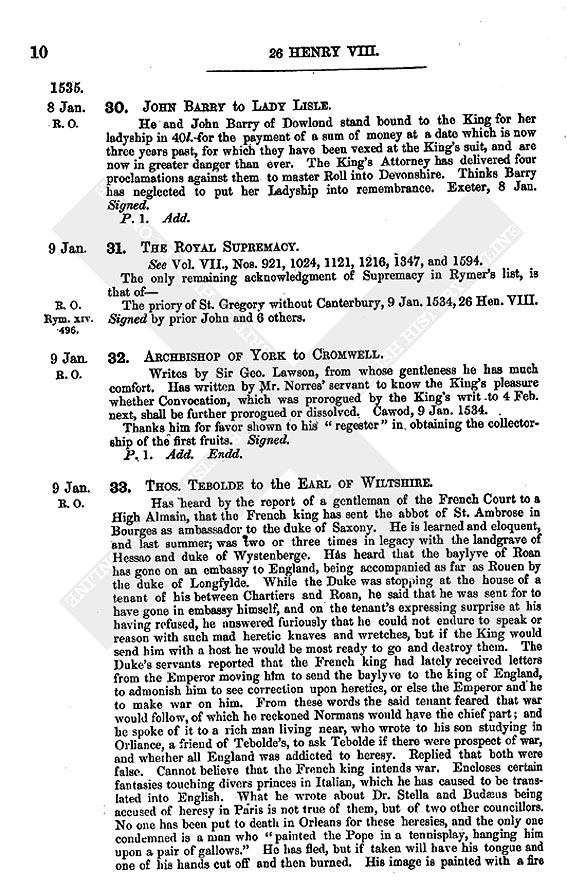
30. John Barry to Lady Lisle. |
| He and John Barry of Dowlond stand bound to the King for her ladyship in 40l. for the payment of a sum of money at a date which is now three years past, for which they have been vexed at the King's suit, and are now in greater danger than ever. The King's Attorney has delivered four proclamations against them to master Roll into Devonshire. Thinks Barry has neglected to put her Ladyship into remembrance. Exeter, 8 Jan. Signed. | |
| P. 1. Add. | |
| 9 Jan. | 31. The Royal Supremacy. |
| See Vol. VII., Nos. 921, 1024, 1121, 1216, 1347, and 1594. | |
| The only remaining acknowledgment of Supremacy in Rymer's list, is that of— | |
| R. O. Eym. xiv. 496. |
The priory of St. Gregory without Canterbury, 9 Jan. 1534, 26 Hen. VIII. Signed by prior John and 6 others. |
| 9 Jan. R. O. |
32. Archbishop of York to Cromwell. |
| Writes by Sir Geo. Lawson, from whose gentleness he has much comfort. Has written by Mr. Norres' servant to know the King's pleasure whether Convocation, which was prorogued by the King's writ to 4 Feb. next, shall be further prorogued or dissolved. Cawod, 9 Jan. 1534. | |
| Thanks him for favor shown to his "regester" in obtaining the collectorship of the first fruits. Signed. | |
| P. 1. Add. Endd. | |
| 9 Jan. R. O. |
33. Thos. Tebolde to the Earl of Wiltshire. |
| Has heard by the report of a gentleman of the French Court to a High Almain, that the French king has sent the abbot of St. Ambrose in Bourges as ambassador to the duke of Saxony. He is learned and eloquent, and last summer; was two or three times in legacy with the landgrave of Hessao and duke of Wystenberge. Has heard that the baylyve of Roan has gone on an embassy to England, being accompanied as far as Rouen by the duke of Longfylde. While the Duke was stopping at the house of a tenant of his between Chartiers and Roan, he said that he was sent for to have gone in embassy himself, and on the tenant's expressing surprise at his having refused, he answered furiously that he could not endure to speak or reason with such mad heretic knaves and wretches, but if the King would send him with a host he would be most ready to go and destroy them. The Duke's servants reported that the French king had lately received letters from the Emperor moving him to send the baylyve to the king of England, to admonish him to see correction upon heretics, or else the Emperor and he to make war on him. From these words the said tenant feared that war would follow, of which he reckoned Normans would have the chief part; and he spoke of it to a rich man living near, who wrote to his son studying in Orliance, a friend of Tebolde's, to ask Tebolde if there were prospect of war, and whether all England was addicted to heresy. Replied that both were false. Cannot believe that the French king intends war. Encloses certain fantasies touching divers princes in Italian, which he has caused to be translated into English. What he wrote about Dr. Stella and Budæus being accused of heresy in Paris is not true of them, but of two other councillors. No one has been put to death in Orleans for these heresies, and the only one condemned is a man who "painted the Pope in a tennisplay, hanging him upon a pair of gallows." He has fled, but if taken will have his tongue and one of his hands cut off and then burned. His image is painted with a fire about him, and is hung upon a pair of gallows in the middle of the market place. | |
| The receiver of Brytanne, about whom he wrote before Christmas, is condemned to be burned at Paris with his wife, one of the most beautiful ladies in France. His father will be publicly punished, lose his goods and be banished. | |
| The French king is very earnest in this persecution, probably to win the favor of this new Pope, for he has no such zeal in himself. He suffered the Italian friar sent him by the Pope to preach before him and his Court most liberally last Lent; and by his sufferance and authority master Gerarde chaplain to the queen of Navarre, preached most liberally last Easter and summer, although the doctors of the university of Paris and the common people greatly resisted. He has also made a league with the High Almains, and daily "inserches" it more and more, both with the Sacramentarians and the Lutherans. Orliance, St. William's Even. | |
| Hol., pp. 3. Add. Endd. | |
| R. O. | 2. "Impresi di tutti gli Signori." |
| 1. Clement VII.:—A mule laden with gold, ridden by a Turk, who holds a urinal in his hand, and turns to a king who conducts him, and says, "Nescio an odio vel amore dignus sit." 2. The Emperor Charles:—A painter, painting the emperor with Fortune holding him by the arm, and saying to Fortune "Non me derelinquas usque in finem, quia finis coronat." 3. The French king:—A pope helping the King to climb a tree with golden fruits, and a woman saying "In vanum laboraverunt." 4. The Turk:—Birds on a tree, and a sparrowhawk, with the motto "Circuit quærens quem devoret, cui resistite forte et in fide." 5. The king of England:—The King standing between Christ, Moses and Mahomet, saying, "Quo me vertam nescio." 6. The duke of Savoy:—A tortoise with his head and feet under his shell, with the motto "Non movebor a generatione in generationem usque in finem." 7. The duke of Milan:—The north wind (La bisa) devouring a man, St. Ambrose striking it with a whip, saying "Qui deverat plebem meam sicut escam panis." 8. The Venetians:—A sleeping lion, with several of the stronger animals round him, and a wolf coming out of a cave (una tanna), with the motto about the lion, "Domine quando hæc erunt?" 9. The Genoese:—Christ at table with a number of Genoese, with the motto, "Amen dico vobis, omnes vos me tradituri estis." 10. The duke of Ferrara:—A duke digging for gold in the sand, and a groom coming from a stable, who throws to him "le dame" (horse dung?) with the motto "Quærit aurum ex stercore." 11. Duke of Mantua:—A gipsy with her hair dishevelled and tearing her cheeks, saying "Anxiatus est spiritus meus in me, et defecit quoniam dereliquit me virtus mea." 12. Antony de Leva:—A demoniac on a chair and a priest exorcising him, the spirit saying to the priest "Intravi ego ad interitum spiritus et earnis suæ quoniam a planta pedis usque ad verticem non est in eo sanitas." 13. The duke of Urbino:—The Duke on foot with a naked sword in his hand, and a garment under his feet, with the motto "Diviserunt sibi vestimenta mea et super vestem meam miserunt sortem." 14. The marquis of Saluze:—An altar with a Christ above, and on the other side many devils bound, and the Marquis in the middle, saying "Flectere si nequeo superos, Acheronta movebo." | |
| Ital., pp. 2. | |
| 10 Jan. R. O. |
34. John Bishop of Bangor to Lord Lisle. |
| Sorry for his long absence from Hampshire. Recommends to him his waterman, who desires to be a "saudeure" (soldier?) in Calais. If any room of 6d. or 8d. a day were void, would be glad that he should have it. From the monastery of Hide, 10 Jan. Signed. | |
| P. 1. Add.: My lord Lissley's good lordship at Calais. | |
| 10 Jan. R. O. |
35. John Bishop of Bangor to Lady Lisle. |
| I am very desirous of hearing of the health of you and lord Lisle, and of seeing you both in Hampshire, which I hope may be shortly. I have written to lord Lisle in favour of a servant of mine, and beg you to be a mediator for him. The monastery of Hide, 10 Jan. | |
| I hope Mr. George and Mr. James are in good health. Signed. | |
| P. 1. Add.: At Calais. | |
| 10 Jan. Corpus Ref. II. 822. |
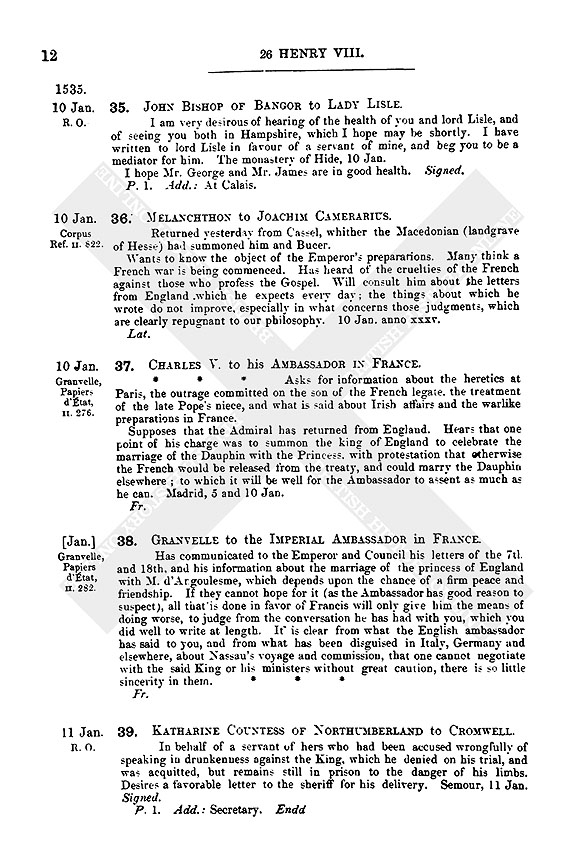
36. Melanchthon to Joachim Camerarius. |
| Returned yesterday from Cassel, whither the Macedonian (landgrave of Hesse) had summoned him and Bucer. | |
| Wants to know the object of the Emperor's preparations. Many think a French war is being commenced. Has heard of the cruelties of the French against those who profess the Gospel. Will consult him about the letters from England which he expects every day; the things about which he wrote do not improve, especially in what concerns those judgments, which are clearly repugnant to our philosophy. 10 Jan. anno xxxv. | |
| Lat. | |
| 10 Jan. Granvelle, Papiers d'État, II. 276. |
37. Charles V. to his Ambassador in France. |
| * * * Asks for information about the heretics at Paris, the outrage committed on the son of the French legate the treatment of the late Pope's niece, and what is said about Irish affairs and the warlike preparations in France. | |
| Supposes that the Admiral has returned from England. Hears that one point of his charge was to summon the king of England to celebrate the marriage of the Dauphin with the Princess, with protestation that otherwise the French would be released from the treaty, and could marry the Dauphin elsewhere; to which it will be well for the Ambassador to assent as much as he can. Madrid, 5 and 10 Jan. | |
| Fr. | |
| [Jan.] Granvelle, Papiers d'État, II. 282. |
38. Granvelle to the Imperial Ambassador in France. |
| Has communicated to the Emperor and Council his letters of the 7th. and 18th, and his information about the marriage of the princess of England with M. d'Angoulesme, which depends upon the chance of a firm peace and friendship. If they cannot hope for it (as the Ambassador has good reason to suspect), all that is done in favor of Francis will only give him the means of doing worse, to judge from the conversation he has had with you, which you did well to write at length. It is clear from what the English ambassador has said to you, and from what has been disguised in Italy, Germany and elsewhere, about Nassau's voyage and commission, that one cannot negotiate with the said King or his ministers without great caution, there is so little sincerity in them. * * * | |
| Fr. | |