
Letters and Papers, Foreign and Domestic, Henry VIII, Volume 8, January-July 1535. Originally published by Her Majesty's Stationery Office, London, 1885.
This free content was digitised by double rekeying. All rights reserved.
'Henry VIII: January 1535, 11-20', in Letters and Papers, Foreign and Domestic, Henry VIII, Volume 8, January-July 1535, (London, 1885) pp. 12-24. British History Online https://www.british-history.ac.uk/letters-papers-hen8/vol8/pp12-24 [accessed 25 April 2024]
Image
Image
Image

Image
Image
Image

Image
Image
Image

Image
Image

Image
Image
January 1535, 11-20
| 11 Jan. R. O. |
39. Katharine Countess of Northumberland to Cromwell. |
|---|---|
| In behalf of a servant of hers who had been accused wrongfully of speaking in drunkenness against the King, which he denied on his trial, and was acquitted, but remains still in prison to the danger of his limbs. Desires a favorable letter to the sheriff for his delivery. Semour, 11 Jan. Signed. | |
| P. 1. Add.: Secretary. Endd | |
| 12 Jan. R. O. |
40. Leonard Smyth to Lady Lisle. |
| Has sent by Hugh Colton the letuse bonnet for my Lord's daughter. It would have been sent before Christmas if the skinner had been as honest as he esteems himself; when he expected to have had the bonnet ready, the skinner refused to make it without earnest. Was with my lord of Essex this Christmas, who thanks lord and lady Lisle for their good wine. | |
| The doe was not delivered for Mr. Densell at the White Hart in Gracyous Street. London, 12 Jan. | |
| Wrote to Mr. Wyndesore, her receiver, before Christmas, for the money, as Hussey can tell. | |
| Hol., p. 1. Add. | |
| 12 Jan. R. O. |
41. Friar Andrew, of Genoa, Dominican, to [Cromwell]. |
| The King yesterday commanded me by Briante to let him have a view of a certain instrument of small expense, useful and easy for carrying large stones for the port at Dover. I have been waiting here, much to my discomfort, as I am old and ignorant of English, and have no interpreter. Please expedite my business, as I want nothing for the things I am willing to give to the King in return for the 250 cr. which he gave me on another occasion. | |
| Hol., Lat., p. 1. Begins: "Magce D. Secretarie. Endd.: "1514 (1534?), die 12 Jan." | |
| 12 Jan. | 42. Archbishop Cranmer. |
| See Grants in January. No. 5. | |
| 13 Jan. Cleop. E. vi. 225.* B. M. |
43. Henry VIII. to the Bishop of Lincoln. |
| Commands him to appear before himself and the Council in the Starred Chamber at Westminster, on the morrow after the Purification of Our Lady. | |
| Westm., 13 Jan. Signed with a stamp. | |
| Add. Endd. | |
| 13 Jan. R. O. |
44. Plate. |
| Parcels delivered by the King's commandment by Mr. Norres at Westminster. | |
| A little casket of crimson velvet, with broken gold. A gilt flagon with the King's and Queen's arms, the stopple with a crown imperial. Two plain standing bowls, with H. and A. on the cover. An ewer of mother-of-pearl, garnished with silver and gilt and stones Pets with H. and A. Two great cruses, with lions on the covers holding a scutcheon. A glass of crystal, garnished with silver-gilt. An espoyer, a strainer for oranges, two casting bottles, a pair of snuffers silver and gilt, and a little "perfewne" parcel-gilt. Two great books of the Old Testament and the New. Eight little books of the Bible. A dozen carpets given by Mr. Treasurer. Two carpets of Mr. Russell's gift; one with imagery for an altar, the other for a table. All the virginals that the King bought of the Frenchman. | |
| Delivered by the King's commandment, 13 Jan. A° 26, to Mr. Alvorde's servant, the unicorn's horn; to Mr. Lovekyn, three targets; to Westminster, two cases of recorders, black, seven in one case and nine in the other. | |
| Pp. 3. | |
| 13 Jan R. O. |
45. John Husee to Lord Lisle. |
| Is glad to hear that Mr. Highefield is recovered. If he had died, I hoped that Whethill should not have enjoyed "it" (his place). Has delivered the piece of Orleans to Mr. Secretary. You may send him the mule as she is. The King's coming to Calais depends on the return of Mons. l'Admiral. Wishes to know what prices he must give for the 70 liveries. Asks what he shall do with the two horns he has received. Has advertised Mr. Secretary of your charges in Mr. Seymour's matter. He will consult with the lord Chancellor. Has no answer yet touching Mr. Hacket's funeral and burial. Thinks Jenyne will bring orders for the same. Is promised the Commission of Sewers by Mr. Secretary. Has had no answer of the toll of Mark and Oye. Such suits are long, as Lacy knows. I send the Acts last passed. My lord William [Howard] is going to Scotland, with presents to the Scotch king, and William Polle to Ireland as provostmarshal. Gives an account of his fees. Would rather stay at home, for his wife's sake. Your servant Smyth is with Mr. Secretary. London, 13 Jan. | |
| Hol., p. 1. Add. Endd. | |
| 13 Jan. R. O. |
46. John Husee to Lady Lisle. |
| I received your letter by Jenyns, and shall see your letters to Soberton conveyed according to your writing. I shall do your command about your frontlet, but would like to know where (whether?) you received it. I shall also do my best about the spices. I have not yet received your book of Smythe. He is now Mr. Secretary's servant. You will learn from my Lord's letter about his affairs. Here are fair behests, and small performance. I shall always be ready to wait on Mr. Basset. I send you the Queen's New Year's gift,—a pair of gold beads, weighing, with their tassels, 5 oz ..... [of the] Wardrobe, should have brought them. I have delivered them to Mr. Lacy. | |
| Hol., p. 1. Add. | |
| 13 Jan. R. O. |
47. Thos. Leygh to Lady Lisle. |
| I have received your letter of the 28th ult. and the ring by Hussey. Since then I have received a small ring and a silver flagon by Jenyn, who was Mr. Hacket's servant, for which I thank you. I have no leisure to answer other matters in your letter. As to the ring that your Ladyship willed me to send to her that I love best, I suppose it will be my chance to send it to Calais very shortly. And she that I shall send it to, I put no doubt but that she will wear it for my sake. | |
| Desires to be commended to lord Lisle, Mr. Treasurer, Mr. Thos. Fouler and his wife, and other friends. | |
| Sends a ring of lady Lisle's by the bearer, the ambassador of Flanders. Loudon, 13 Jan. 1534. | |
| Hopes to be at Calais in a fortnight. | |
| Hol., p. 1. Add.: At Calais. | |
| 14 Jan. Vienna Archives. |
48. Chapuys to Charles V. |
| I have received your Majesty's letters of the 9th ultimo, and informed the Queen and Princess of what concerned them, which has been to their great comfort. I have always done, and shall do, my best to gain the goodwill of this people towards your Majesty. It does not cost much trouble, for they are almost all devoted to you. The day before yesterday lord Sands, the King's chamberlain, captain of Guisnes, and one of the best men of war in the kingdom, sent to tell me he was very sorry the times were such that he could not invite me to his house, but your Majesty might be sure that you had the hearts of all this kingdom; and that if you knew the great disorder that exists here, and the little hope of making good resistance now that the people were so alienated from the King, you would not delay to apply a remedy. At the least disturbance your Majesty could make, this kingdom would be found in inestimable confusion. The said lord Sands is at his house pretending to be ill, he is so disgusted with the Court, and has sent this message to me by his physician, whom I know. I like to make acquaintance with men of that profession, because they can come and go to all places without suspicion. I have sent no message yet to those mentioned in your letters, because my ordinary messenger is in Flanders. | |
| Nothing is known about news from Ireland, except that about three days ago Cromwell delivered a good sum of money to two Irishmen, and said to some who were present that they had already taken one of the principal of those who had caused trouble there, and that Kildare would be taken and brought hither in a few days. Cromwell also mentioned that the king of France was raising lanceknights about Lorraine and the county of Montbeliard. Kildare has long been threatened, and will take as good care of himself as hitherto. It is true many fear that his men may betray him if he has not money to maintain them. I am told by a good man that about 60 English harquebusiers had entered some tower, but were surprised and driven out by Kildare, leaving their arms behind. I hear the King and Council are much disappointed at hearing nothing from France on the subject of the negotiations between the King and the Admiral, and they fear some intelligence with your Majesty. The King hopes that at an interview with Francis, which he reckons will be very soon, he will break off all other understandings. And to persuade Francis the better to this assembly, in order that he may not excuse himself, as last year, I am told that the King has come to no determination on any of the matters proposed by the Admiral, but put off his answer till the meeting. That was the answer given (among other things) as to the marriage of this princess with the duke of Angouleme; which the Admiral, I am told, took very ill; and still worse what occurred at the feast the King gave him on the eve of his departure, when he, being seated next the Lady, while they were dancing, (fn. 1) she burst into a fit of incontrollable laughter without any occasion. The Admiral frowned, and said, "What, madam, do you laugh at me?" On which she excused herself by saying it was because the King had told her he was going to ask for the Admiral's secretary to amuse her, and that the King had met on the way a lady who made him forget the matter. I don't know if the excuse was accepted as satisfactory. The King, on the other hand, and the Lady were much disappointed that the Admiral showed no pleasure at any attention that was shown to him, even at the Tower of London and the Ordnance. | |
| As to master Godscalke, he must be ere this in Flanders. There is no way of hearing, as no Scotch ambassador has been here since the one who came to swear to the peace, who returned immediately; nor have the English sent any until now. The duke of Norfolk's brother leaves to-morrow, and carries some rich garments to present to the king of Scots, with cloth of gold and silver; and it is said he is to ask James to send back some English Observants who go about preaching there that this king is schismatic. He must also have some other charge, as the Council have met several times. At all events, he will have leisure to inquire about the business of Godscalke, and will probably again solicit James to be present at the proposed interview. People are astonished at the despatch of so stupid and indiscreet a man. I hear also he is to present a Barbary horse and three other great horses. | |
| I have not been able to learn more about the count de Hui, except that I hear he got a very meagre present, and left ill content. Eight days ago Norfolk sent to tell me that his master, desiring to be frank with the Emperor. wished to communicate to me certain letters lately written to him by one named Jacques, a native of Bruges, who had left the Court of your Majesty, where he was halberdier, for some homicide; and after he had taken refuge in France, as I was informed, not only by him but by the treasurer of Besancon, who was then ambassador in that country, that he had done service to the Emperor, I took him into my service, but did not feel I could trust him, and got rid of him. He then returned to France, entered the service of Mons. de Likerke, fled to Scotland for another homicide, and at last, as I wrote a few days ago, has arrived here. He relates in the said letters several services he has done to your Majesty, which, he says, have been ill-requited, charging you with avarice and ingratitude more than any other prince; for which reason he offered, through the duke of Norfolk, to do service to this king against your Majesty, and said he would endeavour to get into my service again to play the spy and let them know when I sent off despatches. He informed them also of the day that messire Gouschalke left your Majesty, and when he embarked for Flanders, saying that Kildare had accompanied him through Ireland with 500 horses till he embarked for Scotland, and that he had given Kildare all the ordnance in the zabre that brought him from Spain, and that he had done all he wanted in Scotland, so that your Majesty, who wanted to usurp everything, with the aid of the Irish and Scotch (who were now very bad Frenchmen on account of the refusal of the promised marriage), would make an expedition against England, although it would be fruitless, and that messire Gotschalke, who had once been chancellor of king Christiern, would conduct the affairs of your Majesty as unhappily as those of his late master. He said also that Gotschalke was very angry at him because he would not take some letters to Kildare in Ireland, and that he had some words with him, which, as he wrote, he did not wish to let me know. He said also in the said letters that he was kinsman of the provost of Cassel, who was formerly here as ambassador from your Majesty. | |
| Having considered the whole matter, I told the gentleman, and sent word to the duke of Norfolk that there could have been no danger of the said Jacques doing mischief, for there was not the smallest chance of my taking him into my service again, and, moreover, that even if he were there and understood all I did, he could not have reported anything but what was honorable; it would rather have done me good by showing that things were quite otherwise from what was suspected. Nevertheless, I thanked them for what was a really friendly turn done to your Majesty and myself, adding that I would hereafter thank them in person. The Duke answered my messenger that if I would come to him he would await me at the place where the King's ships are built, halfway between Greenwich and this town. Next morning I was there at the appointed hour. The Duke and the treasurer Fitzwilliam had been waiting for me some time, being anxious to show me two ships which were then on land, the one finished and the other not. In doing which the Duke several times said it was a good thing for a king of England to be provided with such vessels to inspire awe in those who wished to attack him, and that he thought with these two, and four or five in the river before them, they could tight the whole world. He also said that your Majesty would have much trouble with Barbarossa, who was "taille" (?) not only to waste Sicily but also several other countries, and they had also news that Barbarossa was "paisible" of Tunis, and that the Turk was arming in great force at Constantinople. I said I thought that these ships might also serve against the Turk, and that everything might be set right "apres les fumees passees," and as to Barbarossa, I had firm hope that God would defend his own cause, and that often when the affairs of your Majesty seemed desperate, they were on the eve of a triumphant issue. When the Duke saw that I did not make much of his suggestions, he turned to another matter, and said I knew well the inestimable money (fn. 2) (?) that his master would derive from the power that the churchmen had given him. As it would have done no good to irritate those whom the case touched, I only said to him that those who had granted that had shown themselves very good subjects. He then said that if your Majesty would not show so much respect to the bishop of Rome, you might do the same yourself and fill your coffers. I answered, if that were determined by a General Council, it would tend to a common agreement. I then proceeded to thank the King and the Duke for their communication about the aforesaid letters, and I begged that I might have them to send, as evidence of their friendship, to your Majesty. He said he didn't know what had become of them, and was afraid he had burnt them that morning with some others, but would send them if he found them. I have little doubt he has them, but they mean to make use of them in France and Scotland. I told the Duke also that M. de Roguendorff had written to me that I ought particularly to report to him the disorder of affairs here, thinking that for the honesty and virtue the Duke had known in him, he would try to remedy it, and that if there were any misunderstanding between your Majesty and this king, he would endeavor to get the king of the Romans to be a mediator. The Duke replied he would it should cost him one of his hands that your Majesty and the King his master should be good friends, and that if M. de Roguendorff or I were prepared to make any overture, he would do his best in the matter. I said it was no use referring to Roguendorff, who had no knowledge of affairs here, or to me, who had no ability to speak of such things before such a prudent council as that of the King; for I had ventured formerly to represent that the good treatment of the Queen and Princess was very necessary not to offend God and the world, and not having seen any amendment in that matter, I did not intend to speak of it any more, especially as the English ambassador had intimated to your Majesty that they should be treated with all favor and respect. | |
| The Duke then sought somehow to excuse the said treatment, and, finding it would be troublesome to make a pertinent conclusion. said neither would he enter into discussion of such matters, and that I should devise some other means. I said God would find means when he pleased, and that what I had said was only to comply with the wish of the sieur de Roguendorff. In parting, when I was about to embark on the boat, the Duke said it was very strange your Majesty would receive ambassadors from that traitor, meaning Kildare, and still more, that you had sent ambassadors to him with ordnance, as he had been informed. I told him I didn't believe it, but that your Majesty might have sent to Ireland for some matter relating to the Spanish fishermen who haunt their coasts, and that if they were suspicious of anything, your Majesty would doubtless explain it to their ambassador. | |
| The said Jacques has had some suspicions, and hidden himself two or three days. Now he begins to go at large. As he might run away before I have an answer from your Majesty, I have written to the Queen in Flanders whether it would not be well to make some suit against him, knowing that the duke of Norfolk would help, for he hates him, and when he was at Marseilles, meeting Jacques at La Palisse, he took him prisoner by his own authority, as M. de Likerke well knows, who had to speak to the French king about it. | |
| There is a report that the Pope has sent a brief to this king. If his Holiness expected to mend matters here he was mistaken, for since the report, the King, who held in his hands the bishoprics of cardinal Campeggio and the auditor of the Chamber. has given that of the former to the Lady's almoner and the other to another, and sermons and farces are made daily as much as ever against Papal authority. | |
| I have not been able to find out what the Waywode's envoy solicited; most likely money, and to incite France and England against your Majesty and the king of the Romans. For a good Englishman told me he heard from the said envoy that he pretends the quarrel of Hungary touches not only his master, but this king and Francis; for if Hungary be overcome, France and England will be slaves to the Emperor. London, 14 Jan. 1535. | |
| Fr., from a modern copy. pp. 11. | |
| 14 Jan. R. O. |
49. John Davy to Lady Lisle. |
| Lord Daubeny wrote lately to Mr. Barry and to John Butler for carrying away the evidence at Heaumpton. Mr. Barry privily showed the letter to me, which was that they should provide a wain to carry the coffer, according to the promise made to Mrs. Coffin when he was in the country. I therefore rode to Heaumpton, and desired Mrs. Coffin that it should not be delivered until your pleasure be known. If your Ladyship will receive the evidences of such lands as you now have, they will be delivered, and my Lord shall have the rest. I thank you for remembering me about Ware's house to master Dygory. Begs an answer in all speed, for on Monday last my Lord sent a servant again to Mrs. Coffin for the same. Exeter, 14 Jan. | |
| Hol., p. 1. Add. | |
| 14 Jan. R. O. |
50. Brion to the Deputy of Calais. |
| Has received his letters by the bearer, for whom he has obtained a licence to export merchandise from France, though it was not necessary, seeing that free trade on either side is secured by the treaties of amity and alliance between our masters. Sends him 12 pieces of wine of the best growth he can find. Paris, 14 Jan. Signed. | |
| Fr., p. 1. Add. | |
| 14 Jan. R. O. |
51. Campeggio to Cromwell. |
| Thanks Cromwell for his intercession, of which Polydore Vergil has written to him, and hopes he will continue to protect his interests. Is entirely devoted to the King. Rome, 14 Jan. 1535. Signed. | |
| Lat. Sealed. Add. | |
| 15 Jan. Close Roll, 26 Hen. VIII. m. 14 d. Rym.xiv. 549. |
52. The King's Style. |
| Memorandum that the King in his privy chamber, 15 January 26 Hen. VIII., in presence of Sir Thos. Audley, lord Chancellor, Thos. duke of Norfolk, treasurer of England, Thos. earl of Wiltshire, keeper of the Privy Seal, Thos. Crumwell, chief secretary, and others, ordained that his style should henceforth be "Henricus Octavus, Dei gratia Angliæ et Franciæ Rex, Fidei Defensor et Dominus Hiberniæ, et in Terra Supremum Caput Anglicanæ Ecclesiæ." | |
| 15 Jan. R. O. Letters, 297. |
53. Cranmer to Cromwell. |
| I beg your favor to my servant Nevill in the matter of Wilton Abbey, and that he may have your letters to the abbess there, and be restored to his office according to law. Knoll, 15 Jan. Signed. | |
| Add.: Secretary. Endd. | |
| 16 Jan. More's Eng. Works, 1450. |
54. More to Master Leder. |
| His conduct is not for obstinacy, but for the salvation of his soul. Will not judge other men's consciences, and has never advised any other man either to swear or to refuse. If ever he should mishap to receive the oath, it will be extorted by duresse and hard handling. Trust they will not use forcible ways, and that if they do God will give him strength to stand. Understands that he is considered wilful and obstinate for not writing himself to the King. Could write nothing but what the King would be likely to be displeased with. Saturday, 16 Jan. | |
| Headed: A letter written by Sir Thos. More to one master Leder, a virtuous priest, 16 Jan. A.D. 1534, after the computation of the Church of England, and in the 26th year of the reign of King Henry VIII. | |
| 16 Jan. R. O. |
55. John [Stokesley] Bishop of London to Cromwell. |
| I would have sent you my books of the canon law and schoolmen favoring the bp. of Rome; but as I am informed by those to whom you have declared the King's proclamation in this behalf, it is not meant but of the bp. of Rochester's books and sermons, and of those who have lately written in defence of the said primacy against the opinion of the Germans, I do not send them until I know your further pleasure. I shall send them and all other books, rather than keep unawares any that maintain that intolerable and exorbitant primacy. Fulham, 16 Jan. | |
| Hol., p. 1. Add.: Secretary. | |
| 16 Jan. R. O. |
56. G. Earl of Shrewsbury to Cromwell. |
| The prior of Tutbury is dead, and the house in the King's gift. Begs that one of the brethren may have the preferment, and not a stranger. Dan Arthur Meverell, the subprior, is the ablest. Wynfeld, 16 Jan. Signed. | |
| P. 1. Add.: Secretary. Endd. | |
| 16 Jan. Add. Ch., 13,765. B. M. |
57. Bath Cathedral. |
| Lease by Wm. Holleweye, prior of the Cathedral Church of the Saviour and Sts. Peter and Paul, of the reversion of the rectory of Bathestone, with appurtenances, to Richard and Agnes Herford of Bathestone. Bath, 16 Jan. 26 Hen. VIII. Sealed. | |
| Lat. Vellum. | |
| 16 Jan. R. O. |
58. Ireland. |
| Commission to Edmond Sexten, sewer of the Chamber, to parley and speak with lords, knights and other the King's subjects, English and Irish, in Mounster, and to offer them wages and rewards. The mayors, bailiffs, &c. of Limerick, Cork and Killmallock are ordered to assist him. Whitehall, 16 Jan. 26 Hen. VIII. | |
| P. 1. Draft. Mutilated. | |
| 16 Jan. R. O. |
59. Warrant for Game. |
| To the keeper of the Great Park at Henley Nordon, (fn. 3) to deliver a doe to Edmund Connesbe, one of the grooms of the King's chamber. Westm., 16 Jan. 26 Hen. VIII. Signed with a stamp. | |
| Endd. | |
| 17 Jan. R. O. St. P.II.229, note. |
60. The Earl of Ossory to Skeffington. |
| At the arrival of Skeffington's letters of the 2nd and 5th, at Kilkenny, Ossory was in the borders of Yoghull, trying to cause the pretended earls of Desmond to join the King, or, if this could not be done, to kindle their discord, and prevent their joining the enemy. Has, therefore, only received today the said letters, in which the Deputy asks him to send his son James with 60 horse. Is always ready to bestow his service where the Deputy and Council think fit. | |
| The pretended earls of Desmond would be of great power but for their own dissensions. Since the execution of Thos. earl of Desmond at Drogheda they have been rebellions, and are now looking for assistance from Spain. Keeps his son-in-law, O'Brien's son, at great cost from joining with his father; otherwise he would have joined Thos. of Kyldare or now. | |
| Hears that the Kellyes of Imane in Connayght are preparing to aid the said Thos. with eightscore horse. Has sent to Mc William of Clanricard and Ric. Burges' sons to annoy the said Kellyes, and has promised them the King's reward. The three or four score horse and sixscore sparris of galloglas that his son must bring with him would put the King to greater charge than the retinue the Earl has with him. If Skeffington wishes him to come he must send horse to meet him at the borders of Catherlagh. He shall be at Leiswodd any day and hour after Candlemas. Sir John Sentlo shall be at the Deputy's commandment, but Ossory can ill spare him, and begs that he may remain. Will be obliged to send strangers with his son, and they will want to know what wages they will receive. Every horseman must have three horses and three keepers, and their wages must be rated so as to give them a living according to the market there. 17 Jan. | |
| Pp. 2. Headed: The copy of the earl of Ossories letter to the Deputy. | |
| 18 Jan. R. O. |
61. Edward Asshe to Ralph Fane. |
| By my lord of Wiltshire's commandment there has been sent unto him from Sevenoaks one Margaret West for traitorous words spoken against the King. Her accusers are Jas. Fuller and John Potted, weaver, of Sevenoaks. The woman has been a keeper of them that have been visited with the pestilence, from which also her accusers have suffered, of which his Lordship must be informed. Had I not been commanded by the Master of the Horse to fulfil his directions without delay, I should have come up myself. I beg you will be good master to the carriers of the aforesaid woman, that they may be discharged as soon as possible. 18 Jan. | |
| Hol., p. 1. Add. Endd. | |
| 19 Jan. R. O. |
62. Ralph Earl of Westmoreland to Cromwell. |
| Begs Cromwell to favor his suit for the feefarm of Kent. Thinks his counsel have been very remiss about putting Cromwell in mind. Sends up an evidence of the grants to his ancestors. Brauncepath, 19 Jan. Signed. | |
| P. 1. Add.: To master Secretary. Endd. | |
| 19 Jan. R. O. |
63. Robert Bager, Mayor of Winchester, to Cromwell. |
| The mayor and city of Winchester have heard from master Hawles, their recorder, that you have considered the great ruin of the city, and that it is likely to fall into greater decay unless some remedy be shortly applied upon their suggestion. They have deliberated upon it, and think that certain commissioners of sewers should be appointed for all streams between Blakbruge and the haven of Hampton; and that the mills erected upon the said stream may be pulled up, that barges may pass with merchandise as formerly. 19 Jan. | |
| Hol., p. 1. Add.: Secretary. | |
| [19] Jan. R. O. |
64. Johannes de Ponte to Cromwell. |
| The master of the Maison Dieu is dead, and a great benefice is fallen unto the King, with which you may oblige your friends or take it yourself, and I will serve the same. The priests there are of St. Austin's rule. There are many hundred pounds sterling in the house, of which I will send you an inventory of the goods if you will put me in authority. The letter your clerk delivered me is well regarded by the bailiff and the jurates of the town of Heyde [Hithe], but the mariners are indiscreet and rude, and I have suffered much tribulation. Dover, Tuesday last, this same day that the master departed. Signed: Johannes de Ponte, chappelayn unto Mons. de Vaullx. | |
| Hol., p. 1. Add.: Secretary. Endd.: "18 (fn. 4) (?) die Januarii." | |
| 19 Jan. R. O. |
65. John Husee to Lord Lisle. |
| Wrote by Lacy of all things till that day requisite. Mr. Secretary has since promised that I should be despatched of the money to be bestowed for Hacket's obsequies, but he has not yet delivered it. He has also promised that the toll shall be freed for the inhabitants of Marke and Oye, and the low countries there, but I can get no final answer. Mr. Semer sealed his obligation on Sunday last, and Mr. Secretary says he will make a good end. If you send the mule as she is you will have no further charge. Sends "by Philip Crayers, master of his ship Robert Johnson," Mr. James's saddle, with stirrups, girths, bridle without bit, peytrell and crupper. Pyckering has good comfort of Mr. Norres. London, 19 Jan. 1534. | |
| Hol., p. 1. Add. Endd. | |
| 19 Jan. R. O. |
66. John Husee to Lady Lisle. |
| I received by Godealle your letter and 5l. in money, both which I have delivered to Mr. Sulyard and master Densill, who have both promised to do what they can for Mr. Basset when he comes hither. They say no discreeter "creanser" can be found for him in all that Inn than Mr. Lane, who will be in chamber with him. At his coming Smythe and I will solicit with him for that cause, and at Mr. Bassett's coming I will see to everything; but I should have esteemed it all the greater favor if you had wished me to ride down and accompany him up to London. I will inquire for a gentlewoman and woman's tailor for you. I sent you the Queen's New Year's gift by Lacy. I hope ere long you shall have a good end in Mr. Saymer's matter, if Mr. Secretary will do as he saith. I send you a bill of prices of the grocery and spices you write for. The Portingalle will not sell such small portions. I wish I could tell you my mind, but I cannot write it all. I find no man good to me indeed in my Lord's suits but Mr. Norres, whom I find always one manner man. "And by my faith I cannot see the contrary, but Mr. Secretary beareth my Lord good mind and heart." I cannot yet obtain Mr. Gaynsford's letter, but there is no fear but he shall have it. I have been with Mr. Norres for Mr. Staynyng's place, who has done all he can for your Ladyship's sake. London, 19 Jan. 1534. | |
| Hol., pp. 2. | |
| 20 Jan. R. O. |
67. Edw. Lee, Archbishop of York, to Cromwell. |
| His "registre," the bearer, can tell Cromwell what the Archbishop has done touching the arrearages of the King's quinte, and why they are at a stay. Cawod, 20 Jan. Signed. | |
| P. 1. Add.: Master Secretary. Endd. | |
| 20 Jan. R. O. |
68. Richard Besiley to Cromwell. |
| Refers to his kindness to York herald, the writer's father, deceased, for which he is sorry he cannot make any adequate return. Was appointed by Cromwell student in Oxford "in the new College, which new transposed afterwards."you promoted me to a fellowship in All Souls, and have now given me a benefice. Breaks out into exclamations at so much liberality. Owes all to Cromwell. Oxford. 20 Jan. | |
| Hol., p. 1. Add. Chief Secretary. Endd. | |
| 20 Jan. Ansris. Order of the Garter. II. 394. |
69. James V. |
| On 20 Jan. 26 Hen. VIII. at the palace of Westminster, after sure tidings of the death of lord Mountjoy, a knight of the Order, (fn. 5) the king of Scotland was elected knight of the Garter by the King, the dukes of Richmond. Norfolk and Suffolk, the earl of Northumberland and Sir Wm. Fitzwilliam. Lord William Haward was immediately sent as ambassador to him, and Garter king-at-arms followed. | |
| Lat. | |
| Harl. MS. 6,059, f. 1. B. M. |
2. Anno 1534. Cost for the book of the Garter for James king of Scotland. sent to him by the King our Sovereign of the noble Order of the said Garter. |
| Vellum, 5s.: illuminating the arms and letters, 10s.; writing, 20s.; binding and gilding. 2s. 8d.; ½ yd. of purple velver. 7s.: ½ yd. of crimson satin. 7s.: purple silk for laces. 4d.: white and green silk for the seals, 12d.; red silk for the strings and garnishing of the bag, 12d.; ½ oz. of Venice gold, 5s. 2d.; shaping, making, and garnishing the bag, 3s. 4d.; red sarcenet for lining the bag. 1s. 4d.; a box. 8d. | |
| On the same page is a memorandum of the proclamation of the King as king of Ireland. at Dublin, 19 June 33 Hen. VIII., and in England on 7 July, at Greenwich. | |
| Harl. MS. 1,355, f. 22. B. M. |
70. Lord William Howard's Mission. |
| Instructions to Lord Wm. Haward. and Garter king-of-arms, sent to deliver the habit of the Order of the Garter to James V. | |
| The said lord William, within five or six days after he has been with the king of Scots for his first embassage, shall deliver him the letter missive certify ng his election to the Order of the Garter; "the letter read and the consentory to the reception of the said Order," the book of statutes is to be delivered to him and a day appointed for his consent thereto, which must be at least Sunday. On that day they shall present the commission to the King, and cause it to be read, and then require him to make his corporal oath to observe the states, as every knight is bound to do. | |
| If the King make any exceptions to the statutes, they must be rehearsed in the oath. Lord William shall then put the garter about his left leg, deliver him the gown of crimson, and the mantle of blue velvet, and the collar of the Order. Garter repeating the customary words. | |
| The King must then hear a solemn mass, and if he dine abroad, wear the habit during dinner time. Garter shall procure a certificate of the reception of the Order and his cath, under seal, and arrange for the coming of his procurator to be installed in seven months. When all these things are done, lord William and Garter are to return. | |
| Later copy. pp. 3. | |
| 20 Jan. R. O. |
71. Nicholas Hardy to John [Be]nolt, Secretary of Calais. |
| Wrote to him by one of Mr. Wallop's men in reply to his letter of the 24th ult. Has since received the money for the king of England's ordinary payment for the term of November last, for the salt for two terms of May and November. Requests him to have the quittances ready, as he hopes to be with him and the treasurer Fouller by the 8th Feb.; also to ask Fouller to give order to pay the writer the pensions of the Grandmaster, Admiral and Legate, for the two terms of May and November last, of which he will bring the quittances,—and further, if possible, the 200 cr. of the Sun due to the writer's master for the 24,000 cr. which we paid you a year ago last September; otherwise my master will think his pains ill rewarded. Paris, 20 Jan. 1534. | |
| Hol., Fr., p. 1. Add. | |
| R. O. | 2. English translation of the preceding. |
| P. 1. Endd. | |
| 20 Jan. Waitz, II. 390. |
72. Christiern III. |
| Instructions for Peter Suavenius on his mission to Henry VIII. | |
| After saluting the King, is to tell him that there is a common report here, confirmed even by the letters of princes and friends, that Henry made a treaty with the Lubeckers last summer, in which, for a loan of 20,000 g. cr. (aureorum), they offered him quiet possession of Denmark. This Christiern cannot believe, even on the evidence of princes' letters, but sends a copy of the alleged treaty. Has never been untrue in any way to his friend the king of England. Sets forth at considerable length his title to Denmark and the cabals of the Lubeckers against him. "Ex arce Gottorum," 20 Jan. 1535. | |
| Lat. | |
| R. O. | 73. Visitation of Monasteries. |
| Draft commission to Thos. Cromwell, Esq., chief secretary, John Tregunwell, LL.D, principal judge of the Admiralty, and Thos. Bedyll, archdeacon of London and Cornwall, (fn. 6) to hold a visitation of all churches and monasteries. [This commission is very much in the same form (though with several verbal differences) as that granted to Cromwell alone on the 21st Jan.] | |
| Lat. Corrected draft, pp. 3, large paper. Endd. | |
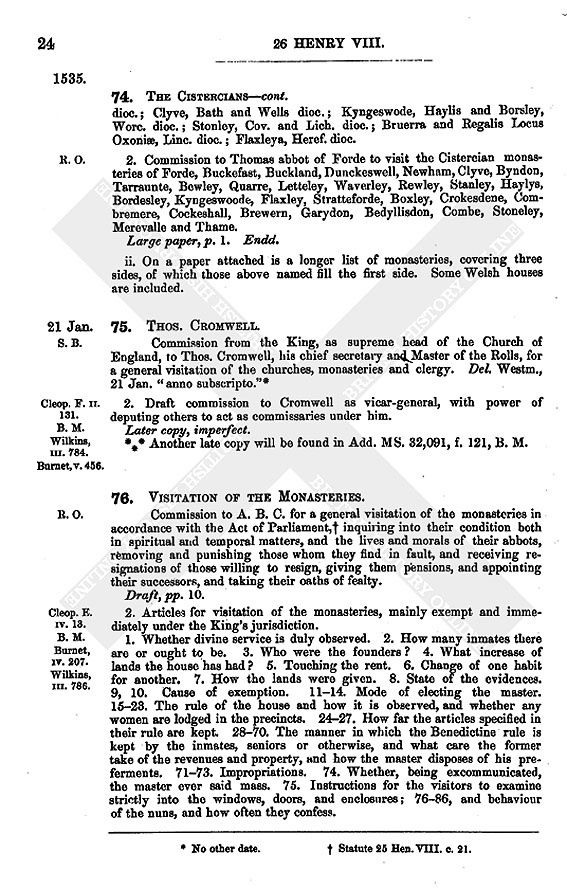
| R. O. | 74. The Cistercians. |
| Draft Royal commission to Thos. Calne, abbot of Stanley, Sarum dioc., to visit certain monasteries of the Cistercian order; referring in the preamble to statute 25 Hen. VIII. [c. 21]. | |
| Pp. 4. | |
| ii. A list of the Cistercian monasteries to be visited in different dioceses, on the first leaf of the preceding, viz.:— | |
| Waverley, Beaulieu, Letus Locus (qu. Netley, formerly Letley?) and Quar, Winchester dioc; Byndon, Terranta Sanctimonialium and Stanley, Sarum dioc.; Ford, Newham, Dunxwella, Buckfast and Buckfast and Buckland, Exeter dioc.; Clyve, Bath and Wells dioc.; Kyngeswode, Haylis and Borsley, Worc. dioc.; Stonley, Cov. and Lich. dioc.; Bruerra and Regalis Locus Oxoniæ, Linc. dioc.; Flaxleya, Heref. dioc. | |
| R. O. | 2. Commission to Thomas abbot of Forde to visit the Cistercian monasteries of Forde, Buckefast, Buckland, Dunckeswell, Newham, Clyve, Byndon, Tarraunte, Bewley, Quarre, Letteley, Waverley, Rewley, Stanley, Haylys, Bordesley, Kyngeswoode, Flaxley, Stratteforde, Boxley, Crokesdene, Combremere, Cockeshall, Brewern, Garydon, Bedyllisdon, Combe, Stoneley, Merevalle and Thame. |
| Large paper, p. 1. Endd. | |
| ii. On a paper attached is a longer list of monasteries, covering three sides, of which those above named fill the first side. Some Welsh houses are included. | |