Letters and Papers, Foreign and Domestic, Henry VIII, Volume 8, January-July 1535. Originally published by Her Majesty's Stationery Office, London, 1885.
This free content was digitised by double rekeying. All rights reserved.
'Henry VIII: April 1535, 11-20', in Letters and Papers, Foreign and Domestic, Henry VIII, Volume 8, January-July 1535, ed. James Gairdner (London, 1885), British History Online https://www.british-history.ac.uk/letters-papers-hen8/vol8/pp202-218 [accessed 1 May 2025].
'Henry VIII: April 1535, 11-20', in Letters and Papers, Foreign and Domestic, Henry VIII, Volume 8, January-July 1535. Edited by James Gairdner (London, 1885), British History Online, accessed May 1, 2025, https://www.british-history.ac.uk/letters-papers-hen8/vol8/pp202-218.
"Henry VIII: April 1535, 11-20". Letters and Papers, Foreign and Domestic, Henry VIII, Volume 8, January-July 1535. Ed. James Gairdner (London, 1885), British History Online. Web. 1 May 2025. https://www.british-history.ac.uk/letters-papers-hen8/vol8/pp202-218.






April 1535, 11-20
| 11 April. R. O. |
531. T. Warley to Lady Lisle. |
|---|---|
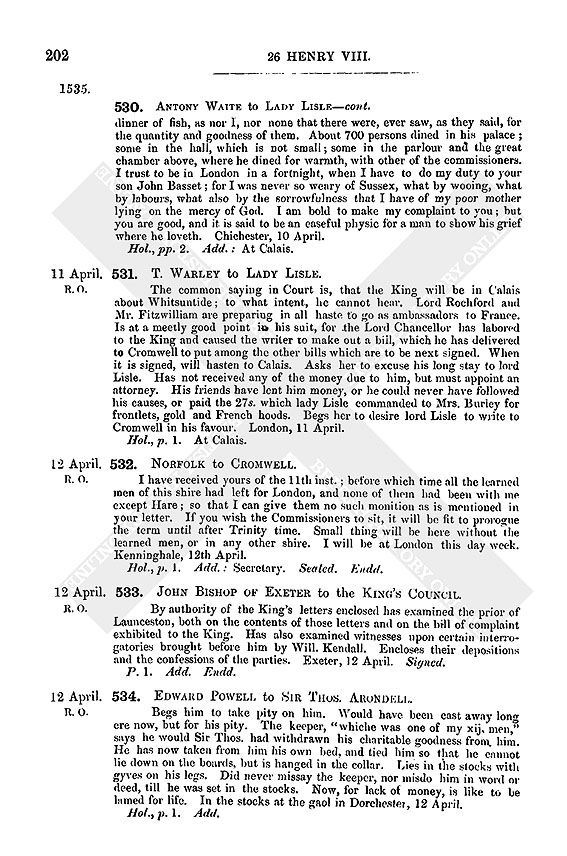
| The common saying in Court is, that the King will be in Calais about Whitsuntide; to what intent, he cannot hear. Lord Rochford and Mr. Fitzwilliam are preparing in all haste to go as ambassadors to France. Is at a meetly good point in his suit, for the Lord Chancellor has labored to the King and caused the writer to make out a bill, which he has delivered to Cromwell to put among the other bills which are to be next signed. When it is signed, will hasten to Calais. Asks her to excuse his long stay to lord Lisle. Has not received any of the money due to him, but must appoint an attorney. His friends have lent him money, or he could never have followed his causes, or paid the 27s. which lady Lisle commanded to Mrs. Buriey for frontlets, gold and French hoods. Begs her to desire lord Lisle to write to Cromwell in his favour. London, 11 April. | |
| Hol., p. 1. At Calais. | |
| 12 April. R. O. |
532. Norfolk to Cromwell. |
| I have received yours of the 11th inst.; before which time all the learned men of this shire had left for London, and none of them had been with me except Hare; so that I can give them no such monition as is mentioned in your letter. If you wish the Commissioners to sit, it will be fit to prorogue the term until after Trinity time. Small thing will be here without the learned men, or in any other shire. I will be at London this day week. Kenninghale, 12th April. | |
| Hol., p. 1. Add.: Secretary. Sealed. Endd. | |
| 12 April. R. O. |
533. John Bishop of Exeter to the King's Council. |
| By authority of the King's letters enclosed has examined the prior of Launceston, both on the contents of those letters and on the bill of complaint exhibited to the King. Has also examined witnesses upon certain interrogatories brought before him by Will. Kendall. Encloses their depositions and the confessions of the parties. Exeter, 12 April. Signed. | |
| P. 1. Add. Endd. | |
| 12 April. R. O. |
534. Edward Powell to Sir Thus. Arondell. |
| Begs him to take pity on him. Would have been cast away long ere now, but for his pity. The keeper, "whiche was one of my xij, men," says he would Sir Thos. had withdrawn his charitable goodness from him. He has now taken from him his own bed, and tied him so that he cannot lie down on the boards, but is hanged in the collar. Lies in the stocks with gyves on his legs. Did never missay the keeper, nor misdo him in word or deed, till he was set in the stocks. Now, for lack of money, is like to be lamed for life. In the stocks at the gaol in Dorchester, 12 April. | |
| Hol., p. 1. Add. | |
| 12 April. Nero, B. vii. 108. B. M. |
535. Harvel to Starkey. |
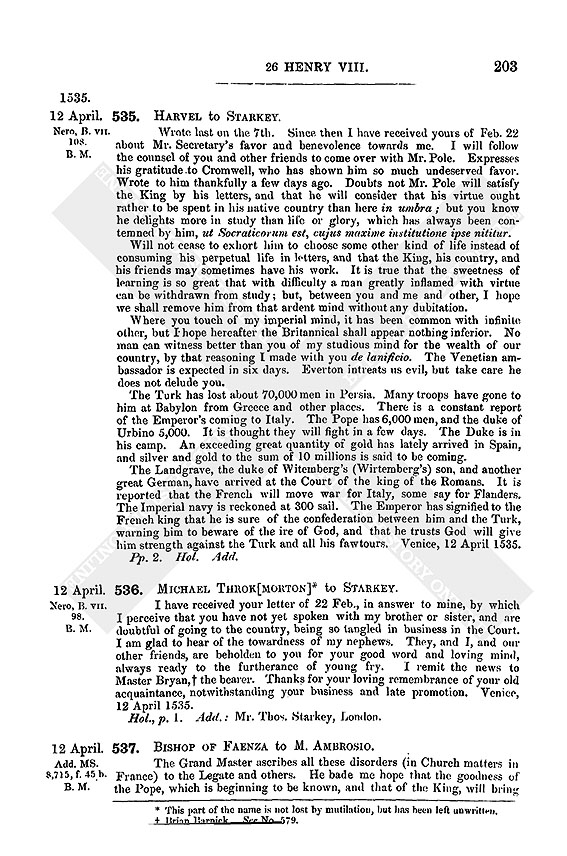
| Wrote last on the 7th. Since then I have received yours of Feb. 22 about Mr. Secretary's favor and benevolence towards me. I will follow the counsel of you and other friends to come over with Mr. Pole. Expresses his gratitude to Cromwell, who has shown him so much undeserved favor. Wrote to him thankfully a few days ago. Doubts not Mr. Pole will satisfy the King by his letters, and that he will consider that his virtue ought rather to be spent in his native country than here in umbra; but you know he delights more in study than life or glory, which has always been contemned by him, at Socraticorum est, cujus maxime institutione ipse nititur. | |
| Will not cease to exhort him to choose some other kind of life instead of consuming his perpetual life in letters, and that the King, his country, and his friends may sometimes have his work. It is true that the sweetness of learning is so great that with difficulty a man greatly inflamed with virtue can be withdrawn from study; but, between you and me and other, I hope we shall remove him from that ardent mind without any dubitation. | |
| Where you touch of my imperial mind, it has been common with infinite other, but I hope hereafter the Britannical shall appear nothing inferior. No man can witness better than you of my studious mind for the wealth of our country, by that reasoning I made with you de lanificio. The Venetian ambassador is expected in six days. Everton intreats us evil, but take care he does not delude you. | |
| The Turk has lost about 70,000 men in Persia. Many troops have gone to him at Babylon from Greece and other places. There is a constant report of the Emperor's coming to Italy. The Pope has 6,000 men, and the duke of Urbino 5,000. It is thought they will fight in a few days. The Duke is in his camp. An exceeding great quantity of gold has lately arrived in Spain, and silver and gold to the sum of 10 millions is said to be coming. | |
| The Landgrave, the duke of Witemberg's (Wirtemberg's) son, and another great German, have arrived at the Court of the king of the Romans. It is reported that the French will move war for Italy, some say for Flanders. The Imperial navy is reckoned at 300 sail. The Emperor has signified to the French king that he is sure of the confederation between him and the Turk, warning him to beware of the ire of God, and that he trusts God will give him strength against the Turk and all his fawtours. Venice, 12 April 1535. | |
| Pp. 2. Hol. Add. | |
| 12 April. Nero, B. vii. 98. B. M. |
536. Michael Throk[morton] (fn. 1) to Starkey. |
| I have received your letter of 22 Feb., in answer to mine, by which I perceive that you have not yet spoken with my brother or sister, and are doubtful of going to the country, being so tangled in business in the Court. I am glad to hear of the towardness of my nephews. They, and I, and our other friends, are beholden to you for your good word and loving mind, always ready to the furtherance of young fry. I remit the news to Master Bryan, (fn. 2) the bearer. Thanks for your loving remembrance of your old acquaintance, notwithstanding your business and late promotion. Venice, 12 April 1535. | |
| Hol., p. 1. Add.: Mr. Thos. Starkey, London. | |
| 12 April. Add. MS. 8,715, f. 45 b. B. M. |
537. Bishop of Faenza to M. Ambrosio. |
| The Grand Master ascribes all these disorders (in Church matters in France) to the Legate and others. He bade me hope that the goodness of the Pope, which is beginning to be known, and that of the King, will bring about better things,—hinting that the practise with England was the cause of much disorder, but he hoped all would be well in the end. Great hatred reigns in this Court, but the Grand Master overcomes all in the end. The Legate has every one for his enemy. Lately when the King was displeased with him he retired from Court for five or six days, during which time he examined the King's expenses; then told Francis on his return he was hated for his attempts at economy; for Francis had spent in a few years 13 millions of gold, of which the Grand Master and the Admiral had received a good share. The Admiral supports England, the Grand Master the contrary. The English, who have increased their revenues at the expense of the Church, try to persuade the French to do the same, but the Bishop does not fear it. | |
| The bishop of Paris professes to have done much service to the Holy See in Germany, and says he can do more than anyone else in England. The marriage with the duke of Angouleme is being negociated in England. The King despairs of other sons, so that this last daughter may be mistress of England. It is expected that the king of England will do everything, but the interview is not certain, and will probably depend upon the decision about the marriage. | |
| Ital., modern copy, pp. 5. Headed: Da Montiviglier alli 12 ut supra a Sig. M. Ambrogio a Mons. Baldassarro, &c. | |
| 13 April. R. O. |
538. Sir W. Courtenay to Cromwell. |
| I beg your favor to my brother Sir Will. Carewe in a matter depending before you in the Chancery in the matter of Thos. Speke. Such learned men as have been his counsel cannot be at London at this time because of the King's business about the commission, and therefore he must trust entirely to Richard Pollard. Powderham, 13 April. Signed. | |
| P. 1. Add.: Secretary. Endd. | |
| 13 April. R. O. |
539. Sir T. Nevill to Cromwell. |
| I have received your letter by master Palmer, and have sent to you my poor conceit by my son your servant Rob. Sothwell, as to his marriage with my daughter, waiting your pleasure. Mereworth in Kent, 13 April. Signed. | |
| P. 1. Add.: Secretary. | |
| 13 April. R. O. |
540. Arthur Layton, priest, to Dr. Richard Layton. |
| I desire you to be good friend to Mr. Wygge, prior of the Austin Friars, Bristol, in such matters as he shall have before Mr. Secretary, and to further his business as if it were my own. Dene, 13 April. "With the rude hand of your loving brother." | |
| Hol., p. 1. Add. Endd. | |
| 13 April. R. O. |
541. Leonard Smyth to Lord Lisle. |
| I have received your two letters, one by my servant, the other dated 5 April. I perceive you intend to have your whole revenue this half year, and that my suit for your warrant—mostly for money laid out of my own purse by your command and my lady's—shall stay till my coming to Calais, which is uncertain. I have not been very importunate, and shall wait your pleasure, trusting you will not see me a loser. I never wrote that your creation money was barred or taken from you; but, owing to the pardon, the sheriffs in other shires, as well as where you are paid, cannot levy so much money as they should have done otherwise, so that it will not be raised in those shires for a year or two. But it will be all paid at length, and you are in no worse case than other noblemen who have creation money. | |
| I have not yet delivered my master your letter touching Debnam's matter, because he has been sick and is not yet out of his chamber. I have received your warrant for a protection, for which I will pay you 40s. as I promised, or redeliver it to you. I will send a letter of attorney and a quittance for you to send to Mr. Wyndesore to receive your money of Mr. Seymour at Paul's, on the 31 May next. You must also send a letter to the Lord Chancellor that you are content all recognizances between you and Mr. Seymour be cancelled according to the award. Your bill of victualling is signed, to be dormant. I advised Hussey long ago not to trouble your friends for the King's bill, for it will only enable you to get victuals for your household out of England, putting in surety at every port to the customers for as much as is shipped, to bring certificates of its delivery at Calais. You might have as much without any licence, but as your bill is signed the matter is past. It is thought the duke of Norfolk and my master will be at Calais before Pentecost or shortly after. London, 13 April. | |
| Hol., p. 1. Add.: deputy of [Calais]. | |
| 13 April. Nero, B. vi. 149. B. M. |
542. Bernardin Sandro to Starkey. |
| Was about to complain that Starkey had only written once since their departure from Venice, when Messer Edmondo [Harvel ?] arrived with a packet of letters for N. Signore d'Inghilterra, (fn. 3) among which was Starkey's second of Feb. 22. Thanks him for his affection, which neither dignity, honor, nor distance can extinguish, which is found in few people now. Hopes his present good fortune will be the beginning of greater things. Will send him news from Venice, as he asks. On the third Sunday in April the bâton will be given to Pietro Lando, General of the sea, and he will immediately depart to protect the Venetian possessions, because the Jew has attacked Canaletto, a Venetian captain of galleys, with 30 foists, and put him to flight. Since the first day of Lent till now more than 10,000 persons have died of "mal di punta." In our parish forty have died in less than three weeks, and deaths occur every day. In S. Simeone sometimes six are buried in one day. Never goes out without seeing a body carried to the church. All the country is in terror. The "Signori della Sanita" have had two bodies dissected, but he has not heard whether the cause of the disease has been discovered. Messer Jo. Baptista is here to see "il Signore" about his eye, and is better. Bread is cheap. A "marchetto" will buy as much as the hungriest can eat. Wine is dearer, the duty (il datio) being increased. In the rest of Italy things are cheap. From Spain there are letters that the Emperor is coming to Naples. Thinks it is true, because Thomaso Contarini, M. Gasparo's brother, was chosen ambassador to the Emperor, and being ready to start has been stopped. The Turk has been defeated by the Sophy, and himself escaped with difficulty. The Persian has taken all his artillery. This news came in letters from Canaletto at Corfu. He was informed by a Greek of the company of Habbrayn Bassa. They are working hard at the arsenal. | |
| A considerable number of Germans have come from Germany. In Venice they say they number 7,000, in Lombardy 13,000. Matthio saw some of them at Verona, on their way to embark at Genoa to serve against Barbarossa in Barbary. Barbarossa has left Tunis, and joined the Jewish Corsair. Between them they have a great fleet. Some say that Philippo Doria, the marquis of Guasto, and Ferrante, brother of the duke of Mantua, are gone with 50 barks and 10 galleys to the Straits of Constantinople to prevent Barbarossa's return thither. Some say this is untrue. It is said that the king of Tunis, driven out by Barbarossa, has promised the Emperor to be his subject, and turn Christian, if he will help him. Venice, 13 April 1535, at the 3rd hour at night. | |
| Hol., Ital., pp. 2. Add.: Londini in Aula Regis. | |
| 15 April. R. O. |
543. Henry Earl of Essex to [Cromwell]. |
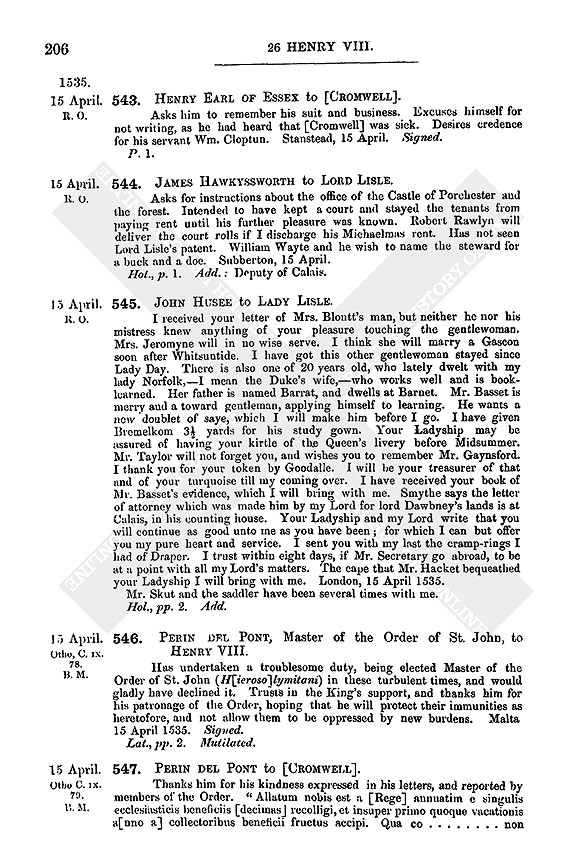
| Asks him to remember his suit and business. Excuses himself for not writing, as he had heard that [Cromwell] was sick. Desires credence for his servant Wm. Cloptun. Stanstead, 15 April. Signed. | |
| P. 1. | |
| 15 April. R. O. |
544. James Hawkyssworth to Lord Lisle. |
| Asks for instructions about the office of the Castle of Porchester and the forest. Intended to have kept a court and stayed the tenants from paying rent until his further pleasure was known. Robert Rawlyn will deliver the court rolls if I discharge his Michaelmas rent. Has not seen Lord Lisle's patent. William Wayte and he wish to name the steward for a buck and a doe. Subberton, 15 April. | |
| Hol., p. 1. Add.: Deputy of Calais. | |
| 15 April. R. O. |
545. John Husee to Lady Lisle. |
| I received your letter of Mrs. Blontt's man, but neither he nor his mistress knew anything of your pleasure touching the gentlewoman. Mrs. Jeromyne will in no wise serve. I think she will marry a Gascon soon after Whitsuntide. I have got this other gentlewoman stayed since Lady Day. There is also one of 20 years old, who lately dwelt with my lady Norfolk,—I mean the Duke's wife,—who works well and is booklearned. Her father is named Barrat, and dwells at Barnet. Mr. Basset is merry and a toward gentleman, applying himself to learning. He wants a new doublet of saye, which I will make him before I go. I have given Bremelkom 3½ yards for his study gown. Your Ladyship may be assured of having your kirtle of the Queen's livery before Midsummer. Mr. Taylor will not forget you, and wishes you to remember Mr. Gaynsford. I thank you for your token by Goodalle. I will be your treasurer of that and of your turquoise till my coming over. I have received your book of Mr. Basset's evidence, which I will bring with me. Smythe says the letter of attorney which was made him by my Lord for lord Dawbney's lands is at Calais, in his counting house. Your Ladyship and my Lord write that you will continue as good unto me as you have been; for which I can but offer you my pure heart and service. I sent you with my last the cramp-rings I had of Draper. I trust within eight days, if Mr. Secretary go abroad, to be at a point with all my Lord's matters. The cape that Mr. Hacket bequeathed your Ladyship I will bring with me. London, 15 April 1535. | |
| Mr. Skut and the saddler have been several times with me. | |
| Hol., pp. 2. Add. | |
| 15 April. Otho, C. ix. 78. B. M. |
546. Perin del Pont, Master of the Order of St. John, to Henry VIII. |
| Has undertaken a troublesome duty, being elected Master of the Order of St. John (H[ieroso]lymitani) in these turbulent times, and would gladly have declined it. Trusts in the King's support, and thanks him for his patronage of the Order, hoping that he will protect their immunities as heretofore, and not allow them to be oppressed by new burdens. Malta 15 April 1535. Signed. | |
| Lat., pp. 2. Mutilated. | |
| 15 April. Otho C. ix. 79. B. M. |
547. Perin del Pont to [Cromwell]. |
| Thanks him for his kindness expressed in his letters, and reported by members of the Order. "Allatum nobis est a [Rege] annuatim e singulis ecclesiasticis beneficiis [decimas] recolligi, et insuper primo quoque vacationis a[nno a] collectoribus beneficii fructus accipi. Qua co ........ non puto Regem voluisse, immo vero certo sci[o] .......... nostrum protectorem, commendas nostras obligat ........ nostra alioqui religione actum. Quod prolixius ......... [pri]ore Sti Joannis, quem cum nostris omnibus qui istic agunt jussi[mu]s ad te tanquam ad præcipuum patronum nostrum confugere, si [aliqu]id ejusmodi forte inciderit a rege nobis impetrandum." Begs him not to desert the Order. If they can return his kindness, will do so. Malta, 15 April 1535. Signed. | |
| Lat., mutilated, pp. 2. | |
| 15 Apr. Vatican Archives. |
548. Bishop of Faenza to M. Ambrogio. |
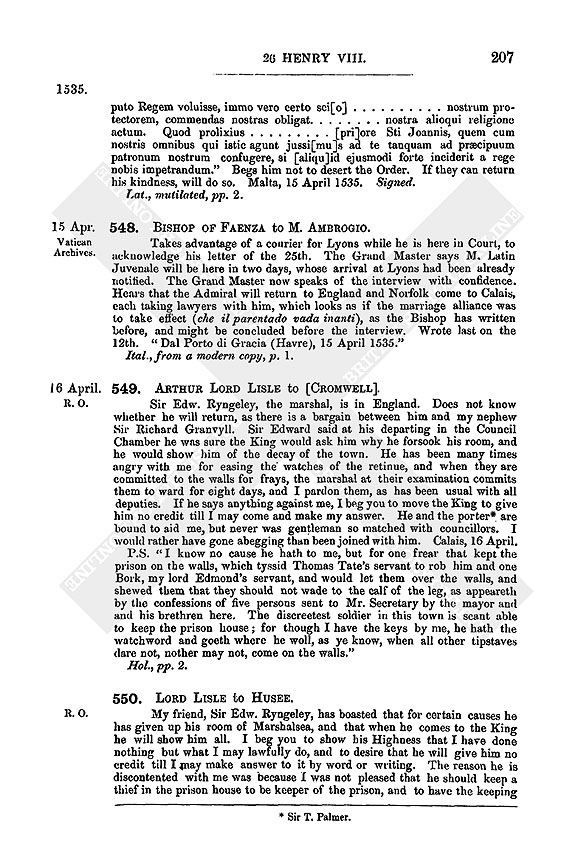
| Takes advantage of a courier for Lyons while he is here in Court, to acknowledge his letter of the 25th. The Grand Master says M. Latin Juvenale will be here in two days, whose arrival at Lyons had been already notified. The Grand Master now speaks of the interview with confidence. Hears that the Admiral will return to England and Norfolk come to Calais, each taking lawyers with him, which looks as if the marriage alliance was to take effect (che il parentado vada inanti), as the Bishop has written before, and might be concluded before the interview. Wrote last on the 12th. "Dal Porto di Gracia (Havre), 15 April 1535." | |
| Ital., from a modern copy, p. 1. | |
| 16 April. R. O. |
549. Arthur Lord Lisle to [Cromwell]. |
| Sir Edw. Ryngeley, the marshal, is in England. Does not know whether he will return, as there is a bargain between him and my nephew Sir Richard Granvyll. Sir Edward said at his departing in the Council Chamber he was sure the King would ask him why he forsook his room, and he would show him of the decay of the town. He has been many times angry with me for easing the watches of the retinue, and when they are committed to the walls for frays, the marshal at their examination commits them to ward for eight days, and I pardon them, as has been usual with all deputies. If he says anything against me, I beg you to move the King to give him no credit till I may come and make my answer. He and the porter (fn. 4) are bound to aid me, but never was gentleman so matched with councillors. I would rather have gone abegging than been joined with him. Calais, 16 April. | |
| P.S. "I know no cause he hath to me, but for one frear that kept the prison on the walls, which tyssid Thomas Tate's servant to rob him and one Bork, my lord Edmond's servant, and would let them over the walls, and shewed them that they should not wade to the calf of the leg, as appeareth by the confessions of five persons sent to Mr. Secretary by the mayor and and his brethren here. The discreetest soldier in this town is scant able to keep the prison house; for though I have the keys by me, he hath the watchword and goeth where he woll, as ye know, when all other tipstaves dare not, nother may not, come on the walls." | |
| Hol., pp. 2. | |
| R. O. | 550. Lord Lisle to Husee. |
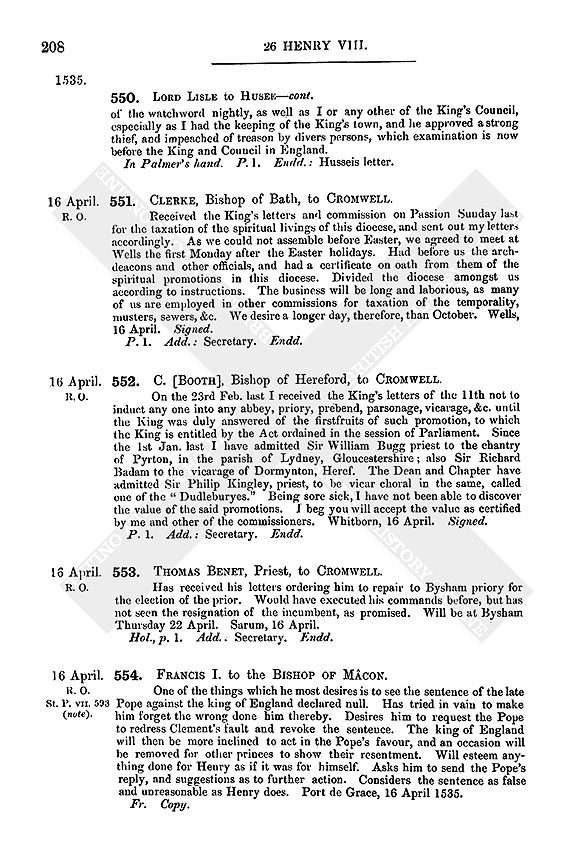
| My friend, Sir Edw. Ryngeley, has boasted that for certain causes he has given up his room of Marshalsea, and that when he comes to the King he will show him all. I beg you to show his Highness that I have done nothing but what I may lawfully do, and to desire that he will give him no credit till I may make answer to it by word or writing. The reason he is discontented with me was because I was not pleased that he should keep a thief in the prison house to be keeper of the prison, and to have the keeping of the watchword nightly, as well as I or any other of the King's Council, especially as I had the keeping of the King's town, and he approved a strong thief, and impeached of treason by divers persons, which examination is now before the King and Council in England. | |
| In Palmer's hand. P. 1. Endd.: Husseis letter. | |
| 16 April. R. O. |
551. Clerke, Bishop of Bath, to Cromwell. |
| Received the King's letters and commission on Passion Sunday last for the taxation of the spiritual livings of this diocese, and sent out my letters accordingly. As we could not assemble before Easter, we agreed to meet at Wells the first Monday after the Easter holidays. Had before us the archdeacons and other officials, and had a certificate on oath from them of the spiritual promotions in this diocese. Divided the diocese amongst us according to instructions. The business will be long and laborious, as many of us are employed in other commissions for taxation of the temporality, musters, sewers, &c. We desire a longer day, therefore, than October. Wells, 16 April. Signed. | |
| P. 1. Add.: Secretary. Endd. | |
| 16 April. R. O. |
552. C. [Booth], Bishop of Hereford, to Cromwell. |
| On the 23rd Feb. last I received the King's letters of the 11th not to induct any one into any abbey, priory, prebend, parsonage, vicarage, &c. until the King was duly answered of the firstfruits of such promotion, to which the King is entitled by the Act ordained in the session of Parliament. Since the 1st Jan. last I have admitted Sir William Bugg priest to the chantry of Pyrton, in the parish of Lydney, Gloucestershire; also Sir Richard Badam to the vicarage of Dormynton, Heref. The Dean and Chapter have admitted Sir Philip Kingley, priest, to be vicar choral in the same, called one of the "Dudleburyes." Being sore sick, I have not been able to discover the value of the said promotions. I beg you will accept the value as certified by me and other of the commissioners. Whitborn, 16 April. Signed. | |
| P. 1. Add.: Secretary. Endd. | |
| 16 April. R. O. |
553. Thomas Benet, Priest, to Cromwell. |
| Has received his letters ordering him to repair to Bysham priory for the election of the prior. Would have executed his commands before, but has not seen the resignation of the incumbent, as promised. Will be at Bysham Thursday 22 April. Sarum, 16 April. | |
| Hol., p. 1. Add.: Secretary. Endd. | |
| 16 April. R. O. St. P. vii. 593 (note). |
554. Francis I. to the Bishop of Mâcon. |
| One of the things which he most desires is to see the sentence of the late Pope against the king of England declared null. Has tried in vain to make him forget the wrong done him thereby. Desires him to request the Pope to redress Clement's fault and revoke the sentence. The king of England will then be more inclined to act in the Pope's favour, and an occasion will be removed for other princes to show their resentment. Will esteem anything done for Henry as if it was for himself. Asks him to send the Pope's reply, and suggestions as to further action. Considers the sentence as false and unreasonable as Henry does. Port de Grace, 16 April 1535. | |
| Fr. Copy. | |
| 16 April. Vatican Archives. |
555. Bishop of Faenza to M. Ambrogio. |
| Is convinced that the practices for the marriage with England are being pressed forward, and having to be managed by the Admiral on this side, and Norfolk on that, it may reasonably be expected that it will take effect. Havre de Grace, 16 April 1535. | |
| Ital., from a modern copy, p. 1. There is also a copy in MS. Add. 8,715, f. 48. B. M. | |
| 17 April. Vienna Archives. |
556. Chapuys to Charles V. |
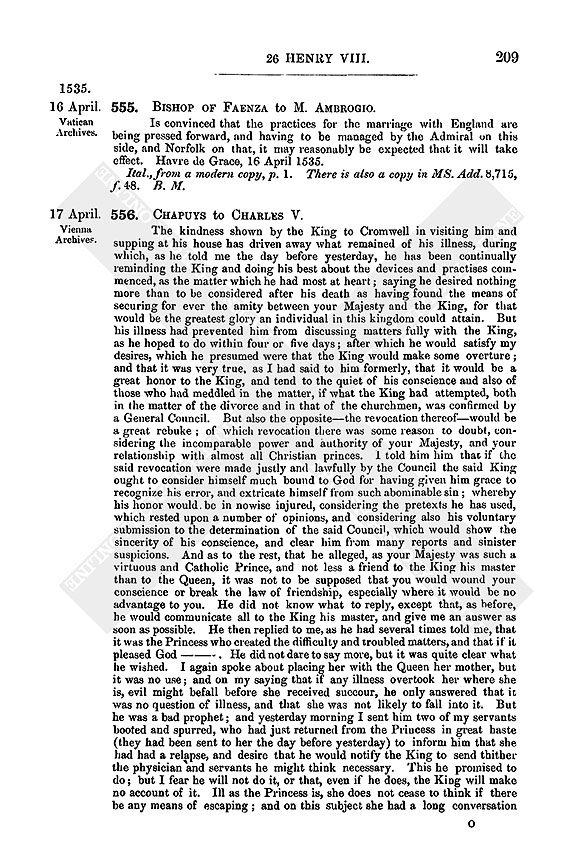
| The kindness shown by the King to Cromwell in visiting him and supping at his house has driven away what remained of his illness, during which, as he told me the day before yesterday, he has been continually reminding the King and doing his best about the devices and practises commenced, as the matter which he had most at heart; saying he desired nothing more than to be considered after his death as having found the means of securing for ever the amity between your Majesty and the King, for that would be the greatest glory an individual in this kingdom could attain. But his illness had prevented him from discussing matters fully with the King, as he hoped to do within four or five days; after which he would satisfy my desires, which he presumed were that the King would make some overture; and that it was very true, as I had said to him formerly, that it would be a great honor to the King, and tend to the quiet of his conscience and also of those who had meddled in the matter, if what the King had attempted, both in the matter of the divorce and in that of the churchmen, was confirmed by a General Council. But also the opposite—the revocation thereof—would be a great rebuke; of which revocation there was some reason to doubt, considering the incomparable power and authority of your Majesty, and your relationship with almost all Christian princes. I told him him that if the said revocation were made justly and lawfully by the Council the said King ought to consider himself much bound to God for having given him grace to recognize his error, and extricate himself from such abominable sin; whereby his honor would be in nowise injured, considering the pretexts he has used, which rested upon a number of opinions, and considering also his voluntary submission to the determination of the said Council, which would show the sincerity of his conscience, and clear him from many reports and sinister suspicions. And as to the rest, that he alleged, as your Majesty was such a virtuous and Catholic Prince, and not less a friend to the King his master than to the Queen, it was not to be supposed that you would wound your conscience or break the law of friendship, especially where it would be no advantage to you. He did not know what to reply, except that, as before, he would communicate all to the King his master, and give me an answer as soon as possible. He then replied to me, as he had several times told me, that it was the Princess who created the difficulty and troubled matters, and that if it pleased God ——. He did not dare to say more, but it was quite clear what he wished. I again spoke about placing her with the Queen her mother, but it was no use; and on my saying that if any illness overtook her where she is, evil might befall before she received succour, he only answered that it was no question of illness, and that she was not likely to fall into it. But he was a bad prophet; and yesterday morning I sent him two of my servants booted and spurred, who had just returned from the Princess in great haste (they had been sent to her the day before yesterday) to inform him that she had had a relapse, and desire that he would notify the King to send thither the physician and servants he might think necessary. This he promised to do; but I fear he will not do it, or that, even if he does, the King will make no account of it. Ill as the Princess is, she does not cease to think if there be any means of escaping; and on this subject she had a long conversation with one of my men, begging me most urgently to think over the matter, otherwise she considered herself lost, knowing that they wanted only to kill her. She has not had leisure to visit the neighbourhood of the house where she is, nor to devise means how she could get away night or day. And because I see the thing is difficult I keep her in hope of a speedy remedy by some other means, and endeavour to remove her suspicion that foul play is intended against her. | |
| Cromwell has always given me to understand that he is much devoted to the Princess; nevertheless, I have found no evidence of it, except words; and today a notable personage has informed me that the King, the day he went to visit Cromwell, told him that he had that day heard many good things of the Princess his daughter, of which he had not been so well informed before; and on coming to the particulars of what had been told him, Cromwell ventured to say they were all lies, and afterwards sent for a gentleman who had so informed the King, commanding him, if he did not wish to be destroyed and possibly lose his life, that he should go and unsay to the King what he had said in favor of the Princess; but the gentleman refused to obey. Your Majesty may consider how the good Princess is placed. Cromwell has certified me that it is not yet determined whether the assembly of commissioners shall be held or not; but if a conclusion be come to, he will inform me at once. He assures me that nothing will be done in any case prejudicial to the affairs discussed between us. I asked him if the treasurer of Brittany had related to him some news such as he was accustomed to report. He said he had not wished to see or hear him; which was the very news I wanted, and it was for no other purpose that I had asked, except to learn if he had given him audience. He said, however, that Morette, the French ambassador, instead of giving him news, had made great complaints of the familiarity and communications we had had together, which he thought showed no great wisdom. I tried by various ways to ascertain with what object the said assembly was appointed, but I could get no satisfaction, and could only conjecture that, as regards the English, they wished to interrupt the Council, or bind the French like those of Lubeck, in case of the said Council, to maintain their quarrel with the Pope about the divorce. Cromwell informs me the English ambassador in France had informed him (navoit advertyr, apparently for Pavoit adverti) that it was reported there your Majesty would go to Italy and reside some days at Milan, and afterwards go to Mantua; at which, and at the powerful army of your Majesty, the French are very much depressed. Cromwell expresses satisfaction at it, both for the confusion of the French, and because he thinks it certain that your Majesty will take order about the falsehood and dissolute lives of the churchmen, saying that they would require to have their head cut off, and ere long the Pope would be reduced to a chaplain of your Majesty. Cromwell also told me that he thought I was already apprised of their good news from Ireland, that their traitor was caught. But on asking him how he had been taken, he corrected his words, saying he thought it certain that he had been by that time taken, for the King had already news of a castle (fn. 5) that the King's men had won from him, and that he could not possibly have escaped. I know not how the matter goes, but a good man has received two letters lately from Ireland declaring that Kildare had abandoned the said castle in order to draw the others on, and had killed 300 English, having decoyed them by a body accoutred in the English fashion. He had sent his followers to a town belonging to the King, where they were allowed entrance as friends and seized the gates, after which Kildare came up and sacked the place without resistance. The letters also state that Kildare was as powerful as ever. The truth must be known before long. The Secretary of the duke of Holstein, who has several times come to see me, has only been despatched within these two days; and I know not how, for he has had no verbal answer, but only a letter addressed to the Duke his master, delivered to him by Cromwell, who would not allow him to speak again, or take leave of the King. The said Secretary, with all his urgency, has been unable to obtain information from the King or Cromwell whether a certain treaty offered by the Lubeckers to the King to make him peaceful possessor of the kingdom of Denmark had been accepted or not. The answers made to him on the subject have always been obscure and ambiguous. London, 17 April 1535. | |
| French, from a modern copy, pp. 4. | |
| 17 April. R. O. St. P. vii. 592. |
557. Philip Chabot, Lord of Bryon, to Henry VIII. |
| Has received his letters by the treasurer Palamydes, and shown the contents and his message to the French king, who is pleased to hear of Henry's prosperity, and approves of the proposal for confirming their friendship by the marriage of the English princess with the duke of Angoulesme. After hearing the names of the persons whom Henry will send to Calais, Francis has appointed to meet them, the Grand Esquire, (fn. 6) Guillaume Poyet, president of the Court of Parliament, and Guillaume Bochetel, secretary of Finances, and approves of the King's proposal that the meeting should be held at Whitsuntide. The King also approves of Henry's advice that he should persuade the Pope to annul Clement's sentence before treating of this matter, and intends to send a prompt dispatch to Rome to persuade the Pope to make the said revocation. He does not think that if the Pope refuse that will be any reason to put off the meeting at Calais, and he promises that he will always consider the said sentence to be unjust, and will help Henry in maintaining it to be so, but in other matters each must live in his kingdom without the other trying to make him do otherwise than he likes. | |
| Promises on behalf of Francis that he will make no treaty for the marriage of any of his children till the said meeting. | |
| Will do all he can towards the perpetual friendship and union of the two Kings. Francis is as willing as Henry to enter into any honourable agreement or treaty. Grace, 17 April. Signed. | |
| Pp. 3. Fr. Add. Sealed. Endd. | |
| 17 April. R. O. |
558. Sir Thomas Arundell to Cromwell. |
| Has received his letter, and is glad to learn he is recovering from his sickness. Is much grieved that he should have taken anything in his late letter for a taunt. Is not so regardless of Cromwell's authority, or so ungrateful to his best master, but for whose goodness he would have been in danger of losing the greater part of his living. Nothing will be more painful to him than that Cromwell should misunderstand him. Although Cromwell has been persuaded that the bishop of Exeter will proceed according to justice in the Abbot's appeal, "he is too well known in these parts to be so taken." The Bishop's intentions are manifest by the handling of this matter; for since the remitting he has done nothing but support his official without examination. Begs that the matter be tried by indifferent judges. Chydyoke, 17 April. | |
| Hol., pp. 2. Add.: To the Right Hon. Mr. Secretary. Endd. | |
| 17 April. R. O. |
559. [Lisle to Cromwell.] |
| Sir Edw. Ryngeley, marshal here, on Wednesday, 15th inst, (fn. 7) said in the Council Chamber that he would into England, and he was sure the King would ask him why he departed from his office. He spoke highly of his office, what it was worth to him yearly, and how he might live with his lands in England and keep a good house. Nevertheless there was great decay here in this town, which he would show the King and his Council. I beg you, if he blame me in anything for the insecurity of this town, to give no credence to it till I make answer before the King or his Council. Calais, 17 April. Signed. | |
| P. 1. Begins. Right honourable Sir. | |
| R. O. | 2. Draft with a correction by Lisle's hand. P. 1. |
| 18 April. R. O. |
560. Sir John Markham and others to Cromwell. |
| On Friday, 16 April, the 26 of Hen. VIII., Supreme Head of the English Church, we, the Commissioners for the true value of all spiritual promotions in the county of Nottingham, being assembled at the priory of Bevall in the said shire, belonging to the Charterhouse, the proctors and others of the convent appeared before us, showing that the Prior was absent in London, and they desired us to take presentment of lay persons, which we would not, as we had not done so in other houses. Seeing them of such scrupulosity [in] a friendly examination, we showed them that the King was of right Supreme Head of the Church, "dilating the story true of Lucius and Eleutherius, and of Ethelertus and Lerta (sic) his wife, and Gregory and Austen." Hereon, one Will. Trafford, proctor of the said house, said, "I believe firmly that the Pope of Rome is Supreme Head of the Church Catholic." On our asking he said he would abide by his words usque ad mortem. He wrote them down, and they rest with Sir John Markham, sheriff, in whose ward he is. Send word how he is to be treated in exemplum aliorum. 18 April. Signed: John Markham—Anthony Babyngton—John Constable. | |
| P. 1. Add. Endd. | |
| 18 April. Granvelle Papiers d'Etat, ii. 326. |
561. Charles V. to his Ambassador in France. |
| Has received his letters of the 4th and 16th ult. and Good Friday. Approves of what he has done with the English ambassador and their decision to remit the practice to England, if intentions there agree with words. His object must be to disunite England and France, or, at all events, to cause suspicion so as to hinder their assisting each other, to the prejudice of Christendom, against the Emperor and his brother. Desires him to find out all he can about the understanding between them, and about the interview which has been so long talked of. * * * Barcelona, 18 April 1535. | |
| Fr. | |
| 19 April. | 562. Sir John Baldwin, Chief Justice of Common Pleas. |
| See Grants in April 26 Hen. VIII. No. 30. | |
| 20 April. R. O. |
563. [Cromwell] to Mr. Riche. |
| Requesting him to be a mean to Mr. Sayntclere to stay further suits against Edward Campion, clerk of the peace in Essex. London, 20 April. | |
| Draft, p. 1. Endd.: "Minute of letters." | |
| 20 April. R. O. |
564. John Bishop of Bangor to Cromwell. |
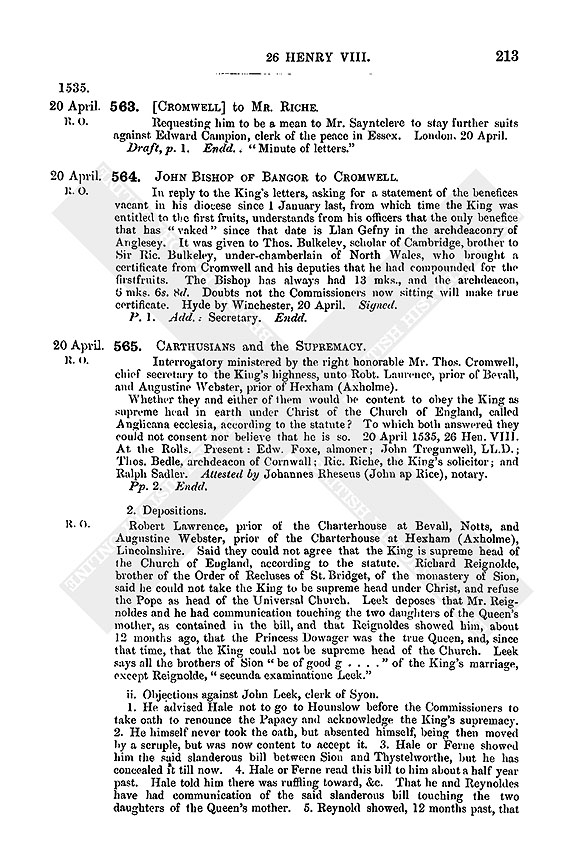
| In reply to the King's letters, asking for a statement of the benefices vacant in his diocese since 1 January last, from which time the King was entitled to the first fruits, understands from his officers that the only benefice that has "vaked" since that date is Llan Gefny in the archdeaconry of Anglesey. It was given to Thos. Bulkeley, scholar of Cambridge, brother to Sir Ric. Bulkeley, under-chamberlain of North Wales, who brought a certificate from Cromwell and his deputies that he had compounded for the firstfruits. The Bishop has always had 13 mks., and the archdeacon, 6 mks. 6s. 8d. Doubts not the Commissioners now sitting will make true certificate. Hyde by Winchester, 20 April. Signed. | |
| P. 1. Add.: Secretary. Endd. | |
| 20 April. R. O. |
565. Carthusians and the Supremacy. |
| Interrogatory ministered by the right honorable Mr. Thos. Cromwell, chief secretary to the King's highness, unto Robt. Laurence, prior of Bevall, and Augustine Webster, prior of Hexham (Axholme). | |
| Whether they and either of them would be content to obey the King as supreme head in earth under Christ of the Church of England, called Anglicana ecclesia, according to the statute? To which both answered they could not consent nor believe that he is so. 20 April 1535, 26 Hen. VIII. At the Rolls. Present: Edw. Foxe, almoner; John Tregunwell, LL.D.; Thos. Bedle, archdeacon of Cornwall; Ric. Riche, the King's solicitor; and Ralph Sadler. Attested by Johannes Rheseus (John ap Rice), notary. | |
| Pp. 2. Endd. | |
| R. O. | 2. Depositions. |
| Robert Lawrence, prior of the Charterhouse at Bevall, Notts, and Augustine Webster, prior of the Charterhouse at Hexham (Axholme), Lincolnshire. Said they could not agree that the King is supreme head of the Church of England, according to the statute. Richard Reignolde, brother of the Order of Recluses of St. Bridget, of the monastery of Sion, said he could not take the King to be supreme head under Christ, and refuse the Pope as head of the Universal Church. Leek deposes that Mr. Reignoldes and he had communication touching the two daughters of the Queen's mother, as contained in the bill, and that Reignoldes showed him, about 12 months ago, that the Princess Dowager was the true Queen, and, since that time, that the King could not be supreme head of the Church. Leek says all the brothers of Sion "be of good g ...." of the King's marriage, except Reignolde, "secunda examinatione Leek." | |
| ii. Objections against John Leek, clerk of Syon. | |
| 1. He advised Hale not to go to Hounslow before the Commissioners to take oath to renounce the Papacy and acknowledge the King's supremacy. | |
| 2. He himself never took the oath, but absented himself, being then moved by a scruple, but was now content to accept it. 3. Hale or Ferne showed him the said slanderous bill between Sion and Thystelworthe, but he has concealed it till now. 4. Hale or Ferne read this bill to him about a half year past. Hale told him there was ruffling toward, &c. That he and Reynoldes have had communication of the said slanderous bill touching the two daughters of the Queen's mother. 5. Reynold showed, 12 months past, that the lady Dowager was the true Queen, and that the King could not be supreme head. 6. Mody says that Hale and he had communication that the saying was, "the King's grace had meddling with the Queen's mother." | |
| 7. He read the same slanderous bill, and confesses the concealment of it. | |
| iii. Objections against John Hale, vicar of Istylworthe. | |
| Leek says that Hale or Ferne showed him the slanderous bill; he could not remember which, but on second examination said it was Ferne. That Hale said to Leek there was ruffling toward in Ireland, and that he would stand in stead of a man. That he heard Skydmore speak divers words. That Skydmore says Hale called the King the "Molywarppe" that Merlin prophesied of, that turned all up, and that the King was accursed of God's own mouth, and that the marriage between the King and Queen was unlawful. | |
| iv. Objections against Ferne, clerk. | |
| He confesses writing the bill with his own hand in Latin and English, &c. | |
| v. Objections against Thos. Skydmore, of Syon. | |
| John Hale says he had heard Skydmore call the King a robber and piller of the commonwealth, and say there should be ruffling in Ireland, &c. One Layman, a prophecier, said that the Pope would be in England ere Midsummer, &c. | |
| In the margin of all these depositions are certain numbers, referring apparently to articles of indictment. | |
| Pp. 5, mutilated. | |
| R. O. | 566. The Royal Supremacy. |
| Copy of the Act 26 Hen. VIII. c. 13, defining certain treasons, with the following memoranda on the back:—John Howghton says he cannot take the King to be supreme head of the Church of England. Ric. Lawrence says there is one Catholic Church, of which the bishop of Rome is the head. Augustine Webbester also denies the supremacy. Ric. Reynolds says he means no malice to the King, but he will spend "ther" (his ?) blood that he is head of the Church who has been so these 300 years, and that he must blame those who gave the King such counsel. He also says that he doth this as thousand thousand that be dead. | |
| The King is justly supreme head of the Church, and is so recognised by clergy and convocation, and besides by an Act of Parliament made to suppress errors. | |
| One leaf. Docketed: Concerning Houghton. | |
| R. O. | 567. [John Hale, Vicar of Isleworth, to the Council.] |
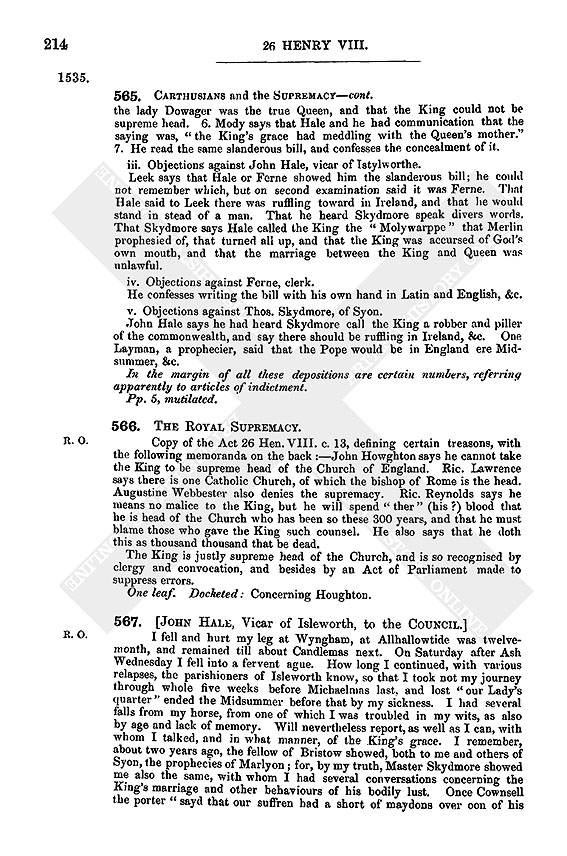
| I fell and hurt my leg at Wyngham, at Allhallowtide was twelvemonth, and remained till about Candlemas next. On Saturday after Ash Wednesday I fell into a fervent ague. How long I continued, with various relapses, the parishioners of Isleworth know, so that I took not my journey through whole five weeks before Michaelmas last, and lost "our Lady's quarter" ended the Midsummer before that by my sickness. I had several falls from my horse, from one of which I was troubled in my wits, as also by age and lack of memory. Will nevertheless report, as well as I can, with whom I talked, and in what manner, of the King's grace. I remember, about two years ago, the fellow of Bristow showed, both to me and others of Syon, the prophecies of Marlyon; for, by my truth, Master Skydmore showed me also the same, with whom I had several conversations concerning the King's marriage and other behaviours of his bodily lust. Once Cownsell the porter "sayd that our suffren had a short of maydons over oon of his chambyres at Farnam while he was with the oold lord of Wynchester." Had also conversations with Skydmore, with Sir Thomas my priest, and with Master Leeke; and once, I think, about two years ago, of the Acts of Parliament made against churchmen, with the prior of Hounslow, who offered to show me a prophecy; but we had no leisure to speak together further, for we only met at the new inn, where Mr. Yowng, Awnsam and his wife, and others, dined with us. Skydmore also used to speak of young Sir Rice, saying that Welshmen and priests were sore disdained nowadays. As to Mr. Ferne, (fn. 8) my wits were so troubled with sickness that I cannot perfectly remember what he rehearsed; but by Mr. Bydyll's rehearsal, Mr. Steward of Syon told me it was likely to be enacted that no more tithe corn should be made. I was sick long after, and, being aged and oblivious, did not see him till we met at the Secretary's at the Rolls. Also Mr. Waren, old surveyor, and the master of Ashford, in Kent, sometime steward to the bp. of Canterbury, spoke in the churchyard of Istleworth of the hard statutes made and to be made against the Church. Finally, I confess the four bills by Mr. Feerne, Mr. Leeke, Mr. Skydmore, and Sir Thos. Mody to be true, and that by such seditious ways I have maliciously slandered the King and Queen and their Council; for which I ask forgiveness of God, king Henry VIII., and queen Anne, and shall continue sorrowful during my life, which stands only in the King's will. "Moreover, Mr. Skydmore dyd show to me yongge Master Care, saying that he was our suffren Lord the Kynge's son by our suffren Lady the Qwyen's syster, whom the Qwyen's grace myght not suffer to be yn the Cowrte." | |
| Pp.3. Headed: Jhus Salvator Mundi, miserere mei quia timor mortis conturbat me. Endd.: Concernyng ..... | |
| R. O. | 568. [John Husee to Lord Lisle.] |
| After closing this letter, heard from one who saw it that 10 monks of the Charterhouse were this afternoon had to Newgate. The sheriffs still remain in the Charterhouse, which it is thought will be dissolved. | |
| Hol., p. 1. | |
| 20 April. R. O. |
569. Sir Will. Courtenay to Cromwell. |
| The bishop of Exeter, as you desired, has made Sir Thomas Pope abbot of Hartland. Since the last abbot was deposed he has conveyed away the plate of the house by means of Sir Thomas Arundell, and no corn is left. There are not four ploughs where there were six or seven. Of 1,000 sheep there is not 4, of 50 kine not 13, and of 100 other cattle not threescore. A servant of Sir Thos. Arundell came with the quondam (fn. 9) saying he was your servant; and when my servant came with the discharge of the first inhibition, he "axed" for your servant, and there he denied he was your servant. Can find none of the plate, except a cup, pawned for 22l., which the abbot has sent you, desiring you to continue his good master. | |
| I desire you to be good to my prior of Launceston, who is troubled with that wretch Kendall, and four or five unthrifty monks, of whom my friend, your nephew, can inform you. I am glad of your recovery. Exeter, 20 April. Signed. | |
| P. 1. Add.: Secretary. Endd. | |
| 20 April. R. O. |
570. Sir T. Wentworth to Cromwell. |
| The bearer is in trouble for preaching, for which he is indicted of heresy in the county of Essex. I never heard anyone well learned in God's Word who accused him of it. I have heard him three or four times, and judge him to be an honest man. Netylstede, 20 April. Signed. | |
| P. 1. Add.: Mr. Secretary. | |
| 20 April. R. O. |
571. Henry Lokwod to Cromwell. |
| I am glad to hear of your amendment. Begging your attention to our tedious suit for recompense of our lands, which has been to us great impoverishment, and occasioned great grudge to me among our company, who say that I have brought matters to no pass. If I had known that I should not have had readier expedition I would never have tarried the first conclusion of exchange, but taken me to my poor cure in the country. I have done no good in the college. By a final conclusion I shall be rejoiced, and I trust my hopes will not be frustrated. Christ's College, Cambridge, 20 April. | |
| Hol., p 1. Add.: Secretary. | |
| R. O. | 2. Grant by Henry Lokwod, S.T.P., Master, and the fellows of Christ's College, Cambridge, to Thos. Cromwell, Esq., secretary, and his son Gregory, in survivorship, of a rent of 10 mks. from the manor of Dyseworthe, Leic. |
| Lat., pp. 2. Large paper. Endd. | |
| 20 April. R. O. |
572. Thos. [Butler], Abbot of Shrewsbury, to Cromwell. |
| I received your letters that one Ric. Coly may have the bailiwick of Baschurch, in the marches of Wales. It was granted by my predecessor to Roger Cotton, deceased. The said Cotton had a deputy who would not pay the rent, and therefore it was granted to Thos. Kynaston, servant of my lord President, who occupied it while Cotton was alive. As Coley has married Cotton's wife, he is labouring to have the said office, untruly suggesting to you that he had also a grant of a pasture called Estall. My Lord President desires me to certify you of the truth of this. Shrewsbury, 20 April. | |
| Hol., p. 1. Add.: Mr. Secretary. Endd. | |
| 20 April. R. O. |
573. Hugh Yeo to Lady Lisle. |
| Master John Graynfyld, her nephew, sent long since a writ of subpæna to Mrs. Jakett Coffyn to appear in the Chancery at Mr. Bassett's suit, but no order to deliver evidences or writings. Has, therefore, returned it to Mr. Greynfyld, desiring him to procure another writ to deliver writings in her custody belonging to the manors, &c., which Lady Lisle now has, and Mr. Bassett shall have, that were Beamount's lands, or else to appear in the Chancery. Has heard nothing of it as yet, and has therefore caused such a writ to be drawn up; and if Lady Lisle will have the writ made and sent, Mrs. Coffyn will gladly deliver the writings. Thanks her for moving lord Montague to desire Mr. Reynold Pole, dean of Exeter, for the gift of the next avoidance of the vicarage of Braunton. Can hear nothing of it since the draft was delivered to Lord Montague. Cannot obtain the farm of Combmartyn church from Master Foxse, the King's almoner. Asks her to desire the dean of Exeter for the next avoidance of Braunton for his kinsman John Bery, B. D. Has not been paid his fee by Sir George Seyntleger for Wakefyl's goods seized by him. He says the goods were redelivered on Wakefyld's acquittal at Exeter before Mr. Chamond and other. Has delivered his arms to Mr. Luppyncote, the bearer, to have them engraved in a silver seal, with the helmet, in as little space as is possible, to show well in wax outwards. Asks her to get it done for him through some substantial merchant of Calais who labours to Paris. Is informed that it can be better made there than anywhere in the world, and within the breadth of a penny or twopence at the largest. Will be content to pay at the largest, for the making in a stamp, with the letter H. for Hugh, and Y. for Yeo. | |
| Advises her not to distrain Lovys, as Davy says she has ordered him to do. Braunton, 20 April. | |
| A restraint must be sent to Womberlegh this year, for the game is almost destroyed. Asks for the pasture of a yearling colt in Womberlegh, or else a buck to be taken in season. | |
| Hol., pp. 2. Add.: In Calais. | |
| R. O. | 574. [John Davy to Lady Lisle.] |
| "Articles for my good Lady's remembrance." | |
| As to the manor of Tehedy, I know no default of rent or decay there, except land called Sulmere, the lord Hastings' land, of which your Ladyship should have 4s. a year. It was distrained by Philip Harrys 26 years ago, when I made the books there. As to the manor of Marshall, your Ladyship loses 12d. a year because Trogyan, who was a freeholder there before, has purchased Mary's part, and made two tenures into one. As to Loves (Louis's?) matter, I have shown my mind to John Bury. On the death of John Manfylde, I wrote to Barnstaple to ask his wife if there were any evidences concerning my master, and I have obtained from her a box of letters of homage. One is about Davyll's land at Little Toryton, which was never known; another touching Stowford, and lands in Bekington, under fair seal of arms of Bryghtles, "which Mr. Coblegh ever denied that Stowford should be hold of Womberlegh." This is a great proof that the river of Taw should be yours. I wish it had been found before your business. As to the benefice of Tetteburne, I have shown the bearer the trouble I have had with the registrar of my lord of Exeter, and how Sir Owen shall obtain his advowson that my master granted him, or a benefice of Mr. Frost's for it, after the decease of the parson of Tetteburne, through your Ladyship's favour. I have paid Pitts 20s. of the heriots of Whittchaple, and 12s. remains in my hands for my last coat, but it cost 15s., and my costs to Cornwall and elsewhere are unpaid. I have done my best to get an honest man for the conveyance of your rent; and on my Lord's commandment to get a horse, Sir John and I determined Bury to go. Mr. Yeo has written his mind about Mrs. Coffin. Mr. Fox has not taken possession of the new feoffment in Somersetshire, Wiltshire, or Gloucestershire. Please to appoint Mr. Elmer or Master Wayte, who are nigh in the country, and John Bury may wait upon them when he next rides to Colston. I think if Loves (Louis'?) matter were moved to Mr. Merven we might have a subpœna to get his obligation out of his hands. Please remember my fee and liveries for your old servants. | |
| Pp. 2. In the hand of John Davy. | |
| R. O. | 575. Starkey to Cromwell. |
| Since I was with you I have caught an ague, and must write my mind. I perceived by your instruction that the King took well such communication as I had with him concerning the superstitious blindness of these monks. Yet, to eradicate all suspicion in his Grace, I beg you to read him the enclosed little scroll, which I wrote to you when you delivered me your book in your study. I forebore then to ask you to read it, not wishing to trouble you with trifles; but now I write to you in the same book the bottom of my heart in these lately designed causes, and others of no small weight, that you may instruct the King of my mind. You shall never find me a feigned man. All the King's treasure heaped upon a rock would not tempt me to serve him otherwise than my judgment approved. Gold and honors might have affected me when I was younger, but now by the benefit of letters I have another judgment. I beg you therefore to stablish in his Grace such an opinion of me that I may serve him with free heart. If you think fit to show the King the scroll, you may point out to him that as he was not satisfied, when I spoke to him, with the argument I used to "take away the great ground of Raynold's foolish and superstitious framed conscience," because it was not drawn out of Scripture, I have drawn this ground out of Scripture, and out of the deepness of philosophy. But this I leave to your judgment. | |
| I beg you to keep this my desire to yourself, as I should be sorry any other man should hear the King suspected me of dissembling with him, as I saw he feared in Master Pole. But I assure you he need not suspect him, as there lives not a more sincere man on earth than Master Pole, and whatever he thinks in these causes the King will be sure to know shortly. I was never more bound to you than for telling me plainly the King's suspicion of me, and I trust if you will now "stable the King" in a good opinion of me I shall not trouble you with many such requests hereafter. London, in my lady of Salisbury's place at Dowgate, this Friday. | |
| Hol., pp. 3. Add. as Secretary. Endd. | |
| 20 April. R. O. |
576. Bernardin Sandro to Starkey. |
| Received yesterday yours of the 23rd March, acknowledging receipt of the sayings (gli ditti) of Pasquino sent by me. I am glad to have done you a pleasure. I will see if it be possible to speak with the Burgundians for those moneys. Will not write now at length, as I wrote eight days ago by Thos. Polsted. Armed galleys are sent out daily with the greatest expedition. It is rumoured that the duke of Ferrara has been seriously wounded by one of his brothers; but this is not certain. Padua, 20 April 1535. | |
| Hol., Ital., p. 1. Add.: D. Thomæ Starkeo, utriusque juris doctori, &c. Londini. | |