Letters and Papers, Foreign and Domestic, Henry VIII, Volume 8, January-July 1535. Originally published by Her Majesty's Stationery Office, London, 1885.
This free content was digitised by double rekeying. All rights reserved.
'Henry VIII: April 1535, 21-30', in Letters and Papers, Foreign and Domestic, Henry VIII, Volume 8, January-July 1535, ed. James Gairdner (London, 1885), British History Online https://www.british-history.ac.uk/letters-papers-hen8/vol8/pp218-241 [accessed 30 April 2025].
'Henry VIII: April 1535, 21-30', in Letters and Papers, Foreign and Domestic, Henry VIII, Volume 8, January-July 1535. Edited by James Gairdner (London, 1885), British History Online, accessed April 30, 2025, https://www.british-history.ac.uk/letters-papers-hen8/vol8/pp218-241.
"Henry VIII: April 1535, 21-30". Letters and Papers, Foreign and Domestic, Henry VIII, Volume 8, January-July 1535. Ed. James Gairdner (London, 1885), British History Online. Web. 30 April 2025. https://www.british-history.ac.uk/letters-papers-hen8/vol8/pp218-241.







April 1535, 21-30
| 21 April. Faustina. C. iii., 458. B. M. |
577. Henry Lockwood, (fn. 1) Master, and the Fellows of Christ's College, to Cromwell. |
|---|---|
| Have been much impoverished by the loss of annual rent restored to the countess of Oxford three years ago, after the exchange of College lands with the King, and by their law suits with Laurence Cheyney (Chenœus) and others. The King promised them by letter restitution if any lands were taken from the College. Beg Cromwell to assist them. Christ's College, Cambridge, 11 kal. Maias. | |
| Lat., pp. 2. Add.: Clarissimo viro, domino Thome Crumwello, regio secretario, &c. Endd. | |
| 21 April. R. O. |
578. John Bunolt to Cromwell. |
| Was lately informed, to his great discomfort, of Cromwell's serious illness, but is happy to hear now of his recovery. Sends by his servant, with Cromwell's mullet, 10 bags of sweet powder to lay among clothes. Calais, 21 April. | |
| Hol., p. 1. Add.: Master Secretary. Endd.: "xxti day of Aprile, lettres from John Bunolt, secretary of Calais." | |
| 21 April. Nero, B. vii. 107. B. M. |
579. Edmond Harvel to Thos. Starkey. |
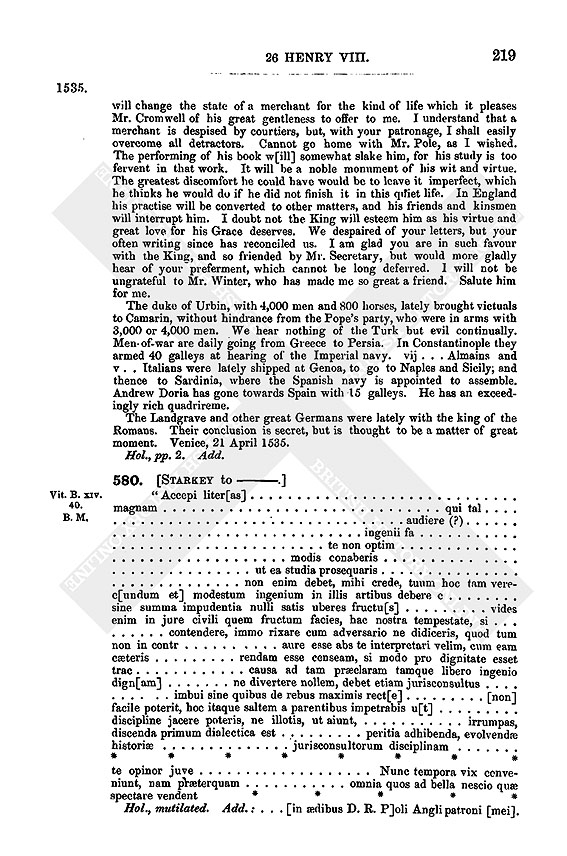
| Wrote lately by Mr. Brian Barnik. Since I received yours of the 12th and 23rd ult. "To this present, the Venetian orator was [not] arrived, greatly to our marvel." Mr. Secretary's benevolence moves me to return homeward, but I must have 10 or 12 months to settle my business. Then I will change the state of a merchant for the kind of life which it pleases Mr. Cromwell of his great gentleness to offer to me. I understand that a merchant is despised by courtiers, but, with your patronage, I shall easily overcome all detractors. Cannot go home with Mr. Pole, as I wished. The performing of his book w[ill] somewhat slake him, for his study is too fervent in that work. It will be a noble monument of his wit and virtue. The greatest discomfort he could have would be to leave it imperfect, which he thinks he would do if he did not finish it in this quiet life. In England his practise will be converted to other matters, and his friends and kinsmen will interrupt him. I doubt not the King will esteem him as his virtue and great love for his Grace deserves. We despaired of your letters, but your often writing since has reconciled us. I am glad you are in such favour with the King, and so friended by Mr.Secretary, but would more gladly hear of your preferment, which cannot be long deferred. I will not be ungrateful to Mr. Winter, who has made me so great a friend. Salute him for me. | |
| The duke of Urbin, with 4,000 men and 800 horses, lately brought victuals to Camarin, without hindrance from the Pope's party, who were in arms with 3,000 or 4,000 men. We hear nothing of the Turk but evil continually. Men-of-war are daily going from Greece to Persia. In Constantinople they armed 40 galleys at hearing of the Imperial navy. vij … Almains and v .. Italians were lately shipped at Genoa, to go to Naples and Sicily; and thence to Sardinia, where the Spanish navy is appointed to assemble. Andrew Doria has gone towards Spain with 15 galleys. He has an exceedingly rich quadrireme. | |
| The Landgrave and other great Germans were lately with the king of the Romans. Their conclusion is secret, but is thought to be a matter of great moment. Venice, 21 April 1535. | |
| Hol., pp. 2. Add. | |
| Vit. B. xiv. 40. B. M. |
580. [Starkey to—.] |
| "Accepi liter[as] ............................. magnam ..............................qui tal ..................................... audiere (?) ................................. ingenii fa .................................. te non optim ................................ modis conaberis ............................. ut ea studia prosequaris ............................. non enim debet, mihi crede, tuum hoc tam verec[undum et] modestum ingenium in illis artibus debere c ........ sine summa impudentia nulli satis uberes fructu[s] ......... vides enim in jure civili quem fructum facies, hac nostra tempestate, si ......... contendere, immo rixare cum adversario ne didiceris, quod tum non in contr .......... aure esse abs te interpretari velim, cum eam cæteris ......... rendam esse censeam, si modo pro dignitate esset trac ............ causa ad tam præclaram tamque libero ingenio dign[am] ....... ne divertere nollem, debet etiam jurisconsultus .......... imbui sine quibus de rebus maximis rect[e] ......... [non] facile poterit, hoc itaque saltem a parentibus impetrabis u[t] ......... discipline jacere poteris, ne illotis, ut aiunt,........... irrumpas, discenda primum dialectica est ......... peritia adhibenda, evolvendæ historiæ .............. jurisconsultorum disciplinam ....... * * * * * * * * te opinor juve ................... Nunc tempora vix conveniunt, nam præterquam ........... omnia quos ad bella nescio quæ spectare vendent * * * * * | |
| Hol., mutilated. Add.: ... [in ædibus D. R. P]oli Angli patroni [mei]. | |
| 22 April. Nero, B. vi. 158. B. M. |
581. G. Lily to Starkey. |
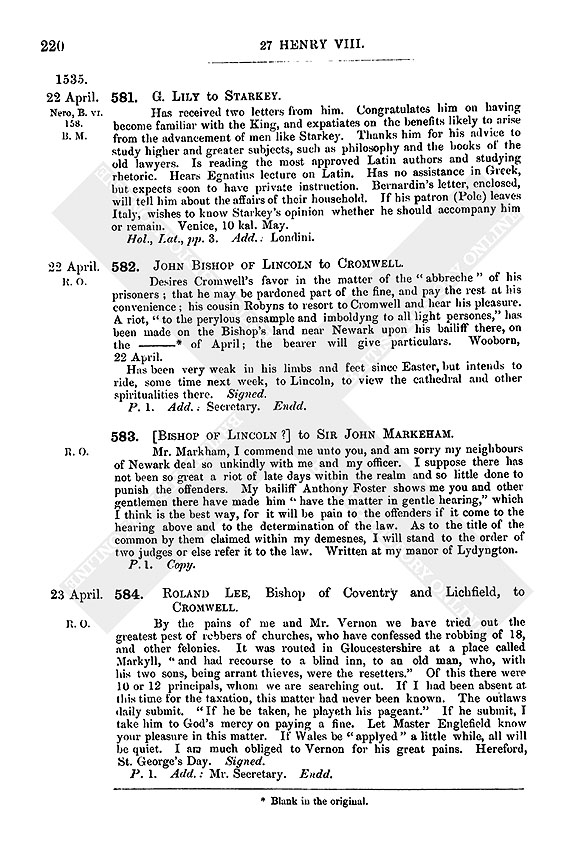
| Has received two letters from him. Congratulates him on having become familiar with the King, and expatiates on the benefits likely to arise from the advancement of men like Starkey. Thanks him for his advice to study higher and greater subjects, such as philosophy and the books of the old lawyers. Is reading the most approved Latin authors and studying rhetoric. Hears Egnatius lecture on Latin. Has no assistance in Greek, but expects soon to have private instruction. Bernardin's letter, enclosed, will tell him about the affairs of their household. If his patron (Pole) leaves Italy, wishes to know Starkey's opinion whether he should accompany him or remain. Venice, 10 kal. May. | |
| Hol., Lat., pp. 3. Add.: Londini. | |
| 22 April. R. O. |
582. John Bishop of Lincoln to Cromwell. |
| Desires Cromwell's favor in the matter of the "abbreche" of his prisoners; that he may be pardoned part of the fine, and pay the rest at his convenience; his cousin Robyns to resort to Cromwell and hear his pleasure. A riot, "to the perylous ensample and imboldyng to all light persones," has been made on the Bishop's land near Newark upon his bailiff there, on the— (fn. 2) of April; the bearer will give particulars. Wooborn, 22 April. | |
| Has been very weak in his limbs and feet since Easter, but intends to ride, some time next week, to Lincoln, to view the cathedral and other spiritualities there. Signed. | |
| P. 1. Add.: Secretary. Endd. | |
| R. O. | 583. [Bishop of Lincoln?] to Sir John Markeham. |
| Mr. Markham, I commend me unto you, and am sorry my neighbours of Newark deal so unkindly with me and my officer. I suppose there has not been so great a riot of late days within the realm and so little done to punish the offenders. My bailiff Anthony Foster shows me you and other gentlemen there have made him "have the matter in gentle hearing," which I think is the best way, for it will be pain to the offenders if it come to the hearing above and to the determination of the law. As to the title of the common by them claimed within my demesnes, I will stand to the order of two judges or else refer it to the law. Written at my manor of Lydyngton. | |
| P. 1. Copy. | |
| 23 April. R. O. |
584. Roland Lee, Bishop of Coventry and Lichfield, to Cromwell. |
| By the pains of me and Mr. Vernon we have tried out the greatest pest of robbers of churches, who have confessed the robbing of 18, and other felonies. It was routed in Gloucestershire at a place called Markyll, "and had recourse to a blind inn, to an old man, who, with his two sons, being arrant thieves, were the resetters." Of this there were 10 or 12 principals, whom we are searching out. If I had been absent at this time for the taxation, this matter had never been known. The outlaws daily submit. "If he be taken, he playeth his pageant." If he submit, I take him to God's mercy on paying a fine. Let Master Englefield know your pleasure in this matter. If Wales be "applyed" a little while, all will be quiet. I am much obliged to Vernon for his great pains. Hereford, St. George's Day. Signed. | |
| P. 1. Add.: Mr. Secretary. Endd. | |
| 23 April. R. O. |
585. Henry Prior of Shene to Cromwell. |
| Writes in favor of the bearer, father Trafford, appointed prior of the Charterhouse, Smithfield. Shene, 23 April. Signed. | |
| P. 1. Add.: Secretary and M.R. | |
| 23 April. R. O. |
586. Robt. Lord to Cromwell. |
| "Thanks be unto Almighty God for your recovery."Received this morning a letter from the under-steward of the honour of Wallingford, of which he is receiver, stating that Leonard Chamberleyn, keeper of Woodstock Park, has obtained a warrant from the King for as many oaks as will pale the said park, but for no certain number. In Horam Wood, nine miles from Woodstock, part of my Lady Dowager's jointure, he has marked out 1,100 oaks, which is too many to be taken in one piace. Understands he will not enclose it for saving of the springs, but will have the lops to his own use. Asks for Cromwell's commands in writing, bidding him not to be so extreme in that place. The tenants lament that if that wood is spoiled they will be undone for lack of mast. St. George's Day. | |
| Hol., p. 1. Add.: Mr. Secretary. Endd. | |
| 23 April. Anstis' Order of the Garter, ii. 395. |
587. Chapter of the Garter. |
| On St. George's Day 27 Hen. VIII. a chapter was held at Greenwich, at which were present the King, the marquis of Exeter, the earls of Arundel, Essex, Rutland, Oxford, Wiltshire, and Sir Wm. Fitzwilliam. It was ordered that the feast should be kept at Windsor on May 9, that the duke of Suffolk should take the Sovereign's place, and the earls of Arundel and Sussex and lords Burgavenny and Sandys should assist him. It was determined that the stalls of the nobility should be transposed, so that the king of Scotland should be next to the king of the Romans. At the feast on May 9 the lord Burgavenny was absent from illness, and his place was supplied by the earl of Ormond and Wiltshire. | |
| Letters were produced in proof of the masses offered up for the earl of Oxford, Sir Henry Goulford, and lord Mountjoy. The next day, after mass for the dead, the hatchments of lord Mountjoy were offered up by the earls of Arundel and Wiltshire. | |
| Lat. | |
| MS. Ashmol, 1109, f. 104. |
2. List of "Knights of the Order as they stood ranked, a° 17, [18, 19] H. 8;" and notes of the removals made 21–26 Hen. VIII. [f. 1b, 2, 2b, 6.] |
| MS. Ashmol, 1109, f. 105. |
3. "The King's highness' appointment for the translations of the stalls for the king of Scotland, 13 (qu. 23?) Apr. a° r' sui 27;" also lists or notes of variations for the years 28–37 Hen. VIII. |
| 24 April. | 588. Town of Dorchester. |
| See Grants in April. 27 Hen. VIII., No. 2. | |
| 25 April. R. O. |
589. The King's Marriages. |
| Articles objected by the abp. (Cranmer), not as ordinary, against Sir Thomas Kinge, vicar of the chapel of St. Andrew's in St. Alban's, 14 April 26 Hen. VIII.; with his answers. | |
| 1. For saying that the King's marriage was null and void, and Katharine is the true queen. | |
| 2. For taking a book out of the hands of a priest called Walter, in defence of the marriage, saying it was heresy. | |
| 3. For speaking words against the King and Queen. | |
| 4. For persuading the people that they are bound under pain of damnation to obey the Pope. | |
| Among his answers he states that he saw Sir Walter read in St. Alban's a certain English book called "the Glass of Truth" when the Lady Dowager came riding there. | |
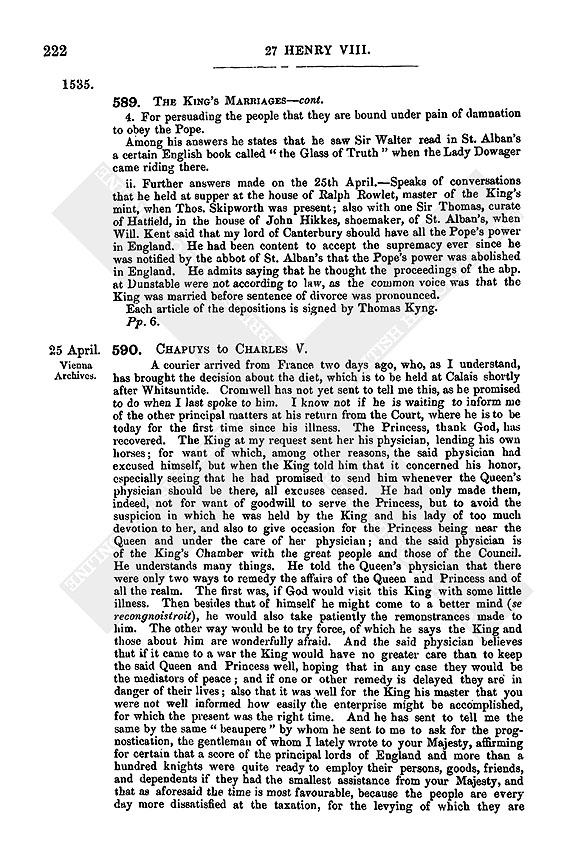
| ii. Further answers made on the 25th April.—Speaks of conversations that he held at supper at the house of Ralph Rowlet, master of the King's mint, when Thos. Skipworth was present; also with one Sir Thomas, curate of Hatfield, in the house of John Hikkes, shoemaker, of St. Alban's, when Will. Kent said that my lord of Canterbury should have all the Pope's power in England. He had been content to accept the supremacy ever since he was notified by the abbot of St. Alban's that the Pope's power was abolished in England. He admits saying that he thought the proceedings of the abp. at Dunstable were not according to law, as the common voice was that the King was married before sentence of divorce was pronounced. | |
| Each article of the depositions is signed by Thomas Kyng. | |
| Pp. 6. | |
| 25 April. Vienna Archives. |
590. Chapuys to Charles V. |
| A courier arrived from France two days ago, who, as I understand, has brought the decision about the diet, which is to be held at Calais shortly after Whitsuntide. Cromwell has not yet sent to tell me this, as he promised to do when I last spoke to him. I know not if he is waiting to inform me of the other principal matters at his return from the Court, where he is to be today for the first time since his illness. The Princess, thank God, has recovered. The King at my request sent her his physician, lending his own horses; for want of which, among other reasons, the said physician had excused himself, but when the King told him that it concerned his honor, especially seeing that he had promised to send him whenever the Queen's physician should be there, all excuses ceased. He had only made them, indeed, not for want of goodwill to serve the Princess, but to avoid the suspicion in which he was held by the King and his lady of too much devotion to her, and also to give occasion for the Princess being near the Queen and under the care of her physician; and the said physician is of the King's Chamber with the great people and those of the Council. He understands many things. He told the Queen's physician that there were only two ways to remedy the affairs of the Queen and Princess and of all the realm. The first was, if God would visit this King with some little illness. Then besides that of himself he might come to a better mind (se recongnoistroit), he would also take patiently the remonstrances made to him. The other way would be to try force, of which he says the King and those about him are wonderfully afraid. And the said physician believes that if it came to a war the King would have no greater care than to keep the said Queen and Princess well, hoping that in any case they would be the mediators of peace; and if one or other remedy is delayed they are in danger of their lives; also that it was well for the King his master that you were not well informed how easily the enterprise might be accomplished, for which the present was the right time. And he has sent to tell me the same by the same "beaupere" by whom he sent to me to ask for the prognostication, the gentleman of whom I lately wrote to your Majesty, affirming for certain that a score of the principal lords of England and more than a hundred knights were quite ready to employ their persons, goods, friends, and dependents if they had the smallest assistance from your Majesty, and that as aforesaid the time is most favourable, because the people are every day more dissatisfied at the taxation, for the levying of which they are beginning to depute commissioners to enquire the value of every one's goods and assess them accordingly. The Chancellor has been of late in different countries (qu. counties?) to select the said Commissioners and has not found the disposition of the people such as he had expected; so that he has had great altercations with Cromwell, whom he accused of having been the author of the impost, which might give rise to a dangerous tumult within the kingdom, and that it would be well to provide a speedy remedy. Cromwell replied he thought all would go well, but that he ought not to be blamed for the said taxation which was owing to the great cupidity and avarice of the King as the Chancellor well knew. This conversation was reported by the son-in-law of the Chancellor, who knows all his secrets, and who has moreover declared to a friend of his that the said Chancellor was in great dread and anxiety, believing almost for certain that this government could not long endure. | |
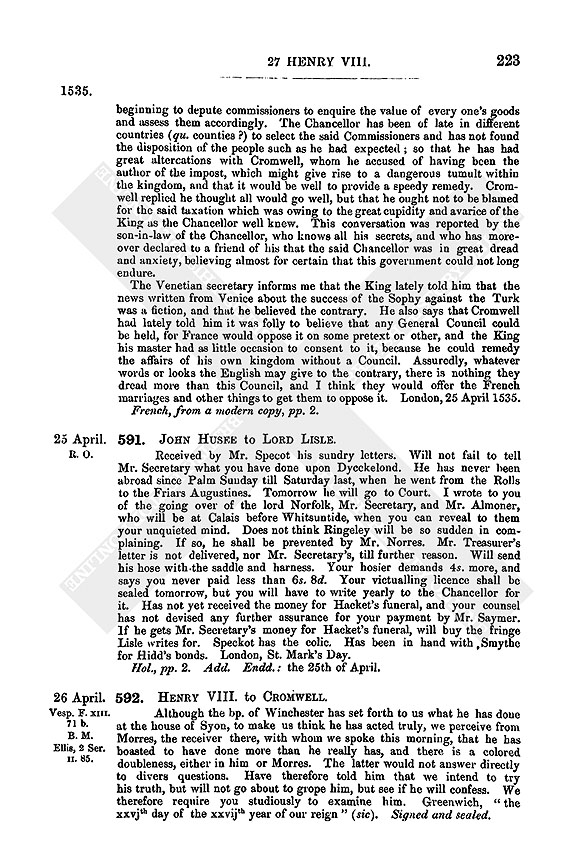
| The Venetian secretary informs me that the King lately told him that the news written from Venice about the success of the Sophy against the Turk was a fiction, and that he believed the contrary. He also says that Cromwell had lately told him it was folly to believe that any General Council could be held, for France would oppose it on some pretext or other, and the King his master had as little occasion to consent to it, because he could remedy the affairs of his own kingdom without a Council. Assuredly, whatever words or looks the English may give to the contrary, there is nothing they dread more than this Council, and I think they would offer the French marriages and other things to get them to oppose it. London, 25 April 1535. | |
| French, from a modern copy, pp. 2. | |
| 25 April. R. O. |
591. John Husee to Lord Lisle. |
| Received by Mr. Specot his sundry letters. Will not fail to tell Mr. Secretary what you have done upon Dycckelond. He has never been abroad since Palm Sunday till Saturday last, when he went from the Rolls to the Friars Augustines. Tomorrow he will go to Court. I wrote to you of the going over of the lord Norfolk, Mr. Secretary, and Mr. Almoner, who will be at Calais before Whitsuntide, when you can reveal to them your unquieted mind. Does not think Ringeley will be so sudden in complaining. If so, he shall be prevented by Mr. Norres. Mr. Treasurer's letter is not delivered, nor Mr. Secretary's, till further reason. Will send his hose with the saddle and harness. Your hosier demands 4s. more, and says you never paid less than 6s. 8d. Your victualling licence shall be sealed tomorrow, but you will have to write yearly to the Chancellor for it. Has not yet received the money for Hacket's funeral, and your counsel has not devised any further assurance for your payment by Mr. Saymer. If he gets Mr. Secretary's money for Hacket's funeral, will buy the fringe Lisle writes for. Speckot has the colic. Has been in hand with Smythe for Hidd's bonds. London, St. Mark's Day. | |
| Hol., pp. 2. Add. Endd.: the 25th of April. | |
| 26 April. Vesp.F. xiii. 71 b. B. M. Ellis, 2 Ser. ii. 85. |
592. Henry VIII. to Cromwell. |
| Although the bp. of Winchester has set forth to us what he has done at the house of Syon, to make us think he has acted truly, we perceive from Morres, the receiver there, with whom we spoke this morning, that he has boasted to have done more than he really has, and there is a colored doubleness, either in him or Morres. The latter would not answer directly to divers questions. Have therefore told him that we intend to try his truth, but will not go about to grope him, but see if he will confess. We therefore require you studiously to examine him. Greenwich, "the xxvjth day of the xxvijth year of our reign"(sic). Signed and sealed. | |
| R. O. | 2. "Interrogatories for Mr. Mores." |
| 1. How long he has been acquainted with the bp. of Winchester? 2 and 3. What communication he had with him touching the primacy of the bp. of Rome? 4 and 5. Who began it, and what answer the bp. made? 6. What he required Mores to declare to the brethren of Sion? 7. How often the bp. has been to Sion? 8. Whether he expressed any evil opinion contrary to the statutes touching the primacy of the bp. of Rome ? 9. What communication passed between them touching the King's marriage and succession? 10. What is Mores' opinion touching General Councils, and why he said that the primacy of the bp. of Rome had been confirmed by a General Council? | |
| In Cromwell's hand, pp. 2. | |
| R. O. | 3. Interrogatories ministered by Mr. Secretary to John Mores; and his answers. |
| 1. Has been acquainted with the bp. of Winchester only since he was Bishop, from asking him to sue the King that he might have the keeping of the little park of Farnham. 3. Spoke with him about the said park at Ascher and at London; twice at St. Mary Overeys, for the benefice of Sutton in Surrey; at Waltham, when Nores spoke of his trouble in obtaining the Park; and dined with him at Farnham Castle. 3. In the beginning of last Lent, at Farnham, the Bishop showed him that the primacy of the bp. of Rome began by the policy of man, and since then clerks have applied Scripture, to make it appear that the primacy had the beginning of God, which he thought could not be truly maintained. Asked him, if it proceeded from man's policy, and was made by General Council, to which the Holy Ghost is assistant, how the contrary might be used without offence of conscience. The Bp. answered that he thought the Act of Parliament discharged his conscience, and that of all the King's subjects; that a law was made by the Holy Ghost and the Apostles that no Christian man should eat of meat that was suffocate or bloody, but the contrary is now used without offence. 4. Moved this communication himself, being desirous of knowing the Bishop's opinion, as a man of great learning, cunning, and wisdom, that he might the better persuade the brethren of Sion, "like as you yourself, Mr. Secretary, commanded me to do." 5. Remembers no other questions and answers between them but what are here mentioned. 6. At the end of the communication asked the Bishop whether he should declare the matter discussed by them to the brethren of Sion; and he required him to do so. Accordingly showed it to the confessor, and desired him to declare it to the brethren. 7. Is of opinion that an Act of Parliament for the common wealth of the realm ought rather to be observed within the realm than any General Council. Thinks the Holy Ghost is as present at such an act as ever He was at any General Council. Thinks the act of the primacy is as much for the common wealth of the realm as any act that ever was made before the King's time. Asked this question of the Bishop because he had heard it much spoken of in the Parliament-house, and taken by many to be a doubt, as Mr. Secretary best knows. Considered the Bishop's wisdom and learning to be such that he thought he could not be better answered, because he had heard Mr. Secretary say that the Bishop was much affectionate to the Papacy. Proposed the question to him, not for any scrupulosity, but to know his affection, and how to answer others, especially the brethren in Sion. Doubts not that Cromwell knows the trouble he has taken with them. 8. Has never seen the Bishop at Sion since he was Bishop, and does not think he ever was there since then. 9. Has never heard the Bishop express any evil opinion contrary to the statutes of the realm, concerning the primacy of the bishop of Rome or any other foreign potentate. 10. Has never communed with him concerning the King's marriage and succession.Signed. | |
| Pp., 5. Endd. | |
| 26 April. Add. MS. 29,300 A. B. M. |
593. John Redyng to the Prior and Convent of Redyng. |
| Our father Abbot has untruly complained to the King and his Council that I and my brethren of Leomster are not obedient, nor of honest and clean living, and has thereby obtained a commission to suppress the house; to execute which he has sent hither his servant William Edmondes. I wish you to inform me whether the Abbot opened the matter to you and the brethren in the chapter-house or elsewhere; whether ye were agreed, and of counsel with him; and whether ye and my brethren have ever known of such things as he has reported against us. Fear not touching your duties from Leomster. I will not fail to content you. Leomster, 26 April. | |
| Hol., p. 1. Add. | |
| 26 April. Add MS.. 19,865, f. 8. B. M. |
594. Henry VIII. to Sir John Desmond. |
| Has received his letters by Edm. Sexten, sewer of the Chamber, by which he makes humble submission, and promises to observe faith and loyalty to the King. Though he and his generation have abstained from all honesty and civil orders, accommodating themselves to a kind of living both savage and beastly, promises him that if he will resort to the Deputy, and reduce his country to civility, he will consider him a faithful subject, and advance him to a certain degree of honour. If he has dissembled, will not fail to punish him, so that all Ireland may beware by his example. As he has taken possession of the earldom of Desmond, the title of which is in controversy between him and James the son of Maurice, commands him either to come to England or send his eldest son James hither to explain his title, and meantime to surrender the earldom, to be held by the Deputy for him who shall appear to have the right. Desires credence for Edmund Sexten. Greenwich, 26 April. | |
| Modern copy, pp. 3. | |
| 27 April. R. O. |
595. Head of the Church. |
| Accusation by Thomas Smyth, servant of the King, against one Sir Roger— (fn. 3), priest, who, on the 27th April 27 Hen. VIII., in the house of Thomas Williamson, fishmonger, and in presence of several persons (named), spoke words upholding the supremacy of the Pope as head of the Church on earth. | |
| Pp. 4. Endd. | |
| 27 April. R. O. |
596. Sir Nicholas Carew to Cromwell. |
| Thanks him for having written in favour of his friend (fn. 4) for the priory of Bissame. Hears that the Prior, by the persuasion of my lady of Salisbury and Warde with other people, refuses to resign, though even they thought him very unmeet to continue till they saw Cromwell meant to prefer one contrary to their minds. "If it shold thys passe and rest, I wolde I hade spent a hundred poundes I had never spokyn in it, for somewhat it toucheth my poor honesty." Bedyngton, 27 April. | |
| P.S. in his own hand: Desires credence for his chaplain in the matter. Signed. | |
| P. 1. Add.: Secretary. Endd. | |
| 27 April. R. O. |
597. Elizabeth Burgh (fn. 5) to Cromwell. |
| I am informed by Mr. Treasurer (fn. 6) how much I have been bound to your goodness in my late business, which I regret that I am unable to recompense, but I trust you will take the will for the deed. 27 April. Signed. | |
| P. 1. Add.: Secretary. Endd. | |
| R. O. | 598. Elizabeth Burgh to Cromwell. |
| I am bound to you for life by your goodness at divers times, and pray God I may be able to do you service before I die. But I beg to know when I may wait upon you to learn effectually whereto I may trust for my living. | |
| Hol., (fn. 7) p. 1. Add. Secretary. Sealed. Endd. | |
| 27 April. Cleop. E. iv. 311. B. M. |
599. Sir Richard Bulkeley to Cromwell. |
| I have received the King's commission to the bishop of Bangor, myself, and other gentlemen of the diocese, joining with us John Arnold, "pregnatory" of North Wales, Henry Parker and Ric. Hawkyns, auditors there. The bishop sent me the commission on Friday before Easter Day, desiring me to see it executed. Knowing how barbarous and ignorant I and the gentlemen of the country are, and that there was no learned man to consult, I sent on Monday following for Arnold and Hawkyns, who live 120 miles off, and desired them to send for Parker. Neither the Bishop, Arnold, nor Hawkins have yet come to these parts, but I and the fest have done the best we could. We are in doubt whether we should have included the Bishop's see, as he was absent. We have put the matter in a good readiness, and will not proceed till we know your further pleasure. Meantime, will visit the bishop of St. Asaph, to accomplish the King's commission in his diocese. In the diocese of Bangor we have proceeded thus: First, we have sworn the incumbents to make a true valuation of their benefices, and four persons of the parish to certify it. We have then used other means to obtain true knowledge, and have made open proclamation for other persons also to give evidence. In some parishes persons have come forward and told us that neither the parson nor the four persons have given the true value of the benefices, and have even offered to farm them at a greater sum. We wish to know which value we shall take. Though the King has not so great profit here as in other countries, the country is large and wide, and the truth harder to be known than elsewhere. We therefore desire a longer day for the return of our certificate. Conwey, 27 April. Signed. | |
| Pp. 2. Add.: Mr. Cromwell, one of the King's privy council and chief secretary. Endd. | |
| R. O. | 600. John Whalley to Cromwell. |
| Mr. Rastall has come, saying it is Cromwell's pleasure that he should speak to the monks. Does not think Rastall the kind of man to convert them, for they laugh at all he says; "no question of it, they be exceedingly superstitious, ceremonious, and pharisaical, and wonderfully addict to their old mumpsimus. "Suggests a plan to convert them. First send some honest loyal man to stay with them, then have the vicar of Croydon, Dr. Buckmaister, Symonds, and other of the popish sort, to preach before them, against their superstitions; and, lastly, cause the bishops (of York, Winchester, Durham, Lincoln, Bath, and London, and others) to preach. If this does not answer, call them before the whole nobility, temporal and spiritual, and sentence them publicly according to law. Mr. Fylolle, Cromwell's servant, has been there, and spoken with some of them; also Mr. Roberts, Mr. Shyngleton, who preached at the Spitle on Tuesday in Easter week, Wm. Marshall, and others, to whom Whalley, not knowing Cromwell's pleasure, refused admission. From the Charterhouse. | |
| Hol., pp. 2. Add. Endd. | |
| R. O. | 601. John Whalley to [Cromwell]. |
| Asks that a brother of this house, named Salter, who has been in prison this twelvemonth and more, may be put at liberty in the cloister. Has given charge that no persons, spiritual or temporal, shall come into the cloister to have communication with any of them, unless they bring [Cromwell's] token, or Whalley knows them to be of an honest sort. Sends a dish of such apples as are left in the house. "If they like you they shall be kept for you as long as they last, and provide for the convent almonds and figs accordingly."At the Charterhouse, this Friday. | |
| Hol., p. 1. Add.: To his most singular good master. Endd. | |
| R. O. | 602. John Whalley to [Cromwell]. |
| "Right worshipful Sir, &c., I am writing for the copy of the vicar of Croyden's sermon. It was this morning or I could get it, and the person whom I had it of doth send a copy unto the bishop of Canterbury, for he goeth unto the Court. Therefore, Sir, if I have not done or you go, if it be your pleasure that I shall bring it unto you I pray you that I may have word; for I would that your mastership should first declare it unto the King before him, for I perceive that the said bishop and you and the King be touched in parable. Your servant, John Whalley." | |
| Hol., p. 1. Endd. | |
| 27 April. R. O. |
603. John Whalley to Cromwell. |
| Came to Windsor this Tuesday at 11 o'clock. Examined one of the clerks of the College "that satt at the Dean's table, named Doctor Sampson." The other clerk was present, and commanded him on his allegiance to show the truth. Examined him "of the premisses of that one of his company named John Wylson had sworne before, and hym examened, supposing verely by the sayd Wylson, that he wold have in lyke maner and fourme have confessed and declared all, whose name was Ric. Conway."This man affirmed certain of the things, as, that "there was none promoted but naughty fellawes,"and that the Dean prayed God "that we were not skurged as they were in Almayn, which he feyred shortely shuld com to passe."The man was very fearful. Perceives he is very old and weak. Two other clerks, Thomas Man and Robert Guy, have sworne to me that the old man, Conway, told them all the premisses of the examination of Wylson. The Dean is expected tomorrow. Cromwell should command him, the said Dr. Sampson, to stay in attendance till the King's pleasure be known. Wishes to know if he should bring some of the priests tomorrow to be examined before Cromwell, from whom they will hide nothing. Tomorrow he will examine one, who is sick. "In great hast," Tuesday at 4 o'clock, 27 April. | |
| Hol. Signed: "J. W." P. 1. Add.: "Mr. Secretaury." Endd. | |
| R. O. | 604. Sampson to Cromwell. |
| Has come in haste from the Commissioners at Windsor, hearing that reports were made against him. Would like to wait on Cromwell. Intends to go to the Court tomorrow if Cromwell does not forbid him. | |
| Hol., p. 1. Endd. Add.: Secretary. Mutilated. | |
| 27 April. R. O. |
605. Fitzwilliam to Lord Lisle. |
| Is appointed in a short time to repair to Calais, and has written to lady Garneys to lodge in her house, as the wholesome walk he may have in her garden will be conducive to his health. Begs he will speak to lady Garneys in his behalf. Will pay for the accommodation. Westminster, 27 April. Signed by Fitzwilliam and Sir William Kingston. | |
| P. 1. Add. Endd. | |
| 27 April. R. O. |
606. John Husee to Lord Lisle. |
| Has spoken to Mr. Secretary, who is not a little displeased that you should have written to Stephen Vaughan touching the money of Mr. Hacket's legacy, and thought you mistrusted him. He commanded me to wait upon him this afternoon when he would pay me 40 marks, but has not done it, because he has had much ado with the judges and serjeants about certain of the Charter House, which I think are like to die this week for treason. He would not have your Lordship write in any light cause;—was not inclined to listen when I moved him for the toll of Oye Sluice, and the inhabitants of the Low Countries. He will speak of this when he comes with other commissioners to Calais on the 14th prox. Holt will furnish you with liveries for 20l. in hand, and the rest at Hallowtide. Cannot get his licence for victualling signed, but Popley says it shall be at the next sealing. Speccot has the colic. Ringley has not yet come. Garter says if you do not certify the suffrages for my lord Mountjoy before St. George's feast you will have to forfeit half the amount. Sends a letter for Mrs. Poolle from her husband in Ireland. London, 27 April. | |
| Hol., pp. 2. Add. Endd. | |
| 28 April. R. O. Cranmer's Letters, 322. |
607. Cranmer to Lord Lisle. (fn. 8) |
| Thanks lord and lady Lisle for their "gentle entreating" of his chaplains, late at Calais. Where Lisle wrote that he had been accused, by some of Cranmer's house, of being a papist, although he had given so little reason to be considered a "fautour" of the Pope, it is not so much the person of the bishop of Rome, usurping the title of Pope, but the whole papacy and see of Rome, setting up the Pope as a God of this World that is to be detested. And since the Word of God was against the Pope and his vices, the Pope. in turn, set himself against the Word of God, "extorting it out of the true sense," and suppressing it. The chief thing to be detested in that see is "that it hath brought the professors of Christ into such ignorance of Christ."Moreover, the Pope has impoverished all Christendom for the maintenance of his own estate. | |
| Though some have suspected Lisle of favouring this usurped power, Cranmer, perceiving both lord and lady Lisle inclined to promote the Word of God, will stand to their defence either before the King and Council or elsewhere. Desires favour for his commissary, and trusts Lisle will find him a plain and honest man. Thanks Lisle for his pains in the cause of Barton, Cranmer's cousin. Otford, 28 April. Signed. | |
| Add.: Deputy in Calais. Endd. | |
| 29 April. R. O. |
608. William Cobbe, priest, to Cromwell. |
| Has received his letter, dated at the Rolls, 22 March, of a complaint made by Henry Peper for 30l. delivered to the writer, as he supposes, by the prior of Lynne, for the use of the said Peper when he came of age. Never received any money from the Prior, which he is ready to depose. Is aged and sickly, and not able to ride without great pain; but if Cromwell desire it, will come up to London. Titchmarsh, 29 April. Signed. | |
| P. 1. Add.: Secretary and M.R. Endd. | |
| 29 April. R. O. |
609. The Prior of the Charter House and others. (fn. 9) |
| Proceedings against Robert Feron, or Fern, of Todynton (Teddington), Midd., clk.; John Hale, late of Isleworth, clk.; John Howghton, prior of the Charter House, Midd.; Augustine Webster, prior of the Charter House, Axholme, Linc.; Rob. Lawrens, prior of the Charter House of Bevall, Notts; and Ric. Reynolds, brother of the house of Syon, Midd.; for high treason, viz.:— | |
| i. Special commission of Oyer and Terminer for Middlesex to Sir Thos. Audeley, chancellor, Thos. duke of Norfolk, treasurer, Henry marquis of Exeter, Will. earl of Arundel, John earl of Oxford, Henry earl of Essex, Thos. earl of Rutland, Hen. earl of Cumberland, Thos. earl of Wiltshire, Hen. lord Montague, Geo. lord Rocheford, Thos. Cromwell, chief secretary, Sir John FitzJames, Sir John Baldwin, Sir Ric. Lister, Sir John Porte, Sir John Spelman, Sir Walter Luke, Sir Ant. Fitzherbert, Sir Thos. Inglefeld, and Sir Will. Shelley. Westm., 23 April 27 Hen. VIII. | |
| ii. The justices' precept to the sheriff for the return of the grand jury, with panel annexed. Westm., 24 April 27 Hen. VIII. | |
| iii. The justices' precept to the constable of the Tower to bring up John Howghton, Augustine Webster, Rob. Lawrens, Ric. Reynolds, Rob. Feron or Fern, and John Hale, at Westminster, on Wednesday next after one month of Easter. Westm., 27 April 27 Hen. VIII. Endorsed with the reply of Sir Edmund Walsingham as lieutenant of Sir Will. Kyngeston, constable of the Tower. | |
| iv. Indictment setting forth that by the statute 25 Hen. VIII. [c. 22.] any person who shall do anything to the peril of the King or prejudice of his succession shall be guilty of high treason; that Rob. Feron and John Hale above named, endeavouring to excite sedition, &c., did, 20 May 26 Hen. VIII. and at other times between 2 and 20 May and subsequently, at Isleworth and Syon, Midd., meet and have various discourseś against the King and his marriage while they were walking to and fro. And after many scandalous and false words spoken by Feron to Hale, the said Feron asked Hale if there was no one who had written or who would write against the King's evil deeds. Hale replied that there were many notorious and sufficient causes to write against the King, and further said these most execrable words:—"Syth the realm of England was first a realm, was there never in it so great a robber and pyller of the commonwealth read of nor heard of as is our King. And not only we, that be of the spirituality, by his wrongs be oppressed and robbed of our livings as if we were his utter enemies, enemies to Christ, and guilty of his death, but also thus ungoodly he doth handle innocents, and also highly learned and virtuous men, not only robbing them of their livings and spoiling them of their goods, but also thrusting them into perpetual prison, so that it is too great pity to hear, and more to be lamented than any good Christian man's ears may abide. And he doth the same as if by that mean he would revenge his own injuries and the injuries of Christian faith, by whose title in a marvellous fashion he boasteth himself to be above and to excel all other Christian kings and princes, thereby being puffed with vain glory and pride, where, of a truth, he is the most cruellest, capital heretic, defacer, and treader under foot of Christ and of his Church, continually applying and minding to extinct the same. And also the lay fee, sometime the noble and sometime the commons, without difference, upon chance and displeasure grown, or of truth forsought and feigned, he doth enpoverish, destroy, and kill, for none other intent but that he may enjoy and use his foul pleasures, and increase to himself great treasure and riches, enriching strangers, and pylling and robbing his own subjects, and making fair houses but most superfluous. Whose death I beseech God may be like to the death of the most wicked John, sometime King of this realm, or rather to be called a great tyrant than a King, and that his death may not be much unlike to the end of that manqueller Richard, sometime usurper of this Imperial realm. And if thou will deeply look upon his life, thou shalt find it more foul and more stinking than a sow, wallowing and defiling herself in any filthy place; for how great so ever he is, he is fully given to his foul pleasure of the flesh and other voluptuousness. And look how many matrons be in the court, or given to marriage; these almost all he hath violated, so often neclecting his duty to his wife and offending the Holy sacrament of matrimony; and now he hath taken to his wife of fornication this matron Anne, not only to the highest shame and undoing of himself, but also of all this realm." | |
| Afterwards, 10 March 26 Hen. VIII., Feron wrote down in Latin these words spoken by Hale in English. Also in the same conversation on the 20th May, Hale said to Feron, "Until the King and the rulers of this realm be plucked by the pates, and brought, as we say, to the pot, shall we never live merrily in England; which I pray God may chance and now shortly to come to pass. Ireland is set against him, which will never shrink in their quarrel, to die in it. And what think ye of Wales?—Their noble and gentle Ap Ryce so cruelly put to death, and he innocent, as they say, in the cause. I think not contrary but they will join and take part with the Irish, and so invade our realm. If they do so, doubt ye not but they shall have aid and strength enough in England; for this is truth, three parts of England is against the King, as he shall find if he need; for of truth they go about to bring this realm into such miserable condition as is France, which the Commons see and perceive well enough a sufficient cause of rebellion and insurrection in this realm. And truly we of the Church shall never live merrily until that day come." | |
| v. The justices' precept to the sheriff for the return of a jury from Istylworth and Syon for the trial of Feron and Hale. Westm., 28 April 27 Hen. VIII.— With panel of jury annexed. | |
| vi. Indictment against Howghton, Webster, Lawrens, and Reynolds, for declaring, 26 April 27 Hen. VIII. at the Tower of London, "The King our sovereign lord is not supreme head in earth of the Church of England." | |
| vii. The justices' precept to the sheriff for the return of a jury of inhabitants of the Tower for the trial of Howghton, Webster, Lawrens, and Reynolds. Westm., 28 April 27 Hen. VIII. | |
| viii. Records of the trial before the above justices, reciting the above documents in the preamble, in which the indictments are dated at Westminster on Wednesday after one month of Easter, 27 Hen. VIII. | |
| Feron and Hale, being brought to the bar by Sir Edw. Walsingham on Wednesday after one month of Easter, 27 Hen. VIII., plead Not Guilty. Venire awarded returnable at Westminster on Thursday after one month of Easter (29 April); on which day, after the jury were sworn, the prisoners withdrew their former plea, and pleaded Guilty. | |
| Judgment as usual in high treason. Execution at Tyburn. | |
| Howghton, Webster, Lawrens, and Reynolds in like manner were brought to the bar on Wednesday after one month of Easter, when they pleaded Not Guilty; and again on Thursday, when they pleaded Guilty. | |
| Judgment and execution as before. | |
| Proceedings brought into court, Hilary term, 27 Hen. VIII., by Sir John FitzJames. | |
| Cleopatra, E. vi. 231. B. M. |
2."The bill of indictment against the Carthusians," i.e., John Rochester and Jas. Whalworth, for denying the King's supremacy. |
| Lat. Vellum. In margin: "Billa vera." | |
| R. O. | 610. Henry Ball, Vicar at Shene, to Sir [William Pa]ulet. |
| Thanks him for his good counsel to them, at their last meeting, as to the significavit. Cannot all agree in it, most of them thinking it better to suffer than yield, though they cannot resist the King's power. "Neither yet in taking the first fruits of the tenths to the great hindrance of the poor people for whom our lands were much part granted, our conscience is sore ageyne it."Hopes the King will have compassion on their timorous conscience; it is not obstinacy. | |
| Hol., p. 1. Mutilated. Add.: To the wurshypfull and h[is] especyall good master [Sir William Po]ulett, knyght, co[mptroller] of the Kynges m[ost honora]ble howshold. Endd. | |
| R. O. | 611. The Charter House, London. |
| Eight letters of uncertain years addressed to the prior of the Charter House by— | |
| 1. Robert prior of the Charter House in the Isle of Axholme, dated 22 Jan. | |
| 2. Thos.[Skeffington], bp. of Bangor, dated Beaulieu, 15 Oct. | |
| 3. John prior of Bevall, dated 20 July. | |
| 4. The prior of the Charterhouse beside Coventry, dated 22 Oct. | |
| 5. The prior of Shene, dated on the Feast of St. Paul. | |
| 6. The prior of Shene, dated "In Vigilia Sanctorum Martyrum, Cosmæ et Damiani." | |
| 7. The prior of Shene, dated at All Hallow tide. | |
| 8. Richard prior of Witham, dated 20 July. | |
| Also (9) a letter of William prior of the Charter House by London, to master William Orde .. er, parson of St. Peter in Thetford, dated 14 Feb. | |
| R. O. | 612. The Charterhouse. |
| File of acquittances relating to the Charterhouse, from Sir Thomas Norton, 12 and 13 Hen. VIII., and Sir Thos. Ratcliff, 20 and 21 Hen. VIII., masters of Burton Lazars; Rosa Reygat, 12 and 13 Hen. VIII., and Isabella Sakeveld, 21 Hen. VIII., prioresses of St. Mary's Clerkenwell; and Margaret Chawry, prioress of Chesthunt, 24 Hen. VIII. | |
| Including also:— | |
| i. Grant by Wm. Dovell, abbot of Clyff, to John Torre, of Donyforde, of an annual rent of 3s. 4d., 26 Hen. VIII. | |
| ii. Receipts for the forced loan to the King, 14 and 15 Hen. VIII., given by Edm.abbot of St. Mary's, York, to John abbot of Selby, and Brian Higdon, dean of York; one signed by Rob. Selby, prior. | |
| iii. Privy seal to the abbot of Farly. | |
| iv. Instructions for commissioners appointed by the King to enquire touching the making and sealing of a certain writing obligatory for payment of 30l. to Rob. Maye, grocer of London, by Thomas late prior of Tortyngton, Sussex, dated 19 Jan. 26 Hen. VIII. | |
| 37 parchment documents in cloth boards. | |
| R. O. | 613. The Charterhouse. |
| 1. View of account by Wm. Tynbegh, prior of the Charterhouse, London, 6–7 Hen. VIII. | |
| Roll of 9 sheets of paper. | |
| R. O. | 2. Receipt by John Heth, chantry priest of Sir Robert Reed, in the Charterhouse, 11 Hen. VIII. |
| 1 slip of paper. Similar to Cal. Hen.VIII., vol. iii., No. 1730. | |
| R. O. | 3. Rental of lands leased to the Charterhouse, London, by the prior of Christchurch, Canterbury, and the Abp. |
| 1 sheet of paper, undated. | |
| R. O. | 614. The Charterhouse, London. |
| Twenty one receipts for money paid by the Convent, as follows:— | |
| 1. A quitrent of 24s. 4d. to Wm. Whaplod and Robt. Bale, churchwardens of St. Margaret's, Bridge Street, Lady Day in Lent, 21 Hen. VII. | |
| 2. 20s. rent for two houses against the stocks in Wolchyrche, to Thos. Gostwyke, rent gatherer of the wardens of the Fellowship of the Mercery, 15 Aug. 1506, 21 Hen. VII. | |
| 3–13. For the salary of Sir John Heth, chantry priest of Sir Robt. Rede, knt., in the Charterhouse, 8l. a year, from the Purification of the B.V.M. 9 Hen. VIII. to 1 Aug. 13 Hen. VIII. | |
| 14. By Wm. Aprice, for 33s. 6d. for rent of tenements in St. John's Street and St. Margaret, Lothbury, due to the lord of St. John's, 9 May 22 Hen. VIII. | |
| 15. By John Gaynger, clerk of the old works at Polles, for 10s. quitrent of lands in Paternoster Row, due to the bp. of London, Mich. 22 Hen. VIII. | |
| 16, 17. By Robt. Rydley, prebendary of Iseldou, quitrent of 26s. a year. 4 Oct. and 27 March 22 Hen. VIII. | |
| 18. By John Barnard, mercer, for 5s., a quarter's rent of the garden, 25 March 1532. | |
| 19. By Wm. Kempe, priest, singing for the soul of Sir John Brugge, alderman in St. Nicholas Acon's church, 35s. for a quarter's salary, 4 April 23 Hen. VIII. | |
| 20. By Geo. Browne, provincial and prior of the Austens in London, for 13s. 4d. for the behoof of friar Wm. Hope, 24 Oct. 26 Hen. VIII. | |
| 21. By John Nevell lord Latymer, for 33l. 5s. 8d. in part payment of a loan of 100 marks, 7 Dec. 26 Hen. VIII. | |
| Signed and sealed. | |
| 30 April. R. O. |
615. Geoffrey Blythe to Cromwell. |
| Has accomplished his commands in sequestrating to the King's use such goods as Mr. John Hale, the King's prisoner, has in this college. Has delivered an inventory to the bearer. Though he has a right to nominate to the vacancy caused by Hale, forbears to do so till he knows Cromwell's pleasure. Recommends Geoffrey Bagotte, who needs help from the death of his father. At the King's Hall, 30 April.Signed. | |
| Pp. 2. Add.: Secretary and Councillor. Endd.: Letters from the master of the King's Hall in Cambridge. | |
| 30 April. R. O. Cranmer's Letters, 303. |
616. Cranmer to Cromwell. |
| Whereas the prior of Axholme, named Webster, and Master Raynald, of Syon, are attainted of high treason for offending against the late statute made for suppressing the usurped power of the bishop of Rome, I marvel at both, as they are learned men, and Webster promised he would never support that opinion. If there is no other offence alleged against them, it will much more tend to the conversion of others to convert their consciences by sincere doctrine, and so for them to publish it than to suffer the penalty of the law. | |
| If they were sent to me I suppose I could do much in their behalf. Otford, 30 April. Signed. | |
| Add.: Secretary. Endd. by Wriothesley. | |
| 30 April. R. O. |
617. Sir Francis Bryan to [Cromwell]. |
| This day the bearer, my kinsman, coming out of Stafford, showed me that at Coventry he was commanded by a serjeant-at-arms to appear before you next Tuesday on pain of forfeiting 1,000l. "I am certain the title which is the cause of his trouble is very lawfully by him enterprised." I desire your favour for him. 30 April.Signed. | |
| P. 1. Add.: Master Secretary.Endd. | |
| 30 April. R. O. Ellis, 3 Ser. i. 341. |
618. Henry Dowes to Cromwell. |
| Mr. Gregory and his company are in good health and busy in learning. His improvement is greater than at any time here before, partly because he is brought into some awe and dread, and is ready to give himself to learning when required; partly because those things which formerly alienated his mind from study are now withdrawn. The ripeness of his wit, which is not of that hasty sort "that by and by do bring forth their fruit," grows to a greater docility. The hours of his study for the French tongue, writing, playing at weapons, casting accounts, pastimes of instruments, have been devised by Mr. Southwell, who spares no pains, daily hearing him read in the English tongue, advertising him of their true pronunciation, explaining the etymology of those words we have borrowed from the French or the Latin, "not even so commonly used in our quotidian speech." Mr. Cheney and Mr. Charles also accompany Mr. Gregory in learning, contending who shall do best, not only in the French tongue, for which Mr. Vallence uses a most compendious and easy way, but also in writing and other exercises. If he continues in this way, this summer shall be consecrated to Apollo and the Muses, as was the last to "the wild goddess Diana." Rising, Norf., 30 April. | |
| Hol., p. 1. Add.: Secretary.Endd. | |
| 30 April. R. O. |
619. Sir John Gifford to Cromwell. |
| On Tuesday, 6 April, I received yours of the 19th Feb., stating that at the last sessions of the county of Stafford a bill concerning heresy was exhibited against Walter Blont, which was delivered to me before Blont's examination, and embezzled by me, "and that person that exibyd the bill would not be known of it."You desire to have the bill and the name of the person that exhibited it this Easter term. The truth is, "that a bill concernyg (sic) in hit now certente was put in." After it was read by Justice Fitzherbert and others it was thought fit that Walter Blont should be spoken with "to leave such light communications." And when he was before me and Fitzherbert the bill was delivered to me, and he desired to see it, but I could not then find it, though I had put it in my purse. Its contents will appear in the bill enclosed. The name of the exhibitor is Thomas Foster. There was no certainty in it; if there had been, and it had been submitted to the jury, it would have been found against him, as there was an evil rumor that he has spoken lightly of the saints; and at the last sessions he openly, at dinner, before my lord Stafford, Sir Edw. Aston, Sir Philip Dracote, Sir John Harcourte, and others, spake light words of the saints, to which my lord Stafford objected. Refers him to Fitzherbert. Has been justice of the peace 38 years, and six times sheriff, for the county he dwells in, (fn. 10) but was never before called before the King's Council, or before any judge, spiritual or temporal, for any act he ever did. Chelynton, 30 April. | |
| Hol. p. 1.Add.: Secretary. | |
| 30 April. R. O. |
620. Sir George Lawson to Cromwell. |
| This week strife arose between two priests, Sir Hew Halle and Sir John Smethson, of whom the former now accuses the latter of seditious words in Lent was twelvemonth, viz., that when saying matins together, Sir John said, "I woll not pray for the King, for he is abouts to beggar us." Magnus and Lawson have charged the Mayor to attach them both till Cromwell's pleasure be known. The Mayor sends the accuser's confession, signed with his own hand, and the defendant's answer. Sir Hew is well known to be a naughty fellow, and the other of good conversation. York, 30 April. Signed. | |
| P. 1. Add.: Master Cromwell, secretary to the King's highness and Master of the Rolls. Endd. | |
| 30 April. R. O. S. P. ii. 240. |
621. Skeffyngton to Henry VIII. |
| Has received by Thos. Paulet the King's letters of credence and instructions. Commends Paulet's conduct. The cause of the army lying at Dublin idle was Skeffington's sickness. | |
| Thanks the King for sending a proclamation for the redress of the disobedience of the captains, and for appointing Sir John Seyntclow marshall. He came hither from Waterford on April 17. Has granted no pardon to the Geraldynes, or any other mentioned in the King's letters. Cannot take pledges from the claimants to the earldom of Desmond, and abide the order of the Council, unless he goes thither with the army. Cannot yet inform the King of the establishments of the land, and of the profits of the land of Kildare and other rebels. Whereas Paulet told the King that Skeffyngton's retinue was not complete, he and the other captains have now mustered their numbers. Before Paulett's arrival, made offers of 100 mks. a year and 500 mks. down for the capture or death of the traitor, but the offers. were not taken, from the belief that he might have the King's pardon. | |
| It is not known whither he is now fled. Till Paulett's arrival, Breurton and Salisbury refused to receive wages for their retinues unless they had allowance for every 100 men of 4s. a day for a captain and 2s. each for two captains; but the matter is now settled by Paulett's means. | |
| Has not been able to proceed against the abp. of Armagh, on account of his sickness. Maynuth, 30 April. Signed. | |
| Pp. 5. Add. | |
| 30 April. Cal. D. x, 412 B. M. |
622. [The Bishop of Faenza] to Peter Vannes. |
| Has lately arrived here in post, having been sent by the Pope to the French king. Cannot visit him at present as he wishes, and therefore writes offering to serve him in any matters at Rome. Is in good health, and in a good position in Rome, in favor with the Pope, his old patron. | |
| Has two sons and two daughters. The Pope has given him such liberal gifts since his creation that at Rome he is a rich fellow (un ricco villano). | |
| Desires to be recommended to the king [of England] * * * "in Inghilterra venni a S. Mta. "Will be glad if he can be of any service to the King and his lords. Will do as much for them as he would for the Pope or for his old patron the king of France. | |
| Desires to be recommended to the bishops of London and Winchester and Mons. di Br[ian]. Rouen (Roano), 30 April 1535. | |
| Ital., hol., mutilated, pp. 2. Add.: In London, o dove sia. | |
| April. Harl. MS. 6,148, f. 80. B. M. |
623. Henry VIII. to — |
| Sundry persons, both religious and secular, priests and curates, daily set forth and extol the jurisdiction and authority of the bishop of Rome, otherwise called Pope, sowing their pestilent and false doctrine, praying for him [in] the pulpit, and making him a god, illuding and seducing our subjects, and bringing them into great errors, sedition, and evil opinions, more preserving the power, laws, and jurisdiction of the said Bishop than the most holy laws and precepts of Almighty God. Orders him to apprehend or cause to be apprehended such persons, who are to be committed to ward, without bail or mainprise, till the King's further pleasure be known. Greenwich,— (fn. 11) April. | |
| From Cranmer's Letter Book. Begins: Trusty and wellbeloved. | |
| R. O. | 624. Friar Robert Augustyn. |
| These be words spoken by the mouth of Robert Augustyn. That whoever wrote otherwise than charity would require against the bishop of Rome, he would regard him no otherwise than as a schismatic, paynim or Jew. When "I" alleged the mischievous and proud usurping of the bishop of Rome that so used king John, he said the chronicles were false, and he was accused maliciously of malice and of false heretics; that we should see a new turn of the bishop of Rome if we lived; that we were a many wretches of this realm, without any charity thus to blaspheme him, seeing that he does not write against us, but we malicious wretches write and rail upon him without any charity; that though some of his predecessors were evil, he is a good man. Signed: Guydo Lilley—John Eglyston—Rychard Curll. | |
| P. 1.Endd.: Certain articles of treason spoken by friar Robert Austen white friar. | |
| R. O. | 625. Robert Ward's Sermon. |
| "Mem. To remember to the right worshipful Master Secretary" that here followeth the copy of the words spoken by friar Robt. Ward at Mysteleye, Essex, on 31 March last, from which Hugh Vaghan, parson of Mysteleye, (fn. 12) has sinisterly gathered heresy, and caused Ward to be indicted at Chelmsford. | |
| Preached from 1 Corinth. v., Expurgate vetus fermentum, &c. Said that ignorance would be no excuse for sin. Exhorted the ministers of the Church to show to the people the pure sweet bread of God's Word without any mixture of fable or tradition; to cleanse out the leaven of ignorance about the ceremonies of the Church, reproving the opinion of a friar who preached that holy water washed away venial sin,—which was superstition and a robbery of the honour of Christ's blood; to declare to their parishioners what the sacraments signified, and to be as good in ministering them as in serving citations, &c., which they always explained in English. Desired them to reform themselves in ministering the sacrament of repentance, and not to make people believe that they will have forgiveness by their absolution. Showed that no deeds could be a sacrifice of satisfaction, but only of praise to God. | |
| From the above Sir Hugh Vaghan, parson of Mystleye, commissary to the bishop of London, gathered that Ward said that "they were wrongfully taught before in that they were made to believe that satisfaction is necessary and profitable for the wealth of Christian souls; for the truth is contrary; for satisfaction is but a superstition, and that only to believe in Christ is sufficient for our salvation." | |
| Never spake these general terms, as Sir John Raynforth and others of the King's subjects will testify. | |
| Paper roll. Slightly mutilated. | |
| R. O. | 626. Robert Ward to Cromwell. |
| As I cannot speak with you I am compelled to write. On Sunday last I was at St. Thomas of Acres, and at a sermon there on the north side of the church I spied certain windows wherein was pictured the life of St. Thomas, especially a superstitious and popish remembrance in the absolution of the King that was in that time. There were divers monks pourtrayed with rods in their hands, and the King kneeling naked before a monk as he should be beaten at the shrine of St. Thomas. This manner I have seen in divers places, and have heard pardoners set forth, in the declaration of the pardon of St. Thomas, divers points wherefore he was slain in that he did resist the King. One is that he would not grant that whosoever set his child to school should pay a tribute; also that no poor man should eat certain meats except he paid a tribute; also that priests or clerks should be judged of any layman, whom they call secular judges. These words, with divers others remaining in the people's heads, which they call the articles of St. Thomas and liberties of the Church of England, with such pictures, shall be a great hindrance to the contentation of the King's subjects unless you help here. Moreover, the Friars Mendicants living by the alms of the King's subjects often send forth limiters unlearned and without discretion, who use much flattery, conforming themselves to the fashion of the people; and when they come to the aged and simple they drive them with their words into admiration, saying, "Ogh, father or sister, what a world is this! It was not so in your fathers' days. Ye may see this is a parlous world. They will have no pilgrimage. They will not we should pray to saints, or fast, or do any good deeds. Our Lord have mercy on us! I will live as my forefathers have done, and I am sure your fathers and friends were good, and ye have followed them hithertoward. Therefore I pray you, continue as ye have done, and believe as your friends and fathers did; whatsoever these new fellows do, say and do for yourself while ye be here." Thus they do much hurt, and will do, except they be otherwise provided for, that they may no more so scatter abroad. I hope much will not be needed to move you to this reformation. Also for the quietness of my conscience to be at liberty to preach God's Word, to which our statutes, local and ceremonial, are an impediment, I have obtained the good will of my master provincial to send for dispensation of my habit and obedience to the friars. And as you are general visitor I will do nothing without your advice; for if I could do more good in the habit and coat of a friar I would not change it. As I am going into Suffolk I shall be glad to know your pleasure. | |
| Hol., pp. 2. Add.: Secretary. Endd. | |
| R. O. | 627. Subsidy. |
| "Your" assessment of the subsidy granted by the citizens of London to the King, at 12d. in the pound for English subjects, and 2s. in the pound from strangers and aliens born out of his dominion, the goods of orphans, corporations, church goods, and legacies. | |
| Total sum, 280,719l. 6s. 8d.; that is, of subjects, 246,025l. 10s. 2d.; for the King, 12,301l. 5s. 6d., aliens, &c., 34,693l. 16s. 6d.; for the King, 3,469l. 7s. 6d. Total for the King, 15,770l. 11s. 6d. | |
| The first assessment brought in by the King's commissioners amounts to 119,455l. 18s. 6d., so that the assessment increased and amended by you exceeds it by 161,263l. 8s. 2d. | |
| Pp. 2. Endd. | |
| R. O. | 628. The Great Wardrobe. |
| Account of money paid out of the King's great wardrobe:—25 Hen. VIII., 4,037l. 16s. 9d.: 26 Hen. VIII., 1,905l. 3s. 4½d. | |
| P. 1. Endd.: "This is the money paid by me for the wardrobe." | |
| April. Vienna Archives. |
629. Charles V. to Chapuys. |
| Has received his letters of the 9th and 25th Feb., and of the 4th ult. Has been unable to reply sooner, as he was on his journey, and has been continually occupied since. Thanks him for his diligence and discrction used touching the illness of the Princess, and his efforts to get her placed with the Queen, and also for his politic bearing with regard to the confidence shown him since the coming of the treasurer of Brittany, considering that it was done to make profit for the English with the French. Commends also what he has said to the King and Cromwell and his watchful care to keep and gain friends. Cannot write more particularly at present until he receives news from Chapuys about what the Emperor and also the ambassador in France have lately written to him, except to desire him to continue his good offices. Notifies, however, that the English ambassador here came to Granvelle four days ago, and told him by way of confidence that the French ambassador was suspicious of him, for which reason he did not wish to meet Granvelle so frequently, but that he would use every effort to restore the amity between his master and the Emperor. Granvelle replied to him that as the difficulty only consisted in the obligation the Emperor was under towards the Queen and Princess, and which he could not forego, the best way of restoring it would be that the King should treat the said ladies well, according to conscience, virtue, and honour, and likewise that he should forbear to adhere to the French, who always entertain him, and abandon his intrigues in Germany, Denmark, and elsewhere, which the Emperor has borne with hitherto, although he had very great occasion to resent them. On this he promised of himself to write very earnestly, and Chapuys had better note if anything come of it. As to the Turk and the Sophi, the loss sustained by the former, with the slaughter of at least 40,000 of his men at once, is now so notorious that it can no longer be disguised. It is said to be really much greater, and that the Turk is retiring defeated towards Constantinople. But this we will not affirm. Chapuys answered very well about the intimation made by the king of France to the English that the Emperor had offered him Milan. He never did so, although Francis has continually persisted [in soliciting it], and thereby making the Emperor monarch, to which Charles has never lent an ear. As to the letter written by Francis into Germany, it is so dishonourable and plainly mendacious that the Emperor would not reply to it, for it does not become princes to bandy words and writings. If the matter proceeds to any further extremity there will be time enough to say, write, and do worse. Chapuys will do well to take heed of every method of getting the Princess out of England, not doubting that it will be done with secrecy and discretion. | |
| Copy. Fr., pp. 2. Headed: "Copie de la minute dune lettre de lempereur a son ambassadeur en Angleterre. Avril 1535. | |
| [April.] Corpus Reform., ii. 876. |
630. Melanchthon to Fr. Myconius. |
| Wishes that it was not only men of the Church who meddled with the Gospel. Will shortly talk with him about his own affairs, that is about his journey to England and France. Is altering the Apologia that it may have less sophistry. The Loci Communes are also being published. | |
| Lat. Add.: Pastori ecclesiæ Gotthanæ. | |
| Vit. B. xxi. 107. B. M. |
631. Henry VIII. to the Marquis of Midelburg. |
| Thanks him for his offer of service. Greenwich, "die x..... mdxxxv." | |
| Lat., draft, p. 1, mutilated. | |
| April. — Grants. |
632. Grants in April 26 Hen. VIII., 1535. |
| 1. Bishopric of Salisbury. Restitution of temporalities on the election, confirmed by Thomas archbp. of Canterbury, of Nic. Shaxton, S. T. P., as bishop, vice Lawrence Campegio, cardinal, deprived. Del. Westm., 1 April 26 Hen. VIII.—S.B. Pat. p. 1, m. 4. Rym. XIV. 550. | |
| 2. John Vaughan, page of the Chamber. To be steward of the lordships of Pembrige, Gresland, Malmeshillacy, Fencotte, and Nethewood, Heref., in the King's hands by the death of Sir Richard Cornewell; on surrender of patent 8 Oct. 25 Hen. VIII., which is invalid. Del. Westm., 1 April 26 Hen. VIII.—S.B. Pat. p. 2, m. 30. | |
| 3. John Baptist Cymyn or Simyn, alias John Baptist of Southwark, alias of London, dyer. Pardon of all penalties incurred by his using the art of "calendrynge of worstedys," contrary to the statute 5 Hen. VIII. Del. Westm., 2 April 26 Hen. VIII.—S.B. Pat. p. 2, m. 36. | |
| 4. Lord Lysle, deputy of Calais; Edm. Howard, lord Howard, comptroller, and Robt. Fowler, vice-treasurer of the same. Warrant for the admission of Robt. Whetehill, s. and h. of Sir Ric. Whetehill, to the place of a spear or a man-at-arms in the great retinue of the said town, as soon as any such place shall fall vacant; this reversion having been granted to the said Robt. by letters under the Privy Seal, 1 June 23 Hen. VIII., before the admission of the said lord Lysle to his office of deputy, since which time the King has directed letters to the said lord Lysle, signifying to him his desire in this behalf. Del. Westm., 3 April 26 Hen. VIII.—S.B. Pat. p. 2, m. 2. | |
| 5. Wm. Salesbury of Chester, aliasof Suthwarke, Surrey, serving-man, &c., Pardon for having, with others, on the 2 March 25 Hen. VIII., entered the mansion-house of Thos. Gawyn, Esq., at Norryngton, in the parish of Alveston, Wilts, assaulted the said Thos. and Eliz. his wife, Henry Sander, Wm. Alyne, and Hen. White, then servants of the said Thos., and stolen thence certain gold rings and seals, &c. belonging to the said Thos. Gawyn. Del. Westm., 5 April 26 Hen. VIII.—S.B. Pat. p. 2, m. 36. | |
| 6. Arnold Lobery, alias Arnold Fesan, shoemaker, a born subject of the Emperor, Denization. Del........ 5 April 26 Hen. VIII.—S.B. | |
| 7. Thos. Vowell, one of the gentlemen ushers of the King's Chamber. Licence to export 300 quarters of barley malt. Del. Westm., 6 April 26 Hen. VIII.—S.B. | |
| 8. Ralph Platt of London, yeoman. Pardon for robbery, 25 Feb. 20 Hen. VIII., of 30s. from some person unknown, at Iseldon, Midd. Del. Westm., 6 April 26 Hen.VIII.—S.B. | |
| 9. John Skyppe, S.T.P., almoner of the Queen. To have the canonry and prebend in St. Stephen's, Westm., vacant by the consecration of Nich. Shaxton as bp. of Salisbury.—S.B. [Shaxton was consecrated 7 April.] | |
| 10. Pierce Mutton, one of the yeomen ushers of the King's Chamber. Fee of the Crown of 6d. a day vice John Samford, deceased. Del. Westm., 8 April 26 Hen.VIII.—S.B. | |
| 11. Ric. Pasmych of Weryngton, Lanc., glover. Pardon for the murder of Thos. Birch. Del. Westm., 8 April 26 Hen. VIII.—S.B. | |
| 12. Hen. Nall alias Hen. Heynoll, fuller, a native of Paylte in the "Lande Vonluke" (Liege) in Flanders, in the Emperor's dominions, now dwelling in the town of South Molton, Devon. Denization. Westm., 17 Feb. 26 Hen. VIII. Del. Westm., 9 April.—P.S. Pat. p. 2, m. 5. | |
| 13. Sir George Bulleyne, viscount Rocheford. Grant of the manor of Southe, Kent, with advowsons, &c. thereto belonging; which was granted by patent 8 May 13 Hen. VIII. to Sir Thomas More, and is now in the King's hands by virtue of an Act passed against the said Sir Thomas in Parliament, Westm., 20 Jan. 26 Hen. VIII. Del. Westm., 10 April.—P.S. Pat. p. 1, m. 32. | |
| 14. Master Peter Vannes, the King's chaplain and Latin secretary. Licence to receive and enjoy "at one time, presentation or patronage,"of the gift of the King, or any person or persons in England or any of the King's dominions, any archdeaconries, prebends, or dignities in any cathedral, church, monastery, &c., together with four parish churches with cure, of whatsoever value, without residence, notwithstanding the statute 21 Hen. VIII. [cap. 13.] Del. Westm., 10 April. Pat. p. 2, m. 5. | |
| 15. Nele Robson, the King's brickmaker. To take labourers and material for making bricks for buildings at Calais at accustomed wages and prices. Del. Westm., 10 April 26 Hen. VIII.—S.B. | |
| 16. John Baker, master mason of Calais. To take all manner of stuff necessary for buildings at Calais. Del. Westm., 10 April 26 Hen. VIII.—S.B. | |
| 17. Thos. Pennyngton of Bradfelde, Essex, yeoman. Pardon for felony. Del. Westm., 12 April 26 Hen. VIII.—S.B. | |
| 18. Edw. Barn aliasBarons of Carlisle, merchant. Pardon for the felonious sale of a grey horse to one Pat. Murray, a Scot. Del. Westm., 14 April 26 Hen. VIII.—S.B. | |
| 19. Roger de Prat, a native of Gascony, in the dominions of the king of the French. Denization. Westm., 15 April.—Pat. 26 Hen. VIII. p. 2, m. 42. | |
| 20. John Bagly, alias Bagley, of London, yeoman. Pardon for a highway robbery committed at Shoreditch, upon Wm. Pate, of a woollen gown, colour medley, worth 20s., a sword worth 5s., a dagger worth 3s. 4d., and a purse of "tuke" containing 4d. Richmond, 8 April 26 Hen. VIII. Del. Westm., 16 April.—P.S. | |
| 21. Ann Grene of St. John's Street, Midd., single woman. Pardon for robbery of Geoff. Harrison at St. Katharine's, Midd., 4dRichmond, 8 April 26 Hen. VIII. Del. Westm., 16 April.—P.S. | |
| 22. John Knottisford, yeoman of the Guard. To be bailiff of the lordship of Upton-on-Severn, Worc., with the keepership of the park of Hanley, in reversion after John Dyngley, who holds the office by patent 11 Nov. 3 Hen. VIII. Del. Westm., 16 April [26] Hen. VIII.—S.B. | |
| 23. Robt. Howell, LL.B. Presentation to the parish church of Hyrstmoncex, Chichester dioc., void by death, and in the King's presentation by the minority of Thos. Fynes lord Dacre, s. and h. of Sir Thos. Fynes, dec. Richmond, 14 April 26 Hen.VIII. Del. Westm., 16 April.—P.S. | |
| 24. Alice Walpole of London, spinster. Pardon as accessory to a robbery, 28 Dec., 19 Hen. VIII., by Robt. Wyse aliasWinter, "capthikker,"of London, and Roger Crane of London, smith, in the par. of St. Botulph's without Algate, ward of Portsokyn, London, of articles (enumerated) of silver and silver gilt valued at 30l., property of the parish church of St. Mary Matfelon, Midd., and, when stolen, in the custody of John Roke, gent., Chr. Hall, brickmaker, and Ric. Leylond, bowyer, churchwardens. She was indicted before John Hardy and Wm. Holles, late sheriffs, and John Welford, coroner of London. Del. Westm., 16 April 26 Hen. VIII.—S.B. | |
| 25. Monastery of Godstowe. Restitution of the temporalities on the election of Katherine Bulkeley, alias Bewmarys, as abbess, confirmed by John bp. of Lincoln. Hampton Court, 14 April 26 Hen. VIII. Del. Westm., 17 April.—P.S. Pat. p. 1, m. 4. | |
| ii. Certificate of John bp. of Lincoln for the above, dated 27 March 1534. | |
| 26. Thos. Gwent, student of All Souls, Oxford. To have the pension which the abbess of Godstowe is bound to give to a clerk of the King's nomination by reason of her election, until promoted to a competent benefice.—S.B. (undated, year uncertain.) | |
| 27. Anthony Brakenburye, a gentleman usher of the Chamber. To be marshal of Berwick, with fees as enjoyed by Thomas Strangwais, Sir Thomas Foster, or Thomas Musgrave; in reversion after the said Thomas Musgrave, who holds the office by patent 26 April 23 Hen. VIII. Del. Westm., 17 April 26 Hen. VIII.—S.B.—Pat. p. 2.m. 2. | |
| 28. Brian Roclyf or Rouclyf, Esq. Livery of lands as s. and h. of Sir John Roclyf and Margaret his wife, deceased, in England, Wales and Calais, and their marches, and in Ireland. Hampton Court, 16 April 26 Hen. VIII. Del. Westm., 17 April.—P.S.—Pat. p. 1, m. 3. | |
| 29. Chris. Swalowe, vicar of Messyng, Essex. License to hold a farm in the rectory of Messyng, and sell the cattle, &c.; also to be non-resident. Del. Westm., 18 April 26 Hen. VIII.—S.B. | |
| 30. Edward Marten and John Fletewode. Grant, in survivorship, of the office of clerks for writing and inrolling commissions of appeal in Chancery according to the statutes passed in the Parliament, 21–26 Hen. VIII. Del. Westm., 18 April 26 Hen. VIII.—S.B.—Pat. p. 1, m. 5. | |
| —Vacated on personal surrender by the said John Fletewood the survivor. 26 May 12 Eliz., before Thomas Trentham and Henry Webbe, commissioners by virtue of a writ of dedimus potestatem directed to them and Ralph Oker of Oker, and Thomas Warner. | |
| 31. Sir John Baldwin. To be chief justice of Common Pleas. Del. Westm., 19 April 26 Hen. VIII.—S.B. | |
| 32. Humph. Brown, serjeant-at-law. To be King's serjeant from Easter last. Del. Westm., 19 April 26 Hen. VIII.—S.B. | |
| 33. John Mason, bailiff itinerant of the rape of Lewes. Pardon for the escape of John Dendy of Bekley, Sussex, laborer, who was, on the 20 March 23 Hen. VIII., arrested for felony by the constable of the hundred of Goldspore, and delivered to the custody of the said John or of Sir Roger Lewkener, then sheriff of the said co. Westm., 19 April.—Pat. 26 Hen. VIII. p. 1,m. 24. | |
| 34. Sir Thos. Nevyll and Ric. Riche. To be overseers of liveries of lands in England, Calais, Wales, and the marches; on surrender of patent 15 Sept. 21 Hen. VIII., granting the same office to Nevyll and the late Sir Robt. Norwich, chief justice of the Common Pleas. Del. Westm., 20 April 26. Hen. VIII.—S.B. | |
| 35. Robt. Smyth of Southampton, "brotherer." Pardon for having on the 23 Nov. 25 Hen. VIII. broken and entered the house of Ric. Tymmys, clk., at Avebury, Wilts, and stolen therefrom certain money and other articles of the said Richard. Richmond, 6 April 26 Hen. VIII. Del. Westm., 20 April. (Enrolled 21 April.)—P.S.—Pat. p. 1, m. 26. | |
| 36. Morgan ap Griffith ap Enyon of London, alias of the King's Household, yeoman, late servant of Francis Weston of the King's Household. Pardon for having, along with others, on the 13 Feb. 22 Hen. VIII., in the parish of St. Dunstan, in the ward of Faryngdon without, London, at the instigation of Richard Lewes of London, alias of the lordship of Abergeyne, S. Wales, yeoman, and servant of William Herbert of the King's Household, assaulted and mortally wounded Richard ap Yevan, who died on the 15 Feb. following in the parish of St. Dunstan aforesaid. Westm., 21 April.—Pat. 26 Hen. VIII. p. 1, m. 24. | |
| 633. Undated Grants, 26 Hen. VIII. | |
| 1. Thos. Crumwell, the King's head secretary, and Ric. Crumwell. Grant, in survivorship, of the offices of constable and door-ward of Berkeley Castle, Glouc., and the custody of "le castell parke" with "le worthy" enclosed in the said park; and the offices of paler of the same park, and keeper of the woods of Hynton called Cheslaunder and Redwood, keeper of the deer in the said park and wood, and master of the hunt of deer there, from the death of Thos. Berkeley, lord Berkeley, deceased; with fees as enjoyed by James Berkeley, or Thomas lord Berkeley, deceased, out of the issues of the lordship of Berkeley, and the herbage and pannage of the said park and woods and the fishery of Smythemore, Glouc. — S.B. Pat. 26Hen.VIII. p. 2, m. 22. | |
| 2. Sir Hen. Wyat of Alyngton, Kent, baron, alias treasurer of the King's Chamber, alias general receiver of the monies of the King's Chamber; alias one of the justices of peace in co. Kent, alias one of the justices of peace in co. Surrey. Pardon and release of all sums paid by the King's order, or by order of Thomas, cardinal, late archbp. of York, and chancellor, &c.; and of all payments of coined gold in England or else-where contrary to the statute 4 Hen. VII.; and of all trespasses, entries on lands without livery, wastes, &c.—Pat. 26 Hen. VIII. p. 2, m. 19. | |
| 3. Prioress of Cawstreme (Coldstream) in Scotland. Licence to procure in England six horses or geldings not exceeding the value of 4l. each, and convey them into Scotland.—S.B. Pat. 26 Hen. VIII., p. 1, m. 25. | |
| 4. John S ... vys, a native of Brabant, and born subject of the Emperor. Denization. Westm., undated.—Pat. 26 Hen. VIII. p. 2, m. 43. | |
| 634. Grants in April 27 Hen. VIII, 1535. | |
| 1. Leonard Peterson of London, shoemaker, a native of Holland and born subject of the Emperor. Denization. Westm., 22 April.—Pat. 27 Hen. VIII., p. 1, m. 15. | |
| 2. The bailiffs and inhabitants of the county town of Dorchester. Grant authorising the holding of the sessions of gaol delivery in the said town as formerly; the justices having of late taken upon themselves to hold the sessions at Shaftisbury and other places, to the great hindrance of the said county town. Del. Westm., 24 April 27 Hen. VIII.—S. B. | |
| 3. John Lyson and John Musting, two of the King's arras-makers. Licence to keep in their service as many journeymen or convenient servants as they think fit, notwithstanding the Act. Hampton Court, 18 April 26 Hen. VIII. Del. Westm., 23 April 27 Hen. VIII.—P. S. | |
| 4. Ric. Carlyon, clk. Licence to be nonresident on any of his benefices, statute of 21 Hen. VIII. notwithstanding. Westm., 24 April.—Pat. 27 Hen. VIII., p. 1, m. 10. | |
| 5. Peter Trofte, of Essen, shoemaker, a native of the duchy of Cleves. Denization. Westm., 27 April.—Pat. 27 Hen. VIII. p. 1, m. 15. | |
| 6. Eliz. alias Isabella Auns (?), of London, widow. Protection; going in the retinue of Sir Thos. Clyfford, captain of Berwick-onTweed. Hampton Court, 15 Apr. 26 Hen. VIII. T. 28 April 27 Hen. VIII.—P. S. fiat. | |
| 7. Will. Tylar of London, clothworker, alias yeoman, &c. Protection; going in the retinue of Sir Arthur Plantagenet, viscount Lysle, deputy of Calais. Hampton Court, 15 April 26 Hen. VIII.—T. R. Westm., 28 April 27 Hen.VIII.—P.S. fiat. | |
| 8. Yorkshire: Sir Will. Malery, Sir Roger Lassels, Geo. Graynesfeld, and Thos. Fulthorp. Commission to make inquisition on the lands and heir of Rob. Browne of Hopton, deceased. Westm., 28 April.—Pat. 27 Hen. VIII. p. 2, m. 18d. | |
| Vesp., C. vii. 43. B. M. |
635. Charles V. |
| "Anno 1535.—Armada queo emperador leva de Barcelona." Account of the fleet at Barcelona. | |
| Sp., pp. 3. With a Spanish endorsement in a different hand. | |
| Corpus. Reform. ii. 872. |
636. Melancthon to G. Spalatinus. |
| Wrote lately about the flame seen here in the air. Did not know it was visible so far off, but hears that it was seen in great part of Germany, and for a long time at Bamberg. Supposes it foretells drought. Asks for an answer about the money of Alexander Alesius, the Scot, concerning which Melancthon sent letters from the Prince. 1535. | |
| Lat. | |
| R. O. | 637. Laurence Gopferler to Cromwell. |
| I wish to know whom you will assign to admit the preachers that shall preach with me. I am so visited with this new fever that I cannot leave my house, and the preaching begins the first Sunday after the feast of Trinity, on which day the master and fellows of St. Catharine's Hall, Cambridge, are bound to find one to occupy the place. The Sundays after must be at his appointment whom you depute. | |
| Hol., p. 1. Add.: Master of the Rolls and Chief Secretary. | |