Letters and Papers, Foreign and Domestic, Henry VIII, Volume 17, 1542. Originally published by Her Majesty's Stationery Office, London, 1900.
This free content was digitised by double rekeying. All rights reserved.
'Henry VIII: February 1542, 1-15', in Letters and Papers, Foreign and Domestic, Henry VIII, Volume 17, 1542, ed. James Gairdner, R H Brodie (London, 1900), British History Online https://www.british-history.ac.uk/letters-papers-hen8/vol17/pp33-46 [accessed 30 April 2025].
'Henry VIII: February 1542, 1-15', in Letters and Papers, Foreign and Domestic, Henry VIII, Volume 17, 1542. Edited by James Gairdner, R H Brodie (London, 1900), British History Online, accessed April 30, 2025, https://www.british-history.ac.uk/letters-papers-hen8/vol17/pp33-46.
"Henry VIII: February 1542, 1-15". Letters and Papers, Foreign and Domestic, Henry VIII, Volume 17, 1542. Ed. James Gairdner, R H Brodie (London, 1900), British History Online. Web. 30 April 2025. https://www.british-history.ac.uk/letters-papers-hen8/vol17/pp33-46.







February 1542, 1-15
|
1 Feb. Nicolas' P.C.P., VII. 302. |
72. The Privy Council. Meeting at Westm., 1 Feb. Present : Chancellor, Norfolk, Suffolk, Privy Seal, Gt. Chamb., Hertford, Durham, Winchester, Gt. Admiral, Treasurer, Comptroller, Mr. of Horse, Vicechamb., Wriothesley, Sadler. No business recorded. |
|---|---|
|
1 Feb. R. O. |
73. The Subsidy. Receipt by Edm. bp. of London, from Wm. Latymer, master of the college of St. Laurence Pountney, of 15l. 3s. 9½d. for a certain annual pension and a certain subsidy of the clergy, due to the King by Act of Parliament at Christmas last. Also of 20s. received for two stipends there and one with Little Allhallows. Dated 1 Feb. 33 (fn. 1) Hen. VIII. Signed by Robt. Smyth. A printed form filled in with the particulars, small paper, p. 1. |
|
1 Feb. |
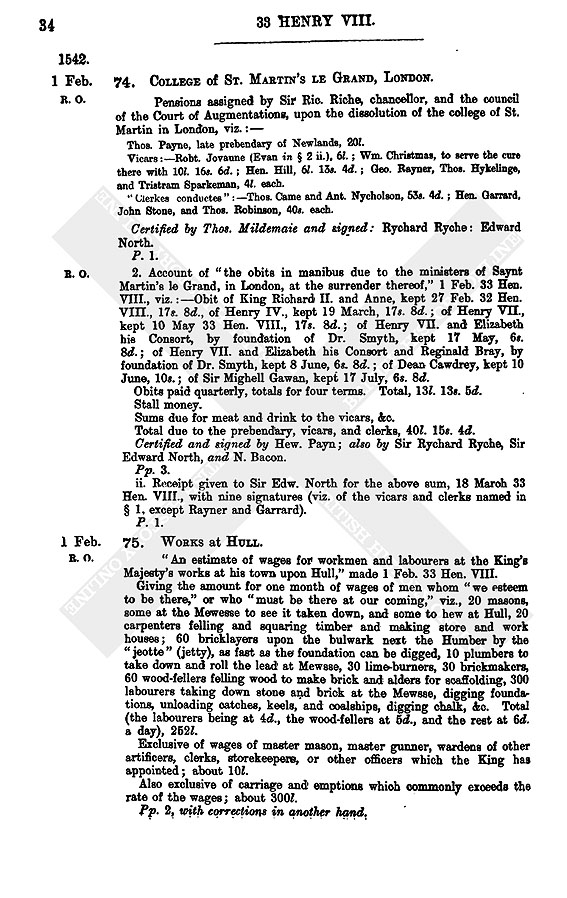
74. College of St. Martin's le Grand, London. Pensions assigned by Sir Ric. Riche, chancellor, and the council of the Court of Augmentations, upon the dissolution of the college of St. Martin in London, viz. :— Thos. Payne, late prebendary of Newlands, 20l. Vicars :—Robt. Jovaune (Evan in § 2 ii.). 6l.; Wm. Christmas, to serve the cure there with 10l. 16s. 6d.; Hen. Hill, 6l. 13s. 4d.; Geo. Rayner, Thos. Hykelinge, and Tristram Sparkeman, 4l. each. "Clerkes conductes" :—Thos. Came and Ant. Nycholson, 53s. 4d.; Hen. Garrard, John Stone, and Thos. Robinson, 40s. each. Certified by Thos. Mildemaie and signed : Rychard Ryche : Edward North. P. 1. |
| R. O |
2. Account of "the obits in manibus due to the ministers of Saynt
Martin's le Grand, in London, at the surrender thereof," 1 Feb. 33 Hen.
VIII., viz. :—Obit of King Richard II. and Anne, kept 27 Feb. 32 Hen.
VIII., 17s. 8d., of Henry IV., kept 19 March, 17s. 8d.; of Henry VII.,
kept 10 May 33 Hen. VIII., 17s. 8d.; of Henry VII. and Elizabeth
his Consort, by foundation of Dr. Smyth, kept 17 May, 6s.
8d.; of Henry VII. and Elizabeth his Consort and Reginald Bray, by
foundation of Dr. Smyth, kept 8 June, 6s. 8d.; of Dean Cawdrey, kept 10
June, 10s.; of Sir Mighell Gawan, kept 17 July, 6s. 8d. Obits paid quarterly, totals for four terms. Total, 13l. 13s. 5d. Stall money. Sums due for meat and drink to the vicars, &c. Total due to the prebendary, vicars, and clerks, 40l. 15s. 4d. Certified and signed by Hew. Payn; also by Sir Rychard Ryche, Sir Edward North, and N. Bacon. Pp. 3. |
| R. O. |
ii. Receipt given to Sir Edw. North for the above sum, 18 March 33
Hen. VIII., with nine signatures (viz. of the vicars and clerks named in
§ 1, except Rayner and Garrard). P. 1. |
|
1 Feb. R. O. |
75. Works at Hull. "An estimate of wages for workmen and labourers at the King's Majesty's works at his town upon Hull," made 1 Feb. 33 Hen. VIII. Giving the amount for one month of wages of men whom "we esteem to be there," or who "must be there at our coming," viz., 20 masons, some at the Mewesse to see it taken down, and some to hew at Hull, 20 carpenters felling and squaring timber and making store and work houses; 60 bricklayers upon the bulwark next the Humber by the "jeotte" (jetty), as fast as the foundation can be digged, 10 plumbers to take down and roll the lead at Mewsse, 30 lime-burners, 30 brickmakers, 60 wood-fellers felling wood to make brick and alders for scaffolding, 300 labourers taking down stone and brick at the Mewsse, digging foundations, unloading catches, keels, and coalships, digging chalk, &c. Total (the labourers being at 4d., the wood-fellers at 5d., and the rest at 6d. a day), 252l. Exclusive of wages of master mason, master gunner, wardens of other artificers, clerks, storekeepers, or other officers which the King has appointed; about 10l. Also exclusive of carriage and emptions which commonly exceeds the rate of the wages; about 300l. Pp. 2, with corrections in another hand. |
|
1 Feb. Corpus Reform., IV. 770. |
76. The Dean of the Faculty of Theology (fn. 2) to the University
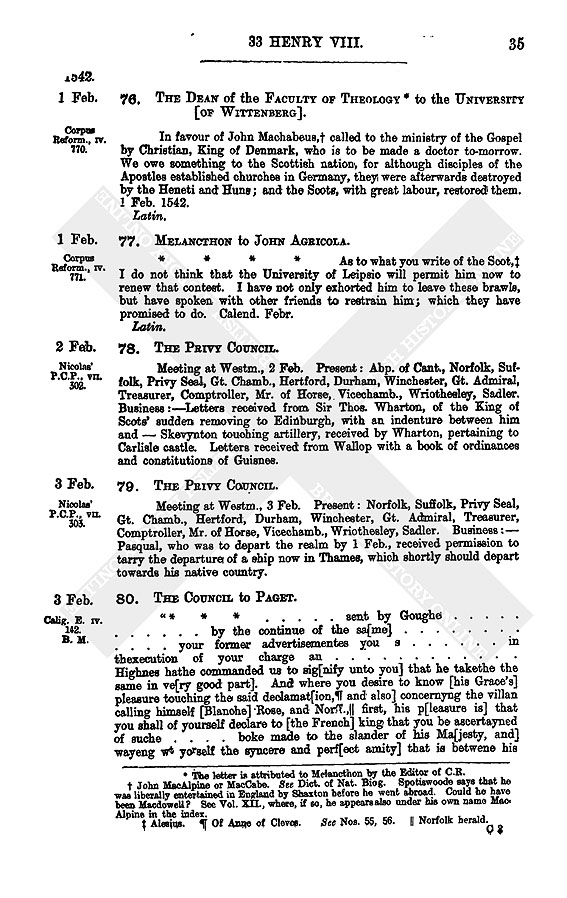
[of Wittenberg]. In favour of John Machabeus, (fn. 3) called to the ministry of the Gospel by Christian, King of Denmark, who is to be made a doctor to-morrow. We owe something to the Scottish nation, for although disciples of the Apostles established churches in Germany, they were afterwards destroyed by the Heneti and Huns; and the Scots, with great labour, restored them. 1 Feb. 1542. Latin. |
|
1 Feb. Corpus Reform., IV. 771. |
77. Melancthon to John Agricola. * * * * As to what you write of the Scot, (fn. 4); I do not think that the University of Leipsio will permit him now to renew that contest. I have not only exhorted him to leave these brawls, but have spoken with other friends to restrain him; which they have promised to do. Calend. Febr. Latin. |
|
2 Feb. Nicolas' P.C.P., VII. 302. |
78. The Privy Council. Meeting at Westm., 2 Feb. Present : Abp. of Cant., Norfolk, Suffolk, Privy Seal, Gt. Chamb., Hertford, Durham, Winchester, Gt. Admiral, Treasurer, Comptroller, Mr. of Horse, Vicechamb., Wriothesley, Sadler. Business :—Letters received from Sir Thos. Wharton, of the King of Scots' sudden removing to Edinburgh, with an indenture between him and — Skevynton touching artillery, received by Wharton, pertaining to Carlisle castle. Letters received from Wallop with a book of ordinances and constitutions of Guisnes. |
|
3 Feb. Nicolas' P.C.P., VII. 303. |
79. The Privy Council. Meeting at Westm., 3 Feb. Present : Norfolk, Suffolk, Privy Seal, Gt. Chamb., Hertford, Durham, Winchester, Gt. Admiral, Treasurer, Comptroller, Mr. of Horse, Vicechamb., Wriothesley, Sadler. Business :— Pasqual, who was to depart the realm by 1 Feb., received permission to tarry the departure of a ship now in Thames, which shortly should depart towards his native country. |
|
3 Feb. Calig. E. IV. 142. B. M. |
80. The Council to Paget. "* * * . . . . . sent by Goughe . . . . . . . . . . . by the continue of the sa[me] . . . . . . . . . . . . your former advertisementes you s . . . . . . in thexecution of your charge an . . . . . . . . . . . . Highnes hathe commanded us to sig[nify unto you] that he takethe the same in ve[ry good part]. And where you desire to know [his Grace's] pleasure touching the said declamat[ion, (fn. 5) and also] concernyng the villan calling himself [Blanche] Rose, and Norff., (fn. 6) first, his p[leasure is] that you shall of yourself declare to [the French] king that you be ascertayned of suche . . . . boke made to the slander of his Ma[jesty, and] wayeng wt yorself the syncere and perf[ect amity] that is betwene his Mate and him [that] you could noo lesse doo then to give h[im knowledge] of it to thintent it may please him [to give] ordre that the same be not permytted [to be] further divulged and published, like [as you] be assured his Mate would divise a[nd give] ordre for any thing that might sembla[bly here] touche the Frenche king. Seconde, as to[uching] that villan namyng himself Blanch Rose h[is] Mate hathe no such estimacion of him [that], seing they have hertofore made difficultie in [his] delyverance, his Grace woll any further y[ou] * * * see him conveyed [hither]." . . . . . ., 3 Feb. Signed by [Norfol]k, Suffolk, Southampton, Hertford, Browne, Wingfield, Sadler, and Baker (and, perhaps, others whose signatures are lost). Pp. 2. Mutilated. Add. (at f. 139). Endd. by Paget : To be answered. |
|
3 Feb. R. O. |
81. Cardinal Pole to Blosius. Being asked to report the nature of the office of "cavallarato" of this town, and whether Gironimo Spreca is a fit person to exercise it, has made enquiries, and finds that the office is to solicit the community to pay their dues to the treasurer of the Patrimony, and could be exercised by anyone, even an idiot, and this Gironimo is a married man, worthy and fit for a greater office. Begs commendations to His Holiness. Viterbo, 3 Feb. 1542. Modern transcript, p. 1. Italian. Add. : Al reverendo come fratello Mons. Blosio, vescovo di Foligno. |
|
4 Feb. Nicolas' P.C.P., VII. 303. |
82. The Privy Council. Meeting at Westm., 4 Feb. Present : Chancellor, Norfolk, Suffolk, Privy Seal, Gt. Chamb., Hertford, Durham, Winchester, Gt. Admiral, Treasurer, Comptroller, Mr. of Horse, Vicechamb., Wriothesley, Sadler, Chanc. of Tenths. Business :—Ph. Hobbin, gentleman usher, Sir Edw. Kerne, and Dr. Peter, who, by the King's command, apprehended certain persons suspected to be Jews, (fn. 7) presented their examinations and inventories of their goods. |
|
5 Feb. Nicolas' P.C.P., VII. 304. |
83. The Privy Council. Meeting at Westm., 5 Feb. Present : Chancellor, Norfolk, Suffolk, Privy Seal, Gt. Chamb., Hertford, Durham, Winchester, Gt. Admiral, Treasurer, Comptroller, Mr. of Horse, Vicechamb., Wriothesley, Sadler, Chanc. of Tenths. No business recorded. Like entries for the 7th, 12th, and 13th Feb. follow. |
|
5 Feb. R. O. Kaulek, 385. (Abstract.) |
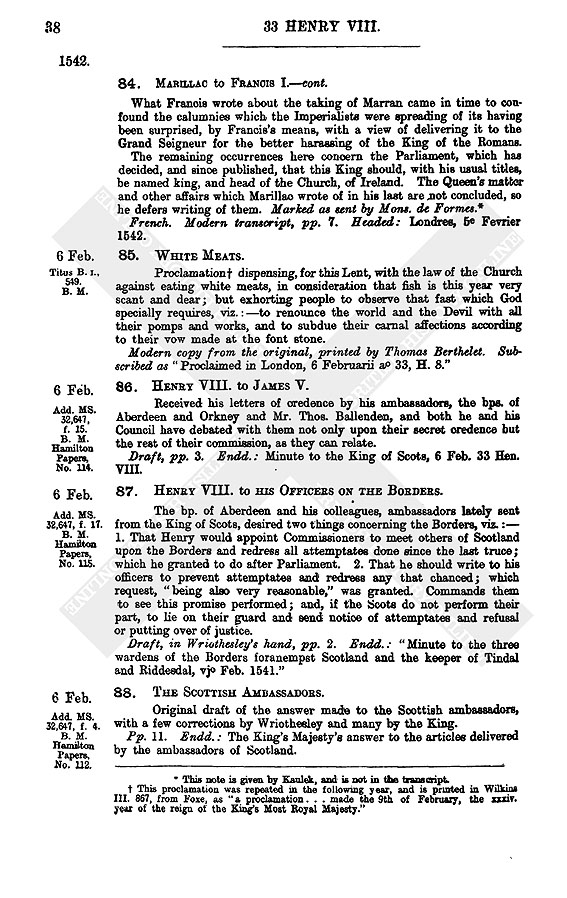
84. Marillac to Francis I. Francis's letters from Yarre, of the 14th ult., directed him, without going further into the question of marriage, to keep the English in hope on pretext of daily expecting instruction. As they required answer to what this King had last said at Greenwich, he told them he had a letter from Francis, informing him that the final deliberation would be sent in a few days. Thus gained time to see what would be treated in Parliament. Meanwhile received the other and last despatch, of the 24th, commanding him to resume the subject of marriage, and put forward the interview of Francis, this King, and the King of Scots. It came very apropos; for the bp. of London, who had taken leave and was about to depart to the Emperor, was thereupon stopped, and his departure deferred until further news from France. Thinks they first wish to have his answer about what he now writes, which is the substance of what Norfolk, to whom he had privately proposed these two points, replied to him two days later, in presence of the lord Privy Seal and Chief Secretary. To commence with the marriage; on his stating that, if he saw the King disposed to go through with it, he would furnish a power, Norfolk said he had never seen prince so inclined to listen to a thing; adding, on his King's behalf, many gracious and hopeful words which it would take too much space to detail. Never saw them use such earnest language, or show less dissimulation. The effect was that their King would grant anything reasonable (although they specified nothing), and they thought this affair should be resolved without further delay, which would be as soon as Francis sent power to conclude. Norfolk had said as much to him apart, and also sent him word that this was the time for the matters to proceed, hinting that this last overture had recalled them from listening to marriages proposed by the Emperor, by whom they were very instantly sought. As to the interview, they said their master singularly desired it, and, after another long discourse of his affection and cordiality, they ended by saying that neither age, nor the troubles he had had, nor business, nor, lastly, the fear of the sea, could diminish the wish he had to see the brother and friend, and the personage whom he loved most in the world; but he would put two conditions to it :—1, That they should first, by ambassadors, bring the principal affairs near some conclusion, lest either of the Kings should put forward something not agreeable to the other, and so cause secret indignation, which might lead to war, or else, if the interview produced no treaty, it might be made a matter of ridicule rather than reputation that the two first kings of Christendom had met in vain. 2. They know not how the King of Scots could well be there, for, besides the difficulty that he must either pass through England or risk the sea, they would not have him put himself on a level with the other two (although they did not say so, but alleged that this King, having something to say to Francis apart, the King of Scotland might thereby think himself slighted); but they would not oppose his sending ambassadors and treating jointly with them, and, if the said King wished to see his uncle, they would consent to a meeting on the frontiers; inferring that the meeting of two princes might do good, but the third would spoil the business, and so they would not have the King of Scots there, either because they would have two to deal with (for he would be all for Francis), or else because they resent his having kept them waiting at York, at which they were indignant enough. Can see no likelihood that this King contributed to the expense of the Emperor's expedition of Algiers, nor that his ambassador lost 100,000 cr. by shipwreck, or had other money with him than his ordinary provision. He writes that he only lost 7,000 or 8,000 cr. worth of money and goods, besides (it is true) the silver plate which this King furnishes to his ambassadors. Hears, on the contrary, from a good quarter, that this King sometimes expressed wonder that the Emperor made this journey at such a season, and thought he should not have left the Germans without ending the religious differences, in order to arm ("pour venir armer," Kaulek reads "arriver") in Italy, when nothing was asked of him but peace, and his brother had so much to do in Hungary. Moreover, the English are not so religious as to put themselves to expense for a thing which nowise touches them. What Francis wrote about the taking of Marran came in time to confound the calumnies which the Imperialists were spreading of its having been surprised, by Francis's means, with a view of delivering it to the Grand Seigneur for the better harassing of the King of the Romans. The remaining occurrences here concern the Parliament, which has decided, and since published, that this King should, with his usual titles, be named king, and head of the Church, of Ireland. The Queen's matter and other affairs which Marillac wrote of in his last are not concluded, so he defers writing of them. Marked as sent by Mons. de Formes. (fn. 8) French. Modern transcript, pp. 7. Headed : Londres, 5e Fevrier 1542. |
|
6 Feb. Titus B. I., 549. B. M. |
85. White Meats. Proclamation (fn. 9) dispensing, for this Lent, with the law of the Church against eating white meats, in consideration that fish is this year very scant and dear; but exhorting people to observe that fast which God specially requires, viz. :—to renounce the world and the Devil with all their pomps and works, and to subdue their carnal affections according to their vow made at the font stone. Modern copy from the original, printed by Thomas Berthelet. Subscribed as "Proclaimed in London, 6 Februarii ao 33, H. 8." |
|
6 Feb. Add. MS. 32,647, f. 15. B. M. Hamilton Papers, No. 114. |
86. Henry VIII. to James V. Received his letters of credence by his ambassadors, the bps. of Aberdeen and Orkney and Mr. Thos. Ballenden, and both he and his Council have debated with them not only upon their secret credence but the rest of their commission, as they can relate. Draft, pp. 3. Endd. : Minute to the King of Scots, 6 Feb. 33 Hen. VIII. |
|
6 Feb. Add. MS. 32,647, f. 17. B. M. Hamilton Papers, No. 115. |
87. Henry VIII. to His Officers on the Borders. The bp. of Aberdeen and his colleagues, ambassadors lately sent from the King of Scots, desired two things concerning the Borders, viz. :— 1. That Henry would appoint Commissioners to meet others of Scotland upon the Borders and redress all attemptates done since the last truce; which he granted to do after Parliament. 2. That he should write to his officers to prevent attemptates and redress any that chanced; which request, "being also very reasonable," was granted. Commands them to see this promise performed; and, if the Scots do not perform their part, to lie on their guard and send notice of attemptates and refusal or putting over of justice. Draft, in Wriothesley's hand, pp. 2. Endd. : "Minute to the three wardens of the Borders foranempst Scotland and the keeper of Tindal and Riddesdal, vjo Feb. 1541." |
|
6 Feb. Add. MS. 32,647, f. 4. B. M. Hamilton Papers, No. 112. |
88. The Scottish Ambassadors. Original draft of the answer made to the Scottish ambassadors, with a few corrections by Wriothesley and many by the King. Pp. 11. Endd. : The King's Majesty's answer to the articles delivered by the ambassadors of Scotland. |
| R. O. |
2. Fair copy of the preceding. Pp. 4. Endd. : Th'ambassadors of Scotland. |
| R. O. |
3. Copy of § 2, with three passages cancelled and re-written by
Wriothesley at the end. Pp. 12. |
| R. O. St. P., V. 200. |
4. Fair copy of § 3, corrected by the King, viz. :— "Answer to the articles and credence given by our dearest nephew the King of Scots" to the bps. of Aberdeen and Orkney and Mr. Thos. Ballenden, "his ambassadors now resident with us." 1. To the first article, wherein James rejoices to hear, by Mr. Ballenden, of Henry's friendship, &c.; he may be sure that in kindness and friendly dealing Henry can give place to none. 2. Where he says their meeting was deferred for lack of the consent of the States of his realm and the French King, whom he earnestly solicited to consent; when Mr. Ballenden, at Northampton, proposed the meeting, and letters sent to Pomfret and Cawode, both from James and him, showed that James still desired it, Henry did indeed protract his stay there, but, seeing the matter is made so difficile, he is content to pass it over for this time. 3. As to his further "excuse by certain enormities then committed" by the great men of his South Isles; has not heard otherwise of them, but doubtless they are now reduced to obedience by his wisdom and policy. 4. As to his offer to labour further to the French King for his consent to the meeting or else for a meeting between the three Kings, to treat a perpetual league, and his further offer to mediate in controversies between Henry and the French King; if he can remove the difficulties of a meeting between them two near the Borders, Henry will be content. But, as to the joint meeting with the French King, which also James's ambassadors have moved since exhibiting the articles to which this is an answer, cannot understand how the French King could be induced to "take such pains and adventure" as to come to any place near the Borders. And as to James's offer for composition of his controversies with the French King, doubts not but the French King will so remember his past friendship that mediation shall not be needed. Finally, as to the continuance of amity, trusts his nephew will so redubb some things past and proceed hereafter that there shall be no cause to the contrary. Draft, with corrections in Henry VIII.'s hand, pp. 11. Much injured by damp. |
| Add. MS. 32,647, f. 12. B. M. |
5. Fair copy of § 4 (with two slight verbal differences, which are noted
in the Hamilton Papers, Vol. I., No. 113). Signed at the head. Pp. 3. Endd. : "The [true] copy of the King's Majesty's answer to th articles given by the King of Scots to his ambassadors within named sent to his Majesty : despatched vjo Februarii 1541." |
|
6 Feb. R. O. |
89. Robert Oxenbregg To Lord Laware. Has been prevented by long sickness of the fever quartan from waiting upon him. As lord Laware has "the assessment of all the gentlemen of the shire for the Subsidy," certifies that his lands have, for previous subsidies, been assessed at 120l. a year, which is their full value. Halle, in Kent, 6 Feb. Signed. P. 1. Add. Endd. : Memorandum, that Mr. Oxenbrige dwelleth in the rape of Hastings. |
|
7 Feb. Poli Epp., III. 50. |
90. Cardinal Pole To Cardinal Contarini. Is returned from Civitavecchia, whither he went to kiss the Pope's feet at his coming within the territory of the legation. (fn. 10) Found his Holiness as benign as usual, and talked with him for two hours before supper of the impending calamities, the more hopeful aspect of English affairs, and Contarini's appointment to the legation. (fn. 11) The Cardinal of St. Cross was present, but Pole had little opportunity of speaking with him that night, and the Pope departed early next morning. Eulogises the promising talent of Cardinal Fernese. Hopes to see Contarini here soon, as the Pope evidently wishes the departure of the legates from Rome. Viterbo, 7 Feb. 1542. Italian and Latin. |
|
8 Feb. Laemmer, 399. |
91. Bishop Of Modena To Cardinal Farnese. Describes interview with Duke William of Bavaria, who protested his desire to remain a good Catholic, and wished that some good monks might be sent from Italy to renew religious observances in the monasteries of his country, which were very ill ruled. Spoke to him of the Scottish doctor, (fn. 12) as he will write when the latter arrives here. * * Spires, 8 Feb. 1542. Italian. |
|
9 Feb. Spanish Calendar, VI., I., No. 230. |
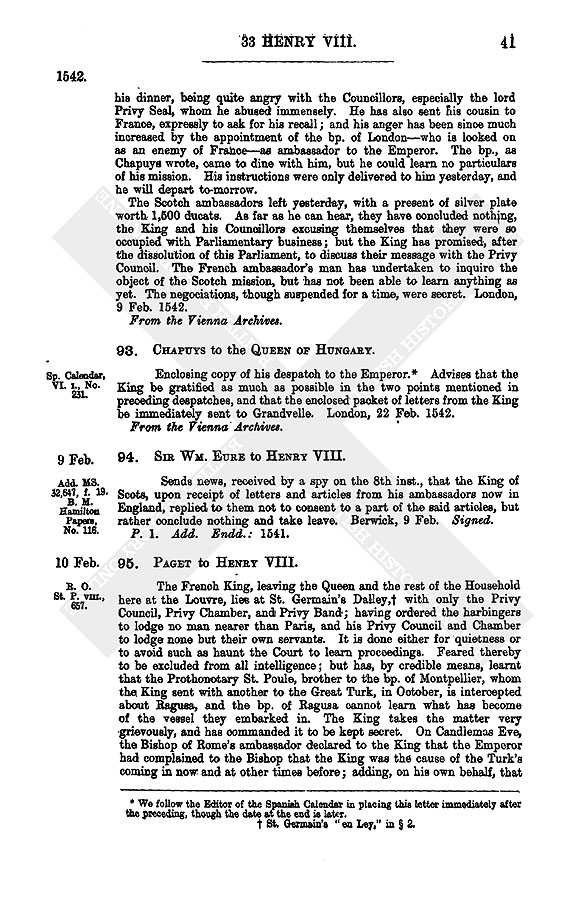
92. Chapuys To Charles V. Wrote on the 29th ult of the Queen's condemnation and that of the duchess of Norfolk, her daughter, (fn. 13) and lady Rochford. Till then the King had never been merry since first hearing of the Queen's misconduct; but he has been so since, especially on the 29th, when he gave a supper and banquet with 26 ladies at his table, besides gentlemen, and 35 at another table close by. The lady for whom he showed the greatest regard was the sister of lord Cobham, whom Wyatt sometime ago repudiated for adultery. She is a pretty young creature, with wit enough to do as badly as the others if she were to try. The King is also said to have a fancy for the daughter of Madame Albart, niece, of the Grand Esquire, Master Anthony Brown, and also for a daughter (fn. 14) (by her first marriage) of the wife of Mons. Lyt, late deputy of Calais—a surmise which rests partly on the fact that after nearly two years' close confinement in the Tower, her father has been liberated, and the King has ordered his arms, which had been removed from their place in the chapel of the Order, (fn. 15) to be replaced. (fn. 16) Two days ago the Comptroller of the King's household (fn. 17) went to Syon house to break up the Queen's household and dismiss her servants. The Comptroller is then to take the Queen to his own lodging, that is to say, to the Tower, of which he is governor. No final determination has yet been come to about her fate, but in two or three days it will be known. The French ambassador's man says he has had no letters from Francis for some time, the last merely directing him to continue the same game of trying to cajole and amuse the English to prevent their making a league with the Emperor, and to promise the King the support of the Scots if he will treat with Francis. After receipt of this letter, the ambassador endeavoured to treat with some of the Privy Councillors, but unsuccessfully, and left the Council in disgust, and for three days after could not enjoy his dinner, being quite angry with the Councillors, especially the lord Privy Seal, whom he abused immensely. He has also sent his cousin to France, expressly to ask for his recall; and his anger has been since much increased by the appointment of the bp. of London—who is looked on as an enemy of France—as ambassador to the Emperor. The bp., as Chapuys wrote, came to dine with him, but he could learn no particulars of his mission. His instructions were only delivered to him yesterday, and he will depart to-morrow. The Scotch ambassadors left yesterday, with a present of silver plate worth 1,500 ducats. As far as he can hear, they have concluded nothing, the King and his Councillors excusing themselves that they were so occupied with Parliamentary business; but the King has promised, after the dissolution of this Parliament, to discuss their message with the Privy Council. The French ambassador's man has undertaken to inquire the object of the Scotch mission, but has not been able to learn anything as yet. The negociations, though suspended for a time, were secret. London, 9 Feb. 1542. From the Vienna Archives. |
|
Sp. Calendar, VI. I., No. 231. |
93. Chapuys To The Queen Of Hungary. Enclosing copy of his despatch to the Emperor. (fn. 18) Advises that the King be gratified as much as possible in the two points mentioned in preceding despatches, and that the enclosed packet of letters from the King be immediately sent to Grandvelle. London, 22 Feb. 1542. From the Vienna Archives. |
|
9 Feb. Add. MS. 32,647, f. 19. B. M. Hamilton Papers, No. 116. |
94. Sir Wm. Eure To Henry VIII. Sends news, received by a spy on the 8th inst., that the King of Scots, upon receipt of letters and articles from his ambassadors now in England, replied to them not to consent to a part of the said articles, but rather conclude nothing and take leave. Berwick, 9 Feb. Signed. P. 1. Add. Endd. : 1541. |
|
10 Feb. R. O. St. P. VIII., 657. |
95. Paget to Henry VIII. The French King, leaving the Queen and the rest of the Household here at the Louvre, lies at St. Germain's Dalley, (fn. 19) with only the Privy Council, Privy Chamber, and Privy Band; having ordered the harbingers to lodge no man nearer than Paris, and his Privy Council and Chamber to lodge none but their own servants. It is done either for quietness or to avoid such as haunt the Court to learn proceedings. Feared thereby to be excluded from all intelligence; but has, by credible means, learnt that the Prothonotary St. Poule, brother to the bp. of Montpellier, whom the King sent with another to the Great Turk, in October, is intercepted about Ragusa, and the bp. of Ragusa cannot learn what has become of the vessel they embarked in. The King takes the matter very grievously, and has commanded it to be kept secret. On Candlemas Eve, the Bishop of Rome's ambassador declared to the King that the Emperor had complained to the Bishop that the King was the cause of the Turk's coming in now and at other times before; adding, on his own behalf, that Piers Strawz, (fn. 20) the King's servant, and son to the great merchant that killed himself in prison in Florence, who came over to England when the French King was last at Abbeville, (fn. 21) did avaunt himself to have caused the surprise of Maran. The King replied that the Emperor would say what he list, although it were not true, and, as for Piers Strawz, he would send for and question him; as he did within two days. His answer is not known, but the King immediately made him one of the gentlemen of the Privy Chamber. The bp. of Rome lately sent briefs to all the Cardinals in France to repair to Rome, but the King has staid them. All captains and bands about Piedmont are appointed to go to their posts, and musters are made throughout France. All persons, spiritual and lay, who are of the "bande or ariere-bande," that is, hold land of the King "in chief or in meane," were commanded to certify last month the value of their lands; and now, within these two days, command is sent them to be ready within 15 days, to serve in person for two months, or pay for footmen according to the amount of their lands. Whether this is to raise money or to make war is uncertain, but one of the Privy Council has said that the King had never better will to make war, and that "if there be no war, your Majesty is the let." The Duke of Alva has a safe conduct to pass through France into Flanders, and it is thought his journey is into England. A gentleman is come from King Ferdinand, to desire (as the Emperor's ambassador says) the French King not to support them of Maran, to besiege which Ferdinand has sent 6,000 or 7,000 Italians and Almains. The Duke of Ferrara's physician sent me yesterday a letter and a book, to be sent to your Majesty. Knowing Italy to be full of poison, and doubting whether some of these traitors there would have caused me to convey to your Majesty I wist not what, I was bold to unpack it, in presence of your servant Hammes and some of my servants. The book is a comment of physic, and the author seems well minded. What his learning is I remit to your Majesty's most excellent wisdom. Begs pardon if he has offended in opening it. Paris, 10 Feb. Signed. Pp. 4. Add. Endd. : 1541. |
| Caius College MS. 597, p. 30. |
2. Letter-book copy of the preceding, in the hand of Paget's clerk. Pp. 4. |
| 11 Feb. |
96. Bishopric Of Bangor. See Grants in February, No. 29. |
|
11 Feb. R. O. Kaulek 387. (Abstract.) |
97. Francis I. to Marillac. Received his letters of the 5th, by his cousin, the bearer, showing the good and honest words which have been held to him touching the marriage and interview; and agrees that all things which have to be passed at the meeting should be well digested first, so that there may be no need of disputes or difficulties, which the conclusion of the marriage will entirely dispel, and there will be nothing needed but to finish and consummate it. To give no occasion for dissembling for want of powers, sends two, to be used as he sees needful. Until the matter is entered upon, if they demand the original of the said power, he shall escape by dexterously delivering a copy (but that is left to his discretion), and he must conclude the marriage before entering on other matters. Afterwards he can speak of the interview, for its consummation. As to the difficulties alleged against the King of Scotland's being at the interview; after declaring the great pleasure it is to Francis to know Henry's wish to see him, and the singular desire he (Francis) has to meet the person to whom he bears such perfect and entire friendship, Marillac shall point out that the King of Scotland, because of his youth and good health, can easily take the trouble to come to the meeting place, and his presence will be no hindrance to the conversation, and nothing could more frighten the Pope than to see the meeting of them three. They would not be two against one (tous, qu. un ?), for, being Francis's son, the King of Scotland would be Henry's son also. Still, if the English do not like the King of Scotland's being at the interview, at the least, it will be reasonable that some great personage should come on his behalf, with power to treat; and Francis would likewise send a man if there was a subsequent interview made between the Kings of England and Scotland. The King of the Romans has lately sent a gentleman to complain of the taking of Marran, and tell various false reports which he had had, especially that the taker (fn. 22) of the said town showed Francis's letters patent empowering him to do it, whereas Francis knew sooner of the taking than the enterprise. Made answer in accordance with the truth, which he wrote in his last. Countersigned : Bayard. French. Modern transcript, pp. 3. Headed : St. Arnoul, 11 Fevrier 1542. |
| R. O. |
2. Full power given by Francis I. to Charles de Marillac, councillor
and master of requests ordinary, to treat and conclude the marriage of
lady Mary, eldest and legitimate daughter of the King of England, and
the duke of Orleans. Saint Arnoul, 10 Feb. 1541, 28 Fras. I. Countersigned :
Bayard. French. Modern transcript, pp. 3. Headed : "Double du pouvoir envoyé à M. de Marillac par le Roy (sic, qu. sieur ?) des Formes touchant le mariage." |
|
11 Feb. Epp. Reg. Sc., II. 147. |
98. John, King Of Portugal, To James V. Received his letters, by his herald Snaudon, signifying that some of his people were pressing for licence to seize goods of Portuguese merchants, saying that they were so empowered by James's grandfather, because of some merchandise and ships of which their ancestors were despoiled. Expresses surprise at the demand, and, although he could easily prove by letter why it should not be granted, will send a servant to James's court. Lisbon, 11 Feb. 1542. Latin. |
|
12 Feb. R. O. |
99. Thomas Mynternus To Henry VIII. Some time ago (ante dies aliquot) the King commanded him to travel for foreign study, but he is restrained by poverty, which he begs the King to relieve. Aureliis, pridie Idus Feb. 1541. Latin, p. 1. Add. Endd. : Myntren to the King's Majesty. |
|
13 Feb. R. O. Kaulek, 388. (Full abstract.) |
100. Marillac To Francis I. The Scottish ambassadors yesterday came to report that they had received this King's answer about the interview; which was in substance what he wrote on the 5th, viz., that this King would willingly grant an interview for two, but not for three. As they are sending the Cardinal of St. Andrews the said answer, which was given them in writing, Marillac could do no less than forward their letters with these; to which there is nothing to add but that Parliament has condemned this Queen and the lady of Rochefort to death. Her execution was expected this week, for last night she was brought from Syon to the Tower, but as she weeps, cries, and torments herself miserably, without ceasing, it is deferred for three or four days, to give her leisure to recover, and "penser au faict de sa conscience." As to the old duchess of Norfolk, some say she shall die, others that she shall keep perpetual prison, like her son lord William and daughter the countess of Brizchwatre. A few days will show. All her goods are already confiscated, and are of marvellous value, 400,000 or 500,000 cr., for ladies in this country succeed for life to the moveables of their deceased husbands. Norfolk is greatly interested, since the greater part came to her through his late father; yet the times are such that he dare not show that the affair touches him, but approves all that is done. P.S.—13 Feb. : After writing the above, was informed that to-day, Monday, 13th inst., the condemned ladies should be executed; and, indeed, about nine o'clock in the morning, this Queen first, and afterwards the lady of Rochefort, within the Tower, had their heads cut off with an axe, after the manner of the country. The Queen was so weak that she could hardly speak, but confessed in few words that she had merited a hundred deaths for so offending the King who had so graciously treated her. The lady of Rochefort said as much in a long discourse of several faults which she had committed in her life. It is not yet said who will be Queen; but the common voice is that this King will not be long without a wife, for the great desire he has to have further issue. French. Modern transcript, pp. 3. Headed : Londres, 11 Fevrier. |
|
13 Feb. Royal MS. 18 B. VI. 135. B. M. |
101. James V. to O'neil. In favour of the bearers (fn. 23) whom the Pope, for the sake of the Irish church, writes to him to commend in their passage to Ireland. Stirling, id. Feb. 1541. Lat. Copy, p. 1. |
|
13 Feb. Royal MS. 18 B. VI. 135. B. M. St. P., V. 202. |
102. James V. to the Chieftains Of Ireland. With Paschasius Broet, Alphesus Salmeron, and Fras. Capata, received the Pope's brief, showing how solicitous his Holiness is for Ireland and its people, and desiring him to commend them, in their passage to Ireland, to his islanders and to his friends through whose dominions they pass. Begs that they may be received and assisted. Stirling, id. Feb. 1541. Lat. Copy, pp. 2. Begins : Jacobus Dei gratia Rex Scotorum Hibernie dominis ac nobilibus, amicis nostris, salutem. |
|
14 Feb. Nicolas' P.C.P., VII. 305. |
103. The Privy Council. Meeting at Westm., 14 Feb. Present : Chancellor, Norfolk, Suffolk, Privy Seal, Hertford, Durham, Winchester, Gt. Admiral, Treasurer, Comptroller, Mr. of Horse, Vicechamb., Wriothesley, Sadler, Chanc. of Tenths. Business :—Thos. Barnabie, who was imprisoned by Alderman Roche in the Counter, although he had a letter signed by the Council forbidding that he should be troubled while occupied in the King's affairs, was released, and Roche commanded to pay his costs. |
|
14 Feb. Royal MS. 18 B. VI. 135 b. B. M. |
104. James V. To Cardinal Carpi. Complains of the wickedness of those "qui pridem Johannes (sic) Reid Aberdonensis Cancellarii diutino morbo laborantis sic captarunt sacerdotium ut alternis pene diebus id ipsum istic impetraverunt ea vafricie ordinarii hie collationem eludentes." To defeat such tricks, desires a new provision sent at once for dominus Georgius Marcellus to have the chancellorship of Aberdeen, together with his title of provost of Linclowden, Glasgow dioc., and the treasurership of Aberdeen. Edinburgh, 16 cal. Martiis. Lat. Copy, pp. 2. |
|
15 Feb. Nicolas' P.C.P., VII. 306. B. M. |
105. The Privy Council. Meeting at Westm., 15 Feb. Present : Chancellor, Norfolk, Suffolk, Privy Seal, Hertford, Durham, Winchester, Gt. Admiral, Treasurer, Comptroller, Mr. of Horse, Vicechamb., Wriothesley, Sadler, Chanc. of Tenths. Business :—Edm. and Charles Fox and one Calfhill having exhibited a book of heinous articles against the President of the Council of the Marches of Wales, the President appeared and made answer, showing the accusations to be malicious and groundless; and all three were thereupon committed to the Fleet, but, as Edm. and Charles Fox claimed privilege as burgesses of Parliament, they were bound to appear before the Council once a week during Parliament, and afterwards from time to time until dismissed, and Calfhill only sent to the Fleet. |
|
15 Feb. R. O. |
106. Ottwell Johnson To His Brother, John Johnson. (fn. 24) London, 15 Feb. 1541 :—Wrote on Sunday last. Describes purchase of wine and herrings for his mother, and some commercial dealings with Wm. Gifford, Adrian of Dunkirke and Bartram de la Salle. From Calais hears nothing of his brother's suit to lord Gray. "And for news from hence, know ye, that, even according to my writing on Sunday last, I see the Queen and the lady Retcheford suffer within the Tower, the day following; whose souls (I doubt not) be with God, for they made the most godly and Christians' end that ever was heard tell of (I think) since the world's creation, uttering their lively faith in the blood of Christ only, with wonderful patience and constancy to the death, and, with goodly words and steadfast countenance, they desired all Christian people to take regard unto their worthy and just punishment with death, for their offences against God heinously from their youth upward, in breaking of all his commandments, and also against the King's royal majesty very dangerously; wherefor they, being justly condemned (as they said), by the laws of the realm and Parliament, to die, required the people (I say) to take example at them for amendment of their ungodly lives, and gladly obey the King in all things, for whose preservation they did heartily pray, and willed all people so to do, commending their souls to God and earnestly calling for mercy upon Him, whom I beseech to give us grace with such faith, hope, and charity, at our departing out of this miserable world, to come to the fruition of his Godhead in joy everlasting. Amen." Desires that Mr. and Mrs. Cave and his wife may share this news, which is surely "well worth the knowledge." Large paper, pp. 2. Add. : merchant of the Staple at Calais. At Tykeford. |
|
15 Feb. R. O. Kaulek, 389. (Abstract.) |
107. Marillac To Francis I. Since his last, of the 13th inst., M. de Morvillier, the bearer, on his return from Scotland, passed by this town, where he has sojourned about eight days, waiting for a passport and to know if this King would send any message to Francis by him. He can report both what he has seen and Marillac's opinion of the state of affairs here. French. Modern transcript, p. 1. Headed : 15 Feb. 1542. |
|
15 Feb. |
108. Parliament Of Ireland. Parliament of 33 Hen. VIII., 2nd session, at Limerick, 15 Feb. [See Vol. XVI., No. 901.] Acts : — Chap. 1. Adjournment of Parliament and choice of Commons. Rot. Parl. C. 2. Chap. 2. Election of the lord Justice. Rot. Parl. c. 3. Chap. 3. Mispleading and jeoyfailes. Rot. Parl. c. 3 (sic). Chap. 4. Lands given by the King. Rot. Parl. c. 5. Chap. 5. Suppression of Kilmainham and other religious houses. Rot. Parl. c. 6. |
|
15 Feb. R. O. Kaulek, 389. (Abstract.) |
109. Francis I. To Marillac. Although in my last letters by your cousin I explained my intention at length, I wish to repeat that the principal point is that the marriage be concluded, even though there should be no interview. But, if there shall be need of speaking of the interview, the Scottish ambassadors must be informed of my suit for it, and that if there is a refusal it proceeds from the King of England, and that he (the Scottish King) will have to send a man to it, with power to treat and hear all that passes, where there will not be a single point to his disadvantage. Countersigned : Bayard. French. Modern transcript, p. 1. Headed : Lymours, 15 Feb. 1542. |
|
15 Feb. Theiner, 613. |
110. James V. to Paul III. Has read his late brief to the cardinal of St. Andrews, summoning him immediately to Rome. His assistance and counsel at present and in the immediate future seem so necessary that James cannot spare him, and begs the Pope to allow him to stay and to believe that James will not fail in his duty to the Holy See. Edinburgh, 15 Feb. 1541. Latin. |