
Letters and Papers, Foreign and Domestic, Henry VIII, Volume 5, 1531-1532. Originally published by Her Majesty's Stationery Office, London, 1880.
This free content was digitised by double rekeying. All rights reserved.
'Henry VIII: March 1531, 16-31', in Letters and Papers, Foreign and Domestic, Henry VIII, Volume 5, 1531-1532, (London, 1880) pp. 66-82. British History Online https://www.british-history.ac.uk/letters-papers-hen8/vol5/pp66-82 [accessed 26 April 2024]
Image

Image

Image

Image
Image

Image
Image
Image

Image

Image
Image

Image
Image

Image

Image

Image

Image

March 1531, 16-31
| 16 March. |
143. St. Alban's. Election of abbot. See Grants in March, Nos. 28 and 29. |
|---|---|
|
16 March. Add. MS. 28,583, f. 110. B. M. |
144. Ortiz to Charles V. Has received his letters of 15 and 16 Feb. Has written twice since his arrival in Rome about the matters the Emperor mentions in them; and the letters of the Ambassador will have informed him more largely of the state of the cause, and that the king of England had refused to answer here; and that his reasons had not been allowed by the Consistory, who have ordered him to send a procuration for treating the cause here in his name. This he has not yet done. If he perseveres in his refusal, the intention of the queen of England must be proved, and the sentence called "por contradictas" given as against a person who fails to appear. Then his Holiness should be required to hear the examination of the merits of the cause, and the Consistory would determine by an "extravagante" that this grade of affinity between brother and sister-in-law does not impede marriage, except by human law, with which the Pope can dispense. By this means the justice of the cause will be well determined and founded for ever. There has been no opportunity to treat of the second article, to examine which you sent me here, until after the appearance of some one to answer for the king of England, and sentence given against him for not appearing. Then the Pope can, by reason of his office, determine the truth of himself, and notify it to all the Church. Meanwhile the Ambassador can manage the first point, as it only concerns the forms of law. It is well that the English king knows that those on your side are ready. He shows their demand to have been unjust, and answers the reasons of those by whom he has been deceived. He has proclaimed here that he has only moved this cause for the security of his conscience;which is evidently dishonest, as he has hindered the case from being decided, by his delays. This country is very dear. The university of Salamanca have not paid his salary, which, he was told, should be continued while he was in the Emperor's service. Begs the Emperor not to allow him to want. Rome, 16 March 1531. Sp., pp. 4, modern copy. |
|
8 March. Erasm. Ep. xxvi. 39. |
145. Erasmus to William Lord Mountjoy. Thinks he has replied in a rather confused manner to Mountjoy's letters. Writes briefly now. Is much gratified by the Queen's regard for him. Who would not love a woman of such sanctity of life ? Mary, to whom he has dedicated the Vidua Christiana, has expressed her good will to Erasmus by letters under her own hand,a favor equal to a magnificent gift. The whole world is now disturbed, princes and common people alike. Trusts, however, that the leader of these pastimes (summus ille choragus) will conduct everything to a good issue. A truce is expected with the Turk, which is very necessary for Christendom, especially Austria, and will extend the outworks of the Faith even better than war. If your son Charles wrote that letter unaided, it is time for Erasmus to throw away the pen. Congratulates Mountjoy with all his heart on having such a son. Had much trouble last summer with physicians and surgeons, that is, butchers, on account of an abscess, from which he has happily, though slowly, recovered. Fortune would not fail me, if health permitted me, to frequent the courts of princes. But I must live as I do, or not live at all. You have no notion of the virulence of my enemies. Spain, Italy, France, Germany, Britain, each has its vipers casting venom in secret, and maligning me by subornation. Such is my fate; I am loved or feared by the great, but attacked by dogs and vermin. Will not honor slaves henceforth with a reply when he has the concurrence of men like Tunstall, Sadolet, and Alciatus. Wishes Mountjoy's fortune equal to his spirit;not that Erasmus is reduced to poverty, but that an old warrior like himself should live more handsomely. Has many in Germany who wish him well, but it is more honorable not to seek new patrons. Fears that old age will soon deprive him of Warham, though they have vowed that neither shall survive the other. Would gladly have dedicated to Mountjoy's son some books of Apophthegms, but last summer was barren, and the winter not too fertile, from his shattered health. Has also promised his first production to the young duke William of Juliers. Has therefore dedicated to Charles Livy, with five additional books, as an incentive to study, and a reward for his elegant letter. If Simon Grinus, whose name stands in the preface, bring you this letter, I beg you to advance his business. He is a man of great learning and singular modesty, thoroughly versed in Latin, Greek, philosophy, and mathematics, drawn to England chiefly by the desire to visit your libraries. Friburg, xv. kal. April 1531. Lat. |
|
20 March. Add. MS. 28,583, f. 117. B. M. |
146. Secret Consistory Of Cardinals. "On the 20 March 1531, a secret Consistory of Cardinals was held in the Apostolic Palace at Rome, in the usual room, in which Consistory the following business was transacted :Letters of the king of Scots and a pamphlet (libellum) were read, in which the said King stated certain demands. It was decided that the Cardinals should be first informed of what the said letters and pamphlet contained, and then in a future Consistory discuss the claims of the king of Scots." English abstract from copy at Simancas. |
|
21 March. Add. MS. 28,583, f. 118. B. M. |
147. Mai to Archbishop Of Santiago. As he has already written, the excusator appeared, and was repulsed unless he brought with him a mandate. He then appealed, and a new discussion was necessary to gain the "apostolos refutatorios," which was done. They then asked for delay without shame, as they had done before; but as I thoroughly undeceived the Pope, nothing more was said of it. They tried to prevent more than one "remissoria" being given for one place, and it was disputed first in the Rota and then in the Consistory. The result was that eight "remissorias" will be given,four for Castile, three for Aragon, and one for Flanders,in which they would not include England. Not to lose time, I have taken these, and will ask for the others. Will send them by a special courier in eight or ten days. I send this news that the witnesses may be ready. Castile is of the most importance. I will try to obtain a sentence "por contradita," but I do not think they will give it. I say that I am trying to obtain it, because they give me the remissoria sine retardatione processus principalis in quatenus exadverso compareat legitimus contradictor. Rome, 21 March 1531. Sp., pp. 3, modern copy. |
|
22 March. Vienna Archives. |
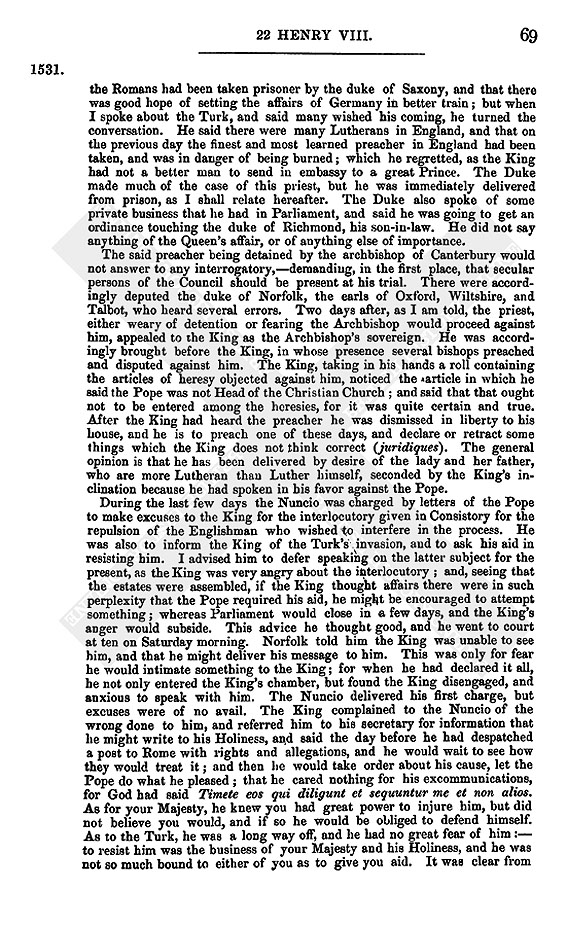
148. Chapuys to Charles V. I have lately understood by May's letters th[...]ome who are anxious to delay the Queen's process object that they have [...]ot at Rome the procedure before the Legates in England, which is the foundation of the whole cause. They think, perhaps, that the King would give orders that they could not find it, and thus they would avoid sentence being given at all. But I have found it, and I send an authenticated copy with these, which it may please you to send thither as soon as possible. Since my last I have visited the duke of Norfolk to learn what was doing in Parliament against foreigners. I desired that he would not allow new imposts to be made contrary to the old treaties. He said there was no fear of this; that the matter was remitted to the Chancellor and five bishops, doctors, and others, and that for whatever concerned the intercourse he would care as for his own eyes. He then asked me about the coming of the Turk, and where Don Fernando was, saying he thought the duke of Saxony was doing much mischief. I said it was not true that the king of the Romans had been taken prisoner by the duke of Saxony, and that there was good hope of setting the affairs of Germany in better train; but when I spoke about the Turk, and said many wished his coming, he turned the conversation. He said there were many Lutherans in England, and that on the previous day the finest and most learned preacher in England had been taken, and was in danger of being burned; which he regretted, as the King had not a better man to send in embassy to a great Prince. The Duke made much of the case of this priest, but he was immediately delivered from prison, as I shall relate hereafter. The Duke also spoke of some private business that he had in Parliament, and said he was going to get an ordinance touching the duke of Richmond, his son-in-law. He did not say anything of the Queen's affair, or of anything else of importance. The said preacher being detained by the archbishop of Canterbury would not answer to any interrogatory,demanding, in the first place, that secular persons of the Council should be present at his trial. There were accordingly deputed the duke of Norfolk, the earls of Oxford, Wiltshire, and Talbot, who heard several errors. Two days after, as I am told, the priest, either weary of detention or fearing the Archbishop would proceed against him, appealed to the King as the Archbishop's sovereign. He was accordingly brought before the King, in whose presence several bishops preached and disputed against him. The King, taking in his hands a roll containing the articles of heresy objected against him, noticed the article in which he said the Pope was not Head of the Christian Church; and said that that ought not to be entered among the heresies, for it was quite certain and true. After the King had heard the preacher he was dismissed in liberty to his house, and he is to preach one of these days, and declare or retract some things which the King does not think correct (juridiques). The general opinion is that he has been delivered by desire of the lady and her father, who are more Lutheran than Luther himself, seconded by the King's inclination because he had spoken in his favor against the Pope. During the last few days the Nuncio was charged by letters of the Pope to make excuses to the King for the interlocutory given in Consistory for the repulsion of the Englishman who wished to interfere in the process. He was also to inform the King of the Turk's invasion, and to ask his aid in resisting him. I advised him to defer speaking on the latter subject for the present, as the King was very angry about the interlocutory; and, seeing that the estates were assembled, if the King thought affairs there were in such perplexity that the Pope required his aid, he might be encouraged to attempt something; whereas Parliament would close in a few days, and the King's anger would subside. This advice he thought good, and he went to court at ten on Saturday morning. Norfolk told him the King was unable to see him, and that he might deliver his message to him. This was only for fear he would intimate something to the King; for when he had declared it all, he not only entered the King's chamber, but found the King disengaged, and anxious to speak with him. The Nuncio delivered his first charge, but excuses were of no avail. The King complained to the Nuncio of the wrong done to him, and referred him to his secretary for information that he might write to his Holiness, and said the day before he had despatched a post to Rome with rights and allegations, and he would wait to see how they would treat it; and then he would take order about his cause, let the Pope do what he pleased; that he cared nothing for his excommunications, for God had said Timete eos qui diligunt et sequuntur me et non alios. As for your Majesty, he knew you had great power to injure him, but did not believe you would, and if so he would be obliged to defend himself. As to the Turk, he was a long way off, and he had no great fear of him : to resist him was the business of your Majesty and his Holiness, and he was not so much bound to either of you as to give you aid. It was clear from his manner that he was rather glad of the Turk's invasion than otherwise. The Nuncio, at the Duke's request, had dismissed all his servants, meaning to dine there, but he did not do so, and returned with one servant only, without any convoy being given him. I cannot yet tell the exact reason why he did not remain. I have since received your letters of the 12th along with those directed to the Chancellor, which I have not yet had an opportunity to present. I spoke on Monday with Norfolk about getting corn from this country. He at first said he had no orders on the subject, and that the King had refused it to Monseigneur de Belgues (Berghes ?) who is the gentleman out of England for whom the King would soonest grant this favor, because it would be for the aid of the English inhabiting the said Belgues. States several arguments he used upon the subject. In the end he promised to speak to the King about it, and give Chapuis an answer on Tuesday (yesterday) morning. On sending yesterday he was put off again till this morning, and today till tomorrow. The Duke spoke to me of the very formidable character of the Turk's invasion. I said it seemed they were glad of the Emperor's difficulties, but I had little doubt your Majesty would have the aid of most Christian princes. After this the Duke offered to accompany me to my barge, but he first took me to walk in his garden, and in going said that your Majesty might be able to oppose the Turk well on the side of Germany, but that Naples and Sicily were in danger. I said, laughing, that the King might help us with the money he had drawn from the clergy, which would be better employed there than elsewhere. He said no one had yet spoken to the King about it; and on reminding him of the request I had made last year, he knew not what to reply. I also told him that it was not merely that they had refused to help in repelling the Turk, but they boasted they had prevented other princes from helping, and that God would dare to punish them. This I said as it were triumphantly; and he in the same spirit replied that not they, but your Majesty, would be punished by God, and all who maintained the Queen's cause. He added that you and the Queen were pressing for sentence to be given at Rome, but it was all in vain, for if the Pope issued 10,000 excommunications, he would not care a straw for them. He then began to argue that the archbishop of Canterbury was the judge who ought properly to decide the cause, and not the Pope, who was too much inclined to your Majesty. He also said your Majesty was very ungrateful for the favors the King had done to you in past times. I said you could not reward him better than by promoting a matter which so much concerned his honor and the tranquillity of his realm, and that those who promoted the divorce were his real enemies. This he would not believe, and said your Majesty would ere long repent not having consented to it. I begged him, for the devotion he had formerly professed to your Majesty's service, that he would declare to me the reason why you should repent it; but he made no answer, although I asked him twice. I spoke to him several times of Monseigneur de Praet, saying I had letters from him of the 3rd inst., and I wished for the return of John Joquin, to obtain further news of him. He said he had letters from Joquin, stating that if it were not for the illness of Madame the Regent, he would have been here by this time, and that he would be very shortly. I could get nothing out of him about the Council; but, for the reasons I have already written, I think they will be very glad if there is none, and that the Turks should come. It is said the meeting of the estates is to [cease?] on the eve of Our Lady, and they will be prorogued again. The Princess is still with the Queen, to her great satisfaction. London, 22 March. Hol., Fr., pp. 7. Endorsed as received 28 March. From a modern copy. |
|
22 March. R. O. |
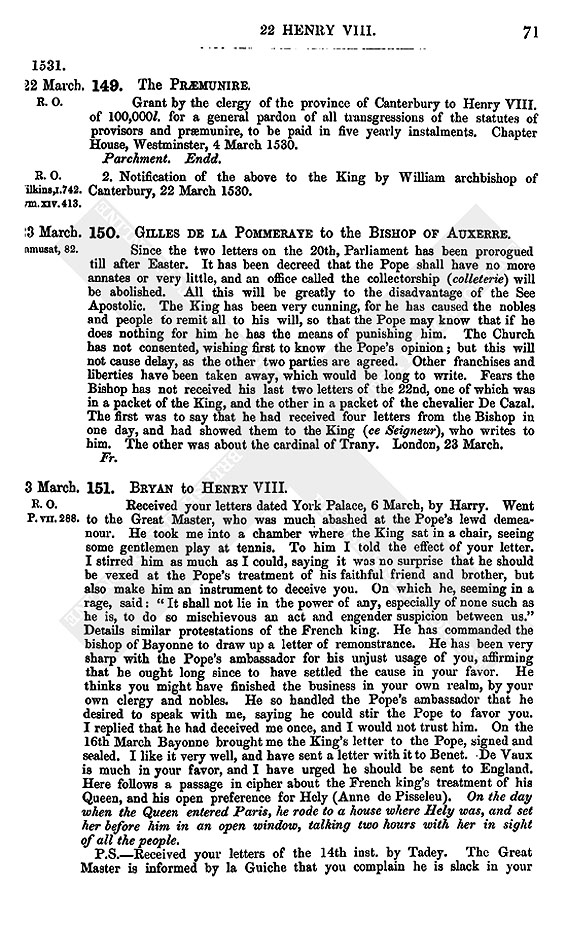
149. The Prmunire. Grant by the clergy of the province of Canterbury to Henry VIII. of 100,000l. for a general pardon of all transgressions of the statutes of provisors and prmunire, to be paid in five yearly instalments. Chapter House, Westminster, 4 March 1530. Parchment. Endd. |
| R. O. Wilkins, I.742. Rym. XIV.413. | 2. Notification of the above to the King by William archbishop of Canterbury, 22 March 1530. |
|
23 March. Camusat, 82. |
150. Gilles De La Pommeraye to the Bishop Of Auxerre. Since the two letters on the 20th, Parliament has been prorogued till after Easter. It has been decreed that the Pope shall have no more annates or very little, and an office called the collectorship (colleterie) will be abolished. All this will be greatly to the disadvantage of the See Apostolic. The King has been very cunning, for he has caused the nobles and people to remit all to his will, so that the Pope may know that if he does nothing for him he has the means of punishing him. The Church has not consented, wishing first to know the Pope's opinion; but this will not cause delay, as the other two parties are agreed. Other franchises and liberties have been taken away, which would be long to write. Fears the Bishop has not received his last two letters of the 22nd, one of which was in a packet of the King, and the other in a packet of the chevalier De Cazal. The first was to say that he had received four letters from the Bishop in one day, and had showed them to the King (ce Seigneur), who writes to him. The other was about the cardinal of Trany. London, 23 March. Fr. |
|
23 March. R. O. St. P. VII. 288. |
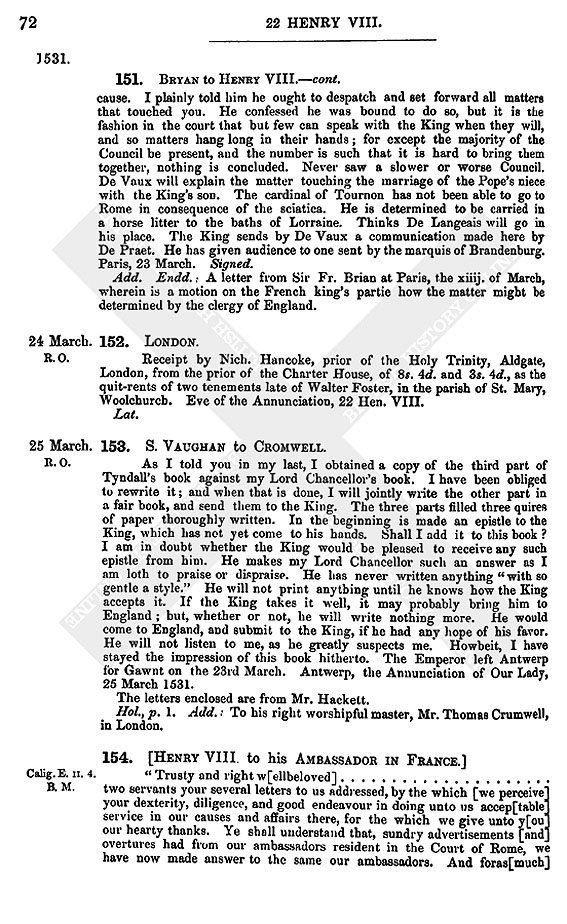
151. Bryan to Henry VIII. Received your letters dated York Palace, 6 March, by Harry. Went to the Great Master, who was much abashed at the Pope's lewd demeanour. He took me into a chamber where the King sat in a chair, seeing some gentlemen play at tennis. To him I told the effect of your letter. I stirred him as much as I could, saying it was no surprise that he should be vexed at the Pope's treatment of his faithful friend and brother, but also make him an instrument to deceive you. On which he, seeming in a rage, said : "It shall not lie in the power of any, especially of none such as he is, to do so mischievous an act and engender suspicion between us." Details similar protestations of the French king. He has commanded the bishop of Bayonne to draw up a letter of remonstrance. He has been very sharp with the Pope's ambassador for his unjust usage of you, affirming that he ought long since to have settled the cause in your favor. He thinks you might have finished the business in your own realm, by your own clergy and nobles. He so handled the Pope's ambassador that he desired to speak with me, saying he could stir the Pope to favor you. I replied that he had deceived me once, and I would not trust him. On the 16th March Bayonne brought me the King's letter to the Pope, signed and sealed. I like it very well, and have sent a letter with it to Benet. De Vaux is much in your favor, and I have urged he should be sent to England. Here follows a passage in cipher about the French king's treatment of his Queen, and his open preference for Hely (Anne de Pisseleu). On the day when the Queen entered Paris, he rode to a house where Hely was, and set her before him in an open window, talking two hours with her in sight of all the people. P.S.Received your letters of the 14th inst. by Tadey. The Great Master is informed by la Guiche that you complain he is slack in your cause. I plainly told him he ought to despatch and set forward all matters that touched you. He confessed he was bound to do so, but it is the fashion in the court that but few can speak with the King when they will, and so matters hang long in their hands; for except the majority of the Council be present, and the number is such that it is hard to bring them together, nothing is concluded. Never saw a slower or worse Council. De Vaux will explain the matter touching the marriage of the Pope's niece with the King's son. The cardinal of Tournon has not been able to go to Rome in consequence of the sciatica. He is determined to be carried in a horse litter to the baths of Lorraine. Thinks De Langeais will go in his place. The King sends by De Vaux a communication made here by De Praet. He has given audience to one sent by the marquis of Brandenburg. Paris, 23 March. Signed. Add. Endd. : A letter from Sir Fr. Brian at Paris, the xiiij. of March, wherein is a motion on the French king's partie how the matter might be determined by the clergy of England. |
|
24 March. R. O. |
152. London. Receipt by Nich. Hancoke, prior of the Holy Trinity, Aldgate, London, from the prior of the Charter House, of 8s. 4d. and 3s. 4d., as the quit-rents of two tenements late of Walter Foster, in the parish of St. Mary, Woolchurch. Eve of the Annunciation, 22 Hen. VIII. Lat. |
|
25 March. R. O. |
153. S. Vaughan to Cromwell. As I told you in my last, I obtained a copy of the third part of Tyndall's book against my Lord Chancellor's book. I have been obliged to rewrite it; and when that is done, I will jointly write the other part in a fair book, and send them to the King. The three parts filled three quires of paper thoroughly written. In the beginning is made an epistle to the King, which has not yet come to his hands. Shall I add it to this book? I am in doubt whether the King would be pleased to receive any such epistle from him. He makes my Lord Chancellor such an answer as I am loth to praise or dispraise. He has never written anything "with so gentle a style." He will not print anything until he knows how the King accepts it. If the King takes it well, it may probably bring him to England; but, whether or not, he will write nothing more. He would come to England, and submit to the King, if he had any hope of his favor. He will not listen to me, as he greatly suspects me. Howbeit, I have stayed the impression of this book hitherto. The Emperor left Antwerp for Gawnt on the 23rd March. Antwerp, the Annunciation of Our Lady, 25 March 1531. The letters enclosed are from Mr. Hackett. Hol., p. 1. Add. : To his right worshipful master, Mr. Thomas Crumwell, in London. |
|
Calig. E. II. 4. B. M. |
154. [Henry VIII to his Ambassador In France.] "Trusty and right w[ellbeloved]... two servants your several letters to us addressed, by the which [we perceive] your dexterity, diligence, and good endeavour in doing unto us accep[table] service in our causes and affairs there, for the which we give unto y[ou] our hearty thanks. Ye shall understand that, sundry advertisements [and] overtures had from our ambassadors resident in the Court of Rome, we have now made answer to the same our ambassadors. And foras[much] as we continually be of that mind and purpose, to make our good brother and perpetual ally, the French king, privy from time [to time] of all our proceedings and doings in our great and weighty cause[s, we] have at this season sent unto you herewith a very extract or co[py of] our said letters translated into French; willing and desiring you, that [you, first] riping yourself in the specialties of the same, will, at [some] convenient season, after our most hearty recommendations to our said good brother, and (sic) make him privy of the specialties and the whole circ[umstances] of our said answer; and in case, for the more plain knowledge [and rip]ing of the same shall be requisite, a copy of the same b[e given] to our said good brother, ye shall see the same done accordingly, [informing] us with diligence of the mind and opinion of our said good [brother] in that behalf as shall appertain, our mind and pleasu[re is] that ye, making our hearty recommendations unto the Great M[aster], shall show unto the same that we have had no manner letters f[rom our said] good brother of long time, declaring unto the same that the[re is] nothing that we more desire than to hear of the good estate [of] our said good brother." Mutilated. |
|
27 March. R. O. St. P. VII. 293. |
155. Bryan to Henry VIII. On the 25th March received a message from the Grand Master. On going to seek him found from the bishop of Bayonne that he was gone to the King. On meeting the Grand Master he complained of the slackness laid to his charge by you. He then showed me that he thought it was necessary for your cause, as the cardinal Grammont was going to Rome, to justify the reports he had made by making due trial and proof of the Pope. Said Grammont would do much to further your cause. I thanked him for his news, and said that the mission would prove of great service. He then urged that I should speak to the King about it. On seeing the King, and finding that he wished that your great cause was concluded, I said that Grammont by going to Rome would further it, and compel him either to abide by his words or else revoke them. On which the King offered to send him. At my request he will be despatched in four days, and if you have any letters to send they shall be forwarded. The Grand Master urged that Grammont's mission should be kept secret from the Imperialists, Eleanor being so near kin to Katharine. On which the King swore he cared not what was said or thought about it. I agreed with the Grand Master that if it could be coloured it would be as well. The King, after telling me that he would stick to you above all others, showed to me that the Emperor had sent to him Mons. de Praet, and he would communicate the letters to you. In one of them he was advised to agree to a General Council; to which he says the Pope will not consent, lest he should lose some part of his dignity. Francis, that he may not seem to have the title of Most Christian King in vain, answered that it was convenient that communications should be opened with all Christian princes. He will do nothing without you; but to make good his title will first send his ambassador to you. Under this colour the Grand Master said that Grammont might be sent. I have consequently sent my servant Harry to you to know your pleasure in this matter. Paris, 27 March. Signed. Add. Endd. |
| 27 March. |
156. Lord Berners, Deputy of Calais. See Grants in March, No. 40. |
|
28 March. Add. MS. 28,583, f. 125. B. M. |
157. Mai to Charles V. "Creation of two cardinals. The Pope is ill. Turks. Naples. Castellan de Mus. Milan. The secretary of the king of Scotland has left. The cardinal of Ravenna has persuaded his uncle (the cardinal of Ancona) to come to Rome. He deserves favors. Refers him to what he has written to M. de Granvelle about the cause of the queen of England. The auditor Capisucci must not be forgotten. Duke of Albany. Interview, &c. Rome, 28 March 1531." English abstract from original at Simancas. |
|
28 March. Add. MS. 28,583, f. 123. B. M. |
158. Mai to Los Covos. Speaks of the king of France and the General Council. The cardinal of Trent says in a letter that it would be well if a delay of two years were taken in the king of England's marriage case, unless some agreement can be made. This seems good to almost all the Imperialists. I cannot say, what I have always said, and once at Bologna before you, that it is a hole to let in a thousand inconveniences, and that it would be a good thing for the Pope and Cardinals, and for those who are opposed to the Emperor. As to the Lutherans, and the practices with the French and English, I think it would be better to make some delay or suspension of arms than allow the others to do it to our damage. Rome, 28 March 1531. Sp., pp. 3, modern copy. |
| Ib., f. 27. | 2. English abstract. |
| 29 March. |
159. Burton On Trent and Athelney. Election of abbots. See Grants in March, Nos. 45 and 47. |
|
29 March. R. O. |
160. Wm. Stokyll to Cromwell. On the 24th of this month I arrived here, and have seen the ship, which is not ready. She is of no more than 80 tons, but she is strong, and if I had my Lord's commission to take workmen, "I shold son a don." I have sent for Mr. Belices (Bellasys), who is 20 miles away. It will be a month before the ship is ready. The lead is not melted, and Mr. Chancellor will not deliver it without your warrant. My father-in-law, Mr. Reynald Gray, will be with you touching a lordship that [a] younger brother keeps from him. My wife is heir to it; but I pray you speak to my father-in-law that he do not give his wife "a state thys when God shall send it him, as he did in that he has, in the which he did me great wrong." He is bound to release Kempston, and suffer a recovery of it to my wife between this and Whitsuntide. I have left Jas. Sterley to pay all costs. Newcastle, 29 March. Hol., p. 1. Add. : Right worshipful. Endd. |
|
29 March. Add. MS. 28,583, f. 131. B. M. |
161. Mai to Los Covos. "Has received the opinions of Sicily (sic) concerning the marriage between the king and queen of England. Has received similar opinions from Valencia. "Diego de Sotomayor, &c. Rome, 29 March 1531." English abstract from original at Simancas. |
|
29 March. Add. MS. 28,583, f. 126. B. M. |
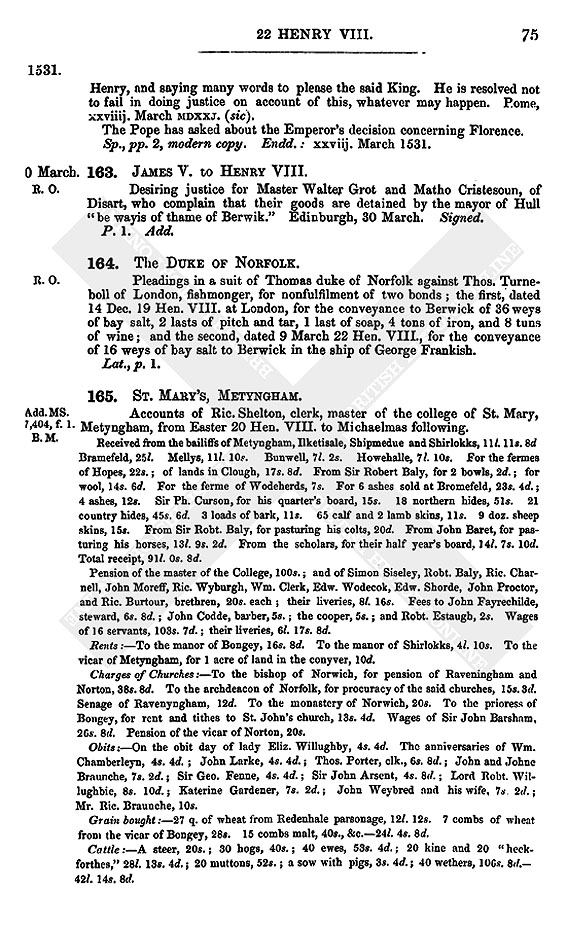
162. Muxetula to Charles V. There is news from England that the King has altogether renounced obedience to the Pope, and does a thousand things in contempt of the Holy See. The Pope thinks it will be necessary to recall his Nuncio there. His Holiness says that the duke of Albany has shown him letters from his king (Francis), warning the Pope not to proceed in this manner in the divorce case, for he would lose altogether that kingdom (England) and the said king Henry, and saying many words to please the said King. He is resolved not to fail in doing justice on account of this, whatever may happen. Rome, xxviiij. March MDXXJ. (sic). The Pope has asked about the Emperor's decision concerning Florence. Sp., pp. 2, modern copy. Endd. : xxviij. March 1531. |
|
30 March. R. O. |
163. James V. to Henry VIII. Desiring justice for Master Walter Grot and Matho Cristesoun, of Disart, who complain that their goods are detained by the mayor of Hull "be wayis of thame of Berwik." Edinburgh, 30 March. Signed. P. 1. Add. |
|
R. O. |
164. The Duke Of Norfolk. Pleadings in a suit of Thomas duke of Norfolk against Thos. Turneboll of London, fishmonger, for nonfulfilment of two bonds; the first, dated 14 Dec. 19 Hen. VIII. at London, for the conveyance to Berwick of 36 weys of bay salt, 2 lasts of pitch and tar, 1 last of soap, 4 tons of iron, and 8 tuns of wine; and the second, dated 9 March 22 Hen. VIII., for the conveyance of 16 weys of bay salt to Berwick in the ship of George Frankish. Lat., p. 1. |
|
Add. MS. 27,404, f. 1. B. M. |
165. St. Mary's, Metyngham. Accounts of Ric. Shelton, clerk, master of the college of St. Mary, Metyngham, from Easter 20 Hen. VIII. to Michaelmas following. Received from the bailiffs of Metyngham, Ilketisale, Shipmedue and Shirlokks, 11l. 11s. 8d. Bramefeld, 25l. Mellys, 11l. 10s. Bunwell, 7l. 2s. Howehalle, 7l. 10s. For the fermes of Hopes, 22s.; of lands in Clough, 17s. 8d. From Sir Robert Baly, for 2 bowls, 2d.; for wool, 14s. 6d. For the ferme of Wodeherds, 7s. For 6 ashes sold at Bromefeld, 23s. 4d.; 4 ashes, 12s. Sir Ph. Curson, for his quarter's board, 15s. 18 northern hides, 51s. 21 country hides, 45s. 6d. 3 loads of bark, 11s. 65 calf and 2 lamb skins, 11s. 9 doz. sheep skins, 15s. From Sir Robt. Baly, for pasturing his colts, 20d. From John Baret, for pasturing his horses, 13l. 9s. 2d. From the scholars, for their half year's board, 14l. 7s. 10d. Total receipt, 91l. 0s. 8d. Pension of the master of the College, 100s.; and of Simon Siseley, Robt. Baly, Ric. Charnell, John Moreff, Ric. Wyburgh, Wm. Clerk, Edw. Wodecok, Edw. Shorde, John Proctor, and Ric. Burtour, brethren, 20s. each; their liveries, 8l. 16s. Fees to John Fayrechilde, steward, 6s. 8d.; John Codde, barber, 5s.; the cooper, 5s.; and Robt. Estaugh, 2s. Wages of 16 servants, 103s. 7d.; their liveries, 6l. 17s. 8d. Rents :To the manor of Bongey, 16s. 8d. To the manor of Shirlokks, 4l. 10s. To the vicar of Metyngham, for 1 acre of land in the conyver, 10d. Charges of Churches :To the bishop of Norwich, for pension of Raveningham and Norton, 38s. 8d. To the archdeacon of Norfolk, for procuracy of the said churches, 15s. 3d. Senage of Ravenyngham, 12d. To the monastery of Norwich, 20s. To the prioress of Bongey, for rent and tithes to St. John's church, 13s. 4d. Wages of Sir John Barsham, 26s. 8d. Pension of the vicar of Norton, 20s. Obits :On the obit day of lady Eliz. Willughby, 4s. 4d. The anniversaries of Wm. Chamberleyn, 4s. 4d.; John Larke, 4s. 4d.; Thos. Porter, clk., 6s. 8d.; John and Johne Braunche, 7s. 2d.; Sir Geo. Fenne, 4s. 4d.; Sir John Arsent, 4s. 8d.; Lord Robt. Willughbie, 8s. 10d.; Katerine Gardener, 7s. 2d.; John Weybred and his wife, 7s. 2d.; Mr. Ric. Braunche, 10s. Grain bought :27 q. of wheat from Redenhale parsonage, 12l. 12s. 7 combs of wheat from the vicar of Bongey, 28s. 15 combs malt, 40s., &c.24l. 4s. 8d. Cattle :A steer, 20s.; 30 hogs, 40s.; 40 ewes, 53s. 4d.; 20 kine and 20 "heckforthes," 28l. 13s. 4d.; 20 muttons, 52s.; a sow with pigs, 3s. 4d.; 40 wethers, 106s. 8d. 42l. 14s. 8d. Iron work :To Wm. Empson, for horse-shoeing, &c., 21s. 2d. General payments :Grinding wheat for 2 years, 67s. 6d. 1 wey of cheese, 14s. 8d. barrel of pitch, 2s. 4d. Making a boat, 11s. 6d. To the saddler, 15s. 4d. 18 Ib. of soap, 18d. To the tanner for "netyswombes," 12d. Carrying the tithe corn at Raveningham, 26s. 8d.7l. 3s. Wood-making :1,300 broom fagots, 14s. 8d. 40 loads of thorn fagots, 10s.24s. 8d. Repairs :Repairs at Ilketsale Hall, and carrying thatch, 3s. 4d. At Lyng Mylles, 14s. 2d. To the sawyers, for 7 days' work, 4s. 1d. Drawing ditches at the marsh, 12s. The tiler and his servant, 5 days, 2s. 11d. A chalder of lime, 2s. 8d. The mason and his servant, 6 days, 3s.48s. 10d. Thrashing :26 q. of barley with the dross, 6s. 6d. Wheat and mixtelyn, 4s. 2d., &c. 4l. 1s. 1d. Fresh fish, &c. 18l. 7s. 2d. Total spent, 153l. 13s. 4d. |
|
ii. From Mich. 20 Hen. VIII. to Easter following. Receipts, 230l. 6s. 2d. Payments :Wages and liveries of the master and brethren, 23l. 6s. 8d. Fees, 100s. 7d. Wages, 8l. 17s. 4d. Liveries, 44s. 2d. Rentes and fermes, 16l. 14s. 7d. Charges of churches :"To diverse churches for Romeshott," 18s. 0d. Obits :Mr. Fransham, Sir Thos. Peeke, Benet and Sewall, John Wylbey, Thos. Harneys, Master Rede and his wife, Sir John Lovell, Roger Bowbrygge, lady Elyanor Salvayn, John Lokyngton, Marg. Grene, Wm. Philipp lord Bardolf, Sir Ric. Umfrey, Sir John Pynchebek, Sir Simon Lynde, Sir Robt. Walsham, and lady Eliz. Willughby.9l. 2s. 8d. Grain, 10l. 12s. 8d. Cattle, 30l. 3s. 4d. Fish, 250 cod, 101s. 8d. 4 cades spurling, 4s. 6d. 9,000 oysters, 9s. 9d., &c.21l. 17s. 1d. Iron work, 56s. 9d. Repairs, 67s. 10d. General payments, 14l. 15s. 5d. Laborers, 11l. 8s. 8d. Wood-making, 4l. 17s. 6d. Thrashing, 61s. 8d. Steward's expenses, 11l. 17s. 7d. Total, 188l. 8s. 4d. Excess, 20l. 14s. 10d. |
|
|
iii. From Easter 21 Hen. VIII. to Michaelmas following. Receipts, 61l. 13s. 5d. Payments : Stipend of the master and 12 brethren, 16l. 10s. Wages, 7l. 6s. 2d. Liveries, 19l. 1s. 4d. Fees, 31s. Fermes and rents, 8l. 13s. 2d. Expenses of churches, 6l. 1s. 7d. Obits, 68s. 2d. Grain, 10l. 11s. Cattle, 44l. 12s. 7d. 300 lb. hops, 30s. Mending the glass windows in the chancel of Norton church, 2s. 8d. 160 fathoms of "rede" for the chancel, 17s. 2d.; and other repairs and expenses, 11l. 1s. 10d. Iron work, 43s. 8d. Carriage of corn and wood, 4l. 9s. 9d. Paid by Sir Ric. Charnell, steward of household, 10l. 8s. 0d. Total, 145l. 18s. 3d. |
|
|
iv. From Mich. 22 Hen. VIII. to Easter following. Receipts, 227l. 1s. Payments :Stipends, 23l. 6s. 8d. Wages, 11l. 13s. 8d. Fees to Sir John Shelton, knt., high steward of our manor, Humphrey Wingfield, and others, 4l. 18s. 6d. Rents and fermes, 6l. 12s. 8d. Church expenses, 8l. 18s. 7d. Obits, 8l. 9s. 2d. Grain and cattle, 11l. 14s. 6d. Fish and hops, 19l. 16s. 6d. Iron work, 70s. 1d. Repairs, 15l. 17s. 9d. Husbandry, 30l. 4s. 3d. Thrashing, 52s. 2d. Wood, 52s. 7d. Steward's payments, 15l. 1s. 6d. Total, 165l. 8s. 6d. Pp. 28. |
|
| March./Grants. | 166. Grants in March 1531. |
| 1. Thomas Audeley, attorney of the duchy of Lancaster. Grant of all the land or pasture in co. Essex, late in the custody of Robert Selbie, William Gunter, and Robert Prvor, and now in farm by Thomas Myller, viz., 3 acres of land in Colchester, at the annual rent of 5s.; and 9 messuages, 12 acres of land, 5 acres of meadow, 30 acres of pasture, and 9s. 3d. rent, in Colchester and Myleende, (which 9 messuages, &c. lately be longed to Thomas Fraunces, deceased, and escheated to the King on the said Thomas dying without heir). Also a mill in Fyngringhoo and Estdonylond, and 4 acres of marsh or pasture thereto adjoining in Estdonylond, with the watercourse of the said mill; which mill is newly built by Richard Whyter and Robert Cowper, and came to the King's hands, because Thomas the abbot and the convent of St. John's, near Colchester, alienated a moiety of the ground whereon a moiety of the watercourse of the mill is built, to the said Richard and Robert, and their heirs, contrary to the form of a collation thereof made to the predecessors of the said abbot and convent; and William Fountleroy, the warden, and the brethren of the college of Hyham Ferreys alienated the other moiety of the said ground whereon the other moiety of the mill is built, and the other moiety of the said watercourse, to the said Richard and Robert, and their heirs, contrary to the form of a collation thereof made to the predecessors of the said warden and brethren; to hold to the said Thomas Audeley in fee, at the annual rent of 5s. York Place, 13 Feb. 22 Hen. VIII. Del. Westm., 2 March.P.S. Pat. p. 2, m. 9. | |
| 2. Thos. a Leghe, of Middx., yeoman. Protection; going in the retinue of Sir Rob. Wingfield. Signed by Wingfield. Endd. : Apud Yorke Place, secundo die Marcii anno R. R. H. Oct. Fidei Defensoris xxijo. P.S. | |
| 3. Thos. Greve alias Grevys, of Shenley, Herts, alias of Salisbury, yeoman, alias of Shenley, Herts, gentleman, late of London. Protection; going in the retinue of Sir Thos. Clifforde, vice-captain of the town and castle of Berwick-on-Tweed. Signed by Clifford. Endd. : Apud York Place, secundo die Marcii ao R. R. Henrici Octavi Fidei Defensoris xxijo.P.S. | |
| 4. Walter Osborne. Lease of the site of the manor of Estyngton, Glouc., with all houses, demesne lands, &c. thereto belonging, parcel of the lands of Edward late duke of Buckingham, attainted, with reservations; for 21 years, at the annual rent of 11l., and 12d. of increase. Del. Westm., 3 March 22 Hen. VIII.S.B. Pat. p. 1, m. 20. | |
| 5. Sir William Kyngeston, knight of the Body. Lease of the manor of Rendecombe, with all lands, &c. thereto belonging, parcel of the lands late of Edward duke of Buckingham, attainted, with reservations; for 21 years, at the annual rent of 10l. 10s. 7d., and 4d. of increase.Vacated on surrender 1 May 23 Hen. VIII. in order that another patent might be granted to the said Sir William and Edmund Tame. , 3 Mar.Pat. 22 Hen. VIII. p. 1, m. 20. | |
| 6. William Hyckman, husbandman, late of Steplecleydon, Bucks. Pardon for having stolen certain property belonging to Ric. Sprygnell; also for having, in conjunction with Edward Hyckman, stolen certain property belonging to William Wattes. York Place, 23 Feb. 22 Hen. VIII. Del. Westm., 4 March.P.S. | |
| 7. Humphrey Colles. To be under-steward of the possessions of the duchy of Exeter, in co. Devon, with 4l. a year. Easthampstead, 7 Aug. 22 Hen. VIII. Del. Westm., 4 March.P.S. Pat. p. 1, m. 18. | |
|
Commissions of the Peace. 8. Middlesex : William archbishop of Canterbury, Sir Thomas More, C., Thomas duke of Norfolk, Charles duke of Suffolk, Thomas earl of Wiltshire, Thos. earl of Rutland, John abbot of St. Peter's, Westminster, William prior of St. John's of Jerusalem in England, Andrew lord Wyndesore, Sir William Fitzwilliam, jun., Thomas Ingelfeld, Christopher Hales the attorney general, Sir John Daunce, Sir Thomas Nevell, Sir Brian Tuke, Henry abbot of St. Mary of Graces, near the Tower of London, Sir John Alleyn, John Halys, John Spelman, serjeant-at-law, Ralph Pexsall, John Skewes, John Broune, John Pakyngton, Henry White, Roger Cholmely, jun., Robert Wrothe, Elryngton, Robert Cheseman, Richard Hawkys, John Denysell, William Asshby, John Palmer. Westm., 4 March.Pat. 22 Hen. VIII. p. 1, m. 15d. |
|
| 9. Notts : Sir Thomas More, C., Thomas duke of Norfolk, Charles duke of Suffolk, Thomas earl of Wiltshire, George earl of Shrewsbury, Thomas earl of Rutland, Sir William Fitzwilliam, jun., Sir Humphrey Conyngesby, Sir Anthony Fitzherbert, Sir William Meryng, Sir William Perpoynt, Sir Brian Stapleton, Sir John Markeham, Sir John Byron, Sir John Willoughby, Anthony Babyngton, Wm. Crerkson (sic), Jn. Hercy, Edward Molyneux, Roger Grenall, Thomas Meryng, William Waryner. Westm., 4 March.Pat. 22 Hen. VIII. p. 1, m. 15d. | |
| 10. Leicestershire : Sir Thos. More, C., Thomas duke of Norfolk, Charles duke of Suffolk, Thomas earl of Wiltshire, George earl of Shrewsbury, Thomas earl of Rutland, George earl of Huntingdon, J. bishop of Lincoln, Sir Leonard Grey, Sir William Fitzwilliam, jun., Sir Humphrey Conyngesby, Sir Anthony Fitzherbert, Sir Richard Sacheverell, Sir John Dygby, Sir William Skevyngton, Sir John Vyllers, Sir Thomas Pulteney, Edward Digby, William Turvyle, Roger Wigston, Thomas Hasilrigge, William Asshby, William Legh, Edward Warner, Thomas Trie, Thomas Harvy, Thomas Entwysell, Thomas Brokesby, Nicholas Jakson, John Fowler, John Beamounte. Westm., 4 March. Pat. 22 Hen. VIII. p. 1, m. 15d. | |
| 11. Northamptonshire : Sir Thomas More, C., Thomas duke of Norfolk, Charles duke of Suffolk, Thomas earl of Wiltshire, J. bishop of Lincoln, William prior of St. John's of Jerusalem in England, John lord Zouche, Thomas lord Vaux of Harowdon, Sir Richard Grey, Sir William Fitzwilliam, jun., Sir Humphrey Conyngesby, Sir Anthony Fitzherbert, Sir William Fitzwilliam, sen., Sir William Parre, Sir William Gascoign, Sir Thomas Tressham, Richard Knyghtley, Edmund Knyghtley, Anthony Ralegh, Richard Verney, Richard Burton, William Spenser, Thomas Brudenell, Edward Montague, John Hasilwod, William Newenham, Edward Warner, Richard Humfrey, Thomas Lovett, William Saunders, Robert Chauntrell. Westm., 4 March.Pat. 22 Hen. VIII. p. 1, m. 15d. | |
| 12. Norfolk : Sir Thomas More, C., Th. duke of Norfolk, Charles duke of Suffolk, Thomas earl of Wiltshire, Robert earl of Sussex, R. bishop of Norwich, N. bishop of Ely, Sir John Burghchier lord Berners, Sir William Fitzwilliam, jun., Sir Robert Norwich, Richard Lister, chief baron of the Exchequer, Sir James Bulleyn, Sir Roger Townesend, Sir William Paston, Sir Philip Calthorp, Sir John Heydon, Sir John Skelton, Sir Thomas Benyngfeld, Sir William Penyngton, Sir Thomas Straunge, Sir Francis Lovell, William Elys, John Spelman, serjeant-at-law, Robert Holdiche, Edmund Wyndham, John Tyndale, Richard Suthwell, Roger Woodhowse, William Conyngesby, Francis Moundeford, Henry Fermer, Christopher Jenney, Walter Hubberd, Robert Townesend, Nicholas Hare, Robert Curzon. Westm., 4 March.Pat. 22 Hen. VIII. p. 1, m. 16d. | |
| 13. Yorkshire : Commission to Ralph Poleyn, Walter Grymeston, Christopher Conyers, and Ralph Bukton, to make inquisition on the lands of John Crofte, William Bukton, Sir Ninian Markenfeld, and Gilbert Topclyf. Westm., 4 March.Pat. 22 Hen. VIII. p. 2, m. 26d. | |
| 14. Yorkshire : Commission to Ralph Poleyn, Walter Grymston, Christopher Conyers, and Ralph Bukton, to make inquisition on the idiocy of Christopher Barry alias Barelli. Westm., 4 March.Pat. 22 Hen. VIII. p. 2, m. 26d. | |
|
Commissions of the Peace. 15. Hants : W. archbp. of Canterbury, Sir Thomas More, C., Thomas duke of Norfolk, Charles duke of Suffolk, Thomas earl of Wiltshire, J. bishop of Bath and Wells, T. bishop of Bangor, Arthur viscount Lisle, Sir Edmund Haward, William prior of St. John's of Jerusalem in England, Henry lord Mountague, John lord Audeley, William lord Sandys, Sir John Fitzjames, Richard Lister, chief baron of the Exchequer, Sir William Shelley, Sir William Fitzwilliam, jun., Sir William Paulett, Sir Geoffrey Poole, Sir Richard Sandys, Sir James Worseley, Sir William Gifford, Sir George Posenham, Sir Robert Wallop, Sir Peter Fylpott, Sir Lionel Norreys, Ralph Pexsall, Richard Andrewes, James Bettys, Richard Palshide, Stephen Coope, Robert Bulkeley, Nicholas Tychebourn, Henry White, Anthony Wyndesore, Edmund Mervyn, William Hawles, John Wyntershull, Thomas Wellys. Westm., 5 March.Pat. 22 Hen. VIII. p. 1, m. 17d. |
|
| 16. Westmoreland : Sir Thos. More, C., Thos. duke of Norfolk, Charles duke of Suffolk, Thomas earl of Wiltshire, Ralph earl of Westmoreland, Henry earl of Cumberland, J. bishop of Carlisle, William lord Dacre of Gillesland, Sir William Fitzwilliam, jun., John Spelman, serjeant-at-law, Humphrey Broune, serjeant-at-law, Thomas Magnus, clk., Sir Christopher Dacre, Sir Thomas Clifford, Sir William Parre, Sir Robert Belyngham, Sir William Bulmer, Sir Thomas Tempest, Sir William Eures, Sir John Lowther, Sir Edward Musgrave, Geoffrey Lancastre, Robert Bowes, Richard Redmayn, Thomas Stanford, Launcelot Salkeld, Rowland Thornborough, Geoffrey Middleton, Ambrose Middleton, Thomas Musgrave, Launcelot Lowther, William Lancastre, John Lambert, sen., Thomas Blenkensop, Richard Dukett, Thomas Wharton, Gilbert Wharton. Westm., 5 March.Pat. 22 Hen. VIII. p. 1, m. 18d. | |
| 17. Sussex : William archbp. of Canterbury, Sir Thomas More, Thomas duke of Norfolk, Charles duke of Suffolk, Thomas earl of Wiltshire, William earl of Arundel, Henry earl of Northumberland, R. bishop of Chichester, Arthur Viscount Lisle, Henry lord Mountague, George Nevell lord Bergevenny, Thomas West lord de la Warr, Thomas Fynes lord Dacre, Sir William Fitzwilliam, jun., Richard Lister, chief baron of the Exchequer, Thomas Inglefeld, Sir William Shelley, Christopher Hales, the attorney general, Robert prior of Lewys, Sir John Dudley, John Halys, Sir Thomas Nevell, Sir David Owen, Sir John Gage, Sir Edward Nevell, Sir Geoffrey Poole, Sir Edward Oxenbrigge, Sir Alexander Culpeper, Sir William Fynche, Sir William Pelham, Sir John Dawtrey, Sir Richard Shirley, Sir Edward Bray, John Sakevyle, Henry Darell, Richard Coverte, Giles Fenys, Richard Devenysshe, Thomas Thetcher, Richard Sakevyle, William Scardevyle, John Palmer, John Parker, John Stanney, Thomas Shirley, William Waller, William Staple. Westm., 5 March. Pat. 22 Hen. VIII. p. 1, m. 18d. | |
| 18. John Hills, senior, and John Hills, junior. Grant of the office of chafewax (calefactor cer) in Chancery; on surrender of patent 6 Dec. 13 Hen. VIII. granting the office to John Hills, senior. Hampton Court, 19 Oct. 22 Hen. VIII. Del. Westm., 6 March. P.S. | |
| 19. John Williams. To be receiver of the possessions late of Edward duke of Buckingham in England, Wales, Calais, or elsewhere; with 20 marks a year, and 10 marks a year for expences, out of the issues of the said possessions York Place, 3 March 22 Hen. VIII. Del. Westm., 6 March.P.S. Pat. p. 1, m. 21. | |
| 20. Brian Cace, clerk. Presentation to the parish church of Chilton Canton, Bath and Wells dioc., void by death. Westm., 3 March 22 Hen. VIII. Del. Westm., 7 March. P.S. Pat. p. 1, m. 18. | |
| 21. Richard Bradford. To be gauger of the town and port of Lynne, Norf. Westm., 3 Mar. 22 Hen. VIII. Del. Westm., 8 March. P.S. Pat. p. 2, m. 26. | |
| 22. Sir Anthony Poyntz, and Nicholas his son and heir. To be keeper of Kyngeswood forest, Glouc., and Fylwoode forest, Somers., with 7d. a day out of the fee-farm and other issues of the town of Bristol; on surrender of patent; 1 May 21 Hen. VIII., granting the office to the said Sir Anthony alone. Also to be keeper of the new park of Barkeley, Glouc., with 40s. a year out of the issues of the castle, hundred, or lordship of Barkeley, which lately belonged to William marquis of Barkeley; with herbage and pannage of the said park. York Place, 1 March 22 Hen. VIII. Del. Westm., 8 MarchP.S. Pat. p. 2, m. 30. | |
| 23. Wm.Cokks, alias Cokkys, alias Cokkes, merchant venturer of Bristol. Protection; going in the retinue of Sir Rob. Wingfield. Signed by Wingfield. Endd. : Apud manerium de Westm., nono die Marc ao R. R. Henrici Octavi xxijdo.P.S. | |
| 24. Sir Edward Chamberlayn, son and heir of Sir Robert Chamberlayn, of Barkyng, Essex, deceased. Patent reversing in his favor, according to the provisions of the Act 15 Hen. VIII. (c. 21), the Act of attainder, 7 Hen. VII. (c. 23), passed against the said Sir Robert, and all previous indictments and judgments against him; with proviso that this patent do not extend to the restitution of the possessions of the said Sir Robert in England and Wales. York Place, 4 March 22 Hen. VIII. Del. Westm., 11 March.P.S. Pat. p. 1, m. 18. | |
| 25. Coventry : Commission to Ryse the mayor, Baldwin Porter, John Jett, and Simon Parker, to make inquisition p. m. on the lands of Robert Stokys. Westm., 11 March.Pat. 22 Hen. VIII. p. 2, m. 26d. | |
| 26. John Gostwycke, one of the King's auditors, and Edward Copley. Lease of the site of the manor of Camelton, a close called Wescrofte, and a meadow called Burnehammede, Beds, with reservations; for 21 years, at the annual rents of 4l. for the site, 10s. for the close, and 26s. 8d. for the meadow, and 12d. of increase. Westm., 31 March.Pat. 22 Hen. VIII. p. 1, m. 21. | |
|
27. The monastery of St. Giles, Barnewell,
Ely dioc. Assent to the election of
Nicholas Smythe, late prior of Busshement,
Linc. dioc., as prior, vice Thomas Cambrydge,
resigned. Westm., 5 March 22 Hen. VIII.
Del. Westm., 13 March.P.S. ii. Petition for the above; in which it is stated that the election was made by Rob. Clifford LL.D., official of Nic. bp. of Ely, Rob. Assheby, and Will. Raynes, canons of the house, per viam compromissi. 4 March 1530. |
|
|
28. The exempt monastery of St. Alban's,
Linc. dioc. Assent to the election of Robert
Catton, late prior of the cathedral church of
Norwich, as abbot; on the death of the
last abbot. Westm., 14 March 22 Hen. VIII.
Del. Westm., 16 Mar.P.S. ii. Petition for the above. 14 March 1530. |
|
| 29. The monastery of St. Alban's. Restitution of temporalities on the election of Robt. Catton as abbot. No confirmation from the Apostolic See is requisite, by reason of the privileges granted to the monastery at the request of Richard II. Westm., 16 March. Pat. 22 Hen. VIII. p. 1, m. 15. | |
| 30. Sir John Nevyle, lord Latymer. Livery of lands, first to himself as s. and h. of Sir Richard Nevyle, lord Latymer, deceased; secondly, to John Fox, kinsman and heir of Richard bishop of Winchester, deceased, viz., son and heir of Thomas Fox, brother and heir of the said bishop, late feoffee to the use of the said Richard late lord Latymer, and now to the use of the said John Nevyle, (the said Bishop having also held in chief of the Crown); and, thirdly, to Sir Marmaduke Constable, sen., Sir Marmaduke Constable, jun., John Constable, Robert Constable, Christopher Jenny, Esq., John Harrison, Richard Crosyer, clks., and Robert Loune, as feoffees to his use. Westm., 11 March 22 Hen. VIII. Del. Westm., 17 March.Pat. p. 2, m. 34. | |
| 31. George Folbery, S. T. B. Presentation to a canonry in York cathedral, and the prebend of Northnewbolte in the same, vice Augustine de Augustinis, M.D., resigned; at the King's disposal by the voidance of the archbishopric of York. Westm., 16 March 22 Hen. VIII. Del. Westm., 17 March.P.S. Pat. p. 1, m. 19. | |
| 32. William Bassett, jun. Livery of lands as kinsman and heir of John Bassett of Bewper, alias Jankyn Bassett, viz. son and heir of the said John, who held in chief of Edward late Duke of Buckingham as of his castle of Hereford ... 22 Hen. VIII. Del. Westm., 18 March.P.S. Pat. p. 2, m. 29. | |
| 33. Richard Suthayke, clk. alias chaplain, brother and heir of John Suthayke, deceased. Livery of lands. Westm., 13 March [22 Hen. VIII.]P.S. (mutilated, and date of delivery lost). Patent dated Westm., 20 March.Pat. 22 Hen. VIII. p. 2, m. 24. | |
| 34. The Friars Observants of the convents of Ynestcortie and the New Abbey, Ireland. Licence to export from England to Ireland 200 quarters of beans and malt for the relief of the said convents, which are in danger of famishing from the scarcity of corn in Ireland. York Place, 19 March 22 Hen. VIII. Del. Westm., 21 March. P.S. | |
| 35. Robert Asshefeld, s. and h. of George Asshefeld, of Vakenham, Suff., deceased. Licence of entry, without proof of age, on all the possessions of the said George in cos. Suff., Norf., Camb., Beds., or elsewhere in England ... 15 March 22 Hen. VIII. Del. Westm., 22 March.P.S. Pat. p. 2, m. 25. | |
| 36. Thomas duke of Norfolk. Reversion in fee simple of the manor of Wolverhampton, Staff., which was granted in tail male, among other possessions, by patent 1 Feb. 5 Hen. VIII., to Thomas late duke of Norfolk, father of the present Duke. Westm., 22 March 22 Hen. VIII.S.B. Pat. p. 1, m. 17. | |
|
37. Nicholas Hurleton, clk. of the Green
Cloth. Lease of the manor of Bawdewyns,
Kent, with the warrens of coneys there,
lately belonging to Thos. late cardinal archbishop
of York, for 21 years, at the annual
rent of 8l. Westm., 18 March 22 Hen. VIII.
Del. Westm., 22 March.P.S. Pat. p. 1,
m. 19. (2.) Copy of the above.R.O. |
|
| 38. Thos. Carpenter, Thos. Broke, Gilbert Tomson, Wm. Paule, John Tegge, And. Curteys, John Gyles, Ric. Welshe, Walter Hayes, Wm. Atkynson, John Eyton, Hen. Mathewe, Patrick Crosby, MarkDowne, John Hodder, David Jones, John Jones, John Devonshire, John Reynolds, Wm. Cacy, Stephen Rychardys, John Bullok, Giles Ovyngton, Wm. Meller, Peter Lynche, Ralph Phelipps, Thos. Alynny, Geoff. Barnewell, Thos. Stannop, Nich. Welshe, John Wyng, Martin Pod, Will. Hall, John Lyster, Simon Adams, Wm. Edwardes, Patrick Knoll, Will. Maillforce, Jas. Audeley, Ric. Tyrrell, Geo. Whereatte, and Ric. Showmaker. Pardon for all treasons, captures of ships, disturbances of merchants, and violations of truces. Del. Westm., 23 March 22 Hen. VIII.S.B. | |
| 39. John Joachino de Passano. Licence to export 20 tuns of beer. Westm., 23 March. Fr. 22 Hen. VIII. m. 2. | |
| 40. Richard Luce, clk. Presentation to the parish church of Nynecellers and Mylstune, Heref. dioc., void by death. Westm., 22 March 22 Hen. VIII. Del. Westm., 24 March.P.S. | |
| 41. John Johns, clk., native of Gascony. Denization. YorkPlace, 15 Jan. 22 Hen. VIII. Del. Westm., 24 March.P.S. | |
| 42. John Barkeley, s. and h. of Richard Barkeley, of Stoke Gyfford, Glouc., deceased. Special livery to the said John and to Sir Humphrey Conyngesby, justice of the King's Bench, Sir William Denys, Sir John Welshe, Sir Edward Wadham, Christopher Codryngton, Thomas Lucas, Edmund Wykys, and William Conyngesby, as trustees to the use of the said John, on all the possessions of the said Richard, the reversions of the manors of Stoke Gyfford and Little Stoke, held by Elizabeth, widow of the said Richard, in usu; and of a third part of the manors of Ewley Barwyke and Kyngys Norton, Glouc., held by the said Elizabeth in dowry, &c. Westm., 19 March 22 Hen. VIII. Del. Westm., 24 March.P.S. Pat. p. 2, m. 27. | |
| 43. Sir James Strangwyse. Livery of lands as one of the kinsmen and heirs of Geoffrey lord Scrope of Upsale, deceased, brother and heir of Ralph lord Scrope, deceased, viz. s. and h. of Sir Thomas Strangwise, s. and h. of Sir James Strangwise and Alice his wife, one of the sisters and heirs of the said Geoffrey lord Scrope; also to Nicholas Herley and Elizabeth his wife, kinswoman and another of the heirs of the said Geoffrey lord Scrope, viz., one of the daughters and heirs of Elizabeth Fitzraundolf, second sister and heir of the said Geoffrey; to Ralph Dransfeld, another of the kinsmen and heirs of the said Geoffrey, viz., son of Charles Dransfeld and Alice his wife, deceased, another of the daughters and heirs of the said Elizabeth Fitzraundolf; to Launcelot Ashe and Dorothy his wife, another of the kinswomen and heirs of the said Geoffrey, viz., another of the daughters and heirs of the said Elizabeth; to Marmaduke Wyvell and Agnes his wife, another of the kinswomen and heirs of the said Geoffrey, viz., another of the daughters of the said Elizabeth; to Margery Danby, widow of Sir Christopher Danby, deceased, third sister and heir of the said Geoffrey; and to Sir William Blount, Lord Mountjoy, Sir Thomas Darcy, Lord Darcy, Sir Andrew Wyndesore, Lord Wyndesore, Sir Ralph Evers, Sir Peter Vavasor, Anthony Wyndesore, 'Sir William Stortune, Roger Lasseles, William Wyndesore, and Richard Lyster, chief baron of the Exchequer, feoffees to the use of the said Ralph lord Scrope and Eleanor his wife, deceased. Westm., 25 March.Pat. 22 Hen. VIII. p. 2, m. 33. Fragment of P.S. only. | |
|
Commissions of the Peace. 44. Warwickshire : Sir Thomas More, C., Thomas duke of Norfolk, Charles duke of Suffolk, Thomas earl of Wiltshire, G. bishop of Coventry and Lichfield, William prior of St. John's of Jerusalem in England, Edward lord Dudley, Sir William Fitzwilliam, jun., abbot of Kelyngworth, Sir Humphrey Conyngesby, Sir Anthony Fitzherbert, Sir George Throkmarton, Sir Edward Ferrers, Sir John Willoughby, Sir Edward Willoughby, Roger Wygston, William Legh, William Feldyng, Thomas Trye, Thomas Spenser, Reginald Digby, John Greyvyle, Thomas Arden, Simon Mountford, Robert Fulwood, Thomas Slade, Richard Verney, John Waldyff, Thomas Holte, Baldwin Porter, Richard Wyllys. Westm., 26 March.Pat. 22 Hen. VIII. p. 1, m. 18d. |
|
| 45. Wilts : Sir Thomas More, C., Thomas duke of Norfolk, Charles duke of Suffolk, Thomas earl of Wiltshire, Henry lord Mountague, Edward lord Stourton, John lord Audeley, Sir John Fitzjamys, Richard Lister, chief baron of the Exchequer, Sir William Shelley, Sir William Fitzwilliam, jun., Richard abbot of Malmesbury, Sir William Paulett, Sir John Bourghchier, Sir John Seymour, Sir Henry Longe, Sir William Stourton, Sir Edward Baynton, Sir William Essex, Sir Edmund Tame, Sir John Brigges, Sir Anthony Hungreford, Sir Edmund Seymour, Walter Hungreford, Richard Hylley, clk., Robert Baynard, Roger Yorke, Anthony Stylman, William Ludlowe, Thomas Apprice, Bartholomew Hussey, John Bonham, Charles Bulkeley, Robert Wye, James Lowdre. Westm., 26 Mar. Pat. 22 Hen. VIII. p. 1, m. 18d. | |
| 46. Worcestershire : Sir Thomas More, C., Thomas duke of Norfolk, Charles duke of Suffolk, Thomas earl of Wiltshire, William earl of Arundel, George earl of Shrewsbury, J. bishop of Exeter, Walter Devereux lord Ferrers, Edward Sutton lord Dudley, Sir William Fitzwilliam, jun., Clement abbot of Evesham, William prior of Worcester, Sir John Porte, Th. Willoughby, serjeant-at-law, Sir Humphrey Conyngesby, James Denton, clk., Sir Edward Crofte, Sir William Morgan, Sir Gilbert Talbott, Sir Thomas Cornewall, Sir George Throkmarton, Sir John Russell, John Salter, George Bromley, William Muklowe, Thomas Audeley, Thomas Nevell, Roger Wynter, Rouland Moreton, Edmund Harwell, Thomas Lynom, John Littelton, John Russell, John Pakyngton, William Nevell, John Ketylby. Westm., 26 March.Pat. 22 Hen. VIII. p. 1, m. 18d. | |
| 47. George, s. and h. of Sir John Blounte. To be steward of the lordships of Bewdeley and Cleybury Mortimer, Salop; and master of the hunt and rider of Wyere forest, Salop and Worc.; also master of the hunt of all the King's parks in the said forest; keeper of Clebury Mortimer park, Salop; master of the hunt of Yernewood park and "Bewdeley park," Salop, with the usual fees as had by the said Sir John Blounte. Westm., 24 March 22 Hen. VIII. Del. Westm., 27 March.P.S. Pat. p. 1, m. 19. | |
| 48. John Bourchier lord Berners. To be deputy of Calais; with 100l. a year, and 104l. a year spyall money; also to have a retinue of 31 soldiers; on surrender of patent 1 Oct. 18 Hen. VIII. granting the office to Sir Robt. Wyngfelde. Westm., 27 March. Fr. 22 Hen. VIII. ms. 3 and 4. | |
| 49. Sir John Fitzjames, chief justice of the King's Bench. Mortmain licence to alienate lands, to the annual value of 16l., to the abbot of the monastery of St. Mary Brewton, Somers. Westm., 11 March 22 Hen. VIII. Del. Westm., 28 March. P.S Pat. p. 2, m. 28. | |
| 50. Roger Wilcokkys, of Rounde Acton, Salop. Pardon for having stolen certain cattle belonging severally to Robt. Wele, Thos. Deyos, Robt. Doughty, William Highyns, Thos. Tedestill, John Skette, and John Lowes. Westm., 25 March 22 Hen. VIII. Del Westm., 28 March.P.S. Pat. p. 1, m. 17. | |
| 51. Cheshire : Commission to Sir William Standley, Richard Snede, William Venables, Humphrey Newton, and John Leicester; to make inquisition p. m. on the lands of John Dokenfeld John Bridge, George Wymmyngton, Fulk Hope, and Richard Redyche. Westm. 28 March.Pat. 22 Hen. VIII. p. 2, m. 26d. | |
| 52. Nicholas Wilson, clk. Presentation to the parish church of St. Thomas Apostle, London dioc.; void by the resignation of William Clerke, and at the King's disposal by virtue of letters under the seal of the dean and chapter of St. Paul's, London, dated 28 Jan. last, granting the first presentation thereto to the King. Westm., 28 March 22 Hen. VIII. Del. Westm., 29 March.P.S. Pat. p. 1, m. 20. | |
|
53. William Boston, S. T. P. Assent to
his election as abbot of the convent of
Burton-upon-Trent, Cov. and Lich. dioc.
Westm., 27 March 22 Hen. VIII. Del.
Westm., 29 March.P.S. Pat. p. 2, m. 28. ii. Petition for the above. 21 March 1530. |
|
| 54. Clement Harleston, of Coksale, Essex. Licence to alienate his moiety or purparty of the manor of Bekenham, Kent, and his messuages, &c. in Bekenham, to Robert Legh, Roger Starkey, Mathew Haddes, John Preston, William Lamberd, Robert Meredith, and Richard Malery, citizens and mercers, London; to the use of the said Robert, his heirs and assigns for ever. Westm., 29 March. Pat. 22 Hen. VIII. p. 1, m 14. | |
|
55. John Major, prior of the Benedictine
monastery of Athelney, Bath and Wells
dioc. Assent to his election as abbot of the
same. Westm., 28 March 22 Hen. VIII.
Del. Westm., 29 March.P.S. Pat. p. 2,
m. 28. ii. Petition for the above. 18 March 1530. |
|
| 56. John Arthur. To be chaplain of the perpetual vicarage of the parish church of Husbourne Prioris, Winchester dioc., void by death. Add. : To W. archbishop of Canterbury. Westm., 28 March 22 Hen. VIII. Del. Westm., 29 March.P.S. Pat. p. 1, m. 18. | |
| 57. William Purdy, sen., and his wife Jocosa, late wife and executrix of Sir Edward Bensted, of London, als. of Hertingfordbury, Herts, late treasurer of war in Picardy, and treasurer of Tournay. Pardon and release. Westm., 23 March 22 Hen. VIII. Del. Westm., 30 March.P.S. Pat. p. 1, m. 19. | |
| 58. John Barlow, M. A. To be one of the King's chaplains; which office admits of his being non-resident upon the various benefices he may hold, according to the statute. Westm., 27 Sept. 22 Hen. VIII. Del. Westm., 30 March.P.S. | |
| 59. William Wrougton. Livery of lands as kinsman and heir of Sir Christopher Wrougton; and to John Bourghchier lord Berners, Sir Anthony Willoughby, Sir William Essex, Sir Henry Long, Sir Anthony Saintmond, Sir George Monoux, Sir Anthony Hungerford, Thomas Yorke, Henry Poole, and Thomas Bodnam, as trustees Westm., 24 March 22 Hen. VIII. Del. Westm., 30 March.P.S. Pat. p. 2, m. 28. | |
|
60. Commission of Peace. Salop : Sir Thomas More, C., Thomas duke of Norfolk, Charles duke of Suffolk, Thomas earl of Wiltshire, William earl of Arundel, George earl of Shrewsbury, J. bishop of Exeter, G. bishop of Coventry and Lichfield, C. bishop of Hereford, Walter lord Ferrers, Edward lord Dudley, Sir William Fitzwilliam, jun., Sir John Porte, Th. Willoughby, serjeant-at-law, James Denton, clk., Sir John Talbott, Sir Edward Croftis, Sir William Morgan, John Salter, George Bromley, Richard Hoorde, Arthur Newton, Robert Nedam, Thomas Lakyn, Richard Foster, Richard Selman, Francis Yong, Thomas Newporte, William Chorleton. Westm., ... March. (fn. 1) Pat. 22 Hen. VIII. p. 1, 17d. |