Letters and Papers, Foreign and Domestic, Henry VIII, Volume 5, 1531-1532. Originally published by Her Majesty's Stationery Office, London, 1880.
This free content was digitised by double rekeying. All rights reserved.
'Henry VIII: June 1531, 1-15', in Letters and Papers, Foreign and Domestic, Henry VIII, Volume 5, 1531-1532, ed. James Gairdner (London, 1880), British History Online https://www.british-history.ac.uk/letters-papers-hen8/vol5/pp130-140 [accessed 1 May 2025].
'Henry VIII: June 1531, 1-15', in Letters and Papers, Foreign and Domestic, Henry VIII, Volume 5, 1531-1532. Edited by James Gairdner (London, 1880), British History Online, accessed May 1, 2025, https://www.british-history.ac.uk/letters-papers-hen8/vol5/pp130-140.
"Henry VIII: June 1531, 1-15". Letters and Papers, Foreign and Domestic, Henry VIII, Volume 5, 1531-1532. Ed. James Gairdner (London, 1880), British History Online. Web. 1 May 2025. https://www.british-history.ac.uk/letters-papers-hen8/vol5/pp130-140.


June 1531, 1-15
|
1 June. R. O. |
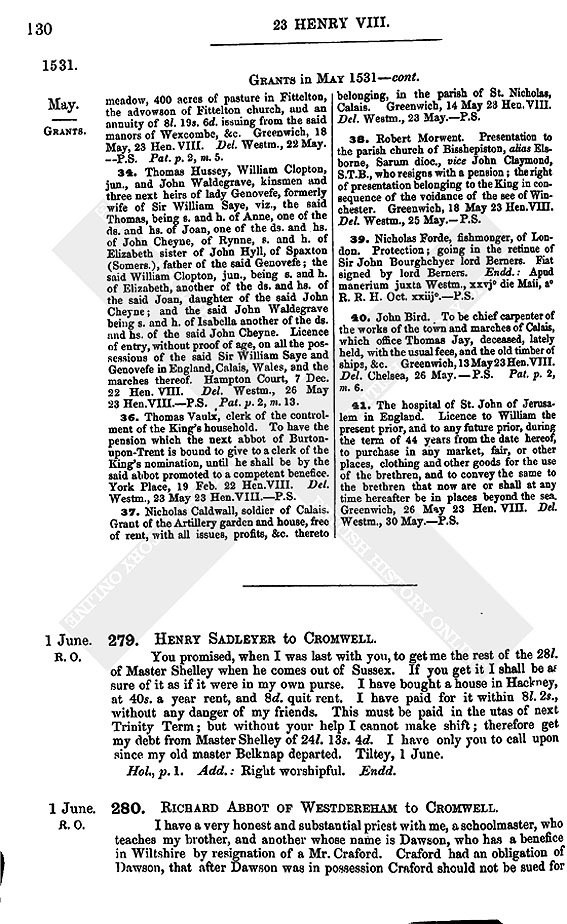
279. Henry Sadleyer to Cromwell. You promised, when I was last with you, to get me the rest of the 28l. of Master Shelley when he comes out of Sussex. If you get it I shall be as sure of it as if it were in my own purse. I have bought a house in Hackney, at 40s. a year rent, and 8d. quit rent. I have paid for it within 8l. 2s., without any danger of my friends. This must be paid in the utas of next Trinity Term; but without your help I cannot make shift; therefore get my debt from Master Shelley of 24l. 13s. 4d. I have only you to call upon since my old master Belknap departed. Tiltey, 1 June. Hol., p. 1. Add. : Right worshipful. Endd. |
|---|---|
|
1 June. R. O. |
280. Richard Abbot Of Westdereham to Cromwell. I have a very honest and substantial priest with me, a schoolmaster, who teaches my brother, and another whose name is Dawson, who has a benefice in Wiltshire by resignation of a Mr. Craford. Craford had an obligation of Dawson, that after Dawson was in possession Craford should not be sued for dilapidation. As the knowledge of this had come to the chancellor of Salisbury, he will not admit Dawson to the benefice until he has the obligation out of Craford's hands. I beg you will call Craford before you, and obtain the obligation from him, that Dawson may show it to the Chancellor. He shall be secured against all claims for dilapidations. Westderham, Norf., 1 June. Hol., p. 1. Add. : Right worshipful. |
|
2 June. Simancas MS. |
281. Rafael De Como, Canon of Padua, to Charles V. Answered his letters of 1 Aug. and 23 Sept. Sends a treatise on predestination and free will. Has written a treatise in favor of the queen of England, which he thinks will answer every argument. Has sent it to the cardinal Campeggio by the bishop of Bologna, his son, that it may come to the Emperor's hands, not daring to write directly to so great a monarch. Pietro Rolans Burxeleis, the Emperor's servant, who is lodged near him in the monastery, encouraged him to write. Is going to the convent of St. Augustine at Piacenza to read philosophy and theology. Padua, 2 June 1531. Ital., pp. 2, modern copy. |
|
2 June. R. O. |
282. Banaster's Garden. Deed of gift by John Merston, jun., fishmonger, London, son of John Merston, sen., citizen and fishmonger, deceased, to Thos. Tailloure, fishmonger, London, Thos. Brakyn, of Cambridge, Esq., Ric. Brayfeld, Edw. Colyn, Ric. Turke, fishmongers, of London, and Thos. Bateman, of the parish of St. Margaret, Suthwerk, watermen, of the garden called Banaster's Gardeyn, containing 3 acres and a gatehouse, with "decem et ..." (mutilated), cottages in the same garden, with the walls, hedges, ditches, wharves, and steps to the same garden belonging, situated at the Stewes in the said parish; all which belonged to his father, and formerly to Will. Danvers, one of the [justices] of the Common Pleas, and Thos. Danvers, Esq.; to hold to the use of the said Thos. Taillour and his heirs. Southwark, 2 June 23 Hen. VIII. Signed. Vellum. Seal mutilated. |
|
3 June. Galba, B. x. 8. B. M. Pocock's Records, II. 125. |
283. Augustine De Augustinis to the Duke Of Norfolk. Has delayed to write, not knowing whether his previous letters were welcome, nor whether these will be. Before the Emperor's arrival here, I met his chief councillors, Granvelle, the Comendador Mayor of Leon, the archbishop of Bari, who was ill with gout, and the Comendador Mayor of Calatrava, but especially Granvelle, to whom the affairs of England (illius regni) are entrusted, and to whom I was already known. He told me that he was a true prophet (fn. 1) in having said that the divorce would be the cause of Wolsey's ruin; the French king, his mother, and many nobles were his witnesses, as he was then Ambassador there. He also asked me if he had been poisoned? I said, By no means, "sed tremore cordis et atra bili, forsa[n] dolore animi jampridem contracto." I then spoke a few words of myself, concerning the profit of these two Princes, between whom I wished there to be perpetual peace, for the sake of Christendom. After much conversation he said he would not reply to me till he had reported everything to the Emperor, as I hear he does in all matters. He [suggested] my having an audience of the Emperor; at which I was inwardly pleased, but which I did not much press. On the last of April, three days after this, I had an audience of him in his chamber (secre[to cubi]culo) for an hour. Repeated what I had said to Granvelle. His Majesty replied kindly that he knew that he owed much to the King, whose friendship and perpetual alliance he always desired. The King would always find him a good neighbour and relation, if he would take the course of justice in this cause; but [otherwise], (which he said he could not suppose,) the King would know what he owes to the blood of Spain, which he inherits. As I had no commission, I replied to him on my own responsibility, telling him I had often heard Wolsey say that for his undisturbed possession of Spain he was indebted to the king of England; next, that where a dispute begins, it should end there; thirdly, of the commerce of the two kingdoms, and the tranquillity of Christendom, threatened by Turks and Lutherans. In the end he ordered me to converse with Granvelle, and return to him if anything of importance happened. I attend his Majesty nearly every day at dinner. In reply to his Majesty's questions about Lutheranism in England, I told him that men and books came from hence, and infected many, but the King by punishment and exhortation had brought many back to a sound mind. A little before I left England he had spent the whole day, from 9 a.m. to 7 p.m., in examining a heretic. On hearing this, the Emperor looked at me fixedly for some time in silence, which all know to be a sign of wonder in him. From this, and other things, I think he is not averse to justice if it could be managed. A few days after, De Praet returned from France, whom I have long known. Conversed with him about Wolsey. (fn. 2) Could hardly believe the hatred with which he still pursues him, even now that he is dead. It would be unnecessary to explain the causes of this implacable hatred (Vatiniani odii), as De Praet is here in great authority. Will do what he can to defend the King's honor. You will find other men wiser than me, but none more faithful to your nation. All are of opinion here, that if any arrangement can be made, it must be by means of your Excellency, whose ability, integrity, and prudence are so famous. You think that I flatter you. If I had been a flatterer I should not have been here. There is a rumour here that your Excellency, in consequence of some altercation, "inter &c." (between the Duke and Anne Boleyn), have left the Court in indignation, and gone to your dukedom in Norfolk; and when I was asked by certain Cardinals, who took no small delight in the news, and thought the present Government would have no long duration, I replied that I had no knowledge of the circumstance, but rather thought that you had gone on private affairs to Norfolk, which you had not visited for more than two years : for when I was in England, I had heard, even before Christmas, that such was your intention, but that you had been prevented by public business. I beg you to turn your eyes of liberality and mercy upon me, and have some regard to my poverty, so that if I cannot by active service, I may at least by my prayers ask God to preserve his Majesty, and send him his wishes, and likewise preserve the happy state of your Excellency, and not suffer it to be deprived of your rising family, but that you may live to a good old age, and see them such as you wish them to be. "De rebus ... cum M. Constabile humillime eam rogatam velim, ut pergat quemadmodum hucusque fecit, [semper] favere justiti et subvenire oppressis." As he has received no advantage in this business, begs that Norfolk will consider him among the number of his dependents, to whom he feels himself so much attached for his singular endowments of mind and body. Will never enter into any other person's service without giving Norfolk notice. Ghent, 3 June 1531. Refers him for further news to Cromwell. After Campeggio had recovered from his gout, he had a long interview with the Emperor. He told me that his mind was entirely set upon justice. He said this after he had been deprived of the Protectorate, at which he is very much grieved, and thinks it was done at the suggestion of the Casalis. Hol., Lat., pp. 4, mutilated. Add. |
|
4 June. Add. MS. 28,583, f. 249. B. M. |
284. Dr. Ortiz to Charles V. Mentions the letter of the queen of England, and the mission of Tarbes, as contained in his letter of 25 May. On the second day of Pentecost, after giving the Pope information, he told me that the cardinal of Tarbes had said he had a book sent to the king of France in favor of the king of England, and he would get it from him, and give it to me that I might answer it. In truth he abominates the attempt of the king of England. The Ambassador keeps the witnesses who were in Rome to present them. Wishes they had been presented long ago, for the King could not have answered them, and sentence could have been given por contradictas. Thinks the English ambassador now says that he has a mandate to excuse the King. He must be heard first, and replying to him will occupy the time until the vacation. Rome, 4 June 1531. Sp., pp. 3, modern copy. |
|
[5 June.] R. O. |
285. Hampton Court. Grant by Sir William Weston, prior of St. John's Hospital, to Sir William Poulet, Christopher Hales, attorney general, Baldwin Mallet, and Thomas Cromwell, to the King's use, of the manor of Hampton or Hampton Courte, Midd., with the advowson of the prebend of Blewbery in Salisbury cathedral, and a messuage in Chancery Lane, in the suburbs of London, lying between a messuage in the tenure of the Six Clerks on the north and Ballardes Lane on the south, and abutting on Chancery Lane to the east, and Fyckehethfild to the west. Hugh Whalley, Ralph Saddeyler, and Will. Brabazon to enter in the Prior's name, and deliver up possession for him. Dated in the chapter, 23 Hen. VIII. (fn. 3) Large paper, pp. 4, fair copy. |
| R. O. | 2. Corrected draft of the preceding. |
|
6 June. Vesp. F. XIII. 75 b. B. M. |
286. Warham to R. Rydon. Desires him to help the bearer, a poor priest, to obtain a speedy expedition of letters under the privy seal to the persons and for the causes mentioned in the enclosed bill of complaint. Keep the bill that it may be exhibited in the Star Chamber. Croydon, 6 June. Signed. P. 1. ii. Memorandum below by Rydon to summon John Spynk, sen. and jun., and others, to appear in the Star Chamber. Add. : To Master R. Rydon to deliver to one of the clerks of the Privy Seal in haste. |
|
6 June. Vienna Archives. |
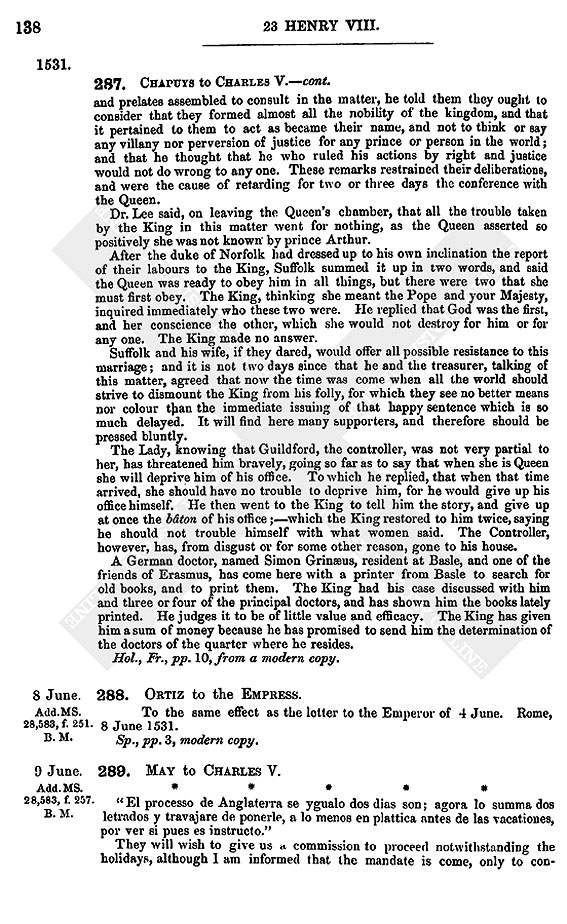
287. Chapuys to Charles V. On Monday last the Nuncio received letters from the Pope, notifying Albany's importunity for delaying the procedure. The reason of cardinal Grammont's return to Rome was to request, in the name of the King, the renewal of the practice of the said cessation; but it was of no use, for what his Holiness would not do at the request of the King, he would not for any one else. He wrote of the truce between the Turk and the king of the Romans, asking this King to arm for next year. The Nuncio was in no humor to go to Court, knowing well that his going would be neither agreeable nor useful. He went there, however, by my advice, on Tuesday; was well received; and on making his excuses for refusal of the cessation, the King told him he knew it long ago by his ambassadors. And after his usual reproaches and complaints against the Pope, he said that the Pope sought all means to retain the cognisance of this process; but it was of no use, and it was waste of time to attempt any persuasions and remonstrances, for he would never on any account assent to them; and when his Holiness had done the worst he could it would only be excommunication, for which he did not care three straws : and when the Pope had done what he liked on that side, he would do what he liked here. He said also he had sent a power to the Englishman at Rome, who had been present at the process, whose intervention he thought would be admitted. Entering further on the business, and growing warm, the King went so far as to say, that if the Pope ventured to do him any injustice, he would be avenged, and, with the aid of France, would proceed in arms to Rome. He then proceeded to talk of the Turk; and said you were strong enough to resist without his aid; and if the Pope wanted succour, let him ask it of those whom he had obliged, for he must never expect it of him, as he had never done anything at his request. Then, checking his anger, he said that the Pope of himself was not a bad fellow, but since these wars he was horribly afraid, and dared do nothing, except at the will of your Majesty; and, more than this, he said to the Nuncio, that as he thought he was a respectable man, and inclined to be civil, to make him clearly understand the justice of his cause, he would give him a book lately printed, on condition that for some time he would not communicate it to any one; and delivered him this book. The day before I had obtained a similar one, notwithstanding the King's care that they should not be published. I have sent it to Granvelle to be answered, which may easily be done, for it is not very pungent, and can be refuted in two words. After the Nuncio left, the King was long with his Council, and, not finding any other means of delaying the cause, it was agreed to speak to the Queen to allow it, and that the cognisance of the cause shall be remitted elsewhere. The Queen was secretly advertised of this in the evening, and on Wednesday morning, being deprived of all other communication, like a virtuous Princess she had recourse to the truest counsel, and had various masses of the Holy Ghost celebrated to enlighten her path, and make a true answer for the salvation of her soul, and repose of all Christendom. About 8 or 9 at night, as she was retiring to rest, there came the dukes of Norfolk and Suffolk, the young Marquis, the earls Talbot, Northumberland, Wiltshire, and many others, more than 30 in number, accompanied with the bishops of Lincoln and London, Drs. Lee, Sampson, and Stive (Stephen Gardiner), chief secretary; and being ushered into her presence, the duke of Norfolk began by saying that he and all his company had come in such numbers by the commandment of the King in a matter which concerned the King and all the kingdom, to tell her that the King was very much displeased and grieved that, owing to her, there had been so much scandal respecting him at Rome, as that he should be cited by a public edict to appear there personally,which was a very strange thing, and not suitable to a king of England; that she might consider that it was neither reasonable nor honorable that the King should on that account abandon his kingdom, and that neither she, nor those who guided these affairs in Rome, took the right course to come to a feasible and loving end of this business; and that it would be much better that the matter was not carried on with so much precipitation at Rome, and that she should be content that a place and judges should be chosen by common accord who were above suspicion; otherwise she would be the cause of the greatest disorders and slanders that had ever happened in this kingdom, whereby they, their children, and the whole posterity of those who supported her, and even the whole kingdom, would fall into great trouble. They therefore prayed and exhorted her to have an eye to this, considering that she had no legitimate occasion to create such inconveniences;because, in the first place, she had always been treated well and honorably, more than any queen of England; secondly, she ought to remember the aid given to her father, the King Catholic, in the conquest of Navarre; thirdly, she ought to regard the innumerable kindnesses the King had done to the Emperor in the times of the commonalty of Spain, and in all other distresses, which, he said, it was too long to enumerate. Moreover, she must consider that the King could not judicially be dragged to Rome without his own consent; for he was entirely sovereign chief in his kingdom, as well in regard to the temporalty as to the spiritualty, as had been lately recognized and approved by the Parliament and clergy of England. She ought therefore to set aside all scruples as to the election and delay. When the Duke had finished his harangue, the Queen replied that there was nobody in the world to whom he could show more properly the sorrow and regret of the King for any wrong or vituperation that had been done to him, especially if she was in fault ("que a nulle personne du monde desclayroit plus lennuyt et le regret du Roy, ne de que luy fust fait aucung tord ou vitupere que a personne vivant, principallement si elle en estoyt en coulpe"). But she could not think that her proctors could solicit any unjust process, and still less those to whom the cognisance of the cause belonged, except what the cause of justice required; and in following it, no wrong or prejudice was done to anyone; and as to electing any other judge but the Pope, it was no use to speak of it, for she would never consent, not for any favor that she expected of his Holiness, because hitherto he had shown himself much more partial to the King than could be expressed, and therefore she alone had cause for lamentation and regret. Hereupon she recited the different favors granted by the Pope to the King from the commencement, and the disfavors that she had received. But as the King, in the first instance, had recourse to the Pope, who held the place and puissance of God upon earth, and consequently of the truth,for God was true and eternal truth,she wished that truth and justice should be seen and determined by the minister and lieutenant of the sovereign truth, viz., the Pope, whose authority and sentence was the more necessary in this case, not merely for the repose of this kingdom, but of all Christendom. And as to the slanders which had been circulated, she hoped, as God has hitherto preserved her from giving any occasion for such things, He would extend the same goodness to her for the future; and the way of justice that she had followed was to obviate them; and they ought to admonish those who put the King on these courses, against whom she protested if any inconvenience arose. As to her good treatment, of which the Duke had spoken, she admitted it, and was accordingly more obliged to the King. As to the aid for the conquest of Navarre, she was aware of it; and if the King, her father, had not entirely discharged the obligation, it must be imputed to his sudden death, for if he had survived, he would not have failed to find the means of doing so. As for the favors done to you, she could herself bear witness in part, but it was not required; for you not only did not deny them, but often had the intention to requite them, and please the King in all things honorable; and that herein there was no failure and no dissimulation, as she knew for certain that you were a most thorough friend to the King, as they ought all of them to believe and persuade him. As to the supremum caput, she considered the King as her sovereign, and would therefore serve and obey him. He was also sovereign in his realm, as far as regards temporal jurisdiction; but as to the spiritual, it was not pleasing to God either that the King should so intend, or that she should consent, for the Pope was the only true sovereign and vicar of God, who had power to judge of spiritual matters, of which marriage was one. After this answer, Dr. Lee broke in, saying that she ought firmly to believe that as she was known to prince Arthur, the marriage between her and the King was very detestable and abominable before God and the world; that this was notorious, as he had discovered by all the most learned doctors, and the universities had confirmed it,adding much other talk. The Queen answered that he ought to have addressed that argument to others than to her, as he said it more for the pleasure of another than for the truth, and that in this case he was neither her councillor nor her judge to tell her to believe in the truth of what he said; that she was not known to the Prince at all, and that this was not the place to set forth such discussions; and that, if he liked, he might go to Rome, where he would find other than women to argue with, and who would tell him that he had not read nor seen everything. Hereupon Dr. Sampson, the dean of the chapel, began to say to the Queen that it was great pertinacity in her that she would not for any argument condescend that the cause should be tried anywhere else except at Rome, but would precipitate the sentence; and that in Rome they would do the worst they could for the King, and the best in her favor; and that would be no other than a sentence given par contradictes, which could be afterwards set aside by several means, which would lead to many discussions; and the best expedient was to select the judges as Norfolk had proposed. The Queen replied, as she had done to the Duke already : "Dean, if you had experienced part of the bitter days and nights which I have endured since the commencement of this sad affair, you would not have considered it precipitation to desire a sentence and determination of this affair; nor would you have accused me so carelessly and inadvertently of pertinacity." And as to these contradictes, or any other law terms, she said she understood them not, but he could go to Rome with Dr. Lee and discuss them there. Then the bishop of Lincoln began to denounce the marriage in strong terms as Dr. Lee had done, saying moreover, that she had always lived in concubinage with the King, and that God had, always shown his displeasure at this abomination by the curse of sterility, and that it was no use her denying her connection (fn. 4) with the Prince, for there were solemn evident proofs to the contrary. To this the Queen answered, that although she esteemed and loved the King as much as any woman could love her husband, besides that the King was 100,000 times greater in all qualities and perfections, nevertheless she never would have wished, nor did wish, to live a moment with him contrary to her conscience; but that she knew well she was his true and lawful wife; that the proofs of which he spoke were false and forged, as she could say boldly, knowing the truth better than anybody in the world; and if it came to proof, besides her oath thereupon, which she would not falsify for all the world, she would bring manifest evidences of their lies and falsehoods. Then Dr. Stephen attacked this last point, saying that if there had been no other proof, the presumption of the law would suffice, and would be credited against her,considering also that she had lived some time with the Prince, and they had slept together. She told them that she did not proceed by cavil or presumption, but only according to the exact truth; and as for his presumptions and his laws, he could go and ventilate them at Rome with the others. When the discussion was finished, she proceeded to say that she was greatly astonished how and for what consideration so many grand personages, who could appall the world, had come in this manner to take her by surprise when she was alone and unfurnished of counsel. The Duke told her she had no reason to complain on that head, for she had the most complete counsel in England, as the archbishop of Canterbury, the bishops of Durham, Rochester, and others. The Queen replied that they were fine councillors, for when she asked advice of the archbishop of Canterbury, he replied that he would not meddle in these affairs, saying frequently, Ira principis mors est; the bishop of Durham said he dared not, for he was the King's subject and vassal; Rochester told her to keep up her courage;and that was all the counsel she got from them. The rest made the same answer; so that she was constrained, as all the world knows, to send for doctors from Flanders, for no one was willing or even dared to intermeddle in drawing up her appeal, which was made by the licence and consent of the King, who at that time was not repugnant to the cause being tried at Rome. Hereupon Wiltshire replied, that the licence for this appeal did not extend to citing the King personally. The Queen answered that she had not procured any such citation; but, if in pursuing the appeal the law required it, they must not lay the blame upon her. In the end Norfolk and Wiltshire, by way of excuse, wished her to understand that they were not the promoters of these affairs, and that they did not apply themselves to it further than what they heard men of the long robe say. And so they left without uttering another word, though the bishop of London was very much urged to speak; but when he had heard the Queen's reasons, he had not the courage. As for the most part of the rest, if they had the liberty of speaking their thoughts, they would have inclined to the Queen's side; but as they could do no more, they testified their inclinations by showing the satisfaction they had at the Queen's answers, and they secretly nudged one another when any point touched the quick. Among these was the secretary, Dr. Stephen, who at the commencement unravelled (a demesl) these affairs, but is now very much suspected by the Lady. Some said they had worked hard, and counselled long, and devised fine plans, but were confounded by a single woman, and all their designs turned topsyturvy. Of these was Guildford, the Controller, who said it would be the best deed in the world to tie all the doctors who had invented and supported this affair in a cart, and send them to Rome to maintain their opinion; or meet with the confusion they deserve. When the said Duke and others came to the King, who was waiting for them in great anxiety to hear of their success, they told him what had occurred. On which he said he was afraid it would be so, considering the courage and fantasy of the Queen; but it would be very necessary to provide other remedies. And on saying this, he remained very pensive. The King is in great trouble and perplexity since the penultimate letters from Rome, and has spoken sharply against Joachin, who had promised him that his master would obtain the delay in the cause. Yesterday the King was enraged with Joachin being discontented with his master and with him, because they had been treating for a marriage between the Pope's niece and the younger son of France without consulting him. These things have put the King into great confusion, and he does not know where to turn. It is possible that by his Ambassador in your Court he may dress up some proposal to you. Yesterday there was a report that the King had sent for many of his mariners. Some thought it was for an expedition. I am told it is only to fetch three or four vessels which have to be repaired, having been long in port. I am told that if it had not been for Talbot, they would have used stronger language to the Queen; but that two or three times, when the nobles and prelates assembled to consult in the matter, he told them they ought to consider that they formed almost all the nobility of the kingdom, and that it pertained to them to act as became their name, and not to think or say any villany nor perversion of justice for any prince or person in the world; and that he thought that he who ruled his actions by right and justice would not do wrong to any one. These remarks restrained their deliberations, and were the cause of retarding for two or three days the conference with the Queen. Dr. Lee said, on leaving the Queen's chamber, that all the trouble taken by the King in this matter went for nothing, as the Queen asserted so positively she was not known by prince Arthur. After the duke of Norfolk had dressed up to his own inclination the report of their labours to the King, Suffolk summed it up in two words, and said the Queen was ready to obey him in all things, but there were two that she must first obey. The King, thinking she meant the Pope and your Majesty, inquired immediately who these two were. He replied that God was the first, and her conscience the other, which she would not destroy for him or for any one. The King made no answer. Suffolk and his wife, if they dared, would offer all possible resistance to this marriage; and it is not two days since that he and the treasurer, talking of this matter, agreed that now the time was come when all the world should strive to dismount the King from his folly, for which they see no better means nor colour than the immediate issuing of that happy sentence which is so much delayed. It will find here many supporters, and therefore should be pressed bluntly. The Lady, knowing that Guildford, the controller, was not very partial to her, has threatened him bravely, going so far as to say that when she is Queen she will deprive him of his office. To which he replied, that when that time arrived, she should have no trouble to deprive him, for he would give up his office himself. He then went to the King to tell him the story, and give up at once the bton of his office;which the King restored to him twice, saying he should not trouble himself with what women said. The Controller, however, has, from disgust or for some other reason, gone to his house. A German doctor, named Simon Grinus, resident at Basle, and one of the friends of Erasmus, has come here with a printer from Basle to search for old books, and to print them. The King had his case discussed with him and three or four of the principal doctors, and has shown him the books lately printed. He judges it to be of little value and efficacy. The King has given him a sum of money because he has promised to send him the determination of the doctors of the quarter where he resides. Hol., Fr., pp. 10, from a modern copy. |
|
8 June. Add. MS. 28,583, f. 251. B. M. |
288. Ortiz to the Empress. To the same effect as the letter to the Emperor of 4 June. Rome, 8 June 1531. Sp., pp. 3, modern copy. |
|
9 June. Add. MS. 28,583, f. 257. B. M. |
289. May to Charles V. "El processo de Anglaterra se ygualo dos dias son; agora lo summa dos letrados y travajare de ponerle, a lo menos en plattica antes de las vacationes, por ver si pues es instructo." They will wish to give us a commission to proceed notwithstanding the holidays, although I am informed that the mandate is come, only to contradict, which is a manifest calumny (calumnia). It will not stop us much more than a month. No point has yet been lost. Rome, 9 June 1531. Sp., pp. 9, modern copy. |
|
9 June. Add. MS. 28,583, f. 262. B. M. Ib., f. 272. |
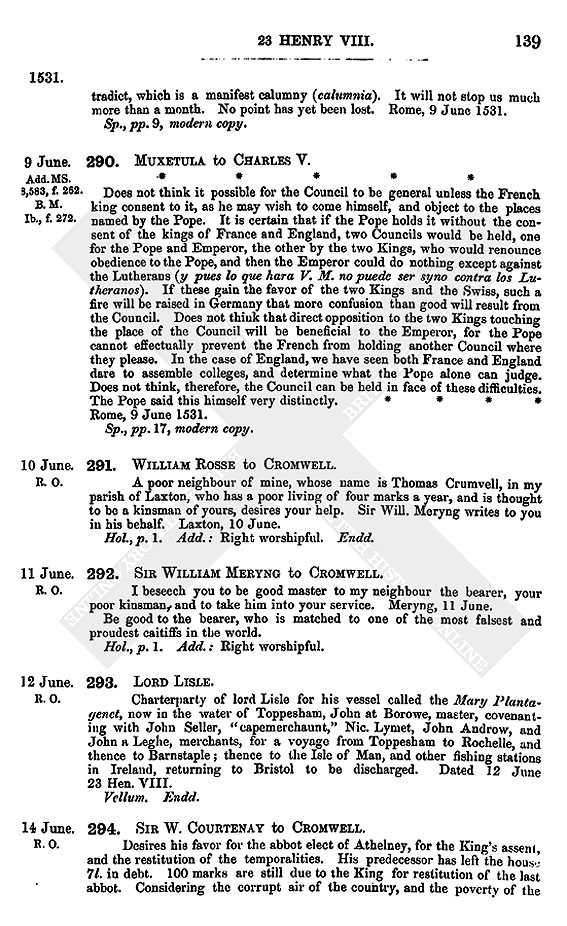
290. Muxetula to Charles V. Does not think it possible for the Council to be general unless the French king consent to it, as he may wish to come himself, and object to the places named by the Pope. It is certain that if the Pope holds it without the consent of the kings of France and England, two Councils would be held, one for the Pope and Emperor, the other by the two Kings, who would renounce obedience to the Pope, and then the Emperor could do nothing except against the Lutherans (y pues lo que hara V. M. no puede ser syno contra los Lutheranos). If these gain the favor of the two Kings and the Swiss, such a fire will be raised in Germany that more confusion than good will result from the Council. Does not think that direct opposition to the two Kings touching the place of the Council will be beneficial to the Emperor, for the Pope cannot effectually prevent the French from holding another Council where they please. In the case of England, we have seen both France and England dare to assemble colleges, and determine what the Pope alone can judge. Does not think, therefore, the Council can be held in face of these difficulties. The Pope said this himself very distinctly. * Rome, 9 June 1531. Sp., pp. 17, modern copy. |
|
10 June. R. O. |
291. William Rosse to Cromwell. A poor neighbour of mine, whose name is Thomas Crumvell, in my parish of Laxton, who has a poor living of four marks a year, and is thought to be a kinsman of yours, desires your help. Sir Will. Meryng writes to you in his behalf. Laxton, 10 June. Hol., p. 1. Add. : Right worshipful. Endd. |
|
11 June. R. O. |
292. Sir William Meryng to Cromwell. I beseech you to be good master to my neighbour the bearer, your poor kinsman, and to take him into your service. Meryng, 11 June. Be good to the bearer, who is matched to one of the most falsest and proudest caitiffs in the world. Hol., p. 1. Add. : Right worshipful. |
|
12 June. R. O. |
293. Lord Lisle. Charterparty of lord Lisle for his vessel called the Mary Plantagenet, now in the water of Toppesham, John at Borowe, master, covenanting with John Seller, "capemerchaunt," Nic. Lymet, John Androw, and John a Leghe, merchants, for a voyage from Toppesham to Rochelle, and thence to Barnstaple; thence to the Isle of Man, and other fishing stations in Ireland, returning to Bristol to be discharged. Dated 12 June 23 Hen. VIII. Vellum. Endd. |
|
14 June. R. O. |
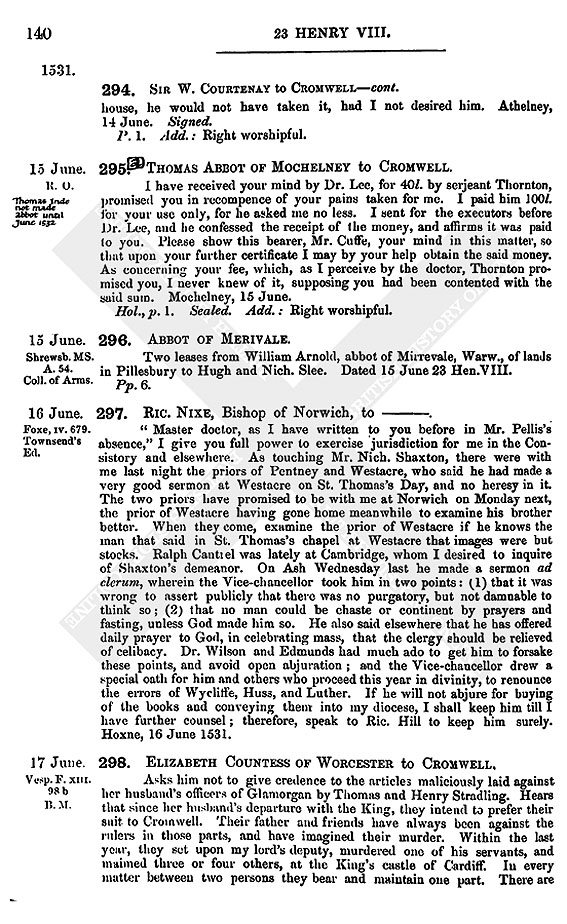
294. Sir W. Courtenay to Cromwell. Desires his favor for the abbot elect of Athelney, for the King's assent, and the restitution of the temporalities. His predecessor has left the house 7l. in debt. 100 marks are still due to the King for restitution of the last abbot. Considering the corrupt air of the country, and the poverty of the house, he would not have taken it, had I not desired him. Athelney, 14 June. Signed. P. 1. Add. : Right worshipful. |
|
15 June. R. O. |
295. Thomas Abbot Of Mochelney to Cromwell. I have received your mind by Dr. Lee, for 40l. by serjeant Thornton, promised you in recompence of your pains taken for me. I paid him 100l. for your use only, for he asked me no less. I sent for the executors before Dr. Lee, and he confessed the receipt of the money, and affirms it was paid to you. Please show this bearer, Mr. Cuffe, your mind in this matter, so that upon your further certificate I may by your help obtain the said money. As concerning your fee, which, as I perceive by the doctor, Thornton promised you, I never knew of it, supposing you had been contented with the said sum. Mochelney, 15 June. Hol., p. 1. Sealed. Add. : Right worshipful. |
|
15 June. Shrewsb. MS. A. 54. Coll. of Arms. |
296. Abbot Of Merivale. Two leases from William Arnold, abbot of Mirrevale, Warw., of lands in Pillesbury to Hugh and Nich. Slee. Dated 15 June 23 Hen. VIII. Pp. 6. |