Letters and Papers, Foreign and Domestic, Henry VIII, Volume 5, 1531-1532. Originally published by Her Majesty's Stationery Office, London, 1880.
This free content was digitised by double rekeying. All rights reserved.
'Henry VIII: September 1532, 1-15', in Letters and Papers, Foreign and Domestic, Henry VIII, Volume 5, 1531-1532, ed. James Gairdner (London, 1880), British History Online https://www.british-history.ac.uk/letters-papers-hen8/vol5/pp552-571 [accessed 30 April 2025].
'Henry VIII: September 1532, 1-15', in Letters and Papers, Foreign and Domestic, Henry VIII, Volume 5, 1531-1532. Edited by James Gairdner (London, 1880), British History Online, accessed April 30, 2025, https://www.british-history.ac.uk/letters-papers-hen8/vol5/pp552-571.
"Henry VIII: September 1532, 1-15". Letters and Papers, Foreign and Domestic, Henry VIII, Volume 5, 1531-1532. Ed. James Gairdner (London, 1880), British History Online. Web. 30 April 2025. https://www.british-history.ac.uk/letters-papers-hen8/vol5/pp552-571.










September 1532, 1-15
| 1 Sept. |
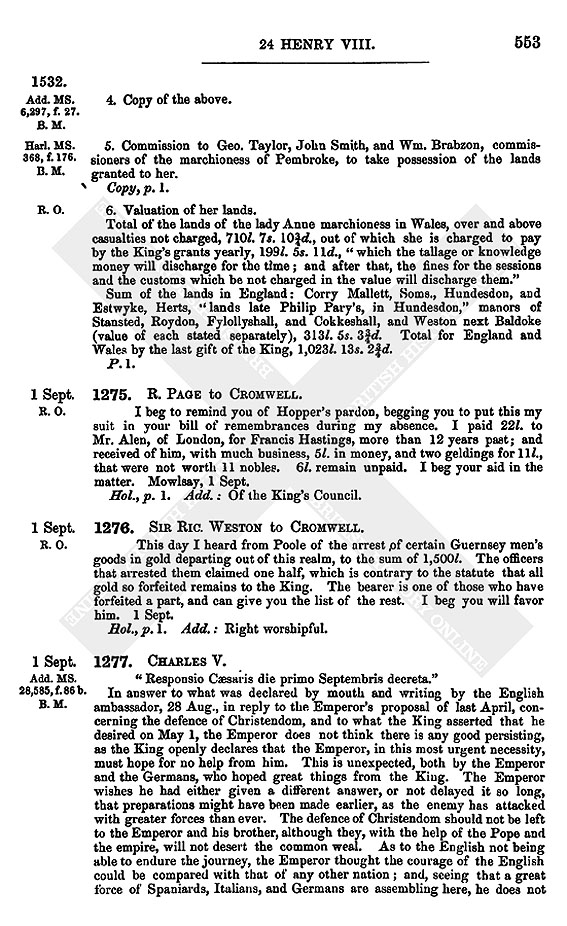
1274. Anne Boleyn. Creation as marchioness of Pembroke, and grants of land, annuities, &c. See Grants in September, Nos. 13. |
|---|---|
| Lansd. MS. 261, f. 140. B. M. |
2. "The true order of the ceremony of the creacion of the marchioness of
Pembroke." Directions for the ceremony, which exactly correspond with the account which follows. Copy, temp. Jac. I., p. 1. |
| Add. MS. 6,113, f. 70. B. M. |
3. "Creacion of lady Anne, doughter to therle of Wilteshier, marquesse of
Penbroke." Sunday, 1 Sept. 1532, 24 Hen. VIII. The lady was conveyed by noblemen and the officers of arms at Windsor Castle to the King, who was accompanied by the dukes of Norfolk and Suffolk and other noblemen, and the ambassador of France. Mr. Garter bore her patent of creation; and lady Mary, daughter to the duke of Norfolk, her mantle of crimson velvet, furred with ermines, and a coronet. The lady Marques, who was "in her hair," and dressed in a surcoat of crimson velvet, furred with ermines, with strait sleeves, was led by Elizabeth countess of Rutland, and Dorothy countess of Sussex. While she kneeled before the King, Garter delivered her patent, which was read by the bishop of Winchester. The King invested her with the mantle and coronet, and gave her two patents,one of her creation, the other of 1,000l. a year. She thanked the King, and returned to her chamber. Gifts given by the lady Marques :To Mr. Garter, for her apparel, 8l.; to the Office of Arms, 11l. 13s. 4d. The King gave them 5l. Officers of Arms present :Garter and Clarencieux, kings; Richmond, Carlisle, and Windsor, heralds; Rougecross, Portcullis, Bluemantle, and Guisnes, pursuivants. P. 2. |
| Add. MS. 6,297, f. 27. B. M. | 4. Copy of the above. |
| Harl. MS. 368, f. 176. B. M. |
5. Commission to Geo. Taylor, John Smith, and Wm. Brabzon, commissioners
of the marchioness of Pembroke, to take possession of the lands
granted to her. Copy, p. 1. |
| R. O. |
6. Valuation of her lands. Total of the lands of the lady Anne marchioness in Wales, over and above casualties not charged, 710l. 7s. 10d., out of which she is charged to pay by the King's grants yearly, 199l. 5s. 11d., "which the tallage or knowledge money will discharge for the time; and after that, the fines for the sessions and the customs which be not charged in the value will discharge them." Sum of the lands in England : Corry Mallett, Soms., Hundesdon, and Estwyke, Herts, "lands late Philip Pary's, in Hundesdon," manors of Stansted, Roydon, Fylollyshall, and Cokkeshall, and Weston next Baldoke (value of each stated separately), 313l. 5s. 3d. Total for England and Wales by the last gift of the King, 1,023l. 13s. 2d. P. 1. |
|
1 Sept. R. O. |
1275. R. Page to Cromwell. I beg to remind you of Hopper's pardon, begging you to put this my suit in your bill of remembrances during my absence. I paid 22l. to Mr. Alen, of London, for Francis Hastings, more than 12 years past; and received of him, with much business, 5l. in money, and two geldings for 11l., that were not worth 11 nobles. 6l. remain unpaid. I beg your aid in the matter. Mowlsay, 1 Sept. Hol., p. 1. Add. : Of the King's Council. |
|
1 Sept. R. O. |
1276. Sir Ric. Weston to Cromwell. This day I heard from Poole of the arrest of certain Guernsey men's goods in gold departing out of this realm, to the sum of 1,500l. The officers that arrested them claimed one half, which is contrary to the statute that all gold so forfeited remains to the King. The bearer is one of those who have forfeited a part, and can give you the list of the rest. I beg you will favor him. 1 Sept. Hol., p. 1. Add. : Right worshipful. |
|
1 Sept. Add. MS. 28,585, f. 86 b. B. M. |
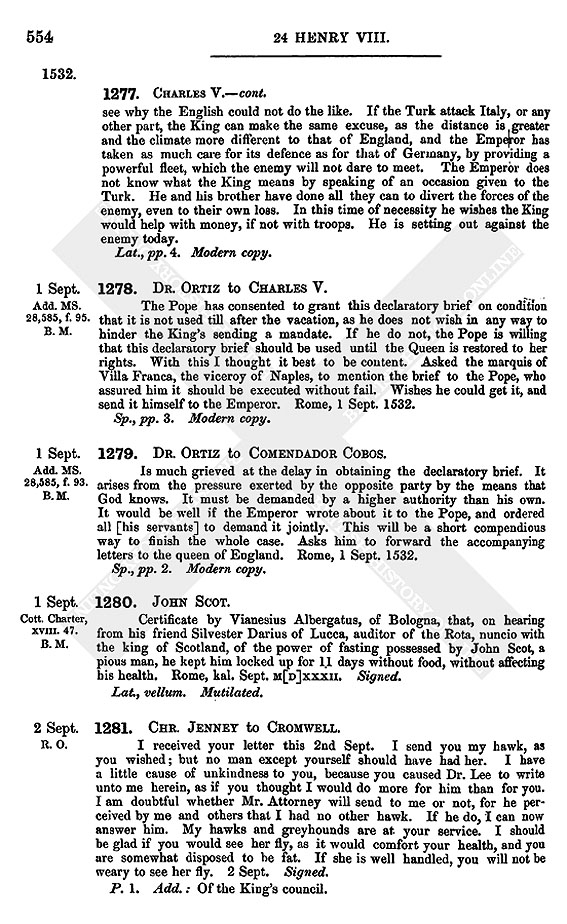
1277. Charles V. "Responsio Csaris die primo Septembris decreta." In answer to what was declared by mouth and writing by the English ambassador, 28 Aug., in reply to the Emperor's proposal of last April, concerning the defence of Christendom, and to what the King asserted that he desired on May 1, the Emperor does not think there is any good persisting, as the King openly declares that the Emperor, in this most urgent necessity, must hope for no help from him. This is unexpected, both by the Emperor and the Germans, who hoped great things from the King. The Emperor wishes he had either given a different answer, or not delayed it so long, that preparations might have been made earlier, as the enemy has attacked with greater forces than ever. The defence of Christendom should not be left to the Emperor and his brother, although they, with the help of the Pope and the empire, will not desert the common weal. As to the English not being able to endure the journey, the Emperor thought the courage of the English could be compared with that of any other nation; and, seeing that a great force of Spaniards, Italians, and Germans are assembling here, he does not see why the English could not do the like. If the Turk attack Italy, or any other part, the King can make the same excuse, as the distance is greater and the climate more different to that of England, and the Emperor has taken as much care for its defence as for that of Germany, by providing a powerful fleet, which the enemy will not dare to meet. The Emperor does not know what the King means by speaking of an occasion given to the Turk. He and his brother have done all they can to divert the forces of the enemy, even to their own loss. In this time of necessity he wishes the King would help with money, if not with troops. He is setting out against the enemy today. Lat., pp. 4. Modern copy. |
|
1 Sept. Add. MS. 28,585, f. 95. B. M. |
1278. Dr. Ortiz to Charles V. The Pope has consented to grant this declaratory brief on condition that it is not used till after the vacation, as he does not wish in any way to hinder the King's sending a mandate. If he do not, the Pope is willing that this declaratory brief should be used until the Queen is restored to her rights. With this I thought it best to be content. Asked the marquis of Villa Franca, the viceroy of Naples, to mention the brief to the Pope, who assured him it should be executed without fail. Wishes he could get it, and send it himself to the Emperor. Rome, 1 Sept. 1532. Sp., pp. 3. Modern copy. |
|
1 Sept. Add. MS. 28,585, f. 93. B. M. |
1279. Dr. Ortiz to Comendador Cobos. Is much grieved at the delay in obtaining the declaratory brief. It arises from the pressure exerted by the opposite party by the means that God knows. It must be demanded by a higher authority than his own. It would be well if the Emperor wrote about it to the Pope, and ordered all [his servants] to demand it jointly. This will be a short compendious way to finish the whole case. Asks him to forward the accompanying letters to the queen of England. Rome, 1 Sept. 1532. Sp., pp. 2. Modern copy. |
|
1 Sept. Cott. Charter, XVIII. 47. B. M. |
1280. John Scot. Certificate by Vianesius Albergatus, of Bologna, that, on hearing from his friend Silvester Darius of Lucca, auditor of the Rota, nuncio with the king of Scotland, of the power of fasting possessed by John Scot, a pious man, he kept him locked up for 11 days without food, without affecting his health. Rome, kal. Sept. M[D]XXXII. Signed. Lat., vellum. Mutilated. |
|
2 Sept. R. O. |
1281. Chr. Jenney to Cromwell. I received your letter this 2nd Sept. I send you my hawk, as you wished; but no man except yourself should have had her. I have a little cause of unkindness to you, because you caused Dr. Lee to write unto me herein, as if you thought I would do more for him than for you. I am doubtful whether Mr. Attorney will send to me or not, for he perceived by me and others that I had no other hawk. If he do, I can now answer him. My hawks and greyhounds are at your service. I should be glad if you would see her fly, as it would comfort your health, and you are somewhat disposed to be fat. If she is well handled, you will not be weary to see her fly. 2 Sept. Signed. P. 1. Add. : Of the King's council. |
|
2 Sept. Add. MS. 8,585, f. 97. B. M. |
1282. Dr. Ortiz to Secretary Cobos. Has received the Emperor's letter and his of 22 Sept. The Pope says he has sent a brief to bid the king of England send a mandate, but his Ambassadors say he has not yet received it. The sentence which the Pope says he has given in Consistory must be put in form of a decretal, and entered in the register. The Ambassador told me yesterday that this has been done by the Data[...]ut the Datary contradicts this, and says that what was given in the Consistory was not a judicial sentence, but a vote (explication de voluntades) for notifying the king of England. Will speak of this to the Ambassador. Rome, 2 Sept. 1532. Sp., pp. 3. Modern copy. |
|
2 Sept. R. O. |
1283. John [Bunolt] of Calkewell, to his Brother Clarencieux. "I recommend me unto you and to my good sister." Has received his letter by Mr. Weldon, with the indenture, obligation, and procuration for Mr. Warton, parson of Newkerke, which he returns. Wishes him to bring the counterpane when he comes. Will do his best for the parson's interests. Has obtained a lodging of the marshal for our good master, Mr. Cromwell. He shall have in it a parlour wherein is a field bed, with another bed for two of his servants; also a servants' hall and 2 servants' chambers with 5 beds, a cellar for 5 or 6 tuns of wine, a kitchen, a stable for 24 horses, if necessary, and over it 7 load of hay; also a garret for 100 qrs. of corn. The lodging "is the house that was to our aunte the lady Doon." It is in the most wholesome street in Calais, "and directly against my poor house." Clarencieux should get Cromwell to send Mr. Marshal his thanks for granting him such a place. Try to make an end with Bassechurch before the King's departure. Your officers here have obtained a good lodging for those you have written for. Calais, 2 Sept. Hol., pp. 2. Add. : [To Mr.] Clarencieux king at [ar]mys, this be delivered in St. Elyns at London. Add., in another hand (Clarencieux's?) : To the right honorable Maistre Cromewell. |
|
2 Sept. R. O. |
1284. John Bunolt to Cromwell. On receipt of Clarencieux's letter, has this day procured a lodging of Mr. Marshal of this town, for Cromwell and his servants, with stabling for as many horses as Clarencieux mentions, "a cellar for your drink," and a garret for oats, all in one house. Has written to Clarencieux more fully on the subject. Calais, 2 Sept. Hol., p. 1. Add. : [Mr.] Cromwell, master of the King's jewel-house. |
|
2 Sept. R. O. |
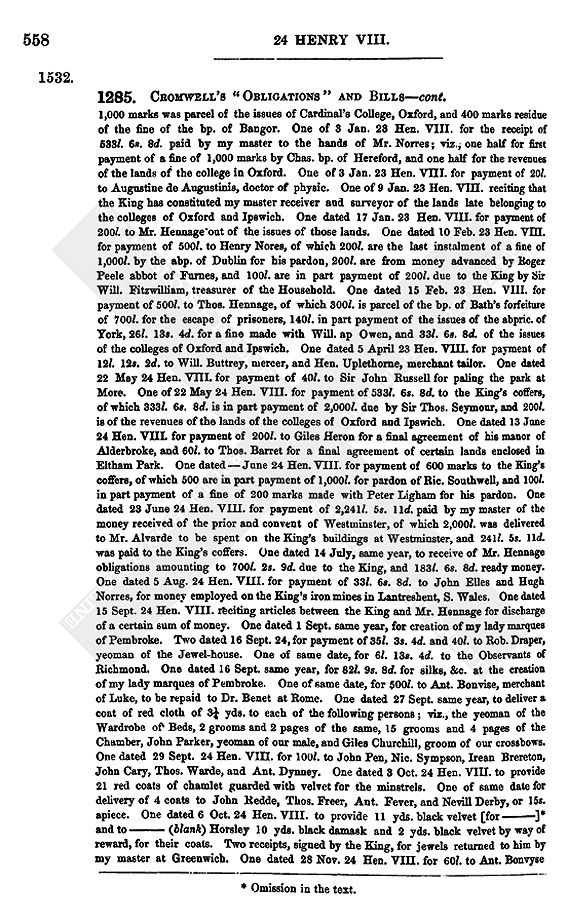
1285. Cromwell's "Obligations" And Bills. "The true pie or catalogue of all my master's obligations, bills obligatory, and all other escripts, remaining in the custody of John Williamson, his servant, the 2d day of September in the 24th year of King Henry VIII." i. Obligations. Five separate obligations of 100 marks each, payable at different dates, wherein Nic. Statham, Alex. Plomley, and Ric. Jerves, mercers, of London, stand bound to my master; one of Thos. marquis of Dorset for 240l. as security for a debt of Thos. Trye and Thos. Holt; one of Geoff. Chamber, of London, for 33l. 6s. 8d.; one of Chr. Coo, for 60l. as security for 50l. in which my master at his instance stands bound to Mr. Reynolds; one of Sir John Russell and Anne his wife, for 100l.; one of Sir Will. Barlowe, parson of Cressingham, Norf., for 6l. 13s. 4d. payable at Mich. 21 Hen. VIII.; one of Ric. Southwell for 200l. payable 2 Sept. 24 Hen. VIII.; one of 200l. by Thos. marquis of Dorset, Ric. Philipps of Poule, Dorset, and Ant. Bogegood of London, as security for payment of 120l. in which my master at their instance stands bound jointly with them to Dominico Lomelino; one of 100l. by Thos. Somer, stock-fishmonger, of London, payable 19 Hen. VIII.; one of 40l. by Ric. Parker, of London, cook, payable 22 Hen. VIII. Others, for various sums : by John Tate, clk.; Chr. a Lye, shereman, of London; Chr. Bendeloos of Berdefeld; Sir Edw. Leighton, priest; Chr. Coo; John Horwood of London, innholder; Sir Edw. Seymour; Thos. Addyngton, skinner, of London, Reynold Litilprowe of Norwich; Thos. Leighton of Aspeden "in the county of Shroisbery;" lord Geo. Gray, clk.; Rob. Bolles of Yorkshire (on condition of my master obtaining a papal dispensation for his marriage with Marian Boolles, being of the second degree); John Cockes, sen. and jun., leathersellers; Sir John Wallop; Rob. Cartor and Thos. Canmor, clks.; Domyngo Lomelyne, Genoese merchant; Reynold Vaughan, baker, and Rob. Sharper, miller, both of Wansworth, Surrey. Several of the above are for past dates, one as far back as the 13th year. Pp. 7. |
|
ii. Statutes of the Staple of Westminster. One by Sir John Gage and his sons Edw. and Jas. Gage, for 1,000 marks payable 21 Hen. VIII.; one by Perpoynt Deovanter, Hanse merchant, payable 15 Hen. VIII. P. 1. |
|
|
iii. "Desperat obligations." By Will. Honynges, fishmonger, of London, and Ric. Cowper, grocer; Sir Edw. Baynton; by John Heughes of London to Sir Will. Kyngeston and Sir Edw. Walsingham, that Jas. Gryffith Appowell shall be true prisoner in the Tower; by John Turner of London, Walter Spynke of London, saddler, and John Coke of London, girdler, for performance of certain covenants; by Thos. and John Barton, Ralph Evers, Thos. Donyngton, clk., Will. Thorneton, Ant. Hamond, and Ric. Dalby, to Mr. Wynter, provost of Beverley; by my master and Thos. Alen of London, to Rob. Cowper, goldsmith. P. 1. |
|
|
iv. "Bills obligatory in paper," &c. By Steph. Gardiner bp. of Winchester; John Chekyn of Cambridge; Sir Thos. Cornewaill; Edw., heir apparent to Sir John Gage; John Watson of London, brewer, Thos. Tong alias Nory king-at-arms; Chas. Knyvet; Edw. Leighton, priest; Will. Dodd, vintner, London; Humph. Farrar; Florens Volusenus; Thos. Legh; Ant. Knyvet; Marmaduke Constable, priest; John Hughes (bond of 25l. to the use of my late lord Cardinal); John Almayn; Will. Dod, vintner, London; Sir Edw. Lynney, priest; John Clyfford, mercer, London. A warrant of my lady marques Dorset to Ric. Philipis for repayment of 40l. to my master. A receipt given by Sir John Gage, 7 Sept. 24 Hen. VIII., for a chain of fine gold of 319 links weighing 10 oz. Bill of Sir Arthur Darcy, acknowledging receipt from the King, by the hands of my master, of the advowson of the vicarage of Kirkby Kendal. Bills obligatory of Thos. duke of Norfolk, Ric. Long, Anth. Knyvet, Will. Brereton, and Rob. Acton, saddler. Pp. 5. |
|
|
v. "Inventory of the desperat bills remaining in the custody of the said John Williams." Bills of Mr. Wynter; Will. Tresham and Will. Beattes, of Oxford; Edw. Gage; Edw. Leighton; Alen Hawte (for Thos. Wyat's debt to the King); lord Geo. Gray (to save my master harmless against Sir John Alen, alderman); Rob. Croxton (to Thos. Barley, chaplain to Mr. Marney); Ric. Long (for receipt of 20l. from my master for half year's rent of Hudelstone, the King's ward); Mich. Purfrey (for receipt of 20l. to the use of the prior of Landa); Edw. Gage (for 300l. received to the use of Sir John Gage); Dr. Capon (for which my master has certain plate); Thos. Strangwayes (recognizance to keep the peace against my master and his servants). Indenture between my master and Roger Fowler, of the goods in Bromehill priory. Indenture between my master and Ric. Banckes, for sale of a gold chain, with image of the Assumption of Our Lady, a little rose with a diamond triangled at the foot of the same image, weighing 14 oz. q. A bill from the abbot of St. Benet's, stating that he had sent my master 5l. in part payment of 10l. for which he stands bound for Mr. Palsgrave. A letter, signed by Anth. Knyvet, to borrow 10l. A bill, signed by Margaret Vernon, for a loan of 20l. A bill of Thos. Try. A paper of the costs of Mr. Gage's patent. A bill, signed by the marquis of Dorset, to Ric. Philippes, for a payment on two statutes. Bond of Ric. and John Bradshaw of Osmaston, to save harmless my master for payments of the parsonge of Melborne to the bp. of Carlisle. Chr. Wellifed's presentation to the parsonage of Belton, Linc. Pp. 3. |
|
|
vi. "My master's patents." A patent made to my master by the dean and canons of Cardinal's College, Oxford, of an annuity of 20l. A similar patent of 20s. a year by the prior of Bradnestok. Another of 40s. by Edw. Aston, of Tyksall, Staff. Another of 10l. by Sir Ant. Ughtred. Another of 4l. by Roger abbot of Furnes. Another of 26s. 8d. by Will. Burrey, prior of Shelbrede. A patent by Will. Frere, mayor of York [Oxford], (fn. 1) of the understewardship of Oxford. A patent of 4l. a year by Sir John Husee. And other patents of annuities, of various amounts, by Rob. Dillon of Devonshire; Will, abbot of St. Mary's without York; Mr. Wyntar (of 40s.); Mr. Will. Frankelen, chancellor of Durham, 4l.; John Pakyngton (3l. 6s. 8d.); Sir Will. Thomas; Sir Ant. Wingfield; the prior and convent of Rochester; the earl of Northumberland (6l. 13s. 4d.); the abbot and convent of Welbeck, Notts; the master and fellowship of the Bakers; the abbot and convent of Westminster (6l. 13s. 4d.); John Copley, alderman of the guild of Our Lady of Boston (4l.); the prior of Lewes; the prior and convent of Heryngham; the lord of St. John's, with the chapter; Will. Fynche, prior of Bromehill; Thos. Holbeme, prior of Michelham, Sussex; Mr. Huddlestone of Southam, Glouc.; Thos. abbot of Our Lady, Pipwell, Northt.; Sir Ant. Ughtred; the earl of Huntingdon; Edmond abbot of York; the dean and fellows of Cardinal's College, Ipswich; the prior of St. Bartholomew's, West Smithfield; Sir Walter Hungerford; Geo. Rolle; Will. Thorneton, abbot of York; lady Katharine Blunte, widow of Sir John Blunte; Lewis, prior of Ferlegh, Wilts; Will. Cleyburgh, clk.; Rob. abbot of Waltham and prior of St. Bartholomew's, West Smithfield; Ric. Verney and lady Eliz. Lucy, his wife; Thos. duke of Norfolk; Edw. abp. of York; John abbot of Athelney; Thos. prior of St. Nicholas, Spalding; Marg. Tewkysburye, abbess of Godstow; John abbot of Osney; Will. Fynche, prior of Bromer, Hants. Pp. 6. |
|
|
vii. Indentures between my master and others; viz., with Hugh Whalley, for the
parsonage of Melborne; with Giles Heron, for the farm of Canbery; with the prior of
St. Bartholomew's, and Giles Heron, for the same; an obligation of Heron's for performance
of covenants in a pair of indentures. Indentures with Nic. Statham, for the manor of
Sutton at Hone; Ric. Parker, cook, London, for wood sales; the prior of St. Bartholomew's,
for the house and garden of Canberie; two servants of Sir Fras. Brian, for a loan on
plate; Mr. Wyntour and Thos. Barton, for "receivership of his lands belonging to his
master's provousty." A general acquittance by Will. Bolleyn, clk., to Mr. Wynter, of all
actions. An indenture with lord Leonard Grey, about the pledging of certain articles
of plate (described). An indenture with the prior of St. Bartholomew's touching the
manors of Canbery, Cutlers and Iermongers (lease). Pp. 2. |
|
|
viii. "Releases from divers persons to my master;" viz., from Ant. Cavallary, Jas.
Wilson, Rob. Bolles. P. 1. |
|
|
ix. Warrants from the King, directed to my master, Thos. Cromwell, for payment of
special sums, viz. : One dated 27 May 23 Hen. VIII. for 100 marks in part payment of a
fine of 500 marks concluded by my master with the bishop of Bangor. One dated 18 July
23 Hen. VIII. for 100l. prest to Will. Tresham. One dated 11 Dec. 23 Hen. VIII. for
1,400 marks; viz., 1,100 marks to Henry Nores,and 300 marks to Mr. Henage,of which
1,000 marks was parcel of the issues of Cardinal's College, Oxford, and 400 marks residue
of the fine of the bp. of Bangor. One of 3 Jan. 23 Hen. VIII. for the receipt of
533l. 6s. 8d. paid by my master to the hands of Mr. Norres; viz., one half for first
payment of a fine of 1,000 marks by Chas. bp. of Hereford, and one half for the revenues
of the lands of the college in Oxford. One of 3 Jan. 23 Hen. VIII. for payment of 20l.
to Augustine de Augustinis, doctor of physic. One of 9 Jan. 23 Hen. VIII. reciting that
the King has constituted my master receiver and surveyor of the lands late belonging to
the colleges of Oxford and Ipswich. One dated 17 Jan. 23 Hen. VIII. for payment of
200l. to Mr. Hennage out of the issues of those lands. One dated 10 Feb. 23 Hen. VIII.
for payment of 500l. to Henry Nores, of which 200l. are the last instalment of a fine of
1,000l. by the abp. of Dublin for his pardon, 200l. are from money advanced by Roger
Peele abbot of Furnes, and 100l. are in part payment of 200l. due to the King by Sir
Will. Fitzwilliam, treasurer of the Household. One dated 15 Feb. 23 Hen. VIII. for
payment of 500l. to Thos. Hennage, of which 300l. is parcel of the bp. of Bath's forfeiture
of 700l. for the escape of prisoners, 140l. in part payment of the issues of the abpric. of
York, 26l. 13s. 4d. for a fine made with Will. ap Owen, and 33l. 6s. 8d. of the issues
of the colleges of Oxford and Ipswich. One dated 5 April 23 Hen. VIII. for payment of
12l. 12s. 2d. to Will. Buttrey, mercer, and Hen. Uplethorne, merchant tailor. One dated
22 May 24 Hen. VIII. for payment of 40l. to Sir John Russell for paling the park at
More. One of 22 May 24 Hen. VIII. for payment of 533l. 6s. 8d. to the King's coffers,
of which 333l. 6s. 8d. is in part payment of 2,000l. due by Sir Thos. Seymour, and 200l.
is of the revenues of the lands of the colleges of Oxford and Ipswich. One dated 13 June
24 Hen. VIII. for payment of 200l. to Giles Heron for a final agreement of his manor of
Alderbroke, and 60l. to Thos. Barret for a final agreement of certain lands enclosed in
Eltham Park. One dated June 24 Hen. VIII. for payment of 600 marks to the King's
coffers, of which 500 are in part payment of 1,000l. for pardon of Ric. Southwell, and 100l.
in part payment of a fine of 200 marks made with Peter Ligham for his pardon. One
dated 23 June 24 Hen. VIII. for payment of 2,241l. 5s. 11d. paid by my master of the
money received of the prior and convent of Westminster, of which 2,000l. was delivered
to Mr. Alvarde to be spent on the King's buildings at Westminster, and 241l. 5s. 11d.
was paid to the King's coffers. One dated 14 July, same year, to receive of Mr. Hennage
obligations amounting to 700l. 2s. 9d. due to the King, and 183l. 6s. 8d. ready money.
One dated 5 Aug. 24 Hen. VIII. for payment of 33l. 6s. 8d. to John Elles and Hugh
Norres, for money employed on the King's iron mines in Lantreshent, S. Wales. One dated
15 Sept. 24 Hen. VIII. reciting articles between the King and Mr. Hennage for discharge
of a certain sum of money. One dated 1 Sept. same year, for creation of my lady marques
of Pembroke. Two dated 16 Sept. 24, for payment of 35l. 3s. 4d. and 40l. to Rob. Draper,
yeoman of the Jewel-house. One of same date, for 6l. 13s. 4d. to the Observants of
Richmond. One dated 16 Sept. same year, for 82l. 9s. 8d. for silks, &c. at the creation
of my lady marques of Pembroke. One of same date, for 500l. to Ant. Bonvise, merchant
of Luke, to be repaid to Dr. Benet at Rome. One dated 27 Sept. same year, to deliver a
coat of red cloth of 3 yds. to each of the following persons; viz., the yeoman of the
Wardrobe of Beds, 2 grooms and 2 pages of the same, 15 grooms and 4 pages of the
Chamber, John Parker, yeoman of our male, and Giles Churchill, groom of our crossbows.
One dated 29 Sept. 24 Hen. VIII. for 100l. to John Pen, Nic. Sympson, Irean Brereton,
John Cary, Thos. Warde, and Ant. Dynney. One dated 3 Oct. 24 Hen. VIII. to provide
21 red coats of chamlet guarded with velvet for the minstrels. One of same date for
delivery of 4 coats to John Redde, Thos. Freer, Ant. Fever, and Nevill Derby, or 15s.
apiece. One dated 6 Oct. 24 Hen. VIII. to provide 11 yds. black velvet [for] (fn. 2)
and to (blank) Horsley 10 yds. black damask and 2 yds. black velvet by way of
reward, for their coats. Two receipts, signed by the King, for jewels returned to him by
my master at Greenwich. One dated 28 Nov. 24 Hen. VIII. for 60l. to Ant. Bonvyse
merchant of Luke, due by Philip Wylde of the Privy Chamber, which he had of the King
in recompence of a licence of wine and woad, 60l. One of same date, for 44l. 1s. 6d.
to Mr. Gresham of London, mercer, for silks. One dated 30 Nov. 24 Hen. VIII. for
2,500l. to Sir Geo. Lawson, to be employed on the Marches of Scotland. One dated
5 Dec. 24 Hen. VIII. for receipt of 1,100l. into the King's privy coffers. Pp. 8. |
|
|
x. "Separate bills and other specialties belonging unto divers persons being also in the
custody of the said John Williams." A bond of 1,000l. given by Polidore Virgill and others to the late lord Cardinal for his appearance before the Council when required. A patent made to Mr. Alvarde by Res ap Gryffith of an annuity of 40s. A "testimonial" of John Horsley and John Almoner, mariner, "for a how (hoy) in their presents (presence) wrecked at the North sands upon the border of Kent, laden with beer to go to Calais." A bond of Thos. Jaykes and Sir Will. Cumberton, clk., to save "the bishop of Salop" (Salisbury) against any "incondempnyte" that may ensue for the institution of the said Cumberton to the ch. of Rustelhale, Wilts. A bond given by John Marter, butcher, of London, to Will. Marshall of Alnetheley, Essex. An indenture made by Will. Franklen, clk., with Will. Frankelen and Katharine his wife, touching his prebend of Walton. A parchment containing the examination of wools before the duke of Norfolk and my lord Cardinal. The answers of the town clerk of Beverley. P. 1. |
|
|
3 Sept. Calig.B.I.124. B. M. St. P. IV. 616. |
1286. [Northumberland to Henry VIII.] Has received letters from the Scotch king. Sends them, with copies of his own, to which they are an answer. The King will see James's mind towards justice and redress. Learns that Makayn is gone over to Ireland with 7,000 men, and done much harm there, but whether to the King's subjects he cannot tell. 1,000 men have been sent to him. Hopes to learn particulars when Argyle comes to Edinburgh on the 6th Sept. for the Parliament. Trusts to deliver Bothwell without indemnity, and bring Argyle and the earl of Craford to the King's purpose. James has deprived Argyle of the rule of all the out Isles, and given it to Mackayn and his heirs for ever. He has also given Crafford's lands to him. The spiritualty are all disaffected to James, except the bishops of Glasgow, Aberdeen, and Dunkeld. The abp. of St. Andrew's has obtained a bull from the Pope in such form that James is now content to release the spiritualty from a payment of 10,000 cr. a year, accepting instead 4,000l. stg. to be paid in four years. James is preparing an army beyond the North Seas. Has sent a servant thither to ascertain particulars. Has received, Sunday, 1 Sept., two letters from the King by Angus; the one about furnishing 100 men for defence of the Borders, the other for the entertainment of the said Earl and his brother George, and letting slip secretly them of Riddisdale and Tynedale to join those of Liddersdale in annoying Scotland. The captain of Berwick has doubtless certified the King of the last road made by the Scots in Berwick bounds. Has written to James for redress of this open-day foray, and also of that at Hawtewesill. One Waugh, a Scotchman, taken at Hawtewesill, is detained by Dacre, who covertly alleged his taking to be within the West March, and though the Earl has proved by a quest that it was within the Middle March, Dacre refuses restitution. He has also caused one Carock, who took two men of Tyvidale prisoners there, to let them escape, lest, if the Earl put them to execution, he should be at feud with Tyvidale. This Carock confessed on oath before the captain of Berwick and others. Warkworth, 3 Sept. Copy. |
|
3 Sept. R. O. |
1287. Northumberland to Cromwell. Is as much bound to Cromwell as any brother or son he has, for his manifold kindness and plainness. As to the sheriffwick of Northumberland, which the King has promised him for a certain rent, "that the country may perceive the love his Grace beareth unto me, and for my service in ministering of justice to the said county, I am sure the justices can declare unto his Highness, with the polling of all the sheriffs in this country embezzling and not serving the King's processes, thinking that the said justices will report the same, and that the country is like to be in no good stay to the sheriffwick be in my hands as appeared evidently unto them." Begs him to set forward with the King his matters concerning Lord Dacre and the old retinue that has always belonged to the warden. Sends copies secretly of his letters to the King and the duke of Norfolk on the subject. Begs him, at a convenient opportunity, seeing that wars are likely to ensue, to get the King to allow him one year's fee beforehand for the office of wardenry, and he will requite Cromwell's pains. Warkworth Castle, 3 Sept. Signed. P. 1. Add. : Mr. Cromwell, one of the King's most honorable Council. Endd. |
|
3 Sept. R. O. |
1288. Sir Arthur Darcy to Cromwell. Is sorry the King's gift of the advowson of Kendale should now be withdrawn from him, for he had promised to give it to one of his Grace's chaplains. Has not had a penny of his Grace for three years, nor of his father for four. The King knows he surrendered 100l. land to help his father, for which his father received 1,000l., and gave him "the said 600 marks." Has been the King's servant 14 years, and never failed at any journey or triumph; but will not weary his Grace, who, he believes, is sore charged, by asking forfeits or lands. This advowson given to a friend would have relieved him; "and of certainty I may not spend by his Grace nor my father 32l." Owes various sums to the master of the Savoy, Anth. Vivald, Mr. Chollmeley, Domyngo (?), and the King. His expenditure is at the rate of 200 marks. Begs Cromwell to advance the King's gift to him, and, if he refuse any journey in the wars, let the King take the "vowson" and all his offices. Waits till Saturday for the setting forth of his ordnance given him by the King to the Borders, and for money. His day at the Borders shall not be broken, according to the King's letters. 3 Sept. Hol., p. 1. Add. : To the right worshipful Mr. Thomas Cromwell. |
|
3 Sept. R. O. |
1289. Richard Bilbye to Cromwell. Begs him to remember the bill made by Mr. Cole, dean of the King's chapel, and for one of his clerks to write to Mr. Pryor or Mr. Monke, baylye masters of this monastery of Westminster, touching the same. Westm., 3 Sept. 1532. Hol., p. 1. Add. |
|
4 Sept. Strype's Cranmer, 679. |
1290. Cranmer to Henry VIII. At his last solicitation for an answer about commerce between the merchants of England and the Low Countries, Mons. Grandeveile told him that as the Diet concerning that matter had lately been held in Flanders, where the queen of Hungary was governor, the Emperor would make answer by her. To Grandeveile's question about the aid and subsidy desired of the King by the Emperor, replied according to his instructions received from Wm. Paget, and gave it him in writing to show to the Emperor. Grandeveile says he shall have an answer at Lintz. Both Cranmer and the French ambassador are furnishing waggons, horses, tents, ships, and other things for their voyage, but will not be ready to depart for eight or ten days, Expects to be at Lyntz before the Emperor, who will stay at Passaw ten or twelve days. The Turk is in Hungary, at the same place whereof he wrote in his last. On the 2nd inst. the Emperor left Abagh for Vienna by land, and Ferdinand went hence by water to meet him at Passaw. At Vienna the ambassadors will know his pleasure. Sends the Emperor's proclamation about a General Council and reformation of controversies of the faith in Germany, and the number of soldiers to be contributed by all the states of the Empire against the Turk. The greatest prince of Germany (the duke of Burgundy and Austry except) is only appointed to send 10 horsemen and 554 footmen. Regenspurgh, 4 Sept. |
|
4 Sept. Add. MS. 28,585, f. 99. B. M. |
1291. Mai to Cobos. After writing another letter, which accompanies this, the Viceroy arrived. Accompanied him to the Pope at his first audience. The Pope told the Viceroy what he had already told Mai about the amity and "respetos" of France. Cannot believe that he has done as he says, for the French ambassador enters to negotiate at all times, and does not appear discontented. Will not believe, though he swears it, that while an interview is being arranged between France and England, as it is said, they will undeceive them here until they have tried to gratify him (Henry?) as much as they can. This is an incurable evil. (fn. 3) The Viceroy told the Pope he was surprised at the French ambassador's assurance that his master did not propose to make any innovations in Italy. The Pope said this was true, and that it would be well if these two wills should be united; to which the Ambassador replied that the Pope ought to search for the means to do this. Thinks it is some unimportant matter (liviandad), like the offensive war in the time of the duke of Albany. [The French ambassador] told [the Pope] he was much grieved at the death of the prince of Denmark, (fn. 4) because, if his sister were married to the king of Scotland, it would disturb their treaties. Does not know whether it is of much importance; but has told the cardinal of Ravenna to advise them, as of himself, to this marriage (este partido). His Holiness will not give the tenth in France, but has given permission to sell Church property in Spain to pay the half annate. In the English case, the Pope said that at the beginning of the audiences they would proceed, whether the mandate of the King arrived or not. He had heard that they would hold a Parliament in October, and pass Acts against the apostolic authority. Fearing this, he has sent a brief to the King, admonishing him not to do so; and another to the prelates, commanding them not to consent. The English ambassadors and lawyers have sent a person to the King to inform him of the true justice of the case; but it will probably have no effect. The Pope told Mai that Gardiner (el Obispo Unidoniense) has changed his mind about the divorce, and left the Court on that account; and said that it would be well if the Emperor could manage to have good intelligence with the duke of Norfolk, as he would be of great service, and is well acquainted with French practices (porque tiene exosas las platicas Francesas en grandisima manera). The imperial Ambassador and the Queen's agents in England ask for a brief "regravatorio del primero." Both Mai and the Viceroy have pressed it, but the Pope says they must wait till October. If the King appears (viene a la causa) there will be no need of it, as the cause would soon be despatched; but if he does not appear, he will grant it. Thinks it is better to wait, as the time is short, especially as he feels sure they will not grant it, although, whenever Ortiz speaks to the Pope, he promises it. Hears from Brindisi that the Turk has retired. It is reported that an interview between France and England is being negotiated, and that cavalry have been sent to Picardy. Had another conversation with the Pope about the Turks. He promised to pay the aid, even if the Turks were repulsed. Thinks it will be well to go on against the Turks first, because it is natural to use one's victory, and because by this they will free the Pope from his fear of the Council, and other reformations; and, thirdly, he will think this will hinder the Emperor from turning against France, of which he is afraid, as he would have to declare, and might lose the obedience of France and England, with which they have threatened him. Rome, 4 Sept. 1532. Sp., pp. 17. Modern copy. |
| Ib., f. 108. | 2. English translation. |
|
5 Sept. Vienna Archives. |
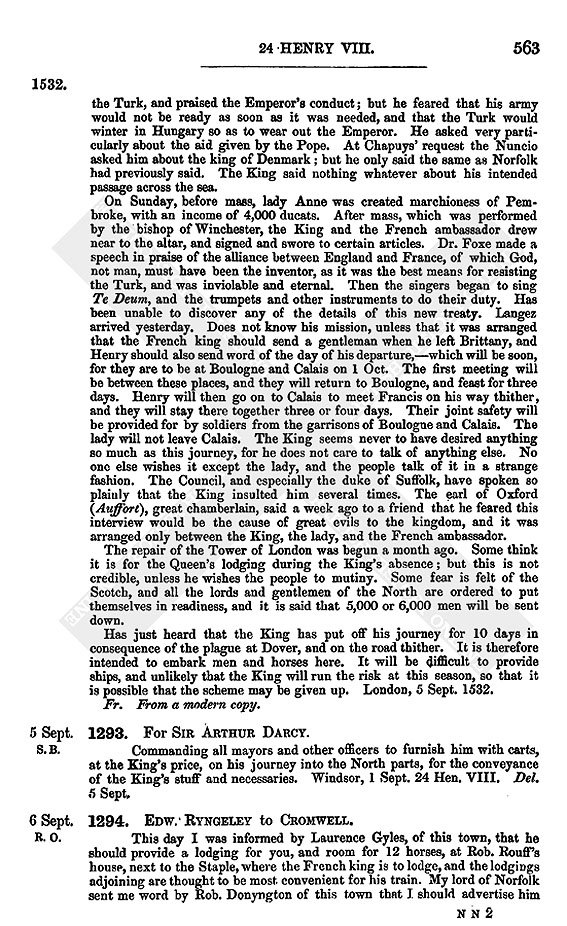
1292. Chapuys to Charles V. Has communicated the good news in the Emperor's letter of the 12th ult. to the duke of Norfolk, who seemed not only astonished but vexed at the perfect union of Germany. Not only did he tell some one that Chapuys had told him things with which the King would not be very pleased, but he seemed quite pensive and forbade any one to speak to him. Heard this from the Queen. His regret was increased by Chapuys saying that it was commonly reported that secretary Paget had gone to Germany to deal with the princes there. At this he changed colour, and seemed confused, but after a time said that if Paget had done this he acted on his own responsibility, for he was only commissioned to go to their ambassador. But this is improbable. After some conversation about the arrival of the Turk and of the Emperor, he began to speak of the interview between the kings of England and France, saying that he thought he knew something of the secrets of both Kings, and was sure that nothing would be treated of, except resistance against the Turk in case the Emperor were defeated. In this case, it was to be presumed that the Turk would march towards Italy, and the Kings were determined to go against him in person, and intended to consult about it at the interview. Did not choose to display any curiosity, lest he should seem to care much for what they might arrange. In answer to a question about the king of Denmark, the Duke said that the matter did not concern the King, and they had taken no pains to enquire; but the King had heard from Flanders that he had surrendered to his uncle. On parting, the Duke was more courteous than ever. On Saturday evening the Nuncio presented to the King the Pope's brief, exhorting him to send a power to appear in his cause. He told the Nuncio he had heard that it had been proposed in the Consistory to send briefs both to the French king and himself; but the trouble was wasted, for he would never do it. On this he put himself in a passion, as at other times, and said that if the Pope irritated him he would open the eyes of other princes, who are not learned as he is, and do not know that the real power of the Pope is very small compared with the power which he has tyrannically usurped, with his other usual threats. When his anger was cooled, he said he would consider the brief, and write his intention to the Pope. He then spoke about the Turk, and praised the Emperor's conduct; but he feared that his army would not be ready as soon as it was needed, and that the Turk would winter in Hungary so as to wear out the Emperor. He asked very particularly about the aid given by the Pope. At Chapuys' request the Nuncio asked him about the king of Denmark; but he only said the same as Norfolk had previously said. The King said nothing whatever about his intended passage across the sea. On Sunday, before mass, lady Anne was created marchioness of Pembroke, with an income of 4,000 ducats. After mass, which was performed by the bishop of Winchester, the King and the French ambassador drew near to the altar, and signed and swore to certain articles. Dr. Foxe made a speech in praise of the alliance between England and France, of which God, not man, must have been the inventor, as it was the best means for resisting the Turk, and was inviolable and eternal. Then the singers began to sing Te Deum, and the trumpets and other instruments to do their duty. Has been unable to discover any of the details of this new treaty. Langez arrived yesterday. Does not know his mission, unless that it was arranged that the French king should send a gentleman when he left Brittany, and Henry should also send word of the day of his departure,which will be soon, for they are to be at Boulogne and Calais on 1 Oct. The first meeting will be between these places, and they will return to Boulogne, and feast for three days. Henry will then go on to Calais to meet Francis on his way thither, and they will stay there together three or four days. Their joint safety will be provided for by soldiers from the garrisons of Boulogne and Calais. The lady will not leave Calais. The King seems never to have desired anything so much as this journey, for he does not care to talk of anything else. No one else wishes it except the lady, and the people talk of it in a strange fashion. The Council, and especially the duke of Suffolk, have spoken so plainly that the King insulted him several times. The earl of Oxford (Auffort), great chamberlain, said a week ago to a friend that he feared this interview would be the cause of great evils to the kingdom, and it was arranged only between the King, the lady, and the French ambassador. The repair of the Tower of London was begun a month ago. Some think it is for the Queen's lodging during the King's absence; but this is not credible, unless he wishes the people to mutiny. Some fear is felt of the Scotch, and all the lords and gentlemen of the North are ordered to put themselves in readiness, and it is said that 5,000 or 6,000 men will be sent down. Has just heard that the King has put off his journey for 10 days in consequence of the plague at Dover, and on the road thither. It is therefore intended to embark men and horses here. It will be difficult to provide ships, and unlikely that the King will run the risk at this season, so that it is possible that the scheme may be given up. London, 5 Sept. 1532. Fr. From a modern copy. |
|
5 Sept. S. B. |
1293. For Sir Arthur Darcy. Commanding all mayors and other officers to furnish him with carts, at the King's price, on his journey into the North parts, for the conveyance of the King's stuff and necessaries. Windsor, 1 Sept. 24 Hen. VIII. Del. 5 Sept. |
|
6 Sept. R. O. |
1294. Edw. Ryngeley to Cromwell. This day I was informed by Laurence Gyles, of this town, that he should provide a lodging for you, and room for 12 horses, at Rob. Rouff's house, next to the Staple, where the French king is to lodge, and the lodgings adjoining are thought to be most convenient for his train. My lord of Norfolk sent me word by Rob. Donyngton of this town that I should advertise him of 16 of the best lodgings, furnished with napery and kitchen stuff, for noblemen strangers to keep their houses in. The King's French secretary spoke to me seven or eight days ago to appoint you a lodging, which I have done, and I trust you will be contented. Calais, 6 Sept. Signed. P. 1. Add. : Right worshipful. |
|
6 Sept. Close Roll 24 Hen. VIII. m. 24 d. Rym. XIV. 439. |
1295. The Great Seal. Memorandum, that on the 6 Sept. 24 Hen. VIII. Sir Thos. Audley, keeper of the Great Seal, about 6 p.m. delivered the said seal to the King at Whitehall, in the Banket Chamber, in a white leather bag sealed with his seal, in presence of Henry marquis of Exeter, Sir John Russell, Sir Anthony Broun, Sir Ric. Page, Hen. Norreys, Thos. Crumwell, John Bell, clk., Thos. Neuman, clk., one of the masters of Chancery, Hen. Knyvet, Thos. Aluard, and others; which seal, because the letters were much worn away, the King ordered to be destroyed, and delivered to the said Sir Thomas another Great Seal, having on one side the following style round the margin, Henricus Octavus Dei Gratia Angl. et Franci Rex, Fidei Defensor, et Dominus Hiberni, with other impressions; viz., the King sitting in his majesty, bearing a sceptre in one hand and the sign of the cross in the other, and on either side of the King the insignia of England, with the title of the Order of the Garter about them and the imperial Crown above; and on the other side of the same seal, the same royal style, and a figure of the King armed with a sword in his right hand, and seated on a horse, likewise adorned, and bearing on his shield the insignia of England, with a rose engraved on the right side, and a dog running under the King's feet. |
| 6 Sept. |
1296. Abbey of Mochelney. See Grants in September, No. 11. |
|
6 Sept. S. B. |
1297. Henry VIII. to Sir Thomas Audeley, Lord Chancellor. To make out letters patent as follows, for provisions of victuals, on the King's repair to Calais. 1. For Richard Benet and Robert Donyngton, to provide 500 qrs. of oats, and as much poultry as they think needful. 2. William Mattres, to provide 1,000 oxen and 1,000 muttons. 3. Robert Donyngton, to provide 130 qrs. of malt. 4. Bartholomew Johnson, to provide 140 qrs. of malt. 5. John Ratclif, to provide 130 qrs. of malt. 6. James Wading, to provide 100 qrs. of malt. A proviso is inserted that no poultry be taken within Kent, Essex, or Sussex. Windsor, 4 Sept. 24 Hen. VIII. Del. Westm., 6 Sept. |
| R. O. | 2. Draft of the preceding corrected by Cromwell. Endd. |
|
[Sept.] R. O. |
1298. [Cromwell to Henry VIII.] (fn. 5) Has caused patterns to be made after the King's device, but has desired the goldsmith not to proceed to the finishing of them till the King's pleasure be further known, for which he will repair to him on Saturday night or Sunday morning. Sends by the bearer the pattern of the King's collar of balasses and diamonds "drawn according to your Grace's first device." A matter in variance between the executors of Sir Wm. Spencer and my lady Spencer, of which information has been given to the Judges, has been heard before my lord keeper of the Great Seal, Sir Will. Poulet, and Cromwell; and it appears, by the examination of the executors and of Edmund Knyghtley, his brother Richard, and the said lady Spencer their sister, that, notwithstanding an agreement made between the executors and lady Spencer, Edmund Knightley has done his utmost to set them at variance, and defeat the King's title to the heir; to effect which he has presumptuously caused proclamations to be made in various towns in cos. Warw., Leic., and Northt., in contempt of the King and his laws. My Lord Keeper has therefore committed him to the Fleet till the King's pleasure be known. As to the cup of gold and corporas case, I sent your Highness word by Thos. Alvard, as the bearer Steph. Vawhan can inform you, who has made perfect books of them, and all other your Highness's jewels now in the hands of Cornelys. Draft, corrected by Cromwell, pp. 3. |
|
[7 ? Sept.] R. O. |
1299. S. Vaughan to Cromwell. Delivered Cromwell's letters to the King on Friday night, when he returned late from hunting. Showed his Highness a draught of the fashion of his chain, which he called my lady Marques to look at, and liked very well. He had been afraid Cornelis would have put in more than seven balasses, and made it too large. He expects Cromwell at his coming will bring six or seven draughts of troches in which to set the other diamonds, emeralds, and rubies. He might bring six or seven for each stone. Vaughan told the King he had written a list of the jewels delivered to Cromwell, and those Cromwell was going to deliver to Cornelis to make up. "Yea, but," said his Grace, "he hath not delivered so great a charge unto him at once?" Vaughan said, Not yet; that the jewels would be delivered according to Cornelis' need of work, but that he had taken a draught of all. The King desired him to put what he had now written with the part he wrote before. The King expected Cromwell this night. My lady Marques asked Vaughan if he had brought her anything from Master Alverd. Windsor, Saturday. (fn. 6) Hol., p. 1. Add. : Unto the right worshipful Master Crumwell. |
|
8 Sept. R. O. |
1300. Sir Thomas Audeley to Cromwell. Came to London on Our Lady's eve. Did not mean to have returned so soon but for Cromwell's loving letters to make haste. Was sorry not to find him at home, but hopes to see him soon. Wishes to know when the King means to return to London, for it is said he is coming shortly hither, and going to Calais to meet the French king. Desires news if his Grace is merry and in good health, "for that is all my comfort." Hopes his Highness will live longer than himself. Was sorry to hear Cromwell has been sick, who has been one of his greatest friends. London, on Our Lady Day. (fn. 7) Signed : Thomas Audeley, keeper of the King's seal. P. 1. Add. : To his assured loving friend, Mr. Cromwell. |
|
8 Sept. R. O. |
1301. Will. Abbot of York to Cromwell. I have received your letter in favor of Master Fenton, who desires to have a new lease in the terms of a draft sent to me. I have communicated it to my brethren, and they are not satisfied with the terms, but will adhere to those that are usual in all leases of the parsonage of Rudstone. I have, however, appointed my counsel to keep a court at Rudstone for the profit of "the said" Mr. Anthony, when I will arrange what reparations shall be required from him. York, 8 Sept. Signed. P. 1. Add. : Right honourable. |
|
8 Sept. R. O. |
1302. Alexander Wode to Cromwell. Please obtain the King's favor to admit Sir John Burgyn, clk., to be one of his chaplains, according to my former suit, and your pains shall be recompensed. I trust you will be good master to Ric. Copleston, that he may have a commission to look up penalties and forfeits to which the King is entitled. Nativity of Our Lady. Hol., p. 1. Add. : Right worshipful. |
|
8 Sept. Nero, B. VI. 106. B. M. |
1303. The King's Armourer. Charge of Baltesar Bullato, a Milanese, armourer to the king of England, against Fra Antonio Vienuzo, formerly sacristan. He says he comes from Lucca. But no Lucchese in this city know him. He has changed his name, so as not to be known, for the tricks he did at the siege of Florence. During the war, he, with other robbers, stole chalices and vestments which had been put for safety in the sacristy of a church, in which he was employed to ring the bells and sweep. He has lent money to Bullato, and run away with robes given as security. He has stolen from Bullato a horse harness belonging to the King, worth 10l. st., and it was found in the house of one Peter, a Lombard. He has also committed another crime, which in Italy deserves burning, and has cheated young men at the house of Antony Bonvixi with false cards and dice. 8 Sept. 1532. London. Ital., pp. 2. |
|
9 Sept. R. O. |
1304. Sir John Fitz James to Cromwell. For your kind dealing for the prior of Mountagew, I know not how the said Prior hath deserved your pains. I never spake with my servant Cuff since that time. The abbey of Brewton is within a mile of my house. The Abbot is sick and old, and upon his death or resignation the monks desire to have one that I dislike. The Abbot has been to me an unkind neighbour, and I would gladly have a better one. The house is not of the King's foundation, but of Sir Andrew Lutterell's, and he and his ancestors have given the monks licence for election. But still the King's letter and your policy can do much in the matter. I shall be glad to hear from you. Redlinche, 9 Sept. I shall be glad to know what applications have been made to you in the matter. Hol., pp. 2. Add. : Of the Council. Sealed. |
|
9 Sept. R. O. |
1305. Thomas Bedyll to Cromwell. Has noticed three or four things in the paper enclosed concerning the King's great matter, which he leaves it to Cromwell to alter as he thinks fit. Thinks the contents somewhat bitter, and that they ought to be softened. They contain also some secret things, which should be well weighed whether the French king should know them. They will certainly make for the King's part, and animate the French king to speak the more at this interview. There are also some points mentioned which should induce the Pope to revoke his sentence for fear of afterclaps. Desires it to be written in a fairer hand, and that the name of the writer may be concealed, "for it may so fortune that the same matters shall be hereafter dilated in another fashion." London, 9 Sept. Hol., p. 1. Add. : Of the Council. |
|
9 Sept. Nero, B. VI. 138. B. M. |
1306. Andrea Gritti, Doge of Venice. Commission to to treat with the king of England and his Council as to sending Venetian galleys thither. Understands from his letters that the duke of Norfolk proposes that if the galleys are sent, he would treat about the kind and quantity of merchandise and sums of money, adding that the Venetians should export from England coloured cloths and coarser wools, as well as the finer, which is against their privileges and liberties. It will be hard to find any Venetians who will go thither on these conditions. Desires the old custom to endure. Our Duchy Palace, 9 Sept. 1532. English translation, pp. 2. Endd. |
|
9 Sept. R. O. |
1307. Tower of London. "Abstract of certain reparations done within the King's Tower of London." Payments of carpenters, sawyers, freemasons, &c. at the Tower, from 4 June to 9 Sept. 24 Hen. VIII., showing i. The amount of wages paid to each kind of workman fortnightly. |
| ii. Ready money payments in prest to sundry carpenters "in part payment of certain frames task work taken in great;" viz., at St. Thomas's tower, a new roof and new floors; the houses of office next to the kitchen, a new wardrobe, two new lodgings adjoining the King's privy closet, and a new roof and floor to the Queen's great chamber. To Jas. Nedham, Ric. Ambrose, Thos. Sherys, Will. Walker, John Kyng, and Thos. Hall, various sums to each, amounting in all to 241l. 13s. 4d. | |
| iii. "Emptions bought and provided for the foresaid buildings" from 4 June to 7 Sept., with timber and other materials, turner work, iron work, &c., 377l. 4s. 3d. Total 970l. | |
|
iv. Account of the work done by the carpenters, masons, bricklayers, plumbers, joiners,
glasiers, &c.; viz. 1. Carpenters' work. Taking down old timber, &c. at St. Thomas's tower, two old lodgings and a little gallery adjoining the King's privy closet, the old timber of the Queen's dining chamber, and of the King's grandmother's chamber, now to be made the King's wardrobe, which is already half finished. Out of the old timber taken down there have been set up three houses for the masons to work in; part has been burned to melt the old lead, and part has been saved. There has also been taken down the old timber upon the four turrets of the White Tower, the old timber of Robyn the Devil's tower, the timber of Julius Csar's tower, and of the tower at the end of the King's wardrobe; "the which three towers finished six weeks past, and the other four turrets to be finished within eight days." The Queen's bridge is almost finished, and another bridge in her garden likewise. 2. Masons' work. Finished two great pillars of Caen stone under St. Thomas's tower, and certain hard stone set about the arch and the foundation of the walls about the floodgate under the said tower, "as the pulling down of an old wall, the which wall is almost half finished." Half the White Tower, and more, is "new embattled, coped, indented (?) and cressed" with Caen stone to the extent of 500 feet. Four doors ready wrought for three chambers, and the door for the gallery going to the King's privy closet; also the sills and jambs for two great windows. 3. Work of bricklayers, plumbers, &c., on the same buildings. Pp. 9. |
|
|
10 Sept. Camusat, 6. |
1308. [Langeais?] to . "Monseigneur." Having opportunity to send this despatch to Lyons, advertises him of the news in this country. The interview between the two Kings is concluded. On 12 Oct. the French king will be at Rue, 9 or 10 leagues from Boulogne, and the king of England at Dover. On the 14th the grand master of France and the duke of Norfolk will meet at Marquise to make arrangements. The interview will take place on the 20th. There will be as few people and as modest apparel as possible; no cloth of gold or silver, except for their own persons, and for the ladies, if any. He that has fewest people and most modest apparel shall give his companion to understand that he knew best how "donner l'ordre." On the 20th, at Marquise, Francis is to entertain Henry at dinner, whom he shall go to meet as far as Henry's territory, to conduct him to Marquise, thence to Boulogne, where they will stay three days or more. The king of England to be accompanied by all his retinue, and retain only 600 horse at Boulogne. Francis to do the like on going to Calais with Henry, who is to conduct him thence out of the English territory. No gentleman to use quarrelsome words, on pain of banishment from his country for one year; or put his hand to his sword, on pain of death. Each King to have a guard of 200 horse at Ardre. The writer bears these articles, which have been signed by this King, and is going hence to cause the Grand Master to depart. This King is sending a gentleman to obtain the signature of the King "our master," and will return to cause the duke of Norfolk to cross the sea. Francis may send to this sea his two galiaces and a number of gallions and other vessels to guard this coast; and he may assemble all the garrisons of Picardy, which the Dauphin is to keep on the frontier for the surety of the two Kings. Believes he will have already learnt the cause of the meeting, which is, that the offer by these princes of succour for Christendom was rejected by the Emperor, either because he thinks himself strong enough, or because he wishes alone to have the honor of fighting the Turk; but they, considering that if the Emperor (which God forbid!) should have the worst of it, the damage would be common to all Christendom, have determined to consult together beforehand as to what they ought to do, and in order to devise some means, perhaps by way of a council, for the reunion of Christendom. Windsor, 10 Sept. 1532. Fr. |
|
12 Sept. R. O. |
1309. Henry Lokwod to Cromwell. Is glad to hear of his welfare, on which depends all his hope of worldly promotion. Reminds him of "our poor college," that we may have a final conclusion by the King's letters patent for the lands we are to have in recompense of Wyttyng. If your mastership had not been "special good" to me in our college matters, "I would never have tarried all the incumbrances that we have been in;" but now "we be meynly well if these new lands were limit and stablished." I pray you help us with the parsonage in Kent that Mr. Wyatt moved you of, "by cause there both the byshopp and the arschedekyn wylbe heysse (easy) to intret for owr colleg," and it will be a great commodity to us; and you shall have what you please for yourself for life, or your son Gregory. Let your writings be made and sent by Mr. Wyett, and you shall have them sealed with the college seal. Cambridge, 12 Sept. Signed : Henry Lokwod, "minister of the same." P.S.The bp. of Norwich's commissary has been here, and says there are debts for Croxton and Eteryg (?) Heath unpaid for five years, amounting to 8l., and if they are not paid he will suspend the church of Croxton. Begs his help, and that he will send word by Wyatt. Would have been glad to have had the vicarage of Sepulchre's until Endfeld (fn. 8) had fallen in. Was too scrupulous in declining Cromwell's offer. Begs him to remember the "arr."? (arrears?) of Wyttyng now due by the King's grant. He shall have part of them if he will help. The parsonage which he desires for the wife of Mr. Cycyll is held for the term of his life by John Bird, and has been promised after his death to another. Will, however, do what he can for Cromwell. "Your son Gregorius tuus unigenitus bene valet." Would be glad if Mr. Seydnoyr, or Dr. Hawkins, or Mr. Herytage had better promotion, "so that I had one of their benefices that Gregory might lie off it, that I might see to his tuition. I would trust so to cull of him that it should be both in time to come to your comfort and his profit." Hopes after Michaelmas to have him again as bedfellow in Christ College. Desires credence for Wyet in business connected with the college. Hol., pp. 3. Add. : Of the King's council. |
|
12 Sept. R. O. |
1310. Christopher Hales to Cromwell. Thanks for your letters sent by your servant, John Brygenden. I hope he may prosper. "I send unto you a buck which I know is of no reputation unto you." Accept it as the extent of my mind. I have had my health this summer, and can ride meetly well, but am no goer. I am sorry to hear of the death of your sister. Birlyng, Thursday before the Exaltation of the Holy Cross. Hol., p. 1. Add. : Councillor and master of the jewels. |
|
13 Sept. Add. MS. 28,585, f. 112. B. M. |
1311. Katharine of Arragon to Charles V. Though she knows that the Emperor is occupied in resisting the Turk, she will not refrain from importuning him with her affairs, which are perhaps equal in the offence they cause to God. God will give the victory to those who serve Him with good works, and one of the best will be to get her cause settled. It appears not to be hers only, but to concern all who fear God, considering the evils which it has produced and will produce in Christendom if the Pope will not take some steps, and that shortly. Books are being printed here full of falsehoods and filth touching the Faith. It is determined to settle the case here at the same time as the interview between these two Kings. Begs the Emperor to urge the Pope to decide the case without more delay. The details are so foul and unreasonable, and dishonorable to her husband, that she does not like the Emperor to know them from her, and the Ambassador will tell him. Prays for his victory over the Turks. Asks him to thank card. Egydyo and the Abad Lloro for the trouble they have taken on her behalf. Enfyle, 13 Sept. Sp., pp. 3. Modern copy. Add. |
|
13 Sept. R. O. |
1312. Robert Mores. The deposition of Robert Mores, alias Robert Meredethe, before Thomas Crumwell, 13 Sept. 24 Hen. VIII. On Bartholomew's Even last he dined in his own house over against the bishop of Worcester's, in company with one Pynner, who dwells next him; and afterwards came to London to Mr. Dodmer, alderman, and also before Mr. Recorder, to offer bail for Evan, a capper, who was taken on suspicion of felony. The Recorder refused one of the two sureties, "and he saith that a woman dwelling nigh unto the bishop of Ely's place within a pale; but he saith he knoweth not the sureties that should have been bounden for the said Evan Capper." He was also the same day, about 8 p.m., with Davy Tayler, who lives about St. John's. He dined on Bartholomew's Day with my lord of Derby's bargeman in his boat. In Cromwell's hand, p. 1. Endd. ii. On the back of the preceding are the following lists, also in Cromwell's hand, arranged in two columns. (1.) Mynyster, Father Peytow. Warden of Greenwich, Freer Henry Elston. Warden of Richmond, Freer Ryche. Warden of Canterbury, Gabriel Pekoke. Warden of Newarke, Father Rykys. Warden of Newcastle, Father Baker. Warden of Southampton, Father Scryvener. Father Donall. Father Deryke. Father Corson, vicar of Greenwich. Father Honter. Father Robynson. Father Robert Neswyke. Father Elwyn. (2.) "Contra Peytow." Father Pekoke. Father Forest. Father Lawrens. Father Covert. Father Sydney. Father Penreth. Father Thomas Queyntance. Father Massey. Fraunces Boknell. Father Sebastyon. |
|
R. O. |
1313. James Beek to Cromwell. On Tuesday last Father Commissary and Father Forest were with the King, when he entertained the former with good words. He desires they should be with him on Sunday next. The commissary and Forest will come from Richmond on Wednesday to Greenwich, to hold a visitation, to know the minds of the fathers and brethren. Afterwards he will sit at Richmond. Every man is to be examined by himself. It is, therefore, supposed that when they come to the chapter the votes will be given by the headiest and stiff sort, so that if the King does not appoint a chief himself they will retain Peyto as their minister. His Grace is supported by those whose names the writer sent to Cromwell, and they will be satisfied to have a stranger appointed, if he be an Observant. Hears that a curse has been passed by the Pope, and is coming to England to the Observants' hands. Is not sure of the truth, but as soon as he knows will send Cromwell word. Would gladly have come to Cromwell himself, but must have patience lest he be restrained. Has nothing to pay as yet, but will bring his bill at the King's coming to Greenwich or Eltham, unless Cromwell would like to see him before. Friday. Hol., pp. 2. Add. : Councillor. Endd. inaccurately : Thomas Beck. |
|
15 Sept. R. O. |
1314. Thomas Hennage. Warrant under the sign manual to Cromwell, master of the jewels, to deliver to Thos. Hennage, to be cancelled, an obligation dated July, wherein he stands bound to Sir Brian Tuke, Cromwell, and Sir Chr. Hales, in 53l. 5s. 3d. It is recited that by a former warrant, dated Hunsdon, 14 July 24 Hen. VIII., Cromwell was authorised to receive of Hennage 183l. 6s. 8d., and certain specialties and obligations amounting to 516l. 16s. 1d., residue of 766l. 16s. 1d. in which he was indebted to the King by indenture 22 May 22 Hen. VIII.; on which, by indenture 19 July 24 Hen. VIII., Cromwell received of Hennage the obligation first-mentioned. Windsor, 15 Sept. 24 Hen. VIII. |
|
15 Sept. R. O. St. P. VII. 378. |
1315. Benet to [Cranmer]. Received Cranmer's letter from Regenspurgh, dated the 17th ult. Has received no commandment from the King to certify Cranmer in what state the cause is here, as he signified the King had ordered. Will, however, give credence to his letter. Explains to him the circumstances of the admission of Carne as excusator. After various discussions, the Pope resolved in the Consistory on the 9th July to prorogue the cause till the beginning of November, and meanwhile the King should be exhorted to "send a proxy unto the principal cause." On the 11th the abbot of Farfa made his brother Hieronimo prisoner, as he was leaving for the Emperor with 100 light horse. News has come that the French and English kings will meet at Calais. Hol., draft. Headed : 15 Sept. 1532. |
|
15 Sept. Vienna Archives. |
1316. Chapuys to Charles V. Wrote on the 5th about the arrival of Langey, &c. Four days ago he left the Court without staying in London, so that Chapuys could not ask him about his charge. Understands that it was to fix the time for the interview, which the French king wishes to be put off till the 20th; to offer the king of England a fleet for his passage, which he will not accept; and to ask the King to bring the new Marchioness with him. If he has not such a charge, the Ambassador has given out that he has, for the King has written to several lords to prepare their wives to accompany the Marchioness, whom he is taking to this assembly at the request of the French king. Francis has probably made this request, knowing that it would please the King and the lady, and that the King would bring her without being asked, as he cannot leave her for an hour. Doubts not that the French king wishes to see her, to thank her for her daily good offices, for which the Ambassador says he can hardly be sufficiently grateful. Francis has lost nothing by the death of the cardinal of York; for, besides that the lady is more mischievous and has more credit than he had, the King does not pay her 25,000 cr., but only flattery and promises of soliciting the divorce. Two days after Langey arrived, the King, leaving him and the other ambassadors at Windsor, came here in haste to inspect his ships. Finding that it was impossible to carry out his determination, of which Chapuys wrote in his last, he has resolved, in spite of the pestilence, to embark at Dover; and, to prevent the danger of contagion from a large retinue, has licensed his people to embark when and where they please, so long as they are at Calais by the day fixed. Suffolk, who ought to be with the King, is going tomorrow to Suffolk to embark. His purpose in going so far may be to have an excuse for absence, as he could not prevent the interview by his remonstrances. Brian will go post to France tomorrow, in return for Langey's coming. Has not been able to find out anything about the league which was sworn at Windsor on the 1st inst., except that the French ambassador says there was nothing in it concerning the Emperor, and it was only a defensive league, which was not really necessary, but the English wanted some addition to previous treaties. The harangue, after the oath, certainly implied something more than a defensive league. The day before yesterday the French ambassador said to Chapuys, in presence of the Venetian ambassador and his secretary, among other words which showed his master's illwill to the Emperor, that it was reported that the Emperor, under colour of the king of the Romans, had sent ambassadors to the Turk, proposing to divide the monarchy of the world with him, and offering to leave him Hungary if he would help in subduing other Christian princes;which, however, he did not believe. Rebuked him for repeating such stories, which he knew were not true. He said Langey was his authority. After this he said that perhaps the two Kings at their interview would treat of an expedition to Greece and Constantinople, of which his master was Emperor. The king of England will not only not give aid to the Emperor, nor allow his subjects to serve against the Turk, but has not permitted the publication of a bull of plenary indulgence to those who pray for the prosperity of Christendom. Notwithstanding this, does not think there are ten persons in England who do not pray for the Emperor as devoutly as his own subjects. Procured a month ago a book, written by the King's order, about the divorce, but principally about the authority of the Pope. Gave it to the Nuncio to send to the Pope to incline him to give sentence and to hinder this interview, for fear the king of England should induce the French king to join him in renouncing obedience to the Pope. The Nuncio says that he has written amply about it. Fr. Imperfect. From a modern copy. Headed : "Londres, 15 Sept. 1532." |