
Letters and Papers, Foreign and Domestic, Henry VIII, Volume 5, 1531-1532. Originally published by Her Majesty's Stationery Office, London, 1880.
This free content was digitised by double rekeying. All rights reserved.
'Henry VIII: October 1532, 1-10', in Letters and Papers, Foreign and Domestic, Henry VIII, Volume 5, 1531-1532, (London, 1880) pp. 589-599. British History Online https://www.british-history.ac.uk/letters-papers-hen8/vol5/pp589-599 [accessed 25 April 2024]
Image
Image

Image

Image

Image

Image

Image

Image
Image

Image

Image

October 1532, 1-10
|
Oct. Camusat, 105. |
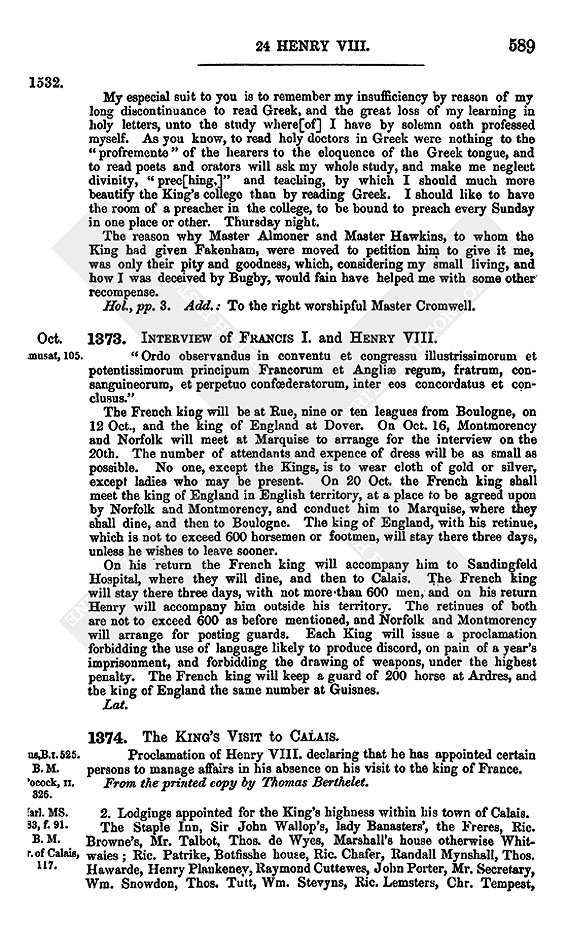
1373. Interview of Francis I. and Henry VIII. "Ordo observandus in conventu et congressu illustrissimorum et potentissimorum principum Francorum et Angli regum, fratrum, consanguineorum, et perpetuo confderatorum, inter eos concordatus et conclusus." The French king will be at Rue, nine or ten leagues from Boulogne, on 12 Oct., and the king of England at Dover. On Oct. 16, Montmorency and Norfolk will meet at Marquise to arrange for the interview on the 20th. The number of attendants and expence of dress will be as small as possible. No one, except the Kings, is to wear cloth of gold or silver, except ladies who may be present. On 20 Oct. the French king shall meet the king of England in English territory, at a place to be agreed upon by Norfolk and Montmorency, and conduct him to Marquise, where they shall dine, and then to Boulogne. The king of England, with his retinue, which is not to exceed 600 horsemen or footmen, will stay there three days, unless he wishes to leave sooner. On his return the French king will accompany him to Sandingfeld Hospital, where they will dine, and then to Calais. The French king will stay there three days, with not more than 600 men, and on his return Henry will accompany him outside his territory. The retinues of both are not to exceed 600 as before mentioned, and Norfolk and Montmorency will arrange for posting guards. Each King will issue a proclamation forbidding the use of language likely to produce discord, on pain of a year's imprisonment, and forbidding the drawing of weapons, under the highest penalty. The French king will keep a guard of 200 horse at Ardres, and the king of England the same number at Guisnes. Lat. |
|---|---|
|
Titus, B. I. 525. B. M. Pocock, II. 326. |
1374. The King's Visit to Calais. Proclamation of Henry VIII. declaring that he has appointed certain persons to manage affairs in his absence on his visit to the king of France. From the printed copy by Thomas Berthelet. |
| Harl. MS. 283, f. 91. B. M. Chr. of Calais, 117. |
2. Lodgings appointed for the King's highness within his town of Calais. The Staple Inn, Sir John Wallop's, lady Banasters', the Freres, Ric. Browne's, Mr. Talbot, Thos. de Wyes, Marshall's house otherwise Whitwaies; Ric. Patrike, Botfisshe house, Ric. Chafer, Randall Mynshall, Thos. Hawarde, Henry Plankeney, Raymond Cuttewes, John Porter, Mr. Secretary, Wm. Snowdon, Thos. Tutt, Wm. Stevyns, Ric. Lemsters, Chr. Tempest, Thos. Lewes, John Adison, Thos. Skryven, Robt. Garneys, Robt. Bayneham, John Grynstede, Ric. Judson, Antony Strayle, Wm. Burdon, Jas. Thacher, Edm. Prestwiche, John Kele, Walter Baker, Hughe Smythe's widow, Wm. Staples, Wm. Gardyner, Mrs. Hubbard, the Noble, Henry Kele, Thorneton's widow, Everard Goston. Lodgings appointed within the same town for the French king. The Exchequer, Henry Lacy, Thos. Barton, Rauf Brooke, Arthur Beawford, John Sakfeld, Sampson Norton, John Stoble, Ric. Wodehous, Fras. Ychingham, Gregory Van, John Massingberd, Bryan Vavasour, George Gaynesford, Robt. Mathewe, Edw. Pye, Edw. Jenkyns, John Henbery, John Middleton, Mr. Mason, Henry Lacy, Robt. Hall, Ric. Long, Symon Jenyns, Sir Ric. Whetehyll, Ric. Sextons, the Redde Crosse, Adryan Dyer, John Myller, Henry Smalebery, William Bayneham, Newton's house at the Gate otherwise Minshall, Adryan Dogan, John Atwell, Christopher Conwaye, Ric. Rutter, Lucas wydowe. Pp. 6. Endd. |
|
1 Oct. R. O. |
1375. John Legh to Cromwell. I am commanded by Will. Musgraff to appear before you in the Octave of Michaelmas, and hope your favor that I incur not the King's displeasure. Sorry I cannot attend you. If you have any business with me concerning the King's "teners" (tenures?) in the shire of Cumberland, the King shall lose none of his right, as far as depends upon me. I beg your favor for the sheriffwick of Cumberland this year. Yssel, 1 Oct. Hol., p. 1. Add. : Of the Council. |
|
1 Oct. Royal MS. 7 C. XVI. f. 40. B. M. |
1376. The King's Jewels. "A booke of jewelles delyvered by the Kinges hyghnes at sondrie tymes unto Mr. Crumwell, master and treasourer of hys jewelles, in the xxiiii. yere of hys most gracious reigne." Delivered by the King at Windsor, 3 Sept. 24 Hen. VIII., to Cromwell, to be delivered to Cornelis Hayes, goldsmith, for alteration, &c.14 emeralds, 18 rubies, 63 diamonds, 2 balasses, and 418 pearls set in various jewels, besides 20 rubies and 2 diamonds reserved for my lady Marques. Delivered by the King at Greenwich, 6 Sept.A tabernacle of gold set upon a great cushion of gold, with an image of Our Lady crowned, and a child on her lap, surmounted by a canopy. The tabernacle also contains images of Angels, St. George and the Dragon, St. John the Baptist, St. Katharine, desks of the Ascension and Resurrection of Our Lord, and other figures, which are all described. The stones therein are as follows : 24 diamonds, 9 rubies, 18 emeralds, 8 balasses, 4 sapphires, 2 garnets, 1 jacinth, and 126 pearls. Delivered at Greenwich, 6 Sept.A gold girdle, a collet and an image of St. George, containing 14 balasses, 1 emerald, and 134 pearls. Delivered at Windsor, 15 Sept. (copy of Mr. Norris' bill.)Rings, &c., containing 38 diamonds, 34 rubies, 1 balas, 2 emeralds, and 8 pearls. Delivered at Windsor, 15 Sept.Rings, owches, and bracelets, containing 14 diamonds, 6 rubies, 5 balasses, 6 emeralds, 22 pearls, and 2 gold plummets for a clock. Delivered at Greenwich, 1 Oct.Collettes and troches containing 6 rubies, 25 diamonds, and 13 balasses. Delivered by Thos. Alverde, 18 Sept.18 diamonds set in troches of gold. Pp. 11. Endd. |
|
1 Oct. Vienna Archives. |
1377. Chapuys to Charles V. It seemed from the prorogation of the interview which the French demanded, that there was some suspicion of a rupture, especially as Brian, who was to set out immediately after Langey, had not left; so that Norfolk, who came the day before yesterday to buy silk, and other great men, were not making any preparations. Now everything is settled again, and the Grand Esquire (fn. 1) will go tomorrow, instead of Brian, to wake up the French, and tell them that the King has started; which he will do on Friday next, St. Francis's Day. In order to avoid Rochester and other places where they are dying, the King will go from Greenwich to Gravesend in his barge, and stay there for a day at the house du gentilhomme. There he will embark in the Minion, of 150 tons, and sail to an isle in the Thames, and feast for three days at the house of a gentleman named Chennet (Cheney). Thence he will travel by land to Canterbury and Dover, and cross the sea in the Minion. He expects to be at Calais by the 15th. However cold other people have been, the Lady has been busy in buying costly dresses; and the King, not contented with having given her his jewels, sent the duke of Norfolk to obtain the Queen's as well. She replied that she could not send jewels or anything else to the King, as he had long ago forbidden her to do so; and, besides, it was against her conscience to give her jewels to adorn a person who is the scandal of Christendom, and a disgrace to the King, who takes her to such an assembly; however, if the King sent expressly to ask for them, she would obey him in this as in other things. Though he was vexed at what she said, he did not fail to send for them by one of his chamber, who had letters to the Queen's chancellor and chamberlain as well as to herself. The man told her the King was surprised that she had not sent her jewels, as the queen of France and many others had done. She excused herself, and sent all she had;with which the King was much pleased. A week ago the French ambassador, on his way to a feast given by the Lady at a house presented to her by the King, called at Chapuys' house. Showed him a summary of news of the Turkish camp obtained from prisoners. He was not pleased at it, and would gladly have evaded a promise, made before seeing it, to show it to the duke of Norfolk. He revenged himself by discrediting the news, and adding that Neustat was taken, and that 10,000 lansquenetz had been overthrown by the Turks. Heard this afterwards from the Duke while telling him of the raising of the siege of the castle and village of Guns. He was pleased at this, as an opportunity of confounding the Ambassador, who, he says, often tells them fictitious news. He has lately spread a report that the dukes of Bavaria were ill disposed towards the Emperor on account of the bad conduct of certain Spaniards, and threats used by a Spaniard who was sent by the Emperor to ask them for artillery. This is the kind of reports he spreads, either because he wishes them to be true, or to strengthen the pretext for the interview. Norfolk told Chapuys that he had always been of opinion that the King ought to tell the ambassadors, especially the Emperor's, about this interview, so as to remove suspicion of an intention to attack Flanders while the Emperor was engaged elsewhere. Said this was not likely, as neither King pretended any claim to it. To which the Duke replied that Chapuys' opinion was not very certain, and if they played at "laisser fere Franois," the contrary would soon be seen; and as to the English, it was not in the King's power to move them against the Flemings, nor the Flemings against them. His conversation showed him to be unfavorable to the French, but he tried to hide it by extolling the friendship of the two Kings. Said that the Emperor was equally rejoiced at their friendship, as he desired nothing so much as the union of Christendom; but as this friendship was excessive, it was dangerous;supporting the statement by various reasons, which the Duke said he should repeat to the French ambassador. Met the latter today, and he seemed more modest than before, praising the Emperor, and expressing a hope that there would soon be greater friendship between him and his master. Eight days ago the King met the Princess in the fields, but did not say much to her, except to ask how she was, and assure her that in future he would see her more often. It is certain that the King dares [not] bring her where the Lady is, for she does not wish to see her or hear of her. Thinks he would have talked with the Princess longer and more familiarly, if the Lady had not sent two of her people to listen. There is no likelihood of a treaty of marriage between the duke of Orleans and the Princess, as the King did not speak of it to her. The Princess will be at Windsor during the King's absence. The arrangements for the Queen are not known. The Queen was very much afraid that the King would marry the Lady at this meeting; but the Lady has assured some person in whom she trusts, that, even if the King wished, she would not consent, for she wishes it to be done here in the place where queens are wont to be married and crowned. Three weeks ago the Scotch king ordered all men between 20 and 60 to put themselves under arms. This is reported by two servants of the Nuncio whom he sent back from Scotland because they were English. 20,000 men have taken the field, and a number of Irish. In England men and horses are continually moving to the defence of the Borders. Some raids have been made, and small villages burned. Many would not think much of invading France, which could repel them much more easily than before; but it seems to many others that the Scotch would have an advantage now from the King's misgovernment, which has alienated all the nobility and people. The Scotch continue in their enterprise, and the French will not stick to the English, and declare the Scotch enemies. The English already begin to murmur that the French are cheating them, and will not continue their cordiality (les Francois les pipent, et ne demeureront cousins). A man whom Chapuys sent to the Grand Esquire has just returned with a message from him that he is going against his will to France to hasten the interview, and would rather break it off if he could; and that the King is rather vexed that Madame d'Alenon will not come, but instead of her Madame de Vendosme, who will probably bring with her companions of bad reputation, which would be a disgrace and an insult to the English ladies. These people cannot see the mountain in their own eyes, and wish to take the straw from the eyes of others. The King has ordered general processions to be held three days in the week, beginning at last Ember days. The people came with devout intentions of praying for the Emperor's victory, though the cause was not stated. Thinks it was done from shame, as the French had behaved so well. As to the indulgences, there is no question that the King would have wished to allow them to be published so as to continue his threats against the Pope (pour, comme je croys, continuer a ses braveries contre le Pape). The duke of Norfolk says that the King has recalled his Ambassador with the Emperor (Cranmer), and sent in his place the archdeacon of Ely (Hawkins), who did him good service when he declared himself Head of the Church, and in everything that has been done and written against the Pope. He was for a long time in prison for Lutheranism, and was condemned to carry a fagot by his uncle, the bishop of Ely. Is sure that he will have instructions and money to procure opinions about the divorce. It has been determined by the King and his Council that all the ambassadors, except the French, shall remain here, the pretext being want of room at Boulogne and Calais. Is sorry not to be able to go to serve the Emperor there, and fears they will not allow him to send a man, on pretence of his waiting for the packets there, and giving the King anything addressed to him immediately. London, 1 Oct. 1532. Fr. From a modern copy. |
|
1 Oct. R. O. St. P. VII. 380. |
1378. [Benet to Henry VIII.] Sir Gregory has been compelled to leave for England in consequence of the absence of letters. It is divulged that nothing will be had from the French Court but what is openly known, wherefore "those men" are in a state of desperation. Andrea de Cassali goes with Sir Gregory. Headed : 1 Oct. 1532. Hol. Draft. |
|
1 Oct. R. O. |
1379. Benet to [Norfolk]. I wrote on the 17th ult. how necessary it was, for the entertainment of those men you wot of, that Sir Gregory "should come thither." I am still more of this opinion now, for they are in such a desperation that they shall be deluded with words that it will be impossible to entertain them any longer. And without them we can do no good, for the adverse party is urgent for process against the beginning of next month, which, without the foresaid stay, they will obtain. Besides, they here, I suspect, have an inkling of the practice, which has been somewhat divulged in the French Court, and if it be not soon remedied all we have gone about may be destroyed. 1 Oct. 1532. Draft in Benet's hand, p. 1. |
|
1 Oct. Vit.B.XXI. 78. B. M. Pocock, II. 327. |
1380. Henry VIII. to the King Of Hungary. Desires credence for [Nicolas] Hawkyns, archdeacon of Ely, who is going to take the place of Dr. Cranemer, resident ambassador. Greenwich, 1 Oct. 1532. Signed. Fr., p. 1. Mutilated. Add. |
|
2 Oct. Vit.B.XXI. 77. B. M. |
1381. Henry VIII. to Frederick Count Palatine. Desires credence for Nicolas Hawkyns, archdeacon [of Ely], whom he sends to take the place of the present ambassador. Greenwich, 2 Oct. 1532. Signed. Lat., p. 1. Mutilated. Add. |
|
2 Oct. R. O. |
1382. John Abbot Of Walden to Cromwell. The last day of Sept. I received your letters, by which I perceive that John Smyth has complained to you that a monk, cellarer of my house, should be a bearer against him of Will. Hoggeken and Nich. Hynde in certain causes, contrary to his duty, and contrary to the ordinance made between them. I have called the cellarer before me, intending to forbid him to meddle in these matters. He denies meddling in the said matter between the parties, or in any order taken in the probation of the testament of Eliz. Marchaull, mother of the said Smyth, or carrying any corn, as Smyth alleges. But he says that on the Eve of Our Lady's Assumption, about 5 p.m., Hoggeken and Hynde, being laborers with him in the harvest, took horse and cart of ours without his knowledge, and went into a lordship of the bishop of Ely, called Litelbury, to fetch the corn of seven rods there, which ground the said Hoggeken farms of the Bishop; that Smyth came to this ground with sword, bow, and arrows, and shot Hoggeken in the head, so leaving him and Hynde to carry away the corn without my cellarer's knowlege, as he is ready to depose. You must not overmuch credit Smyth, as he is a very troublous fellow. Walden Abbey, 2 Oct. Hol., pp. 2. Add. : Right worshipful. |
| 2 Oct. |
1383. St. Andrew's Priory, Northampton. See Grants in October, No. 2. |
|
3 Oct. R. O. |
1384. Dr. John London to Cromwell. I have sent you a dish of partridges with the fee which you are pleased to accept of me and your poor college, sc., 40s. in gold. Before, you had but 20s. I beg we may have the King's licence to conclude with the town for Candiche. If we had it I would this winter prepare to have brick burned for next summer. Hornchurch, 3 Oct. Hol., p. 1. Add. : Of the King's Council. Sealed. |
|
4 Oct. Cott. App. XXVIII. 37. B. M. |
1385. Jewels. Memoranda of jewels returned by Cromwell to the King, 4 Oct. 24 Hen. VIII., viz., a golden collar, 143 diamonds, 54 rubies, a gold carket, a gold owche, emeralds, balasses, and rings. Signed by Cromwell. Pp. 2. |
|
5 Oct. R. O. |
1386. Christopher Hales to Cromwell. I thank you for your last letters by John Antony. My horses shall be at your service. Antony showed me letters lately from Calais, by which it appears that your lodging there is not very convenient, and there is no bed. Mr. Marshal of Calais thinks you will bring your own stuff with you. It will be right for you to let John Brygenden have such things as shall be convenient for you, "and among much more that I am indebted to you for him I will make recompense." Canterbury, Saturday, 5 Oct. Hol., p. 1. Add. : Councillor and Master of the Jewels. |
|
5 Oct. Vit. B. XIII. 236. B. M. |
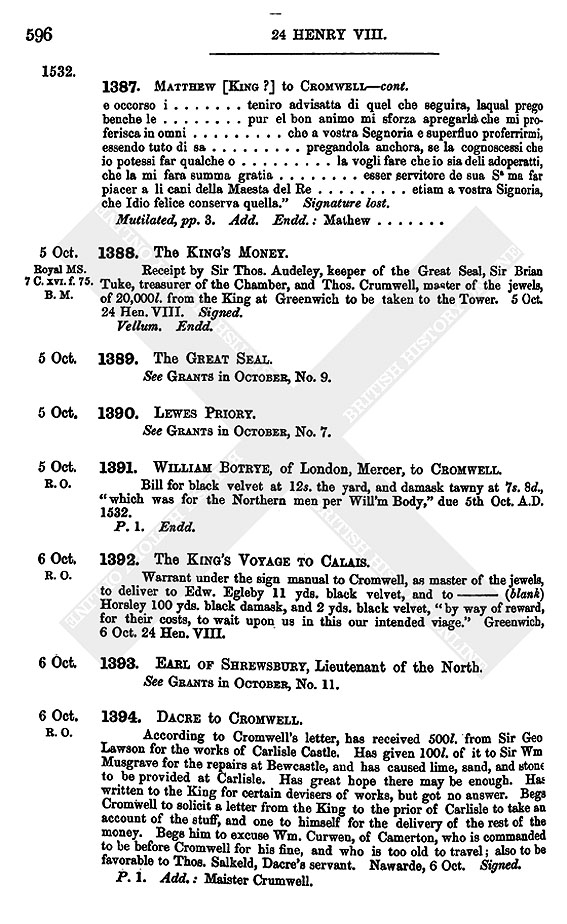
1387. Matthew [King?] (fn. 2) to Cromwell. (fn. 3) "Jesus Maria, 1532, a di 5 Oct. In V[enezia]. "Segnor mio, Messer Cromuello, mi riservava a scriver a vostra Segnoria, et ... cosa degna di venir ad le orechie, che non essendo di poi la parte ... [deside]rato il longo tempo, che sonno absente da vostra Segnoria, et che Cicer[o] ... materia a intratenire li amici, usava se non altro, si vales bene [est, ego valeo]; e per non li venir in oblivione non voglio transcorrer de non li fa ... quatro versi in memoria di la servitu mia verso di quella, et p ... Maiesta del mio Serenissimo Re, per moiam di quella, alla quale ma ... il mio itinerare, che di nuovo cum la mia persona me inchinero ... minimo servitore, che me pareria poter esse appellatto ingratto a non ... di quella, Ateso le amorevole dimostratione di sua serma Maiesta, u ... "Et vi diro il vero, Signor mio Cromuello, mi riservava anchora a scriver ... continua expectatione ogni hora di dover la rengratiare de haver o ... derai da sua Maiesta, et che vostra Segnoria per sua humanita tolse in ... la quale non tanto per il beneficio che mi resultassi, quanto per esser ... apresso sua serenita magior gratia, che li altri mercanti, et prorogativa ... sonno disposto a sforzarmi di superar li altri mercanti, che usa ... ficto di quello. Benche quomodocunque, io non manchero mai dil ... cum ogni possibel mezo gratificarmi cum sua altezza. Et sempre esser ... sa et ubligatissimo, et tanto maiormente, quanto per sue mani ... non dubito di non impetrar, prima per la permission sua, la quale a g ... et ame non credo habi a venir a mancho, che pur non sonno delli ing ... Segnoria. Poi per esser comune beneficio di la Maesta Regia, che senza che ... la puol veder in un anno quante nave di Malvasie de Marcadanti streng ... a li lidi vestri, che non trovera ale sue costume pur una sola botte ... et pur io ricercho questo avantazo per adoperarlo, el non haver la gratia i ... frequentar continuamente el mandar in quetti porti vestri delle nave, et qu ... delle potissime cause che fabricho, una bellissima caracha per mandar in ... le altre mie nave, le quale oltra la intratta sonno in beneficio delle cos[tume] ... sempre al servitio di la Maesta del Re, e vestra Signoria la qu ... occupata, sapendo certo quella m ... or suo. ... molte parte debbe esser advisatta de li exerciti de Ongaria, et armata de ... che non voria, che sua altezza per el studio delli Cesarei in ampliar Je cosse sue ... le forze di Csare le quale non sonno cusi grande di un gran longo, como sua ... che si crede, et comette ali oratori che scrivanno, et si sforza de diminuir le ... le quale sonno grandissime, et ben Csare si puol gloriare, de una ... a Julio Csare, che una tanta prosperitta non estatta piu al mondo, che in un ... ssime secure, e, in stagione, che el non piove goza de acqua, sia statto tante ... l exercito Turchescho, non solamente hanno possutto marchiar inanzi, ma ... nutti tirar in alto, et perder un grandissimo tempo proprio cossi datto ... eniva in tempo che ritrovava tuto sproveduto, et in quel stante, chel exercito ... impeditti da le grande acque, fu monitto Vienna, et il resto del paese, che ... usione di modo, chel signor Turcho non li ha parso occasione di expugnar ... do un suo eraldo amodo nostro, adessidar sua Cesarea Maesta de venir ... conflitto, et li fece intendere che lui ittinerava verso Pitovia, dove e ... gne, et che se sua Maesta voleva deputar la giornatta lui non arderis ... ria alcun luogo, ma che, chi vinceva fusse signor del mondo; ma a Csar ... preposito el partito, ne ha volutto mostrarsi in campagnia de mille miglia ... barchatto sul Denubio per venir a Vienna. Et sappi vestra Signoria chel Signor ... expugnato alcun luogo, como si semina, ma molti castelli, si sonno detti a lui, ... acostato, et lui li ha lassatti, ade chi isonno. Immo li ha cressuto le jurisdictione ... si puol veder, et per qualche relatione el ditto exercitto, e, per ritornar in ... so Belgrado, como desidera tuti Christianni, et ultimamente, la Sta del nostro [Signor] ha propalatto la captura di Modon et Chorum, per che vaddi a le orechie del Signor ... t che l'habbi causa di ritornarsi piui infretta, et tamen non e cossa alcuna ... et mancho di Modone, ma li sateliti Csarei si servenno de questi ... la comune opinione, e che ogni modo questi Turchi non habbinno ... Ongaria, ma ben si dubita che atempo nuovo habbinno a ritor ... ti come fanno li altri Principi, maxime questo tratto la Maiesta Csarea che a spesso tesori, ... teressi. Il mancho che sia diexe per cento a[l] mese cum boni aseg ... danari, si che vestra Segnoria intende succinte quel che e occorso i ... teniro advisatta di quel che seguira, laqual prego benche le ... pur el bon animo mi sforza apregarla che mi proferisca in omni ... che a vostra Segnoria e superfluo proferrirmi, essendo tuto di sa ... pregandola anchora, se la cognoscessi che io potessi far qualche o ... la vogli fare che io sia deli adoperatti, che la mi fara summa gratia ... esser servitore de sua Sa ma far piacer a li cani della Maesta del Re ... etiam a vostra Signoria, che Idio felice conserva quella." Signature lost. Mutilated, pp. 3. Add. Endd. : Mathew ... |
|
5 Oct. Royal MS. 7 C. XVI. f. 75. B. M. |
1388. The King's Money. Receipt by Sir Thos. Audeley, keeper of the Great Seal, Sir Brian Tuke, treasurer of the Chamber, and Thos. Crumwell, master of the jewels, of 20,000l. from the King at Greenwich to be taken to the Tower. 5 Oct. 24 Hen. VIII. Signed. Vellum. Endd. |
| 5 Oct. |
1389. The Great Seal. See Grants in October, No. 9. |
| 5 Oct. |
1390. Lewes Priory. See Grants in October, No. 7. |
|
5 Oct. R. O. |
1391. William Botrye, of London, Mercer, to Cromwell. Bill for black velvet at 12s. the yard, and damask tawny at 7s. 8d., "which was for the Northern men per Will'm Body," due 5th Oct. A.D. 1532. P. 1. Endd. |
|
6 Oct. R. O. |
1392. The King's Voyage to Calais. Warrant under the sign manual to Cromwell, as master of the jewels, to deliver to Edw. Egleby 11 yds. black velvet, and to (blank) Horsley 100 yds. black damask, and 2 yds. black velvet, "by way of reward, for their costs, to wait upon us in this our intended viage." Greenwich, 6 Oct. 24 Hen. VIII. |
| 6 Oct. |
1393. Earl Of Shrewsbury, Lieutenant of the North. See Grants in October, No. 11. |
|
6 Oct. R. O. |
1394. Dacre to Cromwell. According to Cromwell's letter, has received 500l. from Sir Geo Lawson for the works of Carlisle Castle. Has given 100l. of it to Sir Wm Musgrave for the repairs at Bewcastle, and has caused lime, sand, and stone to be provided at Carlisle. Has great hope there may be enough. Has written to the King for certain devisers of works, but got no answer. Begs Cromwell to solicit a letter from the King to the prior of Carlisle to take an account of the stuff, and one to himself for the delivery of the rest of the money. Begs him to excuse Wm. Curwen, of Camerton, who is commanded to be before Cromwell for his fine, and who is too old to travel; also to be favorable to Thos. Salkeld, Dacre's servant. Nawarde, 6 Oct. Signed. P. 1. Add. : Maister Crumwell. |
|
6 Oct. R. O. |
1395. Sir Edw. Guldefford to Cromwell. I beg you to remember my bill, signed before the King's going to Calais, and the warrants for the paling of the parks and repair of the lodge, else I shall be unable to keep the King's deer in the park or keep up the lodge, and 100 marks will not make another such lodge. And I will deserve your favor. Halden, 6 Oct. Signed. P. 1. Add. : Right worshipful. |
|
6 Oct. R. O. |
1396. Hugh Mallet. Copy of a writ addressed to the sheriff of Somerset, for the arrest of Hugh Mallet, returnable in the King's Bench. Westm., 6 Oct. 24 Hen. VIII. ii. Draft testimonial by inhabitants of the borough of Bridgewater relative to something done by Rob. Botteler, Mr. Hugh Mallet's servant, at Bridgewater at St. Matthew's tide last past. P. 1. |
|
6 Oct. Simancas MS. |
1397. Mai to Charles V. Extract from a letter dated Rome, 6 Oct. 1532.It is said here that the interview between the kings of England and France is prorogued till 25 Oct., and many think it will be postponed longer to see how Turkish matters succeed. It is certain that the Kings are meeting upon this account, and have more fear of the Emperor's victory than of the Turk's. Nothing more is said about the marriage of the king of England with the daughter of the king of France, but they say she will marry the Scotch king, and the Dauphin the princess of Wales. Has written to the card, of Ravenna, who is not here, and then Ancona will write about the Scotch marriage, as the Emperor has ordered. Sp., p. 1. Modern copy. |
|
7 Oct. R. O. |
1398. Christopher Hales to Cromwell. I thank you for your help to my brother Caunton in the deliverance of my letters to my lady marchioness of Pembroke. As I intend to wait upon the King at his coming to Canterbury, I send you only three geldings. My lord prior of Christchurch sends you three more. He is glad at your coming, in consequence of your gentle treatment of the sub-prior. My wife is crept into the straw. Two of my servants are sick,Petyte, whom you know, and Tayllour that came late to me. As you must have daily access to the King, you shall lodge in a friend's house, where no one shall disturb you, or else at Christchurch. Canterbury, Monday, 7 Oct. Hol., p. 1. Add. : Councillor and Master of the Jewels. |
|
7 Oct. Royal MS. 7 C. XVI. 50. B. M. |
1399. Jewellery. Receipt by Henry Norrys, from the King, of a gold casket set with 8 diamonds of various kinds and 16 pearls. 7 Oct. 24 Hen. VIII. Signed. Endd. |
| Cott. App. XXVIII. 36. B. M. |
2. Memoranda of the delivery of jewels to the King by Cromwell, 7 Oct.
24 Hen. VIII.; viz., an owche of gold ruby buttons, balasses, and
diamonds. P. 1. Signed by Cromwell. |
| 8 Oct. |
1400. Mochelney Abbey. See Grants in October, No. 16. |
|
8 Oct. Add. MS. 28,585, f. 132. B. M. |
1401. Mai to the Comendador Mayor. The knight Casal has gone to the interview of the kings of England and France; but, as he is much favored by the Pope, I fear he has no particular commission, especially as the Pope favors the brother of count Guido, with whom Casale has a lawsuit. He complained to the Pope about it, and has obtained a supersedeas (sobreseymiento). The ambassadors with the two Kings might be written to; but they say the Ambassadors will not go to the place where the interview will be held. In the English cause the King has all this month to appear. It was given to him by fraud, as the Consistory was only for September, and they have inserted October in the decree. (Y hasele dado con cauthela que el consistorio no fue sino por Septiembre, &c.) Rome, 8 Oct. Sp., pp. 5. Modern copy. |
|
8 Oct. R. O. |
1402. Sir Ralph Eure and two others to Cromwell. John Berton and Anthony Awmonde have received a commission to take the issue of the King's woods at Sheryf Howton, and its members, to which a return was required at Mich. last. Have taken the issue of Sheryf Howton, but not of all the members yet, they are so far apart. Request a new commission for a longer time. Malton, 8 Oct. Signed : Rawf Eure John BartonAntony Hawmond. P. 1. Add. : To the right honorable Mr. Cromwell, one of the King's honorable Council. |
|
9 Oct. R. O. |
1403. Duke Of Suffolk to Cromwell. Asks him to favor Gawyn Carew at the next election of sheriffs for Devonshire. Kawe, 9 Oct. Signed. P. 1. Add. : To my kind and loving friend Master Cromwell. |
|
9 Oct. Camusat, 205. |
1404. Bishop Of Auxerre to Albany. Has received his letters of 11th ult. There is great anxiety to hear from Andrew Doria's fleet, which has gone to fight the Turkish fleet, if he finds it. Hears that the Emperor has ordered him to return to Genoa, and leave the poor Turk till another time. The Spaniards continue to spread evidently false reports of the flight of the Turk. They began to print them, but were laughed at, and told to print also how the Emperor's sea army of 14 or 15,000 men, which went to succour Poussonio and Strigonia, was defeated, and a band of Italians under the marquis of Algoast cut to pieces. Hears that Hieronymo de Leva has been beheaded for accusing the Marquis of having only 5,000 Spaniards in his company. The Pope is determined to take the abbot of Farfa by force, and has sent horse, foot, and artillery against Vicovara, where he keeps Hieronimo, his brother, prisoner. Fra Nicolo has passed here on his way to Capua, displeased with the Pope, and the Pope with him. He has not much hope of being a cardinal. John Antonio Mussetola is still dangerously ill. Both say the Pope laughs at them; but the Bishop does not believe this. Fr. Headed : A Mons. d'Albanie, du 9 Oct. 1532. |
|
9 Oct. Add. M.S. 28,585, f. 135. B. M. |
1405. Card. Of Siguenza to Cobos. The Pope considers the interview of the kings of England and France as certain, and fears it will be to his prejudice (contra el). Hopes the usual effect will follow, that the princes will be more at variance (diferentes) after the interview than before. His Holiness relies upon the Emperor's power. Rome, 9 Oct. Sp., pp. 2. Modern copy. |
|
[9 Oct.] R. O. |
1406. Sir Francis Bryan to Cromwell. The King has given the French queen's skinner a protection for one year, which he sends with this. Desires Cromwell, if his debt pass not 40 marks, to aid him to the said grant; otherwise the King's pleasure is that he shall retain it till he speak with him. My lord of Norfolk is well amended, and I trust a week's rest at Eltham shall set him afoot. From Stone (fn. 4) this morning at 9 o'clock. Signed. P. 1. Add. : Master of the Jewel-house and of the Privy Council. |
|
10 Oct. R. O. |
1407. Nicholas Longmed to Cromwell. I have sent you divers letters, and was bold enough to write unto you to receive 8l. stg., ordering my wife to pay it to Sir Henry Fermor, and to receive my bill of 8l., which I had by exchange of Will. Hawker, servant of Fermor's. Please to pay the money to Fermor, and receive a bill of 32 ducats, dated the Groyne, 10 Oct., where the said Hawker was imprisoned 25 days, and very ill treated, only for warning the crew of Will. Sprat's ship, merchant of Bristol. Sprat was imprisoned for buying a ship of certain Biscayans at Bristol, in execution of a statute made by Ferdinand king of Spain, and confirmed by the present Emperor. Enters into further details of the affair.But for this I would have been in England and in Flanders, intending to lade for London. For Mr. Carey's matter, which is an old one of 96l. and now in Lussheburne (Lisbon), I must beg your favor. Describes his further trouble. I hope you will cause the King and my lord of Norfolk to be good unto me. I am yet able to serve 20 years. Groyne, in Galicia, 10 Oct. (fn. 5) P.S. by William Spratt, asking for Cromwell's favor in this matter. Hol., pp. 3. Add. : Right worshipful. |