Letters and Papers, Foreign and Domestic, Henry VIII, Volume 5, 1531-1532. Originally published by Her Majesty's Stationery Office, London, 1880.
This free content was digitised by double rekeying. All rights reserved.
'Henry VIII: October 1532, 25-31', in Letters and Papers, Foreign and Domestic, Henry VIII, Volume 5, 1531-1532, ed. James Gairdner (London, 1880), British History Online https://www.british-history.ac.uk/letters-papers-hen8/vol5/pp619-636 [accessed 1 May 2025].
'Henry VIII: October 1532, 25-31', in Letters and Papers, Foreign and Domestic, Henry VIII, Volume 5, 1531-1532. Edited by James Gairdner (London, 1880), British History Online, accessed May 1, 2025, https://www.british-history.ac.uk/letters-papers-hen8/vol5/pp619-636.
"Henry VIII: October 1532, 25-31". Letters and Papers, Foreign and Domestic, Henry VIII, Volume 5, 1531-1532. Ed. James Gairdner (London, 1880), British History Online. Web. 1 May 2025. https://www.british-history.ac.uk/letters-papers-hen8/vol5/pp619-636.







October 1532, 26-31
|
26 Oct. R. O. |
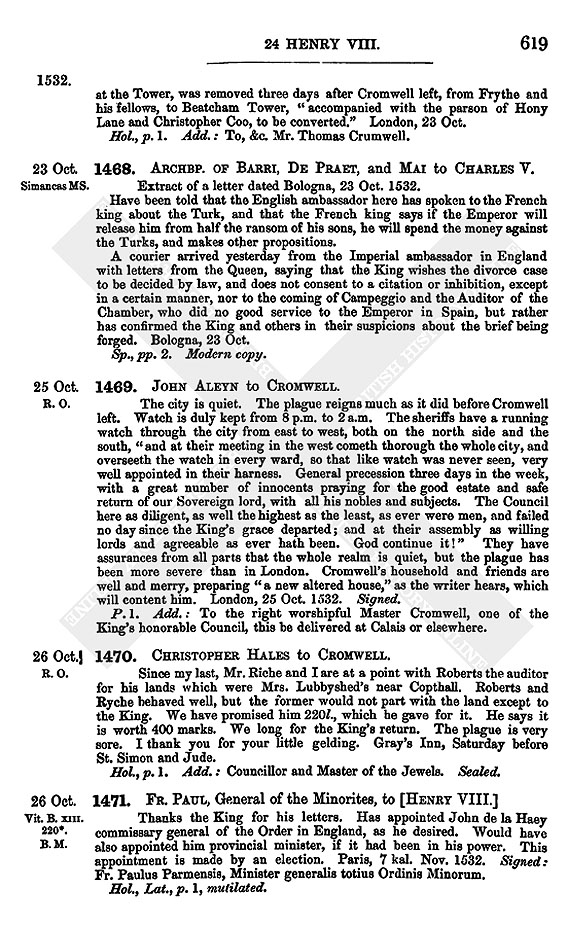
1470. Christopher Hales to Cromwell. Since my last, Mr. Riche and I are at a point with Roberts the auditor for his lands which were Mrs. Lubbyshed's near Copthall. Roberts and Ryche behaved well, but the former would not part with the land except to the King. We have promised him 220l., which he gave for it. He says it is worth 400 marks. We long for the King's return. The plague is very sore. I thank you for your little gelding. Gray's Inn, Saturday before St. Simon and Jude. Hol., p. 1. Add. : Councillor and Master of the Jewels. Sealed. |
|---|---|
|
26 Oct. Vit. B. XIII. 220*. B. M. |
1471. Fr. Paul, General of the Minorites, to [Henry VIII.] Thanks the King for his letters. Has appointed John de la Haey commissary general of the Order in England, as he desired. Would have also appointed him provincial minister, if it had been in his power. This appointment is made by an election. Paris, 7 kal. Nov. 1532. Signed : Fr. Paulus Parmensis, Minister generalis totius Ordinis Minorum. Hol., Lat., p. 1, mutilated. |
|
[Oct.] R. O. |
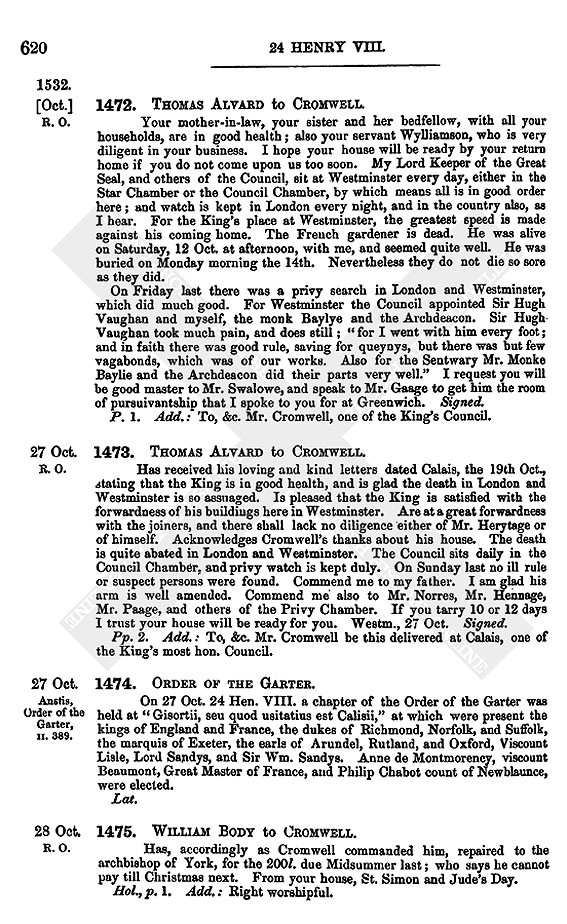
1472. Thomas Alvard to Cromwell. Your mother-in-law, your sister and her bedfellow, with all your households, are in good health; also your servant Wylliamson, who is very diligent in your business. I hope your house will be ready by your return home if you do not come upon us too soon. My Lord Keeper of the Great Seal, and others of the Council, sit at Westminster every day, either in the Star Chamber or the Council Chamber, by which means all is in good order here; and watch is kept in London every night, and in the country also, as I hear. For the King's place at Westminster, the greatest speed is made against his coming home. The French gardener is dead. He was alive on Saturday, 12 Oct. at afternoon, with me, and seemed quite well. He was buried on Monday morning the 14th. Nevertheless they do not die so sore as they did. On Friday last there was a privy search in London and Westminster, which did much good. For Westminster the Council appointed Sir Hugh Vaughan and myself, the monk Baylye and the Archdeacon. Sir Hugh Vaughan took much pain, and does still; "for I went with him every foot; and in faith there was good rule, saving for queynys, but there was but few vagabonds, which was of our works. Also for the Sentwary Mr. Monke Baylie and the Archdeacon did their parts very well." I request you will be good master to Mr. Swalowe, and speak to Mr. Gaage to get him the room of pursuivantship that I spoke to you for at Greenwich. Signed. P. 1. Add. : To, &c. Mr. Cromwell, one of the King's Council. |
|
27 Oct. R. O. |
1473. Thomas Alvard to Cromwell. Has received his loving and kind letters dated Calais, the 19th Oct., stating that the King is in good health, and is glad the death in London and Westminster is so assuaged. Is pleased that the King is satisfied with the forwardness of his buildings here in Westminster. Are at a great forwardness with the joiners, and there shall lack no diligence either of Mr. Herytage or of himself. Acknowledges Cromwell's thanks about his house. The death is quite abated in London and Westminster. The Council sits daily in the Council Chamber, and privy watch is kept duly. On Sunday last no ill rule or suspect persons were found. Commend me to my father. I am glad his arm is well amended. Commend me also to Mr. Norres, Mr. Hennage, Mr. Paage, and others of the Privy Chamber. If you tarry 10 or 12 days I trust your house will be ready for you. Westm., 27 Oct. Signed. Pp. 2. Add. : To, &c. Mr. Cromwell be this delivered at Calais, one of the King's most hon. Council. |
|
27 Oct. Anstis, Order of the Garter, II. 389. |
1474. Order Of The Garter. On 27 Oct. 24 Hen. VIII. a chapter of the Order of the Garter was held at "Gisortii, seu quod usitatius est Calisii," at which were present the kings of England and France, the dukes of Richmond, Norfolk, and Suffolk, the marquis of Exeter, the earls of Arundel, Rutland, and Oxford, Viscount Lisle, Lord Sandys, and Sir Wm. Sandys. Anne de Montmorency, viscount Beaumont, Great Master of France, and Philip Chabot count of Newblaunce, were elected. Lat. |
|
28 Oct. R. O. |
1475. William Body to Cromwell. Has, accordingly as Cromwell commanded him, repaired to the archbishop of York, for the 200l. due Midsummer last; who says he cannot pay till Christmas next. From your house, St. Simon and Jude's Day. Hol., p. 1. Add. : Right worshipful. |
|
28 Oct. R. O. |
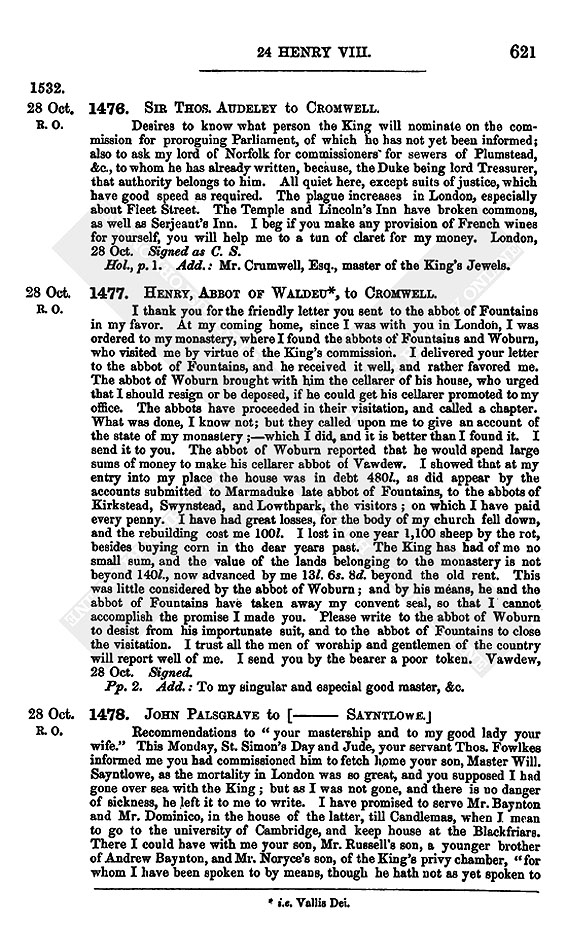
1476. Sir Thos. Audeley to Cromwell. Desires to know what person the King will nominate on the commission for proroguing Parliament, of which he has not yet been informed; also to ask my lord of Norfolk for commissioners for sewers of Plumstead, &c., to whom he has already written, because, the Duke being lord Treasurer, that authority belongs to him. All quiet here, except suits of justice, which have good speed as required. The plague increases in London, especially about Fleet Street. The Temple and Lincoln's Inn have broken commons, as well as Serjeant's Inn. I beg if you make any provision of French wines for yourself, you will help me to a tun of claret for my money. London, 28 Oct. Signed as C. S. Hol., p. 1. Add. : Mr. Crumwell, Esq., master of the King's Jewels. |
|
28 Oct. R. O. |
1477. Henry, Abbot Of Waldeu (fn. 1), to Cromwell. I thank you for the friendly letter you sent to the abbot of Fountains in my favor. At my coming home, since I was with you in London, I was ordered to my monastery, where I found the abbots of Fountains and Woburn, who visited me by virtue of the King's commission. I delivered your letter to the abbot of Fountains, and he received it well, and rather favored me. The abbot of Woburn brought with him the cellarer of his house, who urged that I should resign or be deposed, if he could get his cellarer promoted to my office. The abbots have proceeded in their visitation, and called a chapter. What was done, I know not; but they called upon me to give an account of the state of my monastery;which I did, and it is better than I found it. I send it to you. The abbot of Woburn reported that he would spend large sums of money to make his cellarer abbot of Vawdew. I showed that at my entry into my place the house was in debt 480l., as did appear by the accounts submitted to Marmaduke late abbot of Fountains, to the abbots of Kirkstead, Swynstead, and Lowthpark, the visitors; on which I have paid every penny. I have had great losses, for the body of my church fell down, and the rebuilding cost me 100l. I lost in one year 1,100 sheep by the rot, besides buying corn in the dear years past. The King has had of me no small sum, and the value of the lands belonging to the monastery is not beyond 140l., now advanced by me 13l. 6s. 8d. beyond the old rent. This was little considered by the abbot of Woburn; and by his means, he and the abbot of Fountains have taken away my convent seal, so that I cannot accomplish the promise I made you. Please write to the abbot of Woburn to desist from his importunate suit, and to the abbot of Fountains to close the visitation. I trust all the men of worship and gentlemen of the country will report well of me. I send you by the bearer a poor token. Vawdew, 28 Oct. Signed. Pp. 2. Add. : To my singular and especial good master, &c. |
|
28 Oct. R. O. |
1478. John Palsgrave to [ Sayntlowe.] Recommendations to "your mastership and to my good lady your wife." This Monday, St. Simon's Day and Jude, your servant Thos. Fowlkes informed me you had commissioned him to fetch home your son, Master Will. Sayntlowe, as the mortality in London was so great, and you supposed I had gone over sea with the King; but as I was not gone, and there is no danger of sickness, he left it to me to write. I have promised to serve Mr. Baynton and Mr. Dominico, in the house of the latter, till Candlemas, when I mean to go to the university of Cambridge, and keep house at the Blackfriars. There I could have with me your son, Mr. Russell's son, a younger brother of Andrew Baynton, and Mr. Noryce's son, of the King's privy chamber, "for whom I have been spoken to by means, though he hath not as yet spoken to me himself." I am induced to go to the university, for three reasons : 1, I an already B.D., and hope to be D.D. 2, I could get a man to help me in teaching, as this constant attendance hurts my health. And I go to Cambridge rather than Oxford, because I have a benefice 16 miles off. Your son, Will. Sayntlow, is the best sped child of his age and time with me. If you withdraw him, either "for any tenderness that my lady, his mother, may have towards him," or for any doubt of my "honest dealing" with "such an inheritor as he is, on my faith I promise you that you have killed a schoolmaster, for I will never teach more after Candlemas Day." I hope my lady, your wife (whose displeasure I hazard before I know her), will excuse me, as your servant brought no letter, and Mr. Kingston, who gave me charge with your son, is beyond sea. Do not believe the reports made to you and her. The example of Mr. Russell's son shows what it is to let children go see their mothers. "The child shall not recover this three years what he hath lost in one." Thanks him for a present of flesh. Hol., pp. 3. |
|
28 Oct. Poli Epp. I. 397. |
1479. Pole to Sadolet. Thanks him for his great hospitality shown to Pole when he was most desirous of meeting with him. Recalls with delight, after the lapse of months, the pleasure of his conversation, and how Sadolet freed his mind from perplexity in very great matters. Even the pain of parting was alleviated, as he had Sadolet for a companion still in the book he gave him to present to Bembo. Describes how it delighted him on the journey into Italy. But Sadolet must not think his task accomplished in bringing Pole to the mere threshold of philosophy, or even in giving him the whole of philosophy. He must lead him to that sacred harbour in which he himself lives with tranquillity of mind. Has written at considerable length, partly in compliance with Sadolet's own request, to know what he thought of the book, partly to urge him not to pass over in silence the study of theology as he has so worthily discoursed on every other art. Is sure it will greatly gratify "Langes nostro," for the instruction of whose children the work was mainly undertaken, if he devote some attention to this greatest of studies, in which all others merge like rivers in the ocean. Comes now to Sadolet's injunctions, with regard to which little has been left him to say, by the letters of those to whom Sadolet gave him messages. Sends letters from Bembo. It is easier to conceive than to describe his satisfaction with Sadolet's book. Delivered, at Verona, Sadolet's letters to the bp. of Verona, who detained him with him one day, talking about scarcely anything else than Sadolet and his studies. Met with your friend Lazarus at Padua, and gave him also your letters. Venice, v. Calend. Nov. 1532. Lat. |
|
28 Oct. R. O. |
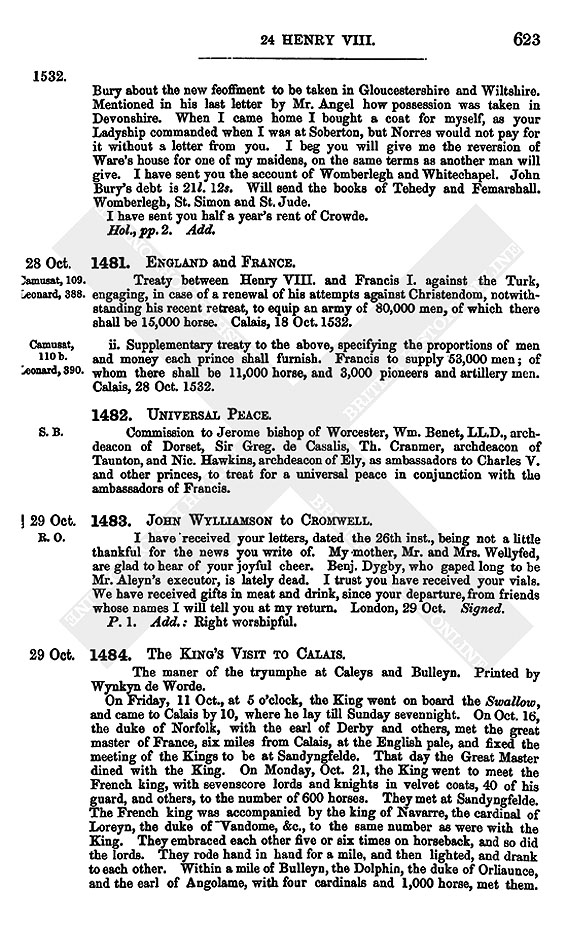
1480. John Davy to Lady Lisle. I did all I could for young Bury, of Colaton, but Mr. Pollerd has him by means of his brother, Ric. Pollerd. He holds of your Ladyship in Bekington. I find no precedent to charge him by knight's service. I think letters of homage are at Heaumpton. I have arranged and put in boxes the documents about your jointures, according to your commandments sent by Mrs. Jane. One Gardener, tenant at Whitechapel, died on Thursday last; and another tenant, Roger, two or three days before him; by which you gained two oxen for heriots, which the widows have bought of me for 32s. Desires instructions what to do with the money. Mentions a presentment of the Court about the goods of the felon Ric. Edward. Will fulfill her Ladyship's command given when he was last at Soberton. Has shown his mind to John Bury about the new feoffment to be taken in Gloucestershire and Wiltshire. Mentioned in his last letter by Mr. Angel how possession was taken in Devonshire. When I came home I bought a coat for myself, as your Ladyship commanded when I was at Soberton, but Norres would not pay for it without a letter from you. I beg you will give me the reversion of Ware's house for one of my maidens, on the same terms as another man will give. I have sent you the account of Womberlegh and Whitechapel. John Bury's debt is 21l. 12s. Will send the books of Tehedy and Femarshall. Womberlegh, St. Simon and St. Jude. I have sent you half a year's rent of Crowde. Hol., pp. 2. Add. |
|
28 Oct. Camusat, 109. Leonard, 388. |
1481. England and France. Treaty between Henry VIII. and Francis I. against the Turk, engaging, in case of a renewal of his attempts against Christendom, notwithstanding his recent retreat, to equip an army of 80,000 men, of which there shall be 15,000 horse. Calais, 18 Oct. 1532. |
| Camusat, 110 b. Leonard, 390. | ii. Supplementary treaty to the above, specifying the proportions of men and money each prince shall furnish. Francis to supply 53,000 men; of whom there shall be 11,000 horse, and 3,000 pioneers and artillery men. Calais, 28 Oct. 1532. |
|
S. B. |
1482. Universal Peace. Commission to Jerome bishop of Worcester, Wm. Benet, LL.D., archdeacon of Dorset, Sir Greg. de Casalis, Th. Cranmer, archdeacon of Taunton, and Nic. Hawkins, archdeacon of Ely, as ambassadors to Charles V. and other princes, to treat for a universal peace in conjunction with the ambassadors of Francis. |
|
29 Oct. R. O. |
1483. John Wylliamson to Cromwell. I have received your letters, dated the 26th inst., being not a little thankful for the news you write of. My mother, Mr. and Mrs. Wellyfed, are glad to hear of your joyful cheer. Benj. Dygby, who gaped long to be Mr. Aleyn's executor, is lately dead. I trust you have received your vials. We have received gifts in meat and drink, since your departure, from friends whose names I will tell you at my return. London, 29 Oct. Signed. P. 1. Add. : Right worshipful. |
| 29 Oct. |
1484. The King's Visit to Calais. The maner of the tryumphe at Caleys and Bulleyn. Printed by Wynkyn de Worde. On Friday, 11 Oct., at 5 o'clock, the King went on board the Swallow, and came to Calais by 10, where he lay till Sunday sevennight. On Oct. 16, the duke of Norfolk, with the earl of Derby and others, met the great master of France, six miles from Calais, at the English pale, and fixed the meeting of the Kings to be at Sandyngfelde. That day the Great Master dined with the King. On Monday, Oct. 21, the King went to meet the French king, with sevenscore lords and knights in velvet coats, 40 of his guard, and others, to the number of 600 horses. They met at Sandyngfelde. The French king was accompanied by the king of Navarre, the cardinal of Loreyn, the duke of Vandome, &c., to the same number as were with the King. They embraced each other five or six times on horseback, and so did the lords. They rode hand in hand for a mile, and then lighted, and drank to each other. Within a mile of Bulleyn, the Dolphin, the duke of Orliaunce, and the earl of Angolame, with four cardinals and 1,000 horse, met them. Before they entered, guns were shot, which were heard 20 miles off; and in the town, the garrison, Swiss guard, Scots, and Frenchmen of the guard, with 200 gentlemen in gowns, were drawn up to receive them. The King and lords were sumptuously entertained there until Thursday; and provisions and wines for the servants, and horsemeat, were provided by the French. There were no ladies or gentlewomen there. On Friday the Kings came to Calais, the Dolphin, &c. accompanying them to where he met them before. The French king had 300 mules laden with stuff. They were saluted by 3,000 shot at Newnam Bridge, the Blockhouse, Rycebanke, and the town; while at Boulogne there were not more than 200, but they were great pieces. Within the town were set on one side serving men in tawny coats; and on the other, soldiers in red and blue, with halberds. The French king went to Staple Hall. On Saturday both Kings went to Our Lady's church to mass, and in the afternoon they sate with their Councils. On Sunday the Kings heard mass in their lodgings, and in the afternoon the King went to the French king at Staple Hall, where was bear and bull baiting till night. The French king supped with the king of England; and after supper the lady marques of Pembroke, lady Mary, lady Darby, lady Fitzwater, lady Rocheford, lady Lisley, and lady Wallop, came in masked, and danced with the French king and lords. The King then took off their visors, and they danced with French gentlemen for an hour. The French king's doublet was set all over with stones and diamonds, valued at 100,000l., and his company far surpassed the English in apparel. On the day the Kings came from Bulleyn, the French king made the dukes of Norfolk and Suffolk knights of the Order of St. Michael, and on Monday the 29th the King made the Great Master and Admiral knights of the Garter. On that day there was great wrestling between the English and French. The latter were all priests, and big men and strong, but they had most falls. On the 29th, the French king left for Paris, the King accompanying him to Morgyson, seven miles. He intends to be at Canterbury on 8 Nov., and so home. Pp. 5, 4o. |
|
29 Oct. Camusat, 106. |
1485. to . On Saturday last, 19 Oct., the king [of France] arrived in this town of Boulogne, and the Monday after went to Marquise, which he left about 10 a.m. to meet the king of England, accompanied by Messrs. de Vendosme, de Guise, and St. Pol, the Great Master, and the Admiral, with a band of 200 gentlemen, and other great lords. When the two Kings saw each other they rode out from their troops and embraced each other, and afterwards each King embraced the lords of the other party. The French king insisted on the king of England taking the right-hand side, (fn. 2) and in this order they rode for two leagues towards Boulogne, stopping to drink wine at a little thicket over a fountain on the French frontier. At 1 p.m. the French princes left Boulogne, with the Legate, cardinals, and prelates of France, and met the two Kings at a league from the town. After mutual embraces they returned to the town, where they were saluted by more than 1,000 guns. On dismounting, the King led the king of England to his chamber, and each supped alone. Afterwards they met in the hall, and retired to a closet for some time. Both Kings are lodged in the Abbey; the refectory, used as a hall, being carpeted and hung with tapestry representing the victories of Scipio Africanus, at 50 cr. an ell. At one end is a buffet of six steps, laden with gold and silver gilt plate, and great gold cups set with precious stones. Below is a canopy of crimson satin, sem with lions and other beasts, in pearls. Over the table is another canopy, with a figure of Charity in gold thread. On Tuesday the Kings supped there. The king of England was served by his people bareheaded and on their knees, and the French king in the usual way. The former wore clothes which the French king had sent him similar to his own, being a crimson satin doublet set with pearls, and a robe of white velvet embroidered with gold thread and "crespines" of gold. In these clothes he came to mass, with all his men between the ages of 30 and 60. There were with him "le comte de Richemonte," and the dukes of Suffolk and Norfolk. Two oratories for the Kings were fitted up near the high altar of the church of Our Lady. The king of England went into that on the right, and heard a low mass, and then as he was waiting for the King another was begun. Francis came in at the beginning of the Gospel, accompanied by princes, cardinals, and noblemen. The king of England came out of his oratory and embraced him, and then returned with the cardinal of Lorraine to his oratory, to hear the end of the mass, and the French king went to his oratory to hear his mass, while the singers sang "motez." After mass the Kings returned to the Abbey and dined separately, while music was made by trumpets, hautboys, cornets, and singers. The King's maistres d'hotel wore velvet robes and great gold chains, worth 1,000 or 1,200 cr. On Wednesday each King invited the lords of the other to dinner. That day the king of England wore a doublet covered with diamonds and rubies, valued at 100,000 cr. There dined with him the Legate, the cardinals of Tournon and Grammont, Loys de Nevers, Marshal de Florenges, Barbezieux, and Humyeres. After dinner he played tennis with the French princes, as he did on Tuesday. The two Kings could not have shown more friendliness to each other. On the morrow they went to Calais, the King having only 600 horses in his train. On Tuesday he will return, and thence go to Paris. This morning the King presented to the king of England six "pieces de chevaux." The Princes were present at his levee. He is a handsome and gracious prince. On Thursday the king of England gave the princes 300,000 cr., which the King still owed him for his ransom. The same day the Order of France was given to the dukes of Norfolk and Suffolk. Since writing the above, on Friday last after dinner the Kings left the town to go to Calais. The king of England wore a riding gown of cloth of gold, with slashes fastened with diamonds and rubies. The Princes and the Legate and Cardinals accompanied them for a league. At Calais the King was lodged in a house of merchants, square, with a courtyard in the middle. The king of England was lodged some distance off, and with him "Madame la marquise de Boulan," with 10 or 12 ladies. The King sent to her by the provost of Paris, as a present, a diamond worth 15,000 or 16,000 cr. Yesterday, Sunday, the King wore a doublet embroidered with diamonds, worth more than 100,000 cr. The king of England wore a robe of violet cloth of gold, with a collar of 14 rubies, of which the least was as large as an egg, and 14 diamonds not so big. Between these stones there were two rows of great pearls, and hanging from them a carbuncle as big as a goose's egg. This collar was valued at more that 400,000 cr. In the afternoon there was bull and bear baiting in the courtyard of the King's house. The King will stay till tomorrow, return here to sleep, and hold the feast at Estapes. Tomorrow the king of England will give the Order of the Garter to the Grand Master and Admiral. The King paid the expences of the English at Boulogne, and the king of England did the like for the French at Calais, though there were many more of them than there were English. The king of England presented his bastard son, the earl of Richmond, to the King yesterday, and today presented him with six horses. The Kings parted on Tuesday last, 29 Oct. Fr. |
|
29 Oct. Harl. MS. 6,989, No. 30. B. M. St. P. I. 387. |
1486. Chief Justice Fitz James to Cromwell. Thanks him for his news of the King's passage to Calais, his visitation by the French nobles, the meeting of the two Princes, and the French children. All is quiet here. The Scots have attacked and burnt a town of the earl of Northumberland. He has burnt one of theirs, as appears by his letter to the King. The plague increases. Several persons have died of it, as Benjamin Dikby, Jas. Clarell, and Bayley, an alderman of London. London, 29 Oct. Wishes him to judge "between Gervisse and my son Barkeley." Hol., Add. : Mr. Tho. Cromwell, one of the King's most honorable Council. |
|
30 Oct. R. O. |
1487. John Whalley to Cromwell. Wrote five days ago by Nich. Tyrry (supposing till this day that he had left London) about providing some Cane stone and Luke stone for the masons to work on during the winter. Mr. Alward has delivered prest money. There are not 50 tons left. Your buildings at the Tower and your house go well forward. Your family are merry. London, 30 Oct. 1532. Hol., p. 1. Add. Endd. |
|
31 Oct. R. O. |
1488. Christopher Hales to Cromwell. I tarried in London until Monday last. On the Sunday before my servant Wynborne died, and I was afraid Thos. Davy would go the same way. As my wife was purified on Tuesday, I came home to do my duty. Since then Caunton, my wife's brother, and one of my servants, have fallen sick, and one of my horses broke one of my servant's legs. I have received your letters in behalf of your friend Gerveys of London, "giving me a temperament in the same to exclude other affections." I will comply with your wishes. I intend to ride to London on Monday; "and 4o die Crastini Animarum I will be there." I pray God send the King good weather homeward. Canterbury is free from infection. I have not seen London so destitute of people as it was when I came there. Canterbury, All Hallows Eve. Hol., p. 1. Add. : Councillor and Master of the Jewels. |
|
31 Oct. Camusat, 172. |
1489. Francis I. to the Bishop Of Auxerre. He knows from what Francis wrote from Rue, and from his late conversation at Paris with the Papal ambassador, who has doubtless written about it, that he is not contented with the Pope's conduct toward him. Perceives from the language used by the king of England at their interview that he also is displeased at the way the Pope has acted in the matter of his marriage, and especially at the citation to appear at Rome, without sending judges to England. Every one knows that it has not been usual to compel kings to come to Rome. Both the Kings desire to inform the Pope more fully of their causes of complaint, so that he may remedy them for the future, and to have some persons present at the interview between the Pope and Emperor who can speak when affairs concerning them are discussed. Intends, therefore, to send the cardinals Tournon and Grammont speedily, with instructions. Desires him to inform the Pope of their coming, to send them news as often as possible, and to inform them of the time and place of the meeting. As the Emperor will not omit to do anything he thinks necessary to draw the Pope over to his side, the Bishop may advise his Holiness, as of himself, to be careful not to grant anything which may hereafter prejudice any one; and remind him that the Emperor has promised the princes of Germany to cause a council to be summoned within a year; and if he does not keep his promise, he may also fail in anything he promises the Pope. If, on the other hand, he desires to hold a council, it is in the power of the kings of England and France to prevent it, or to hold it, if he does not wish, as, besides the clergy of their own realms, all the princes and potentates of Germany daily solicit it. Received four or five days ago three letters from the Bishop, two of the 9th, and one of the 15th, with an account of what the Pope said about Napolion and Jerome Ursin, and the taking of Modon and Coron. Had heard it already from the sieur De Velly. Though the chief reason of his meeting with the king of England was to consult about the danger of Christendom, when they heard the news of the retreat of the Turk, they thought there was no longer any need to make provision, and only made arrangements in case of another attack. Estappes, 31 Oct. 1532. Fr. |
|
31 Oct. Add. MS. 28,585, f. 147. B. M. |
1490. Pedro De La Cueva to Cobos. In the affair of the queen of England [the Ambassador] tells me that I may speak, and I have done and will do so while I am here; it is necessary that more diligence should be used, as all say that people are getting careless (la solicitud anda floxa). * * * Rome, 31 Oct. Sp., pp. 8. Modern copy. |
|
31 Oct. Add. MS. 28,585, f. 152. B. M. |
1491. Antonio Muxetula to Charles V. News has not yet come from France that the interview has been held, but the king of England was still at Calais. Both Kings threaten the Pope's nuncios, saying that as his Holiness does not take proper account of them, they will be obedient sons, but they will procure better treatment in some other way, more for the sake of others than themselves. They say that this interview will have a good effect on the affairs of the Pope, and his obedience. * Rome, 31 Oct. 1532. Sp., pp. 7. Modern copy. |
|
R. O. |
1492. Interview Of Henry VIII. And Francis I. Accounts of the Commissioners appointed by the King to view the charges of those of the French king's train who were lately lodged in Calais and its Marches. The ward of Griffith ap Hendereth; Thos. Melody, officer :Bills of John Kele, Raymond Cuttures, Harry Banester, Edm. Prestwyche, Peter Pryesley, Robt. Hodgeson, John Porter, Laurens Johnson, Wm. Pycher, John Gavelly, Jas. Roberts, Gyles Segewik, John Maydewell, Wm. Talbot. Total, 59l. 3s. 9d. Johnson's ward; Thos. Melody, officer :Bills of John Cocke, Ric. Egyngworthe, Arnold Duluke, Ric. Browne, John the Spaniard, Ric. Thorpe, Robt. Garnyshe, Wm. Blakton, Harry Adams, Harry Snowdon, Andro Flamok, John Apowell, Wm. Fletcher, Harry Warton, Thos. Lether, Peter Amy, Nic. Wolley, Robt. Rollff, John a Bele, Eliz. a Cleve, Thos. Hall, John Baker, Thos. Jones, Jane Bretland, Nele Robson, Wm. Croke, John Woodward, Wm. Fisheborne, Wm. Johnson, Rob. Aylesby, Eliz. Hayes, John Hyll, Hugh Smyth, Rob. Cocke, Geo. Morell, Harry Vernon, John Hatfield, John Kyng, Jas. Walters, Thos. Lacy, Thos. Steffyns, John Morton, John Eton, Diryk Johnson, Thos. Knight, John Chambres, Matthew Fyvenall, John Benet, Bawdwyne Poncherdene, Hamelet Rydar, Mare Lemester, Thos. Saunders, Ric. Lenche, John Holande, archer, Bastyan Davy, Wm. Fyscheborne, Thos. Lewys, John Payne, John the Spaniard alias Ryall, Newell Cordys, Wm. Mason, Edw. Garthe, John Cokeson, water bailiff, Wm. Bardesley, Robt. Marshall. Total, 254l. 1s. 9d. Robt. Baynam's and Wm. Lake's ward :Bilis of Ric. Turpyn, Thos. Percy, John Ferrys, Robt. Hall, Wm. Kenerdy, Edw. Markeland, Wm. Jane, John Hynlery. Total, 21l. Wm. Snawdon's ward; Thos. Lewes, officer :Bills of John Hert, Jane Bowmer, York Herald, Thos. Doway, Wm. Harryson, Geram Wright, John Johnson, John Draynow, Ric. Townesende, Robert Partrige, John Haster, John Ratlyff, Wm. Archer, tailor, John How alias Spycer, Nic. Mydelton, Robt. Ingolby, Robt. Thacher, Christofer Tempest, Wm. Skynner, Wm. Govard, butcher. Total, 46l. 5s. 1d. Wm. Pryesley's ward; Thos. Lewys, officer :Bills of Wm. Snawdon, alderman, Wm. Staples, Symond Meux, Wm. Maundey, Wm. Berde, John Gorreyne, trumpeter, Cristyan Derham, Wm. Robynson, Ric. Mathewe, Gawen Cramyngton, Alys Smyth, John Edwardes, John Morecok, Harry Byrgett, Thos. Bollenoys, Edmund Mommar, fisher, Geo. Leonard, Jas. Mighell, Thos. Raw, John a Kawkewell, joiner, Thos. Clerk, Geo. Myghell, Alex. Dayly, Margaret Clare, Adrian Elbotte, Matthew Wyke, John Farlyng, fisher, Katherine Pereson, John Elbote, carter, Felyp Crayer, Maryan Browne, Matthew Whytte, tiler, Fraunces Franke, Morgane Bollande, Laurens Hochyn, Florans Swete, John Caster, John Nicolas, Antony More, Isabel Mountford, John Highfeld, Harry Byrgett, John Fryar, John Faulke, Ric. Cole, John Chaunce, Water Jones, Antony Peres, Wm. Cannon, mason, Matthew Hake, Ric. Howsse, John Arnold, Jas. Johnson, "sowdyar." Total, 102l. 10s. 8d. |
|
ii. Demands of certain of the inhabitants of Calais, and without the
Lantern Gate, for the expences of the French king's train. Without the Lantern Gate, in the water bailiff's bailiwick :Demands of Wm. Pryseley, lady Mower, John Broke, the post, Robt. Shepway, Geo. Kyng, Thos. Massy, Ric. Rypley, Wm. Cotten, Wm. Talbot, Thos. ap Price. Total, 33l. 6s. 11d. Mr. Massyngberd Alderman's ward; John Clare, officer :Demands of Mrs. Baynam, Wm. Shakeshaft, Humfray Butler, Ant. Strayle, John Elwold, Hugh Phylcoks, John Atwell, Thos. Dene, John Mummer, Ardyson's widow, Jas. Thaccher, John Baxster, Roger Browne, John Long, Cornelys Case, Thos. Haward, Barnaby, John Luk. Total, 79l. 18s. 3d. Alderman Plankney's ward; John Clare, officer :Demands of Thos. Dekyn's widow, Ric. Haryes, Edw. Vauke, John Judson, Wm. Chydley, Humfray Medlycote, Fraunces Hall, John Nicolas, Ric. Caterall. Total, 7l. 17s. 8d. Thos. Hollond's ward; Andrew Barrett, officer :Demands of Thos. Skryven, Gise Besse, John Mates, Hugh Colton, Thos. Baker, Henry Harper, Ric. Dudeston, Robt. Chamberleyn, Peter Skynner, Wm. Wade's widow, Nic. Basshe, Hen. Trippe, Bastyan Davy, Thos. Story, Wm. Fyre, Jas. Huson, Giles Parson, Nic. Scottey, Lod Pounde, Chr. Conwey, Bastyan Peterson, Chas. Arundell, Ric. Eliott, Ric. Curlew, Walter Pole, Wm. Sympson, Wm. Leonard, John Fole, baker, Harry Kendall. Total, 58l. 3s. 6d. Pontesbery ward; Davith Fely, officer :Demands of Wm. Rykerdby, Geo. Couper, Thos. Welles, John Grenested, Jacobyn Derek, Robt. Wilkocks, Edw. Page, Hugh Dellingcourt, Jas. Arthure, Wm. Stevyns, Wm. Johnson, Rose Somerset, Hen. Freman, John Bulles, Felyp Gylbert, Ric. Michell, Jas. a More, Peter Newys, John Teby, John Rogers, Awdrey Sonnyng, widow. Total, 94l. 19s. 0d. Thos. Skrevan's ward; Andrew Barett, tipstaff :Demands of John Taylor, Edw. Baseley, Maryon Meux, Jas. Tomson, Thos. Brande, miller, Pers Pryke, "my lady Banester giveth to the King all her charge," Wm. Oliver, Ric. Gybson, Jas. Plomer, Geffrey Loveday. Total, 11l. 12s. 9d. Christopher Conwey's ward; Davith Sely, officer :Demands of Edw. Skell, chandler, Denys Squyer, the tenants living before the King's Gate at the Chekar put out of their houses, in which the King's Privy Chamber was lodged, Thos. Saunders, fawkenars' charge, John Abell, Kateryn Conwey. Total, 6l. 14s. 10d. The West Country without Calais :Demands of Nic. White, Harry Froyk, Peter Best, Ric. Colf, Gylian de la Bare, Thos. Forvard, John de Camp, Jas. Porter, Humfrey Hall, Ric. Lewys. Total, 9l. 14s. 7d. The East Country without Calais :Demands of John Edall, Wm. Matrys, and for forage for the horses of the French king's train in Marke and Oye. Total, 28l. 1s. For hay, oats, litter, &c. laid out by John Palmer, 98l. 16s. 9d. For making racks and mangers in wool houses, and other alterations, 4l. 1s. 1d. 33 qr. 3 bushels of oats, at 3s. 8d. a qr., delivered to the Frenchmen by Robt. Donyngton; 3 loads hay, 11s.; binding the hay in bottles, 6d. Total, 109l. 11s. 11d. Wine bought of John Walters, vintner, by order of the Council, 5 tuns I hogshead of Gascon wine, delivered to the French in a cellar by the market, 6l. gret, or 3l. 14s. st. a tun,19l. 7s. 8d. (fn. 3) Not charged. For Raff Harre upon Mrs. Conwey's bill, with the tales, 20s. Pp. 21. Endd. : "A boke of the charges of the French king and his trayn being in Calays." |
|
|
Vit. B. XIV. 7. B. M. |
1493. Henry VIII. to Benet and another. "Trusty and [right well-beloved, we greet you well,] and have recey[ved your letter of the XXth of this month,] wherein ye advert[ise us of your opinion concerning the making] of any appeal [there; the declaration of the Nicene council] as you do take [it; and, thirdly, how you have stayed] the delivery of [our letters to the Pope, lest he should] thereupon take a ground [and foundation to resolve against] us now at the Emperor's coming in[to Italy; with your doing] whereof we be right well pleased [and contented; and] the Emperor's said coming being so near, an[d his demore] in Italy of lightlywode to be short, [it were] good policy to pass over the time w[ith the Pope,] and to suspend thereby his resolution, if [he should] utterly diffine against us until [the said] Emperor were past. And therefore, forasmuch [as we] have here communed and devised with Sir [Gregory] de Cassales in that matter, wh[o shall by] mouth report unto you the same, and [now] depeched of us, repaireth thitherward [in all diligence,] ye may use his said coming th[ither with the Pope] for a mean to retard such purpos[e as the Pope might be moved by the Imperials to resolve against us, and say that by him you shall know more than is known, and before his arrival there cannot tell] further what [to do; wherewith if ye can content] the Pope, ye [may then retain with you our said] letters, and not to [deliver them, but in case of extrem]ite to be used [by the Pope in making any declarati]on against us, which [we think he will not] do. And in case he should, [we doubt not but] whatsoever ye write unto us [in your said] letters concerning the declaration of [the Council] of Nice, and the difficulty of the [making of] appele, by reason of the bull [of Pius, the] copy whereof, like as ye have sent [unto us no]we, so likewise ye have sent it unto us [before]. Yet ye will, we doubt not, according to [such trust a]s we put in you, search and study to say and do that [may lie in y]our possible powers for the conservation of [our rights, with]out regard or respect [of any other person,] and at that time against the [bulls prohibiting appellation] allege how they be but [decrees of Popes given in their own favor] to the hurt [and prejudice of all them that shall be grieved by them, taking away] refuge and re[medy of wrongs, which is defence granted] by law [of nature, and not to be in anywise taken] away; and as to[uching the Nicene council, to say that albeit] by some decretal [it be limited as you writ in case] of appeal, yet, [finding divers other councils] confirming the same, and noting, [in the book which we] sent unto you, how men sh[ould not appeal] beyond the seas, for confirmation wh[ereof be there also] certain counsailes in the said book alleged, [ye will] according to our expectation endeavour yourself t[o show] unto us the zeal and affection ye have to [do us] service there, which might be to our satisf[action and] contentation, whereof we have had and have ever good trus[t, and] shall remember the same accordingly. "Ye shall furthermore understand that having delivered to [Sir Gregory,] for the use of the Old man, (fn. 4) a grant for the bis[hopric of Elye], as the said Sir Gregory shall show unto you, [and jointly] with you, Master Benet, execute our pleasure in that behalf, w[e will that in any]wise ye now press him to [attain the admission of our excusator, being a matter so evident and manifestly just in the opinion of all learned men here, as alack therein should cause us little to trust any other matter to be further obtained by their means. Wherefore we do sue, and pray to use and make as much instance and sticking therein as you possible may."] Draft, mutilated. |
| Harl. MS. 296, f. 31. B. M. |
2. Later copy of the preceding, from which mutilated passages have been
supplied. P. 1. |
|
R. O. |
1494. The King's Visit to Calais. Costs of Ric. Bennett and Robt. Donyngton in providing oats against the King's coming to Calais, from 21 Aug. to (fn. 5) 24 Hen. VIII. Riding about England for 50 days, 21 Aug. to 9 Oct., when they brought 400 qrs., 16d. a day each. Freight to Calais, 4d. a qr. Carriage from the ship to the loft, d. a qr. Bearing them from the carts to the loft, d. a qr. Hire of two lofts, 8d. a week for 15 weeks. Carriage of 390 qrs. back to Greenwich, 5d. a qr. Total, 21l. 14s. 8d. P. 1. Endd. |
|
Faustina, E. VII. 33. B. M. Chron. of Calais, 125. |
1495. Calais. "For Mr. Amner, touching the fortifications of Calais." "A device made by the King's highness at his Grace's being at the town of Calais, in the 24th year of his reign, for the fortification of the same." "First, to make Becham's bulwark so massy that it be not well bateable;" and from the same bulwark N.E. into the sea, to make a strong bulwark with an arch for a carriage to pass under, with gates to be opened and shut as thought good; also that a platform may be made on the said arch. The bulwark towards the sea to be made round, so as to beat into the sea to the mouth of the haven, and along the greve towards Flanders and the way to Lantern Gate. To make a travers from Becham's tower to Becham's bulwark, with an arch for the water to pass under, both for the defence of the "brais," and to prevent men looking along them. Works towards Milkgate described. Becham's tower to be taken down, to the two windows at the nether end of the ivies growing on the same, and the said towers to be "massied" up with lime and sand, stone, rubbish, &c., and a platform set on the top. The bulwark between Becham's tower and Milkgate to be raised, and a platform, if need be, with a vauntmure set on the top. Between Becham's and Dewlin's tower are six towers, counting Becham's as one, whereof three to be made massy, and three open, to beat the flanks of the ditch. A mount to be constructed halfway between Becham's and Dewlyn's tower, within the town, to beat the park, the pawne, the Downs, and the country all abouts. A light bridge to be made beside the said mount out of the town to give succour to the "brais," or retire into the town, as need may require. Alterations to be made on the new bulwarks at Milkgate and at Dewlyn tower. Dewlyn's tower to be taken down, as far as necessary, and made broader. The tower next it towards Princes bulwerke to be open, and the tower next that to be massied up for a platform. A new bulwark to be made between Dewlyn tower and the Prince's bulwark, with some further alterations, at the latter place. Another light bridge to be made between Prince's bulwark and Dewlyn tower, and a new bulwark between Prince's bulwark and Bolen gate, &c. Where the wall round the town stands on arches, they are to be filled with brick, and two feet of the vaundmure to be taken down, and along the wall splays to be made after the King's device, instead of loops; and such a rampeir of earth to be laid along the wall as two carts may go afront thereupon. |
|
ii. A device for the haven. At the end of the east jutty a strong tower to be made, with a platform on the top, and cannoners, &c. to beat the mouth of the haven, both hard by the water and along the greve towards Graveling. The jutty to be made broad beneath and narrow upwards, the timber work being made strong against the sea. A travers to be made over the haven with three floodgates, from the bulwark in the bray where the King did appoint, straight over the Downs, a tower being made at the end. A stone wharf to be made along the Downs on the side towards the haven from Risebanke almost to Dikeland to prevent the sea in course of time wearing through the Downs, especially when the wind is between E. and S.S.W. A strong wall to be made from the end of the bray behind the Castle along the full sea mark till you come to the new bulwark, &c. A stone wharf to be made from the end of the new bray next the Castle almost as far as the round bulwark of earth to keep off the sea in N. and W. wind. A sluice to be made at Dikeland, and a wall of earth from the said sluice straight up to the high land of the country, passing between Frowick's house and Lambert's. A wall of earth to be made on either side of the "plashe" at Newnham Bridge, to prevent the fresh water overflowing the country when the sea is stopped till the half-ebb. The earth for the making of the said two walls to be dug only in two places where ponds shall be formed thereby. Endd. (by Cromwell?) |
|
|
Ib., f. 103. |
2. Another copy. |
|
R. O. |
1496. William Button to Cromwell. The warden of the New College has granted to the farm of Alton a new lease, which is not delivered until he comes to his audit. The warden says he has given you a lease at the farm of Sterte, which you have sold for 10l., for the which ye should be content to stay your suit for the exchange between the warden and the King, "and soo over to my lord my master from the King." If it be so, I am without my purpose. Begs he will write to Dr. London that the lease may be staid till the King comes home again, at which time you may take such order as you please. Begs he will remember Mr. Hynd concerning the office of custos rotulorum in Cambridgeshire to my lord of the Great Seal. From London. Hol., p. 1. Add. : One of the King's Council. Sealed. |
|
R. O. |
1497. Friar John Laurence to Cromwell. I have attempted with all diligence to accomplish the King's command and yours. At Boulogne I had such intolerable pain in my foot from a wrench that I could not set it to the ground. My brother and I lack knowledge of the French tongue, and also of the country, but providentially met with a servant of my lord marquis of Exeter, Will. Wevare, the bearer, and, considering our necessity, he provided for us a child that perfectly understands the English and French tongues to act as our guide. As the child had no clothing, Wevare took him a crown of 5s. to buy him a coat, and gave him money in his purse to pay his charges. He also offered us money, which we only accepted for speeding the King's letters. I beg you will thank him, and repay his costs. At Bullayne. Hol., p. 1. Add. : Right honorable. |
|
Proclamations, Soc. Antiq. I. 63. |
1497. For Execution of the Laws. A proclamation commanding the justices of peace to see due execution of all laws and statutes made for the common wealth of the realm, especially the statutes made concerning sewers, and for repressing and punishment of vagabonds and sturdy beggars. A writ to the sheriff of Kent is prefixed. Later copy, p. 1. |
| Oct./Grants. | 1499. Grants in October 1532. |
| 1. Sir Thomas Gamage and Ric. Carue. Grant of the first presentation to the parish church of St. Bynoi, Berfro, N. Wales, Bangor dioc. Chertsey, 17 Sept. 24 Hen. VIII. Del. Westm., 1 Oct.P.S. Pat. p. 1, m. 17. | |
|
2. For the priory of St. Andrew, Northampton.
Assent to the election of Francis
Leycester as prior, vice Wm. Recknar, resigned.
Windsor, 12 Sept. 24 Hen. VIII.
Teste 2 Oct.P.S. ii. Petition for the above by the sub-prior and convent. Dated 11 Sept. 24 Hen. VIII. |
|
| 3. John Petyte. Appointment, during good conduct, as third baron of the Exchequer. Greenwich, 2 Oct. 24 Hen. VIII. Del. Westm., 2 Oct.P.S. Pat. p. 1, m. 17. | |
| 4. Thos. Treheron alias Notingham, one of the King's pursuivants. Grant of the office of herald, and the name, style, and title of Somerset; with fees of 20 marks a year. Windsor, 1 Sept. 24 Hen. VIII. Del. Westm., 3 Oct.P.S. Pat. p. 1, m. 16. | |
| 5. John Dane or Danye. Grant of the office of pursuivant commonly called Notingham, with Henry duke of Richmond and Somerset and earl of Nottingham, resigned by Thomas Treheron; with an annuity of 10l. Windsor, 2 Sept. 24 Hen. VIII. Del. Westm., 3 Oct.P.S. Pat. p. 1, m. 16. | |
| 6. John Rayne, LL.D. Licence to have three benefices, notwithstanding the Act of 21 Hen. VIII. Woodstock, 16 Aug. 24 Hen. VIII. Del. Westm., 4 Oct. P.S. | |
| 7. Robert the prior and the convent of the monastery of St. Pancras, Lewes. Mortmain licence to acquire lands, &c. to the annual value of 13l. 6s. 8d. Greenwich, 30 Sept. 24 Hen. VIII. Del. Westm., 5 Oct. P.S. Pat. p. 1, m. 18. | |
|
8. Thos. Pope. Grant of the reversion
of the office of clerk of the Crown in Chancery,
which was granted to Ralph Pexsall
by pat. 6 Mar. 13 Hen. VIII., with 20l. a
year in that office, and a livery of fur annually
from the Great Wardrobe. Also
grant to the said Thomas of the office of
clerk of the writs and processes before the
King and Council in the Star Chamber at
Westminster.P.S. (Date illegible.) Pat.
(Westm., 5 Oct.) 24 Hen. VIII. p. 1, m. 34. Vacated on surrender 26 Feb. 29 Hen. VIII. as to the office of clerk of the Crown in Chancery, in order that another patent might be granted to Thos. and John Lucax. Vacated on personal surrender 22 Dec. 26 Hen. VIII. as to the office of clerk of the writs, &c., in order that another patent might be granted to the said Thos. Pope and one Will. Smyth. |
|
| 9. For Sir Thos. Audeley, keeper of the Great Seal. Commission to hear and determine causes as the Chancellor of England might do. Del. Westm., 5 Oct. 24 Hen. VIII. S.B. | |
| 10. Francis de Bardi, merchant of London or of Florence, alias Checote de Bardy. Protection, as being in the suite of John Bowcher lord Berners, deputy of Calais. Del. Westm., 5 Oct. 24 Hen. VIII.S.B. | |
|
11. For Geo. earl of Shrewsbury, K.G.,
steward of the Household. To be the King's
lieutenant towards the North parts, with
power to array the lieges in cos. Salop,
Stafford, Derby, Notts, Yorks., Northumb.,
Cumbl., Westmorl., Lanc., and Chesh. Del.
Westm., 6 Oct. 24 Hen. VIII.S.B. Another commission as general of an army about to be sent against the Scots, with power to confer knighthood, &c. Del. Westm., 6 Oct. 24 Hen. VIII. |
|
| 12. Licence to the abbot of Melinais (Mellinensis), Mr. John Thenandi, frere John Colmieir (?), frere Thos. Verrier, frere Eustachius, frere Peter Brossier, frere Peter Desnons, frere John Chabane, John Bonroye, Guyllerme Bygot, frere Isaac, Geo. B[ro]wn, prior of the Augustine friars in London, and frere John Peryn, to go beyond the sea. Greenwich, 6 Oct. 24 Hen. VIII.S.B. | |
| 13. Thos. Bacon, clk. Presentation to the parish church of Chellysfeld, Rochester dioc., void by the death of John Williams, the patronage having been granted to the King by William Walsyngham, 29 Sept. 24 Hen. VIII. Greenwich, 5 Oct. 24 Hen. VIII. Del. Westm., 6 Oct. P.S. Pat. p. 1, m. 18. | |
| 14. John Cocks and Ric. and John Warren. Licence to be King's chaplains, and to hold their rectories for four years without residence, notwithstanding the Act 21 Hen. VIII. Del. Westm., 7 Oct. 24 Hen. VIII.S.B. Pat. p. 1, m. 25. | |
| 15. Ric. Pygot. To have the corrody in the monastery of Coggshall, Essex, surrendered by Wm. Colman. Greenwich, 3 Oct. 24 Hen. VIII. Del. Westm., 7 Oct. P.S. | |
| 16. For the monastery of Mochelney. Restitution of temporalities on the election of Thomas Ine as abbot. Windsor, 3 Sept. 24 Hen. VIII. Del. Westm., 8 Oct.S.B. | |
| 17. Wm. Waller, of Gromebregge, late sheriff of Kent. Pardon. Del. Westm., 8 Oct. 24 Hen. VIII.S.B. | |
| 18. Geo. Heynes, groom of the buttery. To have the corrody within the priory of Worcester, now held by Wm. Gowre, at the next voidance. Windsor, 10 Sept. 24 Hen. VIII. Del. Westm., 8 Oct.P.S. | |
| 19. Wm. Orchard, merchant. Licence to export 300 weye of butter and cheese. Greenwich, 7 Oct. 24 Hen. VIII. Del. Westm., 9 Oct.P.S. | |
| 20. William abbot of St. Mary's without the walls of York. Pardon. Greenwich, 7 Oct. 24 Hen. VIII. Del. Westm., 10 Oct. P.S. Pat. p. 1, m. 21. | |
| 21. For Henry bishop of St. Asaph's. Licence to imprison persons convicted of felony within his diocese in the "Rede Towre," otherwise called the Bishop's tower, in Denbigh Castle, North Wales, as he and his predecessors have been accustomed to do, not having any castle or gaol belonging to the bishopric. Del. Westm., 12 Oct. 24 Hen. VIII.S.B. | |
| 22. John Hulston, of Westminster. Grant of the free chapel of St. Mary Magdalene and St. Arnull, near Totehill, Midd., in the same way as to Philip Tymmys, deceased. Del. Westm., 11 Oct. 24 Hen. VIII. S.B. Pat. p. 2, m. 4. | |
|
23. Anne marchioness of Pembroke.
Grant of the several rents and farms reserved
to the King and the abbot and convent
of Waltham Holy Cross, in the following
leases, viz. : Pat. 1 Sept. 8 Hen. VIII., granting to Charles earl of Worcester, the King's chamberlain, a 20 years' lease of the fishery of the waters of Uske and Seyn, in the lordship of Uske and Caerlyon, parcel of the earldom of March, and all rivers leading into the said waters; and also the manor of Wondy, and all demesne lands, &c. in Nova Grangia, Llantrussan, and Holygosse, in the lordship of Uske and Kaerlyon, at the annual rent of 20l. for the fishery and weirs, 10l. for the manor of Wondy, 11l. 10s. 9d. for the demesne lands in Nova Grangia, 9l. 0s. 4d. for those in Llantrussan, and 4l. for those in Holygosse, and 4 marks of increase. Patent 31 July 6 Hen. VIII., granting to John Wogan of Bolyston a 20 years' lease of the islands called Scopeholme, in the earldom or lordship of Haverford, S. Wales, and all lands and tenements in the said islands, and the water-mill called Camps Myll, in the said earldom or lordship, in the same way as Sir John Wogan formerly held the same, at the annual rents of 3l. for the island, and 26s. 8d. for the mill. Patent 17 Nov. 10 Hen. VIII., granting to Thomas ap Robert a 21 years' lease of the manor of Trylleke, the hamlet of Pennergoly, the hamlet of Pennealt, in the lordship of Trilleke, parcel of the earldom of March, marches of Wales, at the annual rents of 4l. 12s. 2d. for the manor, 43s. 8d. for the hamlet of Pennergoly, 110s. 11d. for that of Penneallt, and 6s. 6d. of increase. Patent 24 May 11 Hen. VIII., granting to Wm. Jones (on his finding security to the exchequer of Uske) a 21 years' lease of a parcel of land called Pencarreg and Byblyns, containing 6 acres, 12 acres in the lordship of Uske, and another parcel of land in the lordship of Treguk, called Eves Grove, containing 6 acres, two parcels of land in the said lordship, containing 6 acres, between the meadow of Edward ap Jenkyn and the road from Llanbradok to the meadow of the said Edward, and the lands of John Thomas; another parcel of land containing 3 acres, in a place called Gorilode Howell Bady, in the parish of Llanbadok, in the lordship of Uske; at the annual rent of 16s. 8d. for the parcels called Pencarreg and Byblyns, 13s. 10d. and 3s. 4d. increase for Eves Grove, and the two parcels in the lordship of Uske, and 2s. 4d. and 12d. of increase for the parcel of land in Gorylond and Howell Bady. Patent under the seal of the chancery of Pembroke, 23 April 11 Hen. VIII., granting Maurice Lloid and Jankyn Lloid, his son, a 21 years' lease of certain lands called Iverspits, late in the tenure of the said Maurice, in the vill of Llanstehan, 7 acres of meadow lying under the castle there, the pasture called Castell Hill, a weir there [called] Ladywere alias Ebewere, and the ground of another weir to be newly built by the said Maurice and Jankyn, and to be called Neuslode were, the mill of Llanstephan and Mondegney, parcel of the earldom of Pembroke, and a parcel of waste pasture called Forestycha, between the water of Drymlyn on the west, and the commote of Elnet on the north, in the vill of Penryn, parcel of the same earldom; at the annual rents of 18s. for Iverspits, 30s. for the 7 acres of meadow under the Castle, 13s. 4d. for Castell Hill, 12d. for Ladywere alias Ebewere, 53s. 4d. for the mill of Llanstephan and Mondegney, 3s. 4d. for Foresticha, 12d. for the ground of the other weir, and 3s. 4d. of increase. Patent 29 Mar. 10 Hen. VIII., granting to Griffin ap Roger a 21 years' lease of two corn-mills, certain pastures, and a fulling mill in the lordship of Kaerlion, at certain stated rents. Patent 5 May 15 Hen. VIII., granting to Morgan Jones a 21 years' lease of the herbage of Uske park, and certain lands, &c. in the lordship of Tregruke, at certain stated rents. Patent 20 May 8 Hen. VIII., granting (by the advice of Sir Edw. Belknap, now deceased, Bartholomew Westby, and Rob. Blag, likewise deceased,) to Sir Owin Perot and Katherine his wife a 21 years' lease of the mills of Haverford West, and the weir and water of Dongledy, with the fishery therein, which Wm. ap Ho lately held, at the annual rent of 15l., and 26s. 8d. of increase. Patent 6 May 22 Hen. VIII., granting to Wm. Harrys a 21 years' lease of the farm of Westguxton, &c., at certain stated rents. Patent 5 July 20 Hen. VIII., granting to Tho. Williams a lease of lands in Penrosemede and Kaerlyon. [Enrolled 19 Hen. VIII. p. 1, m. 23.] Patent 9 March 18 Hen. VIII., granting to Wm. Jones a 21 years' rent of a fishery or weir of Kaerlyon, at the annual rent of 20s. Patent 16 May 14 Hen. VIII., granting to John Wogan of Bolyston, and Wm. Wogan, late of Melton, Pembroke, a lease of the islands called Sokkholme, Middelholme, and Skalney, in the earldom or lordship of Haverford, S. Wales, &c., at stated rents. Patent 16 Nov. 11 Hen. VIII., granting a 21 years' lease to Sir Wm. Herbert of Troy, of the site of the manor of Magna Troy, parcel of the possessions of the late earl of March, in the commote of Uske, at a rent of 7l. 13s., and 2s. of increase. Patent 4 April 20 Hen. VIII., granting (by the advice of the chancellor of Pembroke) to Wm. ap Dd. Williams a 7 years' lease of the farm of the coal mines in the view of Cordrathe, Pembroke, which used to be leased at 53s. 4d., at the annual rent of 46s. 8d. Charter of John abbot of Waltham Holy Cross, dated 7 Nov. 14 Hen. VIII., granting to John Rodes of London, and Margaret his wife, a 61 years' lease of the manor of Stansted, Herts, at the annual rent of 25l. 6s. 8d. Another charter of the said abbot and convent, dated 24 Oct. 18 Hen. VIII., granting to John Rodes of Stansted Abbot, Herts, a 5 years' lease of a tenement in Isney or Isney Parke, called "the Lady Grove," in Stansted, with wood and underwood called Stansted Grove alias Almondes Frith, at the annual rent of 5l. 6s. 8d. Another charter of the said abbot and convent, dated 20 Sept. 17 Hen. VIII., granting to Roger Rodes a 21 years' lease of the lands called "le Pitansry" alias Joyses, in Stansted Abbot, as formerly held by Ric. Draper, at the annual rent of 5 marks, payable to the "pitanciarius." Which manor, &c., leased by the said abbot and convent, were afterwards granted to the King by Robert now abbot, and the said convent, in exchange for other possessions. Also grant to the said Marchioness, of the earldom of Pembroke, with the issues thereof, and the lordships of Gylgarran, Llanstephan, and Westhaverford, lately belonging to Jasper late duke of Bedford, and the lordships and manors of Uske and Caerlyon, lately belonging to the earl of March; with all woods, underwoods, advowsons, knights' fees, &c., thereto belonging; the manors of Hundesdon and Estwyk, with appurtenances, Herts and Essex; and the manors of Stansted Abbot, Roydon, and Weston near Baldok, Herts and Essex; which manor of Roydon, James Morres now holds to farm for a term of years, at the annual rent of 53l., by a lease of the master and scholars of Christ's College, Cambridge; the manors of Fyllolleshall and Coggeshall Hall, Essex, and all messuages, lands, &c., which the King lately acquired from Philip Parrys in Hundesden or elsewhere, Essex and Herts; the whole manor called Corry Malett, Somers., and all lands and tenements so called, lately belonging to the earl of Huntingdon; and the annual rent of 23l. 8s. 5d. issuing from the manor of Corry Malett, with knights' fees, wards, marriages, &c. Also grant to the said Marchioness of views of frankpledge, waifs and strays, in the said earldom, lordships, manors, &c. Westm., 14 Oct. Enrolled on Pat. "25" Hen. VIII. p. 1, ms. 44 to 47. (2.) Draft of the preceding in Wriothesley's hand.R. O. Large paper, pp. 23. |
|
| 24. Yorkshire : Commission to Rob. Bowes, John Norton, Ralph Evers, and John Barton, to make inquisition p.m. on the lands and heir of Wm. Thursby. 14 Oct.Pat. 24 Hen. VIII. p. 1, m. 2d. | |
| 25. Wm. Oxenbrige, one of the pages of the King's Chamber. Grant of two parts of five parts of two messuages or tenements in the parish of St. Peter in Westchepe, Lon don, in one of which Thos. Hayes and (while he lived) Hen. Worley, citizen and alderman of London, dwelt, and in the other Simon Palmer now dwells, and formerly Nic. Dicons; which two parts came to the King's hands by reason of an acquisition thereof in use by the wardens and commonalty of the Goldsmiths of London, without licence, as appears by an inquisition before Sir Nic. Lambert, mayor and escheator of London. Grafton, 2 Aug. 24 Hen. VIII. Del. Westm., 16 Oct.P.S.Pat. p. 1, m. 16. | |
| 26. For Robert the abbot and the convent of the monastery of St. Alban's, Herts. Charter granting an annual fair at the town of St. Alban's, on the eve, day, and morrow of the Nativity of St. Mary. (Witnesses' names not given.) Del. Westm., 17 Oct. 24 Hen. VIII.S.B. Pat. p. 1, m. 31. | |
| 27. Robert the abbot and the convent of the monastery of St. Alban's, Herts. Mortmain grant of the patronage and advowson of the rectory or vicarage of the parish church of Aston Rowant, with the advowson of the chapel of Stokenchurch, Oxon. Del. Westm., 17 Oct. 24 Hen. VIII.S.B. Pat. p. 1, m. 31. | |
| 28. Sir John Gage. Licence to alienate 40 acres of land, 2 acres of meadow, 10 acres of pasture, and 50 acres of wood in Hellynglygh, called Cromer alias Caneland, Sussex, to Giles Fynes; with remainder, on his decease, to Thos. Fenys lord Dacre, and Wm. Fenys, his uncle. Westm., 18 Oct. Pat. 24 Hen. VIII. p. 1, m. 13. | |
| 29. Rob. Gygges and Alice his wife, and Ric. Gunnor and Constance his wife. Licence to alienate the manor of Estbekham, called Isaakys, Norf., to Edm. Wyndham, Francis Mountford, Will. Knyghtley, and Miles Groos. Westm., 18 Oct. Pat. 24 Hen. VIII. p. 2, m. 15. | |
| 30. Rob. Turwhytt, esquire of the Royal Body, and Rob. Ellarcar. Grant, in survivorship, of the office of chamberlain of the town of Berwick-upon-Tweed, with the usual fees; also a retinue of 12 soldiers in the said town, with 10 marks a year for each of 4 of them, and 9 marks for each of the 8 remaining, out of the issues of the town; on surrender of pat. 13 Sept. 17 Hen. VIII., granting the same to the said Rob. Turwhytt alone. Calais, 10 Oct. 24 Hen. VIII. Del. Westm., 20 Oct.P. S. Pat. p. 1, m. 13. | |
| 31. Leonard Thorneton. To be clerk of the King's navy. Greenwich, 5 Oct. 24 Hen. VIII. Del. Westm., 25 Oct. P.S. | |
| 32. Edw. Ogglesthorpe. Lease of the farm of Newesham, in the lordship of Longenewton, parcel of the duchy of York, in the bishopric of Durham, with reservations for 21 years, at the annual rent of 5l. 20d., and 20d. of increase; on surrender of pat. 9 July 10 Hen. VIII., being a similar lease in a different form. Del. Westm., 26 Oct. 24 Hen. VIII.S.B. Pat. p. 2, m. 4. | |
| 33. David Williams of Harodon Parva, Northt., yeoman. Pardon for having, along with Rob. Uppyngham of the same, yeoman, and Edm. Madyson, of the same, yeoman, on the 23rd Oct. 23 Hen. VIII., broken and entered the house of Brian Sympson, at Bletyshoo, Beds, and stolen therefrom certain money and valuables of the said Brian. Windsor, 31 Aug. 24 Hen. VIII. Del. Westm., 30 Oct.P.S. Pat. p. 2, m. 34. | |
|
R. O. |
1500. Friar John Laurence to Cromwell. I thank you for the kind offer you made me when I was with you last. If you accomplish it, I trust you will say with the prophet, "Inveni virum secundum cor meum." I have never been able to accomplish it, for my head has ever been tied under another man's girdle. If ever I be at liberty, you shall find me not only a faithful subject but a profitable chaplain. Hol., p. 1. Add. : Right honorable. |
|
Lansd. MS. 97, f. 148. B. M. |
1501. Discourse Addressed To The King. Begins : "In most humble wise showith unto your gracious Highness your natural-born subject hath long time intended to show your Grace your image of a Christian king in form of Christ's heavenly man, called the Son of Man, that your Grace may see how to bear Christ's heavenly manhood upon your shoulders in the same form as the Son of Man in Matthew xvii. showed himself in his kingdom, his face shining as the sun." There are marginal notes of the argument as follows :"The image of a Christian king in form of Son of Man." "The Lord promised all men shall know him, that men shall no more teach one another." "The King's head seal is the form of Christ's church in his heavenly manhood." "To justify all men by faith without works of law." "Right of faith is the righteousness of God." "The righteousness and mercy of God are both knit together in unity of God." "The state wherein every man by faith in spirit is justified by the Holy Spirit of Christ at the altar." "The form of living in Adam's fall into sin under law." "The Pope hath destroyed the faith of Christ." "Abhomination of the Pope." "The Pope['s] wicked Church." "The Pope must needs will that sin should work." "The Pope hath destroyed the unity of Christ's person." "False preachers of Christ" (i.e. the Pope's lawyers and divines). "The Pope's church standeth for lack of setting up Christ's church." "The Pope hath been esteemed like as God." "The image of Christ's heavenly man borne upon the shoulders of a Christian king." "The form of the King's image, his body (i.e. his kingdom) to be without sin." "The spirit and flesh are adversaries." "The earthly man in the heavenly man, both one." "God's teaching is by revelation of Christ." "In Adam's fall can be no faith." "If the King wishes to tread down the Pope's church, he must begin at Christ's church, which He left at His ascension, and thus draw up the Pope's laws by the roots." "A king's head right of faith is in his heavenly man over his earthly man." "Walk after the spirit contrary to the flesh." Advises the King to assign some discreet person of his Secret Council, not busied with matters of law, "to see and perceive such order as is to be ministered by God's laws in form of your kingly head seal, not to trouble your gracious mind unto your coming home again by God's grace out of France." By that time all such things as follow shall be put in right order : 1. "Your Grace, in form of Son of Man, shall be a lively King in your kingly image like as an earthly man, to have all your people as members in your kingly body of your realm, in as sensible knowledge in the soul in your kingly head in Christ's heavenly man, as every earthly man hath sense and knowledge of all his bodily members in his soul in his head, so as never man nor woman in England shall live out of cure nor out of knowledge, never to have no insurrection nor riot in this whole realm." 2. The King must see that all the people have work, and that those who cannot work must have livings to keep them out of need. "That order is ready made," whereto the King shall not spend one penny; for the living of those who cannot work shall rise out of the works of those that can. 3. By leading the people out of necessity and giving them work, the King will be the best beloved king that ever was in England, which will be the richest of all realms. 4. "By the very ministry of right of faith in God's laws," the King shall have 400,000l. a year, which is withheld from him contrary to God's laws. 5. He will be able to raise 200,000 men-in-arms within eight days, "and never put no lords to no penny cost." Enlarges upon these five points, advising the King, without any alteration of laws which would be prejudicial to any one, to set up a right order of faith, to put all the people to work at husbandry, clothing, &c., and not to suffer vagabonds or workers of sin. The whole reformation of right order of the common weal rests only in the ministration of the "kingly head right," which is "the very right of faith in spirit of your heavenly man over the soul and body of your earthly man." "Where the Pope hath put your Grace out of his Church, if your Grace will know your kingly head right in form of God's law, shall pluck down the Pope and his ministers of his law from the high altar in the quere, and spurn them out of Christ's holy church, to make that place holy at the altar, where the Pope's ministers, by his law, judgeth all matters of sin and bawdry." The King can prove the Pope a heretic and antichrist by God's law. Pp. 11. Add. |