
An Essay Towards A Topographical History of the County of Norfolk: Volume 5. Originally published by W Miller, London, 1806.
This free content was digitised by double rekeying. All rights reserved.
Francis Blomefield, 'Hundred of Depwade: Tibenham', in An Essay Towards A Topographical History of the County of Norfolk: Volume 5, (London, 1806) pp. 275-284. British History Online https://www.british-history.ac.uk/topographical-hist-norfolk/vol5/pp275-284 [accessed 18 May 2024].
Francis Blomefield. "Hundred of Depwade: Tibenham", in An Essay Towards A Topographical History of the County of Norfolk: Volume 5, (London, 1806) 275-284. British History Online, accessed May 18, 2024, https://www.british-history.ac.uk/topographical-hist-norfolk/vol5/pp275-284.
Blomefield, Francis. "Hundred of Depwade: Tibenham", An Essay Towards A Topographical History of the County of Norfolk: Volume 5, (London, 1806). 275-284. British History Online. Web. 18 May 2024, https://www.british-history.ac.uk/topographical-hist-norfolk/vol5/pp275-284.
In this section
TIBENHAM.
The church here is dedicated to all the Saints, and hath a square tower and five large bells; the south porch, south isle, nave, and chancel are all leaded; the vicarage-house joins to the west part of the churchyard: there are the emblems of the four Evangelists at each corner of the tower, carved in stone, and four marbles in the chancel
1. Robertus Herne, Generosus, ob. Mar. 2. A. D. 1685. Anna Herne, ob. 20 Mar. A. D. 1729, æt. 81.
2. Richard Herne, Gent. 1668.
3. Herne's arms and crest, a herne's head erased proper, collared with a crown or. Robertus Herne Armiger, Filius Roberti Herne Generosi, ob. 12 die Aug. A. D. 1720, æt. 66.
4. Gooch impaling Herne.
Here lieth Sarah Gooch, the Wife of Clement Gooch, late of Earsham in the County of Norfolk Esq; and Daughter of Robert Herne of this Parish Gent. Dec. 1, 1729. æt. 76. To the Memory of so good a Parent, Ann the Wife of John Buxton of Channonz-Hall Esq; her only surviving Child by the said Clement Gooch, consecrates this Monument. Clement the 7th Son of the said John and Ann Buxton, died in Infancy, and was buried near this Place May 19, 1741.
There are several brasses lost in the nave and south isle. At the west end of the nave is a stone for Sam. Verdon, Gent. March 2, 1686, æt. 49, who left one son and one daughter, by Sara his wife, who is buried by him.
On an old brass in St. Nicholas's chapel, at the east end of the south isle,
Orate pro animabus Roberti Bucston, Cristiane, et Agnetis, Urorum eius, qui quidem Robertus obiit Anno Dni. Mo ccccco rrviiio. quorum animabus propicietur Deus, (Weever, fo. 814.)
Buxton quartering two bucks couchant, impaling or, a bend ingrailed between six roses Gul. seeded and barbed proper.
Hic requiescit Johannes Buxton Generosus Filius et Heres Roberti Buxton qui quidem Johannes Thalamo sibi conjunxit Margaretam Warner, et ex ea habuit prolem, Robertum, Franciscum, Elizabetham, et Annam, annos spiravit Octoginta et Quatuor piè vixit, patienter obijt, 5° die Aprilis in Vigilia Pasche. Anno Dom. 1572.
There is cut on the Buxtons' seat in the church, which was built by these two, the paternal coat of
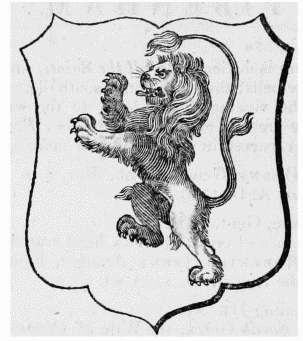
BUXTON,
Quartering or, two bucks lodged gul. and is the rebus for the name of Buxton, as I have seen for the name of the town of Buxton in Norfolk, whence this family took their sirname; and indeed, Buxton signifies the bucks town, lodgement, or habitation,
Impaled with Warner as before.
Buxton impaled with Herne, az. three herns or. Buxton and Kemp impaled. Buxton impaling gul. three bucks heads caboshed arg.
Buxton impaled Pert, arg. a bend gul. between two mascles or. On a coat of pretence az. a maunch gul.
On another brass plate,
(fn. 1)Johannes de Burton, er huius Umbra seculi, annis sue Etatis octaginta et quatuor, pie, beateque transactis, per constantem in Christo Fidem, in Consortium Electorum migravit 5° Die Aprilis in Uigifia Pasche Anno Dni. 1572. Et Ao 14 Eliz. Regine, qui instante nevissimo sui transitus puncto, mirabili Patientia in iaculum Mortis proveditus, Uisu, Auditu, Memoria, Intellectu et Sermone gandens, ipsa ad honorem verumque Dei Cultum saluberiter applicuit. Cui Omnipotenti Deo Patri, Filio, et Spiritui Sancto, ob hanc suam ingentem in ipsum et sibi consimiles mise- recordiarum Erpansam, sit Honor, Gloria, et Laus, nunc et in Secula Seculorum. Amen.
Buxton with his crest of a buck's head cooped, impaling Pert.
Joaannes Buxton de Channonz apud Tybenham Armiger, Charitate plenus, Claritate refulgens, obijt 29° Die Mensis Aprilis, Ao Dni. 1660, Ætatis suæ 51, cujus Reliquiæ sub hoc marmore requiescunt. Exemplar Virtutis, et Pietatis insigne; Margareta Uxor, Filia Gulielmi Pert de Montuessiny Comitatu Essex' Armigeri, una ex Heredibus Thomæ Conyers de East Barnett Comitatu Hartford' Armigeri, Filios Robertum, Johannem, Conyers, (improviso ereptum) Gulielmum, Henricum; Filiasq; tres, Isabellam, Margaretam, (in Infantiâ Mortuam enixa) Hic juxta posita, obijt 1° Die Mensis Maij Ao Dni. 1687, æt. suæ curren' 76. In Pietatis Memoriam debitæque observantiæ Testimonium, Johannes Filius, Flens, Mærensque, posuit. Deo Gloria.
There is a stone for Benjamin, third son of William Buxton, who died 16 April 1681. And another headstone by the chancel door, for Mary wife of Francis Buxton Gent. and Mary his wife, who died Jan. 29 1723, æt. 22. And Hannah their daughter.
Thomas Talbot Armiger, (fn. 2) Juris consultus, (fn. 3) Justiciarius, Vir Deo Devotus, omnibus bonis charus, Amicus fidissimus, natalibus virtutibus, Dignitatibus inclytus, Mortem patiendo Corporalem Victor abibat in Vitam eternam, per Dominum nostrum Jesum Christum, cui omnis Laus, Gloria, Honor, &c. in secula seculorum. Amen.
Here was a chapel dedicated to the Virgin Mary, standing by itself in the churchyard, at the east end of the chancel, the ruins of which may still be seen. William Lynster, alias Bocher, by his will proved May 7, 1493, ordered his body to be buried in the chapel of the blessed Virgin Mary at Tibenham; he gave a messuage and lands to the parish church of All-Saints here, ordering the church-wardens to apply the neat profit to repair and adorn the church for ever: he gave also, nine acres of freehold, lying at Mil-hill and Rowe-Bushes, for the constables to receive the rent, and with the neat yearly profit thereof, to pay the King's fifteenths for the poorer sort of people; and when there are no fifteenths, then the church-wardens are to receive it, and repair and beautify the church with it. His house and land, which he bought of William Wothorpe, if the brothers and sisters of the gilds of St. Thomas and St. Mary will buy them, they to have them 10l. cheaper than any one else, and their own time of payment; if they settle it on a priest to pray for the brethren and sisters of the gilds. (Reg. Hyrning, fo. 136.)
There were three gilds here, the brethren and sisters of which, had one common gild-hall, (fn. 4) since turned into a school-house; viz. the gild of All-Saints, held in the nave of the church; that of St. Thomas the Martyr, held in St. Nicholas's chapel at the east end of the south isle; and that of the Virgin Mary, held in her chapel in the churchyard. These gilds had divers lands here, which at their dissolution were seized by the Crown, where they continued till 1609, and then King James I. granted them to John Eldred, Esq; and Joan Verdon, gentlewoman, and their heirs. The furniture of the gild-hall re mained till 1650, when the hall was ruined; for then the officers sold 30lb. of pewter, 92lb. of lead, four spits that weighed 169lb. a metal pot that weighed 44lb. two pots of brass of 89lb. and a brass pan of 9lb. A plain proof of the jolly doings at these gilds! But, as the poor of the parish always were partakers with them, I much question whether their revenues were not better spent then, than they have been, since they were rapaciously seized from the parishes, to which they of right belonged.
In 1652, the town lands to beautify and repair the church, were let at above 28l. per annum.
In 1506, John Blomefield of Norwich, Gent. bequeathed to the paving of St. Nicholas's chapel in Tibenham church, a thousand paving tiles, or money to the value. (Regr. Rix, fo. 449.)
Vicars of Tibenham,
Presented by the priors of Horsham St. Faith; or the King, when he seized that priory into his hands, as being an alien.
1310, Robert de Hegham, res.
1345, John Gerard of Bukenham-Castle. (fn. 9)
1351, Ralf Randes,
1380, Robert de Kirkeby,
1386, John Hervy; in 1389, he changed for Bradfield mediety, with
Ralf at Heythe of Gunton, who in 1393, changed for Aldham, (fn. 6) with
John atte Stretesende of Pakenham, who the same year, changed for Milend by Colchester, with
Simon de Lakenham of Berton.
1395, Will. Joye of Carleton Rode, who in 1408, changed for Shadenfield with
Robert Samborn, who was succeeded by
John Chaloner, who resigned in
1431 to Thomas Tasman.
1476, Thomas Cowell, who was succeeded by
Simon Driver, licenciate in the decrees, on whose resignation in
1484, Nic. Williams had it; at whose death in
1503, John Avelyn was instituted: he lies buried here, with this on a brass plate preserved by Mr. Weever, fo. 814:
Orate pro anima Johannis Avelyn quondam Uic arii istius Ecclesie qui obiit rrviii die Decembris Ao. Mccccc vo cuius anime propicietur deus Amen.
In 1505, Jacob Glover succeeded him, and is buried here; the aforesaid author hath preserved his inscription also:
Orate pro anima Jacobi Blober, quondam Aicacii isttus Euclesti, cuius anime propicieure deus. Amen.
He died in 1525, for then
Peter Paine succeeded him, at whose death in
1535, George Plate was the last presented by the Prior of Horsham. In 1554, Plate being deprived, and a pension assigned him, Sir Ric, Southwell, Knt. by lease from the Crown, of the impropriation and advowson of the vicarage, gave it to
Peter Walker; and in
1558, to John Seaman, who held it with Flordon. (See p. 73.)
1596, Anthony Locke, A. M. the Queen. (fn. 7) He was buried Oct. 1641, and Elizabeth his wife, remarried to Robert Green, Gent. and died in 1673.
On his stone are Lock's arms, and crest of an eagle volant or.
1641, Abel Hodges, who held it united to Tharston.
1720, Will. Herring, LL. B. united to Intwood, at whose resignation,
The Rev. Mr. Philip Carver, the present vicar, had it of the gift of the Bishop of Ely, and holds it united to Besthorp, as at vol. i. p. 492.
In 1227, it was a rectory, for Ric. le Chaum then granted two parts of the advowson, to Augustine, Prior of St. Faith at Horsham, who had the other third part before, in right of their lands here; (fn. 8) and the church was appropriated and confirmed to them by John of Oxford Bishop of Norwich, according to an agreement made in the time of William his predecessor, saving a sufficient maintenance to the vicar: And in 1428, the prior was taxed for his spiritualities at 23 marks, and his temporals paid 12d. to each tenth. At the Dissolution, their temporals as well as spirituals, vested in the Crown, and in 1610, were granted by James I. to George Salter and John Williams, by the name of the revenues and lands late of St. Faith's Priory; viz. the tenement called the Priory-house, and yard, and 32 acres of land; and a tenement and 11 acres of land called Annables; and the tithe wood and hay, (fn. 9) of the rectory of Tibenham aforesaid, late in the tenure of Thomas Baker, and now in the tenure of Nic. Herne, Esq. of the yearly value of 44s.
As the impropriation consists of all the great, so doth the vicarage of all the small, tithes, except the tithe wood and hay aforesaid. (fn. 10) It now stands in the King's Books at 7l. 6s. 8d. When Domesday was made, the vicar had a house and half an acre of land, and the vicarage was valued at five, and after at six marks, but was not taxed; it paid 3s. 8d. synodals and procurations, 22d. Peter-pence, and 2d. ob. carvage; and the village paid 4l. 15s. 11d. clear to every tenth The Prior of Westacre was taxed at 6l. 13s. 5d. for his temporals here. The Prior of Castle-Acre at half a mark for his spirituals, which were two parts out of three, of the tithes of the demean lands of the manors of Robert de Bosevile here, which the said Robert confirmed to the monastery, as his ancestors had formerly granted them. (fn. 11) The portion of the monastery of Sees (in Mendham) was 6s. The portion of the Prior of St. Olave in spirituals (being taxed at half a mark) was for two parts of the tithes of their demeans here, valued at two marks: and the portion of the Abbot of St. Bennet in the Holm was one mark, and was for two parts of the tithes of his demeans here. The Prior of Bukenham had temporals also in this parish taxed at 25s. And it is said, there was a chapel at Tibenham Old-hall, which belonged to, and was served by, the canons of that house; but I have not met with any certain account of it.
Tibenham-Hall,
Alias Orrebys, Tatersales, &c. cum Carleton, &c.
(For it hath gone by the several names of its owners,) is the capital manor, and belonged to Alric, a thane of King Edward the Confessor, and had then three carucates of land belonging to it, two in demean, and one in the tenants hands; who had liberty to sell their lands, if they first offered them to sale to their lord, and he refused them. The King and Earl had then the lete, and all superiour jurisdiction: (fn. 12) and at the Conqueror's survey, it was owned by Eudo son of Spiruwin, (fn. 13) the founder of the Tateshale family; in which it continued, till it was joined to Bukenham-castle, and passed exactly as that castle did, (fn. 14) through the Tateshales, Orrebys, Cliftons, Knevets, &c. till it was sold by the Harveys, to Mr. Shaw of Besthorp, (fn. 15) whose daughter and heiress married to the Lord Biron, who now owns it.
In 1257, Sir Rob. de Tateshale had a charter for free-warren in this manor, from K. Hen. III. which was afterwards confirmed to Constantine de Clifton, his heir, by King Ric. II. in 1274, assise of bread and ale over all his tenants in Tibenham and Carleton, was allowed him by Edw. I. In 1285, all these privileges were allowed in eire, with weyf, and a timberel.
In 1272, it was found that this manor was held in capite of the King by barony, of which John de Ingham held a fee in Ingham and Worsted, and Margery de Creik half a fee in Westhorp, and another half fee in Hillington. He also held Shelly manor in Suffolk, of this barony of Tibenham.
In 1649, Philip Knevet, Baronet, had it valued, and the free quitrents, &c. were 20l. site of the hall, &c. 93l. 15s. per annum. The hall stands a quarter of a mile north-west of the church.
Abbot's Manor,
Was given before the Conquest by Lefwald, a Saxon, to the abbey of St. Bennet at the Holm in Norfolk; and at the Conquest was worth 20s. a year. (fn. 16) In 1218, the abbot, by fine in the King's court, conveyed to Osbert de Dagworth, a messuage and 140 acres of land, and divers rents in Tibenham; and in 1249, Adam Fitzwalter released to the Abbot of Holm, a messuage and carucate of land in Tibenham for ever; and in 1326, Roland, then parson of East-Bradenham, gave to the abbot 13 acres of land and 20 acres of wood, parcel of the manor of Tibenham, and then the rents of assise were 22s. 4d. ob. a year; and there was a manor-house, and 136 acres of arable land worth 3d, an acre; two acres of meadow worth 2s. and 20 acres of wood; for all which temporals, the about was taxed in 1428, at 4l. 7s. 4d. ob. The whole revenues went with the abbey of Holm, to the Bishop of Norwich, whose lessee now hath it, and is valued as at p. 540, vol. iv.
Dagworth's Manor
Was part of the Abbot's manor granted as above, to Osbert de Dagworth, who recovered it in the King's court against the abbot, by proving that his father, and Osbert son of Hervi de Dagworth, his grand-father, was seized thereof by grant of Abbot Thomas; and then the said Osbert gave it to the monastery of St. Olave's at Herringfleet in Suffolk; and the prior of that house paid 7s. 1d. tax for it in 1428. In 1392, Ric. II. licensed Rog. Rogers to grant 50 acres of land here, to Herringfleet convent. At the Dissolution, this manor of Tibenham was given by King Hen. VIII. to Henry Jerningham, and it after came to the Lord Burgavenny.
The Manor of Tibenham, Hastyngs, or Longrowe,
Belonged to the Abbot of St. Edmund's Bury, and was held of him by Ricuard, (fn. 17) being raised from 40, to 60s. value. At the Conqueror's survey, the village was a league and an half long, and one league broad, and paid 18d. geld or tax; (fn. 18) and it passed as Hastyngs's manor in Gissing, which see at vol. i. p. 168, &c. (fn. 19) In 1272, John de Hastyngs, senior, held it of the Abbot of Bury, by the service of half a fee, and 2s. 7d. per annum rent, for castle-guard to Norwich castle. In 1374, John Hastyngs Earl of Pembrook died seized of Tibenham-Rowes and Winfarthing, of which manor it was held, and constantly attended it, as at. p. 187, 8, vol. i. &c. for some time. In 1401, Will. Beauchamp had it; and in 1445, Joan, widow of Will. Beauchamp, Knt. Lord of Bergavenny, died seized thereof, having held it in dower of the inheritance of Elizabeth her grandaughter; wife of Sir Edward Nevile, Knt. Lord Abergavenny, as parcel of the inheritance of Hastyngs Earl of Pembrook. In 1475, Edward Nevile Lord Bergavenny died seized; and in 1570, it was in the hands of the Lord Bergavenny.
Channons, or Chaneux's manor,
Was so called from the Chauns or Chains, the ancient lords thereof. In the Conqueror's time it was parcel of Forncet manor, and belonged to Roger Bigot, as at p. 187, 214, &c. and in 1198, it was Adam Fitz-Robert's afterwards the Fitz-Walters, (fn. 20) of whom Henry de Crostweyt held it at one fee. In 1200, Ralf de Chaum, Cham, or Caam, held it at one fee; in 1227, Ric. le Cham, who sold two parts of the advowson, as before mentioned. In 1303, it was found that William de Morbun and John le Wales or Wallis, had the manor late Tho. de Chaun's, which then contained 30 messuages, four carucates of land, two acres of meadow, 20 acres of pasture, 80 acres of wood, a windmill, and 60s. per annum rent, in Tibenham, Aslacton, Multon, and the towns adjacent. In 1312, the heirs of Robert de Chaum had it, and William de Morburne, parson of Suffield, settled it on Tho. Bacun of Baconesthorp, and Elizabeth his wife, it being then held by Elizabeth, widow of William de Colney, for life, remainder to Eliz. wife of Tho. Bacun, and her heirs. In 1319 Roger son of Tho. Bacon of Baconesthorp, settled it on Godfry de Rokele and Eliz. his wife for their lives, with remainder to his right heirs; and in 1334, it was settled after the death of Eliz. widow of Will de Colney, by Roger de Bacon, on Thomas Bacon, his son, and Joan his wife, in tail; in 1401, John Bacon had it, who died at Baconesthorp in 1460, being son of Sir Roger Bacon, Knt. In 1426, John Bacon of Lodne, Esq. son of the said John Bacon, on his marriage with Margaret daughter of Robert Banyard of Spectishale in Suffolk, if he survived his father, had the united manors of Hackford, Chaun's or Chaneux, and Westhall in Tibenham, settled on them and their heirs; and he inherited them; and dying in 1462, gave them to his wife Margaret for life, with view of frankpledge, &c. belonging to them. In 1477, John Bacon of Baconesthorp, Esq; was lord of Chaneux, Westhall, and Hackford, alias Tibenham-Bacons: It descended to the coheirs of Thomas Bacon, and the last of that family, Anne, married to Robert Garnish of Kenton in Suffolk; and Elizabeth, to Sir John Glemham, Knt. who inherited the whole, by release from Anne and Rob. Garnish; and in 1513, John Glemham, Esq. and Eliz. his wife, settled them in trust, on Charles Brandon Viscount L'isle, Sir Rob. Brandon, Knt. Chris. Willoughby, Esq. Humfry Wingfield, Esq. and Chris. Jenney, Esq. with the manors of Over-Petistre, Chesteyn, Ketleburgh, Fornham, and Tunstall, in Suffolk; with 20 messuages, &c. in Great and Little-Glemham, &c. 30 messuages, 1800 acres of land, and 12l. rent in Tibenham and Old-Bukenham. In 1537, Sir John Glemham, Knt. died seized, and left Christopher his son and heir 26 years old; he died 18 Oct. 1549, and left them all to Tho. Glemham, Esq. his son and heir, who was also cousin and heir to Charles Brandon Duke of Suffolk. After this I find, Christiana Glemham had these manors of Chanons, Westhall, Hackford, and Seckford in Tibenham, and paid for Ward to Norwich castle every 30 weeks, 2s. 4d. and before the year 1567, I find them in the hands of
Robert Buxton, Gent. who died seized of them, and North or Great Glemham manor in Suffolk, June 5, 1621, leaving, Robert his son and heir, 19 years old: this Robert, was grandson to Robert Buxton who was buried in the church of Tibenham in 1528, being son of John Buxton, Gent. by Margaret Warner his wife, who was buried here in 1572. In 1655, John Buxton of Chanons was lord, and was buried here in 1660, leaving by Margaret Pert his wife, one of the heiresses of Thomas Conyers of East-Barnet in Hertfordshire, Esq. four sons, Robert, John, William, and Henry, and Isabell, who married to Mr. Acton of Bramford in Suffolk; and Eliz. to Mr. Thruston of Hoxne; John Buxton, the second son, lived at St. Margaret's in Suffolk, and by his wife, who was heiress to Mr. Proctor of Burston, he had three sons, Robert, John, and Thomas, who was educated at Cambridge. (See vol. i. p. 158.)
William, the third son, married Bridget, daughter of Robert Jermy of Bayfield, Esq. and had John Buxton, who died at Dereham in 1699; and Will. Buxton.
Henry Buxton, the fourth son, was unmarried in 1699.
Robert Buxton of Chanons, the eldest son, married Hannah daughter of Robert Wilton, Esq. of Topcroft and Wilby, (see p. 364, 5, vol. i.) and was buried at Tibenham; John Buxton, his eldest son, dying unmarried at Orleans in France, where he was buried,
Robert Buxton, his second son, succeeded him, and married Eliz. daughter of Leonard Gooch of Earsham in Norfolk; he was buried at Rushford in 1691, and Eliz. Buxton was buried by him in 1730. (See vol. i. p. 295.) His brother Charles was A. B. and fellow of Clare-hall in Cambridge, and died in 1682, and was buried in St. Edward's church there, being 22 years old. Margaret his sister married to Henry Kiddington of Hockham, as at p. 367, vol. i. and Hannah her sister was then unmarried.
John Buxton, son of Robert Buxton and Eliz. Gooch, succeeded, and was buried at Rushworth in 1731, as at p. 295, vol. i. leaving these manors to Anne his wife, who is now owner of them for life, and
Robert Buxton, Esq. his son, who is now unmarried, is heir.
In 1570, Knevet and Buxton, in right of their manors here, were chief lords of the commons. In 1742, the total of the quitrents of the manors of Chanons, Westhall, Hackford, and Seckford, were 7l. 6s. 11d. ob. per annum. The site of the manor of Chanons is now called Chanons Hall, and is the seat of the Buxtons; it stands about a mile south-east of the church, and is a good old regular building, moated in.
The Manors of West-Hall, Hackford, and Seckford,
Called afterwards Bacon's manor, belonged to Roger Bigod's manor of Forncet at the Conquest, as may be seen under Forncet at p. 223, 4; and the several parts before their union belonged to different families; West-hall was held by Ric. de Hadesco, by the 4th part of a fee, in Ric. the First's time; and after that, was joined to Hackford's manor, which passed as Hackford's manor in West-Herling, as you may see in vol. i. p. 300, and from thence to the Seckfords, as at p. 301, and was by one of them sold to the Bacons, and joined to Chanons manor as before mentioned.
The Manors of Skeyton-Hall, alias Whitwell's and Launde's,
Are now joined to the manors of Bunwell, Carleton, and Tibenham cum membris, the members of it being these two manors, as at p. 128 and 140.
Skeyton-Hall manor, alias Whitwell's, took its name from Sir John de Skegeton, lord of it in Edward the First's time, as also of Skeyton-hall in Skeyton, from which village he took his name. In 1303, Ralf de Skeyton was under age, and a ward of Sir Fulk Baynard, Knt. of whom this manor was held, and Richer de Whitwell had it in 1261.
Launde's manor, in 1264, belonged to Richard Lemming of Tibenham, who forfeited it for rebelling against Hen. III. In 1278, Robert de Bukenham had it, and in 1283, Will. de Cruce, de la Croyz, or at Cross, owned it. In 1287, John de Tibenham had assise of bread and ale, and weyf, allowed him here. In 1478, John Heydon of Baconesthorp, died seized, and from that time to this, they have passed as at p. 140, Robert Buxton, Esq; being now lord.
Alan Earl of Richmond's manor of Carleton (fn. 21) extended hither; see p. 128.
For Tibenham commons see vol. i. p. 350, 51. Fox's Martyrs, fo. 2073, and Cole's Collections, vol. i. p. 192, 4.
Tibenham vicarage is valued in the King's Books at 6l. 16s. 8d. and being sworn of the clear yearly value of 46l. it pays no first-fruits nor tenths, and is capable of augmentation.