An Essay Towards A Topographical History of the County of Norfolk: Volume 6. Originally published by W Miller, London, 1807.
This free content was digitised by double rekeying. All rights reserved.
Francis Blomefield, 'Hundred of South Greenhoe: Swaffham', in An Essay Towards A Topographical History of the County of Norfolk: Volume 6(London, 1807), British History Online https://www.british-history.ac.uk/topographical-hist-norfolk/vol6/pp197-228 [accessed 1 May 2025].
Francis Blomefield, 'Hundred of South Greenhoe: Swaffham', in An Essay Towards A Topographical History of the County of Norfolk: Volume 6(London, 1807), British History Online, accessed May 1, 2025, https://www.british-history.ac.uk/topographical-hist-norfolk/vol6/pp197-228.
Francis Blomefield. "Hundred of South Greenhoe: Swaffham". An Essay Towards A Topographical History of the County of Norfolk: Volume 6. (London, 1807), British History Online. Web. 1 May 2025. https://www.british-history.ac.uk/topographical-hist-norfolk/vol6/pp197-228.
In this section
SWAFFHAM. (fn. 1)
Harold (fn. 2) son of Goodwin Earl of Kent, was lord of this town in the beginning of the reign of Edward the Confessor, from whom it came to the Confessor, who gave it to
Ralph Guader, or Waher, Earl of Norfolk, who was lord here, as we learn from Domesday, where we have this account of the town. (fn. 3)
Suafham, now the lordship of Alan Earl of Richmond, was royal demesnes, and after belonged to the earldom of Norfolk; it was a mile long, and as much broad, and had one carucate in demesne, afterwards two, and at the survey four, a mill and the moiety of another, and one fishpond or fishery. It was accounted for as two manors, and valued in the Confessor's time at 8l. per annum at the survey at 16l. and there was 20s. per annum more belonging to it, and the whole paid 16d. to the Dane-gelt.
This Ralph Earl of Norfolk, entering into a conspiracy with other lords, against the Conqueror, lost all his possessions, and fled into France, and the Conqueror gave this lordship, &c. to his sonin-law,
Alan Rufus, alias Fergaunt, Earl of Richmond in Yorkshire, (fn. 4) who married his daughter Constance. This Alan is also said to have all the lands given to him, that Edwin Earl of Mercia possessed in the Confessor's time, either in Yorkshire, Norfolk, or Suffolk, and are said to be 444 lordships; which Earl Edwin styled himself at times, Earl of the East Angles, and the lordships belonging to this Alan, as Earl of Richmond, in this county alone, are said to be 81.
Earl Alan died in 1093, and was buried near the south door of the abbey of St. Edmund in Suffolk, before the altar of St. Nicholas.
The lordship of this town being thus vested in the Earls of Richmond, it was looked upon as a member of, and went along with, that honour successively.
About the 17th of King John, this town had a mercate granted to it, for in that year, the King directed his precept to the heriff of Norfolk, to abolish the mercate then granted, if he found it to be to the damage of the mercate of Eudo de Arsic at Dunham; but as I conceive it was found otherwise, because it has continued to this time; and in the 37th of King Henry III. we find that Peter de Savoy Earl of Richmond, uncle to Queen Eleanor, wife to King Henry III. and lord of the town, had a confirmation of the former grant of a mercate weekly, and also of two fairs here yearly. (fn. 5) In the 50th of the said King, Earl Peter would not permit the sheriff to enter into his manors here, &c. which implies that he had return of writs, within himself. (fn. 6) In the third year of King Edward I. John de Dreux Duke of Britain and Richmond was lord, and held the manor in capite; and in the 8th year of that King, the said John being lord, an extent was made of the manor, on Sunday after the Feast of St. John Port Latin, before Thomas de Normanville, &c. on the oaths of William de Shirring, &c. from whence we learn, that there was then a capital messuage belonging to it valued at 10s. per annum, 213 acres of arable land in demesne, valued at 5d. per acre, a fold of the customary tenants at 40s. and 80 acres of pasture valued at 40s. per annum; chevage valued at 3s. (fn. 7) two windmills, valued at 40s. the rent of assize, &c. 22l. 9s. 8d. the toll of the town for carriages, valued at 12s. per annum. The customs and duties of the mercate, xviil. per annum, pleas and perquisites of the courts, xxl. Insomuch, that with these and other dues and customs, this manor was valued in the whole at 92l. 10s. 2d. qr. per annum, and the church of Swaffham, which was in the gift or presentation of the Earl of Richmond, was then valued at 80l. per annum.
Then follows an account of the several knights-fees in Norfolk, belonging to the honour of Richmond, and the time when they performed ward at Richmond castle. (fn. 8) In 1286, the jury say that John de Dreux Earl of Richmond, &c. and lord here, claimed free-warren in all his demesne lands here, view of frankpledge, gallows, pillory, tumbrell, assize of bread and beer, weyf, the sheriff's turn twice in a year, return of writs, and a weekly mercate on Saturday. (fn. 9)
In 1308, John de Britannia Earl of Richmond was lord, and had a confirmation of two fairs here and the market, and a Fair at Fodringhay in Northamptonshire, of a market and fair at Leystoff in Suffolk, and two markets at Botolph's-Town, (now Boston,) in Lincolnshire, and at Kirton in the said county. (fn. 10) In the beginning of the reign of King Richard II. it appears from the King's letters patent, that the men and tenants belonging to the honour of Richmond, (and consequently the inhabitants of this town,) were freed from all toll, pontage, murage, pavage, passage, lastage, stallage, kaiage and piccage, on account of their goods, through all England. (fn. 11)
These were considerable privileges, and include a freedom from all dues, tributes, tolls, &c. due by sea or land, in passing and repassing from place to place. And in the 3d year of the said Richard, there was an exemplification passed under the great seal, of a pleading in the time of King Henry III. between Peter of Savoy Earl of Richmond, and the citizens of Lincoln, wherein Peter claimed that all his men and tenants of the honour of Richmond, should be quit of toll, throughout England, and it was allowed him, and ordered by the King, that letters patent should pass for that purpose.
In 1425, Ralph Nevile Earl of Westmorland died seized of this manor and advowson, and the honour of Richmond, (which he had given him by King Henry IV. on his accession to the Crown, and held it for life,) and of 20 knights fees and a quarter, and 8l. 10s. rent of assize, issuing out of certain tenements and lands in this town, Nerford, Hederset, Huningham, Wramplingham, Saxthorp, North and South Pickenham, Foxley, Cley, Sistern, Westfield, Lyn, Fincham, Mileham, Horningtoft, Kypton, Redenhale, Thurning, Hekling, Attlebrygge, Starston, Hyndryngham, Dalling, Brunham, Bathelee, Sharington, Rougham, Becham-well, Wissingset, Southfeild, Midleherling, Redelesworth, Swannington, Titeshale, Costesy, Baubergh, Rockland, and Berford in Norfolk, all held by knight's service, for term of life only, the reversion thereof being granted by King Henry IV. in the first year of his reign, to John Duke of Bedford, with the county of Richmond, the castle, honour, and seigniory. (fn. 12)
In 1435, John Duke of Bedford, son to King Henry IV. died seized of the manor and advowson of the church of Swaffham, also of the liberty of keeping a court here called shire-court, from month to month, belonging to the honour of Richmond. (fn. 13)
In 1456, Edmund of Hadham Earl of Richmond, the King's half brother, died seized of two parts of this lordship and advowson, held in capite, by him and the heirs males of his body, and also of a certain liberty of return of writs, and other mandates of the King, as parcel of the castle and honour of Richmond, with the reversion of the third part, after the death of Jaquetta Dutchess of Bedford, relict of John Duke of Bedford and Earl of Richmond. (fn. 14)
In 1473, King Edward IV. granted this lordship to George Duke of Clarence, his brother, Henry Earl of Richmond, then being in banishment; but on the accession of King Henry VII. to the Crown, it became parcel of the Crown-lands, and was held by King Henry VIII. Queen Mary, and Queen Elizabeth, who in the 26th year of her reign, recites, that she by her letters patent under the great seal dated 4th of May, in the 12th year of her reign, did demise to Phillip Strelly, Gent. then one of the captains of the village of Berwick, amongst other things, all and singular the lands and demesnes of the lordship or manor of Swaffham, and the warren of coneys called Spinney-Park, &c.: and to Sir Henry Bedingfeld, the lordship and manor of Swaffham, except courts baron and letes of the said manor; the Queen, therefore, on the surrender of that lease, demiseth to Robert Chabenor, and Anne his wife, and Payne their son, all the premises aforesaid, which are parcel of the honour of Richmond, and of Richmond-fee by the name of the manor of Swaffham, (except as before excepted,) to hold to them and their heirs successively, paying for the warren and land called Spinney-Park, 6l. 10s. per annum, and for the demesne lands and premises, 7l. 10s. and the best beast for an heriot. (fn. 15)
In 1620, we have much knowledge, of the state of the town, from the verdict of the jury, given at the court of the manor then held, viz. that the freeholders hold of the manor by soccage, fealty, and freerent, and pay for free-rent 4d. per acre, and for every acre of copyhold 3d. per acre, for every copyhold messuage 9d.; that the copyholders may make leases of their copyhold estates for 21 years, without license of the lord, and on admittance 2d. per acre. To their knowledge, there never was any manor-house, but many acres of demesne lands, and Edward Heye, and Christopher Watson, were farmers thereof; there is another manor called Haspals and Whitsands, which was granted by King Edward VI. to certain persons and their heirs, under which grant, Robert Halman, Gent. &c. who have the said manor, keep court, &c. no mill now belongs to the manor, but two newly built, and they know not of any fishing or fouling: the lord hath weyfs, strays, and felons-goods, now no fair but a market, wherein six score and thirteen stalls, and 14 shops, and the toll and profits, taken by the bailiff of the manor; the Lord Bishop of Norwich hath the right of presentation to the vicarage, and Nicholas Bate, clerk, is incumbent: the vicarage-house is in much decay; the impropriation is worth 100l. per annum; John Stallon, Gent. is the farmer of it; the copyholders of inheritance used to top, lop, cut, stub, and fell down their wood, and their timber-trees, standing on their copyhold-lands, and to pull their houses down at pleasure; the lord hath many great commons, &c. and the tenants are not stinted in their common, the lord and his farmers have kept sheep on part of the demesnes, and common about 1400, till of late, that some part of the demesnes, about 80 acres, have been ploughed, and 1400 sheep kept, to the damage of the tenants: there are two town-houses, parcel of the manor of Aspalls and Whitsands, one for the relief of the poor, the other for the clerk of the parish to live in: that the King's Majesty was lately owner of the manor, but now the Prince.
In the beginning of the reign of King Charles I. Sir Edward Coke farmed this lordship of the King, and about 1630 it was possessed by Sir Edward Barkham, who in 1633 procured a grant for three fairs to be kept here. One on May day, another on the 10th of July, and the third, on the third of November.
In the family of the Barkhams it continued, till it came by the marriage of Ellen, daughter and sole heir of Sir Edward Barkham, Bart. by his second wife, Frances, daughter of Sir John Napier of Luton Hoo in Bedfordshire, to
Charles Yallop, Esq. of Bowthorp near Norwich, (fn. 16) who mortgaged it to Mr. Nash of London; but his son,
Edward Yallop, alias Spelman, Esq. of Westacre-High-House hath recovered it, and is now lord here.
The custom of the manor is to the eldest son.
Aspal's Manor.
In 1239, Olive de Aula, or Hall, held here and in Holme-Hale, a moiety of one knight's fee of Giles de Holme, he of Robert son of Roger, and he of the Earl of Richmond, and the Earl of the King in capite.
In 1338, John Lovel of Barton Bendish, and Olive his wife conveyed it by fine to John de Dodyngton and Mary his wife, the quitrents being 24s. per annum, and soon after Henry Atte-Cross died seized of it; and in the following year, Walter Del-Gate, and Margaret his wife, held it of Henry Atte-Cross, and William son of Agatha Dick of Castleacre.
In 1345, John de Dodyngton, John Revech, and their parceners, held here, in Holm-Hale, and Pykenham, half a fee of Stephen de Tetleshall, and he of Robert son of Roger, and he of the Earl of Richmond, which Olive de Aula formerly held.
In 1381, William Cote, vicar of Swaffham, Roger Atte-Lound, chaplain, John Bachelor, and John Atte-Cross, junior, granted it to Thomas Tiveteshall of Neketon and his heirs, by the name of the manor of Haspalys, which they held of the gift of Thomas Wombe of Swaffham. (fn. 17)
In the 3d of Henry IV. William Robyn and his partners held here in Holm-Hale, &c. half a fee of the heirs of Robert Illey, who held of the honour of Richmond.
In the 14th of Henry VI. Thomas Styward of Swaffham-Market, son and heir of Thomas Styward of the same, deceased, granted to John Walpole, clerk, vicar of Swaffham, Thomas Beaupre of Well, John Heylet, chaplain, Osbert Mundford of Hokewold, Adam Mundford of Feltwell, and John Spelman of Stow-Bydon, and their heirs, his manor of Haspale in Swaffham Market, with liberty of a freefold, together with 50 acres of land in one piece at Shortlyng, called Estgate-brech, and liberty of driving the sheep to the moor of Cootys to water. And in 1436, John Walpole, Thomas Beaupre, &c. granted to Sir Thomas Tudenham, Knt. Thomas Shuldham, Jeffry Norris, Ralph Geyton, and William Prentys, their manor of Aspale, and appointed John Blake, and John Sowle, their attorneys, to deliver seizin. After this, it was held by Hugh Fenne, and by his daughter and heir Cecily, it came to Thomas Ludford of Westminster, scrivener; and in 1473, was on the death of Ludford, conveyed by William Alburgh citizen and mercer of London, (on whom it was settled in trust) to Henry Spelman, Simon Blake, &c.; but in the following year, Anthony Woodvill Earl of Rivers, and Lord Scales, &c. (the lord, as I take it, who held it in capite) granted to Richard Southwell, Henry Heydon, Esq. Edmund Clere, Henry Spelman, &c. his manor of Aspales, late Hugh Fenn's; and in 1475, Robert Southwell, &c. enfeoffed Symond Blake, William Grey, Roger Townsend, Thomas Brampton, &c. in the said manor, and the said Roger Townsend, Thomas Brampton, &c. resigned all their right in the said manor, to Symond Blake, Gent. and Robert Fuller, clerk, for the sole use of Blake.
This Simon Blake, by will dated 10th December, 1487, gives his manors called Haspalds and Whitesondes, to be settled on feoffees to find for ever, an honest and secular chaplain, not instituted into any vicarage, rectory, or free chapel, or other spiritual benefice, but to officiate, and daily say Matins, the Hours, Mass at 7 every morning, and Vespers, and all divine offices, and on all festivals, and when ever service is sung by note, to assist in the church, with other chaplains and clerks, in singing in the choir there, and to pray especially for the health of his soul, his wife Joan's, his parents, Thomas Blake, Esq. and Elizabeth his wife, Robert Heigham, Esq. Margaret, Richard, and John Aleyn, John Bocking, and Joan, late wife of Thomas Bocking, Esq. and all his benefactors, and faithful deceased, to be called Blake's chantry priest, and his chantry was the south transept chapel of the church of Swaffham, where he lies buried under a marble stone near the altar of Our Lady of Pity; (fn. 18) and the said altar to be called the altar of the chantry of Simon Blake, the priest to have 8 marks per annum, to be paid on the four quarter days, by equal payments; a new chantry priest is to be chosen on the death of the old one, by the vicar of Swaffham for the time being, the churchwardens, and 5 at least of his 16 feoffees; and on their neglect to choose in the space of 8 weeks from the voidance, then the nomination and election to be in the master of St. Martin's-College at Thompson in Norfolk; and when his 16 feoffees are reduced by death to six, they are to renew the feoffment to themselves and 10 more; the vicar and churchwardens are always to receive the profits and manage the estates, pay the priest, &c. He gave also 5l. to be placed in a chest in the church, out of which, 5s. may be borrowed by any poor person of this town on pledges, but no one to have more than 5s. at a time: he gives an alms-house for four poor people, and to Trinity gild here 10 ewes and 5 sheep; a cup of silver gilt, to the church of Swaffham, formerly Mr. John Botewright's, rector of that church; to Margaret Heigham of Marham (the abbess) 4s. per annum out of a close in Holm-Hale, and after the death of the said Margaret to be settled on the said nuns for their clothing; to every priest at Swaffham 12d.; to every clerk 6d.; to the boys of the choir 3d.; to every priest in the hundreds of South-Greenhoe and Clackclose 4d.; for the obit of Edmund Blake late of Hale 40d. per annum. He wills his own obit to be kept yearly, (fn. 19) and gives to every priest officiating at it 4d. to every lay clerk 2d. and to each of the 12 boys choristers there 1d.; 20d. to the poor; to the clerk 4d. and to the sexton for ringing 4d. and appoints a lamp to burn by his grave on all holidays and Lordsdays from matins, to compline, and the bellman of the town of Swaffham to take care of it, and to have 4d. per annum; Sir Roger Townshend, Knt. and the Lady Ann Wyngfield were supervisors of his will. (fn. 20)
This manor continued thus settled till the dissolution of chantrys, in the reign of King Edward VI.; and in the 3d year of that King, he granted it, with a fold course and about 90 acres of land, to John Wright and William Walter, &c. (fn. 21) for the use of the town, to be held in capite by the 40th part of a knight's fee. (fn. 22) In the 5th of the said King, license was granted to William Walter, &c. to alienate it to William Orrell, &c. feoffees, &c.
In 1627, May 16, an inquisition was taken before Sir William Yelverton Bart. Sir Henry Beding feld, Knt. Sir John Hare, Knt. and Thomas Athow, sergeant at law, commissioners for charitable uses, when the jury found, that the late dissolved chantry of Swaffham, founded by Simon Blake, and the lordship and manor of Haspal and Whitsand, with the fold course and 60 acres of land in Swaffham, with the Church-croft, alias the Shooting-croft, was by King Edward VI. by patent dated 26th July, in the 3d of his reign, for 126l. granted to John Wright and William Walter, and their heirs and assignees, to pay yearly to nine poor people in Swaffham 56s. (fn. 23) and that the purchase was made with the common-stock of the town, (fn. 24) for the repairing of the church, maintenance of the poor, repairing the highways, common-wells, &c. (fn. 25) that Wright died, and Walter survived, and after died, whose son, William Walter, assigned the trust by deed, dated 27th May, 5th of Edward VI. to William Orrell, &c. who enfeoft, by deed dated 27th of September, in the 35th of Elizabeth, Robert Halman, &c. as feoffees, to have the government of the lands, manors, &c. and it continues at this present time in the hands of feoffees, in the said town. John Reader held this chantry at the dissolution of it, and had a pension from King Edward VI. of 5l. per annum which he held in 1553. He being the last chantry priest.
Whitsand's Manor.
Hugh de Whytsand, by deed sans date, granted to Walter his son, and Agnes his wife and their heirs, the moiety of it, and of a fald in the fields of Swaffham, with the homages and services of the several tenants, and all services suits of court, &c. This Hugh lived in the reign of King Edward I. for in the 3d of that King, one of that name occurs in the hundred roll of South Greenhoe, as an inhabitant of Swaffham. In 1320, Isabel de Quitsand, held it, and in 1239, Gilbert de Quitsand of Swaffham confirmed it to Gilbert his son, and Catharine daughter of Peter Maupas of Swaffham, and their heirs, with a fold-course, and the homages and services of all his free-tenants in the said town; and afterwards this manor was annexed to that of Aspals, and had the same lords as is there observed.
The fine of these manors is only an additional year's quitrent to every new tenant, in the nature of a relief
Saltrey, Sawtrey Manor, alias Priors-Thorns.
In the reign of Henry II. the Abbot of Sawtrey in Huntingdonshire held 2 carucates, and a manor in this town and Narford, of the gift of Warine de Bassingbourn and Alan of Swaffham: and in the 32d of that King, a fine was levied between Adam Abbot of Sawtrey, and a Warin de Bassingbourn, whereby he acquitted the Abbot of the suit of the court, due to the manor of Swaffham, and demanded by Peter of Savoy Earl of Richmond; and in this abbey the manor continued till the general Dissolution of King Henry VIII. who gave it, in the 29th year of his reign, (fn. 26) to
Sir Richard Williams, alias Cromwell; and in the 30th of the said King, license was granted to alienate it, with all the appurtenances in Swaffham, Narford and Stow, (fn. 27) to
Sir John Crofts of West Stow in Suffolk, and his heirs. In the 1st and 2d year of Philip and Mary, a fine was levied between Ralph Chamberlain, querent, John Crofts and Margaret his wife, defendants, of the manor of Prior's or Fryers Thorns, with the appurtenances, and liberty of a fold in Swaffham. (fn. 28)
In the 15th of Elizabeth, license was granted to Ralph Chamberlain, to alienate it to Thomas and John Ives, and their heirs.
And soon after it was conveyed to Richard Beckham, Esq. by the name of the manor late of John Crofts, by Sir Ralf Chamberlain and his trustees, Sir John Crofts, and Margaret his wife, and Thomas Crofts, Esq. their son, having released it to Sir Ralf.
From the Beckhams it came to the Fountains,
And Sir Andrew Fountain of Narford, Knt. is the present lord and owner of the whole manor, all the lands belonging to it being purchased in.
The site of it is about a mile and half, west of Swaffham, on a very high hill, surveying the country at a great distance; the situation is clean and pleasant, and formerly the monks of Sawtrey had two or three of their fraternity residing here, it being a sort of hotel or house of reception for pilgrims that travelled this way to Walsingham, or from thence to St. Thomas Becket at Canterbury, the way leading cross the county from hence, still retaining the name of Becket's way.
This town is very pleasantly and healthfully seated on a rising ground, in a fine open champaign country; it has a good market every week on Saturday, and three fairs in the year, 1st of May, the 10th of July, and the 3d of November; the wells in the town are generally about 50 yards deep. On the north-west side is a spacious heath, famous a few years past for horse-races. In ancient days the Earls of Richmond had a prison in this town, and at this time here is a house of correction, or bridewell, which was erected in the 41st year of Queen Elizabeth, for the hundreds of South-Greenhoe, Weyland, Grimshoe, Shropham, Gilt-Cross, Freebridge in the part of Marshland, and citra Lynn, and Clackclose. The rate for the hundreds, for the charge of erecting it, was fixed by the justices, Sir Basingbourn Gawdy, Humphry Guybon, Clement Spelman, Edmund Mundeford, and Gregory Pratt, Esq. in this manner; South-Greenhoe 10l. Weyland 6l. Grimshoe 6l. Shropham 7l. 10s. Gilt-Cross 6l. 10s. Freebridge in Marshland 10l. 13s. 4d. Freebridge citra Lynn 10l. Clackclose 11l.
The inhabitants of the town still enjoy privileges beyond their neighbours, the town being ancient demesnes King Charles I. in the 13th year of his reign, 29th of March, exemplified the privileges of ancient demesne manors, that they were free from payment of toll, and from contribution to the expenses of knights of parliament, not to be put in assizes upon juries, or any recognizances, but only in the court of the manor, the manors of Swaffham-Market, Narford, South and North-Pickenham, Pagrave, Foulden, and Cressingham-Magna, in this hundred, are certified to be ancient demesne, by the Chamberlains of the Exchequer, and command is given to let them enjoy those privileges unless they held lands and tenements of another tenure, for which they may be put on juries at the assizes.
In this parish of Swaffham, north-west of the town, above half a mile, by the Lynn road, was an hamlet in ancient days called Stow, and Guthlakes-Stow, from a chapel that was there dedicated to St. Guthlac. In the Register of the Abbey of Castleacre, now in the library of the Right Hon. the Earl of Oxford, this place is often mentioned. Alan son of Godfrey of Swaffham, by deed suns date, gave to the monks of Castleacre, 2 acres of land, at Stow-Slod, lying between that land that Alan de Bassingbourn gave to the monks of Sawtree. The said Alan, by deed sans date, gave to the said monks of Ailrick de Stow and Margaret his wife, their family and services, with liberty of a fold-course, and all the tenement which they held of him in Swaffham, and Guthlakes-Stow, and 18 acres thereof lying near St. Guthlack's chapel, and 6 acres of land at Marham Stokes, &c. (fn. 29) This Alan lived in the reign of King Henry II. as appears from a deed of his sans date, wherein he gives to the said monks the yearly rent of 4d. which Roger son of Baldwin held of him at Accingate, for the health of his own soul, and that of Margaret Countess of Richmond, which Margaret was the wife of Conan Duke of Britain, &c. who lived in the reign of King Henry II. and daughter of Henry Earl of Huntington. The said Alan also gave them two parts of the tithes of his own house.
Gilbert de Gaunt, by deed confirmed to the said monks, 40 acres of land at Gudlacistovia, which Earl Alan his uncle had granted to them; this Gilbert de Gaunt was Earl of Lincoln, in the time of Henry II. Alexander de Bassingbourne, by deed sans date, released to them all the land that was William de Meldeburne, in the village of GuthlakesStow, &c. These and many other gifts were given here and in Swaffham to the monastery of Castleacre, and it is probable that, on account of some of these, the prior and convent were obliged in those times to find a priest to officiate on certain days in the chapel of St. Guthlack, for in the 39th year of King Edward III. the prior of Castleacre was summoned to a court held here by Sir Godfrey de Folejambe, Knt. steward to John of Gaunt Duke of Lancaster and Earl of Richmond, on Friday after the feast of St. Martin the Bishop, to show cause why he ought not to find a chantry priest to officiate here in the said chapel of Stow, for two days in every week, as he had been presented for not doing it; but he showed that he was under no obligation so to do. (fn. 30)
This place is now by corruption called Good-Luck's Closes; this chapel was standing in 1464, (fn. 31) as appears from the will of Richard Plumhe, chaplain, who by will then gives 3s. to the repair of the ceiling over the high-altar of this chapel.
The tenths of this town were 12l. clear.
The temporalities of the Prior a Pentney here in 1428, at 6d.
Those of the Prior of Castleacre, at 7s. 7d. ob. q.
Those of the Abbot of Sawtree 4l. 2s. 8d.
The spiritualities of the Prior of Rumburgh in Suffolk, at 20s. This priory was founded by Alan Earl of Richmond, and was a cell to the abbey at York, and had this portion out of the rectory here. It was dissolved by letters patent, dated 30th of December, in the 20th of Henry VIII. (before the general Dissolution,) and granted to Cardinal Woolsey, towards endowing his colleges at Oxford and Ipswich, and the Abbot of St. Mary at York released to Thomas Capon, Dean of the Cardinal's college at Ipswich, all his right in the monastery of Rumburgh, and in the possessions thereof lying in many towns in Suffolk and Norfolk.
Thomas Duke of Norfolk, had a pension and portion of tithes here, (which belonged to the Prior of Castleacre,) in the 4th and 5th of Philip and Mary.
The lete of this town is in the lord of the manor.
The Church of Swaffham is built in the form of a cathedral, having a nave, north and south isles, a chancel, and two transept chapels, (fn. 32) making it in the shape of a cross. It is a lofty magnificent Gothick pile, of a very venerable aspect, being the largest and most beautiful parish church in the neighbourhood; the whole is covered with lead, and built for the most part with flint, freestone, brick, &c.; the upper part of the nave is coped and embattled with free-stone. At the west end of which is a stately large and lofty foursquare tower built entirely of free-stone and embattled; about the water-table, and under the battlements are these shields,
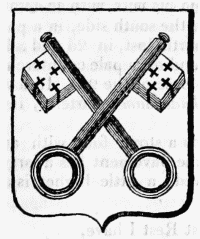
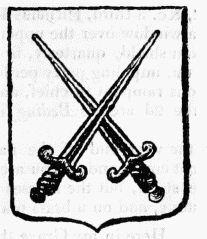
The emblems of St. Peter and St. Paul, to whom the church is dedicated. At each corner of the battlements, stands a pinnacle of carved stone, and on the summit of the tower a curious turret of wood covered with lead, in which hangs the Saint's bell; round this, raised in the form of a lantern, stand several tall shafts covered with lead, and bearing on their heads a weathercock; in this tower, which by its height is seen several miles round, hang eight large musical bells; and there is a clock with a dial-plate on the west side: this tower was begun in 1507 and finished in 1510, Sir Robert Lovell, Knt. of this town, and John Oxburgh and John Newell, Church-Reeves, laid the first stone, on which was Deo Sacrum.
At the entrance on the west side of the tower is a neat large folding door of oak, lately erected; over this, on the tower, are several niches for images, two of a very great length, one on each side of the great west window; from the west door to the entrance into the chancel is about 41 yards, which is equal to the length of the nave of the cathedral of St. David's, and the breadth of the nave, together with the two side isles within the walls, is about 17 yards.
The vault of this church, and the side isles, are supported by fine slender pillars, consisting each of four small pilasters joined together, and forming 14 lofty curious turned arches, 7 on a side, over these arches are 28 neat and light windows, 14 on a side, two over each arch: the roof is wonderfully beautiful of oak, neatly wrought and carved, supported by many angels with their wings expanded, bearing shields on their breasts, and on them are several insignia, instruments, &c. relating to our Saviour and his crucifixion, &c. as crosses, nails, the seamless coat, ladder, cup, and spear. These, &c. are on the north side, crown of thorns, spear, pincers, hammer, three dice, two whips, a lantern, an escallop, two spears in saltier, a crown, a mitre, &c. on the south side.
In the windows over the arches on the north side of this nave are the effigies in pannels of the glass of benefactors, men and their wives on their knees, and hands erect, and joined in a supplicant posture, painted in close round gowns of blue and purple, turned up and robed with fur, coloured or, with beads, &c. by their sides. One of these represents Thomas Styward and Cecily his wife, with an Orate pro animabus, &c. Walter Taylur and Isabel his wife, with an Orate, &c. Nicholas Wryght and his wife,with an Orate, &c.
In a window over the upper arch on the south side, in a pannel is a broken shield, quarterly, first and fourth lost, in 2d and 3d Fitzwalter, impaling party per fess gules and or, a pale counterchanged, two lions rampant in chief, and one in base of the 2d. In a window over the 2d arch is Beding feld and Tudenham quarterly, impaling Scot.
At the west end of the nave, stands a stone font with an high wainscot cover; and as you ascend, on the pavement lies a large gray marble stone, but the brasses are reaved; a little higher is a small gravestone, and on a brass plate this:
Here in my Grave the chiefest Rest I have, No greater Rest, can Christian Creature crave.
Here lyeth the Body of Thomas Cannon the son of Abry Cannon, and buried the fyrst of June, Ano Dni. 1634.
Adjoining is a marble gravestone in memory of Mrs. Rose Case, wife of Mr. John Case, who died 22d of April 1712, aged 63 years.
A little higher lies a stone in memory of Dorothy wife of Tobias Sheldrake, October 5, 1689.
On the pavement, higher yet, lies a black marble stone in memory of Mr. Henry Devall, who died 30th of January 1728, aged 45 years. Per fess gul. and or, four flowers-de-lis counterchanged. Devall.
At the upper end of the nave (before the old rood-loft) lie several old marble gravestones. On one is the portraiture of a man in complete armour, that of his wife, with the shields, &c. of brass, that were thereon, are stolen and gone. Adjoining to this lies another stone, with the portraiture of an armed man in brass, with a dog couchant at his feet, but that of his wife, &c. is reaved and lost. On the pavement at the west end of the south isle lies a marble stone in memory of Thomas Bodham, Gent. who died 21st of June 1725, aged 38.
Bodham arg. on a cross gul. five mullets or.
Near to this hang two dozen of leather-buckets, with keys in saltier, and this date, 1723.
About the middle of this isle is a little chapel 13 feet in length, and about 8 in breadth, with a large window to the south. This is the chapel of Corpus Christi, founded by John Pain and Catharine his wife, who are there interred.
At the upper end of this isle lies a large gray marble stone, with the portraiture of a person in complete armour, on his surcoat are the arms of Touchet and Audley, quarterly, viz. in 1st and 4th ermine a chevron gul. in 2d and 3d gul. a frett or, by which we are assured that it is in memory of Sir John Audley of this town, who lived and died in the reign of King Henry VIII. and the same shield is painted on the glass in the window of the parlour in the vicar's house; the nobility and gentry in ancient days, wore over their armour, rich surcoats of silk and satin embroidery, as the heralds do at this day, whereon was curiously wrought the arms of their house and family in their proper colours, &c. and such a coat the renowned Lord Audley wore at the battle of Poitiers in France; this stone had also the portraiture of his lady, and several shields in brass, &c. all which are reaved except part of one at the foot of the stone, and on the left side, which seems, being almost obscure, to be only the impalement of his lady, the other part being covered by a pew, viz.
Quarterly in 1st quarter quarterly a chevron, a fess indented, &c. between three lions heads erased, and as many plates in 1st and 4th, in 2d and 3d quarter lozengy, the 4th as the 1st.
This Sir John was of a noble family, being descended from Sir John Touchet of Marketon, who by Jane, sister and heir of Nicholas Lord Audley, had
James Touchet Lord Audley, who had two wives; by his first wife, Margaret, daughter of Thomas Lord Roos of Hamlake, he had Sir John Touchet Lord Audley, and by Eleanor (fn. 33) his second wife, two daughters; Anne, married to Richard Delabere, and Margaret to Grey Lord Powis, and three sons: Thomas the youngest, Edmund the second was Bishop of Rochester, Hereford and Salisbury;
Sir Humphry Audley, Knt. the eldest son, married Elizabeth, daughter of Sir Philip Courtney, Knt. relict of Sir Thomas Lutterell, and had two daughters, the youngest married Stewkley of Devonshire, and the eldest John Hadley of Somertsetshire; but their son,
Sir John Awdley, lived at Swaffham in 1526, and had two wives; Elizabeth, his second wife, and Muriel, daughter of Sir Thomas Brewse of Wenham in Suffolk, by whom he had
Richard Awdley of Swaffham, Esq. (fn. 34) who married Catharine, daughter of Richard, younger son of the Lord Scroop of Bolton, and had
Edmund Awdeley of Great Pagrave, Esq. (fn. 35) who had two wives; his second wife was Anne, daughter of Sir Thomas Tirrel of Warley in Essex; his 1st wife was Mary, daughter of Sir Philip Paris of Linton in Cambridgeshire, by whom he had three sons.
Philip, his eldest son, married Margaret, daughter and coheir of John Calibut of Castleacre in Norfolk, Esq. and had Anne, a sole daughter and heiress, (fn. 36) who married Christopher Paston of Oxnead in Norfolk,
His second son was James Awdeley; and his third,
Thomas Awdeley of Attlebrigge, who married Catharine, daughter of Reginald Knatchbull, whose daughter and coheir, Catherine, married to Richard Butler of Cullam in Ireland.
In the said isle lie several old gravestones deprived of their brasses, also a porch is annexed to this isle, with a lofty roof of oak, supported by angels with shields on their breasts, charged with keys and swords in saltier, and covered with lead.
At the east end of the said isle is Blake's chantry or transept chapel of the Virgin Mary, or Lady's Chapel, where the Archdeacon's court is held. Against the south wall, there is a neat mural stone monument, with two Dorick pillars supporting an arch, under which is the effigies of a gentlewoman in marble, kneeling on a cushion; on her gown is carved the quartered coat of steward; in her right hand she holds a book, and rests her left hand on a death's head; before her face in the arch is
Resuscitabor Et Vivam.
And behind her,
Hic inhumatur Caterina una Filiarum et Hæredum Thomæ
Paine, quondam de Castleacre Arm' et nuper Uxor Gulielmi Steward de Ely Armig' quæ obiit 15 April 1590.
On the summit of the monument stand these shields, or, and a fess checque azure and arg. an eschutcheon of the 3d, with a lion rampant gules, bruised with a ragged staff in bend of the 1st, Steward,
And impaling gul. three crescents arg. and a chief ermine. Fulneby.
The second shield has, Steward quartering in the 2d quarter or, the fess checque as before, Steward. In the 3d vert, three boars heads couped arg. Burley. In the 4th, arg. a lion rampant sable, on his shoulder a mullet of the first Walkfare. In the 5th, arg a chevron gules between three hurts, Baskerville. The 6th quarter as the 1st, impaling azure a fess between three leopards heads or, Paine. The third shield is Steward as before, impaling Paine, and at the foot of the monument are three shields; first Steward with his quarterings as above, the second Steward with his quarterings impaling Paine, and the third is Paine alone, and these verses:
In obitum Generosissimæ Fæminæ Katharinæ Stuardæ.
Hic Katharina tuum Corpus Stewarde repostum est, Sed domus Æterni Te capit alta Patris.
Namq; tuæ raræ dotes documenta dederunt, Hanc semper fueris quam meditata domum.
Tam devota Deo semper, tam fida Marito, Tam Bona, tam Natis provida Mater eras.
Tam Famulis dominata Piè, nulliq; molesta Mortali, cunctis Æqua, benigna bonis.
Sic demum Christo cujus mandata colebas, Te Moriens animo non dubitante dabas.
On a stone on the pavement,
Here lyeth the Body of Mary Skippon, Daughter of the Reverend Luke Skippon of Mileham, D. D. Master Elect of Peter-House Cambridge, Convocation Clerk for the Diocess of Norwich, eminent for his Piety, Learning and Loyalty, she departed this Life the 28th of May, 1713, Aged 71 Years.
In the south wall is an arch for the holy water, and in the upper part of the east window this shield, gules a cross botony arg.
The north isle of this church is generally reported and believed to be built by John Chapman, a tinker of this town; the history of it I shall here transcribe from Sir Roger Twysden's Remembrances, MS. p. 299, published by our great English antiquary Mr. Hearne of Oxford, and then shall give my opinion on it.
The story of the pedlar of Swaffham Market, is in substance this: (fn. 37)
That dreaming one night if he went to London, he should certainly
meet with a man upon London Bridge, which would tell him good
news; he was so perplext in his mind, that till he set upon his journey,
/?/Tho. Caij Vindic. Antiq. Acad. Oxon. vol. i. p. 84. Appendix.
he could have no rest: to London therefore he hasts, and walk'd upon
the Bridge for some hours, where being espyed by a Shopkeeper, and
asked what he wanted, he answered, you may well ask me that question, for truly (quoth he) I am come hither upon a very vain errand,
and so told the story of his dream which occasioned the journey.
Whereupon the Shopkeeper reply'd, alas good friend! should I have
heeded dreams, I might have proved myself, as very a fool as thou
hast; for 'tis not long since that I dreamt, that at a place called Swaffham-Market in Norfolk, dwells one John Chapman a Pedlar, who
hath a tree in his backside under which is buried a Pot of Money.
Now therefore, if I should have made a journey thither to dig for such
hidden treasure, judge you whether I should not have been counted a
fool. To whom the pedlar cunningly said "Yes verily;" I will therefore return home and follow my business, not heeding such dreams
hence forward. But when he came home, (being satisfied that his
dream was fulfilled,) he took occasion to dig in that place, and accordingly found a large pot full of money, which he prudently conceal'd,
putting the pot amongst the rest of his brass. After a time it happen'd
that one, who came to his house and beholding the pot, observed an inscription upon it, which being in Latin, he interpreted it, that under
that there was an other twice as good. (fn. 38) Of this inscription the Pedlar was before ignorant, or at least minded it not, but when he heard
the meaning of it he said, 'tis very true, in the shop where I bought
this pot, stood another under it, which was twice as big; but considering that it might tend to his further profit to dig deeper in the same
place where he found that, he fell again to work, and discover'd such
a pot, as was intimated by the inscription, full of old coine: notwithstanding all which, he so conceal'd his wealth, that the neighbours
took no notice of it. But not long after the inhabitance of Swaffham
resolving to reedify their church, and having consulted the workmen
about the charge, they made a levy, wherein they taxed the Pedlar,
according to no other rate than what they had formerly done. But
he knowing his own ability, came to the church and desired the workmen to shew him thir model, and to tell him what they esteemed the
charge of the North-isle would amount to; which when they told
him, he presently undertook to pay them for building it, and not only
that, but of a very tall and beautifull tower steeple. This is the tradition of the inhabitants, as it was told me there. And in testimony
thereof, there was then his picture, with his wife and three children, in
every window of the isle, with an inscription running through the
bottom of all those windows, viz. Grate pro bono Statu Johannis
Chapman, Uroris eius, et Liberorum suorum, qui quiuem for
hannes hane Alam rum Tenestris, tecto et feri fecit.
It was in Henry the Seventh's time, but the year I now remember not, my notes being left with Mr. William Sedgwike, who trickt the pictures, he being then with me,
In that isle is his seat, of an antique form, and on each side the entrance, the statue of the Pedlar of about a foot in length, with his pack on his back, very artificially cut.
This was sent me from Mr. William Dugdale of Blyth Hall in Warwickshire, in a letter dated the 29th of January 1652-3, which I have since learnt from others to have been most true.
Roger Twysden.
And in effect the same has been found, in the Histoires Admirables de nostre Temps, par Simon Goulart, imprimé à Geneve 1614, Tom. 3, p. 366. Soubs ce titre, Songe marveilleus, &c. Et Johannis Fungeri Etimologicon Latino-Grœcum, pag. 1110 et 1111.
It is somewhat surprising to find such considerable persons as Sir William Dugdale, Sir Roger Twysden, &c. to patronize or credit such a monkish legend and tradition savouring so much of the cloister, and that the townsmen and neighbourhood should also believe it, I shall therefore endeavour to clear up this trite story.
The seat of the pedlar observed by Dugdale in his time, to be in
the north isle, was taken down with others some years past, when the
greatest part of the church, with the east end of the said isle, was new
seated and pewed in a modern way; but in the north transept chapel
there is now a patched piece of woodwork, collected out of the fragments of ancient stalls and seats, and here united. On the lower part
of this work is this inscription, Grate pro animabus, and near the top,
Johannis Langman Katerine this part no doubt belonged to
some seat made at the charge of John Langman, who appears from
an ancient MS. of this church, called the Black-Book, to have been
a considerable benefactor to it. In the middle of this work, and between the inscriptions, is twice represented the effigies of a man as
busied in his shop, with a mark of an I and C. conjoined near it; probably for John Chapman and Catharine his wife, and the figure of a
woman also carved in two places, and looking over the door of a shop.
This work is supported on each side by the heads of the founder's seat,
on both which, near the summit, is a pedlar carved, with a pack
upon his shoulders, and below him, near the bottom, a figure which is
commonly said to be a dog, but from his being muzzled, and a chain
running cross his back, is much more likely to prove a bear, and so it
seems to be in the window of the north isle. The uppermost window
but one of this isle is now the only one where the effigies are remaining, here they are represented in two places in a suppliant posture,
with close round purple gowns turned up, and robed with fur, tinctured
or. He has a rich pilgrim's purse or pouch hanging from a curious
belt or girdle, and a little dagger, and from her right side hangs a
string or lace, at the end of which is something very like to the shield
and arms of the ancient family of the Knevets in Norfolk, but I believe nothing more than a buckle; behind her kneels her son in a close
blue gown furred or; there were two more children behind him, but
they are broken and lost. At the bottom of the window this fragment
of an inscription now remains,
Fenetice, ad Dei et Santorum eius gloriam.
Over the head of the man in one pannel as a label,
Petite Derce quoque Paul Beate.
In another,
Christi Baptista Pisca
That the north isle of this church was founded by John Chapman, who was churchwarden in 1462, is beyond dispute; but that the founder was a pedlar, is very improbable, for the richness of his habit, &c. shows that he was a person of distinction: (fn. 39) now had this Chapman been really a pedlar, it would have been more commendable, to have had a portraiture suitable to his calling, (as is the picture of the pedlar, who was a benefactor to the church of St. Mary Lambeth in Surry,) and to have been represented on the glass, as the pedlar is on his seat. If the carved work was designed to perpetuate the memory of his low degree, the affectation of a dress on the glass so much superiour to his station, being of a piece with other benefactors in the windows, men of estate and worth, must be ridiculous to his own times, and frustrate the very end and intent of the carving, by showing posterity that he was a man of figure and fortune.
The truth of the case seems to be no more than this; the figures of a pedlar, and a man and woman busied in their shop, were according to the low taste of that age in a modest manner to set forth the name of the founder, Chapman, a trader or dealer, the word chapman for a trader is of great antiquity, and pedlars are often called by that name even to this day, by some ancient people; such rebusses are frequently met with on old works, but I shall only mention one, and that because it is in the very church.
Near to the communion table, on the north side, is the altar monument of John Botwright, D.D. rector of the church when it was rebuilt; on the body of the tomb are four shields, two to represent his priesthood, bearing the sacramental cups, and the triangular emblem of the Trinity, and two to represent his name, bearing boats and wimbles, instruments essential to any wright or worker in wood, an anigma or rebus full as obscure, as chapman, (fn. 40) under the figure of a pedlar.
At the upper end of this isle, which is paved with marble, in the pavement lies a large marble gravestone, with the portraiture of a man and his wife in brass, with their hands erect, this is commonly affirmed to be in memory of the founder of the isle and his wife.
At the west end stands a very large fire-engine, with two keys in saltier painted on it, and the year 1706.
In this isle is a large and lofty gallery erected for the singers; the ascent is by a stone staircase in the wall adjoining, the way no doubt to the ancient rood-loft; at the end of this isle is a wooden-screen, on the pannels of it, several saints, men, and women have been painted, and on the cornice has been an inscription now defaced. This leads into the north transept chapel, or Trinity chapel, where the remains of Chapman's seat, commonly called the Pedlar's seat, as has been observed, is now fixed; on the pavement lie some old gravestones, with their brasses reaved. The modern ones are, one in memory of Richard Hammond, Gent. who died 16 May, 1724, aged 25 years.
Adjoining is another, with Hammond's arms, and thus inscribed,
Here lyeth Interr'd the Body of Nicholas Hammond, Gent. third Son of Anthony Hammond of Narford in this County, Gent. he had Issue two Sons, Richard, who died May 16, 1724, and Nicholas, who in Memory of his Kind and indulgent Father, laid down this Stone, in token of his lasting and dutiful Affection, he died 11 October 1725, Aged 70 Years.
Also one in memory of Frances More, fifth daughter of Luke Constable, late of this parish, Esq. and widow of John More, late of GreatYarmouth, merchant, she died February 26, 1708-9, aged 78 years.
At the east end of the nave stands the chancel, the arch here, and at the west end, are very grand and spacious, rising almost to the summit of the roof of the church; it is in length about 15 yards, and 7 in breadth, and the roof is of oak, supported by angels. On the pavement as you ascend, lies a gray marble in memory of some priest, as appears from the incision of the stone where the brass effigies was.
On the same pavement lies a stone in memory of Robert Crow, Gent. who died 21 May 1725, aged 38 years. Adjoining, another in memory of Anna wife of Robert Crow, who died 29th of May 1727, aged 37 years.
Another thus inscribed,
In Memoriam Thomæ Theodorick, Gent. qui obijt xxi Aug' Ano Dni' 1724, Ætatis suæ LXXXIIII.
Against the north wall, near the communion table, is an arch in the wall, and under it, on an altar monument of stone, lies the effigies of John Botewright, D.D. master of Corpus Christi College in Cambridge, chaplain to King Henry VI. rector of this parish, in his doctor's robes, on his back, his hands conjoined and erect; at his head kneel two angels, St. Michael and Oriel, one on each side, with their heads broke off; the dœmon that lies couchant or crushed at his feet has had better fortune, his head being still entire; this effigies, &c. which is of stone, has been decently painted in proper colours, but is now daubed over with whitening. On the body of this monument are four shields, one containing three cups with the sacramental wafer on the lips of each of them, a second with the triangular emblem of the Trinity, these are to represent his office and calling of the priesthood; the third shield bears three boats or barges, and the fourth has three wimbles or augurs; the two last are by way of rebus, and in allusion to his name, Boatright or Botewright.
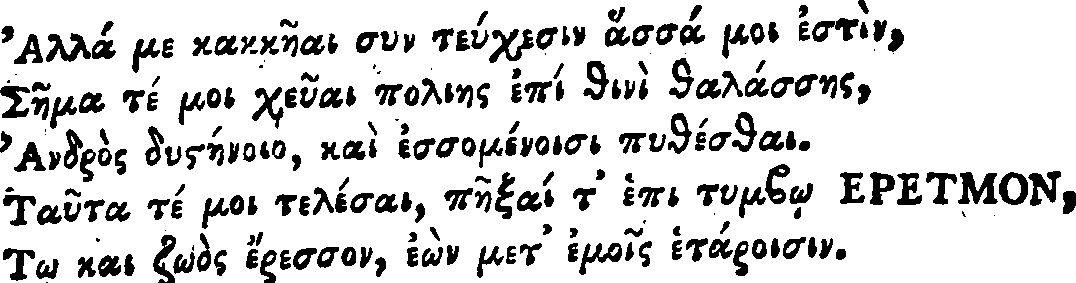
This way of setting forth the office of the deceased, by some instru ment, &c. is very antique; it was practised by the Greeks in the age of Homer, who informs us that when his hero Ulysses visited the infernal shades, he was first addressed by Elpenor, who entreated him to take care of his body, to erect a monument for him, and to put that oar on it, which he was used to row with when alive:
Odys. l. xi.
This was also practised by the Romans, and thus Æneas, in honour of Misenus,
Ingenti mole sepulchrum
Imponit, suaque arma viro, remumque, tubamque. Æn. vi. l. 233.
And in the age of Botwright, &c. nothing was more usual than to transmit to posterity the names of founders, benefactors, and persons interred, by way of rebus and hieroglyphical marks; thus in the chapel of St. Erasmus at Westminster, built by Abbot Islip, are many such devices alluding to his name; as one slipping boughs from a tree, an eye with a slip of a tree, a youth slipping from the bough of a tree, with a label from his mouth J Slip. And in the church of Peterborough, on the present organ-loft, which was the old rood-loft, is a tun, on that a kirk or chirch, and on that the bird called a robin, to set forth the founder, Robert Kirkton, once abbot; and so late as Queen Elizabeth's time we find the same in use, as we may perceive from the staple and tun cut on the cross of this town of Swaffham, in memory of Stapleton, (vicar of this parish) the founder of it.
This rector's will bears date on the Passover, 1474; herein he mentions his guardian angel, Oriel, whom he calls his custos, and desires to be buried before the image of St. Peter, (the saint that is of the church,) gives all his vestments to the church of Swaffham, on condition of being commemorated as a benefactor, to the abbies of Castleacre, Westacre, Pentney, Marham, Blackburgh, Crabhouse, Shouldham, Denny and Carhow, 6s. 8d. each; to every house of friars and nuns, at Lynn and Cambridge, 6s. 8d. bequeaths legacies to the poor of Swaffham, (fn. 41) and a croft to the town; (fn. 42) appoints Simon Blake, Robert Fuller, vicar, and T. Wygenhale, chaplain, his executors.
In this rector's time, the present church was began, about the end of the reign of King Edward IV. when the chancel was finished, by this rector here buried, but the church was not completed till the reign of King Henry VII. and the tower at the west end was not finished till the year 1510.
The communion table is railed in, and has an ascent of two steps, and against the east wall are the Ten Commandments wrote, and over them a glory. On the pavement here, lies a stone in memory of John Case, who died 12 December 1700, æt. suæ 64.
On the north side of this chancel is the vestry, in which is a library; the greatest part of the books were the gift of the Spelmans of Narburgh. Here is preserved a MS. paper book, commonly called the Black Book of Swaffham, (fn. 43) containing a terrier of the lands belonging to the church, an inventory of the vestments, plate, &c. from which I have taken the following account:
There were 6 acres and 3 roods of land to find a light burning before the image of the Virgin Mary in her chapel on the south side of the church, and 6 acres and 2 roods to find lights on Christmas-day, Epiphany and Easter, before the great-crucifix on the rood-loft, and the gilds of the Ascencion, and of St. Nicholas had lands also. (fn. 44)
There was a large gilt chalice, and two lesser chalices; a cloth of gold tissue belonging to St. Nicholas's altar, and an altar cloth of black velvet, and another of fine linen at Trinity altar, given by Dr. Botwright, with much more fine plate and vestments.
The general commemoration or mass for the dead benefactors, was solemnized every Whitsundy, and the day following, mass of requiem was sung by note specially for Dr. Botwright, (fn. 45) and then the following benefactors were commemorated thus:
Ye shall pray especially for the Sowle of Sir John, sumtime Vikar of this Chirch, which gaf 1 Mesbooke, 1 Chalice, 1 Vestment, and a great Chest.
And of Syr John Candeler, (fn. 46) sumetyme Vikar of this Chirch, which give her ii new Graelis, 1 Cross of Copyr gilt with Staff and Baner to the same, 1 Processionari's Tabil gylt upon the hye Auter.
And of Sir John Drew sumtyme Person of Harple, which gave here 1 Vestment for 1 Prest of Bordalisander.
And of Hue Mustarder, which gefe a Chalice, and of Alyce his Wife, which geve the lytel Bell of the Tower.
And of Richard Cross and Katharyne his Wyf, which gave fifty Marks to repair the old Stepil, and the Vestry that is now.
And of Thomas Barber, which geve 1 of the best Antiphoneris, and one Cloth for the Presbyter. (fn. 47)
And of Christian Aloff, which gave a Vestment of reed Sylk for a Sole Prest.
And of Mr. Richard Bastun, somtym Viker here, which geve 1 Mesbok Abbreviatt, and 1 Martiloge, and ii Clothis of Silk for Hersis and Gravis, and in Money xls.
And of Thomas Hykkis, which geve the great Processionary, and of Matthew Mayken which gave 4 reed Vestments.
And of Thomas Blake, which geve 1 Chalice gylt, and the Clock Belle, and did make divers Pathnigs in the old Chirch.
And of John Baxter and Margaret his Wyf, which gave a Sylveren Censure, and in Money 4 Nobles, to the Reparation of the old Chirch.
And of John Bachelor of London, which geve 1 hool reed Vestment,
And of Steveyn Lord and Marion his Wyf, which geve iiii Queen Copis of Bordalysander, ii Aubis for Candelberrers in Procession, and vii Marks for peynting of St. Peter's Tabernacle.
And of Thomas Styward and Cecily his Wyf, which geve i Sautyr to the Queer, and did Seat Stole the North Syde of the old Chirch to the cross Alley between the old Dooris, and did Pathe the middle Chirch from the Quere Dore to the seyd Aley, and did glase ii Wyndows in the Quer, and oder ii in the old Chirch on the South Side, and geve i Invitatory Book, and in Money xls. with other Costs.
And of Maister William Cross sumtyme Viker here, which geve ii hye Latyn Candlestikks before the hye Auter, i Vestment for a Soul sole Prest, and in Mony to the Reparation of the old Chirch vii Marks.
And of Maister John Bery, sumtyme here Parson, which geve the principal Mesbooke, 1 Chalice gravyn and gylt, 1 hool black Vestment for Messis of the Deed, 1 Vestment of red Silk, 1 necessary Book, clep'd the Ordinal, vi Marke to the buying of the new Legendis, and did make the Stallis in the Queer, and celid the Chancell with oder Costis besides.
And of Maister John Walpole sumtyme here Viker, which beside many oder Costis geve to the Reparation of the old Chirch xls. Also for the Soulis of Robert Serjawnt and Katheryn his Wyf, which geve ii Sylveren Candelstykks.
Also Henry Serjeant and Anneys his Wyf, which geve a Crismatory of Sylver, 1 Halywater stop of Sylver, with a Sprykkyllyng Styk to the same, with oder Costis.
And of John Pope which geve a Chalice.
And of Geoffry Sawle and Cecyly his Wyf, which gefe a hool whyght Vestment, i silver Censor, ii sylver Basyns, and did peynt the Images of the old Crucifix, and of our Lady, and of St. John, and geve a reed Clothe for the Presbytery, with Braunchis and Fowlis, and in Money to the Chirch xxvis. viiid. a blue Clothe of Wurstede for the Heerce, and about the hye Autor expended xxiili.
And of Katheryn Robyn, which gave a Pyxt of Sylver, and did glase a Windown in the South Syde of the olde Chirche.
And of Syr John Heylott, that geven to our Ladys Autor a whyght Vestment, and in Money to the Chirch vis. viiid.
And of Geoffry Cursun, which geve the Organys, in the which, and in oder Costis expended in the Chirch xiiili. xiiis. iiiid. And of William Evan, which geve the Lectryn of Latyn in the Queer, and in Money to the olde Rode Lofte iiili. vis. viiid. And of John Bladsmyth, which expended in part of our Ladies Chapel with gravyng and peyntyng of Ymagis and Tabernaclys in the same Chapell, and in Deskys, Tabyll and Clothis to the Auter, a Vestment, and the former Part of the olde Rode-Loft, with the Rode Auter, with oder Costis to the Summe of cxix Marks.
"Also for the Soule of John Chapman (fn. 48) and Catharyne his Wyf, the which geve ij Shyppys of Sylver, ij grete Antiphoners on Grayle; ij gret Candelsticks, on hole sute of Cloth of Tyssews, and also did make the North Ysle, with glasyng, stolyng and Pathing of the same with Marbyl, and did geve to making the New Stepyll in Mony, besyde the Premisses cxxli."
And of William Gardener and Agnes his Wyf, which expended in the old Chirch ixli. And of Syr William Myller, which geve iii Bokys cheny'd in our Ladyse Chapell, and in Mony to the Reparation of the Chirch and the Stepyll, and to the Hollowing of the Chirch viii Marks. And of Jeffrey Baxter and Johne his Wyffe, the which gave ii Paxbreds of Sylver, and on blu Vestment for on Pryst, and in Mony to the Reparation of the Chirch and the Stepyll, with glasing of on Wyndow of the South Part of the Chirch lli. And of William Coo and Emme his Wyf, which did make the Roffe of the Porch, and the Rowell in the Chirche, and also geve in Mony to the Reparation of the Chirch 33s. 4d. And of Robert Payne, the which gaff on Cope of whyght Damaske, and did Pathe the mid Aley of the old Chirch with Marbyl, and also did make a Part of the New Chirch with all Charges, from the nether Cross Alley to the Stepyll, and the RodeAutyr, and the Chapell of the Trynyte, and gaff xx Tun of Free Stone to the Stepyll, and also in Mony to the edyfying of the Stepyll xx Marks. And of Mr. Robert Coppyng, late Parson of this Chirche, which gaff in Mony to the edyfying the Stepyll xx Marks. And of Thomas Bannoke which did glase ii Wyndows in the Chirche, and gaffe in Mony to the edyfying of the Chirch and the Stepyll xiii Mark. And of Thomas Rame, which gaff to the edyfying of the Chirch and Stepyll xs. and in Mony to the making of a new Sepulchyr iiiili. And of Symond Oxborow, the which gaff to the edifying of the Stepyll v Mark. And of William Langman, which gaff to the edyfying of the Stepyll xxxiiis. iiiid. And of Raffe Hamonde, the which did the Cost of Stoling in the Trinity Chapell, and did make the Cofyr that stond in the Vestry to kepe the Tokys and Vestments, and also gaff to the edyfying of the Stepyll xxxiiis. iiiid. And of John Plummere and Margaret his Wyff, which dede expend in making of the old Chapell of the Trynyte, with the Rode-Loft of the said Chapell, and of a Cross of Sylver and Gylt, with other Costs to the Honor of God lxli. And of Richard Plowright and Cecyly Fuller, wheche expended in a Peyre Chaleys, and in other Things to the Honowr of God VI Mark. And of John Walsingham, which expended in Glasing of the gret Wyndow in our Lady's Chapell, and in a blew Cope with ij Tunekells to the same, and to the makyng of the new Chirche and Stepyll xlli. and more. And of John Angere Parson of Southacre, which did Glason a Windowe on the South Syde of the New Chirche.
Also for the Soule of Mr. John Botewryth sumtym Parson of this Chirch, which gaff the Chirche-Crofte, the best blew Chesebyll with a Cope to the same, and divers Bokys cheyn'd in the Chawnsell, and in our Lady's Chapell.
And of Walter Taylor and Isabell his Wyffe, which did make the new Rofe of the Chirch from the Chancel to the Cross-Aley, and gaff an hole Vestment of rede Velvet with Angel splayde, and in Freestone and Mony to the makyng of the Chirch and Stepyll 36li.
And of John Langman and Agnes his Wyffe, which did make all the gret Stolys of both Sydes of the myd Aley.
And of Mr. Robert Fullere sumtyme vicar, which did expend in the makyng the Chirch and Stepyll, and other Costs xxli. And of Thomas Hyx and Alice his Wyff, which gaff a Grayle, ij. Processionarys, and did glasen a window in the Clarestory, and expended in the Reparation of the Stepyll and Chirch xiili. And of Cateryn Norman, of whose Goods were expended to the Honor of God, in this Chirch v Mark. And of Cecyly Blake, which gaff a whyth Vestment to the Rode Auter. And of Thomas Bryston, which gaff a peyr Chaleys, and to the makyng of the Gabyll betwyx the Chirche and the Chaunsell xx Mark. And of Richard Newman and Christian his Wyffe, which gaff to the Reparation of the Chirche XI Mark. And of John Payn and Cateryne his Wyffe, which dede make the lytell Chapell of Corpus Christi, and the Teretory in the same Chapell, and gaff XL Chaldron of Lyme to the makyng of the Stepyll, with many other Costs. And of Thomas Cock, which ded make certeyn Stolys in the South Yle.
Also for the Soules of Symond Blake Gentylman and Jone his Wyff, which ded expendyn in Pathyng with Marbyll of the Cross Aley before Chancell Dore, in reparation of the Organs brokyn with the fallyng of the Chirch, (fn. 49) with glasing of a window in the Claristory, and in finding of a Free-Mason to the making of the Chirch by the space of a Yere, and in Money given to the makyng of the new Stepyll xlli. Also the said Symond and Jone gave the Chawntrey, with Mass Boke, Chalys, Vestment and awther Clothes to the same, and assigned lyvelode be Godd's Grace suffycyent to maynteyn and contynew the same Chauntrey, with the Lawmpe brenyng over his Grave, after the Form of the Wyll Tripartyte of the said Symond made upon the said Chawntrey, and that the Chawntry-Prest shuld begynn his immediately after hys Decesse, he assigned vli. to be delyvered to the Chirch-Revys, to help to pay the said Prest his hyer, unto the Time that Mony myth be made of the Livelode for the said Prest, and he assign'd other vli. to be delyver'd to the said Chirche-Revys, to the Help and Releve of poor Men of this Town, undyr this Form following, that is to say, if any pore Man or pore Woman nedeth to borow Mony to the Sum of vs. and under, that he or she so being in Necessyte shuld have of the Money 5s. upon a suffycient Plegge to ese themselves, be space of half a Yere, and then to bring ageyn and deliver the said vs. to the Chirche Revys, and to have their Pleggs delyver'd agayn unto them. And that the said Plegges shuld be in safe kepyng, he dede ordayn a great chest under ij Keys for to stand in the Chirche, in the which Chest he wold the Plegges should be leyd, and therein safe kept by the Chirche-Revys having the Keys, and the Governawns of the said Chest and Money, to the Use and intent before rehers'd.
Also for the Soule of Thomas Blake, Esq. who gave viiili. to the Augmentation of the Chirche.
And of Thomas Styward and Agnes his Wyff, who gaff a Cross of Silver and gylt, a peyr of Silver Candelstykks ij Silver Basons, a Moustre for the Sacrament, a peyr gret Organs XLli. in Money, and of his Wyffe vli. in Mony, with other divers good deeds.
And of Mr. John Serjeant, (fn. 50) whyche gaff ij Silver Sensurs, ij Shypps, a Halywater Stoppe, and Strengsile of Sylver, and certen Mony.
And of Robert Newman and Katheryne his Wyfe, who gaff in ready Mony to the Steple x Mark, with other Cost and Charges.
And of John Oxburgh and Alys hys Wyffe, which gaff in Money to the Reparation of the Chirch and Stepil xli. xiiis. iiiid. and a Halywater Stopp of Laten.
And of John Newell, which gaff a Chrysmatory of Sylver, and to the Reparation of the Chirche in Money vli.
And of Robert Wyngyff, which gaffe ij Paxeys of Sylver and gylt, and in Money viiili. xiiis. iiiid. and of Margaret Wyngyff hys Wife, in Money to the Reparation of the Stepull vli. with other good deeds.
And of Thomas Blake and Cecely his Wyff, wheche gaffe in Money to the glasing of the Stepull window xli.
And of Thomas Pepyr, which gaff to the Chirche in Money xxli.
And of John Sparke, which gaff ij Corpeis and iij Surpells.
And of Master William Gullet Priest, and many Years Curat here, which gave in Mony to the Byldyng of the Alms-Houses eight Pounds. And of Nicholas Wryght, that gaff unto the Chyrcke a Lyme-Kylle with five Rood of Land. And of Kateryn Colleyn that gaff 3 Surpless to the Honour of God. Also for the Soules of these that follow, who were all benefactors towards building the Church and Steeple.
William Morrel and Catherine his Wife, Thomas and John Morrel, Richard and William Hare, Thomas Wignale, William Carter, John Cooper, William Coppin, William Oldmedew, Thomas Smith, William Coe, John Cantley, Robert Notingham, John Allen and Mary his Wife, John Blake Draper and Elizabeth his Wife, Joan Fayken, Nicholas Grave, Adam Bond, Walter Cely, Margaret Pepyr, Richard Treshare, Margaret Serjeant, Theobald Bryel, Walter Pain, William Ram, John Taylor, John Sibby and Christian his Wife, William Codd and Margaret his Wife, Maud Bolton, John Bryon.
And for the Soules of all the Benefactors of this Church.
I have been the more particular in this last account, because it not only acquaints us with the benefactors and founders of this church, but also with the practice and custom of that age in commemorating them, &c.
Staveley, in his History of Churches, has observed, p. 129, that few of our parochial country churches have any remarks or memorials left of their particular founders, or the time of their building, and assigns this for reason, seeing the modest and pious founders, built these fabricks generally out of pure devotion, they would not in any case sound a trumpet before their own performances. Whereas our ignorance in this case is owing to the great length of time since their foundation, the many alterations and additions that have been made in the churches themselves, and the great disorders and confusions that have happened since the time of their foundation, which have not only defaced and ruined the records and evidences, but even the marble stones and brasses, which would have given us a clear light. The Romish Clergy never enjoined silence in these cases; they were prodigal of their indulgences here, and such benefactors and their posterity were entitled to, and often had most solemn pardons granted them to last for many centuries. They eternalized the memory of their founders, and commemorated them annually and kept their solemn obits; this it was that pushed on the inhabitants of all townships, villages, &c. to contribute: plays also were frequently acted to raise money, which were not only pleasing to the ear, but likewise satisfying the belly. On these obits, gaude-days, days of commemoration, &c. their chief study was to exceed one another, and thus they made the profuseness and vanity of their entertainments a mark of their zeal and devotion:
Prævisis alijs, Eliensia Festa videre, Est quasi prævisa Nocte videre diem.
That they were not so modest is plain, from our frequent meeting with Orate pro anima, &c. even at this time, and to be found almost on every glass window, &c. before the rebellion, from the many shields and arms cut on stone, &c. from old rebusses and allusions to founders names, and from that list of every particular benefactor, which no doubt every church had (as well as this of Swaffham) to commemorate them at stated times.
In the reign of Edward I. the Earl of Richmond was patron of this church; the rector had then a mansion-house near to the church, (fn. 51) and was valued at 70 marks. The vicar had also a mansion-house near the church, (fn. 52) and was valued at 16 marks, the portion of the monastery of Rumburgh here was valued at 20d. Romescot, or Peter-pence 16d. (Domesd. Norwich.)
Rectors.
Turchillus, presbyter, of Swaffham in the reign of King Hen. II.
Alan de Bassyngborne occurs rector about the 20th of Hen. II.
1296, Peter Arnold.
1312, Luke de Chevyngny, presented by John de Britannia Earl of Richmond, to whom he was chaplain.
1349, Robert de Creyk. Queen Philippa.
1380, John Bonryng. John Lestrop, Robert Bealknap, Knt. and John Fitz-Nichol, Esq. attorney generals to John Duke of Britain and Earl of Richmond; and the rectory was then valued at 80l. per annum in the King's Books.
1383, Reginall Hall. King Richard II. the lands of the Earl of Richmond being then in the King's hands; he was rector of Notefeld in the diocese of Winchester, and exchanged with Banryng.
1393, Richard Maudelyn. (fn. 53) Ann Queen of England. In 1294 he was prebend of Heydun cum Walton in the church of Lincoln; and in 1397, rector of Wigan in Lancashire, archdeacon of Sudbury 1398, rector also of East-Derham and of Hays in Middlesex, and in 1299, prebend of St. Stephen's, Westminster.
1398, John Maperley. The King, on the resignation of Maudelyn.
1409, Andrew Bondeby, alias Atte Kyrk. Ralph Nevill Earl of Westmorland; he was sub-dean of York, and rector of Preston in Holderness, Yorkshire, with the chapel of Hedon, and exchanged with Maperley.
1414, John de Aula, or Hall, de Lutchurch, alias Knyvynton. Ralph Earl of Westmorland, on the resignation of Atte Kyrk; this Knyvyngton was vicar of St. Sepulchre's in London, and exchanged with Atte Kyrk.
1414, John Bury. Ralph Earl of Westmorland. He was rector of Snyterle with the chapel of Glaunford, and exchanged with Knyvynton; by his will dated 30th of May 1434, he desires to be buried in the chancel of this church, and the chancel to be selyd with estrych bord at his cost; proved 9th of December, 1434. Regr. Surflete, p. 159.
1435, Mr. John Botwright, A. M. Sacræ Theologiæ Scolaris, on the death of Bury. John Duke of Bedford and Earl of Richmond. Of this rector see before.
1474, Robert Copping, ob.
1495, John de Giglis, LL. D. (fn. 54) King Henry VII, He was rector of St. Michael, Crooked Lane, London; prebend of More and Hoxon in the church of St. Paul's, London; canon of Wells; archdeacon of London 22d of June 1482; rector of Lanham in Suffolk, which he resigned in 1497, being then made Bishop of Worcester.
1497, Peter Caversham. King Henry VII. He was Abbot of Notley in the diocese of Lincoln in Buckinghamshire in 1460, the last rector here,
For King Henry VII. patron of the church, by charter dated at Westminster the 12th of June in the 18th year of his reign, granted to John, then abbot, and to the prior and convent of Westminster, and their successours, the advowson and patronage of this rectory in free almes, with license to appropriate the same to them and their successours; pursuant to which, the said rectory was appropriated in the year 1503, and King Henry VIII. on the 9th of August, in the 34th year of his reign, granted the rectory to the dean and chapter of Westminster, on the erection of that church into an episcopal see, to hold freely in pure almes, except 3l. 6s. 8d. paid yearly to the Bishop of Norwich, and 10s. to the archdeacon for procurations, and the impropriation is at this day in the church of Westminster. (fn. 55) Dr. Reuben Clarke, late archdeacon of Essex, had the lease of the impropriation, and it now belongs to his son, who is a minor, for whom Baron Clarke acts as guardian.
Caversham died in 1503, and was presented to the church of Sawtre-All-Saints in Huntingdonshire, on the 7th of May 1488, by the abbot and convent of Ramsey.
There was from the most ancient times a vicar under the rector, presented by him; so that the rectory was a sinecure.
Vicars.
1299, Richard de Wichford, collated by the Bishop.
1309, Thomas de Langeford, presented by Peter Arnold, rector.
1312, John de Suthgate, collated by the Bishop of Norwich.
1322, Walter Corpekyll of Dunham. Luke de Chevyngne, rector.
1339, John de Welveton. Ditto.
1339, John Giffard. Ditto. He was vicar of Bassingbourn in Cambridgeshire, and exchanged with Welveton.
1348, John Say. Ditto.
1350, William Robyn. Robert de Creyk, rector.
1358, William Cote. Ditto.
1388, John Candeler. Reginald Halle, rector. Candeler was afterwards rector of Dalham in Suffolk, Barton St. Andrew, and Lynn All-Saints in Norfolk.
1404, John Clerk. John Maperly, rector. He was rector of Dalham, and exchanged with Candeler.
1407, Richard Baston. Ditto. He was vicar of Hokyngton in Cambridgeshire, and exchanged with Clerk.
1420, William Cross, S. T. B. by John Bury, rector, on the resignation of Baston; by his will dated on Thursday after the Feast of St. Lawrence 1434, he desires to be buried in the chancel of Swaffham, gives to Pembroke-Hall in Cambridge, (where he was educated,) 40s. (Regr. Surflete, p. 148.)
1434, John Cateroff. John Bury. Res.
1434, John Walpole, after rector of Fincham St. Michael. Ditto.
1436, John Moresburgh, ob. He was rector of Shipdam, and exchanged with Walpole. John Botwright, rector here, and patron as rector, of this vicarage.
1465, Robert Fuller, A. M. Ditto.
1488, John Carter, collated by the Bishop of Norwich.
1514, Thomas Leman; he was afterwards rector of Southacre.
1534, Nicholas Tymperley, not 18 years of age, ob. By Thomas Duke of Norfolk, assignee to the abbot and convent of Westminster.
1550, John Fuller, LL. D. (fn. 56) The Bishop of Norwich. He was rector of East-Derham and North-Creak, and vicar general to the Bishop of Norwich in 1550. About this time the patronage of this vicarage was given by King Edward VI. to the Bishop of Norwich, and his successours. (fn. 57)
September 4, 1554, Thomas Dysse, S. T. P. The Bishop of Norwich. Rector also of Bradwell in Suffolk.
Robert Stapleton, (fn. 58) who built the Market Cross.
1575, George Gardiner, S. T. P. the Queen. Res. He was dean of Norwich, &c. (fn. 59)
1580, Robert Grafton, A. M. ob.
1589, Francis Snell, S. T. B. ob.
1589, Nicholas Bate, A. M. ob. He was prebend of the fourth stall in the the church of Norwich. (fn. 60) In his answers to King James, 1603, he says there were then 500 communicants here.
1628, Gregory Franklyng, A. M. ob.
1630, Robert King, S. T. B. rector also of St. Michael Coslany in Norwich.
1662, Thomas Roberts. He was vicar also of Fouldon, ob.
1678, John Sparrow, A. M. ob.
1696, Thomas Ibbot, A. B. res. He was also rector of Beachamwell St. John, St. Mary and All-Saints, educated at Clare-Hall, Cambridge.
1720, Joseph Charles, rector of Wacton Parva in 1719, educated at Jesus college in Oxford, and rector of South Pickenham, ob.
1737, James Reynolds, was collated by Bishop Butts, his father-inlaw, and held it with the rectory of Lackford in Suffolk, but being collated by the said Bishop, then Bishop of Ely, to the rectory of Willingham in the county of Cambridge, which he now holds with Lackford, he resigned this, and in
1738, Robert Say was collated by Bishop Gooch, and held it united to the rectories of Beachamwell St. Mary and St. John consolidated, but on his taking the consolidated rectory of North Pickenham and Houghton, (as at p. 133,) he resigned this vicarage, and in
1748, Dr. Samuel Lisle, then Bishop of Norwich, collated his domestick chaplain, the Rev. Mr. Gilbert Bouchery, A. M. the present vicar, son of Weyman Bouchery, late rector of Blakenham Super Montem, in Suffolk; he was born at Ipswich, and was scholar and fellow of Clarehall in Cambridge; on his taking Swaffham, he voided the rectory of LLanymynech in Shropshire, which he was collated to by Bishop Lisle, when on the see of St. Asaph, of whose gift he now holds the prebend of Meliden in the church of St. Asaph, and the sinecure rectory of LLansanfraid in Montgomeryshire.
The vicarage is valued at 14l. 5s. 10d. in the King's Books, and being undischarged, pays first fruits, and 1l. 8s. 7d. yearly-tenths. The Revision in 1630 says, that the farmer of the impropriate rectory paid an annual pension of 10s. and the vicar paid synodals to the Bishop 2s. 8d. visitatorial procurations 3s. 6d. ob. qr. archidiaconal procurations 7s. 7d. ob. The Terrier in 1747, hath a vicarage-house on the north side of the churchyard, the site of it, with the two gardens, contain 1 acre 1 rood; the churchyard contains 3 acres, and the whole glebe is 41 acres in 27 pieces.
There is paid to the vicar 10l. yearly, 5l. at Midsummer, and 5l. at Christmas, and ten combs of the best dressed wheat, ten combs of best dressed mistling, five combs of rye, and five combs of barley, yearly, by the impropriators or their tenants.
The tithes of hay, clover, turnips, lamb and wool belong to the vicar, also all other small tithes and ecclesiastical dues. Also 4d. a cow, or two meals of milk in Whitsun-week, one penny herbage, and one halfpenny the calf, and one penny for a heifer dry stock, for a heifer of the 1st calf 1d. herbage; and a half-penny the calf, and 3d. the two meals for milk.
Mortuaries are due to the vicar, and Easter offerings from all above 16 years old, by custom, as was proved upon a trial between the Rev. Mr. Robert Say and Travel Fuller, at Thetford assizes in 1746.
The real value of this vicarage is above 100l. per annum. (fn. 61)
There are two small manors in this town, known by the name of Haspals and Whitesands, the quitrents of which, and other dues belonging to the same, the churchwardens receive for the use of the town.
Also an estate of about 50l. a year, which being formerly chantry lands, was given to the town by King Edward VI. and since confirmed by several royal grants, and is appropriated to the relief of 9 poor widows, the reparation of the church, mending the highways, repairing the town-houses and town-wells, and payment of the clerk and sexton their wages.
Susan Machin, widow, gave 12s. yearly to the churchwardens, for the use of 12 widows who take no collection.
Edward Chapman, Gent. gave 10l. the interest for the poor, to be paid by the churchwardens.
Thomas Theodorick gave three dwellings for 6 poor people.
There is also an alms-house in Mangate-street. (fn. 62)
There is now on the north side of the churchyard, a house standing towards the eastern part of it, the lower part for the use of the clerk of the parish church, and the upper part for the use of a schoolmaster, to be chosen by the minister and church-wardens, and the majority of the parishioners then present.
There is a free-school lately built in the Camping-land, founded by Nicholas Hammond, Gent. late of this parish, with a dwelling for the master, and the interest of 500l. (until a purchase can be made) for teaching 20 boys; the choice of the master is in the following trustees, the vicar of Swaffham, the rectors of Necton, Great Cressingham, Ashill, and Hilburgh, and their successours for ever.
Over the school-house door, are the crest and arms of Hammond;
Crest, on a mound vert, a dove rising with an olive-branch in its mouth proper.
Or, on a chevron sable, voided az. three martlets of the field.
1736, Nicholas Hammond, Esq. gave by will, in 1724, a thousand pounds, five hundred for erecting a school-house, five hundred for endowing the same, for instructing xx. boys in reading, writing and arithmetic.
Benefactors, who promote knowledge, virtue and industry, Deserve to be recorded on earth, and rewarded in Heaven.
There is a silver chalice and patin of about 36 oz.
Books in the library, on the north side of the chancel, as by the catalogue appear.
The biggest bell weighs about 20 hundred weight.
Here was also, besides the parochial church of Swaffham, and the CHAPEL of St. Guthlack, a free chapel, dedicated to St. Mary, said to be in the manor of John de Britannia Earl of Richmond, and in the parish of Swaffham.
This chapel was well endowed, John de Britannia abovementioned gave to his chaplain here and to his successours, in the 32d of Edward I. 38 acres of land in Swaffham, (fn. 63) and one messuage; and divers others, gave to the said chaplain, other lands in Swaffham and elsewhere. From the Institution Books at Norwich, I find
That this chapel was given to John son of Henry de Suthgate of Swaffham, on the 25th of May 1319, by John Earl of Richmond. (fn. 64)
1349, William Robyn, was instituted and presented by Queen Philippa. (Lib. Instit. 4, p. 113.)
1351, Richard Talbot. Ditto. &c.
Julian Model of Swaffham wills, in 1422, to be buried in the church. (Regr. Hurning, p. 106.)
Thomas Steward of Swaffham gives by will, in 1433, to every light sustained or maintained by charity, 8d. (because many lights had land bequeathed for their perpetual maintenance,) and to the work of St. Guthlack's chapel 40d. (Regr. Surflete, p. 127.)
In the year 1485, I find that the gild of St. John Baptist in this town flourished much; in that year Robert Fuller the vicar was chosen alderman of it, John Bryston and John Gold, treasurers, and John Sawer, bedell; that gild then numbered 77 brothers and sisters, who paid each 40d. ob. per annum.
Thomas Styward of Swaffham, Gent. by Will, 1511, bequeaths to the Repair of this Church xl. and a Monster of Sylver Gylt, for to beare the Blessed Sacrament, weyng 100 Ounces and above. Also a payer of Organs, the Price xxiiii Marks or more, (by this Will, &c. it appears here was service as in choirs or cathedral churches,) Item To the Repair of 60 Parish Churches next adjoining unto the said Town 20s. each, but to Sporle Church 40s. Item To the renewing the Charter of Swaffham x li. (Regr. Johnson, fo. 29.)
In the parlour of the vicarage-house are these arms painted in glass, Touchet and Audley (as before) quarterly, sab. three martlets arg. Naunton impaling sab. an estoil or, between two flaunches ermine, Hobert, but this shield is transposed. The badge of King Henry VII. the white and red rose united, France and England quarterly or, a chevron between three lions heads gules, Nix Bishop of Norwich, in whose time the house was built.
This town hath been also noted, as the birthplace of brother John de Swaffham, D. D. of Cambridge, and a Carmelite or white-friar of the monastery at Lyn, where he was educated; he was allowed to be a man of great learning, but employed it in a very strenuous manner against the doctrine of Wickliff, against whose followers he wrote a book; (fn. 65) he was made Bishop of Bangor by Pope Gregory XI. and lived in 1394, in King Richard the Second's time; being an active man under Pope Boniface IX. at the council held at Stanford, against the disciples of Wickliff.