Survey of London: Volume 11, Chelsea, Part IV: the Royal Hospital. Originally published by London County Council, London, 1927.
This free content was digitised by double rekeying. All rights reserved.
'The Royal Hospital: King James's Theological College', in Survey of London: Volume 11, Chelsea, Part IV: the Royal Hospital, ed. Walter H Godfrey (London, 1927), British History Online https://www.british-history.ac.uk/survey-london/vol11/pt4/pp1-4 [accessed 30 April 2025].
'The Royal Hospital: King James's Theological College', in Survey of London: Volume 11, Chelsea, Part IV: the Royal Hospital. Edited by Walter H Godfrey (London, 1927), British History Online, accessed April 30, 2025, https://www.british-history.ac.uk/survey-london/vol11/pt4/pp1-4.
"The Royal Hospital: King James's Theological College". Survey of London: Volume 11, Chelsea, Part IV: the Royal Hospital. Ed. Walter H Godfrey (London, 1927), British History Online. Web. 30 April 2025. https://www.british-history.ac.uk/survey-london/vol11/pt4/pp1-4.
I.—KING JAMES'S THEOLOGICAL COLLEGE
The Royal Hospital, Chelsea, stands upon the site of an earlier building which was pulled down when the hospital was built. This was the ill–fated Theological College, founded by James I, the memory of which has not entirely departed from Chelsea, where the present hospital is still called familiarly "the College." The prime mover in the institution of a College for the express purpose of training the clergy to engage effectively in the sharp controversies of the time, was Matthew Sutcliffe, Dean of Exeter, and he seems to have provided the chief part of the funds for its first establishment. The King regarded the project with so much favour that he identified his own name with the College, and gave by letters patent the reversion of land in Chelsea of which a lease was held by Margaret Countess of Nottingham for her lifetime and 40 years thereafter. (fn. 1) This land was part of Thames Shot, a portion of the Manor of Chelsea which had come to the Crown from the Abbey of Westminster at the Dissolution of the Monasteries, and had remained in the King's hands when the rest of the property was sold. The remainder of the lease was assigned to Sutcliffe by the Earl of Nottingham at a yearly rent of £7 10s., and preparations for building were immediately made. The King laid the foundation-stone on May 8th, 1609, and the Charter of Incorporation is dated exactly twelve months later.
The structure, for which the King gave the timber from Windsor Forest, was designed as a large double quadrangle, of which, however, only one side of (presumably) the southern court was ever completed. The views of the projected College, as shown in Dr. Darley's Glory of Chelsey College now Revived (1662) and in Grose's Military Antiquities, indicate a curious arrangement. The south court is formed of three ranges of building, four storeys high, with massive square angle towers at the extremity of each range, a gatehouse in the centre of the south range towards the river, and on the inner side of the east and west ranges a central porch carried up as a square tower, and two intermediate circular towers. Into this south court the northern quadrangle projects for half its area. The latter is composed of four ranges of building two storeys only in height, the east and western sides of which have a central tower corresponding to a small tower attached to each of the northern blocks at the extremities of the larger court, which is apparently entered here by gates. The south block has a cloister walk on the ground floor and twin towers in the centre; the north block is also furnished with twin towers, and circular turrets at the external angles. There are some low buildings shown to the east, and what appears to be a chapel is seen projecting from the western side of the southern quadrangle. The part of the College which was actually built is described in the Parliamentary Survey (fn. 2) as follows: "All that capitall messuage called the Colledge of king James in Chelsey neere London of the foundacon of the said king James of England scituate and being on a parcell of land called Theamshott in a Comon feild called Eastfeild in Chelsey aforesaid built of bricke and couered with tyle haueing large gutters of lead with spouts for the passage of the water Consisting of an Entry, A Kitchin, Two Buttrys, Two larders, A hall and two large Parlours wainscotted with a Clossett in each of the said Parlours below staires. In the second story ffoure faire Chambers wainscotted, Two Withdrawing roomes and foure Clossetts. In the third story foure large Chambers wainscotted, Two withdrawing roomes and foure Clossetts. And over them all being a foureth story of a very large gallery haueing at each end a little roome with Turretts over them covered with slatt which said house conteines in length from East to West one hundred and thirty foote of assize or thereabouts And in breadth from North to South thirty-three foote of assize or thereabouts Together with a yard encompassed with a bricke wall lyeing on the East end and parte of the South side of the said messuage wherein stands a Kitchin and Stable with lofts over them built of bricke and couered with tyle, One gardine encompassed with a bricke wall lyeing on the other parte of the South side of the said messuage and on the west end thereof with a row of Elmes before the South side of the said messuage And alsoe one yard on the North side of the said house walled at both ends and fenced with sawne pales on the North side All which Conteines by estimacon one acre worth by the yeare thirty pounds. xxx li."
The failure to complete the buildings was due entirely to the lack of public support, in spite of urgent appeals by the Archbishop of Canterbury to the bishops and clergy, sent at the instance of the King himself. The re-imposition of a poll-tax to be paid on taking the oath of allegiance and supremacy to aid the funds apparently proved abortive, and an Act of Parliament empowering the College to supply the city of London with water from Hackney Marsh failed to bring aid, since the scheme could not compete with Sir Hugh Myddleton's supply from the New River. The short history of the College is a record of a hopeless struggle with inadequate resources rendered more difficult by frequent litigation.
The establishment of the College consisted of a Provost, 17 Fellows and two Historians. The first names, selected by King James, were as follows:—
Provost: Matthew Sutcliffe, Dean of Exeter.
Fellows: John Overall, Dean of St. Paul's; Thomas Morton, Dean of Winchester; Richard Field, Dean of Gloucester; Robert Abbot, Chaplain to the King and afterwards Bishop of Salisbury; John Spencer, President of Corpus Christi, Oxford; Miles Smith, one of the translators of the Bible and afterwards Bishop of Gloucester; William Covitt (fn. 3); John Howson, who later held the Sees of Oxford and Durham; John Layfield, Rector of St. Clement Danes and one of the translators of the Bible; Benjamin Charrier; Martin Fotherby, afterwards Bishop of Salisbury; John Boys, one of the translators of the Bible; Richard Brett, another translator of the Bible and Rector of Quainton, Bucks.; Peter Lilly, afterwards a brother of Savoy Hospital, Prebend of St. Paul's and Archdeacon of Taunton; Francis Burley; John White; William Hellier (treasurer of the College), Archdeacon of Barnstaple.
Historians: William Camden, Clarencieux, author of Britannia; and Sir John Hayward, Kt., author of a number of royal biographies and other historical works.
The list is perhaps most interesting in its inclusion of the last two names, especially that of Camden: it shows the importance the King attached to the work which he proposed for the College. Thomas Faulkner gives a later list (fn. 4) and also particulars of persons admitted to fellowship, including the notorious Marcus Antonio de Dominis, Archbishop of Spalato. There were provosts of the College as follows:—
1610–1629. Matthew Sutcliffe, Dean of Exeter.
1629–1645. Daniel Featley.
1645–. William Slater.
Samuel Wilkinson, Rector of Chelsea.
Dean Sutcliffe left considerable property to the College which he had served so well, but his will was disputed and the College did not benefit. During Dr. Featley's term of office the College seems to have continued its existence in a very feeble state. In resisting an application by Sir Francis Kyneston to the King for permission to move an educational establishment called the Museum Minervæ to the College, during a visitation of the plague in 1636, Dr. Featley could give the names of only two fellows in residence, namely, Dr. William Slater and Mr. John Burley. A significant sentence occurs in a letter written by George Collington to Archbishop Laud, (fn. 5) suggesting that the College endowments "might be established upon the reparation of St. Paul's, and there to continue, until altercation and controversy in religion be necessary in a Christian Commonwealth or until Oxford and Cambridge (the two prime seminaries of learning in Christendom) shall grow barren of able divines!" The back of this paper is appropriately endorsed "Controversy College."
In the will of Dr. Godfrey Goodman (dated 17th January, 1655) the College is mentioned as "dissolved" (vide Faulkner).
After being used as a prison during the Commonwealth, it appears to have continued in use after the Restoration for various public services. From 1664–66 it housed the prisoners of war taken in the sea-fights with the Dutch, and John Evelyn has many references to it, when he was entrusted with the care of these seamen. (fn. 6) In 1667 there are records of French prisoners here also. (fn. 7) At this time the owner of the unexpired term of the original lease to the Countess of Nottingham was a certain Andrew Cole, and in February, 1667–68, he was induced to assign it to the newly formed Royal Society. This was confirmed by Charles II, (fn. 8) who set aside a petition from John Sutcliffe, nephew of the first provost, who had applied for the property on the ground that his uncle had provided most of the money for erecting the building.
The Royal Society did not hold the college for long. They found it unsuitable for their purpose, and its condition no doubt was such as to promise them endless trouble and expense. They were relieved in a timely manner of this incubus by the proposal to use the site for the new Royal Hospital, and on 11th January, 1681–82, they sold the College and lands to the Crown for the sum of £1300.
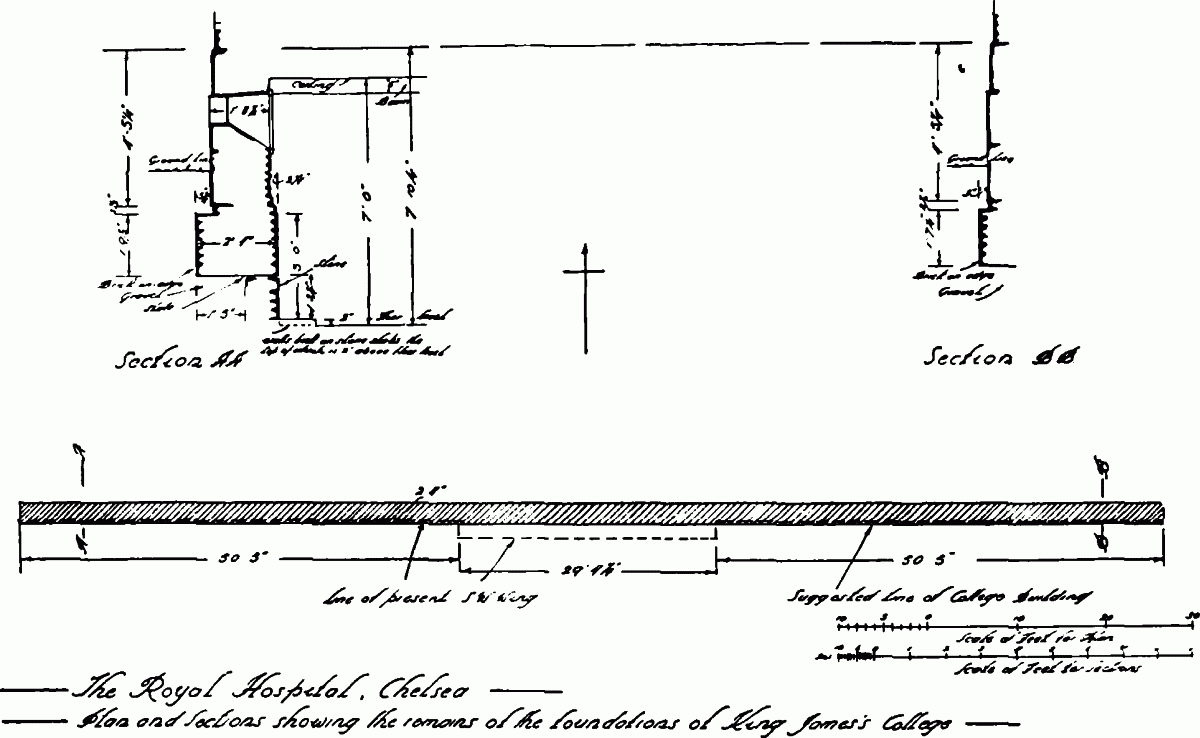
Plan and sections showing the remains of the foundations of King James's College