A History of the County of Somerset: Volume 4. Originally published by Victoria County History, London, 1978.
This free content was digitised by double rekeying. All rights reserved.
A P Baggs, R J E Bush, 'Parishes: Crewkerne', in A History of the County of Somerset: Volume 4, ed. R W Dunning (London, 1978), British History Online https://www.british-history.ac.uk/vch/som/vol4/pp4-38 [accessed 3 May 2025].
A P Baggs, R J E Bush, 'Parishes: Crewkerne', in A History of the County of Somerset: Volume 4. Edited by R W Dunning (London, 1978), British History Online, accessed May 3, 2025, https://www.british-history.ac.uk/vch/som/vol4/pp4-38.
A P Baggs, R J E Bush. "Parishes: Crewkerne". A History of the County of Somerset: Volume 4. Ed. R W Dunning (London, 1978), British History Online. Web. 3 May 2025. https://www.british-history.ac.uk/vch/som/vol4/pp4-38.
In this section
CREWKERNE
The Town of Crewkerne lies within a large parish on the southern boundary of the county and hundred. (fn. 1) Its church was a minster, (fn. 2) serving as the mother church of a Saxon royal estate in existence by the end of the 9th century; an estate whose boundaries were clearly marked by the river Axe in the south and the river Parrett on the east, but less obviously by streams in the north, one of which virtually touched the village of Merriott, the 'boundary gate' on the road to Crewkerne from the north. (fn. 3) The western boundary bears marks of later origin in its regularity and its failure to follow any natural feature. (fn. 4)
The creation of independent parochial units around the dependent chapels of the minster at Wayford, Seaborough, and Misterton from the 13th century (fn. 5) considerably reduced the area of the parochia served directly by the parish church, and radically altered its southern boundary. The eastern limit was similarly modified in the late 13th century by the emergence of Eastham as an independent parish, (fn. 6) but returned to its ancient line when the living was consolidated with Crewkerne in the 20th century. The northern boundary was less easily defined because the manor of Crewkerne possessed land at Shutteroaks in Merriott parish, and because Furland, a tithe-free area within Crewkerne parish, was almost certainly within the medieval field-system of Hinton St. George. (fn. 7) The Crewkerne tithe award thus omitted both Furland and part of Hinton Park since it also paid no tithe, so that the parish in 1842 was thought to comprise 4,667 a., together with 205 a. at Eastham. (fn. 8) In 1901 the area of the parish was 5,331 a. (fn. 9)
The ancient town lay below the eastern end of the Windwhistle ridge, in a coombe just above the 200 ft. contour, sheltered from the north-east by Bincombe Hill, possibly the 'cruc' which gave the town its name. (fn. 10) The church occupies a position at the end of a small plateau above the town centre, (fn. 11) very like that of South Petherton. To the north and east of the town the gentle contours on the heavilyfaulted Yeovil Sands and limestone, (fn. 12) generally falling towards Merriott and the Parrett, provided the main stretches of meadow land, concentrated at Furringdons in the north-east. In the 16th and early 17th centuries there is some evidence of water meadows in the area. (fn. 13) To the south and west the more irregular and dramatic landscape, cut by a stream flowing south through Hewish and Clapton to the Axe, rises to over 600 ft. in the south at Henley and to over 775 ft. in the extreme northwest. The complicated geological formation of the Windwhistle ridge, including clay, flints, chalk, and greensand, provided a source for stone, sand, lime, marl, and clay for farmers, builders, and brick makers. (fn. 14)
Place-name evidence as well as the irregularity of the fields suggests that much of this hilly land was wooded in early times. Henley, Growley, Putelegh, Wyteley, Venley, and Laymore indicate woodland and woodland clearings; and scrubland survived in the west of the parish at Blackmoor, Ridge Hill, Ridge wood, Shave, and Croft in 1315. The common at Roundham was then partially moorland. (fn. 15) A park was created at Clapton by the 13th century (fn. 16) and another at Furringdons by the 16th, the latter then divided between Cow park and Knight's park. (fn. 17) During the 18th and early 19th centuries the Pouletts encouraged tree planting on their holdings at Tuncombe, Coombe, and Misterton, and also increased the timber around Hinton Park. (fn. 18)
The original parish included not only the central settlement of Crewkerne itself but villages and hamlets within a radius of some four miles. Eastham and Seaborough became the centres of separate estates before 1086, (fn. 19) and the former achieved ecclesiastical independence in 1295. (fn. 20) Seaborough continued to pay dues to Crewkerne and to bury its dead at the mother church until the 18th century, (fn. 21) but its transfer to Dorset in 1896 precludes further study. Eastham's development as a separate village was unsuccessful: its church was a ruin by the 16th century, (fn. 22) indicating earlier depopulation. Wayford and Misterton, like Seaborough, acknowledged ecclesiastical links with Crewkerne until the early 19th century, though Wayford was otherwise independent by the 13th century. Only Misterton remained in obvious economic dependence on its near and larger neighbour.
The smaller hamlets remaining within Crewkerne parish include the early valley settlements of Coombe, Tuncombe, and Clapton, the former yielding a hoard of 4th-century Roman coins; (fn. 23) Furland, Croft, Henley, and Hewish, whose names indicate early stages of cultivation and settlement; and Woolminstone, occurring in 1236 as Wulureston, (fn. 24) recalling either an early settler or the fauna of the former woodland. (fn. 25) At least until the 16th century Woolminstone and Hewish seem to have been the largest of these hamlets, and with Clapton continued so in the 20th century. (fn. 26) A green is referred to at Woolminstone in 1752. (fn. 27) Furland, Coombe, Henley, and Tuncombe became the sites of substantial farmsteads. In 1327 the first had 7 tax payers, 6 men were mustered in 1539, and there were 8 holdings there in 1653. (fn. 28) A consolidated farm, Furland farm, was created there by William Hussey between 1787 and 1789. (fn. 29) Coombe, known from its proximity to St. Reyne's chapel as Coombe St. Reyne in the early 13th century, (fn. 30) was detached from Crewkerne manor in 1541 and became part of the Poulett estate. (fn. 31) By the end of the 16th century it had developed into a single consolidated farmstead. (fn. 32) Croft, apparently divided into two holdings in the mid 13th century and known as Craft St. Reyne and Countess's Craft, (fn. 33) lay in the extreme north-west of the parish. Croft castle, traditionally the site of a medieval stronghold, (fn. 34) lies to the east of earthworks which may well represent the hamlet of Croft, on the northern slopes of Windwhistle. Croft was another part of the manor sold to the Pouletts in 1541. (fn. 35) There were 6 tax payers there, and 6 at Coombe in 1327, (fn. 36) but by 1539 the name Craft as a village or hamlet had disappeared. (fn. 37)
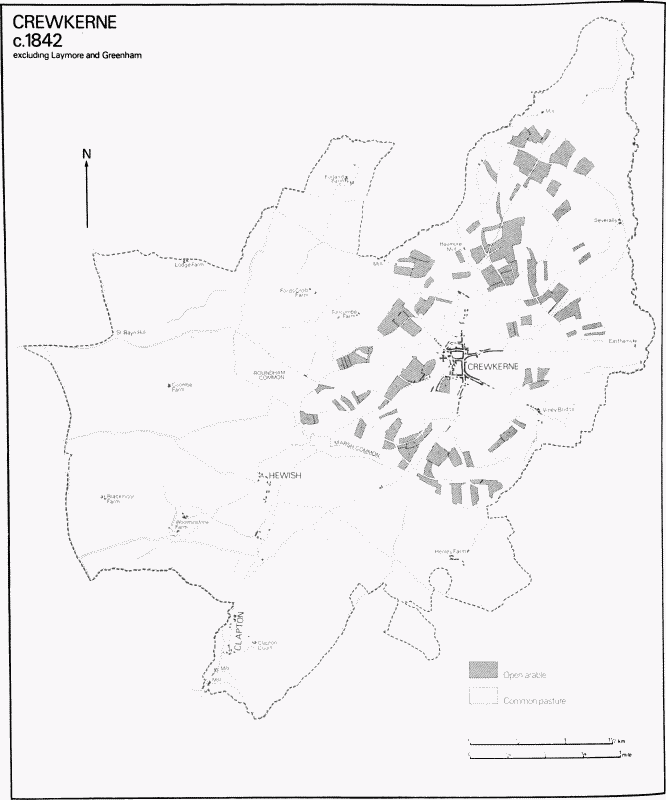
In 1599 it was clearly stated that there was no intercommoning between the tithings in the parish. (fn. 38) The manors of Crewkerne Magna and Crewkerne Parva, the former including Hewish and Woolminstone, (fn. 39) shared three common arable fields, but there is no evidence for open fields at Clapton or Henley, and only a group of furlongs and cultures at Eastham in the late 13th century. (fn. 40) The very independence of these settlements outside the main manor, however, at least implies some measure of separate agricultural development. The north and south fields of Crewkerne occur in the mid 13th century, (fn. 41) and north, south, and west fields, shared between the two Crewkerne manors, by the early 16th. (fn. 42) In the later 16th century these were known as north, south, and east, evidence of some reorganization. North field was north-west of the town, between Tuncombe and the mill stream beside North Street. It was later known variously as North-west, West, or Cuckoo field. South field, known in 1609 as West Southfield, (fn. 43) and later as Higher or South-west field, was bounded by Marsh common and Folly and Henley farms, and by the boundary with Misterton. East field, the largest of the three, and subsequently called Northeast or Lower field, adjoined the town on its eastern side. The Severalls estate, later Lower Severalls, was carved out of it in the 17th century. (fn. 44)
The principal areas of common meadow and pasture were at Roundham and Marsh, with a small meadow at Blacknell. The lord of the manor had 50 a. of pasture at 'Rowenham' in 1315 (fn. 45) and let the grazing in the early 16th century. (fn. 46) It was inclosed in 1823. (fn. 47) Traces of it survive in the hamlet of Roundham, the houses built on the waste at the edge of the common beside the Chard road. Marsh common adjoined Roundham common to the southeast, running into the valley now occupied by the railway. This tract was also inclosed in 1823.
Crewkerne was described in the 16th century as 'a thorough fare betwixt London and Exeter', (fn. 48) and its position on that route was the key to its prosperity in subsequent centuries. This was, however, only one of the roads which converged on the town, fanning out southwards into Dorset with direct links to Lyme Regis, Bridport, and Dorchester, and northwards to Merriott and Somerton. (fn. 49) Two roads were outside this pattern, the most important linking Roundham with Misterton, bypassing the town on the south-west. In the late 18th century it was known as Portway Lane between Roundham and Maiden Beech Tree, (fn. 50) and thereafter as Lang Lane. (fn. 51) Its present width is an indication of its former status as the main coach route between Taunton and Bridport in the 1790s. (fn. 52) A parallel route further south-west, through Hewish and over Shave Hill, has the appearance of a prehistoric ridgeway.
The chronology of the turnpikes emphasizes the relative importance of Crewkerne's roads. The London-Exeter route from Haselbury Bridge on the eastern boundary through the town to Lady's Down on St. Rayn's Hill, was adopted by a trust based at Chard in 1753, but was taken over by the Crewkerne trust in 1825. (fn. 53) The Crewkerne trust, established in 1765, immediately adopted the main north-south routes from Ilchester and Taunton via Provost (or Prophet's) Lane in Stoke sub Hamdon and Lopen Head to Misterton, Clapton, and the Dorset ports. Also taken over at the same time was the Portway route from Roundham and the tortuous road to Hinton St. George through Furland. (fn. 54) Extensions in 1825 brought in Furringdons Lane from Haselbury to Merriott. The most obvious road improvements were the realignment of the Chard road west of the town north of its original course along Lyewater, and Gouldsbrook Terrace, the new road into Goulds Barton, both done before 1841, (fn. 55) and improvements on the same road east of the town at Clammer Hill, (fn. 56) by Easthams toll gate, and at Haselbury Bridge. (fn. 57)
The principal bridge in the parish was over the Axe at Clapton. It was said to be 'fallen into great decay' in 1629. (fn. 58) There was a washing-place for sheep near by in 1652. (fn. 59)
The London and South-Western railway, constructed in 1860 well south of the town, caused a road diversion at Hewish and involved the sale of the remaining piece of Marsh common. (fn. 60) Crewkerne station lies in Misterton parish, but dwellings near it in Crewkerne owe their position entirely to the railway.
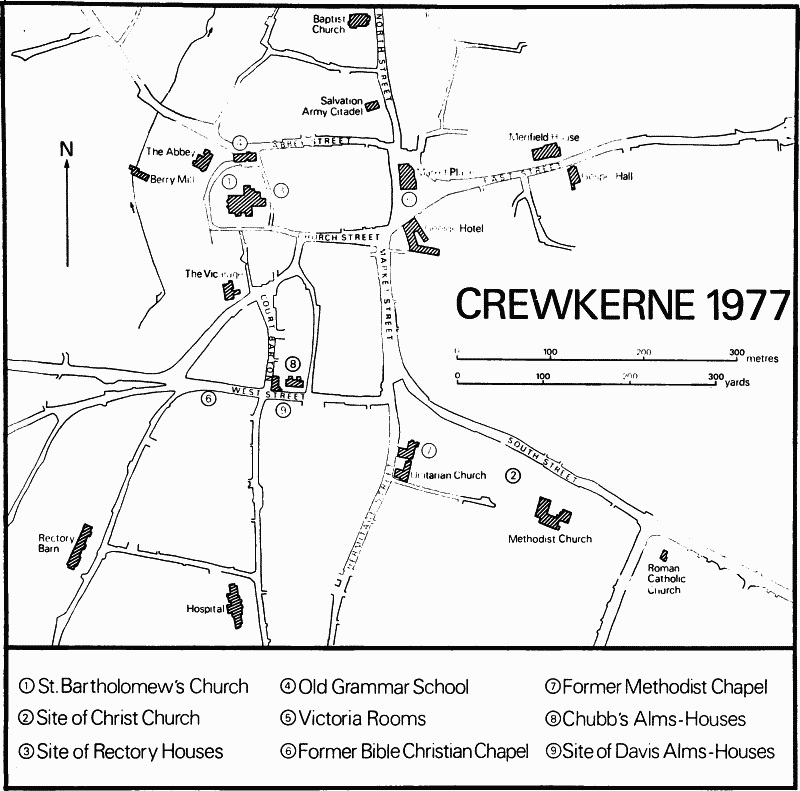
The tortuous convergence of even the main roads on the present market place indicates that the original street pattern has been modified in antiquity. Properties between church and market place belonged until the 19th century, with a single exception, to the rectory estate, suggesting that the whole area was once an open space, occupied in part by churchyard and in part by an enlarged market area. (fn. 61) The division of the rectory into portions in the late 13th century and the erection of clergy houses east of the church in consequence, may have been the occasion for the encroachment.
From the market place, the south side of which was known as Fore Street from the 16th century to the late 18th, (fn. 62) streets radiated to the cardinal points. East Street was so called at the end of the 13th century; (fn. 63) South Street, including the present Market Street, occurs in 1548; (fn. 64) and the north street in 1584. (fn. 65) Westwards from the market place, leading to Hinton St. George and beyond, was Carter Street, a name perhaps indicating its function as an early trade route and so called by 1539. (fn. 66) In more genteel times it became the residential Abbey Street after the rebuilding of the parsonage house c. 1846. The name Church Street has been found only from 1727, (fn. 67) and a possible earlier alternative is 'Scole strete', occurring in the mid 13th century. (fn. 68) New Court Lane evidently lay east of the church, between Carter and Church streets, and was probably so called because of one of the clergy houses there in the late 15th century. (fn. 69) The 18th-century Cross Tree Street or Cross Street, so called after a tree standing there in 1640, was at the southern end of Market Street at the junction with Hermitage and West streets. (fn. 70)
The growth of population and trade extended the built-up area and changed street names. Pig Market Street, possibly at the north end of the market place towards Bincombe Lane, occurs in 1680; (fn. 71) Oxen Lane (but perhaps referring to the former manorhouse complex and not to the town's market) in 1740; (fn. 72) and Sheep Market Street (the 20th-century Market Street) by 1772, possibly as a result of the establishment of a sheep market in 1753. (fn. 73) Almshouse Street was the 18th-century name for West Street after the founding of the Davis alms-houses there, though the name Chard Street occurs and West Street continued. (fn. 74) Hermitage Street is also an 18th-century name in recognition of the 'cottage called Hermitage' standing there in 1540–1. (fn. 75)
The irregular street pattern south of the church marks the site of the manor-house and farm complex. The house itself disappeared in the later Middle Ages. By 1526 a barn and barton were let to James Gold (d. 1530), and his widow Margaret later leased closes called Court Barton and Court Orchard. (fn. 76) By 1619 their tenancy had produced the alternative name of Gould's Orchard and later Gould's Barton. (fn. 77) The property was developed for housing in the 18th century: Court Barton had become a street by 1738 and a new cottage stood in a garden in Oxen Lane by 1740. (fn. 78) There was still open ground on the west of the site in the 1830s, (fn. 79) and it remained undeveloped until the erection of houses in Gould's Orchard c. 1838 and Gouldsbrook Terrace and Gould's Cottage by 1841, the latter replaced by Gouldsbrook House or Hall c. 1870. Gould's Square, so called by 1859, also recalls the 16th-century tenants. (fn. 80)
In the later 18th and early 19th centuries the built-up area of the town was extended, notably along South Street towards Viney Bridge, with infilling along North Street, Hermitage Street, and Lyewater. (fn. 81) In 1831 the district of South Street and Viney Bridge housed 550 people from a total of 3,789 for the whole parish, followed by 397 in Hermitage Street and 317 at North Street and Ashlands. (fn. 82) Expansion continued generally southwards between Hermitage and South streets in the 20th century, notably on the Severalls estate in the 1920s and in later developments in the same area.
The town centre has a considerable number of Georgian and early Victorian buildings or frontages in the local yellow limestone which reflect both the town's prosperity in that period and its subsequent immunity from later wholesale development. There remain, however, a few earlier buildings such as Candle Cottage and the White Hart, both in East Street, which date from the 15th century, and no. 15 Market Square, formerly the Red Lion inn, which probably belongs to the early sixteenth. (fn. 83) Other, evidently substantial, houses such as White Hall in North Street and Sergers Court, are known from written sources, (fn. 84) in addition to the manorand clergy houses. The later 16th and 17th centuries are represented not only by buildings of public or manor-house status like the church hall, formerly the Grammar School, erected in 1636, (fn. 85) or Merifield House, partly of 1661 and 1679; there are also substantial dwellings further from the town centre such as Townsend House, East Street, and parts of the Old Parsonage Guest House, Barn Street. Seventeenth-century inventories of town properties describe three-unit houses of hall, kitchen, and buttery with added shops, together with specialist outhouses or warehouses connected with particular trades. (fn. 86) The house of John James, apothecary, was evidently more substantial, having five rooms on the first floor including a study and fore chamber above shop, kitchen, brewhouse, and cellar, with an attic floor. (fn. 87)
Buildings of the 18th and early 19th centuries are much more in evidence, especially in Church and Abbey streets, where frontages have been largely untouched. The elegant proportions of houses in Market Square are matched by no. 17 Market Street, a five-bay building with a segmental pediment over its central door. Datable buildings of the period include part of the Swan inn, said to be 'newly built' in 1774, the King's Arms inn, 'newly erected' in 1782, no. 26 Abbey Street, built as a school-house in 1828 by Richard Carver, then of Bridgwater, to the designs of John Patch of Crewkerne, and the National Westminster Bank, Market Street, of 1838. (fn. 88) Residential development later in the century included both Hermitage Terrace (1879) and the villas of Mount Pleasant. A more significant and characteristic feature of the town is the industrial buildings. These occur both in the centre of the town, in Abbey Street, (fn. 89) and also on the outskirts, notably at Viney Bridge and South Street, usually accompanied by terraced housing for employees. The County Mail Office, South Street, with its windows in round-headed recesses, also belongs to the mid 19th century, the period of much of the factory-building activity.
Farm-houses and cottages in the surrounding hamlets date from the 17th and 18th centuries, though an exception is Higher Farm, Woolminstone, which has a traditional plan with internal chimney and cross-passage, and in origin may belong to the 16th century. Inventories of the 1630s and 1640s show three- and four-unit houses of two storeys, with occasional larger ones such as that of George Merifield of Woolminstone, yeoman, with hall, kitchen, buttery, parlour, and entrance porch. (fn. 90) Woolminstone Farm, the same property but evidently much extended to the north in the later 17th century, in 1751 included hall, a great parlour, two studies, and a porch, with four chambers above as only part of the house. (fn. 91) The present house is of local rubble with internal and gable chimneys, and has a reset doorway dated 1617, with the initials of John Daubeney (fn. 92) beneath the arms of Merifield.
Buildings of the early 18th century range from Hewish Manor Farm, in traditional style but with later additions, to the symmetrical Clapton Dairy Farm and the long, two-storeyed Lower Severalls, where traces of avenues mark the house as a superior residence. Middle Farm, Hewish, though with a 17th-century datestone, was reconstructed in the 19th century. Coombe, a 20th-century complex of houses, farm- and dairy-buildings almost industrial in scale, has at its centre an imposing ashlar farmhouse of the mid 19th century with pillared entrance. On the edge of the parish, on an elevated site in the south-west corner of Hinton Park, is Warren House, in 1976 in ruins. It is of brick, and evidently originated in the late 17th century as a hunting lodge within the warren of the Poulett estate. (fn. 93)
Cockfighting, fives, and visits of travelling players provided regular amusements in the 17th century. (fn. 94) A chapter of the Order of Gregorians was formed in 1744 and a music club, founded in 1748, held an annual feast and was known as the Orphean club by 1762. (fn. 95) There was a monthly ball at the George inn by 1753. (fn. 96) In 1768 three grand 'Ridotto' balls were held at the town hall which 'was formed into a grand garden and illuminated after the manner of Vauxhall', and a Crewkerne Assembly was held regularly at the George during the winter. (fn. 97) Travelling theatre companies visited regularly between 1813 and 1820 and between 1831 and 1881, usually performing at the town hall. (fn. 98) A Literary and Scientific Institution was formed in 1849, and in 1850 its 100 members were entertained by the choral class run by the church organist and the Crewkerne Philharmonic Society. (fn. 99) From 1851 there were music and reading rooms at the town hall. (fn. 100)
A race course at Roundham, successor to courses at Haselbury Plucknett and West Chinnock, was used intermittently between 1906 and 1922. (fn. 101) A bowling club was formed in 1910 and tennis courts and a bowling green were opened at Severalls in 1923. A recreation ground at Higher Bincombe was presented to the town in 1924 and another at Henhays purchased in 1951. (fn. 102) A swimming pool was opened at Viney Bridge in 1935 and closed in 1952. (fn. 103) A town band was formed in 1923. 'The People's Perfect Picture Palace' showed silent films at the Victoria Hall during the First World War, and the present Palace Cinema in West Street was opened in 1922. (fn. 104)
The George inn on the south side of Market Square occurs by 1541 and has a continuous history since. (fn. 105) The Swan or White Swan, at the junction of Market Square and Church Street, was larger in the 17th and 18th centuries. (fn. 106) In 1696 the town's inns offered 54 beds and stabling for 130 horses. (fn. 107) By 1735 there were 22 licensed victuallers in the parish, 25 by 1740, and 35 by 1751. (fn. 108) Among the leading houses were the Green Dragon or Antelope, the Bell, and the White Hart or Gun belonging to the grammar school estate, and the Swan, the Nag's Head, and the Red Lion, adjoining each other on the west side of the market place, all belonging to the rectory estate. (fn. 109) The number of inns fell towards the end of the 18th century, but new ones were established outside the town, including the Blue Boy at Clapton, so named by 1819 but traceable back to 1780, and the Blue Ball at Roundham, successor by 1770 to the Bottle. (fn. 110) The George, the Swan, the Nag's Head, and the White Hart were the survivors of the town's ancient inns in 1976.
A friendly society was formed in 1815. (fn. 111) This or another based at the White Hart, was said to have been dissolved c. 1862, (fn. 112) but was perhaps re-formed in 1864 and continued as the Royal Old Blue friendly society at least until 1899. (fn. 113) Another society was formed in connexion with the Baptist chapel. (fn. 114) Branches of national benefit societies paraded together in the town at least until 1930. (fn. 115)
In 1548 the whole parish contained 1,000 communicants, (fn. 116) and in 1563 there were 250 households. (fn. 117) In 1801 the population amounted to 2,576 and within the next century gradually doubled. (fn. 118) Thereafter the number fell until the 1950s, and recovered to 5,285 only in 1971. (fn. 119)
Crewkerne's position on the London-Exeter road (fn. 120) rather than its own importance brought visitors to the town. Catherine of Aragon stayed at one of the parsonage houses for a night in 1501 on her way from Devon to London for her marriage to Arthur, Prince of Wales. (fn. 121) Justices of gaol delivery met there instead of at Ilchester in 1543, 1544, and 1547. (fn. 122) Gaps in the parish registers in 1643–4 and the absence of churchwardens' accounts for the years 1642–5 are evidence of the disruption caused in the town during the Civil War. (fn. 123) Continuous accounts of the grammar school trustees for the period indicate not only the presence of troops but also the financial demands made by both sides in turn. The monthly contributions payable to the hundred constable were increased by special levies for troops in the area. (fn. 124) Royalist armies met near the town in June 1643 before proceeding to Taunton and eventually to Lansdown. (fn. 125) Exactly a year later Essex was expected at Crewkerne on his way to Cornwall. (fn. 126) In September 1644 Prince Maurice was ordered to stay there, and the king was awaited in the town. (fn. 127) Early in 1645 troops under Goring were in the neighbourhood, and a substantial party was routed there by Col. Holborne. (fn. 128) In July the New Model army under Fairfax spent a night in the town before the battle of Langport. (fn. 129) After the fighting was over the school trustees found them-selves paying for the 'British Army' and for the removal of the quay at Lyme Regis (Dors.). (fn. 130) A number of local gentry and townsmen, including John Merifield, John Bonville of Clapton, and John Bragg were fined for their support of the royalists. (fn. 131)
Royalists under Penruddocke came through the town after proclaiming Charles II in Dorset in 1655, (fn. 132) but Crewkerne was probably unsympathetic and rang the church bells in 1659 when Attorney General Prideaux passed by. (fn. 133) Nearly forty people from the parish were implicated in Monmouth's rebellion, and a number of townsmen bought pardons. (fn. 134) Ten executions took place in the town, (fn. 135) and the parish found itself supporting soldiers discharged by Col. Kirk. (fn. 136) William of Orange passed through the town in 1688. (fn. 137)
Thomas Hutchins, post master at Crewkerne by 1619 until after 1631, organized between London and Plymouth the first profitable postal system. (fn. 138)
MANORS AND OTHER ESTATES.
The manor of CREWKERNE formed part of the ancient demesne of the kings of Wessex. It was left by King Alfred (d. 899) to his younger son Ethelweard (d. 922), but evidently reverted to the Crown of Wessex in 937. (fn. 139) It was held in 1066 by Eddeva, whom Round identified with Edith 'Swan's neck', mistress of King Harold, and after the Conquest by William I. (fn. 140) In 1177 the property was held by Richard de Reviers (II), earl of Devon (d. 1162), and it may have been among estates granted to his grandfather, Richard de Reviers (I) (d. 1107), by Henry I and inherited by his father Baldwin (d. 1155), the first earl. (fn. 141) From Richard it passed to his sons Baldwin (d. 1188) and Richard (III) (d. 1193), and then to his brother William, earl of Devon and lord of the Isle (d. 1217), who received lands called the manor of Crewkerne out of dower in 1202. The property was subject to a fee-farm rent of £80 a year. (fn. 142)
William had a son, Baldwin, and two daughters. According to a later history of Forde abbey, partially confirmed by contemporary official sources, William gave to his elder daughter Joan, on her marriage with William de Briwere (d. 1232–3), 50 librates of land variously described as at 'Craft' in the manor of Crewkerne and de castris, together with the advowson of the church or churches. (fn. 143) The younger daughter Mary, wife of Robert de Courtenay (d. 1242), received an estate again variously described as the chace (chaseam) of Crewkerne or as the whole residue of the manor of Crewkerne, with the foreign hundred and the chace. (fn. 144)
Joan granted part of her estate to William de Lisle in 1249, by virtue of which William's son John held the advowson in 1272 and half of four mills and the market in 1274. (fn. 145) She also granted lands in Hewish to Christchurch priory (Hants) in 1256. (fn. 146) At her death without issue c. 1272 there was a disputed succession, eventually decided in favour of Isabel de Forz, countess of Devon and Aumale, great-granddaughter and heir of William de Reviers, who laid claim to properties including those given to Christchurch priory and to the de Lisle family. (fn. 147) In 1282 she granted 'her whole manor' to Agnes, daughter of Robert de Monceaux, subject for her own life to the payment of the £80 fee-farm rent. (fn. 148) On Isabel's death in 1293 Agnes was still in possession, but Sir Hugh de Courtenay, then a minor but successor to the Courtenay interest through his great-grandmother Mary de Reviers, was declared to be Isabel's heir. (fn. 149)
That part of the Reviers estate granted to Mary de Reviers and her husband Robert de Courtenay descended to their son John (d. 1274), and was described as a manor and included the hundred but only half the market and four mills, then shared with the de Lisles. (fn. 150) By 1280 market and mills were shared with Isabel de Forz. (fn. 151) John Courtenay was succeeded by his son Sir Hugh (d. 1292), whose estate was described as half the manor of Crewkerne and similarly included half-shares in four mills and the markets. (fn. 152) His son, also Sir Hugh, succeeded as a minor, and his estates were held in wardship first by Sir William de Fiennes and, between 1294 and 1297, by the Crown. (fn. 153) On the death of Agnes de Monceaux c. 1315 Courtenay acquired her half of the manor, and on his death in 1340 the united property descended to his son Hugh (d. 1377), whose widow Margaret (d. 1391) succeeded under a settlement made in 1341. (fn. 154) Margaret's heir was her grandson, Edward Courtenay, earl of Devon (d. 1419), from whom the manor passed through successive generations to Hugh (d. 1422), Thomas (d. 1458), and Thomas, earls of Devon. The last leased the manor to William Haddesfeld for the life of the lessee in 1458 and the earl was attainted and executed in 1461. (fn. 155)
Licence was given for Henry Courtenay, brother of the attainted earl, to enter on the manor in 1461, but this was evidently revoked and in 1462 the estate was granted to the king's uncle, William Neville, earl of Kent (d. 1463), with remainder failing male heirs to George Neville, bishop of Exeter, and others for twelve years. In 1463 Edward IV gave the reversion after the twelve years to his brother George Plantagenet, duke of Clarence, on whose attainder and death in 1478 the manor again reverted to the Crown. (fn. 156) In 1484 it was granted by Richard III to Sir Richard Radcliffe, killed at Bosworth, and in 1485 by Henry VII to Edward Courtenay, a distant cousin of the former earls, on his creation as earl of Devon. Edward surrendered the patent in 1490 in favour of Joan, sister of Thomas Courtenay, earl of Devon (d. 1461), and her husband Sir William Knyvett. (fn. 157) On Joan's death in 1501 her son by an earlier marriage, Charles Clifford, was disinherited in favour of Edward Courtenay, earl of Devon. (fn. 158) On Edward's death in 1509 it was again confiscated. (fn. 159) In 1512 the manor was granted to Catherine, widow of William Courtenay, but passed in 1516–17, before her death, to her son Henry (cr. marquess of Exeter 1525), who was attainted and executed in 1539. (fn. 160) From Henry's death the estate was usually described as the manors of CREWKERNE MAGNA, CREWKERNE PARVA, AND MISTERTON. Crewkerne returned to Crown ownership in 1539 until Edward Courtenay, son of the attainted marquess, was created earl of Devon, and given the manors in fee tail in 1553. (fn. 161) He died unmarried in 1556 when the estate was divided between the descendants of the four sisters of his great-grandfather, Edward Courtenay, earl of Devon (d. 1509), Florence, Isabel, Elizabeth, and Maud. (fn. 162)
Florence, wife of John Trelawney, was represented by her grandson, John Trelawney (d. 1563), from whom a quarter descended to his son John (d. 1568), and thereafter in turn to his grandsons John (d. 1569) and Sir Jonathan Trelawney (d. 1604). (fn. 163) John Trelawney, son of the last, enfranchised his portions in 1618 and the Trelawney lordship came to an end. (fn. 164)
The second quarter was inherited by Sir Reynold Mohun (d. 1567), great-grandson of Isabel, wife of William Mohun. Sir Reynold's son William (d. 1587) was succeeded by his son, Sir Reynold Mohun, Bt. (d. 1639), who enfranchised most of the shares in his quarter in 1610. (fn. 165) John Mohun, Lord Mohun (d. 1641), son of Sir Reynold, sold what was claimed to be half the manor to John, Lord Poulett, in 1633, although Warwick, Lord Mohun (d. 1665), was still enfranchising lands there in 1664. (fn. 166)
The claims of the third sister Maud, wife of Sir John Arundel, had descended to her great-grandson Alexander Arundel (d. 1563), who was succeeded by his nephew John. In 1580 John sold his quarter of the manors to Sir Amias Poulett (d. 1588), from whom it descended through the Poulett family with the manor of Hinton St. George until the 'fourths' were enfranchised in 1810 and 1811. (fn. 167) The claim to the lordship by the earls Poulett, mentioned in 1923, (fn. 168) has persisted to the present day.
The fourth sister Elizabeth married John Trethurf and her title to the remaining quarter descended as eighths to the two daughters of her son Thomas (d. 1529). Of these Elizabeth married John (I) Vivian of Trelowarren (d. 1562), the eighth passing to their son John (II) (d. 1577), (fn. 169) and then to the latter's second son Hannibal Vivian (d. 1610). Hannibal leased the eighth for 21 years to his son Francis (later Sir Francis) Vivian in 1608, who enfranchised most of the property in 1612. (fn. 170) The title apparently passed in turn to Sir Francis's son and grandson, Sir Richard (d. 1665) and Sir Vyell Vivian (d. 1697), Bts., who occur as lords until 1684. (fn. 171) The final eighth descended to Margaret Trethurf (d. 1576). Her son Peter (d. 1606), by Edward Courtenay of Landrake (Cornw.), was followed in turn by his sons John (d. 1615) and Edward Courtenay (d. 1622), who were jointly enfranchising their Crewkerne shares in 1611. (fn. 172) In 1617 Edward Courtenay leased his part of the manor to Samuel Berd, a Crewkerne yeoman, who was granting long leases of eighths in the following year. (fn. 173) Edward's son, Sir Peter Courtenay, and Alice his wife, however, were executing enfranchisements until at least 1652, (fn. 174) although their lordship does not occur thereafter.
A dilapidated dovecot was mentioned in 1292 and repairs were made to the great chamber, hall, the chamber beyond the gate, the grange, and various outbuildings of the lord between 1294 and 1297. (fn. 175) The manor-house and garden were valued at 40d. and the dovecot at 2s. in 1341, and new barn doors were made in 1396. (fn. 176) By the 16th century the house had disappeared, but its site was still recognized, to the south of the church, in closes called Court Barton and Court Orchard. Within the latter in 1599 stood 'an old house of stone which sometime it should seem was a chapel'. (fn. 177) A barn next Court Barton and a small yard were let by 1526 and not long afterwards Margaret Gold or Gould was tenant of Court Barton, Court Orchard, and a house called the Sheerehall there. (fn. 178) The 'builded house called the Sheerehall' (fn. 179) and other parts of the demesne site continued in being during the early 17th century, though the hall had probably been demolished by 1677 when Lord Poulett leased a quarter share in the rent of a close of land called Sheerehall. (fn. 180) A pound survived on the site until after 1772. (fn. 181)
The manor of EASTHAM, later known as EASTHAMS, was held in 1066 with the king's manor of Crewkerne by Godwin, the king's reeve. By 1086 it had been separated from Crewkerne, the overlordship having passed to Robert, count of Mortain, and, like that of Cricket St. Thomas, descended through the Lovel and Seymour families with the manor of Castle Cary. (fn. 182) The overlordship was last mentioned in 1377 when it was held by Nicholas Seymour. (fn. 183)
By 1086 the terre-tenancy had been granted to Turstin, from whom probably descended a Turstin of Eastham who occurred as a 12th-century witness. (fn. 184) In 1223 Andrew of Misterton and John of Eastham may have been lords of Eastham manor. (fn. 185) An undated precedent produced in a lawsuit of 1312, but perhaps relating to the mid 13th century, refers to John, possibly the above John of Eastham, a former owner of both manor and advowson, being succeeded by his son Roger. (fn. 186) In 1295 the manor was held by Thomas Asshelond and William of Cricket. (fn. 187) By 1296 Thomas's half had passed to Geoffrey de Asshelond, who also occurred as lord in 1303. (fn. 188) Geoffrey was succeeded by his son Ives, who held the half between 1316 and 1320. (fn. 189) Ives was father of Thomas and Alice but no evidence has been found that either succeeded him. (fn. 190) A reversionary right to Asshelond property in Eastham had descended to John Wouburne by 1329, although William de Asshelond was lord of a half in 1346. (fn. 191) The Asshelond estate was held in 1316 under the lord of Crewkerne manor and may have merged with it by 1428. (fn. 192) Certainly lands known as Easthams, lying north of the later manor of Eastham, were subsequently held under Crewkerne.
The half held by the Cricket family descended from William of Cricket (d. c. 1313) during his lifetime to his son Michael, who occurred as lord by 1299 until at least 1331. (fn. 193) In 1325 William Sinclair claimed rights to Michael's Eastham lands and by 1346 was lord of the former Cricket half. (fn. 194) Lettice Sinclair, widow of this William or his namesake, who had held the manor jointly with her former husband, died in 1377 and was succeeded by her son John, then a minor. (fn. 195) There followed a succession of owners named John Sinclair during the 15th century, the last of whom, described as son and heir of John Sinclair the younger, settled the manor on trustees in 1479. (fn. 196) The manor was mistakenly seized by John Hayes at the same time as he entered on Crewkerne for the king, and Hayes presented to Eastham chapel in 1493. (fn. 197) By 1500 rights to the manor had passed to Anne and Joan Copplestone, widows, who in that year conveyed the manor to Sir Reynold Bray (d. 1503), Bray also having obtained or tried to obtain a grant from John Hayes. (fn. 198) Bray was succeeded by his nephew Edmund Bray, Lord Bray, whose title to the manor was challenged by John Lacy (d. 1529), nephew of the last John Sinclair, claiming that he had been disseised by Hayes. (fn. 199) Lacy successfully evicted Bray c. 1511 and presented to the chapel in 1517 and 1526. (fn. 200) Other rights in the manor were claimed in 1510 by William Sandys, Lord Sandys of the Vine, husband of Sir Reynold Bray's half-sister Margery. (fn. 201) John Lacy was succeeded by his son Thomas and grandson James Lacy who, having been evicted by Lord Bray, took the manor back by force in 1529. Counter attacks in 1530 and 1531 and protracted lawsuits secured the manor for Bray. (fn. 202) In 1532 Lord Bray conveyed the estate to Sir Edward Seymour who sold it in 1535 to Thomas Yorke of Ramsbury (Wilts.), and Yorke still held it three years later. (fn. 203) Thereafter the descent is not clear; in 1554 the assignee of Robert Hungerford presented an incumbent to the chapel and Hungerford claimed the manor in 1555–6. (fn. 204)
By 1575 the lordship was again held by the Sandys family. In that year a grantee of William, Lord Sandys of the Vine, presented to Eastham chapel and in 1578 Walter Sandys sold the manor to Robert Freke of Iwerne Courtney (Dors.), a transaction confirmed by Lord Sandys in 1585. (fn. 205) On Robert's death in 1592 he was succeeded by his four sons, who jointly conveyed the estate to their cousin Francis Freke of Crewkerne and to John his son. (fn. 206) In 1617 John Freke settled the manor on his son William, reserving a life interest to himself, but William combined with his father's mortgagee, John Freke of Hilton (Dors.), to gain possession. (fn. 207) By 1692 the property had descended from William to his son Edward, who in the following year settled it on his four sons and two daughters. (fn. 208) The manor was apparently being offered for sale in 1694 and was probably purchased by John Poole of Chillington (d. c. 1715), whose widow Mary presented to Eastham chapel in 1734. (fn. 209) By 1736 it had descended to Mary Poole's son-in-law Caleb King, a Crewkerne grocer (d. 1759), who by his will divided his lands equally between his son-inlaw, John Genest, and his daughters Margaret, wife of Hugh Yeatman, and Christian King. (fn. 210)
The third of the manor left to Christian King was subsequently divided equally between her seven children by William Corfield of Taunton. Their representatives and assignees jointly conveyed their third to William Hoskins of North Perrott in 1803. The share inherited by John Genest (d. c. 1766) passed in turn to his son Peter and granddaughter Sophia, wife of Jasper Parratt, who in 1810 also sold their third to William Hoskins. (fn. 211) The final share, inherited by Hugh Yeatman (d. 1783), was left to his niece Mary Slade Yeatman, her husband, Nathaniel Dalton, and their daughter Mary Slade Dalton. In 1804 these three conveyed their third to Thomas Graham of Lincoln's Inn, probably acting as a trustee, and this share seems also to have passed to the Hoskins family. (fn. 212)
William Hoskins (d. 1813) was succeeded in turn by his sons William (d. 1863) and the Revd. Henry Hoskins (d. 1876). From Henry the manor descended through successive generations to H. W. Hoskyns (d. 1904), H. W. P. Hoskyns (d. 1921), and H. W. W. Hoskyns. (fn. 213) The farm was purchased from the last-named as an investment c. 1950 but it is doubtful whether the lordship was included in the sale. (fn. 214)
The manor-house, mentioned in 1296, was described as 'new built' in 1694 when it included a small earthen-floored hall, two small butteries within the hall, a large kitchen, a place for tubs and dairy, a brewhouse, a 'bad barn', and a stall. (fn. 215) In 1768 as Easthams Farm it was adapted by Hugh Yeatman as a smallpox inoculation centre and continued to be so used in the following year. (fn. 216) Its present name, Higher Easthams, was used by the 19th century to distinguish it from Lower Easthams farm to the north. (fn. 217) The kitchen and outhouses, described as newly built in 1694, survive as the service wing to a large farmhouse of the later 19th century.
The overlordship of the manor of CLAPTON was described in 1281 as 1/3 fee of the little fee of Mortain, (fn. 218) and had probably been held at the Conquest by Robert, count of Mortain. The overlordship seems to have descended with the Mortain manor of Bickenhall, held in 1086 by William de L'Estre from whom it had passed by about 1260 to Joan, daughter of another William de L'Estre, who married Robert de Paveley (d. 1274). (fn. 219) Paveley held ½ fee in Clapton at his death and it passed to his son John (d. 1281). (fn. 220) John's widow Eve successfully claimed the overlordship as her dower in 1287 and by 1303 it was held by John de Bykenhulle, identified with John son of John and Eve de Paveley. (fn. 221) The tenure was not mentioned again until 1484 when it was held by John son of Thomas Rodney, who occurred as overlord in 1493. (fn. 222) By 1551 and subsequently the manor was held of the king in chief. (fn. 223)
In the late 12th century the terre-tenancy was evidently held by William de Durville, who was succeeded by his son Eustace. (fn. 224) In 1208 Eustace gave half of Clapton to Christine, widow of Ralph Wake, (fn. 225) although this subdivision does not recur. Eustace de Durville had conveyed the manor to Alice de Vaux before 1212, in which year it was held by her son Robert, although her ownership was again recorded in 1214. (fn. 226) By 1228 the manor had passed to Baldwin of Clapton who was continuing as lord there in 1252. (fn. 227) Robert of Clapton was mentioned in 1254 and the estate was held in 1281 by John of Clapton (d. 1287) and in 1303 for ¼ fee by Roger of Clapton. (fn. 228) John of Clapton held ¼ fee there in 1346, Robert of Clapton owned land in Crewkerne in 1364, and Walter Clapton, who was mentioned between 1365 and 1386, held 1/8 fee at Clapton in 1377. (fn. 229) By 1412 the manor had descended to Richard Clapton, whose heirs seems to have been Ralph Maloisell and Joan his wife, possibly Richard's daughter. (fn. 230) By 1428 Ralph had been succeeded by his brother William Maloisell, who was living in 1435. (fn. 231) From Maloisell the manor passed to John Bonville of Clapton, who was mentioned in 1454 and described in a non-contemporary source as husband of Alice, daughter of Richard Clapton. (fn. 232) A John Bonville died in 1484 and was succeeded in turn by his son and grandson, John (d. 1493) and John (d. 1551). (fn. 233) From the second the manor passed successively to his sons Thomas (d. 1565) and Richard. (fn. 234) Richard mortgaged the manor in 1607 and had been succeeded before 1637 by his son or grandson, John Bonville. (fn. 235) A John Bonville held it in 1657 and another sold it in 1667 to Sir Andrew Henley, Bt. (d. 1675), who was succeeded in turn by his sons Sir Robert (d. c. 1689) and Sir Andrew Henley. (fn. 236) Sir Andrew conveyed the manor to his son-in-law Carleton Whitelock in 1700, and he sold it in the following year to Henry Palmer (d. c. 1715) of Henley. Palmer left it to his son Henry (d. 1740), whose heir was his cousin Joseph Palmer of Drimpton in Broadwindsor (Dors.). (fn. 237) From Joseph Palmer the manor passed in 1772–3 to John Perkins of Clapton (d. 1791) who left it jointly to his nephews Hugh Perkins Lowman and Robert Lowman. (fn. 238) Hugh became sole proprietor in 1795–6 and was succeeded by John Perkins Lowman between 1811 and 1813. (fn. 239) The estate was purchased from the Lowmans in 1866 by John Bryant Phelps, who had married into the Lowman family. (fn. 240) It was acquired in 1873 by Edward Tanner, owner in 1901, held between 1907 and 1923 by F. T. Wrigley, and by 1927 by Maj. A. E. L. Craven. (fn. 241) The property was purchased from Maj. Craven in 1950 by Mr. G. and Mr. L. Martineau, the last-named holding it in 1976. (fn. 242)
The site of Clapton manor-house was probably occupied by the Clapton family in the early 13th century. John Bonville refers to his 'household stuff' there in 1551 and the house was known as Clapton Farm in 1715 and 1731, and as Clapton Court by 1791. (fn. 243) It is a large gabled house, standing in well-planted gardens, mostly of 20th-century creation, with a small park. The house incorporates a long 17th-century range which has been extended to the north and east at various times in the 18th and 19th centuries. A single-storey outbuilding NW. of the house bears the date 1813 and the initials of J. P. Lowman.
The manor of HENLEY was held in 1222 by Richard de L'Estre for ½ fee, when he sold it to Agnes de Windsor, widow of Richard de Esse. (fn. 244) From her it evidently descended to John de Asshe who, in 1280, brought an assize of mort d'ancestor against Nicholas le Frye for 2/3 of the manor. (fn. 245)
John de Asshe may possibly be the John of Henley who held the estate for 1/4 fee in 1292. (fn. 246) By 1346 the manor was owned by Nicholas le Duyn and his wife Alice, and it may be the 1/4 fee in Crewkerne held in 1377 by Robert Montague. (fn. 247) Thereafter it evidently continued in the Montague family, for William Montague (d. 1489) was described as of Henley between 1460 and 1473 and in 1483 he settled the manor on his son William (d. 1484) and his son's wife Florence for their lives. (fn. 248) The second William was succeeded by his son Robert, although in 1490 John Wyke received a grant of 1/3 of the manor, evidently held in dower by Florence Montague, William's widow, and by his death in 1517 Wyke held the whole estate. (fn. 249) The manor had been settled on John Wyke's younger sons, John and Robert, but it passed in 1534 to Thomas Wyke with reversion to Richard Wyke of Nynehead. Thomas leased the manor for his own life to Robert Merifield who acquired in 1557 a 41-year reversionary lease which Richard Wyke had made to Arthur Disshe a year earlier. Merifield assigned the lease to Sir Hugh Poulett in 1557, and the lease on Thomas Wyke's life to Christopher Sampford in 1559. (fn. 250) In 1577 Richard Wyke (d. 1590) settled the manor on himself and his wife for their lives and in 1579 leased it to his younger sons Henry, Richard, and William. Henry and Richard assigned their rights in 1601 and 1603 to their eldest brother John (d. 1622). (fn. 251) The fee, however, evidently passed to his brother Henry, whose daughters and coheirs, Barbara, Averyn, and Elizabeth, sold their shares to Robert Henley of Henley between 1632 and 1636. (fn. 252)
Robert Henley (d. 1656) was succeeded by his son Sir Andrew Henley, Bt., from whom it descended with the manor of Clapton until sold by Carleton Whitelock to John, Lord Poulett, in 1700. (fn. 253) The manor continued to be held by the Poulett family with that of Hinton St. George until the Henley estate was sold in 1911. (fn. 254) It has been owned since 1946 by Imperial Chemical Industries. (fn. 255)
Henley manor-house, now known as Henley Manor, was mentioned in 1473 when an oratory was licensed for mass there. (fn. 256) The present house surrounds three sides of a courtyard which is open to the south. The northern range is possibly of late medieval origin, but has been much altered. The eastern range, which incorporates features which suggest it was the earlier hall range, now appears to be of c. 1700, possibly the result of remodelling on its purchase by Lord Poulett. (fn. 257) The western range is of the later 16th or early 17th century and may have been built as lodgings.
Lands at Hewish were evidently among those granted to William Briwere (d. 1233) in marriage with Joan daughter of William de Reviers. In 1256 Joan granted 3 1/2 virgates and a ferling of land in Hewish to the priory of Christchurch (Hants), to found a chantry for the souls of herself and her parents. (fn. 258) These lands were among those which Isabel de Forz tried to recover, without success, in 1272. (fn. 259) The estate was retained by the priory until the Dissolution and was sold in 1545 to Roger Long of London. (fn. 260) Long conveyed the property to William Johnson of Hinton St. George in 1547, and he sold it in 1557 to Robert and Elizabeth Merifield of Crewkerne. (fn. 261) Robert was succeeded by John Merifield (d. 1581), whose estate was described as the manor of HEWISH on the death of John's son Robert in 1608. (fn. 262) The estate passed through successive generations to John (d. 1623), John (d. 1666), Robert (d. 1686), and John Merifield (d. 1695). (fn. 263) The manor was then left equally between the sisters of the last John Merifield: Susanna wife of William Merifield (d. 1728) of Woolminstone and Alice (d. 1739) wife of John Donne a Crewkerne grocer. Disputes within the family led to a private Act of Parliament for settling the estate and to the physical subdivision of the manor into three parts under successive partitions of 1740 and 1745. (fn. 264)
One third was granted to William Merifield of Woolminstone, son of William and Susanna, and was sold in 1752 to Henry Hele, M.D., of Salisbury (d. 1778). Hele's executors conveyed it to William Gray of Crewkerne, who sold it to John, Earl Poulett, in 1809, after which it merged with the other Poulett lands in Crewkerne. (fn. 265) Another third passed to John Donne of Crewkerne (d. 1768), son of John and Alice, and descended successively to his son James (d. 1783) and granddaughter Anna Maria Susanna (d. 1856), wife of the Revd. George Donisthorpe. She left the estate jointly to her distant cousins Benjamin J. M. Donne (d. 1928), and his sister Elizabeth (d. 1897), wife of Henry Parsons of Misterton. (fn. 266) The third was not mentioned thereafter. The final share was inherited by Mary, widow of Robert Merifield of Shaftesbury (Dors.) (d. 1739), who was half-brother of John (d. 1695), and to her son Matthew. Mary released her share to Matthew Merifield (d. 1782) in 1750, and it evidently passed to Matthew's brother-inlaw, Peter Battiscombe of Bridport (Dors.) (d. 1798), and then to Peter's son Robert of Windsor (Berks.) (d. 1839). Subsequently it descended to Robert's son, the Revd. Richard Battiscombe of Hacton in Upminster (Essex) (d. 1873), and was last recorded in 1876 when it was held by the latter's son Robert Charles Battiscombe. (fn. 267)
The property known as Merifield House on the north side of East Street was occupied by the lords of Hewish manor by 1608. On James Donne's death in 1783 the house was physically divided between his two daughters, but was reunited by 1802 in the hands of the sole survivor, Mrs. A. M. S. Donisthorpe. (fn. 268) The central block, with panelled front and a recessed Doric doorcase, is of the early 19th century, but is attached on the east to the remains of a 17th-century house, the front section rebuilt in the later 19th century, but bearing the dates 1661 and 1679 and the Merifield arms. To the west is a wing of one storey dated 1901. There is a terraced garden surrounded by a brick wall with a late-17th-century garden house. Gate piers and railings of the 19th century on the street front flank an 18th-century wrought-iron gate surmounted by the Merifield arms.
Among properties owned by Forde abbey at the Dissolution were lands called Laymore, which were granted to Richard (later Sir Richard) Pollard with the site of the abbey in 1540. (fn. 269) The grant did not include all the land called Laymore, for some was sold in 1545 to Guy Bonville of Street in Winsham and John Preston of Cricket St. Thomas. (fn. 270) Subsequently these lands with others in Thorncombe and Broadwindsor (Dors.) came to be regarded as a single estate called Laymore and Southcombe. (fn. 271) Sir Richard's son, Sir John Pollard, sold the estate in 1572 to Sir Amias Poulett, (fn. 272) and he conveyed it to William Rosewell, solicitor-general. Rosewell's son, Sir Henry, sold it in 1649 to Sir Edmund Prideaux (d. 1659). By 1692, during the tenure of Sir Edmund's son Edmund Prideaux (d. 1702) it was known as the manor of LAYMORE. (fn. 273) From Edmund it passed to his daughter Margaret (d. 1709), wife of Francis Gwyn (d. 1734), and thence in turn to their sons Edward Prideaux (d. c. 1736) and Francis Gwyn (d. 1752). The last left it to his distant cousin, John Fraunceis (d. 1789) of Combe Florey, who assumed the name of Gwyn, and was succeeded by his son John Fraunceis Gwyn (d. 1846). In 1847 Gwyn's trustees sold the manor to George Frederick Miles, who conveyed it in 1865 to Jane, widow of William Bertram Evans. (fn. 274) It was not mentioned thereafter.
The grant of Crewkerne rectory to the chapter of Winchester in 1547 was followed by several years of confusion. The former rector of the first portion had let his estate for nine years to one H. Creike in 1546–7. (fn. 275) By 1548 the three occupiers were Sir William Herbert, Edward Horsey, and Thomas Freke, the second described as a scholar, the last as a clerk. (fn. 276) By 1557 John Berde, a Crewkerne draper, was leasing the first and second portions, (fn. 277) and his widow continued his interest in the first at least until 1568, though much of it was sub-let to Robert Hawkins, clerk. (fn. 278)
Meanwhile in 1562 Robert Freke of the Inner Temple, later of Iwerne Courtney (Dors.), had taken an immediate lease from the Winchester chapter of the second and third portions for 21 years and a similar reversionary lease of the first portion from 1573. (fn. 279) But confusion continued: the churchwardens in a suit in 1567 thought that Winchester college, not the chapter, was involved; and the chapter, aware of previous occupiers of their estate, provided for a rent rebate in the event of their tenant's eviction. (fn. 280) The second portion was not formally surrendered until 1564–5. (fn. 281)
Robert Freke continued in possession of the whole parsonage from 1573 until his death in 1592, and was succeeded by his son Sir Thomas. (fn. 282) In 1612 it passed to Sir Henry Hawley of Buckland Sororum, who ten years later assigned his interest to Henry Poulett of Hinton St. George (d. c. 1633), probably his wife's nephew. (fn. 283) It then passed to another Henry, probably son of the first. (fn. 284) On the confiscation of cathedral property in 1650 the estate was divided between Elizabeth Poulett, spinster, who took the manorial rights, and Richard Jeane and Thomas Biddell who bought the parsonage house and demesne lands. (fn. 285)
Anthony Poulett of Torrell's Preston in Milverton was granted a lease on the old terms for 21 years in 1660, and was followed in 1680 by Richard Cutts, a Middle Temple lawyer, acting as trustee for his daughter Elizabeth, Poulett's sole executrix. (fn. 286) From 1684 to 1708 it was held by Elizabeth's husband Andrews Warner of Badmondesfield, Wickhambrook (Suff.), and from then until 1764 by members of the Godwin or Goodwin family of Weeke (Hants) or their trustees. (fn. 287) From 1764 the occupier was Nicholas Baconnean, a Winchester surgeon, who by 1767 had assigned his interest to William Hussey of Salisbury. (fn. 288)
Hussey, M.P. for New Salisbury, who purchased the freehold in 1801, (fn. 289) died in 1813, leaving the rectory to his great-nephew John (1789–1848). It passed to John's son Thomas (d. 1894), and then to Augustus Henry Hussey (d. 1934), Thomas's nephew. On his death the estate descended to Capt. (later Major) H. Hussey, owner in 1976. (fn. 290)
In 1599 the rectory estate comprised the tithes of the whole parish and nearly 500 a. of land. (fn. 291) A survey of 1650 enumerated just over 494 a., let with the tithes for £52 8s. (fn. 292) The land alone was said to be worth over £372 on improvement and the tithes a further £400. The sales in 1650 realized £1,177. (fn. 293) After the Restoration the ancient rent was resumed, but from 1680 the farmer contributed £80 a year as salary for the curate. (fn. 294) In the 1740s, however, it was said that the chapter of Winchester 'runs (sic) away with the parsonage and starve the curates by their salaries and leave others to make up their deficiencies'. (fn. 295) In 1765 the value was £453 9s., and in 1772 the parsonage land comprised 507 a. (fn. 296)
In 1765 the tithes claimed in different parts of the parish varied. The town and Furland paid all tithes, great and small, and Coombe paid 'all sorts of tithes' except hay from Blackmoor farm. From Misterton came tithes of corn and sheep only, and from Hewish, Woolminstone, and Clapton tithes of corn, hay, sheep, and beasts, though part of the Hewish hay tithes was commuted for a modus of 1d. an acre. There were also tithes worth £4 from part of Wayford, and from Oathill tithes of corn and hay and a modus 'for the part', worth £4 10s. (fn. 297) By 1842 the tithes in the parish were commuted for £1,300. Moduses had been negotiated in some numbers, and were defended in a lawsuit between John Hussey and Earl Poulett over the tithes of Hinton park, part of Crewkerne parish but not so shown on the tithe map. (fn. 298) There were moduses of 8d. for every milch cow, 1d. an acre for stock meadow and other small pieces of grass, small sums for mills, and larger sums for Coldharbour farm and the four holdings owned by Earl Poulett in and near Hinton park. (fn. 299)
Most of the property, based on the parsonage house, was let to the Budd family from 1758, (fn. 300) and the whole in 1842 covered 499 a. (fn. 301) Some additional property at Furland, apparently acquired in the 18th century, (fn. 302) was sold c. 1922, and the rectory estate comprised c. 400 a. in 1976. (fn. 303)
Two parsonage houses survived the 16th century. One stood on the east side of the churchyard in 1650, (fn. 304) and may have been partially demolished in 1785. (fn. 305) The other was the medieval house, later replaced by the Abbey, which was usually occupied by tenant farmers. That house was demolished in 1846, and its successor became the residence of the owners of the estate. (fn. 306) In 1903–4 the family moved to a large house called Maincombe which they had built on high ground to the west of the town. It is of Pinhoe brick with Bath stone dressings in a debased Georgian style by Charles Benson of Yeovil, and a feature of its design was four towers. (fn. 307) Much of the house was demolished c. 1948 after occupation by troops during the Second World War. (fn. 308)
The estate also contained two barns in 1650, (fn. 309) described as Parsonage and Blackhall barns. A floor and a half of the latter was let with a 40-a. farm in 1814, (fn. 310) and the former, together with a little barn apparently adjoining, was leased with the main farm. Parsonage Barn, of local stone with three porches, apparently dates from the 18th or possibly from the late 17th century. Opposite the barn a house called the Parsonage or the Old Parsonage Guest House was evidently acquired and altered by John Hussey (d. 1848) as a dwelling for the largest tenant when the parsonage house west of the church became uninhabitable. (fn. 311)
Lands in Crewkerne which had formed the endowment of the chantry chapel of the Virgin in Crewkerne churchyard were granted in 1549 to Robert Wood of London. (fn. 312) It was probably these lands which by the early 17th century had passed to John Pyne (d. 1607) of Curry Mallet and were settled by him on his son Thomas Pyne (d. 1609) of Merriott. At Thomas's death the estate was known as the manor of CREWKERNE CHANTRY and was held in socage of the manor of Stanton Lacy (Salop.). (fn. 313) From Thomas the property descended through successive generations of the family to John (d. 1679), Charles (d. 1715), and John Pyne (d. 1764) of Curry Mallet. (fn. 314) John Pyne of Charlton Mackrell, son of the last, sold the lands to the tenants in 1769 and 1770 (fn. 315) and the manor was not mentioned thereafter.
ECONOMIC HISTORY.
Crewkerne was evidently a place of some importance in the late Saxon period, but although its topographical position gave it a long history of trade with the south coast, its urban development cannot be traced until the 16th century with any certainty. Not until the 19th century did its manufactures, notably webbing and sailcloth, claim more of the labour market than agriculture, the dominant feature of an extensive and prosperous parish.
Agriculture.
Crewkerne was an estate which T.R.E. Earl Godwin and his sons had held, but by 1086 it was divided: Eastham and Seaborough had become separate holdings, the latter in the possession of the bishop of Salisbury, and the church estate had passed to the abbey of St. Stephen, Caen (Calvados). (fn. 316) All, however, remained within the ancient parish. The main manor, as a royal possession, did not pay geld and the number of hides it contained is not recorded; but there was land for 40 ploughs. The church estate measured 10 hides, and Eastham 2 hides. Hides and plough teams corresponded except on the main manor, where the land for 40 ploughs had only 20 teams.
The demesne of Crewkerne manor, which then included both Misterton and Wayford, had only 5 ploughs; Eastham was wholly in demesne, but the church estate comprised a demesne farm of 2 hides, 4 1/2 hides occupied by peasant farmers, and a 3-hide property held by a knight, half of which was sub-let. Stock on the demesne farms was dominated by sheep, with 400 on the main manor and 175 on the church estate. There were 64 she-goats on the main manor and a total of 65 pigs in the parish.
As many as 176 people are recorded on Crewkerne manor, the church estate, and Eastham together, an indication of the existence of more than one dependent settlement of peasant origin. The main manor alone had 42 villeins and 45 bordars, and there were 11 villeins, 2 coliberts, and 17 bordars among the church estate tenants. A dozen servi were found on the Crewkerne demesne, and one each at Eastham, on the church demesne, and on the knight's demesne. In the 13th century Misterton, Wayford, and Oathill among the 'outliers' had none but tenant farmers, (fn. 317) and Woolminstone and Hewish still bore the same character in the 16th century. (fn. 318) A nativus was found at Hewish at least until 1530. (fn. 319)
Accounts and extents dating from 1267 to the beginning of the 16th century do not relate always to the whole manor of Crewkerne, and differ so widely in character that generalizations are impossible. The earliest account, for the manor of 'Craft and Cruk'', the possession of Isabel de Forz, covers the years 1267–8. (fn. 320) Nearly half the income was from rents, including some from Misterton, from the farm of markets, mills, and land, from customary aids, church scot and chevage, and perquisites of courts. The demesne arable that year covered 286 a. and was given over to wheat (108/12; a.), oats (84 a.), rye (49 a.), barley (24 a.), and beans (21 a.). (fn. 321) Sales of grain were small, but two-thirds of the total of 150 qr. of oats, half new grain and some brought from Honiton (Devon), were consumed by the horses of the countess Isabel's retinue on their journeys to other estates. The sheep flock accounted for sales of 297 large fleeces, 42 sheepskins, 134 lambskins, and 173 cheeses. Other livestock included 24 oxen, 14 cows, and 84 pigs.
The staff of the farm were a hayward, a gardener, three ploughmen, a shepherd, a cowherd, a carter, and a swineherd, with a keeper of beasts and a 'darye' for half a year, an extra carter for harvest, and two women to milk ewes for 17 weeks. Beyond regular services 15 boonworkers ploughed the fallow during that year, 45 reaped the wheat, and 43 the oats.
An extent of lands lately held by John de Courtenay in 1274 in the manor of Crewkerne revealed the strength of villeinage there. The property was valued at £29 2s. 11d., and was evidently that known as the 'chase' of Crewkerne. (fn. 322) The demesne was small, only 80 a. of arable then under crop, 12 a. of meadow, and a small amount of shared and common pasture. Two-thirds of the income was from rents of free tenants and villeins, including the customs and services of 22 villeins in Misterton and 13 in Craft and Woolminstone. (fn. 323) An extent of Courtenay lands in 1292 referred expressly to a half of the manor of Crewkerne, and was valued at £47 11s. 8d. (fn. 324)
The minority of the Courtenay heir and the death of Isabel de Forz in 1293 brought most of the estate into the hands of a Crown-appointed farmer. Accounts of the property between 1292 and 1297 include customary rents which contributed more than a quarter of the total income of £91 6s. 5/12d. in 1295–6. (fn. 325) There were common renders of hens at Martinmas called church scot from 19 tenants and of cash at Michaelmas for chevage and feudal aids. More unusual were 12 ewes coming from Misterton at Whitsun, 5s. from Craft known as 'bakselver', 5s. 3d. from the sale of 28 slabs of iron, recalling the Domesday renders from Seaborough, (fn. 326) and 2s. 6d. rent at Michaelmas called 'skotmust'.
Customary works had largely been commuted, with the exception of mowing at Misterton, the mills, fair, and market were let to farm, and conversion to cash was evident policy. In 1295–6 almost half the demesne arable (346 a.) was fallow, (fn. 327) and most of the remainder was shared between wheat and oats, though seed had to be purchased since all had been sold in the previous year. The costs of ploughing, sowing, haymaking, and harvest were only slightly less than the sales of works during the year, though a handsome profit was made on the grain. The demesne sheep flock had been entirely abandoned, and the only livestock in 1296 were two horses and ten oxen. The farm staff had, of necessity, decreased in number to a hayward, a carter, a ploughman, and a drover. (fn. 328)
With the return of Courtenay control and the death of Agnes de Monceaux, occupier of the de Forz property, the demesne farm reached its greatest extent in the early 14th century. In 1315 it comprised 281 a. of arable in Crewkerne and 217 a. in Craft, with 45 a. of meadow, 55 a. of pasture mostly at Roundham, 50 a. of alder wood, 155 a. of wood, and 35 a. of thorn scrub. (fn. 329) The total value of the tenanted property was £49 8s. 4 1/2d. in terms of cash income, comprising rents of over £26 and commuted works of nearly £19. There were sixteen freeholdings of which three were held by charter and one at will, mostly in return for suit at the threeweek court. The two most substantial tenants were Robert le Tort with a virgate and 23 a., and Robert of Potteford holding half of two mills and rents of six marks. Fifteen tenants grouped together held each a ferling or 1/2 ferling in return for services at haymaking, harvest, and cider making, moving the lord's sheepfold from field to field, helping at sheep washing, and holding office as reeve, tithingman, bedel, hayward, ploughman, or granger (berubrittarius). Richard le Borgh, the leading villein, had particular charge of the sheepfold. A group of nineteen tenants, with holdings of similar size and paying rents, aids, cider, and chickens, owed ploughing and sowing duties. There were some 34 cottage holdings, 9 miscellaneous tenants including the prior of Christchurch with 5 virgates and 14 sub-tenants; and finally a group of 33 holders, 23 with a virgate each, involved in extensive works including sheep washing, mowing, and sowing 'gavelsed'. In this group the rents amounted to £4 15s. 7d. and the works were worth £15 3s. 9 1/2d.
The last reference to tenancies in the 14th century is incomplete, but there were in 1341 35 free tenants and 23 villeins on a moiety of the manor. (fn. 330) Cash received from the property in 1392–3 was £97 13s. 8d. (fn. 331) and the net value in the following year was £194 4s. 4 1/2;d. (fn. 332) Already it is likely that the demesne was let, and it was certainly so by the early 16th century. By that time the estate was divided for administrative purposes between the 'manors' of Misterton, Crewkerne Magna, and Crewkerne Parva. Between 1524 and 1545 the two items of account to show an increase were perquisites of the manor court, held for all three 'manors' together, and the arrears on Crewkerne Magna. (fn. 333) Actual cash income varied between £74 and £113 on Crewkerne Magna and between £57 and £60 on Crewkerne Parva, where arrears were negligible. The main income in both was rents: just over £70 on Crewkerne Magna until the sale of Upcroft and Coombe to Sir Hugh Poulett in 1541, when they fell to just under £55; and nearly £60 on Crewkerne Parva. The income from Crewkerne Magna included rents from shambles, stalls, shops, and tolls in the market place and from tenants in Hewish and Woolminstone. Rents on Crewkerne Parva came similarly from town as well as parish.
In the later 16th century Crewkerne manor covered about 2,600 a., including some 420 a. at Woolminstone, 180 a. at Coombe, 140 a. at Hewish, and 70 a. at Clapton. There were 8 freeholders and 103 customary tenants, excluding those at Misterton and Ashcombe in Wayford. Of these one tenant, Magdalene Partridge, held nearly 300 a., of which 120 a. lay in Woolminstone, and Agnes Stembridge occupied 122 a. No other tenement exceeded 100 a. and, apart from cottagers, most holdings were between 10 a. and 40 a. each. Common pasture was evidently allotted on the larger tenements in units of 22 sheep for each, and on holdings of 6 a. or less for two kine and a bullock each on Roundham, giving total commoning by the tenants for 683 sheep, 60 kine, and 30 bullocks. Over 300 a. at Furringdons had been parcelled out in closes of between 10 a. and 39 a. each, and the former demesne at Craft had evidently been divided since 1541 into ten allotments of between 20 a. and 28 a. each. (fn. 334) By 1599 the manorial area had shrunk to just over 2,200 a. It was then 'very good and fruitful for corn, pasture, and meadow'. Roundham common then comprised 80 a. and was pastured by the cottagers between Holyrood day (14 Sept.) and Christmas. The first crop of a common meadow called Corymead was taken by the tenants, who thereafter pastured there between Lammas and Christmas. The tithings of Crewkerne Magna and Parva were free to pasture the common fields in summer with as many cattle as they could support in winter, and sheep pasture in the common fields had been increased to 90 sheep for each tenement. (fn. 335) In 1658 presentments for depasturing involved 5,980 sheep, and in 1663 c. 4,000. (fn. 336)
The granting of 3,000-year leases by the lords of fractions of tenements started in 1599 and continued until at least 1665, although it was principally carried out between 1610 and 1618. The quarter retained by the Pouletts was generally leased to tenants for terms of 21 years, although some leases for 99 years or lives and copyhold transactions have been noted. The long leaseholds so granted encouraged the creation of larger holdings, particularly from the 18th century.
Of the lesser manors and freeholds the rectory estate of nearly 500 a. was by far the largest. Eastham manor had an area of 125 a. in 1693, little changed from its extent of 106 a. in 1295. (fn. 337) In 1694 it was 'as fine a thing of the bigness as England can afford', with new buildings and well-watered land, the best worth 40s. an acre and none less than 20s. (fn. 338) The Clapton estate was somewhat larger, at least 190 a. in 1715; Henley manor was 200 a. let to 26 tenants in 1699, and Hewish manor comprised c. 166 a. at its partition in 1740. (fn. 339) Another estate centred on Woolminstone was gradually accumulated by a branch of the Merifield family during the 17th and 18th centuries, and amounted to 513 a. in 1752.
In 1796 426 a. of Woolminstone property were purchased by the Pouletts (fn. 340) and were added to a growing estate which in the late 18th and 19th centuries dominated the rural areas in the north and west of the parish. The family had held lands known as Upcroft and Coombe from 1541 and added Henley to this in 1700. Although they disposed of their quarter interest in about 1,500 a. in 1810–11, (fn. 341) by 1820 they held 2,228 a. in the parish, including Woolminstone (458 a.), Henley (473 a.), Coombe (636 a.), and Fordscroft (198 a.). The largest estate in 1839 was still that of the Pouletts, although it had fallen in size to 1,765 a. It was followed by the Husseys with c. 500 a., Clapton Court with 251 a., the Donisthorpe lands of 226 a., and seven other holdings of over 100 a. each. The three principal Poulett farms of Coombe, Woolminstone, and Henley accounted for over a third of the parish's total area. (fn. 342) By 1851 there were 7 farms of 300 a. or more and a further 8 over 100 a., the farmers in the parish then employing just over 300 labourers. (fn. 343)
The extent of the three open arable fields in Crewkerne manor had been diminished by inclosure by the late 16th century, and the process continued into the 19th century, evidently by private agreement. Those fields were worked only by the tenants of the manors of Crewkerne Magna and Parva. The outlying hamlets of Coombe, Woolminstone, Hewish, Clapton, and possibly Henley and Eastham may have had their own field systems, but the fields must have been inclosed by the late 16th century, and surviving names do not permit their reconstruction. (fn. 344) Some few strips survived in 1886: at Boscombe, Broadshord, Long Strings, Butts, and Wire Pits in the former East field, Saunders Piece in the North field, and at Bush field in South field, but these had been inclosed by 1931. (fn. 345) Common pasture of 90 a. at Roundham and Marsh was inclosed in 1823 by Act of Parliament. Sale allotments accounted for 47 a., more than half, Lord Poulett received 7 1/2 a., and John Hussey and his tenants of the rectory manor 29 a. (fn. 346)
A detailed statement of the farming of Woolminstone survives. Of a total of 382 a., 152 a. were arable. Nearly a third was devoted to wheat in 1820, 27 a. to barley, 22 a. to clover and oats, 15 1/2 a. to turnips, 15 a. to oats alone, and smaller areas to beans, ever grass, and White Dutch marl, with 19 a. lying fallow. There were 180 sheep in 1820, when 200 lambs were shorn, and 260 sheep with lambs in 1822; and dairy cows, plough oxen, horses, and young stock 'bred for plough and pail' were grazed on a total of just over 220 a. of meadow and pasture. (fn. 347) Crewkerne, like many other places, was affected by a fall in the value of land in the early 19th century. One farmer indicated in 1816 that the fixed rents, particularly on estates held under trustees, would drive his fellows to ruin, dairy lands having lost a third, good arable a half, and grazing lands two fifths of their former values. Poor arable land could then no longer be cultivated since the income from crops would not cover the cost of sowing and much had been laid down to grass. (fn. 348) Coombe farm was considered a model unit in the mid 19th century with the most modern machinery, including Chandler's liquid-manure drill, one of Hornsby's drills, a drying kiln for corn, a bone-crushing mill powered by water, and 'scarifiers' and pressers. The farmer had introduced a three-year rotation system of two root crops followed by wheat, and on his 700 a. had 40 Devon cows and 500 breeding Dorset ewes, besides other sheep. (fn. 349)
In 1839 the parish was almost equally divided between arable and grass, with 132 a. of wood. By 1905, however, there was nearly twice as much meadow and pasture as arable, although mixed as well as dairy farming has continued to the present day. (fn. 350) The Pouletts sold their 640-a. Henley estate in 1911 and some 900 a., including Fordscroft, Coombe, and Lower Coombe farms, were conveyed to the University of Oxford in 1941. (fn. 351) In 1939 there were eight farms with over 150 a. each. (fn. 352) In 1976 the parish was primarily devoted to grazing livestock, predominantly dairy, and Coombe farm specialized in milk products, especially cheese. Henley Manor farm of 440 a. was one of five farms in the country used by I.C.I. for the investigation and demonstration of agricultural methods. (fn. 353)
Trade and industry.
The existence at Crewkerne of a market and of a pre-Conquest mint during the reigns of Ethelred II and Cnut (fn. 354) at least implies a concentration of population for the purposes of trade, but the absence of any evidence of significant urban organization thereafter suggests a decline common to other Somerset towns of the 11th century. (fn. 355) Medieval accounts and rentals survive for estates whose property was largely concentrated in the outlying parts of the parish, and only occasional occupation-names and the foundation of the fair bear witness to any development in urban settlement and trade. A family of goldsmiths, active in the 13th and early 14th centuries, was evidently prominent in local affairs. (fn. 356) Single references in the later Middle Ages to a chapman, a draper, a dyer, a glover, a hooper, a mercer, a tailor, a weaver, and a whittawer, while evidently involving a concentration on the clothing trade, are not enough to suggest any significant volume of business, though a link with Bridport in 1318, (fn. 357) and obvious business connexions outside the parish in the 15th century are indicated. (fn. 358) The habit of including occupations in the parish registers of the 16th century onwards certainly reveals a continuing concentration on cloth. Most significant in the 16th century is the appearance of two French weavers, one a linen worker, in the 1560s, (fn. 359) and a gradual widening of manufactures thereafter to include felt, fustian, white yarn, bone lace, and finally, by the end of the 17th century, serge. (fn. 360)
Associated trades in the same period included clothiers, drapers, a dyer, a fuller, haberdashers, hatters, a hosier, mercers, a milliner, ropers, and tailors. (fn. 361) During that period, too, the professions were represented by three attornies, two apothecaries, two doctors, including Daubeney Turberville of Wayford well known as an eye specialist in the 1650s, (fn. 362) an organ-maker, practising his craft at Lyme Regis in 1551, (fn. 363) a gardener, and a continuing succession of goldsmiths. (fn. 364) Prominent among local suppliers to Lord Poulett was John Greenway, variously described as merchant and grocer, (fn. 365) who in the early months of 1653 sold his customer such luxuries as capers, olives, spice, and sugar for the table, stockings, silk, fustian, cheyney, galoon, ribbon, buttons, whalebone thread, and trimming to clothe family and household, and pitch, tar, tallow, linseed oil, white lead, and books of gold leaf for use in the garden and for decorating the new rooms at Hinton House. (fn. 366) Greenway and four fellow tradesmen issued tokens between 1666 and 1670. (fn. 367)
The geographical position of the town on the London road to the south-west had an important bearing on its economy, and by the 1580s the town was a regular post stage. (fn. 368) Travellers requiring help from the parish, using both the London road and the road from the south coast, became a serious charge at the end of the 17th century. There were as many as 297 in 1659, 360 in 1675, 282 in 1687, and 785 in 1693, the last number including 536 seamen, 128 soldiers, and 67 'Dutchmen'. (fn. 369) Several inns, catering both for travellers and attenders at the market, have continuous histories from the 16th or 17th centuries, most notably the George, first mentioned in a rental no later than 1541. (fn. 370) Other prominent inns of the 17th century were the Green Dragon (formerly the Cock) in Fore Street, the Gun in East Street, the Swan, and the Red Lion, followed by the Angel, the Ship, the Lamb, and the Labour in Vain. (fn. 371)
During the early 18th century clothing appears to have continued as the dominant industry in the town, particularly in the Foster and Tyler families, the latter insuring textile mills in 1730 and 1740. (fn. 372) Sergemakers occur regularly between 1720 and 1761, (fn. 373) a dyer, two linen-weavers, and a woolbroker in 1704, a haberdasher and hosier in 1724, a bodice maker and worsted-comber in 1726, and a woolcomber in 1765. (fn. 374) Other trades represented include an engraver in 1701, a basket maker, silver-wire drawer, and rope maker in 1704, a tanner in 1727, and peruke makers in 1730 and 1751. (fn. 375) The Fitchett family were prominent tallow chandlers and soapboilers between 1704 and 1764. (fn. 376)
Girth-web weavers had come to the parish by 1698 (fn. 377) and the allied manufacturers of webbing, sailcloth, hair-seating, and later shirts eventually came to dominate the 19th-century labour market. The first factory was probably established in 1789 at Viney Bridge by Samuel Sparks (d. 1827), a Crewkerne solicitor, and Bartholomew Gidley (d. 1812– 13). A bleaching or 'bucking' house was built there, and the same firm had a spinning house in Hermitage Street. (fn. 378) In 1797 the partners issued tokens from their 'linen and woollen girth web manufactory'. There were two other factories by 1823, William Dummet's in East Street (moved to North Street by 1840) and William French's in Carter Street. Robert Bird had established himself in Church Street by 1840, had moved to Sheep Market Street by 1842 in partnership with Thomas Matthews, and, again alone, had his factory with 180 hands in South Street by 1850. (fn. 379) Tail mill was acquired c. 1825 by Richard Hayward (d. 1852), a sailcloth maker of West Chinnock, and by 1840 it was being run by one of his sons. Another son developed a London outlet for the firm's products, and 132 workers were employed at Tail mill by 1851. (fn. 380) After a dispute in 1868 the Hayward business was divided between two firms: R. Hayward and Company took over the Coker works in North Street and Greenham mill, and Richard Hayward and Sons continued at Tail mill, both producing canvas and sailcloth. The Haywards left Tail mill in 1929, selling their goodwill and trademarks to a Scottish firm. (fn. 381) Greenham, a sailcloth mill by 1840 and used for flax and tow spinning by 1851, was sold in 1931, although R. Hayward and Company were continuing at the Coker works in 1939. (fn. 382)
Henry Holman (d. 1858) took over the former Sparks factory at Viney Bridge by 1830, (fn. 383) and Thomas Matthews and Sons at Poples Well and Sheep Market Street added curled hair and hair seating to their manufacture of girth-webs. John Wall Row had also set up a sailcloth factory in North Street by 1850. (fn. 384) Thomas Matthews, who had discontinued his factory by 1883, was apparently succeeded by Samuel Laycock and Sons, and by 1883 Arthur Hart had taken over Holman's Viney Bridge works. Robert Bird and Company survived in South Street until 1931, and the factory of Arthur Hart and Son at Viney Bridge was, in 1976, the home of Crewkerne Textiles, uniting the former Hart, Hayward, and Bird companies. The firm was acquired in 1976 by Bridport-Gundry, net makers. (fn. 385)
The present factory includes a range of buildings beside the stream dating from the late 18th and early 19th centuries, including one bearing the letters 'S & G' and the date 1793.
In 1872 the West Somerset and Devon Shirt Manufacturing Company started in Market Street and had moved to Abbey Street by 1875. Another factory was added in North Street in 1880 and the firm had about 600 employees in 1897. By 1939 it had taken over Southcombe's shirt factory in North Street and from 1950 occupied the former works of Robert Bird and Company. In 1953 the business was purchased by Van Heusens of Taunton, but it closed in 1976. The Abbey Street factory was occupied from 1953 by 'Bonsoir' shirt and pyjama makers. (fn. 386)
By c. 1797 other miscellaneous trades and manufactures had developed in the town, including maltsters, vintners, clockmakers, a printer, a breeches maker, ironmongers, and three butter factors. (fn. 387) Apart from the 22 per cent of the working population employed in the sailcloth industry, there were in 1851 about 140 glovers, mainly female outworkers supplying factories elsewhere, 82 female dress makers, and 76 boot and shoe makers. The principal shoemaker, William Lucy in South Street, had a work force of eleven under him and the Public Benefit Boot Company was still flourishing in 1910. (fn. 388) Other minor industries represented in 1851 included basket, straw-bonnet, sieve, and trunk makers. (fn. 389) There were brick and tile works in North Street in 1841, at Furringdons in 1854, and at Henley in 1886, a fourth at Maiden Beech surviving until 1939. (fn. 390) An industrial estate was established in 1958 at Blacknell Lane and on adjacent sites at Cropmead, and a smaller area on the former mill and brewery sites in North Street. Industries represented include a foundry firm specializing in nickel and chrome castings and horticultural engineers. (fn. 391) In 1976 Tail mill housed Merriott Mouldings Limited, a plastics moulding company.
A bank was opened by Hoskins, Gray, Hoskins, and Company in the late 18th century. It was joined by another, next to the George inn, founded in 1806 by Sparks and Gidley, the sailcloth makers, and in 1810 by a third, established by Robert Perham and Thomas Phelps, butter factors, which took over the Hoskins bank in 1816. The Sparks bank suspended payment in 1829, owing to over-speculation in the lace and sailcloth industries, and both the surviving banks were assimilated by Stuckey's bank in the same year. Perham, Phelps, and their banking partner from 1821, Peter Smith Payne, were butter factors who were prominent among others with financial interests in trade through Lyme Regis with ports further east. (fn. 392)
The town's professional men in the 19th century included 5 attorneys, 4 surgeons, and 2 auctioneers in 1823, 6 surgeons by 1830, and 7 by 1840. Also by 1830 there were 2 chemists, 2 perfumiers and hairdressers, 2 veterinary surgeons, and by 1840 a land surveyor and 3 printers and booksellers. (fn. 393) The most prominent printer and bookseller was G. P. R. Pulman (d. 1880). Between 1849 and 1851 he issued the United Counties Miscellany, was editor of the Yeovil Times, in 1857 founded Pulman's Weekly News and Advertiser, a paper continuing in 1976, and wrote a local history, the Book of the Axe. (fn. 394) The County Mail, an advertisement newssheet, was started in the town by James Wheatley in 1878 and was still issued in 1976. (fn. 395)
Markets and fair. In 1086 a market at Crewkerne paid £4. (fn. 396) In 1267–8 it was let to farm with a mill and other properties, and in 1274, when shared between John de Courtenay and John de Lisle, it was worth £5. (fn. 397) Twenty years later, when linked with the fair and still held in halves, it was worth £6 13s. 4d. (fn. 398) One half was sub-let by 1315 for £3 6s. 8d. (fn. 399) By 1504 the tolls of the market were let with shambles, stalls, and shops in the market place for £4 13s. 4d., a figure which remained constant at least until 1545. (fn. 400) From 1511 the whole, which apparently also included the profits of the fair, was let by the Crown to Sylvester Stewkley. Stewkley later assigned his lease to Sir Richard Sackville, though William Glover and William Anston of Crewkerne claimed 'by inheritance' and took the profits. (fn. 401)
By the end of the 16th century the market was held every Saturday. It was said to be 'well served and furnished with all kinds of wares and victuals out of all parts of the county'. With the fair it was worth £40, but the office of portreeve, the collector of rents, hitherto in the gift of the lord, had been let by copy for lives for £4 13s. 4d. (fn. 402) The market itself was let during the 17th century, from 1663 until 1694 or later to John Marder. (fn. 403) By 1699, the property was worth £90 a year. Three quarters were held in fee and the remainder for three lives; the tenant in fee was Carleton Whitelock, son-in-law to Sir Andrew Henley. (fn. 404) The Pouletts, who owned the remaining quarter share, seem to have bought up the rest c. 1742, when they leased the tolls and profits of all markets and fairs for seven years for £140. (fn. 405) Sheep markets for ten weeks in the Spring of 1749 were worth £27 12s. 6d., and lettings from the shambles and outstandings were at the annual rate of £88 10s. Lessees included 37 butchers and 49 traders in the stalls, both in the market place and under the market house, among them two bakers from South Petherton and one from Cerne Abbas (Dors.). (fn. 406) In 1787 fairs and markets were let together for ten years for £90. (fn. 407)
In 1811 Earl Poulett sold the market and fair rights to William Gray, a Crewkerne banker, for £3,716. (fn. 408) On Gray's death in 1817 they passed to his great-nephew John Gray Draper (d. 1843) and then to John's son William. In 1898 William Gray Draper sold his interest to a group of local men who formed the Crewkerne Fair and Markets Company. This company, which rented and later purchased a site for the stock market off West Street, in 1956 sold the Victoria Hall to the Urban District Council, retaining in 1976 only the right to hold the annual fair in the centre of the town. (fn. 409)
In 1820 the market and fair together were rated at £80 and in 1824 the income from tolls was £19 1s. (fn. 410) In 1830 the market was said to be a good one for corn and 'other marketable articles', and there were extra sales in April and May for sheep and cattle. (fn. 411) By 1840 the Saturday market specialized in corn, meat, and vegetables, and there was also another on Wednesdays. (fn. 412) By the early 1850s both Wednesday and Saturday had been established as market days; there were 'great markets' on alternate Saturdays for corn, cattle, and flax, with sheep markets 'numerously attended' in April and May, September, and October. (fn. 413) Monthly sheep and cattle sales were held regularly by the 1870s, and by the late 1890s these were held on Tuesdays. (fn. 414) At the turn of the century they were transferred from the market place to a sale yard off West Street. By the beginning of the First World War markets were held only on alternate Tuesdays, with monthly stock sales, a practice which continued until c. 1956, when stock sales ceased. (fn. 415) During the 1970s Crewkerne became a centre for Fine Art sales.
By 1511 there were shambles and shops in the market place associated with the market and fair. (fn. 416) Leland described 'a pretty cross environed with small pillars', and 'a pretty town house' which stood in the market place (fn. 417) between the cross on the south and the town well on the north. By 1541 the house was let to the churchwardens. (fn. 418) In 1660 the central block was let to John Serry, barber surgeon, while the wardens continued to pay rent for a quarter, sub-letting it to the tenant of the market. (fn. 419) The fourth quarter was let from 1684 to a merchant, subject to its use as a court house. (fn. 420) The building continued to be let in parts until c. 1742, when it was probably rebuilt. (fn. 421) A lease of the house in 1787 offered it as a silk factory. (fn. 422)
The mid-18th-century market house or town hall was raised on arches and was reached by a wide staircase. A 'south piazza' was added in 1836 after the demolition of the shambles. One of the rooms was used in the mid 19th century for depositing flax sent for sale. This building was extensively remodelled and the arches filled by Charles Benson of Yeovil in 1900 to create the Victoria Hall and a number of shops and offices. (fn. 423)
An annual fair on St. Bartholomew's day (24 August) was established probably in the 1270s. (fn. 424) It was evidently let with the market during the Middle Ages, and was described as a 'great fair' in 1599. (fn. 425) Its date was changed in 1753 to 4 September, and in 1767 was said to be noted for horses, bullocks, linen drapery, cheese, and 'toys'. (fn. 426) Sheep, horses, bullocks, and cheese were its specialities a century later, and it was unrivalled in the county as a pleasure fair. (fn. 427) By this time it lasted for two days, and the sale of its rights to the Crewkerne Fair and Markets Company in 1898 included hurdles to pen at least 60 dozen sheep. The growth of the weekly cattle market in the early 20th century gradually confined the fair to pleasure, though in 1974 stalls and sideshows occupied the market place and Market Street and spilled over into Church Street and the western end of East Street. Early in the century there was also a regular Whitsun fair, evidently held like other travelling shows on the Fair Field or Chubbs Lawn, on the south side of West Street. (fn. 428)
Mills.
In 1086 there were six mills in Crewkerne, four on the principal manor, one on the rectory estate, and one on Eastham manor. (fn. 429) Only that at Eastham can positively be identified. By the 13th century there were at least eight, and possibly nine, but it is not clear which had 11th-century sites.
Eastham mill, part of Eastham manor, was in 1296 occupied by Alice of the mills. (fn. 430) In 1320 it was leased to Richard Lough and it was probably this mill, with a dovecot and 22 a., which was held by Robert Lough in 1361. (fn. 431) Richard and Alice Pruet held it in 1426 and it was sometimes described as two mills at various dates from 1597. (fn. 432) In 1693 the water-grist mill with a malt mill was occupied by Richard Sherlock the elder. (fn. 433) The mill and mill-house were known as Pikers mill c. 1820, but were disused by 1842. (fn. 434) The mill stood about 250 yds. SSE. of Higher Easthams Farm, the former manor-house, its site marked by an overgrown stone wall. The mill was evidently overshot, driven by a leat running east along the contour.
In 1228 a mill at Clapton, formerly held by Walter le Despenser, was exchanged by his widow Agatha with Baldwin of Clapton, then lord of Clapton manor. (fn. 435) Baldwin let the mill to Adam Rys, burgess of Taunton. Rys was succeeded by his sister, Avice de la Barre. She sold it to William de Lo, clerk, who conveyed it to Walter Boce in 1263. In the same year Boce obtained the right to divert water from the river Axe to drive the mill. (fn. 436) This source of water seems to identify the property with the present Clapton mills which in 1976 were still partly driven by a leat fed from the Axe. Subsequently the mill appears to have been held with Crewkerne manor. It was occupied as a corn mill by Roger Longdon between 1530 and 1541 and was granted by copy in 1553 to Robert Merifield. (fn. 437) One Pynnye of Clapton mill was mentioned in 1588, by 1599 the mill was held by John Hitchcock, and in 1625 it was bought by Robert Hitchcock, a Clapton tanner. (fn. 438) It was called Langdon's mill in the 1640s and 1650s, and Lower mill when held in 1658 and 1660 by John Palmer. Occupied by Edward Cossins from 1660, it passed c. 1680 to John Palmer (d. 1696), and then to his son John. (fn. 439) The mill was worked by the Palmer family until c. 1824, followed by George Trenchard, who owned it in 1827, and William Trenchard before 1842. (fn. 440) By 1852 it had been acquired by the Lowmans, lords of Clapton manor, and their last tenant, Robert Lockyer, miller and corn merchant, bought the mill in 1901. The family owned it in 1975. (fn. 441) The present mill was built c. 1875 and is powered by two streams, one from the Axe and the other from the mill stream through Clapton, carried on pillars to drive an overshot wheel, 21 ft. in diameter, constructed by Thomas of Beaminster (Dors.) in 1864. In 1976 the mill had three pairs of millstones, a roller mill, and a cubing plant. (fn. 442)
A second mill at Clapton was held with Clapton manor by 1607 and was probably that mill occupied by John Elford between 1653 and 1663. (fn. 443) It was occupied in 1743 by Thomas Guppy, (fn. 444) by Richard Cannicott between 1828 and 1845, and by members of the Tucker family until 1861. (fn. 445) Soon afterwards the mill, on the west side of the road through Clapton, ceased to grind and was converted to a farm-house held with Clapton Court and known as Court Farm. The mill building survives.
In 1272 Roger de Putford held half of two mills in Crewkerne. (fn. 446) They were sold by him to Agnes de Monceaux in 1296, and in 1315 were identified as Paddokeslake mill (in Misterton) and 'Cotemylle', having been given in 1309 to endow the chantry of the Virgin in Crewkerne churchyard. (fn. 447) 'Courtesmyll' was mentioned in 1527 and formed part of the lands of the chapel at its dissolution in 1548, when it was occupied by Richard Hull. (fn. 448) In 1549 the mill was sold to Robert Wood of the Inner Temple, London, and it was probably one of the two watergrist mills which formed part of the manor of Crewkerne Chantry in 1572 and 1671. (fn. 449) The mill was held between 1742 and 1780 by Adam Martin, under the name of Viney mill, and from 1780 by Roger Cossins. (fn. 450) The property was acquired by Sparks and Gidley for webbing manufacture in 1789, when the mill buildings, some yards south of the Lyme Regis road, were incorporated into the expanded Viney Bridge mills. (fn. 451)
Bery or Bury mill occurs in 1274. It was then treated separately from four other mills held with Crewkerne manor, and may thus have been of recent foundation. (fn. 452) By 1541 it was held by Margaret Gold, widow, under the manor of Crewkerne Parva. (fn. 453) John Vanner held it as copyhold from 1563 until after 1599. (fn. 454) By 1611 the mill was owned by John Freke of Crewkerne, who assigned his interest to John Daubeney of Woolminstone (d. 1625) in 1619. (fn. 455) John Daubeney the younger was still holding it in 1647. (fn. 456) By 1677 it had passed to William Hodges of Crewkerne, but its name changed to Whitepot or Whiteford mill. A succession of tenants included Jasper Fone from 1788 until at least 1842. (fn. 457) It was known as Town, Whiteford, or Carey mill in 1842 and Bury mills in 1850, by the latter year having been sub-let by Fone's trustees, but it evidently ceased to grind soon after 1860. (fn. 458) The mill building west of the church was in 1976 a dwelling-house known as Whitford Mill. The mill leat and mill-pond, which formerly drove an overshot wheel, survived.
A windmill was held at his death c. 1281 by Thomas Trivet under John de Horsey, and then passed to his son William. (fn. 459) Fields on the northern slopes of a hill east of North Street and south of Tetts Lane were known as Windmill and may indicate the site. (fn. 460)
Tail mill, called the 'Tayle' in 1292, was probably named after the family of Hubert le Taile of Merriott mentioned in 1225. (fn. 461) It was held at farm under Crewkerne manor between 1294 and 1297 and was worth 30s. in 1315. (fn. 462) It was held by William Mitchell in 1548 and by him or his namesake in 1599. (fn. 463) The premises were sold to Henry Elliott in 1632 as a 'late' water-grist mill. 'The house of Henry Elliott called Tayle mill' was a nonconformist preaching place in 1669, (fn. 464) and the Elliott family were still occupiers in 1737. It was held from 1760 by successive members of the Parker family. George Parker sold the mill c. 1825 to Richard Hayward, when the mill was converted to the manufacture of sailcloth and flax and tow spinning. (fn. 465) Merriott Mouldings Ltd. was established there in 1938. The earliest buildings probably date from the late 18th and early 19th centuries, and are of stone with brick voussoirs to the windows. To the north is the base for a chimney, presumably connected with a large steam engine, and several more buildings, mostly of one storey, which were probably erected in the later 19th century as weaving sheds.
Hewish mill was mentioned in 1292, but by 1294 it had been 'totally destroyed'. (fn. 466) John Browning had a corn-mill there c. 1530–41 and from 1583 until 1618 it was held by Peter Downham as a copyhold. (fn. 467) Peter's son, John, bought a long lease of part of the mill in 1618, and assigned it in 1635 to his son, also John. (fn. 468) This son, a worsted-maker from Glastonbury, assigned his interest to Robert Ford of Hawkchurch (Devon), whose father, James Ford, took long leases of the rest of the mill in 1637 and 1638. The property was then known as Downham's mill and was occupied by James Downham. In 1668 Robert Ford assigned the mill to Richard Minterne of Meerhay, Beaminster (Dors.), and in 1701 John Minterne settled it on his daughter, Joan, and her husband John Whitehead, a miller from Netherbury (Dors.). The Whiteheads sold it in 1705 to Tristram Palmer of Montacute, mill carpenter, who assigned it in the following year to the tenant from 1684, John Rowsell of Merriott. (fn. 469) Thomas Rowsell owned and occupied the mill, again known as Hewish mill, by 1730, and from his brother Henry, a mill carpenter of Merriott, it passed in 1737 to William White, then the tenant. In 1766 White conveyed the mill to his son Robert, on Robert's marriage, in return for a lease of a newlybuilt house and stable beside the mill, the use of an oat-meal mill and drying house, and a payment of 1s. a sack for oats produced by him as an 'out sheller'. (fn. 470)
In 1793 the mill was destroyed by fire. Robert Hull of Dowlish Wake rebuilt it in the same year and assigned it in 1795 to John Bartlett, a Merriott miller. (fn. 471) In 1812 Bartlett agreed that the tenant of Coombe farm might pond back the water at night to drive a recently-built threshing mill and machine. (fn. 472) By 1829 the mill had been purchased by Lord Poulett, and was leased with Coombe farm. (fn. 473) In 1840 Job Ireland was miller at Hewish followed by John Manley in 1850. (fn. 474) The Manleys continued to work the mill until it became a farm in 1925; it has since been known as Hewish Mill farm. The mill-house, evidently that built after the fire in 1793, lies at the southern end of Hewish village and the leat, mill-pond, and sluice survived in 1976. The overshot mill-wheel was removed during the Second World War. (fn. 475)
Coombe mill and Dunnings mill, valued in 1292 at 6s. and 16s. 8d. respectively, were held at farm under Crewkerne manor between 1294 and 1297. In 1315 a house with half of Dunnings mill and 2 a. of land produced 15s. (fn. 476) Neither has been subsequently traced, although Coombe mill probably lay near the present Coombe farm.
A mill and lands in Crewkerne and adjacent parishes were leased by Thomas and Parnell de Baa to John and Alice Crosse in 1353, (fn. 477) but have not been subsequently traced.
In 1484 John Lisle and Avice his wife granted to Henry and Isabel Burnel their interest for Avice's life in a mill in Crewkerne. (fn. 478) On Isabel's death in 1524 her possessions included a water-mill which passed to her son John and was sold by him to Humphrey Walrond in 1541. (fn. 479) Its site has not been identified.
Henry Lede held a grain mill c. 1530–41, which had passed by 1599 to Thomas Hawkins. (fn. 480) References in 1578 to John Hill of Hewish, miller, and in 1581 to one Hill at Hawkins mill, suggest that the property may have been a second mill at Hewish. (fn. 481) Atkins or Atkings mill, mentioned between 1653 and 1658, may possibly be the same mill under a corrupt name. (fn. 482)
In 1571 John Draper and Elizabeth his wife held lands which included a water-mill. (fn. 483) The property was still held by John Draper in 1599, and was described as formerly held by the heirs of Downham, (fn. 484) possibly ancestors of the later millers at Hewish.
A water-mill probably in Crewkerne was owned in 1606 by Robert Hody (d. 1610) and evidently passed to his son John, who sold it in 1639 to Robert Bowditch. (fn. 485) Its later descent has not been noted.
Two mills to the west of North Street were held by Richard Sherlock in the late 17th century. One of these, on the site later occupied by the Coker sailcloth works, was described in 1707 as a paper mill. It was called Hemp Mill in 1770, and in 1811 was the site of a former 'balling' mill. (fn. 486) Apart from its water supply all traces have been destroyed. The second mill lay c. ½ mile to the north at Haymore, possibly the Whites mill of the period 1530–41, perpetuated by the field name White Mill or Bowdens Mill. (fn. 487) In 1704 the site was occupied by a water-grist mill. Richard Sherlock was dead by 1704 and his lands were subsequently divided between his two daughters, Ann wife of the Revd. Amos Martin of Crewkerne, and Elizabeth wife of John Clarke. Clarke took a lease on the mill in 1704 but the premises passed c. 1707 to Ann Martin. They had been sold by 1719 to Osborne Thomas, and were known as Haymore mills by 1759 when they were owned by Thomas Templeman of Merriott. They passed c. 1760 to Osborne Templeman, who conveyed them c. 1778 to John Phelps, descending c. 1787 to Thomas Phelps, described c. 1797 as a miller, and as a butter merchant by 1811. (fn. 488) The Phelps family continued as owners at least until 1852 and successive millers worked it until c. 1890. (fn. 489)
A third mill on former Sherlock land, probably a water-grist mill, occupied the site of the later Ashlands brewery, also on the west side of North Street. It was held by Henry Marsh between 1761 and 1800 and was known in 1770 as Marshes mill. (fn. 490)
Shutteroaks mill occurs in 1748. (fn. 491) Its name was changed to No Place mill in 1785, corrupted by the early 19th century to New Place. (fn. 492) The Edgars, occupiers since 1788, were still at the mill in 1828, and were succeeded by a number of different families until c. 1874. (fn. 493) In 1976 the site, just south of the northern parish boundary near Shutteroaks bridge, was occupied by a 20th-century house known as New Place Mill with remains of the mill dam and mill leat.
A paper mill and watercourse were mentioned at the northern end of four closes at Maincombe in 1714. (fn. 494) This may possibly represent an earlier reference to New Place mill, or another mill site to the west of it. A further paper mill, in South field, was mentioned in 1723 and 1741, but has not been located. (fn. 495)
Stray references to milling activity in the parish include a millward of Furland in 1359, a water-grist mill held by Richard Braine, clerk, in 1633, a mill called Palmers mill in North field in 1715, and Cottens mill in 1741. (fn. 496)
LOCAL GOVERNMENT AND PUBLIC SERVICES.
The royal manor of Crewkerne T.R.E. included in Wayford, Misterton, Eastham, and Seaborough settlements which subsequently achieved measures of independence as units of secular administration, though they all, with the exception of Eastham, retained the ancient ecclesiastical links with the central mother church. Within the ancient parish from the 16th century units of local government varied. In 1539 for the purposes of a muster the parish comprised the tithings of Crewkerne, Misterton, Woolminstone and Coombe, Furland, and Hewish, while Clapton was linked with the otherwise independent Seaborough. (fn. 497) For a similar purpose thirty years later the six tithings were Crewkerne, Misterton, Clapton, Hewish, Woolminstone, and Furland. (fn. 498) Tithingmen present at a hundred court c. 1586 represented Misterton, Hewish, Eastham, and the two Crewkerne manors, Crewkerne Prima and Crewkerne Secunda. (fn. 499) A manorial survey of 1599 divided the property between Crewkerne Magna, Crewkerne Parva, Misterton, Woolminstone, Coombe, Clapton, and Hewish, (fn. 500) but by the mid 17th century Crewkerne was divided into three tithings, first, second, and third, together with Woolminstone, Clapton, Hewish, Coombe, Misterton, Furland, and Eastham. (fn. 501) By the mid 18th century the same area was divided for tax purposes between the tithings of Town, Misterton, Woolminstone, Coombe, Clapton, Hewish, and Furland. (fn. 502)
Manorial jurisdiction claimed in 1280 covered Crewkerne and Misterton but excluded the more ancient members of the royal manor, Wayford, Seaborough, and Eastham. The exact rights are difficult to distinguish from those of the hundred, but the assize of bread and ale, then shared between joint lords, was linked with the market and fair in the vill. (fn. 503) Hundred and manor were distinct in 1274, but were apparently administered together in the 1290s and in 1315, (fn. 504) although only financial records and not court rolls survive. In the later 14th century the manor courts were attached to one half of the Courtenay estate in Crewkerne, the hundred courts to the other. (fn. 505) By the early 16th century the two jurisdictions were quite separate, the manor having two lawdays and six other courts in 1514–15, increased to ten other courts in 1526–7. (fn. 506)
Income in the 16th century from strays, fines, heriots, and trespass, and a successful case against the Crown for ownership of a felon's goods, imply a much wider jurisdiction than that claimed in 1280. (fn. 507) The division of the manor after 1556 and enfranchisement of properties on three of the four quarters c. 1600, effectively put an end to courts for those estates, though in 1599 courts baron for customary tenants were said to meet at need, a court of survey for the Trelawney share was held in 1613, and copies from the Trelawney and Vivian shares survive for 1609 and 1624 respectively. (fn. 508) The remaining fourth part of the manor held by the Poulett family continued unenfranchised until 1810–11, and was administered as a single manor. The conveyance of 1578 claimed to include a fourth share of courts leet and view of frankpledge, (fn. 509) and sessions in the 17th century were described as courts baron and views of frankpledge. (fn. 510) An extract survives for 1617 and court books for 1651–77. (fn. 511) Between 1677 and 1703 the sessions were divided, tenancy business remaining with the court baron and all other matters being transferred to the town court. Court books of the 'manor baron' survive for 1703–10 and 1715–27, and extracts until 1785. (fn. 512) The 'town leet court', held on the same day as the manor and hundred courts by the 18th century, appointed two constables and dealt with nuisances and the examination of butter weights and bread within the town. Court books survive for 1703–10 and 1715–26.
Sessions in 1684 were held in the church house. (fn. 513) In October 1785 the 'town leet court' was held at noon after a session of the hundred court and was followed by a 'manor baron' at 4 pm. (fn. 514) The leet is said to have continued until the mid 19th century. (fn. 515) The manor court acquired a new 'shillyngstole' for offenders in 1514–15. (fn. 516)
No rolls and only one extract have been found from the first roll of the court of Sir Reynold Bray (d. 1503) for the manor of Eastham. The extract probably belongs to the year 1500. (fn. 517)
The first and third portioners of the rectory, sharing the same steward, reckoned perquisites of court among their income. (fn. 518) The chapter of Winchester reserved the courts leet and baron of the first portion from their first surviving lease of the property made in 1562, and the lessee was obliged to find food and lodging for seven men and seven horses for two days and nights while courts were in session. (fn. 519) Lessees from 1617 also kept courts, and extracts survive of entries and surrenders before courts baron between 1714 and 1800. Enfranchisements took place by 1814 and the courts thereafter ceased to exist. (fn. 520)
The chantry priests of the two main chantries included perquisites of court in their income in 1535. (fn. 521) There were certainly copyhold tenants belonging to the chantry of the Virgin in the churchyard, and the estate after the Dissolution was known as the manor of Crewkerne Chantry, though no court rolls have been found. (fn. 522)
In 1599 it was recalled that in the past the lords of the manor chose a portreeve, whose duties were to collect and gather the profits of markets and fairs. (fn. 523) The office had by that time ceased to exist because the markets and fairs had been let to farm. How far such an office implies a measure of urban government is uncertain, but Robert the portreeve occurs in 1272, Robert the provost in 1280, and bailiffs of Crewkerne at the end of the 13th century. (fn. 524) There is no further trace of similar officers until the bailiff and the constable were involved in an affray at Eastham in 1531. (fn. 525)
By the early 17th century collective decisions were being made at meetings of townsmen, presided over by the constable. Town clerks, who occur from 1573, (fn. 526) may well have had duties in respect of this body. The townsmen approved payments to an Irishman in 1627, were concerned with the erection of a workhouse in 1631, fixed rates in 1638–9 and 1668, and approved the sale of a seat in church in 1658. In the 1650s the accounts of the churchwardens were approved by two constables and up to 18 other signatories, and the tradition continued into the 1670s. In 1691 there were several 'parish meetings' of townsmen. (fn. 527)
The role of the grammar school trustees was of importance in the development of collective government during the same period. At least from 1577 the trustees included 'six of the most discreetest men of the town', (fn. 528) and from the early 17th century they gave the town financial support. They lent money during plague, gave to the poor in hard times, advanced cash to buy fire buckets in 1626, and contributed substantially when the bridewell was partially converted to a workhouse and a cage and pillory were erected in 1630–1. In 1638 the trustees were hosts at a meeting to settle a dispute over the choice of churchwardens. (fn. 529)
Poor-relief was administered in the 18th century by four overseers through monthly meetings, decisions of which were usually signed by up to a dozen people. Meetings were first called vestries in 1747. A policy begun in 1724 gave the parish possession of property and goods of all paupers, and those receiving parish pay were divided between 'constant payers' and those having 'free gifts'. Expenditure in the early 18th century was almost evenly shared between the two groups. Payment for medical care was strictly controlled, but patients were sent to hospital in Bath and Exeter in 1758 and an apothecary or surgeon was retained from 1759. A pauper tailor was employed by the parish from 1763. (fn. 530)
A workhouse, first suggested in 1756 in face of growing expenditure on the poor, was not established until 1767. In January 1779 it had 67 inmates, and continued in use until the parish became part of the Chard poor-law union in 1836. It was then sold, together with other parish poorhouses. The workhouse stood in Hermitage Street, and the poorhouses there and in Goulds Barton. (fn. 531)
By 1782 the churchwardens had responsibility for the housing and maintenance of a fire engine, which was regularly 'played' on Shrove Tuesday, Whit Monday, and 5 November each year. In the 1780s it was kept in the shambles, but by 1820 was stored in the church porch. (fn. 532) The wardens also maintained the town pumps.
In the early years of the 19th century the vestry, comprising the minister and some fifteen members, continued to administer the town and parish through two wardens and four overseers. A salaried assistant overseer was not appointed until 1843, and one of the wardens was chosen by the minister from 1841. From the late 1830s improvements were made for public benefit, including the enclosure of the churchyard, and in 1842 the sum of £400 was borrowed to help emigrants to be chosen by a committee. (fn. 533)
The growth of population and the consequent pressure on the work of the vestry is marked by increase in local government bodies. A lighting committee was formed in 1838, from 1848 the parish was divided into districts for nuisance removal, from 1851 the vestry conducted regular elections for the office of surveyor of the highways, and from 1853 the town constable was salaried.
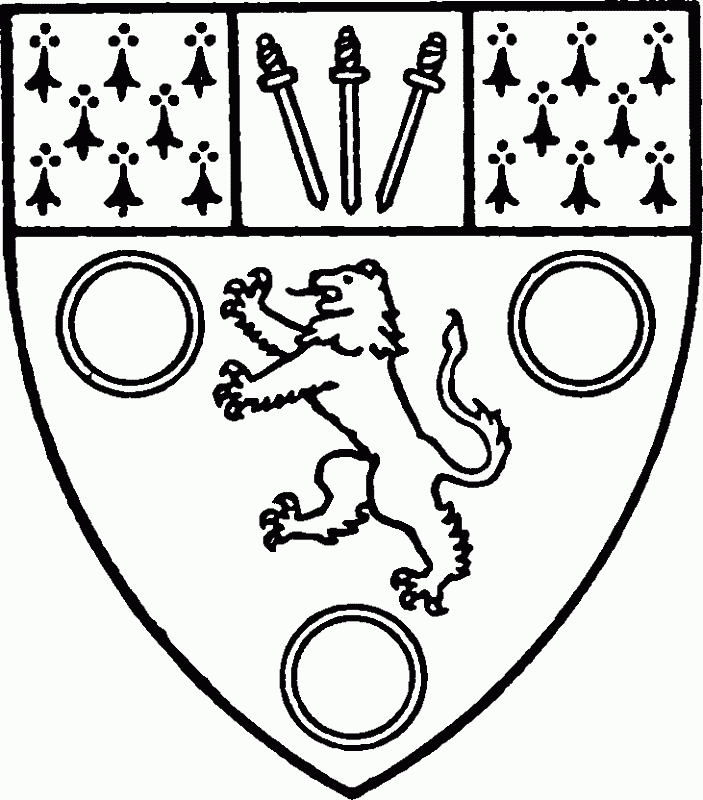
Crewkerne Urban District Council. Or, a lion rampant azure between three torteaux; on a chief ermine a pale sable, thereon three swords in pile, points downwards, proper, pommels and hilts of the first
A Board of Health was formed in 1854, and a Drainage District in 1866. Special committees of the vestry dealt with nuisances from 1858, finance from 1862, and sanitary matters from 1868. A Burial Board was formed in 1872. (fn. 534) Crewkerne urban district was established in 1894 to administer the town, the remainder of the ancient parish becoming the civil parish of West Crewkerne. In 1974 urban district and parish became part of the enlarged Yeovil District.
Until 1871 the vestry met at various places in the town, first in the church and thereafter at one of the larger inns or at the National schools. In 1858 and regularly from 1871 it met at the town hall, where the overseers had permanent use of a room. (fn. 535)
Stocks stood in the market place next to the shambles by 1772, and the town had a blind house by the 1830s. (fn. 536) A fire engine was bought by the vestry and a brigade newly organized in 1876. (fn. 537) The town was lighted by gas in 1837. (fn. 538) A voluntary hospital established by Robert Bird in 1867 in South Street, in a converted factory, was replaced by the present building opened in 1904. (fn. 539)
The trustees of the grammar school from 1703 but not earlier used a seal which bears the legend sigillum crokorniensis in a scroll above a castle. It has been variously interpreted as formerly a corporate seal of the town or as a device linking the grammar school with the Holy Trinity chantry and the Templars, previous owners of part of the school estate. (fn. 540)
CHURCH.
The church of Crewkerne was a minster (fn. 541) of Saxon origin, probably founded by one of the royal owners of the estate, and its territory extended over the later parishes of Misterton, Wayford, and Seaborough (Dors.). Chapels at those places and at Eastham depended on Crewkerne as their mother church, but during the course of time acquired varying degrees of independence. The position of each dependency is set out in a statement of dues, dating in its present form largely from the mid 13th century, before the benefice of Crewkerne was divided into portions, apparently between 1272 and 1282. (fn. 542)
At the Conquest the church, with 10 hides of land and all the tithes of its 'territory', was given by William I to the abbey of St. Stephen, Caen (Calvados). (fn. 543) The abbey seems to have lost possession by Henry I's time, (fn. 544) and by the early 13th century the church had evidently been reunited with the manor. William de Reviers (d. 1217) gave the advowson of the church or churches to his elder daughter Joan on her marriage to William Briwere (d. 1233). (fn. 545) Joan's grant of property to William de Lisle in 1249 seems to have included the advowson, and in 1272 Isabel de Forz, countess of Aumale and great-granddaughter of William de Reviers, successfully reclaimed it from John de Lisle, then a minor. (fn. 546) Subsequently Isabel granted her property for life to Agnes de Monceaux, and Agnes evidently acted as patron of the divided rectory. (fn. 547) On her death c. 1315 the patronage passed to the Courtenays, successively owners of the manor with some interruptions, until 1547.
As a minster serving a wide area the church had probably been the base for a community of clergy, but such a group was apparently dispersed before or at the Conquest. (fn. 548) By the 13th century the benefice had become a sole rectory. (fn. 549) Between 1272 and 1282, however, the living was divided into three portions, the only such arrangement in the county. (fn. 550) The first and largest portion was also called the portion of the rector, the second that of the deacon, the third that of the subdeacon, (fn. 551) an arrangement which may be an echo of Crewkerne's former collegiate status. The deacon's portion survived as a name until the 15th century, (fn. 552) and the two deacons or clerks of the 16th century were perhaps similar survivals. (fn. 553)
The sole rectory was supported by a substantial estate (fn. 554) and also by tithes payable from the whole parochia of the former minster. By the mid 13th century the heart of the territory, most of the later parish of Crewkerne, yielded tithes of all kinds, paid solely to the mother church. The establishment of chapels at Wayford, Seaborough, Misterton, and Eastham had by the 13th century diverted some revenue elsewhere, but links still remained. The people of Ashcombe and Bere in Wayford still paid all tithes and oblations to Crewkerne and a few tenants at Seaborough also owed tithes to the mother church, but annual offerings at the dedication festival and burial at Crewkerne were the sole obligations of the people of Misterton, Wayford, and Oathill, and burial rights alone were reserved from the people of Seaborough and Eastham. Henley tenants were treated like the people of Misterton, but the lord, his family, and chief servants were considered part of Crewkerne. In 1295 previous arrangements for Eastham were modified to give the portioners of Crewkerne half the tithes of 106 a. of land in exchange for yielding burial rights. (fn. 555) Misterton and Wayford continued to send their dead to Crewkerne until the 18th century. (fn. 556)
In 1547, in return for some property in Wiltshire taken by the Crown, the chapter of Winchester was given, inter alia, the advowson of the three portions of Crewkerne rectory, with licence to appropriate the then vacant first portion and the other two when they fell vacant, and to endow a vicarage. (fn. 557) For more than a decade there was evidently confusion over the benefice: it is not known when the two remaining rectors ceased to serve, though Edward Horsey esquire, captain of the Isle of Wight, who surrendered the second portion in 1564–5, may perhaps be identified as the scholar appointed in 1539. (fn. 558) A Crown presentation to the sole rectory in 1557 was evidently of no effect, but no vicarage was ever ordained. (fn. 559) Leases of the rectory from 1562 required the farmers to provide for the cure and they continued to do so well into the 17th century, (fn. 560) but from 1680 onwards the curate was chosen by the chapter of Winchester. (fn. 561) The chapter's choice was often exercised in favour of men with Winchester connexions until 1908 when the patronage was exchanged with the Lord Chancellor, patron in 1976. (fn. 562) The benefice, augmented by endowment, became a vicarage in 1868. (fn. 563)
The value of the minster estate in 1086 was £11. (fn. 564) In 1291 the first portion was taxed at £33 6s. 8d., the second at £10 13s. 4d., and the third at £6 13s. 4d., (fn. 565) though an extent of 1315 put the figures much higher, at £66 13s. 4d., £26 13s. 4d., and £20 (fn. 566) and a statement also of the 14th century gave the first portioner £40 and agreed with the two lower figures. (fn. 567) In 1535 the clear value of the first portion was £55 12s. 11½d., the second £20, and the third £10 1s. 6d. The chapel at Misterton seems to have been annexed to the third portion. (fn. 568)
In 1535 the value of tithes and oblations of the first portion was £44, of the second £16 5s. 1d., and of the third £3 7s. 0d. Glebe land, tenants' rents, and perquisites of court were worth respectively £10 7s. 8d., £2 17s. 0d., and £6 9s. 8d. All three portioners received small rents from the lord of the manor and the first two also from the abbot of Forde (Dors.). (fn. 569)
Each of the three portioners presumably had a residence, and that of the third rector was in need of repair in 1557. (fn. 570) The third rector's association with New Court and the presence of New Court Lane near the churchyard suggests its close proximity, (fn. 571) and the one recognized clergy house stood in 1650 on the east side of the churchyard. (fn. 572) A second, probably the largest, and associated with the first portion of the rectory, was already in lay hands by 1547 and subsequently became the centre of the parsonage estate; it was occupied in the 17th and 18th centuries by tenant farmers. (fn. 573) It was a substantial house of the 14th century, the hall entered by a porch and lit by a tall 15th-century window. A long cross-wing to the south had its principal rooms on the first floor with a small annexe, possibly for a chapel, against the gable wall. (fn. 574) This house was replaced in 1846 by a house in similar style known as the Abbey, which incorporates a traceried window of the former building. (fn. 575)
Under the arrangements for the vicarage in 1547 the incumbent was to be assigned a 'suitable dwelling' and a pension of £18 until the second and third portions should be vacant, when these were to be taken instead. (fn. 576) The curates appointed on the failure of the scheme seem to have been paid £10 in 1575 (fn. 577) but by 1651, when there was a sole curate, the value was £30. (fn. 578) It was increased between 1649 and 1659, (fn. 579) and from 1680 the lessee of the rectorial estate was paying £80 a year. (fn. 580) In 1812 the benefice was augmented with £600 by Parliamentary grant and there were further augmentations of £200 in 1820 and £400 in 1833. (fn. 581) By 1851 the income from other sources beyond fees and the lay rector's contribution was £50. (fn. 582) The Ecclesiastical Commissioners added a further grant of £111 yearly in 1870, (fn. 583) and by 1884 the value of the benefice had risen to £300. (fn. 584)
At least from the middle of the 17th century no house was provided for the curate, and in 1650 Jacob Tomkins was renting a house from the farmer of the rectory containing four lower rooms, two upper rooms, and a small garden. (fn. 585) This house he continued to occupy after he had been removed from the curacy. (fn. 586) In 1815 the curate declared there was no glebe house and that he lived in a hired lodging. (fn. 587) A proposal in 1832 to build a dwelling was evidently not proceeded with, but a house was erected on Constitution Hill c. 1840. (fn. 588) It was extended in 1862–3 and again in 1882, on both occasions by J. M. Allen. (fn. 589) The house was sold in 1947 and was replaced by the former Gouldsbrook Hall, a 19th-century building in Gouldsbrook Terrace. (fn. 590)
The valuable portions of the rectory attracted distinguished incumbents, many of whom had close connexions with the Courtenays and with Devon. Robert Pyl (1328 at least until 1352) was at the time in Sir Hugh Courtenay's household. (fn. 591) Walter Collys (1422–7) was a lawyer well beneficed in Devon and later became a diplomat. His successor, Thomas Hendyman, a theologian and a former chancellor of Oxford University, remained at Crewkerne only six months, exchanging with John Odelande or Wodelond (1428–72), a canonist and another Exeter clerk. (fn. 592) John Combe (1472–96) also held high office in Exeter, but may have been a native of Crewkerne and is considered to have founded the grammar school. (fn. 593)
The second portion was twice used for the benefit of Courtenay's younger sons, when Philip Courtenay was appointed in 1362 and John in 1431–5, both having only the first tonsure. (fn. 594) Andrew Lanvyan (1428–c. 1431) was registrar of the bishop of Bath and Wells. (fn. 595) The same portion was later held by Richard Surland (1479–1509), subdean of the chapels royal, followed by Christopher Plummer (1509–c. 1536), chaplain successively to Queen Elizabeth of York, Henry VIII, and Queen Catherine of Aragon. For opposing the king's divorce Plummer was attainted and lodged in the Tower in 1534, but was pardoned two years later. (fn. 596)
The most distinguished occupant of the third portion was John Stafford (1422–7), subsequently Bishop of Bath and Wells and Archbishop of Canterbury, who while holding Crewkerne was also Treasurer of England. Thomas Kent, appointed in 1443, having recently lectured in canon law in Italy, was clerk of the Council from 1444 and underconstable of England from 1445. His successor William Hoper (1446–54) was also a distinguished lawyer and considerable pluralist. (fn. 597)
The 16th-century curates after the appropriation of the portions are obscure. William Pyers and John Toller were both deprived in 1554 for being married, though the former said Mass while under suspension. (fn. 598) William Robyns (c. 1577–c. 1586) was also rector of Eastham. (fn. 599) Most of the other curates until the 1640s are unidentifiable, often serving for very short periods. (fn. 600) John Norris, serving c. 1596, was later presented in court for not holding a cure, but it was found that he had retired to Clapton because he was 'not well able to see and read divine service'. (fn. 601) In contrast, however, John Fuller held one of the two curacies from c. 1595 until his death in 1642. (fn. 602)
Jacob Tomkins, sole minister by 1646, continued until 1660, when the parish secured his removal. He is regarded as an after-conformist and subsequently held the living of Misterton. (fn. 603) Daniel Ballowe, curate from 1683, was 'very insolent' to Bishop Kidder when the bishop discovered he was also holding the curacy of Chard in 1692 and 'plied between the two market towns . . . and . . . designed to keep them both'. (fn. 604) Nathaniel Forster (1720–52), formerly a minor canon at Winchester, combined the livings of Misterton and Crewkerne. (fn. 605) James Taggart (1753–75) was also a Winchester minor canon, and his successor Robert Hoadley Ashe, D.D. (1775–1826), was the son of a Winchester prebendary and also for a time (1780–87) master of the grammar school. (fn. 606)
From the mid 15th century the parish was normally served by two parochial chaplains, (fn. 607) in 1532 described respectively as curate and stipendiary, (fn. 608) in addition to the two chantry chaplains. In a Chancery suit in 1567 the wardens claimed that 'time out of mind . . . two priests or ministers at the best' had been found to serve the cure. They further stated that the then lessee had only appointed one priest for the previous six years. (fn. 609) Leases of the rectory from 1562 onwards required the farmers to provide two suitable curates and two deacons or clerks 'to serve at the said parsonages and portions and to administer the sacraments to the parishioners there', (fn. 610) and certainly from the 1570s onwards two clergymen, one known as the curate, the other as the preacher, jointly served the parish until c. 1640. (fn. 611) The claim for two ministers was raised unsuccessfully in 1658. (fn. 612)
The two 'deacons or clerks', perhaps representing the second and third portions of the old parsonage, seem to have emerged at the same time, distinguished as town and parish clerks. (fn. 613) By 1625 each was paid by the parish, but their duties remain unknown until 1648 when the parish clerk also began to care for the clock and chimes, from 1661 when he made register entries, and from 1666 when he cared for the bells and kept the Book of Martyrs. (fn. 614) The town clerk's duties may have been connected with the meetings of the townsmen. (fn. 615)
In 1554 a man from Hinton St. George publicly contradicted a preacher who was declaring the doctrine of transubstantiation. (fn. 616) In 1574 there was action against 'immoderate long peals' of bells both on Sundays and holidays. (fn. 617) Two years later one of the curates was suspended for refusing to publish a sentence of excommunication against the archdeacon of Taunton 'by reason of trouble of mind'. (fn. 618) In 1577 there were complaints about the lack of quarterly sermons and the two curates, evidently suspected of ignorance, were required to repeat by heart chapters from the Epistle to the Romans. (fn. 619) From the 1580s onwards a succession of preachers established a tradition of puritanism in the parish, actively fostered by the trustees of the grammar school. In 1610 the trustees paid 'for the preacher's diet for twenty exercises' and from 1614 until at least 1620 supported a regular preacher and later rewarded visitors. (fn. 620) The farmer of the rectory was obliged to pay the preachers for regular monthly and quarterly sermons under the terms of his lease of 1617. (fn. 621) Complaints against strange preachers in 1629 probably marked the beginning of episcopal opposition to the less regular preachings. (fn. 622)
By the 1630s the Holy Communion was celebrated monthly, and a total of 220 quarts of sack was purchased for 18 services in 1635–6. In 1635 the wardens complied with the bishop's regulations for railing the communion table, covering the font, providing a desk for the Book of Martyrs, and purchasing a hood for the minister. After a hiatus in their accounts, 1642–5, the wardens listed in their storehouse the rails taken from the communion table and the remains of the church organ. Heavy spending on glass in 1647–8 suggests further destruction, and purchase of a bason for baptisms in 1648 the temporary disuse of the font. Before the Restoration, in 1659, the communion table was taken back into the 'old place', and the bason was sold in 1662, though the former organ loft continued to be occupied by grammar school master and pupils. After the Restoration celebrations of the Holy Communion were usually held quarterly. (fn. 623)
By the 1770s there were 'generally about 70 communicants', (fn. 624) and in 1815 two services, each with sermon, were held every Sunday. (fn. 625) By 1833 the incumbent had introduced services on Wednesdays and Fridays in Lent and daily services in Passion Week. (fn. 626) Ten years later there were three services each Sunday, two with sermons; one of the sermons was supported by public subscription. (fn. 627) The incumbent involved in these changes was obliged in 1845 to cease his use of the surplice in the pulpit. (fn. 628) In 1851 the congregation on Census Sunday was 918 in the morning (including 316 Sundayschool children), 323 in the afternoon, and 946 in the evening. (fn. 629) By 1855 the Holy Communion was celebrated monthly and on special occasions, and by 1870 four sermons were delivered each Sunday. (fn. 630)
The church has a long musical tradition. A singing man occurs in 1585, and a 'singing man of the church' in 1621. (fn. 631) An organ was endowed in 1592, but was dismantled and melted down by 1646. (fn. 632) Orchestra and singers were replaced by an organ in 1823, and from 1828 the organist also taught children to sing. (fn. 633) A new organ installed in 1865, replaced in 1906, was said to be 'designed by somebody who never saw the church' and was accompanied by a choir 'anything but first class'. (fn. 634)
In August 1544 the churchwardens leased from the manor a plot of land 'to build a church house', and from November of the same year held the plot, in the market place between the high cross on the south and the town well on the north. (fn. 635) An undated manor rental shows the wardens paying rent for a 'cottage' next to the market cross called the 'town house'. (fn. 636) The wardens continued to pay rent until 1658 and contributed towards its maintenance at least until 1688. Parts were used for storage or for temporary lodging. (fn. 637) Items of repair in the 17th century include wattle and daub, suggesting a timberframed building. The roof was tiled. (fn. 638)
There was a chantry of the Virgin in the church by 1253–4, and by 1315 it was worth 100s. (fn. 639) Its patronage was in the hands of the Courtenays and their successors as patrons of the rectory. (fn. 640) In 1535 its clear value was £4 18s. 4d., (fn. 641) and in 1546 its plate and ornaments were nominally worth 33s. 4d., though its silver chalice (26s. 8d.) had been sold four years previously 'of necessity'. (fn. 642) The last priest was pensioned. (fn. 643)
In 1549 the property, including a capital messuage and land, was sold to Laurence Hyde of London, who re-sold it to Sir Hugh Poulett. Poulett conveyed the holding, worth £4 4s., to James Downham of Chillington in 1550. (fn. 644) In 1574 some of the property, described as concealed, was granted by the Crown to John and William Marshe of London. (fn. 645)
By 1315 2 a. of land in Crewkerne were held for the provision of 10 lb. of wax for St. Edmund's altar, presumably within the church. (fn. 646) By 1514 rent was paid for land at Furringdons called 'Oblighacr'' and 'Gambeleacr'' to the first and second portioners of the rectory to provide bread and wine for celebrations at the high altar. (fn. 647) A close in Merriott by 1548 gave support for obits, and rents in Crewkerne found lamps and lights. (fn. 648) The obit lands were granted to Laurence Hyde in 1549, and the rents were leased to Henry Middlemore in 1572. (fn. 649)
Bequests to the fraternity of the Trinity or to the Trinity altar in the church occur between 1508 and 1534. (fn. 650) The property of this guild or fraternity, often known as a former chantry, (fn. 651) formed much of the endowment of the grammar school said to have been founded in 1499 by a former rector. (fn. 652) In 1548 the clear value of the school property was £8 1s. 3d. (fn. 653)
The church of ST. BARTHOLOMEW is a large building in local Ham stone. It comprises a chancel with double north aisle, a central tower with transepts, an aisled and clerestoreyed nave, and a south porch. A sacristy stood at the east end of the chancel, approached by doors on either side of the high altar, and a vestry is said to have stood on the north side. (fn. 654) Both were apparently destroyed in the 19th century. Part of a late-13th-century arch incorporated in the east wall of the south transept suggests that there was a church of cruciform plan by that time, and the west wall of the nave includes walling, of unknown date, evidence for an earlier nave of the same length but with narrower aisles. It may in fact only be contemporary with the crossing arches which are probably early 15th century. In all its other features the church is the product of a major rebuilding of the late 15th or early 16th century. The presence of royal chaplains as rectors between 1479 and c. 1536 may explain both the splendour of the building and some elements of the design, like the twin turrets on the west front, which are unlikely to be of local origin. (fn. 655) There is a tradition of vaults beneath the building containing a crowned king and queen. (fn. 656)
The Purbeck marble font, of Norman pillared design, is the earliest item of furniture. Before the Reformation there was a figure of St. Michael in the 'midst' of the church. (fn. 657) The screen occupied the east side of the crossing, supported by grotesques including a Green Man, and the rood beam was on the west side. The nave roof is supported on angel capitals, and the Woolminstone chapel roof is richly panelled. There is a memorial brass to Thomas Golde (d. 1525) in the chancel. Galleries were built at the west end early in the 17th century, and 'hanging' or 'trap' seats were added to the pews. (fn. 658) The galleries had been removed before 1809–11 when the nave was re-pewed and galleries erected at the east end of the north and south aisles and at the west end of the nave. (fn. 659) Plans to erect side galleries in the 1840s, drawn by Sampson Kempthorne of London, were not proceeded with, partly on aesthetic grounds, (fn. 660) but an arch for a private pew was made over the south porch. (fn. 661) The vestry in the south transept had a new screen and panelling by J.M. Allen in 1853–5. (fn. 662) Extensive alterations in 1864–5 included the removal of the eastern nave galleries and re-seating. (fn. 663) Restoration beginning in 1887 included opening the south porch, renewal of pews, removal of the pulpit from its central position, and lowering the floor. (fn. 664) The chancel was restored by the lay rector in 1899– 1900, and the remainder of the church refurnished at various times until 1914. (fn. 665) The west window was reglazed by A.K. Nicholson in 1930.
There are eight bells: (i) and (ii) 1894, Taylor of Loughborough; (iii) and (iv) 1820, John Kingston of Bridgwater; (v) to (vii) 1894, Taylor; (viii) 1767, Thomas Bayley of Bridgwater. (fn. 666) The plate consists of a cup and cover of 1608 by John Freke of Crewkerne, and another of 1609. There is a dish or silver plate dated 1683 by 'F.S.'. The parish also has a flagon of 1847. (fn. 667) The registers begin in 1558, but there are gaps in 1643–4 and 1647–8. (fn. 668)
There was an anchoress's cell at the church. In the late 12th century Odolina, anchoress of Crewkerne, provided information on the life of St. Wulfric of Haselbury, (fn. 669) in 1459 an anchoress had been enclosed within the church for 'many years', (fn. 670) and a third received a bequest in 1523. (fn. 671) A 'little cell' still stood at the west end of the church in the 1630s, (fn. 672) and was maintained at parish expense. The churchwardens replaced stone tiles and crests in 1629, set up a chimney in 1639, and provided a new carved fireplace in 1678. It was still standing in 1700. (fn. 673)
In 1402 a monk of Forde elected to lead the life of a hermit in a house also on the west side of the church, within the churchyard, 'constructed for such a person to dwell in'. (fn. 674) This may be the hermitage of St. Edmund for which indulgence was promised to effect maintenance in 1441. (fn. 675) Like the anchoress, the hermit was given money and a pair of sheets under a will of 1523. (fn. 676) From 1539–40 a cottage called 'Hermytage' was being let by the lord of the manor, (fn. 677) and in 1564 it was granted by the Crown to William Gryce, the queen's servant, and Anthony Forster of Cumnor (Berks.). (fn. 678) In 1590 it was sold to William Typper and other Crown agents, and by 1599 Magdalene Partridge occupied the chapel of St. Edmund, bishop, and some land belonging to it, as tenant of the manor. (fn. 679) The hermitage was still standing in 1633 'not far' from the anchoress's house at the west end of the church. (fn. 680)
The chantry of Our Lady in the churchyard was founded under licence of 1309 by Agnes de Monceaux to celebrate daily for the souls of Isabel de Forz, countess of Aumale, and of her ancestors. It was to be endowed with property in Crewkerne, Hewish, and Misterton. (fn. 681) The chapel was described as newly built in 1315, (fn. 682) and the first priest seems to have been appointed in 1316. (fn. 683)
Patronage of the chantry descended in the Courtenay family and their successors: George Neville, bishop of Exeter, and others presented in 1464 after the attainder of Thomas, earl of Devon, (fn. 684) and by 1469 the rights had passed to Sir William Knyvett through his wife Joan, the late earl's sister and heir. (fn. 685)
The chantry was dissolved in 1548, when its estate produced £4 14s. 10d. (fn. 686) The plate and ornaments had already been valued at 35s., and the lead on the chapel roof at £6 13s. 4d. (fn. 687) The chantry house, occupied by John Michell, the former chantry priest, then aged 80, was sold to John Whytehorne and John Bayly of Chard, (fn. 688) though most of the estate went in the following year to Robert Wood of the Inner Temple. (fn. 689) In 1615 the chantry house was owned by William Owsley (d. 1620). (fn. 690) The remainder of the estate seems to have become the manor of Crewkerne Chantry.
A chapel dedicated to St. Reyne or Ranus stood near the road between Crewkerne and Chard at the eastern end of the Windwhistle ridge, complementing on its western end another, dedicated to St. White or Candida. (fn. 691) St. Reyne's chapel was certainly built by the late 13th century, (fn. 692) and survived until the late 15th. (fn. 693) By the 1630s the site was that of a beacon. (fn. 694)
Some waste ground in Woolminstone was known in 1610 as Chappelhaye, and may perhaps have been the site of a chapel. (fn. 695)
A chapel of ease, later known as CHRISTCHURCH, on the west side of South Street, was opened in 1854. Nearly half the cost was borne by William Hoskyns of North Perrott who, together with William Sparks, provided an endowment of £40 for the minister and a repair fund. (fn. 696) Hoskyns's motive was not only to provide church accommodation for the poor, but also 'to prevent the architectural beauty of the interior of the parish church from being in a great measure destroyed by the erection of side galleries'. (fn. 697) The building, designed by J. M. Allen in the Perpendicular style, was of Ham stone, and comprised a chancel, nave with north aisle and north porch, and a turret with one bell. The church was closed and in 1975 demolished. (fn. 698)
A building was erected by subscription at Hewish in 1868 to serve as a schoolroom on weekdays and as a chapel of ease on Sundays. (fn. 699) It became a mission room only after the closure of the school. (fn. 700) The church of the GOOD SHEPHERD is a plain stone building of one room with a porch.
In 1223 there was a dispute between William Briwere the younger on the one hand and Andrew of Misterton and John of Eastham on the other concerning presentation to the 'church' of Misterton and Eastham. (fn. 701) Eastham chapel had also been linked with the church of 'C' in an undated dispute. (fn. 702) Exactly what the link with Misterton implies is not clear since it is the first datable reference to a church in either place, though the separation of the estate at Eastham within the main manor of Crewkerne by 1066 at least argues for an earlier ecclesiastical foundation there than at the less well-developed Misterton. The dispute of 1223 may suggest by that time a sole benefice shared between the two communities, Eastham already perhaps beginning to revert to little more than private manorial status.
Whatever independence the manor acquired in early times was not shared by the church at Eastham, which was a chapel of Crewkerne. In 1295, however, it acquired burial rights, in return for which its rector yielded half the tithes of specified lands. (fn. 703) Thereafter, though the incumbent retained the title of rector, the church was variously described as a chapel, (fn. 704) a chapel with cure, (fn. 705) and a free chapel. (fn. 706) By c. 1548, however, the benefice was evidently a sinecure, for the chapel was described as a ruin and its property occupied by the rector of Wayford. (fn. 707) In 1572 it was evidently regarded as a chantry and was let by the Crown. (fn. 708)
The patronage seems to have descended with the ownership of Eastham manor throughout most of the Middle Ages, though under an agreement of 1309 the Asshetones (recte Asshelonds) and the Crickets agreed to alternate presentations. (fn. 709) Appointments in 1447 and 1463 were made by the bishop through lapse. (fn. 710) The Sinclairs did not dispose of the advowson in 1479, (fn. 711) and in 1493 it was exercised by John Hayes. (fn. 712) John Lacy died in 1529 leaving the advowson to his son Thomas. (fn. 713) Conveyances of the manor in 1538 and 1585 also included the advowson of the 'church and free chapel' and the advowson of the vicarage. (fn. 714) The second, a quitclaim from William, Lord Sandys, to Robert Freke, began the Freke interest in the estate, though the family did not apparently exercise the right of patronage of what was still legally a rectory until 1624. In the meantime William Paris alias Court presented by grant of Robert Hungerford in 1554, Elizabeth, widow of William Orchard late of Compton Valence (Dors.) in her own right in 1573, Roger Garvys by grant of William, Lord Sandys, in 1575, and Richard Braine, clerk, in 1622. (fn. 715)
The Frekes were patrons in 1660 and 1692, though the bishop collated in 1683. Mary Poole, widow, succeeded to the advowson by 1734, and Caleb King, grocer and merchant, by 1736. The bishop again presented by lapse in 1791. (fn. 716) At the next vacancy in 1836 the patron was William Hoskyns of Marylebone (Mdx.) (fn. 717) and thereafter the advowson was owned by trustees headed first by Thomas Hoskyns of Haselbury Plucknett and then by his nephew the Revd. Charles Thomas Hoskyns of North Perrott. (fn. 718) The Hoskynses ceded their patronage when the living was united with Crewkerne in 1925.
In 1535 the rectory was valued at 66s. 8d. net, and comprised glebe worth 3s. 4d. and predial tithes of 63s. 4d. (fn. 719) In 1572 the same property was worth £10. (fn. 720) By 1694 the incumbent, insisting on payment of tithes in kind, made £12 or £14, though some of his immediate predecessors had apparently been content with a modus of c. £5. (fn. 721) The gross tithe rent-charge on the tithing or rectory of Eastham in 1840 was £35 17s. 6d. (fn. 722)
The small benefice did not attract well-known clergy even during the Middle Ages: there was at least one deprivation for failing to take priest's orders, (fn. 723) and the bishop had to collate twice during the 15th century because of lapse. (fn. 724) In 1554 the rector, found to be married and newly in deacon's orders, was deprived. (fn. 725) The first identifiable rector thereafter, Hugh Atkins, rector 1660–82, was also rector of North Perrott, and his successors all held livings elsewhere, usually within the diocese, until the time of James Draper, rector 1791–1836, who was assistant curate of Crewkerne and also served at Misterton. From 1866 the rectory was always held with the living of Crewkerne, and was united with it in 1925. (fn. 726)
About 1548 the chapel was said to be ruined, though its cemetery remained. (fn. 727) There was 'no church there' by 1575, (fn. 728) though a description of the estate of Eastham in 1693 included a field 'where the chapel stands', (fn. 729) and the foundations were still said to be discernible in the 19th century. (fn. 730) A fragment of stone in the parish church is said to have come from the site.
ROMAN CATHOLICISM.
A few individuals, mostly women, were reported as recusants between 1593 and 1626, three of them members of the Bonville family of Clapton. (fn. 731) St. Peter's church, in South Street, was erected in 1935. The parish is served from Chard. (fn. 732)
PROTESTANT NONCONFORMITY.
In 1662 a Crewkerne Quaker was in trouble for refusing tithe. (fn. 733) A regular Quaker meeting, established by 1668, (fn. 734) continued, despite persecution in the 1680s, (fn. 735) and a new meeting-house was in use from 1725. Licences for worship in private houses between 1737 and 1743 suggest that the group had become small. (fn. 736) The meeting-house was still in existence in 1747, but it had apparently been sold and the cause abandoned by 1756. (fn. 737)
James Stevenson, minister and physician, who had been ejected from Martock in 1662, lived and probably taught in the town for two years from 1665; (fn. 738) and in 1669 three more ejected ministers, Robert Pinney, Jeremiah French, and John Westley, were teaching in and near the town, one at Tail mill. (fn. 739) Two Presbyterian groups and a teacher were licensed in 1672, one group meeting in the house of John Serry, barber-surgeon, and a further group and their teacher occur in 1673. (fn. 740) In 1684 some 'fanatics' at Crewkerne welcomed the arrival of the recently released nonconformist John Trenchard. (fn. 741) Three licences, one for 'the public meetinghouse' probably in Hermitage Street and two others for private houses, indicate the strength of Presbyterianism under the leadership of John Pinney from 1689. (fn. 742) By 1718 Robert Knight, the Presbyterian minister, had a following of 250 people. (fn. 743)
The cause continued, apparently becoming Unitarian in theology during the 18th century, though still occasionally called Presbyterian. (fn. 744) In 1752 and 1758 two houses at Clapton were also licensed for worship in the same cause. A building called 'the meeting-house' was licensed for Presbyterians in 1761, though this may well refer to the present Unitarian chapel in Hermitage Street, built in 1733 and otherwise unaccounted for. (fn. 745) There were said to be 'many' Presbyterians in the town in 1776, (fn. 746) though the congregation was described as Unitarian three years earlier. (fn. 747) In 1851 the church, described as the Presbyterian meetinghouse but of Unitarian persuasion, was without a minister, and no service was held on Census Sunday, though the average general congregation was normally 40 on Sunday mornings. (fn. 748)
The Unitarian and Free Christian chapel in Hermitage Street is a plain building in local stone with round-headed mullioned and transomed windows. The dates 1733, 1811, and 1900 over the door indicate foundation and subsequent alterations.
The origins of the Baptists are difficult to trace before the erection of a chapel in North Street in 1820, though worship may have started in private houses licensed in 1808 or 1810. (fn. 749) The congregation was Particular Baptist. (fn. 750) On Census Sunday 1851 attenders including Sunday-school children totalled 300 in the morning, 200 in the afternoon, and 350 in the evening, in sum rather less than the Sunday average of 960. (fn. 751)
The chapel in North Street is a large building of 1880 in local rubble with rusticated quoins. The symmetrical main front has a central pediment, forming a gallery bay, supported on pilasters flanked by pedimented entrance porches. The adjoining manse is a plain symmetrical stone building of the early 19th century.
Followers of Joanna Southcott met in Crewkerne c. 1811 and found support in the incumbent, Dr. Ashe, who was subsequently lampooned for his views. (fn. 752) Their place of meeting is unknown.
About 1821 the Crewkerne Mission was established by itinerant Bible Christian preachers from Dorset and Devon, and by 1824 there were 15 people 'on trial' as potential members of the West Buckland circuit. (fn. 753) Later in the year the original circuit was divided and Crewkerne, with 15 full members and 19 'on trial', became for a time the head of a new one. A chapel 'in the possession of people called Arminian Bible Christians' was licensed in 1825, (fn. 754) and between 1829 and 1833 services were also held at Woolminstone. (fn. 755) During the same period the cause at Crewkerne declined and the chapel was evidently closed in 1831. Another building, known as Ebenezer chapel, in Hermitage Street, (fn. 756) was rented and fitted out in 1835–6 but was given up in 1838. No further meetings were held until 1849, but within a year the movement had achieved a membership of 30. Both the period of the closure and the speed of recovery suggest that members changed their allegiance to and from the Wesleyans. (fn. 757)
In 1851 the Bible Christians were occupying a room in Chard or West Street erected in 1850, and on Census Sunday the afternoon congregation was 100 and the evening 88 strong. (fn. 758) The room was replaced by a chapel in West Street in 1872 (fn. 759) and by another in Hermitage Street in 1890. (fn. 760) This chapel became the head of the United Methodist circuit in 1907 but was absorbed into the former Wesleyan South Petherton and Crewkerne circuit in 1954. The chapel, closed in 1962, is a plain stone building with a gallery. (fn. 761)
Wesleyan Methodism was established in the town by 1831 but was apparently strengthened by a secession from the Bible Christians, for a substantial congregation appeared suddenly in 1833. (fn. 762) By 1834 the cause had 77 members, the largest society in the South Petherton circuit. Between 1836 and 1864 there was also a small society at Hewish. (fn. 763) In the late 1840s membership was over 50 and on Census Sunday 1851 the congregation was 102 in the morning and 90 in the evening. (fn. 764) The afternoon service in a private cottage at Hewish was attended by 40, though the annual average was lower. (fn. 765)
A chapel in South Street, on the site of a cottage acquired for the purpose in 1828 (possibly by Bible Christians before secession), was completed in 1832. (fn. 766) A schoolroom was added in 1864. (fn. 767) Both were replaced in 1874 by the present building, of Ham stone in the Decorated style, with a large stone spire on its north-west corner. Schoolrooms were added in 1907. (fn. 768)
In 1851 there was one other sect whose precise origins in the town are unknown, but which could have been among the groups meeting in West Street, East Street, Clerks Barton, and at unspecified addresses between 1846 and 1850. (fn. 769) By 1851 a group of Latter Day Saints was meeting in a private house in South Street, evidently near Viney Bridge, where there were congregations of 17 in the morning, 28 in the afternoon with 5 Sunday-school children, and 35 in the evening. (fn. 770) The subsequent history of the group is unknown.
In 1859 a group of Plymouth Brethren opened a place of worship in East Street on a site occupied by their Gospel Hall in 1976. (fn. 771)
The Salvation Army began meetings in a private house in Rose Lane in 1884. Shortly afterwards they moved to a hall in Oxen Lane which they occupied for 70 years. The present hall in North Street was opened in 1959. (fn. 772)
EDUCATION.
In 1703 Roger Cossins, a Crewkerne engraver, left rents to maintain six local boys at an English school in the town, the boys to be appointed by the warden and feoffees of the grammar school. An income of £3 12s. a year was paid from 1717. A gift of £50 was made in 1762 by Elizabeth Cookson to educate children of the town, and this produced a further £2 10s. a year. In 1822 these sums were being paid to a master who in return taught twelve children to read. Additional payments were required for teaching writing or arithmetic. (fn. 773) From 1855 no payments were made and funds of £4 a year were accumulated until 1878. (fn. 774) In 1710 Martha Minterne of Crewkerne gave lands from which £5 was paid to teach eight poor children. In 1822 this sum was paid to the sexton's daughter for the purpose, as was £8 8s. a year to J.C. Warr from 1870 to 1877. (fn. 775) Charity monies of £9 12s. a year were paid to a single endowed school for 20 girls in 1835, although the endowment was not mentioned thereafter. (fn. 776) These were probably the charity and infants' schools which in 1840 and 1842 lay in Church Lane and Church Street respectively. (fn. 777) The three educational charities were consolidated under a Scheme of 1878 and had a total income of £23 18s. 9d. in the following year and accumulated funds of £224 14s. 2d. The monies were to be applied in the payment of fees at elementary schools, awarding small scholarships or prizes, and in providing an exhibition for three years at the grammar school. No prizes were given after 1883, but otherwise the Scheme was put into effect. (fn. 778)
In 1835 there were 7 private infant schools for 121 children and 4 other day-schools which, with the 2 endowed schools, took 150 children. There were also 4 Sunday schools: one founded in 1820 attached to the parish church with 172 children; one reputedly established in 1796 by the Unitarians for 20 boys; the Baptist school started in 1820, with 180 children; and a Methodist Sunday school in South Street with 202 children, held since 1831. (fn. 779)
The two older charity schools were probably replaced by the National Schools built in 1847 in West Street. (fn. 780) A new infant department was built further down West Street in 1871, and in 1883 there was accommodation for 680 and an average attendance of 521. (fn. 781) Numbers were 485 in 1889 and 591 in 1897. (fn. 782) In 1903 there was a total staff of 21, 673 children on the books, and average attendances of 582. The premises were then also used by the Sunday schools, a men's club, the female friendly society, and by Volunteers as a drill hall. (fn. 783) Subsequently numbers fell greatly and were 304 in 1935 and 225 by 1946. In 1970 the former infant school of 1871 became St. Bartholomew's infant schools, and in 1972 one of the two First Schools in the comprehensive system. There were 175 children on the books in 1975. (fn. 784) The school built in 1847 was closed in 1970 and has since been used as a community centre and youth club.
In 1875 a School Board was formed for the united district of Crewkerne and Wayford and a school for 130 children was built in North Street in 1877. (fn. 785) There were 146 on the books in 1889 and the school was enlarged in 1897 for 240 children, including infants, and again in 1903 to take 360 pupils. Average attendances fell from 210 in 1905 to 181 in 1915, and 90 in 1935. (fn. 786) In 1946 it became a County secondary modern school, with 148 pupils, and so remained until c. 1959 when it was converted to a Church of England junior school. From 1970 it was known as Ashlands School. In 1972 it became a First School and in 1975 it had 200 pupils. (fn. 787)
The School Board also established a school at Clapton in 1878 to serve West Crewkerne, Wayford, and Seaborough. It was attended by 130 children in 1883. Numbers attending were 102 in 1915, 88 in 1935, and 51 in 1946. (fn. 788) The school closed in 1970 when most of the pupils were moved to Ashlands School. (fn. 789)
Maiden Beech Secondary Modern School was built in Lyme Road c. 1958 to accommodate 300 children. Under the comprehensive plan of 1972 it became a Middle School and in 1975 had 512 pupils. (fn. 790)
Wadham Comprehensive School north of the Yeovil road was opened in 1972, replacing the existing secondary schools of Crewkerne and Ilminster. Numbers on the roll were 662 in 1975. (fn. 791) It is an extensive, flat-roofed complex generally of two storeys.
The Wesleyans built a mixed day-school at South Street in 1880, evidently replacing their existing Sunday school, and the former had attendances of 85 in 1883. It was enlarged in 1887 although the day-school had apparently been discontinued by 1897. (fn. 792) A building erected by subscription at Hewish in 1868 served as a school-room on weekdays and a chapel of ease on Sundays. (fn. 793) It was referred to as a school in 1870 but, apart from the mention of a school-chapel there in 1906, (fn. 794) no other reference to its educational use has been noted.
Roger Beard, an accountant, kept a writing school in the town in 1751, which may have survived c. 1797 as Mr. Beard's English boarding school. A ladies' boarding school run by Miss Coombs also occurred c. 1797. (fn. 795) By 1822 there were three private boarding schools, two in South Street and one in Church Street. (fn. 796) The numbers of private boarding and day-schools had risen to seven by 1852, and in 1872 there were four such girls' schools and a commercial school in East Street. (fn. 797) There were only two private schools by 1906, and one, the Crawford House school for girls in East Street, in 1939. (fn. 798) St. Martin's boarding and day preparatory school, at present in Abbey Street, was evacuated to the town in 1939, and Bincombe School, founded in 1946, was closed in 1957. (fn. 799)
CHARITIES FOR THE POOR.
There was evidently some form of financial support for the poor by the 1570s, for the death is recorded of an alms-woman of the town. (fn. 800) By will dated 1617 Matthew Chubb of Dorchester (Dors.) gave £100 for the maintenance of the alms-house in Crewkerne which he had 'procured to be built', the sum to be paid out of money owed to him by the Crown which he had advanced for the rebuilding of Dorchester. (fn. 801) The exact date of foundation is unknown, though an inscription visible in the early 19th century was read as 1604. (fn. 802) For some years after Chubb's death in 1617 the maintenance of the foundation was uncertain, and in 1624 and 1630 money was paid by the grammar school trustees, on the first occasion 'for making of a deed for the assurance of the almshouse to Mistress Chubb'. (fn. 803) In 1631 the house, its garden, and a sum of £100 for maintenance, were formally handed over to trustees. (fn. 804)
The alms-house, later known as the Old Almshouse, was for 8 people, 7 from Crewkerne and 1 from Misterton. (fn. 805) Both the grammar school trustees and the churchwardens contributed to the maintenance of the fabric, the wardens making repairs 'by the consent of the town' in 1652, mending the 'chimney-hearth' in 1657, and repaying the alms-house warden a debt he had incurred in 1665. (fn. 806)
By the 1720s the alms-house possessed land near Henley and a rent-charge of £4 from land in Seaborough (Dors.). (fn. 807) By the 1820s this property produced £7 13s. 6d. a year, which kept the house in repair and provided a small quarterly distribution to the 8 residents, then generally women, chosen by the overseers. The doles were supplemented by extra cash at need and occasionally by the provision of spin thread. (fn. 808)
By will proved 1844 Jane Hawkesley gave the residue of her estate to be invested, providing doles on Christmas Eve for the residents. In 1869 the sum totalled £10 11s. 6d. (fn. 809) A further gift of £200 under the will of Mrs. Anna Maria Donisthorpe (d. 1856) was invested for similar distribution on 1 January. (fn. 810) George Slade Jolliffe, by will proved 1894, gave £1,500 to provide quarterly doles for the residents and a like sum to erect an additional building to house 4 more from 1897. (fn. 811)
Smaller sums were given for alms-people by Mary Ann Gapper (d. 1869), Mrs. Ann Wheadon (d. 1881), and Sarah Woodcock (will proved 1892), and they and the proceeds of the Jubilee Fund (1888) were amalgamated by a Scheme in 1896 under the title of the Alms-house Charities of Matthew Chubb and Others. The combined income was £125 11s. 8d. for the support of 8 and later of 12 people of over 60, at the rate of at least 3s. a week. A further reorganization took place in 1966 after the demolition of the Davis Alms-houses to create the New Alms-house and the Alms-house Charities of Matthew Chubb and Others Scheme, under which the charities were administered in 1976. (fn. 812)
The original building in Court Barton comprised 4 dwellings of 2 storeys each with two rooms in a symmetrical stone house, the entrances arranged in pairs. The additional block, built at right angles facing West Street, was designed by George Vialls of Crewkerne in similar style. (fn. 813)
The so-called New Alms-house in West Street, standing opposite the end of Matthew Chubb's Alms-house, was founded under the will of Mary Davis, spinster, dated 1707. Property in Crewkerne and Blackmoor farm in Woolminstone was given in trust after the deaths of her sister and aunt, the town property to be converted into an alms-house for 6 poor old men and 6 poor old women of Crewkerne and Woolminstone. The sum of £4 was also to be distributed on 1 January to 80 poor chosen by the trustees. By 1718 the life interests had ceased, and the charity probably came into being under a decree of 1719. (fn. 814)
By 1866 the income of £132 from the farm and a building next to the alms-house was applied in payments of 3s. a week to the 12 occupants, with coals in winter; £4 was distributed yearly to the 80 poor. By the 1950s the income was slightly less, but the accommodation was still for 12 people. In 1961 the property, then unfit for dwellings, was sold to the urban district council and demolished. (fn. 815) The income of the charity was amalgamated with that of the Old Alms-houses under a Scheme of 1966, providing a total of 8 dwellings, 6 for people from Crewkerne, 1 from Misterton, and 1 from Woolminstone or West Crewkerne. (fn. 816)
The alms-houses were in a single-storeyed building of 9 bays, the central 3 forming a pedimented section with Tuscan pilasters, and each group of 3 having a pedimented door flanked on each side by a window. (fn. 817)
In 1876 Robert Bird established a trust for the benefit of old weavers employed in his factory, and provided 6 cottages in South Street and a capital sum of £1,080 for their maintenance, together with doles to the occupants. Under a Scheme of 1953 the benefits of the trust were extended to any resident in or near Crewkerne, though preference was still to be given to employees. In 1957–8 the 'cottage homes' (nos. 3–13 South Street) were modernized to accommodate 5 people, with a communal room. They were sold for a roadwidening scheme in 1973 and were replaced by 5 bungalows in Bird's Close. (fn. 818)
About 1710 Martha Minterne settled land in trust, the income to be distributed yearly at Candlemas in sums of 3s. each to poor people of Crewkerne. By 1879 the money, about £24 a year, was given on 14 February, and for some 15 years had been limited to residents in the town tithing. By 1895 it was worth £15 and in 1961 £22 10s. (fn. 819) It was administered by the urban district council in succession to the parish overseers until local government reorganization in 1974. (fn. 820)
By 1719 an estate at Greenham was charged in the name of Mrs. Jane Reynolds's Charity with payment of £3, to be distributed to paupers not in constant relief. In that year 68 people were relieved. (fn. 821) By 1759 the income had risen to £4, and in 1776 it was agreed that £3 should go to people from Crewkerne and £1 to those from Hewish, in units of a shilling. (fn. 822) The money was distributed on Easter Monday. The urban district council continued payments in succession to the parish officers until local government reorganization in 1974. (fn. 823)
By will dated 1730 William Budd of Crewkerne settled £20 in trust for loans to 'honest industrious persons . . . of Crewkerne' for periods of 4 years each. (fn. 824) In 1961 the capital sum was c. £31, (fn. 825) and was administered by the urban district council.
William Sharlock of Hereford, by will dated 1786, settled £100 stock in trust for distribution in shillings on St. Thomas's Day. (fn. 826) By 1867 the doles were given on 1 January. (fn. 827) In 1874 the income of £3 12s. was distributed to 72 people. (fn. 828) In 1967 the income was £3 and was administered like Minterne's, Reynolds's, and Budd's by the local authority. (fn. 829)
On the death of Miss Marianne Wills of Exeter (d. 1863) and in her name her brother settled £200 stock in trust for distribution, half in bread and half in Bibles yearly on 1 January to residents of the parish. (fn. 830) Bibles were given at least until 1927. (fn. 831) In 1967 the value of the charity was £5. (fn. 832)