An Inventory of the Historical Monuments in London, Volume 5, East London. Originally published by His Majesty's Stationery Office, London, 1930.
This free content was digitised by double rekeying. All rights reserved.
'Greenwich', in An Inventory of the Historical Monuments in London, Volume 5, East London(London, 1930), British History Online https://www.british-history.ac.uk/rchme/london/vol5/pp12-43 [accessed 9 May 2025].
'Greenwich', in An Inventory of the Historical Monuments in London, Volume 5, East London(London, 1930), British History Online, accessed May 9, 2025, https://www.british-history.ac.uk/rchme/london/vol5/pp12-43.
"Greenwich". An Inventory of the Historical Monuments in London, Volume 5, East London. (London, 1930), British History Online. Web. 9 May 2025. https://www.british-history.ac.uk/rchme/london/vol5/pp12-43.
In this section
5. GREENWICH.
(O.S. 6 in. London, Sheets (a)O, (b)P.)
The Borough of Greenwich includes the civil parishes of Greenwich, Charlton and Kidbrooke and St. Nicholas, Deptford. The principal monuments are the three churches of St. Alfege, Greenwich, St. Nicholas, Deptford, and St. Luke, Charlton, the Royal Hospital and the Queen's House, Greenwich, Charlton House, the Royal Observatory, Morden College, Trinity Hospital and the Presbytery and Manor House, Croom's Hill.
Ecclesiastical
b(1) Parish Church of St. Alfege (Plate 45) stands on the W. side of Church Street, 350 yards S. of the river. The walls are of brick faced with Portland stone, and the roofs are covered with lead. The earlier church was ruined by the fall of the roof on Nov. 28th, 1710, and was demolished, except the early 17th-century tower, in 1711. Both Nicholas Hawksmoor and John James were concerned in the building of the Church which was finished, structurally, in 1714, as is indicated by a date on the lead roof, but the building was not consecrated till September 29th, 1718. In 1730 the tower was re-built or perhaps only recased externally with Portland stone and the upper stages and lantern added from the designs of John James.
The church is interesting as an important example of early 18th-century work.
Architectural Description—The Church is a Renaissance building of the large apartment-type (81 ft. by 61 ft.) with apse and portico at the E. end, projecting wings on the N. and S. and vestibule, tower, etc., at the W. end.
Elevations. The E. End is divided into five bays by Doric columns or pilasters supporting an entablature of the same order and a pediment; the three middle bays, which are divided by columns, form an open colonnade with the entablature broken over the middle bay to support a round arch. On the pediment are three large carved vases. Within the colonnade the main cornice is continued across the middle bay; in this bay is a large elliptical-headed window with an eared architrave and a shaped panel above; above the cornice is a round-headed niche, flanked by pilasters; the adjoining bays have each two windows, the lower square-headed and the upper round-headed. At the N. and S. ends of the portico are recesses, forming porches, with round-headed doorways opening into the church. In front of the portico are four stone pedestals carved with drapery-swags and cherub-heads. The N. and S. Elevations are uniform and are each of eleven bays, including the projecting wing; the bays are divided by Doric pilasters supporting the entablature, continued from that on the E. wall. Each bay of the upper storey, except the narrow bays at each end of the building, have a round-headed window of two square orders and with an apron below the sill. In the lower storey, the three bays of the projecting wing have each a doorway, one with an elliptical head and two with round heads, all with moulded imposts; the three bays on each side of the wing have each a square-headed window with moulded architraves and triple key-stones. In the plinth or podium are square-headed openings to the vaults under the church. In front of the projecting bay is a terrace with steps at each end and a retaining wall with pedestals; in the middle of this wall is the entrance to the vaults. The W. Elevation has two bays on either side of the tower, with pilasters, entablature and pediment similar to those at the E. end, but the pediment is broken back behind the tower; each bay has a round-headed window and a square-headed window below it similar to those in the N. and S. elevations. The Tower, externally, has no features of earlier date than 1730. The projections at the angles probably incorporate the buttresses of the tower of 1617, and rubble-walling perhaps of that date is still visible within the structure.
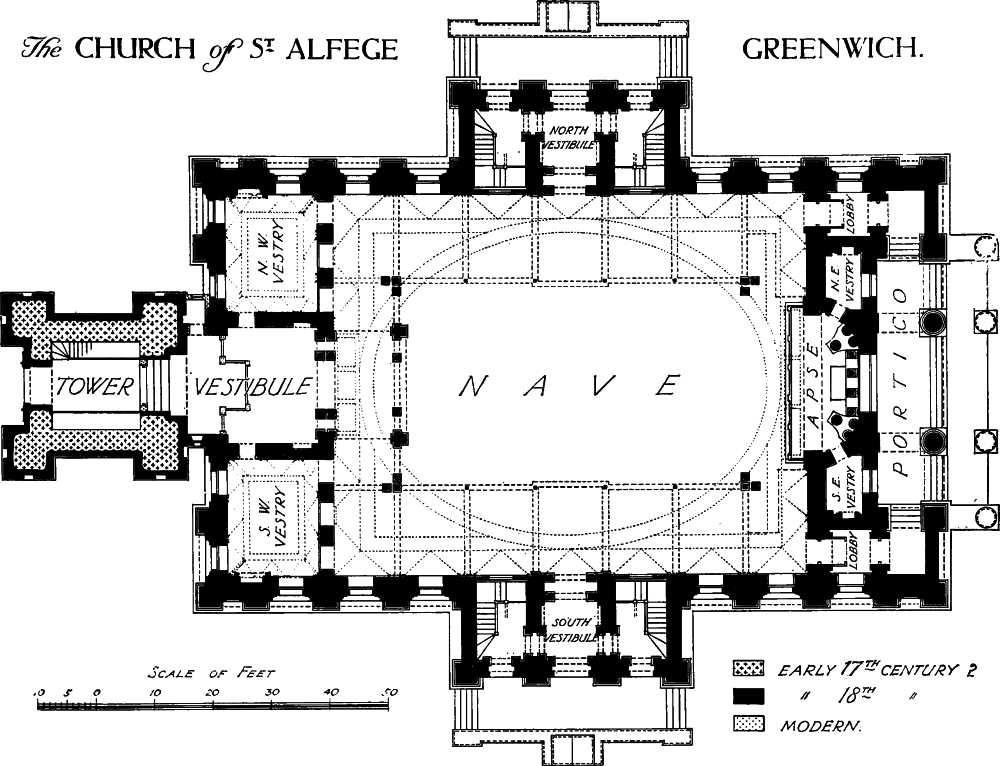
The Church of St Alfege, Greenwich.
Interior (Plate 45). In the E. wall of the church is a shallow apse with quadrant sides and a flattened end; it is entered by an elliptical arch springing from Doric pilasters; the ceiling forms an elliptical semi-dome flattened against the E. wall to admit the head of the E. window. N. and S. of the apse-arch are round-headed doorways with plain architraves; above the gallery-level are round-headed openings communicating with the spaces over the two small lobbies beyond these doorways. The N. and S. walls have each three round-headed openings, at the gallery-level, communicating with the projecting wing; the impost-mouldings are continued along the face of the wall. At the same level in the W. wall are six similar openings to rooms over the vestries; behind the organ is a round arch. The openings to the wings and vestries, below the gallery, have no structural features. The plaster ceiling of the body of the church is bounded by a rectangular moulded band with rosette-ornament and encloses an oval band of the same character and axial dimensions; beyond the rectangular band is a deep cove, groined back over each window or opening and springing from cornice-shaped brackets with scrolled enrichment below. Above both the large E. and W. arches is a flat ceiling, divided into three panels with rosettes; the vestibule beyond has a ceiling of six moulded panels. The W. vestries and the rooms above them have plaster ceilings with coves, groined back against the walls and springing from brackets, with acanthus-foliage. The spaces over the E. lobbies, the staircases with their landings and the space behind the organ have plain groined vaults of plaster.
Fittings—All of early 18th-century date, unless otherwise stated. Communion Table (Plate 47): with inlaid top and carved edge, panelled support at either end with carved scrolls, all resting on moulded rails with ball-feet. Communion Rail (Plate 28): of wrought iron with moulded oak capping, rail in five bays including gates, all of elaborate scrolled ironwork with acanthus-enrichments, standards of similar character. Doors: External. At E. end, with eight moulded panels and two panels in the tympanum; main N. and S. doors, of two four-panel leaves with glazed tympanum; doors to staircases similar to those at E. end; doors to vaults, of two battened leaves each with a wrought-iron panel. Internal: from apse to E. vestries, doors of ten moulded panels, opening flanked by wooden pilasters supporting enriched imposts and archivolt; doors to inner E. lobbies, of six moulded panels with architrave and cornice mouldings to opening and panelled tympanum; doors to W. vestries and vestibule, of eight moulded panels with glazed heads; between S.W. vestry and church, six-panel door and a door of two leaves, each of three panels, glazed head above each; between church and N. and S. vestibules, of two leaves each of three panels, the upper panel glazed, opening flanked by fluted Corinthian pilasters and half-pilasters, with entablature on outer side; doors stand in shallow recess, on inner side, flanked by square Corinthian piers and pilasters with an entablature; outer doorways of vestibules and staircases flanked by Corinthian pilasters with entablature; on either side vestibules, recesses and doorways forming two bays, flanked by panelled pilasters supporting archivolts and recesses enclosing panelling to imitate doors; doors at top of staircases, of six panels with glazed openings above. Fireplaces: In all vestries and in rooms above N.W. and S.W. vestries—of stone with moulded surrounds, panel on lintel and simple cornice. Font (Plate 13): with round moulded and fluted bowl and clumsy baluster-stem. Galleries: On N., S. and W. sides of the church—supported, at the sides, on square posts, of trumpet-form at the top and finished with Corinthian capitals, supporting moulded transverse beams and the frieze-beam and enriched modillioned cornice under the gallery-front; fronts of side galleries of five bays with four moulded panels to each bay, plain pilasters between the bays and moulded capping; fronts returned at E. end between first two windows and supported at the angle by a square fluted Corinthian pier with two columns of the same order; from side galleries are gangways communicating with the spaces over the E. lobbies and also with galleries added later against the E. wall. The W. gallery is raised to a higher level in the middle to form the royal pew; this part stands on two compound piers with a large fluted Composite pilaster on the face and small Corinthian pilasters at the sides; the W. angles of the side galleries are supported on a square post and two columns all with Corinthian capitals; the space under the raised gallery has two Corinthian columns as subsidiary supports and an elliptical arch over the middle bay; the opening under this gallery, to the vestibule, has a pair of coupled Corinthian columns supporting a wooden entablature; the ceilings under the galleries have moulded panels. Inscription: On N. slope of roof—small lead tablet with initials and date I.H. 1714. Monuments: On S. wall of tower— enclosed in cupboard, (1) to John Greene, 1683–4, plain tablet; (2) to Elizabeth, wife of Tobias Pratt, 1709, also to Thomas Charlton and Stephen Hasser her grandchildren, head-stone with skull and cross-bones. In churchyard—N. side, (3) to Gilbert White (?) and Alice . . ., 1689, head-stone with skull. Organ and Case: An organ was built in 1673, and this appears to have been repaired and enlarged by Thomas Swarbutt or Schwarbrook in 1706; it has been again rebuilt in recent years. Case with three 'towers' of pipes, with moulded cornices and carved scroll-work below and standing on carved foliage brackets; bays between in two divisions with simple carving; moulded cornice ramped up to middle tower. Preserved at W. end of church, two manuals with black naturals and white sharps, with an ebony division down the middle of each, perhaps part of organ of 1673. Paintings: on wall-surfaces of apse, pilasters, etc.—painting in chiaroscuro with gilding; on pilasters, foliage-festoons; on soffit of arch, panels with rosettes; on ceiling of apse, octagonal coffers and rosettes; on side walls, compositions including instruments of the Passion, emblems of the Sacrament, etc., attributed to Sir James Thornhill. Panelling: walls panelled throughout on ground floor and at gallery-level in two heights with moulded capping. Plate (Plate 21): includes two cups (Plate 20) of 1631 and 1658 given by John Wardell, and each with a shield-of-arms; two patens of 1631 and c. 1660 with the same arms; large paten and alms-dish of 1711 given by Peter Watton, both with a shield-of-arms; alms-dish of 1685 given in memory of Anne Adams, with lozenge-of-arms; two flagons of 1671 given by Mary Squibb, with lozenge-of-arms; a dish or basin of 1707 given by Dorothy Brewer in 1708; and a spoon of 1640 with bowl incised T.V. 1663 W.S. Pulpit (Plate 48): hexagonal with panelled and inlaid faces, heavily moulded and enriched base, moulded capping with projections at the angles on carved brackets, plain stem with Corinthian capital from which spring six curved and scrolled supports to the base of the pulpit; sounding-board carried on two square, fluted, Corinthian columns with a round arch between the capitals, board itself circular with richly carved cornice, six projections and inlaid soffit; staircase with cut string and carved brackets, wrought-iron balustrade (Plate 28) with acanthus leaves at the top of the standards. Reredos: of three bays, divided and flanked by fluted Corinthian columns, with pilasters behind, supporting an entablature with modillioned cornice; between columns, round-headed panels inscribed with the Decalogue, Creed and Lord's Prayer; flanking reredos, on each side, three grouped fluted columns of the Corinthian order, supporting an entablature. Royal Arms: On front of W. gallery—in carved wood, of Queen Anne before the Union. Seating: church fitted with panelled pews including churchwardens' pews at W. end with carved frieze-panels; pews at W. end of gallery with carved scrolls; royal pew with sea-monsters (Plate 14) on scrolls at ends, door with carved and pierced upper panel. Staircases: Over N.E. vestry—wide newel-staircase leading to the roof. In N. and S. projecting wings—two staircases (Plate 26), with straight moulded strings, turned balusters and square newels with turned pendants; against walls, panelled dado. Miscellanea: In S. projecting wing—two tables of benefactions, one in eastern staircase with carved frame and finished with a crowned cartouche with the garter and monogram A.R. flanked by scrolls and a lion and unicorn; in western staircase similar table but with the royal arms of Queen Anne, wrongly rendered, and initials A.R. on cartouches held by the lion and unicorn.
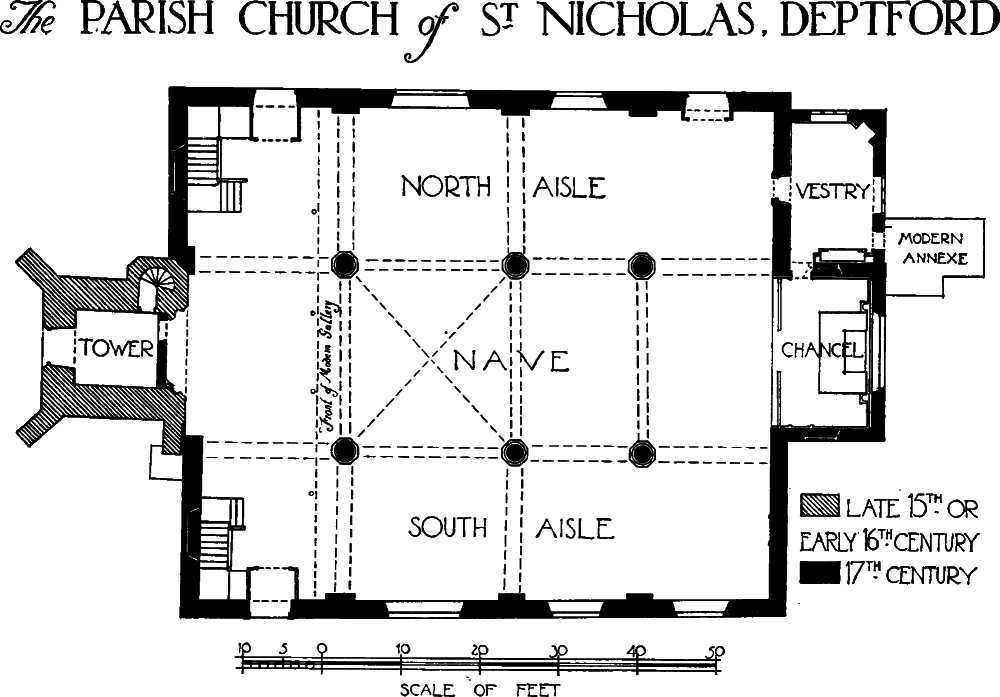
The Parish Church of St Nicholas, Deptford
Condition—Good.
a(2) Parish Church of St. Nicholas, Deptford, stands on the S. side of Deptford Green. The walls of the body of the church are of red brick with stone dressings; the tower is of Kentish rag-stone with free-stone dressings; the roofs are tiled. The West Tower is of late 15th or early 16th-century date, but the whole of the rest of the church was rebuilt c. 1697. There is a modern annexe and a small modern tower at the E. end.
The church is a fairly interesting example of late 17th-century work, and among the fittings the 'Ezekiel' carving is noteworthy.
Architectural Description—The Chancel (12 ft. by 19¾ ft.) has in the E. wall a round-headed window with rubbed brick architrave and carved stone key. High up in the N. and S. walls is a circular window with brick architrave and stone key externally. The chancel arch is of flat elliptical form, and above it on the nave-side are the royal arms of William III in plaster. The Chancel has a flat plaster ceiling with a cornice round it.
The Nave (74 ft. by 22 ft.) is of four bays (Plate 46) and has colonnades of three Doric columns on each side on high octagonal pedestals. These columns support a horizontal cornice, and above each is a plaster cherub-head. The ceiling is elliptical in form and of plaster, and has coffered bands between the bays. The third bay from the E. forms a transept, and here the ceiling is groined, the high vault and cornices being returned N. and S. to the outer walls. The roof is strengthened by wrought-iron ties over the columns with overthrows of scroll-work.
The North and South Aisles (average 18½ ft. wide) are of uniform design, the third bay in each case being finished at the top with a low pitched gable formed by a small pediment resting on a pair of consoles. The rest of the wall has a plain parapet and the angles have stone quoins. Each bay of the N. wall has a round-headed window with brick architraves and stone keys externally. The large windows under the gables have carved stone keys. In the second and third bays the architraves are carried down below the sills forming a panel, and below it are square-headed windows lighting the space below the gallery. Below the window in the easternmost bay is a square-headed doorway surmounted by a pulvinated frieze and segmental pediment with two cherub-heads in the tympanum. In the fourth bay is a similar doorway. The S. wall is similar in every respect, but there is no doorway in the easternmost bay, its place being taken by a window like the others of the lower range. In the W. wall of each aisle is a round-headed window similar to the others. The aisles have flat ceilings with a cornice round them, except in the third bay where the main roof is returned.
The West Tower (10¼ ft. by 9½ ft.) is of three stages (Plate 99) with diagonal buttresses to the western angles and a semi-octagonal staircase-turret at the N.E. angle. The top stage or bell-chamber is modern. The two-centred tower-arch is moulded, and has moulded responds with an attached round shaft having a moulded capital. In the N. wing is a plain doorway to the stair-turret with a two-centred head. In the W. wall is a two-light window with old jambs and four-centred head, two-centred rear-arch and modern tracery and mullion. Below it is the W. doorway with moulded jambs and two-centred arch with moulded label all much decayed, also a two-centred and chamfered rear-arch. The doorway is sunk considerably below the churchyard level. The second stage has in the W. wall a single-light window with a semi-elliptical head, and modern label and sill.
The North-East Vestry has in the E. and N. walls a square-headed window of three lights with a solid wooden frame. The vestry has a hipped roof and a moulded and modillioned wooden cornice to the eaves.
Entrance to churchyard. The piers have been re-built but are surmounted by original moulded stone caps with carved skulls encircled by laurel. Abutting on the piers are carved stone scrolls.
Fittings—Bells: eight, 1st to 4th, 1701; 5th, 1702; 6th and 7th, 1701, with the initials S.N. and I.H. on the 7th bell. Carving: In S. aisle—at E. end, rectangular oak panel (Plate 50) carved in high relief with a figure subject—Ezekiel's vision of the valley of dry bones, with inscription at top, "Audite arida ossa verbum domini, hic dicit dominus deus, his ossibus intermittam spiritum meum inter vos et viventis," late 17th-century, formerly over door of Mortuary. Chairs: on N. side of chancel—two with high carved and pierced backs, turned legs and rails, mid 17th-century. Communion Rails: with panelled oak standards, moulded rail and turned and twisted balusters, late 17th-century. Doors: In chancel—doors (Plate 14) at sides, two panelled (that on S. is sham) with enriched architrave, panel with monogram W.R. in head, segmental pediment over, surmounted by carved festoons. The three doors to the nave aisles have doorcases with curved and broken pediments and bolection-moulded architraves ramped up in the centre of the head. The doors are panelled. The vestry door at the E. end of the N. aisle has a door-case with moulded architrave and pediment over it, and twopanelled door. At the E. end of the S. aisle is a sham door and case to correspond with it. The W. door is externally of three large planks riveted and with moulding round the edge. Internally it is cross battened and hung with long straphinges. Probably of early 17th-century date. At the foot of the circular stair is a simple battendoor of the same period. Galleries and staircases: The gallery front is modern, but the two staircases to it have moulded rail and string, turned balusters, square newels with ball-terminals, and are each of three flights, late 17th-century. Monuments: In chancel—on N. wall, (1) of Roger Boyle, 1615, son of Richard, Earl of Cork, and Edward Fenton, 1603, marble wall-monument (Plate 16) with plinth, kneeling figure of man at prayer-desk, Ionic side-pilasters, entablature, broken pediment, cartouche and four shields-of-arms; on S. wall, (2) to Jane Edisbury, widow, 1618–9, small black marble tablet, recessed in wall with three shields-of-arms. In N. aisle —on E. wall, (3) to William Boulter, 1714–5, and Richard Wilkinson, his grandson, 1725, white marble tablet with scrolls, drapery and shield-of-arms; (4) to Peter Pett, 1652, brown and black marble tablet (Plate 16) with Ionic side-pilasters, standing figures of putti, entablature, curved and broken pediment, achievement and cartouche-of-arms, also second cartouche with arms on sill, on apron, frigate-hull, carved in relief; (5) to Jonas Shish, 1680, master-shipwright to Charles II, and Elizabeth his wife, 1678–9, John, 1686, and Thomas, 1685, their sons, and Kendrick, son of John Shish, 1685, marble tablet (Plate 16) flanked by standing figures of putti, entablature and curved broken pediment with putti, cartouche on apron of the arms of the Shipwrights' Company; N. wall, on first pier from E., (6) to Elizabeth daughter of Thomas Wiltshaw, 1709, and to Judith daughter of Peter Fiot, 1713, white marble oval tablet (Plate 16), with foliage and urn; (7) marble tablet record ing the benefactions of Isaac Loader, erected 1701, with cartouche-of-arms. In S. aisle, on E. wall, (8) to Robert Castell, 1698, white marble draped tablet (Plate 17) with two cartouches-of-arms; (9) to R[ichard] Evelyn, [1658] and Mary, daughter of J. Evelyn, 1685–6, white marble draped tablet (Plate 17), with palms and shield-of-arms; (10) to Sir Richard Browne, 1604, Joanna Vigorus, 1618, Christopher Browne, 1645–6, Thomazine (Gonson) his wife, 1638, Sir Richard Browne Bart., 1682–3, and Elizabeth (Pretyman) his wife, 1652, grey marble tablet erected by J. Evelyn, with cornice, urn and shield-of-arms. On S. wall, (11) to Katherine (Gunman) wife of Captain Francis Wivell, 1713, also their six children, Edward, Christopher, Francis, Edward, Katherin and James, white marble tablet with scrolls, drapery and cartouche-of-arms. On first pier from E., (12) to John Hughes, A.M., 1710, oval marble tablet with foliage; (13) to John Turner, 1672, captain of H.M.S. York, brown and black marble tablet with drapery, Ionic pilasters, curved pediment and cartouche with achievement-of-arms all supported on shelf with scrolls. In churchyard—on E. wall of chancel, (14) to Susanna, wife of Captain George Shelvocke, 1711, small tablet with cartouche-of-arms; on S. side of church—(15) to Francis Ratclif, 1688–9, mariner, small head-stone; loose next E. wall of churchyard—(16) to Thomas Commins, head-stone with shield-of-arms, probably early 18th-century, broken; (17) head-stone, now lying on ground, with three skulls carved at head, inscription illegible, late 17th or early 18th-century date; (18) on S. wall of church, exterior, is a tablet recording the re-building of the church in 1697. It is flanked by narrow brick pilasters supporting cornice. Floor-slabs: In middle aisle— (1) to George Pomeroy, 1709–10, also others of later date. In N. aisle, (2) to Captain John Guy, 1696–7; (3) to John, son of Admiral John Benbow, 1708, with achievement-of-arms at head; (4) on floor of later addition to old Vicarage, to Ben. Twigden, 1709. Organ and Case (Plate 49): In W. gallery—organ built originally by Father Bernard Schmidt. Organ-case, of oak, lower part panelled and upper part rising in three graduated 'towers' of pipes resting on brackets with cherub-heads and terminating in entablatures, of which the side pair support angels with trumpets, the bays between the towers have pierced carving and are ramped up to the middle tower, late 17th-century. Painting (Plate 14): In S. aisle—on E. wall, on canvas, of Queen Anne, by Sir Godfrey Kneller, richly carved and gilt frame. Royal arms (after 1707) at top, also motto, A. and R. at sides. Panelling: In vestry—walls panelled to ceiling, with dado-rails and cornice, late 17th-century. Pulpit (Plate 48): hexagonal, with richly panelled sides, each face with elaborate perspective arch in middle, angles each with a pair of enriched diminishing pilasters, resting on pierced and scrolled brackets, elaborately carved cornice including oval medallion with scenes, moulded and enriched base with convex soffit resting on later figure (Plate 14) of a boy, c. 1620. Reredos (Plate 51): of oak and of three bays with panelled plinth and enriched entablature, middle bay flanked by fluted Corinthian columns and surmounted by a segmental pediment, vases and a carved achievement of the royal arms of William III; in tympanum, oval panel of stained glass, of same date, with inscription Wil. Price pinxit, "Adoration of the Shepherds," surrounded by carved foliage; main part of middle bay in three panelled sub-bays with swags and carved foliage enrichments and mouldings, round-headed middle panels with the Commandments, side panels with painted figures of Moses and Aaron; side bays with similar panelling and with the Lord's Prayer and Creed, respectively. Below is a range of carved panels. Panelling is continued along side walls with enriched cornice and surmounted by carved reclining figures of St. John (Plate 14), and probably one of the major prophets, late 17th-century.
Condition—Good.
b(3) Parish Church of St. Luke, Charlton, stands in the village at the N.E. corner of Church Lane. The walls are faced with brick with some stone dressings, and the roofs are tiled. Some mediæval walling may remain incorporated in the thick S. walls of the Old Chancel and Nave, but of this there is no definite evidence. The Old Chancel, Nave, South Porch and West Tower were built or re-built c. 1630 under the will of Sir Adam Newton. The North Chapel was added probably at the same time, and the North Aisle was built in 1693 from a bequest of Sir William Newton, Bart. The New Chancel, with the North Organ Chamber, was added in 1840 on the site of a charity-school and vestry built in 1713; the N. aisle was restored and a new vestry added in 1873.
The church is of interest as an example of its period. Among the fittings the monuments and glass are noteworthy.
Architectural Description—The Old Chancel (Plate 52) (26 ft. by 15 ft.) has a modern arch in the E. wall. In the N. wall is a plastered 17th-century arcade of two bays with round arches, moulded archivolts continued down the square pier and responds, but interrupted at the springing-level by an impost-moulding. The S. wall is faced with red brick partly repaired and having a straight joint continuing the E. jamb of the window; the window is probably of the 15th century and may be in situ; it is set in a recess with a restored elliptical head, and is of two trefoiled lights in a square head with a moulded label. The 17th- century chancel-arch is round with chamfered edges and dies on to the side walls.
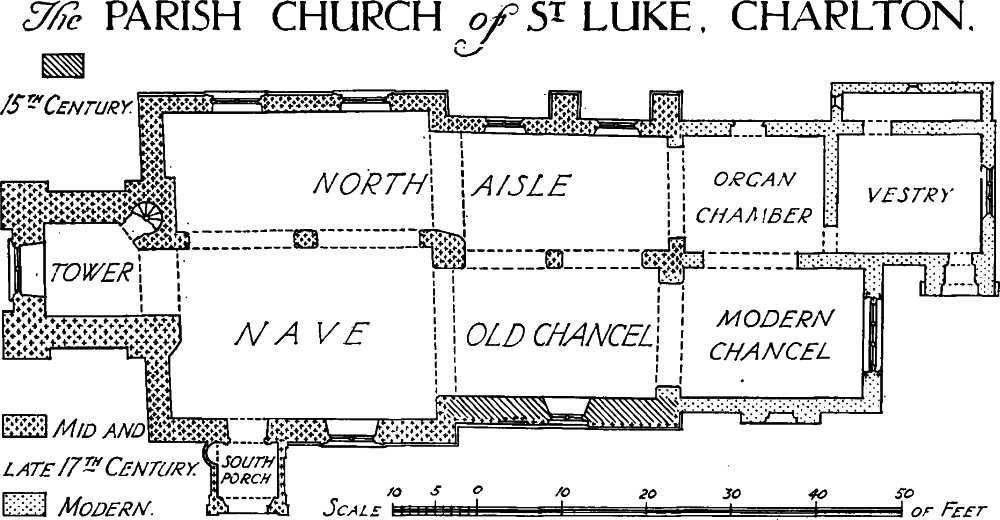
The Parish Church of St Luke, Charlton
The North Chapel (24 ft. by 13½ ft.) has a modern arch in the E. wall. The N. wall is rendered externally in cement, except the buttresses which are of brick; in this wall are two windows, the eastern of the 17th century and of two cinquefoiled lights with a quatrefoil in a two-centred head; each light has two iron guard-bars; the western window is of brick and of two three-centred lights in a square head; each light has one guard-bar. In the W. wall is a plain round arch dying on to the side walls.
The Nave (Plate 52) (30 ft. by 20 ft.) has a 17th-century N. arcade of two bays with round arches having simple moulded archivolts and moulded imposts; the piers and responds have round shafts worked on the angles. The S. wall is faced with brick and has a two-light window similar to the eastern window in the N. chapel; further W. is the plain square-headed S. doorway. In the W. wall is an 18th-century round window.
The North Aisle (14 ft. wide) is faced with brick and finished externally with a coved eaves-cornice of plaster. In the N. wall are two windows uniform with that in the S. wall of the nave.
The West Tower (11 ft. square) is of three stages (Plate 173) and of red brick with square turrets or clasping buttresses at the angles, embattled at the top and rising above the embattled parapet; below the parapet is a dentilled cornice. The tower-arch is round and has chamfered angles; it dies on to the respond on the N. side. The W. window is uniform with that in the S. wall of the nave. The second stage has a restored rectangular opening in the N., S. and W. walls. The bell-chamber has in each wall a brick window of two pointed lights with a pierced spandrel in a two-centred head; the jambs and mullion have impost-blocks.
The South Porch is of brick and has Doric pilasters at the angles supporting a modified entablature; the S. end has a curvilinear 'Dutch' gable. The outer archway is round and has a moulded archivolt, plain key-block and moulded imposts; the jambs and spandrels are rusticated. The side walls are similarly treated, but the arches are not pierced.
The Roof of the old chancel is of the 17th century and is of five-sided waggon-form, ceiled on the soffit and divided into panels by moulded wooden ribs; the wall-plates are covered by moulded cornices. The roof of the N. chapel is of similar type and date. The nave-roof was reconstructed in 1925 and has four heavy tie-beams; it is ceiled on the soffits of the rafters and collars. The N. aisle has a flat plaster ceiling divided into six panels with moulded ribs and cornices, all of 17th-century date.
Fittings—Bells: four; 1st by R. Phelps, 1713; 2nd and 3rd by Christopher Hodson, 1685. Brasses: In old chancel—on S. wall, (1) to Robert Veer, 1598, son of John, Earl of Oxford, inscription and shield-of-arms; (2) to George Seger, 1594, inscription only; (3) a quartered shield-of-arms; on pier of chancel-arch, (4) to Edward Blount, 1617–8, inscription, shield-of-arms fixed in N. aisle. Doors: In S. doorway—of two folds each with eight moulded panels, moulded wooden architrave to doorway; in outer doorway of porch —round-headed, lower part with fifteen moulded panels, upper part with six panels radiating from a small central boss with a cherub-head; both doors mid 17th-century. Glass: In E. window (Plate 53)—middle light with modern figure, above it an Agnus Dei, and below on the pedestal a cartouche with an English inscription recording the glazing of the window by James Newton (died 1639), uncle of Sir Henry Puckering Newton, Bart., who was brother and heir of Sir William Newton, Bart.,; below again are fragments of a Latin inscription apparently recording the gift of the pulpit and 'oratorium' in the same year; the side lights have figures of Moses and Aaron of which the upper parts only are old, above are roundels with the words Jehovah in Hebrew and Deus, and cherub-heads in the heads of the lights and in the tracery; on the pedestals of the figures are shields-of-arms of (a) Warner, Bishop of Rochester (1638–66) and (b) Newton, dated 1639; glass said to be by Isaac Oliver. In nave—in tracery of S. window, the ox of St. Luke with three cherubheads, one mutilated, 17th-century. In N. aisle —in N.E. window, eight panels—(a) and (b) 18th-century achievements; (c) achievement of the quartered arms of Blount impaling Garway and the date 161 [8]; (d) achievement of the quartered arms of Blount with four small shields-of-arms of quarry-form around it; (e) achievement of the quartered arms of Puckering; (f) achievement of the quartered arms of Peto impaling Newton; (g) an irradiated heart charged with the arms of Blount; (h) a sun with a shield bearing the device of the Trinity; in tracery a sun with three cherubheads and the ox of St. Luke, all 17th-century. Font and Cover (Plate 13). Font: of stone with round moulded bowl with four scallop-shells and drapery between them, leaves below; baluster-stem with moulded base, both with acanthus-ornament. Cover: of oak moulded and enriched with acanthus-ornament, fruit, etc., middle rises to a moulded pedestal surmounted by a wreath and a group of fruit, 17th-century. Inscriptions: In nave—over S. doorway, 17th or 18th-century stone tablet with text (Hebrews x. 24–25). On E. wall of vestry— stone tablet with inscription recording erection of Charity School and vestry by Sir William Langhorne, Bart., 1713. Monuments and Floorslabs. Monuments: In chancel—on N. wall, (1) to Elizabeth, wife of James Craggs, 1711–2, white and veined marble tablet, flanked by scrolls and surmounted by a bust of lady, cartouche-of-arms on apron. In nave—on S. wall, (2) to Edward Wilkinson, 1567–8, master-cook to Queen Elizabeth, and Clare, his wife, rectangular stone tablet (Plate 43) with moulded border, inscription and large achievement-of-arms with four small shields-of-arms; at W. end, (3) to Katherine (Puckering) wife of Sir Adam Newton and to Sir Adam Newton, 1629–30, combined altar-tomb and wall-monument (Plate 54) of black and white marble, by Nicholas Stone; simple panelled altar-tomb with pilasters at angles on which stand two free Corinthian columns and two pilasters against the wall, all supporting a canopy with entablature, broken segmental pediment and achievement-of-arms; on wall at back large inscribed tablet with moulded border. In W. tower against N. wall, (4) to Grace (Manners) wife successively of Patrick, Earl of Ardmagh and Sir William Langhorn, Bart., 1699–1700, also to her second husband, 1714–5, combined altar-tomb and wall-monument (Plate 54) of black and white marble; altar-tomb with gadrooned edge to slab, front with carved cherub-heads and drapery; on altar-tomb two Corinthian columns and as many pilasters supporting canopy with enriched entablature, broken, scrolled pediment and achievement-of-arms; on wall at back inscription surrounded by elaborate drapery, cherub-heads, etc.; flanking backpiece two enriched pedestals each with the figure of an angel. In churchyard— S. of chancel, (5) to Anne Richards, 1709, low table-tomb, with lozenge-of-arms; E. of porch, (6) to Isaac, 1663–4, and Frances, 1666, son and daughter of William Collins, head-stone. Floorslabs: In nave—(1) to Francis Lappyrastone, 1694–5, with shield-of-arms; (2) to John Griffith, 1713, much defaced. Plate: includes flagon given by Elizabeth Craggs, 1711, with arms and crest; two stand-patens of 1711, given by Sir Richard Raynes, 1710, with cartouche-of-arms; small stand-paten, probably late 17th-century. Pulpit: of oak, semi-octagonal with moulded base and cornice, each face with shaped panel having scrolled top with cherub-head and small swag at base; shaped panel applied to frieze on each face, under book-board cartouche of the arms of Cunningham; sounding-board, now in tower, hexagonal with enriched entablature, soffit slightly coved and panelled, mid 17th-century. Recess: In S. porch—in W. wall—round-headed recess, possibly for seat. Royal Arms: In N. aisle on W. wall, of Queen Anne before the Union, painted on canvas with enriched frame. In S. porch— carved oak cartouche with four cherub-heads, mid 17th-century, repainted with late Hanoverian arms. Sundial: On S. parapet of nave—of wood, rectangular, painted with sun, etc., 17th or 18th-century.
Condition—Good.
a(4) Burial Ground on the N. side of Wellington Street, 90 yards W. of St. Nicholas Church. In E. wall is a stone tablet inscribed "This Burying Ground Was Consecrated and Wall Built at the Parish charge by Order of Vestry Anno Dom. 1705." The tablet was originally in the N. wall of ground; this wall was removed in 1897 when extra land was added to the garden northwards. The W., E. and S. walls are original and of English bond.
Secular
b(5) Tumuli in Greenwich Park, about 100 yards E.N.E. of Croom's Hill Gate. A group of seventeen small tumuli, all circular on plan and about 21 feet in diameter. The better-preserved still show traces of a surrounding ditch and a slight sinking in the top; the heights vary, being generally from 1 ft. to 1 ft. 8 in. Excavations made in 1784 seem to have proved that they are of the pagan Saxon period.

Greenwich. Trinity Hospital. Ground Floor Plan
Condition—Poor.
b(6) The Royal Hospital (Plates 55, 56, etc.), now the Royal Naval College, stands on the right bank of the river Thames. The building consists of four detached blocks, each with a quadrangle and occupies part of the site of Greenwich Palace. Of the earlier building a vaulted undercroft of early 16th-century date survives under the N.E. or Queen Anne Block. The Tudor palace had become much dilapidated by the date of the Restoration, and in 1662 its demolition was begun and the foundations of a new palace were laid. This work was designed by John Webb and consisted of the N.E. pavilion of the N.W. or King Charles Block, followed by the main E. range and the S.E. pavilion, the whole being roofed by 1669. Nothing further appears to have been done to the unfinished building until near the close of the century, when Queen Mary conceived the idea of converting the palace into a hospital for disabled seamen of the Royal Navy. After her death William III, in 1695, appointed a Commission to carry her intentions into effect. The Commission appointed Sir Christopher Wren architect; the first work undertaken, 1696–98, was the main W. range of King Charles Block and also the N.W. and S.W. pavilions. Both these pavilions, however, were subsequently rebuilt on a larger scale, the N.W. pavilion in 1712 and the S.W. pavilion in 1769 by James Stuart; the main W. range was itself re-built in 1811–14. In 1698 Nicholas Hawksmoor was appointed Clerk of the Works, with John James as his assistant from 1705 and his equal from 1718. In 1698 the S.W. or King William Block was begun, the first work being the Painted Hall and N.E. pavilion, which were finished about 1705. The main W. range was in progress by 1701 and roofed in 1702, but was not finally completed till 1721–3. The foundations of the E. colonnade and the whole S. front were begun in 1699. The foundations of the W. range of the N.E. or Queen Anne Block were laid in 1696, but the work proceeded slowly and in 1729 it was decided to complete the N. pavilions and proceed with those on the S. The foundations of the W. colonnade and part of the chapel of the S.E. or Queen Mary Block were laid in 1699, those of the main building in 1702 and the rest of the chapel in 1706, but work was discontinued for a long period. Building was begun again in 1735, the chapel finished in 1750 and the rest of the building in 1752. In 1779 the chapel was burnt, but was repaired and reopened in 1789. During these works the office of Surveyor was held by Vanbrugh from 1716 (he was previously a member of the Board of Directors, appointed 1702–3), Colin Campbell from 1726, Thomas Ripley from 1729 and James Stuart from 1758. The walls of the buildings are generally of brick faced with ashlar from the Portland, Ketton and Roche Abbey quarries; the W. building of the King William Block is of brick with stone dressings. The roofs are covered with lead.
The building is a handsome example of English Renaissance work exhibiting a general unity of design. Among the fittings the painted ceiling, dome and walls in the Painted Hall are particularly noteworthy.
Elevations. The E. Front (Plate 58) of the King Charles Block is original and of two storeys with attics and a true 'attic-storey' over the angle-pavilions. The walls are faced with rusticated ashlar and have a band between the storeys and a main entablature; the windows are square-headed with heavy key-stones and small cornices carried along the walls at the level of the heads. The middle-bay (Plate 59) of the front projects and has four attached Corinthian columns and a pediment over the entablature; in the tympanum is a richly carved and crowned cartouche of the royal Stuart arms supported by reclining figures of Fortitude and the Dominion of the Sea; between the columns, on the ground floor, are round-headed openings, with moulded imposts and key-blocks carved with women's heads; the soffits are enriched with carved rosettes and acanthus-foliage; the windows above have triangular or segmental pediments. The angle-pavilions (Plate 57) on this front, are each divided into three bays by Corinthian pilasters and the attic-storey has plain pilasters to correspond; the attic is finished with a cornice and balustraded parapet. The middle window on the ground floor has a segmental pediment and the window above a triangular pediment; the windows in the attic-storey are square-headed with architraves. The N. Front retains the original N.E. pavilion, but the rest of the front was re-built in 1712 and is a replica of the earlier work, except that there is no carving in the tympanum. The original pavilion has, on this face, coupled Corinthian pilasters at the angles and a central projection with four engaged columns of the same order and a pediment over the main entablature, which is continued round from the E. front. On the main frieze is a moulded panel with the inscription "Carolus II Rex A. Reg. XVI"; in the tympanum is a carved and crowned cartouche of the royal Stuart arms supported by reclining figures of Mars and Fame. The windows of the two lower storeys have triangular or segmental pediments and the side bays of the central projections have, on both floors, a round-headed niche; the attic-storey is similar to that on the E. front. The W. Front is of later 18th-century or modern date, except the early 18th-century return of the N.W. pavilion; this repeats the design of the corresponding E. front of the N.E. pavilion. The S. Front is entirely of mid 18th-century date. The Internal Elevations to the courtyard have bands between the storeys, plain square-headed windows and a main cornice; in the middle of the E. range is a pediment with a cartouche of the royal Stuart arms and military trophies in the tympanum. In the middle of the N. range is a tall round-headed archway with a moulded archivolt.
Greenwich. Trinity Hospital. Ground Floor Plan
The Queen Anne Block corresponds in general design to the King Charles Block. The W. range was begun in 1696 but proceeded slowly and the whole block was not completed until some time after 1729. The W. Front is probably of early 18th-century date and is uniform with the E. front of King Charles Block, facing it, except that there are no sculptural decorations.
The King William Block was begun in 1698 and finished about 1723. It consists of three ranges forming a half H-shaped block, with the courtyard enclosed on the E. side by a colonnade extending round the ends of the wings. The E. Front (Plate 62) has a long colonnade with coupled Doric columns standing on common pedestals and supporting a continuous entablature and balustraded parapet. The ends of the wings form pavilions of two main storeys, finished with a main cornice and parapet and having a pediment on the three free faces of the building. The upper storey of the N.E. pavilion, which rises above the colonnade, is divided into five bays by plain pilasters and pierced by a round-headed window flanked by niches; the head of the central window is carried up into the tympanum. The lower storey is divided into five bays by Doric pilasters, with a segmental headed doorway (Plate 8) in the middle bay and round-headed niches in the side bays. The upper storey of the S.E. pavilion has three windows flanked by niches, the middle window square-headed and the others round-headed; in the tympanum is an oval window; the lower storey is similar to that in the N.E. pavilion, but has two windows in place of two of the niches. Standing on the N.E. pavilion is a stone cupola and dome; it stands on a square base but is itself circular on plan with four diagonal projections, a round drum in the form of an architectural attic-storey and a lead-covered dome. The main stage is divided into bays by coupled Corinthian columns, with four columns on the face of each projection; these support a continuous entablature; a tall narrow window occupies each of the main intercolumniations. The attic-storey is divided, by plain coupled pilasters, into bays and the N. and S. faces have each a wind-dial face set under a segmental pediment; in each bay is a small square window. The dome is ribbed and has two ranges of oval lunettes; it is capped by a small cupola or lantern of round form with eight square posts supporting a cornice, moulded capping and weather-vane. The ceiling of the colonnade (Plate 61) has trabeations corresponding to the columns and moulded cornices except behind the central feature of the W. face, where it has a deep cove, groined back over each bay and three panels enclosed by a panelled frame. The rear or W. Face of the colonnade (Plate 63) has a central feature with coupled columns as on the E. front but supporting a wide pediment, with modern sculpture in the tympanum; flanking this central feature are pairs of blank bays divided by coupled pilasters and each with a round-headed recess; the rest of the colonnade on this face consists of open bays with coupled and rusticated piers supporting the entablature; above the outer blank bays are two bell-turrets of stone with pilasters at the angles supporting an entablature, a round-headed opening in each of the four faces and a moulded capping, also concave stone roofing with finial. The W. side (Plate 60) of the Courtyard consists of a main block with lower buildings connecting it with the side-wings. The main block is of brick with stone dressings, and is of four storeys divided by stone bands and finished with a cornice and plain parapet. The central feature consists of two pairs of Ionic pilasters, rising to the height of the building, with festooned capitals and supporting entablatures; the recess between the pairs of pilasters is spanned by an elliptical arch springing from responds with moulded capitals; within this arch is an architectural composition consisting of coupled columns on high rusticated plinths and supporting an entablature and pediment. The windows are of varying form, those between the capitals of the Ionic pilasters being octagonal, with carved swags, and below are segmental or round-headed windows; there are three round windows on the second floor under the central arch. The remaining windows are square-headed except those on ground floor, which are segmental. The connecting buildings are of two storeys only and have each a segmental-headed window on the ground floor and above it a tall round-headed recess with eared architrave, carved key-stone and pediment containing two windows, the upper one circular. The return faces of the side-wings, towards the courtyard, are similar to one another and of four storeys on the S. and three on the N.; the walls are of brick with stone dressings and bands between the storeys, cornice and plain parapet. The second and third storeys on the S. are combined externally and have a series of round-headed recesses with moulded architraves; each recess encloses a square-headed window in the second storey and a round window above; the corresponding recesses on the N. have large round-headed windows. The W. Front (Plate 56) of King William's Block consists of the central building and two pavilions with connecting wings between them; all are of brick with stone dressings. The main building has a central feature or portico with pilasters at the angles and two engaged and fluted Doric columns supporting an entablature of the same order; in the middle bay is a round-headed doorway with moulded imposts and archivolt; above it is a round-headed window with moulded and enriched imposts, continued along the wall. The rest of the building has a band between the two lower storeys and a simple cornice and parapet; the remaining windows are as on E. side. The connecting wings are treated in a similar manner to the elevations of the same buildings towards the courtyard. The two pavilions are uniform and each of three storeys with an attic; there is a cornice between the two lower storeys and a moulded band between the upper storeys; the buildings are finished with a second cornice and a low segmental pediment; the tympanum is of ashlar except for an elliptical-headed recess, the back of which is of brick with an oval window in the S.W. pavilion, and is filled with sculpture; there is a similar window in the N.W. pavilion; the sculpture represents Neptune, Amphitrite, the winds, dolphins, lion and unicorn, etc.; the first-floor windows have round heads and moulded architraves, and the segmental-headed windows of the second floor have eared architraves and segmental cornices. The N. Elevation of King William's Block is ashlar-faced and of three storeys generally corresponding to the W. elevation of the N.W. pavilion, but the upper windows have no cornices, except on the pavilion, and the wall is finished with a cornice and balustraded parapet. The N. face of the N.E. pavilion is similar to its E. face but of three bays, and round it the colonnade is returned. In the plinth of the colonnade is a doorway with rusticated jambs and plain key-blocks leading to the rooms under the colonnade. The S. Elevation of King William's Block is of four storeys, faced with ashlar and finished with a cornice. The ground storey of the main block is rusticated and has square-headed windows with key-blocks; the windows of the second storey are segmental-headed and have rusticated jambs, plain key-blocks and cornices resting on carved consoles; the square-headed windows of the third storey have moulded architraves and large keyblocks flanked by entablatures resting on carved consoles; the square-headed windows of the top storey have moulded and eared architraves. The S. face of the S.W. pavilion is of three storeys and has a recess with rusticated jambs and round head extending to the height of two storeys and enclosing a doorway with a round-headed window above it; the doorway has a moulded architrave and a cornice resting on consoles. The lower part of the S.E. pavilion has coupled pilasters and two ranges of square-headed windows.
The Queen Mary Block (Plate 64) was begun in 1702, but little more than the foundations of the colonnade and N. or chapel-range was then proceeded with. Work on the building was not resumed until 1735. The block resembles in plan and elevations the design of King William's Block, except for the E. elevation.
Interior. The E. Range of King Charles' Block has in the middle of the ground floor a vestibule (Plate 67) faced internally with ashlar; it has semi-circular recesses at each end and two similar but smaller recesses in the W. wall; all are roofed with semi-domes. The ceiling has a deep cove groined back over each bay of the side walls and springing from pilasters. The three arched openings in the E. wall have enriched coffered soffits (Plate 23) with carved rosettes. In the middle of the W. wall is a doorway with architrave, frieze, cornice and pediment; in the end-recesses are similar doorways, without the pediment. The passage, W. of the vestibule, has panelling in two stages finished with a cornice; on either side the passage is a doorway with wooden architrave, entablature and pediment. The room over this, on the first floor, is similarly treated. The rooms on the E. front of the main block, at this level, have panelling in two heights with a cornice on the external wall only, between the windows; three of the rooms have original bolection-moulded surrounds to the fireplaces, in stone. Two have large panels and cornices above. Between the S. room and that in the adjoining pavilion is a round-arched stone doorway with moulded imposts and flanked by panelled pilasters of wood supporting a cornice. The adjoining room, facing the courtyard, is panelled in two heights with a cornice. The President's House occupies the N.E. pavilion and part of the main range adjoining. Most of the rooms on the ground and first floors are lined with moulded or bolection-moulded panelling, with dado-rails and cornices; the rooms above have simpler moulded panelling. The staircase has stairs, with treads, risers and ends, framed to represent separate steps; the balusters are turned and the newels have beaded edges. In the E. and W. walls of the staircase are stone doorways with pulvinated frieze and cornice; on the N. of the staircase is a similar doorway with an eared architrave and broken pediment. Other stone doorways open from the staircase at a higher level. The S.E. Pavilion has an original principal staircase (Plate 28) of stone with scrolled wrought-iron balusters and square openwork newels of the same material; the staircase has a dado of bolection-moulded panelling and under the landing is a bearer with a panelled soffit, enriched mouldings and a band of laurel-leaves. The doorways of the ground-floor rooms are flanked by stone pilasters and have moulded archivolts and scrolled key-stones; the doorways on the first floor are similar but have no key-stones. The N.W. Pavilion contains several rooms with early 18th-century panelling, dadorails and cornices. The stone doorways between the principal rooms have architraves and cornices. The secondary staircase, in the S.E. angle, next the courtyard has turned balusters, moulded strings and square newels.
Greenwich. Trinity Hospital. Ground Floor Plan
The Queen Anne Block has no internal features of earlier date than 1714, except the remains of the early 16th-century Undercroft (Plate 68), which lies partly below the W. range and partly under the courtyard. The latter part is complete, but the rest of the building has been cut away and partly destroyed for the walls of the later building. The walls and vaulting are of brick, except the outer face of the S. wall which is of rag-stone rubble; the piers and responds are of free-stone. The whole structure was originally 70 ft. by 30 ft. with a projecting bay at the W. end of the N. side; it perhaps formed the substructure of the Great Hall of Greenwich Palace. The extent of the remains is indicated on the accompanying plan. The piers are octagonal and the responds semi-octagonal, all having moulded capitals; the vaulting is of elliptical form, each bay having transverse, diagonal and ridge-ribs, all chamfered. In the eastern part of the undercroft are remains of original window-openings and in the S.E. bay is a well, now partly filled in.
The King William Block contains, in the N. range, the Painted Hall with the vestibule and dome on the E. and the Upper Hall on the W., all on the first floor. The Painted Hall (Plate 66) has side walls divided into eight bays by Composite pilasters supporting the entablature which is carried round the room. In the E. wall is an opening to the vestibule flanked by detached Composite columns and pilasters of the same order. In the W. wall is an opening to the upper hall with an enriched elliptical arch and imposts and flanked by Composite pilasters; on the soffit of the arch are six signs of the Zodiac in relief, and above the arch is a large cartouche of the arms of William III flanked by seated figures of Mars and Minerva. The spandrels above the arch and flanking the royal arms are painted with military trophies, and a draped curtain and the responds of the opening are painted with festoons of shells, coral, pearls, etc. The pilasters and entablature of the hall are painted and gilt and the jambs and soffits of the windows have painted coffers and rosettes; on the main frieze is painted the inscription "Pietas augusta ut habitent secure et publice alantur qui publicae securitati invigilarunt regia Grenovici Mariae auspiciis sublevandis nautis destinata regnantibus Gulielmo et Maria MDCXCIV." The painted ceiling, with the other painted decorations of the building, is the work of Sir James Thornhill; he was commissioned to paint the ceiling of the great hall in 1707 and appears to have finished it and the other decorations in 1717. The ceiling-painting (Plate 65) has an architectural framework representing a large balustraded opening of oval form, in the middle, with panelled spandrels and coffered bands and at each end a large arch in perspective. In the oval are represented King William and Queen Mary beneath a purple canopy and attended by figures of the four cardinal virtues; above the queen's head is Concord with the fasces and Peace hands the olive-branch to the king, who offers the cap of Liberty to Europe; beneath the king's feet is Tyranny. Above the main group is Apollo in his chariot and, in the corresponding position below, Architecture with a drawing of the hospital and Time bringing Truth to light; on the border below Wisdom and Heroic Virtue, represented by Pallas and Hercules destroying the Vices; around the border of the oval are emblematic figures of the twelve houses of the Zodiac. The painted arch at the W. end of the ceiling contains a view of the taffrail of the Blenheim with figures of Victory, and the City of London supported by Thames and Isis; flanking this composition are groups of figures representing the arts and sciences related to navigation, philosophers, etc. The corresponding arch, at the E. end, contains the stern of a galley filled with Spanish trophies, and figures of the Humber, Severn and other rivers; at the sides of the arch are figures of mathematicians, etc. The spandrels of the two arches have figures representing the four elements. The Upper Hall has a plain dado and on the N. side a fireplace with a bolection-moulded surround of white marble; on the S. side is a square-headed doorway with an architrave of the same material. The painted decoration of this apartment followed on that of the main hall and was not completed till 1726. The pavement is of white and grey marble squares. The Vesti bule, at the E. end of the main hall, consists of a central square, surmounted by a dome (Plate 59), and two rectangular compartments. The central square has openings on three sides and a window on the fourth; the W. opening has already been described; those on the N. and S. are flanked by Composite pilasters and have the main entablature continued over them; flanking the round-headed window in the E. wall are similar pilasters and the entablature is stopped on either side of the window-head. Above the entablature are the four enriched arches supporting the dome; the spandrels or pendentives, between them, are enriched with crowned cyphers of William and Mary and Queen Anne with the garter, medallions, etc. The drum of the dome is divided into 16 bays by Corinthian pilasters supporting a cornice from which springs the dome itself. The painting in the vestibule and dome was finished in 1727. The ceilings of the side compartments of the vestibule are gabled to the slope of the roof. Below the Painted Hall and its annexes is the Dining Hall (Plate 67) with the Kitchen at the W. end. The Dining Hall is divided into seven bays longitudinally by two ranges of pseudo-Doric columns, supporting a groined vault over each bay; against the walls the vault springs from plain square piers. The kitchen is of three bays each way with square piers and groined vaulting. The space below the vestibule has an elliptical vault. The fittings of the remainder of this block are all of later date than 1714.
Greenwich. Trinity Hospital. Ground Floor Plan
Queen Mary's Block has little, except foundations, of earlier date than 1714. It is probable, however, that the Skittle Alley under the colonnade was completed by that date. It has a central row of plain square piers and groined segmental vaulting of chalk.
Over the gateway to the old Fives Court, S.W. of King Charles' Block, is a carving representing a cuirass, three shields, etc.
Condition—Good.
b(7) The Queen's House stands to the S. of the Royal Hospital; it is of two storeys with a basement; the walls are of brick, cement-rendered and with Portland stone dressings; the roofs are lead-covered. The house was designed by Inigo Jones and begun about 1618, probably for Anne of Denmark, queen of James I. It was subsequently occupied by Henrietta Maria, queen of Charles I, and the date 1635, on the front, probably indicates the period of the completion of the building. During the 18th century the house was used as a residence for the Ranger of Greenwich Park, and in 1807 it was granted by George III to the Royal Naval Asylum. At this period the adjacent buildings with the colonnades were erected. Internally the building has been considerably altered; two rain-water heads in the front are dated 1718 and 1730, which perhaps indicate the dates of some of these alterations, and others no doubt took place in 1807. As originally designed a roadway ran through the middle of the building from E. to W. and remained in use until the formation of the existing Romney Road to the N. of the building.
The house is of great interest as an example of the Palladian style of Inigo Jones. The ceilings and staircase are also noteworthy.
Elevations. Both storeys of the building are rendered in cement, the lower storey being rusticated; between them is a plain stone band and the walls are finished with an entablature and parapet, balustraded on the N. and S. fronts and plain on the two sides. The windows generally are square-headed, those to the ground-storey having plain key-blocks and those on the first floor stone architraves, sills and cornices; all are now fitted with double-hung sashes. The N. Front has a slightly projecting bay in the middle, with a square-headed doorway and above it a round-headed window, with a scrolled key-block and a blank balustrade below the sill; above the window is a small tablet inscribed "Henrica Maria Regina, 1635." Extending the full width of the building, on this front, is a raised terrace, enclosed by a stone balustrade and approached by a double staircase, in the middle, with curved flights, and balustrades and pedestals uniform with those of the terrace. The S. Front (Plate 69) has a projecting central bay with a doorway in the middle of the ground-storey and an open gallery or loggia on the first floor; this loggia is of five bays divided and flanked by Ionic columns, over which is carried the main entablature and parapet of the house; at the back of the loggia are four windows and a central doorway, with architrave, scrolled brackets, cornice and broken pediment; there are similar doorways in the return walls. The four windows on the first floor, flanking the central bay, have blank balustrades below the sills, similar to the middle window on the N. front. The E. and W. sides have each a central archway on the ground floor with an elliptical head; under these passed the former roadway and they were originally flanked by smaller square-headed openings for the foot-ways; on the W. side these are now only visible internally, but on the E. side one has been again opened and the other fitted with a modern window. The Elevations to the internal areas are finished with cornices and parapets. The chimneystacks have recessed angles, panelled faces and moulded cappings.
Greenwich. Trinity Hospital. Ground Floor Plan
Interior. The Hall (Plate 73) is the height of both storeys and has a wooden gallery on each side, at the first-floor level; it has a moulded fascia and panelled soffit and is supported on large carved and scrolled brackets; the balustrade has panelled standards and symmetrically turned balusters. In the middle of the S. wall, at this level, is a doorway with architrave, entablature, scrolled brackets and a broken pediment containing a cartouche of the royal Stuart arms impaling France and surmounted by a crown. The doorways in the E. and W. walls are similar but are finished with an entablature only, without brackets. The original plaster ceiling is divided by heavy trabeations, with foliage pendants at the intersections, into one large and eight smaller panels. The trabeations have enriched cornice mouldings, friezes with Greek wave-ornament and guilloche-ornament on the soffits. The main middle panel and the four panels in the angles each enclose an inner round panel. The pavement is in black and white marble and corresponds, in its main divisions, to the ceiling above; each division has diagonal chequer-work, that in the middle division being set radially. The large doorway opening from the room below the loggia to the Corridor has a stone architrave, and on either side the corridor are doorways with stone architraves and cornices. The walls on either side of the former Roadway are rusticated and the cross-walls above are carried on segmental arches with moulded labels; the plaster ceilings are concentric with the arches, but these with the lantern-lights are of 18th-century date. The room in the S.E. angle has a fireplace with a stone bolection-moulded surround, perhaps original. The ceilings of the rooms on the N. side and S. front, although of Palladian character, are probably of mid 18th-century date, as are the cornices of the rooms on the N. front.
The Basement has a series of rooms on the N. front with brick barrel-vaults, now plastered.
On the First Floor the Queen's Drawing Room has a moulded dado-rail and skirting; the windows have moulded architraves and panelled reveals; at the angles of the chimney-breast are pilasters with a cartouche and head at the top and festoons of fruit and foliage in high relief below; on the opposite wall, between the windows, are similar pilasters and festoons. The walls are finished with an enriched entablature; the frieze is filled with scrolled acanthus-foliage, with large fleurs-de-lis at the angles and cartouches with the monograms M.R. and M.C.R. The ceiling (Plate 72) is divided into nine rectangular panels by trabeations with enriched cornice-mouldings and elaborate modelling of fruit and flowers on the soffit and with heads at the intersections; all the plaster-work is painted and gilt. The fireplace, probably of the 18th century, is flanked by pilasters with carved and scrolled brackets and carved pendants below; they support an entablature with a carved head in the middle, flanked by swags. The Queen's Bedroom has window-fittings, etc., similar to those in the Drawing Room. The original ceiling has a broad cove round the sides, springing from a cornice and enclosing a large rectangular panel; this panel has a wide flat border surrounding an inner panel subdivided into three; the inner panel, border and cove are all painted. The inner panel contains a figure-subject, probably Aurora dispersing the shades of night, and perhaps by Gentileschi (Plate 70); the smaller divisions at the ends of this panel bear the monogram H.M.C.R. and other devices. The flat border is divided into panels, painted with small figure-subjects or acanthus and other scroll-work; in the angles are cartouches bearing various devices and the inscriptions—" Mutua fecunditas—spes reipublicae— ardet aeternum—cum odore candor." The cove has, at each end, the arms of France and at the sides the Stuart royal arms impaling France and a crown supported by half-figures of women; above the chimney-breast is the inscription "Henrica Maria Regina"; the rest of the cove is painted with architectural and other decorative compositions, amorini, half-figures of women, temples, shrines with images and worshippers and enriched panels with scrolls and masks. The Room on the S. of the Drawing Room has an entablature and trabeated ceiling forming a central octagonal panel with eight subsidiary panels with rosettes at the intersections and guilloche-ornament on the soffits of the beams. The Main Room on the E. side has an enriched modillioned cornice and an elaborate plaster ceiling (Plate 71) consisting of a central quatrefoiled panel and four spandrelpanels; the trabeations, dividing the panels, have a modillioned cornice-moulding towards the main panel and enriched cornices, with lionheads and paws at intervals, towards the spandrelpanels; the soffits of the trabeations have swags of fruit and flowers in high relief; the paintings in the panels are modern. The corresponding Main Room on the W. side has a modillioned cornice and a plaster ceiling (Plate 74) divided by moulded trabeations into nine panels; the trabeations have enrichments of acanthus-foliage and rosettes on the soffit and large rosettes at the intersections; the main panel has an oval border of bay-leaves superimposed, and four of the other panels have each a wreath of bay-leaves in the middle. The Middle Room, spanning the former roadway, has a deep moulded cornice. The corridor, between it and the loggia, has at the N. end a barrel-ceiling rising from cornices; the doorway to the loggia has a moulded wooden architrave. The two anglerooms on the S. front have each an enriched cornice and a deep cove finishing against a wreath of bay-leaves; the central panel is rectangular in one room and elliptical in the other; both these ceilings may be of the 18th century. The two small rooms adjoining the S.E. room have each a fireplace with a bolection-moulded surround of stone. The Circular Staircase (Plate 28) is of stone with a round well and wrought-iron hand-rail, probably original; between the baluster-bars is scrolled iron-work with lily-flowers. The Main Staircase is also of stone and has a modern iron balustrade. The ceiling forms a barrel-vault, springing from an enriched cornice and divided into three bays by bands enriched with flowers and leaves; each bay contains three sunk panels with enriched mouldings and paintings of cherubheads, winged masks, Neptune, amorini, etc.; in the middle panel, which is round, is a re-painted figure with long hair, reading a book.
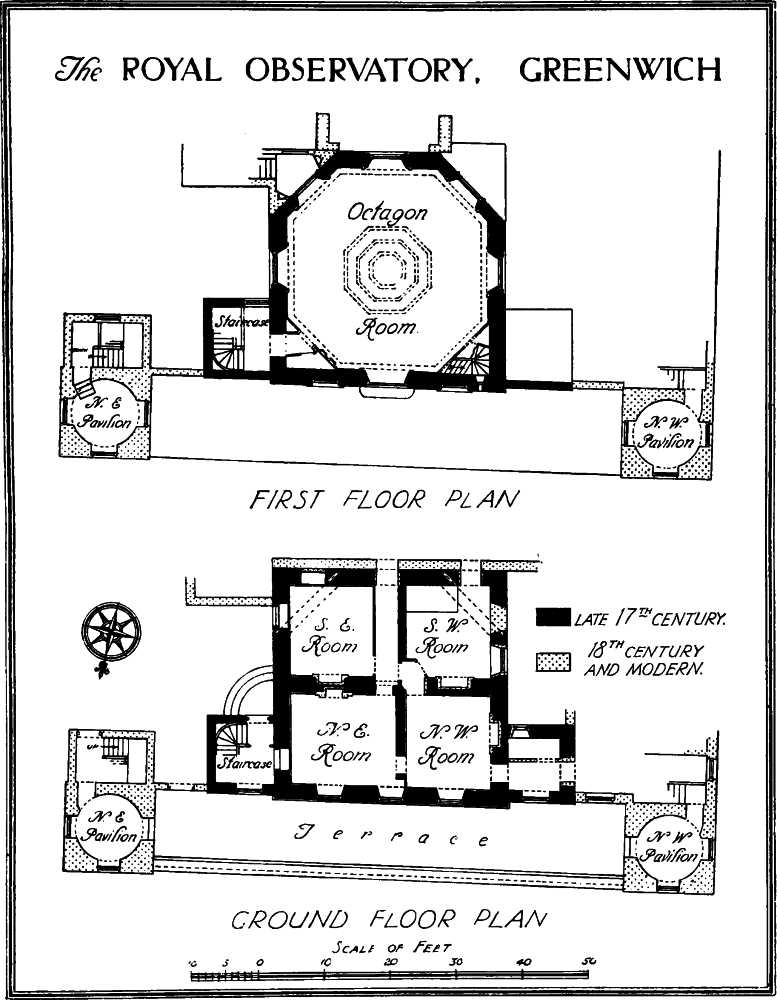
The Royal Observatory, Greenwich
Condition—Good.
b(8) The Royal Observatory stands in Greenwich Park, 620 yards E.S.E. of St. Alfege's Church. The original building (Flamsteed House) is of two storeys with cellars; the walls are of brick with stone dressings and the roofs are covered with lead. It was built, on the site of Greenwich Castle, for John Flamsteed, first Astronomer Royal, in 1675–6; the design is attributed to Sir Christopher Wren and the materials are said to have come from a stock at Tilbury Fort and from a demolished gatehouse in the Tower of London. Various minor alterations have been made since this date—in 1772–3 the N.E. and N.W. pavilions were reconstructed and the upper storeys and domes added; the staircases on the S. side were added at the same time; about 1770 the rooms on the S. side were built on the site of earlier structures; the rooms on the W. side were built in 1835–6 and the staircase from the house to the Octagon Room was built in 1849.
The building is of some interest as being the earliest example of its class in England.
Elevations. The building (Plate 75), generally, is of red brick with rusticated stone angles, moulded plinth, string-course between the storeys and coved wooden cornice at the roof-level. The N. Front has three windows on the ground floor with modern sashes; the middle window was formerly a doorway, the blocking of which is visible below the sill. In the upper storey are two windows with eared architraves and a long central window with a small balcony; all have modern sashes. At the angles of the front rise small square turrets finished with wooden cornices and square lead-covered cupolas; the turrets have brick and stone walls only on the outward faces, the other two faces being of timber. Between the turrets is a modern wooden balustrade reproducing an ancient feature. The one-storey annexes on either side are finished with a parapet with large stone scrolls against the main building. The other elevations are similar in general character, but the upper storey is set back at the angles to form an octagon; each face of the octagon has a large square-headed window. The E. elevation has a plain band between the storeys, and at this level is a stone tablet with moulded sill and cornice, scrolled pediment and cartouche with the double C cypher; at the sides are scrolls and floral pendants; on the tablet is the inscription "Carolus IIs rex optimus Astronomiae et Nauticae artis patronus maximus speculam hanc in utriusque commodum fecit Anno Dnī MDCLXXVI, regni sui XXVIII, curante Jona Moore Milite R.T.S.G." (Master of the Ordnance). The lower parts of the other elevations are covered with modern buildings. The two pavilions appear to have been re-built above the plinths; they were formerly square internally, but are now round. To the S. of the house is part of the original retaining wall and also the lower parts of the walls enclosing the buildings called the Sextant House and the Meridian Quadrant House on Flamsteed's early 18th-century plan.
Interior. The rooms on the ground floor have plain original panelling in two heights. Three rooms have fireplaces with marble surrounds and wood mouldings; that in the N.E. room is flanked by panelled pilasters supporting a cornice. The doorways and windows have moulded architraves. On the first floor, the Octagon Room, called the "Camera Stellata" on Flamsteed's plan, is panelled to about half its height in two ranges, with moulded dado-rail and cornice. The doorways on the N.E. and N.W. have architraves and pedimented overdoors. On the N.E. side are two small glazed bays with splayed angles and moulded capping, formerly used as chronometer-cases. The walls are finished with a coved plaster cornice with foliage sprays, swags, crowned monograms C.R. and double C and crossed sceptres with a crown; from the cornice rises a deep cove terminating in a flat octagonal band with enriched mouldings; within this is a shallow saucer-dome of octagonal form with enriched ribs and a central rosette. In the N.W. angle of the building is a newel-staircase to the roof; half-way up is a balustrade formed with mouldings fixed trelliswise. The Staircase, in the E. annexe, is original and has heavily moulded strings and handrails, twisted balusters and square newels; against the walls is a plain panelled dado. The Basement is of brick and the wall under the middle of the N. front, together with the return-wall adjoining, may be of 16th-century date and part of an earlier building.
Condition—Good.
b(9) Charlton House stands 140 yards S. of the parish church, and is of three storeys with a basement; the walls are of brick with stone dressings and the roofs are covered with slates and lead. The property was acquired by Sir Adam Newton in 1607 and the house was begun soon after; it was practically completed by 1612. Some decorative repairs and additions were made in 1659 by Sir William Ducie. Late in the 18th century the house became the property of the Wilson family, who, during the 19th century, added the domestic buildings S. of the house. It is now the property of the Greenwich Borough Council.
The house is a well-preserved example of a large Jacobean house; the staircase, plaster-work and chimney-pieces are noteworthy.
Exterior. The house is of H-shaped plan with the cross-wings at the N. and S. ends. It has a stone-capped plinth, stone string-courses between the storeys and a parapet; the windows have moulded stone jambs, mullions and transoms. The W. Front (Plate 80) has a pierced stone parapet, mostly modern restoration, with shaped and pierced uprights and panelled piers at intervals. In the middle of the front is a projecting bay (Plate 81) containing the porch and two bay-windows above. The doorway has moulded imposts, scrolled keystone and a round arch with carved spandrels; flanking it are pairs of Corinthian columns standing on a common carved pedestal and supporting an entablature with a carved frieze which is continued over the head of the doorway. The second stage of the porch has a four-light transomed window flanked by elaborately shaped and carved pilasters supporting an enriched entablature with bracketed projections at intervals and a carved frieze; below the window is a round-headed niche containing the bust of a woman, and flanking it are modern cartouches. The third stage has a large five-light window with a round-headed middle-light and two transoms; there is also a two-light window in each return-wall. The stage is finished with a carved and enriched entablature with projections, similar to that of the stage below. Flanking the porch-bay the main block has two-light windows symmetrically placed. The ends of the cross-wings are of uniform design and have each a three-sided bay-window carried up the full height of the house; they contain, on each floor, a four-light window on the face and a single-light window in the canted sides; below the second-floor window in the N. wing is a large rectangular sundial. In the angles of the main block and cross-wings are lead rain-water heads and pipes; the heads are moulded and bear a cartouche with the arms of Ducie and, at the sides, festoons, the monogram W.D. and the date 1659; on the bands of the pipes are leopards. The E. Front (Plate 82) is similar in general arrangement to the W. front, but of much simpler character; the parapets are plain and the angles have no stone quoins. The projecting porch-bay, in the middle of the front, is of two stages only; the lower stage is in Flemish bond and would appear to be a late 17th or 18th-century reconstruction; it has a doorway with a round arch and a key-block with a coronet and the monogram W.D. (?); flanking it are coupled Ionic pilasters supporting entablatures which serve as imposts to the arch. The upper stage has a plain bay-window similar to that in the third stage of the porch-bay of the W. front. The rest of the front is similar to the W. front, except that the lowest window in the N. cross-wing, which lights the chapel, has cinquefoiled heads to the lights. In the angles of the cross-wings are rainwater heads and pipes with cartouche, initials, date and bands as on the W. front. The N. and S. Elevations are generally similar to one another, and have each a projecting square turret with stone quoins and rising two stages above the main building. The turrets are finished with a bracketed cornice and an ogee-shaped roof and tapering finial. The windows and walling on these fronts are generally similar to the E. front. On the N. front are two rain-water heads and pipes, with cartouches, date, initials and bands as before described; on the S. front is a rain-water head dated 1612. The chimney-stacks have, apparently, been re-built; they form groups of octagonal shafts with moulded caps and bases.
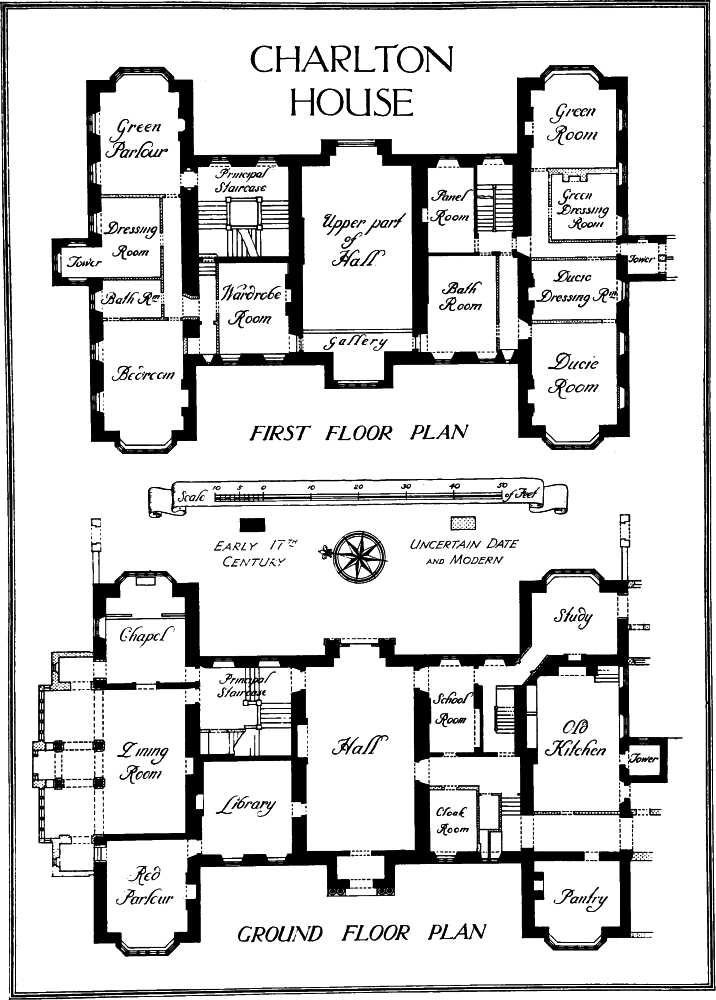
Charlton House, First Floor Plan and Ground Floor Plan
Interior. The Hall (38½ ft. by 22½ ft.), in the middle of the main block, is two storeys high and is panelled for nearly half its height; the panelling is of early 17th-century character, but appears to be largely if not wholly modern. In the S. wall are two original stone doorways with plain round heads and key and impost-blocks, all set in a moulded and square-headed recess. In the N. wall is a similar doorway and further E. a fireplace with a plain surround and an entablature, enriched with three corbelled projections. The gallery, at the W. end of the hall, has a moulded cornice on the face, turned balusters and panelled pedestals of heavy character and perhaps of early 18th-century date. The ceiling, which may be a modern restoration, has a moulded cornice and cove; in the angles and middle are strap-work enrichments, the latter surrounding a pendant. The bay-window, at the gallery-level, has a 17th-century painted achievement-of-arms in each of the four lights above the transom—(a) Ducie impaling Sheffield, (b) Ducie impaling Pipe, (c) Ducie impaling Pyott and (d) Ducie impaling Hardye. The Library, N. of the hall, is lined with panelling, of early 17th-century character, but largely modern. In the N. wall is a doorway similar to those in the hall; the door is panelled to match the panelling of the room. The fireplace (Plate 12) is flanked by richly carved diminishing pilasters of wood, with Ionic capitals and supporting an elaborate entablature consisting of a pulvinated architrave carved with scrolls and the date 1612 and a richly carved frieze with five carved brackets supporting the cornice. The fireplace in the Red Parlour has a blue and white tile-lining, perhaps of early 18th-century date. The Dining Room has a modern extension on the N. incorporating the base of the turret; the latter is pierced on each face by a round-headed arch with Doric pilasters, moulded architrave and key-stone; in the E. and W. walls of the extension are similar arches, possibly old material re-set. The stone fireplace (Plate 12) has an eared architrave and is flanked by terminal pilasters with scroll-work and human heads, supporting the cornice; the frieze has a large cartouche in the middle. The Chapel is paved with marble slabs laid diagonally. The original communion-table has a partly restored cornice and four supports in the form of Doric columns with smaller columns and round arches between. The 18th-century font stands on an octagonal pedestal with a moulded base and four carved acanthus-leaves, probably of early 17th-century date. The Study, at the E. end of the S. wing, has some blue and white tiles in the fireplace, perhaps of early 18th-century date. The doorway between the secondary staircase and the adjoining corridor, is original and has a round arch with key and impost-blocks and sunk spandrels in a squareheaded recess with stop-moulded jambs; the battened door is hung on strap-hinges.
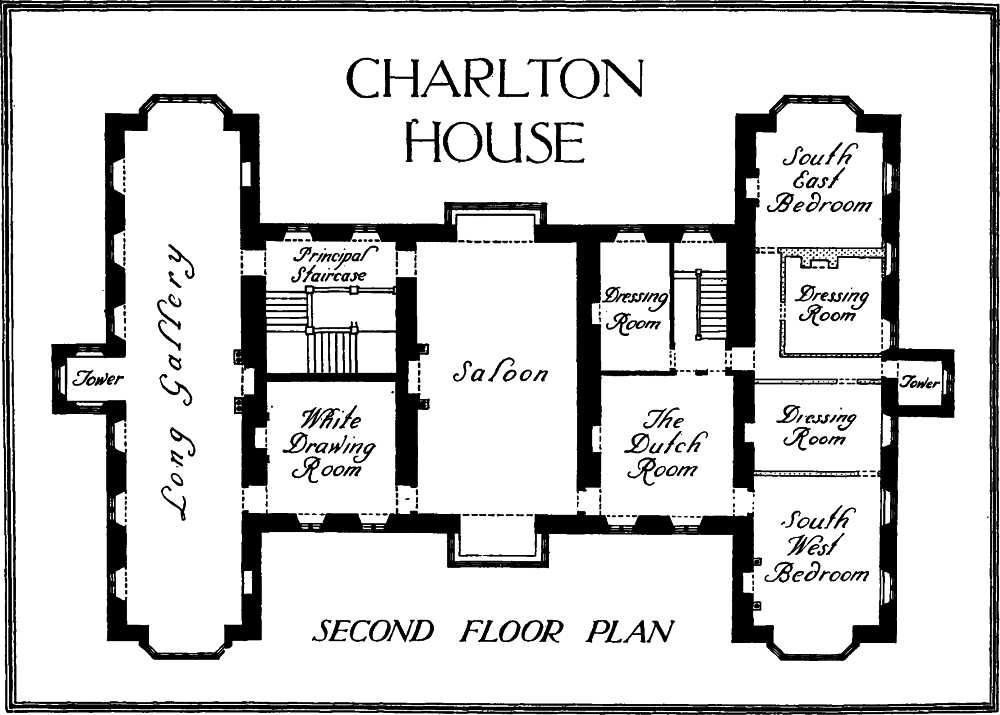
Charlton House, Second Floor Plan
On the first floor, the Green Parlour, over the chapel, has an original oak chimney-piece, cut down and re-arranged; the overmantel is of three bays with short fluted pilasters supporting a panelled frieze with close-set spindles; the middle bay has a middle and four subsidiary panels, and the side bays have each a round-arched panel; flanking the fireplace are fluted pilasters, without caps, stopping under the main ovolo-moulded cornice. The Wardrobe Room, N. of the hall, has a wooden chimney-piece, incorporating three fluted pilasters. The jambs of the doorway to the gallery of the hall have original panelling, and there is similar panelling in the doorway at the S. end of the gallery. The Panel Room, S. of the hall, is lined with early 18th-century panelling with dado-rail and cornice; the chimney-piece has a moulded surround and shelf and a panelled overmantel. The door is panelled and hung on long strap-hinges. The Green Room, at the E. end of the S. wing, has a wooden chimney-piece, partly made up of original material; the ovolo-moulded shelf supports four diminishing pilasters with Ionic caps; between them are three square panels with raised mouldings. The Ducie Room, at the W. end of the S. wing, has a mid to late 17th-century fireplace (Plate 79) of black and white marble with plain side-pilasters carried up to support the main cornice and cut by the shelf and other horizontal mouldings; above the shelf is an achievement-of-arms of Ducie impaling Seymour of Trowbridge; flanking it are the initials W.D. and F.D. for Sir William Ducie and Frances (Seymour) his wife.
On the second floor, the Saloon, over the hall, has a deep plaster frieze forming a range of rectangular panels filled and surrounded with strap-work enrichment; in the bay windows the frieze is reduced in depth and the panels in the W. bay include the initials J.R. for James I and crowned cartouches with the royal devices; at the sides are the arms of Newton, Ducie, Langhorne and Wilson, the owners of the house; the presence of the arms of the modern owners may indicate that part if not all of the frieze is modern. The ceiling is cut up into shaped panels by enriched bands with pendants at some of the intersections; the panels are filled with strap-work designs; in the middle of the room is a large pendant; the W. bay of the ceiling has a bold strap-work design enclosing a shaped panel with the royal Stuart arms; a similar treatment of the E. bay encloses the Prince of Wales' feathers, a garter and the motto "Ich dien" set retrograde. The marble chimneypiece (Plate 79) has an opening flanked by figures of Vulcan and Venus, standing on small pedestals and supporting a panelled entablature, with a segmental pediment and cartouche in the middle; the marble overmantel is panelled and has a plinth, three Ionic pilasters and an entablature; flanking the middle pilaster are round-headed niches and above the main panels are carved cartouches. The White Drawing Room, N. of the saloon, has a cornice and modelled plaster frieze with conventional scroll-work, vases, birds and grotesques. The stone fireplace (Plate 78) is flanked by terminal figures with Ionic capitals supporting an entablature; the frieze above the opening has two figuresubjects carved in high relief, (a) the triumph of Christ and (b) probably the triumph of Death, represented as the rider on the pale horse; the frieze has three projections carved with figures of Piety, Mercy and Peace; the stone overmantel is flanked by terminal figures with baskets of fruit on their heads and supporting an enriched entablature; the panel has an elaborate cartouche with festoons and amorini in the spandrels; within the cartouche is an oval panel carved with a figure-subject—Perseus with the head of Medusa and Pegasus. The Long Gallery (70 ft. by 16½ ft.), in the N. wing (Plate 76), has modern panelling, of early 17th-century character. The plaster frieze has an elaborate scrolled design of conventional foliage, dogs, masks, etc.; the ceiling is coved at the sides and enriched with a bold strap-work design; in the middle are three lozenge-shaped panels, two enclosing conventionalised figures and the middle one a cartouche; in the E. and W. projecting bays are figures of a boar and a hart respectively. The marble fireplace has a moulded surround flanked by coupled Corinthian columns supporting an entablature; the frieze is panelled and enriched with a lion-mask and two cherubheads. In the E. bay-window are four panels of mid or late 17th-century painted glass—(a) a shield-of-arms of Ducie; (b) Ducie impaling Seymour of Trowbridge; (c) Ducie impaling Pyott, and (d) a panel made up of fragments. In the W. bay-window are four similar panels—(a) the upper part only of an achievement; (b) achievement-of-arms of Ducie impaling Seymour; (c) Seymour of Trowbridge; (d) Seymour impaling Alington. The Dutch Room, S. of the saloon, has a modelled plaster frieze with naturalistic scrolled foliage with pomegranates, acorns, etc., and jewel-ornament; the ceiling is divided into panels by raised mouldings and is perhaps 18th-century work. The black marble chimney-piece is flanked by Ionic pilasters with draped capitals, supporting an entablature. The Small Dressing Room, E. of the Dutch room, has a narrow plaster frieze, with scallops and scroll-work of early 17th-century character, but perhaps modern. The South-East Bedroom, at the end of the S. wing, has a fireplace (Plate 78) generally similar to that in the White Drawingroom; the frieze over the opening has vases of flowers and large bunches of fruit; the large panel of the overmantel has a central oval cartouche with a figure-subject of Jupiter and Danaë; surrounding it are sea-monsters, nymphs, birds and conventional ornaments. The South-West Bedroom has a frieze similar to that in the small dressing-room. The stone fireplace has a moulded surround enriched with incised geometrical designs; at the side are Corinthian columns supporting an entablature with a strap-work frieze. The adjoining Dressing Room has a plaster frieze with cartouches, sea-horses, foliage, etc. The black marble chimney-piece may be of the 18th century. The principal Staircase (Plate 77) is original and has a rectangular well, moulded and bracketed strings, heavy moulded hand-rail and balusters in the form of diminishing Doric, Ionic, or Corinthian pilasters with raking mouldings and jewel-ornament; the square newels have carved strap-work on the faces and carved and moulded terminals and pendants. The stone doorways opening on to the staircase are similar to those in the hall; the doorways to the dining-room and chapel retain their original doors of twelve panels; the rail at the springing-level of the head has strap-work enrichment; the two panels in the head have the crests of Newton and Puckering. The secondary staircase appears to be modern.
The Garden House (Plate 100), about 75 yards N.E. of the house, is of one storey; the walls are of brick and the roof is covered with slates. It was built probably in the first half of the 17th century and has been attributed to Inigo Jones. The front and sides are of three bays divided and flanked by Doric pilasters supporting the entablature below the roof. The S. front had in each bay a square-headed window with moulded architrave and sill; the middle window has been cut down to form a doorway. The E. side has, in the middle bay, a blocked doorway, forming the original entrance; the side bays have each two shallow recesses, the lower round-headed and the upper square-headed. The W. side is similar to the E., but with a window in place of the blocked doorway. The N. side is similar to the S., but retains its three windows. The roof is of saddleback form with concave faces and a wooden cresting. Inside the building, the walls are panelled in three heights with dado-rail and cornice; the ceiling is coved at the sides. Below the building is a basement with a central pier and segmental vault in brick.
The Stables, 50 yards S. of the house, are of two storeys; the walls are of brick and the roofs are tiled. They were built early in the 17th century and form ranges on three sides of a square. The building was restored or partly re-built c. 1700. The N.W. end retains part of a shaped gable with three chimney-shafts, set diagonally, and a wrought-iron vane with the date 1700. The N.E. gable has a half-round finish, in place of the chimneys, and five short finial-ornaments; at the springing-level are the initials W.L. for Sir William Langhorne. The initials A.N. for Sir Adam Newton, appear twice, in iron, on the W. side of the W. wing; this face has three shaped gables. The E. elevation has one shaped gable. The elevations to the courtyard have ranges of windows in both storeys, but all have been restored. About 50 yards in front of, and axial with, the house is an arch or Gateway (Plate 8), of early 17th-century date but very extensively restored. It has a round moulded arch, scrolled keystone and moulded imposts; flanking it, on the W. side, are Corinthian columns supporting the entablature, which is enriched with masks. Above the arch is a cresting with a vase and cornucopiae. On the E. face the columns are replaced by panelled pilasters.
Condition—Good.
b(10) Morden College stands on the E. side of Blackheath, about 1½ miles S.E. of Greenwich Hospital. It is of two storeys with cellars; the walls are of brick with stone dressings and the roofs are tiled. The College was founded by Sir John Morden as an asylum for decayed Turkey merchants and the building was erected between the years 1695 and 1702, from the designs of Sir Christopher Wren.
The College is noteworthy not only as a design of Sir Christopher Wren, but also as a little altered building of the large almshouse-type.
Elevations. The W. Front (Plate 83) has projecting side wings and a slightly projecting middle bay. The front is symmetrically designed with a modillioned eaves-cornice, continued round the projecting wings, hipped roofs, rusticated stone quoins, a stone band between the storeys and windows with square heads, stone key-blocks and flush frames. The middle bay (Plate 84) has a pediment and a central doorway with moulded jambs and elliptical head with cherub-head key-block and carved spandrels; it is flanked by columns supporting entablatures and a continuous cornice and pediment; the door is of fifteen moulded panels, including a wicket. Above the pediment is a carved cartouche of the arms of Morden impaling Brand and flanked by swags of fruit and flowers. In the tympanum of the pediment are two round-headed niches, containing statues of Sir John and Lady Morden and supported on each side by scrolls and palm-leaves. In the inner return-face of each wing is a doorway (Plate 9) with key-block and plain brick pilasters supporting carved and scrolled brackets and a plain 'shell-hood.' On the middle of the roof of the main block is a timber cupola, remodelled in 1755, with a square base supporting a round open stage with eight Doric columns, an entablature and a lead-covered dome and weather-vane; this stage contains a bell, inscribed "1699 Sir John Morden." The other external Elevations are of similar general character, but have no stone dressings; the windows, except those on the upper floor, are segmental-headed and the eaves-cornices are coved. The Elevations to the Quadrangle (Plate 85) are of nine bays on the N. and S. and eleven bays on the E. and W. The lower storey forms an open colonnade with Doric columns, on low pedestals, supporting a continuous entablature. The middle bay on each face is wider than the others and is flanked by panelled pilasters against which the half-column responds of the colonnade are set; the upper storey of these bays is flanked by a plain pilaster supporting a modillioned cornice and pediment; the cornice is continued round the courtyard under the eaves. Each bay of the upper storey has a window with square head and flush frame. The walls within the colonnade are plastered, the doorways of the various tenements are square-headed and fitted with two-panel doors; the doorways at the ends of the alleys have elliptical heads. Set against the S. face of the middle chimney-stack of the N. range is a painted stone sun-dial, set up in 1725, with a gadrooned base, carved scrolls at the sides and a scrolled pediment; it bears the date 1695 and the inscription "Sic umbra sic vita."
Interior— The entrance passage or vestibule is panelled to half its height, with a moulded capping and seats, against the side walls, with turned legs. The alleys of the quadrangle are paved with stone squares, partly laid diagonally. The chapelvestibule is also panelled to half its height, with an enriched capping; the archivolts and cornices are enriched and the spandrels over the arches (Plate 86) have carved scroll-work, those over the chapel-doorway having cherub-heads in addition (Plate 86). The tenements have two-panel doors and the staircases have straight strings, turned balusters and square newels; the staircase in the chaplain's house is rather more elaborate. The Chapel (40 ft. by 20 ft.) (Plate 87) has a segmental plaster ceiling, probably modern, divided into nine rectangular panels and rising from a dentilled cornice. In the E. wall is a round-headed window, but the side-windows have square heads and segmental brick arches externally. Fittings. Communion Table: with inlaid top, enriched edge, twisted legs and ball-feet connected by curved rails. Communion Rails: with panelled standards, twisted balusters, moulded sill and enriched rail. Doors (Plate 86): In W. doorway— with bolection-moulded panels in three heights, and scrolled carving (Plate 15) in middle panels; impost of archway carried across, with panelled tympanum above. Gallery: At W. end—supported on square panelled posts with half-posts against walls, middle posts with carved enrichment; enriched entablature and panelled gallery-front and enriched capping; front divided by standards with carved panels, including cherubheads; middle bay altered in modern times and staircase formed in 1729. Glass: In E. window— three 16th or 17th-century German or Flemish figures—(a) Christ seated under a canopy and holding a cup; (b and c) bearded figures standing under canopies, also various fragments, including roundel with rose, helm and feathers, quarries with the initial R and a crown, J.R. and a crown, etc. Hatchments: On E. wall of Sir John Morden, 1708, and Lady Morden, 1721, with achievement and lozenge-of-arms, respectively. Monument: In burial-ground—to John Thompson, 1708, Yeoman of the Mouth to Charles II, James II and William III, and subsequently cook of the college, flat slab. Panelling: On walls, in three heights with moulded capping, below window-sills. Paving: within communion-rails, of black and white marble squares, laid diagonally. Plate (Plate 19): includes flagon, cup and paten of 1701 with shield-of-arms of Morden impaling Brand, and an alms-dish of 1710 with the same arms. Pulpit: hexagonal with enriched mouldings and inlaid panels, ogee-shaped stem on hexagonal post; sounding-board with enriched cornice and inlaid soffit, supported on panelled standard flanked by carved and pierced scrolls; staircase with turned balusters and turned newels. Seating: pews with panelled enclosures and doors. Reredos: in three divisions with panelled dado, middle division with two round-headed and enriched panels painted with the Decalogue and with carved cherubheads in the spandrels, division finished with cornice and broken segmental pediment enclosing a carved cartouche of the arms of William III, with swags at the sides; side divisions each with a square enriched panel, bearing the Creed and Lord's Prayer and surmounted by cornice and segmental pediment with carved cartouches of the arms of Morden and Brand, respectively, flanked by swags. Miscellanea: In vestibule— tablet with carved frame recording foundation of College and consecration of chapel by Thomas Sprat, Bishop of Rochester. In passage at N.E. angle of building—white marble tablet with inscription forming an anagram and acrostic to Sir John Morden. On S. wall of dining-hall, formerly in chapel—tapestry with figure-subject, probably representing David returning from the slaughter of the Philistines; on N. wall, funeral achievement of Sir John Morden.
Greenwich. Trinity Hospital. Ground Floor Plan
The Outbuilding, S. of the E. range and E. of the kitchen-garden, is of one storey with attics; the walls are of brick and the roofs are tiled. It was built at the same time as the College and has a wooden eaves-cornice on the S. side; the door is two-panelled. S. of this building is a brick alcove, semi-circular on plan and with a round arch, key-block and flanking pilasters. The garden has old walling on the E., S. and W. sides and on the W. side a gateway with brick piers, finished with stone caps.
Condition—Good.
b(11) Trinity Hospital, Greenwich, stands 250 yards N.E. of the Royal Hospital. The building is of two storeys; the walls are of brick and the roofs are covered with slate and asphalte. The Hospital was founded by Henry Howard, Earl of Northampton, for the support of twelve poor men of E. Greenwich and eight of Shottisham (Norfolk), in 1613, but the structure has been considerably altered and in part re-built.
The N. Elevation is probably of original brickwork, but is now rendered in cement. In the middle is a tower of four stages carried on two piers flanking the entrance, which it overhangs. All the existing features on this front appear to be modern, including an inscription and coat-of-arms of Howard. At each end of the elevation is a modern stepped gable flanked by buttresses. The windows, generally, have three-light modern frames, with labels rendered in cement. The chimney-stacks are plain square blocks with arched recesses in some of them, all rendered in cement. The E., N. and W. Elevations have been entirely re-built in stock brick. The Elevations to the cloister are of two storeys. The lower opens into the cloister on each side by five four-centred arches divided by buttresses with gabled tops; all are covered with cement and are of doubtful date; the corridor above the cloister is apparently original and has stone windows, each of three lights. The gable end of the hall has a three-light window, the middle light being round-headed; above it is a round opening.
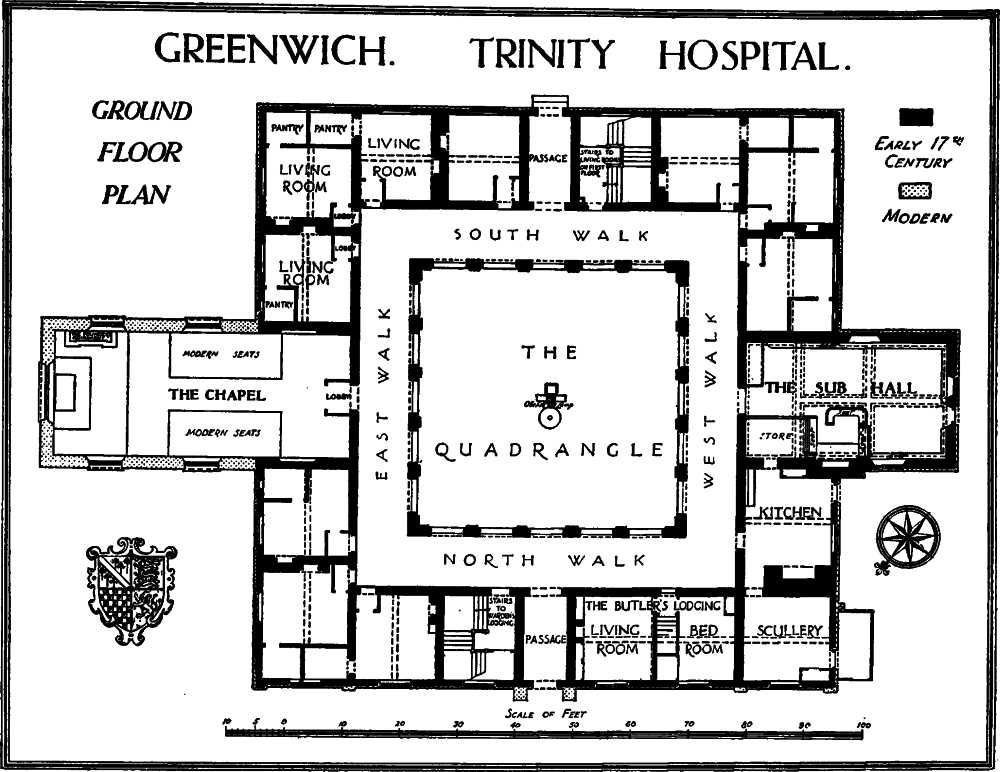
Greenwich. Trinity Hospital. Ground Floor Plan
Interior:—The entrance and cloister walks are paved with stone. All the entrance-doors except those to the Chapel, warden's stair, Hall and Kitchen are of oak with moulded battens. The Inmates' staircase (on the S. side) is original (Plate 88) and has a well, moulded rails and strings, heavy turned balusters and square newels with moulded caps and pendants. The Warden's staircase, in the N. range, is uniform in date and detail with that just described; the Warden's dining-room, towards the W. end of the same range, and on the first floor, is lined with panelling of c. 1700, in two heights and finished with a cornice; the fireplace, in the W. wall, has a veined marble surround with panelled sides and head of the same period. The Lower Hall, projecting from the W. range, has ceiling-beams with moulded cornices, probably of late 17th-century date; benches round the walls are of the 17th century, as are the tables. The Court Room, above the Lower Hall, is lined with original moulded panelling, finished with a restored cornice. In the middle of the S. range, on the first floor, is the Treasury, lined with panelling similar to that in the Court Room and with an original cornice; the door is of twelve moulded panels with nail-studded framing.
The Chapel contains the following:—Fittings. Glass: In E. window (Plate 53)—middle section of window contains three figure subjects—(a) the Crucifixion occupying the three middle lights; (b) the agony in the garden in the left-hand light, and (c) the Ascension in the right-hand light. (a) The Crucifixion has the cross in the middle with a kneeling figure of St. Mary Magdalene at the foot in yellow gown with brown cloak; in the foreground are a skull, bones and a serpent; above the cross the original cinquefoiled head of the light is preserved and contains an angel with a cross, clouds, etc. On either side of the cross are two main figures, on the left the Virgin in yellow and blue robes with a white head-dress, and on the right St. John in blue with a crimson cloak. The background is occupied by a large group of mounted soldiers in armour on the left, with spears and a striped pennon, and on the right the city of Jerusalem with the church of the Holy Sepulchre in the middle, mountains in the background and several figures in front returning towards the town. (b) The agony in the garden—in front two sleeping apostles, one in red and blue and one in blue and brown, in background Christ kneeling, in salmoncoloured gown, to left a jumble of architectural and other fragments. (c) The Ascension—a mount with twelve figures standing or kneeling thereon and mostly looking upwards, landscape background and clouds above. This glass is of early 16th-century date and of Flemish origin; it is distinguished by great clearness of colour. In tracery are the following early 17th-century devices: (a) a sun; (b) crest of Howard; (c) crest—a lion argent charged with a crescent sable; (d) crest— a crowned leopard or with a label argent; (e) shield of Warenne—checky or and azure; all the above are set in quatrefoiled panels. Below the figure-subjects are five elaborate heraldic panels with scroll-work, strapwork, foliage, etc., all of early 17th-century date and bearing shields of Howard and alliances. Monument and Floor-slab. Monument: Against S. wall—of Henry Howard, Earl of Northampton, 1614, remains of monument by Nicholas Stone, first erected in the chapel of the castle of Dover and thence removed to its present position by the Mercers' Company in 1696, modern panelled base of white marble on which is kneeling effigy (Plate 89) in armour with the mantle of the Garter, Garter on leg; also four large separate figures of virtues (Plate 89), much damaged and weathered, and four amorini each with a shield-of-arms, three defaced and one with a lion; now fixed on E. wall of Warden's staircase, achievement-of-arms (Plate 18), from same monument. Floor-slab: Upright against E. wall, externally—to Robert Gilbert, 1689, Warden of the College, with shield-of-arms.
In the yard W. of the hospital is an ornamental lead cistern with two shaped panels, the date 1699 and the initials I. and S. W. twice repeated. Each end bears the same date.
The large garden on the N. of the hospital is surrounded by walls, partly original.
a(12) Refrigerator Building in the Foreign Meat Market, 530 yards N.N.W. of St. Nicholas' Church, Deptford, is of two storeys with brick walls. It was built c. 1513 as a store-house in the royal Dockyard of Deptford. Only the S. and W. walls now remain, the rest of the building being modern. The old walls are of red brick, in English bond, and the W. gable stands to the full height. On the ground floor is an original window with double-chamfered jambs and four-centred arch in a square head; it is fitted with old iron stancheons and saddle-bars. On the upper floor are the remains of three large square-headed windows with chamfered jambs and all blocked. Inside the building, in the S. wall at the first-floor level, is an original recess, not now visible, with moulded jambs, four-centred arch and ogee label with square scrolled stops and panelled spandrel; the label terminates in a small niche, with a four-centred arch in a square head and a moulded label. Below the recess is a band with the initials K.H. and A.X. 1513.
Condition—Good.
a(13) School and School House stand on the N.W. side of St. Nicholas' churchyard, Deptford. The school is of one storey with cellars and attics and the adjoining house of three storeys with cellars; the walls are of brick and the roofs are tiled. The school was built early in the 18th century, and the house is of slightly later date; there is a later 18th-century addition on the E. side. The N. front of the school has a moulded eaves-cornice, partly replaced by boarding. The windows are square-headed with mullion and transom and later sashes; the doorway has a moulded architrave and a transom with blocked lights above it. The house has windows with double-hung sashes and flush frames. The back of the school has a moulded cornice. Inside the school, on the S. wall, is a moulded tablet of wood with fluted Corinthian pilasters and a broken pediment; it bears the inscription— "Thomas Jennings Esq. one of the honorable Commissioners of her Majesties Navy, having largely contributed to the building of this School and caused a Library adjoining to be erected for the benefit thereof did afterwards, by contribution, cause this school to be wainscotted and fitted up in the year 1712."
Condition—Poor.
a(14) Mortuary, stands on the S. side of St. Nicholas' churchyard. It is of one storey; the walls are of brick and the hipped roof is tiled. The building, erected late in the 17th century, has a moulded stone plinth and a wooden eaves-cornice, with carved modillions and rusticated stone quoins. The windows have flat arches with curved cutting on the lower edge; some of them are blocked; the doorway, on the N. side, has a moulded frame and fan-light and is fitted with a three-panel door.
Condition—Good.
b(15) The Vicarage, on the N.W. side of the Park, 600 yards E.N.E. of St. Alfege's Church, incorporates part of one of the outlying buildings of the old Palace of Greenwich. The house itself is of two storeys; the walls are of brick and the roofs are tiled; it is of 18th-century date, but incorporates on the N. side an early 16th-century wall of brick with a splayed brick plinth and a decayed stone string-course below the first-floor windows. Above this string-course is a sunk stone panel with a moulded label and carved with an achievement of the arms (Plate 18) of Henry VIII with lion and dragon supporters, all of early Renaissance character. The S. side of the same building has remains of a string-course, similar to that on the N. side.
Condition—Good.
b(16) Manor House, on the N.W. side of Park Place, 700 yards E.N.E. of St. Alphege's Church, is of two storeys with cellars and attics; the walls are of brick and the roofs are tiled. It was built early in the 18th century. The front (Plate 90) is symmetrically designed with a band between the storeys and a hipped roof with a modillioned eaves-cornice. The entrance has a simple flat hood on shaped brackets and the windows have flat heads and flush frames. Rising above the eaves-cornice is a wide dormer with a hipped roof.
Condition—Good.
b(17) House, No. 21, on the E. side of Park Row, 560 yards N.E. of St. Alfege's Church, is of three storeys with attics; the walls are of brick and the roofs are tiled. It was built early in the 18th century and has later additions at the back. The front has a brick band between the upper storeys and modillioned eaves-cornice. The doorway has a flat hood on shaped brackets and the windows have flat heads with long key-blocks. Inside the building the rooms have shallow moulded cornices and the staircase has cut strings, turned balusters and a moulded rail, scrolled at the foot of the stairs.
Condition—Good.
b(18) Macartney House, on the S.W. side of Greenwich Park and 800 yards S.E. of St. Alfege's Church, is of two storeys; the walls are of brick. A house appears to have been built on the site c. 1694, and part of this appears to survive in the middle of the N.E. side. The rest of the house is of 18th-century and later date. The old portion has a modillioned eaves-cornice and flat heads to the windows.
Condition—Good.
b(19) White House, 50 yards N.W. of (18), is of three storeys; the walls are of cement-rendered brick and the roofs are covered with slates. It was built, possibly, early in the 18th century, but has been much altered. Inside the building, one room has an original cornice and the staircase has straight moulded strings, turned balusters and square newels; the rails have a mahogany capping and are curved out to avoid the string of the flight above.
Condition—Good.
Croom's Hill. W. side
b(20) Manor House, 100 yards N.W. of (19), is of two storeys with cellars and attics; the walls are of brick and the roofs are tiled. It is said to have been built in 1697, but the internal fittings would seem to be of early 18th-century date. The S.E. front (Plate 90) is symmetrically designed with a band between the storeys and a modillioned eaves-cornice; the windows are square-headed and have flush frames, and the roof has three dormer-windows. The doorway (Plate 9) has a fan-light and a flat hood resting on scrolled brackets; the soffit is coved and decorated with a large shell-ornament. The back elevation is similar to the front, but the doorway (Plate 9) has a flat hood with a pediment, resting on scrolled brackets, carved with cherub-heads, flowers, etc. Inside the building, most of the rooms are lined with panelling, either plain, moulded or bolection-moulded and having dado-rails and cornices. The S.W. room on the ground floor has a white marble surround to the fireplace, with a wood architrave enriched with egg and dart ornament. The carved chimney-piece in the N.W. room appears to be of later date. The staircase (Plate 25) has cut strings with carved brackets, turned balusters and moulded hand-rail wreathed at the foot of the stairs. The back staircase has straight strings, turned balusters and shaped splats on the landings. In the attic is a fireplace flanked by enriched Corinthian pilasters supporting an entablature with a pulvinated frieze and a moulded panel in the middle.
The kitchen or stable buildings are of one storey; the walls are of brick and the roofs are tiled. They are probably of the same date as the house.
Condition—Good.
b(21) The Presbytery, 140 yards N.W. of (20), is of two storeys with cellars and attics; the walls are of brick and the roofs are covered with slates. It was built c. 1630, but in the 18th century additions were made at the back of the house and the interior re-fitted. The E. front (Plate 91) has a brick band between the storeys, the upper storey being divided into nine unequal bays by pilasters with moulded bases and capitals and supporting a continuous entablature; above the entablature is a parapet and two gables each with a central feature, consisting of a round-headed recess containing a window and finished with a pediment. The N. end is rendered in cement and contains an original window of three transomed lights; the middle light has a round head and a key-block. Inside the building the hall and the N. room have 18th-century plain panelling and cornices; the door to the larder is of moulded battens and in a window-recess is some original panelling. On the first floor the rooms contain some re-used original panelling, and in the room at the S. end is an original chimney-piece, with fluted pilasters and bracketed shelf; the overmantel (Plate 11) is of two bays, divided and flanked by diminishing pilasters supporting an incomplete entablature; each bay has a star-shaped central panel and four shaped panels enclosing it.
Condition—Good.
b(22) The Grange, house No. 52 and summer-house, 100 yards N.N.W. of (21), is of two storeys with attics; the walls are of cement-rendered brick and the roofs are tiled. It was built, probably, in the first half of the 17th century, but was much altered and re-fitted in the 18th century when additions were made on the S.W. side. There are modern additions on the N.W. side. The front of the house has been much altered, but at the back are two gables and a canted bay with blocked windows; in the attics are some old window-frames, one with original moulded mullions and leaded glazing. Inside the building, the lower rooms have heavy ceiling-beams. A room in the western wing on the first floor has an early 18th-century cornice and dado. At the side of the stairs leading to the attics is some original panelling.
The Summer House (Plate 2), at the N.E. angle of the garden, is an irregular square building of brick with a pyramidal roof and a modillioned eaves-cornice. The S.E. wall has a round-headed opening set in plain brick architrave with a cornice; the opening in the S.W. wall has been re-built in recent years. The opening on the N.E. side towards the road has a similar round-headed opening with an eared architrave, flanked by pilasters supporting a cornice and scrolled pediment; above the arch is a tablet with the date 1672. The opening is fitted with panelled doors. The interior is ceiled with a saucer dome with a moulded surround and bay-leaf enrichment, an enriched cornice and foliage-sprays in the spandrels.
Condition—Good.
b(23) House, No. 32, 100 yards N.W. of (22), is of three storeys with attics; the walls are of cement-rendered brick and the roofs are tiled. It was built late in the 17th or early in the 18th century, but has been much altered. Inside the building, the original staircase (Plate 27) has straight strings, twisted balusters and square newels with moulded pendants.
Condition—Good.
b(24) Houses and shops, Nos. 2 and 4, at the corner of Burney Street, are of three storeys with cellars; the walls are of brick and the roofs are tiled. They were built early in the 18th century, but have been much altered. Inside the building the rooms are lined with moulded panelling, with dado-rails and cornices. The staircase has straight strings, turned balusters and square newels.
Condition—Good.
E. side
b(25) Houses, Nos. 3, 5 and 7, 180 yards S.E. of St. Alfege's Church, are of three storeys with cellars; the walls are of brick and the roofs are covered with tiles and slates. They were built early in the 18th century. The front has brick bands between the storeys and an eaves-cornice. The windows have flat heads and the doorway of No. 3 has an architrave and two console-brackets supporting a cornice and pediment. Inside the building, No. 3 has some original panelled rooms with cornice and dado-rail and an arch with panelled pilasters between the passage and the staircase. The staircase is original and has straight strings, twisted balusters and square newels.
Condition—Good.
Monuments (26 to 47).
The following monuments, unless otherwise described, are of three storeys with attics; the walls are of brick, generally with bands between the storeys, and the roofs are tiled. They were built late in the 17th or early in the 18th century.
Condition—Good or fairly good, unless noted.
Stockwell Street. N.E. side
b(26) Houses and shops, Nos. 7 and 8, 100 yards S.E. of St. Alfege's Church, are of two storeys with cellars and attics, timber-framed and weather-boarded. The front of No. 8 retains its modillioned eaves-cornice.
b(27) Houses and shops, Nos. 9 and 10, N. of (26), are of three storeys. Inside the building, No. 10 has an original staircase with straight strings, turned balusters and square newels with ballterminals.
b(28) Houses and shops, Nos. 11, 12 and 13, N. of (27), retain their modillioned eaves-cornices. Inside the building, No. 11 has the back room lined with bolection-moulded panelling with dado-rail and cornice. The rooms on the first floor have cornices, moulded surrounds to the fireplaces and two-panel doors. The staircase has straight strings, heavy turned balusters and square newels.
Church Street. E. side
b(29) Houses and shops, Nos. 4 and 6, opposite St. Alfege's Church, retain their modillioned eavescornices. Inside the building, both houses have original staircases, with straight strings, twisted balusters and square newels with turned pendants.
b(30) Houses and shops, Nos. 15 and 17, 75 yards N.N.W. of (29), have a modillioned eaves-cornice.
W. side
b(31) House and shop, No. 3, N. of St. Alfege's Church, is of three storeys and has a modern front. The S. side has a moulded eaves-cornice. Inside the building is some original panelling.
b(32) House, No. 18, 30 yards N.N.W. of (31), is of three storeys. Inside the building is some original panelling.
b(33) Houses, Nos. 11 to 14, on the W. side of King William Street, 110 yards E. of St. Alfege's Church, have doorways flanked by panelled pilasters, with console-brackets, cornices and key-blocks. Inside the buildings, some of the rooms have plain panelling with cornices and dadorails; the openings to the staircases have panelled pilasters and round arches. The staircases have straight strings, turned balusters and square newels.
b(34) Houses and shops, Nos. 42–54, on the N.W. side of London Street, 220 yards S.S.W. of St. Alfege's Church, are of two storeys with cellars and attics. The houses form a continuous range with a modillioned eaves-cornice which has been partly renewed. The back has a moulded eaves-cornice. Inside the building, No. 52 has cornices and dados in several rooms, and opening to the staircase is a round arch with panelled pilasters, imposts and key-block. The staircase has straight strings, turned balusters and square newels.
b(35) Houses, Nos. 7–17, on the E. side of Royal Hill, 250 yards S. of St. Alfege's Church, are of two storeys with attics. The fronts have been altered or re-built. Inside the building the staircases have straight strings, turned balusters and square newels.
b(36) Horse and Groom Inn and house (Plate 6), on the S. side of Blackheath Hill, about 1,020 yards S.S.W. of St. Alfege's Church, is of two storeys with cellars and attics. It was built about the middle of the 17th century and the E. wing added early in the 18th century. The front of the older part has a moulded eaves-cornice. The back is partly timber-framed and weather-boarded. Inside the building, the walls of the cellars are of coursed stone with brickwork above. The staircases have straight strings, turned balusters, square newels and hand-rails moulded on one side only.
b(37) Yorkshire Grey Inn, 100 yards W. of (36), is of two storeys with cellars and attics. Inside the building, the staircase has straight strings, heavy turned balusters and square newels.
a(38) Houses, Nos. 4 and 5 on the W. side of Deptford Green, 20 yards W. of St. Nicholas' Church, are of two storeys with attics. The front has a moulded eaves-cornice.
Condition—Poor.
b(39) House, now club, on the S. side of the Stowage, 110 yards E. of St. Nicholas' Church, is of three storeys. The front is partly covered by a single-storey building, but retains its modillioned eaves-cornice and a small pediment with a lunette in the tympanum.
a(40) Houses, Nos. 7 and 9, on the N. side of Albury Street, 250 yards S.W. of St. Nicholas' Church, are of two storeys with cellars and attics and three storeys respectively. The doorway of No. 7 is flanked by panelled pilasters with two scrolled brackets supporting a flat hood. The ground-floor windows have flat arches, but those on the first floor have segmental heads.
a(41) Houses, Nos. 13–21, 7 yards E. of (40), are generally similar to (40), No. 17 being of three storeys. Nos. 15, 17 and 19 have plain panelling in the entrance passage and a round arch with panelled pilasters; the staircases have straight strings, turned balusters and square newels.
a(42) Houses, Nos. 23–27, E. of (41), are generally similar to the other houses in the street, but are of three storeys and the fronts have been re-built. The doorways have more elaborately carved brackets (Plate 10); those to No. 25 have two cherub-heads (Plate 10) and those to No. 27 have seated cherubs (Plate 10) and mathematical instruments. The staircase in No. 25 has twisted balusters and shaped newels.
a(43) Houses, Nos. 29–33, E. of (42) and of two storeys with cellars and attics, are generally similar to the rest, but the upper parts of the fronts of Nos. 29 and 31 and the whole front of No. 33 have been re-built. The doorways are similar to those of (40), that of No. 31 has carved cherubheads (Plate 10) on the brackets. The staircase of No. 29 has cut strings, twisted balusters and newels in the form of columns.
a(44) House, No. 35, E. of (43), is of three storeys with cellars. The front has been re-built, but retains its doorway and hood, similar to those of (40). Inside the building is some moulded panelling and the staircase has straight strings and twisted balusters.
a(45) Houses, Nos. 37 and 43, the former E. of (44), are of two storeys with attics and cellars and are generally similar to (40), but the front of No. 37 has been re-built.
For the houses on the S. side of Albury Street see Deptford Borough.
a(46) House, and shop, No. 204, on the E. side of High Street, Deptford, 30 yards S. of Wellington Street, is of two storeys with attics. The front has a modillioned eaves-cornice.
b(47) Bugle Horn Inn, 40 yards E.S.E. of Charlton Church, is of two storeys with attics; it has been much altered. Inside the building are some chamfered ceiling-beams.