An Inventory of the Historical Monuments in Westmorland. Originally published by His Majesty's Stationery Office, London, 1936.
This free content was digitised by double rekeying. All rights reserved.
'Beetham', in An Inventory of the Historical Monuments in Westmorland(London, 1936), British History Online https://www.british-history.ac.uk/rchme/westm/pp40-42 [accessed 7 May 2025].
'Beetham', in An Inventory of the Historical Monuments in Westmorland(London, 1936), British History Online, accessed May 7, 2025, https://www.british-history.ac.uk/rchme/westm/pp40-42.
"Beetham". An Inventory of the Historical Monuments in Westmorland. (London, 1936), British History Online. Web. 7 May 2025. https://www.british-history.ac.uk/rchme/westm/pp40-42.
In this section
9 BEETHAM (D.h.)
(O.S. 6 in. (a)XLVI, N.W., (b)XLVI, N.E., (c)XLVI, S.E.)
Beetham is a parish on the S.E. of the Kent estuary 9 m. S. of Kendal. Beetham church is now in Haverbrack parish and the principal monuments are Beetham Hall and Hazelslack Tower.
Secular
b(1). Hang Bridge over the river Beela 1 m. E.N.E. of Beetham church, is a rubble structure of three spans with segmental arches and cutwaters both up and down stream. It dates perhaps from the 17th century, but was repaired and reinforced in 1928, when the cutwaters were heightened to carry steel girders.
Condition—Good.
b(2). Beetham Hall, house and ruins, 700 yards S.E. of Beetham church. It belonged to the family of Beetham in the middle ages and passed to the Stanleys late in the 15th century and from them to the Cliffords and Wilsons. The old hall was built about the middle of the 14th century, with a hall-block and cross-wings at the E. and W. ends; an extensive courtyard was enclosed by a defensive curtain-wall of about the same age. The house is mentioned by Leland and is said to have been taken by Fairfax in 1644, when the E. wing was destroyed. About 1684–90 the roof is said to have been removed to repair Bank Hall near Liverpool. The existing house was built by Thomas Brabin probably in 1653 and the older buildings are either ruined or incorporated in outbuildings.
The remains form an interesting example of a semifortified house of the 14th century.
The Hall, now a barn, is of one storey and has a modern doorway in the N. wall; further E. is an original window of two trefoiled ogee lights in a square head with a moulded label; at the W. end of the wall is a projecting turret-staircase. The S. wall (Plate 78) of the hall has two original windows, one similar to that in the N. wall and the second of two ogee lights with tracery in a high, segmental-pointed head with a moulded label; at the E. end of the wall is an original doorway with moulded jambs, two-centred arch and label; it is now blocked. Internally the E. pair of windows have shouldered lintels; the splays of the S.W. window were carried down to within 5 or 6 ft. of the floor; there are traces of a corresponding window in the N. wall. The screens were at the E. end and the solar was approached by the N.W. turret-staircase in connection with which there is a skew-arch across the N.W. angle of the hall. The former E. wing is now reduced to the W. and part of the N. wall; in the latter are remains of an original square-headed window with a moulded label. The S. part of the W. wall contains remains of a wall-staircase and of an original window in the S. return-wall adjoining. The W. or Solar wing (Plate 79) was of three storeys, but is now ruined. The N. end is covered by a barn and from the S. end projects a small wing containing the chapel on the first floor; this has an original window of three trefoiled ogee lights in a square head with a moulded label; in the floor above is a small window. The return walls of the chapel-wing have each two square-headed windows. The W. wall of the W. wing has remains of a garde-robe projection at the S. end and a chimney-stack further N. The first floor has two two-light and square headed windows and the second floor has two original windows similar to the eastern pair in the hall. Inside the wing the chapelwindow has a shouldered lintel and is flanked by small rectangular recesses; in the W. wall is an original piscina with a trefoiled ogee head and a broken drain. The fireplaces in the main W. wing have been stripped of their dressings. The Curtain-wall (Plate 79) of the courtyard is preserved at the N. end of the E. side and on part of the W. side. The E. wall has a bend outwards of about 12 ft. and runs N. for 36 ft. and S. for 85 ft. from this point. The outer face has a slight batter and is finished with a slightly projecting parapet on corbels; the S. length is pierced by four loops, and on the inner face are a series of vertical chaces probably for the feet of struts to support a timber gallery behind the parapet. A wall turns W. near the S. end of the curtain and may have formed part of the former gate-house. Another length of curtain, lacking its parapet, extends along the S. side of the courtyard and about 30 ft. S. of the hall; it forms part of an outbuilding and retains some loops; the return at the E. end runs northward for about 55 ft. A third section extends from the Solar-wing to the later house; it contains three loops.
The House, N.W. of the old building, is of two and three storeys; the walls are of rubble and the roofs are slate-covered. It was built in the second half of the 17th century, the date 1653 or 1693 with the initials T.B. appearing on the moulded lintel of the former front doorway; the later doorway is covered by a porch with ball-finials and a panel with the initials T.M.B. The house retains some windows with stone jambs and mullions. Inside the building are some exposed ceiling-beams and a cupboard with a panelled 17th-century door. The original staircase (Plate 57) has heavy turned balusters and square newels with ball-terminals.
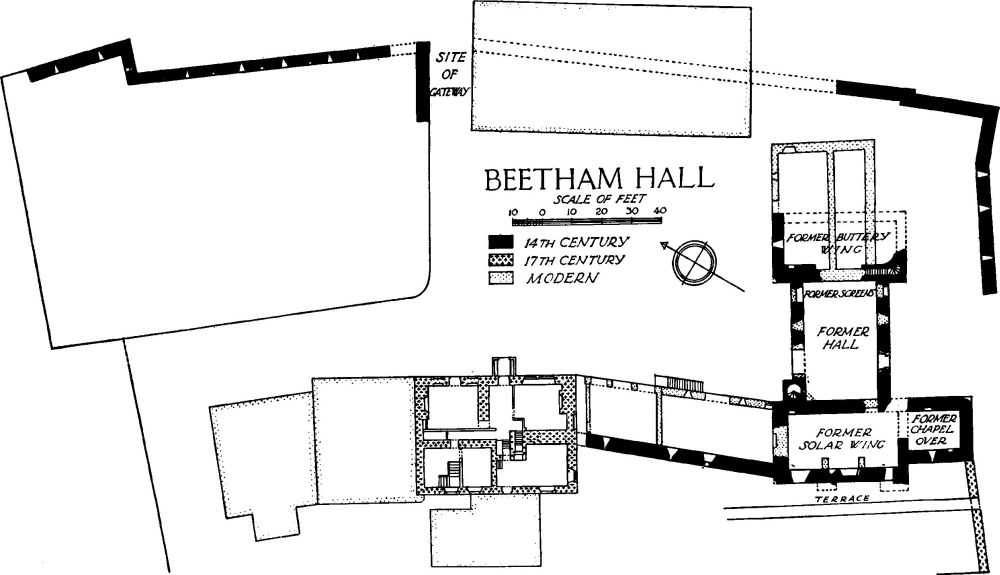
Beetham Hall
Condition—Of house, good; of old building, partly ruined and heavily ivy-grown.
a(3). Hazelslack Tower (Plate 77), nearly 1½ m. W. of (2), was of four storeys; the walls are of rubble with ashlar dressings. The pele-tower, though now standing detached, was formerly part of a larger building which adjoined it on the E. It was built late in the 14th century and probably fell into ruin in the 17th century.
The tower is faced with coursed rubble but retains no remains of its former parapet. The windows generally are either loop-lights on the ground-floor and lighting the garde-robes or small square-headed windows lighting the upper floors. The third storey has, however, in the W. wall an original window of two trefoiled lights in a square head. On the E. wall are the marks of the gable of the adjoining building, now destroyed; it was apparently of two storeys and on the ground floor is a large fireplace (13 ft. wide) with a segmental arch of rubble; the floor above has a small fireplace with a segmental head. The return wall of the projecting part of the tower has an original doorway with chamfered jambs, two-centred arch and a draw-bar hole. Inside, the building is divided into two unequal parts by a cross-wall. The N. room on the ground floor had a barrel-vault, now fallen, and in the E. wall is a fireplace with a segmental head. The S. chamber has the base of an open stone staircase, which becomes an enclosed circular staircase at a higher level; in the S.W. angle are a series of garde-robes. The upper storeys have a number of fireplaces, mostly denuded of their dressings.
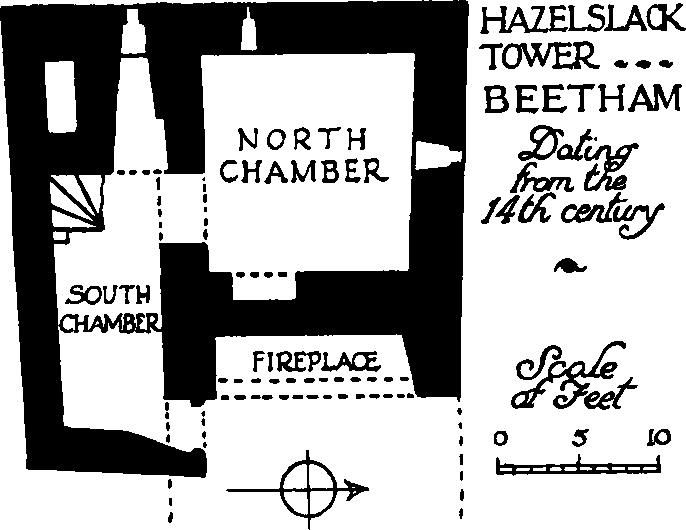
Hazelslack Tower - Beetham
Condition—Ruined and tops of walls damaged with small bushes and vegetation.
b(4). Cappleside Hall, ruin ¾ m. N. of (2) is a rubble structure forming the lower part of the S. wall of a former tower. It belonged to the Middleton family in the 16th century and was pulled down, except for the tower, about 1687. It was used as a barn in 1763 and was reduced to its present state probably in the 19th century. The tower was probably of late mediæval date but retains no detail by which it can be exactly dated. The existing wall formed the S. side of the tower and retains parts of the return-walls to the E. and W. At the S.W. angle is the base of a garde-robe turret and there is a second projection at the S.E. angle, perhaps for a fireplace.
Condition—Ruined.
Monuments (5–20)
The following monuments, unless otherwise described, are of the 17th century and of two storeys; the walls are of rubble and the roofs are slate-covered. Some of the buildings have exposed ceiling-beams.
Condition—Good or fairly good.
b(5). Cottage and barn, at Beetham House 230 yards N.E. of the church. The Cottage was built c. 1600 and retains some original mullioned and transomed windows. Inside the building is a muntin and plank partition and an early 17th-century panelled door. There is also an early 18th-century fireplace with a corbelled head and cornice. The Barn, S.E. of the cottage, is of the 17th century and of five bays.
b(6). Whasset Farm, house and outbuilding 1¼ m. N.E. of the church. The House has a front block, added late in the 17th century. It retains two original stone windows and a late 17th-century mullion and transom window in the N.E. wall. Inside the building is a spice-cupboard with the initials and date T.A. 1710; the early 18th-century staircase has turned balusters and square newels. There are also some 17th-century panelled doors. The Outbuilding, formerly a cottage, N. of the house, was built c. 1600 and has some original stone windows of two and three lights.
b(7). Whasset Gate, house, 30 yards N.W. of (6), has later extensions on the N., E. and S. It contains some original panelling.
b(8). Barn, on the W. side of the road opposite (7), is of five bays with two ranges of loop-lights.
b(9). Hale Green, house, 770 yards E.S.E. of (2), has later additions on the N. and E.
c(10). Cottage, on the N.E. side of the road at Hale 980 yards S.E. of (2), retains some original window-openings.
c(11). Keeper's Cottage, on the S.W. side of the road 150 yards N.W. of (10), has an original E. chimney-stack with a cylindrical shaft.
c(12). Fern Bank, house, on the N.E. side of the road opposite (11).
c(13). Cottage, 70 yards N.W. of (11), retains an original cylindrical chimney-shaft.
c(14). Old Cottage, 40 yards N. of (13), retains a similar chimney-shaft. A fireplace on the upper floor has moulded jambs and a flat triangular head.
c(15). Parkside, house, 230 yards N.W. of (14), retains one cylindrical chimney-shaft. Inside the house is a semi-circular stone staircase and an early 18th-century fireplace with a corbelled head and cornice.
c(16). Cottage, on the E. side of the road at Slack Head 650 yards W.S.W. of (2), was built late in the 17th or early in the 18th century.
a(17). Thorny Hill, house, on the N. side of the road 1¼ m. W.N.W. of the church, contains a three-stage cupboard of the local type with carved upper panels and the initials and date I. and M.A. 1677.
a(18). Shaw House, 220 yards S.S.W. of (17).
a(19). Greenhead Cottage, at the cross-roads ¼ m. S.S.W. of (18), contains an early 18th-century fireplace with a corbelled head and a small cupboard with the initials G. and E.W.
a(20). Nun's House, ¼ m. S.W. of (19), has a semi-circular stone staircase and a small cupboard with a panelled and enriched door.
b(21). Ashton House, 100 yards S. of Beetham church, was re-built in the 18th century, but incorporates a doorway with an enriched lintel bearing the initials and date T. and S.I. 1678.