An Inventory of the Historical Monuments in Westmorland. Originally published by His Majesty's Stationery Office, London, 1936.
This free content was digitised by double rekeying. All rights reserved.
'Haverbrack', in An Inventory of the Historical Monuments in Westmorland(London, 1936), British History Online https://www.british-history.ac.uk/rchme/westm/pp101-104 [accessed 9 May 2025].
'Haverbrack', in An Inventory of the Historical Monuments in Westmorland(London, 1936), British History Online, accessed May 9, 2025, https://www.british-history.ac.uk/rchme/westm/pp101-104.
"Haverbrack". An Inventory of the Historical Monuments in Westmorland. (London, 1936), British History Online. Web. 9 May 2025. https://www.british-history.ac.uk/rchme/westm/pp101-104.
In this section
35 HAVERBRACK (D.h.)
(O.S. 6 in. XLVI, N.E.)
Haverbrack is a small parish formerly part of Beetham parish. The parish church of Beetham is the principal monument.
Ecclesiastical
(1). Parish Church of St. Michael (Plate 97), Beetham, stands in the S.E. corner of the parish. The walls are of local limestone rubble with sandstone dressings, and the roofs are lead-covered. The lower part of the West Tower is perhaps of the 12th century and is the earliest part of the existing structure. It appears to have been planned in connection with a narrower nave than that at present existing, and foundations of an early wall were found in 1872 within the line of the N. arcade. A S. aisle was added c. 1200 and perhaps in the 13th century the Chancel was extended to the E. The Beetham Chapel was added late in the 14th century. In the 15th century the church was enlarged by the addition of the North Aisle, the widening of the South Aisle and the addition of the clearstorey. The top stage of the tower was added early in the 16th century. The church was restored in 1873–4 when the South Porch was added.
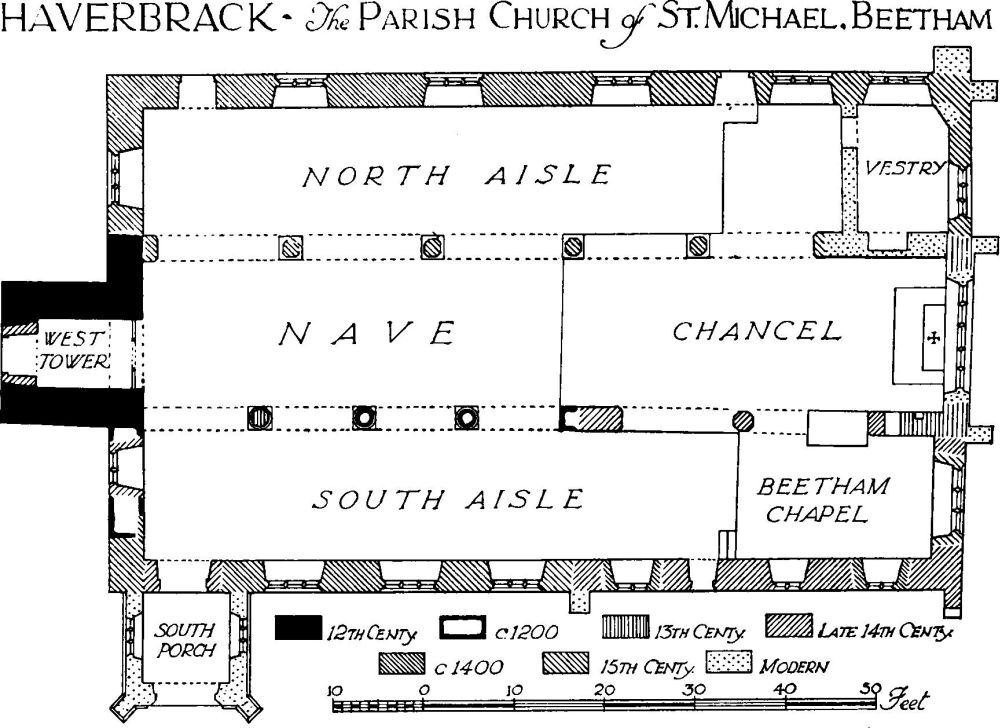
Haverbrack, the Parish Church of St. Michael. Beetham
The church is of some architectural interest and among the fittings the Beetham monument is noteworthy.
Architectural Description—The Chancel (41¼ ft. by 16½ ft.) has a modern five-light E. window. In the N. wall are two bays of the main N. arcade of the nave; farther E. is a two-centred arch of two chamfered orders, now blocked and only visible in the vestry. In the S. wall is a late 14th-century arcade of two bays, with segmental-pointed arches of two chamfered orders; the pier is octagonal with a moulded capital; the responds are chamfered and have hollow-chamfered imposts. There is no structural chancel-arch.
The Nave (46¾ ft. by 16¼ ft.) has a 15th-century N. arcade of five bays, two of which are in the chancel; the two-centred arches are of two chamfered orders and the octagonal piers have moulded capitals and splayed bases, except the first, which has a double-chamfered capital; the chamfered responds have hollow-chamfered imposts; the W. springers of the second arch show evidence of an alteration during the building. The late 12th-century S. arcade (Plate 98) is of four bays with round arches of a single chamfered order; the cylindrical columns have moulded capitals and bases; the square E. respond has a scalloped capital with a moulded abacus and the W. arch springs from a corbel of the same type; the westernmost pier is slighter than the others and has a different moulded capital; both it and the W. arch were probably re-built in the 13th century. The clearstorey of the chancel and nave is of the 15th century, but the windows, five on each side, are modern.
The North Aisle (14 ft. wide) is of the 15th century but has the E. bay cut off by a modern wall to form a vestry. The E. window is of three cinque-foiled lights in a four-centred head with a moulded label. In the N. wall are five windows similar to that in the E. wall; the second window has been partly restored; between the second and third windows is a doorway with chamfered jambs and two-centred head; the main N. doorway has chamfered jambs and segmental-pointed arch; one stone has a saltire-marking. In the W. wall is a window similar to those in the N. wall; on the outer face of the wall is a straight joint marking the extent of the nave before the addition of the aisle.
The South Aisle including the Beetham Chapel (13½–14½ ft. wide) has a 15th-century E. window of three cinque-foiled lights with vertical tracery in a four-centred head with a moulded label. The S. wall has an embattled parapet and contains six windows; the easternmost and the third are each of c. 1400 and of two trefoiled lights in a square head with a moulded label; the 14th-century second window is of two trefoiled ogee lights in a square head with a moulded label; the other windows are of the 15th century and uniform with those in the N. aisle; the S. doorway of the chapel has chamfered jambs and flat lintel; the re-set late 14th-century S. doorway has jambs and two-centred head of two moulded orders. In the W. wall is a late 14th-century window of two trefoiled ogee lights in a square head with a moulded label.
The West Tower (8 ft. by 7½ ft.) is of three storeys, of which the two lower are perhaps of the 12th century and the bell-chamber is an early 16th-century addition. The late 12th-century tower-arch is two-centred and of one chamfered order; the responds are square and have plain impost blocks. In the W. wall is a late 14th-century doorway with moulded jambs, two-centred arch and label; above it is a window of the same date and of two trefoiled ogee lights with vertical tracery in a two-centred head with a moulded label. The second storey has, on the E. wall, the marks of the former steep-pitched roof of the nave and above it a loop-light. The N. wall has a loop-light and above it a blocked square-headed opening formerly of two lights; the S. and W. walls have each two loop-lights and the W. wall a square opening in addition; the second storey is finished with a line of corbelling, over which the bell-chamber projects slightly. It is finished with an embattled parapet and pinnacles and has in each wall an early 16th-century window of three elliptical-headed lights in a square head with a moulded label.
The Roof of the chancel and nave is of early 16th-century date, partly restored and of nine bays; it is low-pitched with cambered and chamfered tie-beams; the truss between the chancel and nave and the curved braces and wall-posts are modern. The late 15th or early 16th-century pent-roof of the N. aisle is of twelve bays; the principal timbers in the five E. bays are moulded, and in the vestry are two star-shaped bosses.
Fittings—Books: In vestry—a small library of theological, historical and scientific works, given to the church by William Hutton in 1705. Chest: In vestry—of oak, panelled, with long drawer in lower part of front, enriched top rail carved with the initials and date T.H. 1689. Churchyard Cross: S. of S. chapel—base only, mediæval. Communion Table: with carved bulbous legs and carved top rail, late 16th-century, modern lower rails. Font-cover: of oak, seven-sided and of two stages, the lower enclosing the bowl, with spire-shaped capping, finials at angles and ball-finial at top; both stages panelled and enriched with conventional designs; on lower panels the date Ano. Dom. 1636, also the date 1891 when the cover was extensively restored. Glass: In Beetham Chapel —in S.E. window, various portions of heraldic glass including (a) fragment with three roundels, perhaps not heraldic, and fragments; (b) panel made up of the following coats: 1. lozengy a chief with a molet therein (possibly two separate coats), 2. a cheveron between three crosslets, 3. a cheveron between three covered cups, 4. a cross paty; also upper part of figure of the Child Christ and a panel with figure of a bearded king, all late 15th or early 16th-century; in second S. window, shield-of-arms of Stanley quartering Lathom and a checky coat, the whole quartering the Isle of Man, also four quarries with sun-burst design, late 15th-century. In W. tower—in W. window, a Crucifixion and a Virgin and Child; below, figures of man in cope and probably St. John, and, in tracery, two mitred heads of a bishop and archbishop, also various fragments, 15th-century. Monument: In chancel— under S. arcade, altar-tomb and effigies (Plate 100) of man and wife of the Beetham family, altar-tomb with quatre-foiled panelled sides and W. end (Plate 46) enclosing shields-of-arms, etc., N. side, (a) Beetham as in the Furness Abbey roll, (b) leopard's-head mask, (c) Thwayts, (d) blank, W. end, (e) Harrington, (f) Beetham, (g) Tunstall, S. side, (h) a cross raguly, (i) Musgrave, (j) Strickland or Dacre, (k) Middleton; effigy of man in armour with laminated skirt and hip-belt, head, legs and arms missing; effigy of woman in long cloak, head and hands missing; c. 1420. Piscinæ: In chancel— rectangular recess with two round drains, mediæval. In Beetham chapel—in S. wall, rectangular recess with round drain, mediæval. Plate: includes a cup of 1692 with an inscription giving that date. Scratchings: On N. arcade of nave and on S. doorway, various masons' marks. Seating: In N. aisle—bench with panelled back with initials T.P., T.I. and I.C., one shaped arm, 17th-century. Sundials: On E. jamb-stone of doorway of S. chapel—round dial with four arms; on buttress, scratch-dial. Miscellanea: In vestry —portion of small oak frame with entablature and part of pediment, inscribed T. and M.B. 1624.
Condition—Good.
Secular
(2). Dallam Tower, house, etc., 1 m. N.N.W. of the church. The House was entirely re-built by Daniel Wilson in 1720–2, but contains some earlier woodwork re-set. On the ground floor one of the W. rooms is lined with 17th-century panelling including a small cupboard door with the initials and date T.W.D. 1676. In the dining-room is a cupboard (Plate 40) of the local type, said to have come from Beetham Hall; the fascia has the initials and date T. and B.M. 1694. In a room on the first floor is a wooden fireplacesurround and overmantel (Plate 99), said to have come from Nether Levens; it has gadrooned and bulbous Ionic columns and an overmantel of three bays divided and flanked by Ionic pilasters; the main panels have cartouches, one bearing the arms of Preston, and on cartouches above is the inscription "Ano. T.P.A. 1602" referring to Thomas Preston. Incorporated with this fireplace is rather later carved work of different provenance. Another room is lined with 17th-century panelling incorporating two panels with the initials R. and E.C. and the date 1685.
At the entrance to the kitchen-garden, S. of the house, is a gabled stone gateway, flanked by panelled pilasters each with a baluster-shaped upper stage and supporting the main entablature and pediment; in the pediment are the initials and date E. and D.W. 1683, for Edward and Dorothy Wilson.
Condition—Good.
(3). Parsonage Farm, house and pigeon-house, 40 yards N. of the church. The House is of two storeys with attics; the walls are of rubble and the roofs are slate-covered. A mediæval building, known as the College, was pulled down in 1756 and the S. part of the existing house appears to have been its N. cross-wing. The N. block of the house was added probably late in the 17th century. The S. wall retains a mediæval doorway, with a two-centred head and now blocked. On the E. front is a late 17th-century attic-window with moulded frame and mullion; there is also a chimney-stack of the same period with cylindrical shafts. Inside the building some of the ceiling-beams are exposed. The drawing-room is lined with 17th-century panelling with enriched frieze-panels. In the kitchen is a two-stage cupboard (Plate 34) of the local type; it has enriched upper panels, pendants and fascia with the initials and date S. and E.D. 1684. A room on the first floor is lined with panelling of c. 1700 and has a fireplace and overmantel of the same date. The staircase of c. 1700 has turned balusters and square newels with ball-terminals. In a passage by the kitchen is a panel with the initials and date R. and I.A. 1661.
The Pigeon House, S.W. of the house, is a square stone structure, gabled towards the N. and S. It is of late 16th or early 17th-century date. On the N. wall is a panel with a defaced date and initials. The front garden has a pair of late 17th-century gate-piers, one retaining its ball-terminal.
Condition—Good.
(4). Haverbrack Cottage, house, nearly ¾ m. N.W. of the church, is of two storeys; the walls are of rubble and the roofs are slate-covered. The N.E. block of the house was built in the 17th century but the rest of the structure is modern.
Condition—Good.
Unclassified
(5). Mound, in the park 350 yards S.E. of Dallam Tower, is of irregular semi-circular form, about 33 yards across and rising about 5 ft. above the surrounding ground. It was probably the site of some mediæval building.
Condition—Fairly good.
(6). Constructions near Wray Cottage, 1,200 yards S.W. of (2), are the remains of two stone galleries or chambers wholly or partly below the surface of the ground. The first is about 180 yards N.N.W. of the cottage, and about 6½ ft. of the covered gallery survive. It is over 2 ft. wide and 2½ ft. high and is built of dry-stone walling in a natural channel in the rock; the covering is of large slabs and above the cover-stones is 1-1½ ft. of loose stones and earth. The construction was at least 20 ft. long but has collapsed at both ends. The second structure stands immediately behind the cottage. The W. end of the gallery survives intact and is 2¼ ft. wide and 2½ ft. high. At this point it is largely above ground-level and is enclosed by dry walling 4½ ft. thick on the S. side. The lintel of the entrance is some 6 ft. long and the gallery opens into a circular kiln across which the flue was carried. There seems no doubt that this structure was a kiln, but the purpose of the other gallery is uncertain.
Condition—Of first, bad; of second, fairly good.
(7). Cave, probably in origin a natural 'pot-hole' and known locally as 'The Fairy Hole', is situated on the S.W. slope of Haverbrack Bank nearly ¾ m. W.S.W. of (2). It was partially explored in 1912 by Dr. J.W. Jackson (C. and W. Trans., N.S. XIV, 262). Its opening, which measures about 5 ft. by 3 ft., is at the ground-level and partly masked by two heavy limestone covers. The shaft below was filled with clay and limestone blocks to within 3 ft. of the surface and has a diameter of about 3 ft. at the top. Excavation showed that the E. wall opened out to give a maximum width of 12 ft. Practical difficulties brought the excavation to an end at a depth of 17 ft., the bottom not being reached. The upper deposit yielded one potsherd said to be of 16th-century date, and lower down were bones of various animals: horse, sheep, goat, pig, dog and wolf. Bones of dog (50 individuals) and pig were most numerous and there were remains of five wolves.