
An Inventory of the Historical Monuments in Essex, Volume 4, South east. Originally published by His Majesty's Stationery Office, London, 1923.
This free content was digitised by double rekeying. All rights reserved.
'Corringham', in An Inventory of the Historical Monuments in Essex, Volume 4, South east, (London, 1923) pp. 25-27. British History Online https://www.british-history.ac.uk/rchme/essex/vol4/pp25-27 [accessed 26 April 2024]
In this section
17. CORRINGHAM. (D.d.)
(O.S. 6 in. (a)lxxvi. S.E. (b)lxxxv. N.W.)
Corringham is a parish and small village on the N. bank of the Thames estuary, 7 m. N.E. of Tilbury. The church is the principal monument.
Ecclesiastical
a(1). Parish Church of St. Mary stands in the village. The walls are of ragstone-rubble and flint; the dressings are of Reigate and other limestone and the roofs are tiled. The S. walls of the Chancel and Nave are of the 11th century, the thickness in each case favouring a pre- rather than a post-Conquest date. The West Tower was added late in the 11th century and stands partly on the earlier W. wall of the nave. Early in the 14th century a North Chapel and North Aisle were added and the chancel was extended to the E. in the same century and the walls heightened; in the 17th century the chancel-arch fell. The church has been restored in modern times when the chancel-arch and part of the S. wall of the nave were re-built and the North Vestry and South Porch added.
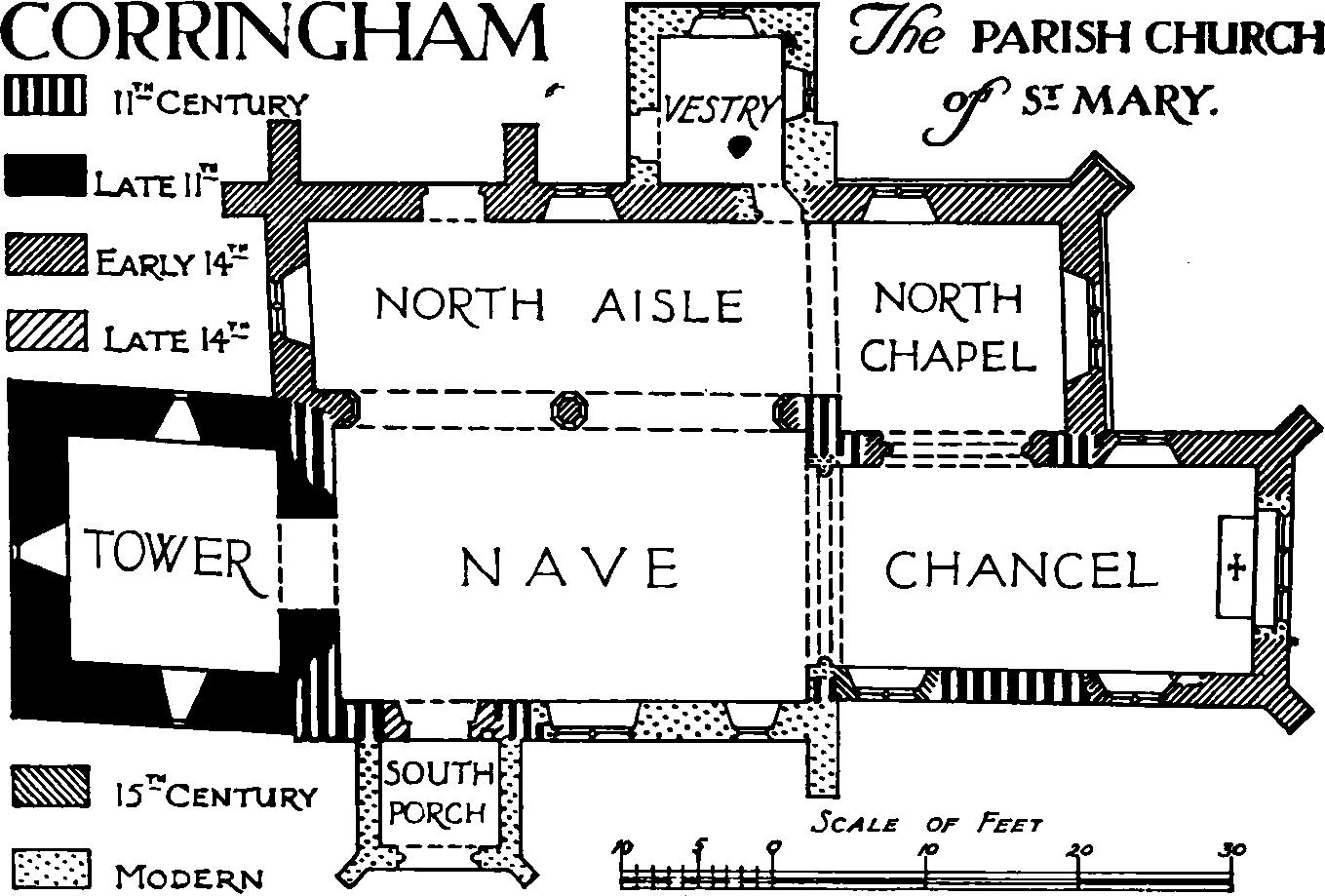
Corringham, the Parish Church of St Mary
The church is of interest from its early date and amongst the fittings the 14th-century screen is noteworthy.
Architectural Description—The Chancel (28 ft. by 13½ ft.) has a modern E. window. In the N. wall is an early 14th-century arch, two-centred and of two chamfered orders the outer continuous and the inner resting on attached shafts with moulded capitals and bases; further E. is a 14th-century window, partly restored and of two trefoiled ogee lights with tracery in a two-centred head with a moulded label. The lower part of the western half of the S. wall is built of roughly coursed herring-bone rubble possibly of pre-Conquest date. In the S. wall are two windows, the eastern of the 14th century and similar to that in the N. wall; the western window is of the 15th century and of two cinque-foiled lights in a square head with a moulded label. The chancel-arch is modern.
The North Chapel (14½ ft. by 13½ ft.) has external wall-faces of bands of flint and freestone. The 14th-century E. window is partly restored and of three trefoiled ogee lights with modern tracery in a segmental head with a moulded label. In the N. wall is a 14th-century window of two trefoiled ogee lights with a quatrefoil in a two-centred head.
The 14th-century W. archway is two-centred and of two chamfered orders dying on to the side walls.
The Nave (31 ft. by 17½ ft.) has an early 14th-century N. arcade of two bays with two-centred arches of two chamfered orders; the octagonal column has a moulded capital and base and the responds have attached half-columns; the responds show evidence of rebuilding and the arches may have been widened. In the S. wall are two modern windows and further W. is the late 14th-century S. doorway with sunk-chamfered jambs and moulded arch of two orders with a moulded label. The western part of the S. wall is similar in date and character to the older walling on the S. of the chancel.
The North Aisle (10¾ ft. wide) has in the N. wall a 14th-century window similar to the N. window in the N. chapel; E. of it is a modern doorway and W. of it is the 14th-century N. doorway with jambs and two-centred arch of two chamfered orders. In the W. wall is a window similar to that in the N. wall.
The West Tower (13¾ ft. by 14¾ ft.) (Plate, p. 28) is of late 11th-century date and of three stages with a pyramidal roof. The round tower-arch is of one plain order with chamfered imposts; the keystone on the E. side is carved with a small head. The N., S. and W. walls have each a window of one narrow light, modern externally. The N., S. and W. walls of the second stage have each a window similar to those in the stage below but with 14th-century trefoiled heads. The bell-chamber is divided externally into two sub-stages by an offset, the lower has on each face three round-headed recesses of rubble; above these on each face is a series of five similar recesses but the middle one on the N., S. and W. sides is pierced for a window and fitted with a modern central shaft with old cushion-capital and base and supporting two small round sub-arches of rubble; the corresponding opening on the E. face formerly opened into the nave roof; the roof on this side also covered the lower range of recesses.
The Roofs are modern except for the 15th-century moulded and embattled wall-plates on the N. of the N. chapel and aisle and on both sides of the nave.
Fittings—Bells: three; 1st by John Dier, 1580; 2nd and 3rd by Thomas Bartlet, 1629 and 1617 respectively. Brasses and Indents. Brasses: In chancel—(1) of Richard de Beltoun, c. 1340, half-effigy of priest in mass vestments; (2) of civilian, c. 1460, much worn and re-set; (3) to Alice Greyve, 1453, inscription only. In N. chapel —(3) to Robert Draper, 1595, parson of Corringham, inscription only. In nave—(4) to Thomas at Lee, 1464, and Margaret his wife, inscription only. Indents: In N. chapel—(1) later used for brass (3), marginal inscription in separate capitals to (Is)abelle Baud, 14th-century. In nave—(2) of figure and inscription-plate, possibly of brass (2); (3) tapering slab with traces of marginal inscription in separate capitals, late 13th or early 14th-century. Chests: In N. chapel—(1) plain, of hutch-type with square lock-plates, 17th-century. In N. vestry—(2) of oak, iron-bound with three strap-hinges and one old drop-handle, mediaeval. Glass: In N. chapel—in E. window, two angels and part of yellow rays. In N. window, foliage, probably in situ. Both 15th-century. In N. aisle— W. window, a dragon (Plate, pp. xliv-v), possibly 14th-century. Panelling: In nave—incorporated in bench, traceried panel in three tiers with foliated spandrels and embattled rail, 15th-century. Piscina: In chancel—with chamfered jambs and trefoiled head, round drain, 14th-century. Plate: includes 17th-century cup with altered rim and dated 1685, cover-paten of 1684. Screen (Plate, pp. 4–5): In N. chapel—with middle doorway and four lights on each side divided by shafts with moulded capitals, bands and bases and with cusped intersecting tracery above, close lower panels, early 14th-century, 17th-century scratched initials and dates on sill. Stoup: In nave—E. of S. doorway, recess with cinque-foiled head and broken bowl, 14th or 15th-century. Miscellanea: Re-set in N. respond of chancel-arch, corbel or bracket of ogee form. The churchyard wall incorporates old stones and has a weathered coping.
Condition—Good.
Secular
Monuments (2–7).
The following monuments, unless otherwise described, are of the 17th century and of two storeys, timber-framed and weather-boarded; the roofs are tiled. Some of the buildings have original chimney-stacks and exposed ceiling-beams.
Condition—Good.
a(2). Bull Inn (Plate, pp. xxxiv–v), 40 yards N.E. of the church, is of two storeys with attics and of plastered timber-framing. It has an E. cross-wing and modern additions on the N.W. and N.E. The cross-wing is probably of 15th-century date but the main block was re-built in the 17th century. The upper storey of the cross-wing projects on the S.W. front. The 17th-century chimney-stack is of cruciform plan set diagonally.
a(3). House and Shop, on W. side of the road, 120 yards N.N.W. of the church, was of half H-shaped plan with the cross-wings extending towards the S.W. but a modern addition makes the present plan rectangular. The S.E. wing is possibly of 15th-century date but the main block and N.W. wing are later.
a(4). Giffords' Cross, house, 650 yards W.N.W. of the church, is of two storeys with attics. It was built probably in the 16th century on an L-shaped plan with the wings extending towards the N.W. and S.W. but a later addition of c. 1700 makes the present plan rectangular; the roof was re-built and heightened at the same time. The original chimney-stack has grouped diagonal shafts. Inside the building is some early 17th-century panelling.
a(5). Northlands Farm, house, about 1¾ m. N.W. of the church, is of two storeys with attics and cellars. The N. and S. doors are panelled and of 17th-century date, the latter has a hood supported on shaped brackets. Inside the building some of the timber-framing is exposed. The main staircase is original and has turned balusters and newel posts.
a(6). Cottage, now two tenements, ½ m. N.E. of the church, is of the central-chimney type.
b(7). Reedham, farmhouse, about 1½ m. E.S.E. of the church, is of two storeys with attics; the walls are partly timber-framed and partly of brick. It has been much altered and has a modern addition at the back. Inside the building some of the timber-framing is exposed.