Journal of the House of Lords: Volume 12, 1666-1675. Originally published by His Majesty's Stationery Office, London, 1767-1830.
This free content was digitised by double rekeying. All rights reserved.
'House of Lords Journal Volume 12: 12 April 1671', in Journal of the House of Lords: Volume 12, 1666-1675(London, 1767-1830), British History Online https://www.british-history.ac.uk/lords-jrnl/vol12/pp485-489 [accessed 10 May 2025].
'House of Lords Journal Volume 12: 12 April 1671', in Journal of the House of Lords: Volume 12, 1666-1675(London, 1767-1830), British History Online, accessed May 10, 2025, https://www.british-history.ac.uk/lords-jrnl/vol12/pp485-489.
"House of Lords Journal Volume 12: 12 April 1671". Journal of the House of Lords: Volume 12, 1666-1675. (London, 1767-1830), British History Online. Web. 10 May 2025. https://www.british-history.ac.uk/lords-jrnl/vol12/pp485-489.
In this section
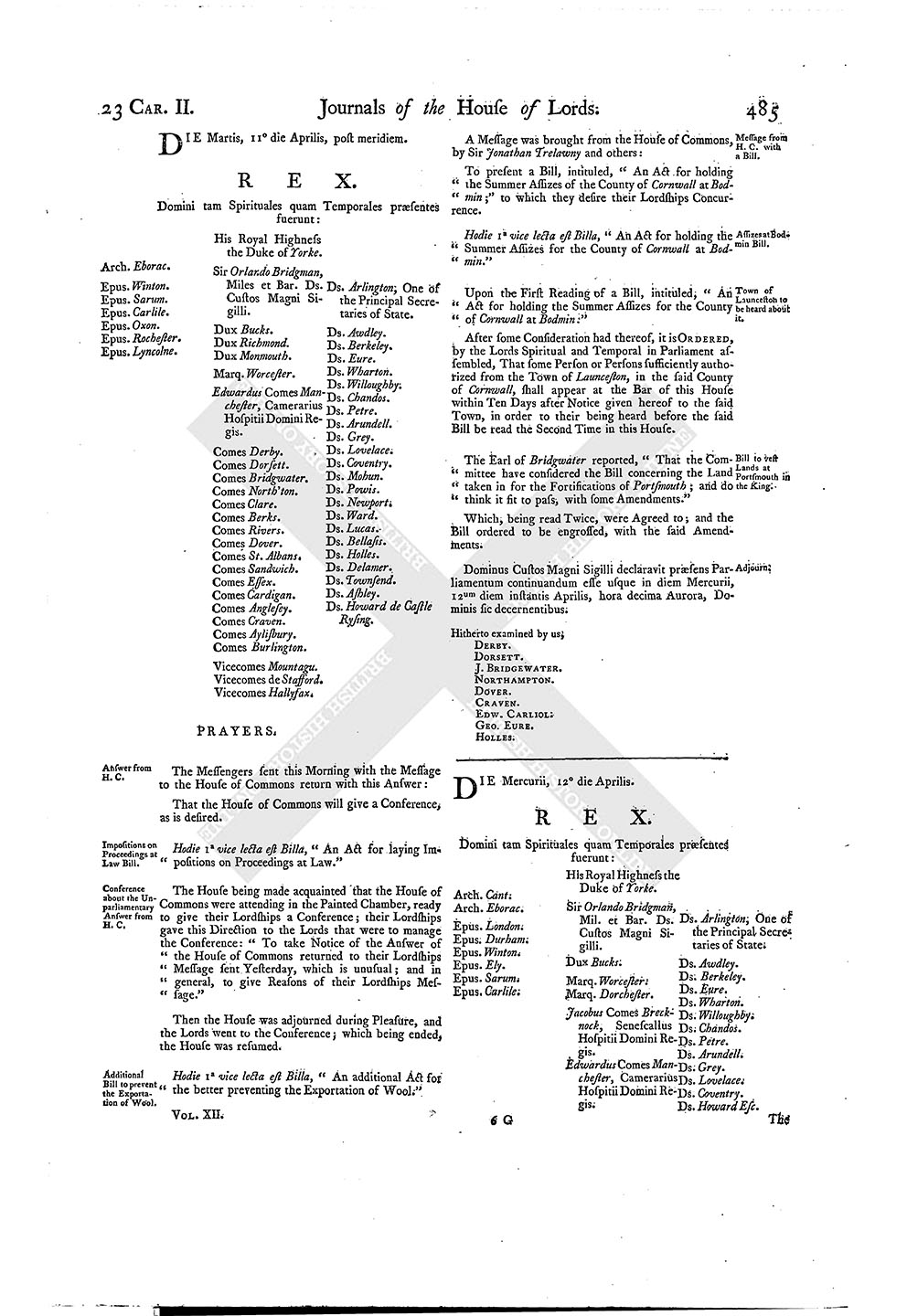
DIE Mercurii, 12 die Aprilis.
REX.
Domini tam Spirituales quam Temporales præsentes fuerunt:
PRAYERS.
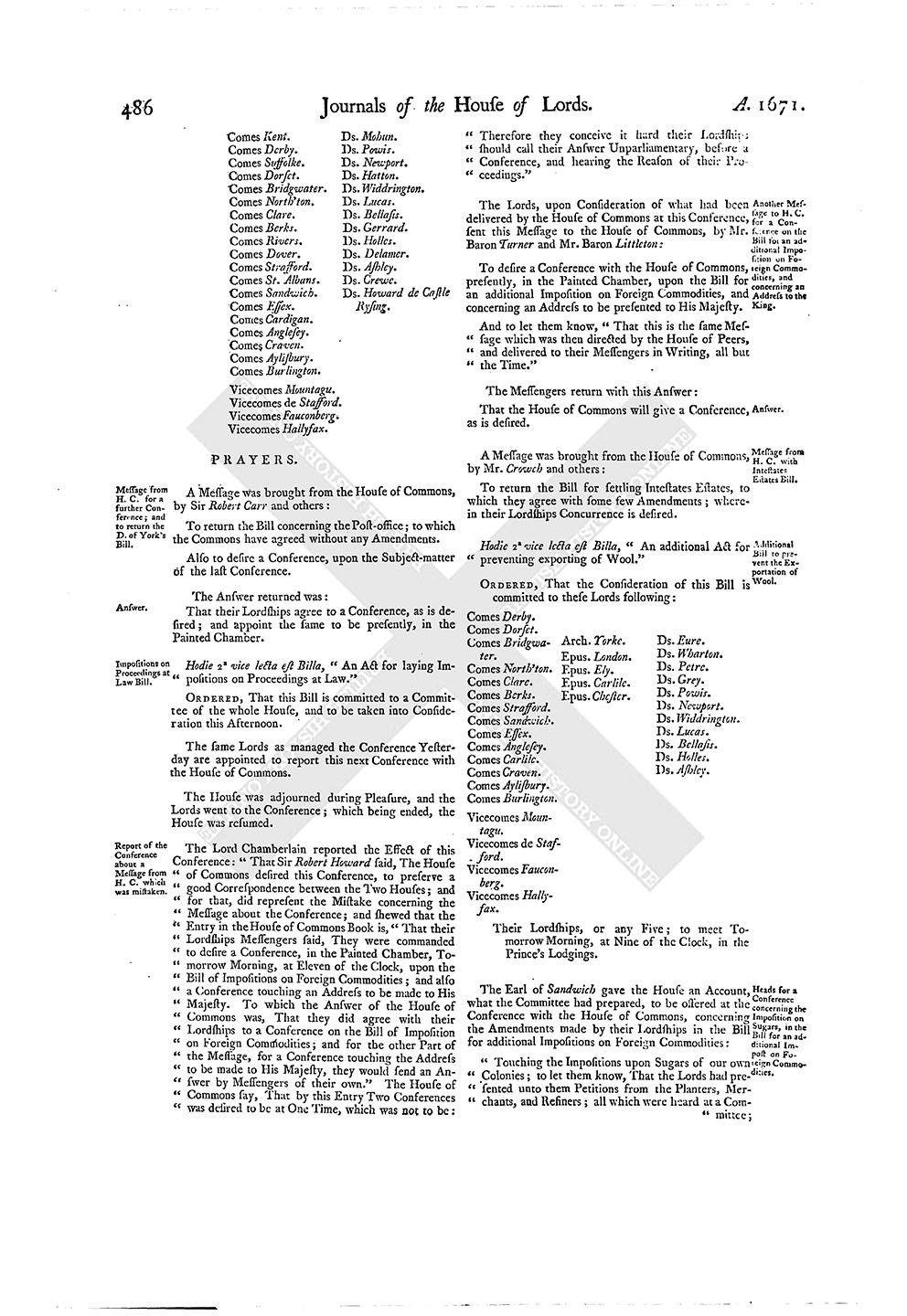
Message from H. C. for a further Conference; and to return the D. of York's Bill.
A Message was brought from the House of Commons, by Sir Robert Carr and others:
To return the Bill concerning the Post-office; to which the Commons have agreed without any Amendments.
Also to desire a Conference, upon the Subject-matter of the last Conference.
The Answer returned was:
Answer.
That their Lordships agree to a Conference, as is desired; and appoint the same to be presently, in the Painted Chamber.
Impositions on Proceedings at Law Bill.
Hodie 2a vice lecta est Billa, "An Act for laying Impositions on Proceedings at Law."
ORDERED, That this Bill is committed to a Committee of the whole House, and to be taken into Consideration this Afternoon.
The same Lords as managed the Conference Yesterday are appointed to report this next Conference with the House of Commons.
The House was adjourned during Pleasure, and the Lords went to the Conference; which being ended, the House was resumed.
Report of the Conference about a Message from H. C. which was mistaken.
The Lord Chamberlain reported the Effect of this Conference: "That Sir Robert Howard said, The House of Commons desired this Conference, to preserve a good Correspondence between the Two Houses; and for that, did represent the Mistake concerning the Message about the Conference; and shewed that the Entry in the House of Commons Book is, "That their Lordships Messengers said, They were commanded to desire a Conference, in the Painted Chamber, Tomorrow Morning, at Eleven of the Clock, upon the Bill of Impositions on Foreign Commodities; and also a Conference touching an Address to be made to His Majesty. To which the Answer of the House of Commons was, That they did agree with their Lordships to a Conference on the Bill of Imposition on Foreign Commodities; and for the other Part of the Message, for a Conference touching the Address to be made to His Majesty, they would send an Answer by Messengers of their own." The House of Commons say, That by this Entry Two Conferences was desired to be at One Time, which was not to be: Therefore they conceive it hard their Lordship; should call their Answer Unparliamentary, before a Conference, and hearing the Reason of their Proceedings."
Another Message to H. C. for a Conference on the Bill for an additional Imposition on Foreign Commodities, and concerning an Address to the King.
The Lords, upon Consideration of what had been delivered by the House of Commons at this Conference, sent this Message to the House of Commons, by Mr. Baron Turner and Mr. Baron Littleton:
To desire a Conference with the House of Commons, presently, in the Painted Chamber, upon the Bill for an additional Imposition on Foreign Commodities, and concerning an Address to be presented to His Majesty.
And to let them know, "That this is the same Message which was then directed by the House of Peers, and delivered to their Messengers in Writing, all but the Time."
The Messengers return with this Answer:
Answer.
That the House of Commons will give a Conference, as is desired.
Message from H. C. with Intestates Estates Bill.
A Message was brought from the House of Commons, by Mr. Crowch and others:
To return the Bill for settling Intestates Estates, to which they agree with some few Amendments; wherein their Lordships Concurrence is desired.
Additional Bill to prevent the Exportation of Wool.
Hodie 2a vice lecta est Billa, "An additional Act for preventing exporting of Wool."
ORDERED, That the Consideration of this Bill is committed to these Lords following:
Their Lordships, or any Five; to meet Tomorrow Morning, at Nine of the Clock, in the Prince's Lodgings.
Heads for a Conference concerning the Imposition on Sugars, in the Bill for an additional Impost on Foreign Commodities.
The Earl of Sandwich gave the House an Account, what the Committee had prepared, to be offered at the Conference with the House of Commons, concerning the Amendments made by their Lordships in the Bill for additional Impositions on Foreign Commodities:
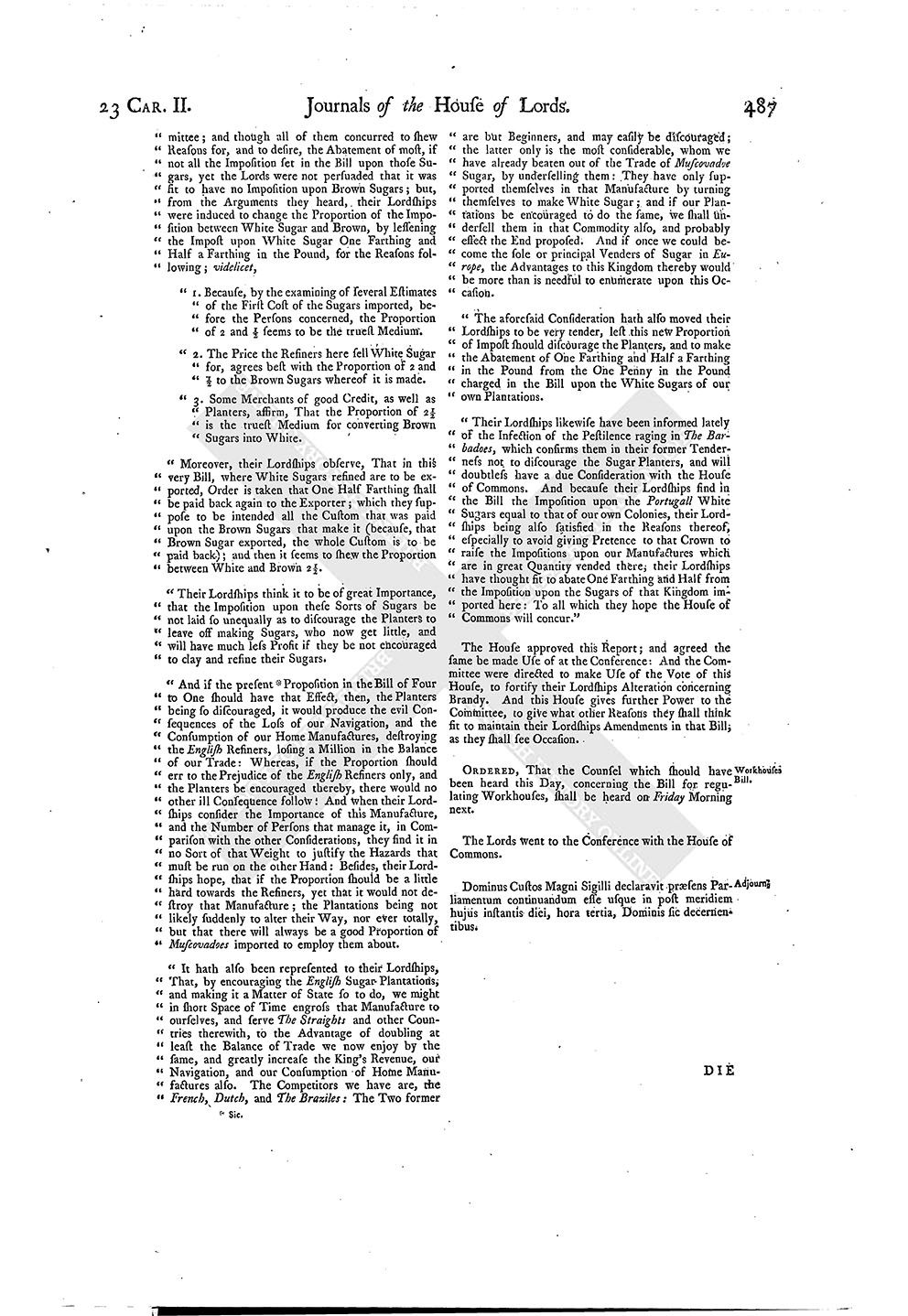
"Touching the Impositions upon Sugars of our own Colonies; to let them know, That the Lords had presented unto them Petitions from the Planters, Merchants, and Refiners; all which were heard at a Committee; and though all of them concurred to shew Reasons for, and to desire, the Abatement of most, if not all the Imposition set in the Bill upon those Sugars, yet the Lords were not persuaded that it was fit to have no Imposition upon Brown Sugars; but, from the Arguments they heard, their Lordships were induced to change the Proportion of the Imposition between White Sugar and Brown, by lessening the Impost upon White Sugar One Farthing and Half a Farthing in the Pound, for the Reasons following; videlicet,
"1. Because, by the examining of several Estimates of the First Cost of the Sugars imported, before the Persons concerned, the Proportion of 2 and ½ seems to be the truest Medium.
"2. The Price the Refiners here sell White Sugar for, agrees best with the Proportion of 2 and ½ to the Brown Sugars whereof it is made.
"3. Some Merchants of good Credit, as well as Planters, affirm, That the Proportion of 2½ is the truest Medium for converting Brown Sugars into White.
"Moreover, their Lordships observe, That in this very Bill, where White Sugars refined are to be exported, Order is taken that One Half Farthing shall be paid back again to the Exporter; which they suppose to be intended all the Custom that was paid upon the Brown Sugars that make it (because, that Brown Sugar exported, the whole Custom is to be paid back); and then it seems to shew the Proportion between White and Brown 2½.
"Their Lordships think it to be of great Importance, that the Imposition upon these Sorts of Sugars be not laid so unequally as to discourage the Planters to leave off making Sugars, who now get little, and will have much less Profit if they be not encouraged to clay and refine their Sugars.
"And if the present (fn. 1) Proposition in the Bill of Four to One should have that Effect, then, the Planters being so discouraged, it would produce the evil Consequences of the Loss of our Navigation, and the Consumption of our Home Manufactures, destroying the English Refiners, losing a Million in the Balance of our Trade: Whereas, if the Proportion should err to the Prejudice of the English Refiners only, and the Planters be encouraged thereby, there would no other ill Consequence follow: And when their Lordships consider the Importance of this Manufacture, and the Number of Persons that manage it, in Comparison with the other Considerations, they find it in no Sort of that Weight to justify the Hazards that must be run on the other Hand: Besides, their Lordships hope, that if the Proportion should be a little hard towards the Refiners, yet that it would not destroy that Manufacture; the Plantations being not likely suddenly to alter their Way, nor ever totally, but that there will always be a good Proportion of Muscovadoes imported to employ them about.
"It hath also been represented to their Lordships, That, by encouraging the English Sugar Plantations, and making it a Matter of State so to do, we might in short Space of Time engross that Manufacture to ourselves, and serve The Straights and other Countries therewith, to the Advantage of doubling at least the Balance of Trade we now enjoy by the same, and greatly increase the King's Revenue, our Navigation, and our Consumption of Home Manufactures also. The Competitors we have are, the French, Dutch, and The Braziles: The Two former are but Beginners, and may easily be discouraged; the latter only is the most considerable, whom we have already beaten out of the Trade of Muscovadoe Sugar, by underselling them: They have only supported themselves in that Manufacture by turning themselves to make White Sugar; and if our Plantations be encouraged to do the same, we shall undersell them in that Commodity also, and probably effect the End proposed. And if once we could become the sole or principal Venders of Sugar in Europe, the Advantages to this Kingdom thereby would be more than is needful to enumerate upon this Occasion.
"The aforesaid Consideration hath also moved their Lordships to be very tender, lest this new Proportion of Impost should discourage the Planters, and to make the Abatement of One Farthing and Half a Farthing in the Pound from the One Penny in the Pound charged in the Bill upon the White Sugars of our own Plantations.
"Their Lordships likewise have been informed lately of the Infection of the Pestilence raging in The Barbadoes, which confirms them in their former Tenderness not to discourage the Sugar Planters, and will doubtless have a due Consideration with the House of Commons. And because their Lordships find in the Bill the Imposition upon the Portugall White Sugars equal to that of our own Colonies, their Lordships being also satisfied in the Reasons thereof, especially to avoid giving Pretence to that Crown to raise the Impositions upon our Manufactures which are in great Quantity vended there, their Lordships have thought fit to abate One Farthing and Half from the Imposition upon the Sugars of that Kingdom imported here: To all which they hope the House of Commons will concur."
The House approved this Report; and agreed the same be made Use of at the Conference: And the Committee were directed to make Use of the Vote of this House, to fortify their Lordships Alteration concerning Brandy. And this House gives further Power to the Committee, to give what other Reasons they shall think fit to maintain their Lordships Amendments in that Bill, as they shall see Occasion.
Workhouses Bill.
ORDERED, That the Counsel which should have been heard this Day, concerning the Bill for regulating Workhouses, shall be heard on Friday Morning next.
The Lords went to the Conference with the House of Commons.
Adjourn.
Dominus Custos Magni Sigilli declaravit præsens Parliamentum continuandum esse usque in post meridiem hujus instantis diei, hora tertia, Dominis sic decernentibus.
Post meridiem.
REX.
Domini tam Spirituales quam Temporales præsentes fuerunt:
PRAYERS.
Bill to determine Differences touching Houses burnt in London.
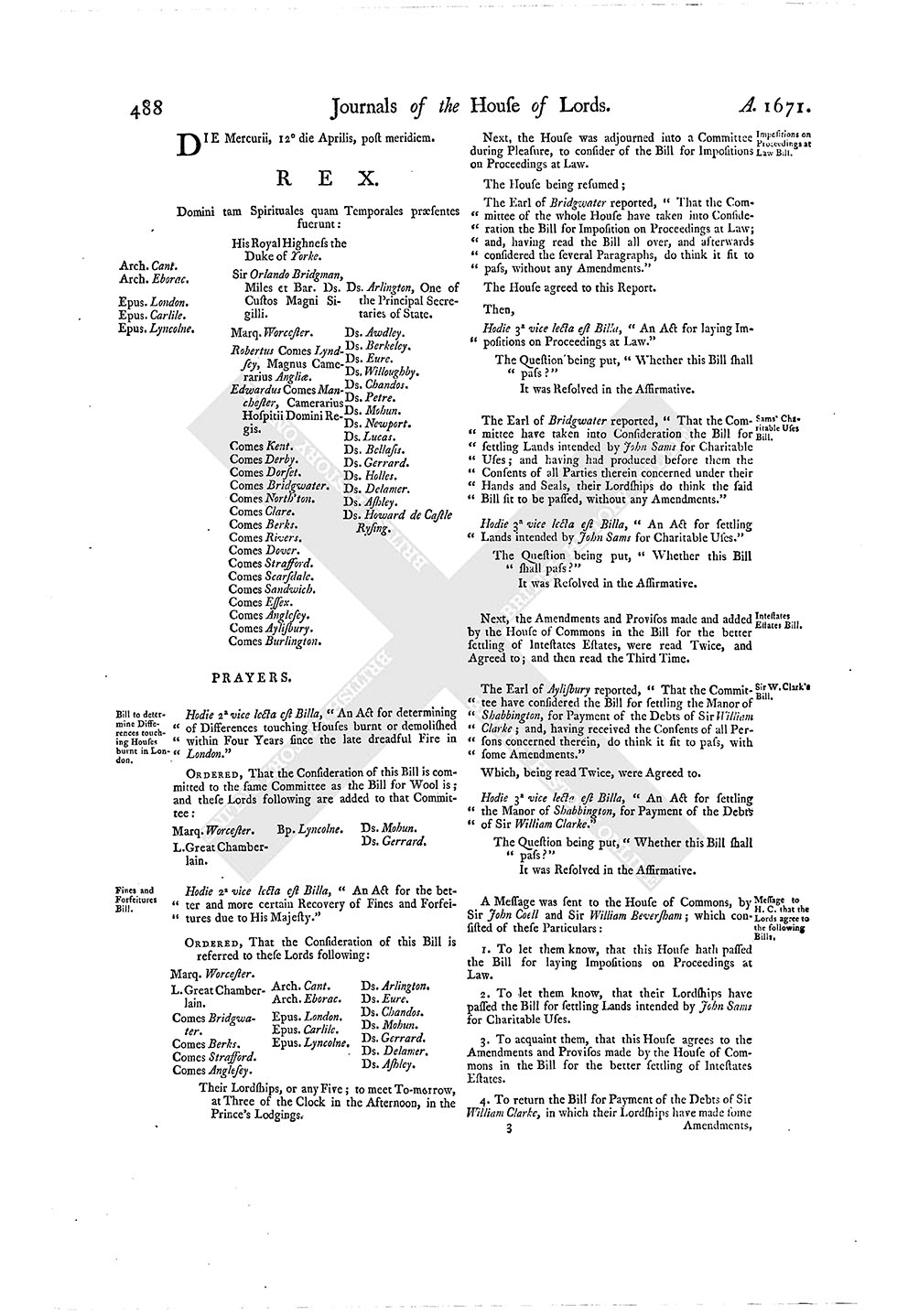
Hodie 2a vice lecta est Billa, "An Act for determining of Differences touching Houses burnt or demolished within Four Years since the late dreadful Fire in London."
ORDERED, That the Consideration of this Bill is committed to the same Committee as the Bill for Wool is; and these Lords following are added to that Committee:
Fines and Forfeitures Bill.
Hodie 2a vice lecta est Billa, "An Act for the better and more certain Recovery of Fines and Forfeitures due to His Majesty."
ORDERED, That the Consideration of this Bill is referred to these Lords following:
Their Lordships, or any Five; to meet To-morrow, at Three of the Clock in the Afternoon, in the Prince's Lodgings.
Impositions on Proceedings at Law Bill.
Next, the House was adjourned into a Committee during Pleasure, to consider of the Bill for Impositions on Proceedings at Law.
The House being resumed;
The Earl of Bridgwater reported, "That the Committee of the whole House have taken into Consideration the Bill for Imposition on Proceedings at Law; and, having read the Bill all over, and afterwards considered the several Paragraphs, do think it fit to pass, without any Amendments."
The House agreed to this Report.
Then,
Hodie 3a vice lecta est Billa, "An Act for laying Impositions on Proceedings at Law."
The Question being put, "Whether this Bill shall pass?"
It was Resolved in the Affirmative.
Sams' Charitable Uses Bill.
The Earl of Bridgwater reported, "That the Committee have taken into Consideration the Bill for settling Lands intended by John Sams for Charitable Uses; and having had produced before them the Consents of all Parties therein concerned under their Hands and Seals, their Lordships do think the said Bill fit to be passed, without any Amendments."
Hodie 3a vice lecta est Billa, "An Act for settling Lands intended by John Sams for Charitable Uses."
The Question being put, "Whether this Bill shall pass?"
It was Resolved in the Affirmative.
Intestates Estates Bill.
Next, the Amendments and Provisos made and added by the House of Commons in the Bill for the better settling of Intestates Estates, were read Twice, and Agreed to; and then read the Third Time.
Sir W. Clark's Bill.
The Earl of Aylisbury reported, "That the Committee have considered the Bill for settling the Manor of Shabbington, for Payment of the Debts of Sir William Clarke; and, having received the Consents of all Persons concerned therein, do think it fit to pass, with some Amendments."
Which, being read Twice, were Agreed to.
Hodie 3a vice lecta est Billa, "An Act for settling the Manor of Shabbington, for Payment of the Debts of Sir William Clarke."
The Question being put, "Whether this Bill shall pass?"
It was Resolved in the Affirmative.
Message to H. C. that the Lords agree to the following Bills.
A Message was sent to the House of Commons, by Sir John Coell and Sir William Beversham; which consisted of these Particulars:
1. To let them know, that this House hath passed the Bill for laying Impositions on Proceedings at Law.
2. To let them know, that their Lordships have passed the Bill for settling Lands intended by John Sams for Charitable Uses.
3. To acquaint them, that this House agrees to the Amendments and Provisos made by the House of Commons in the Bill for the better settling of Intestates Estates.
4. To return the Bill for Payment of the Debts of Sir William Clarke, in which their Lordships have made some Amendments, and desire the Concurrence of the House of Commons thereunto.
Committees to meet.
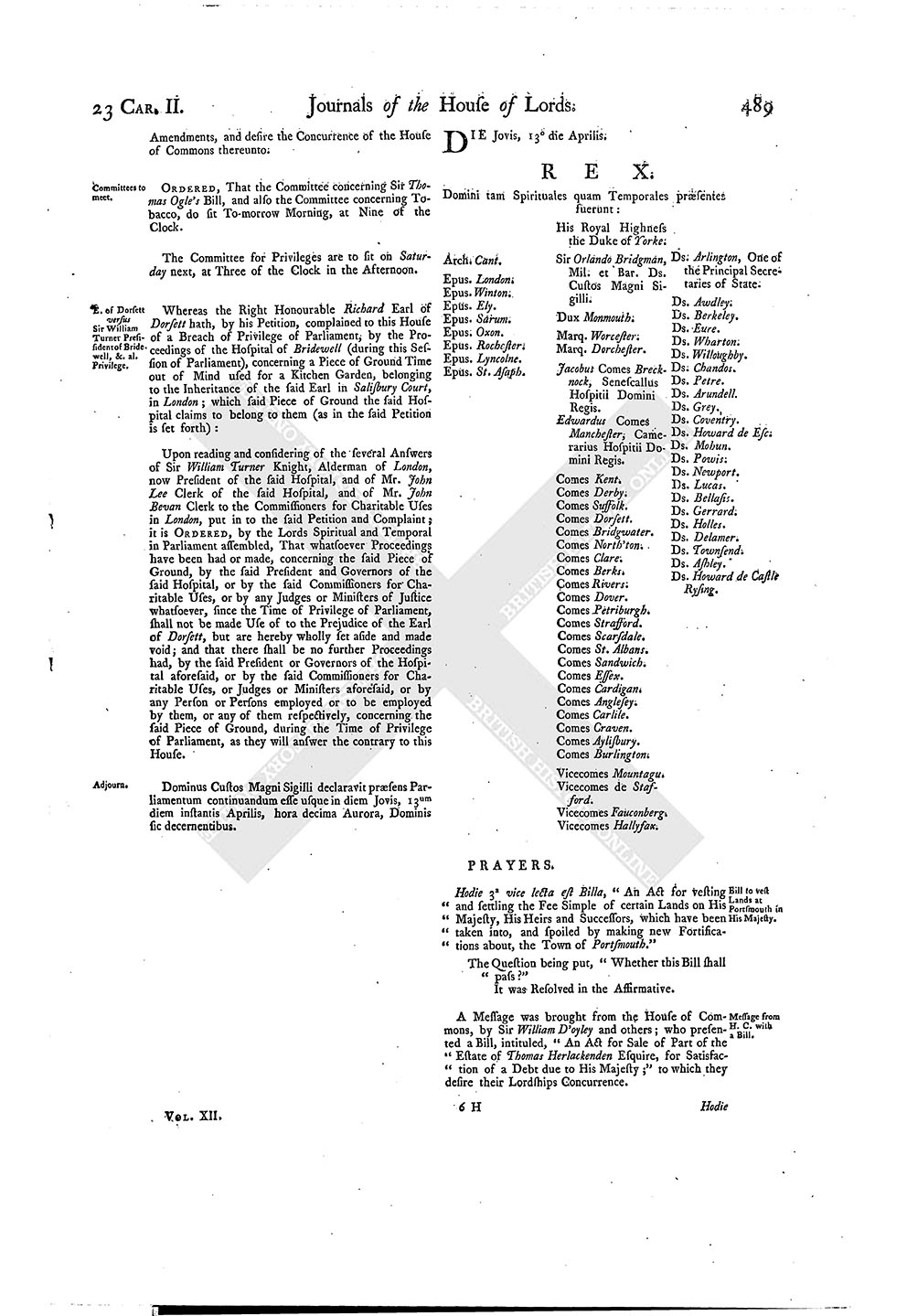
ORDERED, That the Committee concerning Sir Thomas Ogle's Bill, and also the Committee concerning Tobacco, do sit To-morrow Morning, at Nine of the Clock.
The Committee for Privileges are to sit on Saturday next, at Three of the Clock in the Afternoon.
E. of Dorsett versus Sir William Turner President of Bridewell, & al. Privilege.
Whereas the Right Honourable Richard Earl of Dorsett hath, by his Petition, complained to this House of a Breach of Privilege of Parliament, by the Proceedings of the Hospital of Bridewell (during this Session of Parliament), concerning a Piece of Ground Time out of Mind used for a Kitchen Garden, belonging to the Inheritance of the said Earl in Salisbury Court, in London; which said Piece of Ground the said Hospital claims to belong to them (as in the said Petition is set forth):
Upon reading and considering of the several Answers of Sir William Turner Knight, Alderman of London, now President of the said Hospital, and of Mr. John Lee Clerk of the said Hospital, and of Mr. John Bevan Clerk to the Commissioners for Charitable Uses in London, put in to the said Petition and Complaint; it is ORDERED, by the Lords Spiritual and Temporal in Parliament assembled, That whatsoever Proceedings have been had or made, concerning the said Piece of Ground, by the said President and Governors of the said Hospital, or by the said Commissioners for Charitable Uses, or by any Judges or Ministers of Justice whatsoever, since the Time of Privilege of Parliament, shall not be made Use of to the Prejudice of the Earl of Dorsett, but are hereby wholly set aside and made void; and that there shall be no further Proceedings had, by the said President or Governors of the Hospital aforesaid, or by the said Commissioners for Charitable Uses, or Judges or Ministers aforesaid, or by any Person or Persons employed or to be employed by them, or any of them respectively, concerning the said Piece of Ground, during the Time of Privilege of Parliament, as they will answer the contrary to this House.
Adjourn.
Dominus Custos Magni Sigilli declaravit præsens Parliamentum continuandum esse usque in diem Jovis, 13um diem instantis Aprilis, hora decima Aurora, Dominis sic decernentibus.