A History of the County of Lancaster: Volume 3. Originally published by Victoria County History, London, 1907.
This free content was digitised by double rekeying. All rights reserved.
'The parish of Warrington: Introduction, church and charities', in A History of the County of Lancaster: Volume 3, ed. William Farrer, J Brownbill (London, 1907), British History Online https://www.british-history.ac.uk/vch/lancs/vol3/pp304-316 [accessed 30 April 2025].
'The parish of Warrington: Introduction, church and charities', in A History of the County of Lancaster: Volume 3. Edited by William Farrer, J Brownbill (London, 1907), British History Online, accessed April 30, 2025, https://www.british-history.ac.uk/vch/lancs/vol3/pp304-316.
"The parish of Warrington: Introduction, church and charities". A History of the County of Lancaster: Volume 3. Ed. William Farrer, J Brownbill (London, 1907), British History Online. Web. 30 April 2025. https://www.british-history.ac.uk/vch/lancs/vol3/pp304-316.
In this section
WARRINGTON
The ancient parish of Warrington lies along the northern bank of the Mersey between Sankey Brook and Glazebrook; the township of Burtonwood, however, lies to the north-west of this area, on the western side of the Sankey. The total area is 12,954 acres, and the population numbered 69,339 in 1901. (fn. 1) The surface is level and lies low. From Penketh on the west to Glazebrook on the east, the geological formation consists wholly of the new red sandstone or trias, and mainly of the upper mottled sandstone of the bunter series of that formation. In Great Sankey and Burtonwood the pebble beds of the same series occur, and in Rixton-withGlazebrook the keuper series, owing to the effect of a fault running from south-east to north-west through the township. The soil is loamy and fertile, and the neighbourhood has long been famous for potatoes and other vegetables. (fn. 2)
For the county lay, fixed in 1624, each of the four townships paid equally, this parish contributing £6 5s. when the hundred gave £100. (fn. 3) To the ancient fifteenth Warrington itself paid £2 12s. 8d., Burtonwood 18s. 4d., Woolston-with-Poulton £1 2s. 8d., Rixton £1 2s. 4d., and Glazebrook 8s., making £6 3s. 8d. (fn. 4)
The history of the parish is largely that of the town of Warrington. This place is supposed to have been of British origin. Two Roman roads, from the south and from Chester, (fn. 5) met at Latchford on the south bank of the Mersey, near which point considerable discoveries have been made; crossing probably at this ford, the north road was continued through Warrington to Winwick and Wigan. (fn. 6) Sometime before the Norman Conquest Warrington became the head of a hundred.
Afterwards the lordship was divided. Warrington and Rixton seem to have been original parts of the Warrington barony, created early in the twelfth century, and long held by Pain de Vilers and his descendants the Boteler family. Woolston, Poulton, and Burtonwood were retained by the lords of the district 'between Ribble and Mersey,' the two former in time becoming part of the fee of Makerfield, and Burtonwood being added to the fee of Warrington. The lords of Warrington established their residence or castle at the mote hill, (fn. 7) from which the town spread westward along the road to Prescot. (fn. 8) A bridge was built, (fn. 9) perhaps early in the thirteenth century, and this soon became one of the principal means of communication between the north and south of England. The street leading north from it was called the Newgate as late as 1465. Near the bridge, on the west side of Newgate, was a house of Austin Friars, and at the point where this new street crossed the old road to Prescot a market was established about 1260. (fn. 10) The town gradually increased round this point, and in time the parish church, at the extreme east end, became somewhat isolated; the change was no doubt assisted by the removal of the lord's residence from the mote hill to Bewsey in Burtonwood. (fn. 11)
A borough was created about 1230, but its growing strength appears to have alarmed the lord, who contrived to repress it before 1300, granting certain privileges to the free tenants as compensation; and the town remained under the authority of the lords of the manor until the beginning of last century. A survey of the portion belonging to Sir Peter Legh in 1465 has been printed; (fn. 12) this shows that the houses had extended from the church westward as far as the market, and a little way along Sankey Street; also south from the crossing down Newgate to 'the place where the bridge formerly stood.' Other streets, north and south of Church Street, are mentioned; on the north side of the market-place was a row of houses called Pratt Row; their long back gardens touched the great heath, (fn. 13) on which stood a windmill. Across the heath the main road led north by Longford to Winwick, but there was a branch to Bewsey. To the south of the town were the great meadows of Howley and Arpley. The water-mills were on Sankey Brook. The visit of Henry VII to Lathom in 1495 induced the earl of Derby to rebuild the bridge and provide for its maintenance. (fn. 14)
Leland about 1535 thus records his impressions: 'Warrington, a paved town; one church (and) a Freres Augustine at the bridge end. The town is of a pretty bigness. The parish church is at the tail of all the town. It is a better market than Manchester.' (fn. 15)
The Reformation was here received as elsewhere in the district. The chantries were suppressed and the services of the parish church altered; but the grammar school, founded in 1526, was preserved. A lease of the rectory made in 1544 reduced the rector's stipend to £20, at which sum it remained for 200 years. The Butlers conformed to the Elizabethan order in religion, (fn. 16) but this did not stave off their ruin; their successors, the Irelands, were also Protestants. Most of the gentry remained attached to the Roman Catholic religion; and Woolston and Rixton provided refuges for the missionary priests in the times of persecution. How the townsmen of Warrington were affected is not so clear. After the Restoration congregations of Presbyterians and Quakers were formed, and have continued to the present. James I visited Sir Thomas Ireland at Bewsey in 1617 (fn. 17) in his progress from Scotland southwards.
The Civil War necessarily affected Warrington through the town's situation on the road to the north, which made it 'the principal key of Lancashire.' Hitherto the people of the district had known of war only at a distance, (fn. 18) now they had personal experience of it. The earl of Derby in September, 1642, marched through the town with 4,000 men for his futile attack on Manchester; (fn. 19) and at the end of November he was stationed at Warrington, which he made a garrison, in order to secure the passage of the Mersey. (fn. 20)
Sir William Brereton was defeated on 3 April, 1643, at Stockton Heath when advancing to attack Warrington. (fn. 21) Sir William afterwards crossed the Mersey and attacked the town from the west; but Lord Derby began to set the town on fire, on which the parliamentary forces desisted. (fn. 22) Colonel Edward Norris, eldest son of the lord of Speke, was left in command of the king's garrison. He was attacked on 22 May by Sir William Brereton, and after six days' siege gave up the town, leaving arms, ammunition, and provisions behind. On Trinity Sunday, 28 May, Sir George Booth, a parliamentary commander, and lord of the manor, made a formal entry into the town, and was received by the people with the usual tokens of joy. (fn. 23) The townspeople were treated with great leniency by the victors. (fn. 24)
The next five years were uneventful, but the duke of Hamilton's Scottish force on being defeated at Winwick 19 August, 1648, retreated to Warrington, where 4,000 surrendered upon quarter for life—arms, ammunition, and horses being relinquished. (fn. 25) There were skirmishes near the town in 1651 when Charles II with the Scottish army forced the bridge on their march to Worcester, (fn. 26) and in August, 1659, part of Sir George Booth's troops, after their defeat at Winnington, surrendered at Warrington to the parliamentary garrison. (fn. 27)
The rising of 1745 occasioned the partial destruction of the bridge in order to prevent the Young Pretender from crossing the Mersey there. Some Highlanders are said to have been captured near Rixton, at which point the duke of Cumberland crossed the Mersey in his pursuit. (fn. 28) In 1798 a body of volunteers was raised, on threats of a French invasion, but their only active service was in suppressing a riot in Bridge Street in 1799. (fn. 29) In 1859 a corps of volunteers was formed; it is now known as the 1st V.B. Prince of Wales Volunteers (South Lancashire Regiment).
In 1693 an inquiry was held at Warrington as to certain lands and moneys devoted to 'superstitious uses,' Lord Molyneux, Sir William Gerard of Ashton, William Standish of Woolston, and other gentlemen of the neighbourhood having been reported to the government as holders of money or lands for the use of the Jesuits, Franciscans, or secular clergy. (fn. 30)
The prosperity of the town does not seem to have been affected by the Civil War or later troubles. (fn. 31) In 1673 it was thus described: 'Warrington is seated on the River Mersey, over which there is a curious stone bridge, which leadeth to Cheshire. It is a very fine and large town, which hath a considerable market on Wednesdays for linen cloth, corn, cattle, provisions, and fish, being much resorted to by the Welshmen, and is of note for its lampreys.' (fn. 32)
Dr. Kuerden, who passed through the town about 1695, recorded his passing the Mersey 'over a fair stone bridge of four arches,' and 'through the Market Gate to the height of the market'; then 'keeping the road northward over the common at a distance of about half a mile stands a spacious hall or mansion called Bradshaw. . . . You meet with two roads, one leading to Bewsey Hall on the left, and that on the right towards a fair hall with a spacious garden and orchard belonging to Mr. Jonathan Blackburne, justice of the peace.' Then he crossed the Orford Brook by 'an arched bridge of stone,' and through 'a plashy way' to Hulme. (fn. 33)
About 1730 Warrington looked 'a large, populous, old built town, but rich, and full of good country tradesmen. Here is particularly a weekly market for linen . . . a sort of table linen called Huk-a-back or Huk-a-buk.' The writer adds: 'I was told there are generally as many pieces of this linen sold here every market-day as amount to £500 value, sometimes much more, and all made in the neighbourhood of the place.' (fn. 34)
Judge Curwen in 1777 was less complimentary: 'Streets narrow, dirty, and ill-paved; like many other towns, with a gutter running through the middle, rendering it inconvenient passing the streets. This town abounds in dissenters, and has an academy for young preachers of that persuasion.' (fn. 35)
The most notable institution in the modern history of the town was the Academy just referred to, founded in 1757 for the education of candidates for the ministry among the Protestant Nonconformists. It endured for nearly thirty years, when, owing chiefly to internal dissensions, it was dissolved, a similar institution at Manchester (the 'ancestor' of Manchester College, Oxford) replacing it in 1786. John Seddon, minister of the Presbyterian congregation, was its projector; among the tutors were John Taylor, Joseph Priestley, F.R.S.; John Aikin, sen.; Reinhold Forster, William Enfield, George Walker, F.R.S.; Gilbert Wakefield, Nicholas Clayton, Pendlebury Houghton, and John Holt. Most of these have a place in the Dictionary of National Biography. (fn. 36) Thomas Barnes, president of the Academy after its transference to Manchester, was a native of Warrington. (fn. 37)
Among other natives or residents calling for some notice were the Ven. James Bell, a Marian priest executed at Lancaster in 1584; (fn. 38) Charles Owen, a resident Presbyterian minister; (fn. 39) Edward Evanson, an Anglican divine who became heterodox; (fn. 40) John Macgowan, a baker and satirist. Thomas Percival, a physician, founder of the Manchester Literary and Philosophical Society, was born at Warrington in 1740. (fn. 41) Peter Litherland, the inventor of the lever watch, was a Warrington man; and John Harrison, of chronometer fame, resided in this town. Samuel Fothergill (1715–72), a Quaker minister, brother of Dr. John Fothergill, resided here. (fn. 42) John Blackburne of Orford and Anna his daughter were famous for their studies of plants and birds. Michael Adrian Hankinson, O.S.B., became bishop of Port Louis, Mauritius. (fn. 43) Among artists Hamlet Winstanley, a painter of note, who died in 1756; (fn. 44) and John Warrington Wood, a sculptor, who died in 1886, were natives.
In addition, many others might be named, as William Beamont of Orford, the indefatigable local historian, who died in 1889. His son, the Rev. William John Beamont, the two Kendricks, John Fitchett, Thomas Kirkland Glazebrook, George Crosfield, William Wilson, John Fitchett Marsh, and Peter Rylands have found places in the Dictionary of National Biography. (fn. 45)
The printing press was not regularly established until the eighteenth century. The first newspaper, the Warrington Advertiser, was published here in 1756, but soon ceased. It was issued from the Eyres Press, which had been at work since 1731. (fn. 46) A recent paper called the Advertiser was issued from 1862 to 1889. The Warrington Guardian (now issued twice a week) was established in 1853; the Examiner, founded in 1875, and the Observer in 1888, (fn. 47) are weekly papers. The Review is also published weekly.
The river was formerly the great means of communication with Liverpool, (fn. 48) and was improved by the Mersey and Irwell Navigation; (fn. 49) 'the communication between Manchester and Liverpool' by its means was, in 1825, described as 'incessant; the brickdustcoloured sails of the barges are seen every hour of the day on their passage, flickering in the wind.' The first stage-coach (fn. 50) in the county issued from this town, according to the same authority, and 'between sixty and seventy coaches on an average passed through Warrington every day, and the principal streets were kept by them in a state of perpetual animation.' (fn. 51)
The fishery was formerly a valuable one. In 1825 it belonged to John Arthur Borron and Edward Pemberton, but by that time it had ceased to be of much importance. (fn. 52)
The agricultural land in the parish is now occupied as follows: Arable land, 7,635 acres; permanent grass, 1,546; woods and plantations, 164. (fn. 53)
CHURCH
The church of St. Elphin stood till after the middle of the last century at the extreme east end of the town of Warrington, but has since become surrounded by houses. The churchyard is of irregular shape, the longest dimension being from north to south. The fabric of the church has in the last two centuries undergone many changes and reconstructions, and retains nothing of mediaeval date except the chancel. The site is undoubtedly one of great antiquity, but the oldest work that has been found belongs to the latter part of the twelfth century; a series of small capitals of this date, found during the rebuilding of the nave, being preserved in Warrington Museum.
The present building consists of chancel with south vestry, central tower and transepts, and nave with north and south aisles.
The chancel of three bays is recorded to have been built in 1354, and its details agree well with the date. In common with the rest of the church it is entirely faced with red sandstone ashlar. It has an east window of five trefoiled lights with flowing tracery, and on each of the north and south sides three three-light tracery windows of similar style, those in the western bay being modern. The original windows in this bay were destroyed by a fall of part of the tower some fifty years since. Beneath the eastern bay is a contemporary crypt, vaulted in two bays with a modern ribbed vault springing from old corbels, and lighted by two two-light windows on the east, and one each on the north and south. It is approached by stairs on north and south, but only the stair on the north is ancient. This is contained in a broad buttress, and leads down from the chancel to the crypt, and formerly led upwards from the chancel to the roof, though this part of it is now broken away. The buttress in which it is contained dies into the wall before reaching the top, the upper part being modern. The door from the chancel to the stair is modern, but replaces an original doorway which stood a little farther to the west, and after having been hidden by panelling for a long time was rediscovered in 1824. Before this date the crypt had been inaccessible, probably for some centuries, as it had never had an entrance from the churchyard, and had also at some time been filled in with earth, and the crown of its vault destroyed, in order to lower the level of the floor at the east end of the chancel. The window in the buttress which lights the stair is modern, and the west jamb of an older window is to be seen close to it. The doorway at the foot of the stair, opening to the crypt, is also modern, but occupies the site of the original entrance. It seems unlikely that the crypt has ever contained an altar, and as the sills of its two east windows were originally carried down to the floor level, it may have been a charnel, and it is to be noted that many bones were found in it when it was cleared out. But against this must be set the fact that it is unusually well lighted for such a purpose, and it is possible that it was intended for a vestry. Under the second window on the south side of the chancel is an original doorway, once external, but now opening into a vestry built about 1740; it is designed for a door opening inwards, but the present door opens towards the vestry, to the detriment of the mouldings of the outer arch.
The central tower dates from 1860, and is carried on four moulded arches of fourteenth-century style. There are two two-light belfry windows in each face, with crocketed gabled hood-moulds, and above them a pierced and panelled parapet with angle pinnacles, and a tall stone spire with three tiers of spire-lights, the total height being 281 ft. The former central tower is recorded to have been built in 1698 in place of an older one damaged in the Civil Wars, but it is not clear whether the older tower was taken down to the ground or not. Sir Stephen Glynne, (fn. 54) describing the church in 1843, says that the tower arches are part of the original structure, and have continuous mouldings of great depth, and that there is stone groining under the tower with strong ribs. This points to the fact that the upper part only of the tower was rebuilt in 1698, and extant views seem to confirm this. It had an embattled parapet with pinnacles, and large belfry windows, in poor Gothic style, with labels and large dripstones, four of which, representing a lion, a griffin, a dog, and a swan, are preserved in the Warrington Museum.
The north transept, or Boteler chapel, in which was the Lady altar, was rebuilt in 1860. It contained work of the fourteenth century, as the two arched tombrecesses in its north walls appear to be copied from former recesses of this date, and retain carved corbels of c. 1320. The windows were of fifteenth-century style, that in the east wall having five lights.
The south transept, or Mascy chapel, was perhaps originally of the same date as the north transept, but underwent several alterations before the final rebuilding in 1860. It seems to have had an altar of St. Anne, and a chantry was founded in it by Richard Delves, rector, in 1486. In 1723 the Patten chapel was built, adjoining it on the west, and this, after being rebuilt in 1773, was pulled down together with the transept in 1860, and rebuilt in its present form.
The nave and north aisle date from 1860, and replace a nave built in 1770, which had no arcades, and being designed for galleries, had two tiers of windows on north and south. A south aisle was added in 1835, of the width of the south transept, apparently by the process of removing the south wall of the nave of 1770 to its present position, and refacing the south end of the Patten chapel to correspond with it. The upper tier of windows is in a pseudo-Gothic style, evidently intended to harmonize with the fourteenth-century windows of the chancel, and the south doorway has a clumsy ogee head, on which is cut 'Rebuilt 1770.'
The present west front of the church has three gables flanked by pinnacles, with a large tracery window of seven lights in the central gable.
The earlier history of the development of the church is difficult to read on account of the rebuildings of the last few centuries, but something may be deduced from old illustrations and the copy of a small plan of 1628, unfortunately not drawn to scale, which was formerly among the church papers. From these it may be seen that the old tower was narrower than the transepts, the line of its west wall being eastward of that of the transepts. The mediaeval nave certainly had arcades, and consequently aisles, as foundations of the former were discovered in 1860, not being in line with the north and south arches of the tower, but further to the north and south, like the present arcades. The tower arches appear to have been of the fourteenth century, and perhaps coeval with the chancel, which is of the same width north to south as the tower.
These irregularities, and the evidence of the existence of work in the north transept of earlier date than the rebuilding of the chancel, 1354, go to show that the church was not completely rebuilt at the latter date, but followed a gradual process of development, after the usual fashion, having originally consisted of an aisleless nave and chancel, which was afterwards made into a cross church, the tower being built on the west part of the chancel.
The traces of ritual arrangements in the church are naturally scanty. In the south wall of the chancel are three sedilia and a piscina, with ogee arched heads and trefoiled spandrels under a horizontal string, poor modern work of wood and plaster, but in the old position. Parts of the old masonry remain at the backs of the recesses, which have been altered since Sir Stephen Glynne's visit in 1843, and do not at all correspond to his description. There is no ancient woodwork in the church, but the altar table in the Boteler chapel was given to the church in 1720. In this chapel is a fine alabaster altar tomb, on which are the effigies of Sir John Boteler, ob. 1463, and his wife Margaret. The tomb was taken to pieces in 1847, and when it was reset the east end was made up in plaster. On the other three sides are a row of canopies alternating with shields now blank, and under the canopies are alabaster figures or groups: on the north side, St. James, St. Michael, St. Christopher, St. George, St. John Baptist, and the Holy Trinity; on the west a Crucifixion with our Lady and St. John, an angel holding a shield, and an Assumption; and on the south St. Faith, our Lord's Pity, St. Barbara, St. Catherine, St. Margaret, and our Lady and Child. The figure of Sir John Boteler is armed in plate, but the arm defences, except the elbow-cops and gauntlets, appear to be of leather. He wears a collar of St. George, and holds his right gauntlet in the left hand, while his bare right hand clasps that of his wife. She wears a collar of St. Agnes, and has a lamb at her feet. (fn. 55)
In one of the arched recesses in the north wall of this chapel is the sandstone effigy of a lady of late fourteenth-century date. In the floor of the Patten chapel is a cross slab formerly covering the grave of Thomas Mascy, rector, who died in 1464, and close to it is a modern altar tomb with the white marble effigy of the late Lord Winmarleigh.
On the north side of the chancel, opposite the south doorway, formerly stood the tomb of Richard Delves, rector, 1527.
The font is modern.
There are eight bells, all cast by Henry Bagley of Ecton in 1698. (fn. 56)
The church possesses a fine secular standing cup and cover, silver-gilt, with the London date letter for 1615.
The registers begin in 1591.
ADVOWSON
Before the Conquest the church of St. Elphin had a plough-land in Warrington free from all imposts except the geld. (fn. 57) The patronage, except for a grant to Thurgarton Priory about 1160, which was a century later granted back, (fn. 58) remained with the lords of Warrington to the latter half of the sixteenth century, when it passed by sale to the Irelands of Bewsey, and has descended like Bewsey and Great Sankey to Lord Lilford, the present patron. (fn. 59)
In 1291 the value of the benefice was found to be £13 6s. 8d; (fn. 60) and fifty years later the ninth of the sheaves, wool, and lambs was estimated at twenty marks, i.e. the same sum. (fn. 61) The gross value in 1535 was £41 15s. 4d., of which the glebe brought in 16s. 8d.; the payments included one of 20s. to the abbot of Shrewsbury, and the net value was £40. (fn. 62) The Commonwealth surveyors in 1650 found that the tithes, valued at £150, were farmed by Gilbert Ireland, who allowed the rector £20 a year; (fn. 63) this was increased by an allowance of £50 a year out of the sequestered tithes of Childwall, (fn. 64) reduced later. (fn. 65) Bishop Gastrell in 1717 found the income to be £61 18s. 3d. (fn. 66) At present the gross value is stated to be £965. (fn. 67)
Warrington was from early times the head of a deanery comprising the parishes in West Derby hundred. (fn. 68) In 1535 the revenue of the dean was estimated at £15 11s. 11d. (fn. 69)
The following is a list of the rectors:—
| Date | Name | Patron | Cause of Vacancy | |
| c. | 1180 | Richard (fn. 70) | — | — |
| c. | 1220 | James (fn. 71) | — | — |
| c. | 1250 | Jordan de Hulton (fn. 72) | — | — |
| c. | 1265 | William de Eybury (fn. 73) | — | — |
| oc. | 1289 | William le Boteler (fn. 74) | — | — |
| (?) Feb. 1298–9 | William de Sankey (fn. 75) | — | — | |
| 24 Nov. 1325 | Stephen le Blund (fn. 76) | Sir W. le Boteler | res. W. de Sankey | |
| 3 April, 1330 | Robert de Houton (fn. 77) | — | exch. S. le Blund | |
| 10 June, 1343 | John de Luyton (fn. 78) | Sir W. le Boteler | d. R. de Houton | |
| 1 June, 1346 | John de Stamfordham (fn. 79) | — | exch. J. de Luyton | |
| 10 May, 1351 | Nicholas de Waddington (fn. 80) | Sir W. le Boteler | d. J. de Stamfordham | |
| 22 June, 1357 | John de Swinlegh (fn. 81) | — | exc. N. de Waddington | |
| 13 Jan. 1361–2 | John de Donne (fn. 82) | John earl of Lancaster | res. J. de Swinlegh | |
| (?) Dec. 1367 | John Parr, senior (fn. 83) | Urban V | — | |
| 5 June, 1368 | Ellis de Birtwisle (fn. 84) | John duke of Lancaster | res. John Parr | |
| 4 April, 1370 | ||||
| 17 May, 1374 | Robert de Sibthorpe (fn. 85) | Sir William le Boteler and Sir John his son | d. Ellis de Birtwisle | |
| (?) 1374 | William (de Burgh) (fn. 86) | John duke of Lancaster | " | |
| 20 Mar. 1390–1 | Richard de Carleton (fn. 87) | Sir John le Boteler | — | |
| 21 Aug. 1396 | Richard le Walker (fn. 88) | " | d. R. de Carleton | |
| 27 April, 1435 | Thomas Mascy (fn. 89) | Hamlet Mascy, &c. | d. R. le Walker | |
| 4 July, 1464 | Thomas Neilson (fn. 90) | Richard Browne, &c. | — | |
| 18 May, 1466 | Thomas Byrom (fn. 91) | " | res. T. Neilson | |
| 7 Sept. 1476 | Mr. James Stanley (fn. 92) | John Holcroft | d. T. Byrom | |
| — | Hugh Reddish | — | — | |
| 16 June, 1486 | Richard Delves (fn. 93) | T. Boteler | res. Hugh Reddish | |
| 6 Dec. 1527 | Thomas Maria Wingfield (fn. 94) | H. Wingfield, &c. | d. R. Delves | |
| 8 Nov. 1537 | Edward Keble, M.A. (fn. 95) | Sir T. Boteler | res. T. M. Wingfield | |
| 20 Nov. 1554 | Nicholas Taylor (fn. 96) | John Grimsditch and Richard Penketh | depr. E. Keble | |
| 31 Dec. 1556 | Thomas Amery (fn. 97) | — | d. N. Taylor | |
| 24 April, 1574 | John Butler (fn. 98) | Thos. Butler | — | |
| 26 Nov. 1579 | Simon Harward, M.A. (fn. 99) | Edward Butler | d. J. Butler | |
| 4 July, 1581 | Michael Johnson, B.A. (fn. 100) | Sir Hen. Scurwen | — | |
| 3 June, 1589 | John Ashworth (fn. 101) | Thos. Ireland | — | |
| 1 Mar. 1607–8 | William Gillibrand (fn. 102) | " | d. J. Ashworth | |
| 29 May, 1621 | William Ward (fn. 103) | Sir T. Ireland | d. W. Gillibrand | |
| oc. | 1646 | James Smith (fn. 104) | " | res. W. Ward |
| — Dec. 1646 | Robert Yates (fn. 105) | Gilbert Ireland | " | |
| 17 Jan. 1662–3 | Samuel Ellison (fn. 106) | Sir G. Ireland | exp. R. Yates | |
| 4 Oct. 1664 | Joseph Ward, B.A. (fn. 107) | " | — | |
| 10 Jan. 1690–1 | Samuel Shawe, M.A. (fn. 108) | James Holt | d. J. Ward | |
| 22 Jan. 1718–9 | Thomas Egerton, M.A. (fn. 109) | Ric. Atherton | d. S. Shawe | |
| 21 June, 1723 | John Haddon, M.A. (fn. 110) | " | res. T. Egerton | |
| 27 Dec. 1766 | William Farington, B.D. (fn. 111) | R. V. A. Gwillym. | d. J. Haddon | |
| 14 Sept. 1767 | Edward Owen, M.A. (fn. 112) | " | d. W. Farington | |
| 3 June, 1807 | Robert Atherton Rawstorne, M.A. (fn. 113) | Lord Lilford | d. E. Owen | |
| 3 Jan. 1832 | Hon. Horatio Powys, M.A. (fn. 114) | " | res. R. A. Rawstorne | |
| 2 Sept. 1854 | William Quekett, M.A. (fn. 115) | The Queen | prom. Bp. Powys | |
| 20 May, 1888 | Frederic William Willis, M.A. (fn. 116) | Lord Lilford | d. W. Quekett | |
The most noticeable feature of the above list is the rapidity of the succession in many periods. About 1360 the title appears to have been uncertain. The lease of 1534 having reduced the income from tithes to £20 a year for two centuries, Warrington was not as a benefice very attractive.
The commissioners of 1535 found a rector and four endowed chantry priests serving the church; one of these also taught the school, and another served the chantry at Hollinfare. (fn. 117) The clergy list of 1541–2 shows that besides the rector, probably non-resident, and the four cantarists, there were in the parish eight priests, one of them being the curate, and the others paid by private persons or living on casual fees and offerings; two of them seem to have removed soon afterwards. (fn. 118) The visitation list of 1548 records the names of the rector and eight other clergy, four being chantry priests; two died about the same time. Six years later the rector, just deprived, is not named; six names are recorded, two of the bearers, however, appear to have been absent; the four chantry priests were still living, though unemployed. The diminution in the number of clergy went steadily on at Warrington; in 1562 the rector Thomas Amery, his curate, and two others were named in the list; but one of the latter did not appear. The rector, appointed in Bishop Cotes's time, had thus conformed to the Elizabethan statutes, and continued to hold his benefice. In the following year five names appear, two of them being new. In the margin is the record—'They took oath according to the statute,' i.e. acknowledging the queen's supremacy, the formal act of separation from the ancient system. (fn. 119) One of the five, John Barber, curate of Rixton, appears to have repented quickly, a note stating that he had 'fled.' In 1565 the rector and two others appeared; these two were survivors of the 1548 clergy, one being the schoolmaster. (fn. 120)
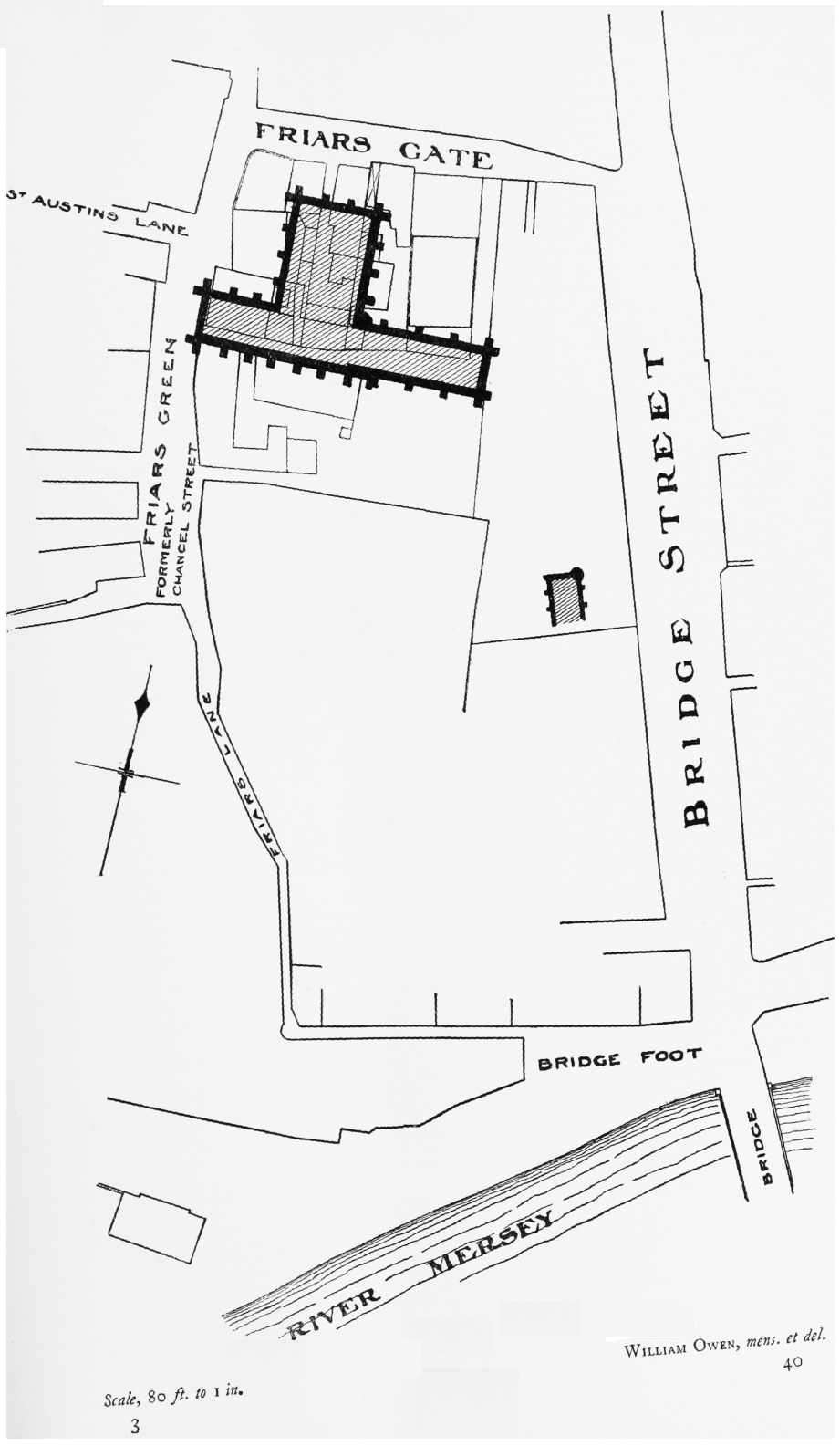
Block Plan of Site of Augustinian Friary, Warrington
Warrington thus fared better than other parishes in the neighbourhood in maintaining a staff of three clergy, there being only one chapel to serve in addition to the parish church. The school stipend was, of course, a means of supporting one beside the rector. At Hollinfare chapel the new services were probably not kept up regularly. As to the parish church the visitation of 1592 showed that the chancel was 'in great decay'; there were wanting Bible, Communion Book, Jewell's Reply and Apology, a 'comely table covering and table cloth,' and surplice. (fn. 121) An improvement no doubt took place as time went on, the Stuart bishops and the puritan ministers of the seventeenth century bringing it about. The later rectors, with one or two exceptions, do not call for remark. (fn. 122)
There were three chantries established in the parish church, and another at Hollinfare. St. Mary's Chantry was endowed or re-endowed by Sir Thomas Boteler, apparently the Sir Thomas who died in 1522. (fn. 123) By his will, carried out by his son Sir Thomas, he founded also the grammar school, the master of which was the priest at a second chantry. (fn. 124) Richard Delves, rector from 1486 to 1527, founded the chantry at the altar of St. Anne. (fn. 125) The chantries were suppressed in 1548, but the school was preserved. (fn. 126)
A house of Austin Friars, the only one in the county, was established near the bridge. (fn. 127) Its church, the Jesus Church, was probably the popular one, being situated near the centre of the town. The friars had an oratory on the bridge. The property was confiscated by Henry VIII and granted to Sir Thomas Holcroft. (fn. 128) Nothing now remains of the buildings. (fn. 129) It is supposed that the church was used for worship, at least occasionally, down to the Civil Wars. (fn. 130)
The site of the house was partly explored in 1886, and from the remains then found a plan of the church was drawn up by Mr. William Owen. (fn. 131) It shows a quire 58 ft. long by 24 ft. wide, an oblong crossing typical of a friars' church, with screens to east and west, a nave 86 ft. by 27 ft., and a very large north transept 62 ft. by 44 ft. The evidence for some part of the plan is slight, but there seems no doubt that Mr. Owen is correct in his reading of it, which has been confirmed, as to the size of the transept, by recent excavations. The details point to c. 1280 for the earliest work, and the large north transept seems to be little, if at all, later than the rest of the building. The crossing was doubtless surmounted by an octagonal tower as in other friars' houses. Part of the tile pavement of the quire was uncovered, and is illustrated in Mr. Owen's paper, being a very good specimen of its kind, dating probably from the early years of the fourteenth century. The shaped tiles of the central panel are specially interesting, though not so elaborate as those in the well-known Crauden chapel at Ely. Part of this pavement was taken up and is preserved in the Warrington Museum. Of other parts of the friary nothing has been found except the north end of a buttressed building south-east of the church and about 120 yards distant from it. It is 15 ft. wide, but its length and purpose cannot at present be determined.
CHARITIES (fn. 132)
The principal charity of Warrington, apart from the grammar school (fn. 133) and the bluecoat school, (fn. 134) is the infirmary, with an income of nearly £740 a year from investments. (fn. 135) Of the minor charities some are for Warrington proper (fn. 136) and others for different townships of the parish—Burtonwood, (fn. 137) Rixton, (fn. 138) and Woolston; (fn. 139) that for Poulton has been lost. (fn. 140)

Plan of Church of Augustinian Friary, Warrington
The Warrington Clergy Institution for the relief of widows and orphans of clergymen in the old archdeaconry of Chester, which included Cheshire and South Lancashire, was founded in 1697, and still continues its benevolent work. In conjunction with it is a school for the orphan daughters of clergymen, founded in 1842; the buildings were erected on the site of the old mote hill, but the school was removed to Darley Dale, Derbyshire, in 1905. There is a training college for schoolmistresses in connexion with the Established Church.