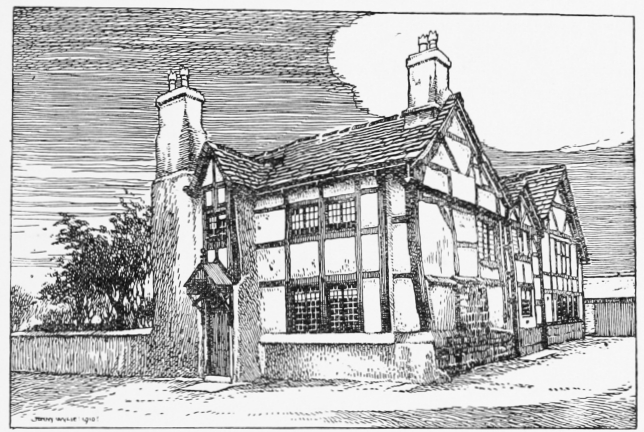
| 1 |
1,299 acres, including 7 of inland
water; Census Rep. 1901. |
| 2 |
An outburst of this moss took place
in Jan. 1633–4; Hist. MSS. Com. Rep.
xii, App. ii, 43. |
| 3 |
Watkin, Roman Lancs. 57. |
| 4 |
E. Butterworth, Chron. Hist. of Manch.
22. |
| 5 |
Subs. R. bdle. 250, no. 9. The chief
houses were those of James Lightbowne's
executors, with nine hearths; Samuel Sandford, eight, and Francis Chetham, seven. |
| 6 |
a Ward, Moston Characters at Play;
C. Roeder, 'Moston Folk Lore' in Lancs.
and Ches. Antiq. Soc. xxv.; E. Waugh,
Sketches of Lancs. Life. |
| 7 |
Mamecestre (Chet. Soc.), ii, 281. The
lord of Moston was hopper-free and paid
one-twentieth as toll instead of one-sixteenth. The tithes in later times were
paid to the college at Manchester.
The lords of Manchester had little to
do with Moston, but in 1418 Thomas
Lord La Warre granted to his feoffees a
messuage and lands in Moston called
Brideshagh next Boukerlegh, lately held
by Thomas le Bouker; the bounds began
at the south at the gate in the side of the
lane leading from the common pasture of
Theale Moor to Manchester, passing the
holding of Robert Shacklock, and the
bounds of Theale Moor and Blackley;
Chan. Inq. p.m. 5 Hen. VI, no. 54. In
1322 Brideshagh seems to be reckoned as
part of Crumpsall; Mamecestre, ii, 363. |
| 8 |
In charters of 1340 and 1356 quoted
below. In 1569–70 an agreement was
made between the parish of Ashton and
the people of Moston, according to which
Moston was taxed with Ashton, paying
an eighth of the sum to be raised; Clowes
D. In the subsidies of 1541 and 1622
also Moston is joined with Ashton; Misc.
(Rec. Soc. Lancs. and Ches.), i, 144, 155. |
| 9 |
a Lancs. Inq. and Extents (Rec. Soc.
Lancs. and Ches.), i, 57. |
| 10 |
b Final Conc. (Rec. Soc. Lancs. and
Ches.), iii, 172. Robert (or Roger) son of
Orm de Ashton is stated to have given
land at Nuthurst to Cockersand; Booker,
Blackley, 135 (quoting Kuerden fol. MS.
214). In 1473 Sir John Ashton held
'Alt' Moston'—either 'the other Moston'
or Alt (and) Moston; Mamecestre, iii,
483. |
| 11 |
He was possibly one of the unnamed
heirs of Orm in 1212, or may have obtained it from Robert son of Bernard. |
| 12 |
Clowes D. no. 162. By it William
de Eccles, clerk, granted to Geoffrey son
of Richard de Trafford all the land of Nuthurst, received by Thomas, the grantor's
brother, from Sir Henry de Chetham; 13d.
rent was payable to Sir Geoffrey de Chetham (a witness to the charter) as chief
lord. For the Chadderton family see
further in the account of that township.
Margery widow of Geoffrey de Chetham
in 1275 claimed dower in 20 acres in
Moston and Chadderton against Geoffrey
de Chadderton; De Banco R. 10, m. 35.
The Chetham land in 'Ashton' in a fine
of 1278 probably refers to Moston; Final
Conc. i, 154. |
| 13 |
Clowes D. no. 146. John de Chetham was a witness of this charter.
In 1345 Alexander and Roger sons of
Geoffrey de Chadderton defended their
right to certain land against Richard de
Moston, who claimed as heir of William
de Moston his brother; De Banco R. 343,
m. 294 d. |
| 14 |
Mamecestre, ii, 279. |
| 15 |
Clowes D. no. 149. John Chetham
is mentioned as early as 1331, when
he acquired lands in Butterworth; ibid.
no. 86. In the following year he contributed to the subsidy as an inhabitant
of Crompton; Exch. Lay Subs. (Rec. Soc.
Lancs. and Ches.), 31. Alice the wife of
John de Chetham received lands from
Adam de Belfield in 1341; Clowes D.
no. 63.
The pedigree of the family has been
worked out by Mr. E. Axon, in the Chetham Gen. (Chet. Soc. new ser.). |
| 16 |
In 1335 John de Chetham granted
land in Butterworth to Richard his son,
with remainders to other sons, Robert and
Roger: Clowes D. no. 88. Adam, also a
son, is named in settlements of lands in
Crompton, Ashworth, Royton, and Manchester in 1342; ibid. no. 98–9. Maud,
a daughter of John, was in 1335 married
to Adam son of William de Butterworth;
ibid. no. 87.
Richard son of John de Chetham occurs
in 1348; ibid. no. 89. Thomas de Chetham, described as son and heir of John
de Chetham and as near of kin to Adam
de Lever, was in 1382 defendant to a plea
by Maud widow of Hugh de Holt of Ashworth; ibid. no. 93. It appears that
Thomas was slain by his neighbour,
Thomas de Chadderton; Lancs. Inq. p.m.
(Chet. Soc.), i, 54–6. His son John was
a minor, but obtained livery of his lands
in 1404; Dep. Keeper's Rep. xxxiii, App.
4. In 1412 John son of Thomas Chetham granted to Ellis son of John Chadderton all his lands in Nuthurst for the term
of thirty years at a peppercorn rent;
Towneley's MS. DD, 2222. In 1413
John Chetham made a settlement of his
lands in Crompton, Ashton, and elsewhere,
with remainder to his son James and his
issue by Eleanor daughter of Ellis de
Buckley; Clowes D. no. 102–3. Charles,
another son, was living in 1465; ibid. no.
124. John Chetham was still alive in
1442; ibid. no. 91, 111.
James Chetham, the son of John, married as his second wife, about 1440, Margery daughter of John Langley; ibid. no.
91, 115. James Chetham was living in
1475; ibid. no. 128.
Margery was living a widow in 1480
and 1487; ibid. no. 130, 138. In 1466 a
grant was made by William Heaton to
Thomas Chetham, son and heir apparent
of James, on his marriage with William's
daughter Elizabeth; ibid. no. 125. A
son Nicholas is mentioned in 1496; ibid.
no. 141.
By an agreement between James and
Thomas his son in 1468, the latter received Nuthurst and Sidgreaves, paying
£4 a year to his father; the father also
had 18d., a moiety of the free rent of
Moston; ibid. no. 164. |
| 17 |
Duchy of Lanc. Inq. p.m. iii, 62.
He held a messuage, 34 acres of land, 6
acres of meadow, 200 acres of pasture, and
60 acres of wood in Nuthurst, together
with messuages and lands in Butterworth,
Middleton, Castleton, and Crompton.
John Chetham, the son and heir, was
thirty-four years of age.
In 1487 John Chetham married Margery daughter of Ellis Prestwich; Clowes
D. no. 138–9.
A Thomas Chetham left a manuscript
of the Gest Hystoriale to be an heirloom at
Nuthurst; see note in Chetham Gen.
15; Lancs. and Cbes. Antiq. Soc. xxiii, 62. |
| 18 |
Duchy of Lanc. Inq. p.m. iv, 6.
Thomas Chetham, the son and heir of John,
was twenty-six years of age.
Thomas married Elizabeth daughter of
John Hopwood; Clowes D. A series of
rentals from 1520 to 1546 has been preserved. Nuthurst itself seems to have
been almost entirely in the hands of the
Chethams; there was one under-tenant in
1520 who paid 3s. 4d., and in 1524 a
second appears, paying 2s. In 1524
Richard Shacklock, who had made a garden on the waste, agreed to give a bunch
of leeks to each of the owners of Nuthurst.
Moss Farm, with a rent of 16s. 8d., was
added to the rental in 1535; ibid. no. 143,
&c. |
| 19 |
Duchy of Lanc. Inq. p.m. ix, 5; his
son and heir John was twenty-four years
of age. The heir had livery in 1547;
Dep. Keeper's Rep. xxxix, App. 552.
John Chetham made a settlement of
his lands in 1557; Clowes D. no. 165.
Among the same deeds are rentals dated
1566 and 1572. |
| 20 |
Duchy of Lanc. Inq. p.m. xii, 33.
By his will he left to Isabel his wife his
mansion house of Nuthurst, with lands
appurtenant, and a messuage in Crompton,
towards the bringing up of their children,
and the marriage of their daughters Elizabeth, Martha, and Anne. Henry, the son
and heir, was twenty-two years of age.
Isabel, the widow, married William
Radcliffe, and a settlement of the hall of
Nuthurst, &c., was made in 1591; Pal.
of Lanc. Feet of F. bdle. 53, m. 182. Her
will, dated 3 Jan. 1596–7, is printed in
Chetham Gen. 22. |
| 21 |
Duchy of Lanc. Inq. p.m. xii, 25.
James, his brother and heir, was twenty years
of age. The wardship was granted to Isabel
Chetham, the widow; Clowes D. no. 174.
Henry Chetham was drowned at Middleton, while riding through the stream
there; Chetham Gen. 23. |
| 22 |
Lancs. Inq. p.m. (Rec. Soc. Lancs.
and Ches.), ii, 16. Thomas, the son and
heir, was under sixteen years of age.
The father's will is printed in the inquisition and in Booker, Blackley, 152.
The king granted to Margery Chetham,
the widow, the guardianship of her son;
Clowes D. no. 177. |
| 23 |
This is seen from a list of chief rents
compiled in 1677. The total was 13s. 0¾d.,
including the 3s. from Moston divided between the lords of the two parts of Nuthurst; 10s. was paid to the heirs of Sir
Edward Mosley. The list (Clowes D.)
is as follows: L. Chetham of Moston
Hall, 4s. 5½d., James Lightbowne, 3s. 4d.,
—Siddall, 1s. 9d., Widow Hall, 7d., Robert
Haugh for Antonies, 3d., Joshua Taylor,
6½d., William Kenyon, 6d., — Worsley,
4¾d., John Gorton, 4½d., Abdy Scofield,
1d., —Hartley, 3½d., Hercules Chadwick,
2d., John Travis, 1½d., John Whitworth,
1d., John Kenyon, 1d.
An early memorandum attached to a
copy of the inquisition of Edward Bowker
(1588) states that Moston was held wholly
of the lord of Manchester by fealty and
10s. rent; Clowes D. |
| 24 |
Civil War Tracts (Chet. Soc.), 52, 91. |
| 25 |
Francis caused a pedigree to be recorded
in 1664; Dugdale, Visit. (Chet. Soc.), 76. |
| 26 |
This part of the account is taken
mainly from Chetham Gen. 27–31, 61–64. |
| 27 |
See further under Turton. |
| 28 |
See further under Broughton. |
| 29 |
Booker, Blackley, 151, 139. The
estates included Great Nuthurst Hall,
Little Nuthurst Hall, and Moston Hall,
with 620 acres of land. T. W. Legh
Hilton, the son and successor of S. C.
Hilton, was resident in Moston in 1854. |
| 30 |
Clowes D. no. 147. The remainders
were to Geoffrey, John, Henry, Robert,
and Richard, brothers of the younger
Roger. There was a limitation to male
heirs in each case. |
| 31 |
There are no inquisitions relating to
them, nor was a pedigree recorded at any
visitation.
In 1446 Geoffrey son of Ellis de Chadderton, then under fourteen years of age,
was contracted to marry Alice daughter of
Richard Chorlton, and had an estate in
Moston settled on him, the bounds beginning at one and a half acres near a ditch by
the west part of Boothclough, and so southwards to Theale Moor and Moss Brook,
to the lower part of Smallclough, to the
Newearth, and between Hencroft and the
Newearth to Theale Moor and so back to
the start; Clowes D. no. 153. Ellis
Chadderton, the father, made a grant of
lands in the hamlet of Moston, the bounds
beginning at Saltergate; ibid. no. 154.
Geoffrey Chadderton was in possession of
Nuthurst in 1483; ibid. no. 155. By
1529 he had been succeeded by his grandson Edmund Chadderton, who with John
Chetham had in 1537 a lease of the tithes
of Moston; ibid. no 156–7, &c.
George Chadderton in 1552 made a
settlement of his estates in Nuthurst
and Ashton; Pal. of Lanc. Feet of F.
bdle. 14, m. 121. He again appears in
1553, and Edmund Chadderton in 1561;
Clowes D. Edmund in 1573 confirmed to
Henry Chetham a sale made to the latter's
father, John of the New Close in Nuthurst, then occupied for life by Margery,
grandmother of Edmund; ibid. no. 172.
There is a brief pedigree in Booker's
Blackley, 147. It appears that George
Chadderton of Nuthurst (after 1529) married Jane daughter of Lawrence Warren
of Poynton in Cheshire; Earwaker, East
Ches. ii, 287. The will of Edmund Chadderton of Nuthurst, dated 1588 and proved
in 1589, is given in Wills (Chet. Soc. New
Ser), i, 206. He names Isabel his wife,
Edmund his son and heir, his 'dear uncle
and good lord' the Bishop of Chester, and
others. |
| 32 |
Seethe account of Manchester Church. |
| 33 |
Clowes D. In a later deed (1625–6)
Edmund Chadderton is described as of
Wentbridge in Kirk Smeaton, Yorkshire.
See also Manch. Ct. Leet Rec. iii, 76; and
31 Local Glean. Lancs. and Ches. ii, 149. |
| 34 |
Clowes D. dated 1626–7; Edmund
Chadderton confirmed the sale in 1629.
The purchasers were sons of a Robert
Jenkinson alias Wilson of Failsworth. In
1631 Nathan and Samuel Jenkinson of
Moston, 'gentlemen,' and Thomas Chetham of Nuthurst, gent., refused knighthood, paying £10 composition; Misc.
(Rec. Soc. Lancs. and Ches.), i, 215–16.
In 1630 Samuel Jenkinson and Elizabeth his wife released their right in Nuthurst to Nathan Jenkinson; Clowes D.
There are also extant a feoffment made
by Robert Jenkinson of Nuthurst in 1650,
and his will of 1654; ibid. From the
brief account of the family given by Booker
(op. cit. 156–158) it appears that Nathan
Jenkinson, who died in 1637, left his estate
in Nuthurst and Failsworth to his wife
Alice until his son Robert should come
of age. The inventory showed goods and
chattels worth £557; the house had a room
called 'the Bishop's chamber.' |
| 35 |
See Booker, op. cit. 159–63. A pedigree was recorded in 1664; Dugdale,
Visit. 253. From various deeds it appears
that William the son of Robert Jenkinson
sold Nuthurst Hall in 1662–3 to Samuel
Sandford and that the latter was in possession in 1664 when a fine was made;
Clowes D. The will of Samuel Sandford
of Little Nuthurst, made in 1683 and
proved in 1684, mentions Ellen his wife,
Samuel his son, and Mary his wife, and
other sons — Theophilus, Robert, and
Daniel; ibid. Samuel the son sold Nuthurst in 1694; Booker, op. cit. 161.
Daniel Sandford, of London, silkman, sold
or concurred in the sale to George Chetham of Smedley; Clowes D. |
| 36 |
Edward Chetham of Nuthurst was
sole owner in 1698; Chet. Gen. 62. |
| 37 |
It has been mentioned (in 1468) in
a preceding note. |
| 38 |
a Axon, Chet. Gen. 28. There are
references to it in the Clowes deeds.
In 1670 Jonathan Chadwick gave it to
James Scholes, and nine years later James
Scholes the younger, of Oldham, gave
it to Thomas Stevenson; in 1684 Robert
Stevenson of Tetlow gave it to Alexander
Davie. It was granted in 1693–4 by
John Chetham of Nuthurst and John his
son to Mary Davie and others. |
| 39 |
Richard de Moston attested the
Manchester charter of 1301; Mamecestre,
ii, 216. There is a complaint of his regarding Nuthurst in Abbrev. Rot. Orig.
(Rec. Com.), i, 124. In 1310 he put in
his claim in a settlement of the manors of
Manchester and Ashton; Final Conc.
(Rec. Soc. Lancs. and Ches.), ii, 5.
In 1315 John La Warre granted to
Richard de Moston a part of the waste,
the bounds beginning at the paling of
Blackley, following the stream called
Doddithokes Clough as far down as Moss
Brook, then up to the bounds of Moston
as far as the paling up to the head of the
stream; together with the Brodeshalgh
and 3 acres of waste between it and the
hedge of William the Harpur (Harpurhey);
Manch. Corp. D. Henry de Moston occurs
in Ashton in 1332; Exch. Lay Subs. 32.
For some further notes on the family see
Booker, op. cit. 142, 143.
In 1325 William de Moston gave to
Emmota his sister, daughter of Richard
de Moston, land in the township; and in
1343 another brother, Richard, granted
her the manor of Moston; while three
years later the same Emmota granted the
manor to John son of Hugh de Moston
and Margaret daughter of Richard de
Tyldesley, with remainders to Hugh and
Robert son of Henry de Tyldesley, and
William son of Robert Mascy of Sale;
Clowes D. In the same year (1346)
Lucy widow of William de Moston
claimed dower in the manor against John
son of Hugh de Moston and Margaret his
wife; De Banco R. 347, m. 296 d.
Light is thrown on these grants by
suits of a few years later. Emma daughter
of Richard de Moston, in Lent, 1352,
claimed the manor (except two messuages,
one plough-land, and 4 acres of pasture)
against William son of Robert de Radcliffe,
Robert (son of Roger) de Bolton and
Margaret his wife, Alice daughter of
Robert de Radcliffe, and James son of
Henry de Tyldesley. Robert and Margaret
answered as tenants, and stated that
Richard, the plaintiff's brother, had
enfeoffed her in trust that she would refeoff him with remainders to Adam de
Abney and his issue and to John son of
Hugh de Moston. Emma at length did
enfeoff the last-named, reserving a rent
of 5 marks for her life; Duchy of Lanc.
Assize R. 1, m. vid. It appears later
that Margaret was the widow of John de
Moston. In 1354 and 1355 Hugh de
Toft and Alice his wife, in right of the
latter, claimed against Robert de Bolton
and Margaret his wife twelve messuages,
200 acres of land, 60 acres of meadow,
80 acres of pasture, and 40 acres of wood
in Moston by Ashton. The plaintiffs
alleged that Emma de Moston had
disseised Robert de Moston, father of
Alice and brother and heir of Richard de
Moston. It appears that Robert had sons
William and Robert; ibid. R. 3, m. vi;
R. 4, m. 23 d. There is a further statement of the matter in Assize R. 440,
m. 1 d.
In 1404 Robert son of Hugh de Toft
recovered the manor of Moston against
Hugh de Moston and Alice his wife;
the jury found that one Richard de
Moston had left issue William, Richard,
Robert, Hugh, and Emma; that William
dying without issue, his widow (Lucy de
Morley) had a third of the manor from
Richard, who gave the other two-thirds
to his sister Emma, and the whole afterwards descended to John de Moston and
Margaret his wife; that Alice daughter
of Robert de Moston, wife of Hugh de
Toft and afterwards of John de Holford,
laid claim; that Hugh de Moston afterwards entered; and that Robert son and
heir of Hugh de Toft entered and was
seised thereof; Dep. Keeper's Rep. xl, App.
540. |
| 40 |
In 1353 Emma daughter of Richard
de Moston granted to John de Radcliffe
her life interest in the lands of William
de Moston; Clowes D.
In 1352 and 1353 John de Radcliffe
the elder secured from Hugh de Toft and
Alice his wife the reversion of a messuage,
40 acres of land, &c., in Ashton; after the
death of Emma de Moston one William
de Moston, who held lands for Emma's
life, was present and did fealty to John
de Radcliffe in court; Final Conc. ii,
134.
The whole manor had come into the
possession of Radcliffe trustees in 1424;
Dep. Keeper's Rep. xl, App. 542. A
settlement of the manor was made in
1425–6; Sir John Radcliffe was to hold
it for life, the remainder being to James
son of Richard Radcliffe; Clowes D.
Richard de Moston in 1345 had made
a settlement of all his lands in Moston
with remainder to Adam son of Agnes
Allimar, and to John son of Hugh de
Moston; Harl. MS. 2112, fol. 155.
Comparing this with the statement in the
preceding note it is clear that Adam was
Adam de Abney. In 1475 Nicholas Hyde
of Denton, into whose possession the
estate (or the claim) seems to have passed,
granted to Richard son and heir of William
Barlow his 'manor of Moston,' with reversion to Nicholas; ibid. fol. 154.
Richard Barlow in 1483 complained
that being in possession of the manor,
John Radcliffe of Radcliffe and Richard
his son, with many others, had put him
out by force; Duchy of Lanc. Misc. Bks.
xix, 122.
The 'manor of Moston' is named in
later Radcliffe inquisitions, but the tenure
is not separately stated; see Lancs. Inq.
p.m. (Chet. Soc.), ii, 121; Duchy of
Lanc. Inq. p.m. iii, 98; iv, 7.
The Chetham rentals mentioned above
continually record the payment of the
Moston rent by Lord Fitzwalter and the
Earl of Sussex. In 1522 a special record
was made as follows: 'Rent service in
Moston per annum, My Lord Fitzwalter,
18d.; which was paid at Prestwich kirk
to my father-in-law John Hopwood before Richard Ashton of Middleton,
esquire, the parson of Prestwich, and
many others, by the hands of John
Radcliffe, then being baily in Moston, the
7 day of July anno predicto'; Clowes D.
no. 143.
The Radcliffes of Ordsall also had land
in Moston, as John de Radcliffe in 1394
gave his lands there to Henry de Strangeways; Clowes D. |
| 41 |
Pal. of Lanc. Feet of F. bdle. 13, m.
194. |
| 42 |
Clowes D. William Radcliffe of
Ordsall seems to have released his claim
to the Shacklocks; ibid. From the same
deeds it appears that the Earl of Sussex
had in 1543 made a lease of land in
Moston to Adam Shacklock.
There was some family disputing over
the acquisition. In 1542 Robert and
Thomas Shacklock complained that in the
preceding year the Earl of Sussex had
made a lease to them, but Richard Shacklock the elder and his sons, Adam, Hugh,
and Ellis, had expelled the plaintiffs. The
latter seem to have established their case,
but in 1544, after the death of Richard
Shacklock, they complained that forcible
entry had again been made, this time by
Margaret widow of Richard, Ellis her
son, and others; Duchy of Lanc. Plead.
Hen. VIII, xv, S 1, S 12. |
| 43 |
Clowes D. To Geoffrey and Oliver
Bowker John Reddish sold 26 acres of his
purchase, and to Nicholas Bowker he sold
20 acres. |
| 44 |
Thomas Shacklock died at the end
of 1570, leaving a son and heir Robert,
of full age; Manch. Ct. Leet Rec. i, 137;
an abstract of his will is printed in the
notes.
Robert Shacklock died in 1588, leaving
Edward as son and heir, of full age; ibid.
ii, 31. For fines referring to his properties see Pal. of Lanc. Feet of F. bdle. 35,
m. 158; 49, m. 191.
Edward Shacklock died in 1618,
leaving a son and heir John, of full age;
Manch. Ct. Leet Rec. iii, 19. The
inquisition taken after his death, embodying his will (see Booker, op. cit.
181), is preserved among the Clowes D.;
his wife was Alice Cudworth, and his son
John was twenty-two years of age. In
1621 an Adam Shacklock and Adam his
son and heir appear; ibid.
John Shacklock the elder made a feoffment of Howgate and other lands in
1628, the remainders being to his son and
heir John the younger, Edward a younger
son, and Daniel brother of John the elder;
ibid. John the younger died before 1649,
when Edward is described as son and heir
apparent; ibid. A further feoffment or
mortgage was made in 1655 by John
Shacklock, Mary his wife, and Edward
then his only son. Daughters Elizabeth
and Mary are mentioned; ibid.
Edward Shacklock died in or before
1666, leaving his sister Mary as his heir,
ibid.
The will of Thomas Shacklock of
Moston, a 'cousin' of the Edward who
died in 1618, is printed by Booker (op. cit.
179); he left sons Robert, Oswald, and
Henry. |
| 45 |
Clowes D. Margaret the widow of
Edward Shacklock had a claim for £500
against the estate; but Edward Chetham,
the purchaser, refused to discharge it until
certain deeds were given up to him. In
1669 the £500 was paid. |
| 46 |
Oliver Bowker, 'late of Moston,'
died in 1565, leaving a son and heir
Edward, of lawful age; Manch. Ct. Leet
Rec. i, 93. Edward Bowker purchased
a messuage and land in Moston from
George Bowker in 1567; Pal. of Lanc.
Feet of F. bdle. 29, m. 25. He died
20 Mar. 1585–6, leaving a son Geoffrey,
then eighteen years old; his messuage and
lands in Moston were held of John Lacy;
Manch. Ct. Leet Rec. i, 258; ii, 32; Inq.
p.m. in Clowes D.
Nicholas Bowker of Harpurhey and
Jane his wife in 1572 sold lands in
Moston to Robert Shacklock; Clowes D.;
Pal. of Lanc. Feet of F. bdle. 34, m. 63. |
| 47 |
See Booker, op. cit. 163–79; a
pedigree is given. The family began
with James Lightbowne, a successful
tradesman of Manchester, who in 1615
purchased a house in (Old) Millgate;
Manch. Ct. Leet Rec. ii, 305. He died in
1621, leaving a son John under age; ibid.
iii, 47, where a full abstract of his will is
printed. The son became a bencher of
Gray's Inn, and recorded a pedigree in
1664, arms having been granted to him
and his brother James in 1662. He died
in 1667, when his estates went to his
daughter Elizabeth, wife of Francis
Lindley, also of Gray's Inn. His will
with the inventory is printed in Booker's
work, 162–8; in his 'study' were
law books valued at £22 and divinity
books at £18. Elizabeth Lindley left a
daughter and ultimate heir also named
Elizabeth, who married George Pigot of
Preston; their son Thomas died without
issue; ibid. 174.
It was John's younger brother James
Lightbowne, aged fifty in 1664, who by
his marriage with Jane, daughter and heir
of Adam Jepson of Moston, acquired the
estate in the township since known by his
name.
The Jepsons can be traced back to a
Ralph Jepson of Moston, who died in
1560 or 1561, leaving a son Nicholas of
full age, as his heir; Manch. Ct. Leet Rec.
i, 61. Nicholas died in 1595, leaving a
son and heir Robert of full age; ibid. ii,
104. His will is printed by Booker, op.
cit. 189–91. Contemporary with him
was a Ralph Jepson of Manchester, often
named in the records. Robert Jepson did
not long survive his father, dying in 1601,
leaving a son and heir Adam, nine years
old. He held two messuages and lands,
&c., in Moston of Sir N. Mosley in socage,
by a rent of 18d. His will is recited in
the inquisition; Duchy of Lanc. Inq. p.m.
xviii, 11; Ct. Leet Rec. ii, 174. Adam
came of age in 1619; ibid. iii, 19. He
died in 1632 leaving seven daughters, the
eldest about twelve years old. His will
is printed by Booker (191–3); the
inventory of his goods, valued at £610,
mentions the shop at Manchester and the
Yarn chamber.
In 1656 the Manchester jury found
'that Mr. James Lightbowne is possessed
of certain lands situate and lying in
Moston, which was given by the last will
and testament of Adam Jepson of Moston
to his daughter Jane, now wife to Mr.
James Lightbowne,' and he was summoned
to do his suit and service; he had also
purchased lands in Moston from Lawrence
Lomax and Richard Ashworth; Ct. Leet
Rec. iv, 168, 169. He was a woollen
draper in Manchester and the friend of
Henry Newcome; Newcome, Autobiog.
(Chet. Soc.), i, 144. By his will (Booker,
168–71) he left his estate in Moston,
except Street Fold, to his eldest son James,
who was also to have the chambers in
Gray's Inn. Another son, Samuel, was to
have the house in Manchester (Ct. Leet
Rec. vi, 53), and the walk mill, &c., in
Blackley; other sons and daughters were
provided for.
James, aged eighteen in 1664, in which
year he succeeded his father, matriculated
at Oxford in 1662 and became a barrister
and bencher of Gray's Inn; Foster,
Alumni. He was steward of the Manchester Court in 1681 (Ct. Leet. Rec. vi,
128), and a feoffee of the Grammar
School in 1696; Booker, op. cit. 172.
In 1679 he married Elizabeth Hough
(Chester, Lond. Marriage Lic.) and dying
in or before 1699 left a son James, who
died in 1738 without issue, his heir being
his sister Elizabeth, wife of John Illingworth of Manchester; Piccope, MS.
Pedigrees (Chet. Lib.), i, 359.
In 1759 it was bequeathed by Elizabeth
Illingworth, widow, to her daughter
Zenobia Ann, widow of Benjamin Bowker,
after whose death it was to go to three
granddaughters, Ann, Elizabeth, and
Maria Bowker. These, or their heirs, in
1800 joined in the sale of the estate to
Samuel Taylor, whose grandson Samuel
in 1831 and 1848 sold Bluestone House
Farm and Lightbowne Hall to Joseph
Bleakley of Ardwick. |
| 48 |
The name was usually spelt Halgh.
For an account of this family see Booker,
op. cit. 184–8. Valentine Halgh in
1613 purchased lands in Moston of
Richard Assheton of Middleton; Manch.
Ct. Leet Rec. ii, 285. An indenture of
1611 between the parties is recited in a
deed of 1646 in Harland's transcripts. |
| 49 |
Robert Halgh, son and heir apparent
of Valentine, in 1629 conveyed to Robert
Maden of Hopwood certain fields in
Moston; Booker, op. cit. 184. He compounded in 1648 (when he claimed the
benefit of the Truro articles of 1646) and
again in 1653; Cal. of Com. for Compounding, iii, 1836; iv, 3124; Royalist
Comp. Papers (Rec. Soc. Lancs. and Ches.),
iii, 171, 263. His will, dated 1678,
bequeathed all his lands in Moston to his
putative son John Dawson alias Halgh.
The will was proved in 1685, and in the
same year James Lightbowne was in
possession of the estate. He did not retain it long, the Minshulls of Chorlton
owning it in the 18th century, and it was
sold in 1774; Booker, op. cit. 186, 187. |
| 50 |
The purchaser by his will of 1801
bequeathed his lands in Moston and
Blackley to his wife Mary for her life,
and then to his son Samuel Taylor. The
younger Samuel died in 1820, and was
succeeded by his son Samuel Taylor of
Eccleston, who dying in 1881 was followed
by his grandson Samuel Taylor of Birkdault near Ulverston. |
| 51 |
There is an illustration of Hough
Hall in Booker's Hist. of Blackley Chapel
(1855), 187, showing the house as it was
before the alterations of twenty-five years
ago, with its two gables on the north, and
before the entrance was made on the east
side. |
| 52 |
Duchy of Lanc. Inq. p.m. xii, 10. |
| 53 |
Booker, op. cit. 188. Richard Street
of Moston died in 1582, his next of kin
being William Street, then a minor; Ct.
Leet Rec. i, 232. His father was perhaps
the Richard Street whose heir was of age
in 1597 (ibid. ii, 120), for in 1600 William
Street was ordered to come in to do his
suit and service; ibid. ii, 155, 162, 167.
In 1624 John Booth purchased a messuage
and lands in Moston from William and
John Street; ibid. iii, 86.
George Street of Moston died in 1588
holding a messuage and land, which he
had in 1586 settled on himself and his
wife Isabel for life and then on Cecily
Ogden, a daughter of Richard Ogden of
Moston. His heir was his brother
Richard, forty years of age; Duchy of
Lanc. Inq. p.m. xv, 53; Manch. Ct.
Leet Rec. ii, 32. Cecily Ogden married
Robert Kenyon; ibid. ii, 132. |
| 54 |
The Radley or Rodley family has
been noticed in the account of Manchester. Henry Radley in 1554
purchased a messuage and land in Moston from George
Kenyon and Isabel his wife; Pal. of
Lanc. Feet of F. bdle. 15, m. 129.
Richard Nugent in 1589 purchased a
messuage, &c., from Ralph Radley and
Anne his wife, and four years later made
a similar purchase from Henry Radley;
ibid. bdle. 51, m. 137; 55, m. 24. |
| 55 |
The above-named Richard Nugent,
son of Edmund, was a mercer in Manchester and served as constable and
borough-reeve. He died in 1609, and
left a son and heir Walter, of full age;
Manch. Ct. Leet Rec. ii, 241, and note.
His inventory shows that he had copies
of Foxe's Acts and Monuments, Calvin's
Institutes, &c.
Walter Nugent in 1612 sold his Moston
lands to Ralph Kenyon and Robert
Wolfenden, the latter buying out his
partner in 1626; ibid. ii, 270; iii, 113.
Walter Nugent died in 1614, having bequeathed most of his estate to his
kinsman
William Wharmby; ibid. ii, 290, and
note.
On 28 Feb. 1625–6 Margaret Nugent
of Manchester, widow, Francis Hollinworth
of the same and Margaret his wife,
Nicholas Clayton of Failsworth, yeoman,
and Alice his wife assured to Edward
Tacey of Manchester, clerk, a messuage
in Fennel Street, lately occupied by
Richard Nugent, deceased (Chet. Soc.
New Ser. xxi, 138, Chet. evidences penes
Dr. Renaud). For the Nugents see E.
Axon in Lancs. and Ches. Antiq. Soc. xxi,
127. |
| 56 |
Land tax returns at Preston. |
| 57 |
Booker, op. cit. 139. |
| 58 |
A list of those entitled to get turves
on Theale Moor in 1550 is printed in
Manch. Guardian N. and Q. no. 1273.
There are in the Ducatus Lanc. (Rec.
Com.) many references to those disputes,
and numerous documents, with plans, are
among the Clowes D.; see Chet. Gen.
(Chet. Soc.), 15, 21. The 'Equal' in
Nuthurst was also the occasion of a
tithe dispute, Ducatus Lanc. (Rec. Com.),
iii, 401, 487. |
| 59 |
Booker, op. cit. 139. |
| 60 |
A district was assigned to it in 1870;
Lond. Gaz. 12 Aug. |
| 61 |
Booker, op. cit. 141. |
| 62 |
Ibid. |