
Survey of London: Volumes 31 and 32, St James Westminster, Part 2. Originally published by London County Council, London, 1963.
This free content was digitised by double rekeying. All rights reserved.
'The early History of Piccadilly', in Survey of London: Volumes 31 and 32, St James Westminster, Part 2, (London, 1963) pp. 32-40. British History Online https://www.british-history.ac.uk/survey-london/vols31-2/pt2/pp32-40 [accessed 26 April 2024]
In this section
CHAPTER II
The Early History of Piccadilly
This chapter describes the early history of the area bounded on the south-west by Glasshouse and Sherwood Streets, north by the line of Smith's Court (to the south of Brewer Street), east by the backs of the houses on the west side of Rupert Street and south by Coventry Street. All of this area, save 13/8 acres on the east side of the present Great Windmill Street, formed part of the land granted in fee by Queen Elizabeth in January 1559/60 to William Dodington of London, gentleman (fn. 16) (see fig. 1), and in June 1561 it came into the possession of Thomas Wilson of St. Botolph without Aldgate, brewer (fn. 17) (see page 24). The latter was probably the builder of the windmill from which Great Windmill Street takes its name.
The small but very important plot on the east side of Great Windmill Street may never have belonged to the Crown. In the reign of Henry VIII it belonged to Anthony Cotton, (fn. 18) who surrendered other lands to the King for the formation of the royal park or Bailiwick of St. James. In the course of the negotiations for the surrender Cotton stated that 'There is another acre of land in the said park belonging to me', but this ground does not appear to have been conveyed to the Crown. (fn. 19) In 1547 John Cotton, gentleman, granted the plot on the east side of Great Windmill Street (together with a small piece of land elsewhere) to John Golightly, (fn. 20) whose heirs in c. 1612 (fn. 21) sold the plot in question to Robert Baker, tailor, the builder of Piccadilly Hall. (fn. 22) In January 1618/1619 Baker bought from Thomas Wilson's son, Richard Wilson, some twenty-two more acres of ground, including the whole of the area covered by this chapter. (fn. 23)
The natural starting point for the history of building development in this area is the conveyance, in c. 1612, of the small plot of land on the east side of what is now Great Windmill Street to Robert Baker. It is from his clandestine activities there that the name Piccadilly, 'the most famous street in the world', derives.
The origin of the word Piccadilly as a placename has been the subject of antiquarian discussion since 1656, when Thomas Blount first propounded two theories which still command widespread assent. A 'pickadil', said Blount, was 'the round hem, or the several divisions set together about the skirt of a Garment; or other thing; also a Kinde of stiff collar, made in fashion of a Band. Hence perhaps that famous Ordinary (fn. 1) near St. James called Pickadilly, took denomination; because it was then the outmost or skirt house of the Suburbs that way. Others say it took name from this, that one Higgins, a Tailor, who built it, got most of his Estate by Pickadilles, which in the last age were much worn in England.' (fn. 24) Most subsequent debate stems from this pronouncement. Successive historians down to the present time have discovered fresh crumbs of information about the early history of Piccadilly, and a fairly complete picture can now be drawn. Yet elements of uncertainty still remain, and will probably always remain, to challenge further research.
Until the end of the eighteenth century the discussion was carried on by the etymologists, but in 1791 Thomas Pennant, the topographer, opined that 'Where Sackville-street was afterwards built, stood Piccadilla-hall, where Piccadillas or Turnovers were sold, which gave name to that vast street, called from that circumstance Piccadilly.' (fn. 25) This idea was taken up by the Rev. Joseph Nightingale, who in 1815 stated that Piccadilla House 'was a sort of repository for ruffs'. (fn. 26) In 1841 Charles Knight quoted a number of seventeenth-century examples of the use of the word piccadilly and ('Where all is conjecture, one more can do no harm') suggested that Piccadilly Hall had been 'the house to which the peccadilloes, the gallants wearing peccadilloes, resorted'. (fn. 27)
The first great advance came in 1849, when Peter Cunningham consulted the parish records of St. Martin in the Fields and was able to show that Piccadilly Hall had been built during the reign of James I by one Robert Baker, whose will, dated 1623, revealed him as a man of some substance. (fn. 28) This discovery greatly discredited Blount, hitherto regarded as the foundation for all research or speculation, for he had given 'one Higgins, a Tailor' as the builder of the house. Blount could now be disregarded, and in 1866 Archdeacon Bickersteth's suggestion that Piccadilly was a corruption of 'Peaked Hill' gained some support. (fn. 29) Edward Walford thought (quite wrongly) that Pennant had attributed the derivation to 'a sort of cakes or turnovers called "piccadillas", which were sold in the fields adjacent', (fn. 30) and Sir Walter Besant was thoroughly confused as well as confusing. (fn. 31)
An important effect of Cunningham's discovery of Robert Baker was the eclipse of Blount's 'one Higgins, a Tailor'. In a scholarly article published in 1901 and based largely upon a close inspection of the parish records, Charlotte Carmichael Stopes dismissed Higgins in favour of Baker, whom she proved to have been a tailor. She also drew attention to a letter written by George Garrard in 1636, and published in 1866 in the Calendar of State Papers Domestic, which confirmed Blount's second theory that 'Piccadilly' was a derisive nickname bestowed on a successful tailor's new house. (fn. 32) Referring to the gaminghouse recently opened by Simon Osbaldeston, the Lord Chamberlain's gentleman barber, at the north-east end of the Haymarket, Garrard wrote that 'Simme Austbistons house is newly christned, It is calld, Shaver's Hall, as other neighbauring Places thereabout are nicknam'd Tart hall, Pickadell Hall'. (fn. 33)
In 1925 C. L. Kingsford, after studying the important Chancery lawsuit of Garland v. Bridle, pronounced categorically that Higgins had proved to be a myth. For the origin of the name Piccadilly Kingsford reverted to Blount, now supported by Garrard, and substituted Robert Baker for Higgins as the tailor whose house had been nicknamed after the article of dress from which he had made his fortune. (fn. 34) In an article published in The Connoisseur in 1926 F. M. Kelly examined the development of the piccadilly as an article of dress and reached much the same conclusions as Kingsford. (fn. 35) The whole subject seemed to be closed at last.
But Higgins was not to be so easily disposed of, even by so distinguished a scholar as Kingsford. In 1944 Mr. Noel Blakiston of the Public Record Office found evidence in the records of the Court of Wards, that Stephen Higgins, apothecary, had been Baker's father-in-law, and that after Baker's death in 1623 Higgins and his widowed daughter Mary acquired Baker's property at Piccadilly. (fn. 36) These discoveries led Mr. Blakiston to revive a theory previously advanced by Miss Stopes, that 'Pickadilla' may have derived its name from the daffodils which may have grown in the neighbourhood (there is no evidence that they did in fact do so). But Higgins's unexpected reappearance, after an absence of three centuries, his close kinship with Baker, and the fact that he continued to live (very probably at Piccadilly Hall) for nearly twenty years after the death of his son-in-law, all help to explain Blount's confusion of Baker the tailor and Higgins the apothecary. The present writer therefore concludes that Piccadilly Hall was a derisive nickname bestowed upon the house built by Robert Baker, a tailor who had made much of his fortune by the sale of piccadillies; and that the situation of the house 'then the outmost or skirt house of the Suburbs that way', may well have given added point to the name.
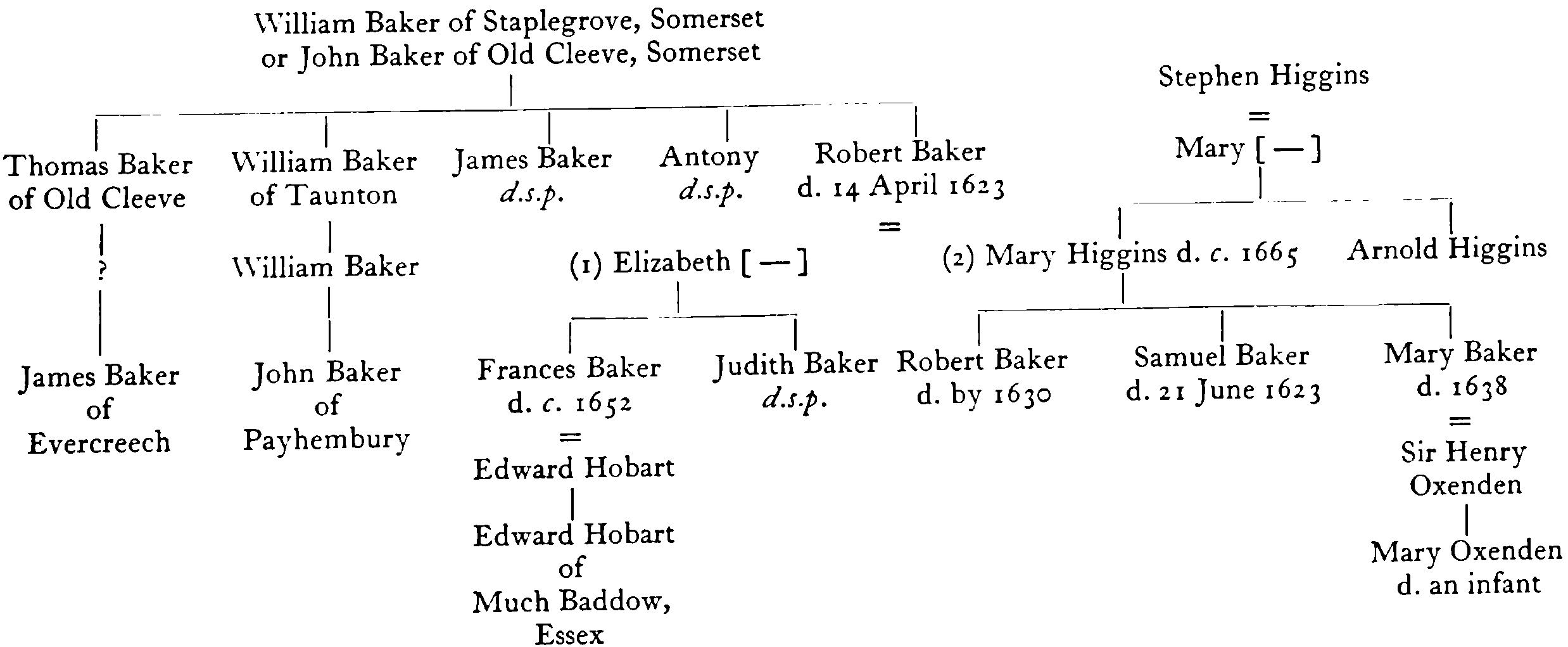
Baker family pedigree.
But difficulties remain. Nicknames are often ephemeral, and the circumstances of their origin are soon forgotten. In this case, even the cardinal fact that the builder of Piccadilly Hall 'got most of his Estate by Pickadilles' depends solely on Blount's account, which is in several other respects incorrect. Then there are other examples of Piccadilly as a place-name in widely scattered parts of England. Many of these are of relatively recent origin and are conscious plagiarisms derived from London. But at least one, at the outof-the-way village of West Walton in Norfolk, where there was a Piccadilly Hall in 1636, presents a problem whose solution might transform the whole subject. (fn. 2)
Robert Baker was the son of William Baker of Staplegrove, Somerset. (fn. 3) He had at least three older brothers, to one of whom, William Baker of Taunton, mercer, he was apprenticed. But Robert 'departed from him before his apprenticeshipp was ended and went to London, where hee lived with a Taylor.' (fn. 37) The first certain reference to him there occurs in 1603–4 when he appears in the churchwardens' and overseers' accounts for St. Martin in the Fields. (fn. 38) It was probably at about this time that he married his first wife, Elizabeth, by whom he had two daughters, Frances (who was herself married in 1622) and Judith. (fn. 39) In 1608 he was described as a tailor, and contributed twenty shillings to the repair of St. Martin's Church. (fn. 40) In the following year he was one of the constables of the parish, and between 1609 and 1613 he was frequently a juryman at Quarter Sessions. (fn. 41) In 1614 he was an overseer of the poor, and in 1616 he was a sidesman. (fn. 42)
At some time between c. 1608 and c. 1615 he married Mary Higgins, his first wife having evidently died. (fn. 4) His erection of Piccadilly Hall in c. 1611–12 (see below) was, so far as is known, his first venture in property speculation, and may well have been connected with his second marriage, for the activities of his new father-in-law, Stephen Higgins, in this field seem also to have begun at about the same time.
Stephen Higgins was an apothecary who lived in the Savoy Liberty. In 1603 he served as a constable there, and he was mentioned as a suitable person to be made a justice of the peace. (fn. 43) Ten years later he was admitted to the livery of the Grocers' Company (to which apothecaries then belonged), but he characteristically refused to play his part in the company's social activities, (fn. 44) and in 1617, when the Society of Apothecaries was founded, he was one of the first wardens of the new body. In 1621 and again in 1638 he served as master, but these moments of distinction were varied by longer periods of quarrelling with, and even partial expulsion from the society. He was thought to be 'an obstinate, contentious and troublesome person', (fn. 45) and his activities as a builder amply confirm this view.
Speculative building in the environs of London was a lucrative, if risky, business in the first half of the seventeenth century. With the establishment of relatively settled conditions of living under the Tudors the expansion of the capital beyond the confines of the City walls had become possible, and by 1580 enough building had taken place to excite the alarm of the Queen, who issued a proclamation forbidding any new building within three miles of the gates of London; not more than one family was to inhabit any one house, and lodgers were to move elsewhere. (fn. 46) This was merely the first of a long series of proclamations by which Elizabeth and her successors, fearful of the dangers of plague and disorder in the capital, sought to limit the growth of London. But the pressure for expansion was stronger than the government's power to enforce a policy which in any case only aggravated the conditions of overcrowding which it hoped to prevent. The regulations were therefore frequently modified in detail; in 1607, for instance, James I introduced the important proviso that there should be no new building within two miles of the gates of London except on old foundations or in the court-yard of an existing house. (fn. 47) Moreover the government repeatedly undermined its own authority by the sale of licences to build, and by allowing offenders to compound for the retention of illegal buildings. (fn. 48)
It is against this background that the activities of Baker and Higgins must be viewed. The former was described as 'a man of a covetous dispocion', (fn. 49) while his father-in-law was 'of a verie naughtie disposition', sometimes 'transported with heate of rage and furie', (fn. 50) and for some ten years after 1611 the records of the various authorities responsible for the enforcement of the proclamations against building abound with references to both of them. Unfortunately many of these references are oblique and their full meaning cannot now be grasped.
The references to Higgins are rather more copious than those to Baker. At about the time that the latter was erecting 'Piccadilly Hall' Higgins was busying himself elsewhere, for in March 1610/11 the minutes of the Westminster Court of Burgesses refer to 'the Annoyance about the building of an House in Drewry Lane which was sometime a Stable in the occupation of Stephen Hidgings'. (fn. 51) This and another stable were in White Hart Yard, near the junction of Drury Lane and High Holborn, and had been built by Higgins on new foundations, probably with the intention of subsequently converting them into tenements — a practice commonly used for the circumvention of the proclamations against building. (fn. 52) In November 1611 Higgins was ordered to appear at the next Court 'for the appointment of a day for the converting of his Tenement into a Stable again'. This order was repeated three times, but Higgins never appeared. (fn. 53) Soon there were complications, for Higgins's tenant, John Baker, tailor, 'a poore man', (fn. 5) who had covenanted with Higgins for the conversion of the stables into tenements, (fn. 54) introduced lodgers contrary to the proclamations, and then he appears to have fathered an illegitimate child. (fn. 55)
John Baker was fined, (fn. 56) but Higgins appears not only to have gone unpunished, but in connexion with his activities in the Savoy Liberty, to have taken the offensive. In c. 1614 he was the plaintiff in a case before the Court of Star Chamber where he asserted that a group of the inhabitants of the Liberty had forcibly interrupted his building work there. (fn. 50) This quarrel rumbled on until 1620, when Higgins stated to the Manor Court of the Duchy of Lancaster that he 'findes himself much agreeved' by the behaviour of his neighbours. (fn. 57) He evidently had some legal authority for his building work, either in White Hart Yard or the Savoy, or both, for in 1615 he was able to produce at Middlesex Sessions a building warrant from the Privy Council, (fn. 58) but it is not known what the warrant permitted.
In 1619 he was in trouble again; the Commissioners for Building (who had been established in 1615) (fn. 59) required him to compound for his offences in both White Hart Yard and the Strand, 'which to accept hee hath obstinatly refused'. The Privy Council, to whom the matter was reported, then ordered the Sheriffs of London and Middlesex to demolish all his buildings. (fn. 54) There are few subsequent references to the matter, and it may be that he finally averted disaster by compounding.
The records of Robert Baker's activities present a rather more blurred picture. In or shortly before 1612 Baker acquired from the heirs of John Golightly 13/8 acres of ground in Windmill Field, bounded on the south by the road from Colnbrook at a point almost opposite to the north end of the Haymarket. (fn. 6) The plan of 1585 (Plate 1) gives it as then the property of Widow Golightly and suggests that it was a narrow strip bounded on the west by the foot-path (now Great Windmill Street) leading to the windmill. This ground was Lammas common land over which the parishioners had grazing rights from Lammas Day (1 August) until the spring. On 9 July 1612 the vestry of St. Martin in the Fields imposed upon Baker an annual payment of thirty shillings in recompense for the parishioners' loss of their rights over the ground, which he had already enclosed, and upon which he and John Baker 'have builded certaine houses'. The first payment was to be made on 1 August 1612, in respect of the year August 1611–12, and it is therefore likely that the houses were built during this period. (fn. 60) On 20 September 1614 the Westminster Court of Burgesses ordered one Hugh Parsons to cease selling beer and tobacco at a house 'near a place there called Pickadilly Hall', (fn. 61) and this (so far as is known) is the first recorded use of this name for Robert Baker's new buildings.
Unfortunately the records do not appear to provide any clue to the legal status of Piccadilly Hall. The use of Lammas land for building was, in the parish of St. Martin in the Fields, of very recent origin, (fn. 62) and Baker's successful speculation, despite the high price of £50 (fn. 22) which he paid for only 13/8 acres, may well have attracted considerable attention. Moreover, his buildings, standing isolated in open country, were so conspicuous that he must have had some authority for their erection. Their existence was not in fact challenged until the 1630's, although they were certainly known to the Attorney General in 1622, when he referred to them in the Court of Star Chamber in a case concerned with houses in the Strand. (fn. 49) It is therefore reasonable to assume either that Baker obtained a licence to build from the Privy Council, or that he compounded for breach of the proclamations. Unfortunately, however, the Council registers for the years 1601/2 to 1613 are no longer extant. Alternatively he may have been able to claim that he was building on old foundations, for the plan of 1585 marks a small house on the eastern side of the ground, probably not far from the site later occupied by Piccadilly Hall. (fn. 7)
Robert Baker built several houses on his plot in Windmill Field. In the summer of 1612 he was probably involved in building operations with John Molton and Thomas Burgesse, bricklayers, who entered into recognisances after having given unjust information against him. (fn. 63) The vestry minutes (already cited) state that he and John Baker 'have builded certaine houses' (fn. 21) and the churchwardens' and overseers' accounts indicate the same. There appear to have been two substantial houses, Robert Baker's own, which was assessed at thirteen shillings, and another, occupied in 1616–17 by a Mr. Drummond, and assessed at seventeen shillings and fourpence. Two others, one occupied by Anthony Phan, wheelwright, paid much less. (fn. 64) By 1626 there were 'seaven messuages with the stables and other buildinges and curtelages thereupon built'. (fn. 65)
Baker's own house, Piccadilly Hall, appears to have been a shop where he received lodgers, for in 1614 he confessed to the Westminster Court of Burgesses that 'he had received into his Shop one James Bale' contrary to the building proclamations. (fn. 66) (fn. 8) This impression of divided use or occupancy is also to be found in the unsuccessful appeal addressed in June 1618 to the vestry of St. Martin 'on the behalfe of the parties that have losse by the fire happening at Pickydilly Hall ye XIIIth. of June abovesaid, exhibited by three [? tenants shewing] 200 l: losse'. (fn. 67) The entries to be found in the overseers' accounts shortly after Robert Baker's death in 1623 suggest that sub-division was taking place, (fn. 68) and in 1624 'Pickadilly Hall' is given in the overseers' accounts as the name of 'divers houses and messuages'. (fn. 34)
In 1622 the Attorney General referred to Baker as 'dwellinge att Peckadilla', (fn. 49) and the record of Lammas payments for 1623–4 gives 'for ground neare the Windmill builded uppon . . . and lately called Pickadilly'; (fn. 69) the ratebook for 1627–8 contains 'Pecadilly' as a street heading. (fn. 70) Thus the name was already being applied to a locality, not to an individual house, as John Gerarde showed in the second edition of his Herball, published in 1633, when he wrote that 'The little wilde Buglosse growes upon the drie ditch bankes about Pickadilla.' (fn. 71)
This extension of the name led to its application to the famous gaming house erected on the opposite or south side of the road in c. 1634 by Simon Osbaldeston, the Lord Chamberlain's gentleman barber. This establishment also had its nickname, as George Garrard related in 1636: 'Simme Austbistons house is newly christned, It is calld, Shaver's Hall, as other neighbauring Places thereabout are nicknam'd Tart hall, (fn. 9) Pickadell Hall; At first noe conceyte [i.e. pun] then was of the builders beeing a Barber; but it came upon my Lord of Dunbarres loosing 3000 l. at one sitting; whereon they said a Northerne Lord was shaved there; But now Putting both togeather, I fearr it will be a Nickname of the Place, as Nicke and Frothe is at Petworth, as long the house stands.' (fn. 72) (fn. 10)
In January 1618/19 Baker greatly enlarged his estate by the acquisition from Richard Wilson of some twenty-two acres of land in Windmill Fields and Scavenger's Close which had previously been held by Thomas Wilson, brewer. (fn. 73) More building may have taken place, for in August 1621 the vestry ordered that 'Mr Robert Baker be warned in about his inclosing of certen of the Lamas comon contrary to Law and order.' (fn. 74) In the following year he was accused by the Attorney General before the Court of Star Chamber of having carried out illicit building in connexion with four houses at 'Brittaines Bursse' in the Strand, of which he had taken a lease from the Archbishop of York some years earlier. (fn. 49)
At the time of his death (which apparently occurred while he was still in the prime of life) on 14 April 1623, (fn. 65) Robert Baker owned lands and tenements of the yearly value of £240, as well as leases, goods and chattels worth £1000. (fn. 75) He styled himself gentleman, (fn. 76) and had married his eldest daughter, Frances, to Edward Hobart, esquire, a member of an important land-owning family in East Anglia. (fn. 77) The family quarrels between rival claimants to the inheritance of Baker's substantial estate lasted for nearly a century after his death.
By his will (fn. 72) Robert Baker bequeathed to his widow, Mary, in lieu of dower, his dwellinghouse (at Piccadilly) and two of his houses in the Strand, for the term of her life. The rest of his estate was distributed amongst his children Judith (a daughter of his first marriage), Mary, Robert and Samuel. In order to pay his debts and to provide marriage portions for his daughters he directed his sole executor, his cousin Samuel Baker, to sell his leasehold property. But the deeds and leases had come into the possession of the widow Mary Baker, and of her father, Stephen Higgins, who appears to have lived at Piccadilly for some time. Mary Baker was dissatisfied with the provision which her husband had made for her, particularly since she had provided most of the money with which he, only four years earlier, had purchased the twenty-two acres in Windmill Field and Scavenger's (or Conduit) Close. She and her father therefore refused to hand over the leases, and Samuel Baker (the executor) commenced a Chancery suit against them. (fn. 78)
Unfortunately Samuel Baker died within ten months of Robert, (fn. 79) and as all the surviving unmarried children were minors, it was probably not difficult for Mary Baker, assisted by her redoubtable father, to gain effective control of the estate. Concealing the jointure which Robert Baker is said to have settled on her during his lifetime, she obtained judgement by writ of dower for the recovery of one third of her husband's property. (fn. 80) The administration of the estate was, of course, in the hands of the Court of Wards, (fn. 11) and by 1626 she and her father, Higgins, had bought it, on payment of a fine of £66 13s. 4d., for the use of the ward, Robert Baker, junior. (fn. 65)
By this time Mary Baker's younger son, Samuel, was dead, and by 1630 her elder son, Robert, had died too. (fn. 12) The inheritance then passed to her only surviving child, Mary, the wardship of whose estate was bought by her mother. (fn. 65) In c. 1634 the latter granted a thirtyfive-year lease of Scavenger's Close (at the northeast end of the Haymarket) to Simon Osbaldeston, who built the gaming house later nicknamed Shaver's Hall. She also granted other leases in the locality of Piccadilly, (fn. 81) and in 1637 the Commissioners for Building reported to the Privy Council that several houses had been built there on new foundations, including one 'which hath formerly bene pulled downe by your Lordships' order'. (fn. 82) In the same year her illicit building activities attracted the attention of the Court of Star Chamber. (fn. 83)
Her property was giving her much trouble, for during the epidemic of plague in 1636 she and the occupants of several other of her houses had been infected and had been shut up for four weeks with a guard set before their doors to prevent their coming out. (fn. 84) Early in 1638 the Court of Star Chamber imposed upon her a fine of one thousand pounds 'for continuing buildings unlawfully erected to the annoyance and putrefaction' of the springs of water which flowed through her ground and supplied the Palace of Whitehall. (fn. 85) The Court also ordered her 'to pull downe her house, and Stables in Pickadilla for that the same was conceaved to bee a Nuisance to the water'. (fn. 86) George Garrard mentioned this order in a letter of 7 February 1637/8 to the Earl of Strafford: 'A sentence in the Star-Chamber this Term hath demolished all the Houses about Piccadilly, by Midsummer they must be pulled down, which have stood since the 13th of King James' (i.e. 1615–16). (fn. 87)
In order to avert this catastrophe Mary Baker petitioned the Privy Council to be allowed to convey the waters 'freshe and servicable' to Whitehall by a brick culvert from the source to Piccadilly, and thence by lead pipes. She was to pay for the work, which was to be done under the supervision of the Surveyor General. (fn. 88)
This proposal was accepted on condition that the work should be completed by Michaelmas 1638. In June 1639 much still remained to be done and Inigo Jones, the Surveyor General, reported Mary Baker's dilatoriness to the Privy Council. (fn. 89) By November the water was at last being conveyed 'sweet and serviceable for his Majesty's use'. The Privy Council respited the demolition of the buildings and agreed to consider a petition from Mrs. Baker for the mitigation of the fine of £1000, with what result is not known. Her expenses in piping the water were £600. (fn. 86)
The first detailed description of the houses at Piccadilly is contained in a parliamentary survey made in 1651. (fn. 90) They are illustrated in Faithorne's map, published in 1658 (Plate 2). The 'Range wherein Mrs. Bakers house standeth' abutted south on the road from St. Giles to Knightsbridge, north and east on Mr. Poultney's land, and west on the foot-path leading from Piccadilly to the windmill. There were eleven houses in all, five of them facing west to the foot-path (Great Windmill Street) and the rest south to the highway. The most northerly, which was occupied by Mrs. Baker, had one room to each of three storeys, a stable and a small plot of ground before the door, and was valued at three pounds. Mrs. Baker also occupied the adjoining three-storey house to the south, valued at fifteen pounds per annum. This was probably the original Piccadilly Hall built by Robert Baker in 1611–12. In the survey of 1651 it was described as a 'Tenement strongly built with Bricke and covered with Tile, consisting one Seller, one Hall, a Kitchen and a Larder below staires, and in the first story above staires 2 Chambers and a Closet there, and over the same 2 Garret roomes, which together with one Court yard, a Garden and a backside, conteyninge by estimacion 3 Roods.' The house is plainly shown on Faithorne's map. Its site was probably at or a few feet north of the intersection of Shaftesbury Avenue and Great Windmill Street. (fn. 13)
The next house to the south was still larger, being valued at twenty-two pounds per annum. It had six rooms on each of two floors, with garrets above, and there was a coach-house, courtyard, and gardens, with an area of half an acre. South again was a smaller house whose high value of twenty pounds was evidently due to the stables and coach-houses attached to it. Next came another small house, built of brick and timber and with a thatched roof, valued at six pounds, and then 'a tenement called by the name of the Signe of the Crowne'. This inn, 'stronglie built with bricke and tile' and valued at £13 6s. 8d., stood at the corner of the main road and the footpath leading to the windmill. On its east side there were two other inns, the Feathers and the Horns, valued respectively at £13 6s. 8d. and £8, and the L-shaped range of eleven tenements was completed by three small buildings further east. (fn. 90)
The later descent of the Baker property may now be described. In 1637, when her buildings had first attracted the attention of the Court of Star Chamber, Mrs. Baker's only surviving child, Mary Baker junior, had married (Sir) Henry Oxenden, of Dene, Wingham, Kent, and in December an agreement had been concluded whereby Mrs. Baker retained a life interest in all the Piccadilly lands and houses. (fn. 91) In December 1638 Mary Oxenden died after giving birth to a daughter, Mary, and in February 1641/2 the wardship of the estate was once more purchased by Mrs. Mary Baker, on this occasion in association with her father, Stephen Higgins, and Arnold Higgins. (fn. 92) (fn. 14) But the younger Mary Oxenden died in 1646 or 1647 while still a child. (fn. 93)
Thus all of Mrs. Mary Baker's children and their issue were now dead, and the reversion of the estate, subject to her life interest and that of Sir Henry Oxenden, passed to the right heirs of Robert Baker, the founder of the family fortune. The first claimant was Edward Hobart, 'thirsting after the possession of the said lands and Tenements', who started proceedings in the Court of King's Bench as well as in Chancery. (fn. 94) He was the husband of Robert Baker's eldest daughter, Frances, by his first wife, and she was the sole survivor of Robert Baker's children by either of his marriages, for her sister Judith was now dead without issue. (fn. 95) Frances Hobart died in c. 1652 (fn. 80) and her husband probably soon afterwards, but his efforts were vigorously maintained in Chancery by his son, Edward Hobart (Hubert), of Much Baddow, Essex, esquire, until his death in 1670. (fn. 96)
Mary Baker scornfully described his claim as without 'any juste ground, reason or title', (fn. 97) but after her death his claim to the original 13/8 acres on the east side of Windmill Street appears to have been sufficiently accepted for Sir William Pulteney and Richard Bull to pay him in 1667 £250 for the acquisition of two plots there. (fn. 98) His title was evidently still in doubt, however, for Pulteney thought it necessary to pay'a competent sum of lawful money' to the occupant for the same ground. (fn. 99)
The strongest claimant was John Baker, variously described as of Wellington, Somerset, cordwainer (fn. 39) or gentleman, (fn. 37) or (in 1673) as of Payhembury, Devon, gentleman. (fn. 95) His claim to be the great-nephew of Robert Baker and therefore entitled to the estate subject to the existing life interests was for some years accepted by both Mrs. Mary Baker and Sir Henry Oxenden. (fn. 95) But in c. 1658 another great-nephew, James Baker of Evercreech, Somerset, yeoman, (fn. 37) 'an illiterate and ignorant man' (fn. 95) advanced a rival claim, (fn. 93) and innumerable suits and counter suits in the Courts of King's Bench, Common Pleas, Exchequer and Chancery followed. (fn. 95)
After the death of Mary Baker in c. 1665 without male issue her lands escheated to the Crown. They were granted to Thomas Eliot, groom of the bedchamber, and Thomas Ross, groom of the privy chamber, but it is very doubtful if they ever gained possession. (fn. 100) John Baker appears to have obtained possession of part of the estate, but his legal expenses in defending his title against his cousin James Baker were so heavy that he had to grant part of his property to the Oxendens, who had provided him with money to advance his claims. His cousin had felt the same necessity, and had made conveyances of his real or pretended rights to Colonel Thomas Panton, the speculator, 'who manages the said James Baker's pretencies'. (fn. 95) Of Panton's prowess as a cardplayer it was said that 'There was no game but what he was an absolute artist at, either upon the square or Foul play.' (fn. 101) He proved too sharp for the Bakers, for ultimately he and Sir Henry Oxenden came to an agreement between themselves, and by 1673 Panton was granting building leases in the locality of Piccadilly north of Coventry Street, in defiance of the complaints of John Baker. (fn. 95) (fn. 15)
What success the Bakers had in the prosecution of their claims to other parts of the estate is not known. James continued to raise money by the sale or mortgage of his slender expectations; (fn. 102) John appears to have received rent from the tenants of houses in Wardour Street and Peter Street, but in 1710 his right to do so was in dispute. (fn. 23) In 1720 three rustic Bakers, all living in Somerset, were still claiming the twenty-two acres purchased by 'Piccadilly Baker' in 1618/19 and stretching from the Haymarket to Oxford Street. By then the area had been largely built upon regardless of these supposed owners' rights. (fn. 103)