Survey of London: Volumes 31 and 32, St James Westminster, Part 2. Originally published by London County Council, London, 1963.
This free content was digitised by double rekeying. All rights reserved.
'Shaftesbury Avenue', in Survey of London: Volumes 31 and 32, St James Westminster, Part 2, ed. F H W Sheppard (London, 1963), British History Online https://www.british-history.ac.uk/survey-london/vols31-2/pt2/pp68-84 [accessed 30 April 2025].
'Shaftesbury Avenue', in Survey of London: Volumes 31 and 32, St James Westminster, Part 2. Edited by F H W Sheppard (London, 1963), British History Online, accessed April 30, 2025, https://www.british-history.ac.uk/survey-london/vols31-2/pt2/pp68-84.
"Shaftesbury Avenue". Survey of London: Volumes 31 and 32, St James Westminster, Part 2. Ed. F H W Sheppard (London, 1963), British History Online. Web. 30 April 2025. https://www.british-history.ac.uk/survey-london/vols31-2/pt2/pp68-84.
In this section
CHAPTER V
Shaftesbury Avenue
In his London and Westminster Improved, published in 1766, John Gwynn suggested that a new street should be formed from the top of the Haymarket to Oxford Street and beyond. (fn. 6) After the formation of Regent Street the need for further improvement in north-south communication in this part of Westminster was recognized in 1838 by the Select Committee of the House of Commons on Metropolis Improvements. The committee was concerned at the volume of traffic from Paddington and Euston Stations that might be expected to converge upon the east end of Oxford Street, and it recommended inter alia an improved line of street from St. Giles's to Charing Cross. (fn. 7) This need was later filled by the formation of Charing Cross Road, but the committee made no recommendation on communication between Piccadilly and Bloomsbury. Thomas Marsh Nelson, an architect who gave evidence to the committee, did, however, propose a road from Piccadilly in the west to Stratford in the east, and this began with 'a new street branching eastward from the County Fire Office corresponding with the Quadrant and similar in width to Regentstreet, to St. Giles's church'. (fn. 8)
In the 1860's and 70's the need for improved communication between Piccadilly Circus and Charing Cross, and between Charing Cross and Tottenham Court Road was frequently discussed, (fn. 9) but little more was heard of the Piccadilly to Bloomsbury route until 1876. By that time a long line of improved east-west communication from Shoreditch to Bloomsbury was almost complete, and the Metropolitan Board of Works realized that the amount of additional traffic which would be brought into Oxford Street and which would make its way towards Charing Cross would require the formation of direct communication from Oxford Street to Piccadilly and to Charing Cross. The Board therefore applied to Parliament for the necessary powers, which were granted by the Metropolitan Street Improvements Act, 1877. (fn. 10)
This Act authorized the Board to form the streets now known as Charing Cross Road and Shaftesbury Avenue, to widen Coventry Street, and to carry out nine other improvements in various parts of London. The line of these new streets had been drawn up jointly by the Board's superintending architect, George Vulliamy, and the engineer, Sir Joseph Bazalgette, (fn. 11) and the plans approved by the Act defined the limits of deviation within which each street must run and within which the Board was empowered to purchase all the ground that it might require (fig. 8). About half the length of the new street from Piccadilly Circus to Bloomsbury was formed by widening existing streets, thus keeping to a minimum the amount of ground to be acquired. (fn. 12)
The history of Shaftesbury Avenue and Charing Cross Road is a story of lost opportunity. Nearly ten years elapsed between the passing of the Act of 1877 and the opening of the two streets, the general standard of design of the buildings finally erected was deplorable, and in 1888 a Royal Commission was appointed to investigate the dishonest conduct of certain of the Board's officers in the disposal of surplus land in Shaftesbury Avenue. In face of this depressing record it should also be remembered that the final achievement was not merely the formation of over a mile of main thoroughfare sixty feet wide, but also the abolition of some of the worst slums in London and the rehousing of over three thousand of the labouring classes. (fn. 13)
The delay in the formation of the two streets was caused by the obligation which was placed by Parliament upon the Board to provide housing for all displaced members of the labouring classes. The Metropolitan Street Improvements Act of 1872 had required the Board to give eight weeks public notice of intention to demolish in any one parish fifteen or more houses occupied by the labouring classes, and had stipulated that certain land bought for each improvement should be set aside for the erection of working-class accommodation. (fn. 14) But in 1875 more stringent obligations were placed upon local authorities by the Artisans' and Labourers' Dwellings Improvement Act (fn. 15) and section 33 of the Metropolitan Street Improvements Act of 1877 stipulated that the Board should not take fifteen or more working-class houses until it had satisfied the Home Secretary that sufficient accommodation had been provided elsewhere. The Act also specified that certain land to be acquired by the Board for the new streets should be used to provide labouring-class accommodation, and that after acquiring this ground the Board should sell or lease it for this purpose, the Board itself having no power to expend money on the erection of buildings.
Much of the proposed line of the two new streets crossed squalid poverty-stricken areas and within the limits of deviation laid down in the Act lived 5497 of the labouring classes, all of whom would have to be rehoused if the Board acquired all the ground which Parliament had authorized. But in the Newport Market area, which the Board considered to be the only suitable site available for working-class accommodation, there was only space to rehouse about 1470 persons, and the others could only be accommodated in the immediate vicinity by building blocks of artisans' dwellings along the frontages of the new streets, a course which the Board pointed out 'would not only entail a heavy pecuniary loss, but would be excessively detrimental to the character of the street'. (fn. 16)
In July 1878 the Board pointed out these difficulties to the Home Secretary, and added that if the restriction on taking fifteen labouring-class houses or more were enforced the completion of the two streets would take twenty years. The Board submitted a scheme whereby other land elsewhere in London might be used to accommodate most of the persons to be displaced, but in December 1879 the Home Secretary rejected it and refused to release the Board from the restriction. He suggested that 'in these street improvements the first step should be to provide houses for the working classes to which those who are displaced belong; the next to carry out the improvements'. (fn. 17)
In February 1880 the Board considered whether to promote a Bill for the repeal of section 33 of the Act of 1877, and whether to try to obtain the appointment of a Select Committee to enquire into the whole matter, 'especially whether powers should not be given to the Board to erect suitable buildings on the various sites, instead of only having power to lease them, which leads to so much delay and difficulty'. In September the Home Secretary urged the Board to acquire the whole of the Newport Market area and to clear part of it so that building leases might be granted, but he refused to allow further clearance until the new buildings had been completed; he could not 'forget that he is specially charged by the Act to protect those who cannot protect themselves, and to take care that no extensive displacement of persons of the working classes should take place until provision was made for their being housed elsewhere'. (fn. 18)
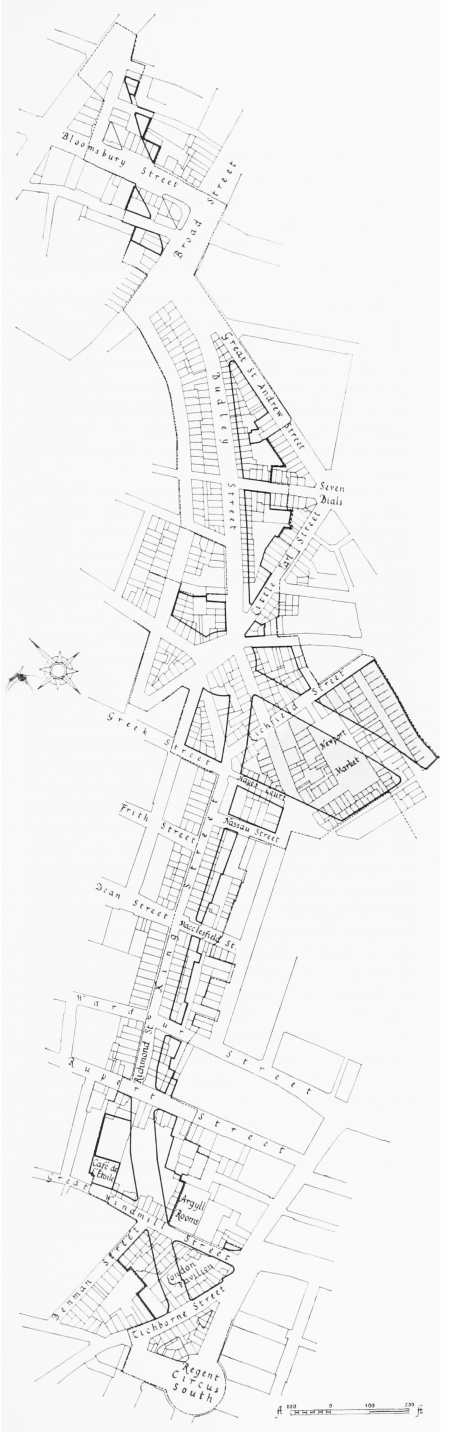
Shaftesbury Avenue, layout plan. Broken lines denote the limits of the land which the Act of 1877 authorized the Metropolitan Board of Works to acquire. In 1883 these limits were reduced. Continuous lines denote the boundaries of the lands which were acquired by the Board but which did not form part of the new street. Stippling denotes the area set aside for the rehousing of the displaced working classes
By this time the Board was being severely criticized for its apparent dilatoriness in carrying out the Act of 1877, (fn. 19) and in October 1880 it resolved to apply to Parliament for the amendment of section 33. (fn. 20) In May 1881 a Select Committee of the House of Commons was appointed to consider the workings of the Artisans' Dwellings Acts and the Metropolitan Street Improvements Acts of 1872 and 1877. (fn. 21)
The committee's report, published in June 1882, admitted the impracticability of the stringent provisions of section 33 of the Act of 1877 and recommended the adoption of a plan submitted in evidence by the Board. If the Board had purchased all the land within the limits defined by the Act of 1877 (fig. 8), over five thousand of the labouring classes would have been displaced; it now proposed to surrender its right to acquire part of this ground, thereby reducing the number to be displaced to 4000. The Board would rehouse half of these, 600 on a site in Old Pye Street, Westminster, and 1470 in the Newport Market area. As soon as this new accommodation was ready, but not before, the Board proposed to proceed with the construction of the two streets, relieved of the obligation imposed by section 33 of the Act of 1877. (fn. 22)
This plan was, after some modification, given statutory authority by an Act passed in 1883, (fn. 23) which raised the number to be rehoused in the Newport Market area from 1470 to 2000. This Act enabled the Board to proceed rapidly with the formation of the two streets, but only at the price of abandoning whatever feeble intention there may previously have been to enforce any standard of street design. Even the Act of 1877 had so restricted the land which the Board could buy that The Builder had complained of 'the formation of irregular and awkward bits of ground, upon which even Gothic ingenuity will be puzzled to contrive satisfactory buildings'. (fn. 11) In 1881 the Board's architect, George Vulliamy, stated that he had 'endeavoured to take only so much of the properties as would be absolutely required to form the street, and to give an available building frontage'. (fn. 24) Yet the Act of 1883 pared off still more land, (fn. 1) making much of the ground which the Board did later acquire so awkward in shape that it could not yield its full value. Nearly half the ground fronting the northern side of Shaftesbury Avenue was not acquired at all, despite the elementary objection mentioned by The Builder that 'the creation of a broad thoroughfare in front of a line of old tumble-down tenements of comparatively small value, is to virtually present a large sum of money to the owner or owners of the land upon which the tenements stand'. (fn. 11) By raising the number of persons to be rehoused in the Newport Market area from the 1470 proposed by the Board to 2000 the Act of 1883 compelled the Board to arrange for the erection of multi-storey blocks of artisans' dwellings along both sides of Charing Cross Road south of Cambridge Circus.
These two blocks were erected in 1884 by the Improved Industrial Dwellings Company, to whom the Board granted building leases. (fn. 25) Most of the rest of the Newport Market area was leased to Mr. G. Foskett, who had previously taken similar leases in Clerkenwell, and in 1884, when the artisans' dwellings which he had covenanted to build were probably nearing completion, he bought the freehold of the site. (fn. 26)
In December 1884 the Home Secretary certified that the Board had now provided artisans' dwellings for upwards of two thousand persons of the labouring classes, and that it was therefore relieved of its obligations under section 33. (fn. 27) Shortly afterwards demolition work began at the south end of the Piccadilly to Bloomsbury route. (fn. 28) The contractors for the formation of the two streets were Turner and Son, J. J. Griffiths, T. Turner and J. Mowlem and Co. The gross cost of the street from Piccadilly to Bloomsbury was £1,136,456 and after deduction of the value of the land acquired, the net cost was £758,887. Taking both streets together accommodation in new buildings for 3044 persons of the labouring classes was provided. The street from Piccadilly to Bloomsbury was opened in January 1886, (fn. 13) and in in the following month the Board named it Shaftesbury Avenue, (fn. 29) (fn. 2) in memory of the recently deceased seventh Earl of Shaftesbury, much of whose work for the poor of London had been done in the area traversed by the new street. Charing Cross Road was opened in February 1887.
The segmental sweep of Shaftesbury Avenue, for the first stage of its progress from Piccadilly Circus to Cambridge Circus, offered the opportunities of another Regent Street Quadrant. By the 1880's, however, the discipline of architectural uniformity had been relaxed in favour of liberty of architectural expression, declaring the taste of the architect or his client. Generally, the fronts were of red brick, dressed with terra-cotta or red sandstone or Portland stone, the heights varying from three to five storeys with a skyline of gables or turrets of French or Flemish Renaissance derivation. No building in the portion of the street under consideration here attained the quality of Collcutt's design for the Palace Theatre further north in the street.
The south side, at the Piccadilly end, begins with the London Pavilion, its style, though florid, and its chief material, Bath stone, relating it more closely to Nash's buildings than to the rest of Shaftesbury Avenue. Nos. 26–32 (even) east of the Trocadero have a front of Portland stone finished with Baroque gables derived from Norman Shaw. On the east corner of Rupert Street is an example of Martin and Purchase's uninspired work. Beyond is an interesting group that has been attributed to Thomas Harris, (fn. 30) probably built about the same time, in 1889, and all featuring the motif of elliptical-headed arches; Nos. 58– 60 are of brick, now painted, No. 62 is faced with stone, and No. 45 Wardour Street, forming part of the group, is of red brick dressed with stone.
On the north side, between Piccadilly Circus and Denman Street, three buildings were erected during 1888–9. From west to east these were first, Piccadilly Mansions, an elaborate but totally uninspired design by Martin and Purchase, with 'P.M.' figuring on the terra-cotta gables; then came the Café Monico extension, by Christopher and White, with more character than its neighbours, and then Piccadilly House, with a fussy elevation, both these last now demolished.
Four theatres—the Lyric, Apollo, Globe and Queen's—occupy almost all of the north side of Shaftesbury Avenue between Denman and Wardour Streets.
The Royal Commission and the disposal of surplus lands in Shaftesbury Avenue
The Metropolitan Board of Works had no power to hold lands in mortmain, except by special licence from the Crown. To do so would have been contrary not only to the general principles of law, but also to the Lands Clauses Consolidation Act of 1845, which required that all surplus lands acquired for public undertakings should be sold within ten years of the completion of the works. (fn. 31) The Metropolitan Street Improvements Act of 1877, under which Shaftesbury Avenue had been built, authorized the Board either to let on building lease all surplus lands, or to sell them, but within ten years from the completion of the improvement all reserved ground-rents and freehold interests had to be sold. (fn. 32) In 1882 the Board considered whether to try to obtain statutory power to retain groundrents, but was advised that the Government would be unlikely to agree. (fn. 33) In 1884, however, the Metropolitan Board of Works (Money) Act extended the prescribed period for the disposal of surplus lands to the year 1929, or, in the case of land bought under any Improvement Act passed in or after 1881, to the year 1941. (fn. 34)
The land which had been acquired by the Board but which was not required for the street was divided up into plots of suitable size and shape and usually the land was then let on building lease by public tender. The tenders were opened by the chairman of the Board, and were then referred to the Works and General Purposes Committee, (fn. 35) which consisted of all the members of the Board, but which sat in private. (fn. 36) Most of the leases of land in Shaftesbury Avenue were for eighty years but the agreement which the successful tenderer entered into with the Board often gave him the option to purchase the freehold. When the London County Council, which unlike the Board had power to hold land in mortmain and was therefore under no obligation to sell it, (fn. 37) came into existence in March 1889, agreements had already been made for the disposal of nearly all the land in Shaftesbury Avenue, and in general the Council could only accept and perform the commitments previously entered into by the Board. In the parish of St. James the freehold of all the land on the south side of the street between Piccadilly Circus and Wardour Street was sold, except for the site of the London Pavilion, while on the north side of the street the freehold of virtually all the land bought by the Board was retained.
Exceptionally, the triangular site later occupied by the new London Pavilion Music Hall was not disposed of by public tender. In 1878 the Board had learnt that Emil Loibl, the proprietor of the old Pavilion, intended to rebuild his theatre, and they therefore 'deemed it prudent' to acquire the freehold, although they had no immediate need of the ground. In August 1879 R. E. Villiers, the proprietor of the Canterbury Music Hall, became the Board's lessee; he paid a rent of £7000 per year and gave substantial guarantees for the proper conduct of the music hall. (fn. 38) Shortly afterwards F. W. Goddard, the Board's chief valuer, one of whose duties was to see that the lessee of the Pavilion complied with the terms of his lease, informed Villiers through an intermediary that he expected 'something for himself'. Throughout the remainder of his tenancy of the old Pavilion Villiers paid Goddard £50 a quarter. (fn. 39)
In about 1883 Villiers became acquainted with T. J. Robertson, an assistant in the architect's department of the Board, who agreed to help Villiers to obtain the building lease of the site on which the new London Pavilion was later erected; in return Robertson's brother W. W. Grey, the lessee of the Black Horse in Tichborne Street, was to have the west corner of the site for the re-erection of his public house. At a later meeting between Villiers, Goddard and Robertson this arrangement was confirmed, and it was also agreed that the profit of selling the public house, estimated at £10,000, should be divided between Goddard and Robertson. (fn. 40)
In November 1884 Robertson informed Villiers that he should at once apply to the Board for permission to make an offer for the new site. He accordingly did so, and George Vulliamy, the superintending architect to whom the matter was referred, reported that a ground-rent of £3000 should be placed on the site, and that the value of the licences was £15,000. Although signed by Vulliamy this report was 'much more the work of his subordinates, Goddard and Robertson, than his own independent production'. The Board then agreed to permit Villiers to make a proposal and by a letter of 29 November, the terms of which were dictated to him by Goddard and Robertson, he offered to take the land at a groundrent of £2700 and to give £15,000 for the licences. On 1 December the Works and General Purposes Committee decided to offer the land to Villiers at a ground-rent of £3000 per annum, with an option to purchase the freehold, and a payment of £15,000 upon confirmation of the licences. Villiers immediately agreed and despite the receipt of an offer from a Mr. Pyke of a ground-rent of £4000 the seal of the Board was on 9 January 1885 affixed to the agreement with Villiers. (fn. 41)
Since October 1884 Villiers had been discussing plans for the rebuilding of the London Pavilion with Messrs. Isaacs and Florence, architects. In December or January he ceased communicating with them, and when Isaacs asked for the reason Villiers replied that he 'had been compelled to engage the services of [Alderman James Ebenezer] Saunders', an architect with much experience of theatres and a member of the Board for the previous twenty-five years. But the elevation produced by Saunders was 'not approved of' by Villiers, whereupon Robertson (who had had a hand in persuading Villiers to employ Saunders) produced an elevation by R. J. Worley. Villiers paid the latter £150 for the design, and told Saunders that he must accept it. (fn. 42)
The last performance in the old London Pavilion took place on 26 March 1885; the present three-sided building was built in slightly over six months, Saunders being the architect in all respects save for the elevation and for the interior of the restaurant, which were exclusively the work of R. J. Worley. (fn. 43) In October 1885 it was arranged that the Board should grant Villiers two leases, one of that part of the site upon which the Pavilion was built at a rental of £2650 and the other of the west corner on which the Piccadilly Restaurant was built at a rental of £350. Subsequently Villiers obtained the Board's permission to assign the lease of the restaurant to Robertson's brother, W. W. Grey. Although the secret arrangements previously described were thus strictly carried out, Robertson lost a considerable sum of money in unsuccessfully attempting to float a company to buy the restaurant. But Goddard continued to receive payments from Villiers at the rate of £200 per year after the opening of the new building. In December 1886 Villiers sold the Pavilion to a company, £5000 of whose debentures plus £1000 in cash he made over to Goddard 'for his assistance in obtaining the site, and for his previous services and supervision, as he was the custodian or censor of the place'. (fn. 44)
In January 1885, less than two weeks after the Board had sealed its agreement with Villiers, the Paddington vestry enquired why the Board had done so 'without first putting the land up to public competition'. (fn. 45) (fn. 3) In October the Board of Works for the Wandsworth District and the Tooting and District Ratepayers' Association both protested to much the same effect. (fn. 46) Otherwise few suspicions seem to have been aroused, although Robertson, whose salary was £425 per annum, was to be seen riding round London in his own carriage with a liveried servant—a fact which Goddard (of all people) drew to George Vulliamy's attention. (fn. 47) Vulliamy had been the Board's superintending architect since 1861, (fn. 48) and for some years he had been 'unequal to the duties of the position'. (fn. 49) In March 1886 illness prevented his attending to his duties, most of which devolved upon Goddard. (fn. 50) In May he resigned, but in October, when suspicion of dishonesty in his department was rapidly growing, he asked to withdraw his resignation. He died a few weeks later, before any decision could be taken about his request. (fn. 51) Subsequently the Royal Commission found that although he had had no part in or knowledge of the malpractices of his subordinates, he had nevertheless been 'unequal to the duties of the position which he filled'. (fn. 49)
In October and November 1886 The Financial News published two articles criticizing the Board's method of disposing of surplus land, and correctly implying an improper connexion between Robertson and the Piccadilly Restaurant Company. In December the Board ordered a statement of the facts connected with the disposal of land at Piccadilly Circus, but the subsequent private enquiry elicited nothing more than Robertson's fraternal relations with the Piccadilly Restaurant Company. The Works and General Purposes Committee therefore concluded, rather naïvely, that Robertson had been injudicious but did not consider 'that there has been anything worthy of more severe censure'. The Board showed more wisdom and on 15 July 1887 passed a resolution of censure on Robertson. (fn. 52)
The result of this first enquiry satisfied nobody, and fresh charges of dishonesty against both officers and members of the Board appeared in the press. On 29 July the Board therefore appointed a special committee of enquiry, which was to sit in public. The accusers refused to give evidence and as the Board had no power to compel them to do so this second enquiry proved even less satisfactory than the first. (fn. 53) In the autumn of 1887 there was a general clamour from the London vestries and district boards for a government investigation into the disposal of surplus lands, and in December the Board did resolve that in future they should in the first instance be submitted to public auction. (fn. 54)
But the accusations continued. The Daily Chronicle asserted rather wildly that the ratepayers had been defrauded of £57,000 in a single transaction in Shaftesbury Avenue and in February 1888 Lord Randolph Churchill successfully proposed a motion in the House of Commons for the appointment of a Royal Commission to enquire into the workings of the Board. (fn. 55)
The Royal Commission began its investigation in May and presented its report in November 1888. (fn. 56) In August the Local Government Act, one of whose objects was to transfer to a new London County Council the functions hitherto discharged by the Board, became law. (fn. 57) The Commissioners therefore confined themselves to enquiring into the alleged irregularities, and did not investigate the general workings of the Board. (fn. 58)
The report of the Commission revealed Goddard's and Robertson's malpractices (fn. 4) (which included illicit dealings in other parts of London as well as in Shaftesbury Avenue) and censured the conduct of two architects, J. E. Saunders and F. H. Fowler, who had been members of the Board for many years. (fn. 59) The Board itself was criticized for retaining Vulliamy as architect when he became unfit for his duties, and for referring the disposal of surplus land to the Works and General Purposes Committee, a body so numerous in composition as to be incapable of exercising proper supervision over the work of its officers. (fn. 60)
Nos. 1–17 (odd) Shaftesbury Avenue: Piccadilly Mansions
This block of shops and chambers (Plate 154b) occupies one of the most valuable sites in the whole of London. The building was erected in 1888–9 for Joseph Collins to the design of Messrs. Martin and Purchase. It is interesting to note that the Metropolitan Board of Works rejected the first two designs which were submitted for the site as lacking in architectural distinction. Collins maintained that as his agreement with the Board provided for an eighty-year lease at the very high ground-rent of £1520, and for the expenditure by him of not less than £6000 on the erection of the building, he was under no obligation to spend a penny more than £6000. His architects maintained that with this limitation in expenditure it was impossible to provide the high quality of design required, and both client and architects maintained that the terms originally fixed by the Board were the cause of all the trouble. (fn. 61)
The conversion of this building into an advertising hoarding for the support of illuminated signs is described on page 97.
The Monico Restaurant
Demolished
The Monico Restaurant was established at No. 15 Tichborne Street in 1877 by Giacomo and Battista Monico. (fn. 62) (fn. 5) An advertisement for the Café Monico on the back of a programme of 1878 for the Argyll Rooms mentions the 'Grand Café Saloon. Grill Room. Best Ventilated Billiard Saloons in London. Supper after the Theatres. Restaurant Open till Half-past 12'. (fn. 63) The fortune of the establishment was made by the Metropolitan Board of Works when, by the demolition of Nos. 1–11 (consec.) Tichborne Street and the houses opposite No. 15 in 1885–6 for the formation of Shaftesbury Avenue, it promoted the Monico from a narrow side street to a prominent position overlooking the muchenlarged Piccadilly Circus. Making the most of their good fortune Giacomo and Battista Monico obtained from the Board a building lease of a plot in Shaftesbury Avenue which abutted at the back upon their premises in Tichborne Street (now renumbered as No. 46 Regent Street). (fn. 64) The building which they erected there in 1888–9 was designed by Messrs. Christopher and White, and more than doubled their business accommodation. (fn. 65)
The Shaftesbury Avenue front of the Café Monico, except for the plinth of polished grey granite, was faced with Burmantofts buffcoloured terra-cotta. The most prominent feature of the design was a large central gable, dressed with volutes, urns and a pediment, placed between the smaller gables of dormers. At the first-floor level was a strapwork-fronted balcony, resting on console brackets rising from the plain-shafted pilasters of the ground storey. Marble was lavishly used inside, for the staircase, and for the columns and arches framing the walnut screens that separated the vestibule from the grill-room and bar. Passenger lifts served the dining-room on the first floor, and the Masonic suite on the second floor. The ground floor communicated with the older premises in Piccadilly Circus, which were enlarged and redecorated with marble wall-linings when the extension was built. (fn. 66)
Battista Monico died in 1893 and Giacomo in 1910, and the restaurant was then carried on by the two sons of the latter. (fn. 65) In the late 1950's the business was acquired by Forte's and Co. Ltd., but the buildings were demolished soon afterwards for the impending rebuilding of this part of Piccadilly Circus. (fn. 62)
The Lyric Theatre
The Lyric Theatre stands upon ground which had been acquired by the Metropolitan Board of Works for the formation of Shaftesbury Avenue. The site was leased by the Board to H. J. Leslie for eighty years from Michaelmas 1886. In October 1887 Leslie acquired from the Board the freehold of the adjoining Hôtel (or Café) de L'Etoile (formerly Dr. William Hunter's house, see page 48) in Great Windmill Street (fn. 67) and the building of the new theatre began on 9 February 1888. The architect was C. J. Phipps and the contractors were Messrs. Stephens and Bastow. The theatre opened on 17 December 1888, when Leslie transferred his successful comic opera Dorothy (by B. C. Stephenson and Alfred Cellier) from the Prince of Wales's Theatre. (fn. 63)
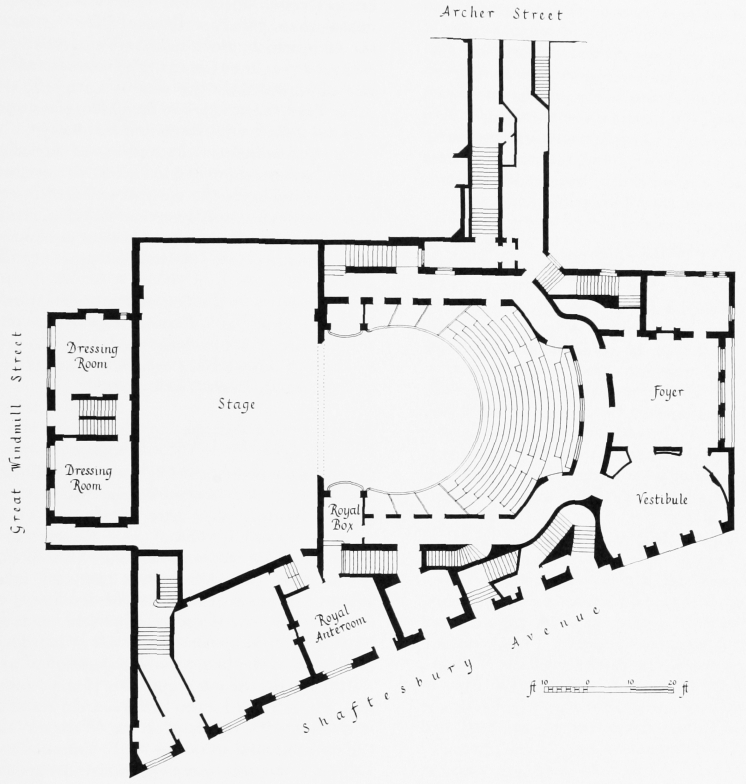
Lyric Theatre, Shaftesbury Avenue, plan of dress-circle level in 1888. Redrawn from a plan in the possession of the London County Council
In view of the irregularity of the site, and the stipulation of the client that, in addition to the usual access staircases, rentable offices and chambers (now shops and offices) must be provided along Shaftesbury Avenue, Phipps made this side of the building a long canted screen to the auditorium, which lies on a more nearly east-west axis behind it. The stage lies at the west end of the axis, on part of the former site of Dr. Hunter's house and museum, the western portion of which was retained and altered to form a stack of dressingrooms at the back of the stage (fn. 68) (fig. 9).
The Shaftesbury Avenue elevation, faced with red brick dressed with Portland stone, consists of three gabled pavilions divided by three-window bays crowned with pedimented dormers (Plate 34a). What appears to be the principal doorway, centred under the central and loftiest gable, is an exit; the entrance to main vestibule, dress circle and stalls is at the eastern end, that to the separate offices at the western end. The ornamental details are of undistinguished Renaissance character.
Phipps was a seasoned theatre architect, and did not mind repeating himself. The auditorium of his last and best theatre, Her Majesty's in the Haymarket erected in 1896–7, had much in common with that of the Lyric. In both, the elliptical proscenium arch rests on pairs of giant Corinthian columns, each pair of columns flanking three superimposed boxes; the circular centre-piece of the ceiling is divided into wedge-shaped sections; the partly cantilevered tiers (three at the Lyric, two at Her Majesty's) rest partly on slender columns. In both theatres the layout of the stalls is similar, but one feature is peculiar to the Lyric, three boxes on either side of the dress circle (Plate 34b).
The original colour scheme was quiet in character, the proscenium arch being of brown and white alabaster, while the walls of stalls and pit were lined with panelled walnut and sycamore, and the walls of circles and boxes were covered with gold-stamped leather paper. The 'grand hall' in the second circle was 'early French Renaissance', the vestibule, crush-room, and corridors were in 'Pompeian style', while the Royal box followed the style of Robert Adam, and the stall foyer and smoking-room imitated an early Dutch interior. (fn. 69)
The Lyric is said to have been built with the profits which Dorothy had previously earned for H. J. Leslie at the Prince of Wales's Theatre (fn. 70) and it was certainly Leslie's aim, in conjunction with Stephenson and Cellier, 'to meet a demand which they believed to exist in all parts of the country for English Comedy-Opera.' (fn. 63) The new theatre originally had a capacity of nearly 1600 (fn. 69) and for some years musical comedy and comic opera formed the main attraction there. Leslie himself appears to have made no profit by his new theatre (he died in poverty), and by 1890 Horace Sedger had become the licensee, manager and sole lessee at the then enormous rent of £6500 per year. (fn. 71)
One of the most notable productions was Oscar Straus's comic opera, The Chocolate Soldier, an unauthorized parody on Bernard Shaw's Arms and the Man, which, much to Shaw's annoyance, ran for over a year in 1910–11. The musical tradition was continued after the war of 1914–18, with Lilac Time (1923–4), but thereafter plays occupied the theatre with increasing frequency.
In 1932 complete redecoration was carried out under the supervision of Michael Rosenauer, who was responsible for the reconstruction of the entrance vestibule, crush-room and stalls bar, and for their decoration in a plain style then fashionable, with extensive use of walnut panelling and mirrors. (fn. 72)
Five years later the first public presentation of Laurence Housman's Victoria Regina took place at the Lyric. (fn. 73) More recent productions have included T. S. Eliot's The Confidential Clerk (1953– 4), and Irma la Douce (1958–62). (fn. 63)
The Apollo Theatre
The site now occupied by the Apollo Theatre and No. 33 Shaftesbury Avenue was the only ground fronting that part of the new street between Piccadilly Circus and Rupert Street which was not acquired by the Metropolitan Board of Works. Apart from two very minor adjustments required to fit in with the line of the new street the site remained in private hands and provides a striking example of the extraordinary parsimony of the Board in the acquisition of land.
In 1900 the site was acquired by Henry Lowenfeld, who selected Lewen Sharp as architect of the new theatre. (fn. 74) The builder was Walter Wallis, and the sculptural work was by T. Simpson. (fn. 75)
This is the only complete theatre designed by Lewen Sharp, whose only other work connected with the stage was the extensive alteration of the Camberwell Palace of Varieties in 1908. (fn. 76)
The axis of the Apollo is approximately northsouth, with the stage at the north end and the entrance fronting Shaftesbury Avenue at the south end (fig. 10). The north side faces Archer Street and the east flank fronts Rupert Street.
The Shaftesbury Avenue front (Plate 34a) is of stone, an astylar composition designed in a free Renaissance style, four storeys high with shallow canted end features crowned with little cupolas flanking the centre which contains the main entrance and three windows on each of the upper floors. The main entablature above second-floor level extends the whole width of the elevation and the top or third floor is in the form of an attic storey. All the third-floor windows are vertical elliptical openings, those in each end feature being flanked by pairs of flamboyantly draped winged figures carved in high relief by T. Simpson. The symmetry of the front is broken by the pattern of fenestration in the end features, the west having three pairs of windows stepped to follow the line of the gallery staircase, and the east having two pairs of windows. The first-floor windows are linked by a solid-fronted balcony, originally intended to be of open strapwork (fn. 77) and there is an iron and glass canopy below. In comparison with most theatre façades of the day, there is a good deal of plain wall surface here, a tendency more noticeable in the office buildings of 1900. The fronts to Rupert Street and Archer Street are utilitarian in character, and faced in red brick.
The original interior decoration, executed by Messrs. Hooydonk, was in the style of Louis XIV, to a colour scheme of white and gold with crimson fabric panels. The plan is simple, long corridors and passages being avoided so that the entire theatre can be quickly cleared. Staircases serve each of the four corners of the stalls and dress circle, the upper circle and gallery each having two separate staircases (fn. 78) (Plate 35).
Henry Lowenfeld was both proprietor and manager, and the theatre opened on 21 February 1901 with an American musical farce, The Belle of Bohemia, by Harry B. Smith and music by Ludwig Englander. (fn. 63)
In 1932 the interior of the theatre was redecorated, E. Schaufelberg being the architect. (fn. 79)
For some twenty years the theatre was used mainly for musical comedy. Notable productions in more recent years have included Sean O'Casey's The Silver Tassie (1929), Emlyn Williams's The Light of Heart (1940) and Terence Rattigan's Flare Path (1942). (fn. 80)
No. 33 Shaftesbury Avenue
No. 33 Shaftesbury Avenue (formerly No. 39 Rupert Street) occupies the corner site between the front and side elevations of the Apollo Theatre (Plate 138b). It was built as the Prince Rupert Tavern at about the same time as the theatre, but neither architect nor client is known. It is possible, however, that Lewen Sharp may have designed it for Henry Lowenfeld, who is listed as occupant in 1902. (fn. 62) While not uniform with the Apollo, the former tavern has a similar distinction, being an attractive and accomplished essay in the vernacular Baroque style of central Europe. The ground storey, originally divided into bays by spirally-fluted columns, has been modernized and only the modillioned cornice remains. The upper face, of red brick elaborately dressed with stone, contains two storeys, both divided by pilasters into bays, one window wide, two facing Shaftesbury Avenue and four towards Rupert Street. The lower order is Doric with blocked shafts, and the upper order is Ionic. All the windows are, or were, casements set in rectangular openings, elaborately dressed with Baroque surrounds. Those of the first floor have lugged architraves with segmental heads framing tympana composed of voussoirs and keystones carved with double eagles. The second-floor windows have similar architraves, headed with scrolls linked by festoons, below segmental or angular pediments. Above the main cornice rises the tall hipped roof, broken by large dormers. The graceful wrought-iron sign bracket projecting from the angle of the building is, presumably, part of the original tavern sign.
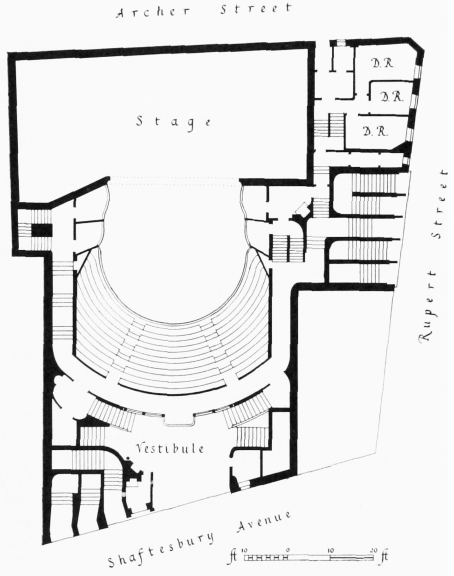
Apollo Theatre, Shaftesbury Avenue, plan of balcony level in 1900. Redrawn from a plan in the possession of the London County Council
The Globe Theatre, Nos. 39-45 (odd) Shaftesbury Avenue, and the Queen's Theatre
The Globe Theatre was formerly the Hicks Theatre
Between Rupert and Greek Streets Shaftesbury Avenue follows the line of Richmond and King Streets, which were widened by the demolition of all the buildings on their south sides. On the north side, where no alteration was made in the existing line of street, no land was acquired by the Metropolitan Board of Works.
In 1904 Jack Jacobus, the owner of a boot and shoe maker's establishment in Shaftesbury Avenue, in association with Sydney Marler, an estate agent, bought an eighty-year building lease of the block bounded by Rupert Street, Upper Rupert Street (now Winnett Street), Wardour Street and Shaftesbury Avenue. They intended to enlarge Jacobus's premises and to build two theatres on the site. (fn. 81) The architect for the whole scheme was W. G. R. Sprague. He placed one theatre— now the Globe—at the south-east corner of Rupert Street and the other—the Queen's—at the south-west corner of Wardour Street (fig. 11); he gave the two theatres similar elevations and the centre of the frontage to Shaftesbury Avenue (now Nos. 39–45 odd) was occupied by Jacobus's boot and shoe business. The builder of both theatres was Walter Wallis of Balham. The Globe (then known as the Hicks Theatre) was opened on 27 December 1906 and the Queen's on 8 October 1907. (fn. 82)
The Globe Theatre
This theatre opened under the name of the Hicks Theatre. Charles Frohman was licensee and manager, but Seymour Hicks had a share in the venture, and he played the lead in the first production, The Beauty of Bath (a transfer from the Aldwych). Within a short time Hicks disposed of his interest in it and in July 1909 the name was changed to the Globe Theatre. Charles Frohman continued as lessee and manager until 1913, but in January 1915 the licensee was Alfred Butt, whose first production at the Globe was J. Hartley Manners's Peg o' my Heart (transferred from the Comedy). In 1918 Anthony Prinsep and his wife Marie Löhr became the lessees, (fn. 63) and Prinsep's productions included Love in a Cottage, Our Betters (both by Somerset Maugham) and Noël Coward's Fallen Angels. (fn. 83) Prinsep's management ended in 1928, and in 1930 the lease of both the Globe and the Queen's was sold for over £250,000 to a firm connected with Maurice Browne, the actor and manager.
Notable productions in more recent years have included Robert Ardrey's Thunder Rock (1940), Terence Rattigan's While the Sun Shines (1943– 6), Christopher Fry's The Lady's Not for Burning (1949–50) and Ring Round the Moon (1950–1). (fn. 63) In 1959 the leases of the Globe and the Queen's were bought by Prince Littler's Associated Theatre Properties (London) Ltd. (fn. 84)
The Queen's Theatre
The first lessee and manager here was J. E. Vedrenne, who originally proposed to call the theatre The Central—'as if it were a criminal court or a railway terminus', commented Bernard Shaw. Later, when the present name had been decided upon Shaw remarked that Vedrenne was 'after a knighthood … it is not for nothing he has called his theatre the Queen's—though why not the Alexandra?' (fn. 85) The theatre opened on 8 October 1907 with The Sugar Bowl, a comedy by Madeleine Lucette Ryley. (fn. 63)
Success eluded the Queen's for some years, and despite H. B. Irving's series of productions in 1909–11 there was no long run until 1914, when Montague Glass's comedy Potash and Perlmutter achieved fame. On 17 September 1929 Bernard Shaw's The Apple Cart had its first performance in London at the Queen's, as also, on 23 September 1930, did Rudolph Besier's The Barretts of Wimpole Street. During the 1930's the theatre was the scene of a series of successful productions, culminating in (Sir) John Gielgud's distinguished season of classic plays in 1937–8. (fn. 63) On 24 September 1940 the theatre was struck by a bomb which severely damaged the vestibule and front of house. (fn. 86) Complete rebuilding was not necessary, for the bomb had fallen at the south end of the building, and the auditorium had escaped with relatively little damage. Reconstruction began in 1957, the architect being Bryan Westwood, of Westwood, Sons and Partners, in co-operation with Sir Hugh Casson, who was the consultant on the décor.
The theatre was re-opened on 8 July 1959. (fn. 63)
Architectural description
The Globe and the Queen's Theatres were designed as part of one composition, with basically similar plans and elevations, although with different schemes of interior decoration. Originally the front to Shaftesbury Avenue, between Rupert and Wardour Streets, consisted of the theatres, twin corner buildings of Portland stone, each four storeys high and crowned with buttressed and domed angle turrets, flanking a shop and office building of similar architectural treatment, five bays wide and one storey higher than the theatres. The corner buildings contain the entrances, foyers and bars of the theatres and behind these and the office building are the 'working' parts of the theatres, the auditoria being placed side by side on a north-south axis with the stages to the north and ranges of dressing-rooms fronting Winnett Street. The 'entrance pile' of the Queen's has been rebuilt in a completely new form since its destruction in the last war but the rest of the joint street front remains, together with the auditoria and stages behind (Plate 36).
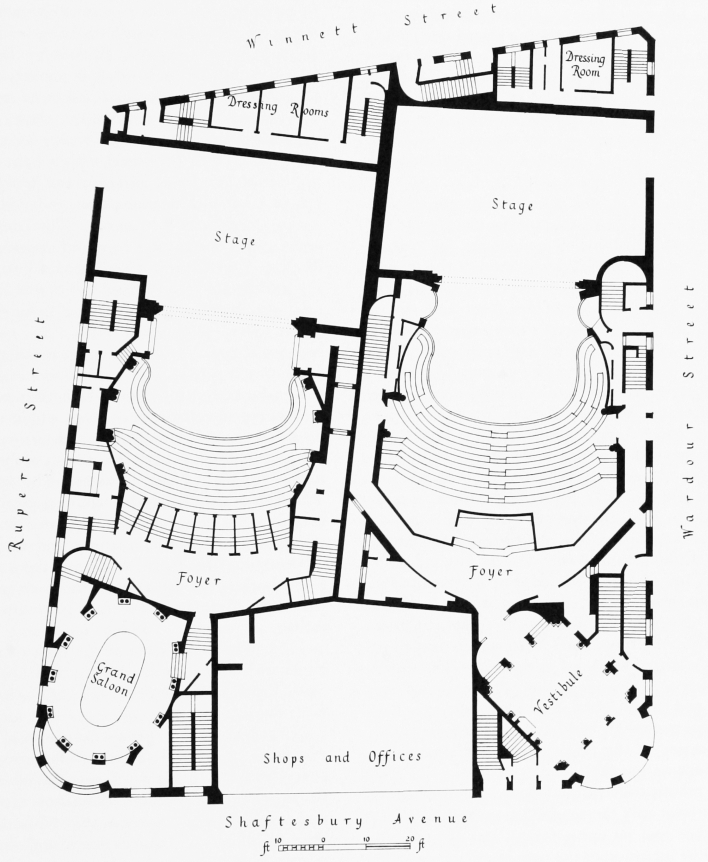
Globe Theatre, Shaftesbury Avenue, plan of dress-circle level in 1924 (left): Queen's Theatre, Shaftesbury Avenue, plan of entrance level in 1935 (right). Redrawn from plans in the possession of the London County Council
The original façade, where unaltered, is in a ripe Edwardian Renaissance style, the bays of the central office building being defined by a giant order of Ionic pilasters rising through the second and third storeys to support the main entablature, which is continued across the front and return face of the Globe Theatre, the pedestal-course below the order being similarly continued. The corner of the Globe is treated as a circular tower inset between the main and return frontages. The base of this tower rises as a triple arcade above the entrance canopy, with projecting keyblocks engaging the soffit of the lower member to the second-floor pedestal. Above the pedestal rise engaged columns of a giant Ionic order, corresponding to the pilasters of the office building, and supporting the continued entablature which, girdling the 'tower', breaks forward over each column. Above the cornice of the theatre front is a stone balustrade, over which rises the heavily buttressed and domed turret. Other motifs from the Edwardian Renaissance repertoire include circular windows with keyblocks, scrolls and other enrichments in the third storey of the theatre and the fourth storey of the offices, heavy segmental pediments emphasizing end bays in the fourth storey of the office block, and stone vases and groups on the skyline.
The rebuilt front of the Queen's, completed in 1959, retains only the rounded frontage line of its predecessor and its eaves follow the old cornice level. The intention of the new glass curtain-wall is said to have been partly to make playbills and posters inside the foyer visible from the pavement, and partly 'to make the bright lights and gaiety of Shaftesbury-avenue the backcloth to the dresscircle and upper-circle bars and to provide in the upper part a background for the necessary lettered theatre announcements'. (fn. 87) Infilling panels between the windows are finished in 'purplishblack' ceramic mosaic and the flank to Wardour Street is of grey semi-glazed bricks.
The Globe has a seating capacity of about 907, in an auditorium with two cantilevered tiers, the upper continued by a gallery rising behind. The rectangular proscenium, flanked by boxes (two superimposed on each side), is set between giant square-shafted Corinthian columns supporting the returns of the entablature above the proscenium (Plate 37a). The circular centrepiece of the ceiling (later furnished with a light-fitting of the 1930's) contains garlands and wedge-shaped panels filled with trophies in accordance with the general Louis XVI décor. The concave side walls to the front of the dress and upper circles are decorated with pairs of engaged Ionic columns supporting entablatures, and this theme is repeated on the walls of the 'Grand Saloon' behind the dress circle where they occur within an arcade and support a coved oval ceiling. The saloon has a corresponding oval well in its floor, overlooking the entrance foyer below, which thus becomes a two-storeyed compartment from which one looks up to the coved ceiling of the saloon—perhaps a small-scale allusion to the treatment of the rotunda saloon at Drury Lane Theatre. The account in The Times, following the opening performance, describes the new house as follows: 'It is all in white and gold, with hangings and carpets of a soft and beautiful shade of red; and the promenade at the back of the dress circle, the wide gangways, and the gallery over the hall help towards the feeling of space … which too many theatres lack.' (fn. 88) The promenade at the back of the dress circle was filled in with a range of boxes in 1914 by J. Emblin Walker. (fn. 79) These boxes have since been removed.
The Queen's also has two cantilevered tiers and a capacity of about 1000. The architectural character of the auditorium was described in The Stage as the 'Old Italian Renaissance style' and the original colour scheme was white and gold with green carpets, hangings and upholstery, besides which there was a 'very charming velvet tableau curtain'. (fn. 89) Much of this original auditorium remains, united with the new foyers (Plate 37b). The proscenium is rectangular and is flanked by three superimposed boxes on either side. The box fronts and their surrounding architecture have been remodelled, but in the cornice and cove over the proscenium, the oval saucer dome, and much of the treament of the balcony fronts and side wall, Sprague's work is still recognizable. The dome, surrounded with heavy Renaissance mouldings and divided into lunettes with over-life-size seated figures of muses or nymphs in plaster relief has lost its extremely elaborate chandelier and is now illuminated from a large ring suspended below it like a floating moulding. In the original work garlands, amorini and other motifs typical of Edwardian decoration filled panels over the proscenium and covered the fronts of the tiers and boxes, and here again much survives. The front of the building, however, containing foyers, stairs and bars has been completely rebuilt, as the new glass front clearly demonstrates. The original entrance foyer, or grand crush-room, formerly corresponding to the Globe's open-ceilinged foyer described above but quite different in style, was a square lofty hall with attached half-columns on pedestals around three sides of it supporting fragmentary entablatures and a groined cove below a circular ceiling. From the fourth side rose a white marble staircase branching symmetrically to a balcony overlooking the foyer. This square compartment, placed on a diagonal from the corner, was entered from an outer semi-circular vestibule while pit and gallery staircases filled the intervening triangular space next to Shaftesbury Avenue. These three areas are now one, the new main foyer furnished with plain surfaces of white terrazzo, dark woods and thick carpet, from which a wide staircase rises on one side.
The London Pavilion
The present London Pavilion stands upon the site of Loibl and Sonnhammer's music hall, described on page 55, which was demolished for the formation of Shaftesbury Avenue. The first stone of the new building was laid on 18 May 1885 (fn. 90) and the first performance there took place on 30 November of the same year. (fn. 91) The elevation of the building, and the interior of the Piccadilly Restaurant which occupied the western end of the block, were designed by Robert J. Worley. The architect in all other matters was James Ebenezer Saunders. The contractors were Messrs. Peto. (fn. 90) The building is now scarcely distinguishable as a coherent design behind a screen of illuminated advertisements.
The theatre auditorium was in the eastern part of the building, with its long axis parallel to Great Windmill Street and the stage in the north angle. The extreme northern tip of the site and the south-east angle pointing towards Coventry Street were both occupied by small shops which were incorporated into the overall design.
Worley planned the restaurant with a buffet on the ground floor, a public dining-room on the first floor some 22 feet high with a gallery on two sides and private rooms above this, with kitchens at the top of the building. (fn. 90) Saunders's auditorium as built was described and illustrated in a booklet issued by the proprietors in 1900, (fn. 92) and this showed that the lyre-shaped plan published in The Builder (fn. 90) was modified in execution to give the balconies the form of a long U (fig. 12). The flat floor of the auditorium was occupied by marble-topped tables placed end-on to the stage between banquettes or, towards the back, rows of chairs (Plate 33a). The balconies were carried on twelve iron columns which supported, above the second balcony tier, an arcade in turn surmounted by a barrel vault and a sliding roof. The long arms of the U were flanked by bars.
The London Pavilion was now 'the first music hall de luxe at the West End'. (fn. 93) Shortly after its re-opening Villiers disposed of it to a limited company (fn. 94) whose 'immense profits … appealed to the imagination, especially of the ultra respectable investor. Clergymen and district visitors abounded among its shareholders.' (fn. 93) The dominant personality in the new company was a chartered accountant, Henry Newson-Smith, who established the first combine of music halls, Syndicate Halls Ltd. (fn. 95)
In 1900 the London Pavilion was closed for five months for redecoration and structural alteration. The marble-topped tables which had originally occupied the area of the pit and stalls had been removed soon after the opening of the building in 1885, but the view from the seats which had replaced the tables had proved very poor, so now the ground floor was raked and provided with tip-up seats, and the refreshment bars were removed to a subterranean saloon beneath the stalls. The proscenium was widened and the stage itself lowered. The architects were Messrs. Wylson and Long. (fn. 96)
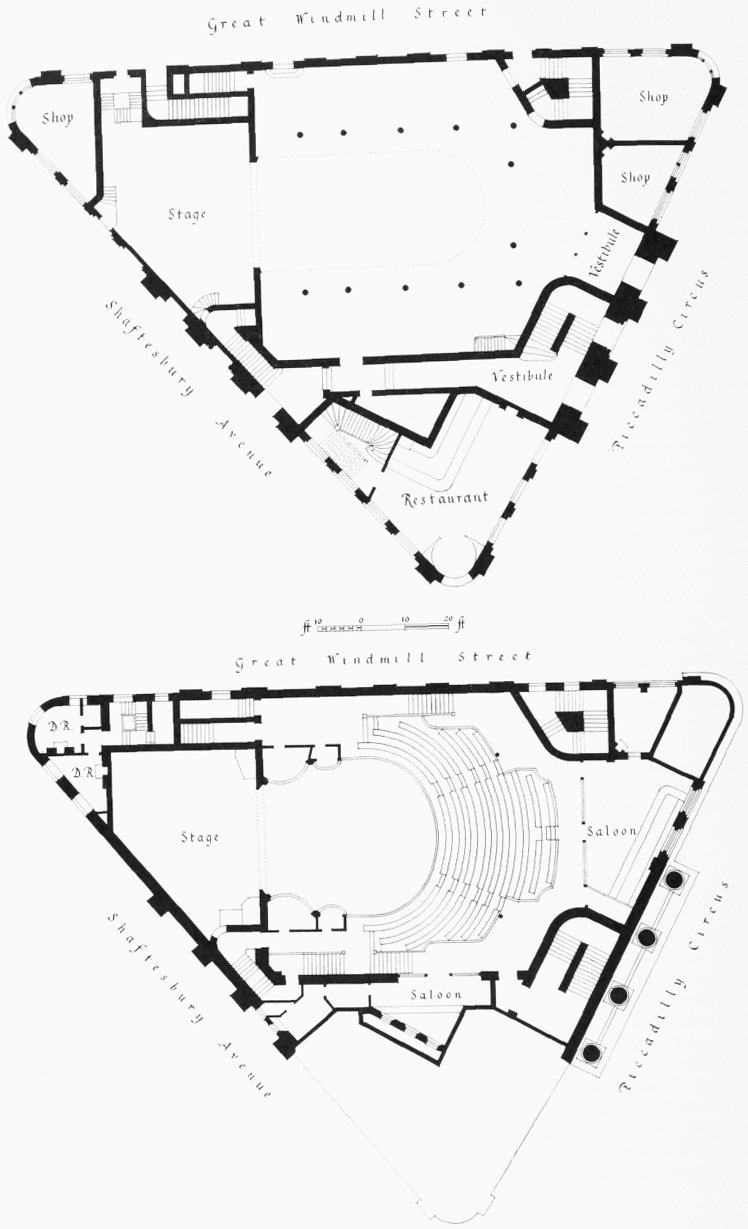
London Pavilion, Piccadilly Circus, plans: (upper) ground-floor level before 1900, (lower) dress-circle level in 1929. Redrawn from plans in the Crown Estate Office and in the possession of the London County Council
The new interior was decorated by J. M. Boekbinder (or Bockbinder) in the 'Louis Quinze' style in white or cream and gold relieved with touches of colour. (fn. 97) The stage boxes were flanked by a giant Corinthian order supporting the principal cornice over the proscenium. Above this cornice and elsewhere in the auditorium were painted panels of allegorical subjects. The proscenium opening was further decorated with sculptural groups and the balconies were elaborated with Rococo scroll-work. Terra-cotta silk, matching the colour of the upholstery and hangings, was used in wall panels. The sliding roof of the old auditorium was retained though entirely redecorated in blue, cream and gold with further painted panels of allegorical subjects in the cove. (fn. 98)
In 1915 the programme at the Pavilion included revue for the first time, and 1918 saw As You Were, C. B. Cochran's first production there. The interior of the building was remodelled again in that year for Cochran, and other alterations followed with succeeding changes in fashion. The year 1924 saw a season of films, but in the spring of 1925 came Noël Coward's On With The Dance, presented by Cochran, who continued at the Pavilion with several other productions until 1931. There were short seasons of films in 1929, 1930 and 1931, and after Cochran's last production, there was non-stop variety in 1932–4. After the last variety performance on 7 April 1934 the building was converted into a cinema, at a cost of £70,000; the architect was F. G. M. Chancellor, of Frank Matcham and Co., in association with C. Masey, and the contractors were F. G. Minter Ltd. The boxes were removed, the proscenium was again enlarged and all the moulded decorative plaster-work was discarded. (fn. 63)
The use of the exterior of the building as an advertising station for the exhibition of illuminated signs is described on page 97. The greater part of the elevation designed by Worley still survives behind the signs (Plates 32c, 33b, 155c). The fronts to Shaftesbury Avenue and Piccadilly Circus are given almost equal value architecturally. On these two main façades the ground floor is treated as a tall arcaded base for the upper storeys, of which the central feature on each face is a tetrastyle Corinthian portico with its pediment rising above the roof-line. Portland stone was used for the plinth and for the giant columns, and Bath stone for the remainder, (fn. 90) but all is now painted. The Shaftesbury Avenue front is subordinated to the shorter Piccadilly front in having an engaged order to the portico, whereas, in the case of the latter, the projecting pediment is carried on a free-standing order with pilaster responds on the main wall. On either side of each portico the windows of the principal storey and the wreathed circular windows above them are set within a blind arcade carried on a subsidiary Corinthian order engaged in the wall. Above the arcading is a moulded string surmounted by a further row of square architraved windows immediately under the main entablature. Each façade is terminated by giant Corinthian pilasters and each angle of the building is segmental on plan and forms a link between the façades, being similar to a single bay of the main elevations.
The Trocadero Restaurant
To the east of Great Windmill Street lay a narrow tapering piece of building ground bounded on its south side by the Trocadero Music Hall (see page 47). In 1888–9 a block of shops and 'residential mansions' was erected upon this most awkwardly shaped plot (Plate 29a). The architects were Messrs. Wylson and Long (fn. 99) and the builder, to whom the building lease from the Metropolitan Board of Works had been assigned, was Harry Smith of Bolton House, Chiswick. The latter had exercised his option to purchase the freehold from the Board, and in July 1890 he sold the property, known as Avenue Mansions (Nos. 8–24 (even) Shaftesbury Avenue), to the Commissioners of Woods and Forests, who were looking for good investments at that time. The Commissioners leased it back to Smith, but he had great difficulty in finding sub-tenants, and in 1895 he became bankrupt. (fn. 100)
In that year J. Lyons and Co. Ltd. were granted a ninety-nine-year lease of the adjoining Trocadero Music Hall, and in the following year they rebuilt it to a completely new design as a restaurant. The principal entrance was moved from Great Windmill Street to Shaftesbury Avenue by the acquisition of No. 8, the most westerly of the shops in Avenue Mansions, and the formation of openings in the party wall between it and the restaurant. (fn. 101) The architect for these works was J. Hatchard Smith, assisted by W. J. Ancell, (fn. 102) but in May 1896 Ancell took over control. Lyons and Co. acted as their own general contractors. (fn. 103)
In 1899 Lyons and Co. acquired the Crown lease of Avenue Mansions, and between 1900 and 1902 the building was extensively altered to suit it for use as a restaurant (Plate 29b). Openings in the party wall with the Great Windmill Street building were made on several of the upper floors, small rooms were thrown together to form larger ones, and two staircases and an additional basement were constructed. A new entrance was formed at the east end of the building, and the existing one in the centre was altered to match the doorway which had been formed at the west end in 1896; all have segmental pediments and canopies with flambeaux. A fourth entrance has since been made via the adjoining office building on the east side. The shop-windows were also changed to suit the needs of a restaurant, and even the fenestration of the upper storeys was modified. The architect for all this work was W. J. Ancell. (fn. 104)
In more recent years J. Lyons and Co. have purchased the freehold of both Avenue Mansions and the original Trocadero in Great Windmill Street. Extensive internal alterations have been made at various dates, the architect for most of them being F. J. Wills. (fn. 105)
The principal elevation of the former Avenue Mansions, in a 'Flemish' style, is faced in cut and rubbed red bricks together with Newbiggin stone. (fn. 106) The almost symmetrical composition comprises a central gabled pavilion connected to a north-eastern subsidiary pavilion, while the southwesterly end of the elevation is terminated on the upper floors by a small turret with a conical roof. Originally a single-storey shop was carried out into the angle of the site, adjoining the Trocadero in Great Windmill Street.
The Great Windmill Street building is of red Dumfries stone and Aberdeen granite in a form described as '"modern" French Renaissance'. (fn. 103) The elevation is a complex design, mainly of four storeys with a steep slated roof broken by dormer windows and large chimney-stacks, and a small gabled tower at the northern end containing two extra storeys. The two-storey entrance hall at the northerly end of the elevation was given big mullioned and transomed windows recessed between heavy piers, and above the entablature the wall face is broken by projecting balconies and an oriel.
In the entrance hall, in spite of alterations, there still remains an important decorative feature of the Trocadero in its early years. This is the great frieze some 6 feet deep and 90 feet long executed in 1896 in coloured plaster bas-relief by Gerald Moira and F. Lynn-Jenkins, on themes taken from Arthurian romance. (fn. 107)
The famous 'Long Bar' was designed in a rich free-classical style by Messrs. Davis and Emanuel, (fn. 108) and opened in 1901. Around the walls were niches flanked by engaged colonnettes of carved dark wood supporting a continuous entablature, alternating with large mirrors under semicircular arches. Behind these arches, and in panels over the niches between them, were tiles decorated with floral designs. There was a panelled ceiling with arabesque decoration, a mosaic floor with art nouveau floral borders, and the 'Long Bar' itself was of variegated marbles. Patterned leather chairs and potted palms completed a setting characteristic of this period. In 1937 the 'Long Bar' was redecorated as a cocktail lounge and called the Salted Almond. (fn. 109)