Survey of London: Volumes 31 and 32, St James Westminster, Part 2. Originally published by London County Council, London, 1963.
This free content was digitised by double rekeying. All rights reserved.
'The rebuilding of Piccadilly Circus and the Regent Street Quadrant', in Survey of London: Volumes 31 and 32, St James Westminster, Part 2, ed. F H W Sheppard (London, 1963), British History Online https://www.british-history.ac.uk/survey-london/vols31-2/pt2/pp85-100 [accessed 30 April 2025].
'The rebuilding of Piccadilly Circus and the Regent Street Quadrant', in Survey of London: Volumes 31 and 32, St James Westminster, Part 2. Edited by F H W Sheppard (London, 1963), British History Online, accessed April 30, 2025, https://www.british-history.ac.uk/survey-london/vols31-2/pt2/pp85-100.
"The rebuilding of Piccadilly Circus and the Regent Street Quadrant". Survey of London: Volumes 31 and 32, St James Westminster, Part 2. Ed. F H W Sheppard (London, 1963), British History Online. Web. 30 April 2025. https://www.british-history.ac.uk/survey-london/vols31-2/pt2/pp85-100.
In this section
CHAPTER VI
The Rebuilding of Piccadilly Circus and the Regent Street Quadrant
Piccadilly Circus was originally formed in 1819 by the intersection of Piccadilly and Nash's New Street. It was one of the two links which joined together the three sections of Regent Street, and was known as Regent Circus South, Oxford Circus being called Regent Circus North. Northwards from the Circus a short length of street, terminated at the north end by the County Fire Office, led to the Quadrant on the west and to an opening into Tichborne Street on the east (Plate 152a). The original buildings in the Circus will be described and illustrated in a later volume of the Survey of London which will be concerned with the whole of Regent Street. Since the formation of Shaftesbury Avenue in the 1880's, however, Piccadilly Circus has ceased to be a circus, (fn. 1) and has become the most famous place in the whole of London. It cannot be considered in isolation from either Shaftesbury Avenue or the Regent Street Quadrant, and its evolution away from Nash's original plan therefore comes within the scope of the present volume.
The construction of the south end of Shaftesbury Avenue involved the removal of the triangular block of buildings which formed the south-west side of Tichborne Street. This triangle also formed one of the segments of Nash's Piccadilly Circus, and its removal reduced the Circus to an undistinguished and ill-shaped vortex of converging streets (see figs. 8, 13).
Shaftesbury Avenue was opened in January 1886 and discussion of how to restore at least the rudiments of architectural propriety to Piccadilly Circus has been going on with little intermission ever since. The greatest single difficulty has been the divided ownership of the surrounding land. The ground landlord on the north, west and south sides is the Crown, while the north-east side belongs partly to the London County Council and partly to private owners (fig. 13). The wide interval of time between the date of expiry of the leases granted by the Crown and of those granted by the Council, and the very great cost of buying out existing interests, has so far prevented the rebuilding of the Circus to a homogeneous architectural design.
Three months before the opening of Shaftesbury Avenue a correspondent of The Builder complained of the ruination of Nash's Circus and suggested that 'if the curve of the Quadrant could be continued on to the new street by throwing back the frontage of Tichborne-street, there would be some chance of putting the architectural lines into shape again'. (fn. 7) This is probably the first public expression of the often repeated idea, now part of official policy, for 'squaring the Circus' by setting back the north-east side.
But the Metropolitan Board of Works had other ideas. Their acquisition of the triangular block of buildings on the south-west side of Tichborne Street and the construction of Shaftesbury Avenue through the centre of it had left the Board with two small triangular islands of ground in the new Circus (fig. 8). In June 1886 the Board's Works Committee favoured the erection on the larger or western island of a single-storey stone kiosk accommodating half-a-dozen shops and an arcade. (fn. 8) This idea was taken up by the loquacious correspondent of The Builder who suggested that the centre of the new Circus should be used for public lavatories and a bus station surmounted by stalls for flower sellers. (fn. 9) With greater wisdom Leonard Stokes, in a letter to the same paper, commented that 'Most of us, no doubt, have looked with wonder at the Piccadilly-end of Shaftesbury-avenue. How any street could ever have been set out on such lines is marvellous, not to say pitiable.' He suggested that symmetry could be restored by setting back the north-east side and proposed the erection of a fountain or statue in the centre of the Circus. (fn. 10)
These and other comments appear to have given the Board second thoughts, for in May 1887 they decided to try to restore the symmetry of Nash's original Circus by 'reproducing in some form the north-eastern portion' of it; the main feature of this remarkable structure would have been 'an archway or a pair of archways that would span the route of Shaftesbury Avenue and accommodate the traffic of that thoroughfare'. (fn. 11) But the St. James's vestry, which ardently wished to erect public lavatories upon the smaller of the two triangular islands, (fn. 12) would have none of this proposal, and not content with addressing three letters in a single day to the Board upon the subject, it persuaded half-a-dozen other metropolitan local authorities to protest likewise. (fn. 13) The Builder witheringly remarked that the Board seemed 'anxious to do all they can to prove (what required very little proof) their utter unfitness to meddle with London architecturally'. Their proposal was 'simply idiotic. Here is a fine open space obtained in a crowded and central position, and the Board propose to block the traffic and shut out the possibility of a fine architectural place by putting in the centre a shapeless block of shops, presenting no architectural form, meaning, or beauty of any kind.' (fn. 14)
Perhaps because of such opposition the Board's Works Committee decided on 17 October 1887 that as the use of the centre of the Circus for building would require statutory authority, the ground in question should be kept as an open space. At the same meeting the Works Committee also decided to offer by public auction the surplus land between the Circus and Denman Street for building and by so doing they rejected their last chance to set back the north-east side of the Circus. (fn. 15)
Public outcry against the alleged corruption of the Board was now at its height, and it was perhaps for this reason that no decision was taken about the layout of the proposed open space on the larger of the two triangular islands, which was fenced off with 'rough balks of timber supporting an unsightly wooden railing'. (fn. 16) In January 1888 the Board finally refused to permit the St. James's vestry to erect underground lavatories on the smaller of the two island plots, only to find that control of this site had passed (under the terms of the Metropolitan Street Improvement Act of 1877) to the vestry, (fn. 17) which was therefore able to defy the Board and go ahead with its long cherished scheme (fn. 18) (Plate 152b). The Shaftesbury Memorial Committee, which had asked the Board to be allowed to erect a monument in the Circus in February 1886, had to wait until January 1890 before it was granted permission by the London County Council (as successor to the Board) to place a memorial fountain on the larger island site. (fn. 19) The fountain was unveiled in July 1893 (see Chapter vii for the history of the memorial).
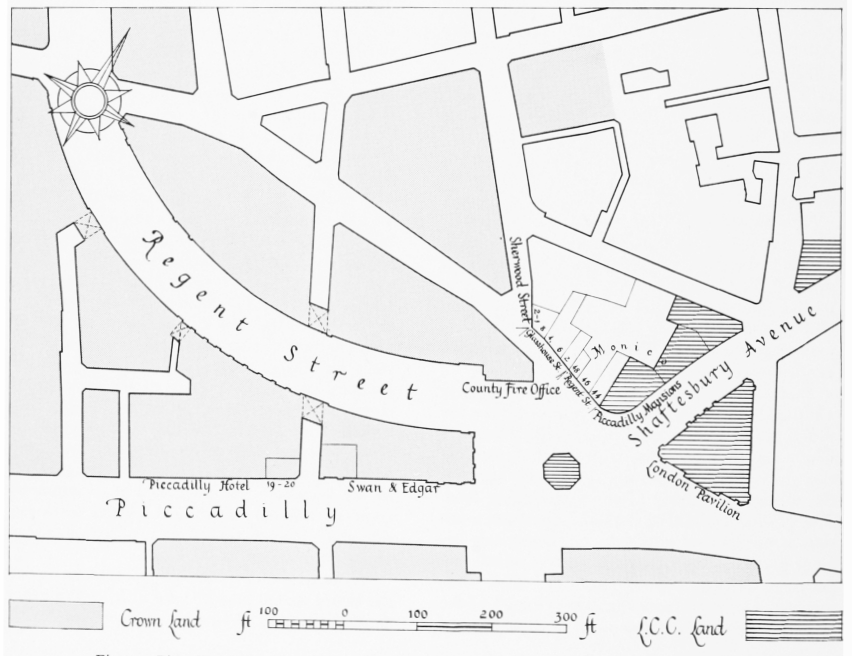
Piccadilly Circus area, plan showing the ownership of land after the rebuilding of the Regent Street Quadrant. Based on the Ordnance Survey
The next occasion on which the replanning of Piccadilly Circus became a matter of public concern was in connexion with the rebuilding of the Regent Street Quadrant. In 1901 the St. James's Hall Company, which as Crown tenant occupied a large part of the block bounded by Piccadilly, Piccadilly Place, Regent Street and Air Street, with frontages to both Piccadilly and Regent Street, agreed with the Crown to carry out extensive improvements in exchange for a fiftyyear lease. (fn. 20) Shortly afterwards the St. James's Hall Company was bought by the P. and R. Syndicate, which proposed to acquire all the outstanding leasehold interests in the whole block and erect a large hotel there. (fn. 21)
The Commissioners of Woods and Forests favoured this scheme because by the amalgamation of leasehold interests it would greatly facilitate the widening of Piccadilly between the Circus and Sackville Street, (fn. 21) negotiations for which had been proceeding with the London County Council since 1898. (fn. 22) Accordingly, in December 1903, the Syndicate and the Commissioners agreed that the former should surrender all its leases in the whole block and after erecting a new hotel thereon should receive a ninety-year lease. The elevation to the Quadrant was to accord with the general design—not yet even discussed—for the rest of the Quadrant, and the existing façade was not to be altered until such a general design had been settled. On the Piccadilly frontage the building line was to be set back to accord with the County Council's widening scheme. The agreement also provided that if the Syndicate should not succeed in acquiring the lease of Nos. 19 and 20 Piccadilly (see fig. 13), which had only recently been renewed and did not expire until 1982, it should arrange for the local authorities to buy the tenant out compulsorily and surrender the lease to the Crown, which would then lease to the Syndicate that part of the premises not required for the road widening. (fn. 21)
Shortly after approving this agreement the Treasury informed the Commissioners of Woods and Forests that 'having regard to the great architectural importance of the site, the Committee presided over by the President of the Royal Institute of British Architects should be requested to advise upon the sketches of the elevations proposed as soon as they have been prepared'. (fn. 21) The Commissioners' architect, Arthur Green, then prepared a design for the Quadrant and for the north side of Piccadilly, but he died before it could be submitted to the expert committee. The members of this body were (Sir) Aston Webb, President of the Royal Institute of British Architects 1902–4, John Belcher, who succeeded Webb in that office, and Sir John Taylor, formerly Surveyor of Royal Palaces and Public Buildings in the Office of Works. After examining Green's design they recommended that 'it would be adviseable to select some architect of eminence to revise the drawings'. They recommended, in order of preference, Richard Norman Shaw, J. Macvicar Anderson and Henry T. Hare, and in September 1904 Shaw agreed to accept the commission. (fn. 23)
Norman Shaw was then seventy-three years old and was living in virtual retirement at his house in Hampstead. In an astonishing burst of creative energy he produced in the course of a few months a design of heroic conception for the Quadrant and for the Piccadilly elevation of the proposed hotel, as well as a number of schemes for the rearrangement of the Circus. But the clamour of the shop-keepers, and the Treasury's determination that not a penny of Crown revenue should be endangered for the sake of either architectural effect or municipal improvement, combined to prevent the full realization of Shaw's proposals. The two façades of the Piccadilly Hotel are merely noble fragments, and even though Sir Reginald Blomfield later completed the Quadrant with skill and propriety, the defeat of Shaw's proposals is one of the greatest of all the many lost opportunities in the architectural history of London in the present century.
Within five weeks of his appointment Shaw submitted a preliminary design for the Quadrant to the committee of three. This provided that 'the ground floor and entresol should be a row of arches' and that the roof should go 'back on one slant with a row of dormer windows'. At the next meeting of the committee, in November 1904, the elevation for the hotel submitted by the P. and R. Syndicate's own architects, Messrs. William Woodward and Walter Emden, were summarily rejected, and the committee went on to consider Shaw's proposals for the treatment of the Circus. (fn. 23)
This first design (fn. 24) (Plate 148a) is in many ways finer than any later scheme. Shaw proposed to form a long oblong place, symmetrically arranged about its main axis, continuing the south-to-north centre of (Lower) Regent Street. On the west side of this place, centred on the short east-west axis, is the rebuilt five-bay front of Swan and Edgar's store, flanked on the north by the Quadrant, and on the south by Piccadilly, now widened to equal the Quadrant. Opposite Swan and Edgar's, on the original site of the Shaftesbury Memorial, is a corresponding building occupying an island site of an irregular hexagonal form, effectively masking the miscellany of buildings at the junction of Shaftesbury Avenue and Coventry Street, yet not interfering with the traffic circulation in the existing roadways. The south end of the place is finished with re-entrant angles flanking the entrance to (Lower) Regent Street. For the north end Shaw reserves his most impressive feature, the County Fire Office set back some 65 feet from its existing frontage line and rebuilt in a monumental style, with a loggia approached by a bold flight of steps. This building is flanked by great archways, giving entrance to Glasshouse and Sherwood Streets, and the new return frontages to the Quadrant and Sherwood Street, facing east and west, are built above open loggias, recalling the Covent Garden piazza. In front of the County Fire Office, and projecting so as to be seen from the Quadrant, Shaw places the Shaftesbury Memorial.
A sketch (Plate 148b) for the elevation of the north end of the place shows the County Fire Office with its wide flight of steps rising against a rusticated podium to the ground storey, an open arcade of five bays built in horizontally channelled courses. The two-storeyed upper face of plain masonry is recessed behind a Corinthian colonnade of five bays, terminated by rustic piers. Over the main entablature is an attic with five square windows, framed in eared and shouldered architraves broken by triple keystones, and the front is finished with a pedestal parapet, possibly intended to have balustrades between the projecting dies except in the centre where a group with a seated Britannia is placed. A one-pitched roof is faintly shadowed on the sketch. The great rusticated arches opening to the side streets are surmounted by open screens conforming with the Corinthian colonnade of the County Fire Office, the entablature of which is placed at a level just below that of the tall pavilions terminating the Quadrant and Sherwood Street.
The committee of three experts quickly approved this scheme. Unfortunately, however, it demanded that the Crown should acquire the land needed for both the County Fire Office and the hexagonal centre block, and when in February 1905 the Treasury authorized the Commissioners of Woods and Forests to employ Shaw to settle the detailed designs for the Quadrant, the Circus and the north side of Piccadilly as far as Piccadilly Place, their Lordships stated that 'they wish to reserve especially Their judgment with regard to the suggested treatment of Piccadilly Circus.' (fn. 23)
A few days later Shaw produced another sketch-plan in which Glasshouse Street was diverted slightly eastward and made to enter the north side of the Circus at right angles instead of slanting; the island site for the County Fire Office, and the hexagonal block in the centre of the Circus were both abandoned. The only advantage of this scheme was that it required the purchase of much less land by the Crown, but on even these modest proposals the Chancellor of the Exchequer, (Sir) Austen Chamberlain, commented discouragingly that 'I am not at all enthusiastic about the alterations at the point of junction of Regent Street, Glasshouse Street and Sherwood Street, and would make no move here without the hearty co-operation of the Local Authorities.' (fn. 23)
Much more urgent in the spring of 1905 was the settlement of the elevations for the hotel. In February Woodward and Emden were instructed by the Office of Woods to place themselves at Shaw's disposal, and when they saw the designs approved by the committee Shaw commented that 'they have much to say'. (fn. 25) They did in fact address a ten-page letter of protest to the Office of Woods. They complained that they had not been told that Shaw was to design the Piccadilly as well as the Quadrant elevation, that the designs had been settled without consulting either them or their clients, that the great arches and wide piers on the ground floor and the round windows on the second floor of the Quadrant elevation were quite unsuitable, and finally (and with most justice) that their clients should have been told before and not after the conclusion of the building agreement with the Crown that they would be required to build elevations over whose design they had no control. (fn. 25)
In April 1905 Shaw, although quite unmoved by these complaints, produced an entirely new design for the Piccadilly front. This provided for the main body of the building to be set back at second-floor level, and for two great projecting gabled wings joined by a huge columned screen. By this arrangement the building could be carried up to a much greater height than would otherwise have been permitted, and there was in consequence no loss of space. (fn. 25) In his biography of Norman Shaw, Sir Reginald Blomfield later wrote 'How Shaw got away with it, how he persuaded his clients to expend very large sums on the screen, which serves no practical purpose whatever, remains a standing wonder, but Shaw was a magician in dealing with clients and committees. He seems to have had a way with him that no one could withstand, so clear, so pleasant, so convincing.' (fn. 26)
Shaw's success with the Piccadilly Hotel Company (which had replaced the P. and R. Syndicate in January 1905) (fn. 27) was partly due to the fact that the company was in no position to protest at anything he might propose. It had constantly pressed for a rapid settlement of the elevations (fn. 25) and in April 1905 it had been allowed to start demolishing its sector of the Quadrant. (fn. 23) Any delay in the settlement of the designs would cost the company a great deal of money, and Shaw was therefore in a very strong position, particularly as the hotel company were not in fact his clients. Nevertheless it was a remarkable achievement to obtain within six weeks of his production of the revised designs for the Piccadilly front, the sanction of the expert committee, of the Office of Woods and of the Treasury, as well as the agreement of the company and their architects, Woodward and Emden. Of his dealings with the latter Shaw amiably remarked 'It has taken some trouble and a good deal of talk to bring them to this desirable frame of mind, but they have arrived at it at last'. (fn. 23)
In May 1905 the chances of complete success for Shaw's designs stood at their height, the execution of his elevations for the hotel being about to start. It is now necessary to describe how the fulfilment of his plans for the Circus, for the Piccadilly front of the hotel, and for the Quadrant was largely stultified.
In July 1905 the Lords of the Treasury decided that as the Office of Woods could not recommend Shaw's scheme for the Circus 'as an investment only', they could not permit negotiations for the purchase of the land without the support and financial co-operation of the local authorities. (fn. 23) Undeterred, Shaw produced in September 1905 another design (fn. 28) (Plate 149a), which retains some features of his first design, but envisages a great square balanced about an eastwest axis with the Shaftesbury Memorial as its focal centre. The bull-nosed end of Shaftesbury Avenue is squared off, and a monumental screen extends across the east side, with a loggia in front of the London Pavilion island, and wide openings to the roadways flanked by pylons, perhaps something in the style of the sketch reproduced on page 70 of Sir Reginald Blomfield's biography of Shaw. (fn. 29) Large trees, presumably planes, are shown at regular intervals along the north and south sides, to effect a relationship and disguise the architectural disparity between Thomas Verity's Criterion and Shaw's new north front. Subsequently Shaw modified this design so as to reduce still further the amount of land which the Crown would have to buy; he also proposed to give Swan and Edgar's a bowed east end. (fn. 28)
His last plan (Plate 149b), dated March 1906, was based upon the hope that if the Crown agreed to set back the line of frontage of the east and south sides of Swan and Edgar's, the London County Council would in return demolish Piccadilly Mansions. The columned screen across the east end of the Circus was replaced by a deep portico which was to be added to the London Pavilion to provide the centrepiece of the east side of the Circus. Sagaciously The Builder commented that the plan was 'too good to be true; too thorough a reforming to have the best chance of being carried out'. (fn. 30)
In the autumn of 1905 the Commissioners of Woods and Forests asked the Treasury to reconsider their decision of July, and in November the latter grudgingly authorized the purchase of property provided that it was a good investment and not merely wanted for Shaw's designs. The premises needed were Nos. 2–8 (even) Glasshouse Street and Nos. 1 and 2 Sherwood Street (fig. 13), but in May 1906 John Murray, the Crown surveyor, reported that there was no chance of buying them except compulsorily. In the same month the Treasury specifically excepted Shaw's Circus plans from the final approval which was accorded to his other designs. So perished Shaw's last chance to restore architectural harmony to the Circus. (fn. 28)
But with the rebuilding of part of the Quadrant already under way, the settlement of the treatment of the Circus could not be indefinitely postponed, and in 1908 John Murray prepared two plans. The aim of both of them was to form a rectangular open space, which was to be achieved by the Office of Woods and the London County Council each agreeing to surrender part of their land. In April 1909 one of these plans, which involved the demolition of the Monico and Piccadilly Mansions, setting back the eastend of Swan and Edgar's by 70 feet and advancing the London Pavilion by a corresponding distance, was sent to the County Council for consideration. Norman Shaw rightly objected to this drastic reduction in the length of the Quadrant, which he maintained would be reduced to a mere segment, and subsequently the Office of Woods appears to have had second thoughts on the matter. (fn. 31) By April 1910, when a conference between the Office of Woods, the County Council, the Westminster City Council and the Metropolitan Police was held, any idea of demolishing Piccadilly Mansions, the Monico or the Pavilion had been abandoned (if, indeed, it had ever been seriously considered), and agreement was only reached on the need for the arcade of the County Fire Office to be continued round the east side of the building so as to provide a foot-way into Glasshouse Street. When Swan and Edgar's building was rebuilt in the 1920's its east end was set back 12 feet. (fn. 32)
Shortly after the death of King Edward VII in May 1910, Murray suggested that the conversion of the tawdry Circus into a large rectangular open space, to be called King Edward VII Square, might be an appropriate object for the national memorial which was then under consideration. With admirable enterprise he made a plan and perspective view (Plate 153a), whose principal features included the removal of Piccadilly Mansions, the Monico, the Pavilion and the Shaftesbury Memorial Fountain and the erection of a Shakespeare Memorial Theatre and a National Opera House on the north side and an equestrian statue of the deceased monarch in the centre of the square. In the autumn Murray forwarded these proposals to the Lord Mayor, who was chairman of the memorial committee. Nothing more seems to have been heard of them, (fn. 32) and thereafter, until the 1920's, discussion of the future of the Circus seems to have been largely unofficial. In 1910 someone suggested that the whole area should be roofed in to form a rotunda with a shopping arcade at first-floor level, (fn. 33) and in 1912 another seer proposed that archways should bridge the streets entering the circus, and that 'possibly by the planning of moving stairways at several convenient intervals, a colonnade of shops at a higher level could be worked in with an increased rental advantage.' (fn. 34)
The realization of Norman Shaw's design for the Piccadilly front of the hotel was also frustrated. In their building agreement of 1903 with the Office of Woods the P. and R. Syndicate (as the hotel company was then known) had undertaken that if they should fail to acquire the lease of Nos. 19 and 20 Piccadilly, at the corner of Air Street (see fig. 13), they would arrange for the local authorities to buy out the tenant, Messrs. Denman, compulsorily, and to surrender the lease to the Crown, which would then lease to the Syndicate that part of the premises not required for the widening of Piccadilly. In 1905 the Westminster City Council, acting under the powers of Michael Angelo Taylor's Act of 1817, served notice on Denman's to treat for the sale of their premises, but in a legal action the latter successfully maintained that they were not bound to sell any more of their ground than was needed for the actual street widening. Consequently they retained possession of the ground on which Shaw had intended one of the great projecting gables of the hotel to stand, and as their lease ran until 1982 and their building had only been erected two or three years previously, to buy them out without compulsory powers was virtually impossible. (fn. 35)
The completion of the widening of this part of Piccadilly involved setting back Denman's new building (Plate 150b), and prolonged negotiations took place between Denman's, the Office of Woods and the hotel company for the purpose of securing that the new front should be erected in accordance with Shaw's designs for the whole block. By 1908 the hotel company was in a very parlous financial position and was therefore unable or unwilling to undertake the expense; it also refused to allow Denman's to erect a slightly modified version of Shaw's design. Ultimately, in 1911–12, Denman's set their building back to the new line of frontage and re-erected the old façade, which had been designed by their own architect, Harold A. Woodington. There was a loud outburst of protest, but as there was no new building and only the re-erection of an old façade, the Office of Woods had no power to intervene. The Builder described this melancholy occasion as 'a hopeless blunder which will remain an eyesore for years', (fn. 36) and it is unquestionable that the absence of Shaw's great eastern gable has robbed his design of much of its grandeur.
It was, however, for the Quadrant that Shaw produced his greatest work, and it was there that he suffered the heaviest defeat. His design for the complete and uniform rebuilding of this part of Regent Street is well shown in the painstakingly rendered perspective drawing by C. W. English, which was exhibited at the Royal Academy in May 1906 (Plate 150a). It was a monumental conception, simple in its general lines, bold in its modelling, and elaborate in its details, for lining the Quadrant with unbroken ranges of uniformly fronted buildings, with skilfully placed intervals and accents to break any monotony that might arise out of uniformity. The great rusticated arcade, framing the shop-fronts and mezzanine-storey windows, forms a substantial base for a giant order of Ionic columns, rising through three storeys and arranged in pairs to form sequences of five bays between single-bay features in which the windows are arranged to form vestigial arches. Above the great entablature is a row of pedimented dormers, breaking the parapet, and out of the high single-pitch roof rise great chimney-stacks of cruciform plan, a range of oval lucarnes extending between them.
The masonry of the arcade rises from a boldly moulded plinth, in channel-jointed courses alternately of smooth-faced and projecting roughfaced stones, the piers being finished with a cornice-impost (omitted in the wider and lower centred arches of the entering streets), and the arches having triple keys. The Ionic columns have plain shafts, broken up to the level of the second tier of windows by square blocks which continue the lines of the accented courses in the single-bay features. Within the colonnades are three tiers of three-light windows, one to each bay, the middle light in the second tier being circular and dressed with a swagged garland. Each single-bay feature also has three superimposed three-light windows, the top being set within the tympanum of an arch. (In the Piccadilly Hotel these bays were built with a rusticated arch framing the second- and third-floor windows.) The main entablature of moulded architrave, plain pulvino-frieze, and modillioned cornice, breaks slightly forward over each accented bay, and the dormers breaking the parapet line have, alternately, triangular and segmental pediments. In the executed part of the design, comprising the 190-foot frontage of the Piccadilly Hotel, which was erected in 1905–8, (fn. 37) a second tier of dormers with splayed sides has replaced the intended lucarnes (Plate 151a).
Shaw's design was received, except by the shopkeepers, with general acclamation. The Builder, for instance, stated that 'The front is a grand piece of masonry design, for which on the whole we can express nothing but admiration, and a satisfaction that the Quadrant should be rebuilt in so monumental a manner.' It singled out the ground storey 'with its massive rusticated arches' for particular admiration and concluded that 'the design as a whole is one which we think can only arouse a general feeling, not only of satisfaction, but of enthusiasm; its complete carrying out, which must be a matter of time, will be a great and important addition to London street architecture'. (fn. 38)
The shop-keepers, however, immediately raised a tremendous clamour against what they called 'the division of the frontage into small spaces'. They protested particularly at the width of the stone piers, the depth to which the windows were set back and the awkwardness of the semi-circular mezzanine windows. In July 1906 they presented a petition to the Office of Woods and Forests requesting that the design might be modified, but they were told that there was no possibility of any material change being made. (fn. 28)
At first these complaints were derided. The Builder said that 'The idea that a great architectural scheme by one of the first architects of the day is to be stopped because a knot of tradesmen fancy there is not plate-glass enough for them, is something too ridiculous; and if the authorities lend any ear to it they make themselves ridiculous also.' (fn. 39) The Daily Express thought that the arches were 'an artistic triumph, and Mr. Norman Shaw may well feel proud of the success of his design'. (fn. 40) Sir Aston Webb commented that 'It seems to be considered essential by some to face the whole of the ground and first-floor fronts of a long series of houses with an appalling mixture of plate-glass, looking-glass, and tawdry wood and brass work; to commence any architectural treatment on the second floor, and to cover the whole building over in due course with advertising announcements.' (fn. 28)
The shops in the Quadrant within the hotel block were ready for occupation in December 1906, but by April 1907 not one had been taken; the manager of Swan and Edgar's, who was prominent in the agitation against Shaw's design, said that they were 'very suitable for Newgate, but utterly absurd for commercial purposes'. Questions were asked in the House of Commons whether the rest of the Quadrant was to be built to the same design, there was much debate in the press, and a Regent Street Rebuilding Committee was formed for the purpose of obtaining modifications in the elevations. (fn. 41)
By January 1908 only one of the shops had been let, and the hotel company was worried at the consequent loss of income—much of which was, apparently, due to the prohibitive rents at first demanded. (fn. 40) The hotel itself was opened on 6 May 1908, (fn. 42) but a receiver in bankruptcy was appointed on 10 August of the same year. The contract price for the erection of the building by Herbert Henry Bartlett, was £359,176, but the actual cost was £552,401, exclusive of furnishings and equipment (£161,111). The difference between the estimated and the actual cost was, of course, attributed 'to a large extent to alterations in the plans made by the Crown authorities', and the unsuitable design of the shops was also said to have reduced the company's estimated annual rental by over £21,000 per annum. There was a total deficiency of over one and a half million pounds, and in 1909 the company was wound up. (fn. 43) (fn. 2)
The failure of the Piccadilly Hotel Company greatly strengthened the agitation against the completion of the rebuilding of the Quadrant to Shaw's designs. The passage of time was also progressively weakening the position of the Commissioners of Woods, who never forgot that all the existing leases in the Quadrant would expire by 1919, and that the continued refusal of the existing tenant shop-keepers to rebuild in accordance with the approved designs could, if continued long enough, cause a disastrous loss of revenue to the Crown. (fn. 3) By 1908 the relative strength of landlord and tenant had shifted sufficiently for the Office of Woods at least to consider a proposal from Swan and Edgar to rebuild at once the whole block from the Circus to Air Street provided that some modification of Shaw's shop-windows would be permitted. The advisory committee of architects, (fn. 4) to whom the matter was referred, quickly reported that 'the proposal is to have a continuous sheet of plate glass for practically the length of the building, obliterating the piers of the Arcade. This cannot be entertained.' (fn. 40) Two years later, however, the modification of the design of the second- and third-floor windows, about whose shape and size there had been complaints, was being seriously considered. (fn. 44)
The year 1912 proved to be the crucial period in the rebuilding of the Quadrant. Four years had passed since the completion of the hotel, but no more building had been started and within seven years all the existing leases would expire. In January 1912 Mr. Henry Tanner (son of Sir Henry Tanner), acting on behalf of Hope Brothers, the tenants of Nos. 84–88 (even) Regent Street, submitted designs for the rebuilding of the whole of the north side of the Quadrant between Glasshouse Street and Air Street. The principal innovations were the omission of the ground-storey arcade, the curtailment of the width of the stone piers and the alteration of the windows of the upper storeys. As surveyor to the Office of Woods John Murray recommended acceptance of the designs and in February they were submitted to Norman Shaw for his comments. (fn. 32)
Shaw was now in his eighty-first year, and was, in his own words, 'well nigh played out and have very little vitality left'. To the Office of Woods he replied 'It is with the deepest regret that I hear of the proposed mutilation of my design for rebuilding the Quadrant. I am, I am afraid, getting somewhat indifferent to architectural matters, but I have not yet arrived at the stage of absolute indifference, and to see a design with which I took so much pains thus vulgarized, troubles me. I am sure that your department has done everything that can be done, but circumstances (and the shopkeepers!) are too strong for us, at present.
'The design you send me is as good as you are likely to get. So subject to minor alterations I should advise its being accepted.' He was willing to help with these minor alterations, but 'would much rather not'. (fn. 32)
Two weeks later, on 1 March, when he had studied Tanner's designs more thoroughly, he finally resigned all connexion with what was to have been his final masterpiece. To the Office of Woods he wrote 'I have pored over the design for the Quadrant till I am worn out, and now I am compelled most reluctantly to ask you to allow me to retire. The question really lies in very small compass. At one time the design might be said to be mine, and of course I was prepared to stand or fall by its merits or demerits. But now all is changed. To fully understand this it is necessary to go into some details.
'From the first I was anxious to give the street more or less of a monumental character. As an architect I dwelt much on the piers and arches on pavement level to carry the upper part, but they have gone bodily. The arrangement of windows between the columns on 1st. 2nd. and 3d. floors I had hoped would have given some distinctive character, but they have gone, and very commonplace windows inserted giving the whole finish the aspect of a block of flats—even the pillars themselves have been mutilated, by the omission of the blocks on the lower part. I hope I do not exaggerate, but with all these alterations it can be no longer said to be my design at all, and practically a new design would be required of which all the odium would attach to me. I cannot say I should like that, nor do I think, should I be exposed to it. … The original design had the approval of the Committee appointed by the Treasury. . . . Every detail had their careful examination and approval and for me to set all this aside and to make a fresh scheme to fall in with the views of some shopkeepers might I fear be misunderstood and subject me to merited censure.' (fn. 45) Shaw died eight months later, on 17 November 1912.
Norman Shaw's resignation was followed by a general hue and cry in the press against the Office of Woods and against the neglect of the shopkeepers' needs. (fn. 46) In April The Builder announced that it would hold a competition for the best design for the completion of the Quadrant in harmony with both the Piccadilly Hotel's sector and with the wishes of the shop-keepers. (fn. 47) On 25 June the future of the street was discussed in the House of Commons and in September the Government appointed a committee to consider the design to be adopted for the completion of the Quadrant, bearing in mind aesthetic considerations, commercial requirements and the interests of the land revenues of the Crown. The members of the committee were the Earl of Plymouth (chairman), President of the London Society and a former First Commissioner of Works, Sir Henry Tanner, John Murray and (Sir) Reginald Blomfield, President of the Royal Institute of British Architects 1912–14. (fn. 46)
The committee inspected a large number of designs (many of them having been made for The Builder's competition, which was won by A. E. Richardson and C. L. Gill) (fn. 48) and heard evidence from several tradesmen, notably from representatives of the Cafe Royal, Hope Brothers and Swan and Edgar; the latter demanded 'windows from twenty to sixty feet [in width] between visible points of support'. All the architects who gave their views said that this was impossible. W. E. Riley, architect to the London County Council, drew attention to the width of the shop-windows and supporting piers of the new buildings erected by Selfridge, Waring and Gillow, Gorringe, and Burberry, and pointed out that by comparison with these the width of the shop-windows at the Piccadilly Hotel could not be regarded as exceptionally small. The report of the committee, which was published in 1913, recommended that Norman Shaw's hotel façade should be treated as the centre of a symmetrical composition, and that the roof-line of the hotel should be continued for the whole length of the Quadrant, the treatment of the dormers and chimneys being modified. On the ground and mezzanine floors the great round arches were to be replaced by rectangular openings, but the span between the piers was not to exceed 25 feet. Between the mezzanine and entablature the recessed columnar treatment of the hotel façade was to be omitted. Subject to these provisos, the general character of the design should follow that of the hotel. (fn. 49)
Surprisingly, the Commissioners of Woods did not order the preparation of a design which would comply with these recommendations, but contented themselves with considering such designs as any of the tenants might submit. (fn. 50) In the second half of 1913 John Belcher and Mr. Henry Tanner, acting on behalf of Hope Brothers, discussed designs with the Office of Woods and with the committee. In these deliberations (Sir) Reginald Blomfield took a prominent part (fn. 51) and ultimately, in May 1914, a design was agreed and submitted to the Treasury for final approval. (fn. 52)
Lloyd George, who was Chancellor of the Exchequer, proved unable or unwilling to reach a decision, and in February 1915 the matter was referred to the Cabinet. There it was decided that the design approved by the Office of Woods should be rejected and that a new plan should be prepared which whilst meeting modern requirements would 'retain as far as possible the general character of the present buildings'. (fn. 52)
This fiat merely created a fresh and quite insoluble problem, for clearly the general character of Nash's buildings would not be retained if the roof-line were raised to the level of that of the Piccadilly Hotel. John Murray quickly prepared two designs, in both of which the roof-line was much lower than that of the hotel. In July 1915 these were submitted to the Cabinet, when the Prime Minister (H. H. Asquith) remitted the whole matter to Lord Selborne (who as President of the Board of Agriculture was the minister responsible for the affairs of the Office of Woods) with authority to act on behalf of the Cabinet. (fn. 52)
A few weeks later a conference was held at which the following were present: the Earl of Plymouth, Sir Henry Tanner, (Sir) Reginald Blomfield and John Murray, all members of the Quadrant enquiry committee, plus Sir Aston Webb and Ernest Newton (President of the Royal Institute of British Architects 1914–17) as additional members, and Lewis Harcourt (First Commissioner of Works, later Lord Harcourt) and Lord Selborne. They all agreed that to lower the level of the roof on either side of the existing hotel, as required by the Cabinet, was impossible, and Murray was instructed to prepare further designs. In the course of the discussions which followed it was ultimately agreed that Blomfield, Webb and Newton should jointly prepare a fresh design, and in January 1916 the Treasury authorized this procedure. (fn. 52)
During 1916 agreement was reached between the Westminster City Council, the London County Council and the Office of Woods for the widening of Vigo Street on the north side as far as Sackville Street and of Glasshouse Street on the south side between Regent Street and Warwick Street; the closing of Warwick Street south of Glasshouse Street; and the arching over of Air Street on both sides of the Quadrant and of Swallow Street and Vine Street (now Man in Moon Passage) on the south side. (fn. 53) The oneeighth inch scale drawings for the new design were signed by Webb, Newton and Blomfield but the latter stated that the first two 'had in fact nothing to do with the design', which they had specifically requested Blomfield to undertake alone. (fn. 54) On 24 June 1917 these drawings were finally approved and signed by Lords Selborne, Harcourt and Plymouth, whose decision was taken as final. (fn. 55) The half-inch scale detail drawings for the elevations were signed at the bottom by Blomfield and dated 1917 or 1918, and at the top by Blomfield, Webb and Newton, and dated 1918. (fn. 56)
The rebuilding of the Quadrant to Blomfield's design began in April 1923, (fn. 57) and was completed in 1928. (fn. 58) The construction of the new tube station in Piccadilly Circus began in 1925 and the new circular concourse and escalators were opened on 10 December 1928. The engineer was Harley H. Dalrymple-Hay, the architects were Adams, Holden, and Pearson, and the principal contractors were John Mowlemand Co. Ltd. (fn. 59)
Architectural description: the Piccadilly Hotel
The main part of the Piccadilly Hotel is planned roughly in the form of a letter V, opening towards the west, with one arm fronting directly to the Quadrant and the other facing south, parallel with, but set well back from Piccadilly, and having at each end a tall wing flanking the low range fronting that thoroughfare.
The north front (Plate 151a) is the only section of Shaw's Quadrant to be erected, and comprises one complete sequence of six colonnaded bays between two accented single bays, and one colonnaded bay to the west. The Piccadilly front (Plate 150b), however, was designed as an entity and is incomplete only because of the deplorable muddle over the Denman House rebuilding. Shaw repeated the rusticated arcade of the Quadrant with a regular sequence of eleven arches (the easternmost two not executed). Above the arcade is a channel-jointed face of one storey containing a range of plain windows, five grouped above the western pair of arches and the rest arranged in nine evenly spaced pairs over the seven arches of the centre. This change of rhythm from seven to nine bays was made to suit the intercolumniation of the Ionic screen that links the east and west wings. Each end bay of this screen is filled with three superimposed windows and flanked by rusticated pilasters, but the seven bays between the plain-shafted columns are left open, with balustrades between the pedestals, to allow sunlight to flood the roof garden and light the windows in the recessed south front. The west wing face, above the first floor, is bounded by rustic pilasters and contains two tall segmental-headed windows, furnished with iron balconies and having architraves that are broken at the head by blocks supporting segmental pediment-hoods. Between these tall windows are two smaller lights, the upper one being circular and set in a carved surround. In the upper part of the wing front are three tiers of three windows and then a three-light window, set in a plain face between plain pilasters, within one of Shaw's most exuberantly Baroque gables. This feature begins with giant inverted consoles flanking the plain pilasters, which support a high segmental pediment, cleft to receive a scroll-pedimented niche.
Sir Reginald Blomfield's Completion of the Quadrant
Sir Reginald Blomfield's completion of the Quadrant was successful enough, in a negative way. While he was careful to maintain the horizontal lines of Shaw's building, and introduce elements from both fronts of the Piccadilly Hotel, his work seems effeminate, softly elegant, and rather French, whereas Shaw's is aggressively masculine and Anglo-Italian. In the Quadrant, Blomfield reduced Shaw's massive arcade to a series of shop-window bays, each with a mezzanine tier of three stone-framed windows, set between rustic piers formed of channel-jointed pulvinated courses. The windows in the upper face are nicely proportioned to the three storeys, and set in vertical bands of plain masonry, slightly projecting from the plain piers. The entablature, except for its flat frieze, the dormers and the roof, conform with Shaw's. On the west side Blomfield's plain repetitious front is divided into three lengths by two features, each having a rustic arch below an upper face containing a tall segmentalheaded window, recessed and flanked by Tuscan columns. The windows are similar to those in the west wing of the Piccadilly Hotel, and Tuscan columns were used because their shorter shafts permitted the introduction of a pedestal-course above the ground-storey arch. At either end of the Quadrant is a pavilion of similar design, but having Ionic columns and, over the main entablature, an attic stage containing one of Shaw's festooned circular windows. The roof rises in a concave-sided pyramid finished with a square dome and a gilded pineapple finial. The south side was completed in the same style as the north, with Shaw's Piccadilly Hotel as its focal centre.
The east part of the south side forms Swan and Edgar's store, which has a front towards Piccadilly Circus of three wide bays, arcaded in the ground storey and mezzanine, and with three of Shaw's tall segmental-pedimented windows in the face above, placed between rusticated piers of slight projection (Plate 151b). The Piccadilly front has a lower stage of shop-fronts and mezzanine windows in six bays between piers formed of pulvinated courses, and in the face above are six large round-arched windows in bays divided by rusticated piers. At each end is a pavilion similar to those terminating the Quadrant, having the same concave-sided and domed roofs, but without columns. Between the attics of these pavilions, set back behind a balustrade dressed with urns and putti, is a face containing two low storeys, and in the roof is a range of lucarnes similar to those designed by Shaw.
The south and north sides of Piccadilly Circus have also been rebuilt to Blomfield's designs, the County Fire Office being a repetition of Swan and Edgar's east front, to which has been added an oval dome, raised on a windowed drum and flanked by two massive chimney-stacks.
Later history
Early in 1928 the completion of the reconstruction of Crown property in the Piccadilly area prompted comment about the need for corresponding improvements on the north-east side of the Circus. In April The Times remarked that the effect of the Crown improvements was largely ruined by the contrast with 'the mean and disorderly chaos of the buildings to the north and east', and urged the ground landlord of most of them, the London County Council, to 'square the circus', by cutting off the bulge between Glasshouse Street and Shaftesbury Avenue and demolishing the London Pavilion. Blomfield should be employed to design the new buildings that would be required. The Times continued, truthfully, but with more optimism than foresight, that 'As a preliminary step it would be a decided gain, from the aesthetic point of view, to get rid of the illuminated signs on the façades of these buildings. By day as well as by night they are a hideous eyesore which no civilized community ought to tolerate, especially in so prominent and important a position. . . . Sooner or later the replanning of the ignoble features of the Circus on lines in harmony with the Quadrant will undoubtedly be demanded by public opinion.' With greater prevision it concluded that 'the longer the operation is delayed the more costly it will become, and the smaller will be the chance of its being undertaken and carried out by the architect who, by his dignified treatment of the western half of the Circus, is marked out for the completion of the task'. (fn. 60)
Blomfield had already sketched out his ideas (fn. 61) for getting rid of what he called 'the disorderly rabble of buildings which at present disgraces the most important "place" in London', (fn. 62) and he twice wrote to the London County Council asking to be commissioned to prepare designs for the completion of the rebuilding of the Circus. (fn. 63) In November 1928 the Council decided that it could not accede to these requests, 'as the matter is not one calling for present determination having regard to the unexpired terms of existing leases'. (fn. 64) But 'in order to leave his ideas on record' Blomfield nevertheless completed his sketch designs, which were exhibited at the Royal Academy in 1936 (fn. 65) (Plate 153b). These provided for cutting back the salient between Glasshouse Street and Shaftesbury Avenue to conform with the line of frontage of the County Fire Office, and for squaring off the projecting west end of the London Pavilion block. This would have provided a large rectangular space, and the new buildings to be erected on the north and east sides would, in Blomfield's proposals, have matched the dignity and restraint of the Crown estate. Piccadilly Circus might, indeed, have at last provided an admirable illustration to Sir Edwin Lutyens's dictum that 'Architecture . . . like true charity, should not be puffed out by any intention of advertisement'. (fn. 66)
After the completion of the rebuilding of the Crown property on the north and west sides of the Circus, there was a lull of some years in public discussion of future plans. But on the north-east side the leasehold interests created by the Metropolitan Board of Works were now not far from expiry, and the municipal authorities had the chance to restore the architectural equilibrium which they had destroyed at the time of the formation of Shaftesbury Avenue. The County of London Plan prepared for the London County Council in 1943 proposed the removal of the buildings on the north-east side, 'with their clutter of advertisements', and reconstruction 'on an improved layout with a dignity that this important "place" deserves'. (fn. 67) After the war the often suggested idea of cutting back the Monico block between Shaftesbury Avenue and Glasshouse Street so as to align the frontage with that of the County Fire Office, and the removal of the London Pavilion block, became part of official policy. (fn. 68) In 1958 the London County Council resolved 'That the Council desires that the policy of the Town Planning Committee of retaining Piccadilly Circus as a cheerful centre of London's entertainment world should be continued and fostered by approving satisfactory architectural schemes which can incorporate illuminated signs in the design, so producing pleasing buildings by day and animation by night.' (fn. 69)
In 1959 the Council gave favourable consideration to a proposal to erect on the north side of the Circus a building which would include shops, a bank, restaurants, exhibition rooms and offices. During the design of the proposed building, which was to include a tower about 172 feet high, special attention had been paid 'to the difficult problem of the accepted desire to have illuminated signs in the new Circus', and the architects had attempted 'to provide adequate daylight for the various uses and at the same time ample wall-space for illuminated signs'. The Council decided that the proposed building could 'take its place as a satisfactory element in the redevelopment of the Circus', (fn. 70) but after widespread public disquiet had been aroused the Minister of Housing and Local Government directed in November 1959 that the application for town planning permission should be referred to him for decision. A public enquiry was held shortly afterwards. (fn. 71)
In May 1960 the Minister announced that he considered that the proposed design fell below the standard required for so important a site, and that the advertising panels should be 'subservient to the design of the building as a whole, instead of, as now, appearing to dominate all other design considerations'. For these and other reasons he refused to allow the proposed development, and recommended that there should be a comprehensive plan for the Circus to which developers could be asked to conform. (fn. 71) Shortly afterwards the County Council appointed Sir William Holford to advise 'on the question of preparing a comprehensive plan and report on the redevelopment of Piccadilly Circus'. (fn. 72)
Illuminated Advertising in Piccadilly Circus
The use as an advertising medium of illuminated lettering attached to the façades of prominent buildings appears to have begun in the 1890's. Piccadilly Circus (or rather, its north-east side) has since become the citadel of illuminated advertising in London, and it is worth examining how and when this came about, and how the architectural virginity of the buildings on the north, west and south sides, has been successfully defended from the persistent and determined attacks of the advertisers.
The London Building Act of 1894, (fn. 73) which recodified the whole range of the London County Council's powers for the regulation of buildings, provided that no 'building or structure' should be erected beyond the general line of buildings in any street without the Council's consent. (fn. 74) It also provided (fn. 75) that no projection from any building should extend beyond the general line of buildings except with the permission of the Council after consulting the local authority (i.e. in Piccadilly, the Westminster City Council after 1900), and empowered the Council to make byelaws, not repugnant to the provisions of the Act, for the regulation of lamps, signs and other structures overhanging the public way. (fn. 76) The byelaws were to be administered by the local authority, but they could be dispensed with in individual cases whenever the London County Council thought fit. The application of these powers to the regulation of illuminated advertising (which was then in its infancy and was not specifically mentioned in the Act) proved extremely difficult, and this, probably, was why the Council postponed making lamp and sign byelaws until 1915.
In 1899 a number of architects practising in London drew the Council's attention to the need for the control of illuminated advertisements, (fn. 77) and in 1900 the Council (using powers contained in the Municipal Corporations Act of 1882 and the Local Government Act of 1888) made byelaws prohibiting the exhibition of flash lights 'so as to be visible from any street and to cause danger to the traffic therein'. (fn. 78) The Council had wanted to impose a complete prohibition which would have put a stop once and for all to intermittently illuminated advertising in London, but the Home Secretary in confirming the Council's draft had added the proviso 'to cause danger to the traffic'. (fn. 79) In 1901 and 1902 the police brought two successful actions against the proprietors of intermittently illuminated advertisements, (fn. 80) but the need to prove danger to traffic rendered these byelaws quite ineffective as a means of general control.
Between 1901 and 1905 the Council's powers of control under the London Building Act of 1894 were whittled away by three adverse decisions in the High Court. In 1901 it was held that a large illuminated sign attached to a building in Seven Sisters Road, Islington, was not a projection within the meaning of section 73, (fn. 81) in 1904 that an advertisement sign in Cranbourn Street was not a structure within the meaning of section 22, (fn. 82) and in 1905 that the framework of an illuminated advertisement in Brick Lane, Stepney, was neither a projection nor a structure within the meaning of the Act. (fn. 83)
To exercise general control the London County Council had therefore to rely on its power to make lamp and sign byelaws. But there were two difficulties—the Council had to obtain the general support of the Westminster City Council and the metropolitan borough councils, who were to administer the regulations, and secondly, the byelaws, when finally made, only applied to signs which overhung the public way. From 1901 onwards intermittent discussion of draft byelaws proceeded, (fn. 84) and in 1908 a conference between representatives of the London County Council and the metropolitan borough councils took place to consider draft byelaws under both the Advertisements Regulation Act of 1907 and the London Building Act of 1894. Proposals for limiting the number of signs on any one building, and for prohibiting flashing signs were emphatically rejected by the borough councils, one of whose representatives declared that 'the owners of these signs are consumers of electric light which a great many Borough Councils supply.' (fn. 85) The lamp and sign byelaws which finally came into force in 1915, (fn. 86) twenty-one years after the passing of the Act, were less stringent than those originally proposed by the Council; they only applied to signs overhanging the public way, and they were therefore frequently circumvented.
The advertisers' attack upon the north-east side of Piccadilly Circus began in about 1890 and ended in complete success in the early 1920's. The formation of Shaftesbury Avenue had presented to the occupants of some half-a-dozen inferior buildings on the north side of Tichborne Street immensely valuable frontages to the enlarged Circus. By 1893 they had celebrated their good fortune by attaching 'sky signs' to the roofs of their premises (fn. 87) (Plate 154a), thus obtaining conspicuous advertisement without the loss of light which erection of lettering in front of windows necessarily involved. By 1899, however, the London County Council had been able to secure the removal of all sky signs, (fn. 88) and the occupants, in order to advertise, therefore had to attach lettering to the front of their buildings.
The first illuminated sign above shop-fascia level was probably erected at Mellin's Pharmacy at No. 48 Regent Street on the north-east side of the Circus, where a photograph of 1904 shows illuminated lettering announcing 'Mellin's Food' and about three feet in height in front of the secondfloor windows. The same photograph also shows lettering of a similar size attached to the next-door premises, No. 2 Glasshouse Street, then occupied by S. Van Raalte and Sons, cigar merchants. (fn. 89) Both these signs (which may also be seen in a photograph of 1910 reproduced on Plate 154b), were almost certainly unauthorized, for there appears to be no record of any application to the London County Council in connexion with either of them. In February 1906 the Council's Building Act Committee considered fifteen unauthorized signs in various parts of London, and decided that in view of the recent High Court decisions, no action could be taken. (fn. 90) In 1908 an electrical firm defied the objections of both the Westminster City and London County Councils over a sign 'Drink Perrier Water' mounted on the parapet of the entrance to the Café Monico, at No. 46 Regent Street, for the sign was still there in 1910 (fn. 91) (Plate 154b).
The signs mentioned so far all advertised the trade of the occupant of the building to which they were attached, while the freehold of the buildings themselves was privately owned. A very important stage in the Rake's Progress in Piccadilly Circus was therefore reached in 1908–10, when signs advertising goods not connected with the trade of the occupant were attached to Piccadilly Mansions (at the northern corner of Piccadilly Circus and Shaftesbury Avenue), whose freehold was owned by the London County Council. In 1908 the Council twice refused applications from J. Joseph, the lessee of Piccadilly Mansions, for permission to erect an illuminated sign in front of the top storey of the building, (fn. 92) but a photograph of 1910 (Plate 154b) shows that signs with letters eight feet high advertising Bovril and Schweppes had nevertheless been erected there. (fn. 93) This defiance—a landmark in the subversion from their proper purpose of the buildings in this part of the Circus—produced no reaction from the Council until 1913, when it was decided to take legal action under the terms of the lease granted in 1889. (fn. 94)
The Shaftesbury Avenue leases granted by the Metropolitan Board of Works and the London County Council had been drawn up before the appearance of illuminated advertising, and therefore contained no specific provisions against it. (fn. 5) But they did contain two clauses under which the tenant covenanted not to 'cut or maim' the walls, or to alter the elevation of the building or its architectural decoration without the landlord's consent. (fn. 95) The sign at Piccadilly Mansions had been fixed so as not to 'cut or maim' the wall, (fn. 93) and in 1914 the High Court decided that it did not constitute an alteration in the elevation of the building. (fn. 96)
There was now little to prevent the use of the buildings on the north-east side of the Circus as advertising stations. In 1913 this lucrative idea had received inadvertent official encouragement when the Board of Trade obtained the London County Council's consent to the erection on the London Pavilion of two temporary illuminated signs 21 feet high advertising the International Exhibition at Ghent. (fn. 97) The outbreak of war in 1914 merely postponed the inevitable dénouement. (fn. 6)
In May 1920 the secretary of the London Pavilion applied for permission to erect an intermittently illuminated sign 21 feet high in front of the portico of the Piccadilly front. The upper storeys of the London Pavilion are set back slightly, and only a small part of the sign overhung the public way. The infringement of the lamp and sign byelaws was therefore merely technical, and as the fabric of the building had not been cut or maimed the Council could not object as ground landlord. Permission was therefore granted, (fn. 97) and shortly afterwards the tenant of the Piccadilly Restaurant, who occupied the top storey of the south-west corner of the London Pavilion, erected a sign in front of his part of the building. In December 1921 he was told by the Council to remove it, (fn. 98) which he did, but by the autumn of 1923 a large illuminated sign advertising Gordon's gin had been fixed in front of the restaurant's second-storey windows at the south-west corner. (fn. 99) The lessee of both parts of the building—theatre and restaurant—was now Mr. Hutter, (fn. 100) who in the autumn of 1923 erected six signs on the Piccadilly and Shaftesbury Avenue fronts; two of them were 45 feet long and 25 feet high, and another was 87 feet long and 4 feet 6 inches high. With one small exception none of the signs overhung the public way, and the byelaws therefore did not apply; (fn. 97) nor, in the absence of any cutting and maiming, was there any infringement of the lease. (fn. 100)
The attachment of the gin sign at the southwest corner did, however, involve cutting and maiming the wall, and in May 1925 the Council obtained a Court order for the removal of the supporting irons and brackets. (fn. 101) This order was obeyed, but in October the sign was still there, suspended from steel frames resting on the parapet of the building (Plate 155a). As lessee of the London Pavilion Hutter had also erected other signs advertising a newspaper and certain brands of tobacco; here again the fabric of the building had been cut and maimed, (fn. 102) but the futile practical outcome of the previous action dissuaded the Council from starting fresh proceedings. (fn. 103)
Where the Council was not the freeholder and no question of the terms of the lease arose, the lamp and sign byelaws were also frequently circumvented. Signs at Nos. 2–6 Glasshouse Street, for instance, were exempt because they had been erected before the byelaws had been promulgated in 1915. (fn. 104) In 1921 a large sign was erected at No. 48 Regent Street, also on the north-east side of Piccadilly Circus; it overhung the public way, and its great size made it a flagrant breach of the byelaws. The sign company then set it back flush with the walls of the building, but it still projected slightly over the public way. The Westminster City Council considered that the projection was nominal and the revenue in rates considerable, and that the London County Council should therefore dispense with observance of the byelaws. The latter thought that because signs not overhanging the public way could not be controlled, there was no reason why control should not be exercised where the byelaws did apply (fn. 105) (Plate 155b).
The trouble was that the real purpose of the lamp and sign byelaws made under the London Building Act of 1894 was the protection of the safety of the public. When the byelaws were used for quite another object, the control of a new form of advertising, they could often be circumvented, for a sign set back so as not to project over the public way could be just as visually objectionable as one to which the regulations did apply. By 1923 the byelaws were being widely disregarded (fn. 106) and the Metropolitan Boroughs Standing Joint Committee asked the London County Council to promote legislation to enable byelaws to be made specifically for the control of illuminated advertising. But the Council felt that such a proposal would be likely to meet with considerable opposition, and the matter was dropped. (fn. 107) It was considered again in 1926, after the Royal Institute of British Architects had enquired whether it would not be in the interests of the general appearance of London to obtain powers for the control of street advertising generally, including the use of flashing and illuminated signs upon the exterior of buildings, but the moment was considered to be inopportune. (fn. 108)
By the mid 1920's the north-east side of Piccadilly Circus had assumed very much its present aspect as an advertising station (Plate 155a, 155b), and it is therefore worth examining how the buildings on the other three sides of the Circus have not been similarly debased. The answer is simple— here the Crown was the ground landlord. Whereas the leases granted in the 1880's by the Metropolitan Board of Works and the London County Council failed to prevent illuminated advertising, those granted in the 1820's by the Commissioners of Woods and Forests were successful. A standard clause in the leases granted at the formation of Regent Street bound the lessee not to 'erect or put up in front of such messuage or dwelling house and premises any water trunk or other thing what so ever nor make any additions thereto either in height or projection' without the landlord's consent. (fn. 109) Correspondingly strict covenants were inserted in the lease of the newly built Criterion Restaurant, on the south side of Piccadilly Circus, in 1874, and when in 1919 the inevitable application for permission to erect signs was received, the Commissioners of Woods and Forests were able to give an absolute refusal, and to insist upon the immediate removal of a large board which had already been erected. (fn. 110) Throughout the 1920's and 30's the Commissioners steadfastly refused to make any concessions, other than allowing one or two signs announcing the name of the theatre and restaurant. Attempts have been made in recent years to persuade the Crown to change its attitude, but the Crown Estate Commissioners have reiterated the policy of their predecessors and take the view that illuminated advertisement signs, even though they have become such a well-recognized feature at Piccadilly Circus (and certain other vantage points in the West End) undeniably spoil the appearance of buildings which were not designed to accommodate them. The buildings owned by the Crown in Piccadilly Circus have not therefore been disfigured or degraded by the exigencies of advertising (Plate 151b).