Survey of London: Volumes 31 and 32, St James Westminster, Part 2. Originally published by London County Council, London, 1963.
This free content was digitised by double rekeying. All rights reserved.
'The burial ground and workhouse', in Survey of London: Volumes 31 and 32, St James Westminster, Part 2, ed. F H W Sheppard (London, 1963), British History Online https://www.british-history.ac.uk/survey-london/vols31-2/pt2/pp209-218 [accessed 1 May 2025].
'The burial ground and workhouse', in Survey of London: Volumes 31 and 32, St James Westminster, Part 2. Edited by F H W Sheppard (London, 1963), British History Online, accessed May 1, 2025, https://www.british-history.ac.uk/survey-london/vols31-2/pt2/pp209-218.
"The burial ground and workhouse". Survey of London: Volumes 31 and 32, St James Westminster, Part 2. Ed. F H W Sheppard (London, 1963), British History Online. Web. 1 May 2025. https://www.british-history.ac.uk/survey-london/vols31-2/pt2/pp209-218.
In this section
The Burial Ground and Workhouse: Pawlett's Garden
The area covered by this chapter is marked on fig. 2 as 'Pawlett's Garden', and takes this name from James Pollett, or Pawlett, or Paulett, who was the sub-tenant in 1693. Until its surrender to the Crown in 1536 it had formed part of the lands of either the Abbot and Convent of Abingdon or of the Mercers' Company, and together with the larger adjoining parcel to the east (described in Chapter XVI) it subsequently became known as Little Gelding's Close. This was the land in dispute in 1580–90 between James Bristow, the tenant under the Crown of most of the former Abingdon lands, and Thomas Wilson, the owner of the freehold of most of the lands formerly owned by the Mercers (see page 24). On the plan of 1585 (Plate 1), the smaller, western portion of Little Gelding's Close with which this chapter is concerned is marked as 'The Queene in the occupation of Mr. Bristow as Abbington Landes'. The final outcome of the dispute is not known, but Wilson's claim to the western portion was evidently not successful, for the freehold remained in the hands of the Crown until 1694.
In 1590 Thomas Poultney acquired the lease of the former Abingdon lands, including the western part of Little Gelding's Close later known as Pawlett's Garden, for the effect of the litigation had been to uphold Bristow's claim that this ground had formerly belonged to the Abbot and Convent of Abingdon. It remained part of the leasehold lands held under the Crown by successive members of the Pulteney family until shortly after the death in 1691 of Sir William Pulteney.
The Burial Ground
In 1693 the vestry of St. James bought from Pulteney's tenant, James Pollett, the sub-lease of half an acre at the north end of Pawlett's Garden for use as a burial ground. (fn. 3) On 4 April 1694 the Crown granted to Pulteney's trustees the freehold of part of Windmill Field and the whole of Pawlett's Garden, subject to a covenant to set aside part of the land for a burial ground. (fn. 4) A few days later the trustees conveyed to the parish the freehold of the new burial ground, which had already been enclosed with a brick wall built by Mr. Horsley. (fn. 5)
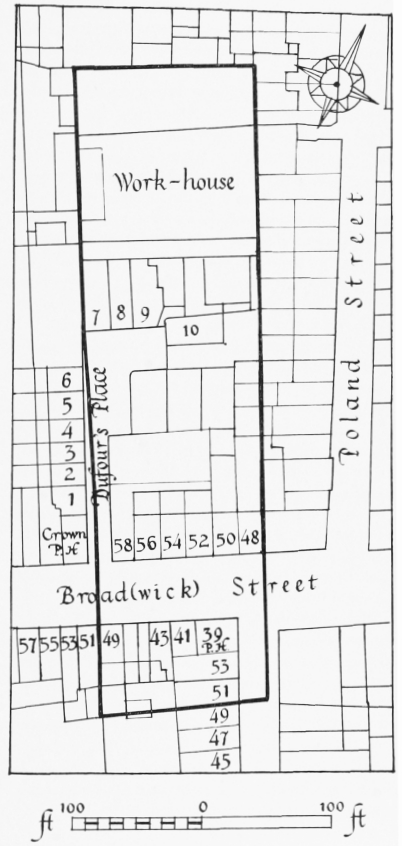
Pawlett's Garden, layout plan. Based on the Ordnance Survey, 1870–5
A small shed was erected in 1694 'to shelter the Minister from the hard weather in Winter'. (fn. 6) In 1711 the vestry received a complaint about the smoke issuing from the chimney of Cope the gravemaker's house in the burial ground. The smoke was 'noysome and offenceive' and was caused 'by the Burning of Old Rotten Coffin Boards, and by his Wife's Frequent Landring for People'; both activities were forbidden for the future. (fn. 7)
By 1733 the burial ground was full. Part of it had been used for the erection of a workhouse in 1725–7 (see page 211) and the only suitable piece of vacant land available for burials within the parish lay in the adjoining Pesthouse Close, which Lord Craven was then attempting for the second time to free from the incumbrances imposed upon it in 1687 (fn. 8) (see pages 196, 197). Viscount Percival (later Earl of Egmont) describes how he 'went to a vestry meeting of St. James's, where we considered of taking some waste ground belonging to my Lord Craven, which he offers to let the parish for 57l odd money per annum to enlarge their church yard. The ground, 'tis computed, will hold 12,000 bodies, which rot so fast that 800 may annually be buried in it. This being the only ground we could get, and the necessity of the parish requiring it, we agreed to give that rent'. (fn. 9) The north-east corner of Pesthouse Close, which adjoined the west side of the existing burial ground, was accordingly taken on lease from Lord Craven, and George Wyatt, bricklayer, was employed to enclose it with a brick wall. (fn. 10)
Both the burial ground in Pawlett's Garden and its extension in Pesthouse Close were subsequently incorporated into the ever-expanding curtilage of the workhouse, whose history is described below. In 1789 an Act of Parliament (fn. 11) enabled the parish to acquire land on the east side of Hampstead Road, St. Pancras, for use as a burial ground. This cemetery was closed in 1853 (fn. 12) and converted in 1887 into a public garden, now known as St. James's Gardens. (fn. 13)
St. James's Workhouse
The site of St. James's workhouse lay between Poland Street and Marshall Street and is now occupied by a garage. The first workhouse building was erected there in 1725–7 on what was then a vacant corner of the parish burial ground in Pawlett's Garden (see above). Subsequently more land was taken in from the adjoining Pesthouse Close, and the original workhouse building and yards were rebuilt and extended to cover a wider area. The workhouse was administered by a committee of the vestry of St. James until 1868, when the Westminster Union was formed to take over the poor law responsibilities of the two parishes of St. James and St. Anne. The workhouse continued to function until 1913 and during the war of 1914–18 was occupied for a time by refugees. In 1925 the Westminster City Council, in whom most of the property was vested as the heirs to St. James's vestry, leased the disused premises to a property company for use as a garage. The workhouse buildings were then adapted for this purpose.
The first proposal to build a workhouse for St. James's parish was made at a meeting of the vestry in December 1724, (fn. 14) an Act of Parliament of the previous year having empowered parish authorities to purchase houses to lodge the poor 'and there to keep, maintain and employ all such poor persons and take the benefit of [their] work'. (fn. 15) This Act did not originate any new policy, but merely gave statutory authority to existing practices, for many parishes already maintained workhouses of their own. St. James's had been supporting a poorhouse for its aged and impotent paupers since 1688. This consisted of six small houses in Salter's Court (part of Smith's Court on the west side of Great Windmill Street) which were leased from John Tully, an undertenant of Sir William Pulteney. (fn. 16) No work seems to have been expected from the inmates, for in 1690 the churchwardens were required by the vestry to take care that the houses were not occupied by persons who could afford to pay the rent but that 'such as are upon charity, if they be found fit objects, do stay.' The poor were then put into two of the houses and the other four let 'towards paying the rent of the said court to Mr. Tully'. (fn. 17) Women were employed to tend the inmates, and the place became known as 'the nurses houses'. The establishment was removed to New Street (now Ingestre Place) in 1721 and remained open until 1748. (fn. 18)
The 'nurses houses' harboured only the sick and impotent paupers. Until 1724 the able-bodied poor were still unprovided for, and it was for them that the original St. James's workhouse was erected in 1725–7. In December 1724 a vestry committee was set up to consider possible sites for the new establishment and eventually it was decided to erect the intended building on part of the burial ground in 'a space almost free from graves'. There were however a number of burial pits (possibly dating from the Great Plague of 1665) sunk there which 'might prove offensive and unwholesome', (fn. 19) and these were covered over. (fn. 20)
John Ludby, carpenter, had been commissioned by the vestry to draw up a plan for a building and by March 1725 his 'drafts for the workhouse' (for which he was paid £10) were exhibited for tenders. (fn. 21) In May Ludby's own tender of £2600, 'the most reasonable and advantageous to the parish', was accepted. (fn. 22)
Building work began soon after but progressed very slowly. In August 1726 The Daily Journal reported that 'while the Officers of the Parish of St. James's at Westminster, were making Merry at a Tavern, the Workhouse in the Pest-fields (near finish'd) for the Reception of their Poor, was blown down by a sudden Gust of Wind; to the no small satisfaction of the Lazars, who testify'd their Joy by Loud Acclamations, Bonfires and other Illuminations etc., in the Evening'. (fn. 23) Shortly afterwards the vestrymen employed Thomas Dance, the surveyor of Guy's Hospital, to examine the completed (and supposedly still standing) portion of the workhouse. The western end, which had fallen down, was then rebuilt by Ludby at his own cost, upon enlarged foundations. The whole building was not complete for another year and it was not until July 1727 that Dance reported to the vestry on the state of their newly finished workhouse. Apart from some defective brickwork and a few minor faults, he found that the building had been erected in conformity with the specifications. He was paid six guineas and his assistant, Mr. Phillips the carpenter, one guinea. The latter was probably Thomas Phillips, who did much building in the parish in the 1720's and 30's. John Ludby undertook to make good any faulty brickwork during his lifetime. (fn. 24) The total cost of the new workhouse, including furniture, was approximately £4000. (fn. 25)
The management of the house was farmed out to a contractor, a Mr. Marriot, who received £200 per annum from the parish. (fn. 26) Marriot was probably the contractor or farmer of other new workhouses built under the Act of 1723, for in 1724 the parish of Hemel Hempstead made a contract with a Mr. Matthew Marriott to manage their workhouse, and a similar contract was entered into by the parish of Luton. (fn. 27) The St. James's poor were put to work upon flax and wool and a chaplain was appointed to administer to their spiritual needs. (fn. 28)
During the first years of its existence the affairs of the workhouse were in great disorder. Marriot neglected his duties and was dismissed, the rules for admittance were not observed and the paupers, when allowed out, begged in the streets. The inventories and accounts were never kept and the master was seldom found in the workhouse. Finally in 1730 the justices and the governors of the poor (as the members of the vestry committee were now called) refused to act so that all the responsibility and trouble fell upon the churchwardens and overseers. (fn. 29)
In 1736 the management of the workhouse was again entrusted to a committee of the vestry known as the governors of the poor. All the poor over the age of six were to be kept at work until six o'clock in summer and until dark in winter, upon the flax, wool and hemp provided by the vestry. The children under six were left in the care of a schoolmistress who was to teach them to read. The paupers' diet (chiefly porridge, boiled meat, bread, cheese and beer) at the three daily meals was minutely regulated. They were to be given clean linen once a week and clean sheets once a month and there were not to be more than two adults or three children in each bed. On Sundays the poor (excluding dissenters, for whom no religious provision was made) were to attend divine service and then be allowed out until 8.30 p.m., with heavy penalties for drunkenness or begging in the streets. Finally there was to be a weekly inspection of the workhouse by one vestryman and one churchwarden. (fn. 30)
Despite these reforms the rector reported in January 1739/40 that the workhouse was in a very bad state; the premises were unclean and the poor not 'regularly managed'. (fn. 31) In the following year it was again reported to the vestry that the workhouse (or 'rather the Infirmary there being no Work done') was in a 'very nasty condition, the stench hardly supportable, poor creatures almost naked and the living go to bed to the dead'. At the same meeting the question of boarding out the younger children was considered, but the vestry finally decided that if 'the children about two or three years old were to be carried out sometimes by the elder women into the [workhouse] yard for air, it would greatly contribute to their healths'. The greatest scourge was the 'Scorbutick Distemper [scurvy] which few escape, some dieing a lingering miserable death', and which was caused by 'the want of a sharp person to confine the Infected in some apartment by themselves'. (fn. 32) In 1742 the vestry resolved to close down the workhouse, which was let to an upholsterer; (fn. 33) part of it was later used by the parish overseers as an office to pay outdoor relief. (fn. 34) (fn. 1)
By 1762 there were eleven hundred poor entitled to relief in the parish and they received between six and seven thousand pounds every year. (fn. 35) The financial and administrative difficulties were too great for the four parish overseers, the governors of the poor appointed in 1736 having long ceased to act. In 1762 an Act of Parliament was therefore obtained which allowed a new committee of the vestry, also to be named the governors of the poor, to take over responsibility for the administration of poor relief in the parish. (fn. 36) The workhouse was then re-opened in the summer of 1762 and a new set of rules of management was drawn up. The poor were put to work on a wide variety of tasks, including silk weaving and the making of quilted petticoats, for which new workshops appear to have been built. (fn. 37)
In 1782 the governors of the poor transferred the children in the workhouse to premises in King (now Kingly) Street, which had previously been Foubert's Riding Academy. This new establishment became known as the parish school of industry. Its administration was entirely separate from that of the workhouse and a conscious effort seems to have been made by the governors of the poor to educate and train the children in their care (see page 180). At about the same time the very young children were put out to nurse at Wimbledon. (fn. 38)
By 1814 the workhouse buildings had become 'very delapidated and dangerous', (fn. 39) although this is not apparent in the engraving of 1809 reproduced on Plate 38b. There was severe overcrowding, with many sleeping three in a bed, and in 1815 a contagious fever broke out among the inmates. The sick were hastily removed to a building which had been erected in one of the yards of the workhouse as an armoury by the nowredundant St. James's Volunteers. In 1817 another temporary infirmary was opened in premises taken in Broad Street. (fn. 40) By this time additional accommodation inside the already overcrowded workhouse was required for the children from the parish school of industry in King Street, for the premises there were to be pulled down for the formation of Regent Street. (fn. 41) In 1816 the vestry therefore decided that a new and enlarged workhouse was 'absolutely and indespesibly [sic] requisite and necessary'. (fn. 42)
The architect Thomas Hardwick was commissioned to draw up a plan for a new building on the existing site, which was to be extended by the purchase of adjoining houses in Marshall Street from Lord Craven. (fn. 43) To carry out this rebuilding scheme and to obtain compulsory purchasing powers over the adjoining properties, another Act of Parliament, which received the royal assent on 20 June 1816, was obtained. (fn. 44)
Hardwick's plans were never fully carried out, and no new building work began until five years after the passing of the Act. During this period a number of houses in Marshall Street and Munday's and Brown's Courts were purchased from Lord Craven (it being intended that they should be demolished and their sites incorporated into the workhouse curtilage), (fn. 45) and makeshift repairs to the existing buildings were carried out. In July 1820 the children from the school of industry were moved into the workhouse. (fn. 46)
A new dormitory block was erected in conformity with Hardwick's 'general plan' on the south side of the workhouse yard in 1821. The cost was £1995 and the builder was Archibald Reid of Pimlico. Other improvements and alterations to existing buildings carried out at the same time cost another £5000. (fn. 47) Some of the new buildings were sited upon parts of the workhouse yard covering the former burial ground. The foundations were therefore built by the able-bodied paupers working behind a tarpaulin, the governors being 'decidely of the opinion, for obvious reasons, that such excavations should be done with as much privacy as the nature of the thing will admit, and exposed as little as possible to the public eye'. The unearthed human remains were then deposited in a new brick vault. (fn. 48)
During the next thirty years little new building work seems to have been carried out at the workhouse, though repairs and minor alterations to the old buildings must have been continuous. The pressure on accommodation in the workhouse was alleviated in 1851, when the children were removed to Wandsworth where new school buildings were erected to the designs of Charles Lee. (fn. 49)
The foundations of many of the buildings had always been insecure and in 1856 a burst watermain under the chapel resulted in wide cracks and subsidence, to the accompaniment of 'a great crashing in the centre'. The inmates in the wards on the floors above the chapel had to be moved and the building underpinned. (fn. 50) Two years later the northern range of buildings, which had been erected in 1725–7, was found to be 'fairly worn out'. The governors' architect, Charles Lee, feared that 'a large portion … would be condemned directly if seen by the Police Surveyor' and he proposed a complete rebuilding at a cost of £8300. His plans were made and approved within two months. By this time the disintegration of the old building had become alarmingly rapid. During the night of 20 May 1858 the female inmates, hearing 'a noise in the building resembling the snapping of burning Timber or the Cracking of a Whip', rushed out of the building in their night-clothes. In the morning more cracks in the structure were found, 'which plainly indicates that the building is continually moving'. Temporary accommodation had therefore to be found outside the workhouse for the women paupers. (fn. 51)
At a meeting of the governors of the poor in July 1858 it was suggested that advantage should be taken 'of the necessity which has arisen for rebuilding the Northern portion of the Workhouse, to endeavour to open up a line of Communication from Portland Street [now D'Arblay Street], to Marshall Street', and the consequent removal of part of the establishment to another site. The scheme was submitted to the vestry with a plan of the proposed redevelopment by Charles Lee. The governors' scheme entailed demolishing most of the buildings (including the decaying north range) and removing the major portion of the workhouse establishment to healthier surroundings outside London. The infirmary and reception and casual wards were to be rehoused in new buildings on part of the existing site, the remainder of which was to be used to lay out the new street with fifteen new houses on its north side and, on the south side, a vestry hall and an ornamental entrance to the adjoining Marshall Street Baths. The scheme did not, however, meet with the approval of the more cautious vestrymen, who considered that the removal of the workhouse into the suburbs would create hardship for the paupers and would endanger the health of the aged, for 'there can be no doubt the country air would increase the sickness among them, it being invariably found that old persons thrive much better in warm, than exposed situations'. (fn. 52)
The original intention to rebuild the demolished wing was therefore carried out in accordance with Lee's first plan and the tender of George Myers of Lambeth for £6190 was accepted. (fn. 53) The old wing was completely demolished and the materials sold for £219. Work on the foundations began in October 1858 and the foundation stone was laid on 3 December. The building was sufficiently completed for the governors to inspect the interior in the following May. (fn. 54)
In 1868 the responsibility for the administration of the poor law in the two parishes of St. James and St. Anne was taken over by the guardians of the newly-formed Westminster Union, and new Union offices were required. Between 1848 and 1855 the vestry of St. James had purchased Nos. 49–53 (consec.) Poland Street, (fn. 55) a group of small houses backing on to the workhouse. In 1871–2 they were demolished and a new office block (with workhouse wards on the upper floors) was erected to the designs of William Lee, by Messrs. Hill, Keddall and Waldram at a cost of £15,451 (fn. 56) (Plate 140a).
By the beginning of the twentieth century the presence of a poorhouse in the centre of a closely built-up and increasingly commercialized area had become an anachronism. In 1901–2, under pressure from the Westminster City Council which was anxious to use the site for the erection of workmen's dwellings, the guardians considered the disposal of the workhouse and the erection of a new institution in Wandsworth. (fn. 57) But this scheme came to nothing and it was not until 1913, after the amalgamation of the various Boards of Guardians inside the City of Westminster, that the St. James's workhouse was finally closed. The guardians and the City Council, as the successors of the St. James's vestry, prepared to sell the property but the war of 1914–18 intervened, bringing to the former workhouse a succession of foreign, chiefly Belgian, refugees. After the war, the proposal to build workmen's dwellings was again revived, but ultimately the site was leased to a property company in 1925. The existing workhouse buildings were then reconstructed and extended as a garage. The surviving part of the last addition to the workhouse, the Union offices erected in 1871–2 in Poland Street, is in separate occupation and is externally little altered.
Nos. 7–10 (consec.) Dufour's Place And 48–58 (even) Broadwick Street
Nos. 7–10 demolished. Nos. 48–58 formerly Nos. 16–21 (consec.) Broad Street
In January 1719/20 and May 1721 William Pulteney leased two pieces of ground to the south of the burial ground (later the site of the workhouse) to Paul Dufour of St. James's, esquire. Dufour covenanted to spend at least £800 within two years in building good and substantial brick houses on some part of the site, (fn. 58) and by 1721 had built four houses which were approached along a narrow passage leading out of Broad(wick) Street (fig. 35). These houses were later numbered 7–10 Dufour's Court, which is now called Dufour's Place. No. 7 was occupied from 1757 to 1764 by Matthew Brettingham, (fn. 59) possibly the elder or younger architect of that name. No. 9 was taken over in 1830 by William Walter Smith and in 1833 a school was opened on the ground on the east side of the house. (fn. 59) The school survived until 1923. (fn. 60)
In 1722–3 six houses (now Nos. 48–58) were erected in Broad(wick) Street to the south of Dufour's Court. (fn. 59) The direct contractor was John Mist, the paviour, who later worked in Sackville Street, another part of the Pulteney estate. He entered into an agreement with William Pulteney on 19 December 1718 under terms similar to those required of other builders engaged in the development of the estate, i.e. to build houses of the second rate according to the provisions of the Act of 1667 for the rebuilding of the City of London. (fn. 61) Mist was a party to most of, if not all the leases, one of which was granted to Paul Dufour (see the table, below). The chief occupants of note were: at No. 52, Abraham Kirkman, a member of the family of harpsichord makers, 1772–91; at No. 54, Charles Bridgman, the landscape gardener, 1723–38, and the family business of harpsichord and pianoforte manufacture founded by Jacob Kirkman, 1750–1832; at No. 56, Jacob Kirkman, the composer and member of the family carrying on the business at No. 54, 1780–1801; and at No. 58, William Hewson, perhaps the surgeon and partner of Dr. William Hunter, 1770–3. (fn. 62) In 1960 a Building Preservation Order on these houses was confirmed.
The development of Dufour's Court was completed in 1736 when six houses (Nos. 1–6 Dufour's Court) were built on the west side of the passage, on land forming part of the adjoining estate belonging to Lord Craven (see page 205).
Nos. 48–58 Broadwick Street make up a uniform row of houses each containing a basement and four storeys (Plates 126c, 142c, figs. 36–7). Possibly the fourth storey is a later addition, since the back walls are still carried up for only three storeys, but it is difficult to find any change in the brickwork. The fronts of Nos. 48 and 50, moreover, have been entirely resurfaced, while the fourth storey and part of the third storey of Nos. 52, 54 and 56 have been rebuilt following bomb damage in the war of 1939–45. The fronts are three windows wide and built of dull-pink stock brick interspersed with occasional yellow bricks, each of the three lower storeys being finished with a raised bandcourse of red brick. The windows have segmental gauged arches of red brick and contain recessed box-frames, although the double-hung sashes are later in date. No. 58 varies from the general pattern in having no bandcourses above the second and third storeys even though it has them, in ordinary pink brick, on the side wall to Dufour's Place. Above the third storey, however, is a moulded cornice, returned at each end, which may be of painted stone but is more probably a later addition of stucco. The ground storeys of all the houses have been stuccoed in the nineteenth century, and drastically altered at Nos. 48 and 50, but in every case the original carved wooden doorcases have been preserved. The moulded architraves have number-plaques in place of keyblocks and at either side are narrow panelled pilasters surmounted by ornate consoles supporting moulded cornices. Most of the doors have been replaced, but the original six-panelled ones with ovolo-moulded frames remain at Nos. 48 and 50. The doorcases can probably be attributed to John Meard, carpenter, who was the original lessee of No. 56, for there are exact duplicates of them at Nos. 1–7 Meard Street, Soho. All the basement areas remain open, but the railings have been replaced, mostly in the nineteenth century.
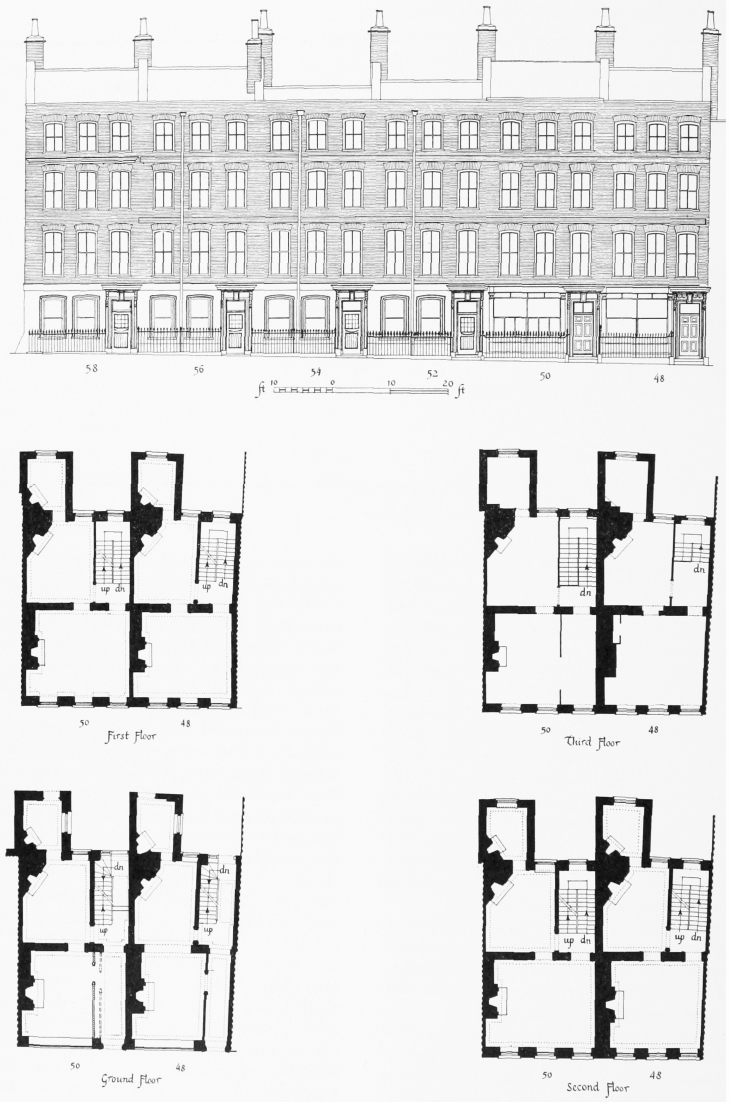
Nos. 48–58 (even) Broadwick Street, elevations and plans
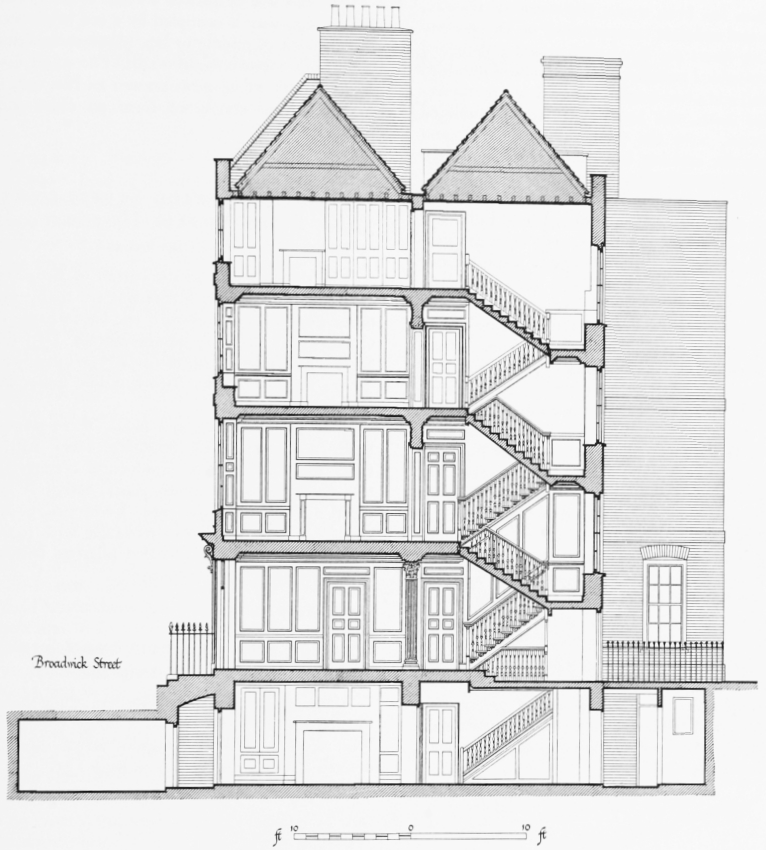
No. 50 Broadwick Street, section
The interiors are, or were originally, identical in plan and this also seems to have been much the case with the finishings. There is a single front and back room on each floor with a small closet projecting beyond the back room, the latter having beside it a dog-legged staircase reached from the street by a narrow passage. Except where a later alteration has been made, the entrance passage, rooms and staircase compartment on the ground and first floors are lined with raised-and-fielded ovolo-moulded panelling finished with a moulded dado-rail and a box-cornice. The shutters and sixpanelled doors, the latter with simple moulded architraves, have the same type of panel, and flanking the opening from the entrance passage into the staircase compartment are panelled Doric, or, at Nos. 48 and 50, fluted Corinthian pilasters. No. 56 seems to have been exceptional in having at either side of the chimney-breast in its ground-floor front room, a round-headed semi-circular niche with a moulded architrave, part of the dado panelling breaking forward below it to form a kind of pedestal. The back room and the closet have corner fireplaces and there remain some simple stone chimneypieces, moulded on the inner and outer edges and with shaped lintels. In the firstfloor back room of No. 54 the chimneypiece has also a wooden architrave carved with egg-and-dart. The lower flights of the staircases have cut strings decorated with carved step-ends, and turned balusters supporting a moulded handrail which is carried over column newels, but the flights above the first floor are more simple, having only moulded closed strings.
The sites of Nos. 7–10 Dufour's Place are now occupied by the Marshall Street Baths, but a photograph in the possession of the London County Council shows that No. 7 (and probably No. 8 before it was stuccoed) was almost identical with Nos. 48–58 Broadwick Street. It differed in containing only three storeys and a garret, the ground-storey windows, apparently unaltered, having flat arches, and the doorcase being without a number-plaque.
The east side of Dufour's Place to the north of the passage-way is occupied by a red brick warehouse block of middle or late nineteenth-century date, built round a court-yard. The small house to the north of it, now known as No. 10, has probably been converted from an older stable building.
DUFOUR'S PLACE AND BROADWICK STREET (see fig. 35) LEASES GRANTED BY WILLIAM PULTENEY
| No. | Date of Lease | M.L.R. (fn. 2) reference | Term of years | Rent | Frontage | Lessee | Designation | Address | Associated builders or architects | First occupant | Period of occupation | ||
| £ | s | d | |||||||||||
| DUFOUR'S PLACE | |||||||||||||
| 7–10 and the court | 26 January 1719/20 | 59 from Christmas 1719 | 30 | 0 | 0 | Paul Dufour | Not stated | ||||||
| 25 May 1721 | 1721/6/157 | 60 from Christmas 1719 | 4 | 0 | 0 | do. | John Mist party to lease | do. | |||||
| BROADWICK STREET | |||||||||||||
| 48 | 12 December 1720 | 1720/4/239 | 60 from Christmas 1719 | 12 | 0 | 0 | 18' | John Mist | paviour | St. Anne's | Let under articles of agreement with Mist 19 Dec. 1718 (fn. 61) | Lady Phipps, ? widow of Sir Constantine Phipps, Chancellor of Ireland | 1724–8 |
| 50 | do. | 1720/4/242 | do. | 9 | 0 | 0 | 20' | George Devall (Mist's brother-in-law) (fn. 63) | citizen and plumber | London | John Mist party to lease under above | Richard Abell | 1723–9 |
| 52 | do. | 1720/4/238 | do. | do. | do. | Thomas Churchill | bricklayer | St. Margaret's | do. | Abraham Duncomb | 1723–7 | ||
| 54 | do. | 1720/4/241 | do. | do. | do. | John Mackreth (Mackerith) | lime merchant | do. | Charles Bridgman, landscape gardener | 1723–38 | |||
| 56 | do. | 1720/4/240 | do. | do. | do. | John Meard | citizen and carpenter | London | do. | Lady Edwards | 1723–9 | ||
| 58 | 25 May 1721 | 1721/6/156 | do. | 8 | 0 | 0 | do. | Paul Dufour | esquire | St. James's | do. | (Peter) Syres | 1723–58 |
No. 39 Broadwick Street: The John Snow Public House
Formerly No. 7 Cambridge Street
The public house on the corner of Broadwick Street and Lexington Street was for many years called the Newcastle-upon-Tyne but its name was changed in 1956 to commemorate Dr. John Snow's association with the area (fn. 60) (see page 223). There may well have been a public house here since 1719. (fn. 64)
This public house is a plain, three-storeyed brick building which probably dates entirely from the mid to late nineteenth century, although a coating of cream paint makes it look older. The elaborate late Victorian ground storey has wide windows alternating with round-arched doorways, the panelled pilasters between them supporting an entablature.
Nos. 51 And 53 Lexiton Street
Formerly Nos. 9 and 8 Cambridge Street
Although in Pawlett's Garden, these houses formed the northern end of a range comprising Nos. 41–53 (odd) Lexington Street, and are described with Nos. 41–49 on page 135.