Survey of London: Volumes 31 and 32, St James Westminster, Part 2. Originally published by London County Council, London, 1963.
This free content was digitised by double rekeying. All rights reserved.
'Great Marlborough Street Area', in Survey of London: Volumes 31 and 32, St James Westminster, Part 2, ed. F H W Sheppard (London, 1963), British History Online https://www.british-history.ac.uk/survey-london/vols31-2/pt2/pp250-267 [accessed 2 May 2025].
'Great Marlborough Street Area', in Survey of London: Volumes 31 and 32, St James Westminster, Part 2. Edited by F H W Sheppard (London, 1963), British History Online, accessed May 2, 2025, https://www.british-history.ac.uk/survey-london/vols31-2/pt2/pp250-267.
"Great Marlborough Street Area". Survey of London: Volumes 31 and 32, St James Westminster, Part 2. Ed. F H W Sheppard (London, 1963), British History Online. Web. 2 May 2025. https://www.british-history.ac.uk/survey-london/vols31-2/pt2/pp250-267.
In this section
CHAPTER XVII
Great Marlborough Street Area: Millfield
All of the ground to be described in this chapter belonged to the Mercers' Company until its surrender to the Crown in 1536. It subsequently formed part of the sixty acres in the parish of St. Martin in the Fields which were granted in fee in January 1559/60 by Queen Elizabeth to William Dodington. These lands quickly passed to Thomas Wilson of St. Botolph without Aldgate, brewer (see page 24), and in 1622 his son, Richard Wilson of King's Lynn, gentleman, sold some 35 acres of them to William Madoxe (Maddox), citizen and merchant taylor of London.
Maddox's estate comprised a close of 11½ acres called Millfield (of which the area to be described in this chapter formed part), a close of 13½ acres called Kirkham or Kirkham's Close and 10 acres to the south of the latter (fig. 2). Millfield, which presumably took its name from Tyburn Mill which stood nearby, was described as being on the east side of the highway from Charing Cross (i.e. Swallow Street) while Kirkham Close lay on the west side. The part of Swallow Street adjoining Millfield later formed part of the boundary between the parishes of St. James and St. George, Hanover Square, and Kirkham Close is therefore not included in this volume. The remaining ten acres later became the Burlington leasehold estate (see Chapter XXVI). At the time of the conveyance to Maddox, Millfield was already enclosed and divided into two parcels then or later in the tenure of Thomas Geethings of St. Giles in the Fields, yeoman. (fn. 2)
In 1664 all these lands were settled by Maddox's son, Benjamin, on the issue of his forthcoming marriage with Dorothy Glascock. They were then or late in the tenure of Isaac Smith under an eleven-year lease from 1658. (fn. 3) In 1670 Maddox leased them for sixty-two years to James Kendrick of St. Martin's, gentleman. (fn. 4)
Kendrick immediately began to grant subleases to several persons who by January 1670/1 had 'already begunn to build and Intend to build severall Messuages or Tenements on the said premises … whereby the same wilbe much ymproved.' (fn. 4) In the western part of Millfield the sub-lessees were Robert Morris, coachman, who had leases of two large parcels, and Thomas Browne, gardener. Their lands lay on the east side of the foot-path which later became King(ly) Street, (fn. 5) and Blome's map of c. 1689 (Plate 4) shows houses along the full length of both sides of the street. The eastern part of Millfield comprising five acres was leased to John Steele of St. Marylebone (fn. 6) and is shown on the map as pasture ground; it may, however, have been dug for brickearth for Steele was rated for a brick field in the parish in 1684. (fn. 7)
By 1688 Kendrick's sixty-two-year lease had become vested in Thomas Pargiter of Thavies Inn, gentleman, who in that year obtained a reversionary lease of Millfield and Kirkham Close from Benjamin (now Sir Benjamin) Maddox for another eighteen years. (fn. 8) But although the overall leasehold term was thus extended to 1750 building development does not seem to have progressed greatly, except near King Street and Tyburn Road. John James of St. James's, carpenter, and Abraham Bridell (Bridle) had a lease from John Pargiter (probably Thomas's father) of land fronting Tyburn Road. (fn. 9) They did some building (fn. 10) and Bridell gave his name to an opening on the east side of King Street. (fn. 11)
The stimulus to develop the rest of the ground came in 1704 from the adjoining Pollett estate. In that year, when the number of buildings seems hardly to have increased since the date of Blome's map, John Steele let his five acres of land to Joseph Collens (fn. 12) of St. Giles in the Fields, carpenter, who was one of the executors of James Pollett, formerly the owner of the land to the east of Millfield. Collens and other builders then laid out Great Marlborough Street and the area south of Oxford Street (see below).
In 1716/17 Sir Benjamin Maddox died leaving as his heirs his daughter, Mary, and her son, the infant Benjamin Pollen. (fn. 13) The latter sold about half of his grandfather's estate in 1732–3, and in later years he disposed of part of the remainder. The leases of the western part of Millfield (which had been let to Morris and Browne) had been bought up piece-meal during the previous twenty years by the Duke of Argyll, who in 1732–3 purchased the freehold from Pollen and built over the ground which still remained open (see Chapter XIX). The narrow piece of Millfield lying between Swallow Street and King Street was sold in 1732, except for one piece which was sold later, in 1757. (fn. 14)
Some of the houses built on the land let to Joseph Collens were also sold in 1732 but most of this part of the estate was retained and is still in the possession of the trustees of the Pollen estate. The history of the development of this part of Millfield is dealt with below.
Great Marlborough Street
The eastern part of Millfield, which John Steele had leased in 1704 to Joseph Collens, comprised five acres between Tyburn Road on the north, the wall of Pesthouse Close on the south, the Pollett estate on the east and the western part of Millfield (later the Argyll estate) on the west (fig. 2). A few weeks after he had obtained the lease Collens and Matthew Hopkinson of St. Anne's, scrivener, (fn. 15) who were two of the executors of the will of James Pollett, the former owner of the adjoining estate on the east, petitioned for common sewers to be constructed on both the Pollett estate and the eastern part of Millfield, (fn. 16) evidently with the intention of developing the two estates jointly (see page 244). The extreme eastern end of Great Marlborough Street was, in fact, built on the Pollett estate.
The first part of the street to be built was the south-western arm, which runs into Carnaby Street in a slanting direction. This skewed frontage was probably occasioned by the need to provide access to the new street from the northern end of Carnaby Street, which had already been laid out on the adjoining Lowndes estate. A tablet formerly attached to a house at the corner of Great Marlborough Street and Foubert's Passage (now Place) was inscribed 'Marlborough Street 1704', (fn. 17) this name being clearly chosen in celebration of the Duke of Marlborough's victory at Blenheim on 13 August 1704. The ratebooks suggest, however, that this south-western arm was sometimes called Little Marlborough Street; it occasionally also appears as part of Carnaby Street. By 1706 eleven houses had been built in this part of the street. (fn. 18)
John Steele's own lease and his sub-lease to Joseph Collens were both due to expire in 1750. Thus the terms offered to individual builders or occupants could only be for forty-six years (from 1704 to 1750) at the most. In order to persuade tradesmen to engage in building and take leases some agreement appears to have been made with Sir Benjamin Maddox to extend these terms as soon as the houses were built, and many grants of reversionary leases from Maddox are recorded. They were usually to the then occupant of the house and always for terms of fifty-nine years from 1750.
For most of the houses in the street these reversionary leases provide the only source of information for the first building, and though this information is fragmentary it appears that the method of development was the usual one, individual craftsmen taking leases of houses in return for their services over a group of houses, and then mortgaging or selling them to realise more capital.
Originally the western extremity of Great Marlborough Street came to an end two houses beyond the modern No. 22 on the north side. In 1736 the Duke of Argyll extended the line of the street a short distance westward under the name of Argyll Street, which then turned north and led into Oxford Street. In 1820 the line of the street was again extended westward from the south end of Argyll Street to Regent Street, which was then in course of construction (see fig. 55). This new street was originally called Argyll Place, but was incorporated in Great Marlborough Street in 1925.
Hatton described the new street in 1708 as being pleasant, with good buildings, (fn. 19) but James Macky, writing in 1714, rated it more highly. He listed it with eight squares because 'though not a Square [it] surpasses any Thing that is called a Street, in the Magnificence of its Buildings and Gardens, and inhabited all by prime Quality'. (fn. 20) A more critical appraisal was made by Ralph in his Review of 1734, where he wrote that 'Great Marlborough-Street is esteemed one of the finest in Europe; but I think it can have this character on no other account but its length and breadth; the buildings on each side being trifling and inconsiderable, and the vista ended neither way with any thing great or extraordinary'. (fn. 21)
Many of the original buildings in Great Marlborough Street were demolished without records being taken, but the few exceptions noted below suggest that a fair degree of uniformity in design and finish prevailed. In its present state, lined with buildings of all styles and materials, varying in height and scale, the street can no longer be described as magnificent. Even the effect of its unusual width has been greatly diminished by the increased size of the newer buildings. Only a few eighteenth-century houses survive, and their rather dull fronts contrast oddly with the florid Victorian and mediocre modern structures.
The inhabitants of 'prime Quality' mentioned by Macky in 1714 included several peers. Five were mentioned as living in Great Marlborough Street in 1716 out of a hundred summoned before the King (the Earls of Sutherland, Bute, Ilay and Yarmouth and Lord Onslow) (fn. 22) and even in the middle of the nineteenth century one earl and two barons were living at No. 12. Out of twenty-one persons living in the street who voted in 1749 in the poll for Westminster eleven were gentlemen and ten were tradesmen. (fn. 23) In a more complete list of tradespeople in 1830 tailors accounted for one sixth of the whole and the medical and legal professions for almost another sixth each. There were also two architects, two surveyors and two artists. (fn. 24)
Like Argyll Street and Argyll Place, Great Marlborough Street accommodated a considerable number of architects at the end of the nineteenth and beginning of the twentieth centuries. The Architectural Association itself was at No. 56 for twelve years.
The musical profession was also well served at this time with firms like Erard's, Augener's and Schott's and the London College of Music, the last two still being housed at Nos. 48 and 47 respectively. The chief concern of the street to-day, however, is the 'rag' trade, in particular, the hat industry. (fn. 24) (fn. 1)
North side
No. 1 Great Marlborough Street
This house stood in Little Gelding's Close and is described on page 249.
Nos. 5–7 (consec.) Great Marlborough Street
No. 5 demolished
These three houses were probably all let about 1708 to Thomas Husbands of St. Giles in the Fields, painter stainer. (fn. 25) They were smaller than the other houses on this side of the street and had much shorter gardens. No. 7 was occupied by Lady Philadelphia Shrimpton, 1708–30; (fn. 26) and by the London College of Music, 1892–5. (fn. 24)
No. 5 was surveyed by the Royal Commission on Historical Monuments in 1924. It was one of the smaller houses at the east end of the north side, having a conventional plan with a large front room and a narrow well staircase on the east side of the back room, which had a corner fireplace and a door leading to a small closet in the back wing. The front was three storeys high and three windows wide, but the original brickwork had been faced with cement. Ovolo-moulded panelling in two heights lined the entrance passage, and an arch, with panelled pilasters and a moulded archivolt broken by a keyblock, opened to the stair compartment, the lower flights of which were panelled. The stair had closed moulded strings, and the moulded handrail rested on twisted balusters and large twisted newels. The ground-floor back room retained its original ovolomoulded panelling, as did the room above, and all of the second-floor rooms were lined with plain rebated panelling, with two-panelled doors. (fn. 27) The house has since been demolished.
The present buildings at Nos. 6 and 7 are a Victorian pair with interesting fronts of uniform design in red brick, sparingly dressed with stone. Each front is four storeys high and, above the elliptical-arched shop-front, three windows wide. Slender faceted colonnets project between the second- and third-floor windows, which have elaborately patterned aprons of moulded brick. The parapet is decorated with floral festoons and surmounted by stone ball finials. There is some correspondence of detail between Nos. 6–7 and No. 10, where a great arch, with splayed reveals and a moulded archivolt, frames the wide windows of the first, second and third floors.
No. 8 Great Marlborough Street
Demolished
This house was said to have been built by Edward or Thomas Carter, (fn. 28) presumably the Edmund Carter of St. Giles's, bricklayer, who worked on the south side of the street. (fn. 29) Occupants have included Lady Coventry, from at least 1716 to 1724; Sir Thomas Willis, 1726; (Sir) Robert Lawley, 1727–9; and Brigadier St. Hippolyte, 1731–6. (fn. 18) The proprietors of the Pantheon appear in the ratebooks for 1791–2 (see page 276) but the house was apparently empty in 1791 and was then taken over by Dr. Underwood, 1792–1800, (fn. 18) probably Michael Underwood, man-midwife (fn. 30) (see also No. 60).
The house has now been demolished, but like No. 5 it was surveyed in 1924 by the Royal Commission on Historical Monuments. It was a later and larger house than No. 5, the first-floor plan showing a large front room with four windows. The back room, with three windows, was on the east side of a roomy staircase, with a narrow well between the flights. There was no back closet wing. The three-storeyed front was four windows wide, that at the east end being a narrow light. The brickwork had been faced with cement, there was a moulded stringcourse at second-floor level, and a series of panels were recessed in the parapet. The hall and lower staircase were lined with raised-and-fielded panelling in ovolo-moulded framing, and on the first-floor landing were two eight-panelled doors. The staircase balustrade, with fluted Corinthian column newels, twisted and turned balusters, and carved step-end brackets, closely resembled those in Nos. 12, 13 and 54, the first still existing and the others recorded by drawings and photographs. (fn. 27)
Nos. 9 and 10 Great Marlborough Street
Demolished
The first house on the site of No. 9 was let on a reversionary lease in 1709 to Matthew Hopkinson of the Middle Temple, gentleman, (fn. 31) who together with Joseph Collens was the executor and developer of James Pollett's estate. It was occupied by the Italian artist Jacopo Amiconi from 1734 to 1739. (fn. 18)
According to deeds relating to adjoining property the first house on the site of No. 10 was built by Henry Bainbridge, joiner, and was said to have been occupied in 1708 by William Pulteney. (fn. 32) He died in 1715 (see page 29) and his widow, Lady Arabella, appears in the ratebooks from 1716 to 1719.
No. 11 Great Marlborough Street
This site was first let in about 1707 to William Warren (fn. 12) and was presumably assigned to Thomas Onslow of St. James's, esquire, later second Baron Onslow, who acquired the reversionary lease from Sir Benjamin Maddox in 1712. (fn. 33) Thomas Onslow married one of the richest heiresses of the day and in 1731–5 built the magnificent house at Clandon Park designed by Giacomo Leoni. (fn. 34) A short note written in 1874 suggests that his house in Great Marlborough Street was handsomely equipped. It had one of the largest frontages in the street (33 feet) and inside was a handsome carved oak staircase and a painted ceiling 'representing the rule of Jupiter over the gods and goddesses of mythology'. A surprising feature was that at some time, not necessarily in Lord Onslow's, the window shutters had been lined with 'bullet proof armour'. (fn. 35) There is a plan of the house (fig. 47) but otherwise it is unrecorded.
Lord Onslow lived here until his death in 1740; his son Richard, the third Baron, also lived here until his death in 1776 and Lady Onslow, the third Baron's widow, lived in the house until 1808 or 1809. (fn. 18) For many years it was occupied by the famous firm of brush manufacturers, founded by William Kent, who is thought to have set up his business in Tyler Street in 1777. In 1809 (fn. 18) William Kent junior moved from No. 60 Great Marlborough Street to No. 11 where the firm stayed until 1897. (fn. 36)
In 1910 the present building was erected to the design of E. Keynes Purchase for Messrs. Cobb and Jenkins, woollen manufacturers. (fn. 37) It has an interesting front of stone and brick, six storeys high and three windows wide. The ground storeys seems low in relation to the first floor, where the three tall windows are set in an elaborate frontispiece of stone in a highly mannered Renaissance style, with panelled piers supporting Doric entablatures across the side windows, and a pedimented attic framing the middle window of the second floor, the flanking windows being round and set in a plain brick face. The upper stage of the front is entirely in brick, with three tiers of windows set in three bays between giant Doric pilasters. The influence of Beresford Pite is apparent in this odd but striking design.
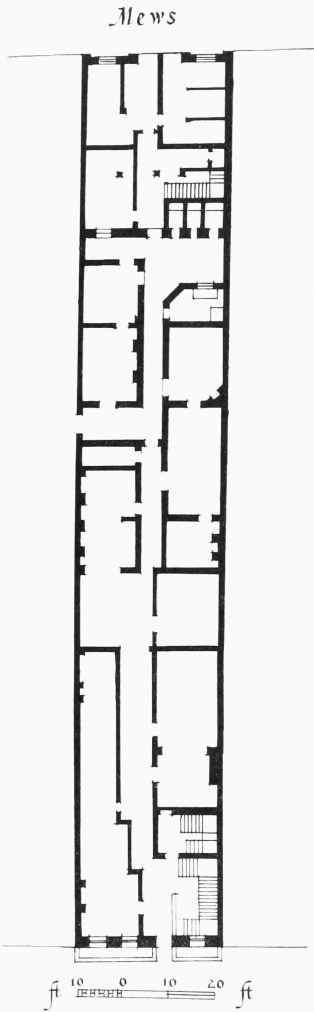
No. 11 Great Marlborough Street, ground-floor plan in 1882. Redrawn from a deed in the possession of G. B. Kent and Sons
No. 12 Great Marlborough Street
Joseph Collens sub-let the original house on this site on 20 November 1707, apparently to Richard Stacey, (fn. 12) master bricklayer to the Office of Works from 1696 to 1714. (fn. 38) In 1712 Stacey obtained a reversionary lease from Sir Benjamin Maddox. (fn. 39) Occupants included Charles Mohun, fifth Baron Mohun, c. 1712, who died of wounds in that year after a duel with the fourth Duke of Hamilton; Lieutenant-General Richard Lumley, first Earl of Scarborough, Chancellor of the Duchy of Lancaster, 1716; Sir William Milner, first baronet, of Nun Appleton Hall, Yorkshire, M.P., 1717–38; Lady Mary Fitzwilliam, daughter of the second Earl Fitzwilliam, and her sisters, 1744–6; the Bendyshe or Bendish family, 1746–1788; Edward Vernon Harbord, fourth Baron Suffield, 1844–52, Thomas William Anson, first Earl of Lichfield, 1849–52 and George John Vernon, fifth Baron Vernon, 1844–63, who were related by marriage; and John Dwyer, architect, 1856–8. (fn. 40)
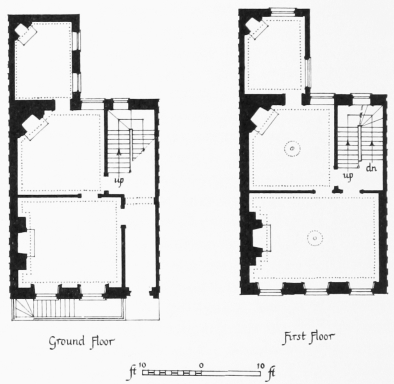
No. 12 Great Marlborough Street, plans

No. 12 Great Marlborough Street, staircase balustrade
This is the least altered of the surviving old houses in the street. It has a conventional plan (fig. 48), with a large front room and the staircase on the east side of the back room, which has an angle fireplace and a door leading to the closet wing, also with an angle fireplace. The front was altered and the interior partly refitted in late Georgian times. Three storeys high and three windows wide, the front is a very plain design in brown stock bricks with red dressings to the flatarched window openings (Plate 124b). The doorway is set in a plain elliptical-arched opening, the six-panelled door being framed by acanthus-capped pilasters and a transom treated as an entablature with a frieze decoration of paterae. Most of the back rooms retain the original panelling, but the best internal feature is the staircase, rising and returning in parallel flights separated by a narrow well. It is of wooden construction and the handsome balustrade is composed of a moulded handrail resting on fluted Corinthian column newels and turned twisted balusters, three to a tread, rising from cut strings with carved bracket step-ends (fig. 49). Similar balustrades occurred in other houses, now demolished, in this street.
No. 13 Great Marlborough Street
Demolished
The large house which formerly stood on the west corner of Blenheim (now Ramillies) Street was built as two separate houses. (fn. 18) The eastern house was mortgaged by Joseph Collens in 1707 (fn. 41) and assigned in 1710 by his widow Lydia, who had in the meantime obtained the reversionary lease, to the Hon. John Richmond, alias Webb. (fn. 42) In the latter year Webb also obtained the reversionary lease of the adjoining house on the corner, which had been built by Richard Daston. (fn. 43)
Webb had fought at Blenheim, Ramillies, Oudenarde and Malplaquet and rose to the rank of general. He combined the two houses, which remained one thereafter, and lived here until his death in 1724. The house was said to have been occupied by the Duke of Marlborough himself, (fn. 44) but it was probably Webb's tenancy which gave rise to this story. After the general's death the house remained unoccupied for several years. (fn. 18)
Webb's house was advertised for sale in The Daily Courant in 1725. (fn. 45) Besides the 'large fine and commodious new-built … House … with a pleasant Garden adjoining', the advertisement mentioned 'a beautiful new-built Apartment at the further End of the said Garden, through which is a Communication from the House to that Apartment, which also lies next a Street, consisting of a very good Kitchen and other convenient Offices under Ground, over which is but one Floor, containing a very good Dining-Room, Parlour, Withdrawing-Room, and a lodging-Room, all very beautiful and convenient, and both Houses well serv'd with New-River-Water; with good Coach-houses and Stabling adjoining.'
The house was eventually taken by Lord Charles Cavendish, third son of the second Duke of Devonshire, who purchased the freehold in 1738. (fn. 14) He appears in the ratebooks from 1738 to 1782, and was followed by his son Henry, the natural philosopher, (fn. 30) 1782–4.
The back house in Blenheim Street which was mentioned in the newspaper advertisement of 1725 was perhaps used by Henry Cavendish as a laboratory or workshop. A later occupant, Joshua Brookes, the anatomist, (fn. 30) had a 'Theatre of Anatomy', here during the period 1786–98 (fn. 18) (Plate 124d), where he gave lectures and exhibited the bodies of notorious criminals. In the 'pleasant Garden' Brookes had a vivarium, 'constructed principally with large masses of the Rock of Gibraltar', where he kept chained wild animals. (fn. 46) An eye-witness of the fire which destroyed the Pantheon in January 1792 related how the mob, looking through the iron gates to Brookes's garden and seeing the discomfiture of the animals from the heat of the fire, threatened 'to pull the house about his ears'. (fn. 47)
From 1833 to 1904 No. 13 was occupied in turn by the publishing houses of Henry Colburn and then Hurst and Blackett. Robert Henry Kerr, architect, occupied No. 13A from 1908 to 1916. (fn. 48)
The house has now been demolished, but a photograph at the National Buildings Record, possibly of this house, shows a fine staircase similar to that at No. 54.
Nos. 14–17 (consec.) Great Marlborough Street
Nos. 15–17 were formerly two houses numbered 15 and 16. Demolished
The first house on the site of No. 14 was built by Joshua Steed or Stead (fn. 49) and was let on reversion in 1709 to Thomas Woodcock of St. James's, esquire. (fn. 50) Woodcock lived here until 1732, followed by Madam Woodcock till 1754. Subsequent occupants (fn. 48) included Sir John Cust, Speaker of the House of Commons, 1754–62; (fn. 30) Lady Middleton, 1772–83; and at 14A, the sons of John Papworth the architect, John Woody Papworth, antiquary, architect and author of the Ordinary of British Armorials, and Wyatt Papworth, antiquary, architect and founder of the Architectural Publication Society, (fn. 30) 1850–69; the society was also listed in the directories at No. 14A from 1850 to 1858.
The former No. 15 was built by John Kemp of St. James's, woodmonger, (fn. 51) and let in 1709 to William, fourth Baron Byron of Rochdale, (fn. 49) who assigned (and probably mortgaged) it in 1710 to Sir John Tyrwhit of Stanfield, Lincolnshire. (fn. 52) The first occupant mentioned in the ratebooks was Robert Darcy, Earl of Holdernesse, 1716–17; followed by Lord Morpeth (? Henry Howard, later fourth Earl of Carlisle, who in 1743 married the fourth Baron Byron's daughter as his second wife), 1718–24. The Byron family appear as ratepayers later, Lord Byron, the fourth Baron, in 1727–36; his widow, Lady Byron, in 1736–40; and William, fifth Baron Byron, 1745–74. From 1833 to 1843 the site appears to have been vacant ground for which Thomas Campbell, the sculptor, was rated. He was also rated at No. 16 from 1835 to 1843.
The former No. 16 was let originally to Mark Dixon, (fn. 49) presumably the carpenter who worked elsewhere in St. James's, and occupied by William Spelman. (fn. 53)
Dixon sold the house in September 1709 to Sir Lambert Blackwell, one of the Directors of the South Sea Company, who in December 1709 obtained a reversionary lease. (fn. 53) After the collapse of the South Sea Bubble in 1721 Blackwell's assets were listed, and the house, with improvements, was said to have cost him £1306 5s. 8d. The inventory described the furnished rooms as four rooms on the first floor, a dining-room, four bed chambers, garrets, kitchen, wash-house and pantry. Most of the rooms and the staircase were hung with pictures and one room was hung with prints. (fn. 54) Sir Lambert occupied the house until his death in 1727 and was followed by his son, Sir Charles Blackwell, who occupied the house until his death in 1741. (fn. 55) Later occupants of note included Thomas Campbell, the sculptor, (fn. 56) 1835– 1843, (fn. 18) whose sitters included Mrs. Siddons, formerly an occupant of a house on the south side of the street. Thereafter the house was occupied by a succession of architects: G. Devey, 1848–80; Coutts Stone, 1848–1903; W. P. Padmore, 1850–89; J. Weir, 1870; C. G. Maylard, 1870; J. Williams, 1880; Percy G. Stone, who designed Augener's (see below), 1882–1903; and Forsyth and Maule, 1898–1909. (fn. 24)
No. 18 Great Marlborough Street
Formerly Nos. 17 and 18. Demolished
The original No. 17 was amalgamated with No. 18 in 1833. (fn. 18) It was one of the three houses, Nos. 18 and 19 being the others, which were apparently let to George Meggott by Joseph Collens. (fn. 53) All three were subsequently let on reversion in 1711 to Robert Meggott, George Meggott's son. (fn. 57) Both father and son were brewers and owned property elsewhere in St. James's, including a brewery in Brewer Street (see page 119).
Robert's son, John, who adopted his mother's maiden name of Elwes, bought the freehold of all three houses in 1751. (fn. 58) His eccentricity won him a place in the Dictionary of National Biography, where he is described as a miser who at his death in 1789 left property worth half a million pounds. He bequeathed the three houses in Great Marlborough Street to his two illegitimate sons, George and John, George taking Nos. 17 and 19 and John No. 18. (fn. 59)
No. 17 was taken over by Pierre Erard in 1833 (fn. 18) and altered or rebuilt with No. 18 (see below).
The original No. 18 occupied only the western part of the site later covered by No. 18. It was the middle one of the three houses belonging to the Meggott family and was occupied by George Meggott from 1707, (fn. 18) possibly till his death in 1711. (fn. 60) His son Robert lived here until 1718. (fn. 18)
In 1794 (fn. 18) the house was taken over by Sébastien Erard, the celebrated harp and pianoforte manufacturer. He had come to England in 1786 to open a branch of the business which he had founded a few years earlier in Paris. (fn. 61)
After Sébastien's death in 1831 the firm was continued by his nephew, Pierre Erard. (fn. 61) In 1833 he took over the adjoining house on the east, the then No. 17, (fn. 18) and apparently rebuilt or refaced the houses to give a uniform façade towards the street, with dressings to the windows and an imposing porch on one side (Plate 133b).
Pierre Erard died in 1855 and his widow's nephew, Pierre Schaeffer, continued the business until 1878. (fn. 61) In 1892 the freehold of Nos. 17 and 18 was purchased from the Elwes family by Marie Eugenie Schaeffer Erard, and her husband, the Comte de Franqueville; (fn. 62) the business at this time was managed by Daniel Mayer, who held a lease of the building. (fn. 63)
Mayer commissioned Percy G. Stone, whose office was next door at No. 16, to design a new building for the firm to contain workshops, showrooms and a concert hall. Stone took C. J. Phipps's advice, as he admitted that this was 'the first time I have had anything to do with a Public place of amusement', but his plans for a hall to hold 770 persons were rejected by the London County Council. By 1894, however, the new building was finished with a concert room on the first floor to seat 300 persons, but as Stone had failed to get approval for his plan a licence for performances was refused. In 1895 Phipps was employed to alter the concert room to suit the licensing requirements. His first plans were also rejected and it was not until 1898 that the room was approved, finished and licensed. The licence was given up in 1910 and the use of the room for concerts discontinued. (fn. 63)
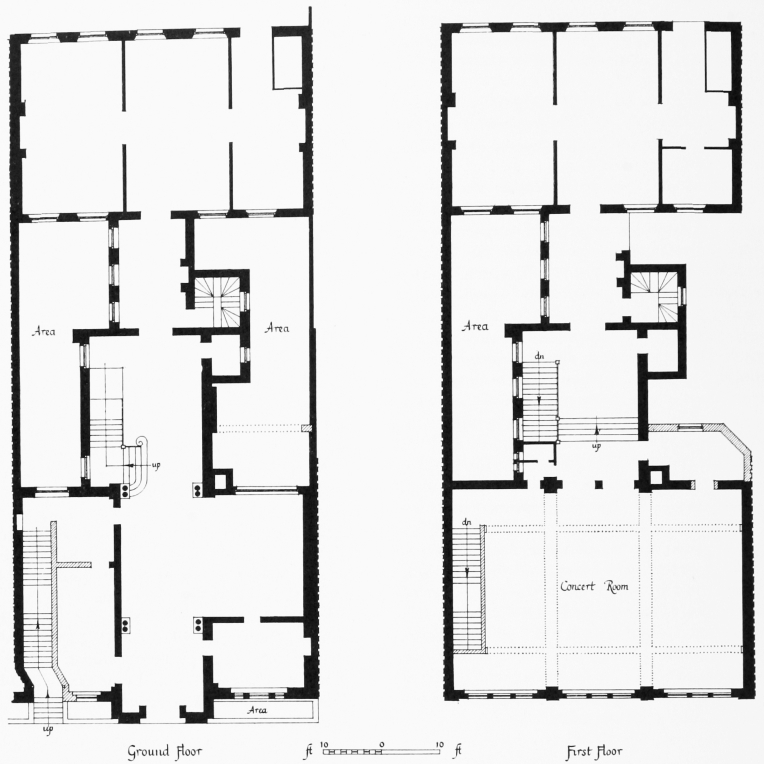
No. 18 Great Marlborough Street, plans in 1897. Redrawn from plans in the possession of the London County Council
The building erected for Erard's (Plate 141a, fig. 50) consisted of a front range and a back range, joined by a large staircase compartment and an ante-room, centrally placed to leave an adequate light area on the east side and on the west. The front range contained a show-room and an office on the ground floor, the Salle Erard for concerts on the first floor, and private apartments above. In the back range were piano show-rooms and workshops. The front, built in buff-pink brick, banded and dressed with terra-cotta, was an elaborate design in a mixture of the 'François Premier' and 'Flemish Renaissance' styles. The composition was of three lofty storeys, divided by narrow panelled pilasters into three bays, each crowned with a gable. The porch projecting from the middle bay had a segmental pediment, which was broken by an arched niche and rested on two groups of three stumpy Doric columns raised on high pedestals with panelled dies. In the left bay was an arched doorway leading to the concert room, and a window. In the right bay was a large window of three lights, the middle one arched. Each bay of the first-floor face contained a large window, divided by pilaster-mullions and transoms to form three arch-headed lights below smaller lights, each divided by a central mullion of paired balusters. The apron panels below these windows were adorned with medallion portraits of musicians, and two similar medallions flanked the royal arms above the middle window. In each bay of the second-floor face was a large square window, divided by mullions and a transom into two tiers of three lights. The window in each side bay had a shaped apron and a scrolled pediment, but the middle window was finished with a semicircular pediment filled with fan ornament. The gables, too, had different profiles, those above the side bays rising in ogee curves to finish with a segmental pediment, whereas the middle one was concave-sided and had a triangular pediment, originally with a finial in the form of a harp.
The bronze medallion-heads on the front were the work of Ruth Canton. The heads on either side of the royal arms were of Sébastien and Pierre Erard, whose names appeared over the door with the dates 1780 (the foundation of the firm in Paris) and 1892. The heads on either side of the door, from left to right, represented Liszt, Beethoven, Thalberg, Spontini, Mozart and Schubert. The group over the door representing Orpheus charming the beasts was added after May 1894, but was part of the original design for the building. (fn. 64)
The ground-floor showroom was very eclectic in style, the walls being hung with 'Cordova leather' lincrusta between grouped columns of a dwarf order on high pedestals, while the ceilings were decidedly Adamesque. The walls of the concert room were also lined with lincrusta above a high dado of neo-Jacobean panelling. In the centre of the north side was an elaborately framed double-doorway with a swan-necked pediment, and in the windows of the south side were medallion portraits in stained glass of famous composers and pianists.
In 1914 the Comte de Franqueville sold No. 18 (as the building was hereafter known) to Augener's, (fn. 62) the firm of music publishers, printers and sellers, whose business had been established at No. 86 Newgate Street in 1853 by George Augener for the importation of foreign music. In 1896 Augener's acquired the business of Robert Cocks and Company, then of New Burlington Street, and in 1904 the two companies were united under the name of Augener Ltd. (fn. 61)
The firm of Erard remained at No. 18 after Augener's had bought the building, and pianos continued to be manufactured here until 1931. (fn. 24) Augener's removed in 1961 to Charing Cross Road and Acton, and No. 18 was demolished. Ronald Ward and Partners have designed the new building erected on the site in 1962. (fn. 65)
Nos. 19–21 : Great Marlborough Street Police Station And Marlborough Street Magistrates' Court
The first house at No. 19 was one of the three houses belonging to the Meggott family (see under the former No. 17). It was occupied by Mrs. Meggott from 1718 to 1754 and by Robert Meggott's son, John Elwes, from 1754 to 1771. (fn. 18) William Rhodes, the surveyor who made a map of the parish in 1770, lived here from 1771 to 1783, (fn. 18) and was possibly responsible for rebuilding the house as shown in a photograph of c. 1900. (fn. 66) It was taken over by the Metropolitan Police in 1912 and rebuilt as part of the police station (see below).
The first house at No. 20 was let in 1707 by Joseph Collens, then described as of St. Martin's, carpenter, to Charles Nourse (fn. 67) of St. James's, esquire, who obtained a reversionary lease in 1709. (fn. 68) It was occupied from 1727 to 1754 by (Sir) Abraham Janssen, the second baronet; his father Sir Theodore (fn. 55) was one of the Directors of the South Sea Company and a close associate of Sir Lambert Blackwell (fn. 69) who lived at No. 16. The house was occupied by James Kennedy, architect, in 1879–85 and James W. J. Kennedy, architect, in 1886–90. (fn. 24) In 1899 the house was demolished for a police station (see below).
The original house at No. 21 was let on reversion in 1710 to Lord William Powlett, second son of the first Duke of Bolton, (fn. 70) who appears as the ratepayer from 1707 to 1729 and whose widow, Lady Powlett, is given as the occupant until 1737. Giles Earle, the soldier, politician and wit, was the next occupant. He had formerly been a follower of the second Duke of Argyll, but changed his allegiance to Walpole, whom the Duke's brother, and Earle's neighbour, Lord Ilay, also supported. (fn. 30)
Earle occupied the house from 1738 until 1744. His son, William Rawlinson Earle, (fn. 30) succeeded him at No. 21 and lived here until his death in 1771. (fn. 18) Sir James Porter, diplomatist, (fn. 30) occupied the house in 1775–7. (fn. 18) In 1793 it became a police office (see below).
In 1792 an Act of Parliament 'for the more effectual administration of the office of a justice of the peace in such parts of the counties of Middlesex and Surrey as lie in and near the metropolis' provided for the establishment of seven public offices. Three justices were to be attached to each office, and they were empowered to employ sufficient constables 'for the more effectual prevention of felonies'. (fn. 71)
In 1793 No. 21 Great Marlborough Street and the ground at the rear in Marlborough Mews (now Ramillies Place) was adapted for use as one of these public or police offices (fn. 59) (Plate 124c). In 1856 the Receiver for the Metropolitan Police District took a lease of No. 20 Great Marlborough Street and the ground at the rear was used for the enlargement of the police station. (fn. 59) No. 20 itself was not used, but was let out to various tenants (fn. 24) until 1892, when the freehold was purchased with that of No. 21. In 1899 No. 20 was demolished and a new police station built on the site; the old station in Marlborough Mews was converted into a section house. (fn. 59) No. 19 Great Marlborough Street and the premises at the rear were purchased by the Receiver from the Elwes family in 1912.
The present building, comprising a court and police station on the sites of Nos. 21, 20 and 19 Great Marlborough Street, was erected in the following year to the designs of J. D. Butler, the police architect; Messrs. Patman and Fotheringham were the contractors. (fn. 59) It has a wide front of two stages, entirely in stone. The lofty ground storey has a channel-jointed face containing tall and narrow round-arched windows, three being set in each of the segmental bows that flank the arched porch. The upper stage is two storeys high and bounded by Ionic pilasters, the windows being arranged in pairs and framed with eared architraves. An open balustrade, broken centrally by a pedestal carved with the royal arms, finishes this front. Inside are three re-used chimneypieces which possibly date from the conversion of No. 21 into a public office in 1792–3; two are fine examples in white marble with green inlay, and the third is of wood and compo.
No. 22 Great Marlborough Street
Demolished
The first occupant of No. 22, from 1707, was Colonel Rawlins (fn. 18) or Thomas Raleigh who assigned it in 1714 to Peter Carle of St. James's, esquire. (fn. 72) In 1738 Lord Ilay (later third Duke of Argyll) purchased the house and left it on his death in 1761 to his mistress, Mrs. Williams. It was divested of its garden in 1827 when the Earl of Aberdeen, who then occupied Argyll House in Argyll Street, bought it to add to his own garden (fn. 73) (see fig. 56, page 296).
Houses in Great Marlborough Street on the site of the Palladium
Demolished
The two houses numbered 23 and 24 on figs. 55 and 56 existed for only a few years. No. 23 was let to Richard Avery of St. Giles in the Fields, bricklayer, by 1706 (fn. 74) and occupied by Colonel (later Major-General) Russell, 1707–30, (fn. 18) and by Dr. Arthur Sykes, latitudinarian divine, (fn. 30) 1731–47. (fn. 18) In 1747 the house was purchased by Lord Ilay, then third Duke of Argyll, (fn. 75) and demolished shortly afterwards. (fn. 18) Its site was left open as a garden for the new house built by the Duke on the next site westward.
The house numbered 24 on figs. 55 and 56 was the last in the street on the north side. It was built by Joseph Collens and first occupied by the Jacobite Lord Duffus (Kenneth Sutherland, third Baron Duffus); Collens's widow assigned it in 1711 to the Earl of Ilay (fn. 76) who purchased the freehold in 1732. (fn. 77) At the end of the garden Lord Ilay erected a free-standing building for a library. (fn. 78) After the completion of Argyll House in Argyll Street about 1742, Lord Duffus's house was demolished. The house subsequently erected on the site was numbered No. 1 Argyll Street for many years and later No. 10 Argyll Place. It is described on page 301.
South side
No. 34 Great Marlborough Street
Formerly No. 29. Demolished
Mary Lepell, maid of honour to the Princess of Wales (Queen Caroline) and who married John, Lord Hervey in 1720, (fn. 30) occupied the first house on this site from at least 1716 until 1724. (fn. 18) (fn. c1)
Nos. 37 And 38 Great Marlborough Street: The Marlborough Head Public House
Since at least 1739 (fn. 18) there has been a public house of this name on this site. (fn. 79) Up till 1885 it occupied only the site of No. 38, but it was rebuilt in 1885–6 on the site of Nos. 37 and 38. (fn. 48)
Nos. 39–45 (consec.) Great Marlborough Street
Formerly Nos. 34–40 (consec.). Demolished
Occupants of note at No. 39 were: Lady (Ann) Hollis, 1721–6; Lady Vane, 1741–2; J. Slater, architect, 1889–91; Arnold B. Mitchell, architect, 1898–1905; (fn. 48) and at No. 40: Lady Hone, 1727. (fn. 18)
The first house at No. 41 was granted on lease by Joseph Collens on 15 July 1706 to Robert Jones of St. James's, carpenter, who also obtained the reversionary lease in 1709. (fn. 80) It was occupied by Thomas Hardwick, architect and surveyor to the parish, (fn. 81) 1815–25, (fn. 18) and by Charles Darwin in 1837–8, shortly before his marriage. (fn. 82)
John Kemp was said to have taken a lease of the first house on the site of No. 42. (fn. 83)
The original house at No. 43 was said in 1709 to have been let to Edmund Carter, (fn. 84) presumably the bricklayer, and the earliest recorded occupant was (Sir) William Paston, second Earl of Yarmouth, from at least 1716 to 1732. (fn. 18) The architects Yates, Cook and Darbyshire have occupied the house since 1922. (fn. 24)
John Kemp(e) was said to have taken the first lease of No. 44; (fn. 83) it was occupied by the following architects: Basil Champneys, 1873–80; T. E. C. Streatfeild, 1874–83; W. O. Milne, 1874–89; Edward Morgan Forster (the father of the novelist), (fn. 85) 1878–80; Peter Dollar, 1879–92; Milne and Hall, 1890–4. (fn. 24)
The original house at No. 45 was said in 1709 to have been let to Richard Avery, the bricklayer. (fn. 84) Occupants have included Sir Peter Mew from at least 1716 to 1720; Lady Clarges, 1721–7; (fn. 18) and the following architects: Arthur Evers, 1867–71; Evers and Mileham, 1872; Mileham and Kennedy, 1873–5; James Kennedy, 1876–8; Richard Creed, 1877–87; Edward Dolby, 1877–83; Haddon Brothers, 1877–82. (fn. 24)
No. 46 Great Marlborough Street
Formerly No. 41
John Dickins of St. James's, mason, took a lease of the first house on this site. (fn. 86)
Sir John Cust, later Speaker of the House of Commons, (fn. 30) occupied it in 1747–52, (fn. 18) and Benjamin Robert Haydon, history painter, occupied the first floor in 1808–17; (fn. 87) Gilbert Stuart Newton, the painter, is said to have taken over Haydon's rooms. (fn. 88)
The present building is a pleasant 'Dutch' design of 1902 by W. Dunn and R. Watson and has stone, framed windows forming bands across the red brick front, which finishes with a stepped gable. (fn. 89)
No. 47 Great Marlborough Street
Formerly No. 42
Some time before January 1710/11 this house was let to Thomas Flight, whose trade or occupation is unrecorded. (fn. 90) The Pollen family to whom Sir Benjamin Maddox's estate descended seem to have occupied the house for some time. Other occupants have included: Sir Nathaniel Napier, from at least 1716 to 1727; Sir William Napier, 1728–46; Benjamin Pollen, 1751–5; — Pollen, 1755–75; Sir Walter Farquhar, physician, (fn. 30) 1775–97; and the London College of Music, 1896–present day (1962). (fn. 48)
The house appears to date from the early eighteenth century but is much altered. It has a front five windows wide now heightened to four storeys, and is finished in cement, with Grecian ornaments to the buttressed ground storey.
No. 48 Great Marlborough Street
Formerly No. 43
The first house on this site was granted on reversionary lease in January 1710/11 to John Willson of St. James's, esquire. (fn. 90) It was assigned in 1725 to George Middleton, (fn. 91) the goldsmith and partner in the banking firm which became Coutts.
In 1732 Middleton purchased the freehold. (fn. 14) Lady Carlisle was an early occupant, 1718–24 or 1725, followed by Lady Read, 1725 (?1726)– 1750. (fn. 18)
In 1774 the house was taken by Edmund Francis Calze who rebuilt it as 'a large Place of Entertainment for the Publick … called the Cassino'. (fn. 92) Calze, whose real name was Cunningham, was a portrait painter, (fn. 30) but he was described in 1777 as a builder (fn. 93) and certainly engaged in building activity elsewhere in London. (fn. 92) In 1776 he abandoned the house in Great Marlborough Street and defaulted in the payment of his rates. (fn. 18) He had become involved in financial difficulties and in July 1777 was declared bankrupt. One of his creditors was Joseph Iredale of King Street, Soho, who performed the bricklayer's work at the Casino. (fn. 92)
In 1776 advertisements appeared in the press for a masquerade to be held at the New Rooms in Great Marlborough Street and a Mr. Barthelemon (presumably the violinist, François Hippolite Barthélemon) (fn. 30) invited subscriptions to a 'Musical Academia' for the following year at the Casino. (fn. 94) The 'New Rooms' and the Casino were presumably one and the same.
At Christmas 1777 the house was taken by William Miller (fn. 18) who also provided public entertainments in the form of masquerades. (fn. 94) Miller quitted the house in 1780 and was succeeded by George Gaines. (fn. 18) The house continued to be open to the public, providing a 'University for Rational Amusement' at which debates were held. (fn. 94)
In 1781 an advertisement appeared for the performance of a 'Dramatic Pasticcio' called The Court of Aristophanes, in which the chief character was Sir Swindle MacSubtle; the managers stated that 'The Theatre, Machinery, Decorations and every other part of this Amusement, is entirely new'. (fn. 94)
The house appears to have stood empty for a few years (fn. 18) until 1786, when it was taken by an attorney, George Hardisty. (fn. 48) His business survived until 1907, the last date at which the firm of Hardisty, Rhodes and Hardisty appeared in directories at No. 48.
In 1908 the house was purchased by Charles Gottlieb Volkert (fn. 95) of the firm of Schott and Company which still occupies it. (fn. 24) This musicpublishing firm had been established in Mainz in 1773 and the London branch was opened possibly in 1838, but perhaps in 1847, the date being uncertain. (fn. 96)
This is another much altered old house (Plate 124a). It has a plain brick front of four storeys, three windows wide, the attic obviously an addition. Inside are a few early Georgian six-panelled doors, but the simple and elegant staircase appears to date from about 1800.
Nos. 49 And 50 Great Marlborough Street: Church of St. John The Baptist
Formerly Nos. 44 and 45. All demolished
The first house on the site of No. 49 was said to have been let to Edmund Carter before January 1709/10. (fn. 97) Lady 'Hertackington' was the first recorded occupant in 1716; followed by John Gordon, sixteenth Earl of Sutherland, 1717–22, and later by (Sir) Walter Farquhar, physician, (fn. 30) 1772–3. (fn. 18)
Occupants of note at No. 50 were: General Whiteman, 1710, (fn. 97) 1717–22; James Stuart, second Earl of Bute, 1716; Sir Peter Vanderput, 1723–6; and Sir Robert Clifton, 1726–33. (fn. 18)
Both Nos. 49 and 50 were demolished in 1884– 1885 for the erection of the church of St. John the Baptist.
The district of St. John the Baptist was formed in 1865 to serve an area of St. James's parish which was bounded approximately by Oxford Street, Poland Street, Brewer Street, Bridle Lane, the former Carnaby Market and Argyll Street. Services were first held in a room behind No. 49 Poland Street and later, from May 1867 until September 1869, in the conservatory of the Pantheon. In 1869 Nos. 49 and 50 Great Marlborough Street were purchased for £6100, and in September of that year a temporary iron church was opened on part of the back premises. Shortage of funds delayed plans for a permanent building, and it was not until 1884 that a promised grant of money from the Commissioners of Woods and Forests at last made it possible for work to begin. A. W. Blomfield was the architect of the new church, and by December 1884 a building contract had been signed with John Woodward. The temporary church was closed on 31 December 1884, and services were held in a mission room in Cambridge Street. The site in Great Marlborough Street was conveyed to the Ecclesiastical Commissioners on 7 February 1885 and the completed church was consecrated on 23 November 1885. The cost of the building was £5100, of which £4000 was given by the Commissioners of Woods and Forests.
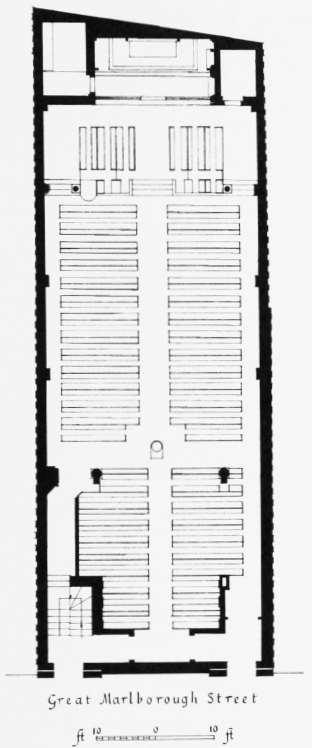
Church of St. John the Baptist, Great Marlborough Street, plan. Redrawn from an engraving in The Building News, 15 May 1885
In 1937 St. John's district was amalgamated with that of St. Thomas's, Kingly Street, and the church was demolished in the latter part of that year. (fn. 98)
The front of St. John's (Plate 12b) was a freely treated Perpendicular Gothic design, executed in red brick and Doulting stone. The composition was crowded and asymmetrical, the dominant feature being a large window of six lights with a traceried head, set within a moulded arch below a gable. This window was slightly off centre, having on its west side an octagonal turret, and on the east a buttressed tower. At the base of the tower and below the turret were doorways with ogee canopies, and beneath the great window was a low window of four lights, in pairs. On the second stage of the tower shaft was a tall canopied niche for a statue, and in the apex of the central gable was a canopied tabernacle framing a relief of St. John baptising. The west turret was finished with a crocketed spirelet, rising, like the central gable, against the straight parapet of open arcading that finished the front, stopping against the belfry stage of the tower. This had a pair of single-light traceried openings in the front face, and one opening in each side face, and was crested with battlements between the corner pinnacles.
The plan (fig. 51) was very simple, a wide aisleless nave of four bays with the southernmost bay arranged as a chancel opening to a shallow pentagonal sanctuary flanked by vestries. At the northern end, behind a screen of three bays, wide between narrow, was an extension of the nave below a gallery. There is no evidence bearing on the decoration of the interior beyond the fact that a report of 1919 to the Ecclesiastical Commissioners mentions damage from roof leaks to the gilding of walls and mosaics.
Nos. 51 And 52 Great Marlborough Street
Formerly Nos. 46 and 47. Demolished
Occupants of No. 51 have included: Lord Bellamount, 1717; Sir James Wood, 1735–6; (Sir) Walter Farquhar, physician, (fn. 30) 1771–5. (fn. 18)
In 1717 No. 52 was said to have been let to John 'Meeres', possibly John Meard, the carpenter. (fn. 99) Lady Jarrett was the occupant in 1734–9 and Edmund Calze, the artist (see also No. 48), appears in the ratebook for 1777–8. (fn. 18)
No. 53 Great Marlborough Street
Formerly No. 48
The former house on this site was said in 1709/10 to have been let to Thomas Ingram, whose trade or occupation is unknown. (fn. 97) It was occupied by Henry Dawnay, second Viscount Downe, from at least 1716 to 1732; and by his son John Dawnay in 1733–40. (fn. 18) Walter W. Gibbings, architect, occupied the present building in 1925–37. (fn. 24)
The present building on the site was erected in 1886–7 by the Metropolitan Board of Works for a fire station to replace one in King (now Kingly) Street. The Board's architect, George Vulliamy, was responsible for the design which was approved in July 1886, a few months before his death. The contractor was G. J. Lough, trading as Messrs. Stimpson and Co., whose tender was for £7660. (fn. 100)
This building is one of the most conspicuous on the south side of the street (Plate 140b). It has an elaborate Gothic front of red brick curiously dressed with Baroque details in stone. The ground storey has two wide openings with stilted segmental arches. In the next two storeys are five windows closely spaced between two buttresses. The third floor also has five windows, that at each end being flanked by faceted colonnets supporting inverted scrolls, linked by festoons. Above these Baroque motifs are panelled dwarf piers from which a tri-lobed arch, framing the three windows of the fourth floor and the single one of the fifth, rises into the scroll-stepped gable.
The fire station was closed in 1922 (fn. 101) and the building has since served as an office block. (fn. 24)
No. 54 Great Marlborough Street
Formerly No. 49. Demolished
The original house on this site was first leased to John Meard, (fn. 102) presumably the carpenter of that name. In 1711 a reversionary lease was granted to Walter Chetwynd of Ingestre, Staffordshire (fn. 103) (later first Viscount Chetwynd), who was then occupying the house. He assigned his lease in 1716 to George Fitzroy, Duke of Northumberland, (fn. 104) whose widow in 1728 assigned it to the Hon. Hatton Compton. (fn. 105) The freehold was purchased in 1739 by Charles Compton. (fn. 106)
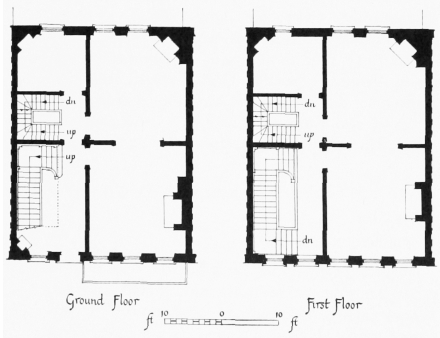
No. 54 Great Marlborough Street, plans
According to the ratebooks the occupants of the house included: Lady Winchilsea, widow of Charles Finch, the fourth Earl, 1716; Lord Compton, 1717–24 (? James, Baron Compton, later the fifth Earl of Northampton); the Duchess of Northumberland, 1726–8 (the 'Countess' in 1726); General Compton, 1729–40; Charles Compton, 1741–55 (? the father of the seventh Earl of Northampton); Sir Piercy Brett, 1768–1781; Lady Brett, 1782–8; Mr. and Mrs. William Siddons, the actress and her husband, 1790–1804.
No. 54 was demolished in 1953. It was a large house with a plan divided by internal walls into four compartments (fig. 52). The front room, three windows wide, was west of the staircase hall, two windows wide and two storeys high. Behind the front room was a room of similar size but having two windows and a corner fireplace. The top-lit service stair was at the back of the main staircase, leaving space for a small back room, or closet. The front was four storeys high, the attic being an addition, and five windows wide. The originally plain brick face had been dressed with cement to provide a horizontally jointed face to the ground storey, and moulded architraves to the first- and second-floor windows. The cornice below the attic was probably original and was aligned with that on the fronts of Nos. 51–52. The finest internal feature was the staircase, which before alteration rose in three flights, short, long, short, round an oblong well to a gallery landing on the first floor (Plate 142a, fig. 53). In its general details the balustrade resembled others in the street, including No. 12 on the north side, in having fluted Corinthian column newels, turned and twisted balusters, and carved bracket stepends. Here, however, the balustrade of the short first flight was swept out in a bold quadrant curve, and the face of the landing gallery was treated as an entablature, having an enriched architrave and an ogee-profiled frieze carved with scrolled foliage and, beneath the central newel, a draped female head. (fn. 107)
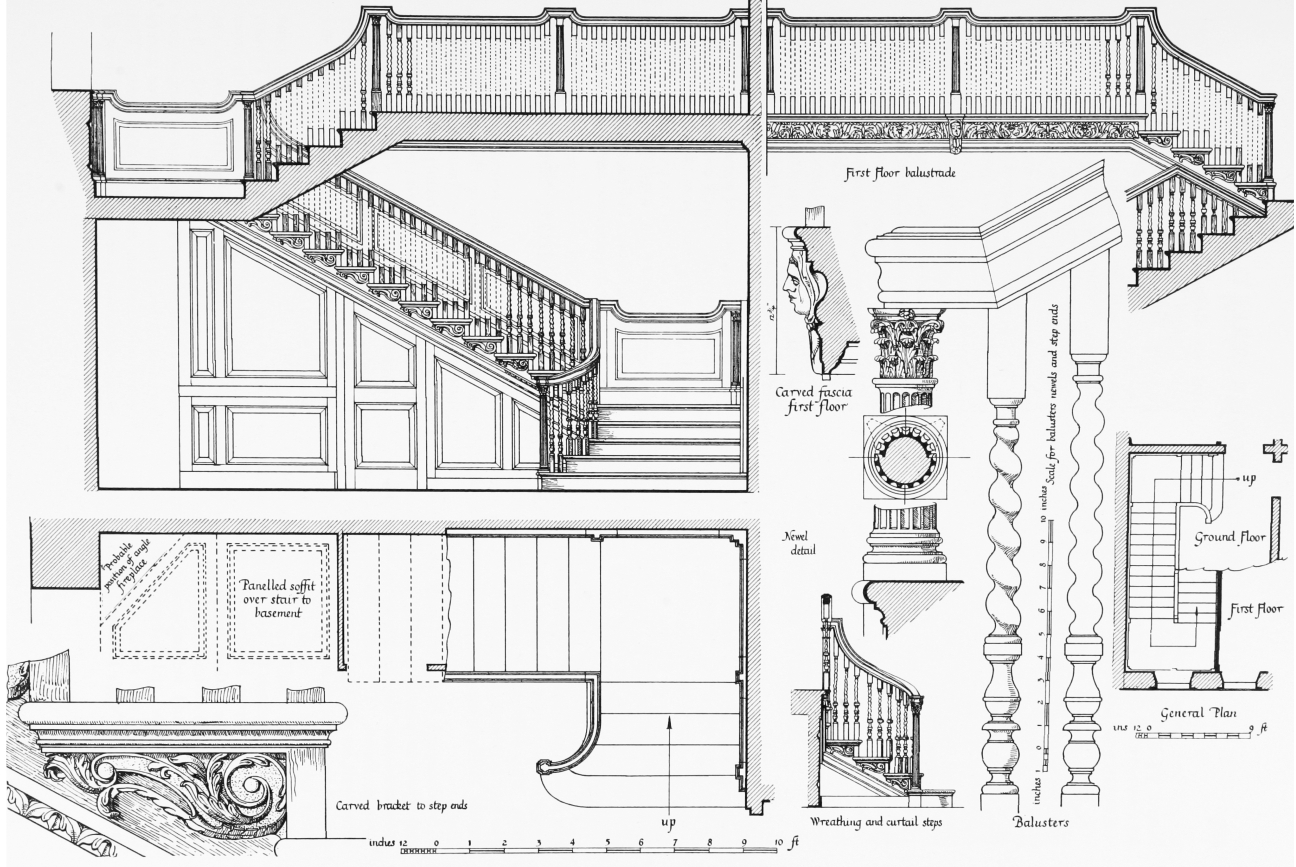
No. 54 Great Marlborough Street, staircase and details
Nos. 55–57 (consec.) Great Marlborough Street
Formerly Nos. 50–52 (consec.). Demolished
Nos. 55 and 56 were first let to Benjamin Hopkins of St. James's, glazier. (fn. 108) No. 55 was occupied in 1724–35 by Lady Jersey, widow of William Villiers, the second Earl of Jersey, (fn. 109) and No. 56 in 1891–1904 by the Architectural Association, during, and just after, its reorganization under the presidency of Leonard Stokes. (fn. 110) No. 57 was occupied by Lady Greville, 1716, 1718–19; Mr. Greville, 1717; and Sir Edward Hill, 1738–40. (fn. 18)
Ramillies Place and Ramillies Street
The only other streets of any consequence in the eastern part of Millfield were those now known as Ramillies Place and Ramillies Street. The former was previously called either Marlborough Mews or Blenheim Mews, and was renamed Ramillies Place in 1910. Ramillies Street was formerly known as Blenheim Street and received its present name in 1885. (fn. 111)
The level of Ramillies Place and Street is a few feet lower than that of Oxford Street, to which direct access on foot is obtained by short flights of steps. This difference is probably partly natural, but may have been emphasized by the use of this part of Millfield for digging brick earth (see page 250).
Marlborough Mews was built between 1704 and 1709 to provide stabling and coach-house accommodation for the houses in Great Marlborough Street. The stables on the south side were built on the northern ends of the plots of ground on the north side of Great Marlborough Street and were let with the houses fronting the latter. (fn. 112) The stables on the north side of the mews were sometimes let with the houses on the south side of Great Marlborough Street. (fn. 113) A description of one of these was probably typical of them all. Over a six-horse stable and coach-house was a hayloft and lodging-room; there was a common staircase and gallery leading to the latter. (fn. 114) Additional stable accommodation was provided by the Nag's Head stable yard, so called after an alehouse fronting the Tyburn Road (now Oxford Street); (fn. 115) the stables here were probably built by Benjamin Hopkins of St. James's, glazier, since the yard was occasionally referred to as Hopkins's stable yard. (fn. 114)
Blenheim Street was probably finished a little later than Great Marlborough Street, about 1710. William Ludb(e)y, of St. James's, carpenter, seems to have been responsible for much of the building. (fn. 116) In 1711 he also granted leases of houses on either side of Queen Street (now Hills Place) to George Devall of St. Andrew's, plumber; (fn. 117) Henry Sawkins of St. James's, carpenter; (fn. 118) Thomas Horseley of St. James's, painter or painter stainer; (fn. 119) John Ludb(e)y of St. James's, bricklayer, (fn. 120) and others.
The property on either side of Queen Street between Oxford Street and Marlborough Mews was part of the Pollen estate sold by Benjamin Pollen in 1732. It was purchased by William Hodsoll of the Strand, goldsmith. (fn. 121)
Another part of Millfield which was sold in 1732 lay between the land purchased by Hodsoll on the east and the Argyll estate on the west. Since 1709 this had been held by Stephen Whitaker, then described as a pipe-maker, (fn. 122) later as a brickmaker (fn. 123) and, when he purchased the freehold from Benjamin Pollen, as a gentleman. (fn. 124) Oxford Circus Avenue now covers this area.
Oxford Street, South side
Oxford Street forms the boundary between the parish of St. Marylebone on the north side, and the parishes of St. Anne, St. James and St. George on the south. Its general history will be described in future volumes on the parish of St. Marylebone. The ground on the south side of the street between Wardour Street and Swallow Passage (a few yards west of Oxford Circus) formed part of the parish of St. James, and all of this section of the street west of No. 167 was in Millfield.
Until 1687 there appear to have been some half a dozen houses in Millfield fronting Tyburn Road (as Oxford Street was then called); more building seems to have taken place there in the early 1690's. (fn. 18) Tallis's street elevation of c. 1839 shows a succession of simple house-fronts, stuccofaced or in brick, rising for two or three storeys above a continuous range of shop-fronts. The single dominant note is provided by the front of the Pantheon (see Chapter XVIII). The first striking intrusion into this modest assembly was made in the 1880's, with T. E. Collcutt's elaborate building at Nos. 175–181, 'impudently adjoining the Pantheon'. (fn. 125) Other, less fastidiously studied buildings followed, but this part of Oxford Street still has many small frontages and retains many vestiges of its past buildings.
Nos. 175–181 (odd) Oxford Street
Formerly Nos. 359–357 (consec.)
Nos. 175–181 (odd) were rebuilt by T. E. Collcutt for Messrs. Phillips, china manufacturers, and for J. J. Duveen, the fine-art importer, to a 'Northern Renaissance' design, exhibited at the Royal Academy in 1885. (fn. 126) The front was in brick with stone dressings and bands of ornament in Doulton salmon-coloured terra-cotta, and with two great gables of which the western one remains. The wider eastern portion, Nos. 175–179, has been rebuilt in a severe featureless style, while Collcutt's façade at No. 181, now painted grey, still exists above the eastern half of a shoe shop.
No. 225 Oxford Street : Studio One and Studio Two Cinemas
Formerly No. 338
No. 225 was for at least a century before 1908 the premises of J. Bell and Co., chemists, (fn. 127) until their amalgamation with Croyden and Co. of Wigmore Street. Until 1908 there was here a charming example of a small late eighteenthcentury shop-front, with slightly projecting arched display windows and delicate woodwork and ironwork (fn. 128) (Plate 137b). With a larger site behind, it was rebuilt in 1909–10 by Melville S. Ward, in the 'Jacobean' style for the London Cinematograph Co. (1909) Ltd., as Cinema House, described as 'the last word in living-picture theatres'. The façade of reconstructed Ketton stone remains above the ground floor behind the present screen of neon tubing. (fn. 129) The interior was reconstructed in 1935 by L. H. Kemp and F. E. Tasker, to provide two separate auditoriums, 'Studio One' in the existing theatre with modifications to the former panelling of 'old oak', and 'Studio Two' in place of the former two-level cafeteria in the basement. (fn. 130)
No. 229 Oxford Street : The Feathers Public House
Formerly No. 336
A public house of this name has existed on this site since at least 1743. (fn. 131) Above the ground floor the stuccoed street front remains little changed since Tallis drew it in c. 1839 as No. 336, halfway between Queen Street (now Hills Place) and Argyll Street.