Survey of London: Volumes 31 and 32, St James Westminster, Part 2. Originally published by London County Council, London, 1963.
This free content was digitised by double rekeying. All rights reserved.
'Albany', in Survey of London: Volumes 31 and 32, St James Westminster, Part 2, ed. F H W Sheppard (London, 1963), British History Online https://www.british-history.ac.uk/survey-london/vols31-2/pt2/pp367-389 [accessed 30 April 2025].
'Albany', in Survey of London: Volumes 31 and 32, St James Westminster, Part 2. Edited by F H W Sheppard (London, 1963), British History Online, accessed April 30, 2025, https://www.british-history.ac.uk/survey-london/vols31-2/pt2/pp367-389.
"Albany". Survey of London: Volumes 31 and 32, St James Westminster, Part 2. Ed. F H W Sheppard (London, 1963), British History Online. Web. 30 April 2025. https://www.british-history.ac.uk/survey-london/vols31-2/pt2/pp367-389.
In this section
CHAPTER XXII
Albany: Stone Conduit Close
Of the present buildings of Albany the 'mansion' (or Albany House) is the former Melbourne House built by Sir William Chambers in 1771–4 for the first Lord Melbourne. Behind the mansion two ranges of chambers stretching north to Burlington Gardens were built by Henry Holland in 1802–3 when the mansion was reconstructed internally for occupation in apartments. Melbourne House was built on the site of an earlier house dating from the post-Restoration development of this part of Piccadilly.
Little is known of this first house to be built here. The site had been part of Stone Conduit Close and was a portion of the ground granted by the Earl of Clarendon in August 1664 to Sir William Pulteney and Sir John Denham, the western half of which Denham, in association with Pulteney, sold to the Earl of Burlington in January 1666/7 (see pages 342, 390–1). On 20 November 1668 Pulteney and his trustee Henry Guy, of Tring, Hertfordshire, esquire, granted the freehold of the westernmost part of the remainder, a block of land about 100 feet wide and about 550 feet deep, stretching between Piccadilly and the present Burlington Gardens, to Sir Thomas Clarges (who was later, with Guy, to be named as trustee for much of Pulteney's property in the latter's will). A yearly rent-charge of £22 was reserved, payable from Lady Day 1670. The deed recording this grant is in the possession of the present owners of the site, the Albany Trustees, by whom the rent-charge is still paid to the Sutton estate as successors to the Pulteney estate. (fn. 5)
On this plot of ground Sir Thomas Clarges erected a house, of which he first appears as occupier in the 1671 ratebook. He certainly resided in the house in May of that year. (fn. 6) Nothing is known of the identity of the architect or builders of the house. The street front is very roughly indicated on Ogilby and Morgan's map of 1681–2 (Plate 3a). A clearer view, but of only the north-west corner of the house, appears at the edge of the Knyff-Kip engraving of Burlington House in c. 1698–9 (Plate 42a). This shows a house with, like Clarendon House, a balustraded platform roof. In common with the other Piccadilly mansions it stood back behind a courtyard. In the hearth tax return for 1674 Clarges was assessed for 39 hearths compared with Lord Townshend's 15 in the adjacent house to the east and Lord Burlington's 41 to the west. (fn. 7) The size of house which this seems to indicate is surprising, but the Knyff-Kip view shows a large west wing of the same height as the central block, and Ogilby and Morgan's map a perhaps slightly smaller east wing. Probably these wings were capable of separate occupation and thus account for the two houses additional to the main mansion which are mentioned in Clarges's will of 1694 (fn. 8) and which were separately rated in this part of Piccadilly until 1699, when their disappearance from the ratebooks is accompanied by an increased assessment of the main house. In 1691 the ratepayer for one of these two residences was said to live 'chez' Sir Thomas Clarges. (fn. 9) A number of the ratepayers presumed to have lived in these wings of the house apparently held official or semi-official positions or were acquaintances or relations of the Clarges. The first occupant of one residence, in 1671, was Sir Thomas Ingram, probably the Chancellor of the Duchy of Lancaster. Later occupants were Henri Justel, the French Protestant émigré and keeper of the King's library at St. James's, (fn. 10) who lived here in 1683–4, Captain Oglethorp, doubtless Gentleman of the Horse, (fn. 11) in 1685, and Armand de la Bastide, a soldier, and a political acquaintance of Clarges, from 1689 to 1699. (fn. 12) In the other residence the first occupant, from 1674 to 1676, was the Court painter, Antonio Verrio. A later occupant, from 1695 to 1699, was Anthony Hammond, Member of Parliament, the writer on public finance, who in 1694 had married Clarges's grand-daughter. (fn. 10)
Sir Thomas Clarges was rated for the main house until 1690, when he was succeeded as ratepayer, five years before his death, by his son Sir Walter. After 1695 a number of short tenancies followed, the occupants including Count Tallard, during his embassy in England, in 1700–1, the second Duke of Queensberry in 1702–5 during the preliminaries to the Union with Scotland in which he played a prominent part, and the Venetian ambassador from 1706 to 1707 or later. In 1695–6 and again in 1699–1700 the assessment of the house was increased, the latter change, as has been seen, being evidently associated with the ending of the separate occupation of the wings. In 1708 Hatton spoke of the house as 'a stately new Building'. (fn. 13)
On 20–21 January 1709/10 Sir Thomas Clarges's grandson, also Sir Thomas, sold the house for £4600 to the Secretary of State, Charles Spencer, third Earl of Sunderland, whose family retained the house for some thirty-seven years. (fn. 14) Sunderland may have been already in occupation at the time, as in the spring of the previous year the gardener Henry Wise was planting 137 limes, 7 jessamines and 6 honeysuckles in a garden in Piccadilly belonging to the Earl. (fn. 15) The Earl's immediately preceding house had been in St. James's Square, but from 1696 to 1702 he had lived in the adjacent house eastward where his mother the Dowager Countess probably still resided. (fn. 16) He is said (fn. 17) to have thrown this latter house and Clarges's former house into one, but it is clear from title-deeds and ratebooks that he did not in fact do so, although in April 1711 he took a nineteen-year lease of part of the eastward site as a stable yard. (fn. 18)
As an avid book-collector Sunderland was concerned to house his treasures fittingly. In 1714 Macky referred to the library as a 'Noble Room built on purpose'. (fn. 19) In about 1719–20, however, extensive building operations were undertaken, to house the library even more handsomely, at a cost of at least £5132 (probably excluding furnishings other than joiners' work). The building was evidently executed under the direction of the Surveyor General of Works, Sir Thomas Hewett, with the bricklayer Thomas Elkins undertaking some payments to other workmen. (fn. 1) The work was not quite finished when Sunderland died in April 1722, and sums for carpets, walnut furnishings and chimney glasses in the old and new library were paid to the noted cabinet-maker James Moore by Sunderland's executors. (fn. 20) The new library stretched northward on the east side of the garden. It was described by Macky in 1723 as 'the finest in Europe, both for the Disposition of the Appartments, as of the Books: The Rooms, divided into five Appartments, are full 150 Foot long, with two Stories of Windows, and a Gallery runs round the whole in the second Story, for the taking down Books.' (fn. 21) The workmen's bills show that each of the five apartments had 'Italian Mold'd Marble Chimney pieces' and that the library was lit by forty large-paned sash windows. (fn. 15)
An inventory of the late Earl's goods, made in February 1722/3, does not add anything of note to the description of the library, which his successor insured for £10,000. (fn. 22) It does, however, give the designation of the rooms in the house. For the most part these were listed, in the customary manner, by floors, but all the rooms in the 'left wing' were described together, supporting the belief that this part at least had earlier been a separate residence. The description of the furnishings in the house indicates that some of the rooms were decorated to a scheme of colouring, blue in Lord Sunderland's bedchamber and yellow in Lady Sunderland's dressing-room; there were also a 'Crimson Damask bedchamber' and a 'Green drawing room'. Some tapestries are mentioned but were mostly in store. China jars were set about the rooms and in the green drawing-room was a silver tea service (and a silver statue of Hercules weighing some 62 ounces). Bedchambers contained a spinet and a harpsichord and there was 'an organ compleat' in the chaplain's dining-room. A marble side table is mentioned in one room and a 'larg Square Carve'd Guilt table with a leather Cover' in another: apart from these, the furniture was 'wainscot' or walnut, except for japanned cabinets and Indian tea-tables. Numerous lookingglasses are mentioned and glasses or paintings over the chimneys. The chimneypieces are not described. All the hearth furnishings were of steel. The entrance hall had the twenty-four fire-buckets usual in such places, and there were three blunderbusses in an adjacent room. (fn. 23)
In June 1745 Sunderland's son, the third Duke of Marlborough, together with mortgagees, sold the house for £6000 to his brother-in-law, the fourth Duke of Bedford. The conveyance was not in the form of a mortgage and was direct to the recipient and not in trust for him, but it was perhaps made to secure various debts of the Duke of Marlborough's which were mentioned as charges on the property. (fn. 24) The Duke of Marlborough continued to occupy the house until 1747 when, on 15–16 April, the Duke of Bedford sold it, again for £6000, to the First Commissioner of Trade and Plantations, Lord Monson. (fn. 25) Lord Monson died in the following year and was succeeded in the house by his son who retained it until 18–19 March 1763 when he sold it, profitably, to the Paymaster General, Henry Fox, who was about to be created Lord Holland. The price was £16,000. (fn. 26) Whether the Monsons had rebuilt or improved the house is not known, but Dasent says that the second Lord Monson had pulled down Lord Sunderland's library in 1758. (fn. 27) A comparison of Rocque's map of 1746 with Rhodes's of 1770 confirms that the library was removed between these dates.
Lord Holland's ownership lasted for eight years, and was marked by the preparation in 1764 of an elaborate and sophisticated design for a complete rebuilding by Robert Adam (fn. 28) (Plate 112a). Nothing was done in fact, perhaps because with his retirement from the House of Commons Lord Holland's interests became diverted to his villa on the Thanet coast.
On 31 March–1 April 1771 Lord Holland sold his house for £16,500 to Sir Peniston Lamb, who in the previous year had been created Lord Melbourne and who was then living at No. 28 Sackville Street. The transaction included an agreement to secure Melbourne against any claim on Lord Holland's estate by the Crown, to whom he was a debtor as Paymaster General. (fn. 29) Melbourne, twenty-six years old and two years married to an attractive and strong-willed wife, was possessed of great wealth inherited from his father (a lawyer who had at one time himself been a mortgagee of the property from the Duke of Marlborough). He now determined to pull down the old house and to build on its site the town residence which survives as the 'mansion' of Albany (Albany House). The architect he chose, on the recommendation of the second Baron Grantham, British ambassador to Spain, (fn. 30) was Sir William Chambers, to whom he became related in 1775 by the marriage of Chambers's daughter to Lady Melbourne's brother John Milbanke. Chambers's zest for the work may well have been sharpened by his knowledge of Robert Adam's very different plan for the site, of which he had a drawing made. (fn. 28) The composition and detailed design of the house developed in deliberate rivalry to the innovations in style and plan by which Adam was attracting the patronage of the fashionable world.
By July 1771 the old house had been demolished, (fn. 31) and in November the first surviving letter of Chambers referring to the house reported that the work was going forward 'very briskly and very well', with the 'chamber floor' (second floor) nearly completed. (fn. 32) The carcase of the house was finished in the following May. (fn. 33) Between 1771 and 1772 the rateable value was increased from £250 to £375. (fn. 16) By July 1772 the kitchen block on the east of the court-yard was covered in and the stable block on the other side nearly so. (fn. 34) Chambers suggested deferring the construction of the coach-house and gateway until the following year, and his design for the screen-wall and entrance is dated 1773. (fn. 35) In the meantime the finishing of the interior was begun, starting at the top. Much thought was given to the design of the ceilings. By October 1773 all the plasterers were reported to be out of the house and the paving of the hall and great staircase was about to begin. (fn. 36) Early in 1774 the family moved in: the stables had been occupied (in Chambers's words) by 'the Cattle, as horses, Grooms and Coach-men,' since the previous spring. Melbourne, rather like Sir Watkin Williams Wynn in St. James's Square, celebrated the opening of his residence with 'two public morning Concerts to show his house'. (fn. 37) Work on the house proved, however, not to be at an end. The operations which continued for at least the rest of that year were substantial, including the decoration and furnishing of the 'round room' on the first floor, and it seems clear that they constituted a belated alteration or extension of the original design. In the last known letter between Melbourne and Chambers during the building period, in November 1774, the owner was hoping that the workmen could be out of the house by the New Year. (fn. 38)
Few of the workmen's names are known. The bricklayer, who was reproached by Chambers in November 1771 for the 'infamous' quality of the bricks he was using, was Edward Gray. (fn. 39) Two of the workmen concerned with the ceilings, presumably as plasterers, were Collins and Evans. (fn. 40) Chambers mentions that the services of a joiner, Mr. John Robey, who was working for him at Earl Fitzwilliam's house, Milton Park, were to be employed at Melbourne House under 'my Joiner'. (fn. 41) Paintings for some of the ceilings, including those of the 'two great rooms' and in 'the Gallery' were provided by Cipriani who in 1773 had submitted drawings with his prices written on the back. Other painters were also paid, (fn. 42) probably including Mr. (?William) Marlow of Leicester Fields, who had been asked to paint large pictures to be set in stucco frames over and opposite the chimney in the eating-room. (fn. 43) Rebecca and Wheatley are also said to have decorated some of the rooms, (fn. 44) but they are not mentioned in Chambers's letters. Unlike Robert Adam, Chambers made use of the services of another architect, James Paine, to design and provide chimneypieces in 1773. (fn. 45) Paine was being or had recently been employed by Melbourne at No. 28 Sackville Street and at Brocket Hall, Hertfordshire, (fn. 46) which perhaps explains his employment here. Chippendale was employed to supply furnishings and also, evidently, to suggest their disposition, but Chambers made it clear that he was deeply concerned with the place of furniture in his decorative scheme. In August 1773 Chippendale had called on Chambers with some designs. They seemed very well, but Chambers communicated to Melbourne his wish 'to be a little consulted about these matters as I am really a Very pretty Connoisseur in furniture'. He went on to criticize 'the method of fitting up my Lady's dressing Room with Girandols and a Glass out of the Center and the Girandoles quite irregularly placed. Pictures would be much better and in the great room fewer Sophas and more chairs would be better than as Chippendale has designed.' (fn. 47) In October 1774 Chippendale's work was being submitted by Melbourne for Chambers's approval. (fn. 48) In essentials the control of the decorative scheme seems to have been as comprehensive as in Adam's work of the time, with Chambers's cognizance extending down to the design of door scutcheons. (fn. 47)
Chambers's conscious opposition to the decorative innovations and professional ambitions of the Adams is avowed in a letter from him to Lord Grantham. 'Messieurs Adam have lately published a book of their ornaments, with a preface rather presumptuous, as I am told; for I have not yet read the book; in which they boast of having first brought the true Style of Decoration into England, and that all the Architects of the present day are only servile copyers of their excellence. I do not agree with them in the first of these positions; and can produce many proofs against the last, among others, Melbourne house, decorated in a manner almost diametrically opposite to theirs: and more, as I flatter myself, in the true Style, as approaching nearer to the most approved Style of the Ancients.' (fn. 49)
Melbourne himself took a constructive interest in the attempt to achieve a calculated perfection. In October 1774 he wrote to Chambers: 'Upon full consideration about furnishing the round room (in which you have exceeded my utmost wish) I am more and more averse to admitt any gilding whatever even in the furniture, in my opinion the Elegance of that room is from the lightness of well disposed well executed Ornaments; vastly preferable to any load of gilding we Could have introduced. Therefore I am sure that carrying that Simplicity throughout, we shall succeed much better; and the novelty of a room of that sort finished without any gilding, cannot fail to Please. Therefore I wish you would Consider in what manner we can colour the glass frames and Chairs, so as to Correspond with that uniformity we have already so much attended to. I have stopped the gilding of any of the things for that room, at Chippendale's, altho' some few things were done, but I had rather give up that, so that we may make the room all Perfection, by which it will give me great Pleasure, and particularly as it will put your taste very superior to any in this Country.' (fn. 48) Chambers, however, replied: 'It is I think clear that the Glasses and Soffas in the Niches should be gilt, for glasses without gilding are large black spots that kill the effect of every thing about them, and the dead coloured silk with which the soffas are to be covered, must have gold to relieve it; when it will suit perfectly with the room; and I am under no apprehensions that the brilliancy of the gilding will hurt the effect of the rest, but rather set its plainness off to advantage. The Chairs must of Course be gilt, but they are much too small; Arm Chairs would have answered much better.' (fn. 50)
Throughout the period for which letters survive Melbourne seems to have been outspokenly and expansively pleased with Chambers's work. In August 1773 Chambers had been able to report to Lord Grantham in Madrid the happy outcome of his recommendation to the Melbournes: 'they are pleased with what has been done, and I am much pleased with their treatment'. (fn. 49) Chambers's letters to Lord Grantham contain a slightly disingenuous element; in April 1774 he was claiming that 'little more than two years' had passed since the foundations of the house, then in occupation, were laid, (fn. 51) whereas two and a half years earlier the house was, as has been seen, already at second-floor level. But Melbourne's own letters, written after he had moved in, testify to his satisfaction. In February 1774 he wrote, 'I believe few people have had better reason than myself to be pleased with so large a sum laid out', (fn. 46) and in the autumn, when the additional work was still in hand, 'I am sure in this you will Shew, as you have in all other parts of my works, more taste, and in every respect give me more satisfaction, than all other Architects put together could possibly have done'. (fn. 52) The house, though it failed to check the turn of taste towards the Adams, seems to have had also a general success: in December 1773 Lord Grantham obligingly reported from Madrid that he had heard 'a very good Account of Melbourne house'. (fn. 53)
Chambers seems to have been responsible for paying all the workmen, including the decorative painters. The cost of the work to October 1773 had been some £22,959, of which £21,300 had been incurred under Melbourne's contract with Chambers and the rest for 'extra works' by 'plaisterers, painters, carvers etc.': of the total, some £3159 was then still owing. (fn. 54) By November 1774 the cost had risen to about £24,632, but a jotting by Chambers on the back of a letter from Melbourne suggests that by then the latter had advanced £25,102, leaving a balance in his favour against the work still outstanding. (fn. 55) This evidently proved considerably more expensive than was expected, and no prompt settlement was made. Ten years later there was still owing to Chambers, secured by a bond, the sum of £3000, on which the interest was two years in arrears. Melbourne sought apologetically to turn aside Chambers's reported wrath with the offer of a year's interest. (fn. 56) Chambers's reply is not known but the principal sum was still owing in March 1789 when it was secured by a mortgage of the house itself. (fn. 57) This was still undischarged when Melbourne disposed of the house some three years later.
Melbourne's version of the cost of the house has been recorded by Mrs. Steele, the companion of his mistress, Mrs. Baddeley, in an account of a conversation with Melbourne printed in Lady Birkenhead's Peace in Piccadilly. (fn. 58) The conversation is undated but occurred when Lady Melbourne was buying silks with which to hang her rooms. 'His Lordship declared … upon his honour, that when the house, in Piccadilly, which he was building, was finished, and the furniture in it complete, so as to sit down in it to dinner, from a just calculation, it would cost him one hundred thousand pounds. "An astonishing sum!" exclaimed I. "It is a much greater sum", continued his Lordship, "than I intended, when I first began"; for Mr. Chambers' the surveyor's estimate of the house and offices complete, did not exceed thirty thousand pounds; but, after they had gone on some way, and had made by his orders, some few alterations, it came to twenty thousand more. So that the buildings [sic] of that house came to fifty thousand pounds, beside the sixteen thousand pounds paid for the old house and ground.' (fn. 59) Melbourne seems to have been both extravagant and ingenuous in matters of finance, and this statement of his commitments may be nearer the truth than would commonly have been the case with such protestations made to Mrs. Steele by admirers of Mrs. Baddeley.
During the Melbournes' occupation of the house the future Prime Minister, the second Viscount, was born here, on 15 March 1779. (fn. 60)
In February 1785 the Melbournes came to an agreement with their friend, the sculptress, Anne Damer, for her to open a door and window into their garden from the yard of a house in Sackville Street. (fn. 61) Mrs. Damer is said to have advised on the finishing of Melbourne House. Lady Birkenhead has written: 'Her knowledge and advice were valued by Lady Melbourne and were of great service to her in the decoration of the house.' (fn. 62)
The Melbournes' tenure of the house was shorter than they had probably intended. The manner of its termination was unusual, being by an exchange with Frederick, Duke of York and Albany, for his leasehold house in Whitehall (now the Scottish Office). The agreement for the exchange was concluded on Christmas Day 1791 and is said to have resulted from Lady Melbourne's assent to a remark dropped by the Duke during a visit to Melbourne House. (fn. 63) Lady Birkenhead has surmised that a reason for the Melbournes' compliance may have been financial difficulties arising from the elaborate state maintained by them at the house, (fn. 64) which Melbourne had already mortgaged for £10,000 in 1775, (fn. 65) before charging it with the £3000 owed to Chambers.
The Duke appears as occupant of the house in the 1792 ratebook. As both the Duke's Whitehall house and Melbourne House were mortgaged the exchange was a complicated transaction, and was not completed until November of that year. By the agreement of Christmas 1791 the Duke had undertaken to pay Melbourne £23,570 as part of the exchange. On 20–21 July 1792 Chambers and Melbourne's other mortgagee, T. H. Broadhead, conveyed their interests to mortgagees of the Duke—Chambers to William Adam and John Antrobus (a partner in the banking firm of Thomas Coutts and Company), and Broadhead to Oliver and James Farrer. At the same time, on 21 July, a deed poll was executed by Melbourne and the Duke, declaring that, in addition to £13,000 plus interest paid by the latter's mortgagees, the Duke had paid £4707 10s. to Melbourne, making a total of £18,000 paid as part of the purchase money. Melbourne undertook to convey Melbourne House on payment of the residue and on the assignment to him of the lease of the Whitehall house. This the Duke in turn undertook to perform within six months. (fn. 66) The final conveyances and assignments were made on 6–7 November. The conveyance of Melbourne House was made by Adam, Antrobus and the Farrers to Edmund Antrobus, a partner in Coutts's bank. His tenure, however, was to the use of Thomas Coutts for a mortgage-term of 1000 years to secure £16,000 previously lent by Coutts to the Duke, and then to the use of the Farrers to secure the £10,000 they had paid for Broadhead's mortgage. (fn. 67) The house was also charged, together with the Duke's other property at Oatlands in Surrey, with the sum of £34,000 owed by him to the Farrers, although it was subsequently discharged of this encumbrance. (fn. 68) On 5 January 1793 the Duke charged the house with a further sum of £10,000, of which £6000 was borrowed from Coutts (making the debt to him charged on the house £22,000) and £4000 from the Farrers. (fn. 69) The interest of these mortgagees, and in particular of Thomas Coutts, in the mansion (now called York House) was to have an important influence on its history.
The Duke's personal extravagance was comparable to the Melbournes', and perhaps occasioned the decision to dispose of the house some ten years later. Nothing, however, is known of the first inception of schemes for the redevelopment of the site, which were in prospect by 1800.
The first report of impending redevelopment seems to be in the text of Thomas Malton's Picturesque Tour Through … London and Westminster accompanying a view of Uxbridge House published in May 1800. This notices that 'it is now in contemplation, to open a communication with Piccadilly, by pulling down York house, and building a street of handsome houses on the site of the gardens, in a direct line with Saville-row. Such a communication continued to Conduitstreet would be a very important improvement; and it is hoped there will be no impediment to prevent its completion.' (fn. 70) The earliest direct records of this project, however, date only from October 1801, and introduce the speculators who were eventually to carry out a very different transformation of the site. One was the architect Henry Holland, who had worked for the Duke at his Whitehall house and at Oatlands, and who was acquainted professionally with Thomas Coutts. (fn. 71) His associate was the successful young building contractor, Alexander Copland of St. Martin's Lane, whose work on barracks and military hospitals might have recommended him to the Duke and who at that time was constructing the Duke of York's School in Chelsea. Holland and Copland had evidently proposed to Thomas Coutts the construction of a single row of houses facing west across a 38-foot-wide roadway to the wall of Burlington House. York House would have been demolished, and by the end of October Coutts had asked James Burton to value the materials of the house. (fn. 72) A detailed questionnaire was submitted by Coutts to Copland, from which it appeared that the latter was expecting £1100 or £1200 per annum in ground-rents. (fn. 73) The precise method of disposing of the property does not appear, but all the mortgagees seem to have been very concerned to obtain proper security that the old materials would not be disposed of by the builder (evidently not Copland himself). (fn. 74) On 1 November the Duke cordially signified to Coutts his assent to the proposal and thanked him for his 'obliging solicitude for the thorough Success and Security' of the project. Holland and Copland were then making 'detailed Plans', (fn. 75) but very soon afterwards the project was abandoned. One cause may have been the inability to prevent the owner of Burlington House from raising his garden wall opposite the houses. (fn. 73)
With the abandonment of the proposed street York House's continuance was assured, and the next short-lived proposal contained in embryo the development actually carried out.
On 22 January 1802 Copland came to an agreement with the Duke for the purchase of the site. The price was to be £37,000, payable in instalments. Copland was to be admitted into possession of the property on 25 March 1802 provided the first instalment had been paid, but the conveyance was not to be executed until the whole payment had been made. (fn. 76) There was a proviso for Copland to rescind the agreement within three months. Lady Birkenhead has stated that this would have become operative if Copland had by then been unable 'to procure Subscribers … to the … House and premises as a Subscription House or Hotel to the amount of £50,000 or upwards'. (fn. 77) The nature of the development then intended is indicated in a printed proposal, without date but assignable to about this period. This was a prospectus 'for Purchasing in Shares, The Extensive Freehold Mansion House and Premises, Situated in Piccadilly, Now in the Occupation of His Royal Highness the Duke of York, and For Making Large Additions to the Same, and Such Alterations, as are Necessary to open the Whole as A Magnificent and Convenient Hotel'. A feature of the enterprise which in essentials was carried over into the establishment of Albany as it now exists, was the attempt to attract a hundred subscribers of £600 each, the first forty of whom were to elect three trustees to hold the property. A committee of seven was to finish and furnish the hotel and erect the additional buildings. The hotel was to be for the residential accommodation of families and was to be known as the Royal York Hotel. It was to be opened at 'Midsummer next'. (fn. 78)
By March 1802, however, this intention had been abandoned for a more original and, in the outcome, highly successful project. On 7 March 1802 a memorandum by Copland recorded that he had waived his right to cancel the agreement and had agreed to become absolute purchaser of the premises. The price remained the same but the Duke and his mortgagees, Coutts and the Farrers, had agreed to an adjustment of the period of payment, which was now to be by eight instalments from May 1802 to September 1805. Copland declared his intention of 'making extensive additions' and of 'building on part of the said premises and of converting the Buildings into and selling the same in separate Lots of Apartments and of letting part of the Ground on Building Leases'. The Duke and his mortgagees agreed that after the payment of Copland's second instalment on 29 September 1802 they would join in 'proper conveyances of each set of apartments as soon as the same is finished and sold' and in granting building leases of the parts of the site to be so let. This was to be conditional upon Copland's paying over an amount which, with the instalments then paid, would equal half the value of the part disposed of, until the purchase price was paid. (fn. 76)
At this time, the end of the first quarter of 1802, the Duke ceased to be rated for York House.
Nothing is known of the discussions and deliberations by which the idea of Albany was developed, as a speculation and as architecture. In this month of March 1802 the main features of the conversion of the old house and the construction of new buildings had, however, been sufficiently settled for a number of copies of finished and coloured manuscript plans to be prepared, doubtless for submission to prospective purchasers (Plate 115). Five levels are shown, from basement to garret storey, and each is entitled a 'Design for dividing and disposing of the Mansion House and Premises lately occupied by His Royal Highness The Duke of York'. Henry Holland's authorship is shown by his inscription 'H. H. Sloane Place Mar. 1802' on some of the plans and on a pen-and-ink plan of part of the layout. (fn. 79) As well as the mansion itself, Chambers's forecourt buildings were to be retained, but four shops were to be built on the Piccadilly frontage. Behind the mansion, on each side of the former garden, two ranges of buildings were to be erected, consisting of chambers opening off staircases in the manner of a college or inn of court. The general dimensions and layout were very similar to that executed. The northern ends of the ranges were not, however, carried right up to the oblique frontage of Burlington Gardens, and the internal planning of the separate sets of chambers was different from that executed and without the simple and graceful formality actually achieved (Plate 119a, fig. 72).
A printed prospectus dated 1802 was prepared, doubtless to accompany these plans. The former idea of an hotel survived vestigially in the proposed provision of a dining-room, under the direction of a maitre d'hôtel, and of 'Hot and Cold Baths etc.', for the use of the inhabitants. But the essence of the proposal was the division of the existing and projected buildings 'into elegant and convenient Sets of independent Freehold Apartments'. They were to be sold, by Copland and the mortgagees, for prices between £350 and £800, with or without the payment to Copland and his heirs of a fee-farm rent of between £20 and £40 at the option of the purchaser. (fn. 80) In the event, the prices at which sets were first sold were sometimes considerably more than was indicated in the prospectus.
In April 1802 a supplemental agreement was drafted but probably not executed between the Duke and Copland. This provided for the latter to pay only £34,000 instead of £37,000 purchase money. An appended note explains, however, that the larger sum would be paid by Copland 'in Case the Interest of his royal [highness] should enable Mr. Copland to dispose of 25 Sets of the apartments as in that Case Mr. C's risque and trouble will be much lessened'. (fn. 81) The Duke was in any event interested in the success of the scheme as a means of discharging his debts to his mortgagees, and Coutts stated some six months later that he was buying sets of chambers, not for residence but only 'to encourage the finishing of the transaction proposed, and to oblige His R.Hs'. (fn. 82) It is not certain whether the purchase price was in fact reduced, as it was subsequently stated at both sums. (fn. 83)
At this time, in July 1802, eighteen subscribers had come forward and Copland and Coutts agreed that they should 'chuse their sets as soon as they please': (fn. 84) as has been seen, in October Coutts was himself choosing sets. By 17 January 1803 Copland was able to come to agreements for the sale of sets of chambers on staircases C and D, which he undertook to finish according to agreed specifications by the following 24 June. It is not clear how far building had already progressed. The specifications include provisions respecting the exterior walls and the roof, and for the staircases to be of Portland stone. Specifications for the interior finishing were not very detailed. They included 'plain plaster Cornices in the Principal Rooms, and the Walls either Stuccoed, or papered, with paper at One Shilling per Yard… . Statuary and veined Marble Chimney Pieces, in the Principal Rooms'. (fn. 85) On the same day Copland agreed 'that the Dining Room Kitchen Cellars Hot & Cold Baths Residence of the Maitre D' Hotel—The Pavement, Iron Rails, covered way, Gates etc. are to be finished in a substantial & proper Manner according to the Plan Proposed by Mr Copland at His Expense.' (fn. 86)
One of the sets was to be sold for £1600 or for £800 plus a rent-charge of £40 per annum and another two for £1200 each with the option of similar alternatives. (fn. 85) In February three more sets were agreed to be sold for £3600. (fn. 87) In the same month, on 28 February 1803, the four shops fronting Piccadilly were leased by the Duke, Coutts, the Farrers, Edmund Antrobus and Copland. The leases ran for 99 years from the previous Lady Day at a peppercorn for the first year, and the carcases were thus probably newly completed at the time of the leases. One of the leases was to Edward Lardner, senior, of the Strand, gentleman. The other three were to William Slade of 34 Lower Thornhaugh Street, Bedford Square, a bricklayer, who was probably the builder, (fn. 88) and who later estimated for some small repairs to stucco-work for the Trustees. (fn. 89) The first occupants of the shops were a gold and silver lace manufacturer, a druggist, a pastrycook and fruiterer, and a linen draper (Plate 116a).
At the end of August 1802 a legal opinion had been taken on the Duke's and the Farrers' title to the property, evidently in contemplation of their joining in the agreed conveyance to Copland after 29 September. (fn. 90) In fact, however, the conveyance to Copland seems never to have been made in the form proposed. He began to pay instalments of money to Coutts, in discharge of Coutts's £22,000 debt from the Duke, early in September 1802 (fn. 91) but by the end of the following September he had paid only £9500 to Coutts and £9300 to the Duke. There was thus still £12,500 owing to Coutts and £5700 to the Duke to complete the purchase. In the meantime, however, as has been seen, the disposal of parts of the premises had been going forward.
The intended nature of the legal estate of the various interested parties is indicated in the printed prospectus of 1802 (fn. 80) and is stated in one of the deeds by which the whole property was finally settled in the autumn of 1803. The latter records that Copland had contracted with several persons for the sale to them of sets of chambers, 'previously to which it was proposed and agreed between the said Alexander Copland and the several Purchasers respectively that the Inheritance in fee simple of and in the said sets of Apartments or Chambers and all other the said Premises should be conveyed to and vested in Trustees; not exceeding 7; with a view to general regulation; and so as to give each Proprietor a freehold Estate therein in Equity'. It was similarly agreed that the purchasers and all future proprietors 'should be subject to such rules and regulations to be from time to time framed by the said Trustees respecting the occupation, letting or other disposing of the said Apartments by each Proprietor; and respecting the general management and regulation of the whole Concern; as would, in the Trustees' judgment be most conducive to the benefit of the Proprietors in general'. The parts of the premises to be run by the maître d'hôtel were to be conveyed in fee simple to the Trustees, who were to let them to him and divide the proceeds among the proprietors. (fn. 92)
It was also agreed that the Trustees were to be elected from among the proprietors at a meeting held after Copland had sold twenty sets of chambers. (fn. 92) By 22 April 1803 it was possible to hold such a meeting of proprietors, at the Thatched House Tavern. (fn. 93) Seven Trustees were elected and held their first meeting six days later at 'Albany House'. A secretary and steward was elected, rules and regulations were ordered to be drafted and it was decided to apply to Copland (who was of course a 'proprietor' but had not yet been elected a Trustee) for the conveyance to them of the maître d'hôtel's part of the premises. (fn. 94)
By the time the final settlement of the property came to be made, by lease and release on 28–29 September 1803, the two ranges of chambers in the former garden had been built. The conveyance now made noticed that Copland had contracted to purchase the site from the Duke but that, as has been said, £18,200 was then still owing to the Duke and to Thomas Coutts. This sum had been advanced to Copland by two partners in Coutts's bank, Coutts Trotter and Edward Marjoribanks (the former being himself a proprietor of chambers). It also noticed that the Farrers had agreed to release the property from the sums of £34,000 and £4000 owed to them, having other security for the same. The conveyance of the whole premises was now made by the Duke and his mortgagees (Coutts, the Farrers and Edmund Antrobus, Copland also being a party to the transaction), to Trotter and Marjoribanks for a mortgage-term of 500 years to secure their £18,200, and then to the seven Albany Trustees. On the day of the release, 29 September, Copland and the Trustees made a declaration of trust in respect of this conveyance, by which the Trustees as legal owners were charged with the regulation of the whole property and with the letting of the maître d'hôtel's part as previously indicated, and were constituted trustees of the rest of the property for Copland and his heirs so long as the latter remained proprietors. (fn. 68)
In October Robert Mylne was valuing sets of chambers for Thomas Coutts or his associates (fn. 95) and in December a number of conveyances of sets were made by the Trustees and Copland to proprietors. (fn. 96) 'Albany' first appears in the ratebooks in 1804, although only ten occupants, apart from the secretary, are shown.
On 28 February of that year articles of agreement were concluded between the seven Trustees of the first part, thirty-three other proprietors of chambers of the second part, and Copland, as proprietor of chambers and of the fee-farm rents charged on some of the other chambers, of the third part. (fn. 97) This recited the previous transactions and proceeded to lay down rules and regulations to be observed by the proprietors. Among these was the provision that 'No projection or alteration in any of the Walls, Windows, Common Staircases or Roofs nor any alteration whatever varying the present Figure of the Buildings shall be made without the consent in writing of the majority of the Trustees first obtained.' The repair of the roof, exterior walls, staircase, etc., belonging to each building was to be made under the direction of the Trustees at the expense of the proprietors of that building.
'In order to exclude improper Inhabitants' there was to be no letting or sale of chambers without the consent of the Trustees, and 'No Profession Trade or Business' was to be 'carried on in any of the Apartments or Chambers without the approbation of the majority of the Trustees in writing'.
The first rule of all may be thought conclusive in a matter that later became the subject of debate: it established that 'the Premises mentioned in the foregoing Articles shall be called Albany'. In the nineteenth century, however, the use of 'the Albany' was common and the present resolute omission of the article seems to spring not so much from awareness of correct usage as from a sense, about the beginning of the twentieth century, that 'the Albany' sounded 'like a publichouse'. (fn. 98)
The early minutes of the Trustees, in 1803, were signed by Henry Holland, who doubtless supervised the fabric of the building when it was first being brought into use. But in August 1804, some two years before Holland's death, Robert Smirke, a relation of Copland's, was officially appointed unpaid architect to the Trustees (fn. 99) and was responsible for overseeing such slight alterations as were thereafter made in the building, chiefly in cutting entrances to the parts used as a dining-room or 'tavern'. In 1812 a request from Lewis Wyatt to make additional upper windows on the west side of the court-yard was refused as it would 'change the present uniformity of the Building'. (fn. 100)
In 1808 Smirke took a set in Albany. In 1819 the Trustees gave permission to George Basevi to practise as an architect in a ground-floor set looking on to Vigo Street. (fn. 101) A similar concession was made to the solicitor who took chambers in the eastern court-yard building formerly used as a kitchen. The limitation on the use of apartments for business or professional purposes seems not to have been applied strictly in the court-yard. Henry Angelo had a fencing school here in 1804 (fn. 102) and in 1807 the pugilist John Jackson probably used the same apartments, (fn. 103) which were subsequently occupied by the architects George and Lewis Wyatt. For a short time Jane Austen's brother Henry, of the banking firm of Austen and Maunde, also had his office in the court-yard.
The new residential enclave thus created was intended for occupation by men of position and wealth. Nine of the earliest sets to be sold, in December 1803, cost between £616 and £1620 each, a rent-charge of £30 or £40 being payable for some of them. (fn. 104) In 1811 Smirke took a twenty-one-year lease from the Trustees of chambers in the mansion, previously used by the maître d'hôtel, at £126 per annum (fn. 105) and in 1814 Byron took a seven-year lease of Lord Althorp's chambers, also in the mansion, at £110 per annum, with the option of purchasing the set for £1900 within one year. (fn. 106)
The sets had not been taken up immediately, but by 1807 there were some fifty residents and by 1811 some sixty-four, (fn. 16) with few vacancies except in the court-yard buildings which were then being converted from their use as adjuncts of the dining-room. This had proved consistently unsuccessful since its opening in 1803 and the project was abandoned in December 1810. (fn. 107)
The Trustees had already guarded against any failure of the hoped-for revenue from this source by reserving to themselves in the rules and regulations the power to make a rate of a shilling in the pound on the estimated value of each set. This was paid by the occupant in addition to the parish rate. The shilling rate is still made on the original valuation although it is now necessary to make such a rate nine times a quarter.
The lighting of the buildings had been put out to contract in June 1805 at a cost of £90 per annum. (fn. 108) In December 1815 Smirke approved 'very advantageous' proposals from the Gas Light Company but gas lighting was not introduced until 1818. (fn. 109) In June 1820 the Trustees agreed that the parish should light the entrance from Piccadilly, the court-yard and the portico of the mansion. (fn. 110)
During the years 1866–8 the Trustees were in negotiation with the Government over the interference with Albany's light and air by the erection of the London University and Royal Academy buildings behind Burlington House. A general accommodation was reached but two individual proprietors, Earl Spencer and Sir Henry Drummond Wolff, seem to have insisted successfully in 1868 on the purchase of their sets of chambers (five in all) on the west side of the mansion by the Commissioners of Works, who thus became Albany proprietors. (fn. 111) The Commissioners were selling two of these sets in April 1873. (fn. 112)
Electric light seems first to have been introduced, into a set of chambers in the mansion, under permission granted in November 1887 to the owner, who wished to dispense with gas 'to save the decorations' of his rooms. A wire was to be brought from Sackville Street. (fn. 113) An agreement with the St. James and Pall Mall Electric Light Company for the provision of current to the chambers generally was reached in April 1893 (fn. 114) but in November 1894 the Trustees were still considering the introduction of electric light into the 'public passages' of Albany. (fn. 115)
In January 1889 the first permission was granted to an owner of chambers, in the western range, to have a telephone wire brought to his apartments. It was a condition that it should run from the Bristol Hotel in Burlington Gardens and should 'not cross Albany at any point'. (fn. 116)
It was probably in the 1880's that women were first resident in Albany although the exact date is not certain. The apartments had at first been so obviously intended for masculine occupation that no formal exclusion of wives or single women was written into the regulations, thus permitting their admission in later years. In 1883 the parish rates for a set of chambers were first paid by a woman, perhaps the widow of the previous occupant, (fn. 117) and in 1889 the Trustees gave permission for an unmarried lady and also a married couple to take sets of chambers for occupation, (fn. 118) though neither permission seems to have been acted upon. (fn. 119)
In the late nineteenth century Albany was in less favour as a place of residence than before or since, and the proprietors of chambers were having difficulty in disposing of them. In 1889 negotiations were begun for the sale of the property. The prospective purchasers were Frank Kirk, a contractor, and G. D. Martin, architect, who acted through the solicitors, Tyrrell Lewis and Broadbent of Albany Courtyard. The suggested price seems to have been £250,000. Negotiations continued for two or three years, and in 1891 the Trustees apparently put the property in the hands of agents for sale at £320,000. The negotiations with Kirk and Martin lapsed in 1892 and in the same year an unsuccessful offer of about half of the site was made to the Royal Academy. (fn. 120)
The following years were crucial for the survival of Albany substantially in its original form. In about 1893 some fifteen sets were empty and were used as 'luggage and lumber rooms'. (fn. 121) In June 1894 nine proprietors of chambers stated to the Trustees that they were 'dissatisfied with the present condition of the property': one source of complaint was the nonresidence of the Trustees and in the following year two resident proprietors were elected Trustees. One of these was Mr. William Stone, who was to be closely associated with the preservation of Albany's distinctive character in the following half-century. (fn. 122) During the next two years the sale of Albany was again debated, and alternatively the modernization of its buildings and appearance. In May 1895 the Trustees considered estimates for the replacement of the wooden covered way between the mansion and Burlington Gardens by 'a new ornamental cast iron glazed covered way, with mosaic paving' at a cost of some £1435. The Trustees' surveyor, J. P. Seddon, recommended that if a new covered way was to be made it should be of a 'more modern description' than the 'rustic character' of the original. By October, however, it had been decided to repaint the existing structure. (fn. 123) In 1897 it was decided not to alter the old buildings materially. (fn. 124)
Some lesser alterations were made in 1894–5. The steps to the mansion were remade in Sicilian marble and a mosaic pavement was laid in the hall, by Jesse Rust of the Vitreous Mosaic Company, Battersea. (fn. 125) An additional flight was made in the staircase hall of the mansion from the first to the second floor, by Mr. Greig, architect. (fn. 126) At the northern end of the eastern range John Lane took the ground-floor set for his publishing house, The Bodley Head, then producing the early numbers of The Yellow Book, and was allowed to convert the bow window into an entrance. The alteration was carried out in 1894: the architect is said to have been (J. T.) Wimperis (fn. 127) and the ornamental ironwork grille was designed by Nelson Dawson. (fn. 128)
The Trustees were again contemplating the sale of Albany in 1903 (fn. 129) and in 1907. Of the forty-five proprietors who expressed an opinion on the proposal in the latter year twenty-six approved it and nineteen disapproved, but the sale was not proceeded with. (fn. 130)
As has been seen, the shops on each side of the entrance from Piccadilly had been built as part of the original redevelopment of the property. Their sites had, however, been granted on ninety-nineyear leases before the final settlement of the rest of the property on the Albany Trustees and were held, subject to these leases, by the Trustees on behalf of Alexander Copland and his heirs. As the expiry of the leases on Lady Day 1901 approached, the legal power of Copland's heirs to sell the sites had become the subject of dispute. In the event this power was conceded, and the first major alteration of the Chambers-Holland ensemble occurred in 1926 when the two shops west of the entrance were rebuilt for the owners, Messrs. Meakers, by the architectural firm of Bomer and Gibbs. (fn. 131) In 1937 the shops east of the entrance were rebuilt for the lessees by Yates, Cook and Darbyshire as part of Nuffield House: this conformed to G. J. Skipper's overall design for the rebuilding of Sackville Street by the freeholders, the Sutton estate. (fn. 132)
During the 1939–45 war Albany suffered considerably from enemy action, particularly during a raid in October 1940 which severely damaged the Vigo Street end of the eastern range of chambers. (fn. 133) Block G was almost gutted down to second-floor level. Rebuilding was carried out in 1951–52 by Messrs. Higgs and Hill. (fn. 134)
Apart from war-damage the residential parts of Albany have not recently suffered change. The control now exercised by the Trustees has been directed to preserving the character of the building from any further alterations such as those to Holland's fenestration introduced here and there in the laxer times of the later nineteenth century. A probable factor in this strengthened control was the acquisition of a large number of freehold sets of chambers by Mr. William Stone before his death in 1958. Seven of the residents are now proprietors of the sets they occupy. (fn. 135)
Adam's design for Lord Holland
The single surviving plan of Adam's 1764 design for Lord Holland (fn. 28) (Plate 112a) holds the promise of a far more exciting building than that subsequently erected by Chambers for Lord Melbourne. Adam proposed that the house should be approached by way of a large ovoid court-yard, an idea probably inspired by the colonnade of Burlington House. This court-yard was to be enclosed by four segmental colonnades of five bays, linked on the north to south axis by large circular lobbies, and on the east to west axis by square coach-houses. Behind the southern pair of colonnades were stables, but the northern colonnades formed loggias opening to the spandrel-shaped courts before the house. This was almost square and planned with single ranges of rooms round a central court, perhaps in a deliberate attempt to recall a Roman villa. Lord Holland's private apartments occupied the whole of the western range, and the eastern was taken up by a suite of reception rooms, the middle one being an apse-ended oblong. At each end of this was a circular ante-room, that to the north leading to the apse-sided dining-room, in the middle of the garden front. The south ante-room led to the entrance hall, on the north side of which was the circular principal staircase, flanked on the east by an oval secondary stair, and on the west by the waiting-room to Lord Holland's library.
Architectural Description: Albany
Melbourne House, the present mansion of Albany, was a well-designed and sensible building, but obviously the work of a determined adherent to the Palladian faith who was resolved to resist the new fashions introduced by his great contemporary, Robert Adam. Chambers's plans (fn. 136) show a severely rectangular entrance court, and the house had few of the interestingly shaped rooms of an Adam design (Plates 112b, 112c, 113a). Behind the screen-wall to Piccadilly were low buildings for coach-houses etc., these flanking a small square fore-court that opened, probably through a screen of columns, to the great court. This is the present Albany court-yard, around which the buildings are placed in the conventional Palladian manner, the house on the north side dominating the attendant wings on the east and west. Here, however, the relationship seems forced because the buildings are awkwardly cramped by the narrow site. The long and low east wing originally contained the great kitchen and other offices, and there were stables in the corresponding west wing.
There are various plans by Chambers that relate to Melbourne House, but none can be taken fully as evidence of what was finally built except, perhaps, for one of the principal floor, a working plan rather than one prepared for displaying to a patron. (fn. 137) But all the plans confirm the general arrangement of the house, with the rooms arranged round a central staircase compartment. The large oblong entrance hall had a fireplace in each end wall, the west flanked by doors opening south to a porter's room, and north to the private stairs. On the north side of the east fireplace was a door to the service stairs from which there were doors leading to two butler's pantries, one having a bed alcove and a silver closet. Three openings in the north wall of the hall gave access to the great staircase, contained in a large oblong compartment rising the full height of the building. West of the stair compartment was a large anteroom, with a door on its south side leading through an octagonal lobby, off which was a water-closet, to Lord Melbourne's dressing-room. North of the large ante-room was the library, a large room having an elliptical bow with three windows on to the garden. A corresponding bow formed the north end of the state dining-room, with a screened ante at its south end, entered from the stair compartment. In the centre of the north front, between the state dining-room and the library, was the common dining-room. The principal floor was similar in its general arrangement, with bedrooms and dressing-rooms on the south front, a state dressing-room over the library, the drawing-room over the common dining-room, and the great salon over the state dining-room. The fully dimensioned working plan (Plate 113a) probably shows the final arrangement of this floor, with an oval ante-room on the west side of the principal staircase. The west end of this oval room is shown contained in a splaysided bay, presumably to be built out over the area lighting the rooms below. The chamber storey seems to have been skilfully planned with alcoved bedrooms and apse-ended dressing-rooms on the south front, and a large alcoved bedroom in each bowed end of the north front. There were also several large and handsomely shaped bedrooms in the attic storey.
The Piccadilly screen and the buildings flanking the small forecourt were demolished in 1803 by Holland, but the screen is well shown in a Soane lecture diagram and in two drawings by Chambers. The dominant feature was the central entrance, formed in the manner of a grand doorcase, with a rustic archway framing a straightheaded door-opening, dressed with an architrave, a frieze carved with fluting between bucranea, and a cornice continuing the arch impost. Above the doorway, in the open tympanum of the arch, rose a poppy-head urn. Against each wide pier of the rustic arch stood an engaged Doric plainshafted column, supporting a triglyphed entablature and a triangular pediment. Chambers's drawing in the Victoria and Albert Museum (fn. 35) shows the entrance to Melbourne House in a sylvan setting. The central arch and the gate piers are composed of vermiculated rustic stones, the arch keystone is adorned with a mask, and the Doric frieze has metopes of Roman urns and helmets. The elevation by Chambers in Sir John Soane's Museum (fn. 138) (Plate 114b) depicts the arch and piers in plain rustics; the keystone is plain and the metope enrichments are paterae. The lecture diagram (fn. 139) (Plate 114a) conforms with this except that the metopes are not ornamented. On either side of the arched doorway were wide openings for carriage gates, hung on rustic piers. The outer piers formed stops for the plain screen-walls, each of which had a central doorway dressed with an architrave broken by a keystone, a shortened frieze, and a cornice projecting from the plain band coping of the wall. The ironwork in front of the screen consisted of plain railings and gates between ornamental panels, and over the side doorways and above the gate piers were lyre-shaped lamp holders.
The east and west wing buildings survive, with reconstructed interiors and slightly altered fronts (Plate 111, fig. 70). Like the house, each front is a tripartite composition, with a central feature originally having three openings widely spaced in each storey, and recessed flanking faces with three openings more closely spaced. The ground-storey windows are proportioned to a double square and those above are a single square. The simple design is carried out in stock bricks, stone being used for the plinth and sill-band to the ground storey, for the architrave, pulvinofrieze and triangular pediment to the central doorway (originally a window), for the firstfloor window sills and the keystone of the central window, for the cornice framing the brick tympanum of the large triangular pediment of the central feature, and for the cornice and blockingcourse of each flanking face.
Compared with the wings, the front of the house seems huge in scale (Plate 111, fig. 70). Three storeys high above the semi-basement, and seven windows wide, it is a composition with a central feature, three windows wide and crowned with a triangular pediment, flanked by slightly recessed faces each two windows wide. The brickwork is of a finer quality and different colour to that used for the wings, and the stone dressings are appropriately more elaborate. The semi-basement, where the windows have flat arches of gauged brick with plain keystones, is finished with a stone bandcourse. The round-headed windows of the ground storey are recessed with wide margins in an arcaded face, the brick piers being finished with a cornice-impost of stone, and the brick arches having plain keystones rising to the first-floor bandcourse. A Doric porch, with plain-shafted columns and engaged antae in front and an arched opening in each side face, encloses the flight of steps rising to the central doorway, where the two-leaf door with side-lights and a radial fanlight is set in a round-arched opening. A moulded sill caps the brick die of the pedestal to the two storeyed upper face, and, before alteration, was continued unbroken below all the first-floor windows. These are dressed with stonework, the central window dominating with a moulded architrave flanked by narrow pilasters with scrolled consoles supporting a narrow frieze and a triangular pediment. The head of the architrave is ornamented with a draped bucraneum, the pulvino-frieze is broken by a plain tablet and has patera stops over the consoles, and the cornice is dentilled. The flanking windows in the central feature are similarly dressed, but are without pilasters, consoles, patera stops and pediment. The two windows in each side face are simply dressed with an architrave, frieze and cornice. Chambers's working detail for the central window has a note instructing the mason to make these simplifications when dealing with the other windows. (fn. 140) The chamber-storey windows have probably been enlarged and originally may have been nearly square, and completely framed with moulded architraves of stone. A mutuled cornice of stone finishes the front, with a plain triangular pediment over the central feature and a blocking-course above each flanking face.
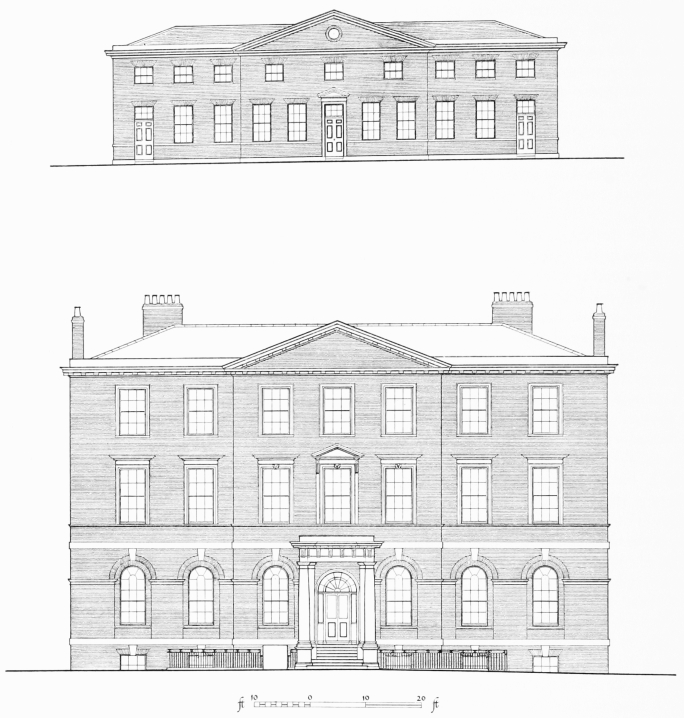
Albany, court-yard elevations
The interior has suffered from change to a far greater extent than the exterior. Although the main structural walls and some of the smaller rooms were retained, the large rooms were subdivided by Holland and his successors, and much of the decorative work by Chambers and his craftsmen and artists has gone. There are, however, drawings to provide sufficient evidence to show the immense care taken to perfect the design of the principal rooms, for some of which several schemes were produced. The most impressive feature was probably the principal staircase, which can be studied in the various plans and in a very explicit section (fn. 141) (Plate 113b). The large and lofty compartment in the middle of the house was an oblong in plan, some 36 feet east to west, and 24 feet 4 inches north to south. The stone staircase began with two short flights rising against the north wall to meet at a central landing. From this point a flying branch crossed to another landing, resting on columns, in the middle of the south side. Twin branches against the south wall continued the stair to the east and west arms of the first-floor gallery. The sectional drawing, taken on a north-south line, shows that the stone steps had bracket profiles, and that the flying branch rested on a form of arch, possibly of cast iron, decorated with a moulding of cross-banded reeding. The second landing rested on Corinthian plain-shafted columns and an entablature with a frieze-tablet of griffins flanking an urn. The balustrade, which is not shown, was presumably of wrought iron.
The wall surfaces of the compartment were apparently quite plain and served as a field for the doorcases, and for the statues standing in plain niches that were placed centrally between the doorways, or flanking them. All the doorcases were similar, each with an enriched architrave, and a modillioned cornice framing a triangular pediment above a frieze, plain on the ground floor but ornamented with a Vitruvian scroll on the principal floor. (fn. 2) Below the gallery was a frieze of circular paterae between paired acanthus buds, and a narrow enriched cornice. The principal-floor stage was finished with a frieze of anthemion ornament, and a mutuled cornice. Above this a plain attic rose to a simply-coffered flat ceiling with a central lantern light of oval plan and conical form, its low drum treated as an entablature with a frieze decoration of festoons and pendants.

Albany, early plan. Redrawn from a plan in Residential Flats, 1905, by Sydney Perks
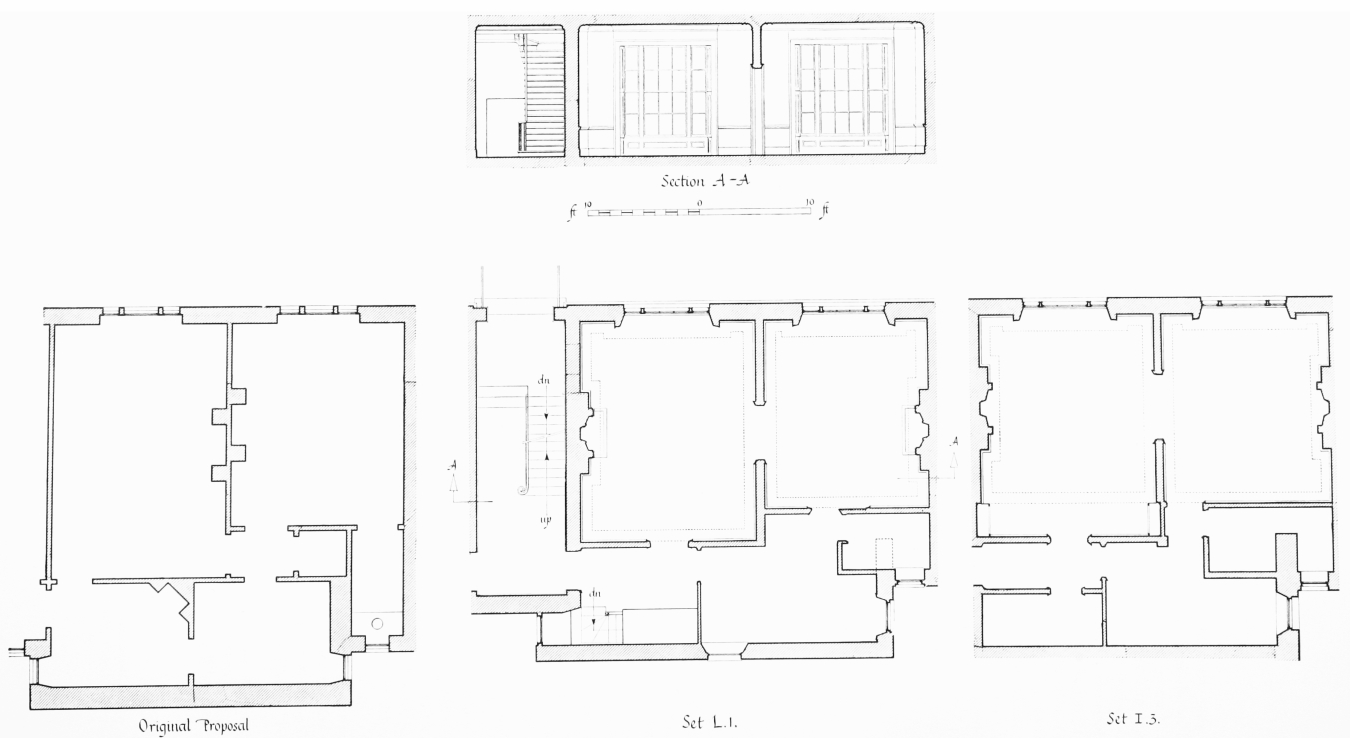
Albany, plans and section
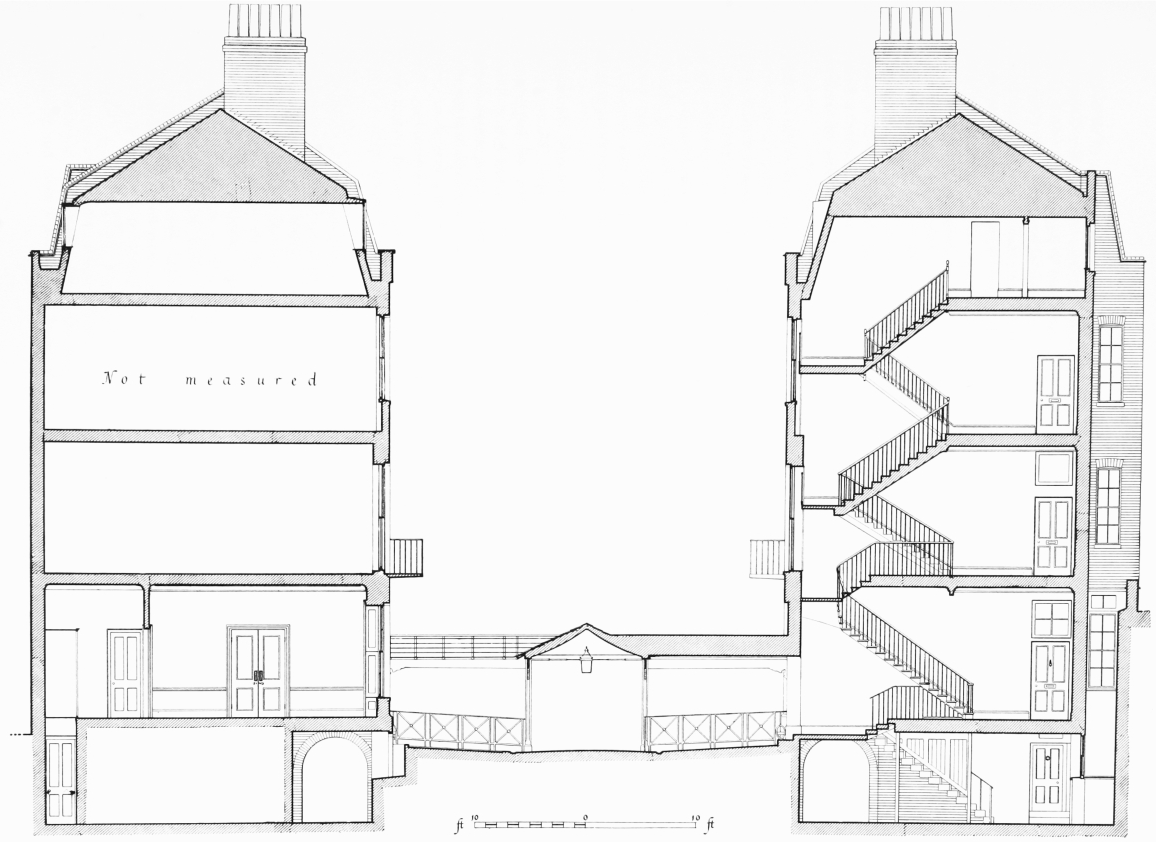
Albany, section through the Ropewalk
Although much of the original decoration was destroyed or mutilated in the course of Holland's reconstruction, one fine ceiling survives entire, that of the north-west room on the first floor, originally the state dressing-room. Chambers's drawing for this survives, (fn. 142) and shows the design composed round a large circular panel containing a central motif surrounded by acanthus scrollwork, overlaid by the deep loops of a festooned garland. An ornamental band of interlacing oak garlands encircles this panel, and a similar but more closely interlaced band surrounds the segmental panel in the bowed end of the ceiling. The spandrel panels around the large circle are filled with arabesques of acanthus scrolls sprouting from urns.
The salon, at the east end of the north front, was probably a splendid room, with freestanding columns placed in each corner of the oblong body, flanking the bowed north and south walls, but no drawings of the decoration appear to have survived. There are, on the other hand, several schemes relating to the screened recess at the south end of the state dining-room, but nothing to indicate which design was executed.
Chimneypieces and other furnishings were removed in 1803 to Renishaw Hall, Derbyshire, where a chimneypiece, with squirrels carved in the capitals, can be identified with one of Paine's. (fn. 143)
Holland's twin ranges extend from south to north and front to the Ropewalk, as the covered passage between them is called. They comprise a basement, three storeys of equal height containing the sets of chambers, and a garret storey. The basement contains kitchens etc., belonging to the ground-floor sets, and in front extends a passage by which servants and tradesmen can reach the various staircases. The garret contains the kitchens for the sets on the upper floors, and rooms originally intended as servants' bedrooms (figs. 71–3).
Both ranges are composed of four identical units, each storey having one set of chambers on either side of a staircase, and there is a single unit, larger in scale, at the north end. Holland's drawing of March 1802 (fn. 137) shows the intended plan of a standard set, and the very light construction proposed for the internal walls. There were to be two good rooms in front, both above 15 feet in width, each having a large window of three lights, wide between narrow, towards the Ropewalk. The first room was a parlour, 22 feet 6 inches deep, the second was a bedroom, 18 feet deep, and their fireplaces were placed back to back in the dividing wall. There were two small rooms at the back, the first being an entrance lobby, 12 feet by 9 feet, with a corner fireplace, and the second a small bed-or dressing-room of the same size but without a fireplace. Between this room and the front bedroom was a small lobby and a cupboard, and opening out of the bedroom was a watercloset. This, like the back rooms and staircase landings, derived daylight from one of the small areas recessed into the back wall.
It is doubtful whether any part of the buildings was finished exactly to this plan, for those sets which it has been possible to inspect show important variations. Generally, the two front rooms are linked by a wide two-leaf door, centrally placed opposite the chimney-breasts which project from the staircase wall and the wall dividing the sets (Plate 119a). The entrance lobbies have generally been made smaller than was first intended, so that the second back room is large enough to be used as the bedroom.
The stucco-faced fronts towards the Ropewalk are very simple in design (Plate 118a), merely a well ordered pattern of large-paned windows, those lighting the rooms being divided by narrow mullions into three lights, wide between narrow, set with slight recession in plain segmentalheaded openings, those on the first floor being furnished with iron balconies of vertical bars. The entrance doorways are set in round-arched openings, and the fronts are finished with a simply moulded parapet.
The buildings at the north end, fronting to Vigo Street and Burlington Gardens, are designed on a large scale and finished in stock brick (Plate 117a). Each has a simply detailed front, on the inner side of which projects a wide segmental bow, rising through the lofty ground and first floors, with a stone-framed window of three lights in each storey. At first-floor level is an iron-railed balcony, embracing the bow and extending across the flat flanking face, which is one window wide. In the ground storey of the west building is a doorway, with narrow side-lights and a fan-ornamented tympanum of stucco, framed in a plain brick arch, designed in Holland's style but possibly a later alteration. Above it, but to the left of its centre, is an oblong window lighting a mezzanine. There are two superimposed windows in the firstfloor face, the square upper light also serving a mezzanine. The second floor has two windows, the wide one above the bowed projection being divided into three lights. Reference has already been made to the altered ground storey of the east building's front, part of which is canted back to conform with the frontage line of Vigo Street.
The tall and large-scaled fronts of the end blocks are in complete contrast with the tiny pavilion-like shops that flank the Ropewalk entrance (Plate 117). This feature remains much as Holland designed it, although the shopfronts have been altered and the charming 'Chinese' colouring has not been perpetuated. The drawing in Sir John Soane's Museum (fn. 144) (Plate 116b) shows the two shops, each with an oblong window divided by glazing-bars and framed by wide piers painted with green panels having yellow borders on a grey ground, the slightly recessed stallboard being similarly decorated, and the fascia painted with blue and green panels between yellow frets. At the extremities of each shop-front are slender colonnets, supporting a tent roof that slopes back to the low gable end of the Ropewalk, and to the stucco-faced upper storey of each shop, containing a single window and finishing with a low pyramid roof of lead. The covered way of the Ropewalk, with its tentshaped ceiling of narrow boarding, its bracketended fascias and simple diagonally braced 'Chinese' railings extending between the widely spaced posts, all glossily painted, gives to this part of Albany the atmosphere of a perpetual garden party (Plate 118b).
To flank the entrance from Piccadilly to the court-yard, Holland designed matching buildings containing shops with a mezzanine floor, and two storeys of living accommodation (Plate 116a). Each building had two wide shop-fronts facing to Piccadilly, divided and flanked by three narrow piers with panelled shafts, projecting to carry, at the level of the mezzanine windows, finely-modelled spread eagles of Coade stone. (fn. 3) These eagles appeared to support a continued balcony of stone, having an iron railing of vertical bars topped with a key-fret border. The upper part of the front was faced with stock bricks and contained two tiers of four evenly spaced windows set in plain openings. The tall casements of the first floor opened to the balcony, and there was a narrow sill-band extending beneath the sash windows of the attic. The return front of each building was four bays wide, with shop-windows in the ground storey and blind recesses in the floors above. Both fronts were finished with a cornice of bold projection and a plain parapet. It is regrettable that these handsome matching buildings have been replaced by two architecturally unrelated structures.
List of Notable Residents up to 1961 (fn. 4)
Ackland, Rodney, playwright, 1944–51
Acton, Sir John (later first Baron), historian, 1865
Acworth, Sir William, 1907–25
Adam, William, ? attorney-general, 1805
Agar-Ellis, Hon. Leopold, M.P., 1861–4, 1881–4
Ainslie, Sir Robert, baronet, 1814–23
Althorp, Lord, later third Earl Spencer, 1804–14, 1821–35
Annesley, Major-General Hugh, 1842
Annesley, Sir James, 1839–41, 1843–7
Anson, Viscount, later second Earl of Lichfield, 1851, 1853–4
Antrobus, Sir Edmund, baronet, 1865–6
Arbuthnot, Major-General the Hon. Hugh, 1836–68
Archdall, Captain Mervyn, M.P., 1850–2
Arkwright, George, M.P., 1846–55
Armstrong, Sir Alexander, naval medical officer, 1876– 1896
Armstrong-Jones, A. C. R., later Earl of Snowdon, 1950–2
Ashton, Sir Leigh, Director of the Victoria and Albert Museum, 1950–2, 1954–8
Audley, twenty-third Baron, 1946–8
Austen-Leigh, Richard, author and printer, 1937–43
Bancroft, Sir Squire, actor, 1917–26
Baring, Thomas, ? financier, 1832–5
Barnard, Sir A. F., 1825–31
Barnes, Sir James Stevenson, 1836–9
Barrington, Hon. Sir William Augustus, 1898–1904
Bartlett, Sir Basil, baronet, 1945, 1949–51
Basevi, George, architect, 1819–26
Bax, Clifford, writer, 1933–41, 1944–
Bearstead, second Viscount, 1947–8
Beauclerk, Lord Frederick, 1807–11
Beecham, (Sir) Thomas, musician, 1916–19
Bellamy, Thomas, architect, 1836
Beresford-Hope, Alexander James, politician and author, 1880–7
Bernstein, Sidney, 1939–43
Blackett, Sir Edward, baronet, 1830–1
Blake, Hon. Anthony Richard, 1845–7, 1849
Blennerhasset, Sir Rowland, baronet, 1865–6
Blond, Anthony, publisher, 1953
Borthwick, twentieth Baron, 1891–8
Bosville (-MacDonald), Colonel the Hon. James, 1857–9
Boucicault, Dion, actor, 1883–4
Bourchier, Arthur, actor-manager, 1904–7
Bourke, General John Jocelyn, 1879–95
Bourne, William Sturges, politician, 1807–8
Bouverie, Hon. Edward, 1840–3
Bowker, Sir Reginald James, Foreign Office official, 1954
Brackenbury, General Sir Henry, 1904–6
Bradshaw, Major-General Lawrence, 1812–13
Brand, Thomas, twentieth Baron Dacre, 1807–20
Brass, Sir William, M.P., 1913–16, 1920–42
Breadalbane, sixth Earl of, 1870–2
Brereton, Major-General Sir William, 1856–64
Broadwood, Henry, M.P., 1818–36
Brooke, Lord, later third Earl of Warwick, 1807–8
Brougham, Henry, later first Baron Brougham and Vaux, Lord Chancellor, c. 1806–10 (fn. 145)
Bryant, Arthur, historian, 1936–8
Budé, General, 1804
Buller, Sir James East, 1872–8
Burdett, Sir Robert, baronet, 1867–80
Burke, Viscount, 1866–70
Burroughs, Sir William, 1825
Butt, Charles Parker, Q.C., 1876–9
Byron, sixth Baron, poet, 1814–15
Caillard, Sir Vincent, 1900–4
Campbell, Major-General Patrick, 1885–1905
Canning, George, statesman, 1807 and 1810 (fn. 146)
Carnegie, Captain the Hon. Swynfen, 1856–8
Carr-Saunders, (Sir) Alexander Morris, later Director of the London School of Economics, 1911–13
Carter, Albert Thomas, jurist, 1926–46
Cattermole, George, water-colourist, 1838–9
Charteris, Colonel the Hon. Richard, 1855–8
Clanricarde, second Marquess of, 1875–1910
Clark, Sir Kenneth, Chairman of the Arts Council, 1955–
Clarke, Sir Geoffrey, Indian Civil Servant, 1934–40
Close, Admiral Francis Arden, 1880–1901
Cochrane, Alexander Baillie, later first Baron Lamington, 1839–44
Colborne, General Sir Francis, 1890–5
Colebrooke, Henry T., Sanscrit scholar, 1816–21
Colston, Sir Charles Blampied, 1954–
Colville, Charles Robert, M.P., 1848–51
Cook, John Douglas, journalist, 1856–68
Cope, Sir John, 1811–14
Corry, Montagu, later first Baron Rowton, 1871–3
Cotton, Thomas Forrest, physician, 1926–8
Courteney, Rear-Admiral George, 1856–62
Craigie, Mrs., the novelist 'John Oliver Hobbes', 1906
Cranstoun, tenth Baron, 1845–62
Craven, Hon. Keppel, 1811–20
Cruise, William, legal writer, 1823–4
Cunliffe, Sir Robert, baronet, 1869
Dalbiac, Sir James Charles, 1839–47
Dawney, Hon. Marmaduke, 1810
D'Azeglio, Marquess Taperelli, 1868–76
De Salis, Count Francis, 1838–9
Desart, Earl of, 1813–16
Des Graz, Geoffrey, Chairman of Sotheby's, 1939–53
De Worms, Baron Henry, politician, 1879–83
Dickinson, Robert Edmund, M.P., 1902–10
Duff, Robert William Abercromby, M.P., 1863–6
Duncan, Viscount, later second Earl of Camperdown, 1836–8
Duncombe, Thomas Slingsby, M.P., 1845–9
Edmunds, Admiral Charles, 1874–9
Ellis, Charles Rose, M.P., later first Baron Seaford, 1806–11
Elphinstone, Mountstewart, statesman, 1834–47
Erne, fifth Earl, 1932
Errington, Sir George, baronet, 1875–86
Erskine, Rear-Admiral John, 1853–4, 1858–87
Esher, third Viscount, 1961–
Evans, Dame Edith, actress, 1942–
Evershed, Sir Raymond, Master of the Rolls, 1948–51
Fergusson, Sir Ewan, 1958–
Fergusson, Sir James, baronet, M.P., 1887–9
Fermor, Hon. Frederick, 1858–60
Fisher, (Sir) Bertie Drew, 1929–35
Fitzclarence, Captain the Hon. George, 1863–4
Foley, Major-General St. George, 1861–6
Fonnereau, Thomas George, author and artist, 1837, 1839
Fox-Pitt, Major-General William, 1960–
Fraser, Sir William, baronet, 1885–98
Frere, Alexander Stewart, publisher, 1940–
Gascoigne, Major-General Charles, 1856–66
Gaunt, Rear-Admiral Sir Guy, 1924–5
Gell(e), Sir William, archaeologist and traveller, 1814– 1817
Gillett, William, banker, 1865–75
Gladstone, (Sir) John, Liverpool merchant, 1830–1
Gladstone, William Ewart, statesman, 1833–9
Glenelg, Lord, 1845–64
Graham, Rear-Admiral Charles, 1856–8
Graham, Lieutenant-General Hope, 1874–5
Graham, Sir James, baronet, statesman, 1855–8
Greene, Graham, novelist, 1954–
Grigg, Sir James, Secretary of State for War, 1955–
Guest, Montagu, M.P., 1904–9
Guest, Hon. Oscar, 1916–17
Hailstone, Rev. John, geologist, 1805–14
Haliburton, Arthur, later first Baron Haliburton, 1876–8
Hall, (Sir) Samuel, lawyer, 1881–95
Hamilton, Cosmo, dramatist and novelist, 1912, 1930
Hamilton, Patrick, novelist and playwright, 1944–51
Hanbury, Robert William, M.P., 1880
Hand, Admiral George Sumner, 1874–83
Hansler, Sir John, 1859–67
Hardwicke, John, ? London police magistrate, 1825– 1849
Hart, Charles, ? organist and musical composer, 1840– 1841
Hastings, Sir George, physician, 1917–26, 1932–43
Hastings, Sir Patrick, barrister, 1948–52
Hay, Lord William Montagu, later tenth Marquess of Tweedale, 1870–7
Henniker, Sir Frederick, traveller, 1822–5
Herbert, Sir Thomas, 1844–6
Hesketh, Roger Fleetwood-, M.P., 1954–
Hobart, Sir Robert, 1959–
Hobart, Sir Robert Henry, 1895
Hobhouse, Sir Charles, baronet, M.P., 1918–23
Holland, Henry, architect, 1804
Hope, General Sir James, 1832–42
Horne, Alderson Burrell, actor-manager, 1918–39, 1944–53
Horsman, Edward, Whig politician, 1840
Howard, Hon. Henry George, 1869–75
Howard, Hon. James, 1841–5
Hubbard, Eric Hesketh, artist and writer, 1930–56
Huntingdon, fifteenth Earl of, 1949–51
Huxley, Aldous, author, 1936–8
Ingilby, Sir William, 1809–20
Ives, George Cecil, author and criminologist, 1895–7
James, Captain Charles, ? writer, 1804
Jodrell, Sir Neville, M.P., 1908–32
Johnson, Right Rev. H. F., Bishop of Colchester, 1898–9
Jones, Henry Arthur, dramatic writer, 1898–1902
Jones, Richard, ? actor and dramatist, 1806–8
Karno, Frederick, music-hall artist, 1917–23, 1928
Kelburn, Viscountess, 1948–
Kemp, T. R., ? founder of Kemp Town, Brighton, 1806
Kennedy, Sir Alexander, engineer, 1915–28
Kenyon, fourth Baron, 1903–27
Keppel, Admiral the Hon. Sir Henry, 1891–1904
Kerr, Robert, ? architect, 1868–9
Kesteven, second Baron, 1877–9
Kilcoursie, Viscount, later tenth Earl of Cavan, 1895– 1900
King, Sir Richard Duckworth, 1848–53
Kinnaird, ninth Baron, 1827–34
Kinnaird, Hon. Arthur, M.P., later tenth Baron Kinnaird, 1835–43
Knoblock, Edward, playwright, 1914–25
Konody, Paul George, art critic, 1913–25
Labouchere, Henry, M.P., 1866
Lane, (Sir) Allen, publisher, 1927–37
Lane, John, publisher, 1894–1926
Law, Hon. Edward, later first Earl of Ellenborough, 1812–13
Leake, Percy Dewe, chartered accountant, 1913–49
Lee, Francis, Baron of Sicily, 1824–5
Lee of Fareham, first Viscount, 1947
Lee of Fareham, Viscountess, 1949–
Leigh, Chandos, poet and author, later first Baron Leigh, 1813–17
Leighton, Margaret, actress, 1957
Lewis, Sir John Henry, 1835–45
Lewis, Matthew Gregory ('Monk'), author, 1810–18
Littler, Prince, impresario, 1944–55
Louth, thirteenth Baron, 1875–6
Lowther, Claude, M.P., 1901–11
Lowther, Lord, M.P., later second Earl of Lonsdale, 1830–3
Lucan, second Earl of, 1826–33
Lucan, third Earl of, 1826–30 (as Lord Bingham), 1860–1
Lucas, Reginald Jaffray, M.P., 1907–14
Lugard, General Sir Edward, 1870–8
Lugard, Major-General Sir Henry, 1871
Lustgarten, Edgar, writer, 1949–
Luttrell, Henry, wit and poet, 1804–30
Lyle, Sir Alexander Park, baronet, 1927–33
Lyle, Sir Archibald, second baronet, 1927–45
Lyttelton, fourth Baron, 1839–40
Lytton, Edward Bulwer, novelist, later first Baron Lytton, 1835–7
Macaulay, Thomas Babington, later Baron Macaulay, historian, 1841–56
McClean, D. F. S., Vice Chairman Daily Mail, 1960
McDonald, Hon. Dudley, 1810–40
McDonald, Major-General the Hon. James, 1848–50, 1852–6
Mackay, Hon. Alan, 1946–8
Mackay, Admiral the Hon. Donald, 1839–41
MacKenzie, James Young, Foreign Office official, 1949–53.
MacKinnon, General George Henry, 1871–5
Macnutt, Rev. Frederick Brodie, then curate of St. James's, Piccadilly, 1901–2
Malcolm, Dugald, Vice-Marshall of the Diplomatic Corps, 1955, 1958–
Manners, Lord Henry Charles Somerset, 1841–55
Manners, Lord John, M.P., later seventh Duke of Rutland, 1840–50
Manners-Sutton, J. H. T., M.P., later third Viscount Canterbury, 1847–53
Margesson, Captain Henry David Reginald, M.P., later first Viscount Margesson, 1924
Marshall, Howard, broadcaster, 1954
Merz, Charles, engineer, 1902–10
Mint, Sir William, 1873–5
Mirski, Prince Michael, 1904–10
Morgan, Sir Herbert Edward, 1934–7
Morshead, Sir Warwick Charles, 1854–6
Moseley, Dr. Benjamin, physician, 1804–12
Mozley, Rev. Thomas, divine and journalist, 1856–7
Muggeridge, Malcolm, journalist, 1955–6
Murray, Admiral the Hon. Anthony, 1854–66
Nathan, Sir Matthew, later Governor of Queensland, 1918–20
Nathan, Sir Robert, retired Indian Civil Servant, 1916–21
Neave, Sheffield, physician, 1896–8
Newman, Sir Lidston, baronet, 1857–66
Newton, Robert Milnes, London police magistrate, 1881
Nicolson, Hon. Sir Harold, writer, 1954–
Nicolson, Nigel, M.P., 1960–
Nolloth, Rear-Admiral Matthew, 1876–80
North, Hon. Frederick Henry, 1868–1917
Obolenski, Prince Serge, 1915–17
O'Connor, Sir Terence, M.P., 1929–37
Oppenheim, Larsa, jurist, 1900–2
Osgoode, William, jurist, 1808–24
Palmerston, Henry, third Viscount, 1808 (fn. 146)
Paulet, Lord Frederick, 1856–70
Paulet, Lord George, 1838, 1845–62
Paulet, Lord William, 1849–66
Payler, Major-General James, 1846–54
Peachy, General William, 1829–30
Pechell, Sir James, 1827–30
Petre, Hon. Albert Henry, 1881–3
Ponsonby, fourth Baron Ponsonby of Imokilly, 1861– 1866
Ponsonby, Captain the Hon. Ashley, 1856
Portsea, Baron, 1943–7
Pownall, Sir George, 1808–12
Pownall, Sir John, 1806–9
Priestley, J. B., writer, 1945–7
Pryce-Jones, Alan, literary critic, 1957–
Ramsay, Lord, later thirteenth Earl of Dalhousie, 1877
Rattigan, Terence, playwright, 1945–50
Ray, Cyril, journalist, 1943–53
Reinhart, Max, publisher, 1950–5
Rhodocanakis, Prince, 1874
Rice, Hon. William Spring, 1867–80
Rollo, tenth Baron, 1856
Rose, William Stewart, poet, 1817–19
Rougier, George Ronald, Q.C., 1944–
Rowley, Sir Josias S., baronet, 1817–24
Russell, Sir William, baronet, 1861–3
Sadleir, John,? Irish politician and swindler, 1850–2
St. Asaph, Viscount, later fifth Earl of Ashburnham, 1870–4
Saxton, Sir Charles, 1814–26
Saye and Sele, ninth Baron, 1836–45
Seaton, second Baron, 1864–88
Seton, Sir Bruce Maxwell, baronet, 1872–86
Seymour, Lord Webb, 1805–16
Shand, Sir Charles, 1881
Shaw, Sebastian, actor, 1938–41
Shortt, John, County Court Judge, 1896–8, 1900–11
Sibthorp, Colonel C. W., Tory politician, 1832–40
Siddeley, John Davenport, pioneer motor car manufacturer, later first Baron Kenilworth, 1925–38
Sligo, second Marquess of, 1810–13
Smiley, Sir John, baronet, 1922–8
Smirke, (Sir) Robert, architect, 1808–18, 1820
Smith, General Philip, 1892–5
Sotheby, Admiral Thomas, 1810–16
Stanley, Lord, M.P., later fifteenth Earl of Derby, 1851–5
Steele, Major-General Augustus, 1868–84
Stephenson, Vice-Admiral Sir Henry, 1888–93, 1900– 1904
Stern, Mrs. G. B., novelist, 1942–58
Steuart, Major-General Charles, 1862–73
Stewart, Sir John, 1923
Stone, William, 1893–1906, 1936–59
Stopford, Hon. (Sir) Frederick William, 1890–4
Storks, Major-General Sir Henry, 1857–9, 1867–74
Strode, Nathaniel, solicitor, 1848–72
Sykes, Sir Frederick Hugh, M. P., 1917–23
Talbot, Henry Fox, pioneer of photography, 1826–9
Temple of Stowe, fifth Earl, 1911–14
Templetown, second Viscount, 1851–63
Thomas, Sir Alfred Brumwell, architect, 1919–40
Throckmorton, Sir Nicholas, baronet, 1865–8
Tree, Sir Herbert Beerbohm, actor, 1904
Twisleton, Hon. Edward, 1852
Twiss, (Sir) Travers, lawyer, 1844–54
Upton, General the Hon. Arthur, 1824–53
Valentia, Lord, 1809–10
Valletort, Lord, later fourth Earl of Mount Edgcumbe, 1859
Vaughan, General Sir John Luther, 1899–1909
Vincent, General John, 1832–46
Von Alvensleben, Baron Joachim, 1912
Vos, Philip, K.C., 1938–47
Vyvyan, Air Vice-Marshall Sir Arthur Vyell, 1924– 1935
Waller, Lewis, actor, 1911–15
Walston, Baron, 1955–
Ward, Robert, ? novelist and politician, 1812–45
Warrender, Sir George, baronet, M. P., 1809
Waterhouse, Sir Ronald, 1930–42
Watkins, Major-General Westrop, 1861–4
Watson, Sir Charles, baronet, 1908–12
Webster, Sir Augustus, baronet, 1858–62
Welby, Sir Alfred, 1936–7
Wheeler-Bennett, (Sir) John, 1929–37, 1954–5
Whitbread, William, ? M. P., 1818–24
Wigram, Major-General Godfrey, 1900–8
Wilmot, Sir John Eardley-, baronet, M. P., 1837–40
Wilmot-Horton, Sir Robert, baronet, 1839–43
Winchester, fourteenth Marquess of, 1871–87
Wingfield, Major-General John, 1876–89
Wolff, Sir Henry Drummond, politician and diplomat, 1864–6
Wollaston, Admiral Charles, 1826–49
Wood, (Sir) George A., Major-General, 1809–10
Wood, Rear-Admiral Sir James A., 1816–29
Wood, Sir Mark, 1809–29
Wynne, Sir Trevredyn Rashleigh, engineer, 1916–39