Survey of London: Volumes 31 and 32, St James Westminster, Part 2. Originally published by London County Council, London, 1963.
This free content was digitised by double rekeying. All rights reserved.
'Cork Street and Savile Row Area: Savile Row', in Survey of London: Volumes 31 and 32, St James Westminster, Part 2, ed. F H W Sheppard (London, 1963), British History Online https://www.british-history.ac.uk/survey-london/vols31-2/pt2/pp517-545 [accessed 30 April 2025].
'Cork Street and Savile Row Area: Savile Row', in Survey of London: Volumes 31 and 32, St James Westminster, Part 2. Edited by F H W Sheppard (London, 1963), British History Online, accessed April 30, 2025, https://www.british-history.ac.uk/survey-london/vols31-2/pt2/pp517-545.
"Cork Street and Savile Row Area: Savile Row". Survey of London: Volumes 31 and 32, St James Westminster, Part 2. Ed. F H W Sheppard (London, 1963), British History Online. Web. 30 April 2025. https://www.british-history.ac.uk/survey-london/vols31-2/pt2/pp517-545.
In this section
Savile Row
This was originally called Savile Street and is first named Savile Row in the ratebooks in 1810, although it was sometimes so called earlier. Its construction inaugurated the second phase of Lord Burlington's estate development, on the eastern of the two closes into which Ten Acre Close had been divided. The commencement of building had probably been dependent on the expiry, at Lady Day 1731 and Lady Day 1732, of two sub-leases granted before the first Earl of Burlington had obtained the head lease of this eastern part in 1683.
The ground at the southern end of the street had been occupied from 1674 by a large house (approximately on the site of No. 1 Savile Row) and garden. The house, which was probably built by John Harrison, the lessee of this part, fronted south to Glasshouse Street (near the present junction of Burlington Gardens and Vigo Street) and is shown in elevation on Ogilby and Morgan's map of 1681–2 (Plate 3a). At a later date Strype described it as 'a fine House and Ground.' (fn. 5) The first occupant seems to have been 'Lady Cranburne', probably the widow of Viscount Cranborne, in the last years of her life. On her death in 1675 she was succeeded by Lady Elizabeth Harvey from 1676 until 1700 or 1701. A later occupant (fn. 6) was Charles Boyle, fourth Earl of Orrery, who as a young man had provoked Bentley's Dissertation on the Letters of Phalaris: he was a distant kinsman of the third Earl of Burlington. Lord Orrery was rated for the house from 1706 to 1723, although for some six months in 1722–3 he was imprisoned in the Tower on suspicion of complicity in Layer's Jacobite plot. (fn. 7) In 1719 the sites of Queensberry House and of Nos. 2 and 3 Old Burlington Street were said to abut eastward on Lord Orrery's garden wall. (fn. 8) From 1724 until it was pulled down in 1730 to make way for Savile Row this house was occupied by the second Viscount Weymouth or his mother, Lady Lansdowne.
The two houses at the southernmost end of the street, Nos. 1 and 2, each owned by close associates of the Burlingtons, were begun first, both probably in 1732, followed shortly by the regular terrace houses running north to New Burlington Street. On 12 March 1732/3 the Daily Post announced: 'A new Pile of Buildings is going to be carry'd on near Swallow-street, by a Plan drawn by the Right Hon. the Earl of Burlington, and which is to be call'd Savile-street'. Burlington's articles of agreement with builders of the houses northward of Nos. 1 and 2 were concluded in April and May 1733. The house looking down Savile Row from the north side of Boyle Street and later numbered 22–23 Savile Row, and the houses at the northern end of the west side, between Boyle Street and Clifford Street, were built at the same period. The west side south of Clifford Street was, however, left undeveloped and was leased, as yards or gardens, to the occupants of the houses on the east side of Old Burlington Street.
Burlington seems to have been careful to include in his leases of the plots on the west side of the street a provision (similar to one on the Pulteney estate) that no street wall or buildings on them should be more than 14 feet high. He also required that any gateway made into Savile Row should exactly adhere to a 'model or design' to be provided by him. (fn. 9)
Unusually detailed specifications were included in the leases of two sites on the northern corner of Savile Row and Clifford Street (later No. 29 Savile Row and No. 1 Clifford Street) to the joiner Thomas Knight in 1736. These required that he should build on each site a 'good and substantial double brick messuage', not more than 14 feet 7 inches high, with scantlings as prescribed for 'second rate' buildings in the Acts of Parliament of 1667 (fn. 10) and 1708. (fn. 11) The street fronts were to be of grey stock bricks, and the windows set in six-inch reveals. The elevations were to follow a design appended to the lease, which shows a simple single-storey building, presumably consisting of separate semi-detached units. Thomas Knight's dwelling house was immediately adjacent, in Old Burlington Street, but the purpose of either 'little house' is not evident. (fn. 12)
Nothing is known of any architect or surveyor acting on behalf of Burlington in the control of the exteriors or interiors of Savile Row. Kent had the lease of, and perhaps intermittently occupied, No. 2; and may be surmised to have had some hand in the architecture of that house and its neighbour No. 1. Flitcroft was a mortgagee of two houses (Nos. 11 and 18), as well as of two in New Burlington Street.
At No. 15, which was bought by the Countess of Suffolk from the builders, Gray and Fortnam, in 1735 for £2500 (fn. 13) some 'allowances' to be made by Gray in his bill for finishing the house were certified in January 1735/6 by Roger Morris. (fn. 14) The payment of part of the purchase price had been made to Gray on behalf of the Countess by the ninth, 'architect', Earl of Pembroke to whom Gray had 'delivered' his agreement for the finishing of the house. (fn. 15) Beyond these indications, it does not appear whether Pembroke and Morris, who had built the Countess's Twickenham villa, Marble Hill, a few years earlier, were responsible for the interior of No. 15, which no longer survives in recognizable form.
The west side of the street south of Clifford Street remained undeveloped until the early nineteenth century. Mayhew's parish map of 1831–6 shows about half the sites here occupied by buildings, but mostly of only a single storey. (fn. 16)
At the northern end of the street only a narrow foot-passage, Savile Place, running under the upper part of the terminal house latterly numbered 22–23, gave communication with Mill Street and Conduit Street. Suggestions for the continuance of Savile Row northward in its full width, beyond the boundary of the Burlington estate and the parish of St. James's, to Conduit Street, were occasionally made. (fn. 17) It was not, however, until December 1929 that the Westminster City Council decided to extend Savile Row as far as Mill Street, to relieve traffic congestion in New and Old Bond Street and Regent Street. (fn. 18) In June 1931 the London County Council decided to contribute to the cost of this scheme which then included the widening of Mill Street, (fn. 19) but in October of that year the need for financial economies caused the scheme to be postponed. (fn. 20) It was taken in hand again in 1936 (fn. 21) and No. 22– 23 was being demolished by the end of the following year. (fn. 22) New buildings on the west side of the extension were completed in 1938. (fn. 23) The east side was not rebuilt until after the 1939–45 war, when the present No. 23, completed in 1950, was built on the whole of the frontage in the parish of St. James's. (fn. 24) As a result of the rebuilding here the principal entrance to New Burlington Place was moved from Regent Street to Savile Row.
The original architectural character of the street is now barely discernible after successive alterations and rebuildings. Nevertheless it retains eight original houses, Nos. 1, 3, 11–14 and 16–17, of which Nos. 1, 3 and 14 are among the most interesting of the handful of terrace houses surviving on the Burlington estate. In addition, illustrations exist of the exteriors of fourteen houses now demolished or altered beyond recognition, Nos. 2, (fn. 25) 4–6, (fn. 26) 18–20, (fn. 27) 22–23 (fn. 28) and 24–29, (fn. 29) so that a fairly adequate reconstruction is possible.
The east side, extending north to New Burlington Street, appears to have comprised a uniform terrace of houses, of which only Nos. 1 and 2 at the southern end were permitted to differ even in detail from the rest. Since, as has been said, most of the west side was occupied only by the gardens or yards of the houses on the east side of Old Burlington Street, the single terrace on the east side of Savile Row was truly a row. Nothing is known about the original appearance of the part of the west side south of Clifford Street, except what is implied by Lord Burlington's provisions limiting the height of walls or buildings and controlling the design of gateways. North of Clifford Street, however, there are known to have been four buildings. On the southern corner of Boyle Street was a small house and immediately to the south of it a larger one, filling the vista westwards along New Burlington Street, while on the northern corner of Clifford Street was the pair of semi-detached single-storey buildings already mentioned. The intervening sites between these two groups of buildings were left vacant. The focal point of the street was the building latterly known as No. 22–23, which blocked the north end and was clearly intended as one of the closing features characteristic of the Burlington estate.
South of Clifford Street the original proportions of Savile Row have been fairly well maintained, despite the intrusion of three large modern blocks, Nos. 4–10, on the east side (Plate 102c). Moreover, although the west side has been built upon, the buildings which occupy it, mostly of mid nineteenth-century date, are mainly of only one or two storeys, so that the contrast between the two sides of the street is preserved. Unfortunately, however, an inroad into the group has been made by the recent demolition of Nos. 37 and 38. North of Clifford Street all the pre-twentieth-century buildings have been replaced by office blocks, largely as a result of the extension of Savile Row northwards to Conduit Street.
No. 1 Savile Row
This house, commanding a view into Lord Burlington's garden, was first occupied by an intimate of the Burlingtons. It was the first house to be built during the second phase of Burlington's estate development in the 1730's and in its design was, with No. 2, perhaps more directly an expression of the taste of the Burlington circle than the terrace houses to the north.
The lease of the site, like that of No. 2, was dated in March 1731/2, (fn. 30) some eighteen months or more before those of the rest of the street. The house was first occupied early in 1733. (fn. 31)
The occupant and lessee, Bryan Fairfax, was a Commissioner of Customs. Like Burlington he was a Yorkshireman, a great-grandson of the first Lord Fairfax, and son of the politician Bryan Fairfax who was equerry to Charles II and William III. (fn. 32) He had previously lived in Panton Square and henceforward remained in Savile Row until his death in January 1748/9. Though some eighteen years older than Burlington he was evidently a close friend: like Richard Arundell in Old Burlington Street he was relieved of rent during Burlington's lifetime. Like Arundell also, his lease included ground stretching well south of the building-line of his house, reaching to about the later line of pavement on the south side of Vigo Street. (fn. 30) His name occurs a number of times in the letters of the Countess of Burlington, often coupled with that of another Yorkshireman, William Kent, who held the lease of (and perhaps lived intermittently at) No. 2 next door.
This is one of the sites for which an original counterpart of Burlington's lease survives at Chatsworth. (fn. 30) Of the forty sites built upon in Savile Row and New Burlington Street in the 1730's such original counterparts survive for twenty-nine. Of these, that for No. 1 is the only lease of a dwelling house to include an elevational design which Burlington required the lessee to follow (Plate 102b). Fairfax undertook to build 'according to the design or plan thereof laid down and approved of by the said Earl and hereunto annexd' and not to alter the front without permission. He undertook to spend £1800 on building the house; probably not an unusually large sum for the carcase of a house on the estate. In many respects No. 1 clearly made a pair with Kent's house at No. 2, and it may therefore be that Kent was associated with Burlington in the design of these two houses.
The only reference to the progress of building occurs in a letter of September 1732 from Fairfax, Burlington's 'most affectionate servant', to the latter who was out of London. (fn. 33) After general gossip, which reveals incidentally the facilities enjoyed by a Commissioner of Customs for buying fine paintings from abroad, Fairfax reported that he had 'sett all hands at work' on his house, which would have made little progress if he had not returned to town. He went on immediately to speak of Kent, who half-suspected the Burlingtons of a practical joke. Fairfax's words transmit something of the intimacy of the Burlingtonian circle, and also what seems an echo of Kent's Yorkshire accent. 'The Princes Architect growls much. I mett Him last Sunday at Court when without being glad to see me return'd He desir'd to know what I meant by sending Him an Ool. I deny'd the fact to which He answered, had those folke been in Toon He should not have doubted whence the present came but as They were 130 miles off He thought nobody but I durst be so free with Him. I told Him He was much mistaken that He was the jest of everybody but to prove it was not me I desird He would send it to me for I had a love for those Creatures, but He said it was a beautifull one & He did not love to make presents.'
Bryan Fairfax was one of the circle to be sketched by Kent, (fn. 34) and he and his brother Ferdinando appear among the signatories of a mock petition addressed by Pope to Burlington in defence of a tree threatened by Kent's landscaping hand. (fn. 35) In one of the Countess's letters Bryan figures settling the plates for inclusion in a book to be published under Burlington's auspices. (fn. 36) He was evidently a man of some scholarship, a Fellow of his college at Cambridge and a Vice-President of the Society for the Encouragement of Learning. Vertue called him his 'worthy Friend.' (fn. 37) Fairfax was himself a notable collector of coins, paintings, statuary and objets d'art. (fn. 38) Kent in his will left him 'the two Busto's of Shakspear and Butler', (fn. 39) of Kent's own making. (fn. 40)
Bryan's brother Ferdinando lived with him here until his own death in the later 1740's, and in 1738 Bryan had assigned the lease to him. (fn. 41) He was, like Bryan, a bachelor place-holder, as Surveyor of the Coal Duties. (fn. 42) 'Nando' was prominent in his brother's circle of acquaintance: he had taken Burlington's letter of dismissal to his lawyer in 1725 (fn. 43) and later figures as an adviser of the Countess on her furnishings at Chiswick. (fn. 44) During the anxious days of the '45 Kent dined with the brothers at No. 1, where, as he wrote, 'Nando and I was bravo'd down by Brian as two cowards that we at this time ought to have corrage and risolution & not to be lamenting about the times.' (fn. 45) A copy of verses in Ferdinando's hand addressed to the Countess exists at Chatsworth, (fn. 46) prefacing some verses attributed to Lord Chesterfield or Lord Hervey (fn. 47) with others probably of his own composing, in conventional abuse of Kent's architecture.
Ferdinando was left a yellow Siena marble table in Kent's will, (fn. 39) and the house is known to have contained 'several Pieces of the Furniture made from Designs of the late Mr Kent'. (fn. 48) These furnishings Bryan wished to remain unaltered at his death in 1749. (fn. 49) Both externally and internally the house doubtless made a very good effect at this time, and won the approbation of Horace Walpole who thought it 'pretty'. (fn. 50)
By his will (fn. 49) Bryan left the lease of the house (which had returned into his legal possession by his brother's death) (fn. 51) to a younger kinsman, the Hon. Robert Fairfax of Leeds Castle, Kent, later seventh Baron Fairfax, to whom Bryan had been 'a kind friend and quasi-guardian' in personal and political matters. (fn. 52) It was Robert who had bought the freehold of the house from a James Whitchurch, merchant, in June 1745. (fn. 53) Robert Fairfax lived here until 1757. In 1751 Bryan's valuable collection of coins and medals was sold. (fn. 54) In the spring of 1756 the rest of his possessions, including the house itself, were disposed of—the pictures and objets d'art on 6–7 April, (fn. 40) the furniture on 8–10 April (fn. 48) and the prints and drawings in May. (fn. 39) According to Nichols his valuable library was intended to be auctioned on 26 April but was sold privately for £2000 to Francis Child and passed into the Osterley library. (fn. 39)
The 'pleasantly situated' house was auctioned on 8 April. (fn. 48) The purchaser, at £3900, was Bryan Fairfax's old friend and Burlington's widow, the Countess, to whom the house was conveyed in August. (fn. 55) The Boyle and Cavendish family owned the house until 1819 but apparently did not occupy it until 1773 when it was taken by Lord Richard Cavendish, the Countess's grandson, until his death in 1781. From 1784 the house was occupied by his younger brother, Lord George Cavendish, who remained here until his removal to the newly reconstructed Burlington House in 1818. The rateable value of the house was increased between 1793 and 1797. When Lord George's eldest brother, the fifth Duke of Devonshire, granted him an extended lease of the house in 1798 it was mentioned that Lord George had spent 'a very considerable sum of money in good and substantial repairs.' (fn. 56) The descent of the freehold between the heirs of the fourth Duke occasioned some subsequent uncertainty and in October 1818 it was confirmed to Lord George (fn. 57) before he sold the house in February 1819 for £9000 to the Hon. John Simpson of Babworth Hall, Nottinghamshire. (fn. 58) The latter remained here until 1840 when he sold the house for £9400 to Z. A. Jessel, (fn. 59) a diamond merchant and father of Sir George Jessel. On Z. A. Jessel's death the house was sold in December 1865 to H. J. and B. Nicoll, tailors, for £15,000. (fn. 60) In 1866 they increased the height of the wall in Vigo Street. (fn. 61) They appear not to have occupied the premises, which from 1866 to 1868 housed the New University Club. (fn. 6)
In 1870 the house was for sale and the printed particulars indicate, as mentioned below, something of the state of the house at that time. They stress that this 'Commanding Mansion' was suitable for occupation as a club, bank, art gallery or business premises or could be let as professional or private chambers. The yard at the rear was 'particularly eligible for building purposes.' (fn. 62) On 29 September 1870 H. J. Nicoll sold the house for £14,400 to the Royal Geographical Society. (fn. 63) The Society was at that time in leasehold premises at 15 Whitehall Place and since 1858 had held its meetings in the west wing of old Burlington House used by the Royal Society and London University. Some £3798 was now spent on alterations to No. 1 Savile Row to fit it for the Society's occupation. (fn. 64) The alterations included the construction of a glass-roofed map-room in the former court-yard at the back. (fn. 65) A new portico was constructed on the Savile Row front and it was probably at this time that the façade was given substantially its present appearance. The alterations were the work of the architect James Edmeston and carried out by the builders Mitchenson and Cowland. (fn. 66) By 1881 a small astronomical observatory had been constructed on the roof. (fn. 64) In 1894 some further alterations, including the provision of an upper library on the second floor, cost £1500. (fn. 67)
The Society remained here until 1912, holding its evening meetings in the London University buildings in Burlington Gardens. (fn. 68) In April 1874 the body of David Livingstone, which had been brought back to England by the relief expedition organized by the Society, lay in state in the map-room before its interment in Westminster Abbey, (fn. 69) and much of the history of British exploration was shaped in these rooms.
In 1912 the need for more spacious premises caused the Society to remove to Lowther Lodge, Kensington, and on 23 December the house was sold by the Society for £38,000 to the tailoring firm of Hawkes and Company. (fn. 70) The firm had begun in 1771 when Thomas Hawkes set up as a cap-maker in Brewer Street, and by the late eighteenth century had removed to No. 17 (later renumbered 14) Piccadilly where Thomas Hawkes was described in 1793 as 'Helmet, Hat and Cap-maker to the King'. (fn. 71) Its products included a shako or helmet made of leather hardened to withstand sabre-cuts, which replaced the old tricorn hat in military use. In the mid nineteenth century the business was taken over from Thomas Hawkes's nephews by H. T. White (grandfather of the present deputy chairman), who developed the cork (or Wolseley) helmet for army use in the tropics. (fn. 72) (fn. 1) In the latter part of the century the trade as military tailors expanded. The firm remained in Piccadilly until the move to Savile Row.
The alterations made by Hawkes include the insertion of a show-window on the Savile Row front, removing the last vestiges of the original dressing of the façade, and the construction of a shop-front and entrance on Vigo Street.
Architectural Description
The house has been heightened and stuccoed, giving it the outward appearance of a building of about 1870. Its probable appearance when first built is, however, recorded by an elevation attached to the original lease (fn. 30) (Plate 102b) and this is partly confirmed by a photograph of 1912 or 1913, (fn. 25) which shows some of the ground-storey details then surviving under the stucco (Plate 102d). The photograph also shows part of the front of No. 2 (now largely if not wholly rebuilt with a modern neo-Georgian front) and indicates that the two houses were originally alike. They had the same stringcourses and general proportions as Nos. 3–20, but to this basic design were added some details of a slightly Mannerist character, perhaps because Kent was concerned with them. No. 1 contained a basement and three storeys with a brick front three windows wide. The groundstorey openings were round-arched, both the windows and the doorway being set in wide round-arched recesses having plain imposts, perhaps of stone, and elaborately shaped rusticated surrounds of brick, the latter very similar in design to the stone surround of the doorway at Kent's No. 44 Berkeley Square. Above the ground storey was a stone bandcourse and in the second storey continued sills, the windows at this level having simply moulded architraves of brick rusticated with large brick 'blocks'. Finishing the third storey was a moulded stone cornice which was broken to form an open triangular pediment extending above the whole width of the front, a small square window being placed in its centre. The house presumably had a pediment because it closes the vista eastward along Burlington Gardens. There is no evidence to show how the third storey of No. 2 was finished, since by the time the photograph was taken a fourth storey had been added. Probably, however, there was a stone cornice, as at No. 3.
The original plan of No. 1 is now difficult to visualize because several of the internal walls and most of the original finishings have been removed. An adequate reconstruction (fig. 97) can, however, be made from a plan attached to the particulars of sale of 1870, (fn. 62) and these also give the names and a brief description of the rooms at that date. It was an unusual plan, neatly adapted to a site which widens out at the back, taking advantage of the oblique angle formed by Vigo Street and Savile Row. On the ground floor the front of the house was divided between the entrance hall, lit only by the fanlight over the front door, and a room with two windows on to the street. Behind these lay a shallow compartment containing a secondary staircase on the north and an 'inner hall' on the south, while at right angles to the latter on the south side was the main staircase compartment. There was a large room behind the secondary staircase and the inner hall, and behind the main staircase a small lobby with its own entrance (now obliterated) from Vigo Street. Beyond it projected a two-storeyed wing having a frontage to Vigo Street, but this was a much later addition, built between 1819 and 1836. (fn. 73)
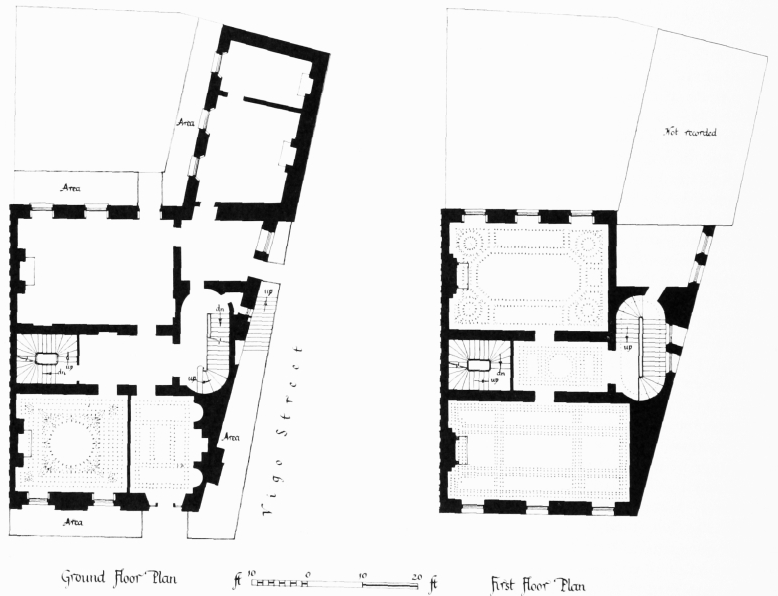
No. 1 Savile Row, plans. Redrawn from a plan of 1870 in the possession of Hawkes and Co. and amplified by measurement of the existing building
The surviving finishings consist, on the ground and first floors, of the main staircase, a chimneypiece and, an unexpected survival, five moulded plaster ceilings. Two old photographs exist showing the first-floor front and back rooms in 1912 and 1913 (fn. 25) (Plate 103a, 103b) but they are of interest mainly as showing how the rooms looked when they were occupied by the Royal Geographical Society. The former entrance hall has a heavy plaster cornice enriched with egg-and-dart and other mouldings, and a compartmented ceiling with shallow guilloche-patterned ribs. There was formerly in the centre of the south wall a fireplace flanked by two semi-circular niches intended to contain sculpture, and the floor was paved with stone. The former morning-room adjoined the hall on the north. All that survives of it is the enriched plaster cornice and the moulded plaster ceiling (Plate 103c). This is composed of a large circular panel with a border of swags alternating with masks and flowers, which is enclosed by a double band of guilloche pattern in the form of a square, the spandrels being filled with foliated C-scrolls. Around the margin of the ceiling runs a band of the same guilloche pattern, this being continued at each end round a narrow panel the length of the centre square. The back room, formerly the dining-room, retains no original features, but in 1870 it had an 'Egyptian marble chimney-piece, painted walls and woodwork grained'.
The main staircase compartment is of two storeys and has semi-circular ends. The walls are now plain, but finishing them is an enriched modillion cornice and an architrave composed simply of an egg-and-dart moulding with no outer fillet, a curious device typical of Kent. The staircase itself has cantilevered stone steps with moulded nosings, and iron balusters ornamented with C-scrolls. At first-floor level, leading into the ante-room above the inner hall, is a wide round-arched opening with enriched imposts and archivolt. The workmanship of the staircase seems a trifle clumsy for Kent. There is, however, a close parallel to it at No. 21 Arlington Street, which has tentatively been attributed to him. (fn. 74) On the other hand, it may be that the staircase was altered in the 1790's by Lord George Cavendish, who later employed Samuel Ware to make alterations in the Kent manner at Burlington House (see page 407). The secondary staircase, lying at the north end of the inner hall, is a simple stone one of nineteenth-century date, and no doubt it replaces an original staircase.
On the first floor the whole of the front is occupied by one large room, formerly a drawingroom. It has a heavy enriched plaster cornice, and a compartmented ceiling having deep ribs ornamented on the soffit with guilloche pattern. The chimneypiece is of white and coloured marbles, an attached Corinthian column at either side supporting an entablature with a blockcornice, the whole breaking forward above the columns. The architrave is decorated with Vitruvian scroll and the frieze with flowers and double guilloche pattern, while in the centre of both is set a plaque bearing a winged cherub's head floating on foliated C-scrolls. The back room, also formerly a drawing-room, has an enriched modillion cornice and a ceiling composed of a large oblong panel, the angles of which are splayed to make room for a small circular panel in each corner (Plate 103d). The ribs enclosing the panels are richly decorated with a guilloche pattern made up of flowers and ribbons. The photograph of 1913 shows a plain dado with moulded rail and skirting, and a mahogany door with six raised-and-fielded panels. The chimneypiece, a simple one in white marble, is of early or mid nineteenth-century date. In the ante-room is an enriched modillion cornice and a ceiling composed of a square flanked by two oblongs, the oblongs having borders of double key pattern and the square being filled with an octagon having a frame enriched with swags and flowers.
The wing to Vigo Street contained a library and a dressing-room in 1870, but it was much altered by the Royal Geographical Society, which also added a galleried map-room with a glazed roof. The map-room still survives as Hawkes's showroom; there is an old photograph showing it in 1912 or 1913, as well as one of the same date showing the exterior before it was altered to its present appearance. (fn. 25)
Nos. 3–6, 11–14, 16–17 (consec.) Savile Row
Nos. 4–6 demolished
Nos. 3–6
There is little to add to the information about the first building of these houses which appears in the table on pages 562–5.
None of the houses had had a fourth storey added by 1836. (fn. 16)
At No. 3 a rather larger sum than usual— £400—was required to be spent by the Duke of Devonshire's lessee on repairs during the first year of his term from Lady Day 1795. (fn. 75)
The first lessee and intending occupant of No. 5, Mrs. Sarah Heysham, widow, was granted in September 1733 the usual building lease by Burlington and the joiner, Thomas Knight, with whom Burlington had concluded a building agreement. By October 1734 she had decided not to take the house (going instead to one in North Audley Street, probably built by Edward Shepherd). She therefore assigned her lease back to Knight and he in turn mortgaged it back to her to secure the repayment of £600 she had already paid him for building the house. (fn. 76) In January 1734/5 Burlington (to whom the lease had made its way back via the vendors of the North Audley Street house) made a new lease of No. 5, for an appropriately reduced term, to Knight, (fn. 77) and a fortnight later Knight assigned this to Thomas Hatton, the first occupant. (fn. 78) He was probably the Lieutenant-Colonel Thomas Hatton who in 1715 held a commission in the Prince of Wales's Own Regiment of Horse. (fn. 79) The Simon Michell who witnessed the assignment from Knight was probably the lawyer of that name (and a relation of Hatton's) who had participated in the development of the Wood-Michell estate in Spitalfields in c. 1718–28. (fn. 80)
In 1957 two chimneypieces from this house were removed by John Cooper and Son, Limited, to their new premises at Savile House, No. 16 Golden Square. (fn. 81)
No. 6 was demolished as the result of enemy action in the 1939–45 war, and Nos. 4–5 were demolished in 1957. (fn. 81)
Nos. 11–14
Lord Burlington's lease of No. 11 was held as a mortgage by the architect Henry Flitcroft, described as of Whitehall, gentleman, from December 1733 until it was assigned to the first occupant in May 1735. (fn. 82)
The fourth storey had been added by 1836. (fn. 16)
The lessee of No. 12 in 1809 was required to spend £1000 on repairs within the first year of his term, under the inspection of John White, surveyor. (fn. 83)
From May 1848 the house was occupied by George Grote and his wife, (fn. 84) and the later volumes of his History of Greece were produced while he lived in the house. Mrs. Grote was a notable hostess and her musical receptions here, which included recitals by Jenny Lind and Chopin, (fn. 84) were celebrated. George Grote died in the house in June 1871. In 1879 a second entrance north of the original doorway was made when the ground floor became solicitors' offices, and in 1906 this added entrance was altered and a shop-window inserted. A tablet recording Grote's occupation of the house was set up in September 1905. (fn. 85)
The first occupant of No. 14 in 1735, Robert Coke, was an acquaintance of the Burlingtons and brother of the first Earl of Leicester who, as Lord Lovel, was then building the Palladian mansion at Holkham with the assistance of Kent and Burlington. Robert had himself travelled in Italy, (fn. 86) and had subscribed to Leoni's Alberti in 1726. That he would not have been indifferent to the architectural character of his own house in Savile Row is suggested by a letter from him congratulating his step-uncle and guardian, Sir Michael Newton (of No. 30 Old Burlington Street), on the improvements he was then making at his country house in Lincolnshire. (fn. 87) On Robert Coke's death in 1750 his widow removed to No. 9.
In 1813 the house was taken by Richard Brinsley Sheridan who died here on 7 July 1816. (fn. 88) Against his name in the ratebook is written: 'Goods distrained by Sheriff, Distraint resisted. Dead and Insolvent'. In 1945 the house was acquired by Hardy Amies, Limited, couturiers, who carried out repairs to damage caused by bombing in the 1939–45 war. (fn. 89)
Nos. 16–17
At No. 16 the fourth storey had been added by 1836. (fn. 16)
At No. 17 the first occupant, Lord Robert Montagu, vacated the house on his succession as third Duke of Manchester in 1739 and was succeeded by William Gore, Member of Parliament, probably the friend of Gay. (fn. 90) From 1826 the house was occupied by the architect George Basevi until his death in 1845: his residence here was recorded by a plaque fixed in 1949. There appears to be no evidence whether or not he made any surviving alterations to the house during this time. Basevi was succeeded, from 1847 until 1867, by the ethnologist, Doctor Richard King. During his residence the Ethnological Society which he had founded was housed here. (fn. 91) From 1867 to 1870 the house contained the offices of London University, during its removal from Burlington House to Burlington Gardens. (fn. 92) In the latter year the Burlington Fine Arts Club took the house and remained here until the 1940's. On taking possession they carried out 'alterations and improvement' which by 1872 had occasioned a substantial increase in rateable value. (fn. 6)
Architectural Description
These houses (Plates 102c, 106a) appear to have formed part of a uniformly fronted terrace extending northward of No. 2, differing from each other externally only in having fronts two, three or four windows wide, according to size. As far as it is now possible to tell, the standard front was of reddishbrown brick, comprising a basement and three storeys with a mansard roof partly concealed by a parapet. The windows were rather narrow, having stone sills and flat gauged arches, except in the basement where the arches were cambered. A broad bandcourse of Portland stone was placed above the ground storey and there were continued sills in the second storey, while below the parapet was a moulded stone cornice. The eightpanelled door was deeply recessed within an opening framed by a moulded stone architrave, above which was a cornice on carved consoles. Around the area was an iron railing with urnfinials to the standards and at either side of the steps leading up to the doorway was a blunted stone obelisk which had an iron torch-extinguisher attached to it and was surmounted by an iron lampholder. Behind the parapet was a row of dormer windows with triangular pediments. The former Nos. 18 and 19 seem to have been designed to form a closing feature for the east end of Clifford Street, for, unlike any other houses in the terrace for which evidence survives, they had mirrored fronts with adjacent doorways sharing three obelisks between them. The uniform design employed in this terrace was repeated exactly on both sides of New Burlington Street, where it is known from original building agreements that the uniformity was required by Lord Burlington. The designer's name is not known, but a close stylistic parallel is provided by Flitcroft's contemporary fronts at Nos. 9 and 10 St. James's Square.
No single front now retains all the standard features described above, but No. 14 provides the most complete example (Plate 106a, fig. 102). All except Nos. 12 and 13 have been raised by a storey and the ground storeys of all but No. 14 have been altered. Nos. 11 and 17 are almost unrecognizable under a layer of nineteenth-century stucco and other additions, while at No. 12 the upper part of the front has been rebuilt in yellow brick, but re-using the original stone dressings. In many of the houses the second-storey windows have been lengthened, often with the addition of small iron balconies of early nineteenth-century type, and at No. 3 the second-storey windows have been fitted with new moulded sills and mask keystones, a stucco frieze having been added below the original crowning cornice. There are original doorcases surviving at Nos. 3 and 14 (Plate 106b) and obelisks at Nos. 12, 14 and 17, although the only original pieces of ironwork left on them are the torch-extinguishers at No. 12. Lampholders survived at No. 18 until the house was destroyed in the 1939–1945 war. Nos. 12 and 13 both have pedimented dormers, those at No. 13 being considerably the heavier in character. The alterations to No. 17 are of some interest. The doorway has an architrave of ribboned bay leaves and from the transom of its fanlight there projects upwards a curious globe-shaped lamp. To the north of the doorway is a canted bay window, which is set in a recess having above it a cornice supported by Egyptianstyle consoles. The second storey has a balcony supported on twisted iron columns and from its patterned railing there formerly sprang the supports for a glazed canopy. Above the fourth storey is a hipped gable, looking from the street like a flat-topped triangle, the apex of the hip surmounted by an ornate weather-vane.
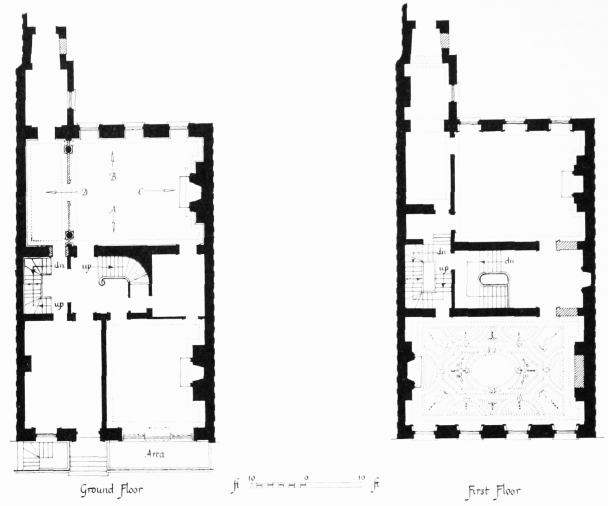
No. 3 Savile Row, plans
The uniformity of the fronts is not reflected internally, and within the limitations imposed by their size the houses vary considerably in plan as well as in finishings. The interiors of the smaller houses, Nos. 11, 13, 16 and 17, have been very heavily altered, but the larger houses, Nos. 3, 12 and 14, retain considerable portions of original work, while the former No. 5, of which there are good records, also had some interesting features.
No. 3, along with No. 14, is the largest surviving house in the terrace, having a front four windows wide, and its plan (fig. 98) also is similar to that of No. 14 (fig. 102). The ground floor has two front rooms, the northern one forming an entrance hall, and behind these lies a relatively shallow compartment with the main staircase in the centre, flanked on the north by the secondary staircase and on the south by a closet. Beyond this compartment in turn is a single room occupying the whole width of the house, its northernmost bay being divided off by a screen of columns. A small closet projects from the back at the north end, and this has been extended at a much later date to link up with a large modern building occupying what must once have been the garden. The first-floor plan is similar except that a single large room takes up the whole front part of the house and the back room is one bay shorter, having to the north of it a closet adjoined on the west by a lobby to the secondary staircase.
The entrance hall, which has now been subpartitioned, has an enriched plaster cornice and is lined for two thirds of its height with sunk twofillet ovolo-moulded panelling, the dado being finished with a moulded rail and the upper panels with a small cornice. The adjoining front room (Plate 104c) is similarly treated, except that the upper panels are carried up full height to the plaster main cornice. The back room (Plate 104d, fig. 99) has the finest woodwork in the house, although a modern partition has been inserted between the columns of the screen. It is lined throughout with two heights of panelling finished with a full entablature, the dado being blank with an enriched skirting and rail, while the upper panels, alternately broad and narrow, have frames carved with egg-and-dart. The entablature has an enriched architrave and an enriched modillion cornice. The two doors south of the screen each have six raised-and-fielded panels, the openings being framed by enriched architraves finished with pulvinated bay-leaf friezes and enriched cornices. The screen comprises two fluted Ionic columns with respondent pilasters, the entablature mouldings of the walls being continued on to each face of the beam above them. The chimneypiece in this room is a modern importation. On the first floor the front room retains its plain dado with a rail having Vitruvian scroll enrichment, and there is an enriched modillion cornice. The main feature, however, is the fine plaster ceiling, an intricate design of different shaped panels sparsely ornamented with scallop-shells, C-scrolls and acanthus leaves (Plate 104a, 104b). In the centre is an oval panel depicting a partially draped female figure seated on a bank of clouds, one arm holding a child and the other beckoning to a winged cherub. The first-floor back room, now sub-divided, has a plain dado with a keypatterned rail, and an enriched cornice.
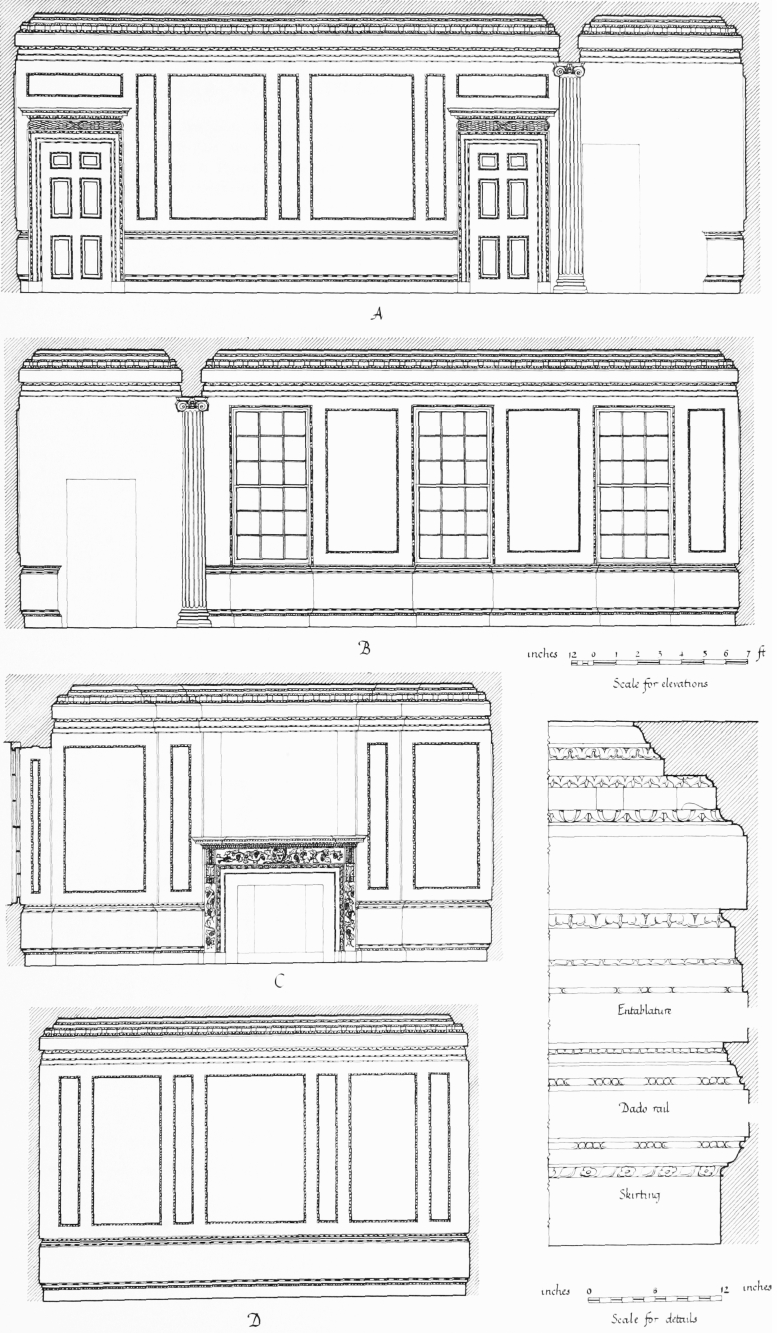
No. 3 Savile Row, interior details
The main staircase, which rises only to the first floor, is of simple wooden construction with plain iron balusters, dating perhaps from the early nineteenth century. However, the original octagonal drum to the skylight remains, alternate faces having enriched bolection-moulded panels and panels with frames carved with key-fret and egg-and-dart. At the time that the new staircase was erected, or later, the closet behind it on the first floor was taken in to form part of the landing. The secondary staircase has also been reconstructed at a later date.
A feature of interest in the modern building at the back of the house is a large open-well staircase of the Jacobean period, presumably installed by Basil Dighton, the antique dealer, when he occupied the house at the beginning of this century. (fn. 93)
The former No. 5 was the smallest house on the east side of the street. Its front was only two windows wide and its simple plan consisted of two rooms on each floor, front and back, separated by a deep staircase compartment (figs. 100–1). On the ground and second floors almost all the original finishings had been removed, while on the first floor much of what remained, although it appeared fairly complete, was probably imitation, the panel-mouldings and the doorcases, for example, being of plaster. In the first-floor front room, however, the enriched modillion cornice and the moulded plaster ceiling appear to have been original (Plate 105b, 105c). The latter had a geometrical pattern consisting of a large octagon with small triangular panels against four of its sides so as to complete a square. Enclosing this square was a border which was composed, on each side, of a circular panel flanked by two oblong panels, these being curved at the end nearest the circle, while in each corner of the ceiling was a small square panel. The centre of the octagon contained a round boss in the form of a mask of foliage, and radiating outwards from this were six concentric circles of tiny fourleaved flowers. The flowers were slightly larger in each successive circle so that they created almost the effect of a dome, while linking them diagonally were small dots which gave the impression of a series of interlacing curves. Enclosing this design was a double frame of alternately inward and outward curving C-scrolls and strapwork, the C-scrolls in the outer frame linked by masks and scallop-shells. The border of the octagon was enriched with Vitruvian scroll while the other panels were framed with half-round mouldings decorated with leaves and flowers. In the triangular panels were foliated C-scrolls, in the circular panels classical heads in profile, and in the square panels quatrefoils adorned with small flowers. This room also had a good chimneypiece of white marble (one of those now installed at No. 16 Golden Square). A series of simple architrave mouldings framed the fireplace opening, and above was a carved frieze and a dentilled cornice on carved consoles. In the centre of the frieze was a tablet depicting Vulcan's forge and flanking it were two paterae.
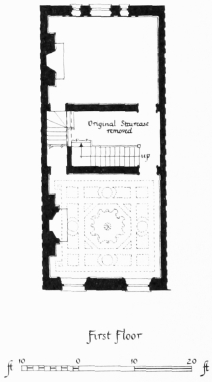
No. 5 Savile Row, first-floor plan
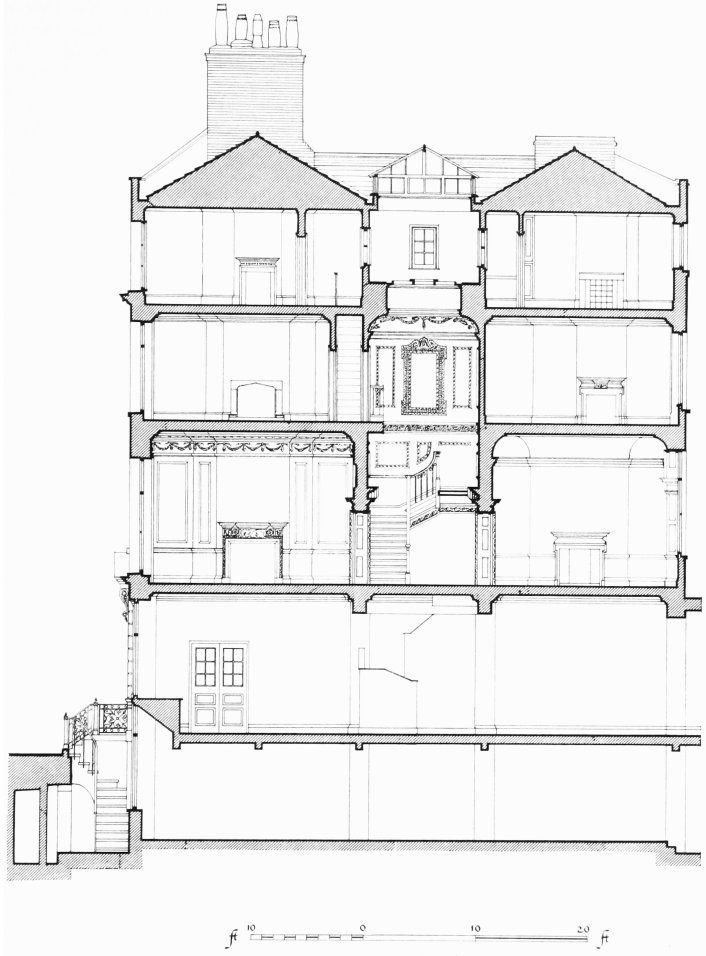
No. 5 Savile Row, section
The main staircase (Plate 105a, fig. 101), which rose only to the second floor, had been almost entirely rebuilt, and at second-storey level there was imitation eighteenth-century plasterwork on the walls of the compartment. At thirdstorey level, however, the plasterwork seems to have been original. There was a band of Vitruvian scroll at second-floor level and in the centre of each wall face above it was a large panel with an enriched frame flanked by two narrower panels having bolection-moulded frames. The frames of the larger panels were shouldered and decorated with key-pattern, the slightly narrower frames on the end walls being broken at the top to form a swan-neck pediment with a mask in the centre. The walls were finished with an enriched cornice, from which sprang the cove surrounding the skylight, decorated with baskets of flowers, cartouches and festoons.
No. 12 has a front three windows wide (Plate 106a), its first-floor plan consisting of one large front room, now sub-divided, and a smaller back room lying to the north of an open-well staircase. The latter, however, is not as deep as the back room, and behind it is a closet having a slight projection. The ground floor has been completely altered, but on the first floor the original finishings are largely intact. In the front room the panelling has been partly re-arranged and a partition wall inserted, but the panelling on three walls of the northern half is probably in its original position. The panels are raised-and-fielded with ovolo-moulded frames, the dado being finished with a band of Vitruvian scroll and the upper panels with an entablature having a pulvinated frieze and a modillion cornice. The back room and the closet are similarly panelled, but with the omission of the frieze and architrave below the cornice. In both rooms the band of Vitruvian scroll is replaced by an ordinary moulded dado-rail, and in the closet the cornice is of the simple moulded type. The chimneypieces in the front and back rooms have been replaced, but that in the closet, which is of greenish marble with an eared architrave, may be original. On the second floor all three rooms have sunk ovolomoulded panelling, some of it altered, with a moulded dado-rail and a box-cornice. In the back room is an original marble chimneypiece, now painted, which has a shaped lintel and simple mouldings on the inner and outer edges. The staircase is a geometrical one of wood and dates from the early nineteenth century, although the part leading from the ground to the first floor has been replaced.
No. 14 is closely similar in plan to No. 3, the only significant differences being that in this house the ground-floor back room is of three bays, the northernmost bay, as on the first floor, being occupied by a small closet (figs. 102–3). On the ground floor the entrance hall has the remnants of three-quarter-height, sunk cyma-moulded panelling finished with a moulded dado-rail and a small cornice, the walls being finished with an enriched dentilled cornice. The front room has a plain dado with enriched rail and skirting, while the upper panels, variously broad and narrow, have frames either carved with egg-and-dart or with applied bolection mouldings, being finished with an enriched dentilled cornice. The windows have heavy architraves carved with egg-and-dart and the architraves of the six-panelled doors are enriched. On the first floor the front room (Plate 107a) is panelled like that below, except that the sunk panels have leaf-and-dart carvings on a cyma moulding and there is a full entablature with an enriched architrave and a modillion cornice, this entablature being supported at either side of the chimney-breast by a fluted Corinthian pilaster having a pedestal broken forward from the dado. The second floor has been considerably altered, but it is still possible to reconstruct the original plan. The front part was divided equally between two rooms, the back part having a similar arrangement, except that the north room was reduced in depth to allow for the secondary staircase. To the south of the octagon over the main staircase, as in the floors below, was a closet with its own fireplace. The original finishings have been almost entirely removed, but there are small portions of ovolo-moulded panelling and small moulded wood cornices, while in the south front room is a stone chimneypiece with panelled jambs and lintel, the jambs finished with moulded imposts and the lintel shaped on the underside.
The main staircase rises through two storeys (Plate 107b, 107c, fig. 103). It is made of wood with moulded closed strings comprising an architrave, pulvinated frieze, and small cornice-moulding, the turned balusters and square panelled newels supporting a broad moulded handrail. The landings are panelled for two-thirds of their height with sunk panelling finished with a moulded dado-rail and a small cornice, while a dado of raised-and-fielded panelling reflects the line of the balustrade, the newels being balanced by panelled pilasters. The doors have moulded architraves, and those on the first-floor landing have pulvinated friezes and moulded cornices. Round the top of the compartment is a modillion cornice, and above it the octagonal drum of the skylight, each face of which has, alternately, a bolection-moulded panel or a panel framed with egg-and-dart and key-fret. At the south end of the compartment, at first-floor level, is a wooden oriel, probably added in the early nineteenth century, which opens out of the closet behind. The casement windows in its centre are framed by a moulded architrave and above them is a low-pitched triangular pediment on carved consoles, while below and at either side are panels with bolection-moulded frames. The secondary staircase is of wood and built round an open well. The lower flights have been renewed, but those above the second floor have moulded closed strings, turned balusters and column newels.
Nos. 16 and 17, although much altered internally in the early or mid nineteenth century, clearly had the common plan of a single front and back room on each floor with a dog-legged staircase beside the back room. No. 16 retains an original dog-legged staircase with cut strings and carved step-ends, although with balustrades of a later date, while at No. 17 is a similar staircase that has suffered even more alteration, the treads of the lower flights having been re-used to make a geometrical staircase. The first-floor front room of No. 17 also has original panelling, the plain dado being finished with a moulded rail and enriched skirting, and the raised-and-fielded upper panels with an enriched cornice.
Former No. 22–23 Savile Row
Until 1864 No. 1 Boyle Street. Demolished
This house (Plate 108) was clearly designed to close the vista northward up Savile Row. Professor Wittkower has noted its resemblance to the wings at Holkham, with which it is contemporary, (fn. 94) and it is very probable that, like Holkham, the design is attributable to the associated talents of Kent and Burlington.
The rather curious ground-floor plan (fig. 104) is perhaps related to the fact that for much of its history the house was in dual occupation.
The site, which included the narrow foot passage to Mill Street, later known as Savile Place, was leased by Burlington in March 1733/4 (fn. 95) to a prominent and prosperous craftsman, the wood-carver John Boson (or Bossom). (fn. 96) Boson lived here from 1735 until his death in 1743, although he also had a house at St. Ann's Hill, Chertsey. (fn. 97)
In April 1736 Boson's brother Francis bought the freehold of the site in Savile Row in trust for him. (fn. 98) At the time of his death Vertue said that Boson was 'a man of great ingenuity, and undertook great works in his way for the prime people of Quality and made his fortune very well in the world'. (fn. 99) The 'people of Quality' included the Countess of Burlington, for whom Boson carved furniture at Chiswick in the year he entered into this house. (fn. 100) In the same year he was providing a chimneypiece for another resident on the estate, Sir Michael Newton, of No. 30 Old Burlington Street, at his country house in Lincolnshire. (fn. 101) He subscribed to the third volume of Leoni's Alberti of 1726 and Ware's Burlington-sponsored edition of Palladio of 1738. His will (fn. 102) made James Horne, the surveyor who measured houses on the Burlington estate, one of the trustees for his property. Some close or friendly relationship with the Burlingtons is perhaps implied by the reduction in the rent of the house for his lifetime. (fn. 95)
After Boson's death in 1743 the house was rated to Mrs. Boson for a year and was then taken by Sir John Bland until 1746. In 1745–6 a Sandys Jones was additionally rated for a 'back house'. Thereafter only a single ratepayer appears until 1768. In 1747–8 it was a Mrs. Hamilton and from 1748 to 1758 Sir Thomas Sebright. In 1759 the house was first rated to John Prestage, an auctioneer, who had, however, already been holding sales at his 'Great Room' here in 1756. (fn. 48) On his taking the premises the rateable value was much increased. He continued here until 1769. In the last two years of his tenure, however, he was rated only for 'the shop' and henceforward, until 1819, the property was assessed for rating in two parts, although it is not clear in what manner the premises were divided. The 'shop' part was subsequently rated to John or Luke Hogard or Hogarth (1770–2), and Miles Nightingale (1772–6). The other part, which was assessed at a higher figure, was occupied from 1768 to 1771 by a Colonel St. John, who then removed to No. 1 Savile Row, and from 1771 to 1776 by Henry Bunbury, probably the artist and caricaturist. From 1776 to 1798 the two parts, though assessed separately, were held by single ratepayers. These were James Squibb (1777–88), Thomas Saunders in 1789, James Squibb again (1789–92), Michael Bryan, probably the connoisseur and compiler of the Dictionary of Painters (1793–6), and George Squibb (1796–8). The Squibbs were auctioneers, like Prestage, and an engraving on an undated trade-card perhaps of about 1790 (fn. 2) shows the entrance to Squibb's premises. The large glazed superstructure there depicted presumably lit an auction room behind the main house fronting Savile Row. (fn. 102) Squibb's address in a trade directory of the period confirms that the entrance to the auctioneer's premises was from this side. (fn. 103)
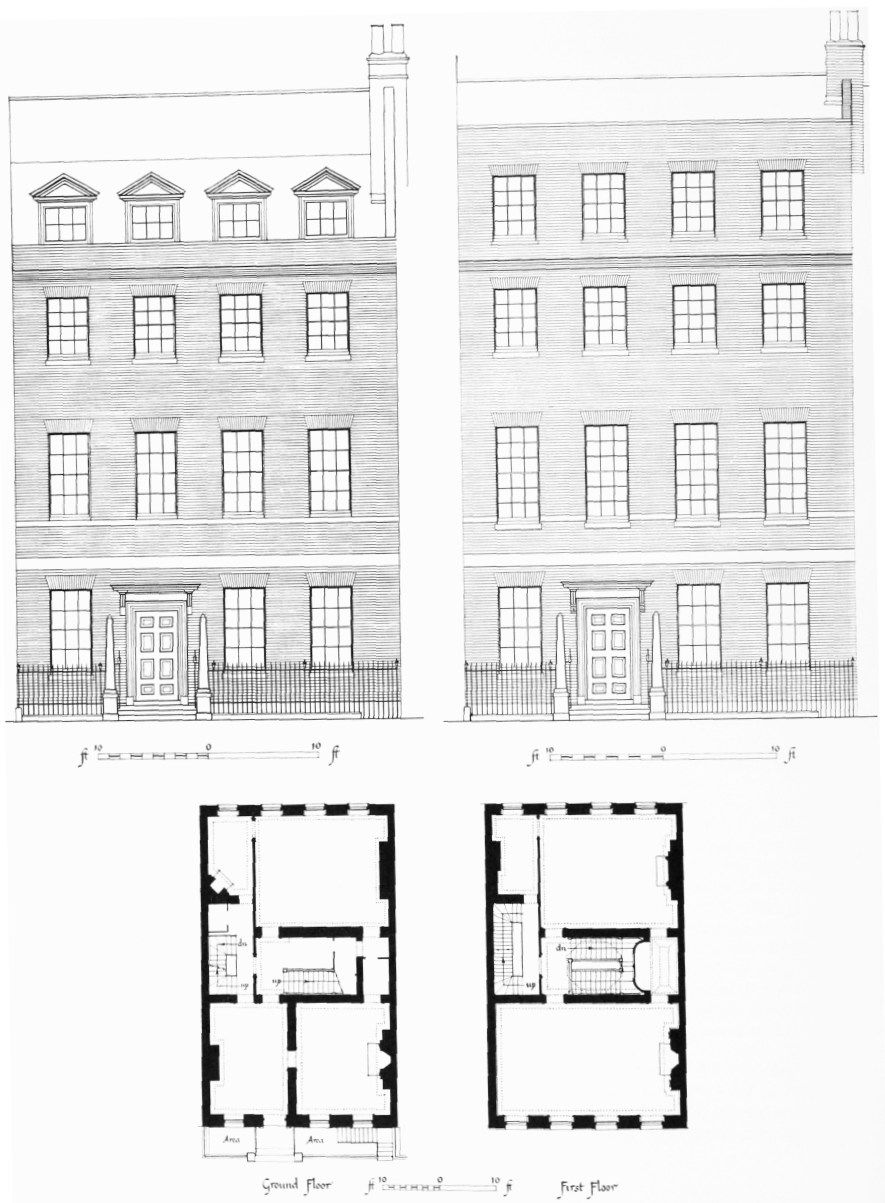
No. 14 Savile Row, elevation before and after alteration, and plans
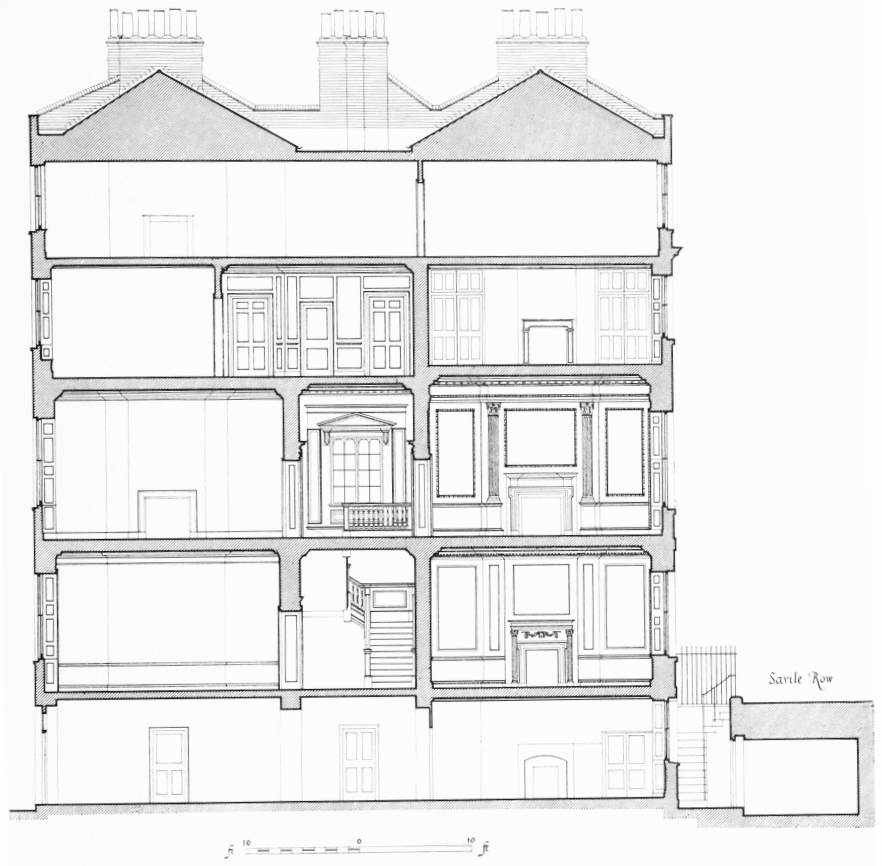
No. 14 Savile Row, section
In the summer of 1790 the auction room had been taken by the youthful tenth Earl of Barrymore for use as a private theatre. It appears that it had previously been used, for an uncertain period, as an Italian marionette theatre, and took from it the name of the 'Fantoccini'. (fn. 104) Neither Lord Barrymore nor the marionette theatre is mentioned in the ratebooks. Lord Barrymore's amateur theatricals attracted great attention and Horace Walpole remarks on the crowd of coaches that blocked the approaches to the theatre when Lord Barrymore, his sister Lady Caroline and Mrs. Goodall performed The Beaux' Stratagem here one summer night in 1790. (fn. 105) An advertisement of 'The Theatre of Varieties Amusantes, in Saville-Row' in January 1792 records the night's entertainment which included a musical farce featuring 'Italian Airs and Duetts', a two-act opera, and an entr'acte 'The Metamorphosis of the Turk'. Seats were offered in the pit at 3s. and in boxes at 5s. (fn. 106) By the summer of that year, however, Lord Barrymore was in great financial difficulties and the theatre was closed. (fn. 107)
Critical opinion of the amateur actors had not been consistently favourable but The Times thought the theatre itself, on which Lord Barrymore was supposed to have spent nearly £1500, 'one of the prettiest Theatres we ever saw'. (fn. 108) It is not known whether Lord Barrymore was responsible for the decorative treatment of the ground floor of the front to Savile Row, although it probably dates from about this time. If so, Michael Novosielski, architect of the Earl's house in Piccadilly, was probably responsible for it, as he probably was also for the theatrical decoration itself.
After 1798 George Squibb continued to occupy the auction rooms but from 1798 to 1819 other ratepayers were assessed for a less highly rated part of the premises, the seventh Lord Reay from 1798 to 1803, and John Irving from 1803 to 1816. From 1817 to 1819 this part was empty.
In 1818 (at the time the Burlington Arcade was being constructed) eight tiny shops were contrived in the walls of Savile Passage (later Place), the covered way that ran through the eastern part of the building. They included a stick shop (subsequently well known as an umbrella shop) and a cobbler's stall, both of which continued until the building was demolished. There were originally also two booksellers, a tailor, a fruiterer, a 'child bed warehouse' and a stay shop. (fn. 6)
Apart from these shops, the premises were from 1820 assessed for rates as a whole. George Squibb remained until 1833 when he was succeeded for one year by Francis Squibb. In 1835 the premises were taken by Edmund Rushworth and W. J. Jarvis, auctioneers, whose firm, later Rushworth and Brown, surveyors, auctioneers and valuers, occupied all or part of the building until its demolition in 1937. From about 1855 until his death in 1873 Sir Paul Edmund de Strzelecki, the Australian explorer, occupied the part of the house which after 1864 was numbered 23, the auctioneers' part being numbered 22. (fn. 109) His residence is described (fn. 110) as 'a suite of rooms—a modest bachelors establishment'. In 1880 work to the value of some £1322 was about to be undertaken by Messrs. Eales and Son, architects. (fn. 111) The work probably included the building of a lecture hall (fn. 6) perhaps used by the Y.M.C.A.; (fn. 109) this was doubtless the Burlington Hall which in 1893 was situated over the auction room. (fn. 112) From 1896 the upper part and basement of the house were occupied as the headquarters of the Alpine Club, until 1937. (fn. 113)
The demolition of the house and the erection of a new building on the site was intended by the owners in 1929 (fn. 112) but as a result of the Westminster City Council's decision in December of that year to extend Savile Row northward (fn. 18) the site was sold to the Council in October 1930 for £33,000. (fn. 112) No. 22–23 Savile Row and the passage-way and shops of Savile Place were being demolished by the end of 1937. (fn. 22)
Architectural Description
This building was intended to be the focal point of the street, but although at first sight it contrasted strongly with the uniform fronts of the other houses, it seems nevertheless to have adhered to the same storey-heights and stringcourses (Plate 108a). Its plain brick front was composed of a three-storeyed centre block flanked by narrower slightly projecting wings of two storeys. The centre block, which was three windows wide, had continued sills in the second storey and was finished with a triangular pediment, while the wings each had one window and an open triangular pediment. The lower part of the front had been altered in the early or mid nineteenth century and it is difficult to distinguish from the photographs how much original work remained. The ground storey of the centre block had been covered with channelled stucco, and the doorway in its eastern bay, though probably (on the evidence of Mayhew's map of 1831–6 (fn. 16) ) original, appears to have been enlarged. In the second storey the windows had been lengthened and an iron-railed balcony added. Each of the wings had in the ground storey a shallow round-arched recess with plain stone imposts, the eastern recess containing the round-arched entrance to Savile Place and the western one a round-arched doorway. Although the western recess had been covered with ornamented stucco it is probable, from comparison with the Horse Guards and other buildings by Burlington and Kent, that both recesses were original. It is possible, however, for reasons to be explained below, that the western recess originally contained a window.
The rear elevation to Mill Street (fn. 114) was latterly of little interest (Plate 108c). It was then of three storeys and entirely stuccoed, the ground storey having two round-arched openings, one the entrance to Savile Place and the other, according to an inscription painted above it, to the 'Alpine Club Gallery'.
No adequate record of the interior was ever made. There is a ground-floor plan attached to a conveyance of 1893 (fn. 112) (fig. 104) but by that date considerable alterations had clearly been made, and in fact the internal dimensions sketched in on Mayhew's map show quite a different arrangement. In this respect Mayhew's map is not the most reliable evidence, but it does provide a slightly more logical plan and it may perhaps explain the expensive work carried out in 1880. The original finishings are illustrated by two drawings by Hanslip Fletcher which show rooms described as 'the reading room of the Alpine Club' (fn. 115) and 'one of the ground floor rooms'. (fn. 116) There is also a photograph of 1907 (fn. 117) showing a third room described as the library of the Alpine Club, but this seems to have been completely altered.
As it existed in 1893 the house was about 51 feet deep, having behind it a warehouse with the Burlington Hall above. Savile Place lay on the east side of the site and carried over it at either end were parts of the upper floors of the building. On the ground floor the front of the centre block was occupied by one large room with an open area behind it, this area having on the east side of it a passage connecting the front room with a staircase at the back. A circular open-well staircase occupied the front of the west wing, and behind it was a deep narrow room followed in turn by a third room which on the east adjoined the back staircase. The square compartment containing the circular staircase, although a thoroughly Burlingtonian feature with a close parallel at the former No. 29 Old Burlington Street, is not, however, shown by Mayhew. In its place is a much deeper room, corresponding in depth to the front room of the main block, which has only a small, almost square, room behind it. The purpose of this alteration, if such it was, would presumably have been to give separate access to the upper floors, which were then known as No. 23. In the centre block Mayhew seems to show the front room reduced in width on the east side by a passage linking the front door with the back staircase. This would have been a more usual arrangement for an eighteenth-century house since the fireplace would then have been in the centre of the back wall. Probably this room was that illustrated by Hanslip Fletcher, for it is the only one in which the chimney-breast is not broken forward. In the drawing the walls are shown with panelling in two heights, the dado plain with a moulded rail, the upper panels sunk with carved frames, and the whole finished with what appears to have been a full entablature having an enriched architrave and cornice. In the west wall was a doorway with an enriched architrave, a pulvinated ribboned bay-leaf frieze, and an enriched cornice. The chimneypiece had a swag frieze with a plain centre plaque and an enriched cornice on carved consoles. Above it was a large rectangular panel, intended either for a picture or a mirror, enclosed by a shouldered architrave broken at the top to form a swam-neck pediment and buttressed by tall scrolls.
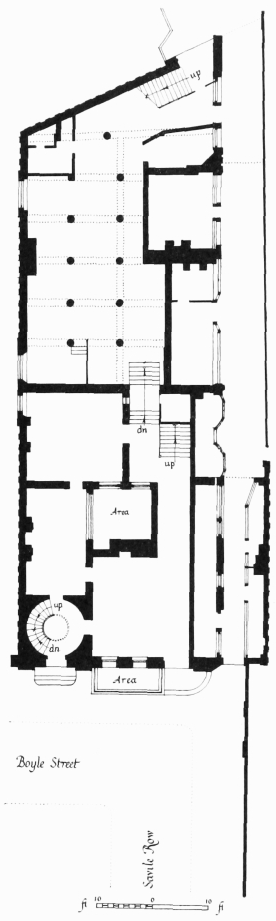
No. 22 and 23 Savile Row, ground-floor plan in 1893. Redrawn from a deed in the possession of Westminster City Council
There is no plan of the first floor, but it is clear that the Alpine Club reading-room shown in Hanslip Fletcher's other drawing is in fact the front room of the centre block, probably extending across all three bays. Its main feature was a fine coved ceiling with enriched octagonal coffers very similar to that of the saloon at Holkham.
No illustration appears to exist of the shops in Savile Place, although an impression of the passageway itself can be obtained from the photograph of the Mill Street elevation.
No. 23 Savile Row: Fortress House
This building, which occupies the sites of the former Nos. 5–9 New Burlington Street, was erected in 1949–50 to the design of W. Curtis Green, Son and Lloyd (fn. 24) and was first occupied by the Ministry of Town and Country Planning. It is of seven storeys, monumentally designed and with a facing of Portland stone. The wide centre block, set well back from the street, is flanked by deep projecting wings. The wall faces are almost entirely plain, except for some rustication in the ground storey of the wings, but the centre block has an imposing entrance porch, the doorway having a niche above it and giant pilasters at either side supporting an open triangular pediment.
Former Nos. 24–29 Savile Row And 1 Clifford Street
Demolished
These houses, the site of which is now occupied by the Police Station and Van Heusen House, are too sketchily recorded to make a satisfactory description possible. Fortunately, however, the best information is that relating to three of the four original houses. The large house later divided and numbered 25 and 26 appears to have been very similar in character to the uniform terrace on the east side of the street. Whether by accident or intention it was so sited as to make a closing feature at the western end of New Burlington Street. The house seems to have had a plain three-storeyed front four windows wide, the windows having flat arches and the front being finished with a moulded cornice. Behind the parapet were three dormers with triangular pediments, these being set in a mansard roof which was hipped at the southern end. No. 29 was latterly a nondescript building of mid nineteenthcentury appearance, but the design attached to the lease to Thomas Knight, joiner, suggests that the original building, if carried out in this form, was of unusual interest. It was one of a semi-detached pair with No. 1 Clifford Street, both being of only one storey and having mirrored fronts, together giving the effect of a garden pavilion. Each had two flat-headed windows, and a doorway placed at the end furthest from the party wall. As in the case of No. 22–23, the detailing was designed to match that of Nos. 3–20 on the east side of the street, except that here the pedestal-course had to be at ground level instead of in the second storey. There was a moulded crowning cornice, placed some ten feet nine inches above the ground, and the roof, unconcealed by a parapet, was hipped at either end. There was a similar return front, four windows wide, to Clifford Street. The sites of Nos. 27 and 28 were not built upon until the late eighteenth century; (fn. 6) in 1933 they were occupied by fourstoreyed buildings of no apparent interest.
West End Central Police Station, Savile Row
This building was designed and erected in 1939–40 by Sir John Burnet, Tait and Lorne in collaboration with the Chief Architect of the Metropolitan Police, G. M. Trench. (fn. 118)
It is a six-storeyed building with a front of Portland stone, the fifth and sixth storeys being set well back. The front of the four lower storeys is very plain with long horizontal bands of windows divided by baulks into alternately wide and narrow groups. In the centre of the ground storey is the wide main entrance with a short flight of steps in front and a deep canopy above.
Nos. 36–39 (consec.) Savile Row
Formerly Henry Poole and Co.: Nos. 37 and 38 demolished
The premises of this firm were among the first to be established, in the second quarter of the nineteenth century, in the street that became synonymous with the best bespoke tailoring. (fn. 3) Savile Row was not, however, the first street on the Burlington estate to become a centre of fashionable tailors, and until the mid nineteenth century Poole's main entrance was probably on the westward frontage of their property, at No. 4 Old Burlington Street. Here James Poole, of the firm of Poole and Cooling, set up business in the autumn of 1828: (fn. 6) three other tailors had become established in this street in the previous ten years. Before moving to Old Burlington Street Poole had had premises as a 'tailor and draper' at No. 171 Regent Street, from 1822, (fn. 119) and before that had had a shop at No. 7 Everett Street, Brunswick Square. (fn. 120) Like other tailors afterwards famous, James Poole seems first to have achieved prosperity as a military tailor. (fn. 121) In addition to No. 4 Old Burlington Street Poole and Cooling had counting houses and a workshop in Savile Row (fn. 122) and the firm gave its address in both streets. (fn. 109) Changes of numbering in Savile Row and apparent differences of enumeration in the parish ratebooks and Post Office Directories make identification of sites on the west side of that street difficult, but it may be presumed that Poole's first premises in Savile Row were immediately behind the Old Burlington Street house, on the site of the later No. 38.
In 1846 James Poole died and was succeeded by his son Henry George Poole, who in the next thirty years advanced the firm to the front rank of internationally fashionable men's tailors with the Prince of Wales and Napoleon III among its customers. Henry Poole's social gifts enabled him to participate in aristocratic society, and he is reputed to be the 'Mr. Vigo' of Disraeli's Endymion. (fn. 123)
It was Henry Poole who is said to have made Savile Row the main frontage of the firm's premises. (fn. 124) He had a gallery constructed in the workshop at the back of No. 4 Old Burlington Street in 1851 by W. Page of Queen Street (now Denman Street). (fn. 125)
In 1853 Poole's acquired the more southerly of two buildings which had been built in 1838 on the site later numbered 37 Savile Row (fn. 126) and in 1858 began to be rated for the more northerly also, (fn. 6) although it seems to have remained wholly or partly in the occupation successively of a dentist and a wine merchant until about 1865. (fn. 109) It is not certain when Poole's acquired or entered into occupation of No. 39 Savile Row. It was perhaps by 1849 (fn. 122) and certainly by 1864. (fn. 127) Considerable increases in the rating of the firm's premises over the years 1856–8 indicate building extensions or alterations. This fact, together with the architectural character of Nos. 37–39 Savile Row in the later nineteenth century (Plate 102a), suggests that it was at this time that the Savile Row frontages were built or rebuilt as a single composition. The Prince of Wales's feathers and a version of the Bonaparte coat-of-arms which by the latter part of the century decorated the central block celebrated Poole's most august clients. The architect and builder is said to have been Cubitt; (fn. 128) this work was suaver and more Belgravian than was apparent in the altered building recently demolished. The showroom between No. 5 Old Burlington Street and No. 37 Savile Row was probably also built by Cubitt (fn. 128) at about this time. Here a commissionaire ushered customers into rooms furnished with more luxury and ostentation than was usual at a later period. Mirrors, vases and statues said to have come from the 1851 Exhibition adorned the walls. (fn. 123)
These were years of growth and prosperity: 1862 was later noted as a 'very busy year indeed'. (fn. 129) Further north in Savile Row, on the southern corner of Clifford Street, Henry Poole acquired the houses numbered 20 and 21 in the latter street in 1866 and rebuilt them as single premises. (fn. 6) In the following year the main site in Savile Row was further extended when No. 36 was acquired and rebuilt; (fn. 6) the lease, dated in May 1868, ran from 1865. (fn. 130) In 1869, Poole's acquired Nos. 3 and 5 Old Burlington Street (fn. 6) and their premises had reached their greatest extent. In 1870, a showroom is said to have been made on the ground floor in Savile Row. (fn. 131)
Spectacular effects were not shunned, and on royal occasions displays of illuminations attracted large crowds of onlookers; (fn. 132) by 1897 the fittingrooms were described as 'miniature palaces'. (fn. 133) At this later period three street lamp posts of distinctive design marked the extent of the firm's premises in Savile Row.
Henry Poole had died in 1876 (fn. 134) leaving the business to his first cousin Samuel Cundey and to C. B. Bingley. The firm was then seriously burdened by the Prince of Wales's bad debts and the winding up of the business was contemplated. (fn. 128) On Samuel Cundey's death in December 1883 (fn. 134) the business was taken over by his son Howard Cundey and a period of renewed prosperity began. Some enlargement of the premises is said to have followed (fn. 135) and in 1896 the rating was increased. (fn. 6) But in 1897 No. 38 Savile Row was still of one storey, surmounted by the Prince of Wales's feathers. (fn. 136) It is not certain when these were replaced by the crown which decorated the building recently demolished, but an old photograph (Plate 102a) shows that it was before the addition of upper storeys to No. 38 in 1903–5. This enlargement and reconstruction was carried out to designs of the architect R. H. Kerr. The contractor was A. W. Webber and the total cost about £8500. (fn. 128)
In March 1961 the firm removed from Savile Row to Nos. 10–12 Cork Street (fn. 137) where (at No. 12) a tailor who was one of the first to be established on the Burlington estate had set up as early as 1795. Many of Henry Poole's furnishings were removed to the new premises. (fn. 138)
Architectural Description
Nos. 36–39, of which Nos. 37 and 38 were demolished in 1962, were latterly of visual interest only as the quaintest of the motley buildings forming the west side of the street. It is clear, however, from the photograph mentioned above that, while No. 36 was always a separate building, Nos. 37–39 had originally been treated as a single composition (Plate 102a). Their stuccoed front, designed in a style probably attributable to the 1850's, was composed of a single-storeyed centre block (No. 38) recessed between twostoreyed wings (Nos. 37 and 39). At the period of the photograph there was in the middle of No. 38 a large channelled projection finished with an entablature, this entablature having below it a recess containing a version of the Bonaparte coat-of-arms (fn. 139) and the piers at either side of the recess being finished with moulded capitals. Above the entablature was a blocking-course surmounted by a pedestal and upon this was a crown resting on a tasselled cushion. The space at either side of the projection had been filled in, more or less after the manner of the original work. The wings were similar to each other in style, except that No. 37 was three windows wide and No. 39 only two. The windows had moulded architraves, those in the ground storey having in addition cornices on richly moulded consoles. Each front was finished with a cornice and a balustrade, and the pedestals of the latter were decorated with wreaths and C-scrolls. No. 36 was of one storey only, its stuccoed front being divided into bays by square columns supporting an entablature, above which was a balustrade with large urns on its pedestals.
No. 36 has not been radically altered nor, until its recent demolition, had No. 37. No. 39, however, has lost its balustrade and has had its ground-storey windows replaced by a display window, while No. 38, which had been completely reconstructed in 1903–5, was, at the time of its demolition, a three-storeyed building of crudely exaggerated Baroque appearance, the pedestal, cushion and crown alone being retained from the former building (Plate 109a).
In the interior the principal feature was the showroom behind No. 37, a fine example of mid nineteenth-century classicism (Plate 109b). This was single-storeyed and rectangular in plan, the south and west sides being divided from the adjoining rooms only by open colonnades, somewhat in the style of a Roman atrium. The Ionic columns were of pink marble (traditionally supposed to have come from the Mount-Edgcumbe estate in Cornwall) with white marble capitals. Instead of columns the east wall had pilasters, while the north wall had pilasters with columns set a little way in front of them. Above the columns and pilasters was an entablature, probably of wood, enriched with marble panels, and from this sprang the deep cove of the ceiling, in the centre of which was a skylight. In the middle of the east wall was a formidably proportioned chimneypiece of black marble flanked by two pairs of round-arched recesses with enriched imposts and archivolts, and these must originally have held mirrors as did a fifth half-length recess above the chimneypiece itself. Upon the mantelshelf stood a clock and two candelabra of bronze, which, along with a great bronze eagle incorporated in the cash desk, are said to have come from one of the Paris Exhibitions. (fn. 128)
The Burlington School For Girls, Boyle Street
Demolished
The school had been founded as a charity day school for girls of the parish of St. James, at the instigation of the rector, William Wake: the date of foundation is traditionally Christmas 1699 but in February 1699/1700 the school was said to be 'about to be sett up.' (fn. 140) The Trustees first met, under the chairmanship of the rector, on 9 July 1700. (fn. 141) In 1707 they took a lease of a house in Carnaby Street, (fn. 142) where the school had probably been from the beginning. Sixty girls were educated and clothed. (fn. 143) The standard of instruction evidently was not high: in 1705 the Trustees sought permission from the trustees of Archbishop Tenison's school 'that such of their Boys as are qualifyed for it, may be employed to teach such of the Girles of this schoole as shall be thought fitt to learn'. (fn. 144) The girls were taught to read and write but the training was chiefly for domestic service or apprenticeship in trade: the latter continued until the nineteenth century. (fn. 145)
In 1715 the Trustees began to look for other accommodation where a boarding school might be maintained. (fn. 146) Three years later they were considering sites in Glasshouse Street, Windmill Street, Charles (II) Street, and on the north side of Piccadilly (outside the parish of St. James). (fn. 147) In January 1718/19 it was decided to build a school-house in the 'Green Church yard' near the boys' charity school. (fn. 148) This resolution came to nothing and in March the Trustees were prepared to offer £800 for a site near King Street chapel. (fn. 149) But by 12 May 1719 they had finally determined to move westward to the Earl of Burlington's new estate.
Shortly before that date some of the Trustees had come to an agreement for a site (possibly that later occupied by Queensberry House) with the bricklayer, John Witt, who evidently had a title under Lord Burlington. On 12 May, however, the Trustees learned that 'there being some Objections rasied by some persons of Qualety in the Neighborehood my Ld Burlington therupon is desirous that the Trustees relinquish the pretentions to ye same'. This they agreed to do, (fn. 150) at the cost of a dispute with Witt, who demanded compensation. (fn. 151)
By 12 May, however, Lord Burlington had evidently announced his intention to give them another site. They thereupon resolved 'that the Schoole bee built on any peice of Ground wherein there may be Room for the Trustees to purchase so much as shall be needfull to add to which my Ld Burlington shall be pleased to give by way of benefation to ye sd School'. (fn. 149)
When they met again on 29 May Lord Burlington had made over to them a site in the most northerly and retired part of his property. He had also ensured that the appearance of the schoolhouse should be conformable to his taste. The Trustees recorded: 'The Rt Honoble the Earl of Burlington having been pleased to give to this board by way of benefation a peice of Ground 50 Foot in Front and from 43 to 60 in Depth or therebts on the North side of the Street intended to be called Boyle Street and Fronting the Street intended to be Called Great Burlington Street. The board Return'd his Ldsp their humble thanks for ye same and came to a Resolution to purchase a peice of Ground Imediately Adjoyning to it Eastward being from 60 to 85 foot in Depth, where it Butts upon Mrs. Hardyes Wall, and they resolev'd Unanimously that they will Cause the Front of Their School to be built in such manner as shall be Agreeable to his Ldsps Intentions'. (fn. 152)
Lord Burlington's 'benefation' took the form of a remission of part of the rent. The lease was granted at £36 13s. per annum, but bore an endorsement that Lord Burlington 'for the encouragement and promotion of the said charity', would accept £21 13s. per annum in lieu of the stated rent during his lifetime. (fn. 153) This concession was continued by his heirs, the Dukes of Devonshire, until some ten years before their head leasehold interest expired when, in 1798, the fifth Duke seems to have remitted the rent altogether. (fn. 154)
The site proposed to be taken on 29 May was not quite that finally leased to the Trustees. The 50-foot frontage looking down Old Burlington Street and itself filling the vista up that street remained as intended, but instead of an additional site wholly eastward of this, ground was taken to both east and west. This change had been made by 24 July when the Trustees resolved that thanks should be returned to Lord Burlington 'for his Favour to this Trust in altering its Setuation of the Ground given by his Ldshp to this Trust for the greater Convenience of their Intendid building'. (fn. 155) It is not clear why the Trustees should have wished or (politeness apart) given thanks for this westward shift of the site, which reduced its depth (fig. 78). A possible but entirely conjectural explanation is that the Trustees already understood that they would be required to construct a handsome doorcase on the part of the site occupying the view up Old Burlington Street. If so, they may have thought it more convenient to have this in the centre than at the west end of their building, where, moreover, it might have required the construction of a balancing architectural feature at the other end.
On 12 August 1719 it was reported to the Trustees by Lord Burlington's representatives that he had signed the lease. (fn. 156) But again difficulties arose with former prospective lessees, (fn. 157) Lord Burlington's lawyer, Collier, was dilatory (fn. 158) and the delivery of the lease to the Trustees was continually deferred: finally a new lease had to be drafted. (fn. 159) It was eventually executed in December 1723. (fn. 160)
It bore a fictitious date of signing and sealing— evidently that of the original superseded lease—on 7 August 1719, and ran for 61 years from Lady Day 1719 at the reduced rent already indicated, payable after the usual two-year building period at a peppercorn rent. The lessee was William Benny, gentleman, of St. James's, the Clerk to the Trustees. (fn. 161) By March 1723/4 he had made a declaration of trust in respect of this lease doubtless in favour of the existing Trustees. (fn. 162)
The subsequent history of the Trustees' title to the site may be noted briefly. On 4 February 1763 they bought the freehold for £150 from Anne Pollen of Great Marlborough Street, spinster, subject to the Burlington-Devonshire leasehold interest expiring in 1809. (fn. 163) Probably their tenure of the site from the expiry of their own lease in 1780 until 1809 was secured by a lease from Lord Burlington's heirs, the Dukes of Devonshire, but it is possible that no formal lease was made (no lease later than Lord Burlington's is listed in the 'Particular of the Leases of the Burlington Garden Estate' of c. 1800 preserved at Chatsworth). From 1798 the Trustees' records contain no reference to the payment of ground rent. In November 1809, perhaps in consequence of the cessation of the Devonshires' intermediate leasehold interest, a conveyance of the property was made from old to new Trustees: the first named of the outgoing Trustees was the Duke of Devonshire's London agent, John Heaton, of Old Burlington Street. (fn. 164) The loss of the school's title-deeds and the minute book for 1745–97, said to have been caused by fire in a solicitor's office, obscured the school's title to the site and by 1854 it was supposed that the freehold had been acquired from the Dukes of Devonshire. This was still thought to be the probable derivation of the school's title to the site when it was sold in 1937. (fn. 165)
As has been seen, the school-house was to be built with a façade agreeable to Lord Burlington. Its construction was paid for by the Trustees, who were responsible for the engagement of the workmen, through their own surveyor, Mr. Warren (or Waring). Preparation for building had begun immediately upon the Trustees' obtaining a lien on the site in August 1719. On the sixth of that month they arranged for a committee to invite tenders, and decided to sit thrice weekly during the residence in town of Lord Burlington (fn. 166) who was shortly to go on his second visit to Italy. The following day one of the Trustees reported that he had seen 'Mr. Campbells draft of the Front for the School'. (fn. 167) The subsequent minutes of the Trustees record a number of meetings with Colin Campbell, Lord Burlington's architect, but do not make it clear whether he had any hand in the design: the probability seems to be that he was acting only on behalf of Lord Burlington.
The 'draft' does not survive and there is no known representation of the entire front as built previous to alterations made in 1876.
On 12 August 1719 Campbell, together with Lord Burlington's secretary Richard Graham, attended a meeting of the Trustees. According to their minutes, 'Mr. Campbell presented the Draught of the Front for the School and reported that the same may be followed in every particular which will be agreeable to my Lds desire, and that the door Case may be of Freestone the rest of the building is left to the discretion of the Trustees and that my Ld desires and Insists that the 1st Floor be 16 and ye 2d 14 Foot high'. Graham was then asked to obtain Lord Burlington's permission for two north windows to be inserted. (fn. 156) At a meeting on 21 August Graham and Lord Burlington's lawyer, Collier, brought a message that Lord Burlington left 'ye Inside of the Schoolhouse and depth of the Building … to the Discretion of the Board'. His requirements respecting the façade seem, however, to have become more explicit, as the Trustees were now told he 'Insisted that the Front of the School and the Portall should be of Stone and be punctually observed and performed according to ye Draft formerly delivered in to the Board by Mr. Campbell'. (fn. 168) If (as the words seem to imply) Lord Burlington had decided that alone among the fronts to streets on his estate the schoolhouse should be wholly faced with masonry the intention had been abandoned by January 1719/20, when the Trustees were agreeing to pay the bricklayer £10 (presumably additional to his contract) 'in Case the plain Rusticks round the Ten front Windows be Insisted upon by My Lord Burlington': this they evidently were, being a feature of the brick façade as built (Plate 101a, 101b). At that time the 'stonecutter' had not yet been shown 'the Draft of the Stone Work' or invited to give an estimate. (fn. 169) By February his 'proposals' had been accepted, but the rector was desired 'to waite upon My Lord Burlington & represent to his Ldship the great Inconvenience & Expence that will attend In Following the Draft in the steps & Collums of the dore Case & in haveing a stone Cornish wch Cornish alone will be an Expence of abot Eighty pounds'. (fn. 170) Whether the rector obtained any concession is not known but on 4 March the Trustees learnt from their own surveyor that 'there had been some defficulties met with from my Ld Burlingtons Surveyor etc.'. The matter was thought sufficiently urgent for the rector and the Trustees' surveyor, Warren, to go at once to wait on Lord Burlington 'to know his Lordships pleasure & finall Determination therein'. It is not known what transpired as 'before the Rector Returned the Board adjourned'. (fn. 171) Twelve days later a meeting of the Trustees, at which were present their own surveyor, and Graham and Collier, but not Campbell, arranged 'some Alterations'. (fn. 172) The last recorded occasion of the enforcement of Lord Burlington's conditions was in February 1720/21 when the carcase of the building was nearly finished and the Trustees noted that 'Mr. Campbell Insists upon Iron Wrailes and Portland Copeings'. (fn. 173)
From January 1719/20 the Trustees had employed a Mr. Warren to act as surveyor for them and instruct the workmen, in return for an allowance. (fn. 174) He had earlier provided abortive plans for building a new school-house on other sites. (fn. 175) Before his official appointment as surveyor he had in August 1719 calculated the scantlings for the school-house, (fn. 168) and later instructed the bricklayer 'about Ornaments to be about the Building'. (fn. 176) When the structural work was completed he was given twenty guineas by the Trustees 'in Consederation of his Trouble in Surveying & other Matters relating to the building & fitting up the School'. (fn. 177)
The names of the workmen are known: the bricklayer Austin (perhaps Edward: he did some work for the parish in 1722); the carpenters Ludbey (two of them, probably John and William); the mason Hardy; the smith Winckles (fn. 170) (possibly Paul, who had worked on the parish church and vestry room c. 1686–90); the plumber Wilkins; (fn. 178) the glazier Lipsham (probably Joseph); the plasterer Thomas Combes (fn. 179) and the painter William Hargrave. (fn. 180)
The progress of the structural work was not slow despite the deliberations occasioned by Lord Burlington's requirements. The first tenders, from bricklayers and carpenters, were ordered to be invited on 26 August 1719. (fn. 170) Foundations were dug in September (fn. 181) and by the following June the carcase was approaching completion with 'the Roof of the Building being near Finished'. (fn. 179) The school-house first appears in the ratebooks in 1721. Completion of the interior seems to have taken some time. In May 1721 the Trustees disposed of the lease of their school-house in Carnaby Street (fn. 182) but it was April 1722 before the Trustees first met in the new house. Wooden 'palasadoes' had still to be set up before it; the footway remained to be paved with 'heading stone' and protected by ten or more 'Large Oaken Postes' from the highway, which was to be paved with ragstone. (fn. 183) By March 1722/3 the Trustees were deciding that the number of girls to be taught and lodged in the first year should be thirty but the carpenter was to make twenty bedsteads for forty girls. (fn. 184) The finishing and furnishing of the school by the carpenter was not, however, agreed to until early in December. (fn. 185) A few days later, as has been noted, Lord Burlington's lease was finally executed, an occasion marked by the bestowal of 'Gratifications' on Graham and Collier. (fn. 186) The school-house was described in 1723 as if then in use (fn. 187) but there is reason to think that, as a contemporary authority stated, (fn. 188) the school was not opened in its 'strong and commodious Fabrick' until Lady Day 1725. (fn. 189) (fn. 4)
The opinion of the historian of the school, who was Head Mistress when it removed to Shepherd's Bush, is less favourable to the strength of the structure. 'The lack of an architect's supervision was apparent in the building. Much of the timber used was of poor quality, the beams supporting the assembly hall were not built into the brick-work of the walls, and the staircase, though a most attractive feature, was badly planned and inadequately supported'. (fn. 190) But outwardly the school enhanced the visual effect of Lord Burlington's estate, as Macky testified in 1723, when he described the new school-house as 'a most noble Pile of Building'. He noted that 'The Benefactions to it are very large, most of them private Charity from unknown Hands: Some Ladies have given One hundred, some Two hundred, and one Lady Four hundred Pounds. The Institutions for bringing up the Girls are excellent, and hung up in the Hall where they eat, that the Mistresses may every Day read their Duty, and the Girls judge whether they perform it'. (fn. 187)
The name of Burlington was not adopted immediately into the school's title, and the first recorded occurrence seems to be on Horwood's map of 1792.
The move to the handsome new quarters did not mean that a more liberal education was given within them; on the contrary, the boarding of the girls on the premises probably permitted a greater emphasis on the training for industrious and dutiful service which was then being urged by many critical friends of the charity schools. (fn. 191) The character of the school is indicated by the 1732 edition of An Account of Several Work-Houses … As also of several Charity Schools For Promoting Work, and Labour. This describes the 'two workhouses' in the parish of St. James in September 1731. One was the parish workhouse in Poland Street: 'Another Workhouse in this Parish is what was originally a Charity School for Girls, … and is wholly devoted to the Maintenance and Education of 40 poor Girls: where they are Taught all parts of Housewifery, that may qualify them to be good Servants; such as Washing, Scouring, Sewing plain Work, and spinning Flax; besides Reading and Writing'. (fn. 192)
Repairs were carried out in 1786 at a cost of some £368, the chief payments being to the surveyor, William Gowan, the bricklayer, Burt (probably a workman employed nearby at Uxbridge House) and the painter, Nash. (fn. 154) All three were at one time or another employed by the parish in connexion with work on St. James's Church.
In the years 1828–30 further repairs and some rebuilding were executed, at a cost of about £748. The name Burt (then of Vine Street) occurs again as bricklayer but the main contractor was the carpenter, Tombleson (of Warwick Street). Other workmen were a mason, Mather (of King Street), a plasterer, Watkins (of Queen Street) and a plumber, Dunn (of Brewer Street): most of these, again, also worked on the parish church or vestry hall. The work included the removal of the roof and the construction of a sick ward, which was paid for by subscription. Decayed oak beams supporting the school-room were also repaired, under the direction of the architect, G. S. Repton, (fn. 193) but a century later the work proved to have been insufficiently thorough. (fn. 194)
By the second quarter of the nineteenth century the numbers in the school had risen to over a hundred, (fn. 195) although they fell again and thereafter fluctuated greatly. (fn. 196) At this period the salary of 'the matron' was nearly twice that of the 'schoolmistress'. (fn. 195)
In 1856 the 'real and leasehold estates' of the school were vested in the Official Trustees of Charity Lands and a Scheme for the regulation of the charity was established by a Chancery Order. (fn. 197) In 1861 fee-paying boarders were admitted. (fn. 198)
Repairs costing some £1100 were carried out in 1863 under the direction of Charles Lee of Golden Square, architect and parish surveyor, who had made alterations to the church. (fn. 199)
A stage in the transformation of the school from its old character was reached in 1867 when fees were made payable for all the children admitted. At the same time the distinctive charity girl's dress was given up. (fn. 200) But in 1868 the 'matron' still received a larger salary than the 'schoolmistress' (fn. 201) and the school's revenue was still augmented, as it had been since 1744, by the girls' needlework. (fn. 202) The most important change came with a Scheme effected in February 1876 under the Endowed School Acts of 1869 and 1872. By this the school became a Middle Class School for Girls, providing 'an Education of a higher order than is given in Elementary Schools'. Among other changes, the school was established as essentially a fee-paying day school with only a limited number of boarders, and training for the teaching profession was provided. (fn. 203) The reorganization was accompanied by the addition of an upper storey in 1876 by the architect J. T. Wimperis, who was also a churchwarden. At this period it was decided that each boarder was to have a single bed and cubicles were constructed. (fn. 204)
The tender of the contractors, Messrs. Patrick and Son, was accepted at £5045. The school was temporarily housed in Marshall Street and reopened on 15 January 1877. (fn. 205) The heightened exterior is shown in Plate 101a. Both the architect and the contractor had, like their predecessors, worked for the parish at St. James's Church.
By 1881 the numbers in the enlarged school had risen to 280 (fn. 206) but had fallen to 152 by 1897, when the Charity Commissioners recorded the provenance of the pupils (137 girls and 15 boys) then in the school: 60 were from St. James's, 55 from St. George's, Hanover Square, 18 from St. Marylebone, 8 from St. Anne's, Soho, and 11 from elsewhere. The report stated 'The scholars are for the most part the sons or daughters of hotel keepers, lodginghouse keepers, tradesmen and managers of shops'. (fn. 207)
In 1904–5 recognition by the Board of Education and a Treasury grant were obtained; grants were also now being obtained from the London County Council. Henceforward the school ceased to accept boarders, (fn. 208) and the rooms previously used for their accommodation were turned into class-rooms. By 1911 over a third of the pupils came from outside Westminster. (fn. 209)
In 1922 it was reported that at the morning service a psalm was substituted for a reading from the scriptures 'as the noise of carters outside at the particular hour renders the reading inaudible'. (fn. 210) Despite a position described in 1864 as 'retired, convenient, salubrious and respectable' (fn. 211) the school's proximity to Coach and Horses Yard had doubtless made it liable to such annoyance from the beginning, but more fundamental disadvantages of its position were now becoming seriously apparent. The classes of society patronizing the school in 1897 were moving to the suburbs to make way for large non-residential stores and office blocks or for expensive flats. The school still contained, as the Head Mistress has noted, 'a number of girls of foreign extraction, from Soho and South Marylebone, who added an unusual and interesting flavour to its life' (fn. 212) but it was from the suburbs that the more promising pupils tended increasingly to be drawn. By 1928 only 82 of the 257 pupils came from Westminster. (fn. 213)
In 1927 dry rot necessitated 'extensive and costly repairs' and in 1928 the Governors decided to move the school. (fn. 214) The financial crisis of 1931 delayed the removal, but in November 1934 the London County Council was able to offer a site in Hammersmith which was approved by the Governors and the Board of Education. (fn. 215) The foundation stone of the new school in Wood Lane, Shepherd's Bush, was laid on 26 November 1935 by Lord Hartington, (fn. 216) as representative of the Devonshire family and descendant of the Earl of Burlington. The school opened in its new building in September 1936. The site in Boyle Street was sold in January 1937 and the old building demolished. (fn. 212)
The present building on the site (numbered 18 Old Burlington Street and 25 Savile Row and occupying the site of the school and of Nos. 1, 2 and 3 Boyle Street) was built in 1937–8 for C. R. Anson of E. D. Winn and Company to the design of Gordon Jeeves. It was intended to accommodate shops on the ground floor and offices above. Permission for its erection was given by the London County Council in February 1937 after a previous application made in September 1936 had been rejected because the proposed sheer height of 60 feet was thought excessive. The building was completed and first occupied in March 1938. (fn. 217)
Architectural Description of the Burlington School
The 1870 Ordnance Survey (Plate 8) shows that the Burlington School was a building of simple plan, fronting to the north side of Boyle Street and consisting of two equal ranges, some 50 feet long and 28 feet deep, flanking the staircase compartment. This was about 15 feet wide and 36 feet deep, forming a projecting bay at the back of the building. The east range was taken up by one large room and the west range was divided into two, although this may not have been the original arrangement. There was a basement containing a kitchen, scullery, pantry, housekeeper's room, dining-room, sick ward, etc. The large rooms in the two lofty storeys were used as school-rooms and dormitories, and there were garrets in the roof.
Engravings and photographs show that the front was eleven windows wide, all equally spaced, with the doorway central and on the axis of Old Burlington Street. This salient position justified the use of a handsome stone doorcase, the principal ornament of the front, with a roundarched doorway framed by rusticated columns and a pedimented entablature of the Roman Ionic order (Plate 101b). The columns were placed on pedestals that projected forwards to flank the steps and provide stops to the area balustrade, which was of stone on a brick plinth. Each plain column shaft was broken by four plain blocks, and the capitals had angle volutes. The architrave of the entablature had two enriched mouldings, the pulvino-frieze was plain, and the cornice had an egg-and-dart ovolo below the plain modillions. The tympanum of the triangular pediment was plain. The doorway arch had an archivolt of one fascia and an enriched moulding, springing from enriched cornice-imposts above plain jambs, and the arch keystone was ornamented with a scrollconsole bearing a finely carved female mask amid leaves and drapery. Latterly, the door, in two leaves with raised-and-fielded panels, was surmounted by a fanlight with two quadrant lights.
The evenly spaced windows in both storeys were proportioned to a double-square. Those of the ground storey were underlined by a plain stone sill and dressed with band architraves broken by rustics, all of brick except the keystones. The ground storey was finished with an entablature continuing that of the doorcase but executed in brick except for the top members of the cornice. A continuous sill underlined the windows of the first floor, but the openings were dressed only with voussoired heads of brick, with stone keys. Originally the front was finished with a stone cornice and blocking-course. The storey added in 1876 by J. T. Wimperis had eleven round-arched windows, the third, sixth, and ninth being accented by their being set within features resembling small triumphal arches, each surmounted by a triangular pediment rising against a pedestal (Plate 101a).
The only noteworthy feature of the interior was the staircase, rising between the floors in two flights flanking a narrow oblong well (Plate 101c). The balustrading consisted of closed strings, treated as an entablature with a moulded architrave, plain frieze, and small cornice; turned balusters of one pattern between plain square newels; and a stout moulded handrail.