A History of the County of Hampshire: Volume 3. Originally published by Victoria County History, London, 1908.
This free content was digitised by double rekeying. All rights reserved.
'Parishes: Petersfield', in A History of the County of Hampshire: Volume 3, ed. William Page (London, 1908), British History Online https://www.british-history.ac.uk/vch/hants/vol3/pp111-121 [accessed 30 April 2025].
'Parishes: Petersfield', in A History of the County of Hampshire: Volume 3. Edited by William Page (London, 1908), British History Online, accessed April 30, 2025, https://www.british-history.ac.uk/vch/hants/vol3/pp111-121.
"Parishes: Petersfield". A History of the County of Hampshire: Volume 3. Ed. William Page (London, 1908), British History Online. Web. 30 April 2025. https://www.british-history.ac.uk/vch/hants/vol3/pp111-121.
In this section
PETERSFIELD
Petrefeld and Peterfeud, xiii cent.; Petresfeld, xiv cent.
The town of Petersfield is situated near the centre of the parish of Petersfield, in the midst of an extensive agricultural district, forming one of the most picturesque portions of Hampshire. Some two and a half miles to the south-west is Butser Hill (889 ft.), the highest point in the county, with the South Downs stretching away eastward in a long line, while on the north-west, at much closer range, the steep wooded slopes of Stoner Hill (770 ft.) and Wheatham Hill (813 ft.) look down on the town. To the east the ground is lower, the upper waters of the Rother running at no great distance, though the main stream is never actually within the parish boundaries. Three of its tributaries flow through the parish: the Tilmore Brook, which rises just beyond its eastern boundary at Stroud Common, passing through the town north of the High Street; a second stream running just to the south, and crossed by the Portsmouth road at Fore Bridge, in the south-east corner of the town; while a third is in the south of the parish, rising in Buriton, and skirting the grounds of Nursted House. The London and Portsmouth road passes through the east side of the town, and on the north side is the main road to Winchester, joined a little way west of the town by the road to Alresford. The importance of Petersfield as a market town is much increased by the existence of its railway station on the direct Portsmouth line of the London and South Western Railway, which is also the junction for a branch line from Midhurst and Rogate. Before the coming of the railway the town was a great posting-centre, as may be judged from the number of inns mentioned in the rent-rolls of the eighteenth century. (fn. 1) The plan of Petersfield is like that of most English boroughs of mediaeval origin—a central square with the principal streets radiating from it—High Street and St. Peter's Road to the east, Chapel Street to the north, and Sheep Street to the west. On the south side of the square stands St. Peter's church, until lately separated from it by the town hall erected in 1824, and adjoining buildings. In 1898 they were pulled down by Mr. William Nicholson and Lord Hylton, and although the spot has lost something of its old-time quaintness, the church stands out as it never did before. On the east, at the corner of the High Street, is the Corn Exchange, a white brick building erected in 1866. In the centre of the square is a fine equestrian statue of William III, the money for which was left in March, 1750, by Sir William Jolliffe, M.P. for Petersfield, a great admirer of that monarch as the 'avenger of liberty.' The statue stood first in the courtyard of Petersfield House, which was for over sixty years the seat of the Jolliffe family in Petersfield, (fn. 2) and it was not until its demolition in 1793 that it was removed to its present position. At one time both the horse and the rider were gilded, and the Golden Horse Inn, on the east side of the square, owes its name to the fact. At the south-west angle of the square is Castle House, architecturally the most interesting domestic building in the town. It dates from the early years of the seventeenth century, retaining the mediaeval arrangement of a central block representing the hall, with wings at right angles to it at each end, but for the rest the old disposition of rooms is abandoned. The entrance is in the middle of the central block, and on either side are projecting rooms filling the angles between it and the wings, and representing the bay window and entrance porch of the mediaeval hall. Here the hall has become a mere central lobby, and the chief living-rooms are in the north wing, on the ground and first floors. Fortunately a great deal of the original panelling and several fine chimney-pieces are preserved, though under a coat of white paint. The house is of two stories with an attic, with a kitchen yard and offices on the north, and a long garden on the west. The front of the house is much overgrown with ivy, and plastered, and the replacement of the mullioned windows by sashes detracts from the general effect; but the hipped roofs and recessed front, and the wrought-iron entrance gateway to the little forecourt, are enough to make it the chief architectural feature of the square. On the jambs of the entrance doorway are the initials E M and W M, which are doubtless those of the first owner. The house was purchased about the middle of the seventeenth century by the Bilson family, and in a deed of 1678 is described as a capital messuage and dwelling-house in Petersfield, in the occupation of Sir John Biggs. (fn. 3) In 1713 Dame Susanna Bilson of Mapledurham, widow, and Leonard Bilson of Mapledurham sold it for £300 to Robert Love of Basing in the parish of Froxfield. (fn. 4) In the deed of sale it is described as 'all that capital messuage with another messuage adjoining, lately in the tenure or occupation of John Corps and Robert Brett, situated in the borough of Petersfield, bounded by the Market-place and High Street on the east, by Parsonage Lane on the north, and on the south by the messuages and gardens of William Heather, Richard Cowper, Thomas Westbrook, William Layfield, John Woolgar, Nicholas Page, senior, Nicholas Page, junior, and others.' Seven years later Robert sold it to Edmund Miller of Serjeants Inn, serjeant-at-law, together with the pews or seats in the church of Petersfield, formerly used or enjoyed by the inhabitants of the messuage. The price he obtained was £620, a considerable advance on the sum for which he had purchased it. (fn. 5) Baron Miller, by his will dated 30 October, 1729, left all his estates in Norfolk, Hampshire, Middlesex, and London to his nephew Richard Hassell of Lincoln's Inn in tail-male, with contingent remainder to his nephew John Hassell. Eleven years later Richard and John sold the messuage described as being in the tenure of Browne Langrish, doctor of physic, (fn. 6) together with a great deal of other property in Petersfield, to John Jolliffe. (fn. 7) Castle House remained in the possession of the Jolliffe family for over fifty years, being finally let on a 999 years' lease (fn. 8) about the end of the eighteenth century to Mr. Carter, lord of the manor of Mapledurham. Eventually it became a boys' school, and was used for this purpose until about eight years ago. It next became the residence of the Right Rev. the Hon. Arthur Temple Lyttelton, D.D., bishop of Southampton, who died 19 February, 1903. It is at the present time occupied by the Rev. E. M. Tomlinson, M.A., formerly vicar of East Meon.
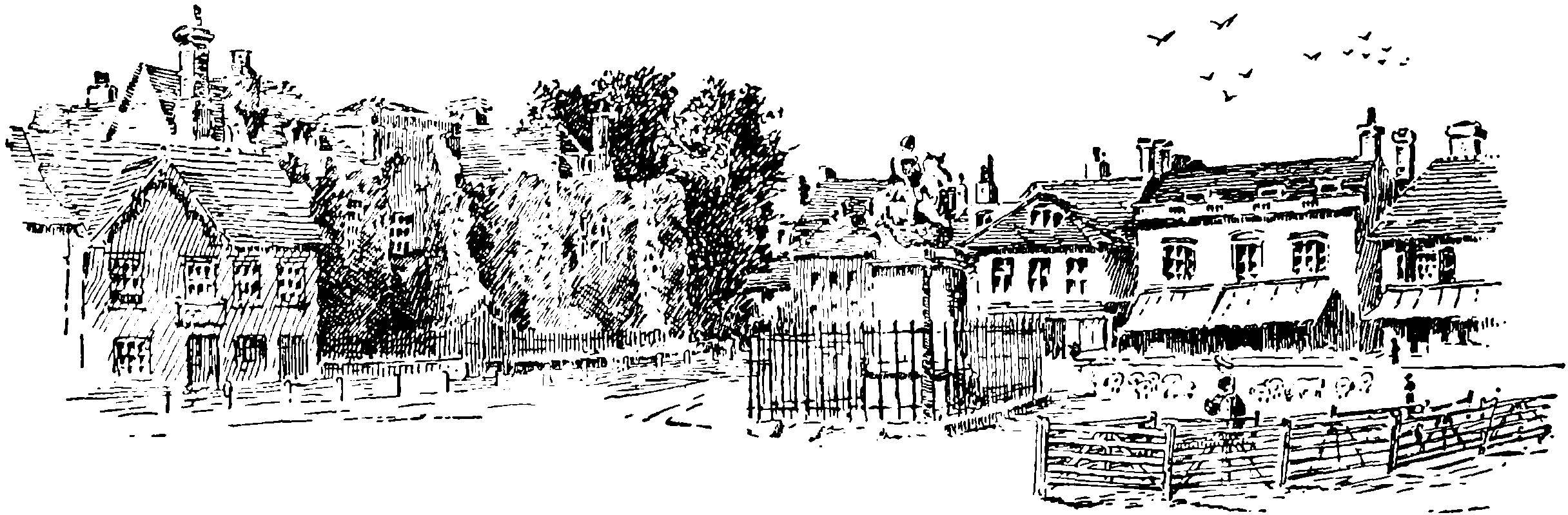
The Market Place, Petersfield
Sheep Street leads from the Square to the Spain, a tranquil old-fashioned thoroughfare said to be socalled from the Spanish merchants who resorted there for wool-dealing. (fn. 9) Hylton Road (fn. 10) runs eastwards from the Spain, and crossing the Portsmouth road at Fore Bridge, becomes Sussex Road, skirting the south side of the Heath Pond. The last house in the town to the north of the road is the vicarage. From the north-west corner of the Spain a road leads to the Borough and Borough Hill, close to which runs the railway.
There is no lack of good eighteenth-century brickwork in the town, especially on the north side of the market square; and on the south side of High Street is a timber front (No. 19) with a moulded beam beneath the gables having pendants below, on one of which is the date 1613. This house has some good seventeenth-century panelling and a chimney-piece in the ground-floor room to the right of the entrance.
In the east of the town are several picturesque groups of houses, along Dragon Street (fn. 11) and College Street—in the latter the fine red-brick buildings of Churcher's College, 1722, (fn. 12) and the blocked stonearched doorways of Antrobus's Almshouses, 1622— now part of a brewery—are the chief attractions.
The Heath, a large public recreation ground in the east of the town, was formed from wet swampy ground in 1867, and comprises 35 acres in the parish of Sheet, 4 acres in the parish of Buriton, and 5 acres in the parish of Petersfield. The formation of the large lake within it, which covers an area of 22 acres, and lies half in Petersfield manor and half in Mapledurham manor, was the result of certain drainage operations in 1750. The Heath House, the residence of Captain the Hon. William Sydney Hylton-Jolliffe, D.L., J.P., is about half a mile south-east.
Petersfield parish covers an area of 1,609 acres of land and 23 acres of water. (fn. 13) Sheet, which was a tithing in the parish, is now a separate parish containing 1,350 acres of land and 8 of water. (fn. 14) Adhurst St. Mary, the seat of Mr. George Lothian BonhamCarter, a mansion in the Elizabethan style, erected in 1858 and enlarged in 1902–3, stands in well-wooded grounds to the north of the road from Godalming to Petersfield. The river Rother intersects Sheet, and on it are two mills called Sheetbridge Mill and Sheet Mill, the latter of which certainly represents one of the mills entered under 'Malpedresham' in Domesday Book. (fn. 15) The common fields in Petersfield and Sheet were inclosed by authority of an Act of Parliament, 18 & 19 Vic. cap. 61. Among place-names mentioned in the sixteenth century are Bullockes Leses, (fn. 16) Whit-redden, (fn. 17) Chappelfields, (fn. 18) Berelands, and Polehill. (fn. 19)
BOROUGH
PETERSFIELD is a mesne borough, its descent being identical with that of the manor of Petersfield. In the reign of Henry II, William earl of Gloucester granted to the burgesses of Petersfield all the liberties and free customs enjoyed by the citizens of Winchester, and to have a merchant gild. These privileges were confirmed by the charter of his widow Hawise. The charter of the earl is lost, but that of the countess is still preserved. (fn. 20) King John, when count of Mortain, confirmed the same liberties and free customs to the burgesses in 1198, (fn. 21) and in 1415 Henry V granted them freedom from toll, stallage, picage, pannage, murage, and pontage throughout the realm of England. (fn. 22) While Maud countess of Buckingham was lady of the borough, (fn. 23) a sum of two marks was exacted every year from the burgesses under colour of a payment pro certo lete, but in 1440 Humphrey earl of Buckingham by letters patent granted to the burgesses of his lordship of Petersfield release for ever from that payment. (fn. 24) That the burgesses were afterwards quit from this payment is supported by entries in the accounts of successive reeves of Petersfield. (fn. 25) It has not been ascertained by what authority the burgesses of Petersfield assumed the corporate name and style of 'the mayor and burgesses' or 'the mayor and commonalty,' but most probably their right was prescriptive. Mr. Illingworth, deputykeeper of the records in the Tower, made a careful search in the various depositories of public records in the early part of the eighteenth century, but failed to find any royal charter of incorporation, although the draft of a charter from James I incorporating the inhabitants was for many years in the possession of the Gibbon family, and is possibly still extant. It is probable that Thomas Hanbury, lord of the borough at that date, to whose advantage it was that the burgesses should receive no charter of incorporation, exerted his influence as an auditor of the Exchequer to prevent the completion of the grant. From the Petersfield court rolls of the latter part of the sixteenth century it appears that the various officers of the borough were elected in the court leet of the manor, and at that time included a mayor, a constable, a bailiff, two aldermen or tithing men, ale-tasters, and sometimes two leather sealers. (fn. 26) The burgesses of Petersfield undoubtedly enjoyed many privileges and, besides exercising the elective franchise, acted in a corporate capacity by taking and making grants of lands and of rents charged on lands. (fn. 27) Under the Tudors, especially, the borough seems to have grown steadily in importance, its increase in prosperity no doubt being due to the development of its cloth and leather manufactures, to both of which industries its cattle market gave rise. A significant entry occurs in the account of the reeve of Petersfield for 1428 to the effect that he had received nothing from the miller of 'Wadeleshall,' near Petersfield, for licence to carry corn from the borough to his mill, because the mill had recently been turned into a fullingmill. (fn. 28)
Most of the court rolls give evidence of the industries of the burgesses, particularly with regard to the trade of tanning, (fn. 29) and in nearly every roll occurs a list of tanners fined 'for using fraud in their trade.' The manufacture of cloth, however, was the principal industry of the inhabitants, and by the reign of James I had grown to such dimensions that it maintained 1,000 poor people in work without begging. (fn. 30) The general prosperity of the place at this time may be judged from the fact that 'forty men for the service of the realm in the wars were maintained at the public charge, besides every man's private charge.' (fn. 31) With this increase in prosperity came a desire for greater independence on the part of the burgesses. During the fifteenth and sixteenth centuries it seems to have become the rule for the lords of the borough to accept from the mayor and burgesses £7 1s. 2d. for the rent of the borough, 16s. for fairs and markets, and diverse sums of money, sometimes more and sometimes less, for profits and perquisites of court. (fn. 32) These sums came to be looked upon by the burgesses as a fee-farm rent. (fn. 33) Further, the mayor and burgesses caused houses to be erected on fit and convenient places in the borough, which they let for moneyrents, and held the three weeks' courts themselves. They also sometimes seized felons' goods to their own use. (fn. 34) The mayor and burgesses moreover came to be accounted owners of the fairs and markets, and collected toll, picage, and stallage from those resorting to them. In short, they seem to have acted very much as they pleased while Sir Henry Weston and Sir Richard Weston, who were members of a Surrey family, and never seem to have lived near Petersfield, were lords of the borough. However, everything was changed when Thomas Hanbury, who lived in the neighbouring parish of Buriton, purchased the borough in 1597. He determined to maintain his rights, (fn. 35) and appointed William Yalden steward for the keeping of courts and leets within the borough, and Anthony Rouse and Lawrence Patrick collectors of picage and stallage. (fn. 36) Naturally the burgesses resisted, and on 20 October, 1601, when William Yalden went to the town hall to keep the three weeks' court in the name of the lord of the borough, 'he was prevented from doing so by Robert Tolderton alias Pynner, the mayor, who commanded Francis Clement to thrust him out of the room, which he did with great violence once or twice. (fn. 37) The collectors of picage and stallage were moreover hindered in the execution of their duties by the burgesses, who, in addition, refused to pay any rents for the borough save as a fee-farm rent. At length, in Easter, 1608, Thomas Hanbury filed his bill in the Court of Exchequer, setting forth that Roger Tirrell, John Colebrooke, William Pagglesham, Gregory Triggs, James Mills, John Salter, Gregory Page, and William Ford, who 'unjustly pretended themselves to be burgesses of the borough of Petersfield,' having got into their possession sundry documents belonging to him, had unlawfully entered upon waste grounds in the borough and built upon them, 'of purpose to defraud and disinherit him of the same,' that they prevented him from keeping his courts in the borough, refused to pay him his rents and services, and lastly, that although the tolls and other profits of the fairs and markets belonged to him, yet they refused to allow those who came to the fairs and markets to have picage and stallage unless they paid toll, picage, and stallage to them; 'and that the same fairs and markets by their occasion, were like in time utterly to decay, which tended not only to his disinheritance, but was like also to turn to the prejudice and hurt of the country near adjoining the borough.' (fn. 38) On 3 May following, the defendants answered that Petersfield had time out of mind been an ancient borough, and had sent two burgesses to Parliament, that the mayor and burgesses were seised in fee simple of the borough, and had paid the fee-farm of £7 1s. 2d. to Sir Richard Weston and his ancestors for a long time, and that as owners of the borough they had built on the waste grounds within it, and had taken picage, toll, and stallage, at the fairs and markets. They, however, expressed themselves willing to pay him the fee-farm rents with the arrears, 'if he would accept thereof.' (fn. 39) Thomas Hanbury filed his replication in Trinity Term, 1608, alleging, 'That it did not appear in the defendants' answer that the mayor and burgesses of Petersfield were a body corporate, and that he was seised in fee of the borough, the rent of £7 1s. 2d. not being a fee-farm rent.' (fn. 40) In their rejoinder the defendants asserted that the mayor and burgesses had for a long time been a body corporate, 'and had used to implead and be impleaded, and to take and purchase lands by the said name.' (fn. 41) The depositions of various witnesses for both sides were taken at Petersfield on 22 September, 1608. (fn. 42) The witnesses nearly all agreed that Petersfield was an ancient borough and mayor-town, but when called upon to adduce any evidence, charter, or grant, whereby privileges or liberties had been granted to the mayor and burgesses, all of them except one declared that they had never seen or heard of any such document. The exception was William Yalden, who said that twenty-five years ago he had seen an ancient charter or parchment in the custody of the mayor and burgesses, wherein 'one Earle Marrett (fn. 43) did grant certain privileges for merchandizing to the inhabitants of the said borough.' The decree of the court was pronounced in Michaelmas Term, 1610, (fn. 44) and was completely in Hanbury's favour. It was ordered that he and his heirs should from henceforth peaceably and quietly have, hold, and enjoy the waste grounds of the borough whereon no houses were built, as also the rents of assize, the burgage-rents, duties, services, and customs, and all profits and perquisites of the courts of the borough, and the profits of the fairs and markets, and toll, picage, and stallage, without interruption or disturbance. The court, however, forbore to make any decree touching the houses built upon the waste ground of the borough, although it was of opinion that they belonged to Hanbury, but advised him to take his course for the recovery of them at the common law. (fn. 45) From the loss of this suit dates the gradual decline of the borough.
In 1652 cloth was still manufactured in Petersfield, for in that year the clothworkers and the other inhabitants of the town presented a petition to the lord of the manor of East Meon, complaining that two fullingmills in the parish of Steep being copyholds of the manor had been suffered to fall into decay for want of repairs 'and tended to their great charge and hindrance,' (fn. 46) but the very fact that they had been thus allowed to fall into ruins shows that the industry even then was a waning one. The leather industry also probably declined at the same time, and no manufactures are carried on in Petersfield at the present day. The constitution of the borough for centuries underwent but little change. In the Herald's Visitation of Hampshire and the Isle of Wight in 1686, there is the following account of Petersfield, no doubt furnished by Thomas Hanbury the lord of the borough: 'The burrough of Petersfield is an ancient burrough, the lord whereof is Thomas Hanbury, esq., who by his steward keepeth yearly a court-leet on the Monday after St. Hillary, at which leet the jury elect a mayor and a bailiff to attend him, both out of the freeholders of the said borough, and two other officers called Aldermanni sive "testatores panis et cervisiae," which execute the office of tithing-men within the said borrough, and are also chosen (ratione tenurae) out of the freeholders of the said borrough. At the same court is chosen a constable out of the most substantiall inhabitants, which constable is for that year one of the constables for the Hundred of Finchdean. The present mayor is John Heather, mercer, the bailiff, John Warne, the constable, Robert Betsworth. This burrough hath no charter'. The mayor and the other officers continued to be elected at the court-leet of the manor held on the first Monday in Epiphany (fn. 47) until 1885. In that year, by the Redistribution of Seats Act, the representation of the borough was merged in that of the county, and consequently the mayor, who had been the returning officer for the parliamentary borough, (fn. 48) was deprived of his sole duty. Naturally the court leet was discontinued, the sole function of which had been to elect the mayor and the other officers, whose duties had long been merely nominal. Under the provisions of the Local Government Act, 1894 (56 & 57 Vic. ch. 73), the town is now governed by an Urban District Council of nine members, which takes the place of a Local Board, established 1893.
Petersfield first sent members to Parliament in 1306–7, when two burgesses were returned, (fn. 49) but from this period it was unrepresented until 1552–3, when Sir Antony Browne and John Vaughan were returned. (fn. 50) The right of election, as established by a committee of the House of Commons in 1727, was in the freeholders of lands or ancient dwelling-houses, or shambles or dwelling-houses, or shambles built upon ancient foundations in the borough. (fn. 51) Until 1831 the number of electors was only about 140. By the Reform Act of 2 Will. IV, cap. 45, it was deprived of one member, and by the same Act, to save it from total disfranchisement, the parliamentary borough was extended so as to include Sheet Tithing, the whole of Buriton, Froxfield, and Liss parishes, the Hampshire part of Steep parish and the tithings of Langrish, Ramsdean, and Oxenbourn in East Meon parish. The town continued to return one member until 1885, when the representation was merged in that of the county. It is interesting to note the rather remarkable Parliamentary connexion between the Jolliffes and Petersfield, members of the family sitting for the borough with but few gaps from 1734 until 1880.
As has been shown above, William de Clare in 1255 received a grant of two yearly fairs at his manor of Petersfield, viz. on the eve, the feast, and the morrow of St. Peter and St. Paul (28, 29, and 30 June), and on the eve, the feast, and the morrow of St. Andrew (29 and 30 November and 1 December). (fn. 52) They were both held until 1902, when the summer fair, which was then held on 10 July, was abolished. The autumn fair, which is now held on 6 October (on the Heath), is for both business and pleasure, a large amount of stock of every description being brought to it. The market, which was formerly held every Saturday, (fn. 53) is now held on alternate Wednesdays in the market square, and is well attended, a good trade being done in corn, live stock, and farm produce. The market rights were purchased by the Urban District Council from Lord Hylton in 1902 for £1,000.
MANORS
PETERSFIELD is not mentioned in the Domesday Survey by name, but it is most probably included in the entry under Mapledurham in Finchdean hundred. (fn. 54) Hence the history of the manor of Petersfield is identical with that of Mapledurham (q.v.) until 1484, when Henry second duke of Buckingham, having entered into a conspiracy to dethrone Richard III, was beheaded at Shrewsbury. His possessions thereupon passed into the hands of the king, who, on 23 May, 1484, granted the manor of Petersfield to trustees to hold for seven years for the payment of the duke's debts. (fn. 55) On 28 February, 1485, the king granted the reversion of the manor, on the expiration of this term of seven years, to his kinsman John duke of Norfolk and the heirs male of his body. (fn. 56) The duke did not live to enjoy this gift, however, for on 22 August, 1485, he was slain at Bosworth while leading the van of Richard's army. (fn. 57) On 7 November, 1485, he was attainted by Act of Parliament and all his honours were forfeited to Henry VII, who restored Petersfield to Edward son and heir of Henry duke of Buckingham, whom he had reinstated in 1486. (fn. 58) The descent of Petersfield is identical with that of Mapledurham from this date until the time of Edward Gibbon, the father of the historian, who sold it in 1739 to John Jolliffe, M.P. for Petersfield. (fn. 59) William George Hylton Jolliffe, great-grandson of the latter, was raised to the peerage as Lord Hylton in 1866. His grandson, Hylton George, Lord Hylton, is the present lord of the manor.
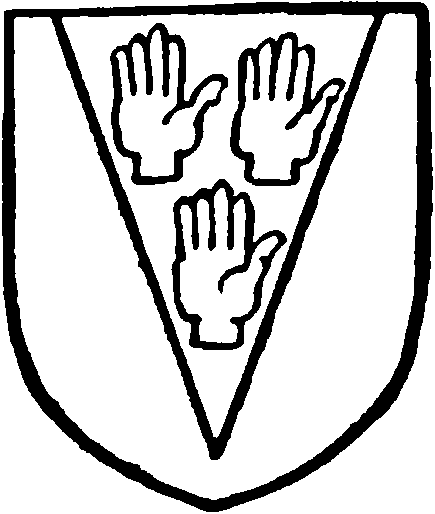
Jolliffe. Argent a pile vert with three right hands or thereon.
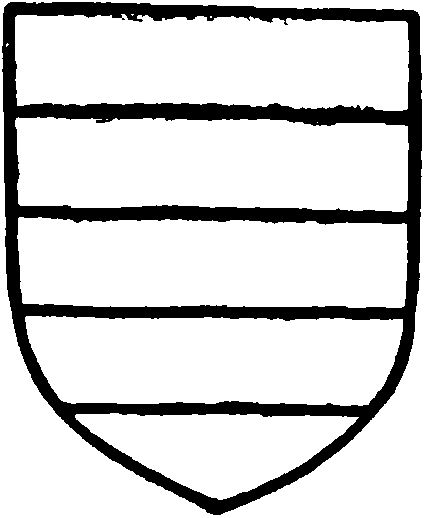
Hylton. Argent two bars azure.
SHEET
SHEET (Sithe, Shite, and Schyte, xiii cent.; Shete, xv cent.; Shett, xvi cent.) formerly formed part of the great manor of Mapledurham, and was granted by Aumary, earl of Gloucester, son of Aumary, count of Evreux, to Eustace de Greinville, to hold to him and his heirs of the grantor and his heirs by the service of the third part of a knight's fee. The tenement of Richard the miller with the mill and the suit and multure of the men of the manor of Mapledurham and Petersfield was included in the grant, as also the annual payment of two cart-loads of brushwood and one sufficient tree at the Feast of St. John the Baptist from the wood for the maintenance of the mill. (fn. 60) The overlordship was changed in 1210, in which year Aumary conveyed to Peter des Roches, bishop of Winchester, all the fee which Eustace held of his gift in Mapledurham, to hold to the bishop and his successors in free alms. (fn. 61) In 1237 Eustace granted to the prior and canons of Selborne in free alms all the land which he had by the gift of his lord Aumary, earl of Gloucester, in the manor of Mapledurham with the mill, saving to the bishop the service of the third part of the knight's fee, (fn. 62) and his gift was confirmed by Peter des Roches in the same year. (fn. 63) After the death of Eustace, his widow Joan received as her dowry the third part of fourteen marks' rent from the tenement in Sheet, but this rent she quitclaimed to John prior of Selborne and his successors in 1251 on her marriage with Stephen Symeon. (fn. 64) In 1281 Prior Richard and the convent of Selborne farmed out to Abbot John and the convent of Dureford all their lands and tenements at Sheet for a rent of fourteen marks. (fn. 65) From this time onwards until the dissolution the abbot and convent of the Blessed Mary of Dureford continued to hold these lands and tenements, which developed into a small manor, for this fixed annual payment, and their connexion with this parish can still be traced in the names Adhurst St. Mary and St. Mary's Well. The prior and convent of Selborne sometimes had some difficulty in securing the payment of the rent, and in 1425 brought an assize of novel disseisin against Thomas abbot of Dureford and John Atte Wode about a tenement in Sheet, (fn. 66) the result of which was that the latter were forced to enter into a bond for £40 for securing the punctual payment of the fourteen marks. (fn. 67) In spite of this, however, they owed Selborne Priory over £50 fee-farm rent in 1462. (fn. 68) The abbot and convent of Dureford in their turn leased out their property in the parish at various times. Thus in 1466 they granted all their lands and tenements in Sheet, which they held at fee-farm of the prior and convent of Selborne, to Nicholas Huse and others to hold for twenty years at a rent of £9 6s. 8d. (fn. 69) Again in 1532 they leased out to Launcelot Sympson of Petersfield the site of their manor of South Sheet and all the houses built there, with all the meads, leasures, &c., as wholly as Martin Frayll held them, except one moor let to Magdalen College, to hold for the term of sixty years at a rent of 40s., (fn. 70) while in the following year Richard Massam of Henley, who was probably acting for Magdalen College, obtained a ninety-nine years' lease of a moor in Sheet for a rent of 8d. (fn. 71) Thus at the dissolution most of the property which Dureford had held at fee-farm of Selborne (fn. 72) was let on lease. Like most of the Dureford property the manor of Sheet was granted to Sir William Fitzwilliam, afterwards earl of Southampton, in tail male, (fn. 73) and on his death without issue reverted to the king, who in 1546, in return for £1,569 15s. 2d., granted to George Rithe and Thomas Grantham 60 acres called Martyns in Petersfield now or late in the occupation of Launcelot Sympson, together with other lands, tenements, rents, and services formerly belonging to Dureford Abbey. (fn. 74) In the same year George and Thomas sold Martyns, 10 acres of moorland in the occupation of Magdalen College, and a cottage, to Roger Childe of Sheet, described sometimes as a yeoman, and sometimes as a miller, who two years later sold the property for £42 to William Standish of Oxford and others. William was an Oxford notary who was regularly employed by the college, and no doubt he was the college agent in the purchase; but it was not until 1556 that he conveyed the property to the college, (fn. 75) the delay in conveying being probably due to the uncertainty of the time; when it was doubtful, first whether the colleges would not go the way of the monasteries, and then whether the monastic possessions might not be reclaimed. Magdalen College still owns Sheet Mill and a great deal of landed property in the parishes of Petersfield and Sheet.
HEATH HOUSE
HEATH HOUSE (Hethehouse, xvi cent.). In the reign of Henry III a certain Henry de Chalvers granted 'Holemed' with an aqueduct and a croft to the abbot and convent of Dureford. (fn. 76) In the same reign Aumary, earl of Gloucester, granted to Richard Talbot and his heirs his mill at 'Chalfversh,' the tenement which Warren de Chalfversh held of him, and the tenement which Sigar de Chalfversh held of him, (fn. 77) and shortly afterwards William Talbot made grants to the abbey of Dureford of lands which are not specified, but which were probably identical with those which Aumary had bestowed upon Richard. (fn. 78) In 1292 the abbot and convent were seised of 108 acres of land, 4 acres of meadow, and a mill at the Heath. (fn. 79) Hence it seems clear that these lands comprised those of Chalfversh, possibly indeed being identical with them. There is no mention of any messuage at the Heath in the survey of the lands of the monastery in 1292, but at the time of the dissolution of the monasteries the abbot and convent of Dureford were seised of the farm of Heath House (fn. 80) and lands called 'The Est Chalverishe,' parcel of the grange of Heath House. (fn. 81) At the dissolution Henry VIII granted the messuage called Heath House to Sir William FitzWilliam in tail male. (fn. 82) On his death without issue in 1542 it reverted to the king, who, on 30 May, 1545, granted it to Sir Edmund Mervyn to hold to him and his heirs for ever. (fn. 83) On Edmund's death Heath House passed to his son and heir Henry Mervyn, (fn. 84) upon whom it was settled in 1555. (fn. 85) In 1613 Henry Mervyn, senior, and Henry Mervyn, junior, and others released all right which they had in the capital messuage called Heath House and closes called ' Chalveries ' and 'Hollwaies' to Thomas Bilson, bishop of Winchester, (fn. 86) the owner of the manor of West Mapledurham, who died seised of them in 1616. (fn. 87) Its subsequent history is obscure, but it is perhaps identical with Heath House Farm, which Edward Rookes left by will in 1694 to his son Edward, with contingent remainder to his brotherin-law, Edward Hunt. (fn. 88)
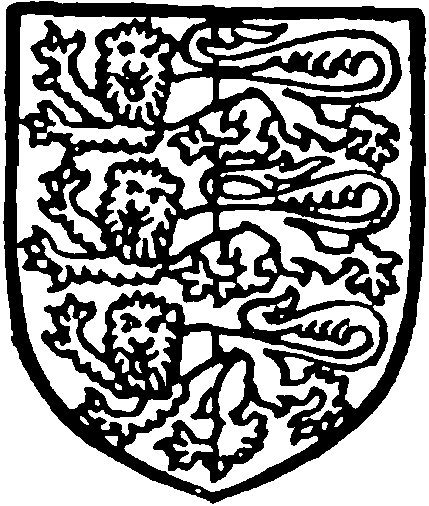
Mervyn. Sable three leopards parted palewise or and argent.
In the sixteenth and seventeenth centuries there seems to have existed side by side with this Heath House another messuage called Heath House, which was held by copy of court-roll of the manor of Mapledurham. Edmund Marshe of Preston Candover, who had purchased it from Stephen Vachell and Mary his wife, (fn. 89) the owners of the manor of Weston, in the parish of Buriton, sold it in 1608 to Thomas Antrobus of Lincoln's Inn, (fn. 90) who died seised of it in 1622. (fn. 91) In the latter part of the seventeenth and the beginning of the eighteenth century it was the residence of the Jacobite family of Matthews. (fn. 92) It seems impossible to discover when they parted with it, but it was before 1800, for in that year it was occupied by Captain Kidson. Colonel Hylton Jolliffe purchased it about 1829, (fn. 93) since when it has remained in the possession of the Jolliffe family. It is at the present day the residence of Captain the Hon. William Sydney Hylton Jolliffe, great-nephew of Colonel Hylton Jolliffe, who purchased it from his nephew, Lord Hylton, in 1904. (fn. 94)
CHURCHES
The church of ST. PETER, CHURCHES PETERSFIELD, consists of chancel 32 ft. by 14 ft., with modern vestry and organ chamber on the north, nave 61 ft. 3 in. by 16 ft. 6 in., with north and south aisles, 16 and 17 ft. wide respectively, north porch, and engaged west tower 16 ft. 6 in. by 17 ft. All measurements are internal. It is a fine building, of great interest for several reasons, and its earliest parts are not later than the beginning of the twelfth century. The church to which they belong was cruciform, with an aisleless nave 41 ft. by 16 ft. 6 in., central tower 16 ft. 3 in. square, north transept of practically the same dimensions, south transept somewhat longer from north to south, and a chancel whose length and eastern termination are uncertain. This church also had a second tower at the west, a very interesting fact which brings it into relation with the normal English type of the larger eleventh-century churches. Its details are not so early as those of the central tower and transepts, and the building was doubtless spread over a number of years as funds could be obtained for the work, but the church must have stood complete with its two towers for some considerable time before the enlargements next to be noticed.
About 1170–80 the church was enlarged by the addition to the nave of north and south aisles of the full width of the transepts, and carried up to the west face of the west tower, the nave walls being pierced with arcades of three bays. The west walls of the transepts must have been pierced, or perhaps removed, at this time. No structural change seems to have been made, beyond the insertion of windows, in the thirteenth and fourteenth centuries, but in the fifteenth century the upper stage of the west tower was either added or rebuilt, and as many of the stones used in this work have worked details like those in the chancel arch and the arcade above, it is possible that at this time the west wall of the central tower was taken down and its area thrown into the nave. The north and south walls of the tower were left standing, though probably lowered, and the north wall at any rate so remained till 1731, when it was destroyed, and the arcade continued up to the east respond of the north arch of the tower. The same thing happened to the south wall, but whether at this date or not is not recorded. The north arcade of the nave was also altered, perhaps at this time, (fn. 95) by the moving of its pillars, probably in the interests of galleries, so that it had two narrow arches at the west and two wide ones at the east. In modern times they have been reset and more evenly spaced.
The chancel has at the east a modern triplet of windows in twelfth-century style, replacing a five-light fifteenth-century window. In the north wall is a late twelfth-century round-headed light, now blocked by the vestry roof, with inner jamb-shafts continued as a roll round the head of the window, unbroken except for a fillet on the springing-line of the arch. Opposite to it in the south wall is a pair of modern roundheaded lights, and below them modern sedilia and a piscina. West of the north window is a doorway with a four-centred head, opening to the vestry, and there seems to have been a late twelfth-century doorway opposite to it on the south, set in a wide pilaster buttress. In the west bay of the chancel are arched recesses on either side, perhaps for quire seats; the arrangement is old, a single-light fourteenth-century window being set in the southern recess. On the north the recess is pierced with a modern arch opening to the organ chamber.
The chancel arch, formerly the east arch of the central tower, is a fine and rich example of early work, with a slightly stilted semicircular arch of two orders, the outer of which has a large roll and hollow and a double line of zigzag, while the inner is a modern restoration, with a plain edge-roll. A wide label with two rows of billets runs round the arch. The jambs have engaged shafts to the outer order on the west, with early bases and volute capitals, and larger shafts to the inner order, projecting for more than half their diameter from the responds, as in the eleventh-century work at Winchester Cathedral. The capitals have cabled neckings, and are carved with flat early leaf-work and volutes at the angles, and the abaci are hollow-chamfered below, with an enriched vertical face above. The inner shafts of the chancel arch are corbelled off a little below the capitals, and are modern copies of old work. Over the chancel arch is a very fine piece of early detail; three tall round-headed openings, the central one looking only into the chancel roof, and the other two inclosing windows. Each has tall jamb-shafts with volute capitals barely projecting beyond the line of the shafts, and arched heads with a roll and two rows of zigzag. Between the openings are groups of three shafts, the central shaft in each group worked with a spiral fluting, having volute capitals like the rest, moulded bases, and common plinths and abaci. From these spring round-headed arches with edge rolls and a deeply cut radiating ornament, having labels worked with a band of circles inclosing lozenges. Above is a horizontal string with billet on the under side, and the spandrels between the arches are filled with a deeply cut diaper pattern. All four sides of the tower were evidently treated in this manner, and the whole effect must have been exceedingly fine. Above the string in the east gable of the nave is a blocked round-headed window with jamb-shafts and scalloped capitals, and a roll in the head, with a little old masonry on either side of it. The bases look early, but the capitals and arch are modern, and of a later type, probably the result of restoration. The gable has been lowered and again raised, but must in the first instance have formed part of the east wall of the tower, being the only remaining piece of its third stage.
The east responds of the north and south arches of the tower, with part of their labels, remain in position, and are of the same detail as the east arch, except in having nook-shafts on both sides.
The nave arcades are of four bays, the east arches on both sides being wider than the west, for the reasons given above. All are round-headed, of two square orders, but only the two western arches of the south arcade are old. The columns are circular, as are the capitals of the north arcade, but those of the south are square, with recessed angles, being of somewhat earlier type than the others. They have small scallops and a deep vertical face above them, while in the north arcade the capitals have convex flutes.
As already noted, the pillars of the north arcade have been altered and reset, but the two western pillars and the western respond of the south arcade are in their original positions, the capitals being at a higher level than those of the third pillar and eastern respond. The reason is that the arcade, being set out before the destruction of the central tower, was not continuous with the arch opening to the south transept, and did not need to correspond in height with its springing; but when the arcade was made continuous after the final removal of the tower the discrepancy between the capitals had to be adjusted, and this was done by lowering the capital of the third pillar to the level of that of the eastern respond. The clearstory of the nave is a modern addition, with pairs of round-headed lights.
The north and east walls of the early north transept, now forming part of the north aisle, are easily distinguished from the later masonry by their herringbone walling, and the remains of similar work are to be seen in the south wall of the chancel. The quoins are of fairly large size, but not in any way remarkable. No original windows are left, the north transept having a north window of two cinquefoiled lights, fifteenth-century work renewed, and the south a wide lancet in modern stonework in its south wall, and three round-headed windows on the east, 'restored' from part of a jamb which still exists, with billet string-courses at sill level within and without. There was formerly a three-light early fourteenth-century window here.
The remaining windows in the north aisle are a plain square-headed two-light window, of no great age, and to the west of it two fifteenth-century windows each of three cinquefoiled lights with tracery. The north doorway is of late twelfth-century date, round-headed of two square orders, with nook-shafts having foliate capitals, renewed. Over it is a modern stone porch, and to the west of the porch a round headed window with an outer rebate which looks earlier than anything else in the aisle, and may be a re-used detail from the nave walls. The remains of a blocked doorway are also to be seen here, which seems to have been in use when this end of the aisle was used as a schoolroom. There is here a tall modern window of twelfth-century style, and another like it in the west wall.
In the south aisle are four large round-headed windows, of which only the third from the east is ancient, of the date of the aisle wall. West of them is a doorway in late twelfth-century style, with two shafts in each jamb, all the stonework being modern. In the west bay of the aisle is a late twelfth-century south window, part of the jambs being original, and in the west wall two similar windows, which preserve old masonry only on the inner face. There is a late thirteenth-century piscina with a shelf at the southeast of this aisle, and a fourteenth-century piscina with a shelf on a line just west of that of the west wall of the early transept, showing that there was an altar here, and therefore some screen or division at this point—possibly part of the old wall left standing. Below the windows of the aisle is a moulded string which also stops here, just east of the piscina, and doubtless on the line of the division.
The west tower is of four stages, the top stage being of fifteenth-century date, embattled, with belfry windows of two cinquefoiled lights, and the lower three stages are of the twelfth century. At the southwest angle is a stair entered from without the church. The side walls on the ground stage are solid, but in the east wall is a wide semicircular arch of two square orders, c. 1120–30, with hollow-chamfered abaci like those of the chancel arch, and over it a plain roundheaded opening from the second stage of the tower, which must have given access to the roof of the early nave, as just above it is a gabled weathering. This latter is not quite central with the opening, its apex being to the south.
In the west wall is a round-headed doorway, with an outer order of zigzag, the stonework being entirely modern, except for two voussoirs of the arch. Above it are two round-headed windows, replacing a twolight fourteenth-century window.
The roofs and fittings of the church are entirely modern, including the font at the west end of the nave; but an older font, octagonal with panelled sides, of early fifteenth-century date, stands in the churchyard west of the tower. A few mediaeval coffin lids are preserved in the church, and in the west bay of the north aisle are two brass plates, one with an inscription to Anne Holt, 1655, the other to Dr. Thomas Aylwin, 1704, and his wife Mary, 1693. Other monuments formerly on the nave walls are now fixed in the tower.
There are eight bells, the treble and second by Warner, 1889; the third and seventh by Taylor, 1895; the fourth and fifth by Robert Catlin, 1750; the sixth by Thomas Lester, 1746, and the tenor by Pack and Chapman, 1771.
The plate comprises a silver communion cup and cover paten of 1568; a second cup and cover paten of 1612, given by Thomas Antrobus, senior, of Heath House; a flagon of 1707; a standing paten of 1721, given in 1830 by Thomas Chitty; an alms dish of 1757, given 1758, and a second dish of 1812, given 1813.
The first book of the registers runs from 1558 to 1667, and contains entries of deaths from plague in 1563 and 1666; the second from 1669 to 1757, the marriages ending at 1754; the third has baptisms and burials, 1758–1807; the fourth marriages, 1754–84—this is a MS. book, and not the printed book ordered by the Act of 1753; the fifth and sixth continue the marriage entries to 1804 and 1812; the seventh contains baptisms 1808–13, and the eighth burials for the same period. There are churchwardens' accounts in six books from 1751 to 1815, and poor-rate accounts from 1697.
The churchyard lies chiefly on the south, having a gate at the east. The churchwardens' accounts mention the making of steps, a wall, and a gate on the east side of the churchyard opposite New Street (now St. Peter's Road) in 1754.
The church of ST. MARY, SHEET, built and consecrated in 1869, is of stone in the thirteenthcentury style, consisting of chancel, nave, south porch, and south-east tower with spire. The register dates from year of erection.
ADVOWSON
The chapel of Petersfield was dependent on the church of Buriton till 13 August, 1886, (fn. 96) when by an Order in Council it was separated, and with the district of Sheet and the tithings of Lower Weston and Lower Nursted constituted a separate benefice in the gift of the bishop of Winchester.
Among lands forfeited in 1547 for superstitious uses were a close called Whitredden of the yearly value of 16d., which had been left for the maintenance of a lamp-light, and lands then in the tenure of John Myll, and of the yearly value of 12d. the issues of which maintained a morrow-mass priest. (fn. 97)
The Roman Catholic church of St. Lawrence, situated in Station Road, was commenced in 1890 at the expense of Mr. Laurence Cave of Ditcham Park, and completed in 1901 by his widow Lucy Cave and his two sons Charles and Adrian Cave. Attached is a residence for the rector, also presented by Mr. Cave. The church is served by monks of the English Benedictine Order. The Congregational church, erected in 1882, is in College Street. (fn. 98) The Wesleyan church, erected in 1903 at a cost of £5,000, is in Station Road. The Primitive Methodist church, with Sunday school and vestry, was erected in Station Road in 1900. The Salvation Army Barracks are in Swan Street. The Union church was built by voluntary subscription, and opened by the bishop of Southampton on Easter Sunday, 1900.
Churcher's College stands on high ground outside the town of Petersfield, and has extensive grounds.
The Elementary School (St. Peter's Road) was built in 1894 at a cost of £2,764; the infants' school has been enlarged at a cost of £866. Sheet Elementary School was erected at a cost of £2,400, and opened September, 1898.
The Cottage Hospital in the Spain was built in 1871 at an expense of £1,400.
CHARITIES
The almshouses founded in 1622 by will of Thomas Antrobus were sold in 1882, and the proceeds invested in £197 6s. 3d. Consols. The annual dividends, amounting to £4 18s. 6d., are given in pensions.
Church Estate.
In 1869, 3 r. 9 p., formerly constituting part of endowment, was sold, and proceeds invested in £181 16s. 7d. Consols. The annual dividends of £4 11s. are remitted to the churchwardens.
Churcher's College.
See article on schools, V.C.H. Hants, ii, 387–92.
Bishop Laney's Apprenticing Charity.
See parish of Buriton.
In 1827 Miss Ann Phillips by her will left £200 Consols, the income (subject to the repair of vault, &c.) to be applied in the distribution of bread to poor men and women of 52 years of age and upwards.
In 1837 John Meere by will left £5 a year for Sunday school—a sum of £166 13s. 4d. Consols was set aside in satisfaction of the legacy.
In 1847 John Holland by will left £5 a year for distribution in bread on St. Thomas's Day, represented by a sum of £166 13s. 4d. The several sums of stock above-mentioned are held by the official trustees.
In 1861 the Reverend Thomas Robert Jolliffe by will left £135 Consols, two-thirds of the dividends to be applied towards the maintenance of certain monuments in the church, and one-third for poor at Christmas in coals or other necessaries. The stock is held by the official trustees and the dividends are duly applied.
In 1863 Mrs. Mary Anne Kennett by deed founded the almshouses known as the Willow Almshouses for the poor of this parish and of Sheet, and endowed the same with £2,000, now represented by £2,036 12s. 3d. New Zealand £3 per cent. Stock with the official trustees.
In 1882 Mrs. Mary Anne Kennett by her will also bequeathed £2,000 to be invested; the income to be applied in the distribution of coals, blankets, sheets, bread, or clothing on 1 December and 14 February in each year. The charity is administered under a scheme of the High Court of 2 December, 1890. The trust fund is now represented by £2,001 14s. 5d. Queensland £3 per cent. Inscribed Stock with the official trustees.
The Town Trust.
By a scheme made by the Charity Commissioners under the Municipal Corporations Act, 1853, for the application of the property of the late corporation of 'The Mayor of Petersfield,' the mace, bearing date 1596, and the charters, one by John count of Mortain (afterwards King John), bearing date 1198, were entrusted to the custody of the lord of the manor of Petersfield, and the churchwardens and overseers of the poor. (fn. 99)
Tithing of Sheet.
In 1674 John Lock by his will charged certain lands with the yearly payment of 50s. for maintenance of a sufficient person to teach poor children of the tithing to read the English tongue. The rent-charge, which is payable out of a farm in Sheet, called Westmark, was at various times in arrear, which arrears on recovery were invested in £130 10s. 4d. consols. The income was applied for educational purposes.
Poor's Allotment.
By an award dated 1859 two acres were appropriated as allotments for the use of the poor, the profits of which, averaging £2 a year (subject to a yearly rent-charge of 15s.), are applied with assistance from the rates in improving the allotments; 4 a. or. 27 p. of land was also awarded as a recreation ground and village green.
Miss Frances Cobb by will proved in 1905 bequeathed £448 2s. 5d. Consols with the official trustees, dividends to be applied at Christmas in providing coals and blankets, and in such other way as trustees may think proper for the benefit of the poor of Sheet.
The Willow Almshouses.
See parish of Petersfield.
Tithing of Weston.
John Goodyer, by his will dated in 1664, and proved in the bishop's court, Winchester, devised to trustees tenements and lands in Weston in this parish and Buriton containing 17 a. 3 r. 28 p., in trust that the rents and profits should be employed for ever thereafter for the putting forth and placing abroad of poor children in the tithing of Weston, and that the overplus thereof should be distributed to the poorest inhabitants of the said Tithing.
The official trustees also hold £1,052 2s. 5d. Consols arising from sale in 1876 of a house and two cottages and gardens. The land is let at £52 a year, which with £26 6s. dividends was in 1905 applied, after payment of expenses of management, in the distribution of £35 in money and clothing to seventyfive persons, clothing allowance at £1 to each of eight servant girls, £5 to the schoolmistress, and £26 in connexion with apprentices. By an order of the Charity Commissioners of 2 July, 1897, trustees were appointed, and the legal estate vested in the official trustee of charity lands.