A History of the County of Hampshire: Volume 3. Originally published by Victoria County History, London, 1908.
This free content was digitised by double rekeying. All rights reserved.
'Parishes: Wield', in A History of the County of Hampshire: Volume 3, ed. William Page (London, 1908), British History Online https://www.british-history.ac.uk/vch/hants/vol3/pp345-347 [accessed 30 April 2025].
'Parishes: Wield', in A History of the County of Hampshire: Volume 3. Edited by William Page (London, 1908), British History Online, accessed April 30, 2025, https://www.british-history.ac.uk/vch/hants/vol3/pp345-347.
"Parishes: Wield". A History of the County of Hampshire: Volume 3. Ed. William Page (London, 1908), British History Online. Web. 30 April 2025. https://www.british-history.ac.uk/vch/hants/vol3/pp345-347.
In this section
WIELD
Walde (xi cent.); Welde, Wolde (xiv cent.).
The parish of Wield, covering an area of 2,104 acres, lies in the open down country that rises north-east of Old Alresford and south-east of Preston Candover. The land, generally speaking, slopes upward from north to south, reaching a height of 576 ft. above the ordnance datum in the south-east as the road leads from Upper Wield to Medsted.
The village of Upper Wield, the nucleus of the parish, lies in the south, and is reached from the northwest from Preston Candover by a steep rough lane which rises for about a mile between thick hedges, plough-land, and pasture land, from 450 ft. above the ordnance datum to over 550 ft. near the village. On the approach to the village a farmhouse stands north of the road, which here makes a more distinct curve to the south round the house and thatched outbuildings of a small farm which lies in the west, and runs past the village pond on the opposite side of the road to the groups of thatched cottages which lie on either side. A branch road to the west leads down to the church, which, being approached by a narrow pathway leading north, stands in a fenced-in churchyard, and on the north side of the road immediately behind a group of thatched cottages. Southwest of the church is a small Primitive Methodist chapel dated 1818. The main road continues south for a few yards beyond this branch leading to the church, a few thatched cottages lying on the west side, while opposite is a rough uninclosed green. At the end of this green the road branches east and west, the western branch leading to Alresford, the eastern to Lower Wield. A few yards along this eastern branch as it leads down hill the village schools stand on the north side, while beyond the schools are a few outlying thatched cottages, and at the corner as a branch road goes north-west to Lower Wield is the thatched vicarage. Lower Wield, lying away towards the north of the parish, is about a mile as the crow flies from Upper Wield, and is on much lower ground. It consists of three farms, Lower Wield Farm, Nicholas' Farm, and Pitter Farm, with a few scattered cottages which always seem to appear round each corner of the lane known as Berry Wood Lane as it winds down hill in a more or less northerly direction towards Bradley. North-west of Lower Wield, Windmill Hill rises to a height of about 490 ft. above the ordnance datum.
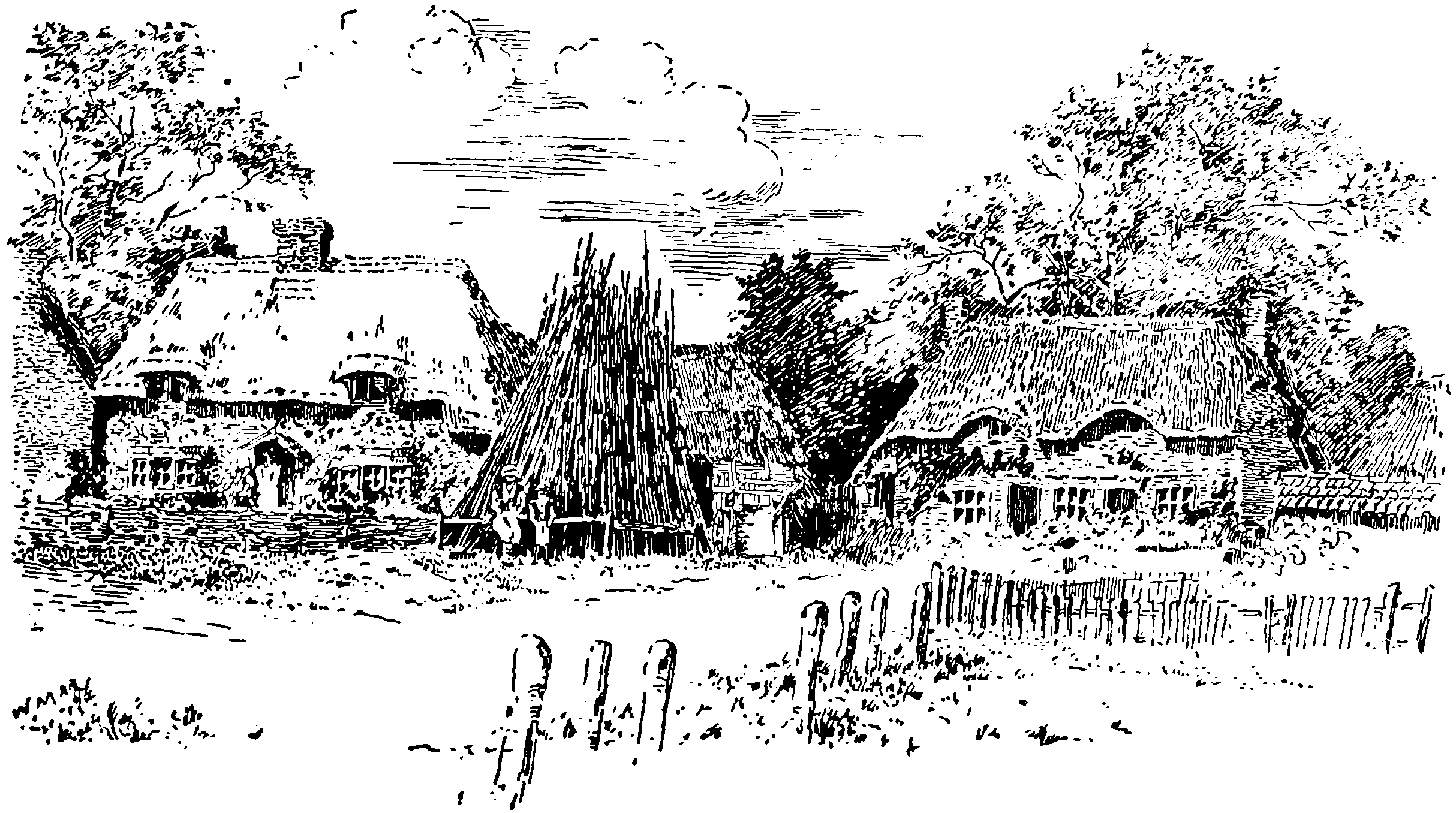
Wield Village
The soil of the whole parish is clay with a subsoil of chalk, and crops of wheat, oats, and turnips are grown on the 1,191 acres of arable land which make up the best part of the parish. Only 304 acres are given up to permanent grass, while Wield Wood and Barton Copse in the south-west of the parish cover nearly the whole of the 215 acres of woodland.
MANOR
The southern portion of the parish formed part of Alresford Liberty, and is most probably included in the entry under Alresford in Domesday Book. (fn. 1) That this is so is supported by a perambulation of the manor taken in the reign of Edward VI, (fn. 2) by the fact that the tithing of Wield sent a tithing-man to the Old Alresford court leet, (fn. 3) and also by the circumstance that an agent sent down from London to report on the whole bailiwick of Bishop's Sutton (fn. 4) included in his survey part of the parish of Wield, reporting as follows: 'Your Wild is but a baron ground whereupon be to littell copices and one small comen thynn sett with greet trees.' (fn. 5)
The overlordship of the remaining portion, the socalled manor of WIELD, belonged from a very early date to the bishops of Winchester, under whom it was held by various tenants. Durand held it of the bishop at the time of the Domesday Survey, and two freemen had been the tenants in the reign of Edward the Confessor. (fn. 6)
From 1270 to 1316 the Wintershulls held Wield from the see of Winchester, for at the earlier date Gerard la Grue conveyed a messuage and two carucates of land at West Wield to William de Wintershull, (fn. 7) who died seised of the manor (fn. 8) in 1286, his heir being his son John, (fn. 9) who was still holding in 1296. (fn. 10) In 1306 William de Wintershull, John's son, conveyed the reversion of the manor, two-thirds of which was held by his mother Mary for life, and the remaining third by his grandmother Beatrice in dower, to John de Drokensford and his heirs. (fn. 11) John de Drokensford must have died almost immediately, for in the same year (1306) Peter de Courtenay and his wife Margaret claimed the manor as next heirs of John de Drokensford on the ground that John de Drokensford, Mary and Beatrice de Wintershull were dead, and that a certain Nicholas de Valence had entered into possession of the manor of Wield, which ought by right to have descended to Margaret as daughter and heiress of John de Drokensford. (fn. 12)
The record of the result of this suit has not been found, but Nicholas de Valence probably proved his claim to some of the property, (fn. 13) and was succeeded by his son John and by his grandson another John, for in 1340 the latter entered a plea for the restoration of the lands in Wield of which his father (fn. 14) had been deprived for 'feloniously breaking the mill of the prior of Southwick, and for having stolen a grindstone worth 40s. and 1½ quarters of wheat found there of the price of 6s,' for which offence he had died in prison.
The lands had been taken into the king's hands, but after it had been proved by inquisition that the Valences' lands in Wield were held of the bishop (fn. 15) and not of the king in chief, they were restored. (fn. 16) Six years later John de Valence was holding half a fee in Wield which had formerly belonged to Beatrice de Wintershull. (fn. 17)
The Holts evidently succeeded to part of the Wintershulls' estate, for in 1428 Richard Holt and his co-parceners were holding half a fee in Wield formerly held by John de Valence. (fn. 18) After this date there seems to be no mention of Wield until 1569, when the manor was settled on Thomas Sackville, Lord Buckhurst, and his wife Cecilia, daughter of Sir John Baker of Sissinghurst in Kent. (fn. 19) (fn. 20)
Seven years later it was conveyed by them to Ralph Henslowe, (fn. 21) who died seised of the manor of Wield in 1578. (fn. 22) His son and heir Thomas conveyed the estate to Thomas Burye in 1591, (fn. 23) who sold the manor in 1598 to Arthur Wilmott, (fn. 24) in whose family it remained for thirty-six years and was then sold by Edward Wilmott to Constance Lucy, widow, and her son Sir Richard for £1,200. (fn. 25)
The manor remained in the possession of the Lucy family for about 140 years, (fn. 26) and then passed to the Rodneys, (fn. 27) though whether they held by the right of inheritance or by purchase it is difficult to discover. Mr. Earle was the owner of the manor from about 1874 to 1886, when he sold it to Mr. Wood, brother of Mr. Gaythorne Wood of Thedden Grange, Alton, who in his turn sold it to Mr. Barnes Wimbush, from whom it was bought in 1900 by Count D. Beaumont Gurowski, the present lord of the manor. (fn. 28)
There is a mill mentioned among the appurtenances of the manor in 1286 (fn. 29) and in 1569, (fn. 30) which probably gave its name to Windmill Hill in the north-west of the parish. There was a park at Wield from an early date. In 1279 complaint was made that certain persons had broken into the park of the bishop of Winchester, hunted therein and carried away deer. (fn. 31) Among the entries in the Ministers' Accounts for Wield for 1323 is 'Payment made by the park-keeper of 2s. each for 6 carts during the winter.' (fn. 32) Beyond these references no record of the park can be found.
CHURCH
The church of ST. JAMES has a chancel 20 ft. 4 in. by 14 ft., and nave 34 ft. 8 in. by 19 ft. 8 in., with a bellturret at the west. There was formerly a western tower, but this was destroyed in 1812, when the turret was set up, which contains a single bell.
Externally the building is covered with rough-cast, and has red-tiled roofs. The nave walls are of twelfthcentury date, probably c. 1150, and those of the chancel, though showing no twelfth-century features, are probably co-eval with them. The chancel has a modern three-light east window of geometrical style, the north and south walls being blank; and the chancel arch is semicircular, of two orders, slightly chamfered on the west face, with a chamfered string at the springing, which is continued up to the angles of the nave. On either side of the arch, which is 5 ft. 8 in. wide, large openings have been cut through the wall.
The nave has two windows on each side, but none at the west; all are apparently the original twelfthcentury windows, altered and enlarged in the fifteenth century, single trefoiled or cinquefoiled lights being inserted in three of them, and in the fourth, that at the south-east, two trefoiled lights. There is a blocked south doorway, which, like the chancel arch, is of the twelfth century, its semicircular head with a label showing on the outside. The entrance to the church is by a west doorway with a square head, dating from 1812. The roof timbers are old, with a modern painted wooden ceiling fitted to them; and at the west of the nave is a wooden gallery, also modern. The fittings are also modern, and very good of their kind; a second altar has been set up at the north-east of the nave, and very well furnished. The font, at the west of the nave, is of Purbeck marble, with a shallow square arcaded bowl on a central and four angle shafts, of late twelfth-century date; it was dug up in a garden in the Close at Winchester, and lately given to Wield church.
Below the north-east window of the nave is a trefoiled fourteenth-century recess, connected with the nave altar whose successor has lately been set up here, but the chancel shows no remains of piscina or sedilia, their place being occupied by the large monument of William Waloppe, 1617, whose alabaster effigy, with that of his third wife, lies on a panelled tomb of alabaster under a canopy on which are cherubs holding emblems of mortality. Above the effigies in the recess beneath the canopy are the arms of Wallop quartering Fisher of Chilton Candover.
The plate consists of a communion cup of 1569 with a modern foot, and a very interesting pre-Reformation paten, c. 1500, and very like that at Bishop's Sutton, with a silver-gilt edge, and engraved I H S in the centre. It has, however, at some time been beaten inside out, so that the hexagonal central depression has been flattened and the I H S is now on the underside.
The registers are also of more than ordinary interest, the original small paper book of 1538 being preserved. To each year a heading is written, giving the regnal year also, and in the time of Edward VI the full royal titles. There is a gap from 1552 to 1560, but from 1560 to 1562 the same form of heading is retained, the entries to this date being in Latin. From 1562 onwards the heading is dropped, and English used till 1597, when Latin occurs again, the entries of baptisms, &c., being from this time kept separate. The baptisms are entered in two sections, 1597–1663 and 1655–95; the burials in one, 1597–1648; and the marriages likewise, 1597–1678. The book also contains a register of briefs, 1707–13. The second book, likewise of paper, is supplementary to the first, containing baptisms 1568–98, marriages 1563–98, and burials 1561–97.
In a wood at some distance from the village is the site of a destroyed house, known as the Castle. It was probably a house of the Wallop family, but nothing of it now remains, its masonry having been, according to local report, carried off for building material in the village.
ADVOWSON
At the time of the Domesday Survey there is no mention of a church in Wield, (fn. 33) and the earliest mention seems to be in the year 1280, when the presentation to the church was in the hands of the king during a vacancy of the see of Winchester. (fn. 34)
In 1306 the priory of Newark (co. Surrey) acquired the advowson of the church of Wield, (fn. 35) by grant of John, bishop of Winchester, and this grant was confirmed by letters patent.
The advowson remained in the hands of the prior and convent until the Dissolution, when the rectory was valued at £4 6s. 8d. (fn. 36)
From this time until about the beginning of the nineteenth century the advowson follows the descent of the manor. From 1817 until the present day presentations to the living have been made by the earls of Portsmouth, (fn. 37) whose ancestors, the Wallops, had held the rectorial tithes of Wield since 1586. (fn. 38)
CHARITIES
In 1872 Miss Jane Ewen by her will proved this date left £100, the interest to be paid yearly to the poor of Lower Wield, under the direction of the incumbent. The legacy (less duty) was invested in £97 0s. 9d. consols with the official trustees. The dividends are distributed in coal to the cottagers.