A History of the County of Hampshire: Volume 5. Originally published by Victoria County History, London, 1912.
This free content was digitised by double rekeying. All rights reserved.
'The liberty of Westover: with Holdenhurst and Bournemouth', in A History of the County of Hampshire: Volume 5, ed. William Page (London, 1912), British History Online https://www.british-history.ac.uk/vch/hants/vol5/pp133-137 [accessed 30 April 2025].
'The liberty of Westover: with Holdenhurst and Bournemouth', in A History of the County of Hampshire: Volume 5. Edited by William Page (London, 1912), British History Online, accessed April 30, 2025, https://www.british-history.ac.uk/vch/hants/vol5/pp133-137.
"The liberty of Westover: with Holdenhurst and Bournemouth". A History of the County of Hampshire: Volume 5. Ed. William Page (London, 1912), British History Online. Web. 30 April 2025. https://www.british-history.ac.uk/vch/hants/vol5/pp133-137.
In this section
WESTOVER LIBERTY
THE LIBERTY OF WESTOVER WITH THE PARISHES OF HOLDENHURST AND BOURNEMOUTH
As has been seen, (fn. 1) the hundred of Holdenhurst, which existed in 1176, was probably co-extensive with the modern liberty of Westover. This hundred was, however, soon after extended and became known as the hundred of Christchurch, the district of Westover, which was held as one large manor and comprised that part of the hundred which lay west of the Stour, (fn. 2) being absorbed into it. (fn. 3) In course of time Westover emerged as a separate hundred. In the hundred court rolls for 1500–1, (fn. 4) 1540–5 (fn. 5) and 1560, which are extant, the tithings represented were North Ashley, Muscliff, Muccleshill, Throop, Holdenhurst, Iver and Luckton. The liberty, however, continued for many years to be included in Christchurch Hundred, (fn. 6) which in 1571 was called 'the hundred of Christchurch Westover.' (fn. 7) By 1620 it seems to have become definitely detached, (fn. 8) although up till 1692 the loose description of 'the hundred of Christchurch and Westover is found.' (fn. 9) In 1595 the liberty contained, in addition to the tithings mentioned above, part of the tithing of Lougham in the parish of Hampreston, Dorset, this part being a detached portion of the parish lying in Hampshire on the county boundary. (fn. 10) It was, however, transferred to Holdenhurst some time after 1861. (fn. 11) North Ashley was still in the liberty in 1831, but a year or two later was transferred to Ringwood Hundred. (fn. 12) The tithings of Hurn and Parley were returned in 1841 as being in the liberty, (fn. 13) but this was probably an error.
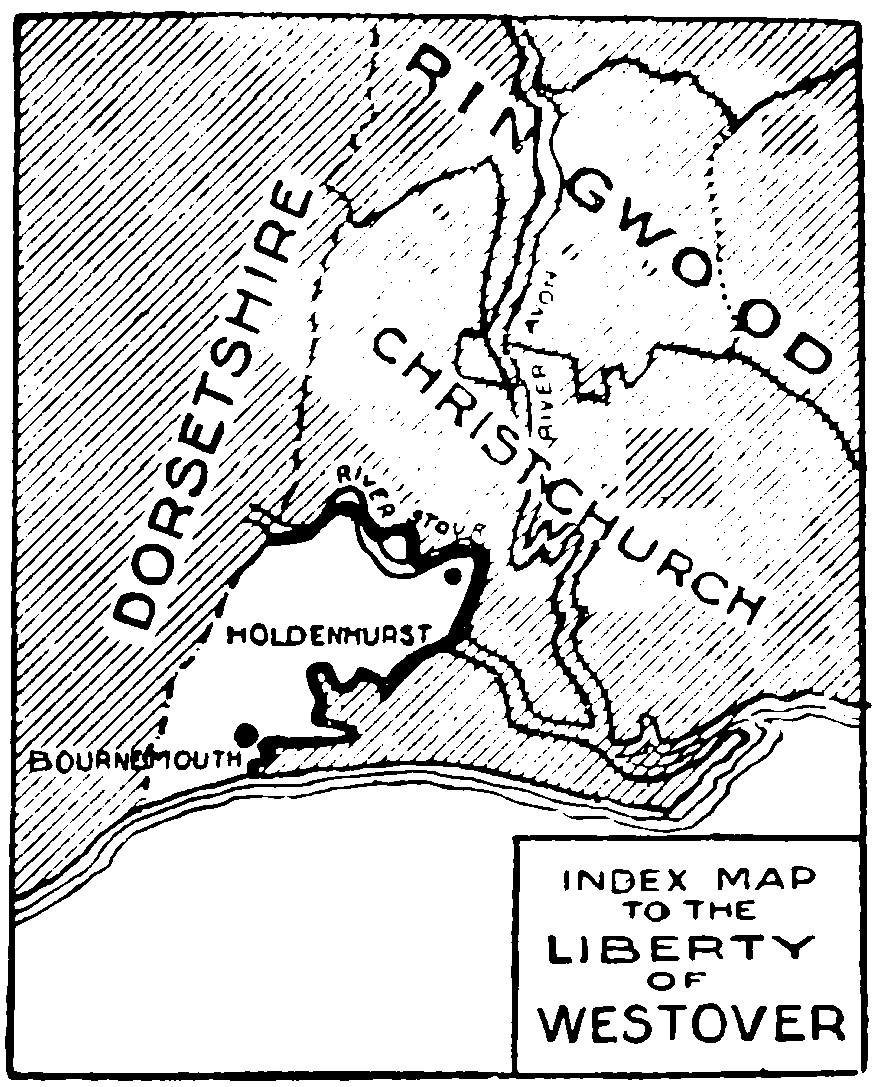
INDEX MAP TO THE LIBERTY OF WESTOVER
The liberty has always belonged, with the hundred of Christchurch, to the lord of the honour of Christchurch (q.v.).
The parish of Holdenhurst (Holeest, xi cent.; Holeherst, xii cent.; Holhurst, xiii cent.; Hollehurst, xiv cent.; Holnehurst, xv–xvii cent.; Holnest, xvi cent.; Holnirst, xvii cent.) comprises an area of 3,080 acres, of which 52 acres are covered by inland and 6 by tidal water; 1,579¼ acres are arable, 778¾ permanent grass and 273 woods and plantations. (fn. 14) Until 1894 the parish was much larger, and comprised 7,390 acres, of which 70 were covered by water. (fn. 15) In that year the part of it adjoining the county boundary was formed into the separate parish of Winton, while that part lying on the coast was detached from the larger portion of the new parish of Bournemouth. In the same year a small portion of Christchurch parish was added to Holdenhurst, and in the following year a further small piece of Holdenhurst was added to Bournemouth. (fn. 16) Finally in 1901 yet another portion of the parish was detached and added partly to Bournemouth and partly to Southbourne. (fn. 17)
The village is prettily situated in the north-east of the parish on a road which running south-east joins the Christchurch and Bournemouth road in the hamlet of Iford (Huver, Huvre, Luvre, xii and xiv cent.; Ever, xv cent.; Iver, xvi cent.), where the river is crossed by a fine bridge. (fn. 18) From the village another road runs west beside the river to the hamlets of Throop (La Throp, La Thorpe, xiv cent.; Throupe, xiv and xv cent.; Troppe, xvi cent.), where is a water mill, Muccleshill (Makeleshulle, xiii cent.; Mukeleshull, xiv cent.; Mulkeshull, xv cent.; Mokylshyll, Muggeshyll, xvi cent.) and Muscliff, where is an old tannery. Littledown House is the property and residence of Mr. James Coward Cooper-Dean, J.P.
The parish of Bournemouth was formed in 1894, as has been stated, (fn. 19) from Christchurch and Holdenhurst. Since 1902 the parish has included those of Pokesdown, Southbourne and Winton, and it now comprises 5,919 acres, of which 97 acres are covered by tidal and one by inland water; 93 acres are foreshore, 581¾ are arable, 300 permanent grass and 71/8 woods and plantations. (fn. 20) Cliffs extend along practically the whole of the coast, their average height being about 100 ft. The greatest altitude in the parish (one of 142½ ft.) is upon the county boundary just west of Winton. The earliest mention of the name that has been found is in 1574, when Bournemouth was regarded as one of the most likely places for an enemy to land. (fn. 21) Men were soon after told off to act as guards there and at other places along the coast. (fn. 22) Attention was again called to the danger in the next century, when Chewton Bunney, Boscombe and Hengistbury were also pointed out as likely places for a landing. (fn. 23) In 1654 there was a marine storehouse at Bournemouth. (fn. 24) Boscombe (then Bascombe) and Alum Chine both appear upon John Norden's map of 1595. (fn. 25)
The town, built upon the cliffs at an average height of over 100 ft., and intersected by the Christchurch and Poole road, is one of the most striking examples of modern development. A hundred years ago the country between Christchurch and Poole was open heath-land, with scarcely a house or a tree upon it. Upon the passing in 1802 of the Inclosure Act (fn. 26) thousands of acres were inclosed and planted with Scotch firs, and it is to the valuable medicinal properties of these trees, combined with the invigorating sea air, that the town owes its origin. In 1810 the first house was built by Mr. L. D. G. Tregonwell, who is styled upon his tomb in St. Peter's churchyard 'the founder of Bournemouth.' It now forms part of Newlyn's Royal Exeter Hotel. A few more houses sprang up, and in 1836 Sir George W. Tapps-Gervis, bart., began to lay out the land on the east of the Bourne stream. Westover Villas and the Royal Bath Hotel were built the following year, when also gardens were set apart for the public. Since then Bournemouth has steadily grown, and has enjoyed an increasing reputation as a health resort for those suffering from pulmonary diseases. It is now a fashionable residential town with several suburbs, those of Branksome Park and Upper Parkstone being wholly, and that of Westbourne partially, in the county of Dorset. The iron pier, now 1,000 ft. long, is approached through a gap in the cliffs. It was opened in 1880 and lengthened in 1894; at its entrance are waiting-rooms and a clock tower. A short drive and promenade under the East Cliff has recently been constructed from the pier entrance towards Boscombe. Each cliff is supplied with an elevator from the beach, while upon the West Cliff is a coastguard station. The line of this cliff is broken by three chines: Durley, Middle and Alum Chine. Along the banks of the Bourne—a small stream which flows south through the town and falls into the sea near the pier—pleasure-grounds have been laid out for a distance of more than a mile. There are two stations: the Central station opened in 1886, and the West station opened in 1873. The chief of the numerous hospitals and homes are the Royal National Sanatorium for Consumption and Diseases of the Chest, built in 1858; and the Royal Victoria Hospital, opened in 1890 by King Edward VII, then Prince of Wales, as a memorial of the Jubilee of Queen Victoria. There are cricket and football grounds and golf links in Meyrick Park, which belongs to the corporation and has an area of about 130 acres. In Talbot woods to the north are two tumuli, one of them known as Robin Hood's Barrow. Springbourne is a north-eastern suburb in the direction of Holdenhurst, while on a road running north from Bournemouth is the large detached suburb of Winton, on the commons to the east of which are six tumuli and the sites of two more. Just north of Winton is the hamlet of Moordown. Between Bournemouth and Christchurch, which continual building operations have almost united, are situated Boscombe, Pokesdown and Southbourne-on-Sea. The first of these is a suburb of Bournemouth, from which it is separated by the Boscombe Chine Gardens. The pier built at the end of Boscombe Chine is 600 ft. in length, and was opened in 1889. The Royal Boscombe and West Hants Hospital was established here in 1876. There is a railway station on the main Bournemouth line, as also at Pokesdown. On Littledown Common to the north are brick works and a tumulus known as Thistle Barrow. The cliffs between here and Southbourne-on-Sea, which at one point reach an altitude of 141 ft., are well wooded. Upon them are situated Boscombe Manor, late the property of Lord Abinger, and Wentworth Lodge, the residence of Viscount Portman.
From Pokesdown, also practically a suburb of Bournemouth, a road runs south-east to Southbourneon-Sea, a watering-place of recent development, situated on the wooded cliffs which fall away from here to the east. The pier, which was recently much damaged, is now being demolished; on either side of it parades have been constructed at the foot of the cliffs. To the north of Southbourne, on the banks of the Stour, are the hamlets of Tuckton and Wick. At the former a fine bridge over the river was built in 1882, the distance to Christchurch being thereby much lessened. (fn. 27) Close by is the site of a tumulus; near the latter is another tumulus.
Many famous men have spent the last years of their lives at Bournemouth, attracted hither by its healthgiving qualities. Thomas Wentworth Beaumont, politician and one of the originators of the Westminster Review, died here in 1848. (fn. 28) Other notable persons who have died here are Thomas Erskine the judge in 1864; John Keble in 1866; Thomas Baring, M.P., in 1873; John Wyatt, army surgeon, in 1874; John Nelson Darby, Plymouth Brother and founder of the Darbyites, in 1882; Thomas Pownall Boultbee, divine and author, in 1884; the first Earl Cairns, Lord Chancellor, in 1885; Sir Francis Bolton, soldier and electrician, in 1887; Sir Bartholomew Sulivan, admiral and hydrographer, and Thomas William Saunders, legal author, in 1890; Sir Arthur Blyth, premier of South Australia, in 1891; César Jean Saloman Malan, oriental linguist and biblical scholar, in 1894; Robert Eli Hooppell, antiquary, in 1895; Sir John Charles Bucknill, physician, in 1897, and General Sir George Henry Willis in 1900. Bournemouth was the birthplace in 1830 of Sir Charles Parker Butt, who became a judge of the High Court. Mary Wollstonecraft Shelley, authoress, second wife of the poet, died in London in 1851, but was buried at Bournemouth. Robert Louis Stevenson lived here 1884–7 in a house at the head of Alum Chine. Frederick Apthorp Paley, the famous classical scholar and author, spent the last seven years of his life at Boscombe, dying there in 1888; John MacGregor, the 'Rob Roy' of canoeing fame, died there in 1892. Edward Morison Wimperis, the water-colour painter, died at Southbourne in 1900.
BOROUGH
In 1856 the Bournemouth Improvement Act was passed and a body of commissioners constituted to discharge the duties of a local government authority. In 1890 the town received a royal charter of incorporation, and ten years later the municipal borough was constituted a county borough. In 1895 part of Pokesdown civil parish was constituted an urban district, and three years later the civil parish of Winton became one also. In 1901, however, both were dissolved and the areas they comprised added to the county borough, together with part of the parish of Holdenhurst and such part of the parish of Southbourne as was not already in the county borough. In the same year it was redivided into the present eleven wards; these are Boscombe East, Boscombe West, Branksome, Central, East Cliff, Malmesbury Park, Southbourne, Springbourne, Westbourne, West Cliff and Winton and Moordown. (fn. 29) The corporation consists of a mayor, eleven aldermen and thirty-three councillors. The borough has a separate commission of the peace and a separate court of Quarter Sessions. (fn. 30)
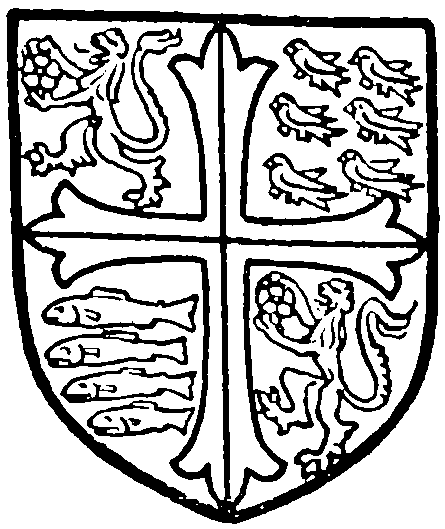
Borough of Bournemouth. Quarterly or and azure a cross paty quarterly between in the first and fourth quarters a lion holding a rose, in the second six martles, and in the third four salmon swimming all countercoloured.
MANORS
The manor of WESTOVER (Westower, xiii-xviii cent.) comprised the district west of the Stour, afterwards known as the liberty of Westover, and was probably co-extensive with the manor of HOLDENHURST, which at the time of the Domesday Survey belonged to the king and was assessed at 18½ hides and half a virgate, and worth £24 by the tale. In the time of Edward the Confessor it had been worth £44, when it was assessed at 29 hides and half a virgate, of which 7 hides were in the Isle of Wight. It was held at that time by Earl Tostig, but had been afterwards granted to Hugh de Port. Since then 3½ hides had been absorbed into the forest. (fn. 31) It was included in the grant of the Christchurch estates made by Henry I to Richard de Redvers, and being appurtenant to the honour of Christchurch followed the descent of the same (q.v.).
Ministers' accounts for the manor for the years 1289, 1301 and 1419 are extant. (fn. 32) From an extent of Christchurch Manor in about 1300 it appears that the king as lord could claim the second best sheep from every customary fold of Wick in Westover, the tenants in return having pasture for their sheep outside the ditch of Hengistbury in the demesne arable lands. (fn. 33) Some of the court rolls for the years 1560, 1594 and 1595 survive, from which it seems that for the purposes of the court baron the manor of Christchurch was known as 'the manor of Christchurch cum membris.' (fn. 34)
The manor of MUSCLIFF (Museclyve, xiiixiv cent.; Moseclyve, xiv-xv cent.; Moseclyre, xv cent.) originated in an estate held there for one-eighth of a knight's fee of the lords of Christchurch, (fn. 35) the last record of whose ownership is in 1414. (fn. 36) In about 1250 the estate was held by John Lancelevee, (fn. 37) but no other record of its tenure has been found until the year 1506, when Reginald Filliol and his wife suffered a recovery of the manor. (fn. 38) Three years later they conveyed it to Richard Elliot, (fn. 39) from whom it passed to Sir Thomas Elliot, kt., who settled it upon his wife Margaret for life. Upon his death he was succeeded by his cousin Richard Puttenham, who in 1547 conveyed the manor, subject to the life interest of Margaret, to John Lennard. (fn. 40) He still owned it four years later, (fn. 41) but from that date no further record of it has been found. It seems to have become merged into the chief manor of Christchurch. There was at Stourfield in the 15th and 16th centuries a deer forest and chase which belonged to the lords of Christchurch. (fn. 42)
At the time of the Domesday Survey there was a mill at Holdenhurst, owned by the king. (fn. 43) It passed to the abbey of Quarr, and then to Christchurch Priory, and is now held by the lords of Westover. (fn. 44)
CHURCHES
The church of ST. JOHN THE EVANGELIST, HOLDENHURST, was built in 1834 on the site of the ancient chapel in a style approximating to that of the 13th and 15th centuries.
There are two bells, the smaller dated 1701, the larger undated but inscribed '+ Ave maria gracia PLENA' in Gothic capitals.
The first book of registers has baptisms and burials 1679 to 1759 and marriages 1680 to 1753; the second and fourth have marriages 1754 to 1796 and 1797 to 1812, and the third has baptisms and burials 1759 to 1812. There are churchwardens' accounts from 1685.
The cruciform church of ST. ALBAN was built in 1908.
The handsome cruciform church of ST. AMBROSE, consecrated in 1907, is of stone in 15th-century style.
The church of ST. AUGUSTIN is cruciform, built of stone in 1891 in 17th-century style.
The church of ST. CATHERINE, SOUTHBOURNE, built of stone about 1898, is a cruciform structure excellently designed in late 13th-century style, with aisles and north porch.
CHRIST CHURCH, dating apparently from the first half of the 19th century, consists of a single hall with sanctuary recess at one end and vestries and a parish room at the other. It is completely inclosed by other buildings, mainly shops.
The church of ST. CLEMENT is cruciform, built of stone in 1872 in 14th-century style. The tower is an addition of 1893. There is an 18th-century Italian reredos in the chapel.
The church of ST. JAMES, POKESDOWN, is a small structure, built of stone in 1858 in 13th and 14th-century style.
The cruciform church of ST. JOHN THE BAPTIST, MOORDOWN, was begun in 1873 and continued in 1886 in 13th-century style.
The church of ST. JOHN THE EVANGELIST, BOSCOMBE, built of flint and stone with tile roofs in 1894 in 14th-century style, is cruciform.
The church of ST. LUKE, MOORDOWN, begun in 1898 of brick and stone in 14th-century style, is still incomplete.
The church of ST. MICHAEL AND ALL ANGELS is cruciform, built of stone in 13th-century style in 1874, with a tower added in 1901.
The cruciform church of ST. PAUL was built in 1881 in 13th-century style of grey and red brick with an outer facing of stone.
The church of ST. PETER is a cruciform church built of stone in 14th-century style about 1845 and enlarged at subsequent dates. The tower contains eight bells.
The cruciform church of ST. STEPHEN was built of stone in 1881 in 13th-century style.
The church of ST. SWITHUN in Jervis Road, a cruciform structure in 14th and 15th-century style, built in 1876, is a chapel of ease to St. Peter.
The church of HOLY TRINITY is a brick structure in the Romanesque style built in 1869, having a narthex, and a campanile with five bells to the south of the narthex.
With the exception of a silver chalice of 1578 at St. John's, Holdenhurst, and a paten of 1701 in the same church, all the plate of the Bournemouth churches is modern. Very careful and elaborate descriptions of each piece are given in Church Plate of Hampshire (1909), by the Rev. P. R. P. Braithwaite.
ADVOWSON
There was in 1086 a chapel in Holdenhurst, (fn. 45) a third part of the tithes of which belonged to Christchurch Priory. (fn. 46) The chapel passed to Richard de Redvers under his grant of Christchurch Manor, and he granted it to the priory in about 1100, (fn. 47) several of his descendants confirming the grant. (fn. 48) The chapel was served by the priory until the Dissolution, after which it was in the charge of the vicar of Christchurch. (fn. 49) The chapel ceased to be in charge before 1808, (fn. 50) but the living continued to be a perpetual curacy annexed to Christchurch vicarage until 1875, when it was constituted a vicarage, in the gift of the Bishop of Winchester.
The tithes have always been held with those of Christchurch; both have now been commuted for a rent-charge.
St. Alban's is a district church of St. Augustin.
St. Ambrose is a chapel of ease to St. Peter's.
The parish of St. Augustin was formed in 1900 from St. Stephen's. The living is a vicarage in the gift of the bishop.
The district of St. Catherine's, Southbourne, was formed in 1885. The living is a vicarage in the gift of trustees.
Christ Church is now worked as a mission.
St. Clement's parish was formed in 1871 from Holdenhurst; the living is a vicarage in the gift of Mr. A. Darby.
The parish of St. James, Pokesdown, which includes part of Boscombe, was formed in 1859 from Christchurch. The vicar of Christchurch is patron.
The parish of St. John the Baptist, Moordown, which included Winton, was formed in 1874 from Christchurch and Holdenhurst. The living, a vicarage, is in the gift of the bishop.
The parish of St. John the Evanglist, Boscombe, was formed in 1890 from St. Clement's. The living is a perpetual curacy in the patronage of the Peache trustees.
St. Luke, Moordown, is a district church of St. John the Baptist.
The parish of St. Michael was formed from St. Peter's in 1874. The living is a vicarage in the gift of Miss Durrant and Mrs. J. B. Wanklyn alternately.
The parish of St. Paul was formed from St. Michael in 1890; the living is in the gift of trustees.
The living of St. Peter, Bournemouth, is a vicarage, the parish being formed in 1845 from Christchurch and Holdenhurst. Sir G. A. E. Tapps-Gervis-Meyrick, bart., is patron.
The parish of St. Stephen was formed out of St. Peter's in 1882; the living is a vicarage in the gift of Keble College, Oxford.
The parish of Holy Trinity, Bournemouth, was formed in 1867 from St. Peter's and Holdenhurst. The living is a vicarage in the gift of trustees.
There are three Congregational chapels at Bournemouth, one at Boscombe, and one at Moordown. There are also Congregational chapels at Pokesdown, Winton and Throop; while there are Baptist chapels at Bournemouth, Pokesdown and Boscombe. The Wesleyans have chapels at Westbourne, Springbourne, Pokesdown, Boscombe and in the Winton and Malmesbury Park district, while in Bournemouth upon Richmond Hill is the Punshon Memorial Wesleyan Church. The Primitive Methodists have chapels at Bournemouth, Pokesdown, and Springbourne, and there is a Unitarian chapel at Bournemouth. There is a Roman Catholic church at Boscombe in the Christchurch road, while at Bournemouth upon Richmond Hill is the Oratory of the Sacred Heart, and at Pokesdown the Convent of the Holy Cross. At Bournemouth in Exeter Road is St. Andrew's Presbyterian Church, and in the Avenue Road is a Meeting House of the Society of Friends.
CHARITIES
(i) Parish of Holdenhurst. (a) Charity of Thomas Brown. See under Christchurch. The share applicable in this parish amounts to about £2 17s. 6d., of which 10s. is payable to the minister for a sermon on 1 January, the residue being applicable in clothes, bread or otherwise.
(b) Charity for Parish Nurse. The official trustees hold a sum of £3,150 5s. 10d. consols, producing £78 15s. yearly, forming part of a sum of stock transferred under an Order of the Court of 25 May 1903 in the matter of the Attorney-General v. Sir George Eliott Meyrick Tapps-Gervis-Meyrick and another (1891 A. 394), whereby a scheme also was established for providing a nurse for this parish and its immediate neighbourhood. See also under Bournemouth.
(ii) Parish of Bournemouth. (a) The Herbert Convalescent Home, founded in 1867 as a memorial to Sidney Lord Herbert of Lea, has endowments from legacies and gifts of General Bowles, Dr. Lambert, Rev. William Savage, and others, of about £300 a year.
(b) The Royal Victoria Hospital, founded in 1837, has an endowment fund of £2,103 7s. 5d. consols, constituting Meyrick's Annuity. A sum of £2,103 7s. 5d. consols is in the hands of the official trustees for the benefit of the Royal Boscombe and West Hants Hospital.
(c) A sum of £5,000 consols for the Meyrick Scholarships in connexion with the Bournemouth Technical and Secondary School, is administered by a scheme of the Court established under the Order of Court of 1903. (fn. 51)
(d) The official trustees also hold a sum of £1,671 17s. 9d. Bournemouth Corporation 3 per cent. Stock as a Scholarship Fund in connexion with the school at Lansdowne, the administration being regulated by a scheme of 12 March 1907.
(e) The official trustees also hold a sum of £1,739 2s. 3d. consols under the will of Charlotte Augusta de Winton, one moiety being applicable towards maintaining a branch of the Royal Society for the Prevention of Cruelty to Children, and the other moiety for the like purpose in Weymouth.
(f) In the ecclesiastical parish of St. Clement. The school consists of schoolhouse, playground, and 2 acres of land, conveyed by deeds of 10 March 1879 and 1 November 1880. A small portion of the land was sold with the sanction of the Charity Commissioners, and the proceeds applied in improving the estate, and the remainder let on building leases for ninety-nine years at ground rents amounting to about £110 a year.