A History of the County of Worcester: Volume 4. Originally published by Victoria County History, London, 1924.
This free content was digitised by double rekeying. All rights reserved.
'Parishes: North Piddle', in A History of the County of Worcester: Volume 4, ed. William Page, J W Willis-Bund (London, 1924), British History Online https://www.british-history.ac.uk/vch/worcs/vol4/pp177-180 [accessed 2 May 2025].
'Parishes: North Piddle', in A History of the County of Worcester: Volume 4. Edited by William Page, J W Willis-Bund (London, 1924), British History Online, accessed May 2, 2025, https://www.british-history.ac.uk/vch/worcs/vol4/pp177-180.
"Parishes: North Piddle". A History of the County of Worcester: Volume 4. Ed. William Page, J W Willis-Bund (London, 1924), British History Online. Web. 2 May 2025. https://www.british-history.ac.uk/vch/worcs/vol4/pp177-180.
In this section
NORTH PIDDLE
Pidelet (xi cent.); Pydele, Northpiddle (xiii cent.).
North Piddle is a very small parish bounded by Piddle Brook on the west and south-west. The surface of the land is flat, the highest point (200 ft.) being near the eastern boundary. The soil is marl and loam on a subsoil of Lower Lias, and the chief crops are wheat, beans and fruit. The area is 797 acres, of which 422 acres are permanent grass and 152 acres arable land.1 It was inclosed under an Act of 1813,2 the award being dated 25 August 1830.3
The road between Worcester and Alcester passes across the extreme north of the parish and a branch road leads south from this to the village, about a quarter of a mile distant. The village consists of two farms and a cottage standing near the church. The farm to the north-east is a half-timber building, and to the west is a moated site without any building upon it.
Amongst the old field-names here are Frarye Acre, Husband Acre, Monck Acre, Le Home, Le Deane and Gostell Field (possibly Gospel Field), all of which are mentioned in a 16th-century document.4
MANOR
At the time of the Domesday Survey two estates in NORTH PIDDLE were held of the abbey of Westminster by Urse the Sheriff, the two having been separately owned in the reign of Edward the Confessor. Toli, a freeman, had held 5 hides5 and Alfwine had held the other portion consisting of 4 hides, one of which did not pay geld.6 The land had increased in value since the Conquest, the two estates, formerly worth 30s. and 50s. respectively, being valued at 60s. each in 1086. The overlordship of the abbey of Westminster was recognized until the 15th century.7
William Beauchamp, son of Emmeline daughter and heir of Urse, owned North Piddle in the 12th century.8 It must, however, have passed from the Beauchamps in the 13th century, for it appears that Richard Fitz John, who was descended from Geoffrey Fitz Piers Earl of Essex,9 was holding the overlordship at his death in 1297, and it was assigned in dower in 1299 to his widow Emma.10 His heir Richard de Burgh Earl of Ulster had seisin in the same year,11 but the overlordship seems afterwards to have reverted to the descendants of Maud, one of the sisters of Richard Fitz John, who was the wife of William Beauchamp, first Earl of Warwick of that name,12 for it belonged to her son Guy,13 and followed the descent of the honour of Elmley Castle14 until it lapsed in the 16th century, the overlordship being mentioned for the last time in 1561–2.15
In a survey of Pershore Hundred taken shortly after 1086, it is stated that Robert Parler held 5 hides and 5 carucates between 'Flavell' and 'Pidelet,' and it is probable that this Robert was Urse's tenant in North Piddle.16 Habington quotes an undated document in which Ellis de Piddle conveyed half a yard-land to William de Selewie, and amongst the witnesses appears Philip de Piddle.17 In the reign of Henry III the manor of North Piddle was held by Stephen de Segrave. Stephen was regent of England during the king's absence in 123018 and justiciar of England in 1232.19 North Piddle formed part of the dowry of his widow Ida after his death in 1241.20 His son Gilbert was his heir,21 and he in turn was succeeded about 1254 by Nicholas his son.22 Nicholas, who had fought with the barons against Henry III, was taken prisoner at Evesham, but was pardoned under the Dictum of Kenilworth, his three sons John, Nicholas and Henry redeeming the manor in 1289.23 He was summoned to Parliament in June 1295 as Lord Segrave and died in the same year.24 North Piddle was granted for life by John Segrave to his brother Henry, who was holding it in 1299.25 He was still in possession in 1315,26 but the manor afterwards reverted to John. Both he and his son Stephen died in 1325,27 and the inheritance gave rise to a dispute between their widows. Christiana, John's widow, claimed a third of the manor as her dower, but Alice, Stephen's widow, declared that her husband held the entire manor of his father's gift. The court decided that Alice should hold the estate, but that the value of one-third of it should be paid to Christiana out of that part of the heir's property which was in the king's wardship.28 John son of Stephen and Alice held the manor in 1346,29 having settled it in 1344 on himself and his wife Margaret.30
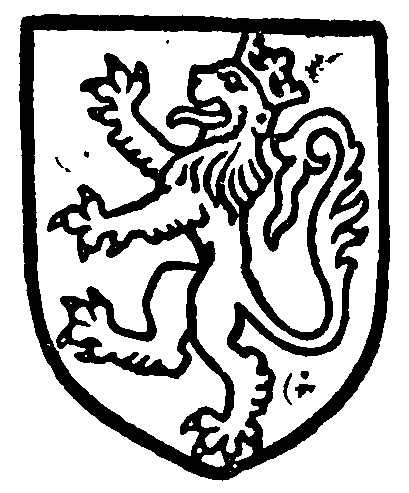
Segrave. Sable a lion argent crowned or.
This John de Segrave, the third Lord Segrave, married Margaret daughter of Thomas of Brotherton, Earl Marshal and Earl of Norfolk, one of the sons of Edward I.31 He granted the manor for life to Thomas de Ferrars, who was holding it at the time of John's death in 1353.32 Margaret, who was called Margaret Marshal, outlived her husband, afterwards marrying Walter Lord Manny, who held the manor of North Piddle in her right.33 He died in 1372–3, leaving her a second time a widow.34 In 1397 she was created Duchess of Norfolk in her own right, and on the same day her grandson and heir Thomas Mowbray, son of her daughter Elizabeth, who had married John Lord Mowbray, was created Duke of Norfolk.35 He was banished from England in 1398, and at the time of her death in the spring of 139936 was still in exile, and his lands were considered forfeit in consequence of his banishment.37 He died of the plague in Venice in the following September.38 His son and heir Thomas Earl of Norfolk was executed in 1405, at the age of eighteen, without trial or attainder, for taking part in the Scrope conspiracy,39 and North Piddle was granted in 1406 for life to Edward Beauchamp.40 John, brother and heir of Thomas Mowbray, did not have livery of his lands until 1412, nor was the dukedom attributed to him till 1424.41 This John Duke of Norfolk, who distinguished himself in the French wars, was succeeded in turn by his son42 and his grandson, both called John,43 and the direct line finally became extinct on the death of Anne, his greatgranddaughter, who was married at the age of five to Richard Duke of York, second son of Edward IV, and died an infant three years later, 16 January 1480–1.44 The Duke of York was murdered in the Tower shortly after. The Mowbray estates were then divided between William Viscount Berkeley, son of Isabel daughter of Thomas Mowbray Duke of Norfolk, and John Lord Howard, son of Margaret the second daughter of Thomas Duke of Norfolk.45 North Piddle seems at first to have been assigned to John Howard, who was created Duke of Norfolk in 1483, but on a subsequent partition passed to his cousin William Lord Berkeley,46 who, as his share of the Mowbray titles, received that of Earl of Nottingham.47 This partition was confirmed in 1488,48 and William Earl of Nottingham conveyed the manor shortly afterwards49 to Humphrey Coningsby and Isabel his wife, Edward Willoughby and Robert Logg acting as trustees.50
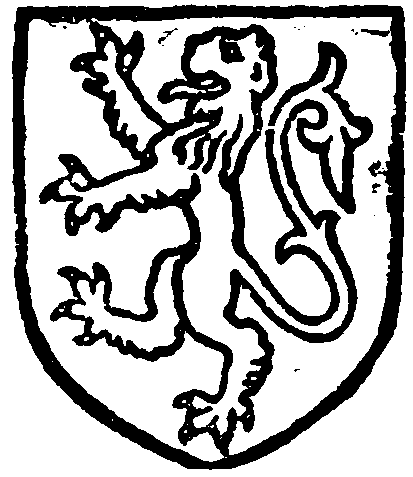
Mowbray. Gules a lion argent.
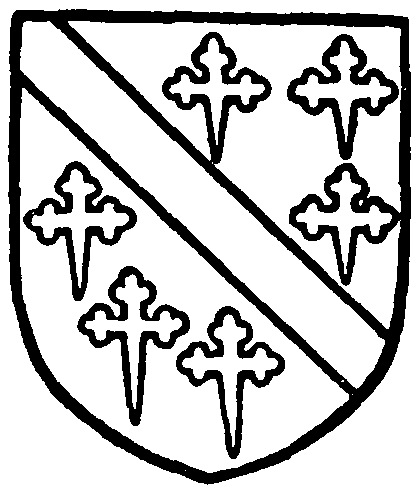
Howard. Gules a bend between six crosslets fitchy argent.
In 1535–6 Sir Humphrey Coningsby, one of the justices of the bench, died seised of the manor.51 His heir was his grandson, another Humphrey, the son of Thomas Coningsby, upon whom lands to the value of £100 had been settled at the time of his marriage in 1532 with Anne the daughter of Sir Thomas Englefield, also a justice of the bench. According to the agreement drawn up between them, Sir Humphrey bought the wedding clothes of both bride and bridegroom, while the cost of the meat and drink was divided between him and Sir Thomas Englefield.52
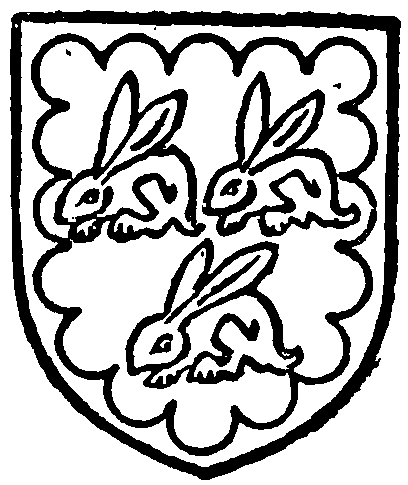
Coningsby. Gules three conies argent and a border engrailed sable.
Anne survived her husband, who died in 1559, their eldest son Edward being then under age.53 He died two years later without having attained his majority and his brother Thomas succeeded.54 Thomas was knighted by the Earl of Essex before Rouen in 159155 and died in 1626.56 His son and successor Fitz William was member of Parliament for Herefordshire in 1620.57 With the rise of the Commonwealth, however, his prosperity vanished, and he and his wife Cecilia, who was a daughter of Sir Henry Nevill Lord Bergavenny,58 and his children were reduced to absolute starvation. In 1649 a fine of over £4,000 was imposed on him, and though a fifth of the estate was reserved to his wife this concession was not put into effect for some years, if ever. In 1651 FitzWilliam was ordered to pay £2,000 within a fortnight. A few weeks later the whole fine was reduced to £3,600, and in 1653 he petitioned for leave to compound at one-sixth, pleading the destitution to which he and his family were reduced. In 1654, however, no part of the fine had been paid, and orders were issued that the estate was to be proceeded against as if there had been no composition.59 At this juncture Sampson Wise, who had married FitzWilliam's daughter Philippa,60 came to the rescue and bought the estates,61 undertaking to pay a sum for the relief of FitzWilliam and his wife and to compound with the commissioners.62
In 1668 Thomas Powis conveyed North Piddle to Robert Knightley,63 who was already possessed of some land at North Piddle.64 In 1683–4 Robert and Valentine Knightley sold land in North Piddle to Thomas Yarnold,65 and his descendant, another Thomas Yarnold, was holding the manor in 1750.66 Mr. Sheldon of Weston was the owner in 1782,67 and it must have been bought shortly after by Humphrey Lyttelton of Naunton Beauchamp.68 Sandys Lyttelton was the owner in 1812, though his right was disputed by a Mr. Phillipps of Evesham.69 The manor seems then to have followed the descent of Naunton Beauchamp to the Frances family,70 Henry Vernon Frances being lord of the manor in 1880. As early as 1868 the parish was divided into small farms,71 and the manorial rights have now lapsed.
Mention is made in 1325 of a windmill worth 10s. yearly in the manor of North Piddle.72
CHURCH
The church of ST. MICHAEL is an entirely modern building consisting of chancel, nave, north porch and vestry. It is in the 13th-century Gothic style with walls of brick faced with stone, steep-pitched tiled roofs, a stone bellcote at the west end, containing one modern bell, and a timber porch. The chancel has a small credence on the north, the pointed arch over which is apparently ancient. The piscina in the south wall has an old basin resting on a head corbel apparently of the 13th century. At the west end of the nave are preserved six encaustic tiles of fairly good design, found in the churchyard to the north of the church in 1896 and indicating an alteration in the site.
Preserved in the vestry is a small uninscribed bell. The old church72a was a small rectangular structure with a wooden bellcote and a north porch. Habington gives the arms of Folliott, Stone of Stone, Tracey and Coningsby as occurring in it. The two old bells were sold late in the last century. They were dated 1676 and 1745.
The plate consists of an Elizabethan cup and cover paten and a pewter flagon and plate.
The registers before 1812 are as follows: (i) baptisms 1565 to 1776, burials 1572 to 1775, marriages 1571 to 1749; (ii) baptisms and burials 1776 to 1812, marriages 1777 to 1812; (iii) marriages 1754 to 1810.
ADVOWSON
The advowson of North Piddle originally belonged to the lords of the manor.73 In 1338 Alice de Segrave presented Thomas de Segrave, a special dispensation being necessary, as he was under the required age, being only twenty-two.74 Throughout the Middle Ages the advowson followed the descent of the manor,75 and in 1660 Sampson Wise was the patron.76 The Coningsbys, however, seem to have retained a right in it, after they had parted with the manor, for in 1683 Thomas Coningsby with William Goold and his wife Alice conveyed it to John Philpott,77 who presented in the following year and in 1704.78 In 1727 it was purchased by Salwey Nash, the incumbent,79 from whom it passed by purchase to Richard Nash of Clerkenleap,80 who presented in 1756.81 From him it passed with the manor of Impney82 to John Lord Somers,83 with whose descendants it remained until it was purchased of Lady Henry Somerset about 1892 by the Bishop of Worcester,84 the present patron.
The living has been united since 1895 to that of Upton Snodsbury.85
In the 19th century the church of North Piddle seems to have been much neglected, the incumbent visiting it only once on a Sunday, and not always giving it even that attention. The fabric was in a ruinous condition and Noake states that at one time it was actually mortgaged to provide the means to erect pews.86
There do not appear to be any endowed charities subsisting in this parish.