A History of the County of Surrey: Volume 3. Originally published by Victoria County History, London, 1911.
This free content was digitised by double rekeying. All rights reserved.
'Parishes: Long Ditton', in A History of the County of Surrey: Volume 3, ed. H E Malden (London, 1911), British History Online https://www.british-history.ac.uk/vch/surrey/vol3/pp516-522 [accessed 30 April 2025].
'Parishes: Long Ditton', in A History of the County of Surrey: Volume 3. Edited by H E Malden (London, 1911), British History Online, accessed April 30, 2025, https://www.british-history.ac.uk/vch/surrey/vol3/pp516-522.
"Parishes: Long Ditton". A History of the County of Surrey: Volume 3. Ed. H E Malden (London, 1911), British History Online. Web. 30 April 2025. https://www.british-history.ac.uk/vch/surrey/vol3/pp516-522.
In this section
LONG DITTON
Ditune (xi cent.).
Long Ditton is a village one and a half miles southwest of Kingston. It was at the time of the Domesday Survey in Kingston Hundred. There was a church there then, and it may have been already parochially distinct from Kingston. In the grant of Kingston and Long Ditton churches to Merton Priory, soon after the foundation in 1117, (fn. 1) Long Ditton was not included among the chapelries of Kingston which are enumerated. The parish is divided into two parts, Long Ditton proper and Talworth (q.v.), with a strip of Kingston parish, the hamlet of Hook, intervening. The western portion, which contains the village of Long Ditton, abuts on the Thames to the north. It is rather over 2 miles from north to south, less than a mile broad, and contains 896 acres of land. The parish is traversed by the road from Kingston to Guildford, and the main line of the London and South Western Railway runs through it. The soil is chiefly London clay, but to the north is Thames alluvial gravel and sand, and it contains two patches of Bagshot Sand in the southern part. Long Ditton gives one of the few examples in Surrey of an ancient church and village standing on the London Clay.
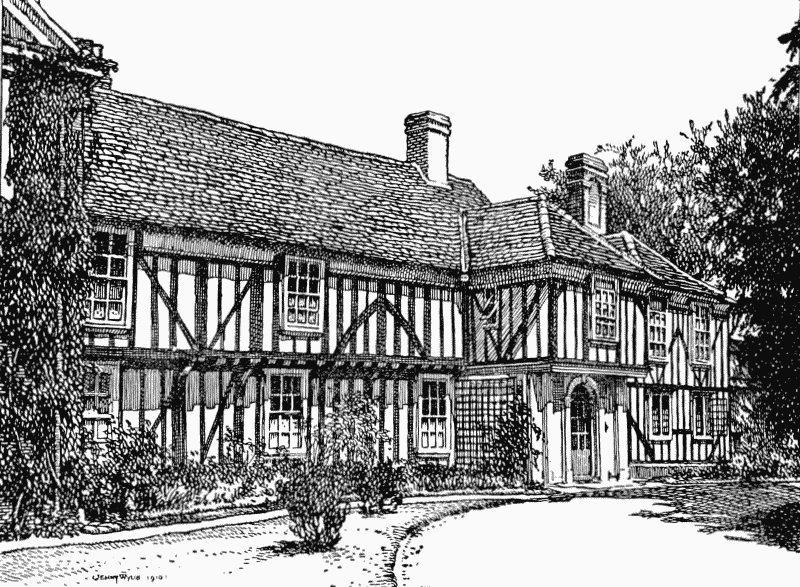
Long Ditton Rectory from the South-west
The parish is now agricultural and residential. A large number of small country houses and villas have been built in the parish during the last thirty years.
The only house of archaeological interest is the rectory, of which the greater part is half-timber, probably of the 16th century. The interior was re-arranged and refitted in the 18th century, and modern wings have been added. The original plan appears to have been of an L-shape, the main portion lying east and west, and the wing containing the kitchen, &c., being at the east end and projecting to the south. The main building had two rooms apparently, with large fireplaces as now; but an 18th-century stair has been inserted in the one, and the other has an 18th-century passage on its south side from the present stair hall to a doorway or to a wing now displaced by the modern drawing-room wing at the west end. The kitchen and another room filled the east wing, but the rooms there are now all more or less re-arranged, and a modern dining-room wing projects to the north at the same end. The south front of the main house has plain vertical uprights and curved brackets brought out in support of the overhanging first floor, which projects 2 ft. beyond the lower part. The window frames generally are of 18th-century insertion. The western third of this front has been modernized, a main post having been inserted before an 18th-century passage window, now blocked. The porch in the angle of the two wings appears to be as old as the rest, but has an 18th-century doorway; the front over the porch also projects 2 ft. beyond the ground story. The front of the east wing is of one plane throughout; the two ground-floor windows are ancient retaining their iron frames and old fasteners, but the upper windows have sash frames like the others. The back of the house (north front) is also all in one plane, and some of the old heavy posts reach from the floor to the eaves. There is an 18th-century moulded cornice of wood. The roofs are tiled. In one of the south windows of the first floor is some old stained and heraldic glass of several dates. There are also a man in the dress of the time of Charles I and four large diamond quarries with square flowers. In the garden to the north is a summer-house constructed of some Elizabethan or early 17th-century woodwork. On the south side stands an ancient yew tree probably as old as the house.
The Manor House, Ditton Hill, is the residence of Baron O. E. von Ernsthausen; Woodstock, Ditton Hill, of Mr. C. L. L. Smith.
A few industries are carried on in Long Ditton. Messrs. Barr & Sons' nurseries are partly included in it; some barge building is carried on upon the Thames, and the Lambeth Water Works reservoirs are also partly in the parish.
A Primitive Methodist chapel was built in 1875, and in 1889 a mission hall for revival services. A workmen's club was established in 1883. The schools, National, were founded in 1840. The present schools were built in 1874.
Talworth is the eastern portion of Long Ditton parish, separated from the rest by Hook in Kingston. It is on the London Clay, and has an area of 1,193 acres. On the eastern borders is the Hogsmill Stream, which early in the 19th-century here worked the Gunpowder Mills, commonly called Malden Mills, of Mr. Taylor. The original powder mills of the Evelyns may have been on the same site. (fn. 2) According to Manning and Bray (fn. 3) Talworth always elected separate parochial officers. It is now ecclesiastically in Surbiton, to which it was annexed in 1876; it was made a civil parish in 1895, (fn. 4) but is included in the Surbiton Urban District. Since the sale of the Earl of Egmont's property it has been covered with small houses.
There was an inclosure act for Talworth in 1818, the award being made on 2 February 1820. (fn. 5) The manors had originally been all open fields. (fn. 6)
St. Matthew's National Schools were opened in 1880.
MANORS
The manor of LONG DITTON, which under King Edward the Confessor was held by Almar, in 1086 formed part of the possessions of Richard de Tonbridge, of whom it was held by Picot. The extent then included a mill, and a rent of 500 herrings payable from a house in Southwark. (fn. 7)
The overlordship passed through Eleanor, sister and co-heir of Gilbert de Clare, who died in 1314, (fn. 8) to the Despensers. (fn. 9) Isabel, daughter of Thomas le Despenser, married Richard Beauchamp, Earl of Warwick, (fn. 10) and was the mother of Anne, wife of Sir Richard Nevill, the Kingmaker. In 1474 the estates of Anne, the latter's widow, were settled on her daughters Isabel, the wife of George Duke of Clarence, and Anne, the wife of Richard Duke of Gloucester, afterwards Richard III. (fn. 11) Both their husbands were attainted, and they both died before the Dowager Countess Anne. Another Act of Parliament early in the reign of Henry VII restored the estates to the countess, who immediately conveyed them to the king, (fn. 12) who thus became overlord of Long Ditton.

Clare. Or three cheverons gules.
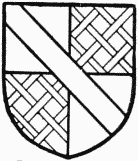
Despenser. Argent quartered with gules fretty or a bend sable over all.
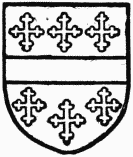
Beauchamp. Gules a fesse between six crosslets or.
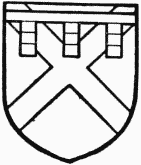
Nevill. Gules a saltire argent and a label gobony argent and azure.
At the beginning of the 13th century the manor was held under the de Clares by Geoffrey de Mandeville, Earl of Essex, (fn. 13) and seems to have been granted by his brother and heir William de Mandeville to the priory of St. Mary Spital without Bishopsgate. (fn. 14) In 1314 the manor was returned as held by the Prior of Bishopsgate for the fourth part of a knight's fee. (fn. 15)

St. Mary Spital. Party argent and sable a mill-rind cross counter-coloured with a martlet gules in the quarter.
The farm of Long Ditton in 1535 was valued at £5, other lands and tenements at £5 1s. 8d., and the perquisites of court, &c., at 2s. (fn. 16) After the Dissolution woods belonging to the manor were sold by the king to Sir Thomas Heneage, (fn. 17) and in 1552 Edward VI granted the manor in exchange for lands in Richmond (fn. 18) to David Vincent, a groom of the Privy Chamber, who died in 1565 leaving the property to his son Thomas, (fn. 19) who sold it almost immediately to George Evelyn, the great maker of gunpowder, (fn. 20) whose mother was daughter of another David Vincent. At his death in 1603 (fn. 21) he left a son Thomas, who, dying in October 1617, left also a son Thomas, (fn. 22) who had been knighted in the July of that year. (fn. 23) Concerning the conduct of Sir Thomas Evelyn and his family towards himself, Richard Hinde, minister of Long Ditton, made complaint to Archbishop Laud. He complained that he had suffered much indignity from Sir Thomas and his lady, which he had borne in silence, until Dame Ann Evelyn, immediately after divine service, while yet in the church, before all the people thus addressed him: 'You are a base man, and a base unworthy priest; you have abused me basely, and your base carriage and usage of me shall not any longer be endured,' and yet more vilifying speeches. Sir Thomas complained that the minister had abused his lady. The archbishop appointed a time for a private hearing of these disagreements. (fn. 24) In 1657 Sir Thomas was again in trouble with the parson. According to the petition of Richard Byfield, officiating as minister in Long Ditton, money that had been collected in 1641 and 1642 for the rebuilding of the church had remained in Sir Thomas Evelyn's hands, while meantime the church fell down. (fn. 25) Another complaint was that Sir Thomas entertained a prelatical household chaplain who used the words of the book of Common Prayer, and gathered a concourse of people of like views and invaded the parson's right, with regard to which Sir Thomas was warned to remove his chaplain. (fn. 26) He died in 1659. His son Sir Edward Evelyn, knighted in 1676 and created a baronet in 1682–3, held this manor, (fn. 27) which, when he died without leaving male issue in 1692, descended to his daughter and co-heiress Penelope and her husband, Sir Joseph Alston, third baronet, the manor having been settled on the occasion of Penelope's marriage on himself (Sir Edward Evelyn) for life, with remainder to Penelope and her husband. (fn. 28) Joseph, their eldest son, succeeded to the manor, (fn. 29) and he dying without issue, it passed to his brother, Sir Evelyn Alston, bart., who in 1720–1 sold it to Sir Peter King of Ockham, co. Surrey, (fn. 30) who was made Lord High Chancellor in 1725, and was created Lord King, Baron of Ockham, in the same year. (fn. 31) His successor and heir male, William King, was, in 1838, created Viscount Ockham and Earl of Lovelace. Lionel Fortescue King, third Earl of Lovelace, is the present lord of the manor.
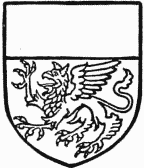
Evelyn of Wotton, baronet. Azure a griffon passant and a chief or.
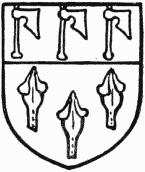
King, Earl of Lovelace. Sable three spearheads argent with drops of blood and chief or with three battle-axes azure therein.
Another manor of DITTON is entered in Domesday as held by Wadard of Odo, Bishop of Bayeux, Wadard being the successor of Leuegar, who had held under King Harold. (fn. 32) The Arsics succeeded here as elsewhere to the lands of Wadard, and this manor appears at the beginning of the 13th century as a knight's fee in Ditton belonging to the barony of Arsic, which was one of the baronies charged with castle ward to Dover. (fn. 33) The overlordship descended with the barony of Arsic, which appears to have escheated to the Crown after the succession of female heirs to the lands of Robert de Arsic, who died in 1244–5. In the 16th and 17th centuries the manor was said to be held of the Crown as of the castle of Dover or as of the barony of Arsic. (fn. 34)
In 1257 this fee was in the tenure of John de Guglesham, who conveyed it under the name of a carucate of land, with a mill in Kingston and Ditton, to William de Brademere. (fn. 35) From an inquisition taken in 1290, it appears that William de Brademere held it of Robert le Tut, husband of Alice daughter of Robert Arsic, by a rent of 25s. (fn. 36) Robert le Tut held of the king in chief for rent of 10s. to Dover Castle every twenty-four weeks, which payment he ceased to render after his wife's death, so that William de Brademere, Richard his son, and William Richard's son, were distrained for the money. (fn. 37) Alice wife of Richard de Brademere, who died in 1288, and Bartholomew de Morle, her second husband, claimed the custody of the land in Long Ditton during the minority of William son of Richard. (fn. 38) William de Brademere was apparently still holding in 1310. (fn. 39) Nothing more appears concerning the manor until 1398, when Walter Pembroke and Margery his wife quitclaimed Long Ditton to John Gravesende and Isabel his wife, (fn. 40) and about 1418 Henry Haweles and Margaret his wife were holding it with successive remainder to John Haweles son of Henry, and Elizabeth, daughter of Margaret, and her issue. (fn. 41) Elizabeth wife of William Stowe, who in 1505 quitclaimed the manor of Long Ditton to Robert Fenrother, may have been a descendant of Henry and Margaret Haweles, as the manor was warranted against her and her heirs. It was also warranted against John, Abbot of St. Peter's Westminster. (fn. 42) In 1560 the manor was in the possession of Thomas Rede, (fn. 43) and he conveyed it in 1566 to William Notte, (fn. 44) who proved before the Exchequer Court that there were two manors called Long Ditton, one held, at the time, by David Vincent, the other by himself. The manor that he held had, he said, been owned by Thomas Rede, who held it of the queen as of Dover Castle by rent of 21s. 8¾d., (fn. 45) and had been granted to himself by Rede. He maintained that there was no reason why it should be taken into the hands of the Crown for alienation by fine without licence, as it was not held of the queen in chief. William Notte died in 1576, leaving an heir, his son Anthony, (fn. 46) who died in 1586 holding this manor. (fn. 47) He also held a wharf named Jeffereyes Wharf (which had formerly belonged to the hospital of St. Mary without Bishopsgate) and other land in Long Ditton. (fn. 48) He left a son Thomas. In 1621–2 Thomas Notte sold the manor to Anne Goulde or Gold, widow. (fn. 49) She, in 1623, mortgaged it to Mark Snelling of Kingston, (fn. 50) but died in seisin of it in 1629. (fn. 51) Her heir was her daughter Anne, wife of Sir Thomas Evelyn, (fn. 52) by whom both the manors of Long Ditton became vested in the same family.
There is one reference to a third manor of Long Ditton. In 1386 Sir Miles de Windsor died possessed of this manor, which was held of him by Geoffrey de Metham, (fn. 53) but there seems to be no further trace of it.
The overlordship of the manor of TALWORTH, or TALWORTH COURT, was from 1086, when Talworth formed part of the possessions of Richard de Tonbridge, vested in the family of Clare, passing thence to the Despensers, Beauchamps, and Nevills. (fn. 54) (See manor of Long Ditton.)
In 1086 Picot held under Richard de Tonbridge the land that had formerly been held by Alwin in Talworth, while Ralph held that land in Talworth which Edmer had formerly held. (fn. 55) The first of these holdings was probably Talworth Court. Early in the 13th century, William Picot appears as witness to a charter of Peter de Talworth, by whom 12 acres in this place were granted to the hospital of St. Thomas of Southwark, (fn. 56) and the Picots were still holding land there in 1291, when Henry Picot (Pycoch) granted 8 acres in Talworth to the Prior of the Hospital of St. John of Jerusalem. (fn. 57) But the manor of Talworth was probably held by the above-mentioned Peter de Talworth (who granted the advowson to Merton), and later by a family named Planaz. Among the fees of the Testa de Nevill was half a fee in Ditton and Talworth, held of the honour of Clare by John de Planaz, (fn. 58) and in 1255 Ralph de Planaz, brother of John, demanded suit at his court of Talworth and foreign service from the Prior of Merton, who held of him the eighth part of a knight's fee there. (fn. 59) In 1314 Herbert de Borhunte held the manor of Talworth of Gilbert de Clare, by service of the third part of a knight's fee, this property being the hereditament of his wife, (fn. 60) who may be the Joan widow of Henry de Saye who in 1316 held the vill of Talworth. (fn. 61) She possibly afterwards married Thomas Corbett, who with Joan his wife in 1320 granted the manor of Talworth to Hugh le Despenser, junior (the overlord in right of his wife), (fn. 62) who had also acquired the manor of Turberville, henceforth reckoned a member of Talworth. Turberville, which was held of the manor of Sheen, was about 1312 in the tenure of John de Berewyk, whose heir at his death was Roger son of John de Husee, aged five years. (fn. 63) Directly after the death of John de Berewyk, Hubert de Swynesford his 'groom' entered into the manor, and afterwards granted it to Walter de Waldeshelf. Hugh le Despenser, junior, coveting the manor, then contrived to obtain a grant of it from Waldeshelf. (fn. 64) From this date Turberville was annexed to the manor of Talworth, which had also another member called Wyke. After the death and forfeiture of Hugh le Despenser an extent of the manor of Talworth with its members Wyke and Turberville was taken in 1327, (fn. 65) whereby it appears that at Talworth there was a moated mansion-house with a gateway and drawbridge, which contained two halls (aule), six chambers, kitchen and scullery, bake-house and brew-house and a chapel. Beyond the moat were the lands pertaining, and two granges, two ox-houses with stable and pig-sty, a garden and a water-mill. Suit was rendered to this manor by tenants holding thirty-two and a half knights' fees, and the quarter of a fee. (fn. 66) At Wyke there was a messuage, various lands and tenants. To the messuage at Turberville a chapel was attached. The mill which was known as 'Brayest Mulne' was held of the lord of Long Ditton. In the same year Talworth was granted to Edmund Earl of Kent, (fn. 67) who in 1330 was sentenced to death on a charge of being engaged in a plot to assist his brother the king, Edward II, who was said to have escaped from Berkeley, but in reality because he opposed the rule of Mortimer and the queen-mother. He died seised of the manor of Talworth with its members Wyke and Turberville, held of the honour of Gloucester by service of the fourth part of a knight's fee. (fn. 68) In 1330 Roger Husee petitioned the king for the manor of Turberville, as the heir of John de Berewyk, (fn. 69) but this petition had apparently no effect. In 1330 Bartholomew de Burghersh was granted Talworth for life; (fn. 70) but this grant must have been revoked when the young Earl of Kent was restored in his blood and honours in the year following the overthrow of Mortimer. The king then granted to Margaret wife of the late Earl of Kent the custody of the manor, to hold for John the younger son of Edmund, (fn. 71) although Edmund the elder son did not die until 1333. William de Arderne in 1332 sued the countess, (fn. 72) apparently without success, for the manor of Wyke, which was still held by her as a member of Talworth in 1347, (fn. 73) and John Earl of Kent died in 1352 seised of the manor and its members. (fn. 74) His sister Joan, the Fair Maid of Kent, was his heir. This Joan and her husband, Thomas de Holand, granted the manor of Talworth for life to Sir Otho de Holand, his younger brother, who died in 1359, (fn. 75) when the manor reverted to Sir Thomas de Holand, who died in 1360, leaving his son Thomas as heir. (fn. 76) The lastnamed Thomas died in 1397 seised of the manor of Talworth held of Lord le Despenser, and also seised of a toft, two carucates of land and a water-mill in the parish of Kingston, called 'Turbelvyle,' held of the king for 18s. rent at his manor of Sheen. (fn. 77) He left a son Thomas through whom once more Talworth became an escheat. This last Thomas de Holand was created Duke of Surrey in 1397, and was in favour with Richard II, but after that king's deposition his title of duke was annulled, and grants were rescinded that had been made to him since the meeting of the preceding Parliament. Joining in a conspiracy against Henry IV he was taken at Cirencester and executed by the inhabitants there in January 1399–1400. (fn. 78) He was attainted and his estates were confiscated. (fn. 79) Alice, his father's widow, was holding the manor at her death in 1416, and as his brother Edmund, who was apparently allowed to succeed to Thomas's estates, died without issue in 1408, the manor passed eventually to Sir John de Nevill, kt., son of Ralph first Earl of Westmorland, who had married Elizabeth, one of the sisters of this last-named Thomas de Holand. (fn. 80) She died in January 1422–3, and Ralph de Nevill the second Earl of Westmorland was her son and heir. (fn. 81) He granted the manor for the rent of a rose to his son John, who married Anne daughter of John Holand, Duke of Exeter, and died in March 1450–1 without issue. (fn. 82) Anne being left a widow married her late husband's heir, who was his uncle Sir John de Nevill, kt. (fn. 83) At her death in 1486 she was holding the manor, her son and heir being Ralph third Earl of Westmorland. (fn. 84) He settled the manor on his son Ralph and his son's wife Edith, but Ralph dying before him in 1498, the manor reverted to him and passed at his death to his grandson Ralph then aged four years, (fn. 85) subject, however, to the life-interest of Edith, who married Thomas, Lord Darcy. (fn. 86) Queen Elizabeth by her letters patent confirmed the manor to Ralph's son Henry fifth Earl of Westmorland in 1559, (fn. 87) and he in the same year granted it to Sir Ambrose Cave under the name of Talworth alias Talworth Court. (fn. 88) Sir Ambrose in 1564 conveyed the manor to George Evelyn. (fn. 89) The manor remained with the Evelyn family (fn. 90) until the death of Sir Edward Evelyn, bart., in 1692, who left three heirs; Edward Hill son of his daughter Anne, Mary wife of Sir William Glynne, bart., and Penelope wife of Sir Joseph Alston. (fn. 91) By his will he devised this manor as Talworth or Talworth Court to Dame Mary Glynne. Both Mary and her son William predeceased Sir William Glynne, who devised the manor of Talworth or Talworth Court to his brother Sir Stephen Glynne. (fn. 92) He conveyed it in 1724 to Hugh Viscount Falmouth and others, trustees of the will of Sir William Scawen, in trust for Thomas Scawen. (fn. 93) From Thomas it descended to James Scawen his son, who in 1777 mortgaged the manor to Robert Waters of Whitehaven, (fn. 94) and it was sold by his trustees in 1781 to Nathaniel Polhill, tobacconist, M.P. for Southwark. (fn. 95) He died in 1782, and Nathaniel his son and heir died in the following November, leaving an infant son. This son dying just before he would have come of age in April 1802, the estate came to his uncle John Polhill, owner in 1810. (fn. 96) Before 1835 the manor was bought by the fourth Earl of Egmont. The land was sold before the death of the seventh earl in 1897, and a number of small houses were built upon it by a building company. Talworth Court was burnt down in April 1911.
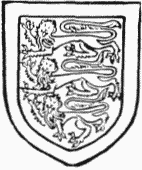
Holand. England in a border argent.
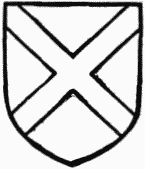
Nevill, Earl of West morland. Gules a saltire argent.
The manor of NORTH TALWORTH may be identified with the land which previous to the Conquest had been held by Edmer, and in 1086 was held by Ralph of Richard de Tonbridge. Afterwards it seems to have been held under the Clares by the Dammartins (fn. 97) and in 1314 appears among the fees held of Gilbert de Clare by Thomas de Warblington, who held the manors of Tandridge, North Talworth, and Ockley by service of three and a half knights' fees. (fn. 98) John de Warblington held the same of Hugh le Despenser in 1349, (fn. 99) and the three manors were in 1376 held by Alice the widow of John de Warblington. (fn. 100) In 1440 they formed part of the fees of Isabel, Countess of Warwick, daughter of Thomas le Despenser, grandson of Hugh, being described as those which Thomas de Warblington formerly held. (fn. 101) There seems to be no further trace of this manor, the overlordship of which was in the same hands as that of Long Ditton, with which perhaps it was united, unless it be the property in Talworth of which John Danaster, baron of the Exchequer, died seised in 1540, (fn. 102) which he settled on his daughter Anne, afterwards the wife of Owen Bray of Chobham. Manning and Bray (fn. 103) say that Danaster's land was held in 1571 by Margaret Lambard (Lambert), whose heir was Christopher Muschamp. Christopher married a daughter of a Margaret Lambert, (fn. 104) who was also apparently his cousin. He died in 1587. His will was dated from his capital messuage of Talworth, and he held lands in Carshalton, Beddington, Sutton, and Wallington 'eidem capitali messuagio spectantes.' His widow Dorothy, who had been apparently his second wife, had a life interest with reversion to his son Henry. (fn. 105)
The priory of Merton held a manor in Talworth, called by Manning and Bray SOUTH TALWORTH, which was also part of the Clare fee.
At an early date Huelmus le Fleming acquired a virgate of land in Talworth from Robert, Prior of Merton, which the prior had before received from Hugh son of Isold. (fn. 106) In 1255 the Prior of Merton held the eighth part of a knight's fee in Talworth of Ralph de Planaz, for which he denied that he owed suit of court at the manor of Talworth, (fn. 107) and in 1314 among the fees of Gilbert de Clare was a manor of Talworth held by the Prior of Merton by the service of a quarter of a knight's fee, value 100s. (fn. 108) In 1349, (fn. 109) 1376, (fn. 110) and 1440, (fn. 111) the inquisitions on the Clares and their descendants mention the same fee.

Merton Priory. Or fretty azure with eagles argent on the fret.
At its dissolution the priory held rents of assize in Kingston, Ditton, Talworth, Chessington, Hook, and elsewhere amounting to £1 16s. 1½d. (fn. 112) These were annexed to the honour of Hampton Court. (fn. 113)
The Knights of St. John in the reign of Henry III held a knight's fee in Talworth of which they had been enfeoffed by Henry Kyryel. Their prior in that reign was fined for withdrawing his men of Talworth so that they did not render suit at the king's court at Kingston, nor pay tallage when due. (fn. 114) In 1294 Henry Pycot granted 8 acres in Talworth to the prior of this order. (fn. 115)
CHURCH
The church of ST. MARY is a building of Godalming stone in the style of the 13th century, consisting of a chancel, chamber, vestry, nave, transepts, aisles, and south porch. It was erected in 1878–80 some distance to the north of a former building on a neighbouring site; the foundations of this are still visible, and some portions of its chancel walls still stand. It was of a small Greek-cross plan and built of brick in the place of the ancient building, which dated partly from the 12th century and which had fallen into a bad state of decay. Nothing remains to show the size and appearance of the ancient church, but from the disposition of the churchyard it must have been very small, no larger than the 18th-century building.
Some of the floor slabs and mural monuments have been left in their original places in the 18th-century remains. The earliest is a slab to Thomas Evelyn, 1659, and there are others to Sir Edward Evelyn, bart., 1692, Lady Mary Evelyn, 1696, Lady Anne Evelyn, 1669, and to other members of the same family, also to Anthony Balam, February 1691–2, Mary infant daughter of Sir William Glynne, bart., 1692, and other later slabs, besides some modern mural tablets. Several ancient brasses were removed to the new building and are now affixed to the walls. One at the east end of the north aisle has the figures of a man in a long fur gown and his wife, both with their hands in prayer. The inscription below reads:—'Hic jacent Ro[ber]tus Castelton armig['] un[us] justic' dñi Regis ad pacem in Com[itatu] Surr ac Clīcus p[o]itor' in S[caccar]io [?] eiusde[m] d[omin]i R apud Westm[..] et Elizabeth ux[or] eius qui quidem Ro[ber]tus obiit XXIII die Dec[em]br ano dñi mill[essim]o Vc XXVII cujus anime propicietur Deus Amen.'
Below are the small figures of their six daughters; but the indent only remains of the sons. There is also a shield with their arms, on a bend three roundels (? buckles).
By the side of this brass is another of a knight and lady of the Elizabethan period, but it has no inscription.
On the south wall of the chancel is a brass inscription which reads:—
'Here lieth Maist' John Haymer M. of Arts and late p[ar]son of this chirche of whose goods was dispende an C Mck. among pore people and upon highways nere unto this town and w'in the same on whose soule Jhesu have mercy.'
John Haymer was rector of the church from 1492 to 1535. These are the only antiquities preserved in the church, which is a well-built structure, one of the last designs of the late George Edmund Street, and contains some good stained glass. The pulpit is of stone, the font of green and white marble. Two bells hang in a cote above the chancel arch.
The churchyard is fairly large, having evidently been augmented when the new church was erected; it contains many graves, and there are some large trees around it, especially the older part at the south end. A new lych-gate stands at the entrance to the north, by the road.
The communion plate consists of a silver cup dated 1659 but without a hall-mark, a stand paten with the hall-mark of 1770, 'The gift of a worthy person to the parish of Long Ditton,' a large silver flagon of 1715, a smaller cup and stand paten of 1894, and a salver of 1856. The first book of the registers is a parchment volume containing baptisms, marriages and burials 1564 to 1655, the second is a large paper book with baptisms 1659 to 1812, marriages 1659 to 1752, and burials 1658 to 1812; the third is a paper copy of part of the second book, from 1695 to 1710; the fourth has marriages from 1754 to 1793, and the fifth continues them to 1812.
There is also a book of churchwardens' accounts and vestry minutes dating from 1663, but it gives little information as to the repairs to and state of the fabric; there were many repairs carried out in 1675, and mention of three new bell-ropes and mending of the wheels in 1676. In 1680 is an entry giving a list of the communion plate as follows:—' (1)2 flaggons of pewter, (2) 1 chalice of silver with a cover to it of silver, (3) 2 pattons of pewter, (4) a faire surplice, (5) a table Cloath of Holland.' The list is continued with later items:—'(6) a large coffin the gift of Mr. Ro. Pocock, rector, (7) a large carpet of green cloath for the Communion table, (8) a faire green velvet cushion for the pulpit, the gift of Mrs. Sarah Pocock, the wife of Mr. Ro. Pocock, rector A.D. 1690, (9) a faire piece of plate to put the Communion bread on in the fashion of a patten or Pattison, being the gift of Mrs. Sarah Pocock, the wife of Mr. Robert Pocock the present rector, Aprl 1696, (10) a Common Prayer Book, the gift of Madame Sophia Glynne wife of Stephen Glynne, esq., given in August 1696, (11) a velvet cushion with a cloath round the pulpit a rich fringe about it of crimson colour lined with fine silk, 1699.' It would be interesting to know whether in the sixth item the word 'coffin' represents a coffer or chest, or whether it is really a late example of the common coffin used for the burial service of poor persons who were interred simply in their grave clothes.
In 1716 George London, gent., gave a large Common Prayer Book for the Communion Table; in 1720 John Willis, Virginia merchant and citizen of London, gave a rich green velvet furniture for the pulpit laced with a broad gold lace, and a cushion of the same, for which the parishioners erected a new pulpit.
In 1715 is a note of the anonymous gift of a silver flagon. In 1778 the vestry decided to pull down and rebuild the church, but no information is given as to the progress and cost of the work, except that in 1779 the rector complained that the work was still unfinished and money unobtainable.
ADVOWSON
A church existed at Long Ditton at the time of the Domesday Survey. (fn. 116)
The advowson was claimed by the Prior of Merton at the end of the 13 th century against the lord of the manor of Long Ditton as having been granted by Peter de Talworth to the Priory of Merton and confirmed by King Henry the elder. (fn. 117) The Priors of Merton presented until the Dissolution, but did not appropriate the church. (fn. 118) Edward VI granted the advowson of the rectory to David Vincent (fn. 119) and the advowson then followed the descent of the manor of Long Ditton. Anne Evelyn, widow, presented in 1662 and 1665. (fn. 120)
Sir Evelyn Alston sold the advowson to Sir James Clarke in 1700. (fn. 121) An Act of Parliament was passed in 1753 for the sale of the advowson after the death of the Rev. Joseph Clarke, (fn. 122) and it was then sold, according to Manning and Bray, to Mrs. Pennicott. George Elers, as a trustee for Mrs. Pennicott, presented in 1750, (fn. 123) but he with Mary his wife sold the advowson in 1767 to New College, Oxford, (fn. 124) to which it still belongs.
CHARITIES
Smith's Charity, which amounts to about £30 a year, is distributed usually in clothing. Bishop Willis's Visitation in 1725 mentions land called Kingswood leased for relief of the poor. This is not the estate upon which Smith's Charity is now charged.