A History of the County of Surrey: Volume 4. Originally published by Victoria County History, London, 1912.
This free content was digitised by double rekeying. All rights reserved.
'Parishes: Merton', in A History of the County of Surrey: Volume 4, ed. H E Malden (London, 1912), British History Online https://www.british-history.ac.uk/vch/surrey/vol4/pp64-68 [accessed 3 May 2025].
'Parishes: Merton', in A History of the County of Surrey: Volume 4. Edited by H E Malden (London, 1912), British History Online, accessed May 3, 2025, https://www.british-history.ac.uk/vch/surrey/vol4/pp64-68.
"Parishes: Merton". A History of the County of Surrey: Volume 4. Ed. H E Malden (London, 1912), British History Online. Web. 3 May 2025. https://www.british-history.ac.uk/vch/surrey/vol4/pp64-68.
In this section
MERTON
Marten, Martin, Marton.
Merton is a parish of about 1,763 acres, occupied for the most part by market gardens on the south and west, and by increasing numbers of small houses connected by unbroken lines of streets with Lower Wimbledon on the north. The Beverley Brook forms the boundary line between Merton and New Malden. The soil is mostly London Clay, but the old village with the site of the priory is on gravel and alluvium of the River Wandle.
An award was made for the inclosure of Merton Common in 1817, under an Act of 1816. (fn. 1) Some common fields had apparently been inclosed earlier. (fn. 2)
The fame of Merton is derived from the ancient priory of Augustinian canons, commonly called Merton Abbey, of which a few walls still remain. These are for the most part built of flint. One wall lies along the north side of the railway line about 100 yards west of the station, and another runs east and west south of the station. Two calico-printing factories were founded on the site in the 18th century, one by Francis Nixon, whose art of copper-plate calico-printing is celebrated in his epitaph. (fn. 3) In 1725 the chapel of the priory still existed, but was not used for services. (fn. 4) The wealth of the priory and its position near London made Merton the scene of various public events during the Middle Ages. The kings often stayed there, and the statute of Merton was there enacted in 1236, whereby Roman civil law was rejected. Hubert de Burgh took sanctuary at Merton on his fall in 1232, and was violently removed from the church. Walter de Merton, chancellor of Edward I, was apparently a native of the parish. Thomas Becket was at school at the priory (fn. 5) and William of Ockham was possibly educated there. (fn. 6)
Before the opening of the railways Merton was completely rural, though the road to Epsom and Dorking ran through it, on which coaches were frequently passing. There are now four railway stations in the parish, Merton Abbey and Raynes Park on the London and South Western, Merton Park and Morden on the London, Brighton and South Coast railway.
In 1801 Merton became the home of the Hamiltons and Nelson. On 15 September 1801 Nelson bought Merton Place, an early 18th-century house, built probably by Mr. Robert Dorrill, who settled Merton Place by name on his daughter Mary Meriton in 1709. By Nelson's will it was left to Lady Hamilton, who sold it in 1808. The house was pulled down about 1840. It stood near the west end of Reform Place, but further back, towards Nelson Grove Road. (fn. 7) The well which supplied it with water is in the back yard of No. 61 High Street. The grounds are now marked by Nelson Road, Trafalgar Road, Victory Road, Hardy Road and Hamilton Road.
Opposite the church, standing in grounds inclosed by high brick walls, is Church House, a large early 18th-century building of two stories, now in a very dilapidated condition, the upper part being used as workshops. The external walls are covered with plaster, the roof is of tiles. The house faces north and south, the south being the principal front, and is approached through a fine wrought-iron gateway standing between brick piers surmounted by stone vases. The house is E-shaped and has at the back two semi-hexagonal bay windows. The hall is a fine panelled room, but unless immediately repaired will soon be in decay. Spring House, another building of about the same date, stands in a road to the north of the church. It is a brick building of three stories with a wooden cornice, Doric entrance doorway and tile roof. The 'King's Arms' in the High Street is an 18th-century hostel. Opposite the wall by the railway lines stands Abbey House, an 18th-century building of no great interest. The external walls are covered with plaster.
The paper mills of Messrs. Read & Co., called Merton Abbey Mills, probably represent the Amery mills (see below under manor), which date back to the days of the Conquest. Close by these mills are some extensive watercress beds. The Merton Abbey Works of the Morris Company glass painters and furniture printers and the Merton Abbey silk-printing works of Messrs. Liberty & Co. occupy the site of the calico-printing factories mentioned above. (fn. 8) The manufacture of japan and varnish is also an industry of the parish.
Merton School (National) was founded in 1865, and the present building erected in 1870. Abbey Road (National, infants) was built in 1856 and enlarged in 1894. The Council School, Botsford Road, was started in temporary buildings in 1906.
MANOR
The earliest mention of land at MERTON is in the year 967, when Edgar granted to EarlAlphen and Elswitha his wife 20 cassatas of land at Merton near Wimbledon and Mitcham, and at Dulwich. (fn. 9) It is not certain whether this land is identical with that which formed part of Harold's holding (perhaps as king) immediately before the Conquest. At the Domesday Survey this was held by William I, and was assessed at 20 hides. It had a church, and two mills worth 60s., and sixteen houses in Southwark belonged to the manor. (fn. 10) The place was then populous, with fifty-six villein holdings and thirteen bordars. Appurtenant to the manor were 2 hides held by one Orcus in another hundred. In 1086 these were valueless. Also the Bishop of Lisieux held 2 solins in Kent which at the time of King Edward and after the Conquest had belonged to this manor. (fn. 11)
By a grant of Henry I (fn. 12) the 'vill of the Crown called Merton' was bestowed on the canons of Merton in frankalmoign, free of all taxation and jurisdiction, to be used for the construction of a church which was to be dedicated to the Virgin Mary. (fn. 13) Henry II and Richard I also confirmed this grant. (fn. 14)
About 1348 litigation arose concerning the customs of the manor. Stephen in the Hale, John Jakes, Richard Est and other men of the Prior of Merton complained of his unscrupulous exaction of services and customs such as had not been went when the king held this demesne. (fn. 15) The men alleged they held only by fealty and rent; but the prior exacted one day's forced labour a week, and compelled their services for mending a ditch called Le Brok, shearing the prior's sheep for two days (for which they only received ½d. a day), mowing his meadows for a day and a half, with pay of 1½d. a day, each man also having to find three men for three days to carry the prior's hay, and for three half-days to take the grain, for nothing. Further, the prior exacted for twelve days a year twenty-four men to reap his corn with an allowance of ¾d. for four days' food, and ½d. for eight days' food. Further, they had to sift the prior's malt from the Feast of St. Andrew to Christmas, with a 4d. fine for any leakage, and to harrow 1 acre for a loaf worth ¼d.; besides which the prior exacted ten eggs a year from each on Good Friday. The upkeep of the bridge between Merton and Kingston was also one of their tasks. Their sons could not escape this bondage by taking holy orders without paying the prior a fine, and none might sell their own corn or cut down their own timber without the prior's licence. To all these and other allegations the prior could only aver the men were his serfs, a charge they denied, and to prevent them from prosecuting the suit he tried to impoverish them by heavily distraining them by their goods and chattels. (fn. 16)
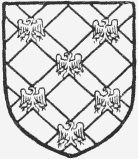
Merton Priory. Or fretty azure with eagles argent at the crossings of the fret.
At the Dissolution Merton with its members was valued at £49 12s. 5d. and the farm and the mills at £4 10s. (fn. 17) The manor was granted by Philip and Mary to the priory of Sheen in 1558. (fn. 18) It afterwards remained in the Crown until 1610, when it was granted, but without the mills or advowsons of churches, to Thomas Hunt of Hammersmith for £828 8s. 9d., (fn. 19) who retained it until 1637, (fn. 20) when he joined with others in conveying it to James Haward. (fn. 21)
In Hilary 1664–5 it was held by Penelope Haward, daughter of James, and John Long and his wife Mary, apparently another daughter. (fn. 22) In 1675 William Godman and Dorothea his wife, probably the third sister, quitclaimed the manor to Penelope and her husband Nicholas Philpot. (fn. 23) In 1699 Nicholas Philpot, apparently a son, (fn. 24) sold it to John Dorrill, (fn. 25) in whose family it remained until the latter part of the reign of George III. (fn. 26) John Chambers Dorrill sold it in 1801 to John Hilbert. (fn. 27) In 1820 Francis Merritt held it in right of his wife Elizabeth, and assigned it to Joseph Benwell and Joseph Kage, probably trustees, with the two mills (fn. 28) (which he had apparently acquired from the owners of the site, see below).
In 1887 Sir John Innes, M.P. (one of the large local landowners), appears as lord of the manor. The manorial rights are now extinct.
The site of MERTON ABBEY was granted in 1558 to the priory of Jesus of Bethlehem at Sheen. (fn. 29) But the same year Elizabeth came to the throne, and the property reverted to the Crown. In 1590 Gregory Lovell, lessee since 1582, (fn. 30) was granted a new lease for twenty-one years (fn. 31); and in 1600, in recognition of the signal service of Charles Earl of Nottingham, Lord Howard of Effingham, against the Armada, Nichola Zouche and Thomas Ware were granted various lands including these, on trust for Lord Howard, to whom they conveyed them in 1601. (fn. 32)
In 1605 Charles Earl of Nottingham conveyed the site to John Spilman, (fn. 33) who was knighted the same year. The following year Spilman and others assigned it to Sir Thomas Cornwall, (fn. 34) from whose hands in 1613 it passed to Sir Edward Bellingham and William Ashenden. (fn. 35) A certain Thomas Marbury also quitclaimed his right to Bellingham at the same time. (fn. 36)
In 1624 Sir Francis Clerke and Anne his wife conveyed the lands to Roland Wilson. (fn. 37) Mary daughter of Roland Wilson married Samuel Crisp. In 1662 Samuel Crisp and his wife, Edward Crisp, Roland Crisp and his wife, John Carleton and his wife, Edmund White and his wife, William Cox and his wife, and Humphrey Davy with his wife all conveyed the lands to Elisha Crisp, (fn. 38) who in 1668 sold to Thomas Pepys. (fn. 39) Thomas Pepys left a widow Ursula, who joined with Edward Smith and Olive his wife in a conveyance to trustees. (fn. 40) Edward Smith and his wife by themselves in 1696 sold to Susanna St. John, (fn. 41) who in 1701 conveyed to William Hubbald of Stoke near Guildford. He died in 1709 and in 1711 an Act was passed for selling his estates to satisfy his debts to the Crown. The site of the priory was sold to Sir William Phippard, kt., who by his will left the estate to his sons William, John (fn. 42) and George, and his daughter Elizabeth, wife of William Cleeves, (fn. 43) as tenants in common.
George died unmarried, having devised his share to William and John. John also died without issue in 1774, when the moiety which he held under George's will went to William. The rest of his estates he left to his niece Mary Cleeves, who married Richard Fezard Mansfield of Ringwood, co. Hants. (fn. 44)
The two mills called Amery Mills, with Amery Garden, formerly appurtenant to the manor, were in 1588 leased to John Penson for twenty-seven years. (fn. 45) In 1613 George Low and others were granted £4 6s. 8d. rent from these mills and other Sheen lands which had been granted to Edward Ferrers on 19 May 1609. (fn. 46) Later they seem to have been granted to Richard Burroll, who previous to his death in 1629 sold them to Sir Francis Clerke for £800, (fn. 47) from whom they devolved on Richard Fezard Mansfield in 1778 (vide supra). Before 1820 they seem to have been acquired by the owner of the manor of Merton.
In 1553 John Earl of Warwick and Sir Henry Sidney, kt., were granted MERTON GRANGE, which was the grange of the priory estates situated outside the gates of the priory. (fn. 48) After the death of the earl without issue in 1554 and the attainder of all his family his half was granted by Elizabeth to Sir Henry Sidney. (fn. 49) It included lands called 'Lyon,' 'Le Vynes,' Hallowmede and Sheephouse. Before 1629 the Grange was among the possessions of Richard Burroll, who sold it to Robert Bromfield for £2,100. (fn. 50)
A house and farm called WEST BARNES (formerly belonging to Merton Priory and valued in 1535 at £3 6s. 8d. a year (fn. 51) ) was in 1545 granted to Sir John Gresham of London, kt. (fn. 52) It comprised 200 acres. By his will of 1553 Gresham settled it on his younger son John, (fn. 53) who in 1612 sold to John Carpenter. In 1660 Robert Carpenter held it and in 1732 this family sold to John Budgen. In 1783 John Smith Budgen sold to John Midleton, who resided there in 1812. (fn. 54) The name still persists.
A house called MARTINHOLTS was in 1547 granted to Sir Ralph Lee. (fn. 55)
CHURCH
The church of ST. MARY consists of chancel 13 ft. 8 in. by 44 ft. 2 in., with modern organ chamber and vestry, nave 21 ft. by 72 ft., north aisle 13 ft. 8 in. by 57 ft. 6 in., and south aisle 9 ft. 8 in. by 57 ft. 6 in., internal measurements. The earliest part of the building is the west end of the nave, which dates from the 12th century. The church then consisted of an aisleless nave the same size as the present one and a chancel. Early in the 13th century the chancel was pulled down and a wider one erected. No other structural alterations appear to have been made until the middle of the 19th century, when in 1856 the south aisle of four bays was added, extending to within nearly 14 ft. of the west wall of the nave. Ten years later the north aisle and organ chamber were added, while in more recent times the vestry was built, and in 1897 an arch was built across the end of the nave between the west walls of the aisles and an old wooden gallery cleared away.
The walls of the nave and aisles are built of split flint with stone quoins and have tile roofs, though the chancel walls are covered with flint dash. The quoins and windows to the vestry are of brick.
The east window is of three cinquefoiled lights with vertical tracery, all of which is modern except a few stones in the inner jambs. A wall arcade of equilateral arches running along the north and south walls divides the chancel into four bays. In the westernmost bay on the north side is the organ, and in the next is a two-light trefoiled window, the jambs only being ancient, and in the easternmost are single lancets. The organ chamber is lighted by a reset 14th-century window of two trefoiled lights and a quatrefoil taken from the westernmost bay of the north chancel wall (the next window of which is a copy). In the easternmost bay of the south wall of the chancel is a two-light window similar to the one opposite, which contains some pieces of old glass. The east light contains the royal arms, and in the west are those of the abbey. A late 16th-century monument covers a blocked-up lancet in the next bay, while in the westernmost division are an early 14th-century window of two trefoiled lights and a plain equilateral arched priest's doorway leading into a modern porch. This door has some pieces of mediaeval ironwork on it. The chancel arch is a chamfered drop arch and springs from the chancel walls.
The nave arcade is modern in 13th-century style. At the west end of the north aisle are the remains of a late 12th-century doorway re-inserted from the north wall of the nave when that aisle was added. The doorway has been badly pieced together, and only the semicircular arch mould, which is enriched with cheveron ornament, is original. On the door are some pieces of mediaeval ironwork, and on the outside is a much-restored and thickly painted 15th-century wooden porch standing on a base of flint and stone. The central opening has a fourcentred head, the side posts are carried up and support an embattled transom, while the mouldings on the head break away and take the form of an ogee head meeting on the transom. The spandrels are filled in with quatrefoils in circles, in which are placed small escutcheons. The roof is of tiles. There are three windows in the north aisle in 14th-century style and a similar window in the west wall.
The south aisle is lighted by four two-light windows in 14th-century style, inserted in 1907, and on the east by a window of two trefoiled lights with a quatrefoil, all of plate tracery. Across the nave, between the west walls of the aisles, is a pointed arch springing from shafts having moulded caps and bases in the style of the 15th century and built in 1897. To the west of this, in the north wall of the nave, is a small semicircular-headed window, the external head of which is new, while on the opposite wall is a similar window having a segmental head filled in with a modern cinquefoil. In the west wall is a 14th-century doorway, and above is a two-light window with modern tracery.
Over the chancel is a late 14th-century opentimber roof divided into three bays by framed trusses. The roof of the nave is plastered over, but the original plain moulded wall plate remains, and the tie-beams of principals to an early roof are still to be seen spanning the nave, though the framing has disappeared. The nave roof is continued down over the south aisle, but the north aisle is covered with a separate steep-pitched roof having trussed pitch pine rafters.
On the south wall of the chancel is a monument to Gregory Lovell of Merton Abbey, coiffeur to Queen Elizabeth, who died in 1597, and his two wives—Joan daughter of — Whithead, by whom he had one son and three daughters, and Dorothy daughter of Michael Greene, by whom he had five sons. The monument is of marble, and on either side is a small Corinthian column of red marble carrying an entablature of the same order. On the dexter side is the figure of Gregory kneeling in prayer, facing his two wives. In a panel beneath the man are figures of his children by his first wife facing his five sons by his wife Dorothy. The inscription is underneath, while above are three shields. In the middle are the quartered arms of Lovell, (1) Argent a cheveron azure between three squirrels gules, (2) Sable a cross between four lions or, (3) Vert two cheverons argent with three cinquefoils gules upon each, (4) Argent four bars gules (this should be Barry of ten argent and gules) a lion or with a crown party gules and or. The dexter shield is Lovell impaling Azure a cheveron between three hunting horns argent, for Joan Whithead, his first wife. The other shield is Lovell impaling Azure three harts tripping or with the difference of a crescent or, for Dorothy Greene his second wife.
In the chancel floor is a stone to 'Sir Henry Stapylton of Moyton upon Swale in ye County of Yorke,' who died 1679, while by the side is one to 'Grace ye wife of Thomas Robinson of Rokeby in ye County of York, eldest daughter of Sir Henry Stapleton 1676.'
Over the west end of the north aisle rises a small broach spire covered with shingle and surmounted by a weather vane, while at the base wooden louvres open into a belfry. Hanging against the south wall at the west of the nave is a painting of the bearing of the Cross, of the school of Van Dyke, the original being in St. Paul's, Antwerp.
Among the hatchments hanging on the nave walls is Lord Nelson's, while in the vestry is the bench which he is said to have occupied when attending service at the parish church.
There are five bells: the treble and second are modern, the third is by Thomas Mears, 1803, the fourth has a Latin inscription in black letter capitals, 'Sancta Margareta ora pro nobis,' together with two stops and a shield of the royal arms, and the fifth is by Bryan Eldridge, 1601.
The plate consists of two patens, one of which has a date mark 1709 and the other 1895, both having the Britannia stamp; two cups, one of 1709, stamped similarly to the paten of that date, and the other of 1879. There is also a flagon, the gift of William Baynes and Hester his wife to the parish church of Merton, date mark 1717.
The registers are in six volumes: i, 1559 to 1656; ii, 1694 to 1714; iii, baptisms and burials 1700 to 1785, marriages 1700 to 1753; iv, 1754 to 1786; v, baptisms and burials 1787 to 1812; vi, marriages 1787 to 1812.
In the last register is an interesting notice of the baptism of the son of Bernard and Elizabeth Suckling, a relation of Lord Nelson, who stood sponsor to the child. The child was born in Norfolk on 17 August 1803, but the baptism was 'postponed on account of Lord Nelson's absence out of England on his Majesty's service' until 6 September 1805.
The ecclesiastical parish of ST. SAVIOUR'S, Raynes Park, was formed in 1907.
A Congregational chapel was built at Merton in 1818 and a Wesleyan chapel was endowed in 1890.
ADVOWSON
A church is mentioned in the Domesday Survey and was evidently included in the grant of the manor to the canons by Henry I. It was appropriated to the convent before 1291 (fn. 56) and the rectory was valued at £10 in 1535. (fn. 57)
No vicarage was ever ordained. Whilst in the possession of Merton Priory the church was served by a chaplain appointed by the prior, and after the Dissolution by a perpetual curate nominated by the impropriator.
The rectory was in 1553 granted to Thomas Locke and his wife. (fn. 58) In 1644 another Thomas Locke sold it to Katharine Highlord. (fn. 59) She devised it to Robert Wilson, her nephew, (fn. 60) who in 1697 conveyed it to Robert Dorrill, (fn. 61) who devised it to his daughter Mary in 1707. She married Henry Meriton, (fn. 62) who survived his wife and in 1733 sold to Joseph Chitty, from whom the rectory passed to his brother Sir Thomas Chitty. He devised in 1762 to his daughter Eleanor wife of George Bond, who was the owner in 1808. (fn. 63)
By 1842 Mrs. M. Bond as impropriator held the advowson, and from 1852 to 1858 a Mr. Wingrove, after which Mrs. Bond appears again as the patroness. From 1862 to 1874 the advowson was held by the Rev. William Edelman, the incumbent, and then by his widow (but from 1866 to 1871 by the Rev. S. Dawes). Mrs. Edelman continued holding the patronage down to 1881, when the Rev. Ernest Murray-Robinson became vicar and held it jointly with his wife up to 1896; in 1901 he married the Honourable Mary Hay, third daughter of Sir John Burns. In 1906 she married the Rev. Claude E. L. Corfield and still holds the advowson. (fn. 64)
Mr. Edward Collins, curate in 1725, complained to Bishop Willis that Mr. Henry Meriton, 'pretended patron,' had his own house licensed as a meeting house for Baptists (although none came), and had been guilty of outrageous behaviour in church, for which he was being then prosecuted in the Ecclesiastical courts. The curate's stipend was £14 a year, but former curates had made large sums by irregular marriages celebrated in the church as an unlicensed place belonging to the former abbey. Mr. Collins and his immediate predecessor had set their faces against such a practice. (fn. 65)
CHARITIES
In 1687 Mr. William Rutlish left £400 for apprenticing poor children. By judicious investment this ultimately became £599 a year. Part has been used for the Rutlish Science School, and part is distributed in clothes, bread and coals.
Mr. Rowland Wilson in 1654 left 52s. a year for bread.
Mrs. Elizabeth Simon left £600 for general charitable purposes. In 1801 six almshouses were founded. These were lately untenanted and in a state of dilapidation owing to a dispute as to the title.
Mr. Richard Thornton left £7,076 in 1865, the interest on which is partly applied to the school and partly to bread and coals.
Half an acre of land in the common fields was left to the poor before 1798 by a person unknown.
There are smaller benefactions, including Henry Smith's, as in other Surrey parishes.