A History of the County of Hertford: Volume 3. Originally published by Victoria County History, London, 1912.
This free content was digitised by double rekeying. All rights reserved.
'Parishes: Stanstead Abbots', in A History of the County of Hertford: Volume 3, ed. William Page (London, 1912), British History Online https://www.british-history.ac.uk/vch/herts/vol3/pp366-373 [accessed 30 April 2025].
'Parishes: Stanstead Abbots', in A History of the County of Hertford: Volume 3. Edited by William Page (London, 1912), British History Online, accessed April 30, 2025, https://www.british-history.ac.uk/vch/herts/vol3/pp366-373.
"Parishes: Stanstead Abbots". A History of the County of Hertford: Volume 3. Ed. William Page (London, 1912), British History Online. Web. 30 April 2025. https://www.british-history.ac.uk/vch/herts/vol3/pp366-373.
In this section
STANSTEAD ABBOTS
Stanstede (xi cent.); Stanstede Abbatis, Abbotts or Abbot (xiv cent.); generally Stansted Abbots after xvi cent.
Stanstead Abbots is a parish of 2,612 acres, bounded on the north-west by the River Ash, which joins the Lea in this parish, on the south-west by the Lea and River Lea Navigation, and on the south by the Stort. Owing to so many rivers there is a large amount of permanent grass in the parish, about twofifths of the whole extent. (fn. 1) There are large patches of wood in the higher part of the parish: Easneye Wood on the north-west, Newgate Wood and Black Bushes on the north-east. The parish lies on the London Clay, the chief crops being wheat, barley and beans.
The old church of St. James and the manor-house of Stanstead Bury lie on high ground at some distance to the south-east of the village, which is situated near the river on the road to Hertford. The neighbourhood of Hertford and Ware probably brought a considerable amount of traffic through Stanstead, which may account for the seven burgesses there recorded in the Domesday Survey. Stanstead never had a market, as far as is known, nor is there any specific mention of burgage tenure later, but a 14th(?)century conveyance of a messuage and land 'vendere, dare, legare vel assignare' (fn. 2) may, perhaps, point to a survival of privileged tenure. To remedy the inconvenient distance of the church from the village the school was used as a chapel on Sundays in the 17th century and served by a minister of its own. (fn. 3) It was probably from this circumstance that Chapel Lane (so called in 1712) (fn. 4) took its name.
The main street of the village is the High Street. This at one end is continued as the road to Hertford, and at the other end makes an angle with the Roydon road, which just past the village branches north to Hunsdon and south to Roydon. At the east end of the street is the old Clock School, a 17th-century two-storied building with a tiled roof. The school was founded by Sir Edward Baesh as a free grammar school for the sons of inhabitants in 1635. Although it has been much altered and repaired, the schoolroom on the ground floor still has the original beams in the ceiling and oakmullioned windows. Under the Endowed Schools Act of 1879 the endowment was separated from the rest of Sir Edward Baesh's charities, and by a scheme under the same Act was devoted, under the name of the Baesh Scholarship Endowment, to maintaining two scholarships of £10 in Ware Grammar School for boys from elementary schools in Stanstead Abbots. When Ware Grammar School was abolished these scholarships were made payable at Hertford Grammar School. (fn. 5) The public elementary school opposite the corn-mill was built in 1869 on a site presented by Mr. T. F. Buxton. In the middle of the village is the Red Lion Inn, an early 17th-century building much altered. The date 1538, however, in modern form of figures appears in the middle gable. The house is tiled and has a projecting upper story and five gables; in spite of the rough-cast with which it is coated, there is visible some plaster ornament in low relief of early 17th-century date. Further along the Roydon road at the bottom of Cat's Hill (Ketteshell, xiv cent.) are Sir Edward Baesh's almshouses, built by the terms of his will proved in 1653. They consist of six brick cottages of two stories under one tiled roof and still retain the original door-posts and moulded window frames of oak. Netherfield, at the top of Cat's Hill, is the residence of Mr. H. L. Prior, J.P. In the village are a number of maltings, the manufacture of malt being the chief industry here as at Ware. The corn-mill, probably occupying the site of the mill mentioned in the Domesday Survey, is situated in Roydon Road. The present mill is a flour-mill, which succeeded an old timber-mill burnt down some years ago. The Mill Race is carried from the Lea through the town, and joins the Lea again to the south of the village, but the present mill is worked by gas power. In Chapel Lane is St. Andrew's Church, built by Mr. T. F. Buxton, consecrated in 1881, and constituted the parish church in 1882, (fn. 6) and the chapel of the Countess of Huntingdon's Connexion, dating from about 1809, but rebuilt in 1874. (fn. 7) To the north of the church is Hill House, the residence of Mr. B. Richardson, and Warrax, that of Mr. E. H. Barlow. The vicarage in the Roydon road is part of the Baesh trust, (fn. 8) and is held on lease by the vicar.
The south-west part of the parish between the Lea and the Stort lies very low, and the Rye Meads adjoining the Stort are liable to flood. Apparently in the 15th century the state of flood was permanent, for the district round the Rye House was then known as the Isle of Rye. (fn. 9) The extent of the island, which was imparked by Sir Andrew Ogard in 1443, seems to have been about 157 acres, (fn. 10) from the Lea on the west to the ditch running from the Stort to the Lea on the east. It thus included Rye Farm, about mid-way along this ditch, and the fields formerly called the Warren, now used as a sewage farm for Ware. (fn. 11) The lord of Rye Manor maintained a bridge over the Lea, and he also kept up a causeway through the Rye Meadows, which was used by coaches, &c., travelling to and from Norfolk and Suffolk (via Stortford) as a more direct way than the main road, for the use of which they paid a toll to the lord. (fn. 12) The present road across the meadows was made by Sir Charles Booth, and the tolls are now taken by the owners of the Netherfield estate.
The chief historical interest in Stanstead Abbots attaches to the Rye House. Richard Rumbold, a maltster and old army officer, one of the most desperate of the conspirators in the famous plot within a plot, was lessee of the Rye House in 1685. One suggestion which he is said to have made for the assassination of the king and Duke of York was to blow up the playhouse when they were both inside; a plan rejected by the other conspirators, who probably remembered the failure of Guy Fawkes in a similar attempt. When other proposals fell through he suggested the use of the Rye House for the murder, as from its lonely situation and high inclosures it seemed to offer a suitable shelter for the conspirators. Forty of these were to hide in the Rye House and waylay the king on his return from Newmarket. After the murder they were to retire into the house, which, being guarded with a moat and brick walls, could easily be defended against the country people. (fn. 13) Travellers from Newmarket, after crossing the Rye Meadows, would have to pass along a narrow lane with a thick hedge and ditch on one side and a long range of buildings belonging to the Rye House on the other, past which were the moat and garden wall, and further on a bridge over the Lea and another over the New River. It was proposed to place a body of horse and foot in the outer courtyard, who, when the king and duke arrived, were to issue out into the lane, this having been previously blocked by an overturned cart. (fn. 14) The plan was frustrated by the unexpected return of the king and Duke of York to London owing to a fire at Newmarket, and before another opportunity occurred the plot was revealed by Joseph Keeling, one of the conspirators, and the king's vengeance fell on the whole Whig party. (fn. 15) Rumbold escaped, and fought in the rising in Scotland under Argyle. He was taken prisoner when Argyle's forces were routed, and although mortally wounded was executed at Edinburgh, 'the pleasure of hanging him,' as Macaulay said, being 'one which the conquerors could not bear to forego.' (fn. 16) The contemporary official account of the plot gives a plan of the house. (fn. 17) North of the gatehouse, which occupies the south-east angle of the site, were two small rooms and a kitchen; on the west there was a small staircase, and next to it a hall 30 ft. by 24 ft. (fn. 18) In the north-west angle was a well staircase. There was a great parlour 35 ft. by 20 ft. at the west end and a smaller one 17 ft. by 16 ft., also other apartments and passages. The house was apparently built round a court (claustrum) of brick, and outside had an inner and outer court, the whole being surrounded by a moat. (fn. 19) Of the main part of the building only the gatehouse remains. This was used as a workhouse for the parish before the Poor Law Act of 1834, when the inmates were removed to Ware. In 1904 it was acquired by Messrs. Christie & Co. (see Rye Manor). It is now used as a show place, and an inn built in the forecourt of the house is a famous resort of excursionists and anglers. The 'great bed of Ware,' apparently immortalized by the reference to it in Shakespeare's Twelfth Night, was brought here from the Saracen's Head at Ware. It bears the date 1463, but it did not probably exist before the latter part of the 16th century. It is a four-post bedstead of carved oak, and measures 11 ft. square and 8 ft. high.
Easneye Wood (Isneye, Hysenhey, xiii cent.) in the north-west of the parish contains a tumulus. This was opened in 1899, but only calcined bones of preRoman date were found. (fn. 20) In 1253 the Abbot of Waltham Holy Cross had licence to make two roads through the wood in place of two other roads outside it, (fn. 21) and in 1332 another licence was obtained for imparking it. (fn. 22) A lease of the lodge in the park with the lands belonging, of the Lady Grove, Stanstead Grove alias Almond's Frith, and all the woods in the manor of Stanstead Abbots was made to John Rodes of this parish for fifty-seven years in 1526. (fn. 23) The farm of these lands was granted with that of the manor to Anne Boleyn in 1532. (fn. 24) In the reign of Elizabeth John Raymond had a lease of Isney Park together with the Great Farm of Stanstead. (fn. 25) When the estate was acquired by Thomas Buxton (see manor of Stanstead Abbots) Isney was still a thick wood. He built the present house, now the residence of Mr. J. H. Buxton, in 1869. (fn. 26) This house stands in a park of 133 acres and is approached by an avenue of trees nearly a mile long. In the abbot's manor were also some lands called Joyses after a family of Joce who had them in tenure in the 14th century. (fn. 27) In 1304 the abbot leased a dwelling-house and land assigned to the pittancer of the convent to Master John de Manhale, clerk, for life, (fn. 28) and in 1525 Roger Rodes had a lease of the land called the Pitansry or Joyses for twenty-one years at a rent of 5 marks payable to the pittancer. (fn. 29) These lands came with the manor to the Crown at the Dissolution and the name survives in Pitansey Meadow. (fn. 30) Other place-names occurring about the 13th century are Danesthemaneswode, Sturtereshull, Newstrate, Bokkeberwefeld, Alfladesfelde, Kyngesfeld and Alfeyesholsme. The frequent occurrence of 'holms' in this parish is noticeable.
Newgate, the site of which is marked by Newgate Wood, was an estate held in the middle of the 15th century by Andrew Ogard, lord of the manor of Rye, and sold in 1558 by George Ogard to Robert Grave. (fn. 31) Bonningtons, about 3 miles north-east of the church, formerly belonging to the Calvert family (see Hunsdon), who made the pond there, and afterwards the seat of Mr. Salisbury Baxendale, (fn. 32) is for the most part a modern two-storied house, but has an east wing which may date from the 17th century. In Moat Wood, on the north-east of the parish, there are traces of a homestead moat, but nothing is known of its history. (fn. 33)
One inhabitant of Stanstead Abbots of more than local fame was Joyce Trappes, daughter of Robert Trappes, a goldsmith of London, who married first Henry Saxaye, a London merchant, and, secondly, William Frankland of the manor of Rye. Her memory is famous from her numerous gifts for educational endowment. Jointly with her son William, who was a student at Gray's Inn, she founded junior fellowships and scholarships at Caius and Emmanuel Colleges, Cambridge. William, to whom there is a brass in the church, was killed whilst riding an unbroken horse in 1581, aged twenty-three. (fn. 34) In memory of him his mother founded the free school at Newport Pond, Essex, and by will of 1586 gave money and houses to Brasenose College to increase the emoluments of the principal and fellows and for the foundation of a fellowship. Her name was included in the grace after meat in the college hall, and the principal and fellows of Brasenose erected a monument to her memory in the church of St. Leonard's, Foster Lane, where she was buried. There is a portrait of her in the hall of Brasenose College and another in the master's gallery in the combination room at Caius College, Cambridge. (fn. 35) Thomas Bradock (1576–1604), who translated Bishop Jewell's confutation of the attack of Thomas Harding on Jewell's Apologia Ecclesiae Anglicanae, was vicar of Stanstead Abbots from 1591 to 1593. (fn. 36)
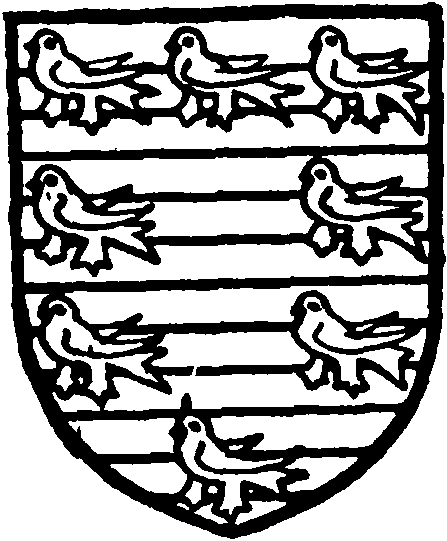
Valence. Burelly argent and azure an orle of martlets gules.
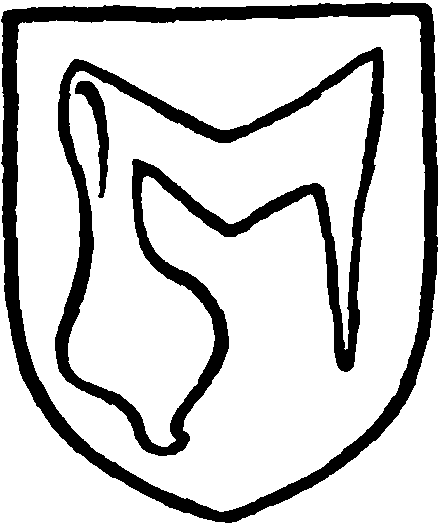
Hastings. Or a sleave gules.
MANORS
Stanstead, later Stanstead Abbots, Stanstead Bury
The manor of STANSTEAD, called later STANSTEAD ABBOTS, STANSTEAD BURY, and sometimes STANSTEAD BAESH, was held in 1086 as 17 hides by Ranulf brother of Ilger. It was then composed of two separate estates, one consisting of 11 hides which had been held in the time of the Confessor by Alwin of Godtone and which after the Conquest had been given by Ralf Taillebois to Ranulf as a marriage portion with his niece (one other hide which had belonged to the estate he attached to his manor of Hunsdon), and the other of 7 hides which had been held by fourteen sokemen, four of them the men of Anschil of Ware and the other ten the men of Alwin. On Ranulf's estate in 1086 there were 13 hides in demesne with two ploughs, whilst the tenants of the manor had eight ploughs, although there was land and also meadow for sixteen plough-teams. There was pasture on the manor for the live stock of the vill, woodland for a hundred swine, and a mill. Among the tenants are mentioned seven burgesses, who paid 23s., including dues of meadow and wood. (fn. 37) With other lands of Ranulf (fn. 38) Stanstead was acquired by the Clares, lords of Chepstow and Earls of Pembroke, (fn. 39) by whom it was held as two knights' fees. (fn. 40) After the manor was acquired by Waltham (see below) Richard de Clare released the abbey from all knight service, and the king also released him from the same service. (fn. 41) This Richard, son of Gilbert the first earl, left a daughter Isabel de Clare, who married William Marshal, afterwards Earl of Pembroke. His sons all died without issue, and the rent from the manor payable by the abbey to the overlords after the mesne lordship lapsed descended to his daughter Joan, who married Warin de Munchensy, and to her daughter Joan, wife of William de Valence Earl of Pembroke. (fn. 42) Through Isabella, sister and heir of Aymer son of William de Valence and wife of John de Hastings, the rent came to Laurence de Hastings, their son, created Earl of Pembroke in 1339. (fn. 43) His grandson John Earl of Pembroke died without issue, (fn. 44) his heir being his kinsman Reginald de Grey de Ruthyn, who levied a fine of the rent in 1400. (fn. 45) Philippa, widow of John de Hastings and afterwards wife of Richard Earl of Arundel, held, however, 44s. in dower (fn. 46) (i.e. onethird of £6 13s. 4d., or 10 marks), and later 5 marks (one-half of £6 13s. 4d.) was in the possession of Joan de Beauchamp, wife of Lord Abergavenny and sister of Thomas Earl of Arundel son of the above Richard (fn. 47); this descended to her son Richard Earl of Worcester, to Richard's daughter Elizabeth de Beauchamp, who married Sir Edward Nevill, and to their son George Nevill Lord Abergavenny. (fn. 48) After this there seems to be no further trace of it.
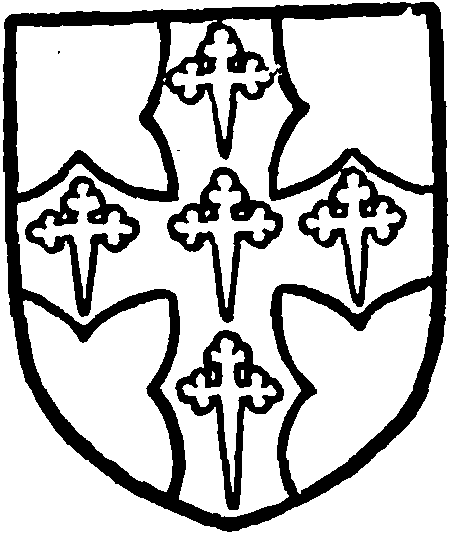
Waltham Abbey. Argent a cross engrailed sable with five crosslets fitchy or thereon.
At the beginning of the 12th century the manor was held under the Earls of Pembroke by Roger de Wancy, who mortgaged it to Bruno, a Jew of London, for a debt of £280 17s. 4d. His son Michael de Wancy, in order to obtain release from the debt, conveyed half of the manor to the king (Henry II), who granted it in free alms to the Abbey of Waltham Holy Cross. The other half was also given to the abbey by Michael at a rent of £12. (fn. 49) The grant was confirmed by William Marshal, the overlord, with a proviso that, if by escheat the fee should come to him or his successors, nothing should be exacted from them except the £12 reserved by Michael de Wancy, (fn. 50) the services due to the overlord being extinguished as stated above. The rent was paid by the abbey to Michael's heir Henry de Wancy, 'a Norman,' who seems to have forfeited at the beginning of the reign of Henry III, when it was granted by the king to Henry de St. Owen for his expenses whilst in Gascony with the king's brother Richard Earl of Cornwall. (fn. 51) Afterwards it was paid to the overlords as above. (fn. 52)
In 1253 the abbey obtained a grant of free warren in their demesne lands. (fn. 53) The liberties enjoyed by the abbey in their lands were as full as 'royal power could make them.' In Stanstead they had inter alia toll, team, soc, sac, infangentheof, utfangentheof, chattels of thieves, amercements of murders, pleas of namii vetiti, free fishing in the Lea throughout their demesne lands, and free warren. Their men were quit of shires and hundreds, ward, scot, geld, sheriff's aids, toll in markets and fairs and in crossing bridges, roads and seas, and anyone accused had the right to take his plea to the court at the Holy Cross and answer there according to civil law. (fn. 54) In 1522 the abbey leased the manor for sixty-one years (reserving the manorial rights) to John Rodes of London and his wife Margaret. (fn. 55) The manor was obtained from the abbey by Henry VIII in 1531, who granted in exchange the site of the monastery of Blackmore in Essex, the priory manor and other lands. (fn. 56) The next year the king gave the farm and reversion of the manor to Anne Boleyn on her creation as Marchioness of Pembroke. (fn. 57)
After the death of Anne Boleyn in 1532, Stanstead Abbots remained in the Crown until 1559, when Queen Elizabeth granted it to Edward Baesh of London, (fn. 58) who in 1577 had licence to impark 300 acres of land there with a grant of free warren. (fn. 59) Edward Baesh died in 1587, when the manor descended to his son Ralph. The inscription to Edward in the church calls him general surveyor of victuals for the royal navy and marine affairs in England and Ireland during the reigns of Henry VIII, Edward VI, Mary and Elizabeth. Ralph died in 1598 and was succeeded by his son Edward. (fn. 60) On the death of Edward in 1653 the manor passed to his cousin Ralph, whose son Edward conveyed it in 1678 to Edward Byde and Ralph Skynner, (fn. 61) probably in trust for Thomas Feilde. Thomas was knighted in 1681 (fn. 62) and died in 1689, when Edmund his son succeeded. (fn. 63) Edmund's three sons, Thomas, Edmund and Paul, held the manor successively and died without issue. (fn. 64) It passed to their cousin Thomas Feilde, rector of Eastwick, to his son William Henry Feilde and to the latter's son of the same name. (fn. 65) William Henry Feilde, jun., sold it to Philip Hollingsworth of Thundridge, who bequeathed it to his sister. She directed that at her death it should be sold for the benefit of the children of Paul Meyers of Forty Hill, Enfield. It was bought by Dr. Abraham Wilkinson of Enfield, whose son sold it to Thomas Fowell Buxton. (fn. 66) Mr. Henry Buxton, his grandson, is the present lord of the manor.
At the beginning of the 19th century the manorhouse of Stanstead Bury was the residence of Captain Jocelyn, R.N., descended from Sir Robert Jocelyn, bart., of Hyde Hall in Sawbridgeworth. He died in 1806 and was succeeded by his son Robert Salusbury Jocelyn of Stanstead Bury. (fn. 67) Later the manor-house was used as a hydropathic establishment, and is now the property and residence of Mr. Spencer Trower. (fn. 68) It is a building of two stories with attics, and is partly built of brick and partly of timber framing covered with cement. It was probably originally a house of late 16th-century date, but it has been so much altered and added to in the 17th and 18th centuries that the old plan is lost. The west side is the oldest part, and the cellar under this appears to be the only 16th-century work remaining. In one of the cellars is a blocked window in the east wall, probably originally an outside wall; in the south wall of the same cellar are two small triangular-headed niches, similar to those at Watton Place, Wymondley Bury, and other old houses in the county. In an angle on the west front is a timber-framed staircase, cemented externally, probably of 17th-century date. The north, south and east fronts are mainly additions of the early 18th century. In the window of a room on the west side is some old heraldic glass; one portion shows a sheaf of corn flanked by the initials I.F. of a member of the Feilde family. There is also a shield of arms with the date 1563 above. (fn. 69)
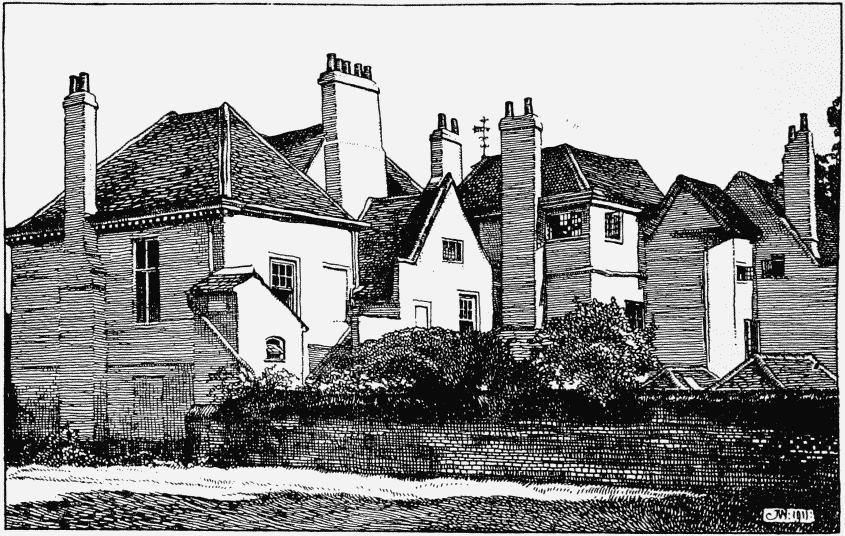
Stanstead Bury from the North-west
Rye
The manor of RYE may be identified with the half hide which was held in 1086 by Geoffrey de Bech. (fn. 70) There seems to be no further record of it until 1443, but doubtless it followed the descent of Thele in Hertford Hundred (q.v.), for in that year Sir Andrew Ogard had licence to inclose the site of his manor of Rye alias the Island of Rye and 50 acres of land, 10 acres of meadow, 80 acres of pasture and 16 acres of wood within the island, to make a park and have free warren, and to crenellate the house. (fn. 71) Sir Andrew Ogard was by birth a Dane, who received letters of denization in England in 1436. (fn. 72) He was a 'knight, chamberlain, and councillor' of John Duke of Bedford, the regent, (fn. 73) who granted him the keepership of the castle of Prudhoe in Northumberland and made him one of his executors. (fn. 74) Later he was appointed captain of the castle and town of Caen in Normandy. (fn. 75) He had estates in Norfolk and Hertfordshire, and acted several times as J.P., commissioner, &c., for the latter county. (fn. 76) According to a contemporary account the purchase of the manor of Rye cost £1,100; the building of the inner court with brick and of the rooms and inclosure (claustrum) cost 11,000 marks, whilst the granary and storehouse with 16 horses and 30 cows were worth 2,000 marks. It also relates that whilst in England Ogard had a chapel in his house with priests, clerks, and choristers. (fn. 77) Apparently his expenditure was on a lavish scale, and he is known to have been very rich when he died. This was in 1454, when his son Henry was four years old. (fn. 78) The custody of the heir was granted by Edward IV to Lawrence Bishop of London, (fn. 79) and in 1463 the manor was granted during the heir's minority to the king's brother, George Duke of Clarence. (fn. 80)
Henry Ogard bequeathed the manor of Rye to his son Andrew, (fn. 81) who died seised of it in 1526, leaving a son and heir George. (fn. 82) In 1559 George Ogard (of Ormesby, co. Norfolk) sold the manor to William Frankland of London, clothworker. (fn. 83) He settled it on himself and his intended wife Joyce Saxaye, whom he married in February 1565–6. (fn. 84) William died in 1576 (fn. 85) and Joyce in 1587. (fn. 86) A settlement had been made on William's eldest son William for life with reversion to Hugh Frankland, his nephew, for life, and then to the issue male of William. In 1606 Hugh Frankland conveyed his interest in the manor to William Frankland his nephew, William Frankland the elder having died without issue. (fn. 87) In 1619 William Frankland and Lucy his wife sold it to Sir Edward Baesh, together with the capital messuage where William Frankland lived, the farm close by, and fields called the Pond, Sayres Mead, Nunneholm, the Little or Hither Park and the Further Park. (fn. 88) The manor descended with Stanstead Abbots to the Feildes. Miss Feilde, who inherited the property, married Captain Upton, and soon afterwards the estate was broken up. Part of it, the Netherfield estate, was sold to Sir Charles Booth, bart., and descended to his niece, who married Mr. H. L. Prior. (fn. 89) The Rye House with 50 acres of land was sold about 1864 to Mr. William Henry Teale, and from him was acquired in 1904 by Messrs. Christie & Co. (fn. 90)
CHURCHES
St. Andrew
The church of ST. ANDREW, erected in 1881, superseded St. James's as the parish church; it is built of brick faced with dressed flint, and is a cruciform building in 15th-century style.
St. James
The old church of ST. JAMES, which is still used for services, consists of chancel as at present 10 ft. long by 17 ft. wide, north chapel 41 ft. 6 in. by 15 ft. 6 in., nave as at present 69 ft. by 17 ft. 6 in., west tower and timber south porch, all internal dimensions. The walls are chiefly of flint rubble, but parts are of brick with stone dressings; the roofs are tiled.
The earliest detail is of the 13th century, but it is probable that the nave walls are older. The chancel was built during that period and windows inserted in the nave. The west tower is of early 15th-century date, the south porch late in the same century, and the north chapel was built of brick in 1577. The original length of the nave was 47 ft., that of the chancel being 32 ft., but at some period, probably when the north chapel was built, they were altered to their present dimensions. There is no chancel arch or structural division between nave and chancel, and externally one unbroken roof covers both, the original chancel being marked internally by the lower part of the rood screen, now forming the back of a pew, and by the mouldings on the roof timbers.
The east window has three cinquefoiled lights under a four-centred arch, and is of late 15th-century date. In the north wall is an arcade of four bays opening into the north chapel. The three western arches belong to the arcade erected in 1577. They are pointed arches with double ogee mouldings and with octagonal piers and responds and moulded capitals and bases; the westernmost arch is narrower than the other two. The easternmost arch has a plain splay and square jambs, and probably was opened at a later date. The whole of the arcade is plastered. In the south wall are two windows of two lights; they are of 15th-century date, but most of the stonework is modern. There are traces of some 13th-century lancet windows in the wall. Near the east wall is a double piscina with two splayed lancet arches, and a ledge at the back which supported a credence shelf; they belong to the 13th century.
On a stone in the east wall of the north chapel, outside, is inscribed the date 1577; it was built by Edward Baesh. In the east wall is a window of three cinquefoiled lights under a four-centred arch, and in the north wall are two windows of two lights under square heads; all the windows have been restored.
There are no window openings in the north wall of the nave, but there are remains of a blocked north doorway. The wall is not in a straight line from chancel to tower, and appears to have been altered or rebuilt at some period—perhaps when the chancel was erected—in order to suit its width. In the south wall are three windows of two cinquefoiled lights with tracery; they are probably of 15th-century work, but most of the stonework has been renewed. The westernmost window appears to be a 13th-century lancet window enlarged in the 15th century; parts of the inner splays of the earlier window remain. The south doorway consists of two continuous splayed orders and is of 13th-century date.
The 15th-century south porch is of plain open timber work, the lower part of the sides is boarded, the upper part open; the gabled front has a cusped barge-board and the arch over the entrance is threecentred.
The roofs retain their 15th-century king-post trusses and tie-beams, but the rafters are plastered.
The west tower is in two stages, with angle buttresses at the west; the parapet is embattled and the wood spire is lead-covered. At the south-east angle a projecting octagonal stair-turret rises to above the parapet. The tower arch is of two moulded orders, the outer order continuous, the inner stopping upon shafted jambs with moulded capitals and bases. The west doorway is of two moulded orders, the inner one forming a pointed arch, the outer being carried square over it. The west window is of three cinquefoiled lights with tracery in the head. The belfry windows are of two lights.
The basin of the font is of 13th-century date; it is circular, and on the rim are the original iron staples for securing the cover; on the south-west side is a small incised cross. The base appears to be of 13th-century date, reversed, but the octagonal stem belongs to the 15th century.
The lower part of a 15th-century rood screen now forms the back of a pew in the nave. Under the tower arch is a screen made up from the 16th-century canopy formerly over the pulpit. (fn. 91)
The oak pulpit is of 16th-century work and the communion table of the late 17th century; the high plainly-panelled pews belong to the 18th century.
In the east window of the chapel are some remains of old glass with the royal arms of Elizabeth's time and the date 1573; in the north window are fragments of Baesh's arms with his motto 'Boulde in God' and other lettering. On the north and east walls are remains of painted inscriptions only partly legible.
In the chapel is the monument of Sir Edward Baesh, died 1587; he is represented in armour, his wife being opposite to him, both kneeling. Above them is a round-arched canopy flanked by classical columns supporting a cornice on which are his arms; below are the kneeling figures of his children.
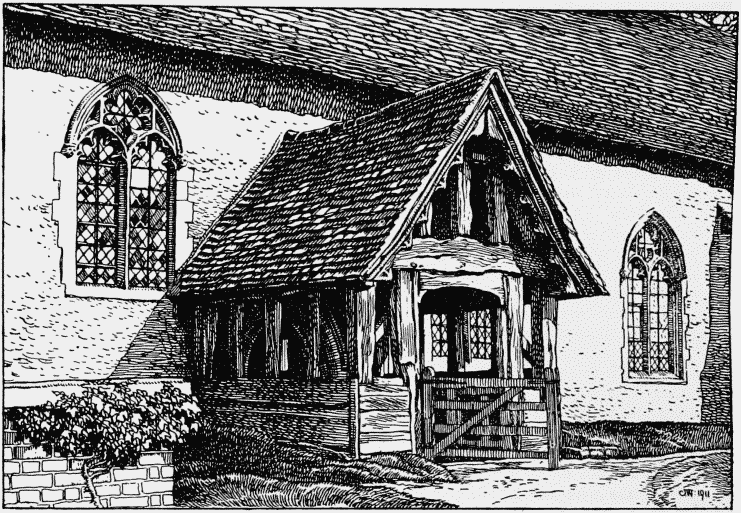
Stanstead Abbots Church: South Porch
On a slab against the south chancel wall is the brass of a knight in armour of late 15th-century date. On the chancel floor is the brass of William Saxaye, who died in 1581; he is represented in robes and with a ruff. On the nave floor near the pulpit is a small brass of a man and woman with their hands joined together; there is no inscription, but it is of the middle of the 16th century. On a large slab is a shield with the arms of Boteler, and on another a shield of arms not identified. In the churchyard near the porch is a mutilated coffin slab with remains of a cross.
There are three bells: the treble by John Briant, 1790; the second inscribed 'God save the King, 1617'; the tenor of 1605, both by Robert Oldfeild.
The communion plate consists of one cup and three patens, all of 1714.
The registers are in four books as follows: (i) baptisms 1695 to 1774, burials 1678 to 1774; (ii) marriages 1754 to 1772; (iii) baptisms and burials 1774 to 1812; (iv) marriages 1774 to 1812.
ADVOWSON
The advowson of the church of St. James was given by Roger de Wancy to the priory of Merton, co. Surrey. (fn. 92) The priory also held a carucate of land in right of the church, (fn. 93) which in 1291 was assessed at £20. (fn. 94) The church was appropriated and a vicarage ordained before the end of the 12th century. (fn. 95) The tithes were leased out by the priory, and after the Dissolution were granted for twenty-one years to John Carye. (fn. 96) In 1553 the rectory and advowson were granted to Thomas Sidney and Nicholas Halswell, (fn. 97) probably trustees for Edward Baesh. The advowson subsequently descended with the manor (fn. 98) (q.v.) until 1847, when it was purchased by W. K. Thomas, from whom it passed into the hands of trustees. (fn. 99)
CHARITIES
The charity of Sir Edward Baesh, founded by deed 10 November 1635, and by his will proved in P.C.C. 28 May 1653, consists of the vicarage-house and grounds containing 1 a. 33 p; land in Chapel Lane containing 11 p. 3 yds., producing £2 yearly; almshouses with 30 p. of land; also the Railway Hotel, let at £70 yearly; also property formerly described as 'a piece of meadow ground called the Pitansey Meadow alias Parentase,' now consisting of (a) gas works, cottages and land containing 2 a. 3 r. 23 p.; (b) maltings, private dwelling-house and pounds containing 2 a. 1 r. 31 p.; and (c) a meadow containing 3 a. 1 r. 7 p., the whole producing £43 yearly. Also a rent-charge of £25 issuing out of the manor of Stanstead Baesh; the block-house and yard containing 3 p. 5 yds., producing £7 16s. yearly, and land in Netherfield Lane containing 2 a. 1 r. 15 p., producing £3 yearly. The official trustees also hold the sum of £219 2s. 5d. consols, producing £5 9s. 4d. yearly, arising from sale of land and accumulations.
The vicarage-house and grounds and the land in Chapel Lane designated the ecclesiastical charity of Sir Edward Baesh is regulated by a scheme of the Charity Commissioners dated 3 June 1902. The vicarage-house is for the use of the vicar of Stanstead Abbots, subject to the payment of 12d. yearly to the non-ecclesiastical branch, and the yearly income derived from the land in Chapel Lane is applied towards the salary of the clerk to the parish church.
In 1908 the net income of the non-ecclesiastical branch was applied in payment of 7s. weekly to the six poor widows in the almshouses, and a premium of £9 8s. was paid for apprenticing a poor boy.
Sir Edward Baesh by the above-mentioned deed also gave a rent-charge of £20 out of the manor of Stanstead Baesh for a schoolmaster of a free grammar school in Stanstead. This sum is annually paid to the governors of Hertford Grammar School. (fn. 100)
In 1802 Randle Cheney gave a sum of £20 3 per cent. reduced annuities, now a like sum of consols in the name of the official trustees, producing 10s. yearly, the interest to be applied in the repair of the tomb in the churchyard of the testator's wife and any surplus to the poor.
The dividends are accumulated and distributed from time to time among the poor.