The Environs of London: Volume 2, County of Middlesex. Originally published by T Cadell and W Davies, London, 1795.
This free content was digitised by double rekeying. All rights reserved.
Daniel Lysons, 'Harrow on the Hill', in The Environs of London: Volume 2, County of Middlesex(London, 1795), British History Online https://www.british-history.ac.uk/london-environs/vol2/pp559-588 [accessed 30 April 2025].
Daniel Lysons, 'Harrow on the Hill', in The Environs of London: Volume 2, County of Middlesex(London, 1795), British History Online, accessed April 30, 2025, https://www.british-history.ac.uk/london-environs/vol2/pp559-588.
Daniel Lysons. "Harrow on the Hill". The Environs of London: Volume 2, County of Middlesex. (London, 1795), British History Online. Web. 30 April 2025. https://www.british-history.ac.uk/london-environs/vol2/pp559-588.
HARROW ON THE HILL.
Etymology.
In the most ancient records (fn. 1) which I have seen relating to this place, it is called Herges, a name derived, it is probable, from the Saxon word Hearge, Hergb,or Herige, which is sometimes translated a troop of soldiers, and sometimes a church. I am inclined to adopt the latter derivation, and to suppose that the church upon the hill (fn. 2) might have been before the Norman Conquest a prominent feature of this part of the county.
Harrow-hill.
Harrow-hill, standing as it were insulated and rising out of a rich vale to a very considerable eminence, affords a variety of beautiful prospects. The view towards the East is terminated by the metropolis; to the South by the Surrey hills; towards the North it is the least extensive, being intercepted by the high ground about Stanmore and Harrow-weald; on this side, the village of Stanmore and the Marquis of Abercorn's seat are the most conspicuous objects. The view towards the West and South-west, which is very extensive and beautiful, may be seen to the greatest advantage from the church-yard, whence the ground declines precipitately to Roxeth-common, where the scenery is very pleasing; the distant prospect takes in Windsor-castle, and a considerable part of the counties of Berks and Buckingham. On the brow of the hill, as you descend to Sudbury-common, is a small villa belonging to Thomas Orde, Esq. with a beautiful garden and shrubbery, which commands nearly the same prospect.
Situation and boundaries.
Extent.
Soil.
The town of Harrow, which had formerly a weekly market (fn. 3), now decayed, is situated at the distance of ten miles from Tyburn turnpike. The parish lies in the hundred of Goare, and is bounded on the North by Watford and Bushy in Hertfordshire; by Stanmore, Whitchurch, Kingsbury, and Wilsdon on the East and South-east; by Acton and Twyford on the South; and by Riselip, Greenford, and Northall on the West and South-west. It contains about 13,600 acres of land, of which 1600 are waste; the remainder is divided in nearly an equal proportion between arable and pasture. The soil, for the most part, is clay; in some places sand and brick-earth. This statement includes Pinner, which is not parochial, but an appendage to Harrow.
Land-tax.
This parish is charged the sum of 2254l. 10s. 0½d. to the landtax, which is assessed in the following proportions:
| Harrow division, | 721l. | 15s. | 2d. | raised at the rate of 2s. 2s. 11½ pound, anno 1792. |
| Weald, &c. | 382l. | 12s. | 8½d. | |
| Wembley, &c. | 529l. | 2s. | 2d. | |
| Pinner, | 621l. | 0s. | 0d. | at the rate of 3s. |
Hamlets.
The principal hamlets, &c. in this parish are Pinner, Roxey, or Roxeth, Wembley, Weald (fn. 4), Apperton, Kenton, and Preston.
Manor of Harrow.
The manor of Harrow belonged to the church of Canterbury a considerable time before the Norman Conquest, for it appears that in the year 822, Wilfred Archbishop of Canterbury purchased Herges and other lands, for the purpose of restoring them to that church, from which they had been taken by Kenulf King of the Mercians (fn. 5). Previously, however, to this restoration, he granted them for life to his relation Warherdus, one of the monks, who, by his will, bearing date 830, bequeathed them, in compliance with the Archbishop's directions, to the Convent, who, it appears, had consented to Wilfred's grant (fn. 6). Herges is said (in Warherdus's will) to contain 104 hides (fn. 7). The record of Doomsday says, it was taxed at 100 hides, both in Edward the Confessor's time and at the taking that survey. The land, adds the record, is 70 carucates; 30 hides belong to the demesnes, on which are four ploughs, and a fifth might be employed. Among the freeholders and villeins are 45 ploughs, and 16 more might be used. The priest has one hide, and three knights six hides; under them are seven tenants. Thirteen villeins hold half a hide each; 28 other villeins a virgate each, and 48 others half a virgate; 13 villeins four hides jointly; there are two cottars (fn. 8) of 13 acres, and two slaves; pasture for the cattle of the town; pannage for 2000 hogs: in the whole valued at 56l. per annum; in the Confessor's time at 60l. This manor was in the occupation of Earl Lewin when Edward the Confessor died. The record adds, that Geoffrey de Mandeville held two hides in the hundred of Elthorne under the Archbishop. The land was of one carucate, on which was one villein, the tenant, who employed one plough: there were also four cottars; pan nage for 20 hogs. This estate was valued at 12s. per ann.; in the Confessor's time at 14s. It had been occupied by Turbert, a servant of Earl Lewin, and could not be separated from the Archbishop's manor of Harrow.
Survey of Archbishop Arundell's manors.
In the year 1398, when Archbishop Arundell was condemned by the parliament for high-treason, and banished (fn. 9), an inquisition was taken of his estates. Among others it was found that he was possessed of the manor of Southbury in Harrow, consisting of 500 acres of land, valued at 3d. an acre; twenty-two acres of meadow, at 3s. amounting, with the services of the tenants, to 100s.; 12 other acres of meadow, worth only 10s.; rents of assize, 72l. 5s.; released services of the tenants, 15l.; 120 hens, valued at 20s. To this manor belonged the advowson of "Harewe at Hill."—The manor of Woodhall in Harrow, (a member of the former,) consisting of 120 acres of land, valued at 6d. an acre; 80 of pasture, at 3d.; nine of meadow, at 1s.; released services, 15l.—The manor of Heggeton in Harrow, (a member also of Southbury,) consisting of a well-built house, &c; 201 acres of land, valued at 6d. an acre; 32 acres of meadow, worth 21s.; rents of assize, 16s. 2d.; 33 hens, worth 2d. each; profits of court, 100s.; each cottager, a day's-work in every month, valued in the whole at 10s. (fn. 10)
Manors given by Archbishop Cranmer to the King, and granted by him to Lord North.
Manors of Harrow-town and Sudbury.
The manors here mentioned, with that of Harrow-town, were given by Archbishop Cranmer, anno 1543, to Henry VIII. in exchange for other lands (fn. 11). The King granted them, in the month of January 1546, to Sir Edward (afterwards Lord) North (fn. 12), who was at that time a great favourite, and in offices of considerable trust. Not long afterwards, the capricious monarch having con ceived some displeasure against him, he was summoned to court one day, in great haste, when the King, after looking at him for some time with much anger, said, "We are informed you have cheated "us of certain lands in Middlesex;" to which Sir Edward answering with an humble negative, "How was it then," said the King, "did we give those lands to you?" "Your Majesty was pleased so to do," replied Sir Edward. Whether the King's anger was appeased by the humility of his minister's behaviour, or whether he found upon reflection that he should have farther occasion for his services, it appears that he admitted the fact, and restored Sir Edward to his favour (fn. 13). These estates continued in the North family till the year 1630, when the manors of Harrow and Sudbury, with the advowson of the church, and rents of assize belonging to the manors of Woodhall, Hegeston, and Roxeth, were aliened by Dudley Lord North to Edmund Philips, George Pitt, and Rowland Pitt (fn. 14). They came afterwards to the Rushout family, by the intermarriage of James Rushout, Esq. (who was created a baronet in 1661,) with Alice, daughter of Edmund Pitt, Esq. (fn. 15) and they are now the property of Sir John Rushout, Bart.
Singular customs of the manor.
Lands within the manor of Sudbury descend as by the common law, except that in default of male issue or heirs, the eldest daughter, or the eldest of any female heirs in the same degree of consanguinity, inherits. A customary tenant, purchasing customary lands within the manor, pays no fine, nor does the heir at law of such tenant at his admission; but if lands are bequeathed to any other than the heir at law, a fine of alienation is paid (fn. 16). The tenants services due formerly in this manor, seem to have been commuted for certain sums of money called work-silver, which is frequently mentioned in the old survey (fn. 17).
Residence of the archbishops at Harrow.
The manor-house at Harrow was formerly the occasional residence of the archbishops of Canterbury. In the year 1170, Thomas a Becket, being about to visit Woodstock, for the purpose of paying his respects to the young Henry Plantagenet, then lately crowned, and associated with his father in the government of the kingdom, received a command, whilst he was on his journey thither, to forbear his visit, and repair immediately to his own diocese. The prelate obeyed, and at his return spent some days at his manor of Harrow, keeping great hospitality. During this time he received many civilities from the Abbot of the neighbouring monastery of St. Albans. Two of his own clergy, Nigellus de Sackville, who is called the usurping Rector of Harrow, and Robert de Broc, the Vicar, treated him with great disrespect, and maimed the horse which carried his provisions, for which they were both publicly excommunicated by the Archbishop on the ensuing Christmas-day at Canterbury. This happened a few days before Becket was murdered (fn. 18). Archbishop Boniface was at Harrow in 1250, and held a visitation there (fn. 19). Archbishop Winchelsey dates thence in 1300 (fn. 20).
Manor of Woodhall.
The manor of Woodhall (fn. 21) (which is in the Pinner division) was aliened by Dudley Lord North, anno 1630, to William Pennifather, Esq. (fn. 22), who, in 1637, conveyed it to William Wilkinson, Esq. (fn. 23) It was afterwards in the possession of his grandson and heir at law Henry Nevill, Esq. (fn. 24) and continued in that family till the year 1754, when an ejectment was brought against Dame Margaret Conyers, and her nephew Cosmos Henry Joseph Nevill, by the heir at law of Anthony Collins the surviving trustee of a settlement made by William Wilkinson in 1655. The estate was recovered and sold in 1760, pursuant to the directions of that settlement, to to Mr. John Lawes, who, in 1766, aliened it to John Drummond, Esq. It is now held in trust for his grandson George Drummond, a minor.
Manor of Heggeton, or Headstone.
The manor of Heggeton, or Hegeston, (now called Headstone,) was aliened by Dudley Lord North, anno 1630, to Simon Rewse (fn. 25). I can learn nothing farther relating to this estate, than that it is now the property of John Asgill Bucknall, Esq. whose ancestor, Sir William Bucknall, purchased it towards the close of the last century.
Residence of the Archbishops there.
The mansion belonging to this estate (which lies in the Pinner division of the parish) is surrounded by a moat. It was formerly the occasional residence of the Archbishops of Canterbury. Arundell dates from Hegeston, anno 1407 (fn. 26).
Manor of Wembley.
The manor or manor-farm of Wymbley, alias Wembley, belonged to the Priory of Kilbourn (fn. 27). After the dissolution of that convent, it was granted by Henry VIII. anno 1543, to Richard Andrews, and Leonard Chamberlayne (fn. 28), by whom it was conveyed the same year to Richard Page, Esq. (fn. 29), whose descendant, Richard Page, Esq. is the present proprietor.
Manor of Woxindon, or Uxendon.
The manor of Woxindon, now called Uxendon, in this parish, was formerly the property of the Travers family, from whom it passed to Sir Nicholas Brembre, about the year 1376 (fn. 30). Some years afterwards, in consequence of a judgment against this Sir Nicholas in parliament, it became forfeited to the crown, and was granted by King Richard, anno 1394, in consideration of the sum of 4.Cl. to Thomas Godelac, and Joan his wife (fn. 31). It seems probable that it passed from the family of Godelac to that of Bellamy, in consequence of an intermarriage (fn. 32); for it appears that the Bellamies of Uxendon, who were for many years proprietors of this and other large estates in Harrow (fn. 33), quartered the arms of Godelac (fn. 34).
Babington and his accomplices concealed by the Bellamies.
It is related in the chronicles, that Babington, who, with other conspirators, had laid a plot against Queen Elizabeth and the state, in the year 1586, when he found that the conspiracy was detected, being a very handsome man, disfigured his face with the juice of green walnuts, and wandered about in that disguise with his associates till they were half starved, in which condition they were received at Bellamy's house near Harrow, where they were at length discovered (fn. 35), and being brought to London, were executed with circumstances of unusual severity (fn. 36). Jerome Bellamy suffered death also for concealing them; his brother destroyed himself in prison. The manor of Uxendon was aliened by the Bellamies to the Page family in the early part of the last century, and is now the property of Richard Page, Esq. of Wembley.
Manor of Roxeth.
The lands of Hamon and Hugh de Rokesie are mentioned in the endowment of Harrow vicarage, about the year 1240 (fn. 37). In the year 1371, William Wittlesey, Archbishop of Canterbury, granted all the estates of William Roxethe, who had been outlawed for felony, (consisting of a capital messuage, 140 acres of land, 12 acres of meadow, 15 of wood, 5s. rents, four cocks, valued at 6d. and 40 hens, at 3s.) to Sir Nicholas Brembre and his wife Idonea, and their heirs; remainder to John de Berlyngham, Margaret his wife, and their heirs; remainder to Sir John de Stody; remainder to Thomas Allbon, citizen of London; remainder to the Archbishop and his successors (fn. 38). This estate seems to have reverted to the Archbishops, for it appears to have been amongst the lands possessed by the North family, and was aliened by Dudley Lord North, anno 1630, to John Hutchinson and others, being then called the manor of Roxeth, alias Roxside place (fn. 39). In 1677, it was aliened by John Hutchinson to Robert Nichols, Esq. Thomas Nichols died seised of it in 1705. It was conveyed in 1727, by the devisees under his will, (after a suit in the court of Chancery,) to Thomas Brian, Esq. Brian Taylor, Esq. in the year 1764, aliened it to the late Percival Hart, Esq. (fn. 40) whose widow now holds a third of it in dower; the remainder is the joint property of Emma, wife of David Garrick, Esq. (nephew of the celebrated David Garrick,) and Mary, relict of Charles Vaughan Blunt, Esq.
Manor of Flambards.
The manor or manor-farm of Flambards takes its name from Sir John Flambard, who had property in Harrow in the reign of Edward III. (fn. 41) William Gerard, Esq. died seised of this estate in 1609 (fn. 42), and it continued in that family for many generations, till it became the property of Elizabeth, only daughter of Sir Charles Gerard, Bart. who married, first Warwick Lake, Esq. secondly Miles Stapleton, Esq. Flambards was purchased, in the year 1767, of Sir Thomas Stapleton, Bart. Gerard Lake, Esq. and others, by Francis Herne, Esq. (fn. 43) and is now, under the will of his sister Mrs. Mary Herne, the property of Richard Page, Esq.
Priory of Bentley.
There was formerly a priory called Benethley or Bentley, situated at the extremity of this parish towards Stanmore. Very little is known of this monastery. Dugdale has nothing relating to it; Tanner merely mentions its existence, and speaks of its unfortunate end in the year 1258; but he has mistaken the fact, for it was a priorof this house who met with an untimely fate by being suffocated under a mow of corn (fn. 44). The priory appears to have existed till the suppression of the smaller monasteries in the early part of Henry VIII.'s reign, when, I suppose, its demesnes were granted to the monks of St. Gregory's at Canterbury; for it appears upon record, that Archbishop Cranmer, in the year 1543, gave to the King, in exchange for other lands, the latepriory of Bentley, with all lands, tenements, &c. thereunto belonging, in Harrow and Stanmore, being parcel of the possessions of St. Gregory's priory at Canterbury (fn. 45). The priory of Bentley, with the prioryhouse, and all profits, rents, &c. was granted by Henry VIII., in the year 1546, to Henry Needham and William Sacheverell (fn. 46), and was aliened by them the same year to Elizabeth Colte (fn. 47).
Manor of Bentley.
Marquis of Abercorn's seat.
In the year 1706, the manor or priory-farm of Bentley belonged to the family of Coghill, and was bequeathed, anno 1734, by Tho mas Coghill, Esq. to his nephew Thomas Whittewronge, who left it, in 1761, to John Bennet (fn. 48). Mr. Bennet sold it the next year to William Waller, Esq. who aliened it, about the year 1776, to Mr. James Duberly, of whom it was purchased, in 1788, by the Marquis of Abercorn, who has made very large additions to the dwelling-house, and converted it into a noble mansion, in which convenience is united with magnificence in a manner rarely to be met with. The house is furnished with a valuable collection of pictures by the old masters, and a few antique busts; that of Marcus Aurelius is much admired by connoisseurs. The dining-room is 40 feet by 30, the saloon and music-room each 50 feet by 30. In the latter are several portraits of the Hamilton family, viz. James, the second Earl of Arran, Regent of Scotland during the minority of Queen Mary, created Duke of Chattelherault by Henry II. of France; Claud Hamilton his son, a distinguished military character, and father of the first Earl of Abercorn; James Hamilton, (elder brother of Count Anthony Hamilton,) often mentioned in the Memoirs de Grammont; he was killed in a sea-fight, anno 1673; this picture, and that of his son James, who became Earl of Abercorn, are by Sir Godfrey Kneller; James, the seventh Earl; the late Earl, by Gainsborough; the Marquis, by Lawrence, (by whose hand are some excellent portraits of his Lordship's children in the saloon, and a whole-length of Sir William Hamilton's Lady in the dining-room,) and the Hon. Capt. Hamilton, the Marquis's father, by Sir Joshua Reynolds, being one of his earliest productions. In the saloon is placed the celebrated and very valuable picture of St. Jerome's dream, by Parmegiano. It belonged originally to a convent near Rome, and came some time ago into the hands of Mr. Durno of that city, of whom it was purchased for the Marquis by Sir William Hamilton.
The premises adjoining to the mansion consist of about 300 acres, 200 of which are inclosed and. surrounded with a shrubbery and plantations. The house stands on a very elevated spot, and commands a prospect of great extent, which is agreeably varied and broken by Harrow-hill, with its tust of trees and graceful spire, and some other eminences in the neighbourhood of Harrow and Stanmore.
Roman antiquities.
A few years ago, when Bentley priory was in the occupation of Mr. Duberly, a considerable quantity of gold Roman coins were found near the house, in digging for the foundation of a wall.
Parish-church, built by Archbishop Lanfranc.
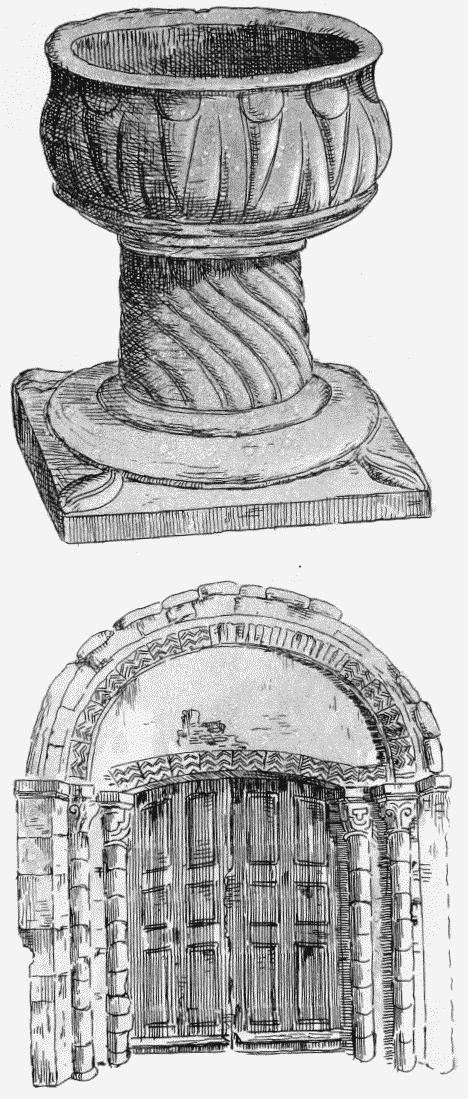
Font and west door of Harrow church
The parish-church, which is situated on the summit of the hill, consists of a nave, chancel, two aisles, and two transepts. At the West end is a lofty spire, covered with lead, which forms a very conspicuous object for many miles round (fn. 49). Eadmer tells us, that when Archbishop Anselm was preparing to consecrate the church of Harrow, built by his predecessor Lanfranc, (in the time of William the Conqueror,) upon one of his own manors, but within the diocese of London, the Bishop of that see claimed the right of consecration, upon which the matter was referred to Wulstan Bishop of Worcester, the only Saxon prelate then living, who decided in favour of the Archbishop (fn. 50). Some parts of Lanfranc's building still remain, viz. the circular columns which divide the aisles from the nave, and part of the tower at the west end, where is a Saxon arch of a singular form, as may be seen in the plate with the font. The church appears to have been rebuilt in or near the fourteenth century, being of the kind of architecture then in use. The nave. has a wooden roof, with carved ornaments. The brackets are supported by whole-length figures of the Apostles.
Tomb of Sir John Flambard.
On the South wall of the chancel is the monument of Anthony
Brucer, Esq. (fn. 51) aged 95, 1754. Within the rails of the communion-table are the tombs of Katherine Clerke, widow of Henry
Clerke, Esq. of Rislip, and daughter of Thomas Martin of Harrow, ob. 1613, æt. 84; Sir Samuel Garth (fn. 52), 1718; his lady, 1717.
In the chancel are also the following tombs,—that of Sir John
Flambard (fn. 53), (no date,) about the reign of Edward III.: it has
a figure in brass of the deceased, under a canopy, armed with a
helmet, mail-gorget, &c. a dog at his feet; beneath is the following inscription, in which the name of Flambard is divided in a singular manner:
"Jon me'do marmore numinis ordine Flam tumlat
Bard quoque verbere Stigis e fune[..] hic tueatur."
Various tombs and monuments.
The tomb of John Byrkhed, Rector of Harrow, who died anno 14 . . . Under a rich Gothic canopy is the effigies (in brass) of the deceased, in a priest's habit, ornamented with whole-length figures of the Apostles and Martyrs. Round the ledge is a multilated inscription, preserved entire in Weever (fn. 54). At the corner are the arms of Byrkhed (fn. 55), and of Archbishop Arundell (fn. 56).— The tomb of William Wightman, Esq. (fn. 57), who had lived 27 years in the rectory at Harrow, and died in 1579: there are figures in brass of himself, his wife, and five children; the tombs of John, son of Thomas Sonkey, Esq. of the county of Lancaster, 1603; William Horne, M. A. master of Harrow school, 1685; Leonard Henchman, citizen of London, 1759, æt. 89; and his daughters Judith and Sarah, 1770, and 1771. There are mutilated remains also in the chancel of some other brass plates.
John Lyon, founder of Harrow school.
In the nave are the tombs of Dorothy, wife of Anthony Frankyshe of Water Stothard, Bucks, and daughter of William Bellamy, Esq. of Uxendon, 1574; John Lyon, founder of Harrowschool, with a figure in brass of the deceased, (nearly covered with a pew,) and the following inscription:
"Heare lyeth buried the bodye of John Lyon late of Preston in this parish, yeoman, decdthe 11thday of Octrin the yeare of our Lord 1592, who hath founded a free grammar school in the parish, to have continuance for ever, and for maintenance thereof; and for releyffe of the poore, and of some poore schollers in the universityes, repairinge of highwayes, and other good and charitable uses, hath made conveyance of lands of good value to a corporation granted for that purpose.—Prayers be to the Author of all goodness, who make us myndful to follow his good example."
There are tombs also of Mrs. Sarah Furbar, 1755; Eusebius Withers, Gent. of Northend in Fulham, 1759; James Cox, D. D. 20 years head-master of Harrow-school, 1759; Margaret his wife, eldest daughter of the Rev. Thomas Brian, 1788, aged 95; Jane, wife of Thomas Moore, Esq. 1768; Thomas Lawrence, 1780; and Charles, son of Charles Bathurst of Fleet-street, 1763.
On the North wall of the North transept is the monument of William Gerard, Esq. (fn. 58), who died in 1584; and on the East wall that of William Gerard, Esq. (fn. 59), who died in 1609. Within a pew in this transept stands a sarcophagus to the memory of John Page, Esq. of Uxendon (fn. 60), 1667. On the floor is the tomb of Thomas Downer, Esq. 1502.
Dr. Sumner's epitaph.
In the South transept is the tomb of Richard Colvile (fn. 61), Esq. of Newton in the Isle of Ely, 1723; and that of Dr. Sumner (fn. 62), with the following inscription, written by the classical pen of Dr. Parr, who is a native of Harrow: "H. S. E. Robertus Sumner, S. T. P. "Col. Regal. apud Cantab. olim Socius; Scholæ Harroviensis haud ita pridem Archididasculus. Fuit huic prœstantissimo viro ingenium naturâ peracre, optimarum disciplinis artium sedulò excultum, usu diuturno confirmatum et quoddammodo subactum. Nemo enim aut in reconditis sapientiæ studiis illo subtilior extitit aut humanioribus literis limatior, nemini feré vel felicius contigit judicii acumen, vel uberior eruditionis copia. Egregiis hisce cum dotibus naturæ, tum doctrinæ subsidiis, insuper accedebant in scriptis vera, & propé perfecta eloquentia, in sermone sacetiarum lepor plané Atticus, et gravitati suaviter aspersa urbanitas, in moribus singularis quædam integritas & sides, vitæ denique ratio constans sibi et ad virtutis normam diligenter severéque exacta; omnibus qui vel amico essent eo vel magistro usi, doctrinæ, ingenii, virtutis triste reliquit desiderium, subitâ eheu! atque immaturâ morte correptus Prid. Id. Septemb. Anno Dom. 1771, Æt. suæ 41."
In the North aisle are the tombs of Mrs. Sarah Butler, 1718; and John Partridge, Gent. 1760.
In the South aisle are the monuments of Sir Edward Waldo (fn. 63), Knt. 1707; Thomas Graham (fn. 64), Apothecary to Geo. I. and Geo. II. and Apothecary-general to the army 1733; Daniel Graham, Esq. (fn. 65) one of the Governors of Harrow-school, 1778; Henrietta Malthus (no date); and Thomas Ryves, Esq. F. R. A. S. 1788. On the floor are the tombs of John Page, Gent. 1715; Penelope, daughter of William Plowden, Esq. and wife 1st of North Foley, Esq. 2dly of Colin Whitworth of Staffordshire, Esq. 1778. Under the gallery, at the West end of the church, are the tombs of Robert Lawes, Apothecary, 1732; Joan, daughter of John Wheeler, and relict of Henry Kellat, Esq. 1771; and the Rev. Francis Saunders, A. M. 49 years Vicar, 1776.
Tombs in the church-yard.
In the church-yard are the tombs of Martha, wife of William Greenhill, Gent. (1658); John Page of Wembley, who lived to fee 75 children and grandchildren (1623); Richard Smelt of Yorkshire (1701); Rev. John Hooker, M. A. (1722); Sarah, wife of John Henshaw (1726); John Highlord, Esq. (1726); Rev. Thomas Brian, 39 years master of Harrow-school (1730); James Waldo, Esq. (1756); Thomas. Thackeray, D. D. master of Harrow school (1760); John Ballinger (1774); Lieut. Gen. Edward Urmston (1778); John Hodsdon, Esq. (1780); John Peachey, Esq. of the island of St. Christopher's (1780); and Charles Waldo, Esq. (1790).
Sir John Boys, by his will, dated 1447, directed his body to be buried in Harrow-church (fn. 66).
Rectory and vicarage.
The parish-church of Harrow, which is dedicated to St. Mary, had formerly a rector and a vicar. The rectory was a sinecure, in the gift of the Archbishop of Canterbury; the rector presented to the vicarage (fn. 67). After Archbishop Cranmer had aliened all his estates in Harrow to the King, the advowson of the vicarage was granted, with the manor, to Sir Edward North, and is still annexed to it; the impropriation of the great tithes was given to Christchurch College in Oxford. The Gerards were formerly lessees under the college, afterwards the Conyers's, and the Hernes; the lease is now (under the will of the late Mrs. Mary Herne) vested in Richard Page, Esq. of Wembley.
Endowment of the vicarage.
The church of Harrow was rated at 60 marks, anno 1327 (fn. 68), the vicarage at 10 marks. The latter was endowed by St. Edmund Archbishop of Canterbury, (who died anno 1242,) with all the small tithes and the tithe of hay on the lands of Hamon and Hugh de Rokesee and Ailwin, and William de la Hegge (fn. 69). The latter I suppose to be the manor of Heggeton,' (now called Headstone,) the tithe-hay of which is said in the parliamentary surveys to belong to the vicarage (fn. 70). In 1650, the vicarage was valued at 50l. per ann. (fn. 71) It is in the peculiar jurisdiction of the Archbishop of Canterbury, being reckoned among the parishes belonging to the Deanery of Croydon in Surrey.
Tokynton chapel.
There were formerly two chapels of case in this parish, Pinner, (which still remains, and will be treated of hereafter,) and Tokynton, long since destroyed. In the Chantry-roll at the Augmenta tion-office, dated 1 Edw. VI. is the following account of this chapel,—" A free chapell, distant two miles from the church, (near "Wembley,) whereunto belongeth certain lands and tenements; by whom, how long time past, or to what use the said chapel was founded, the parson and churchwardens know not, but time out of man's mind hath been belonging and as a member taken of the parish-church of Harrow, untill about two years past, one John Fynch entered, and ever since has occupied the same, by the grant of one William Lighte, that affirmeth he hath purchased it, so that they meddle not with it; which chapel, with the lands thereof, is worth yearly 6l." There was a chantry in this chapel, to which John Fornese was presented, anno 1419, by Matilda Barneld, widow, on the death of William Freeman the last chaplain (fn. 72). The site of Tokynton chapel, with the lands thereto belonging, having been in the tenure of Richard Read, (under a lease from Queen Elizabeth (fn. 73),) were granted, anno 1607, to Sir William Herricke, and Arthur Ingram, Esq. (fn. 74), who aliened them the same year to John Page, Esq. (fn. 75), ancestor of Richard Page, Esq. the present proprietor.
Cuthbert Tunstall and Prior Bolton, Rectors.
Cuthbert Tunstall, afterwards Bishop of London, was Rector of Harrow from 1511 to 1522 (fn. 76). His successor was William Bolton Prior of St. Bartholomew, of whom a story is told in some of the chronicles, that he built a house at this place, as being the highest ground in the country, for the purpose of retiring thither during a flood which was expected to happen in the year 1524. This story, however, does not gain credit among other historians (fn. 77), and the reporters of it do not seem to have been aware, that Prior Bolton, who was a great builder, had the rectory of Harrow as early as 1522, and was very likely to rebuild the parsonage-house, whether a flood was prognosticated or not.
The present Vicar is the Rev. Walter Williams, M. A. presented in 1777.
Chantry in Harrow-church.
William de Bosco, Rector of Harrow, in the year 1324, founded a chantry, dedicated to the Virgin Mary, and endowed it with 101 acres of arable land, five and a half of meadow, and 4s. 4½d. rents (fn. 78). The Chaplain was to say mass daily for the Archbishop of Canterbury, the Rector and other ministers of Harrow, and all the parishioners living and dead. The lands belonging to this chantry, (being situated for the most part at Kynton or Kenton,) together with the chantry-house at Hatchend, were granted, anno 1548, to William Gyes and Michael Puresoy (fn. 79).
Parish register.
The earliest date of the parish register is 1653.
Comparative state of population.
| Average of Baptisms. | Average of Burials. | |
| 1680–9 | 474/5 | |
| 1730–9 | 523/5 | 603/5 |
| 1780–4 | 544/5 | 581/5 |
| 1784–9 | 602/5 | 541/5 |
| 1790 | 68 | 53 |
| 1791 | 66 | 49 |
| 1792 | 55 | 49 |
| 1793 | 53 | 56 |
The present number of houses in Harrow and its hamlets is about 400, of which one-third are in Pinner.
Extracts from the Register.
Sir Gilbert Gerard.
Family of Gerard.
"The Right Worshipful SrGelbert Gerard, Knight and Baronet, buried Jan. 20, 1669-70." Sir Gilbert was son of William Gerard, Esq. Clerk of the Council of the Duchy of Lancaster, (an hereditary office in the family,) and grandson of William Gerard, who settled at Flambards, being the son of Thomas Gerard, Esq. of Lancashire. Sir Gilbert was created a Baronet in 1620. He was member for the county of Middlesex in the two last parliaments of James I. and during a great part of King Charles's reign. During the civil war he attached himself to the parliament (fn. 80), who, in recompence for his services, appointed him to many lucrative places; Cromwell made him one of the Lords of his upper house (fn. 81). Mary, wife of Sir Gilbert Gerard, (and daughter of Sir Francis Barrington,) was buried at Harrow, May 4, 1666. The title of Baronet was inherited by Sir Gilbert's eldest son Francis. Sir Gilbert Gerard, Knt. a younger son, was buried at Harrow, Nov. 5, 1683. Sir Francis Gerard left three sons, Charles, Francis, and Cheeke, who successively inherited the title. Sir Charles died in 1701, leaving issue by his wife Honora, (daughter of Charles Lord Seymour of Troubridge, and sister of Francis and Charles, successively Dukes of Somerset,) an only daughter Mary, married to Warwick Lake, Esq. of Cannons (fn. 82). Lady Honor Gerard was buried at Harrow, May 10, 1731. Sir Francis Gerard the younger was buried Sept. 1, 1704. He left issue two daughters, the elder of whom married—Lethieullier, Esq.; the younger, Isabella, married first, Sir John Fryer, 2dly, Lord Viscount Palmerston (fn. 83). Sir Cheeke Gerard, in whom the title became extinct, was baptized at Harrow, July 2, 1662, and buried there, March 9, 1715–16.
Bynion, Knt.
"Ealse, the wife of Sir George Bynion, was buried April 21, 1659."
Nicolls of the Hermitage.
"Aug. the 4thday, was baptized, the son of Mr. Thomas Nicoll of the Hermitage (fn. 84), Mr. Thomas Nicoll, Mr. Thomas Smyth, his two great-grandfathers, being godfathers, (a third great-grandfather being alive, Mr. Gee of Isleworth,) Mrs. Nicoll, his grandmother, being godmother, 1686."
Pym, Bart.
"SrCharles Pym, buried May 8, 1688." He was created a Baronet in 1663. The title is now extinct. "Dame Catherine Pym of Beakbourn in Kent, was buried Nov. 29, 1705."
Waldo, Knt. Lady Hunsdon.
"SrEdward Waldo, Knt. was buried, Feb. 13, 1707-8." His daughter Grace, wife, first of Sir Nicholas Wolstonholme, Bart. and 2dly, of William Ferdinando Carey Lord Hunsdon, was buried at Harrow, May 15, 1729. She resided at Pinner.
Sir Samuel Garth.
"Sr Samuel Garth was buried Jan. 22, 1718–9." An eminent Physician, the well-known author of the Dispensary, a translation of Ovid, &c. Martha, Lady Garth, was buried in May 1717. In Hay's Religio Philosophi (fn. 85), the circumstance of Sir Samuel Garth's ordering a vault to be made for himself and his lady in Harrow church, is spoken of as the result of some accidental whim.
"The Honble SrJohn Rushout of Northwick in the county of Worcester, Bart. and the RtHonourable the Lady Anne Compton, married by license, Oct. 16, 1729." Sir John Rushout was father of the present Baronet; Lady Anne was fourth daughter of George Earl of Northampton.
William Page.
William Page, author of a treatise in justification of bowing at the name of Jesus, and other theological and controversial tracts, is said to have been born at Harrow. He was Rector of East Locking in Berkshire, and Master of the school at Reading, from which he was sequestered in 1644, but held the living till his death, which happened in 1663 (fn. 86).
Sir Arthur Atye.
Sir Arthur Atye, public orator of the university of Oxford, and Secretary to the Earl of Essex, is said to have been buried at Harrow in 1604 (fn. 87).
Harrow-school.
Statutes.
The free-school at Harrow, which now ranks among the first public seminaries in the kingdom, and gives this place its principal celebrity, was founded in the reign of Queen Elizabeth, by John Lyon, a wealthy yeoman of Preston, who had previously, for many years, appropriated 20 marks per ann. to teaching poor children. In the year 1590, two years before his death, he drew up a set of statutes for the school, with full instructions for the disposal of the estates which he intended to appropriate to various charitable uses. In these papers he mentions his intention of building a schoolhouse, with habitations for the master and usher, and directs the sum of 300l. to be expended for that purpose within three years after his decease, provided he should die without having completed this intention. The statutes for the school are drawn up with much attention and precision, the number of forms are specified; the books and exercises for each form are chalked out; the mode of correction settled, the hours of attending school; the vacations and play-days, and the nature of the scholars amusements, which are confined to "driving a top, tossing a hand-ball, running, and "shooting." The last-mentioned diversion was in a manner insisted upon by the founder, who requires all parents to furnish their children with "bowstrings, shafts and bresters, to exercise shooting." It was customary, till within the last thirty years, for the scholars of Harrow to have a public exhibition of archery annually on the fourth of August, when they shot for a silver arrow. Since this custom has been laid aside, public speeches have been substituted in its room. The founder directs that a competent number of poor scholars shall be educated freely, but allows the Master to take other children for his profit, without any other limitation than the discretion of the governors; he adds a singular clause, that the master shall not receive any girls into the school. The sum of 20l. was allotted for the support of four exhibitioners, two in Gonville and Caius College at Cambridge, the others in any college at Oxford. In choosing the exhibitioners, the preference is to be given to his own kin, to natives of Harrow, and such as are "most mete for towardnesse, poverty, or painfulness." These exhibitions, which are held for eight years, have been raised in consequence of the improved value of the estates to 20l. per ann. each. The Governors were to be six in number, to have a common seal, to superintend the management of the founder's estates, to elect the schoolmaster and usher, the surveyors, &c.; and, jointly with the master, to make any discretionary alterations for the advantage of the school. The schoolmaster's salary was fixed at 20l. per ann. the usher's at 10l. The present Governors are, the Earl of Clarendon, Lord Grimston, Sir John Rushout, Bart. John Asgill Bucknall, Esq. Richard Page, Esq. and the Rev. Walter Williams, M. A. The present master is Joseph Drury, D. D. The second master, or usher, the Rev. Mark Drury, M. A. The reputation of Harrow-school was raised to a great height by Dr. Thackeray and Dr. Sumner, particularly the latter, who was an excellent classical scholar, and celebrated for the elegance of his Latin compositions; under him many of the present nobility, and some of the most distinguished characters of the age for genius and learning (fn. 88), received their education. The school still keeps its reputation and its numbers, which are usually upon an average about 150.
Lyon's charities.
Sermons.
Pensions.
Repairing roads.
Mr. Lyon directed the sum of 10l. per ann. to be paid out of his estates, for 30 good learned sermons preached in the church of Harrow; the schoolmaster or Vicar, if thought a mete man by the governors, to have the preference. The sum of 20l. per ann. was directed to be distributed among poor householders of this parish on Good-Friday, in portions of 6s. 8d. each. Pinner was originally excluded from the benefit of this charity, but its inhabitants might be admitted to partake of it at the discretion of the governors. The rents and profits of certain lands were directed to be expended in repairing the roads from Edgeware and Harrow to London; from Goare-lane to Hyde-house, and between Preston and Deadman's-Hill.
Rent of Lyon's estates.
The present rent of Lyon's estates amounts to 669l. which is expended by the governors in paying the masters' salaries and the exhibitions, educating poor children, relieving decayed housekeepers, repairing roads, &c. &c.
Various benefactions.
Mrs. Katherine Clerke, who died anno 1613, gave 12l. per ann. for ever to be distributed among twelve poor persons, half of whom are to be inhabitants of Harrow-town, the other half of Roxeth. Mrs. Barbara Burnet, Lady of the manor of Stanmore, anno 1631, gave money to buy safeguards once in three years for two poor women living in the hamlet of Weald. Mr. William Dwight, in 1637, gave 40s. per ann. out of his lands at Sudbury to the poor. Sir Gilbert Gerard, by his will, bearing date 1669, gave 100l towards raising a stock to set the poor to work. Edward Robinson, citizen of London, anno 1711, gave a rent-charge of 10l. per ann. out of his field called Dunnings, to clothe and educate 12 poor children in the hamlet of Weald. Henry Birch, citizen of London, anno 1793, gave the sum of 200l. 3 per cent. to the hamlet of Wembley, where he was born.
Infirmary.
In the year 1773, a small infirmary was built on Sudbury common, at the joint expence of John Hodsdon and Samuel Greenhill, Gents. for such poor persons as should be afflicted with infectious sickness, or labour under dangerous accidents.
Pinner.
Market.
The hamlet of Pinner is situated at the distance of about three miles from Harrow-town; though not parochial, it had once a weekly market (fn. 89), long since disused.
Pinner park.
Pinner park was included in the grant to Sir Edward North, and was aliened by Dudley Lord North, anno 1630, to John Hutchinson, Esq. (fn. 90) It has long been converted into tillage, and forms a considerable farm, which is now the property of St. Thomas's Hospital, having been purchased by the governors of that institution in the year 1731 (fn. 91).
Nicholas, Abbot of Westminster was made Keeper of Pinner park in the year 1383 (fn. 92).
Chapel.
The building of Pinner chapel was completed in the year 1321, when it was dedicated to St. John the Baptist (fn. 93). It is a large structure, built for the most part with flints, and consisting of a nave, chancel, two aisles, and two transepts. The nave is separated from the aisles by octagonal pillars, and pointed arches. At the west end is a square tower of stone and flints, embattled. Some of the windows are lancet-shaped, and consist of three compartments, with circular pillars, others are of the later Gothic. In the east window of the chancel are some remains of painted glass, among which is a coat of arms (Az. a pelican, Or).
Day's tomb.
On the north wall is a tablet of black marble, on which is engraved the effigies (in profile) of the deceased, to the memory of
John Day, minister of Pinner (fn. 94), who died anno 1622. Beneath
are the following lines:
"This pourtraiture presents him to thy sight,
Who was a burning and a shining light;
But now consumed to ashes, here he lies,
That spent himself to lighten others eyes.
His land to the church (fn. 95), his name with men remains,
The earth his corpse, but heaven his soul contains."
Various tombs and monuments.
On the same wall is the monument of Thomas Hutchinson, Esq. (fn. 96) 1656; on the north wall those of Christopher Clitherow, Esq. (fn. 97) 1685; Rebecca, wife of Samuel Clarke, Esq. (fn. 98) 1739, and Mr. Edmund Aubery (fn. 99), 1748. In the chancel are flat stones to the memory of Richard Edlyn of Woodhall, 1618; Henry Edlyn, 1627; William Wilkinson, Esq. of Woodhall, 1658; Thomas Clitherow, Esq. 1681; John Hawtrey, Esq. 1682; Randall Page, 1682; Mr. John Page, 1689; Anne, wife of Mr. Stephen Walls, 1685; Sir Bartholomew Shower, Knt. 1701; and John Clifford, 1721. On a south pillar of the nave is the monument of Mr. Richard Budworth, 1791; on the floor is the tomb of Catherine Otway, 1744. On the east wall of the north transept is the monument of Anne, wife of James Lightbourn, Esq. (fn. 100), Master in Chancery, 1743; on the floor a brass plate in memory of Anne, the infant daughter of Eustace Bedingfield, Gent. 1580; and the tomb of Charles Palmer, Esq. 1777. On the west wall of the north transept is the monument of Francis Bolton, Esq. (fn. 101), officer in the Welsh Fuzileers, who died anno 1746. In the north aisle are some remains of painted glass, among which is a figure of Elizabeth, mother of John the Baptist. On the outside of the church is a monument to the memory of Richard Nutcher, 1712, and others of his family. In the church-yard are the tombs of Joseph Downer (1675); William Harvest, Gent. (1766); Miss Felicia Harvest (1772); William Skenelsby, aged 118 (1775); and Mr. William Bellamy (1784).
Curacy.
Pinner chapel is a perpetual curacy, in the patronage of the vicar of Harrow, who allows the curate 8l. per ann. out of the small tithes. In 1650, it was reported to the commissioners appointed to inquire into the state of ecclesiastical benefices, that 60l. per ann. had of late been allowed to the curate of Pinner. The commissioners thought it convenient that Pinner chapel should be made a parish-church (fn. 102), but it does not appear that it ever took place. This curacy has been twice augmented by Queen Anne's bounty, during the incumbency of the present minister. It has been endowed also with the following benefactions. Francis Tyndall, anno 1631, gave a close called Willat-street, alias Howlis, to the preaching minister at this place. Mr. William Norrington, in 1705, gave 100l. to be laid out in the purchase of a house for the minister. Sir Thomas Franklin, by his will, anno 1728, gave an annuity of 4l. to the minister, being a rent-charge on his house and lands at Rislip. In the year 1731, two common field lands were purchased for the minister, with money arising from the sale of timber on Willat-Close. The present curate is the Reverend Walter Williams, M. A. who is vicar also of Harrow. He was appointed to the cure of this chapel in 1764.
There is a small meeting-house at Pinner belonging to the Independents.
Register.
The earliest date of the register of baptisms and burials at Pinner is 1656.
Comparative state of population.
| Average of Baptisms. | Average of Burials. | |
| 1680–9 | 22 3/10 | |
| 1730–9 | 15 9/10 | 20 3/10 |
| 1780–4 | 202/5 | 261/5 |
| 1784–9 | 283/5 | 172/5 |
| 1790 | 23 | 29 |
| 1791 | 29 | 30 |
| 1792 | 32 | 21 |
| 1793 | 21 | 17 |
The number of houses in Pinner is about 130.
Extracts from the Register.
Sir Bartholomew Shower.
"SrBartholomew Shower, Knt. buried December 12, 1701." He was third son of Mr. William Shower of Exeter, and brother of John Shower, an eminent dissenting minister, whose life was published by W. Tong, anno 1716. Sir Bartholomew was a very eminent lawyer. He published reports, a volume of cases in parliament, and some political tracts. His residence was at Pinnerhill, which had been the seat of Sir Christopher Clitherow.
Remarkable instance of longevity.
William Skenelsby, aged 118, buried Nov. 10, 1775. This extraordinary old man was for many years a servant in Lord Henry Beauclerk's family. He retired from service in the year 1769, but retained his intellects, together with a wonderful share of activity, and a countenance by no means indicating such extreme old age, till a short time before his death. The manner in which he calculated his age, was by the following epitome of his life:
Throwing at cocks.
The cruel custom of throwing at cocks was formerly made a matter of public celebrity at this place, as appears by an ancient account of receipts and expenditures in the hamlet of Pinner. The money collected at this sport was applied in aid of the poor's-rates.
| "1622—Received for cocks at Shrovetide, | 12s. | 0d. |
| 1628—Received for cocks in towne, | 19s. | 10d. |
| "—out of towne, | 0s. | 6d." |
This custom appears to have been continued as late as the year 1680.
Benefactions.
Dame Mary Franklin, in 1735, gave the interest of 50l. to be distributed in bread among the poor of the established church. Mrs. Goditha Martin, anno 1763, gave the interest of 100l. Old S. S. annuities, for the purpose of teaching poor children to read. Mrs. Elizabeth Deering, in 1781, gave the interest of 100l. 3 per cent, to be divided among 10 poor widows, being frequent attendants at the sacrament.